




Abstract
Background
Rates of firearm violence (FV) surged during the COVID-19 pandemic. However, there is a paucity of data regarding older adults (OAs) (≥65 years old). This study aimed to evaluate patterns of FV against OAs before and after the COVID-19 pandemic, hypothesizing decreased firearm incidents, injuries, and deaths for OAs due to restricted social movement.
Methods
Retrospective (2016-2021) data for OAs were obtained from the Gun Violence Archive. The rate of FV was weighted per 10,000 OAs using annual population data from the United States Census Bureau. Mann-Whitney U tests were performed to compare annual firearm incidence rates, number of OAs killed, and number of OAs injured from 2016-2020 to 2021.
Results
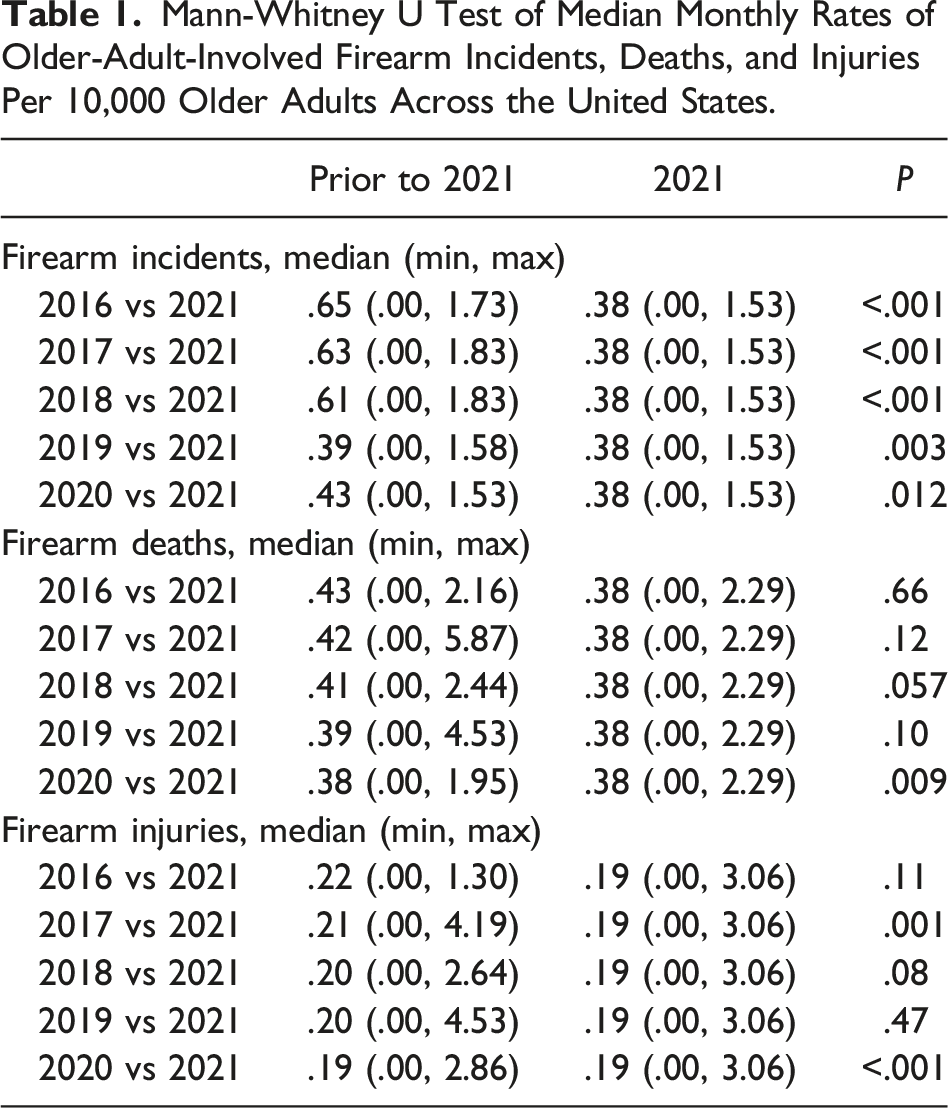
From 944 OA-involved shootings, 842 died in 2021. The median total firearm incidents per month per 10,000 OAs decreased in 2021 vs 2016 (.65 vs .38, P < .001), 2017 (.63 vs .38, P < .001), 2018 (.61 vs .38, P < .001), 2019 (.39 vs .38, P = .003), and 2020 (.43 vs .38, P = .012). However, there was an increased median number of OAs killed in 2021 vs 2020 (.38 vs .38, P = .009), but no difference from 2016-2019 vs 2021 (all P > .05). The median number of firearm injuries decreased from 2017 to 2021 (.21 vs .19, P = .001) and 2020 to 2021 (.19 vs .19 P < .001).
Discussion
Firearm incidents involving OAs decreased in 2021 compared to pre-pandemic years; however, there was a slight increase in deaths compared to 2020. This may reflect increased social isolation; however, future research is needed to understand why this occurred.
Key Takeaways
In contrast to previous findings demonstrating increased overall U.S. firearm violence during the COVID-19 pandemic, shooting incidents involving older adults decreased in 2021 compared to pre-pandemic years; however, there was a slight increase in the rate of older adult firearm deaths in 2021 compared to 2020. This may reflect increased social isolation leading to fewer incidents but increased lethality; future research is needed to definitively determine why older adult deaths did not decrease in this setting. From 2016 to 2021, states with weaker gun laws had higher rates of older-adult-involved firearm incidents, injuries, and deaths compared to states with stronger gun laws.
Introduction
The novel coronavirus disease (COVID-19) pandemic has become one of the most devastating public health crises in modern history, resulting in millions of deaths worldwide and major disruptions in public health infrastructure. In the United States (US) alone, to date there have been over 100 million COVID-19 cases and 1.1 million deaths. Of those deaths, approximately 75% are represented by older adults, defined as age 65 and older. 1 Moreover, this population was an estimated 60 times more likely to die of COVID-19 compared to younger patients. 1 To reduce viral transmission, public health measures including universal masking, physical distancing, and stay-at-home orders were implemented. While these measures were effective in reducing spread of the virus, associated ramifications including increased unemployment and social isolation impacted many aspects of everyday life. This disproportionately affected vulnerable populations, including older adults. Due to fear of an increased risk for death, this population may have practiced more stringent social distancing and self-isolation precautions. 2
Meanwhile, there was also a spike in acquisition of firearms during the initial months of the pandemic. 3 This is compounded by the fact that already approximately 30% of older adults have a firearm in their home. 2 Additionally, there was a well-described increase in firearm violence in the generalized adult population4,5 as well as varying investigations into firearm trauma reported in subsets of populations, such as children and adolescents.6–8
However, there is a paucity of data regarding the impact of the pandemic on firearm violence in the older adult population who are susceptible to firearm injuries and deaths, especially related to suicide.2,9 Therefore, this study sought to evaluate the impact of COVID-19 on firearm violence in the older adult population, hypothesizing that due to increased social distancing, there would be a decrease in total number of firearm incidents, injuries, and deaths in older adults in 2021 compared to 2016-2020.
Furthermore, due to the potential relationship between firearm legislation and firearm violence, this study also sought to evaluate the effect of gun law strength on firearm violence in the older adult population from 2016 to 2021, hypothesizing fewer firearm incidents, deaths, and injuries in states with stronger gun laws compared to those with weaker gun laws.
Methods
This study was deemed exempt by the institutional review board at University of California, Irvine and a waiver of consent was granted, as it utilized a deidentified national database. Retrospective firearm violence data were obtained from the Gun Violence Archive (GVA). This is an independent online database that collects data regarding firearm violence incidents in the US from over 7,500 law enforcement, media, government, and commercial sources. Data from this archive is publicly available and can be accessed using automated internet queries. Incidents from January 1st, 2016 to December 31st, 2021 involving older adults (age 65 and older) were included. The primary outcome was number of older-adult-involved firearm incidents, with secondary outcomes being the number of individuals killed and number of individuals who sustained non-fatal injuries.
To adjust for changes in population size over time, the rate of firearm violence was weighted per 10,000 older adults using annual population data from the United States Census Bureau. Mann-Whitney U tests were performed to compare the total annual firearm incidence rates, number of older adults killed, and number of older adults injured from January 2021 to December 2021, to the same time period in each year between 2016 and 2020.
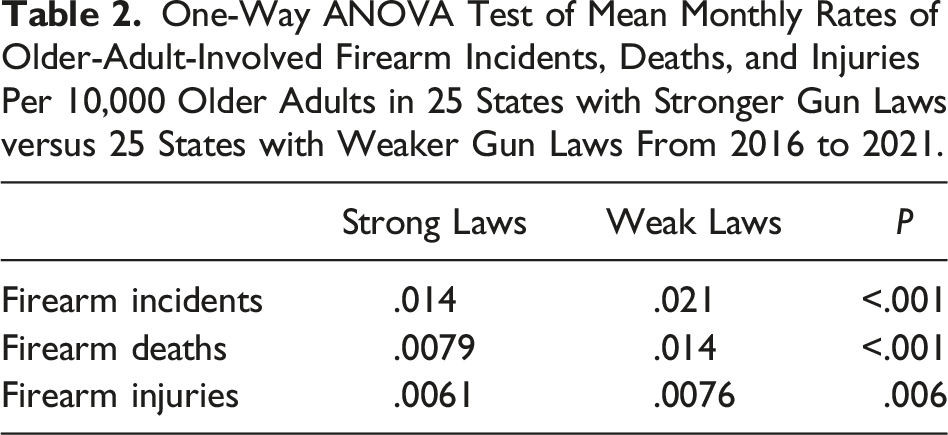
To assess the relationship between gun law strength and firearm violence in the United States, rankings of gun law strength by state were sourced from The Giffords Law Center Annual Gun Law Scorecard. 10 A comparison was made between the 25 states with stronger gun laws and the 25 states with weaker gun laws. Data obtained from the GVA was weighted per 10 000 older adults in each of the two groups (strong gun law states and weak gun law states). One-way ANOVA tests were conducted to compare firearm incidents, injuries, and deaths between states with stronger gun laws and those with weaker gun laws from 2016 to 2021.
For all analyses, a P-value <.05 was considered statistically significant. Analyses were performed using IBM SPSS Statistics, version 26 (IBM Corp., Armonk, NY, USA) and Microsoft Excel, version 16.75.2 (Microsoft Corp., Redmond, WA, USA).
Results
There were a total of 944 older-adult-involved firearm incidents in 2021, resulting in 842 deaths. The median total firearm incidents per month per 10,000 older adults decreased in 2021 compared to 2016 (.65 vs .38, P < .001), 2017 (.63 vs .38, P < .001), 2018 (.61 vs .38, P < .001), 2019 (.39 vs .38, P = .003), and 2020 (.43 vs .38, P = .012).
Mann-Whitney U Test of Median Monthly Rates of Older-Adult-Involved Firearm Incidents, Deaths, and Injuries Per 10,000 Older Adults Across the United States.
One-Way ANOVA Test of Mean Monthly Rates of Older-Adult-Involved Firearm Incidents, Deaths, and Injuries Per 10,000 Older Adults in 25 States with Stronger Gun Laws versus 25 States with Weaker Gun Laws From 2016 to 2021.
Discussion
As the proportion of the US population age 65 and older is projected to double to 83 million by 2050, this represents an increasing population that may be susceptible to firearm violence. 11 This national analysis of the GVA database demonstrated that the median number of firearm incidents per 10,000 older adults decreased in 2021 compared to each year from 2016 to 2020. In addition, there was also a slight increase in median number of deaths in 2021 compared to only 2020. However, the median number of firearm injuries in 2021 decreased compared to 2017 and 2020. Furthermore, states with weaker gun laws had approximately twice the number of firearm incidents and deaths compared to states with stronger gun laws.
It has previously been reported that overall rates of firearm acquisition, firearm violence, and domestic abuse increased during the COVID-19 pandemic. 12 However, contrary to these trends, the rate of firearm violence involving older adults in this study was found to have declined during the pandemic. This finding may be attributed to mitigating behaviors (eg, following stay-at-home orders) in older adults that reduced the chances of engaging in interpersonal firearm violence. Furthermore, as the pandemic progressed, older adults were more likely than younger adults to continue to comply with suggested behaviors and regulations, including quarantining and social distancing. 13 Older adults were also less likely than other age groups to engage in risky behaviors, such as attending social gatherings and meeting friends, neighbors, and relatives. 13 This is consistent with literature indicating that attitudes towards social distancing reflected perceived COVID-19 risk, with older adults expressing the greatest concern regarding COVID-19 as a major threat to personal health. 14 In addition, because most perpetrators of interpersonal firearm violence are known to the victim as a family member, friend, acquaintance, or partner, it follows that reduced social integration could account for a decline in the number of firearm incidents in older adults.
Interestingly, although the rate of firearm incidents and injuries involving older adults declined, the number of firearm deaths did not. Contrary to our hypothesis, there was even a slight increase in median deaths in 2021 compared to the year prior. One potential explanation for this is that although firearm incidents from interpersonal violence may have fallen, firearm suicides and suicide attempts may have remained consistent or even increased. In support of this hypothesis, suicide attempts in older adults are highly lethal, with one in every four attempts resulting in death, compared to one out of every 200 for younger adults. 15 Moreover, 70% of individuals who purchased firearms during the COVID-19 pandemic reported lifetime, past-year, and past-month suicidal ideation compared to non-firearm owners and firearm owners who did not make a purchase during the pandemic. 16 This is of particular concern considering that suicide by firearm is one of the leading causes of death among older adults, especially older men. 17 Old-age loneliness has been an important public health issue long before the pandemic and may have been exacerbated by COVID-19.
Furthermore, in older adults, physical health status may be an even greater risk factor for suicide than mental health. 17 In fact, almost 40% of older Americans reported delaying health care during the COVID-19 pandemic for fear of viral infection or because they were sheltering at home. 18 Delayed or missed routine care for medical conditions can lead to significant consequences, especially in a frail population, including the potential exacerbation of suicide risk factors. Future research to elucidate the impact of suicide on this older adult population is needed, and if confirmed, then studies regarding primary prevention efforts during this ongoing or future pandemics may be helpful.
The potential correlation between strength of gun laws and the prevalence of firearm violence is a frequently discussed topic. This current study, which specifically evaluated older adults, demonstrated that the top 25 states with stronger gun laws had decreased rates of older-adult-involved firearm incidents, injuries, and deaths during the pre and post pandemic period. This aligns with prior studies examining both adult and pediatric populations.19,20 Together this data suggests the potential for firearm legislation as an evidence-based measure to protect older adults from firearm violence.
This study has multiple limitations including those inherent to its retrospective database design. Because this study used the GVA, an online national database, results may be affected by missing information or coding errors. The GVA searches the internet for reports on firearm violence; as such, underreporting to local authorities or media outlets may influence results. Additionally, the implementation of shelter-in-place policies varied regionally throughout the United States, and individual-level data on socioeconomic and psychological stressors is also lacking. Additional demographic data related to older adults and firearm violence is also lacking within the database used for this study. Finally, as with other retrospective studies, this current study cannot determine causality for the findings of this study. Despite these limitations, this study is strengthened by its large sample size and multiple-year study design.
Firearm violence is frequently perceived as an issue that predominantly involves adolescents and young adults; however, as demonstrated in this study, firearm injury and death persist into later life of older adults. This national analysis spanning 6 years of data found a decrease in the median number of firearm incidents involving older adults in 2021 compared to the previous 5 years. However, there was a slight increase in the median number of older-adult-involved firearm deaths in 2021 compared to 2020, but a decrease in number of injuries in 2021 compared to 2017 and 2020. Gun law strength was also correlated with decreased rates of firearm violence from 2016 to 2021, suggesting a protective effect against firearm violence both pre- and post-pandemic. Future research should examine how the pandemic influenced common patterns of firearm-related death in this older adult population, such as suicide. As the population of older adults grows, additional key areas for attention should include prioritizing funding for the implementation and evaluation of firearm violence prevention interventions in health care settings and the community.
Footnotes
Declaration of Conflicting Interests
The author(s) declared no potential conflicts of interest with respect to the research, authorship, and/or publication of this article.
Funding
The author(s) received no financial support for the research, authorship, and/or publication of this article.
