




Abstract
Historically, surgical instruments were designed by men for male surgeons. Although instrumentation has changed with the changing paradigms of surgery, it has failed to adapt to the changing surgical workforce. Almost 30% of surgeons are female and nearly 90% of surveyed female surgeons report poor instrument design and associated musculoskeletal injuries from use. Understanding the current state of handheld surgical instrument design, published literature was reviewed, surgical instrument collections were contacted, and the U.S. Patent and Trademark databases were queried to identify public patents and pre-granted applications of female inventors of handheld surgical instruments. Twenty-five female inventors were identified from published literature and 1551 unique females hold patents. This number pales when the denominator of male inventors is considered. Hence, to address the female surgeon’s lack of instrumentation and design, there is a critical need for participatory ergonomics whereby both the female surgeon and engineer collaborate on design.
Introduction
In the operating room, one is inundated by names of surgical tools. Debakey, Allis, Babcock, Crile, Kelly.
Surgeons. Inventors. Mostly men.
The history of surgical instruments in the United States (U.S.) began with surgeons performing minor procedures with tools manufactured in England and acquired as personal property. Eventually, instrument makers in the U.S., like tailors, made tools for a specific purpose and, in turn, for a specific surgeon. Men have always been involved in this process—from the designers to the makers to the users. Instrument makers, like Philip Syn Physick, considered the “Father of American Surgery,” were obliged to surgeons who provided ideas for design improvement. 1 Philip Browne, a prominent Philadelphia instrument maker, credited surgeons with eponymous classifications of the instruments. 1 Thus, instruments began to carry the names of the surgeons who designed them.1–6
Mass manufacturing of instruments in the U.S. occurred during the late 18th to early 19th centuries. With the rise of aseptic techniques, there was a need to move away from ornamental instrument design. By the 1880s, instruments were sold as sets and were plain, smooth, and standardized. 1 How surgery was performed changed and instrument design was forced to change as well. Surgery progressed from heroic (1785-1840) to conservative (1840-1890) to radical (1890-1900) and now to minimally invasive procedures. 1 Anesthetic development also allowed for increased operation time, resulting in lighter, delicate instruments to optimize surgical finesse, compared to previously heavy and bulky tools meant for speed and strength. 1
Interestingly, in cross-sectional surveys, up to 60% of surgeons today, mostly women and smaller-handed surgeons, report struggling with the size of surgical handheld instruments.7–11 Historically, it appears that most of the handheld instruments and for whom they were designed—men. Therefore, our team composed of engineers and surgeons became curious: are there any women inventors of handheld surgical instruments, and if so, are any named after women?
Methods
We embarked on a search that led to libraries, surgical instrument collections, social media, the Smithsonian Institution Museums, and the U.S. Patent and Trademark Office (USPTO) databases. A formal literature review was performed searching for handheld surgical instruments from inception to September 2021. Literature was reviewed for women’s names, surgeons, and inventors. A similar search was performed using the internet and social media. The following collections were contacted regarding instruments created by or named for women: • Indiana Medical History Museum, Indianapolis, IN • American Academy of Otolaryngology-Head and Neck Surgery, Alexandria, VA • International Museum of Surgical Science, Chicago, IL • Dittrick Museum of Medical History at Case Western University, OH • The Mütter Museum at The College of Physicians of Philadelphia, PA • Warren Anatomical Museum at Harvard Medical School, MA • Wood Library of Anesthesiology, Schaumburg, IL • The Museum of Ophthalmology, San Francisco, CA • Pearson Museum, SIU School of Medicine Springfield, IL • New York Academy of Medicine, NY • Smithsonian National Museum of American History, Washington, DC.
For patents, the USPTO data set of public patents and pre-granted applications with disambiguated inventor data were downloaded (4,441,241 records). 12 The set was queried for “surgery,” “instrument,” “equipment,” “surgical,” “tool,” or “device” leaving 742,646 records. This dataset was linked to a set recently created by the USPTO of women inventors 13 resulting in 49,000 records. Of these records, abstracts were reviewed and items that were not handheld tools were excluded.
Results
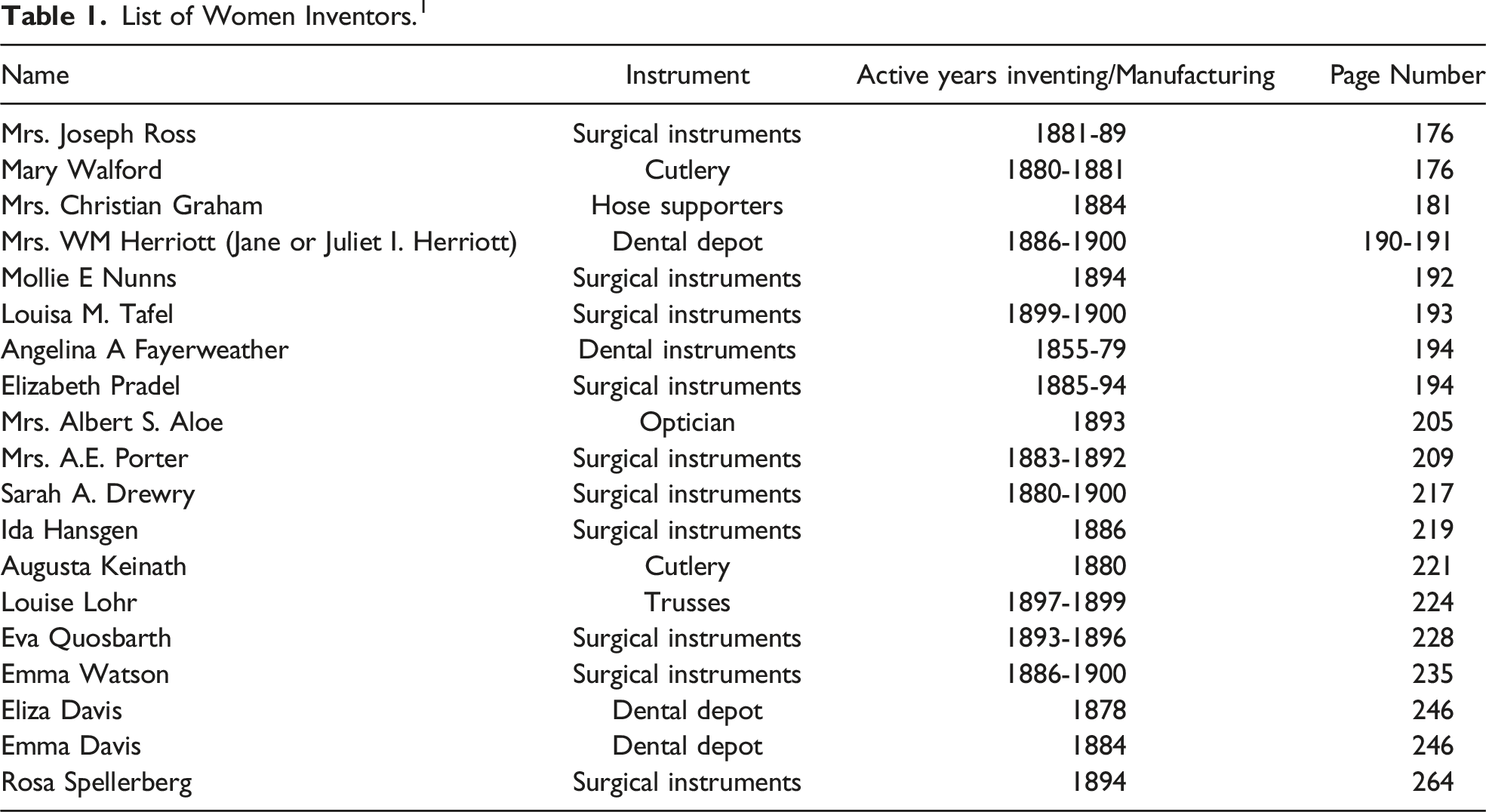
List of Women Inventors. 1
List of Notable Female Inventors of Handheld Surgical Instruments From Internet Search.
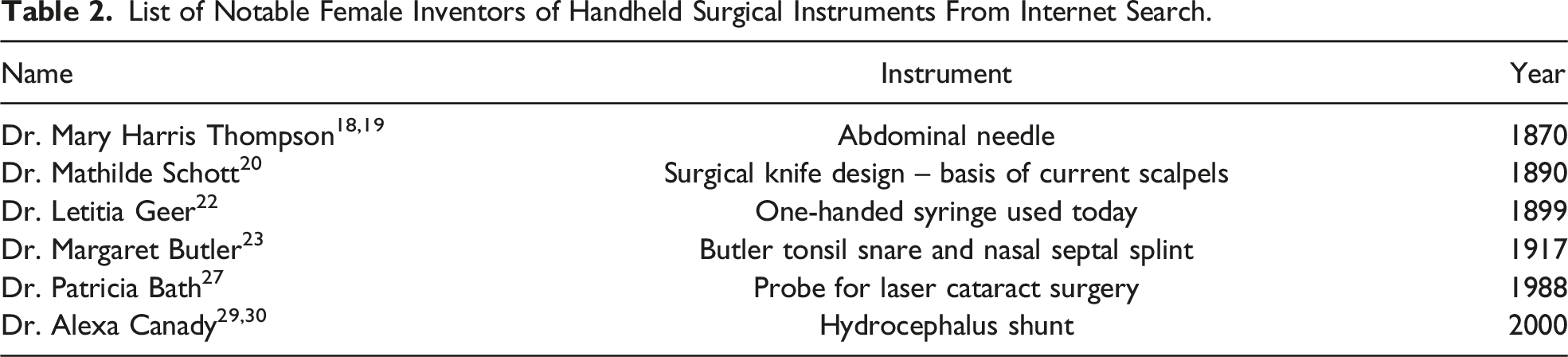
The Butler tonsil snare is one of the few eponymous surgical tools named after a woman and was created in the early 1900s by Margaret F. Butler, who is widely regarded as the first female otolaryngologist.23,24 Butler was dedicated to carving paths for women to pursue a career in ear, nose, and throat surgery during a time when gynecology was a female physician’s main option. 25
Patricia Bath, an ophthalmologist and scientist, is recognized as the first Black female physician to receive a medical patent, issued in 1988 for the laserphaco probe, a novel minimally invasive device that revolutionized cataract removal worldwide.26,27 With a background in chemistry and physics, Bath conducted laser science research at multiple European institutions, motivated by a “shared zeal to discover and invent, be a part of something new and adventurous.” 28 More recently, Alexa Canady was the first Black female neurosurgeon in the United States and a prominent scientist who conceptualized a programmable antisiphon shunt for treatment of hydrocephalus in 2000.29,30 Though retired, Canady continues to advocate for women seeking to pursue careers in medicine today.
Discussion
Indeed, there have been several women inventors of handheld surgical instruments. This number, albeit significant, pales when we consider the denominator of total handheld instruments and inventors. Although women for many years were not brought to the table, they may still have been involved in the inventing process. The Patent Act of 1790 states that the “petition of any person or persons that he, she, or they, hath invented or discovered any useful art, … it shall be lawful … to cause letters patent to be made out in the name of the United States.” 31
In her 1883-piece Matilda Gage noted that “many delicate and important surgical instruments owe their origin to women...” 32 ; however, there is no elaboration nor citations. She discusses that although women made many important inventions, many were not patented due to a lack of freedom. At the time, only 50% of states allowed women to possess the rights to control businesses outside their homes. A woman would not likely possess legal rights, contracts, or licenses for her invention, nor would she have legal recourse to sue someone who infringed upon her idea. Moreover, social norms of the time considered it “improper” for women to obtain patents or copyrights.31,33 Thus, women inventors may have filed under a defeminized name or taken the name of a brother, father, or husband. In Table 1, 3 of the women are listed under their husbands’ names. In many cases, they may not have been credited at all for their invention. It is this historical “void” that leads one to be “left with the strong sense that the industrial revolution is primarily a men’s story.” 34
In 2023, compared to the 1880s of Matilda Gage’s time, women in the U.S. have more educational, economic, and political freedoms including the right to own property, obtain lines of financial credit, and vote. Women now comprise 50.5% of entering medical school classes 35 and make up 30% of surgical and procedural fields. 36 Women make up 15% of the U.S. engineering workforce and 27% in other STEM (Science, Technology, Engineering, Mathematics) fields. 37 There are also more women entering and staying within the patent system. From 2016 to 2019, the number of patents with at least one woman inventor increased from 20.7% to 21.9% and the percentage of women receiving patents increased from 12.1% to 12.8%. 38
There would be hope that with more women entering medicine and STEM fields, more surgical instrument designs would be available for women users. This is not the case. Newer devices including laparoscopic instruments, endoscopic staplers, and ultrasonic devices are difficult for women to use.8,11 Yet, other male-dominated fields including the automotive industry 39 and the U.S. military 40 have designed equipment to fit the female body—why are we still operating with tools built for a male hand?
This disconnect may be due to several causes. First, the percentage of all women patent inventors, or the annual “women inventor rate,” was 12.8% in 2019, only an increase of .7% from 2016. 38 That is the inventor rate for all patents. The instrument sectors (related to optics, measurement, biological material analysis, and medical technology) had an even lower rate with women comprising only 12% of patent inventors from 2007 to 2016. 41 A rise in the number of women entering the field does not translate into inventors within the field. 42
Even if women do enter engineering, they are more likely to be part of a team. Koning et al. 43 and our USPTO database search, found that most women are part of a majority male design team and are less likely to lead those teams. By 2010, less than 10% of patents in surgery and instruments were women-led and this share had hardly changed since the late 1970s.41,43 This stagnant gender composition has resulted in a decline in the gender diversity index or the relative share of men and women patent inventors on a team. 41
This slowed growth may also reflect challenges within the industry, engineering field, and patent process. Within industry, women disproportionately are not inventors in most fields, and therefore, fewer women experience the additional benefits of bonuses and prestigious positions that potentially result in competitive jobs. 42 Surgical subspecialties have documented that more men surgeons than women have relationships with industry.44–46 As a result, women may not be at the design table. Even if women’s ideas are brought to the design table, the greater male audience may not see the need or find value in the invention. Citing literature, Koning et al. 47 remark that “we have no shortage of anecdotes about how a heavily male scientific community tended not to notice or even to dismiss subjects that affected half the population, but not them”.
Stewart Stute 31 discusses how gender bias of all-male panels influences decisions not only to pursue certain technologies but also to supply funds to create and further commercialize them. If a male reviewer does not recognize a problem because he does not experience it (e.g., instruments not fitting), then why support or fund an invention to solve that problem? Jensen et al. 48 note that patent applications by women inventors were more likely to be rejected and less likely to be appealed afterward by the applicant team (inventor, assignee, and prosecuting attorney).
Even without industry, women are less likely to commercialize inventions or market themselves, which is reinforced by socially structured obstacles. Female scientists and engineers may be excluded from social networks that assist in commercializing their inventions and are less likely to be invited to sit on scientific boards or advisory panels where they could meet potential innovation partners. 33
So why is it important to have women in engineering and inventing instruments for female surgeons? Simply put – women invent for women. Koning et al. 49 note that the “historical hostility toward women in surgery has both involved men dismissing promising female-focused surgical ideas and women being especially likely to develop those ideas”. Studies have shown women inventors shift the supply of invention toward the needs of women. A 10% increase in female inventors leads to a 1.2% increase in female-focused patents. 43 Research teams with women are 19% more likely to produce patents for women. 47 Women-led teams and an all-female inventor team are 26% and 35% more likely to focus on a female health outcome.47,49 We will continue to operate with instruments made for a male hand if fewer women invent. Excluding female inventors and surgeons to the design table results in a loss of innovation potential or “lost Einsteins” 50 or more specifically, “lost Curies” 49 – individuals who would have had highly impactful inventions had they been exposed to inventing.
To begin to address this disparity, one needs to acknowledge the gap in participatory ergonomics whereby women are the end-users in the design of inventions made by and tested primarily on men. Participatory ergonomics have greatly started to shape the transformation of the world that women live in. Female inventors can refocus the supply of inventions those that are needed for females. To bridge the gap between women receiving the education, becoming inventors, and receiving patents, an educational barrier must be removed to encourage women to receive patents at a more equal rate as their male counterparts. Curriculum, including medical schools, should be developed that expose trainees to inventing, Intellectual Property (IP), and the process of patenting. This can include connecting students with mentors who have invented, patented, and can stress the importance of protecting an idea and the process for obtaining a patent. Interprofessional coursework can also be established that allows medical and engineering to students to work with each other. For surgeons, there needs to be increased engagement with industry, whether that is expressing concerns with device company representatives or obtaining consulting positions. And finally, industry needs to expand its vision of users and include women surgeons into their design process and evaluation of usability.
Our review here is not exhaustive and our work focused only on handheld surgical tools. Women and small-handed surgeons face an additional challenge such as access to appropriately sized equipment such as surgical gloves. Additionally, our patent search was limited to those inventors who filed in the United States Patent system. However, this limitation should not detract from the message—there are far fewer women engineers and surgeons designing in this space. The gender gap in innovation is shrinking, but at the current rate, it is estimated it will take another 118 years to reach gender parity. 51 Women have long been left on the sidelines for multiple reasons regarding surgical instrument design and there is a need for accelerated partnership between women surgeons and engineers. It is time for more women to become part of the process. Whereas our changing surgical past has shown an evolution of surgical instruments, the increasing number of women surgeons in the field now demands a revolution in instrument design.
Footnotes
Acknowledgments
Authors acknowledge support from the Building Interdisciplinary Research Careers in Women’s Health (BIRCWH) Grant K12 from the National Institutes of Health (NIH) Office of Research on Women’s Health (ORWH). The content is solely the responsibility of the authors and does not necessarily represent the official views of the National Institutes of Health.
Declaration of conflicting interests
The author(s) declared no potential conflicts of interest with respect to the research, authorship, and/or publication of this article.
Funding
The author(s) disclosed receipt of the following financial support for the research, authorship, and/or publication of this article: This work was supported by the Eunice Kennedy Shriver National Institute of Child Health and Human Development (K12HD101373).
