




Abstract
Given that musical performance and expression rely on a player’s body movements, understanding ergonomic movements for each technique is indispensable for mastering string instruments. In string playing, different parts of the body and the whole body move with varying degrees of efficiency in diverse contexts (Polnauer and Marks 1964). Consequently, the question of how to efficiently move the body can vary depending on situations. Although there are many valuable resources about the principles of bow strokes and techniques (e.g., Flesch 1925; Galamian 1999), players still need to understand how to effectively apply these concepts to their musical performances. Moreover, the intermediate and advanced repertoire typically presents a greater variety of dynamic bowing situations compared to less difficult repertoire.
The purpose of this article is to examine ideal body movements for executing various bowing techniques and their applications to intermediate and advanced repertoire. By embracing these insights, string players and instructors can acquire natural body movements that are more harmonious with the body and effective for successful performance of bowing techniques as well as healthy playing. In this article, three types of basic bow strokes are considered: martelé, detaché, and legato. From these types many other related bow strokes can be produced and developed with different speed, part of bow, on and off the string stroke, pauses between strokes, and various combinations of these elements (Menuhin and Primrose 1976). Musical excerpts are provided to demonstrate and contextualize each of the basic bow strokes and illustrate situations in which they might be used. While the musical examples draw from several well-known violin works, their applicability extends to other stringed instruments as well.
Martelé Type Bow Strokes
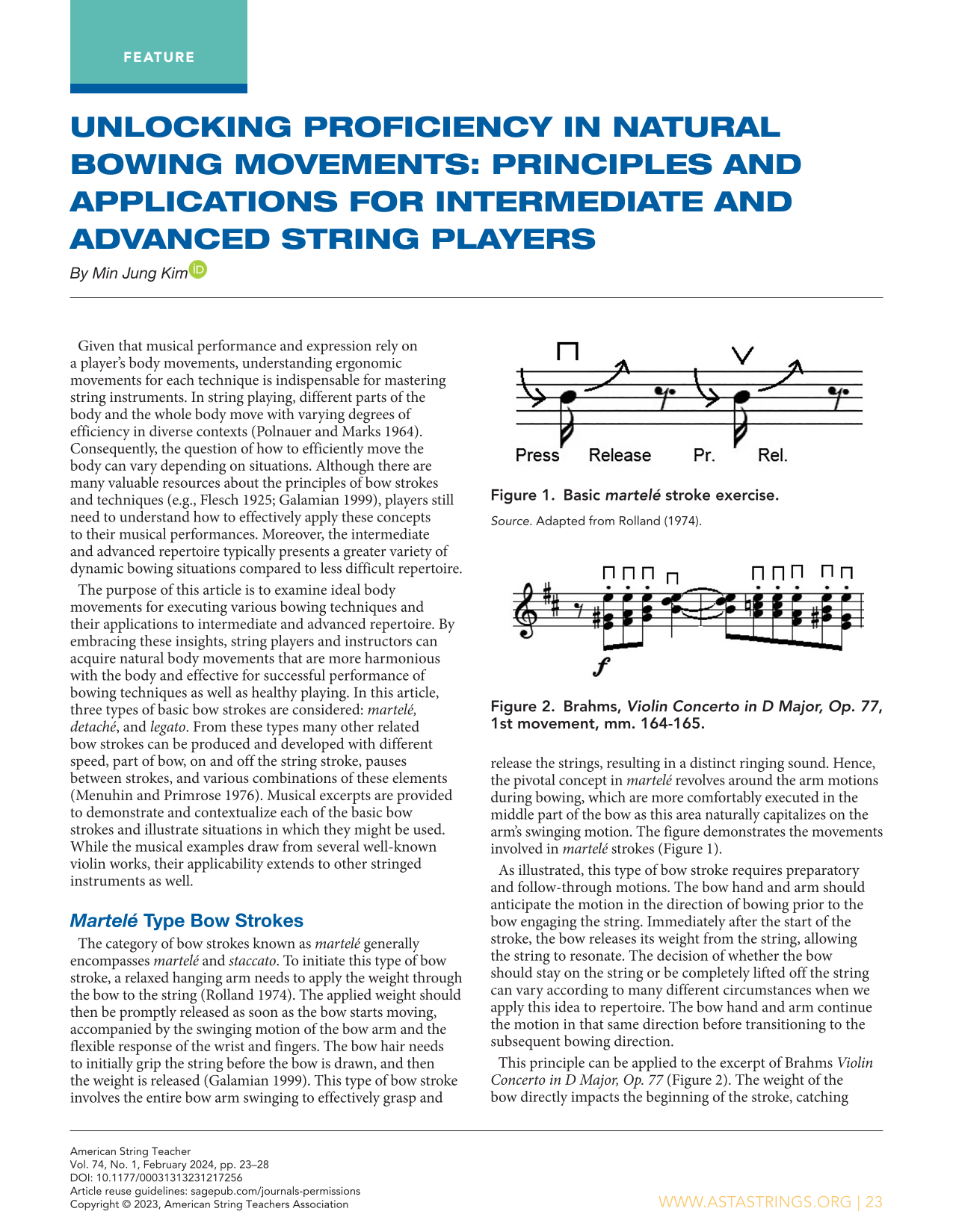
The category of bow strokes known as martelé generally encompasses martelé and staccato. To initiate this type of bow stroke, a relaxed hanging arm needs to apply the weight through the bow to the string (Rolland 1974). The applied weight should then be promptly released as soon as the bow starts moving, accompanied by the swinging motion of the bow arm and the flexible response of the wrist and fingers. The bow hair needs to initially grip the string before the bow is drawn, and then the weight is released (Galamian 1999). This type of bow stroke involves the entire bow arm swinging to effectively grasp and release the strings, resulting in a distinct ringing sound. Hence, the pivotal concept in martelé revolves around the arm motions during bowing, which are more comfortably executed in the middle part of the bow as this area naturally capitalizes on the arm’s swinging motion. The figure demonstrates the movements involved in martelé strokes (Figure 1).
Basic martelé stroke exercise.
As illustrated, this type of bow stroke requires preparatory and follow-through motions. The bow hand and arm should anticipate the motion in the direction of bowing prior to the bow engaging the string. Immediately after the start of the stroke, the bow releases its weight from the string, allowing the string to resonate. The decision of whether the bow should stay on the string or be completely lifted off the string can vary according to many different circumstances when we apply this idea to repertoire. The bow hand and arm continue the motion in that same direction before transitioning to the subsequent bowing direction.
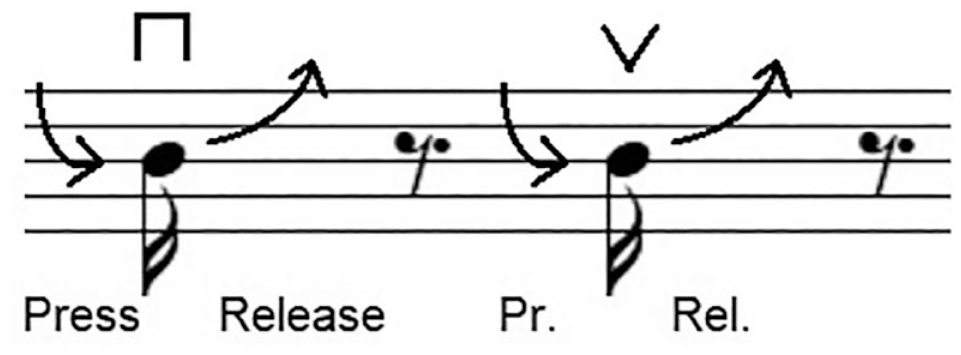
This principle can be applied to the excerpt of Brahms Violin Concerto in D Major, Op. 77 (Figure 2). The weight of the bow directly impacts the beginning of the stroke, catching the strings and releasing them immediately. Because of the successive chords and down-bows, the swinging motion and rotation of the entire arm and shoulder, along with the flexible reaction of the wrist and fingers, is necessary. The bow must be lifted after each note in this case. Although the bow stays on the strings a little longer for the tied notes, the weight of the bow still needs to be released after the initial impact.
Brahms, Violin Concerto in D Major, Op. 77, 1st movement, mm. 164-165.
This concept can find application in many musical contexts, even when certain sections of music do not explicitly call for martelé bow strokes. For example, a similar idea can be employed in this segment (Figure 3), although the sound may not precisely replicate a martelé effect. To be more specific, in order to execute the sforzandos for each note, it is essential to apply adequate weight at the onset of each stroke and promptly release it thereafter (the bow should stay on the string in this case). This should be carried out in a sequence involving the preparation and follow-through motions of the bow hand and arm.

Beethoven, Violin Sonata No. 9, Op. 47, 3rd movement, mm. 114-123.
This also pertains to the excerpt of Beethoven Violin Sonata No. 9, Op. 47 (Figure 4). The bow hair should engage the strings for each chord and then must release the strings to make the ringing sound. As this section is typically performed with consecutive down-bows, the circular motions of bow arm after each chord should function as both preparation and follow-through actions. Since the chords are in quarter notes, the bow should slightly linger on the strings to sustain the sound, while still releasing the weight lifting the bow during the rests. In this case, the speed of the bow stroke naturally decelerates as the sound persists.

Beethoven, Violin Sonata No. 9, Op. 47, 1st movement, mm. 61-67.
To perform this section in Vieuxtemps Violin Concerto No. 5, Op. 37 (Figure 5), the martelé type bow strokes need to be employed at the tip of the bow, as indicated in the score. In this situation, the elbow’s swing is slightly reduced, while the index finger exerts additional weight to leverage the bow. Nonetheless, the motion should still be primarily guided and powered by the entire arm and the back of the player’s body. This approach will also aid in string-crossing and double-stop playing of this section by utilizing rolling motions of the entire arm. These rolling motions require only one gesture to play a group of notes, eliminating the need for a separate motion per note that can lead to tension in the arm and back of the body.

Vieuxtemps, Violin Concerto No. 5, Op. 37, 1st movement, mm. 257-259.
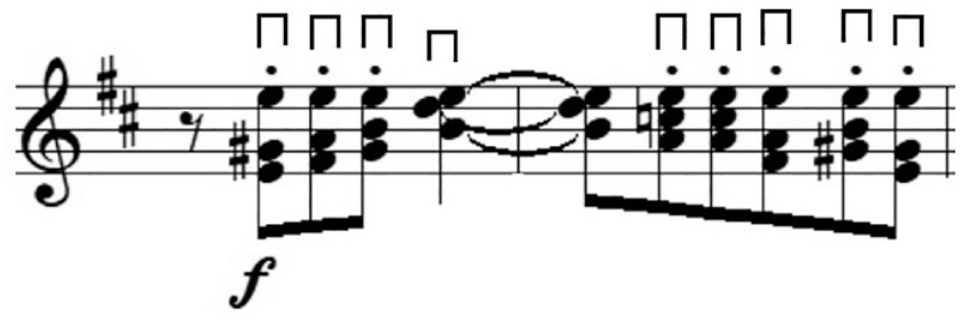
The swinging motion of the elbow enhances the resonant quality of the martelé stroke by providing the necessary weight to initiate the bowing action. This technique is also essential when players execute the long-slurred staccatos found in both Vieuxtemps Violin Concerto No. 5, Op. 37 (Figure 6) and Wieniawski Polonaise (Figure 7). Even with numerous staccato notes within a prolonged slur, violinists can apply a single impulse at the start of the slur, allowing the subsequent slurred notes to be played naturally. To achieve this, the complete arm leverage should be maintained, enabling the swinging motion of the entire arm to produce a distinctive “pop” sound for each note. These two instances of slurred staccato involve ascending or descending stepwise scales, necessitating martelé bowing motion with slight string crossings. For the string crossings, identifying the correct bow angles for each string and timing of angle changes are also a crucial concern.
Vieuxtemps, Violin Concerto No. 5, Op. 37, 1st movement, mm. 111-112.
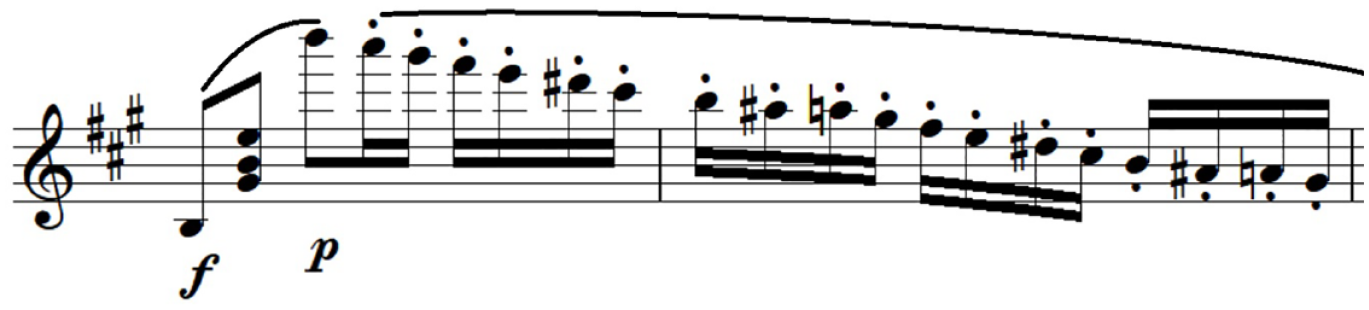
Wieniawski, Polonaise Brillante Op. 21, mm. 23-24.
Detaché Type Bow Strokes
Detaché strokes use a balanced natural rotation of upper arm and are easily transformed into sautillé, tremolo, and spiccato through varied angles, speeds, and motions of the arm, hand, and fingers. When the arm is balanced, it moves in a teeter-totter motion, while the hand and elbow move in opposite directions. This involuntary rotary motion helps the body and arm to relax, making the motion more efficient and less tiring. This motion should be continuous, without complete stopping between each stroke, and should not be isolated. Usually, detaché strokes are easily played between the middle and the tip of the bow and tend to transition into sautillé strokes as the bow naturally tends to transition into sautillé if the bow nears the balance point. Rolland (1974) points out the speed of the bow strokes. In a medium-slow tempo (16th notes at around 60 bpm), the bow naturally bounces near the balance point. In a little faster tempo (16th notes at around 90 bpm), the bow bounces a little above the balance point. And if the motion goes much faster (16th notes at around 150 bpm), the bow bounces at the middle of the bow. In other words, depending on the speed, the bow bounces most easily at different parts of the bow. The slower the bow arm moves, the more bounce is generated near the balance point. The faster the bow arm moves, the more bounce occurs near the middle of the bow.
It is also important to consider horizontal and vertical motions in the bow arm, as well as their combinations (Kashkashian 2020). When violinists move the forearm and elbow in more vertical directions, the bow strokes transition into sautillé or spiccato. Conversely, when the forearm and elbow move in a more horizontal direction, it facilitates detaché strokes (Figure 8).
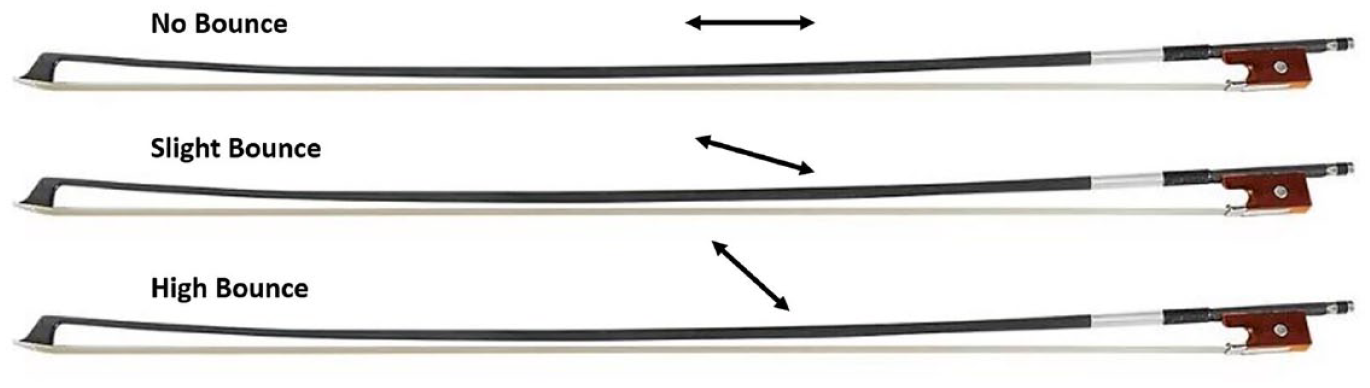
Directions of bow arm movements and bow bounce.
To explain further, violinists can achieve the detaché-sautillé transition using various shapes of imaginary circles and different parts of the bow. They can use a taller and more rounded circular motion to create sufficient downward motion of the bow, which naturally enhances the bow’s bounce from the strings. To play a detaché stroke without bounce, the circular motion should become more horizontal and oval in shape. That is, for various pieces in the repertoire, one should consider both the rotation of the bow arm, and the direction and speed of the bow arm movement, along with the use of different parts of the bow.
For example, when violinists play the basic detaché strokes in the beginning of the Bach’s Partita in B Minor, Double (Presto), the direction of the bow arm movements should be relatively parallel to the floor (Figure 9). It is also advisable to use the upper part of the bow to minimize unintended bow bounces.

Bach, Partita in B Minor, BWV 1002, Double (Presto), mm. 1-3.
Dvorak Violin Concerto Op. 53, 3rd movement, mm. 119-124 (Figure 10) is an excerpt that needs quick transitions between detaché and sautillé. The rolling motion of the bow arm can facilitate a more natural transition. In detaché bowing, the elbow moves to create imaginary circles, driven by the rolling motion of the entire arm. The shape of the imaginary elbow circle naturally corresponds to the height of the elbow. Taller and more rounded circles result in a higher elbow position, while a flatter shape leads to a lower elbow position. Violinists can utilize different parts of the bow: near the balance point for sautillé and the upper half for detaché. Since the tempo of this section is relatively fast, the sautillé stroke can be played closer to the middle of the bow (Rolland 1974), but the detaché stroke is consistently performed in the upper part.

Dvorak, Violin Concerto Op. 53, 3rd movement, mm. 119-124.
Legato Type Bow Strokes
There are five things to consider for legato strokes: contact point, bow speed, straight bowing, bow distribution, and bow weight. It is easy to think of legato strokes as maintaining weight applied to the strings, so players often put too much weight playing this type of stroke. However, too much pressure interferes with the strokes as that disturbs the natural bowing movement and the strings’ vibration (Menuhin 1971). Therefore, it is important to leave room for natural bow vibration. To develop a sense of proper bow weight and even bow distribution, portato stroke practice is suggested. Rolland’s portato stroke practice involves pulsating the bow weight instead of maintaining it constantly (Figure 11). This pulsation should be accompanied by a slight rolling motion of the arm to make it smoother. This portato stroke practice demonstrates how to sustain the sound and allow vibration.
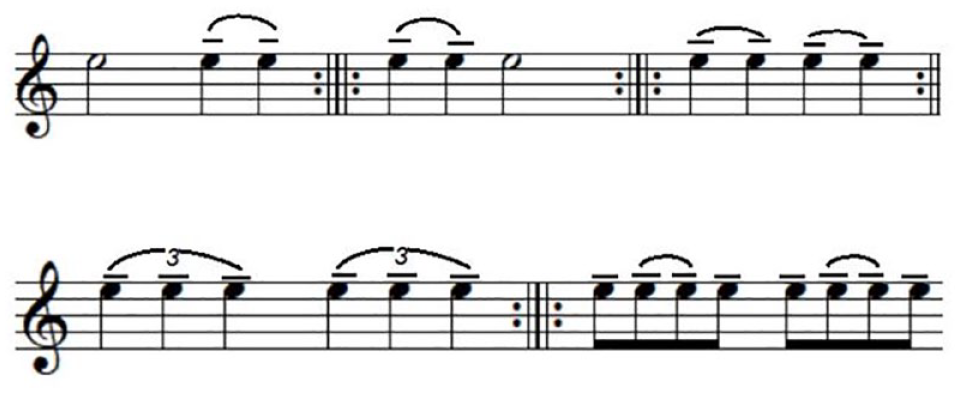
Portato stroke practice (Rolland 1974).
Pulsating weight can be developed with two or more strings (Figure 12). As more strings are added, greater weight may be necessary, and the bow hold tends to become firmer, although it still requires flexibility. Whether on one string or more, the arm, wrist, and finger movements should not come to a complete stop between notes. The motion should be continuous even between notes.
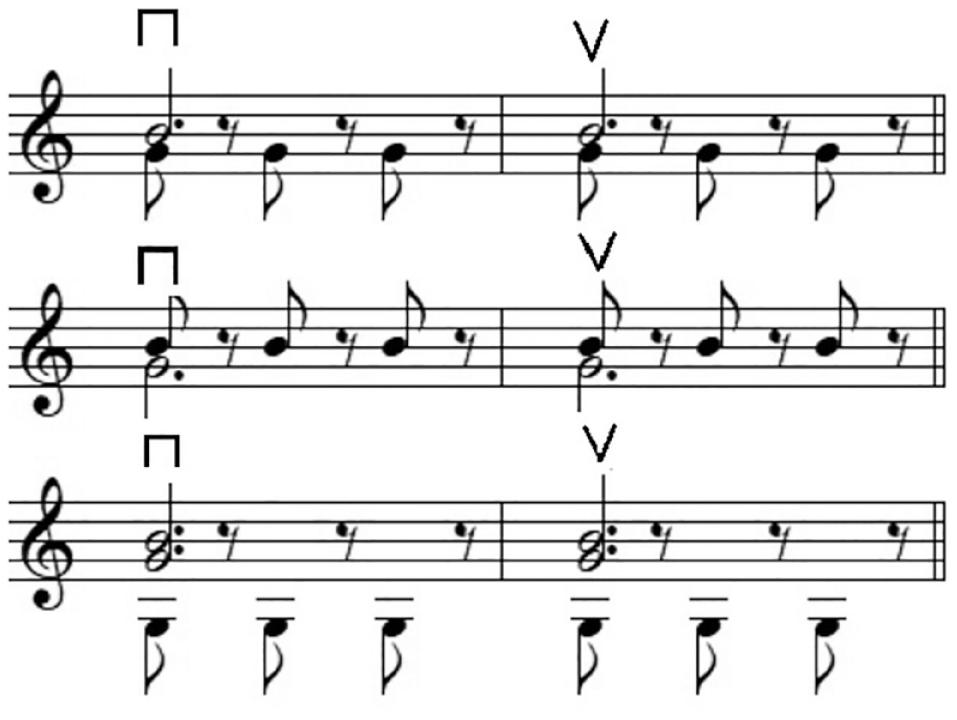
Legato stroke practice with double-stop examples from pp. 99–100 (Menuhin 1971).
Applying portato practice to a single string, the first three notes of this Mozart concerto (Figure 13) can be practiced using subdivided portato strokes (Figure 14).

Mozart, Violin Concerto No. 3, K. 216, 1st movement, mm. 51-53.
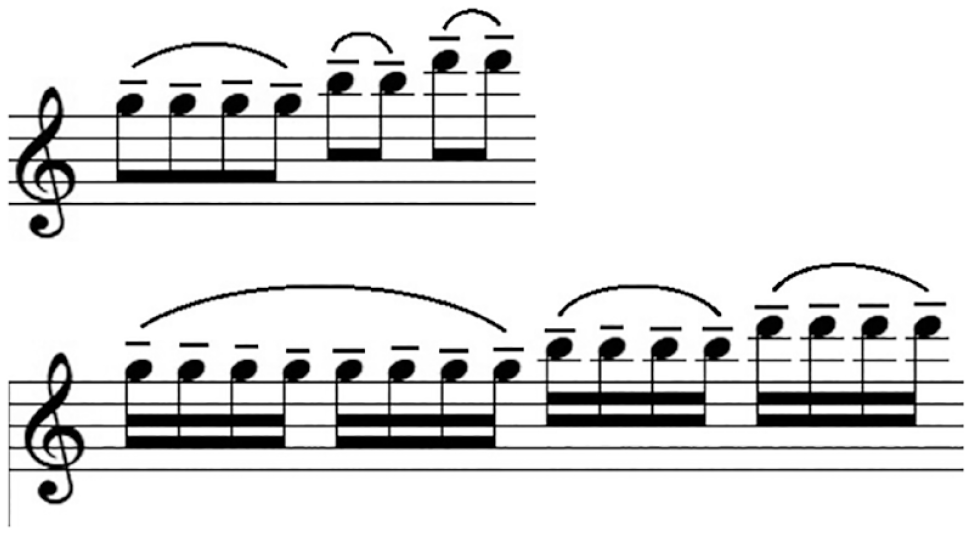
Portato practice example of Mozart, Violin Concerto No. 3, K. 216.
Bowing can be trained by oscillating the bow movement with regular pulses, which also provides a sense of bow division.
The excerpt from Mozart Violin Sonata in B flat Major, K. 454, 2nd movement, mm. 1-5 (Figure 15) does not have a long note value but has a long slur that also needs to be played with the sustained stroke idea. In this case, along with the portato stroke exercise, players should feel the resistance between the bow hair and strings. Menuhin (1971) suggests selecting and maintaining a contact point where the string vibrates with the proper amplitude. Sufficient weight should be applied to sustain the vibration without colliding with the string. Players can experiment with different contact points (near the bridge, middle of the bridge, and near the fingerboard) and vary to develop a keen sense of bow hair resistance in sustained strokes.

Mozart, Violin Sonata in B flat Major, K. 454, 2nd movement, mm. 1-5.
The section from Mozart Violin Sonata in B flat Major, K. 454, 1st movement, mm. 1-3 (Figure 16) can be practiced with even bow distribution for legato. Do that by subdividing the quarter notes into eighth or sixteenth notes and pulsating the weight, Menuhin’s Legato stroke practice with double-stop exercise idea can be applied in this practice. All of these will help to sustain the bow stroke with a proper amount of weight and enough resonance. To produce a loud, ringing tone for the first chord while maintaining the rhythmic pulse, players should prepare the stroke with slight weight shifts of the body (bringing weight to the left foot while opening the body in contrary motion to the bow). The bow, initiated by the preparatory action, naturally sinks into the strings to produce sufficient sound. The momentum created by the preparation also can facilitate the extreme dynamic change after the chords (from forte to piano). When transitioning from a down-bow to an up-bow at the tip the bow, the elbow should gently swing outward, guiding the bow.
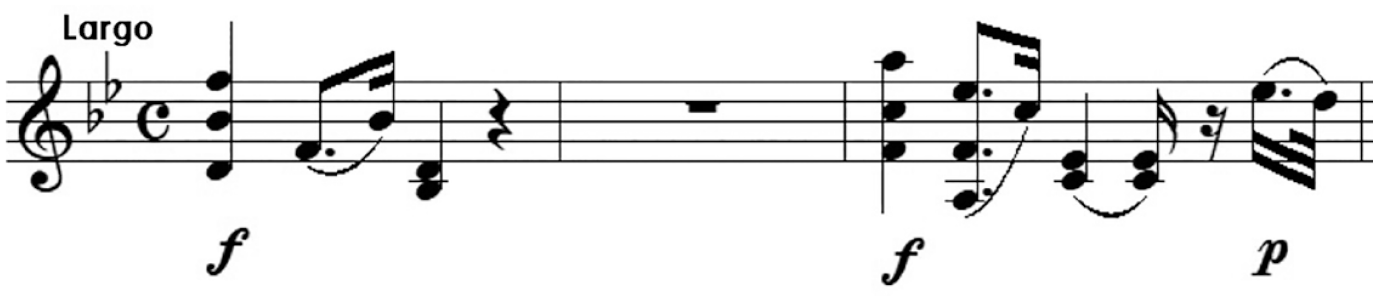
Mozart, Violin Sonata in B flat Major, K. 454, 1st movement, mm. 1-3.
Contextualizing Movements
Many bowing techniques demand optimal movements for their effective execution, and the movements required for each technique need to be considered within the context of repertoire. String playing usually involves a combination of multiple simultaneous or sequential movements rather than solitary actions. Furthermore, every human body movement necessitates both preparatory and concluding actions. These preparatory, actual, and concluding actions make the techniques easier to perform naturally. Thus, it is also necessary to consider connecting motions that can work as preparation and conclusion to link each sequential technique.
“String playing usually involves a combination of multiple simultaneous or sequential movements rather than solitary actions. Furthermore, every human body movement necessitates both preparatory and concluding actions.”
It is also essential to recognize that all bow strokes discussed in this article, along with their evolved variations, should be rooted in a foundation of well-established, flexible, and relaxed playing posture. After understanding the appropriate movements for each technique, it is essential to become familiar with how to apply them within the context of the music. This approach could provide string players the opportunity to improve their performance while utilizing healthier playing habits.
Footnotes

Min Jung Kim (