



Abstract

When you think of the words contemporary classical music, what comes to mind? Likely, the first adjective might be “dissonant” or “atonal.” This often causes people to turn away from new music because anything that does not follow the strict rules of “western music” can be hard to grasp at first. However, there are many wonderful works by living composers that few people know. Imagine what it would have been like to talk with Beethoven or Florence Price about their first symphonies! We all have this opportunity; we just have to reach out and connect with composers who are writing brilliant new works every day!
In this article, we share eight chamber works composed by living composers. We include insights into the technical challenges of these compositions as well as transcripts from our interviews with each composer. In addition to introducing the composers and some of their works, we have included a table with technical difficulties (see Table 1) and have assigned a grade level to each work according to the ASTA grade system. Note: each grade is subjective to the group and the people performing it. However, each grade encompassed the general difficulties of the work and was ascribed with the performer in mind.
Composer Database.

Note. Additional composers and works for strings can be found at: tinyurl.com/stringscomposers.
Our goal is to expose people, be it performers or teachers or conductors, to more contemporary classical works and encourage them to explore these composers as well as the hundreds, even thousands, of others who are out there!
Adrienne Albert, Interiors: String Orchestra, 6 Minutes, Grade 3
Award-winning composer Adrienne Albert has had her chamber, choral, vocal, orchestral, and wind band works performed throughout the United States and across the globe. Albert’s work, Interiors, is beautifully lyrical, and the parts all meld together into one voice. We were attracted to this piece initially because it has a feeling of melting and soaring at the same time. The beginning opens slowly, leading into fugue-like passages throughout all parts (Table 1; Figures 1–3).

Adrienne Albert, Interiors.

Albert excerpt, Interiors m. 57, fugue-like passages.
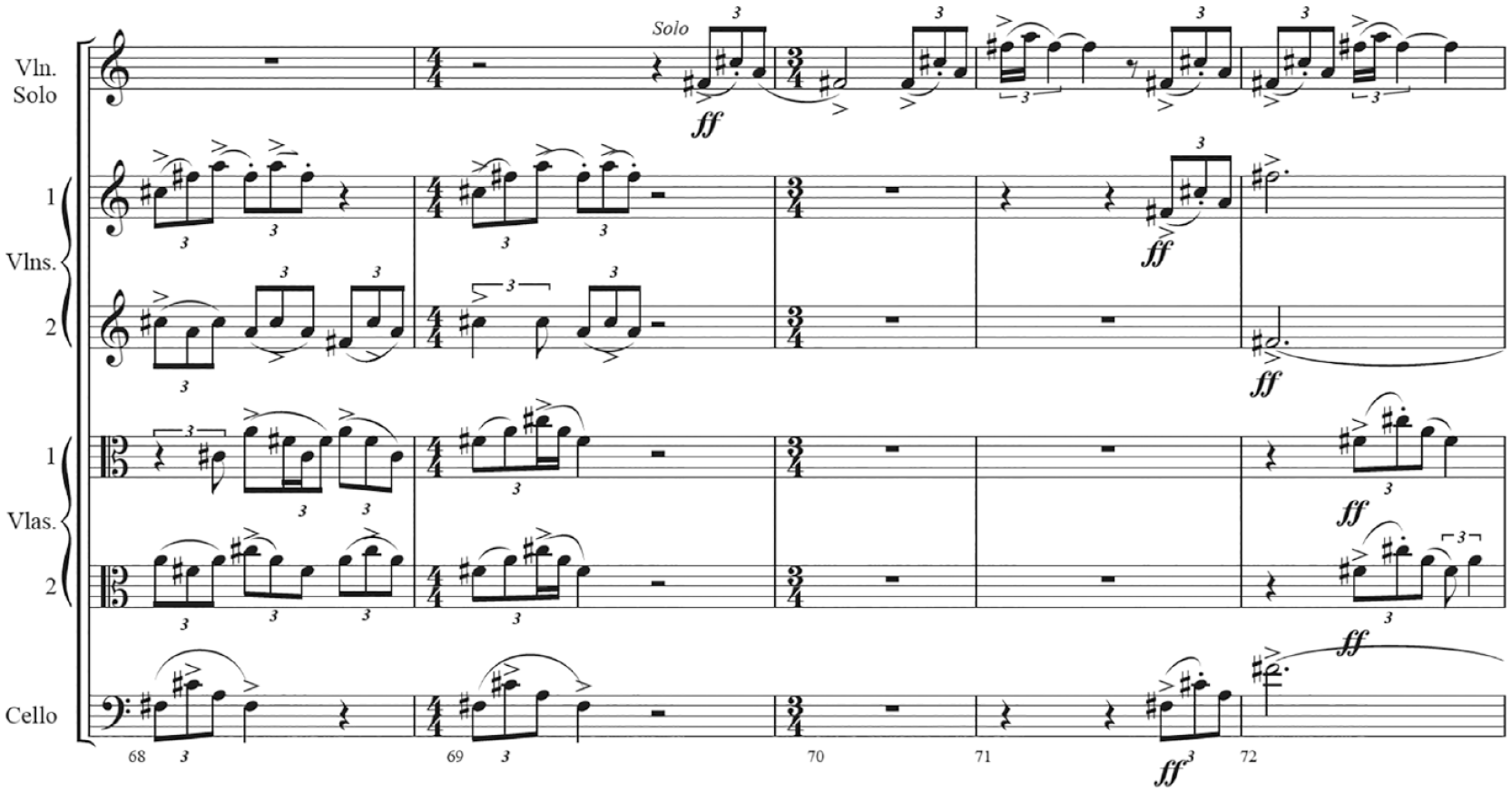
Albert excerpt, Interiors m. 68, challenging rhythms.
What Got You Interested in Composing?
I was a singer for many years. I was raised in a family of musicians. Both my parents were violinists, and I was going to be a musician, and they wanted a pianist. When I was in high school, what I really wanted to do was become a singer. I worked with Igor Stravinsky, Leonard Bernstein, and Phillip Glass. I had years as a professional singer but realized that what I really wanted to do was to write my own music. I had played others’ music for years; I wanted to write my own. I went back to UCLA to do night classes to learn to write music that I wanted to write.
What Was It Like to Hear Your Piece Premiered Live for the First Time?
It is terrifying. Although I have written the notes, I do not really know what it is going to sound like. Oftentimes I am thrilled. But, sometimes I hear things I would like to change. It is very helpful to get to hear my music performed live, most often in rehearsals, so that I have a chance to redo the piece if I want to or if the performers are interested in giving suggestions. I am very collaborative in my composing. I do not want just what is written on the page; it is up to the musicians to bring their personalities and musicality into the piece they are performing.
What Are the Joys and/or Struggles of Being a Contemporary Composer?
The joys are getting a piece performed in a way that makes my feelings soar or makes me cry. Music is a very emotional medium and should express and receive emotion from the listeners.
What Advice Could You Give to an Aspiring Composer?
We all have the ability to create a line of music. If you play the viola, perhaps you noodle around and you find that you like that line. You have become a composer. I started rather late, and it took me years to say “I’m a composer,” not just “I’m a singer” or “I’m a musician.” But, all of those things melded into who I have become as a composer, and everyone’s past is part of who they are and who they are becoming.
Nicole Buetti, Sforza! String Quartet or String Orchestra, 7:20 minutes, Grade 3
Nicole Buetti is a composer of chamber works and large ensembles with a variety of configurations. She composes for all levels but specializes in educational music for children. Sforza is a fun piece for string quartet or string orchestra. What drew us to this piece was the playability for younger students, but also the driving energy (Figures 4–6).
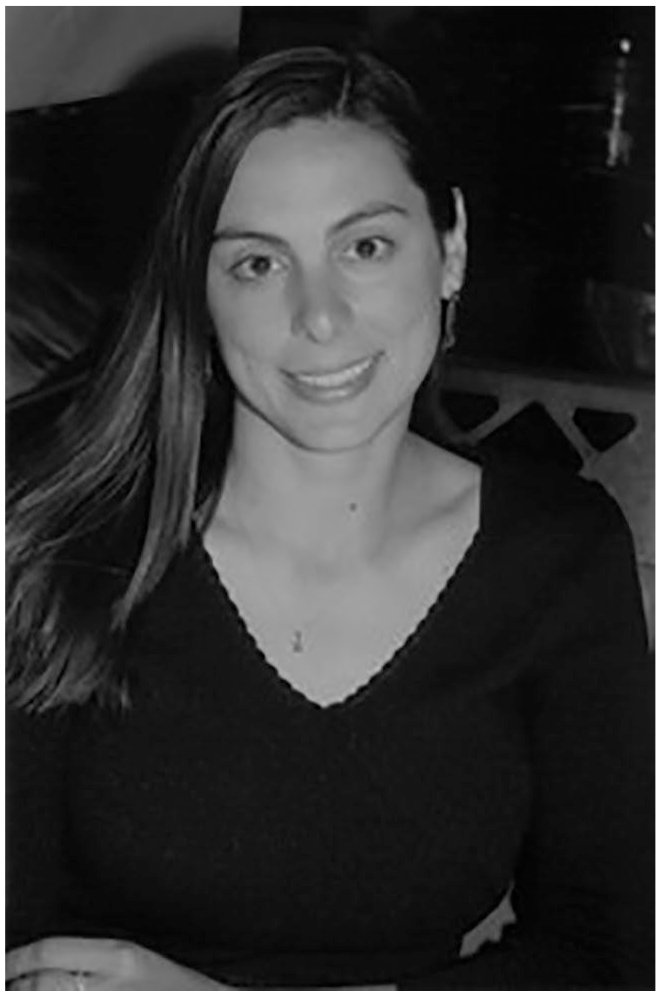
Nicole Buetti, Sforza!
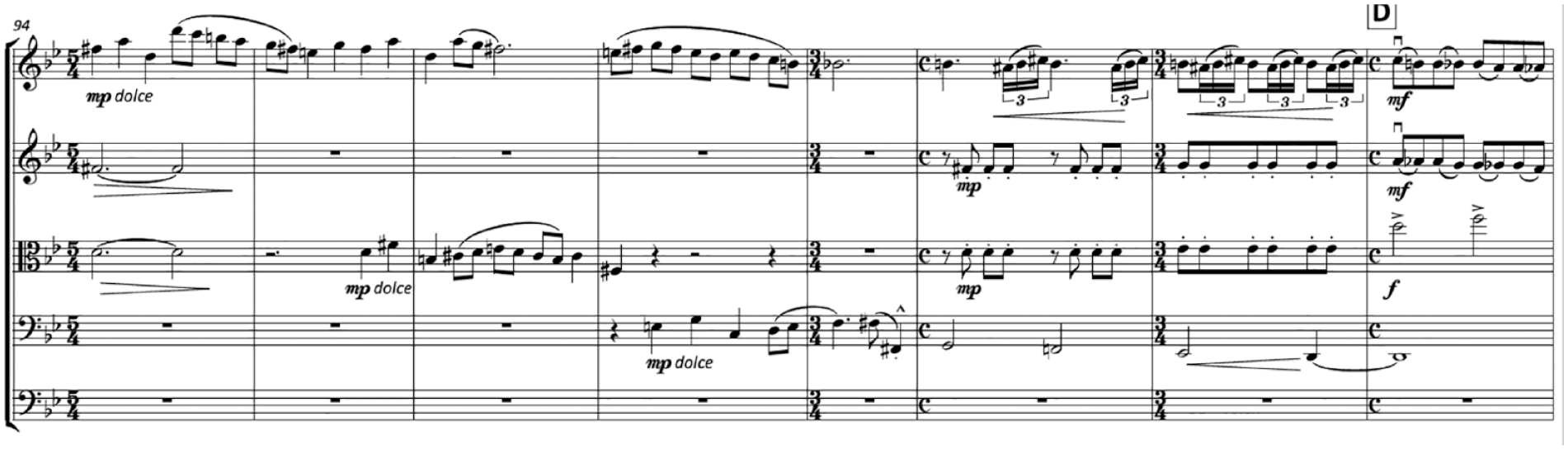
Buetti excerpt, Sforza! m. 94, changing meter.

Buetti excerpt, Sforza! m. 122, changing meter.
What Got You Interested in Composing?
As a little girl, I was always interested in music. I would plink out melodies I heard on the piano and eventually started creating my own. I loved film music (growing up with classic scores like Star Wars, Jaws, Glory, etc.) and thought nothing would be better than bringing a story to life through music. My piano teacher took me to my first orchestra concert, where I learned about where the inspiration for film music came from. Prokofiev, Stravinsky, and Vaughan Williams were all incredible composers who inspired film composers like John Williams, James Horner, and Michael Giacchino. When composing my works, I’m always writing to some sort of story in my head. It may be an epic space odyssey, a ping-pong-playing platypus or my favorite treat, gelato, but there is always a story I am trying to tell.
What Do You Hope Performers Take Away From Your Works?
As a performer myself (bassoon and contrabassoon), I try to be sensitive to the needs of performers. I think about all of the things that frustrate me about performing certain works and try to avoid them. I do my best to create music that will hopefully engage performers, and I try to avoid creating something unplayable. I hope players enjoy the parts I create for them, and even more so, the stories that they are telling through their performance.
Christopher Ducasse, Souveniers: String Quartet or String Orchestra, 5 Minutes, Grade 2
Haïtain composer, conductor, and teacher, Christopher Ducasse began his musical journey from a young age when his parents started him on violin. For him, this was an enormous opportunity because classical music “wasn’t something that was really popular at the time,” according to Ducasse. Neither was composition, which originally was not something that he had intended to do; he picked it up after doing an arrangement at his school for the strings. We love Ducasse’s music because using his Haïtian roots, he combines Haïtian rhythms with classical style to create fun and energetic compositions, one of those being his string quartet, Souvenirs (Figures 7–9).
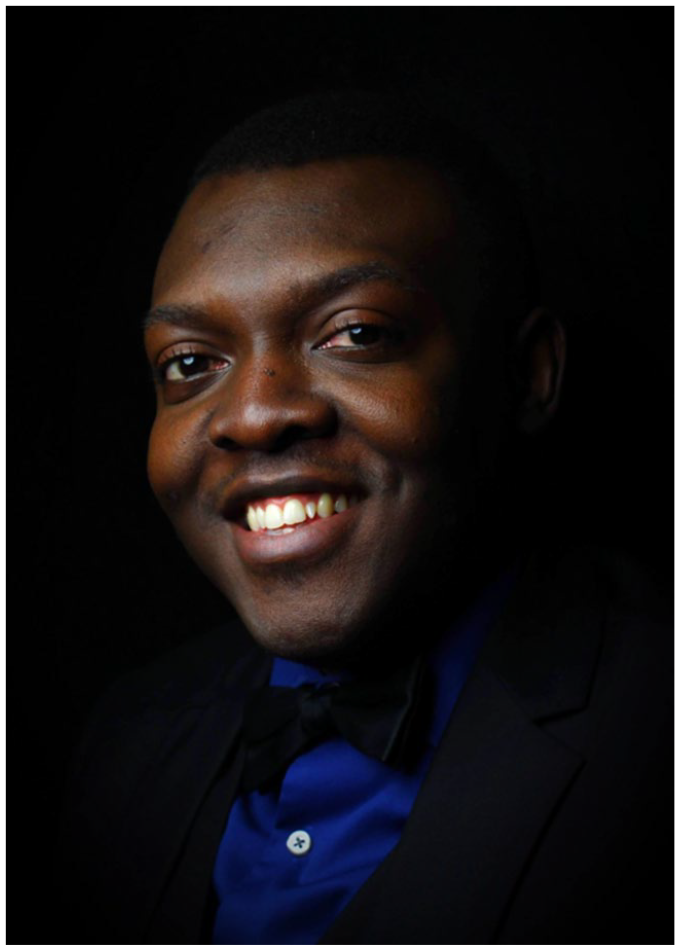
Christopher Ducasse, Souveniers.
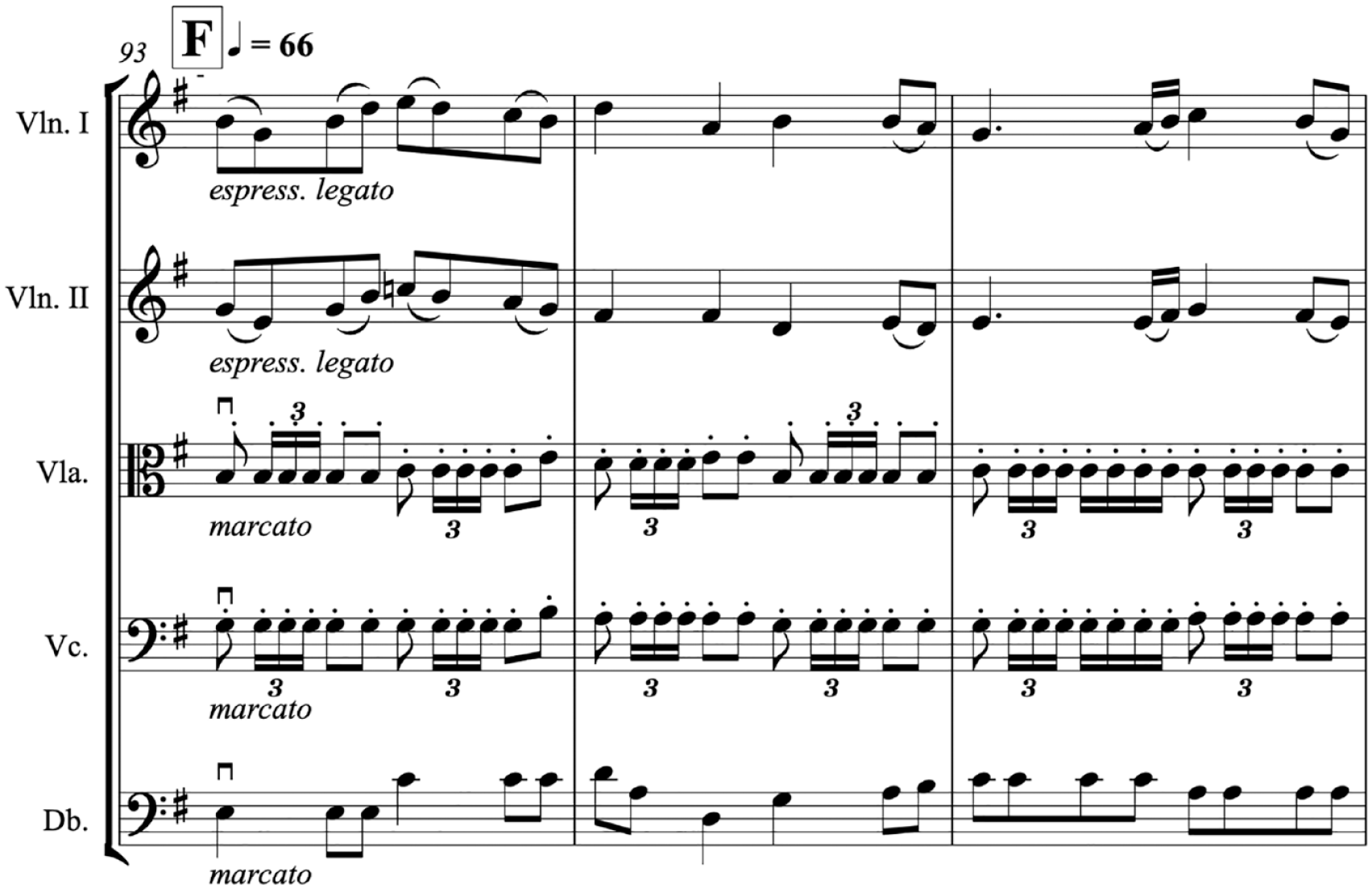
Ducasse excerpt, Souvenirs m. 93, Haïtian rhythms.
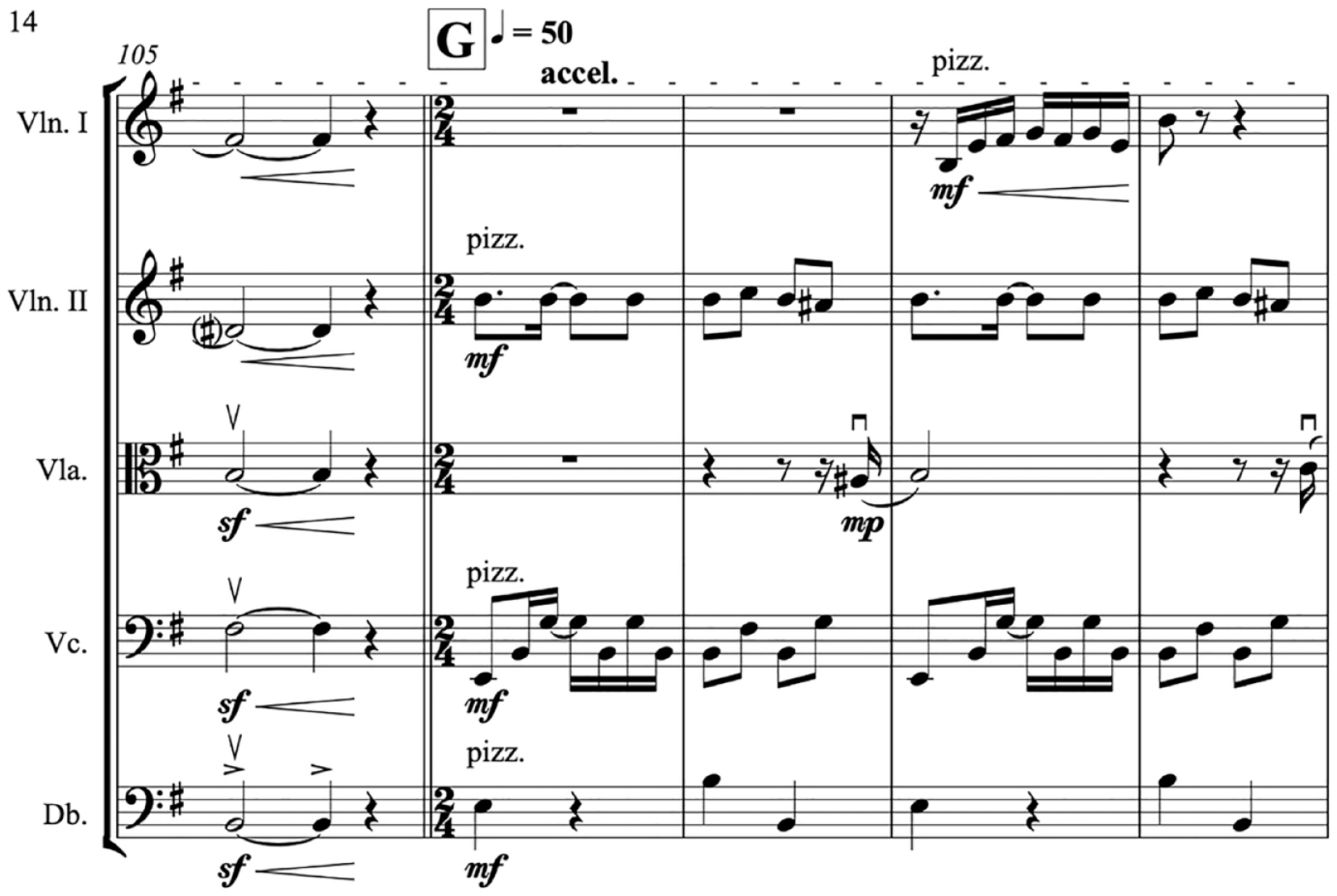
Ducasse excerpt, Souvenirs m. 105, challenging rhythmic patterns.
What Inspired You to Compose This Work?
I was part of an organization that had a program with Lawrence University where they would have one student from Haïti come study for one year. The cello teacher was in charge of that exchange. It was during that period when I was living with her and going to Lawrence that she said, “You need to write something for me.” I said that I could write something for cello, and I started writing. I had a feeling, and the title Souvenirs came because I was in Wisconsin for a year and was thinking about things from Haïti and things that I missed.
Who Is Your Target Audience for This Piece and Your Compositions?
If I am writing for a specific group, I tend to have to have the group level in mind: What sort of thing can they play? If it’s a piece for a specific concert, what is the mood of that concert? That is what I usually try to match. But, if it is something that I am writing for myself, I do not have an audience in mind. However, I always like the mixture of classical writing and Haïtian style.
Adrian Gordan, High Rise: String Quartet, 4 Minutes, Grade 4
Adrian Gordon is an instrumentalist, composer, conductor, author, and teacher located in Charlotte, North Carolina. Gordon shared with us that being a master of many trades is a great asset because they all “inform each other, and all of them really help [him] be the best version of [him]self.” His vast experience in numerous fields, coupled with his determination to surmount barriers both visible and invisible, made him a great candidate for our research. His work, High Rise, is an attestation to this. The piece has a great groove with syncopated rhythms, and you cannot help but tap your foot. Performers and audiences will be engaged right from the first pizzicato in the bass (Figures 10–12).

Adrian Gordan, High Rise.

Gordon excerpt, High Rise m. 13, pizzicato imitating the sounds of New York City and musically interesting slides.

Gordon excerpt, High Rise, m. 50, shifting and rhythmic difficulties in violin parts.
What Was It Like Having Your First Piece Premiered?
The first piece I saw performed was one of my pieces called Apocalypse, and I saw it online. There was a school doing some kind of Halloween performance, and they played [my work] Apocalypse, and I was very impressed. I thought to myself, wow, that is a school out there, and they are playing what is in my head! It is wild that these things are running around in your brain, and then people are actually playing what once was in your head. So I thought that was a really cool experience.
What Was Your Inspiration Behind High Rise?
I was very into performing and songwriting in the early 2000s. I had won an award through the BMI [Broadcast Music, Inc.], a performing arts organization, and it was a songwriting award; I won second place in the country. I went to accept the award in New York. I had never been and was captivated by the sights, the smells, the scenes. It was a special time to be recognized for a song that I had written, and being in this really cool place, I felt inspired. So, I put what I was seeing on paper, and this is one of two pieces that illustrates what I was thinking, seeing, and experiencing in New York.
What Are Some of the Struggles of Being a Contemporary Composer?
For me, it is very hard to get out there. I would say our field is littered with a lot of the Western European tradition, and those are great, but it is hard for new ideas to break out. I think it is even harder for people like myself, under-represented composers, to get out there. I think the choral community does a better job of bringing people of color into the field, and the band world does that pretty well, but strings, in my opinion, are a little behind.
Alex Hastings, Spectrum: String Quartet with Recording, 20 Minutes for Five Movements, Grade 4
Alex Hastings is a violinist, composer, and teacher in Boise, Idaho. One aspect of Alex’s writing and teaching that got our attention is her interest in supporting students with autism, attention deficit hyperactivity disorder (ADHD), or dyslexia. Because of her own experience of being a person on the autism spectrum, Alex wants to make sure there are opportunities for children with special needs, and her work, Spectrum, is a wonderful example of this. The work is written for string quartet and recording and is very accessible and easy to put together. It reminded us of Phillip Glass, at times peaceful, mesmerizing, agitated, and hopeful (Figures 13–15).

Alex Hastings, Spectrum.

Hastings excerpt, Spectrum m. 29, double stop glissandos.

Hastings excerpt, Spectrum m. 61, Minimalist, Philip Glass-like sounds.
What Inspired You to Compose This Work?
I have seen depictions of autism in videos, poems, and visual art, and these creations always seemed to portray the truth in the most effective way. I think it is easy to describe something cerebrally to help people understand, but actually helping people experience it is something only art can do. I figured that the only way to generate real empathy for the subject was to create a multimedia experience with Spectrum to really express what it is like to have autism.
What Do You Hope Performers Take Away from Your Works?
The best feeling is when performers “get it.” It is pretty vulnerable as a composer to give them your work and wonder if they will think it is childish or weird. I actually get sick-to-my-stomach nervous for those first rehearsals, more than any big solo performance I have ever done on violin. But, when you see faces light up, and people say, “What if I did this here?” and really dig into the score, it is so fulfilling. It is a unique opportunity for performers and composers to actually be able to sit and talk together and discuss a piece of music since so much music we play is from hundreds of years ago.
“Because of her own experience of being a person on the autism spectrum, Alex wants to make sure there are opportunities for children with special needs, and her work, Spectrum, is a wonderful example of this.”
Who Is Your Target Audience, or Who Did You Have in Mind When Composing This Work?
For Spectrum, my target audience was people both on and off the Autism Spectrum. I wanted to, in a way, emancipate people on the Spectrum from the rigid stigma around it. After the first performance, the best feeling was hearing people say to me that they related to something portrayed in the piece. It created a common experience for everyone watching and really brought awareness in the way I was hoping to accomplish.
Mona Lyn Reese, Winter Melodies: String Quartet, 15 Minutes for Four Movements, Grade 6
Mona Lyn Reese is a composer with an emphasis on operatic, choral, and orchestral works, located in San Jose, CA. She has received multiple commissions and received numerous awards for her works, one of which was even nominated for the Pulitzer Prize. While her career has been strong, it has not been without hardship. She primarily works on commission, and the impacts of COVID were felt in all realms, including the composition world. Her work is melodic and accessible with an emphasis on driving or complex rhythms, movement, and contrasting textures, which we see in her composition Winter Melodies (Figures 16–18).

Mona Lyn Reese, Winter Melodies.

Reese excerpt, Winter Melodies m. 17, frequent meter changes and difficult shifting in all parts.

Reese excerpt, m. 51, challenging multi-string glissandos and simultaneous trills.
What Was It Like Having Your First Piece Premiered?
I was so nervous. I was the person who wrote that music, and I was so nervous that I threw up. The people who are playing it obviously like it because they commissioned me to write something, but the audience—sometimes things just fall flat, and you do not want that to happen. So I was excited, nervous, and anxious because you write your music, and then you do not know if people are going to like it.
What Inspired You to Compose This Work?
It started out as a string quartet I wrote it in 1985. The piece was commissioned, and the lead cellist and I went to go get coffee, and we talked about what she wanted for the piece. She wanted something programmatic, and I cannot remember how I came up with Winter, but we lived in Minnesota, and I remember walking down the street and seeing a parking meter. The snow was just going around it, making a little whirlwind. I sat there watching the snow on the parking meter for a long time and walking around in Minnesota, looking at stuff I love. It is that, to me, that encapsulates winter.
Lauren Spavelko, Mosaic: String Trio or String Quartet, 7:22 Minutes, Grade 5
Vocalist, violinist, pianist, composer, performer, and teacher Lauren Spavelko is located in Columbus, Ohio. Spavelko has had her works performed across the United States as well as abroad in both Italy and Singapore. She has also won various awards for her works including the 2017 Gian Carlo Menotti Young Composers Prize in Spoleto, Italy, and the Ruth Anderson Commission Prize from IAWM [International Alliance for Women in Music]. Her works cover a wide variety of styles and feelings, one of which we explored in her work Mosaic, which has a tragic story. Mosaic has driving rhythms and a fanciful fiddle-esque vibe that students, performers, and audiences will love (Figures 19–21).

Lauren Spavelko, Mosaic.

Spavelko excerpt, Mosaic m. 60, frequent meter changes.

Spavelko excerpt, Mosaic m. 119, glissandos and half-diminished chords.
What Inspired You to Compose This Work?
I wrote Mosaic for the Point Festival in Vermont and was paired with a violin, cello, and bass trio. I wanted to make a work that had some of the same energy as Grit, which I had written previously, but also had contrasting sections because it was a longer work. I had this central idea that I was taking through a lot of different stylistic and textures and moods and exploring different combinations with the instruments. There are things that are very lyrical, things that are very aggressive, and a whole section that’s just pizzicato, which I think is really fun.
What Are Some Struggles That You Have Encountered as a Contemporary Composer?
I think the perennial problem for the contemporary composer is getting a second performance because everybody loves to do a premiere, but a work has to be played many times to have a life beyond just something short.
What Advice Would You Give to a Performer or Aspiring Composer?
The obvious one first would be practice. For example, develop the skill that you want to have for the music that you want to play. And for both performers and composers, be a good citizen of your community—the whole musical community. Be as interested in other people as you are in wanting them to look at the cool thing you are doing because there has to be room for both. What we are doing, at least for me, is really about connecting with other people and giving them a meaningful experience and having one myself. Be an active citizen in your musical community.
The Program Notes for Mosaic Share the Story of Their Creation
Mosaic’s beauty lies in its fracture. In 2017, after a fast month of composing, my laptop—carrying my most recent work—was stolen. I lost half the piece. Creating has been challenging. Re-creating was impossible. I recollected fragments—a line, but not its context; a section, but not with the same flow; a contour, but not its precise pitches. It cannot be the same. Inevitably, I needed to let go, to create anew, to respond to the pieces all over again, and fashion them into a different picture.
The story of the creation, and re-creation, of Mosaic is beautiful and something we can all relate to. We love music that tells a story, and many of us can connect with the difficulty of losing something important to us and needing to start over. It is a perfect reminder that through challenges, we can continue to create and overcome.
Chen Yi, Tachun: String Quartet, 2:30 Minutes, Grade 5
Chinese-American composer, Chen Yi, is a familiar name to many. She has been a finalist for the Pulitzer Prize for Music for her composition, Si Ji (Four Seasons) and has received many fellowships for composition. She has written over 150 works for orchestra, choir, chamber ensembles, and solo instruments. She brilliantly brings together contemporary classical styles with Chinese folk songs and instruments. We spent time looking at Tachun, a work for string quartet composed in 2021. We love Chen Yi’s passion for nature and community, and her work, Tachun, blends those together beautifully (Figures 22–24).

Chen Yi, Tachun.

Chen excerpt, Tachun m. 12, unison playing.

Chen excerpt, Tachun m. 34, unison playing and difficult string crossings.
What Do You Hope Performers Take Away from Your Works?
The appreciation and understanding of my works with feeling, emotion, passion, and thought sharing, furthermore, the enjoyment of discovering the concept, idea, and technical craftsmanship from my original voice.
Who Is Your Target Audience or Who Did You Have in Mind When Composing This Work?
My music is for a wide range of audiences in general. However, I have some works written for young performers in music education programs. The first listeners would be young students.
What Advice Could You Give to an Aspiring Composer?
To love nature, the people in your community, to make a contribution to our society. You are an inspiration, and you will share your creative works with others passionately.
Other Composers to Check out!
During our interviews, we asked each composer who their favorite contemporary classical composers are. There are obviously many, many more and not enough room to include them all. Here are a few favorites: Lauren Bernofsky, Jenny Brandon, Kevin Day, Ola Gjeilo, Sofia Gubaidulina, Marjorie Halloran, Joan Huang, Nino Janjgava, Witold Lutosławski, Jesse Montgomery, Angelica Negron, Alex Shapiro, Eunike Tanzil, Shirley Thompson, Christopher Tin, Meira Warshauer.
Conclusion
Two themes that came up several times in our interviews were the joys and challenges of composing. When one is creating a new work, there are no rules or limits. There is nothing comparable to collaborating with ensembles as they discover and explore your creation for the first time. Getting a new work premiered might be easy, getting a second performance is nearly impossible. What if we were to change that narrative so that performing works by new composers became popular and standard? We encourage you to find new composers, both well-known and emerging. Program a work by a new composer every year. Reach out to them and tell them your ensemble is performing their piece. If we want classical music to be alive and exciting for our students, we need to make sure they are a part of discovering and learning new music. Perhaps we can even encourage your students to start writing their own!
To continue our research and highlight living composers, we have created a database with contemporary classical works for strings, primarily for the use of middle, high school, and college ensembles. If you have a composer and work you would like to include, please submit them to https://forms.gle/EWH9sPiqkR4bxj2G6. The database (Table 1) will be accessible to the public and will hopefully bring more access to contemporary classical composers.
Footnotes

Rebekah Hanson (
Tyler Lawrence (