




Abstract

For string players, the upper region of the fingerboard can inspire some level of fear, loathing, or dread. It is often associated with desperate note grabs, utter confusion, a strained sound, and thumb position pain for cellists and double bassists. Seemingly a punishing and mysterious place, it is unsurprising students might regard the upper fingerboard with more than a little trepidation. This fear may have negative consequences for string player development, such as avoidance and increased tension, which can lead to awkward fingering choices, poor sound quality, problematic intonation, and the risk of developing performance injuries. When the upper region of the fingerboard is unavoidable, students may use crutches to help them approximate success. While these strategies may be short-term solutions, they ultimately do not build transferable skills in upper position playing.
One such common crutch is cherry-picking pitches, which can occur when a student has a solitary shift to a single note in thumb position in one of their pieces. With strong aural skills and spatial memory, students may be able to memorize the sound and location of that specific upper position pitch well enough to slide up to it before retreating back to the safety of the lower fingerboard. However, as soon as the student moves on to another piece, the memory of where that cherry-picked pitch was located on the fingerboard is likely to quickly fade. Additionally, fear and avoidance of the upper fingerboard greatly complicate the task of memorizing any musical passages played in that area. When the adrenalin of performing hits, vague aural and spatial memories are a poor replacement for a true understanding of how to navigate the upper fingerboard.
In an effort to diminish fear of upper playing positions for cello and double bass, we explore several strategies inspired by aural skills methods. These strategies have the larger goal of providing students with a solid foundational understanding of the geography of the upper fingerboard so their approach to playing musical passages becomes rooted in logic and purpose rather than reliant on shortcuts. While the strategies we suggest could be applied to teaching any string instrument, given our expertise as cello and double bass players, we provide examples for lower string studio teachers guiding students in upper position playing. We hope our ideas will encourage instructors to teach students to transfer theory and aural skills to the upper fingerboard.
“These strategies have the larger goal of providing students with a solid foundational understanding of the geography of the upper fingerboard so their approach to playing musical passages becomes rooted in logic and purpose rather than reliant on shortcuts.”
Current Approaches to Upper Position Playing
Several key issues regarding how upper position playing is taught can be observed across many traditional method books for cello and double bass. Techniques relevant to the upper fingerboard, such as hand frame for thumb position, bowing placement, and shifting to pitches beyond fourth position, are often approached as needed. For example, in the Suzuki book sequence for cello, notes beyond fourth position occasionally appear in different pieces, such as the shift up to D5 on the A string in “The Swan” by Camille Saint-Saëns in Book 6 (Suzuki 1984). On the contrary, when a method book does focus explicitly on developing upper position playing techniques, exercises often stay within comfort keys, as is evident in Progressive Repertoire for Double Bass (Vance and Costanzi 2000). While Vance and Costanzi tackle thumb position head-on, even their later exercises tend to gravitate toward the keys of G and D major. While those keys are pedagogically appropriate to begin with (Hamann and Gillespie 2018), teachers may find the need to periodically supplement their book with exercises and pieces in other keys to help students become comfortable in a variety of musical situations.
Many upper position exercises in classic method books prioritize repetition within a physical framework while implementing a highly challenging aural framework. Examples of such exercises can be found in method books by Petracchi (1982), Billé (1922), Rabbath (1980), Streicher (1978), Popper (1901), and Duport (1806). Often, exercises are quite chromatic, frequently to the point of lacking any diatonic context whatsoever, focused instead around exploring different hand shapes and finger spacings. These exercises also tend to offer every conceivable permutation within one position before inching up a half-step and beginning again as seen in Figure 1. While authors such as Mantel (1975) and Benedetti (2017) have emphasized the importance of exercising physical challenges in thumb position, such as left-hand framework or bow placement, unless students already have a clear, steadfast aural understanding of chromaticism, such exercises can quickly devolve into rote repetition with likely inaccurate intonation. The lack of a familiar harmonic and melodic context and the potential mind-numbing effect of repetitive “finger twisters” may interfere with students’ ability to develop a true aural and geographical understanding of the upper fingerboard.

Excerpts from double bass and cello method books with chromatic hand shape permutations.
Etudes for upper position playing also often engage students in several skills at once. This strategy does not provide an opportunity to focus exclusively on the single new skill. For example, in Jean Louis Duport’s Etude No. 10 for Cello (Duport 1806), students have the opportunity to work on their thumb position technique, but within the context of a multitude of other complicated musical features including chromaticism, dramatic dynamic shifts, triplets at a quick tempo, and challenging bow maneuvers and techniques. Similarly, in Rabbath’s (1980) Nouvelle Technique de la Contrabasse Volume 2, thumb position is introduced in short exercises before Etudes No. 15 and 16. In addition to thumb position, those etudes also emphasize dotted rhythms, hooked bows, quintuplets, arpeggiated slurs, and many accidentals with changing finger patterns. Even if a student is well practiced in these techniques in lower playing positions, the presence of these extra challenges in the thumb position etudes may unnecessarily overcomplicate the task and distract them from the most important goal: learning how to navigate the upper fingerboard.
Given these limitations in existing methods, how can lower string teachers help students develop a strong foundational understanding of the upper fingerboard? Below we explore insights for integrating and transferring musicianship skills modeling upper fingerboard learning using aural skills curricula.
Aural Skills Curricula
Aural skills classes are typically taught in combination with theory classes, especially in undergraduate music programs (Paney and Buonviri 2017). The overarching goal of many aural skills curricula is often to train students to hear the structural components of music through listening, audiation, and singing. Dictation is used to train students to aurally identify structural musical elements and translate them into written notation. Sight-singing is used to develop audiation skills, following the reasoning that if a student can produce an unfamiliar melody correctly with their voice, they are evidently able to audiate the melody accurately. Furthermore, North American aural skills programs typically use solfege with movable “do,” where “do” is assigned to the tonic of the key. This approach helps students hear functional relationships between pitches, such as how “ti” leads to “do,” with movable “do” carrying relationships across keys.
Notably, aural skills classes are taught with forward-reaching transfer in mind (Salomon and Perkins 1989). Classes typically follow a sequence of steps to take students’ abilities from basic recognition to application while performing complex musical activities. An example of such sequential skill building is: (1) Learn how basic structural components of music such as intervals, chords, and scales sound and operate; (2) Expand recognition of elements into a context in miniature—a smaller version of real-life musical practice—often in the form of harmonic progressions or short melodies; and (3) Transfer skills into performing, teaching, composing, and/or arranging practices.
At the start of an aural skills class, for example, students are often introduced to the structure of a major scale. At first, students practice sight-singing and dictating isolated major scales. Next, students may be asked to sight-sing or dictate short melodies with strong scalar features. These short melodies represent a context in miniature. This second step is important in helping students bridge the gap from identifying an isolated major scale to, for example, hearing themselves play a major scale within a concerto. Finally, students are often given a task in which they practice identifying a major scale in a real-life musical context. For instance, they could be asked to find examples of a major scale in a piece on which they are currently working. However, transfer of basic aural skills to real-world musical practice is difficult to fully accomplish in an aural skills class. Instead, applied lesson or ensemble teachers have an opportunity to guide students toward complete transfer through application to repertoire.
Applying Aural Skills in Upper Position Playing
Upper position playing is traditionally taught focusing on developing the required physical framework or through “in the wild” repertoire encounters. These two approaches are comparable to the first and last stage of the aural skills teaching sequence: learning the basic components and application to repertoire. What is critically absent from typical lower string pedagogy is the middle step used in aural skills classes, the context in miniature, which could help students bridge the gap from basics to implementing structural knowledge of the fingerboard in their repertoire. The application of theory and aural skills to string repertoire is crucial for developing a strong foundational and geographical understanding of the upper fingerboard. To address these gaps in lower string pedagogy, we recommend a similar skill building sequence to that of aural skills classes: (1) Label solfege and basic structural components of music such as intervals, chords, and scales; (2) Using solfege, sing through the structures individually and in context; and (3) Play through the structures individually and in context. Below we outline ways in which theory, aural skills, and explicit transfer can be integrated into lower string studio pedagogy.
Tailor Existing Exercises
There are many existing etudes that address upper position playing, focusing especially on thumb position. While these etudes often contain structures like arpeggios or scales, students may not always recognize these patterns in the music. For example, a progression of arpeggios through major, minor, dominant, and inverted iterations may have clear pedagogical value to a teacher but could seem like random permutations to a student who lacks a theory background, or to a student who is not transferring theory knowledge to their instrument. It may be helpful for teachers to label those chord progressions and sing through them with the student so that the aural purpose of the etude comes into focus alongside the mechanical purpose. For example, consider the excerpt from Feuillard (1919) in Figure 2 labeled in the top row with root, quality, and inversion, and in the bottom row by quality and inversion only. Marked in this manner, the etude more clearly conveys how these basic structural elements of music are physically arranged in upper playing positions. Additionally, the labeling provides a framework for applying solfege to accurately sing through and audiate the intervals between arpeggiated pitches. For students with aural skills and music theory training, labeling the chord progressions and singing through them activates backward-reaching transfer (Salomon and Perkins 1989), linking prior music theory and aural skills knowledge to the current experience of playing their instrument. Knowledge transfer requires an understanding that “everything relates to everything” (Peterson and Madsen 2010). Once students begin to make connections through methods like those suggested here, the patterns that we as teachers can see begin to become more obvious to students.
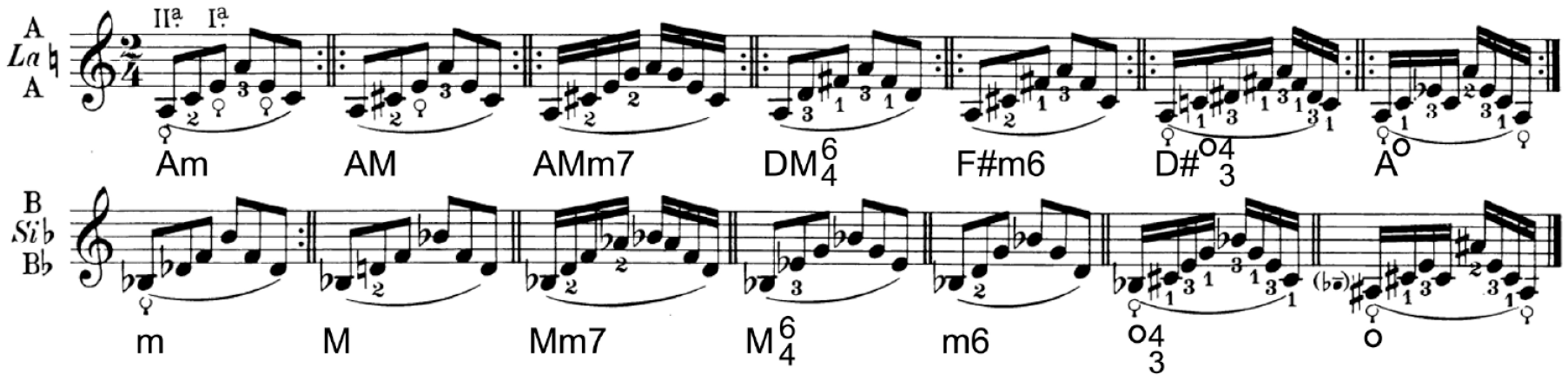
Excerpt from Exercices journaliers pour violoncello (1919) by Louis R. Feuillard with chord labels.
Some notable etude and method books address thumb position in diatonic ways that easily allow for an aural framework such as solfege to be superimposed. Hans Jørgen Jensen’s (1998) Fun in Thumb Position simply requires the handwritten addition of solfege and some singing to guide students’ ears toward accurate intonation in higher registers. Vance and Costanzi’s (2000) Progressive Repertoire for the Double Bass and Richard Mooney’s (1998) Thumb Position for Cello similarly include many diatonic thumb position melodies that are idiomatic to the geography of their respective instruments. Solfege and singing can be easily used with these resources to help students hear and understand the basic musical structures present in the melodies and link that understanding to their technical skills.
Create Etudes from Repertoire
When teaching difficult passages in the upper register, teachers may already isolate those passages into miniature etudes. Through the lens of integrating and transferring aural skills to performance, teachers might also consider repeatedly emphasizing the theoretical and aural context of the passage as well. Consider the following passage for cello from Pyotr Tchaikovsky’s Pezzo capriccioso, Op. 62 (Tchaikovsky 1888) in Figure 3. While this piece is arguably for higher level players, it highlights how aural and theoretical skills can be transferred even while working with technically advanced students. Teaching for transfer with such pieces may be particularly important for college students who did not receive any aural or theoretical training before their freshman year, a fairly common instance. Figure 3 shows the passage labeled with a repeating melodic fragment with the first note of each repetition outlining “mi-re-do-ti-do.” Because the same fragment is continually shifted down a step along the D major scale, the sequence of half and whole steps in the motif changes for each repetition. If a student can recognize how the melodic fragment is shifted diatonically and can use solfege and singing to learn how to audiate and understand these shifts, the changes in half and whole steps between repetitions are understandable and therefore easier to navigate. Without that theoretical and aural framework, the passage could appear to be a random assortment of half and whole steps that would subsequently be much more difficult to learn and later memorize. Passages from the most elementary repertoire to the most demanding concertos can be made into etudes for integration and transference to help students at all levels gain and apply music theory and aural skills to their playing.

Excerpt from Pyotr Tchaikovsky’s Pezzo capriccioso, Op. 62 (Tchaikovsky 1888), mm. 129-131 with solfege and structural elements, like motivic repetition, labeled.
Create Original Exercises
Teachers can also generate their own original miniature etudes that promote theory and aural skills in upper position playing. Figure 4 presents an example of an originally composed etude for mapping inversions of a major triad in thumb position on double bass. This exercise combines the mechanical approach of training hand shape using stepwise motion on one string, while also guiding students toward understanding intervals across strings within a single hand frame. A common strategy for students learning to audiate and sight-sing intervals is to “fill in the blanks” with stepwise motion, which is built into this etude. While Figure 4 is in D major, it is intended to then be shifted into other keys, which is made possible through the framework of movable “do” solfege.

“Thinking in Thumb Position by Thinking in Solfege,” an etude for mapping inversions of a major triad in thumb position on double bass.
Use Exercises from Aural Skills Texts
Fortunately, there are an abundance of texts that aural skills instructors use to sequentially guide students toward improving their audiation such as A New Approach to Sight Singing (6th ed.) (Berkowitz et al. 2017), Sight Singing Complete (8th ed.) (Carr et al. 2015), and Anthology for Sight Singing (Karpinski and Kram 2017). These books contain simple melodies and tunes that feature basic structural elements of music in increasing difficulty. For example, earlier melodies might strongly feature major scales while later ones might outline dominant seventh chords. While intended for sight singing practice, these texts can easily be transferred to practice on an instrument to provide supplemental diatonic practice in upper position playing in a variety of keys. Students can use the same finger patterns learned through rote mechanical exercises, but in a simple, digestible diatonic context—a context in miniature. Additionally, these sight singing exercises are of course particularly well-suited for integrating solfege into lessons. Outside of these texts, other famous simple tunes, such as Happy Birthday, can be similarly useful.
Benefits of Connecting Aural Skills to Upper Position Playing
Teaching for transfer and incorporating aural skills into lower string pedagogy offers many potential benefits. Music theory and aural skills help students understand the hierarchical structures and patterns music contains. Incorporating aural skills into exercises for upper position playing may help students connect structural knowledge to the physical maneuvers of that part of the instrument. Such connection would help them gain a stronger geographical understanding of the upper fingerboard, crucially improving their ability to understand spatial relationships in different hand positions, particularly across strings. Furthermore, methods like those outlined above can help students understand how a certain hand frame fits into a diatonic context. The half and whole step distances between fingers no longer seem random but are seen in relevance with the key and with which finger is on the tonic.
Understanding how the upper fingerboard is laid out harmonically and spatially enables students to approach that part of the fingerboard with greater confidence and artistic agency. Students can use this knowledge to forge their own technically advantageous and expressive fingering patterns, furthering their development into independent musicians. Additionally, once students internalize solfege through the regular application of aural skills in lessons, key and clef are no longer obstacles. With solfege, Ab major is no more difficult than D major, excepting the absence of open strings or harmonics. Likewise, tenor clef or even alto clef are no more complex than treble or bass clef when reading intervals within an aural framework. Finally, for college-level students, implementing aural skills in string pedagogy helps them transfer their theory knowledge fully into real music practice, completing the transfer of knowledge that aural skill instructors aim to accomplish.
Conclusion
We hope these methods will be helpful for teachers who want to give their students a strong understanding of the upper fingerboard, of aural skills and music theory in their playing more broadly, and ultimately more independence and confidence as expressive musical performers. Although this article is intended for lower string studio teachers, orchestra teachers could incorporate many of these concepts into their classroom teaching as well. With solfege and teaching for transfer, orchestra teachers can help students develop a solid aural foundation for upper position playing, making them feel more supported when they venture into the higher regions of their fingerboard for challenging orchestral excerpts or far-reaching scales, arpeggios, or other technical exercises. Furthermore, we hope these ideas might inspire further method book developments for lower strings that incorporate aural skills into string pedagogy and focus on teaching for transfer.
Footnotes

Detailed Summary of Pedagogical Materials
Berkowitz, Sol, Gabriel Fontrier, Leo Kraft, Perry Goldstein, and Edward M. Smaldone. 2017. A New Approach to Sight Singing. 6th ed. New York: W.W. Norton.
Billé, Isaia. 1922. Nuovo Metodo per Contrabbasso [New method for double-bass]. 7 vols. Milan: Ricordi.
Carr, Maureen, Bruce Benward, Taylor Greer, Eric McKee, and Phillip Torbert. 2015. Sight Singing Complete. 8th ed. New York: McGraw-Hill Education.
Duport, Jean-Louis. 1806. Twenty-One Etudes: For Cello. Leipzig: C. F. Peters.
Feuillard, Louis. 1919. Exercices Journaliers Pour Violoncello. Berlin: Schott Music.
Jensen, Hans Jørgen. 1998 Fun in Thumb Position. Ann Arbor, MI: Shar Products.
Karpinski, Gary S., and Richard Kram. 2017. Anthology for Sight Singing. 2nd ed. New York: W.W. Norton.
Mooney, Rick. 1998. Thumb Position for Cello. Vol. 1. Evanston, IL: Summy-Birchard.
Petracchi, Francesco. 1982. Simplified Higher Technique for Double Bass. Rome: Yorke.
Popper, David. 1901. High School of Cello Playing. Van Nuys: Alfred Publishing.
Rabbath, Francois. 1980. Nouvelle Technique de la Contrabasse. Vol. 2. Cincinnati: Liben Music.
Streicher, Ludwig. 1978. My Way of Playing the Double Bass. Vol. 4. Vienna: Doblinger.
Suzuki, Shinichi. 1984. Suzuki Cello School. Vol. 6. Evanston, IL: Summy-Birchard.
Tchaikovsky, Pyotr. 1888. Pezzo Capriccioso, Op. 62. Moscow: P. Jurgenson.
Vance, George, and Annette Costanzi. 2000. Progressive Repertoire for the Double Bass. Vol. 1. New York: Carl Fischer.
Caitlyn Trevor (
Aaron Yackley (