



Abstract
How do some families manage to entrench themselves in the upper class for many generations while others do not? Bringing together economic sociology, political sociology, and stratification, I introduce a concept for the study of multigenerational persistence at the top of a stratified society: kinship interlocks. Kinship interlocks are portions of a kinship network that closely combine great wealth, status, and power. Just as board interlocks connect corporate elites through overlapping board memberships, kinship interlocks connect economic, social, and political elites through family ties. Using a mixed-methods analysis, I find that the intimate exchange of resources in kinship interlocks generates upper-class persistence via two primary mechanisms: it protects kin from economic, legal, and social risk, and it propels kin into higher strata. Processes of kin formation and intimate exchange are co-constitutive with systems of gender, sexuality, and race, such that the most durable portions of an upper class are especially heteronormative and racially dominant. The analysis is based on a unique dataset consisting of the full upper class and all economic, political, and social elites in the first 122 years of Dallas, Texas, along with all mutual family ties.
Dallas billionaire Trammell Crow (1914–2009) wasn’t born to wealth or status, but his wife was, and that’s how he made his first big deal: with her inheritance, at her flower show, with her friend’s husband (Jennings 1984:5E). Lester Crawford (1897–1988) had no fortune, but his mother did, and when he murdered a man in the lobby of a bank, that’s how she got him the Governor’s pardon: with a bribe, using wealth and political ties she built through her marriages. 1 Agnes Stacy (1897–1981) was no political elite, but her daughter was, as were her father, her son-in-law, and her niece’s father-in-law, 2 and that’s how her Camp Mystic became the modal choice for daughters of Texas governors, generating family status and wealth well after her death (Swartz 2011). In each of these cases, elites shared resources with kin, protecting them from risk and providing them with opportunities, as part of a collaborative effort to cement their families in the upper class. They participated in a multidimensional, multi-person process, in which wealth, status, and power combined, spread, shifted, and transmuted across close kin ties. These cases are instructive for social scientists, who typically conceptualize “elites” as individuals with “vastly disproportionate” control over one kind of resource (Khan 2012:361). But when it comes to the family “class project” of upper-class persistence (Hamilton and Armstrong 2021), effectively, all fortunes are family fortunes, all power is family power, and all status is family status.
Upper-class people generally want to cultivate upper-class heirs, and they often succeed (Bourdieu 1990). Each of these introductory examples describes families who were able to entrench themselves in the upper class because they formed what I call kinship interlocks: that is, portions of a kinship network where every node is, or is directly tied to, at least one economic, social, and political elite. In a Weberian framework, kinship interlocks roughly translate to localized, multi-person extremes of Weber’s (2018) class, status, and party triad. Just as board interlocks connect corporate elites through overlapping board memberships (Mizruchi 1996), kinship interlocks connect a setting’s richest, most powerful, and highest-status people through family ties. Just as information flows through weak ties (Granovetter 1973) and structural holes (Burt 1992) leading to market advantages, resources flow through kinship interlocks, generating upper-class persistence. The intimate exchange of resources in kinship interlocks generates upper-class persistence through two primary mechanisms: (1) it protects kin from economic, social, and legal risk, and (2) it propels kin into more resources, both through “big jumps” and the more gradual, multidimensional, interpersonal cumulation of advantage (Mills [1956] 2000; Toft and Hansen 2022). Kinship and intimate exchange are constituted by race, gender, and sexuality systems (Butler 2004; Rubin 1975) such that the protect and propel mechanisms break down when kin deviate from local norms of kin formation and relational work. I develop and test my argument with a mixed-methods analytic approach, leveraging a unique dataset consisting of all economic, political, and social elites in the first century and a quarter of Dallas history (1841 to 1963), the full upper class for the second half of that century, and all mutual family ties.
The term “kinship interlocks” is a reference to corporate interlocks, an elite network formation that has long been an empirical proxy for elite domination. “Perhaps the most studied network in the social sciences” over the past century has been the U.S. corporate interlock network (Chu and Davis 2016:714), and perhaps the most studied elites have been corporate board members, to the point that “much of what we know about elites in the United States and elsewhere comes from the study of corporate elites” (Chu and Mizruchi 2015:2). Corporate interlocks have been an empirical touchstone in a long debate over the nature of American democracy, wherein a cohesive interlock network meant the elite dominated politics, and a fragmented network meant a pluralist collection of interest groups ruled (e.g., Dahl 1974 and Rose 1967 versus Domhoff 1967; Hunter 1953; and Mills [1956] 2000). A similarly extensive literature asks whether elites circulate or persist over generations (e.g., Dupont and Rosenbloom 2018; Pareto 1935; and Schumpeter 1919 versus Ager, Boustan, and Eriksson 2021; Barone and Mocetti 2021; Stone and Stone 1984; and Wiener 1978); elite circulation, like elite fragmentation, has been framed as a precondition for democracy itself (Baltzell 1964:7). All such studies share the assumption that elite cohesion and persistence are socially consequential. But the binary nature of the debates, while empirically generative, render them ultimately unresolvable: how cohesive is cohesive (Mizruchi 1992:31), and how persistent is persistent (Stone and Stone 1984:286)? More interesting questions are when, which, and how elites connect and persist, and what connection and persistence might have to do with one another. Here, I delineate one form of elite cohesion, kinship interlocks, and connect it to one form of elite persistence, upper-class reproduction.
My analytic starting point is the observation from relational economic sociology that our most intimate ties are characterized by particularly dense resource flows (Bandelj 2020; Zelizer 2005, 2012). Corporate board colleagues might swap stock tips, but all people tend to share their wealth, status, and power mostly with close kin. Elites, by definition, have disproportionate resources (Khan 2012), and although the scope and shape vary, elite kin entanglement is likely a global-historical universal (O’Brien 2024). Because of this entanglement, and because elites are often “engines of inequality” (Khan 2015:94), elite kinship networks neatly connect economic sociology and stratification—a union many economic sociologists have called for (e.g., Tomaskovic-Devey et al. 2017). Elite kinship networks also tie together perspectives from stratification and political sociology, in the vein of Adams (2005), who argued that in settings where great wealth and power are largely inherited, elite kinship is constitutive of political economy. I build on those insights here, using a broad vision of intimate exchange that encompasses wealth, status, and power.
My argument also contributes to efforts in stratification and demography to measure kin ties beyond fathers and sons (Mare 2011), to study inequality categorically rather than in terms of bounded groups (Monk 2022), to bring power and relationality back into the study of inequality (Desmond and Clevenstine 2025; Tomaskovic-Devey and Avent-Holt 2019), including by “interlinking structural racism and heteropatriarchy” in the study of family structures (Cross, Fomby, and Letiecq 2022:482), and to examine multiple dimensions of stratification simultaneously, an approach that better captures multigenerational stickiness at the racialized extremes of a class structure (Easley and Baker 2023). I focus on the top of the stratification distribution, but as kinship networks become more widely available, this general approach—looking at the spread of wealth, status, and power across a continuous family fabric—could be applied to full populations. “To view inequality in a multigenerational perspective,” Mare (2011:19) observed, “not only do we need data and models, but we also need to describe new phenomena.” I offer kinship interlocks as one such phenomenon.
In Dallas, economic, political, and social elites were highly concentrated within one massive, tangled family web. Kinship interlocks spanned the core of that web, and they were especially durably upper class. Using a mixed-methods approach, I first argue that the intimate exchange of resources in kinship interlocks protects kin from risk. Second, I argue that the circulation of wealth, status, and power propels kin into ever-more resources by providing contexts for “big jumps” and the multidimensional, multi-person cumulation of advantage. Within each mechanism, I also provide examples of failed upper-class entrenchment. Upper-class entrenchment entails conformity to gendered, racialized norms of kin formation and relational work. Potential upper-class heirs who violated these norms risked exclusion from the protection and propulsion of kinship interlocks.
THE Strength of Kin Ties
Network Structures and Political-Economic Outcomes
Long traditions in economic and political sociology have linked abstract network structures to economic and political outcomes (Erikson and Occhiuto 2017; Smith-Doerr and Powell 2005). In economic sociology, analysts have mapped networks between market actors, theorized ties as conduits for information or trust, and linked structures to economic consequences. For example, “weak ties” match men to jobs (Granovetter 1973); “structural holes” give firms and individuals a competitive edge (Burt 1992); and denser networks facilitate peer-group lending (Biggart 2001). In most such studies, information and trust flow between market actors “like electric current through a circuit board,” producing forms of economic (dis)advantage (Uzzi 1997:63; quoted in Krippner 2001:795).
In political sociology, network studies have traditionally mapped ties between political actors, theorized ties as conduits for alliance and conflict, and connected these formations to the rise, fall, and functioning of states. Patrimonial elite networks expand state capacity in early stages of state formation and hinder it later (Adams 2005; McLean 2007); trust flows through cross-cutting social networks produce effective states (Tilly 2005; Wimmer 2011); dynamic conversational networks drive elite conflict (Zhang and Shi 2023); and positions in patronage networks motivate political elites’ mobilizations against the state (Gould 1996). Alliances and rivalries flow through political networks, shaping the rise and fall of polities.
Straddling economic and political sociology is the voluminous board interlocks literature. Board interlocks are networks of organizations linked through shared board members. Analysts have tied corporate interlocks (board interlocks between corporations) to corporate dominance and other political-economic outcomes, including political collusion (Moody and White 2003), state functioning (Mizruchi 2013), and the spread of ultra-high executive compensation (Kim, Kogut, and Yang 2015). Corporate interlocks have been so oft-studied in part because they were empirically central to the notorious pluralist-power elite debate, a drawn-out argument about whether the U.S. elite was cohesive, undergirded by the assumption that cohesion “would allow elites to act together to defend their interests” (Rohr 2025:507). Now it seems that U.S. corporate interlocks are shattering, to the point that “researchers can no longer use the corporate elite as a proxy for elites in general” (Chu and Davis 2016; Chu and Mizruchi 2015:2; Mizruchi 2013). Proposed alternative measures of elite cohesion include shared workplaces and schools (Bühlmann et al. 2024; Rohr 2025), “revolving door networks” (Li 2024), university boards (Eaton and Gibadullina 2025), and clubs (Cornwell and Dokshin 2014). All such forms of cohesion are worthy of serious study. So is kinship, particularly because it is so universal: elites everywhere tend to marry each other, and more often than anyone else, they tend to produce elite children.
In the embeddedness tradition of economic sociology, kinship has been mostly a background kind of “strong tie,” important only insofar as it shapes the presupposed “hard core of market behavior” (Krippner 2001:778), most typically by connecting people to jobs, shaping business ownership (Chung, Lee, and Zhu 2021; Zeitlin, Ewen, and Ratcliff 1974), or facilitating corporate unity as a backstage “mediating mechanism” (Domhoff 1967, 1970; Mizruchi 1992:21–22). But political sociology has more commonly focused on elite kinship networks in and of themselves, perhaps because in many systems, power is quite obviously inherited: as Zhang and Shi (2023:194) note, “elite politics . . . is the politics of kingship and kinship.” In a “remarkable convergence,” around the same time that Burt (1992) connected structural holes to economic dominance, Padgett and Ansell (1993) connected multiplex patrilineage centrality to political dominance (Breiger 1995:127). 3 Bro (2023) tied conflict in dense areas of a political elite kinship network to the ascendance of newcomers. But one of the most obvious potential consequences of elite kin structures—the multigenerational reproduction of political, economic, and social dominance—has primarily been the purview of stratification research, rather than political or economic sociology.
Processes of Upper-Class and Elite Persistence
Just as scholars have debated whether elites are fragmented or cohesive, they have also debated whether elite populations persist or circulate across generations. Elite persistence studies typically take a group of elites at one point in time and estimate the percentage with elite descendants some years later. These studies mostly envision families as patrilineal dynasties who live or die with the success of sons (e.g., Ager et al. 2021; Wiener 1978). The patrilineal approach aligns with classical theories of upper-class populations under capitalism, which generally follow a three-generation, patrilineal “regression to the mean” narrative (e.g., Jaher 1982; Levine 1980; Schumpeter 1919). Patrilineal persistence models mirror paradigmatic intergenerational stratification studies, which traditionally measure families as father-son pairs and model class transmission as a Markovian process. By assuming that families “regress to the mean” within a generation, these models elide the possibility of compounding (dis)advantage laterally and multigenerationally, an assumption that is especially problematic for the poles of a stratification distribution (Mare 2011).
The patrilineal model of elite persistence is inadequate because elites tend to marry each other, they tend to have elite children, and their resources flow well beyond the father-son tie (Goñi 2022; Mare 2011; Toft and Jarness 2021). As more kinship data has become digitized and linkable (Abramitzky et al. 2021; Song and Campbell 2017), scholars have increasingly looked beyond fathers and sons, finding that other kin ties also influence outcomes (Beller 2009; Chan and Boliver 2013; Hällsten and Pfeffer 2017). Relatedly, elite persistence studies have begun to gather more complex kinship networks (Benz et al. 2024; Legentilhomme and Leimgruber 2025; Reeves and Friedman 2024; Tisch and Ischinsky 2023), producing better measures of elite persistence rates (O’Brien 2024). Inevitably, elite persistence studies find that some elites persist and some do not, and “the unanswerable question is how large is ‘large’ and how small is ‘small’ when discussing social mobility” (Stone and Stone 1984:286). A more interesting question than whether elites persist is which elites persist, and how.
Qualitative studies, largely in the Bourdieusian tradition, have asked how elites do and do not persist, emphasizing the collaborative, contentious, and contingent aspects of upper-class reproduction (Bessière and Gollac 2023; Diaz and Rivera 2025; Khan 2011; Lareau 2022, 2026; Shiffer-Sebba 2025). Hamilton and Armstrong (2021:104) describe this process using the concept of “class projects,” “the bundled, ongoing, multigenerational” set of actions families engage in to achieve class goals. They found that in the United States, young white upper-class women tend to engage with their families in the project of “gender complementarity,” honing their presentations of white, heterosexual femininity to secure elite breadwinner husbands and remain upper class. Two other studies in the contemporary United States similarly highlight the persistent heteronormativity of upper-class reproduction. Lareau (2026) found that queer members of ultra-rich families are particularly vulnerable to disinheritance. Sherman (2021:130) found that some heirs are actively trying to redistribute their wealth, but doing so is difficult, because wealth is “embedded in a welter of personal and institutional relationships that incline toward hoarding,” such that redistribution means “challeng[ing] notions of good personhood, good parenthood, and good manhood.” Suggestively, “many” of the “class traitors” Sherman (2021:122) encountered were queer. Together, these studies suggest that upper-class reproduction in the United States is a collaborative family project that is still constituted by heteronormative kin formation and relational work. In this article, I knit together these more collaborative, sometimes-contentious processes of class reproduction with more abstract, structural ones, like the network-based cumulation of advantage.
Cumulative advantage and disadvantage—colloquially, “the rich get richer” and “the poor get poorer”—are well-established inequality-producing mechanisms (DiPrete and Eirich 2006) that are conceptually compatible with networks (DiMaggio and Garip 2012) and are better-equipped than Markovian models to capture class at the extremes. 4 Mills ([1956] 2000:110–11, quoted in Toft and Hansen 2022) described this process in two parts: ultra-rich people amass fortunes through the “big jump”—that is, “coming into a strategic position which allows [them] the chance to appropriate big money”—followed by the accumulation of advantages, “which is merely another way of saying that to him that hath shall be given.” Most applications of the cumulative advantage mechanism have been intrapersonal and economic or status-based, but Dal Bó, Dal Bó, and Snyder (2009) extend the concept to kin and power, finding that for U.S. politicians, “power begets power,” in that longer-serving legislators are more likely to have relatives follow them into Congress. In this article, I further extend the notions of cumulative advantage and the “big jump” to multiple kin types, generations, and resources, knitting these concepts together with studies of the rates and processes of upper-class persistence.
The Strength of Kin Ties
Network analysis and relational economic sociology are rarely combined. Whereas economic sociologists in the embeddedness tradition have extensively studied networks “solely in their structural aspect” as “a latticework of intricately intersecting ties” between market actors (Krippner 2001:799), relational economic sociologists have mostly (although not exclusively) used qualitative methods to illuminate the meaning-laden dynamics of intimate exchange (Bandelj 2020). But relational economic sociology is conceptually compatible with the study of patterned resource flows in elite kinship networks, because it envisions the economy not as separate from or embedded in intimate ties, but as constituted by them (Zelizer 2005, 2012). From this perspective, the economy is not a discrete realm sometimes shaped by the “strong ties” of kinship; rather, the economy is inextricable from and partially constituted by kinship. Indeed, all people tend to share and exchange resources with kin (Daw, Verdery, and Margolis 2016). People define their kin in part by resource flows; with inheritance, for example, people “mark the boundaries of their own kin group” (Finch and Mason 2000:86). Relational work explains how people do this: “in all economic action,” Zelizer (2012:145) argues, people draw boundaries around categories of relationships, “designate certain sorts of economic transactions as appropriate for the relation, bar other transactions as inappropriate, and adopt certain media for reckoning and facilitating economic transactions within the relation.” This relational, processual approach is especially well-suited to elites, who are highly kin-entangled, and who have “vastly disproportionate” resources to exchange (Khan 2012:361). Even Granovetter (1983:210) noted that “strong ties” may be particularly important for the upper class.
Kinship networks also help us tackle the longstanding problem of gender in the study of elites. Even the contemporary social science of elites is still mostly a study of rich and powerful men and their institutional networks. This makes sense, because in stratified societies, men typically monopolize wealth and power (Bessière and Gollac 2023; Keister, Thébaud, and Yavorsky 2022), and lists of individuals are easier to study at scale than are the families that surround them. But copious work demonstrates the centrality of elite families: showing that, for example, economic elites entrench their fortunes by spreading them across sprawling networks of kin and legal entities (Beckert and Stamm 2025; Shiffer-Sebba 2025); that resources flow in multiple directions through multiple types of kin (Diaz 2023); that wealthy families are still especially characterized by heterosexual marriages with “traditional” divisions of labor (Keister et al. 2022; Yavorsky et al. 2023), including male control of capital (Bessière and Gollac 2023; Lareau 2022); that queer members of wealthy families are still especially vulnerable to disinheritance (Lareau 2026), and may be especially likely to challenge wealth hoarding practices (Sherman 2021); that women’s resources become more valuable in the hands of men (Mears 2020), and that upper-class women perform essential connective and reproductive labor (Farrell 1993; Ostrander 1984), as well as economic and political work behind the scenes (Pak 2013). Together, these findings suggest that at the top of stratified societies, kinship may be especially constituted by rigid, hierarchical gender and sexuality systems. Understanding this association requires us to systematically study the families that surround individual tycoons and tyrants, rather than simply observing that tycoons and tyrants are mostly men. Kinship, not representation, is the key to understanding gender in the elite, because elites are highly kin-entangled, and gender/sexuality systems are constitutive of kinship networks (Rubin 1975).
In summary, this article combines economic sociology, political sociology, and stratification to build empirically-grounded theory about the process of upper-class persistence. Just as a long tradition of studies in economic and political sociology have analyzed the networked flows of information and alliance across corporations and polities, broadly connecting them to economic and political dominance, I study the networked flows of wealth, status, and power across families, connecting them to upper-class persistence. I rely on perspectives from relational economic sociology, which frame intimate exchange as partially constitutive of the economy, and on qualitative studies that demonstrate how central families are to the long-term dynamics of elite domination. Throughout, I work to combine the conceptual portability of an abstract, formal network analysis with the processual depth of qualitative case studies.
Case, Data, and Methods
The Case
The data cover the first century and a quarter of colonial settlement in Dallas, beginning with 1841, the year the first white settler squatted near the Trinity River, and ending in 1963, when President Kennedy was assassinated in Dallas. The first elite settlers were enslavers who moved to Dallas for the free land, which the Texas government had recently stolen from Jumano, Kiikaapoi, Tawakoni, and Wichita peoples (Native Land Digital 2025). The new enslaver-migrants were a continuation of the environmentally and socially destructive “family-based colonization” that characterized nineteenth-century U.S. settlement (Glenn 2015:56). Before and during the Civil War, more enslavers arrived in Dallas, hoping to prolong enslavement by moving further from the free states; 5 after Emancipation, they moved to Dallas as part of the Confederate Diaspora. The nascent power elite bribed and tricked their way into a railroad crossing by 1872 (Graff 2008); more wealthy merchants arrived, and local landowners became even richer. By 1885, the most elite social clubs were born; by 1890, Dallas was the biggest city in Texas, and by 1895, the city produced its first social register, an index of upper-class families.
Relative to upper classes in places like Boston (Amory 1947; Farrell 1993), New York (Accominotti, Khan, and Storer 2018), or Philadelphia (Baltzell 1958), the Dallas upper class in its first century had high rates of geographic and social mobility. Hundreds of well-resourced newcomers arrived every year; hundreds more left. As we shall see, more than half of the upper class in 1910 fell out of it by 1940, either because they had no descendants, they moved away, or they were genuinely downwardly mobile. Dallas elites did tend to marry one another, but they also regularly married outside their class. Despite these relatively high levels of mobility and moderate levels of endogamy, by the middle of the twentieth century, at least three-quarters of elites and the upper class had woven themselves into a single, massive “family web.” Studies mapping kinship networks between elites in more established settings at similar times, including Chile (Bro 2023), Germany (Tisch and Ischinsky 2023), Poland (Wroński and Minakowska 2025), and Switzerland (Armandola 2024; Benz et al. 2024), have revealed analogous family webs using significantly more restrictive sets of elites. The Dallas case demonstrates that elite kin entanglement can emerge from scratch in decades rather than centuries, and from moderate endogamy and steady circulation rather than universal endogamy and total persistence. In other words, elite kin entanglement likely arises to some extent in any stratified society.
The Dataset
The backbone of the analysis is a hand-constructed relational database encompassing the Dallas elite and upper class in its first 122 years (1841 to 1963; n = 20,524). I constructed the database using a huge array of archival sources, including the data compiled in AncestryLibrary.com (e.g., birth and death certificates, the manuscript Census, and marriage records), the Portal to Texas History (e.g., probate and genealogical records), and articles from the Dallas Morning News and Newspapers.com. I included anyone who could be considered elite or upper class in Dallas by any standard measure. For all individuals in the database, I compiled demographic information, organizational memberships, mutual kin ties, and multiple measures of wealth, status, and power, among many other data points. The process is analogous to family genealogical research, except more structured and larger scale.
In this article, I conceptually rely on Sahlins’s (2013:28) flexible definition of kinship as a “mutuality of being”: kin “are people who live each other’s lives and die each other’s deaths,” and who share a mutual responsibility for one another. Quantitatively, I assume the legally sanctified kin ties recorded in archival records are a good measure of these ties of mutuality. The qualitative case studies allow me to loosen that assumption and incorporate the lived complexities of kinship, especially by drawing on relational economic sociology.
The defining feature of the Dallas dataset is the scope and scale of kin entanglement. Most people in the dataset (at least 78 percent) were connected through close kin ties in a single, massive family web. Figure 1 depicts the full graph.
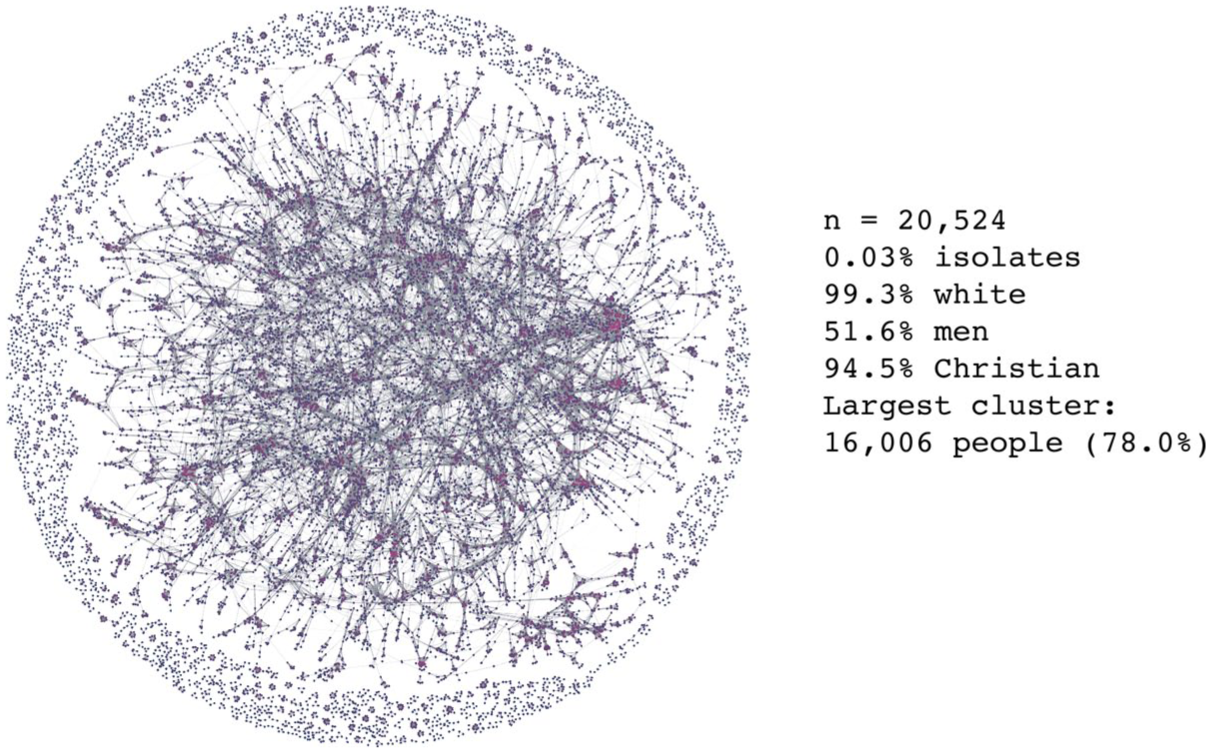
Full Kinship Network for the Dallas Elites and Upper-Class Database
Defining Key Categories and Concepts
I define kinship interlocks as subgraphs (or portions) of a kinship network in which every node is, or is directly tied to, at least one economic, political, and social elite. I link kinship interlocks to upper-class persistence, which I operationalize as whether upper-class lineages in 1910 survived the “stress test” of the Great Depression by persisting in the Dallas upper class after 1940. Surviving stress tests like economic depressions is a good measure of entrenchment for many institutions, including families (Starr 2019:3–4). Embedded in these measures are four overlapping sets of people: (1) all members of the Dallas upper class from 1895 to 1945, and all (2) political, (3) economic, and (4) social elites in Dallas from 1841 to 1963.
To make the analysis most directly comparable to other quantitative studies of elites, I define each set using any standard metric available in the archives. The upper-class population consists of everyone listed in the Dallas social registers published between 1895 and 1945. Political elites are elected officials and unofficial power brokers; economic elites are bank presidents and the richest people of various wealth distributions; and social elites are debutantes and members of the two most exclusive upper-class social clubs.6,7 In this section, I summarize my measurements for kinship interlocks, upper-class persistence, and each of the four overlapping sets of people. Part A of the online supplement includes all metrics and sources, demographic characteristics for each category and subcategory, and diagrams of the individual-level overlap between categories. Figure 2 depicts direct kin ties within the three elite groups and between people in kinship interlocks.

Kin Ties between Political, Economic, and Social Elites, and between People in Kinship Interlocks
Direct kin ties (n = 104,393), in this article, are spouses, parents, children, siblings, aunts, uncles, nieces, nephews, grandparents, grandchildren, and first cousins. This decision is based on qualitative accounts of kinship for this population, reflecting the set of ties through which bequests, favors, businesses, party invitations, job offers, and other resources tended to flow. Cumulatively, most of the upper class (76.2 percent), and most economic (85.7 percent), political (71.5 percent), and social (89.3 percent) elites, were traceably connected through kin in a single, massive hairball of relations and resources.
For year-specific analyses, I constructed the network based on birth, death, and marriage years, and I assumed that elites of each type “became” elite at age 30—except debutantes, who I assumed became socially elite in the years they debuted, typically around age 21. I assumed all elites stayed elite until death. I collected nearly all birth (99.6 percent) and death (92.1 percent) years, and most marriage start years (74.8 percent). When I did not have the marriage year for a couple, I assumed they married when the younger spouse was 21, the average age of the younger spouse in first marriages among the non-missing.
Political elites (n = 1,677) include all elected officials in Dallas from 1841 to 1963: mayors, the city council, judges, the school board, senators and representatives at the state and national levels, government attorneys, and all Texas governors who ever lived in Dallas. Political elites also include all presidents of the Dallas Bar Association, and all members of the Dallas Citizens Council, a group of unofficial power brokers that hand-picked candidates and wrote city policy for decades. White, Christian men overwhelmingly (93.7 percent), often violently (Prince 1993), dominated this category. Direct kin ties between political elites were rarer than direct ties between economic or social elites; most political elites (66.1 percent) were not directly related to other political elites, and the largest component in the network consisted of only 12 men—less than 1 percent of the total.
Economic elites (n = 2,615) include the wealthiest people in the city and those who controlled local economic institutions. I included any Dallas resident on state or national rich lists. I also included people in the top 1 percent or at 10 times the median of any wealth distribution I found (Alfani 2023). Because Texas was and is a community property state, meaning spouses equally own wealth acquired during their marriage, I included spouses of the ultra-wealthy from the year of the wealth measure. I also included people who controlled major economic institutions: bank presidents and presidents of the Dallas Chamber of Commerce. Economic control by these measures was almost entirely in the hands of men; the ownership of wealth was more evenly split between gender categories, which reflects the reality in historic Dallas and in many contemporary wealthy families (Bessière and Gollac 2023). I likely have the highest missingness rate for economic elites, particularly those who were only marginally economically elite, because wealth data are much rarer than lists of elected officials and elite club members.
Social elites (n = 2,549) include all members of the two most exclusive upper-class social clubs in the city—the Idlewild Club for men and the Shakespeare Club for women—along with all debutantes presented by the Idlewild Club. 8 I also included aristocrats, debutantes, and members of equivalent clubs from other cities. Each of these were baldly “racialized organizations” in that they only accepted white Christians (Ray 2019). Of the three elite groups, social elites were the most mutually entangled by kin; almost half were connected in a single cluster. Social status is more difficult to quantify than wealth or power, in part because it is more blatantly relational: power and wealth can be seized, but status must be given (Accominotti 2024). For the purposes of this article, I define social elites as the individuals who had the measurably highest social status within the upper class and among the economic and political elite. They also arguably had very high social status at the level of the city, because local newspapers reported extensively on high-society events, often down to the color of the tablecloths at a debutante’s dinner party.
Kinship interlocks are parts of a kinship network where each person sits within one kin tie of all three types of elites: economic, political, and social. These interlocks are family configurations in which everyone either controls or is directly proximate to great wealth, status, and power. In this case, kinship interlocks encompassed 21.2 percent of the upper class, 31.7 percent of political elites, 38.2 percent of economic elites, and 42.3 percent of social elites. Almost all people in kinship interlocks were part of the family web (at least 97.8 percent).
I measure the upper class (n = 12,353) as anyone listed in the Dallas social registers between 1895 and 1945; this is a standard measure for upper-class status in twentieth-century U.S. cities (Amory 1947; Baltzell 1963). Inclusion in the social registers meant a person was minimally rich and respected by other upper-class people. Not everyone who could plausibly be considered upper class was listed in the social registers, but everyone listed can reasonably be considered upper class. Binary measures indicate whether anyone in the dataset was listed in the registers after 1945 (new entrants in later registers are not yet fully added); I drew on this binary measure in the persistence analysis.
Mapping Basic Patterns of Persistence
I operationalize upper-class persistence as whether upper-class lineages in 1910 survived the “stress test” of the Great Depression. To measure persistence, I began with the kinship network and the upper class as they were in 1910. I looked at living adults, age 30 or older, who had been listed in the Dallas social registers at least once (n = 3,033). Some of these adults were elites or close kin of elites in 1910, and some were not. I broke these upper-class adults into subcategories depending on their elite status and kin ties in 1910. Then I calculated the percentage of each subcategory with descendants in the Dallas social registers after 1940.
If kinship interlocks were not more durably upper class than other sectors of the network, then they did not generate upper-class persistence. And if the multidimensional exchange of resources through kin had something to do with the process of upper-class persistence, then overall, kin ties to more kinds of elites should be associated with higher rates of upper-class persistence. The analysis, illustrated in Figure 3, confirms both points. 9

Family Upper-Class Persistence through the Great Depression
Overall, about 40 percent (39.7 percent) of the upper class persisted by this measure. Those who were in kinship interlocks persisted twice as often; most had upper-class descendants in Dallas after 1940 (82.2 percent). Among the upper-class adults who were only tied to one type of elite in 1910, those with economic elite ties persisted most often. This is unsurprising given the well-known protective qualities of great wealth. But importantly, these patterns of persistence cannot be reduced to wealth alone; those tied to social and political elites, but not economic elites, persisted more often than those tied only to economic elites.
These quantitative patterns are clear and intuitive: the more wealth, status, and power upper-class families amassed, the more often they remained upper-class decades later. To understand how kinship interlocks generated upper-class persistence, I will turn to qualitative case studies.
Whiteness, Elites, and the Upper Class
During its first century and a quarter, the U.S. Census reported that Dallas was, on average, roughly 80 percent white, 17 percent black, and 3 percent Latino. All people in kinship interlocks (100.00 percent), almost all the upper class (99.98 percent), and almost all economic (99.95 percent), social (99.96 percent), and political (99.27 percent) elites were socially categorized as white based on the state categories recorded in archival records, including the U.S. Census, birth certificates, and death certificates. This is not a sampling problem: it is a white supremacy problem. Dallas sprang from the triple wreckage of land theft, genocide, and enslavement. Although the system of racial domination morphed over time, from the start, white elites violently monopolized wealth of all kinds, power of all kinds, and status of all kinds (Phillips 2006). The whiteness of the Dallas elite and upper class reflects multi-scalar processes of racial domination (Wacquant 1997) and the co-constitutive nature of race and class, whereby the extreme tails of a stratification distribution are as characterized by race as they are by class (Torres 2025). There were many more black, indigenous, Latino, and other people of color in Dallas who were elite by analogous measures within racial categories. But here I will focus on the portion of the Dallas kinship network that monopolized “vastly disproportionate” resources relative to the full city population. That portion was not only socially categorized as white—it was the local core of whiteness, and the peak of white prototypicality.
Of course, not all white people were considered equally white, even within the upper class, with consequences for the composition of the populations in this article. The most salient intra-elite cleavages were religious. Jews composed about 7 percent of the Dallas upper class, compared to about 2 percent of the full city population. 10 But within the upper class, Christians marginalized Jews. Christian elites unofficially, but thoroughly, barred Jewish men and women from their most exclusive social clubs; they only accepted Jewish men as political elites at the lower levels; they unofficially, but practically, barred Jewish men from full participation in some lucrative industries like oil. Within the category of white Christian elites, there were more gradations; Episcopalians were the whitest, and Catholics were the most marginally white. These patterns of religion-based “segregated inclusion” (Accominotti et al. 2018) were common to upper classes throughout the contemporaneous United States (Baltzell 1964).
Racial domination in all these forms combined in the demographics of kinship interlocks. Kinship interlocks were not only all white—they were the most prototypically white. They were disproportionately Christian, and disproportionately Episcopalian. They were also the most durably upper class.
Analytic Design
Erikson (2013) divides network analysis into two distinct approaches: formalism, which identifies abstract network formations and ties them to social outcomes, and relationalism, which focuses on the dynamic, lived relationships that compose networks. Sometimes scholars combine the two, “preserving the relationalist emphasis” on lived sociality while “embedding it within a larger, formal description of the network structure” (Erikson and Occhiuto 2017:234). This is my approach here: I sketch a structural pattern with a formalist analysis, and I trace the processes and contingencies shaping that structure with a relationalist approach.
More precisely, I first identified a network structure (kinship interlocks), and I connected it to an outcome (upper-class persistence). I then used that formalist structure as a sampling frame for qualitative case studies. I randomly sampled families at each possible intersection of elite kin ties and persistence illustrated in Figure 3, using an array of historical sources to trace the story of their family’s class (non)-persistence. I randomly sampled at least three case studies, and as many as nine, at each intersection of kin position and persistence, for a total of 76 cases. To ensure the mechanisms held outside the specific slice of the upper class in the persistence analysis, I also did analogous case studies for the families surrounding 30 people randomly sampled from the full upper-class population. I reviewed a large collection of memoirs, news articles, and histories covering this population, both to enrich the case studies and to learn from other narratives of family mobility and persistence. The full set of cases included families that fit the formalist pattern, defied the pattern, and everything in between.
As I worked through the case studies, I inductively identified mechanisms that seemed to link the structure to the outcome, tested those mechanisms whenever possible with quantitative analyses, refined the possible mechanisms with more qualitative studies, and so on until the mechanisms helped explain the processes of (non)-persistence for a plurality of cases. Part B of the online supplement features an illustration of the full sampling frame, summaries of all 106 randomly sampled cases, and a list of the memoirs and histories I reviewed. All the cases I describe here are from the random samples, except for the case of John T. Higginbotham Jr., which comes from a book by an investigative journalist (Pederson 2024), and the first introductory example, which comes from a news article (Jennings 1984).
Processes of Persistence and Non-Persistence
A Case Study Overview, with Four Examples
I begin the processual portion of this analysis with a general overview of the most common themes of (non)-persistence from the case studies, organized into a two-by-two in Figure 4. 11 Persistent kinship interlocks (the top-left box) featured a general absence of risk, coupled with the steady, continual accumulation of resources. Non-persistent non-kinship interlocks (the bottom-right box) were typically genuinely downwardly mobile. Non-persistent kinship interlocks (the top-right box) typically suffered major family scandals; simply did not have children, nieces, or nephews; or moved away. Persistent non-kinship interlocks (the bottom-left box) often became kinship interlocks, or near-kinship interlocks, by steadily accumulating more resources; some of the most remarkable such cases featured a successful family business. Endogamy was key to upper-class persistence across the board: persistent lineages consistently featured endogamous marriages, and non-persistent families often featured multiple marriages to middle- or working-class spouses. Exogamy seems to have been both a cause and a consequence of downward mobility.

How Did Families Persist or Not? Case Study Themes
I will now illustrate these overall themes with four examples from the case studies: one pair that follows the general pattern of kinship interlocks generating persistence, and one pair that defies the pattern. First, consider two pattern-fitters: Betty Hearne Aldredge (1854–1937) and Agnes Burke Marshall (1857–1930). By any standard individual measure of wealth, status, power, or demography, Betty and Agnes look practically identical. They were both white, Protestant, Dallas housewives and mothers from the rural U.S. South. They were born in the same decade, and they died in the same decade, leaving fortunes of about the same size. Neither was a politician; neither made a debut. They were similar enough, across dimensions and decades, to be paired in a matching analysis based on individual observables. But Agnes’s descendants fell out of the upper class almost a century ago, and Betty’s are still entrenched in the Dallas elite today. What made the difference? Their families. Agnes was only marginally upper class, and Betty was in a kinship interlock. Figures 5 and 6 are abbreviated maps of their kinship networks, depicting all their husbands, parents, parents-in-law, children, children-in-law, and grandchildren, and they show how differently-resourced their families were. (Betty’s graph also includes a few additional relatives, because I discuss them in upcoming sections.)
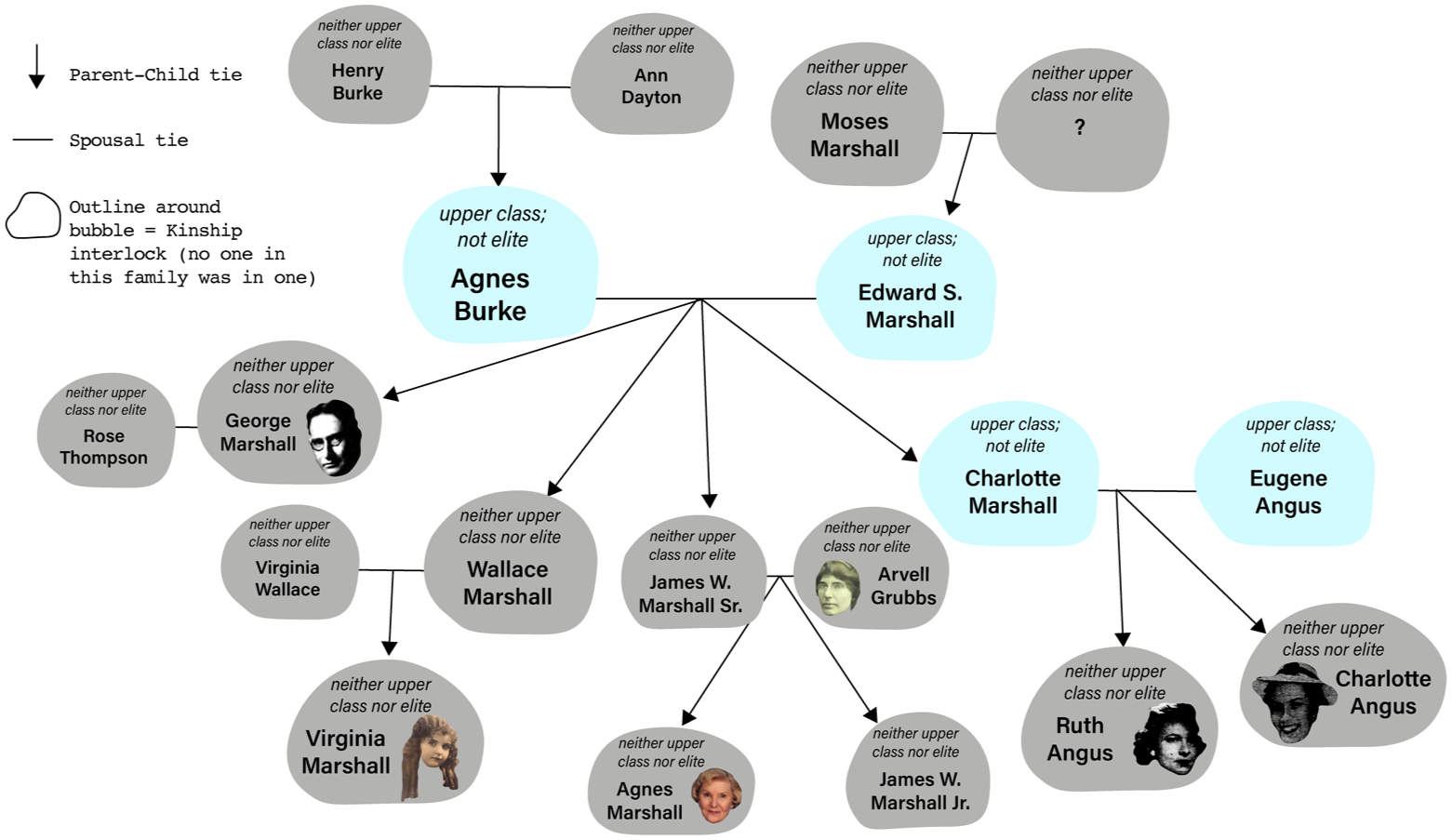
Abbreviated Family Network: Agnes Burke Marshall
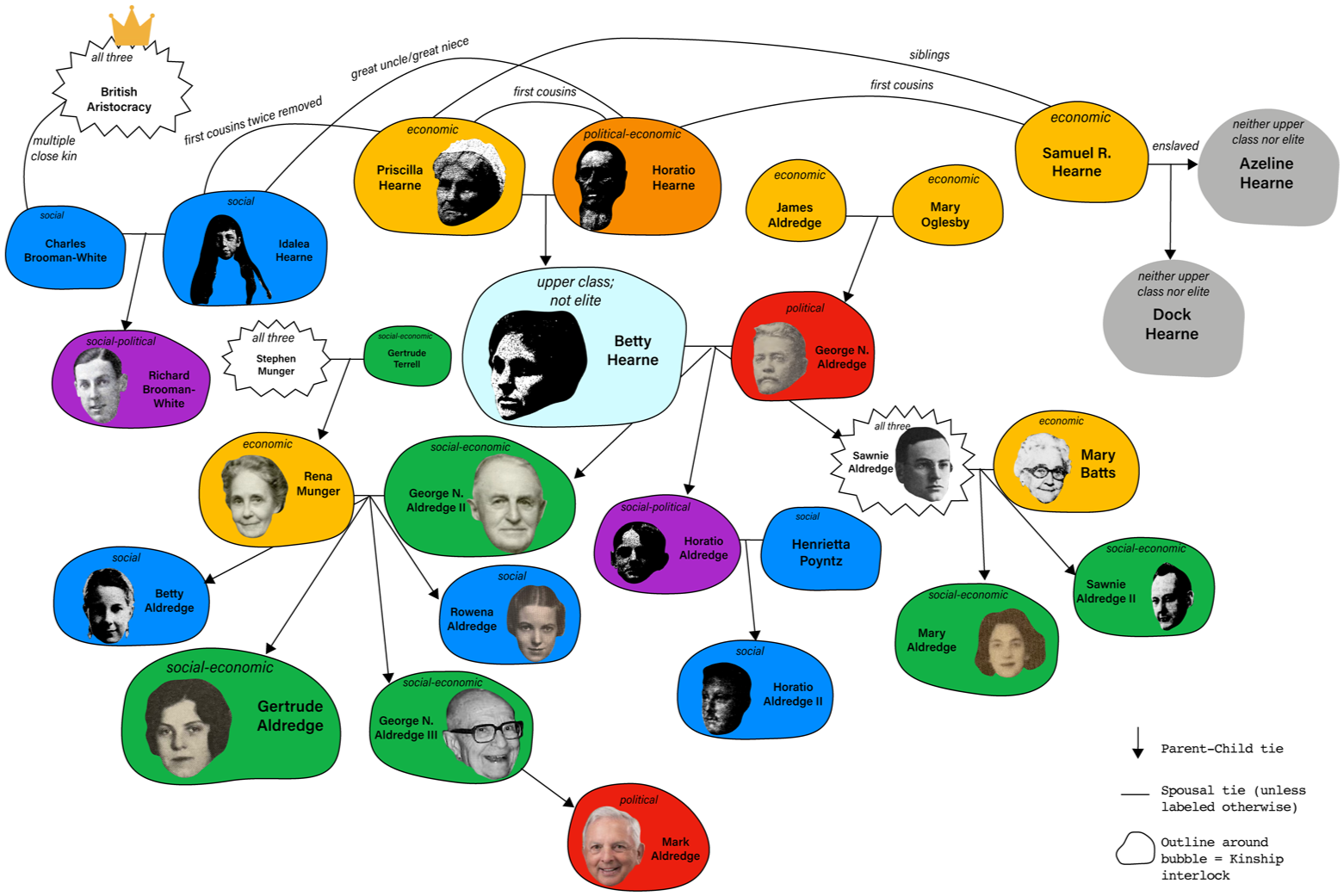
Abbreviated Family Network: Betty Hearne Aldredge
Agnes was upwardly mobile. Her mother was a dressmaker, and her father and brother were machinists. Her husband, born to poor Irish immigrants, rose through the ranks of an oil company that brought them to Dallas. Their daughter married another upwardly mobile oilman, producing two solidly upper-middle-class daughters, but their three sons became salesmen and machinists and married middle- and working-class women. Agnes’s children and grandchildren were more economically secure than she was in her childhood, but still, they generally followed a Markovian, two-generation process of “regressing to the mean.” 12
Betty, on the other hand, was born on a massive plantation in a town named for her cousin, where her parents, who were also cousins, enslaved more than 40 people. She moved to Dallas as a bride, where her husband George became district judge. She successfully raised three elite children: George Jr. became a banker, Horatio became an engineer, and Sawnie became mayor of Dallas. All her sons married upper-class women with significant family resources of their own. None of Agnes’s granddaughters made a debut, but all Betty’s granddaughters did, as did several great-granddaughters and many other kin. Her descendants are still entrenched in the Dallas upper class today; as recently as 2026, Betty’s great-grandson Mark was Mayor Pro Tem of University Park, an incorporated enclave in the center of Dallas. As I will argue, the intimate exchange of wealth, status, and power in Betty’s family protected them from risk and propelled them into more resources. These mechanisms explain how Betty’s family persisted when Agnes’s did not, and how the Dallas upper class has persisted overall, as a continuous set of dense, normative, heavily-resourced relations.
But some families defied the general pattern. Consider another paired example: Meyer Lichtenstein (1852–1919) and Charles Allen Culberson (1855–1925). Like Agnes and Betty, Meyer and Charles were both white upper-class Dallasites who died and were born within years of one other. And like Agnes and Betty, their family resources in 1910 looked very different: Meyer had no elite kin ties, and Charles was in a kinship interlock. If they conformed neatly to the overall persistence pattern, then Charles’s family would have remained upper class for decades, and Meyer’s would have been downwardly mobile. But the opposite was true: by 1940, Meyer’s descendants ranked among the city’s richest and most powerful, and Charles’s had disappeared. What happened? Charles’s daughter sparked a scandal, and Meyer’s founded Neiman-Marcus.
In 1910, Meyer Lichtenstein was a marginally upper-class Jewish salesman. His daughter Minnie married Herbert Marcus, who was, according to a much-richer family friend, “so poor that they had to live with her parents” (Harris 1979:168). But they joined with his sister and brother-in-law to launch a luxury department store called Neiman-Marcus. It was increasingly successful; within a few decades, they were fabulously wealthy, and the company was so vital to the upper class that socialites called it simply “The Store.” Minnie’s son Stanley took over the business in 1950, launched it onto the international stage, and became one of the most powerful political and social operators in the region—to the point that even though his Judaism “kept [him] from membership” in Dallas’s most elite social clubs, “when the richest and most powerful members of those clubs went to San Francisco or London and were introduced as being from Dallas, the first thing they were asked was almost invariably, ‘Do you know Stanley Marcus?’” (Harris 1979:195). By launching a lucrative and prestigious family business, Meyer’s descendants successfully entrenched themselves in the upper class—despite elite anti-Semitism, and despite their relative lack of resources decades earlier.
Charles Culberson, on the other hand, was securely situated in a kinship interlock in 1910, awash in all the status and power largely denied to Jews like Meyer. He was a member of the ultra-exclusive Idlewild Club, he was the minority leader of the U.S. Senate, and before that, he had been Governor of Texas. Charles had political elites on both sides of his family, and his wife Sallie inherited a massive enslaver fortune. They had only one child, Mary, who neatly conformed to the upper-class norm—until she fell in love with a shellshocked British veteran named Alex Robertson with no money or status to speak of. Alex asked Charles for permission to marry her, and Charles responded by hiring a private detective to kidnap him and bundle him on a steamship to Buenos Aires. The British Embassy then intervened, generating international headlines that precipitated Charles’s retirement from the Senate (e.g., New York Times 1922:1). Charles and Sallie soon died, their power and status much-diminished, and their wealth stored in a trust fund for Mary—who then married Alex, divorced him, and died childless in Palm Beach at 60. The formerly illustrious Culbersons were never listed in the social registers again. They were not unique in their drama; more than half the sampled cases of non-persistent kinship interlocks featured at least one massive scandal. The striking concentration of scandals in non-persistent kinship interlocks suggests that while kinship interlocks were not invulnerable, they were remarkably robust. At these multidimensional extremes of advantage, falling out of the upper class more often entailed a cluster of catastrophes than a gradual, Markovian regression to the mean.
The Rules of the Game
The case studies make clear that upper-class persistence was not always a seamless or successful project. Even within successfully entrenched kinship interlocks, individual family members did not always benefit equally from their bounty. As I will demonstrate, the Dallas upper class entirely excluded black biological kin from the protection and propulsion of kinship interlocks, and kin who failed to form endogamous heteropatriarchal families or successfully perform gendered labor did not “receive the same rewards” of protection and propulsion as kin who were willing and able to conform (Cross et al. 2022:484).
Conforming meant following the “rules of the game” for kin formation (Bourdieu 1990): rules that were co-constitutive with local systems of race, gender, and sexuality. Only certain combinations of persons could marry; only certain processes could produce “legitimate” children. (In this case, individuals could not marry someone outside whiteness or near its margins; they could only marry an unmarried person in the opposite gender category; they were ideally supposed to marry someone with equivalent or complementary family resources; and “legitimate” children had to be, at least publicly, the children of both spouses, conceived after a marriage ceremony, or perhaps adopted.)
Intimate exchange, too, had its rules. Particular forms of wealth, status, and power could only flow through particular kin ties. (A man could make his brother the president of his insurance company, but not his sister; a socialite could secure a debut for her niece, but not her nephew; a judge could get his son a job as the assistant district attorney, but not his secret girlfriend; an heiress could leave her fortune to a long-ago lesbian lover, but her siblings might sue [O’Brien 2025b].) Kin were expected to wield resources in particular ways for the benefit of particular relations. (All upper-class adults were expected to feed, house, clothe, and school their “legitimate” children in the upper-class style, plus husbandless and fatherless close kin as-needed; men were expected to manage the family capital, draw incomes from market-based labor, and match male kin with jobs; women were expected to manage domestic workers, supervise the gendered elite socialization of children, and arrange favors, parties, and other connective boons for all kin; and everyone was expected to leave their wealth to their close kin when they died, matching properties and portions to heirs in gendered ways, such that businesses went to men, and trusts and durable consumption assets went to women [O’Brien 2024, 2025a].)
Conformity to these rules paid huge dividends, protecting kin from risk and propelling them into higher strata. Divergence from the rules of kin formation could generate massive scandals that placed the family status in jeopardy, and that could fling even a kinship interlock out of the upper class. Divergence from the rules of intimate exchange could spawn relational mismatches within families—highly emotional disagreements over the proper matching of transactions, relations, and media (Zelizer 2005:53)—which could have dire consequences, like severance from the family altogether. The rules ranged from formal laws to tacit knowledge: some rules were codified in the legal system (e.g., the prohibition against “interracial” marriage); some were more implicit understandings of the way things worked (e.g., women planned parties). Breaking the rules could prevent upper-class persistence, both in and outside kinship interlocks.
Protect
Insulation from Downward Mobility
The lives of people in kinship interlocks often featured a marked absence of economic precarity. Take, for example, Betty Aldredge’s granddaughter Gertrude (1907–1993). Gertrude’s debutante ball was scheduled for November 1, 1929: a week after the stock market crash that launched the Great Depression. But they “were hardly aware of it,” Gertrude later remembered. “Our plans were all made when the stock market crashed and we went on with our plans” (Castleberry 1994:478). In contrast, Agnes’s sons spent the Great Depression in modest, rented homes, working as machinists and salesmen. In rare cases where people in kinship interlocks really did lose their fortunes, they could leverage their access to power and status to recover economically. The multidimensional, multi-person nature of a kinship interlock provided security, much as a diversified wealth portfolio provides security, such that when wealth disappeared in one sector of a kinship interlock, the other elements could shield kin from permanent downward mobility—especially when kin followed the rules.
Consider Inez Thomas (1893–1974) and her daughter Sharon Rubush (1930–present), who were both born into a kinship interlock, depicted in Figure 7. Whereas Betty and Gertrude’s kinship interlock was deep and dense, Inez and Sharon’s kinship interlock was sparse, consisting mostly of Inez’s father, Mike H. Thomas (1866–1943), a millionaire cotton broker who was an economic, political, and social elite. Mike and his progeny split their time between Dallas, where they presided over a palatial estate in the center of the city, and London, where at one point, Inez dated the Prince of Wales. Inez was not only a debutante, but the lead debutante in the 1915 Idlewild Ball. With her family’s blessing, Inez married a charming but penniless carpenter’s son, Bill Rubush, and gave birth to Sharon while wearing a string of pearls.
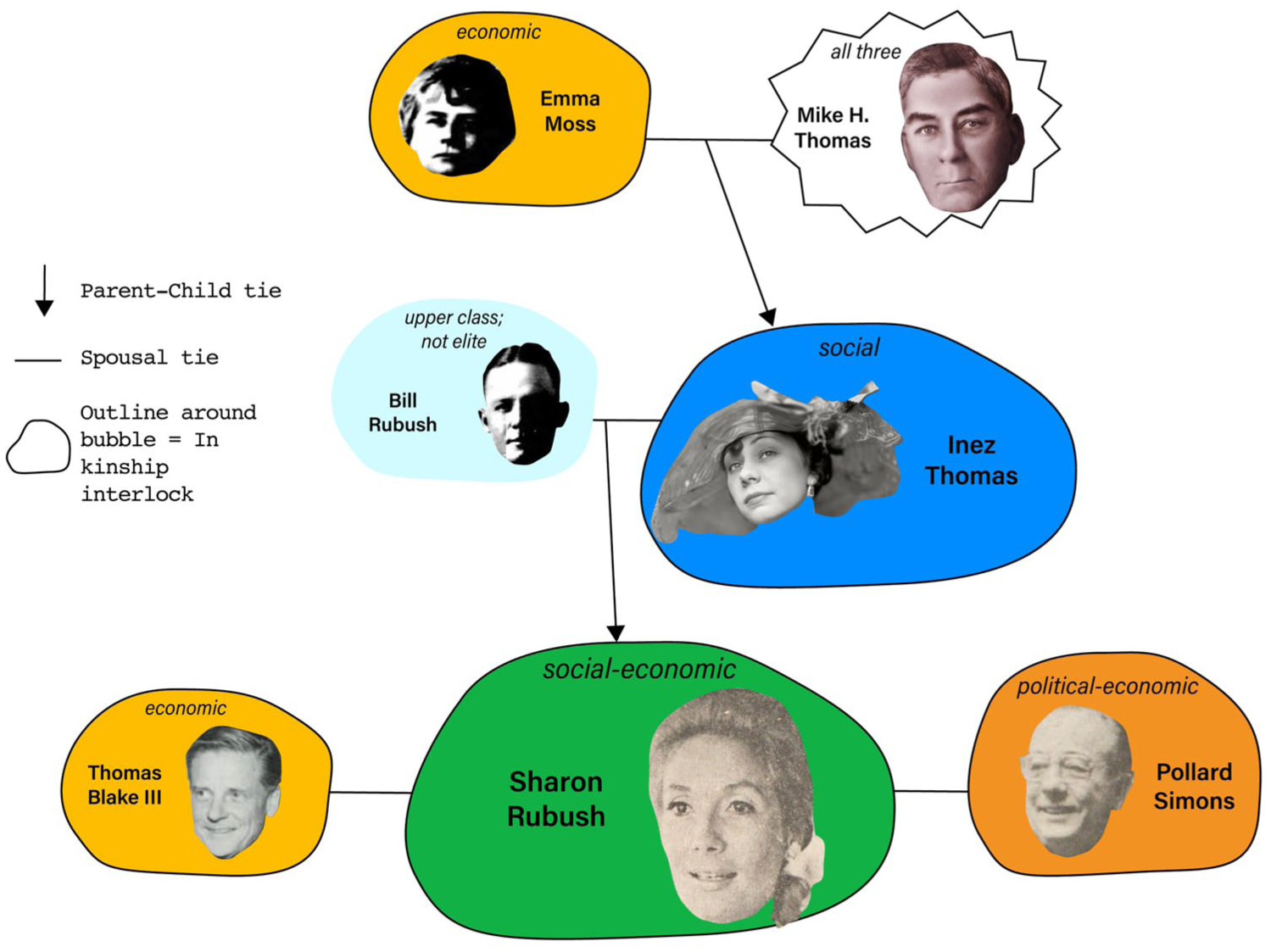
Abbreviated Family Network: Inez Thomas and Sharon Rubush
But Sharon was born in a troubled time. As the stock market crashed, so did Mike’s fortune, and colossal debts began to mount. Mike spent the last years of his life squatting in the empty family mansion, warding off creditors with a shotgun (Hill, Boyar, and Boyar 1994; Macatee 2008). The whole family dropped out of the social registers. Inez began selling homemade pickles to keep Sharon in private school, and they both modeled at Neiman-Marcus to keep themselves afloat. Eventually, Sharon’s father took his own life in despair. But Inez remained high status, and when the time came, the men of the Idlewild Club asked Sharon to debut, even waving the expectation that Inez would pay for a ball. Inez “pressed her daughter to say yes,” hoping it “would preserve her daughter’s position in society and lead to a ‘good match’” (Pederson 2024:168). Sharon borrowed a dress from her godmother, made the debut, and within months, married Tom Blake, a 40-year-old Houston oilman in a kinship interlock of his own. As she later explained, “With him, there was no ‘chicken today, feathers tomorrow,’” meaning he was durably rich (Greenburg 1981). Inez never sold pickles again.
Colossal fortunes did dwindle, but they rarely disappeared in a single whoosh, in part because the ultra-rich tended to entrench their fortunes by spreading them across a maze of legal entities and kin (Shiffer-Sebba 2025). Mike Thomas seems to have totally failed to protect his wealth that way, but he did fund his daughter’s socially elite upbringing; ultimately, it was the status she accrued and passed on to Sharon that facilitated their return to the upper class. Upper-class entrenchment, then, is not driven by wealth alone: even in this extreme case, when a fortune genuinely was lost, status could bring wealth and power back. 13 This finding supports a point Weber ([1921] 1968) made over a century ago: status distinctions can be especially durable relative to economic ones. This finding also supports the idea that endogamous marriage protects upper-class people from permanent downward mobility. Inez may have broken that rule of the game by marrying Sharon’s penniless father, but Sharon followed the rule assiduously, and her family benefited. As one upper-class woman from the U.S. Midwest told Ostrander (1984:59), “My family lost everything in the crash of ’29. But it’s all worked out, because I married well.”
Protection from Legal and Social Risk
The upper class may have had to follow the rules of the persistence game, but they broke other rules all the time. The wealth, status, and power of a kinship interlock protected kin from legal risk and subsequent scandals, allowing them to get away with oodles of illegal and nefarious deeds, including enslavement, embezzlement, tax evasion, arson, sex trafficking, wage theft, bank robberies, child labor, and multiple public murders. Betty’s family sports this pattern, too, albeit a benign version. Gertrude, who made her debut the day after the stock market crashed, spent years smuggling crates of birth control into Dallas for Planned Parenthood. It was highly illegal, but no one was going to arrest a debutante from one of the richest, most powerful families in the city (Castleberry 1994). Gertrude avoided prosecution, and her family avoided social scandal.
It was easiest for elites to get away with exploiting and abusing the highly disadvantaged. But if they were well-positioned enough, they could even get away with robbing each other. One of the most notorious thieves in Dallas history was known for decades only as the “King of Diamonds.” During the middle of the twentieth century, he stole millions of dollars of jewelry from the richest women in Dallas, who were also some of the richest in the world. Dallas police worked the case for years; the FBI, Scotland Yard, French Surete, and Mexican Federal Police all got involved; the local newspapers ran regular headlines; the upper-class gossip network worked in overdrive; but the thief was never arrested, because he was born into a kinship interlock.
After years of digging, investigative journalist Rena Pederson (2024) discovered that the King of Diamonds was John Taylor Higginbotham Jr. (1928–1997). Like Inez, John was ultra-socially elite, being a one-time president of the Idlewild Club, and like Inez, his father was simultaneously an economic, political, and social elite. But John’s kinship interlock was much deeper and more sprawling than hers; he had many dozens of elite kin tangled across the city and state. Figure 8 depicts a small set of them. A few years after John began his thefts, his aunt Frances, who was already the widow of the nephew of one of the most powerful lawyers in the state, married the widower of the only child of two Texas governors. 14 Around the same time, John’s first cousin Henry, who was exactly his age, married the debutante granddaughter of President Franklin D. and Eleanor Roosevelt. “The Higginbothams didn’t just know ‘the right people,’” Pederson (2024:321–3) observed, “they were the right people.”
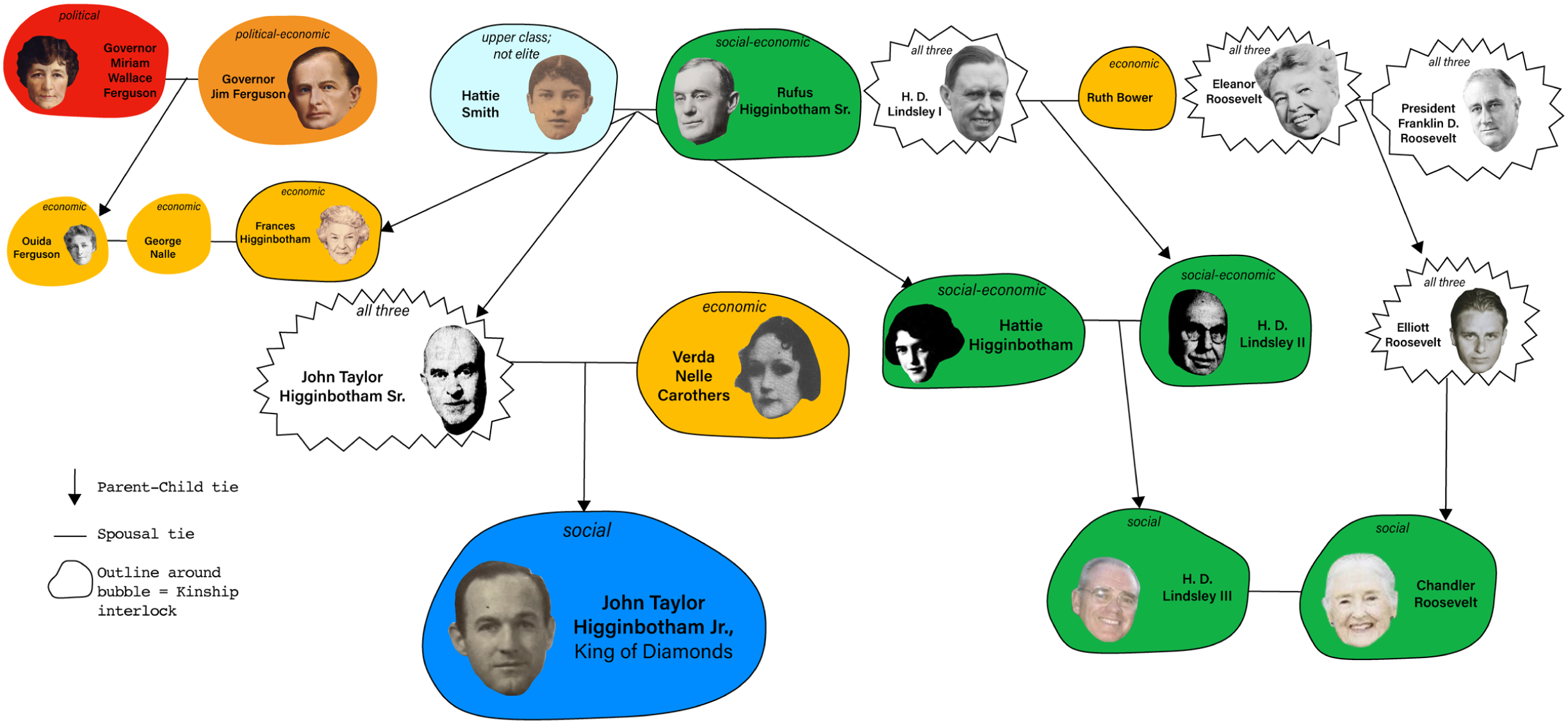
Abbreviated Family Network: John T. Higginbotham Jr
Apparently, the Dallas police knew John was the thief. They tracked his signature waffle-print shoeprints straight from a robbery to his front door. But he lived in Highland Park, an upper-class enclave in the center of Dallas with its own government, and the Highland Park police chief refused to give them a warrant. The investigation screeched to a halt, insulating John from prosecution and the family from scandal. The precise process of John’s protection is lost to history: how actively did his family cover up the thefts, and how much was the cover-up an indirect result of their titanic resources? Likely, it was some combination of the two. Many years after Higginbotham’s death, one relative warned the investigating journalist Pederson (2024:323), “you will be sorry if you do this.”
John’s case, like Sharon’s, highlights the multidimensionality of the protect mechanism. One might reasonably wonder if kinship interlocks were more durably upper class simply because they were richer. 15 But Sharon and her mother lost all their money; it was their status that protected them from permanent downward mobility. And John stole diamonds from women who were, in many cases, orders of magnitude richer than any of his kin; it was his family’s comparatively colossal local power and status that protected him from prosecution. I will also note that John’s case is unusual in that his culpability appeared in the historical record at all—and this was only thanks to years of dogged investigation. Undoubtedly, Dallas elites got away with many more scandalous deeds that never appeared in the archives. The point is that access to wealth, status, and power through kin could thoroughly insulate people from exceptionally rigorous stress tests—even a decades-long string of jewel thefts targeting some of the richest families in the world.
But the full benefits of a kinship interlock were conditional on conformity to norms of kin formation and intimate exchange. John’s case illustrates this idea, too, because John was gay. He was not “out,” but as he got older, he increasingly inched away from heteronormativity. This was socially risky; John’s childhood friend Buddy Macatee remembered that in their world, “most guys wouldn’t even wear a pink shirt” for fear they would be called a “pansy” (Pederson 2024:328). And at first, John diligently “concealed [his] sexuality” (Pederson 2024:325). He took a job at the family business, and he got engaged to a maximally white, upper-class woman: a thin, blonde, blue-eyed debutante so zealously gender-conforming that she hated when women wore pants (Cottom 2019; Donaldson 1966). But a month before the ceremony, she “broke off the engagement and returned the diamond ring he had given her.” Friends said the “rebuff ended his dream of a perfect family,” and he never again tried to form a normative household of his own. He even “displayed the spurned engagement ring in a glass case” (Pederson 2024:329). The following year, he made his first big theft.
Soon after the spurned engagement, John left his family mansion and his family job. Although his father “dutifully” assigned John the same inheritance as his siblings, he increasingly distanced himself from John. “His father loved him,” said a family attorney, “he just didn’t want anything to do with him.” John “drifted away from his society friends” as they formed normative families and he did not. He filled his house with a menagerie of plants, pets, and art. Much of his fortune evaporated during a real estate bust, and he began getting by with a lawn care service; his childhood friends “looked the other way when they saw him driving through his old neighborhood with his lawnmower crews.” John’s increasing distance from upper-class normativity was also increasing distance from the protective cocoon of his family’s wealth, power, and status. He died at 69 “of heart failure,” as the AIDS crisis raged (Pederson 2024:372). John’s case underscores the idea that upper-class persistence in the United States was (and may still be) a heterosexual project. Queer lifeways broke the rules of kin formation and intimate exchange, interrupting the constitutive cycles of upper-class entrenchment: endogamy, reproduction, and gendered elite socialization. In this way, for an heir in a kinship interlock, queerness could be riskier than grand larceny.
Propel
Upper-class persistence was not just about protection from risk. The intimate exchange of wealth, status, and power propelled some elites into even higher strata. This, too, is part of persistence: “those who control wealth and power cannot just sit on their accumulations,” Starr (2019:24) notes, “they have to renew them lest they become vulnerable to challengers.”
I will first illustrate this pattern quantitatively. If kinship interlocks propelled kin into higher strata, then we would expect that when elites of a given type were more elite, they were also more frequently enmeshed in kinship interlocks. Figures 9, 10, and 11 show that the wealthier, more powerful, or higher status individuals were, the more often they were in a kinship interlock. For these analyses, I selectively compare subgroups that can be easily placed on the same scale of magnitude: for example, I can reasonably assume that a Texas congressman had less power than a Texas senator, but I do not attempt to compare the power of a Texas congressman to the power of a Dallas mayor.
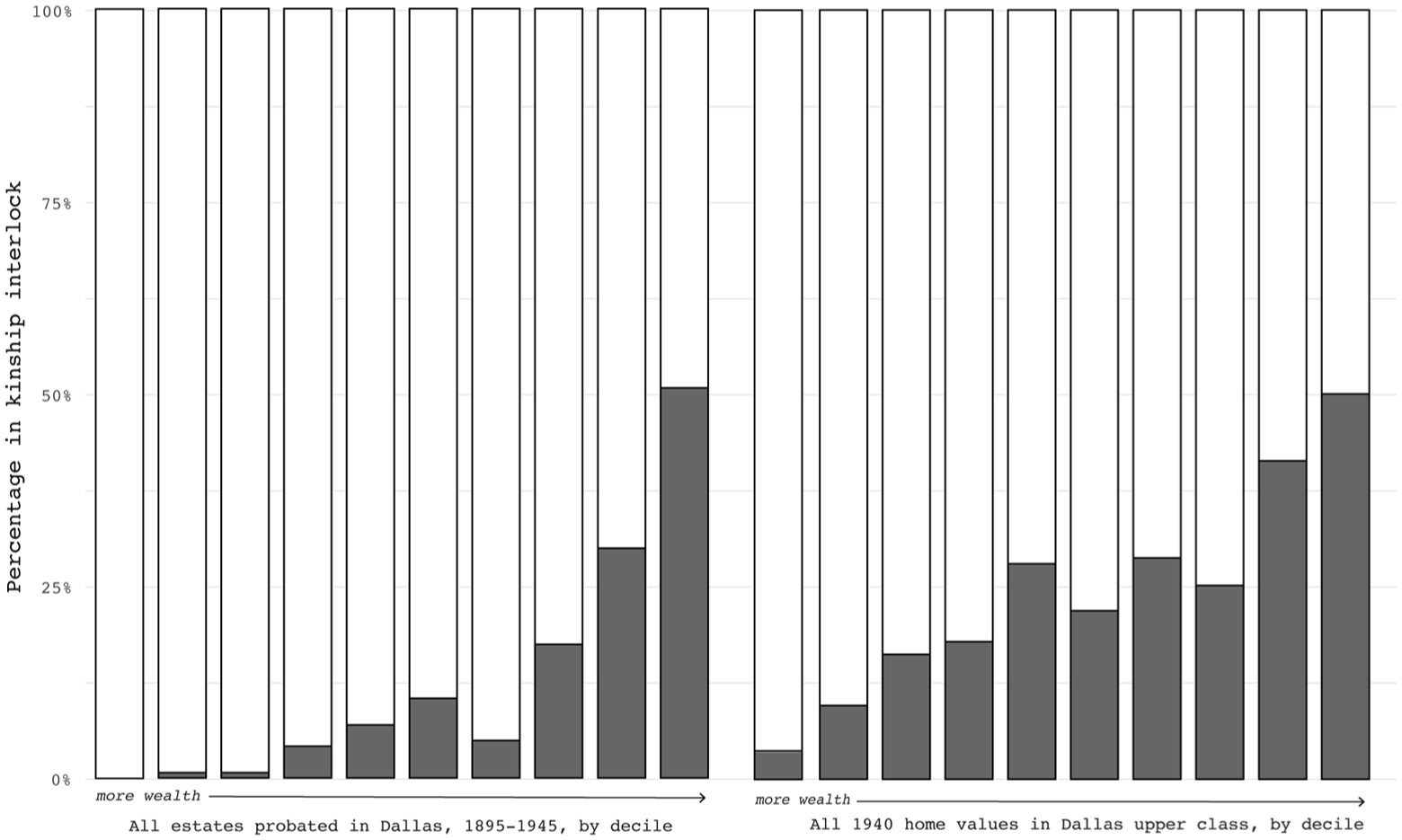
Wealthier People Were More Often in Kinship Interlocks

More Powerful Political Elites Were More Often in Kinship Interlocks

Higher-Status Social Elites Were More Often in Kinship Interlocks
These are associations, of course. Case studies suggest the propel mechanism works through two subprocesses that sometimes coincide: (1) kinship interlocks result from, or are contexts for, “big jumps” in resources, and (2) kinship interlocks result from and facilitate a more gradual, multidimensional, multi-person cumulative advantage process (Mills [1956] 2000). The wealth, status, and power of kin served as the context for a person’s “big jump” into greater wealth, status, or power. More resources in one dimension generated more resources in other dimensions, within both individuals and families. And more resources increased the likelihood of endogamous marriages and successful elite reproduction; all else being equal, more resources rendered people more able and incentivized to follow the rules of the game. Relations and resources clotted in sectors of the kinship network, cementing those sectors in the upper class.
Sharon’s second marriage neatly illustrates the propel mechanism. When we left off, Sharon had leapt out of economic precarity by hastily marrying a securely wealthy Houston oilman. She divorced that husband after a couple of years, moved back to Dallas with her young daughter, and in a matter of months, met and married an even-richer man, Pollard Simons (1910–1974). Pollard was already fabulously wealthy, but, as his stepdaughter later remembered, “he was plagued by insecurity, as if he had a secret—which, as it turns out, he did” (Blake 2018). Pollard was born Jewish. Hearing whispers about his hidden history, social elites excluded Pollard from their fanciest clubs, which meant that despite his wealth, he was unable to become a Dallas social elite himself. But by marrying Sharon, Pollard could access high status, using it to continue growing and entrenching his fortune. 16 Sharon, who had “learned as a debutante how to make conversation” with any tycoon or tyrant, no matter how “boring,” and who “understood that her role was to look glamorous and support his business interests,” was an immense help (Pederson 2024:171). Pollard’s fortune and power grew, which then boosted Sharon’s status, wealth, and access to power. She regularly hosted presidents, princesses, senators, governors, and even mafia bosses, who variously became Pollard’s allies, friends, and business partners. When the mansion next door to her grandfather’s lost estate went up for sale, Pollard bought it. In the end, Sharon sat quite literally restored to the place of her birth. Because their marriage immediately gave each of them access to huge additional resources, the couple were each other’s “big jumps.” Their successful gendered labor as spouses—Pollard’s wheeling and dealing, facilitated by Sharon’s legendary hosting—produced the interpersonal, multidimensional accumulation of advantages that launched them both into the international elite. In this way, normative gendered labor and intimate exchange propelled them into higher strata.
Propelling processes spanned beyond spouses and across multiple kin and generations. Betty’s family continues to be illustrative in this regard; their class trajectories featured myriad interconnected big jumps and accumulations, both within and across people. Her husband George, for example, accumulated steadily more resources over his lifetime; he was first elected district attorney, then used that power to become District Judge; his power gave him status, and also landed him a prestigious bank board seat. Their son George Jr. got a job at that bank through his father, and he worked his way up to the top, a process smoothed by his membership in the Idlewild Club, which itself smoothed the entry of his two younger brothers into the same club; along the way, he married debutante and heiress Rena Munger, immediately jumping into even greater wealth and status. Perhaps most spectacularly, Betty’s second (and third) cousin Idalea Hearne came to Dallas to make her debut through Betty’s social ties; this training, coupled with her inherited enslaver wealth, helped her snag a man with family ties to the British aristocracy—a “big jump” in status for herself and her kin—and the new couple’s combined resources gradually propelled their Eton-educated son into Parliament. Upper-class entrenchment was a multi-person, multidimensional collaborative class project that continually propelled kin into more resources and opportunities.
It is no coincidence that Betty’s and Sharon’s success involved endogamous marriage and gendered labor; the propel mechanism, too, demanded conformity to the rules of kin formation and relational work. One of the strictest such norms was that “legitimate” children, consecrated by the collective protection and propulsion of family resources, could only spring from heterosexual white marriage. When kin violated this norm, other family members could sever the new kin tie and block the flow of family resources, as Betty personally observed. Betty came to Dallas on the heels of a massive family scandal. Her white maternal uncle (and first cousin once removed) Samuel Hearne (1816–1866), who lived just two plantations over from her parents, had a black biological son named Dock (1846–1868) whom he enslaved along with Dock’s mother Azeline (1825–1890). This was not the scandal, from the white Hearnes’ perspective: white men often sexually assaulted black women; white people often enslaved and exploited their black biological kin 17 (Hartman 2016; Hunter 1997). If kinship interlocks were about biological kinship, or even known biological kinship, then Betty’s cousin Dock was born to a kinship interlock. And if one family member could unilaterally bring new kin into the resource flows of a kinship interlock, then Dock would have been one of the richest men in the state, because when Samuel died, just a year after Juneteenth, he left his entire estate to Dock.
That was the scandal. With the relational work of his will, not only was Samuel publicly acknowledging Dock as his son; he was also positioning Dock as legitimate kin to the white Hearnes, and as their peer in wealth. Samuel’s kin-making bequest was a relational mismatch that “outraged and embarrassed his [white] brothers and cousins,” to the point they totally excised Samuel’s name from their extensive genealogical records (Baum 2009:8)—which had never included Dock in the first place. They also immediately launched a series of vicious legal attacks to steal Dock’s inheritance. When Dock died of yellow fever two years later, leaving everything to Azeline, their assaults only escalated. Azeline used every plausible tool to fight back, but ultimately, she died penniless, in the same year Betty gave birth to her future-mayor son Sawnie. Samuel tried to bring Dock into his kinship interlock through a transfer of wealth, which would have been a “big jump” for Dock and Azeline; his white family responded with a two-part attack, severing their kin tie and stealing the wealth flow that consecrated it.
Inheritance and inheritance disputes are especially legible examples of broader, multidimensional patterns of relational work and mismatches. The propelling process was not a free-for-all; kin were not practically able to share their wealth, status, and power however they wanted, even when they were legally able to do so. Throughout slavery and after Emancipation, white enslavers and exploiters occasionally willed property to black heirs, but white families often used estate litigation to block these bequests; similarly, families of origin throughout the twentieth century used estate litigation to steal bequests that queer kin made to partners (Chauncey 2005; O’Brien 2025b; Pascoe 2009; Zelizer 2005). These patterned disputes are especially striking because the United States features total testamentary freedom, meaning people can technically leave their fortunes to whomever they like. The flows of status and power, too, were highly regulated by people and organizations, both formally and informally. By litigating the proper channels for resource flows—the appropriate matches of properties and positions to persons—upper-class families worked to keep wealth, status, and power to themselves, simultaneously reproducing whiteness, heterosexuality, and upper-class status.
Limitations
These data are unusually comprehensive, but they suffer from two major missingness problems: missing kin, and missing elites/resources. The Dallas elite and upper-class kinship network is a subset of an enormous, singular, global-historical kinship network. Many people in these data had relatives who had important effects on their lives who are not included, usually because they never lived in Dallas, but sometimes because they were never very rich, powerful, or high-status, or related to anyone else who was. The resources that define elites, too, are underestimated; I am limited by the archives to particularly visible forms of wealth, status, and power. Of the three, wealth is likely the most underestimated, because wealth data are rarest.
I am certainly missing some elites—especially those whose resources were relatively fleeting or isolated in the context of their kinship network. Brief flares of wealth or power are harder to spot in the historical record than sustained, multigenerational burns. The closer a person sat to other dimensions of elite status, within themselves and across kin, the less likely it is that I missed them as people, even if I missed their resources (and capturing them, even if I miss their individual resources, is a nontrivial benefit of a kinship-network based measure of stratification). The more heavily and securely resourced someone was in any dimension, the less likely it is that I missed them or their resources (e.g., I am certainly missing some informal local power brokers, but I have the full set of elected officials). Because kin ties are inevitably missing, any measures of family persistence or connection are underestimates. Taken together, these patterns of missingness indicate that stricter definitions of elite and upper-class status would likely generate larger estimates of the proportion of elites in kinship interlocks and a stronger association between kinship interlocks and upper-class persistence.
Discussion and Conclusions
In this article, I described an abstract network formation (kinship interlocks), linked it to an outcome (upper-class persistence), and traced the processes between them using in-depth case studies. I argued that kinship interlocks generate upper-class persistence through two primary mechanisms. Multidimensional flows of resources in kinship interlocks protect kin from economic, social, and legal risk. They also propel kin into more wealth, status, and power. These processes require kin to follow the “rules of the game” for kin formation and intimate exchange, which are constituted by gender, sexuality, and race; deviations can nudge or fling potential heirs out of the protective, propulsive flow of a kinship interlock.
I answered a “how” question, but “why” questions remain: If kinship interlocks were so durable, then why didn’t everyone form them? If the potential rewards were so huge, why didn’t they all follow the rules of the game? Certainly, many upper-class people wanted to encase their families in wealth, status, and power, but not all of them, and not all of them could, and not everyone who could was equally able to. Some, like Agnes, tried and failed. Some, like Dock, sat in social categories that locked them out entirely. Some were born with bodies or minds that made conformity impossible (Diaz and Rivera 2025). Some, like Charles and Mary, disagreed with each other disastrously; some made risky decisions that did not pan out; some were beset with random calamities; some were quietly unlucky. Some, like John, were born with all the resources an heir could want, then looked around and chose another kind of life—another way of living, working, and making family in the world. Even this violently homogenous social class contained fundamentally irrepressible variation and stochasticity. Upper-class persistence was a continual choreography of conformity and exclusion, and despite many individual failures and refusals, the overall result was (to paraphrase Beckert and Stamm 2025:4) that while people died, the upper class did not.
From the perspective of the city population, the Dallas upper class in its first 122 years formed a dense web of relations and resources. The web was studded with especially durable multidimensional resource clusters I call kinship interlocks. These kinship interlocks enmeshed most of the city’s tycoons, tyrants, and socialites; the richer, more powerful, and higher status they were, the more likely they were to be in a kinship interlock. Elite resources and potential resources were enormous, such that upper-class people had huge incentives to follow the local template of white heteropatriarchal kin formation and relational work. The more they had, the more incentive they had to conform. Conformity made them richer, higher status, and more powerful, both individually and as families. Conformity protected them from certain calamities and propelled them into more opportunities and resources. Nonconformity interrupted the process of upper-class entrenchment, often by spawning scandals and relational mismatches like inheritance disputes. The ways upper-class people shared, exchanged, and pooled their resources partially determined and reflected who would be on city council, who would land on rich lists, and who would make a debut. These actions partially determined and reflected not only who was richest, but who was rich the longest; they partially shaped not only who ruled in 1900, but who rules today.
Zooming out further to the perspective of the global-historical kinship network, we can define an upper class as a durable density of relations and resources. These densities seem to be generally characterized by local racial dominance and rigid, hierarchical gender/sexuality systems, although this is an empirical question requiring more analysis across settings. In this frame, upper classes are not collections of individuals; they are locations in kinship networks. How do these densities form and persist? What are their effects on everyone else? Crucially, under what conditions do they dissipate? These questions combine economic sociology, political sociology, and stratification, and they help us integrate the study of inequality with our ever-increasing access to complex kinship information, moving beyond individual-level survey data that “[tear] apart the network of relations” binding us all together (Bourdieu 1963:11, quoted in Desmond and Clevenstine 2025:249). As inequality escalates, we need portable concepts to comparatively study elite kin formations and their consequences. In this article, I introduced one such concept, “kinship interlocks,” and linked it to one such consequence, upper-class persistence.
Kinship network-based measures of inequality bring the study of stratification more in line with relational theories of inequality (e.g., Tilly 1999; Tomaskovic-Devey and Avent-Holt 2019). Since the 1960s, stratification studies have generally conceptualized inequality as the unequal distribution of resources across individuals and households. This paradigm stems in part from the structure of large-scale administrative survey data, which have shaped our measures and theories of stratification at every level, “making some research more doable . . . while rendering other objects out of focus” (Hirschman 2021:776). These data sources are indispensable; indeed, the Dallas data are partially composed from more traditional sources like the U.S. Census. But “there is no such thing as an individual actor” divorced from their relational context (Tomaskovic-Devey and Avent-Holt 2019:4), and as the Dallas data demonstrate, it is now possible to build complex kinship networks from individual-level data, combining old sources in new ways to measure inequality across a family fabric.
Additional stratification studies using full kinship networks would help bring these findings into comparative context. The Dallas elite from 1841 to 1963 is just one slice of one population, with its own patterns of distributional and categorical inequality, and with its own “rules of the game” for kin formation and intimate exchange. How would the family flows of wealth, status, and power look across a whole population, or under a completely different inheritance system, a different political structure, or a different kinship system, for that matter? 18 Hypothetically, given the exact same distribution of resources across individuals, the spread of resources across a kinship network could vary widely, with serious potential consequences. A population where all the politicians, socialites, and millionaires are equally spread across the local kinship network, such that everyone has an equal chance of having an elite family tie, is likely very different in cause and consequence from one where elites are concentrated in a few family clusters (indeed, this is one way of describing the ideal-typical difference between an aristocracy and a democracy). When we measure inequality and domination only in terms of individuals, we cannot tell the difference.
I suggested that upper classes are generally characterized by racial dominance—a suggestion consistent with the idea that race and class are inextricably entangled (Torres 2025)—but racial dominance comes in many forms. In a global-historical comparative perspective, race is primarily composed of “ancestry, physical appearance, and sociocultural elements—with the salience and consequentiality of each particular component varying . . . throughout time and space” (Monk 2016:416; Wacquant 1997). Dallas, in its first century, like much of the contemporaneous United States, featured a system of racial domination in which ancestry was an unusually salient and consequential mode of classification (Davis 1991), and in which elite status was almost totally conditional on whiteness. How might upper-class kinship and persistence look in other racial systems, where ancestry is less salient and consequential, and where elite organizations, fortunes, and positions are less exclusive to one racial category? Comparisons among datasets like this one could help answer such a question. More generally, a population-level kinship network combined with sociocultural indicators (including measures of wealth, status, and power), phenotypical data, and state racial categories could support multiple connected streams of research on ethnoracial inequality, including the historical roots of contemporary patterns of racial domination (Baker 2022; Muller 2021); the links between family structures, race, and child outcomes (Bloome 2014; Cross 2025; Cross et al. 2022); and variation in stratification processes within (Adames 2023; Monk 2016, 2022) and between (Easley and Baker 2023:3; O’Brien 2012) racial categories, such as the “major [question] in mobility research” of “what drives the consistent Black-White disparity in mobility outcomes” in the United States. Such a network could also illuminate systematic relationships between elites across and within racial categories at a population level (for an exemplary case study in the United States, see Greenidge 2022). Together, these approaches could help move the sociology of elites beyond “simple ‘headcounts’ of diversity” by focusing instead on the class-race interrelation as it manifests at the top (Young et al. 2021:366).
In general, my findings invite more relational, kin-based approaches to the quantitative social science of elites, which has spectacularly resurged over the past two decades. Much of the resurgence has necessarily focused on determining who the elite are. That this basic descriptive question has so urgently required answers is also a legacy of the structure of large-scale surveys, which tend to under-sample elites. Social scientists have been diligently compiling data on the world’s richest and most powerful people (e.g., Bühlmann et al. 2025; Reeves and Friedman 2024). This work generally focuses on one “type” of elite at a time, defined by control over a singular resource or position—which means the very wealthy, powerful, and high-status are often examined as if they were strangers to one another. But elites of all kinds are highly kin-entangled; their kin ties are conduits for the bulk of their resources; and compared to institutional overlaps, kin ties between elites are especially universal across space and time. Board interlocks shatter and boarding schools shutter, but in any stratified society, analytically distinct “types” of elites tend to weave themselves together through kin, with consequences for elite cohesion and persistence. Crucially, these kin ties and their consequences are only fully visible through the systematic inclusion of women.
I argued that kinship, rather than representation, is the key to understanding gender in the elite. Elite kinship networks allow us to build much-needed theory about the role of gender at the top (Keister et al. 2022). These findings, for example, give us clues about the puzzling gender conservatism of elite populations. Gender inequality is by no means exclusive to elites; “the entire stratification order remains strongly conditioned by male earnings,” male wealth, and male power (Bloome, Burk, and McCall 2019:1457). In general, gender and sexuality are “transversal to class” (Cooper 2017:159), such that people born to upper-class families do not “naturally” fit the “fantasy of normativity” more than anyone else (Butler 2004:114). But in the contemporary United States, the upper class does seem to conform to these norms more regularly, at least when it comes to kin formation and intimate exchange (Hamilton and Armstrong 2021; Keister et al. 2022; Lareau 2022, 2026; Sherman 2017, 2021; Yavorsky et al. 2023). So why is it that even today, the U.S. upper class features an especially rigid, hierarchical gender and sexuality system? Perhaps the comparatively rigid gender hierarchy of the upper class is connected to the constitutive rules of kin formation and intimate exchange that shape its successive generations. When elites are continually incentivized and required to conform, newcomers and heirs alike will be more likely to form heteronormative households sustained by gendered labor and relational work. Potential heirs who carve more creative intimacies will be disproportionately excluded from the full protection and propulsion of upper-class intimate exchange. Just as racial domination is a “strategy of wealth defense” and resource extraction (Beckert 2022:239), so too is heteropatriarchy (Canaday 2023). Heteropatriarchy and racism together seem to be features, not bugs, of upper-class domination.
Finally, these findings motivate the full reintegration of kinship with political economy. Kinship is not, and has never been, a mere marginality to the real rough-and-tumble world of markets and politics. The “particular nexus of violence and care” in elite patriarchal households was foundational to the structure of early states, and indeed may have been one of the only features they had in common (Graeber and Wengrow 2021:510). Heteropatriarchal elite family forms structured the emergence of early modern nations, colonialism, and merchant capitalism (Adams 2005). Although social science since the mid-twentieth century has generally treated families and markets as separate realms, capital and family remain inextricably intertwined, both because families produce workers, and because families own capital, which is more durable than lifespans (Beckert and Stamm 2025; Cooper 2017). The managerial revolution did not rid the “hard core of the market” from the supposedly archaic taint of family ties, just as democracy has never eliminated the supposedly retrograde contamination of hereditary power (Dal Bó et al. 2009), because great resources are never totally held alone. Monarchs and presidents alike entrench themselves, in part, by funneling wealth, power, and status toward their family members. Even in the absence of singular kings, moderate levels of elite endogamy and reproduction clot resources in clumps of kin, generating a durable, cohesive upper class. When it comes to the long-term dynamics of political, social, and economic domination, family is still where the action is.
Supplemental Material
sj-pdf-1-asr-10.1177_00031224261425688 – Supplemental material for Kinship Interlocks: How the Intimate Exchange of Wealth, Status, and Power Generates Upper-Class Persistence
Supplemental material, sj-pdf-1-asr-10.1177_00031224261425688 for Kinship Interlocks: How the Intimate Exchange of Wealth, Status, and Power Generates Upper-Class Persistence by Shay O’Brien in American Sociological Review
Supplemental Material
sj-pdf-2-asr-10.1177_00031224261425688 – Supplemental material for Kinship Interlocks: How the Intimate Exchange of Wealth, Status, and Power Generates Upper-Class Persistence
Supplemental material, sj-pdf-2-asr-10.1177_00031224261425688 for Kinship Interlocks: How the Intimate Exchange of Wealth, Status, and Power Generates Upper-Class Persistence by Shay O’Brien in American Sociological Review
Supplemental Material
sj-pdf-3-asr-10.1177_00031224261425688 – Supplemental material for Kinship Interlocks: How the Intimate Exchange of Wealth, Status, and Power Generates Upper-Class Persistence
Supplemental material, sj-pdf-3-asr-10.1177_00031224261425688 for Kinship Interlocks: How the Intimate Exchange of Wealth, Status, and Power Generates Upper-Class Persistence by Shay O’Brien in American Sociological Review
Footnotes
Acknowledgements
I am deeply indebted to Caitlin Daniel, Estela B. Diaz, Luis Flores, Doron Shiffer-Sebba, three anonymous reviewers, and the editors for their indispensable feedback on drafts, and to Deirdre Bloome, Greta Krippner, and Peter Marsden for conversations that shaped the core of the article. I also benefited from comments made by participants after presentations in the Stone Program Inequality and Social Policy Seminar at Harvard, the Political Economy/Economic History and Development Seminar at U-Mass Amherst, the Economic Sociology Seminar at Harvard, the Stone Multidisciplinary Seminar at the CUNY Graduate Center, Blueprint Labs at MIT, the Sociology Departments at Boston University and the London School of Economics, and the Annual Meeting of the American Sociological Association in August 2024.
Funding
The author disclosed receipt of the following financial support for the research, authorship, and/or publication of this article: This research was supported by funding from the Harvard Stone Program in Wealth Distribution, Inequality, and Social Policy. Open access publication is supported by MIT.

Data Note
Notes
References
Supplementary Material
Please find the following supplemental material available below.
For Open Access articles published under a Creative Commons License, all supplemental material carries the same license as the article it is associated with.
For non-Open Access articles published, all supplemental material carries a non-exclusive license, and permission requests for re-use of supplemental material or any part of supplemental material shall be sent directly to the copyright owner as specified in the copyright notice associated with the article.
