




Abstract
How do structural features of work shape workers’ interpretations of precarity, or the stories they tell? This article draws on 120 interviews with four groups of workers who confront temporal and spatial instability: Texas-based agricultural and oilfield workers and NYC-based adjunct instructors and delivery workers. I find that rather than adopting one dominant individualizing story, as previous research suggests, workers instead move between what I call positioning stories: narratives that interpret their work’s particular structural features. In doing so, workers combine individualistic and structural frames to cope with their positional uncertainty. Depending on the specific tempo and geography of their work, workers account for spatial instability in stories about sacrifice and self-improvement; they interpret temporal instability in stories about addiction and the burden of time passing without progress. Workers combine these with stories highlighting meaning and exploitation in their labor process. These findings reveal how structural precarity impedes a cohesive narrative by disrupting identities and life projects, but it also undermines the credibility of individualistic accounts. The resulting narrative fragmentation may inspire a wide range of responses, from resignation to contestation.
Keywords
In today’s economy, many individuals work with no set workplace or schedule (Petriglieri, Ashford, and Wrzesniewski 2019; Valdés and Barley 2016). Technologies can push work to slip into the temporal and spatial crevices of life (Kelly and Moen 2020; Ticona 2022). Scholars have highlighted the negative effects of temporal uncertainty on worker well-being (e.g., Clawson and Gerstel 2014; Schneider and Harknett 2019; Snyder 2016), but instability in space, which is less examined, can also deeply affect workers (Fleming and Spicer 2004; Johnston et al. 2023). These temporal and spatial instabilities form part of a “great risk shift” (Hacker 2006) from employers onto workers over decades of deregulation, privatization, and welfare retrenchment—making some jobs more precarious, understood as work that is “uncertain, unpredictable, and risky from the point of view of the workers” (Kalleberg 2009:2). An expansive literature, for example, identifies precarity among platform-based workers with unstable schedules, workplaces, and wages (e.g., Johnston et al. 2023; Rahman 2024; Schor 2021). Nevertheless, precarity among waged workers has historically been the norm and stability the exception (Kalleberg 2018; Neilson and Rossiter 2008). Consequently, time and space uncertainty are common across old and new structures of precarious work, affecting workers’ experiences and interpretations.
We know much about the former, but less about the latter. Research shows how precarious conditions affect material outcomes like health and well-being, but the link between insecure work and workers’ interpretations of their situations is underexplored (Schor, Tirrell, and Vallas 2024; Vallas and Prener 2012). Stories matter because they can inform social action and inaction (Greene 2017; Rosen 2017), including decisions to stay at a job, to leave, or to organize (Hirschman 1970). Because workers interpret and frame their experiences through stories, stories illuminate how people feel about their work and themselves. Precarity can destabilize self-understanding (Petriglieri et al. 2019; Sennett 1998; Sharone 2014, 2024), disrupt family and intimate life (Cooper 2014; Pugh 2015), and challenge beliefs in the future (Ayala-Hurtado 2022; Silva 2012). Existing research suggests U.S. workers interpret insecurity in individualistic rather than structural ways, internalizing ideologies linked to the meritocratic myth of the American Dream and the entrepreneurial self of neoliberalism (Lamont 2019; Lane 2011; Pugh 2015; Snyder 2016).
This work is important but incomplete. Scholars have linked self-help books and other ideological influences to workers’ internalization of individualistic and entrepreneurial cultural narratives (e.g., Eberhart, Barley, and Nelson 2022; Vallas and Prener 2012). Yet, workers may draw from multiple repertoires in their “cultural toolkit” (Swidler 1986), particularly when confronting gaps between cultural expectations and material realities (Ayala-Hurtado 2022; Frye 2012), resulting in more heterogeneous narratives (Ho 2024; Lopez and Phillips 2019). Structural conditions, including national employment regimes, institutional norms (Collins 2019; Lamont and Thévenot 2000; Sharone 2014; Vallas and Christin 2018), and market position (Schor et al. 2024), influence these narratives. We need systematic comparisons across cases to identify how particular structural features of work affect cultural interpretations. In particular, research has not examined how time and space uncertainty affect precarious workers’ accounts.
This study draws on 120 interviews with four groups of workers who confront extreme forms of temporal and spatial instability: agricultural and oilfield workers in Texas and university adjuncts and on-demand delivery workers in New York City. Platform-based gig workers, independent contractors with no set wages, hours, or workplace, are the contemporary face of work without a set schedule or location. After decades of higher-education transformations, adjuncts cobbling classes across multiple departments now do most university teaching (Fure-Slocum and Goldstene 2024; Kezar, DePaola, and Scott 2019). Agricultural and extraction workers have long endured temporal and spatial instability, with global economic shifts and climate change altering when and where work happens. I leverage this novel comparison to ask how workers account for disrupted schedules and workplaces, with the goal of understanding how these structural features affect workers’ accounts.
I use positional uncertainty as shorthand for unstable temporal and spatial boundaries at work. Oilfield workers in directional, or non-vertical, drilling use this term to describe not knowing, when drilling into the earth, precisely where the drill is located at any given point in time. This term references an intertwined time and space uncertainty. In the oilfields this uncertainty stems from survey measurement imprecision, unpredictability below ground, and other factors. For contemporary workers it is an apt metaphor for the destabilizing experience of not knowing what one’s work hours or workplace will look like. Theorists have posited that temporal and spatial instability disrupt workers’ sense of self in the contemporary capitalist system (Bauman [1999] 2013; Bourdieu 1998; Powell 2021; Rosa 2013). I empirically examine how and to what extent this positional uncertainty affects workers’ stories about their work, which are also stories about themselves, and which can shape their orientations to action.
Unlike previous work, I find U.S.-based workers tell a mixture of individualizing and structure-focused stories, and I trace these stories to particular structural features of precarious work. Structural instability makes it impossible for workers to develop stable renderings of their position. Instead, workers move between positioning stories, embracing entrepreneurial rhetoric, self-blame, and resignation in one moment and articulating critique and contestation in another. A positioning story is a narrative that mobilizes and reinterprets a particular feature of work, whether time, space, material, or emotional experience. The specific temporal and spatial instabilities workers confront across the four cases—seasonal or stochastic, working far from home or without any set workplace—foster particular positioning stories, with workers accounting for spatial instability in stories about sacrifice and self-improvement and reframing temporal instability in stories about addiction and time passing without progress. Workers mix these stories with stories centering emotional meaning making and stories highlighting material exploitation.
By eschewing conventional arrangements that tie work to specific times and places, these jobs thwart any one central, stable framing, pushing workers to define their identities and expectations in fragmented ways. The cultural narrative of the “American Dream” diverges sharply from the reality of these individuals’ working lives, a dissonance reflected in the unstable and often contradictory positioning stories they tell. Yet this very instability also undermines the meritocratic and entrepreneurial ideologies workers espouse. As precarity disarms workers (Bourdieu 1998), it may also disabuse them of individualistic interpretations, inspiring contestation.
Temporal and Spatial Instability as Features of Precarious Work
Fifty years of globalization and market deregulation transformed contemporary work and U.S. firm structure (Davis 2009; Rahman and Thelen 2019; Weil 2014), weakening the post-WWII “golden age” of capitalism protections. Employers shifted risk onto workers (Hacker 2006), especially low-income workers (Schneider and Harknett 2019), broadly expanding precarious work (Kalleberg 2018). These changes transformed the temporal (Schneider and Harknett 2019) and spatial (Harvey 2007) contours of work. Yet contemporary accounts often ignore precarious work’s historical dominance, or the inaccessibility of previous protections to women, poor people, and people of color (Kalleberg and Vallas 2017; Millar 2017; Neilson and Rossiter 2008; Perea 2011).
Time and space uncertainty characterize old and new structures of precarious work. What are their consequences for workers? Scholars have established temporal instability’s negative consequences (Schneider and Harnett 2019; Snyder 2016). Structural inequalities intersect over a “web of time,” leading to temporal hierarchies that often reinforce organizational class, racial, and gender inequalities (Clawson and Gerstel 2014; Wingfield 2019), exacerbated by new technologies of control (Lambert, Haley-Lock, and Henly 2012). For instance, just-in-time scheduling produces what Schneider and Harknett (2019:107, 2021) call “routine uncertainty” among hourly service-sector workers, causing psychological distress, sleep issues, and unhappiness. As a feature of flexible capitalism, temporal instability produces material, physical, and psychological hardship for workers and work-seekers (Snyder 2016).
Alongside imposing scheduling instability, employers also shift risk onto workers by confining them to certain geographies or requiring them to travel great distances to access work. Although it has received less sociological attention, space is fundamental to capitalist production and restructuring (Massey 2005). Capitalism’s “spatial fix,” according to Harvey ([1982] 2018), is its requirement for enough fixity for accumulation (investment in infrastructure and the built environment) but enough mobility to invest in new locations (see also Herod, Rainnie, and McGrath-Champ 2007). Put differently, capital must be kept in place physically to secure surplus value in production processes, but capitalists develop new geographies of investment to solve problems of overaccumulation (e.g., moving production to other countries). For example, the North American Free Trade Agreement made borders more porous for goods, but not people, even as the same economic forces altered work opportunity structures across borders, pushing many workers to migrate for economic survival. In this way, policies embracing neoliberalism, treating markets as furthering human freedom (Kalleberg and Vallas 2017), produce spatial challenges for workers (Urry [2001] 2004) along with temporal ones: for instance, shifting labor market opportunities farther from home or to the spatial margins of where they live. Some people travel long distances to find work for limited periods of time; others cobble together multiple jobs across the spaces they can access. Spatial instability often intersects with social marginality. Both rural and urban spaces can be sites of “unbelonging,” particularly for workers with few protections, atypical schedules, and demographic differences from work communities, including many gig (Johnston et al. 2023) and agricultural (Griesbach 2022) workers.
Beyond causing material and psychological hardship, I posit that positional uncertainty may disrupt identity. Following Frye (2012:1575) and others, I define identity as a “continuously evolving narrative about the self” that brings meaning to one’s circumstances, experiences, and possibilities, producing a coherent idea of the kind of person one is (Giddens 1991; Taylor 1989). Positional uncertainty can disrupt workers’ sense of who they are and where they are going. Bauman ([1999] 2013) argues that time–space transformations of what he calls “liquid modernity” endanger a coherent identity, and Giddens (1991) conceptualizes modern identity in an unstable world as an “ongoing process.” Temporal and spatial instability may be particularly unsettling in the work context. As Powell (2021:110) notes, “When place and work become disconnected and work hours are routinely irregular, the damages to both the self and the civic fabric of communities are real.” Writing during an earlier period of neoliberal restructuring, Bourdieu (1998:82, 85) observed that employment precarity can produce a destabilizing “destructuring of existence,” deteriorating one’s relationship to time and space; such radical instability can fog peoples’ sense of themselves and their future.
These scholars suggest time and space uncertainty may affect workers’ accounts and identities, but empirical evidence is needed. Previous work, synthesized below, finds that insecure workers tend to individualize hardship. Is this the case for workers facing positional uncertainty, or are such workers more skeptical of entrepreneurial and meritocratic cultural logics? What other kinds of cultural discourses do these workers use? Answering these questions requires considering the stories workers tell in response to time and space uncertainty and the broader conditions of precarious work.
Accounting for Insecure Work: From Structure to Stories
Why should sociologists care about stories? Through telling stories, workers make meaning amid insecurity, claiming dignity (Hodson 2001). Mills (1940) saw stories as “vocabularies of motives,” ways of accounting for, and justifying, one’s actions within a situation. Similarly, Goffman (1974) argued that people tell stories to frame a particular situation, masking or subordinating some aspects of reality and emphasizing others (Lakoff and Johnson [1980] 2003). Stories do more than reflect perceptions; they are social acts in and of themselves (Gilman 2022) that can shape orientations to action (Greene 2017; Sharone 2024). Ewick and Silbey (2003:1331) argue that stories about resistance to legal authority are “social events” that circulate and extend in time and space critiques of social structure, even if they do not inspire immediate change, highlighting stories’ potential to influence others.
Precarious workers’ stories help us understand their responses to work, from resignation to contestation. For example, stories about exploitation may motivate resistance. A story’s loss of credibility, or “narrative rupture” (Rosen 2017), can also affect behavior. Workers may resign themselves to work far from family through a positive story of the future. But if lived experience destroys that story’s credibility, workers may shift to a different vocabulary of motive justifying another response, like leaving the job or organizing.
Previous research finds people tend to individualize hardship, drawing on “neoliberal scripts of the self” (Lamont 2019:666) and using meritocratic frames (with cultural roots stretching back to Calvinism) to justify precarity. Some draw boundaries against others (Lamont 2009), internalizing “insecurity culture” (Pugh 2015), blaming themselves when things go wrong (but see Lopez and Phillips 2019), and framing insecurity in individual rather than structural ways (Eberhart et al. 2022; Lane 2011; Pugh 2021; Snyder 2016). Such individualistic interpretations discourage structural critique and collective action.
This research captures a crucial cultural throughline linking the American Dream and its antecedents to the entrepreneurial ethos of the neoliberal era (Lamont 2019). It shows how cultural individualism can be self-defeating, as people struggle to solve structural problems individually. However, this research may over-emphasize the coherence of individualistic accounts (Ho 2024; Lopez and Phillips 2019; Sharone 2014; Vallas and Christin 2018).
Moreover, sociologists have paid less attention to how structural conditions of precarity affect cultural interpretations. Self-help books, media discourse, and other cultural products may foster individualistic approaches to work and even promote entrepreneurial risk (Eberhart et al. 2022; Lane 2011; Vallas and Prener 2012), but structural features of work also affect cultural interpretations. Sharone (2014), for example, finds that whereas Israeli jobseekers tend to blame the system, U.S. white-collar jobseekers tend to blame themselves. The latter follow a “chemistry game” to mold themselves into a good “fit,” believing their behavior strongly influences outcomes, which fosters self-blame when they do not get hired. By contrast, Israeli jobseekers and U.S. blue-collar jobseekers believe objective qualifications determine job-search outcomes, so they blame the system. Labor market conditions and institutional features produce these diverging interpretations.
Investigating how French and U.S. precarious workers respond to individualistic personal branding discourse, Vallas and Christin (2018) find some workers embrace this discourse, others do so strategically or in desperation, and still others resist it. They trace these distinct cultural responses to structural variations in their sample: nation-specific cultural repertoires, distinct occupational norms, and workers’ degree of material precarity. Finally, research on orientations to platform work shows that workers’ degree of economic dependency on platform income shapes their interpretations (Schor 2021; Schor et al. 2024). Structural precarity clearly constrains narrative possibilities. Aspirational cultural narratives can rupture (Rosen 2017) amid conflicting material realities (Ayala-Hurtado 2022; Frye 2012; Silva 2012). People struggling to arrange a meaningful story often confront contradictions between the past, the present, and the imagined future (Kiviat 2023; Silva 2012; Tavory and Eliasoph 2013).
In short, cultural accounts of precarity are less homogeneous than scholarship suggests, and stories do not come from the cultural ether: they are at least partly shaped by material conditions. The literature on cultural responses to precarity is important, but it undertheorizes the link between structure and stories. This article fills this gap by interrogating how time and space uncertainty affect the stories workers tell. I find that workers mix what I call positioning stories: narratives that mobilize and reframe particular features of work. I identify four main positioning stories within each group of workers: two stories responding to particular time and space uncertainties, and two stories highlighting workers’ sense of meaning and their exploitation. Shifting between stories, workers account for precarious conditions through a fragmentary mixture of structural and individualistic interpretations. Workers’ particular mixtures of stories relate to their particular structural conditions, that is, time and space uncertainties. And these positioning stories are socially consequential. The structural features of precarity that disarm workers in time and space and disrupt identity may foster structural critique and contestation.
Data and Methods
Most research on precarious work either draws on a representative sample or focuses on a single occupational case. Occasionally, research has compared multiple cases of workers confronting a single aspect of precarity (Snyder 2016). In this study, I constructed a novel set of four cases of workers who confront temporal as well as spatial precarity, to understand how these features affect workers’ experiences and sensemaking.
Data include 120 in-depth, semi-structured interviews with four types of workers. In Texas, I interviewed agricultural and oil and gas (“oilfield”) workers. In New York City (NYC) I interviewed on-demand delivery workers and university adjuncts. This selection of two rural-based cases in Texas and two urban-based cases in NYC spans lower (delivery and farm work) and higher (oilfield and higher education) status. The comparison features two tempos of uncertainty, stochastic and seasonal, and two kinds of spatial disruption, working far from home and working without a stable workplace (see Table 1). This study follows the logic of “odious comparisons” (Steinmetz 2004; see also Hatton 2020:19): I tease out the effects of temporal and spatial instability through comparing four groups subject to extreme forms of it, uncovering patterns in workers’ narratives connected to the particular disruptions they confront (Table 1).
Positional Uncertainty Case Selection

Data Collection
I conducted the NYC interviews between March 2017 and August 2018. I interviewed 30 adjuncts across disciplines, recruited from faculty listservs, social media, and snowball sampling. Just under half had taught for more than five years. I interviewed 30 platform delivery workers, recruited via fliers, in-person, and snowball sampling. Respondents worked for a range of platforms, including UberEATS, Postmates, Grub Hub, Caviar, and Door Dash. Interviews occurred in cafés and academic buildings, at workers’ preference. I interviewed 30 agricultural workers in Texas. I first interviewed 18 workers in Brownsville in June and July 2015. Having previously worked as an advocate, I recruited through existing contacts, snowball sampling, and in-person at the Brownsville bus station where many agricultural workers gather between seasonal work. In September 2018, I interviewed 12 more agricultural workers. In October and November 2018, I recruited 30 Texas field-based oil and gas workers through industry meetings, social media, email, telephone, and snowball sampling. I interviewed workers across the state, including several on-location. 1
Interviews were semi-structured with a closing survey instrument for self-reported demographic and financial info. I sampled for range (Weiss 1994) across gender, race and ethnicity, family structure, and age, although recruitment challenges and occupational segregation within each industry limited sample diversity (see Table 2). Most delivery workers are in their 20s and 30s, but the other groups include a wider age range. Reflecting men’s domination in agriculture, extraction, and NYC-based delivery work, these samples are mostly men. Among the adjuncts, 21 identify as women and 9 as men. The agricultural workers, based in the Brownsville-Matamoros border region, are either legal permanent residents or U.S. citizens of Mexican origin. The delivery worker sample includes 26 men of color and 4 white men, reflecting NYC’s racialized service sector. The oilfield worker sample includes 9 men of color, 20 white men, and 1 white woman. The adjunct sample includes 6 people of color and 24 white people. Table 2 reports the average interview length and interview range for each sample.
Respondent Demographics and Interview Details
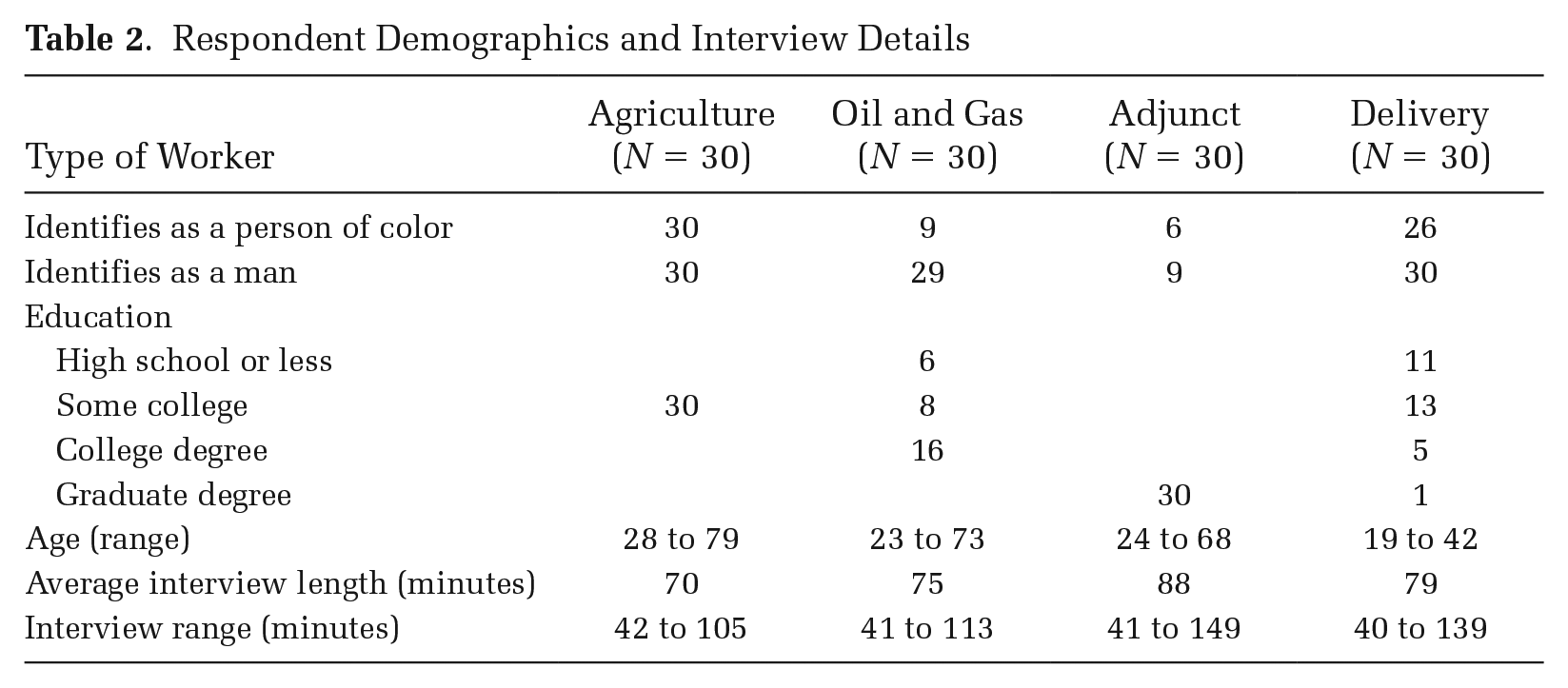
I used logical inference (Mitchell 1983; Small 2009): identifying processes within and across cases, I established hypotheses and generated theory from the patterns. Using a case study logic, I let findings and questions generated by my interviews guide continued recruitment until I was confident I had reached saturation (Yin 2009). I reached saturation sooner in some cases, but I completed 30 interviews with each group to facilitate my analysis and comparison across the four cases. Throughout the study, I toggled between analyzing the four cases on their own terms and comparing them.
Positioning Stories: Analytic Discovery
The project’s focus on how temporal and spatial contexts affect workers’ experiences informed data analysis. I recorded and transcribed the interviews and coded them in ATLAS.ti, building inductively from a set of codes I generated hand-coding my fieldnotes. In an abductive process, I analyzed the data—the four groups of interview transcripts and field notes—alongside literature and positional knowledge (Timmermans and Tavory 2012), including a sensitivity to how workers navigated time and space. As I coded workers’ interpretations of temporal and spatial instability in ATLAS.ti, I noticed them frequently switching between more critical and justificatory frames. Patterns of stories within and across cases emerged, aligning with Pugh’s (2013) typography of the diverse kinds of data culture researchers can uncover in interviews, including meaningful contradictory moments and multiple layers of meaning.
In the next round, I followed a focused coding approach (Deterding and Waters 2021): having coded transcripts based on the procedure outlined above, I re-coded transcript segments in my “stories” code group to understand how workers accounted for temporal and spatial instability in particular, and precarity more broadly. I revisited these “stories” segments while re-reading each transcript, adding subcodes as needed to capture workers’ stories. I eventually distilled the subcodes into six main genres of positioning stories patterned across the four cases (see Figure 1a).
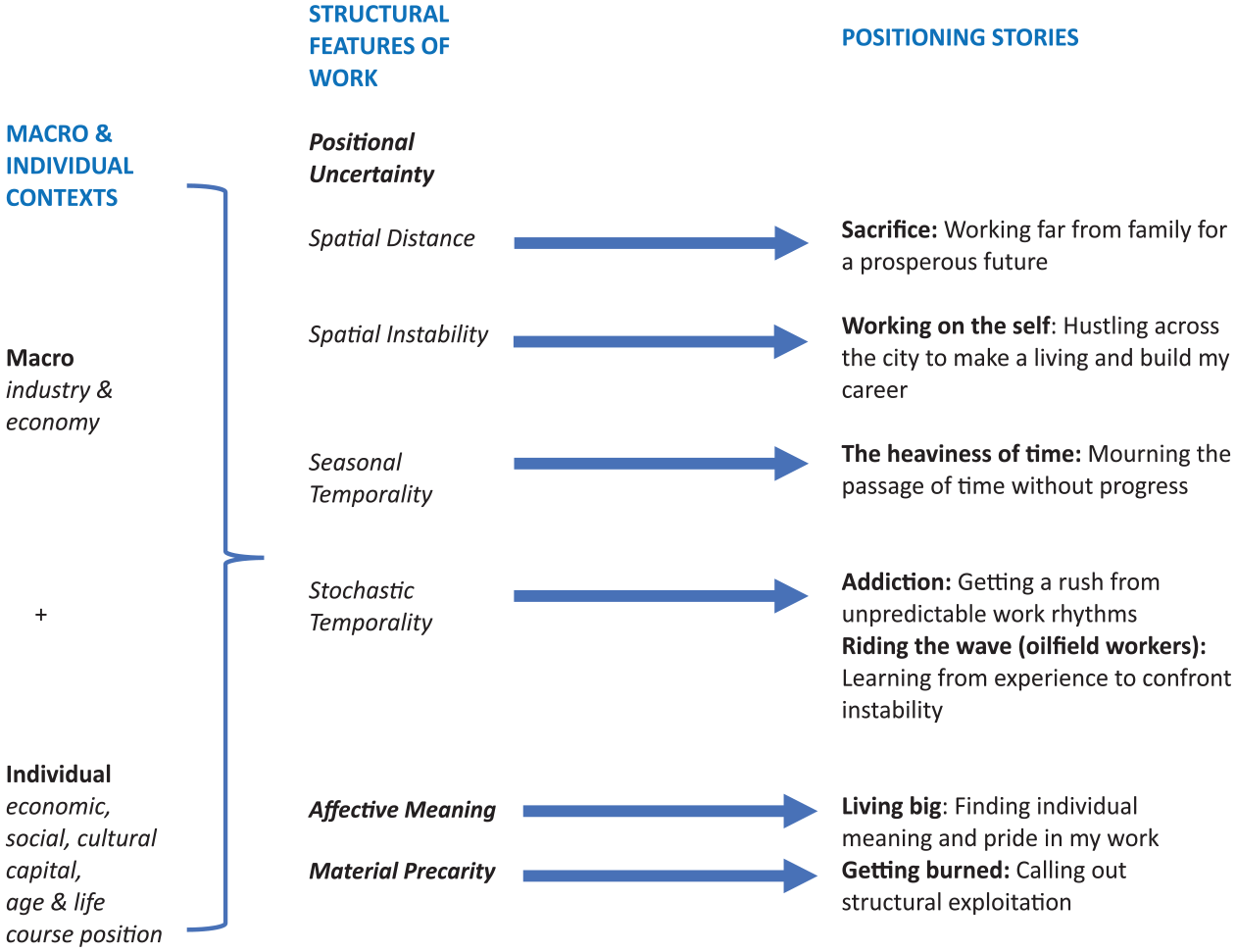
Connecting Structural Conditions to Positioning Stories
The study illuminates how positional uncertainty fosters narrative instability. Over multiple rounds of coding, I saw how workers would start to tell one story, then begin describing an aspect of their work conflicting with that story and switch to a different one. Comparing the four cases, I learned that rather than sticking to one consistent frame, workers moved between stories to interpret particular facets of their work. Through comparing four groups with parallel forms of temporal and spatial instability, I identified workers moving between stories mobilizing these dimensions, alongside (sometimes overlapping) stories interpreting affective and material experiences. First, workers told stories reframing spatial instability. Among agricultural and oilfield workers I coded a sacrifice story, which emerged in field notes and was ubiquitous in interview transcripts. Here, workers interpreted grueling work far from home as sacrifice for a brighter future. In contrast, adjuncts and delivery workers told a story highlighting their individual hustle, cobbling together work hours and pursuing self-improvement across the city. After coding several stories—autonomy story, hustle story, self-reliance story—I distilled them into a broader story of working on the self. This story highlights individual agency managing instability and pursuing a desired future.
Second, workers told stories reframing temporal instabilities. Oilfield and delivery workers reframed frenetic, market-based scheduling instability in an addiction story, centering their compulsion to money, adrenaline, or lifestyle and using the word addiction frequently. Among oilfield workers, I coded a second temporal story that highlighted workers’ agency in managing fluctuations toward a prosperous future, first identified through two workers’ phrasing: riding the wave. This hopeful story aligns with the oilfield industry’s relative mobility potential.
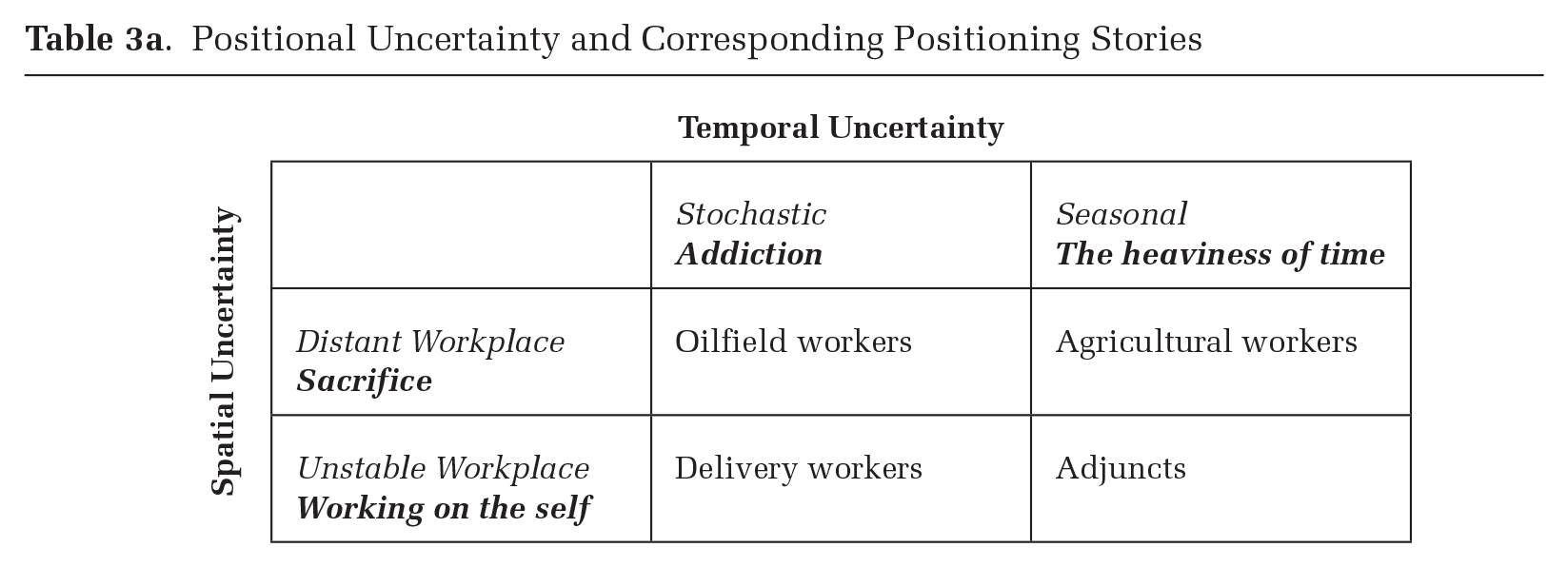
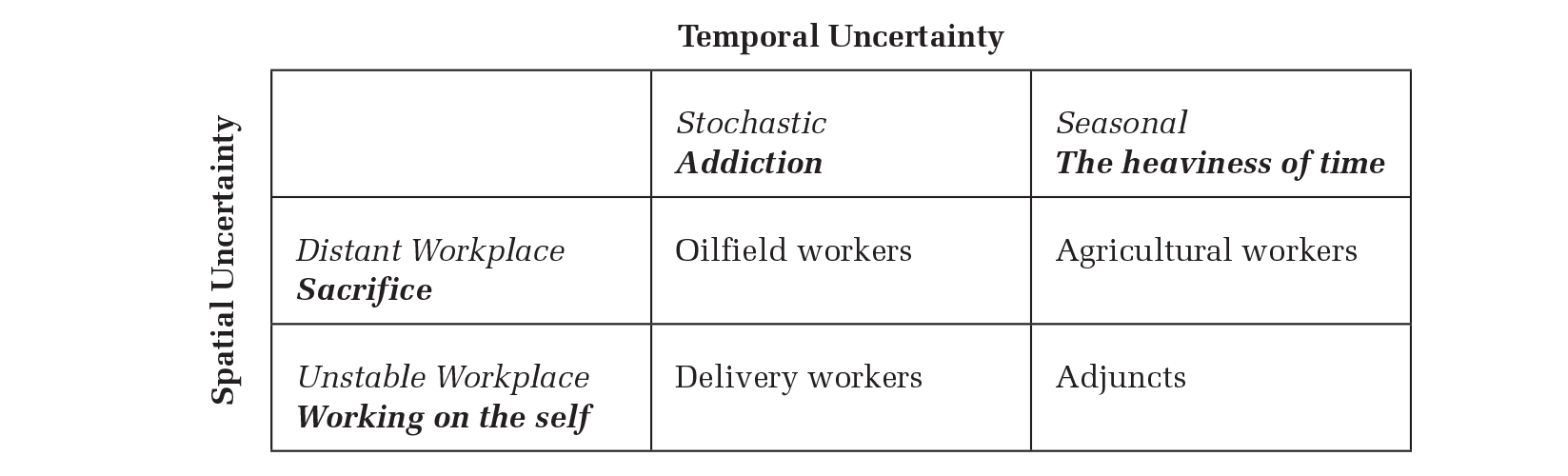
Finally, across interview transcripts with adjuncts and agricultural workers, I coded a story mourning the passage of seasons without progress toward long-sought mobility. I first noted this story during agricultural worker interviews, then discovered the same story coding adjunct interviews. I call this story of time passing without progress the heaviness of time. Alongside these four stories emerging from workers’ temporal and spatial conditions (see Table 3a), I coded two genres of stories interpreting affective and material experiences across all four cases (Table 3b). In stories about living big, workers highlighted day-to-day meaning; in stories about getting burned they expressed structural critique of material exploitation. One might see these as opposing stories, but both are ways of protecting dignity (Hodson 2001) amid precarity: the first through identification with work, the second through discursive resistance.
Positional Uncertainty and Corresponding Positioning Stories
Positioning Stories Appearing across All Four Cases

As the findings show, workers move between positioning stories. Each story interprets a particular aspect of their experience, but none offers a credible frame containing other, conflicting aspects. For instance, through telling the sacrifice story, agricultural workers made meaning of work far from home—but when they started discussing persistently low wages and long-term precarity, many shifted into stories centering those aspects: getting burned and the heaviness of time. Precarity thwarted any one consistent story. Table 3a identifies the positioning stories workers tell in response to particular temporal and spatial instabilities, and Table 3b presents the stories spanning all four cases.
Findings
Overview
Structural conditions produce positional uncertainty. Adjuncts teaching across multiple universities in NYC struggle to claim space across departments and campuses and face temporal uncertainty in the form of canceled classes, fluctuating course loads, and summer income “deserts.” Oilfield workers away from home for weeks at a time confront market instability and the threat of layoffs but earn high wages in boom times. Platform delivery workers move across the city, chasing fluctuating work and earnings through algorithmic prompts. Brownsville-Matamoros-based agricultural workers’ work hours and earnings fluctuate based on crop conditions, weather, and recruitment. They live in either Brownsville or adjacent Matamoros, drawing on both sides to survive (Chavez 2016); limited local work pushes them to migrate. Oilfield and agricultural workers are embedded in occupational communities (Griesbach 2022), whereas adjuncts and delivery workers are socially isolated despite interacting with students and customers. Workers’ accounts varied by individual circumstances, including age and life course position; economic, social, and cultural capital; and family support and resources. However, workers interpreted parallel forms of temporal and spatial instability alongside affective and material conditions in strikingly similar stories, as illustrated in Figures 1a and 1b.
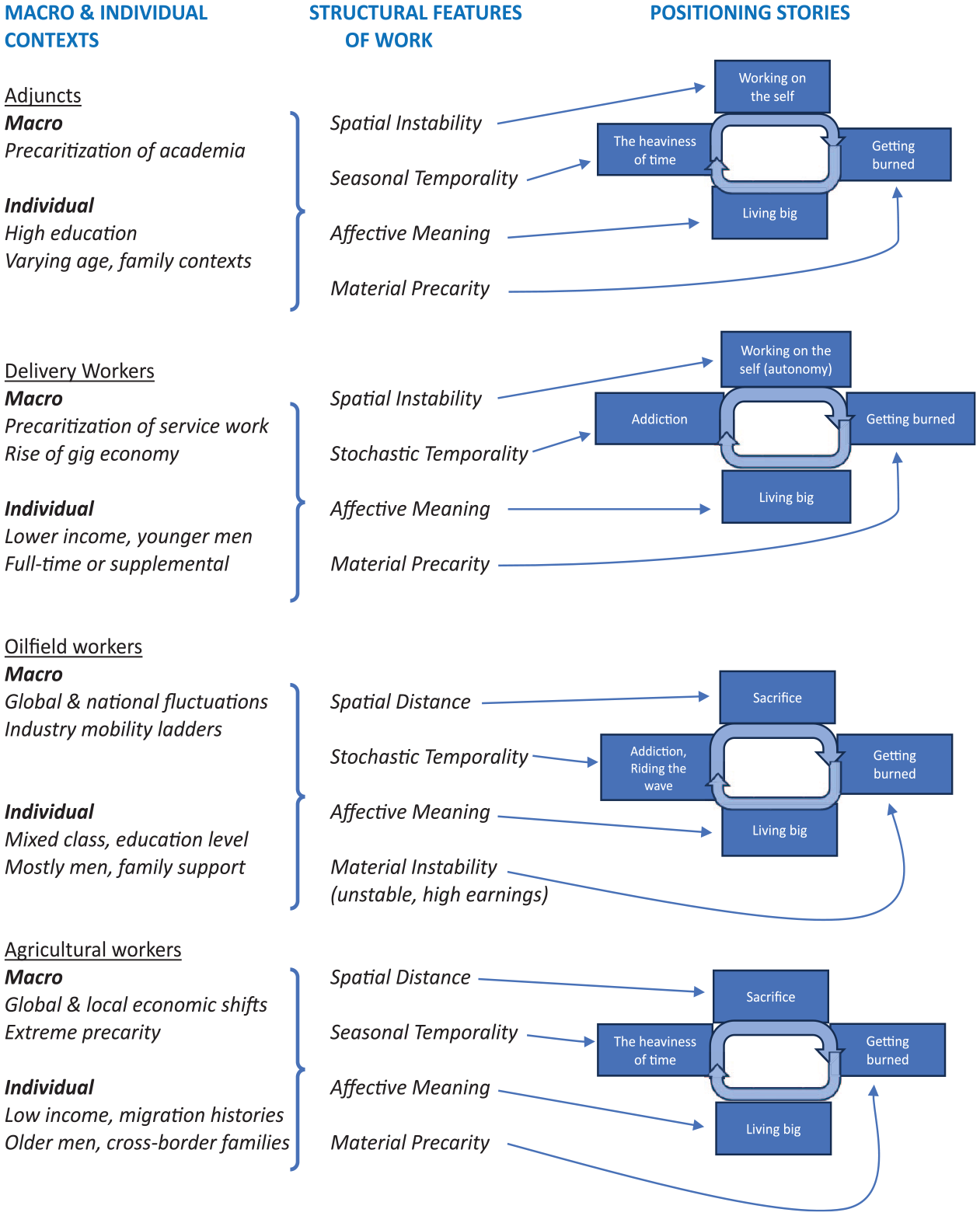
How Workers Mix Positioning Stories
Figure 1a illustrates how precarious workers confront macro and individual contexts (Column 1) that inform their pathways into precarious work with its particular structural features (Column 2). Workers interpret these structural features in a mixture of positioning stories (Column 3). Figure 1b illustrates how this model works for each of the four groups, showing how particular structural features of work foster particular positioning stories. As my findings will illustrate, workers in each case combine stories reframing their temporal and spatial instabilities, affective meaning, and material precarity. Some stories overlap, and others conflict. For instance, delivery and oilfield workers’ addiction stories highlight the pleasures of their work, making it double as a story of living big, but many moved into a conflicting story of getting burned when describing periods of lost work and earnings.
In the following sections, I show how each group combines positioning stories to interpret precarity. In each section, I use a longer vignette followed by shorter examples to highlight each group’s positional uncertainty and how these workers account for precarity by mixing positioning stories. The findings, visualized in Figure 1b, show how disrupted work lives impede a single, cohesive throughline. Along with mobilizing individual meaning, workers reframe their conditions and experiences in stories of critique and contestation, in a fragmentary, but also potentially mobilizing, mixture.
Adjuncts Interpreting Unstable Place and Shifting Semesters
Adjuncts mixed several positioning stories to account for fluctuating semester course loads across universities without a stable workplace (Figure 1b). First, many reframed unstable work geographies in an individualizing story of working on the self, centering their agency hustling to build a career across the city. However, many adjuncts pivoted to a story lamenting a loss of belief in their academic path as semesters passed: the heaviness of time. Alongside these stories responding to positional uncertainty, many adjuncts toggled between highlighting the pleasures of their work, living big, and calling out material exploitation, getting burned. Workers combined stories because precarity impedes a consistent story of self-improvement. The very conditions of precarious work that disorient and disarm workers can foster contestation.
I meet Sarah
2
(50s) on a sunny, breezy day on the CUNY campus where she has taught for 15 years. We tour an adjunct office she schemed for years to claim a desk in, scattered with books and items accumulated over time: “When you don’t have any permanency, just having a space that you can imagine is yours . . . I think somebody’s gonna come and take that space like, tomorrow.” Her schedule is “subject to enrollment”; last summer, her department gave one of her courses to a full-timer and reassigned her something new days before the semester: “I showed up, I taught the class . . . we’re like point and shoot teachers . . . they just say—‘here’s your class, go!’” A moment after highlighting her spatial and temporal impermanence, Sarah emphasizes her work’s pleasures. Reading a student essay, by a former taxi driver, she reflects: It was—the best thing I’ve ever read. And I was so moved and it was so beautiful, right? So, you don’t gush, right? [laughing] You could intimidate somebody. I’m a writer, I know. You could put the curse on that if you gush too much. But yeah. I don’t think a day goes by that I don’t feel privileged to do what I do. And I don’t want to say that cause . . . I know that I’m a worker and that I have you know, solidarity . . . but thankfully I’m very grateful. . . . I know I have something to offer my students, which is about learning to read, write, and think critically.
In this fragmented narrative, Sarah’s affective story of doing good work, living big, coexists with the meta-feeling that she should not feel this way (Pugh 2013)—foreshadowing her political commitments.
As the interview continues, Sarah shifts to a story of working on herself, reframing her instability by centering her own agency hustling across the city, managing fluctuating courses and health and financial obstacles: “So here’s how I get by . . . I start getting into financial trouble because I’m losing courses. Wind up with two roommates and dumpster diving on a regular basis.” Glaring instabilities then prompt Sarah to switch genres, moving from this self-improvement story into a story of becoming “radicalized” and organizing adjuncts.
Mixing positioning stories, Sarah reframes her temporal and spatial challenges through a story of individual agency, centers the affective meaning of working with students, then decries her material conditions. She describes both individual and collective contention, from claiming space in the adjunct office to collective organizing. 3
Like Sarah, other adjuncts combined positioning stories to account for precarity. David (20s) shuttles between teaching and freelance jobs while hustling to publish his work. Gigging at two universities, he tells a faltering story of working on himself, crediting a university union and his wife’s non-academic job for survival. Classroom demands conflict with his goals as a writer: “I guess writer is my primary job, but it’s the one I actually spend the least amount of time doing.” Although teaching should be secondary, “you can’t really be a good teacher unless you put in the work.” But teaching is also a key source of meaning: There aren’t that many jobs where you get paid to like, have a life of the mind. So getting to read and think about really kind of significant writers and artists, I mean that’s what I want to be doing. I wouldn’t always want to have to do it at 9 o’clock in the morning on a Friday . . . with a room full of 18-year-olds. But still, it’s definitely up there.
Yet precarity destabilizes this story of living big. The previous fall, “I was—fucking poor, and very uncertain about what the future held.” Precarity undermines David’s self-narrative as a writer working on himself, threatening narrative rupture. David struggles to tell a cohesive story of individual progress amid positional uncertainty.
Deborah (60s), a longer-term adjunct, mixes stories of living big and getting burned with an account of loss as semesters pass without progress: the heaviness of time (Figure 1b). Each semester she cobbles four or five gigs together and each week she struggles to balance a chaotic schedule and stay solvent: “It’s really like 52 pickup for adjuncts.” Spatial and temporal instability produce precarity: “We don’t have mailboxes. We don’t have a locker or anything like that . . . you don’t know from semester to semester how much you’re going to teach, where your income’s going to be; am I going to have health insurance?” Amid these conditions, she weaves a story of meaning: There’s one thing I like about adjuncting. . . . I love to teach. I love my students. . . . I drag my butt in there. I’m kind of tired sometimes, and I come home happy and fulfilled and intellectually stimulated and thinking about next week and what I could do and how I could build on the comments that were made last night [laughing]. You know? . . . I love to teach. That’s it.
Shifting away from living big, Deborah tells a story of getting burned: low wages, dropped classes, administrator disrespect. Then she turns inward, re-interpreting her years of struggle without achieving a tenure-track job: I think I held on to the dream too long, and I’m really looking at how do I make these last years of my work life be fulfilling and satisfying and financially rewarding? And I don’t think it’s fighting the system. I mean, I’ll fight it as long as I’m in it, but I’m very open to getting out of it at this point. I really am. I held on to the dream too long. Yeah.
And yet, alongside this story of loss—the heaviness of time—Deborah vows to continue “fighting” and organizing adjuncts.
Social position shapes experiences and accounts. Longer-term adjuncts and those experiencing particular kinds of marginalization told sharper stories. Despite stellar teaching evaluations and a hard-fought research record, Roger (40s) feels disposable and invisible, doubly marginalized as an adjunct and person of color: “You always feel like you’re as good as the last class you taught.” Years scrambling to publish and throwing himself into teaching feel like “grand failure,” impeding his sense of the future: I’ve thrown out this idea of where I want to be. . . . a tenured professor . . . seems so out of reach for many reasons. . . . Where . . . you have invested all your life in doing this thing, but it’s not profitable and you’re constantly being torn with, “Ok, do I drop this and start over in something completely different? Or do I stick with it and hope for the best?” . . . When do I stop being this starry-eyed fool and you know get with reality and you know get a real job and you know start contributing in these very important ways.
Roger looks back and reinterprets his years of teaching as a failure, no closer to a tenure-track career or the capacity to support family. Years without advancement jeopardize a self-improvement story and Roger’s identity. The past starts to feel like wasted time, making both the present and the future uncertain—an inversion of the therapeutic narrative of overcoming hardship (Silva 2012).
Many long-term adjuncts struggled to articulate a positive future as semesters wore on, and told a heaviness of time story, but others mobilized defiant stories of getting burned and linked their critique to organizing. Evie (50s) calls out exploitation at several CUNY colleges: A friend of mine . . . he’s done it for 34 years. I’m like, “You. Cannot. Abuse me that long. I can’t do it.” I didn’t even stay with men who abused me that long. . . . I have a list of jobs that are just like bad boyfriends. They’re there, they’re not, they keep you on the hook. And just when you’re like, “I’m gonna quit,” they come back and they go, “Oh darling, I love you.” These are those jobs, right?
Evie blames herself for not extracting herself from an abusive cycle, then tacks back to valorize “this process of really doing work that had some significance in the world,” rather than making money for rich people. She mixes getting burned and living big stories: “The fact that I will take this job for such low money makes me part of the problem. I need to do something to kind of mitigate what I’m doing here, so that’s why I organize.” The bad boyfriend simile describes Evie’s exploitation, and her friend’s position anticipates the heaviness of time. By organizing for better conditions, Evie works to square the conflicting realities expressed in her positioning stories, suggesting a pathway from narrative fragmentation to collective action.
Teaching a 4-4 load across two private universities, Sheila is similarly critical: “My evals have gone down in the last few years because they are not paying me to be a world-class professor, so I have stopped trying to be that.” She puts an adjunct module on her syllabus stating, “My working conditions are your learning conditions. You’re going to have to apply pressure as the tuition payers.” Like Sarah, Sheila claims and repurposes the space around her as a small act of resistance (Courpasson and Vallas 2016). Seven years in, her getting burned story is sharp: It’s not that all [social scientists] are Marxists, but I happen to be one of them, so I don’t want to be a part of a system that whether the kids can afford it or not, only one portion of one body part is paying for me to be there, and they don’t even give me health insurance. It’s a semester-long contract. Fuck them. So yeah, I don’t like it anymore.
After decrying her marginalization, Sheila tacks back to emphasize her work’s meaning. Despite feeling “so defeated and just unimportant . . . like a fly or an ant or some kind of bug . . . I still see a practical way to make a positive change.” Mixing stories of living big and getting burned, Sheila organizes adjuncts—employing voice (Hirschman 1970) to resolve conflicting realities. Yet later in the interview she casts doubt on the future: “What am I gonna do, get a tenure-track job 10 years out, 15 years out? My chances of success . . . like my ovaries, which are fine because I do not want children, and if I had them, we would be living in poverty.” 4 This dramatic comparison is a heaviness of time story.
Adjuncts’ shifting stories show how precarity, and positional uncertainty specifically, impedes a stable framing. Day-to-day precarity and semesters without advancement undermine stories of hustling across the city to advance their careers (working on the self). Many adjuncts shifted into stories of lost hope in the once-imagined future (the heaviness of time). Some adjuncts mobilized their contradictory experiences into collective action, to work through the tension between their work’s meaning (living big) and its devaluation (getting burned). Adjuncts’ mixtures of individualistic and structural positioning stories reveal the destabilizing, but sometimes clarifying, consequences of positional uncertainty.
Platform-Based Delivery Workers Interpreting Shifting Geographies at Stochastic Rhythms
Delivery workers accounted for insecurity, chasing algorithmic prompts across the city, in a shifting mixture of stories (Figure 1b). Like adjuncts, many delivery workers told an individual-focused story of working on themselves in response to spatial instability, constantly moving between restaurants and customers. 5 Many reframed positional uncertainty as autonomy with no one dictating when or where they must work (which we could also interpret as a story of living big). And many reframed stochastic work tempos in addiction stories. Low, inconsistent wages destabilized these stories, inspiring many to shift into a critical story of getting burned. Overall, workers interpreted their positional uncertainty in stories mobilizing their work’s meaning, but frequently pivoted to decry exploitation.
Guillermo (30s) settles into a quiet, reserved room at my Manhattan university, sporting a giant, square, delivery-company-branded backpack. He stumbled into delivery work to supplement seasonal real estate: I started doing runs through the wintertime, and throughout slow season, cause rental season is slow throughout winter. And I got addicted . . . it’s this feeling of instant gratification when you complete a delivery . . . you get a little notice on your phone exactly what you’ve earned . . . and it’s not a lot, but it’s exciting to just see a little number come up like, “Boom. You earned that.”
The work was “like a scavenger hunt. This is what kind of makes it fun. When you get to your location, and you pick up . . . you don’t know where you’re going until you get it.” Here, Guillermo reframes stochastic work rhythms and “blind dispatch” obscuring his route into an addictive game, redefining positional uncertainty as addiction. Then he shifts frames to an autonomy story: I don’t see [the app] as controlling me, I see it as more of a suggestion. It’s like here’s a task that you can do that equates to money. You wanna do it? It’s not like a looming boss, you know with his thumb on your head, like do it, do it, you have to. It’s different, it’s like, do I want to do that?
Guillermo valorizes this sense of control over his work, unlike a previous desk job working for millionaires: “I feel undervalued if I’m set to someone else’s schedule . . . like a cog. I feel like I’m part of this overall machine, that I don’t know exactly who or what is benefiting but I know for sure I’m not. And I don’t like it.” Platform companies push autonomy rhetoric to attract workers, and that rhetoric captures a real desire to work on one’s own terms.
Yet as the interview continues, Guillermo’s precarity in time, space, and earnings destabilizes the autonomy story; he shifts to a critical frame discussing his earnings. Last Friday, “9:58 was my first delivery . . . and I went ’til 1:30 a.m. . . . Crap! I made crap. I made like $30.” During one insulting, tip-less delivery, “the tip was keep your day job.” Struggling not to injure himself without health insurance, Guillermo tells a story of getting burned.
Christopher (20s) also mixes autonomy and addiction stories. He stays out late working, he tells me, “Cause the money was good, cause the deliveries, they were just coming in. So once I see it’s busy and I’m getting money flow pretty good I just lose track of time and bang out every job.” Christopher mixes an addiction story of chasing algorithmic prompts into the night with an autonomy story, contrasting delivery work with a previous service job: It’s not worth it to kill yourself over a job that they’re going to replace you in a day. So I learned that the hard way . . . working for myself doing deliveries and Uber. . . . I work on my own time schedule. . . . I wanna work and not feel like I’m working. I’m gonna make money doing something I love, I don’t wanna wake up and be like, “Ah, I’ve got to go to work.” . . . I felt like that for too many years, I’d wake up and think I didn’t want to do this job. . . . That’s why I like Uber. . . . I’m my own man.
Christopher’s autonomy story supports a broader self-narrative of work on himself as a self-taught artist: “Long-term goal I would like to own my own art studio, work for myself of course, doing murals and stuff like that. Cause there’s nothing better than working for yourself, playing by your own rules, and getting paid for what you love to do.”
Yet Christopher hustles without stable earnings or set hours, biking from the Bronx into Manhattan for the mealtime rush. He chases shifting promotions and “hot spots” to hit his “number”: “Sometimes you have your good days and sometimes you have your slow days.” Slowly amassing momentum with his art work, Christopher mixes addiction and autonomy stories, reframing positional uncertainty to center his individual strength surviving slow times and pushing through rush times. Christopher’s fledgling artistic success supports his self-improvement narrative.
For other delivery workers, precarity fosters a more conflicted narrative mixture. Unlike adjuncts linking their work to identity, many delivery workers confront radical instability without core attachments to the work. Those unable to cobble enough income to support an autonomy story experience algorithmic management not as addiction but as a cruel game. These workers turn autonomy and addiction stories on their head in sharp stories of getting burned. When I meet Robert (20s) at a midtown Starbucks, he is seething from waiting idly in a Hell’s Kitchen restaurant “hot spot”: When I hear orders coming in, like there’s like this buzzer on the app. . . . I’d usually be hanging out here, hoping to get that order, but then you know somebody comes in you know swoops in to get the order. . . . They put out incentives to make you come out. And you get discouraged knowing that they influence you with that garbage.
The backside of addiction is getting burned, chasing “garbage.” And autonomy’s inverse is waiting powerlessly for uncertain returns. Joshua (20s) describes sinking earnings and shifting rules: “When it started off, I would make $20 a trip for a really easy trip. And obviously there’s no way financially that was sustainable . . . they got a bunch of people in” then dropped the rates. “There was one day where I biked around . . . midtown . . . during lunchtime for five hours. . . . I maybe had one trip, which was $3.” Joshua inverts the autonomy story: You don’t have a boss, you have, like a prison guard almost. [laughing] Just in that you have this whole system with all these elaborate rules, and the aim is to steer you into whatever they want to steer you into. But you don’t understand the rules . . . you don’t know what they’re doing.
In this story of getting burned, Joshua describes platform surveillance and “pivots” (Ravenelle 2019) that undermine workers’ control over when and where they work.
Andrés (30s) describes algorithmic immiseration from an inside perspective. After he started doing deliveries for a rising platform after a nonprofit layoff, the company hired him to train workers. He saw the company steadily worsen conditions: I think one of the breaking points . . . was when they decided to change the courier technology where, when it used to show you the pickup and the drop-off and the rate, they got rid of that and then they made it blind . . . that sucked. And then they would cut the rates and justify it. . . . So the New York City market became so saturated with supply that our existing fleet was starving, right? They would rather have more people on, making less, to guarantee that the demand would be met and to have enough people on to meet the demand, [rather than] that everybody would feel like they were earning a basic, decent income . . . because they felt the couriers are replaceable, right? They’re expendable, whatever. For some reason, they didn’t feel like that about customers. They were like, “No, we have to make sure we get them all. Scale up, scale up, scale up,” right?
Andrés tells a critical story of company leaders rigging the game to squeeze workers: “The surplus value that gets extracted, people aren’t doing shit!” Like Sheila’s account, in Andrés’s Marxist analysis, the workers producing the value lose. Andrés quit and started organizing against the company. Now, he fits five income sources like a puzzle into each week: “I know what my number is to live in New York with the lifestyle that I have.” Andrés’s self-image of autonomy stands in tension with his structural critique of platform work. Like some adjuncts, he turns to organizing to resolve his work’s contradictions, even as he continues cobbling together piece work to make a living on his own terms.
Platform delivery companies embrace individualistic cultural rhetoric to draw workers. Workers prioritize autonomy (Petriglieri et al. 2019; Schor 2021), but precarious work and wages undermine this discourse. Many delivery workers reframed temporal and spatial instability in positive ways through stories of addiction (work as a game) and autonomy (work as freedom from a boss), yet intensive precarity undercut these stories. Many delivery workers pivoted from positive, individualistic interpretations to critical stories of getting burned. Overall, delivery workers told a shifting mixture of stories interpreting precarity. As with adjuncts, the contradictions between gig work’s promise and its reality, which undermine any one, cohesive framing, can also inspire resistance. Workers’ fragmentary positioning stories often included “resistant selves” (Collinson 2003), challenging the individualistic and meritocratic interpretations they mobilized elsewhere.
Oilfield Workers Interpreting Distant Work at Boom–Bust Tempos
Oilfield workers mixed stories reframing work far from home at stochastic tempos (Figure 1b). Many told sacrifice stories justifying distance from family for a brighter future. Like delivery workers, oilfield workers told addiction stories, reframing market booms and busts as a compulsion to money and lifestyle, a particularly unstable story that often morphed into living big or getting burned. Many oilfield workers described surviving downturns in a riding the wave story of learning from the past to manage present instability, a story supported by industry mobility ladders. High wages and boom-time mobility support an American Dream narrative, yet intense uncertainty weakens its credibility. Some workers plotted an ultimate exit from the oilfields. In oilfield workers’ mixture of positioning stories, structural instabilities challenged the individualistic and meritocratic stories they elsewhere, and more strongly than the other groups given their occupational mobility, embraced.
I sit with Manny (30s) in the hot food section of a Texas coastal bend gas station smelling of cellophane and sitting meat on a muggy September afternoon—a meeting he almost canceled, multiple times, due to work demands. Manny details 15 years moving “up the ranks” with a high school degree and proudly points to everything around us made of oil: “I’m part of millions that go to work every day to help make the world go round.” Continuing, he moves from this story of affective meaning and pride into a sacrifice story: It’s a sacrifice . . . time with your family is worth more than any amount of money in overtime, right? . . . You’re out there supporting your family, you still have sometimes that feeling of helplessness when your spouse is telling you, “Man I’ve had issues with this, that” or “the dog got loose, and I had the baby” and this and that, and oh my God. What do you do? . . . Two hundred miles away from home, living out of a suitcase, in hotels. Or sometimes on location. You know?
Then, Manny levels: “you gotta understand, you want to make that money . . . you gotta sacrifice your time with your family.”
Manny then shifts positions, moving from this faltering sacrifice story justifying work away from home into a story lamenting instability. He feels conflicted in a field where “we can pretty much lose our jobs, from one day to the next,” recalling an early layoff in 2009 when his wife was pregnant: That was scary. Brand new house I just built [laughing] on top of that. I was 27 years old. Still learning how to live a life I guess. Barely starting a family. . . . And that’s why I had wanted to get out. Cause all these phases of my life, and it’s like, “Well where am I gonna be?” the next time the oilfield busts. . . . It’s like a relationship, you know . . . your girlfriend cheats on you, and you still go back to her, three times, and the third time you’re like, “Well I don’t trust you that much.” And that’s kind of my relationship with the oilfield right now.
Manny links positional uncertainty to a broader experience of disrupted identity, and uses Evie’s metaphor, the abusive partner, to describe his fear of getting burned again: “I feel anytime, they’ll pull the rug from under me, like they’ve done before.” That both Evie and Manny draw on relationship analogies reveals a fine line between living big and getting burned: both strongly identify with their work but resent material exploitation, expressing their working conditions as a kind of abuse. Continuing, Manny shifts to an addiction story. After his last layoff, he tried to stay out: “I was in the middle of raising two girls . . . you gotta think, where am I gonna be the next time that the bust happens?” He took a local job, but “financially I couldn’t get it to work for me. And I was drawn back.” Manny paints a force beyond his control, pushing him to tolerate risk that by his own account he should find intolerable. Manny’s fear of getting burned sits uneasily alongside his addiction to the oilfields.
Manny pivots to a story of experience (riding the wave): “Am I prepared now? Yeah, now more than ever . . . if you’re gonna stay in the industry you gotta learn how to deal with these things.” Past experience informs Manny’s strategy for managing the present. Yet the edge of doubt reemerges in his next breath, destabilizing this positioning story: “Would I recommend it to anybody? Probably not . . . but then on the other hand. Who can actually make a living off 40 hours nowadays, right?”
Rather than a single narrative, Manny mixes stories grappling for a cohesive frame: sacrifice, getting burned, addiction, riding the wave. With instability thwarting any cohesive story of progress, Manny mixes stories reframing his time–space instabilities and affective and material experiences. Late in the interview, somewhat suddenly, he shifts to collective critique: My buddies would be like, “Man, that’s sick,” but man . . . all we’re doing is putting money in these people’s pockets. And we’re all, you know, middle class, raking this in, thinking we’re on top of the world. In reality . . . they got us by our neck man. On a leash. Cause we come back to this stuff, man.
Here, Manny articulates a critique of getting burned calling out the owner class. Ultimately he imagines a positive future outside the oilfields, investing in real estate: “The key to break from that leash, right, you gotta invest your money too. Take that risk and see if it’ll work for you.” While his critique is collective, his solution is individual: joining the owner class he critiques. His fragmented account suggests his consent to oilfield work is contingent and conflictual.
Other workers told less conflicted positioning stories. Christian (40s), a service-side manager, reframed distance from family in a sacrifice story: You want to come out of high school and make six figures you’re giving up your time. . . . So that’s where I’m at. I have given up a lot of time with my family right now so I can get where I need to be so that I can be at home more often . . . a necessary evil because I know what I want to do and my wife knows what she signed up for.
Christian channels the heroic self (Snyder 2016): “Oilfield is pure grit. The reason guys make so much money, the field hands and this, is because how much BS can you put up with?” In this positioning story, sacrifice is enduring the present “bullshit”—grueling, exhausting work far from home—for the future. Notably, Christian folds his wife into this sacrifice. His account was less conflicted than many, emphasizing mobility even through downturns.
Dennis (40s) reframes positional uncertainty in sacrifice and addiction stories. He got “hooked” as a drilling fieldhand working 325 to 345 days a year: For the first couple of years . . . we were staying in $1,000 a night hotel rooms. We were 25 years old making 250 grand a year . . . and didn’t go to college. . . . It’s a completely different life. And I think once you get sucked into it . . . I mean, it becomes a lifestyle and it’s almost impossible to get away from it.
Dennis mixes this addiction story, reframing temporal chaos with a sacrifice story justifying the distance from home: “I didn’t go to college. . . . I knew then if I stuck it out and worked with it, it would get me higher up.” The sacrifice was “losing friends and family. Just being secluded from the world for a long time” for mobility. Despite these hardships, Dennis doubts he will ever change industries. He returns to an addiction story: “I think I’ve put in 15 years, it’s kind of hard to change now. . . . I said like 20 times that I’m going to get out of this. [pause] I can’t. I think you just kind of get addicted to the craziness of it all [laughing]. . . . It’s just hard to get away from, once you get it in your blood I guess.” Through the addiction story, Dennis brings meaning to his chaotic work tempos valorizing the money and “craziness,” a story of living big.
Christian’s and Dennis’s accounts show how mobility can stabilize positioning stories, making some oilfield workers’ accounts less conflicted than workers in the other groups, hewing closer to the individualistic and meritocratic stories predicted by the literature—at least during solid market times. Frank (39), a flowback operator, weaves sacrifice and addiction stories into a mobility narrative. After having kids in high school, I needed to come out and be a man . . . somebody offered me the oil and drilling rig, so I went and during the first two weeks, I was like, “Man, I hate this stuff. I can’t stand it. This is the worst job in the world.” . . . But—it gets in your blood. . . . I mean you can’t get away from it. It’s not really the money. Cause you know the money side of it’s really good. We all make fairly great, great annual checks. [laughing] But it’s more . . . we’re a different breed of people. You learn how to adapt to, it’s a hard environment . . . for 16 years I’ve done it and I love it.
Frank reframes temporal and spatial instability through the pleasures of addiction, like Dennis (“It gets in your blood”). Then he tells a gendered sacrifice story. In exchange for working far from home in dangerous conditions, including a near-death experience, I set a bunch of quality time with my family and I have money to have fun with them and make sure they’re supported and have a good life. . . . You know, we don’t do this for ourselves. . . . We do this to support our families, to have a good life. I grew up poor. I grew up with nothing. I grew up with parents that . . . sat around as bums. . . . Worked here or there. I don’t want that for my family. I don’t want that for my kids. I don’t want them to struggle. I want them to see the structure of where I come from, and that gives them something to look forward to and grow up and be successful.
Frank’s sacrifice story is a therapeutic narrative of overcoming his past (Silva 2012) and securing his kids a positive future. Notably, Frank and other workers’ sacrifice stories hinge on women back home doing reproductive labor. This story was inaccessible to workers whose marriages collapsed, partly from the tolls of positional uncertainty.
I meet Harold (40s), an independent contractor “company man,” at a coastal bend taqueria on his way to his first job, and paycheck, in 50 days: “I hate to turn anything down without knowing what’s around the corner. So that’s always a worry with this line of work.” Then he pivots, referencing a positive future: A lot of negatives that we’re talking about here, but the positive is—I’m putting three kids through college, a fourth one comin’ up and I’m gonna be able to put her through college. And they will not have the debt that my wife had, she’s a college graduate. . . . I’m able to provide my kids a future because I’m doing these things now. To me, that’s worth it.
Harold reframes present instability as a sacrifice for his kids’ future stability. Later, he hedges: I don’t have a whole lot of control. It’s almost like you’re riding a wave, and there’s highs, and lows. But as long as you can keep your balance and stay on the board, it’ll work out. That’s about the best analogy I can come up with. But you don’t control anything [laughing]. The only thing you can control is how you feel about it [laughing]. That’s it.
Riding the wave—an analogy another company man, John, also used—suggests workers learn from past experience to manage instability. Again, workers craft this story with the support of upward mobility, the (arguably now rare) experience of moving up and earning well. Yet like Manny, Harold sees long-term security outside the industry: “Except for like a small enclave that live way out there on the right [laughing], the population is recognizing that we have to turn away from fossil fuels. . . . I want to be free and clear before that happens.”
Oilfield workers mixed sacrifice and addiction stories reinterpreting temporal and spatial chaos, and a riding the wave story, supported by lived mobility and family buy-in. But positional uncertainty can strain family life; market fluctuations threaten workers’ livelihoods and their sacrifice stories. Most oilfield workers combined positioning stories in ambivalent ways. Like delivery workers, they mobilized addiction language to highlight their work’s pleasures (living big) but used the same language to express harm (getting burned). As in Manny’s relationship metaphor, getting sucked back into the oilfields can lead to soaring highs and catastrophic lows, producing another fragmentary narrative mixture. Addiction may drive some to continue investing in boom–bust cycles despite experience getting burned (Goldstein and Knight 2023), but uneasily. Harold, Manny, and others ultimately saw a bright future outside the oilfields and its positional uncertainty. Workers with smoother work histories were less conflicted, but those who had endured rough downturns and family strife approached the industry and future warily.
Agricultural Workers Interpreting Distant Work and Precarious Seasons
Borderlands agricultural workers confront seasonal instability like adjuncts, face intense precarity like delivery workers, and work far from home like oilfield workers. Their mixture of positioning stories (Figure 1b) highlights the contradictions between the American Dream and the harsh realities of precarious work. Agricultural workers reframed planting, harvesting, and packing seasonal crops far from home as sacrifice for a better future, like oilfield workers, and constructed dignity through pride in their work. They told stories of getting burned, interpreting day-to-day hardship, and stories of the heaviness of time, lamenting falling short of their longer-term material goals, especially those working into advanced age. Their positioning stories reveal the material, physical, and cultural costs of long-term precarious work.
On a warm September afternoon in downtown Brownsville, I speak with Pablo (50s), who has worked seasonally across the U.S. Midwest and Southeast for decades. “Working by contract there are some times the season only lasts 25 days. And in that range I can earn up to $4,500.” Pablo reframes grueling seasons working far from home in a future-oriented sacrifice story: “The people that go from here in the Valley buy material [from their earnings], because here there’s no work. . . . You tell yourself, ‘Here you’re going to make two thousand dollars a week’ [more than most workers earn]. You tell yourself ‘I’ll spend 500, I’ll save 1,500 and I can put it toward a house.’ Many of us buy and put something together in Matamoros, we set houses up.” In this sacrifice story, Pablo justifies present hardship for a better future: owning a materially and symbolically valuable home.
Then Pablo switches frames, telling a critical story of getting burned by thieving labor contractors: “They have experience in robbing people.” Pablo emphasizes his skill in specific crops and experience across the country: “I know almost the entire United States. I worked in Michigan in apples, New York, Virginia . . . Illinois . . . North Carolina, in sweet potato . . . Indiana . . . running up and down, here and there.” But those years have broken his body (Holmes and Ramirez-Lopez 2023). As the interview continues, Pablo shifts into a story lamenting the toll of years of fieldwork: “My bones hurt all over.” Pablo has diabetes and high blood pressure, and he struggles to complete local jobs. He lives in Mexico to stretch his earnings.
As with oilfield workers, strong family buy-in supports sacrifice stories. Alfonso (60s) links his longevity and relative mobility to his wife’s support: “she knows I have to work . . . she also worked en la labor.” Alfonso owns a home in Brownsville and receives some social security and Medicare benefits. A newly naturalized U.S. citizen and proud voter, he tells a story of progress and pride in a career spent in agriculture from youth: “I’ve always liked farm work. Up to now. I’m still working. . . . My dad always worked [agriculture], and he taught me, and I would always go with him.” Alfonso’s relative prosperity helps his sacrifice story cohere, but he criticizes his working conditions.
Like Alfonso, Tomás (40s) mobilizes a sacrifice story supported by his wife’s witness (Silva 2012): “It’s a sacrifice to go so far and leave our family.” Although he once worked a five-month harvest, now “I just can’t stand it. Now I can only go for two months, three months, and then come back.” When his wife once complained of his absence, Tomás sent a video illustrating his sacrifice: We were in the hills. . . . I showed the video to my kids and wife. I told her, “look, look at how we work. We walk in the sun, we walk in the field, this is how we plant . . . once a week they take us to buy food, to send money. We have to take advantage of this trip, to exchange our check, to send money to you guys, to buy food . . . do laundry.”
Tomás’s wife witnessed and affirmed his sacrifice story. Yet Tomás later shifts to a story of getting burned: stolen wages, pesticide poisoning. He recalls an exposure to fumigation and torrential water while detasseling corn. “I didn’t like it, because the contractor didn’t respect the laws.” Despite stacking seasonal gigs across the Midwest and Southeast, Tomás sold his house and moved his family to Mexico to save money: “If I had a stable job in Brownsville, maybe I could come back. But there’s no work right now.” Positional uncertainty—and dismal local economic opportunities—undermine Tomás’s relatively hopeful story.
Because workers build their self-image on an imagined upward trajectory from the past, season after season without clear progress destabilizes the present and future. Rather than the accumulation of assets imagined in the sacrifice story, many older workers flip the script, describing an accumulation of damages in the heaviness of time story. Like adjuncts, agricultural workers tell this story of losing belief in their once-imagined future.
I meet Silvio (60) at the bus station, standing with clusters of men hoping for a job for 20 or 40 or 60 dollars. No luck today. “When you’re already old,” he says, “they don’t give you as much work.” He migrates for seasonal crops: corn in Iowa, sweet potato in Mississippi. The previous year he worked 16-hour days packing corn for 4,000 dollars but could not work tomatoes because “the product rotted.” Between seasons, he waits with others at the bus station for “whatever we can get.” Silvio has leveraged the border to survive. “I had to go to Mexico for financial reasons, I couldn’t pay rent here, and later, things got better, you get a bit of work and then you come back and live here.” When we spoke he was renting at the edge of Brownsville.
Silvio tells a story of weariness: “When I was young I did hold on, now I get tired.” He is proud of his five kids: a teacher, a service member, a sushi chef, two homemakers. His other goals feel impossible. He had wanted to “do something big,” to own a house, car. But “sometimes, you just can’t put the money together”: That’s the problem of a lot of people like me . . . if you set yourself to a goal you have to follow that goal to achieve it, and a lot of times you fall back . . . now that I’m alone . . . I would rather have had something to look forward to.
Separated from his wife, without a witness to validate his achievements (Silva 2012), Silvio’s goals feel impossible.
Other older workers told this heaviness of time story, critically appraising years of labor amid persistent precarity. Anselmo (73) worked from age 6, “shining shoes, selling newspapers” in the streets of Matamoros, washing dishes, and harvesting crops across the United States for decades. He tells a sacrifice story centering his family back home, beams describing his wife and grown kids, and jokes affectionately about his compañeros. Yet he struggles working far from home: “It’s tough without my family. Thinking ‘how are they eating,’ ‘how are they doing,’ ‘is there anything left for them.’” He receives under $500 in social security, likely from years of employer reporting violations. “Well, you work and work and work,” his voice cracks a bit, “what more . . . is there to say.” Anselmo struggles to account for a lifetime of intensive labor without a clear pathway toward retirement.
Caught between past and future, many approach retirement without work’s end in sight. The heaviness of time expresses how cyclical, seasonal hardship without mobility undermines workers’ sense of the future. Older agricultural workers struggled to account for years toiling for an imagined future that remained stubbornly out of reach. Many described their American Dream receding alongside their physical health, as decades of grueling work without healthcare marked the past on their bodies: debilitating diabetes, unaddressed work injuries.
Agricultural workers drew meaning from sacrifice, experience, and pride in work “not just anyone can do” but decried getting burned by thieving contractors and growers. They struggled to sustain the dreams that had drawn them to the United States: the sacrifice story loses credibility after years investing their working powers far from home with little to show for it. In the heaviness of time story, workers struggled with the contradiction between the American Dream that had motivated their pathways and the toll of exhausting seasonal work on their bodies, identities, and relationships, especially those working into old age to survive economically.
Many delivery workers, adjuncts, and oilfield workers mixed positioning stories in deeply ambivalent ways, and many agricultural workers confronting the tension between sacrifice and pride in their work and persistent precarity without desired progress told a more tragic story. Age, material hardship, and families split across borders deepened this sense of loss. Like the other three groups, agricultural workers’ structural conditions fostered a mixture of stories. However, grueling labor histories, enduring economic hardship, and advanced age made the American Dream particularly unattainable. Still, agricultural workers’ stories contained fragments of the dream: pride in many seasons of work across the United States, and in the children motivating their sacrifice.
Discussion and Conclusions
How do workers account for insecurity? Through a novel comparison of four groups confronting temporal and spatial instability, or positional uncertainty, I show how structural features of precarious work promote a fragmentary mixture of positioning stories, narratives mobilizing time and space instabilities and affective and material experiences of work. Working far from home fostered sacrifice stories among oilfield and agricultural workers, and working alone across the city fostered stories of working on the self among delivery workers and adjuncts. Agricultural workers and adjuncts confronting years of seasonal uncertainty told a story of the heaviness of time without progress, and oilfield and delivery workers reframed chaotic work tempos in an addiction story. Across all four cases, workers told stories of living big, mobilizing the affective meanings of their work, but they also told stories of getting burned, denouncing material exploitation.
These stories reveal the destabilizing consequences of precarious work for identity and aspirations, but also for meritocratic and individualistic ideologies of work, achievement, and worth. Some positioning stories echo the American Dream, centering workers’ pursuit of upward mobility, recognition, autonomy, and a brighter future. But these motivations cannot sustain workers over precarious seasons, semesters, market busts, and platform pivots. Workers combine stories highlighting the dignity, meaning, and even excitement they find amid instability, with critical stories lamenting unmet aspirations and denouncing the structural forces buffeting them.
This article contributes to our understanding of precarious work and cultural responses to insecurity by showing how structural features of precarious work, particularly time and space instability, shape the stories workers tell about this work, and by showing that these stories tend to be unstable and fragmentary. Positioning stories not only show how precarity disrupts identity, but they also highlight how workers forge meaning and purpose from their circumstances. And they enrich our understanding of consent and resistance at work: positioning stories may inform workers’ orientations to action, including their decisions to stay the course, organize, or exit. Below, I unpack these findings and why they matter.
Comparing adjuncts, delivery workers, oilfield workers, and agricultural workers, I find that particular temporal and spatial instabilities foster particular stories. Previous research finds that dominant cultural scripts, like the entrepreneurial self, permeate peoples’ consciousness through media, literature, and other cultural products, and then influence how individuals interpret their conditions. This scholarship emphasizes workers’ tendency to find individual explanations for structural inequalities, internalizing neoliberal market-based ideologies resonating with Americans’ deep-seated belief in meritocracy (Lamont 2019). This article shows how material conditions can themselves shape the cultural scripts workers draw on (Sharone 2014; Vallas and Christin 2018).
The resulting positioning stories are much more unstable and fragmentary than previously emphasized. Workers combine stories reframing their particular temporal and spatial instabilities, highlighting their agency working on themselves or sacrificing for the future while elsewhere emphasizing the pleasures and perils of addiction or mourning the heaviness of time. They mix these stories with sometimes overlapping stories of living big and getting burned. Overall, positioning stories show that individualistic interpretations of insecurity are not hegemonic, suggesting deep cracks in any “neoliberal scripts of self” (Lamont 2019:666). Workers shift uneasily between individualizing stories like sacrifice and working on the self and critical stories like getting burned and the heaviness of time, challenging the American Dream’s “myth of agency” (Frye 2019; Lamont 2019). Even inward-facing stories shoring up identity and self-image, like addiction, are unstable and double-edged.
This narrative mixture reveals the disruptive consequences of precarity, and positional uncertainty in particular, for identity (Bourdieu 1998; Rosa 2013). We live in a culture where many people posit good work as a prerequisite for a good life (Williams 2021), and many connect paid work to identity. 6 Positioning stories show how insecure work challenges identity. Workers struggle to reconcile their work’s daily pleasures and indignities, an uncertain future, and a past stacking up and reshaping how they feel about both (Silva 2012; Tavory and Eliasoph 2013). But while precarity constrains narrative options (Loseke 2007), workers bring agency into their interpretations and responses (Hodson 2001). They construct different kinds of selves in response to insecurity: some conforming, others only strategically doing so, and others resisting, sometimes in hidden ways (Collinson 2003). Workers find sources of meaning and self-understanding through alternately identifying with and distancing themselves from their work, showing how “the meanings people assign to their work and the ways they accommodate their identities to their work are by no means fixed” (Leidner 2016:5).
Positioning stories in turn inform workers’ orientations to action. By highlighting workers’ fragmentary mixture of positioning stories and the responses they point to, this study speaks to the foundational question of consent in the labor process. Structural instability challenges the adaption of any one, individual-focused story, promoting a degree of contestation even amid consent. Ethnographers of work have identified different mechanisms of consent to exploitation, including an evolving set of work games that redirect blame from employers (e.g., Burawoy [1979] 2012; Sallaz 2009; Sherman 2007), relationships that reframe work as leisure and friendship (Mears 2015), and push-pull factors and structural barriers that can discourage or enable elite worker opt-out (Yavaş 2024). My findings highlight the contingent and unstable nature of consent (Courpasson and Vallas 2016) among four very different groups of workers confronting positional uncertainty. Workers shift between individualized narratives of meaning, effort, and achievement; resignation to precarity; and different kinds of contestation, from structural critique to small acts of dissent to collective organizing. These findings suggest that while workers’ core motivations and attachments to their work can facilitate consent, they can also motivate resistance. For instance, workers may fight to improve their conditions to justify continuing in their positions, as when Evie linked her love of teaching to her need to organize to combat a system that exploits that passion.
My findings suggest links between positioning stories and several kinds of contestation. First, sharing stories may raise consciousness (Ewick and Silbey 2003), particularly among individuals sharing space: adjunct offices, delivery worker “hot spots,” agricultural and oilfield workers’ field sites. Positioning stories can also inspire overt resistance. Multiple long-term adjuncts in the sample were involved in organizing efforts, as were Andrés and other longer-term delivery workers. Long-term agricultural workers sought legal support against employer abuses. Of course, workers’ capacity to resist is constrained by economic necessity. And yet, this comparison highlights shared cultural narratives across unlike cases, which could inform strategies for organizing across industries, class backgrounds, and other differences. Debates over the future of work should take seriously workers’ core attachments, meanings, and values.
To deepen our understanding of how structural features of work affect the cultural repertoires people draw on, future research might investigate the positioning stories of workers with different degrees of exposure to instability. For instance, how do military service members confronting spatial distance from home and varying schedules interpret their conditions? What about traveling nurses? How about finance and tech workers facing boom–bust cycles, but more stable workplaces? Future work could also investigate the accounts of less precarious workers, who nonetheless confront a general “insecurity culture” (Pugh 2015). Comparative research analyzing how people interpret their work can produce additional insights on meaning and alienation, consent and contestation.
Future work should also investigate the relational nature of positioning stories and their consequences. The temporal and spatial configurations of work affect relationships both inside and outside of work and influence workers’ interpretations. How do managers and co-workers affect workers’ stories of getting burned and living big? How do social relationships outside of work affect positioning stories? How do existing organizing infrastructures inform these accounts? Workers surrounded by collective organizing may tell more critical stories. Several respondents suggested that shared spaces where workers come together, like adjunct offices and delivery work “hot spots,” are integral for organizing socially isolated workers. This description resonates with Kellogg’s (2009) discussion of relational spaces, that is, physical and social locations where hospital surgery reformers organized for change. This study shows that time and space are crucial features of work that can greatly affect workers’ experiences, interpretations, and responses.
Positioning stories reveal who workers hold accountable for their circumstances, how they feel about themselves and their place in the world, and what actions they think are possible. My findings suggest both that paid work is often central to conceptions of dignity and self-actualization, and that workers often question, and sometimes flatly reject, that centrality. Workers’ multiple, contradictory accounts suggest that consent and resignation to precarity are quite unstable, signaling multiple possible routes to contestation—often unencumbered by any one dominant cultural script.
Footnotes
Acknowledgements
I gratefully acknowledge the workers who shared their experiences in New York City and Texas. I thank the anonymous reviewers for three rounds of insightful comments. I am especially indebted to Kim Pernell, who carefully read, commented on, and encouraged this paper over many rounds of revision. Many thanks to Bailey Brown, Rahul Dandu, Gil Eyal, Kelley Fong, Joss Greene, Julian Jurgenmeyer, Kate Khanna, Ken-Hou Lin, David Pinzur, Georg Rilinger, Patrick Sheehan, and Christine Williams for helpful comments during revision. Thanks to Adam Reich, Van Tran, and the Max Planck Sociology of Markets research group for comments on earlier drafts.
Correction (May 2025):
This article has been updated since its original publication to correct editors listed in a citation and reference.
Funding
Data collection for this project was enabled by funding from Columbia University and the Columbia University Department of Sociology. I had the space and time to draft the earliest version of this article thanks to a postdoc at the Max Planck Institute for the Study of Societies.
