



Abstract
How does work come to be constructed as a service to the worker? In the United States, the payment of subminimum wages to disabled workers has been legal since 1938 and was entrenched by 1986 legislation eliminating the previously mandated floor of 50 percent of the minimum wage. This article draws on primary historical materials to explain the passage of these amendments, which I analyze as a case of delaborization, a process through which work is mystified as such and reclassified as something else (e.g., service). I find that the managers of segregated workshops for disabled manual laborers rose to control disability employment policy in the aftermath of deinstitutionalization. Professionals mobilized disability stigma to frame the subminimum wage as a social welfare issue subject to their expertise and to lobby successfully for its entrenchment. Weaknesses in the disability–labor coalition enabled this seizure of jurisdiction. This research illuminates professional expertise, the withdrawal of labor unions, and identity-based stigma as major mechanisms driving delaborization, an important contemporary influence on the organization of work. The case of the subminimum wage thus develops sociological literatures on labor, disability, and politics.
The classification of work as labor or not labor is crucial to the sociology of work (Sallaz 2013; Tilly and Tilly 1998; Vallas 2012). According to Sallaz (2013:35), “capitalism depends on the stabilization of market employment as a valid cultural category.” When work is classified as legitimate labor, this classification brings the right to unionize, minimum wage protections, insurance access, and health and safety protections, among other rights. By contrast, when work is mystified as such and classified as training, leisure, consumption, or some other activity, these rights may be withheld, enabling greater exploitation (Crain, Poster, and Cherry 2016; Hatton 2017, 2020; Sallaz 2013). Exemptions to minimum wage regulations for forms of invisible work, including prison labor, youth labor, internships, workfare, and care work, have received substantial scholarly attention (Crain et al. 2016; Frenette 2015; Goldberg 2001; Hatton 2020). The classification of human exertion as something other than labor—what I term “delaborization” 1 —thus contributes to the degradation of working conditions, rendering delaborization an object of concern.
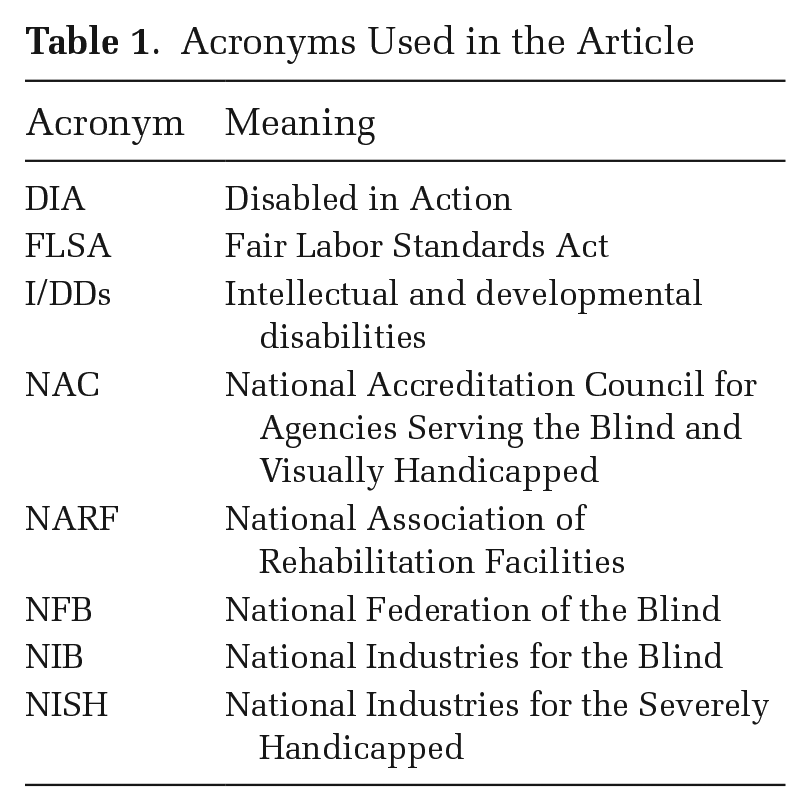
This article investigates the dynamics driving delaborization through an empirical analysis of the subminimum wage for disabled workers. In the United States, these subminimum wages have been legal at the federal level since 1938 under section 14(c) of the Fair Labor Standards Act (FLSA) (see Table 1 for a summary of acronyms used in this article). Early regulations, however, set the floor on disabled workers’ wages at 50 percent of the national minimum wage. This floor on wages was removed in 1986. In 2007, wages paid under section 14(c) averaged $1.36 per hour, after declining relative to the minimum wage for decades (Beckwith 2016). 2 A handful of states have banned the subminimum wage (Bickley 2019), and more than 80 organizations, including disability rights groups, labor unions, and bipartisan government agencies, oppose the law (National Council on Disability 2018; National Federation of the Blind 2016; U.S. CRC 2020). Yet in 2018, approximately 2,000 organizations nationwide paid over 320,000 disabled workers subminimum wages under section 14(c). Minimal sociological research addresses the subminimum wage, begging the excavation of its social preconditions, and in particular the preconditions of its low political visibility.
Acronyms Used in the Article
This article assesses these preconditions through a detailed case study of the dynamics driving the 1986 removal of the 50 percent wage floor. In the late 1970s, mounting criticism of disability-based subminimum wages led Congress to consider reforming or repealing section 14(c). Yet in the early 1980s, Congress changed course, entrenching the subminimum wage. 3 Beginning around 1975, workers paid subminimum wages began to unionize, setting off a series of National Labor Relations Board hearings that escalated to the Supreme Court. Investigations of the subminimum wage by national news outlets (Kwitny and Landauer 1979a, 1979b, 1979c; U.S. Congress 1980:281–82) and government overseers (U.S. Government Accountability Office [GAO] 1981) uncovered massive abuse and exploitation in subminimum wage programs, sparking public outcry. Between 1980 and 1982, five bills to prohibit or limit the subminimum wage were introduced in Congress (U.S. Congress 1980, 1981a, 1981b, 1981c, 1982a).
Given the acceleration of the disability rights movement in the lead-up to the 1990 Americans with Disabilities Act (Barnatt and Scotch 2001; Pettinicchio 2019), alongside the early support of labor unions, one might have expected these bills to gain momentum. Yet by 1986, exploitation had vanished from legislative discourse and advocates of subminimum wage entrenchment truthfully described this entrenchment as uncontroversial (U.S. Congress 1986d:27495). Discussion of the 1986 bill took up seven pages of the Congressional Record, no elected official spoke in opposition, and the bill passed both governing bodies by consensus. Yet these amendments had long-lasting consequences: as one disability activist summarized in a recent retrospective, “That move in ’86 to remove the subminimum wage floor set back the civil rights of workers with disabilities by decades. It’s still impacting us today” (quoted in Crandell 2022:8–9). Analytically, this article leverages the 1980s as a period when the subminimum wage went from controversial to taken-for-granted.
The empirical question guiding this article is: Why was the floor on disabled workers’ wages removed in 1986 despite the unionization drive of the 1970s, the alternative political possibilities of earlier hearings, and the concurrent gains of the disability rights movement in other areas? On a theoretical level, I ask: How does work come to be delaborized, legitimizing loopholes in labor laws? This article draws on archival research to link the entrenchment of the subminimum wage to the growing influence of disability employment program managers, the comparative weakness of the opposing coalition of labor unions and disability rights groups, and the animating power of disability stigma. I propose delaborization as a social process driven by mechanisms including professional expertise, the withdrawal of labor unions, and identity-based stigma.
This analysis of delaborization contributes to several literatures. Most obviously, it contributes to the sociology of work, analyzing how work is rendered invisible and the consequences of this invisibility. The empirical findings on the role of expertise in delaborization develop the literature on professions and expertise, highlighting the depoliticizing effects of expertise. The concept of delaborization has additional ramifications for parallel cases such as workfare, prison labor, migrant labor, graduate student teaching and research, and care work addressed by other literatures, including but not limited to the sociology of gender, the sociology of migration, the sociology of education, the sociology of race and ethnicity, and political sociology. Lastly, at a substantive level, this historical account of the subminimum wage contributes to the sociology of disability, which to date has neglected the payment of subminimum wages to disabled workers (though see exceptions such as Crandell 2022; Gill 2005; Pendo 2016).
Theorizing Delaborization
Where prior literature neglects labor classification or divorces it from sociohistorical context, I develop delaborization as a concept capturing the mystification of work through its reclassification as a social service (or, in other empirical cases, as training, leisure, or restitution), which may legitimize loopholes in labor laws, including the elimination of the wage floor for disabled workers. This concept draws on the invisible work literature, but I take a more processual approach, investigating how invisible work comes to be constituted as such instead of treating it as an essential characteristic of certain types of work or groups of workers. My replacement of “invisible work,” the standard term in extant literature, with “delaborization,” a less commonly-used term, reflects this processual move (for prior deployments of delaborization, see Jia and Zhong 2020; Sarti et al. 2018; Uğurlu 2013). I draw on existing research on invisible work, as well as broader political sociology literatures, to theorize delaborization and hypothesize three possible antecedents. I evaluate these hypothesized antecedents through analysis of the 1986 amendments.
A Processual Approach to Invisible Work
Central cases of invisible work in extant literature include household labor, workfare, and prison labor (Collins and Mayer 2010; Daniels 1987; Federici [1975] 2012; Goldberg 2001; Goodman 2012; Hatton 2020, 2021; Krinsky 2007; Peck 2001; Sarti et al. 2018; Zatz 2009). Parallel cases that receive less attention include graduate student labor (Hatton 2020; Singh, Zinni, and MacLennan 2006), internships (Crain et al. 2016; Frenette 2015), and college athletics (Hatton 2020; McCormick and McCormick 2006). Household labor is the subject of much feminist analysis, which analyzes the invisibility of both paid and unpaid household work as a central dimension of gender inequality (Daniels 1987; Duffy 2011; England 2005; Federici [1975] 2012; Fortunati 1995; Hartmann 1981; Nakano Glenn 1992; Sarti et al. 2018). The workfare literature investigates the classification of people enrolled in welfare-to-work programs as service recipients as opposed to wage workers (Collins and Mayer 2010; Goldberg 2001; Hatton 2020; Krinsky 2007; Peck 2001; Soss, Fording, and Schram 2011). Finally, research on prison work addresses prisoners’ exemption from labor laws, including the minimum wage, justified through their cultural constitution not as workers, but as people paying a debt to society or seeking personal transformation through work (Goodman 2012; Hatton 2020, 2021; Zatz 2009). These cases demonstrate the close relationship between labor classification and protections such as minimum wage laws: when work is not recognized as labor, workers may lose access to institutional and legal protections.
Dynamics of delaborization naturalize working conditions beyond these officially recognized cases. Even when work is formally classified as labor, the perception of this work as a service to the worker may legitimize low wages or poor working conditions. For example, discourse around migrant labor focuses on its benefits for workers, identifying low-wage work as a path to upward mobility, for which migrants should be grateful. The perception that migrants ought to be thankful for any work they can find justifies poverty wages and restrictive working conditions (Canizales 2023; Holmes 2013). Similar dynamics have been documented in day labor hiring, enabling the payment of subminimum wages in this industry (Roberts and Bartley 2004). Broadly, the treatment of work as charity has the potential to legitimize the poor working conditions of any group with a history of labor market exclusion, such as homeless people, people of color, women, or people with disabilities. Even in higher-status creative and white-collar fields, the exhortation to “do what you love” constructs work as something workers ought to enjoy regardless of its conditions, legitimizing precarious conditions and poor compensation (Cech 2021; Jaffe 2021). Delaborization thus has broad significance for the sociology of labor, which has long recognized that the treatment of workers as beneficiaries of their own exploitation is crucial to the mystification of capitalist dynamics (Burawoy 1979).
Investigating the origins of invisible work regimes illuminates delaborization as a contingent process, in contrast to scholarship that takes for granted the outcome of this process. Prior research on invisible work is rightfully concerned with the disproportionate employment of marginalized groups, such as women, migrants, and people of color, in these positions (e.g., Daniels 1987; Federici [1975] 2012; Fortunati 1995; Hatton 2020, 2021). Similarly, I address disability stigma as a factor driving the 1986 entrenchment of the subminimum wage. However, if the low visibility of certain forms of work is treated as fixed, this research program risks essentializing invisible work as intrinsically linked to certain categories of people. For example, if the invisibility of migrant labor is tautologically presumed—migrants’ work is invisible because the workers are migrants—sociologists risk naturalizing factors driving this invisibility, such as the spatial organization of migrant work or the legal regimes it operates under. This article shows there is nothing inherent to disabled workers’ labor that caused its mystification as such; rather, this mystification emerged from a specific set of historical conditions in the late twentieth century.
Three Potential Antecedents to Delaborization
Prior research on expertise and politics points toward potential causes of delaborization. Extant research shows that professionals on the rise cement their jurisdiction by framing contested problems as purely technical matters and excising more overtly political perspectives, including those of activists and labor organizers (Berman 2022; Escobar 1995; Evans 2002; Ferguson 1994; Hirschman and Berman 2014; Mitchell 2002). For example, much postcolonial scholarship shows that in the mid-to-late twentieth century, an emergent class of development experts transformed poverty in the global South into a set of technical problems with technical solutions, erasing postcolonial power relations (Escobar 1995; Ferguson 1994; Mitchell 2002). In a parallel case, Evans’s (2002) analysis of human genetic engineering documents a jurisdictional struggle that produced a shift from “thick” discourse (democratic and entailing a wide range of considerations) to “thin” discourse (restricted to professional bioethicists and highly rationalized).
When contested jurisdictional territory includes a population’s time use and labor power, 4 delaborization—as a “thin” understanding of human labor—emerges as a possible outcome of conflict. Professionals on the rise may assert jurisdiction by redefining labor that they supervise as a service to workers that they alone have sufficient expertise to deliver. Indeed, this article shows that over the course of the 1970s and 1980s, an emergent profession—disability employment program administration—claimed disabled people’s time use and labor power as their jurisdictional territory, excising alternative understandings of disabled workers’ labor and contributing to delaborization.
Second, the sidelining of labor unions may be an important antecedent to delaborization. The labor politics literature identifies union organizing as a central determinant of the resolution of labor contention (Clawson and Clawson 1999; Fantasia and Voss 2004; Korstad 2003; Liu 2017; Voss and Sherman 2000), such as the contention seen over the subminimum wage in the 1970s and early 1980s. The very presence of unions in a given struggle identifies this struggle as labor-related. What happens when unions appear unconcerned with contentious work situations? Might this seeming lack of concern enable the recasting of these situations as something other than labor, for example, as a social service to workers? When unions are sidelined, either through external factors or their own internal decision-making processes, this sidelining may lay the groundwork for delaborization. This article tests this second hypothesized antecedent by evaluating the role of unions in the 1986 entrenchment of the subminimum wage.
Finally, the literature on stable invisible work regimes suggests identity-based stigma as a third antecedent to delaborization. I rely on the expansive definition of stigma developed in recent work, which encompasses racism, misogyny, and other ideological biases, as well as the stigmatization of illness and disability traditionally captured by this concept, and which links interpersonal stigmatization to meso- and macro-level power relations (Best and Arseniev-Koehler 2023; Lamont 2018; Pescosolido and Martin 2015). Extant literature links the invisibility of labor to workers’ stigmatization as migrants (Canizales 2023; Holmes 2013), people of color (Carmody 2022; Hatton 2021; Nakano Glenn 1992; Soss et al. 2011), and women (Daniels 1987; Federici [1975] 2012; Fortunati 1995). This literature suggests identity-based stigma may naturalize poor working conditions, for example, by suggesting that women have natural tendencies toward reproductive labor (Daniels 1987; Federici [1975] 2012); Fortunati 1995) or that workers of color ought to be grateful for any work they can find (Soss et al. 2011).
Although it has received limited scholarly attention, disability stigma may also contribute to delaborization. Since the emergence of capitalism in the eighteenth and nineteenth centuries, disability stigma has been closely connected to the exclusion of disabled people from wage labor (Carmody 2022; Gleeson 1999; Nibert 1995; Rose 2017; Stone 1984). An extensive welfare state effort to put people with disabilities to work has been analyzed as a contemporary vehicle for this stigma (Russell 1998, 2019). However, the analysis I present here diverges from prior literature linking identity-based stigma to the invisibility of labor, first by highlighting identity-based stigma as historically contingent, and second by analyzing it as among a constellation of factors driving delaborization. Identity-based stigma is an insufficient sole precondition for delaborization, as periods of heightened visibility of labor illustrate (e.g., conflict over the subminimum wage in the 1970s, or periods of struggle over women’s household labor [Federici (1975) 2012]). The links I evaluate between identity-based stigma, the sidelining of labor unions, and the rise of experts denaturalize invisible work regimes and illuminate delaborization as a generalizable social process.
Research Design
This article presents findings from archival research on the 1986 amendments to section 14(c) of the Fair Labor Standards Act. Specifically, I analyze over 3,000 pages of primary historical materials related to the subminimum wage produced between the 1960s and the 1980s. I focus on six bodies of documents: (1) congressional records comprising the 1986 bill itself, the House and Senate hearings that preceded the 1986 bill, and congressional subcommittee hearings in 1980, 1982, and 1985 about proposed amendments to section 14(c); (2) records of congressional debates on laws adjacent to the subminimum wage; (3) nine government- or government-commissioned reports on the subminimum wage produced between 1967 and 1981; (4) records of social movement groups; (5) oral histories collected as part of the Disability Rights and Independent Living Movement, held in the Bancroft Library at the University of California-Berkeley; and (6) period news coverage. I use secondary historical research to contextualize these primary documents.
I analyzed these materials in three stages. First, I reviewed documents inductively and recorded key moments, transformations, and themes through extensive notes. Second, to test emergent hypotheses, I deductively revisited documents and passages identified as relevant to the construction of the empirical case. Finally, I reviewed, for a third time, congressional records from subcommittee hearings held in 1980, 1982, and 1985—the historical materials most central to this article—to tally the representation of each organization and the recurrence of specific discursive strategies. In this third stage, I also produced graphs and descriptive statistics summarizing quantitative data extracted from historical materials. Throughout all three stages of analysis, I drafted regular memos detailing my emergent comprehension of the empirical case. This combination of inductive and deductive analysis, reliance on written notes and memos, and descriptive use of quantitative data follows standard practices of case construction in historical sociology (Abbott 2014).
I use a single historical case to investigate delaborization as a general phenomenon. I work within the processual turn in historical sociology to trace the contingent means through which an unsettled situation was settled (Clemens 2007; Van de Ven and Sminia 2012). Specifically, analyzing the rapid reversal in the political prospects of a proposed regime offers theoretical leverage, as it enables within-case comparisons to identify factors driving this reversal (for a methodological parallel, see Levine and Russell 2023). In Hirschman and Reed’s (2014) terms, this article offers a “formation story” for the 1986 entrenchment of the subminimum wage. My aim in case selection is not to elucidate wholly general laws by asserting uniformity across cases of delaborization, but to analyze processual factors distinguishing the empirical case of the subminimum wage (on the use of single cases, see Burawoy 1998; Emigh 1997). In Small’s (2009) terms, I prioritize theory building over empirical generalization. After a brief overview of the empirical case, I describe, in turn, the three antecedents to delaborization identified through historical research: the rise of experts, the withdrawal of labor unions, and identity-based stigma.
Empirical Case
Figure 1 presents a timeline of the subminimum wage from its establishment in 1938 to its entrenchment in 1986; I focus on the 1970s and 1980s. 5 Workshops employing disabled workers at subminimum wages experienced tremendous growth over the 1970s and 1980s following the mass movement of disabled people from institutions into disability employment programs. Over this same period, the management of disability employment programs professionalized, with employment program professionals developing into a cohesive lobby advocating deregulation. These lobbyists came into conflict with disability rights activists and union organizers, who advocated for protections including the payment of minimum wages or above.
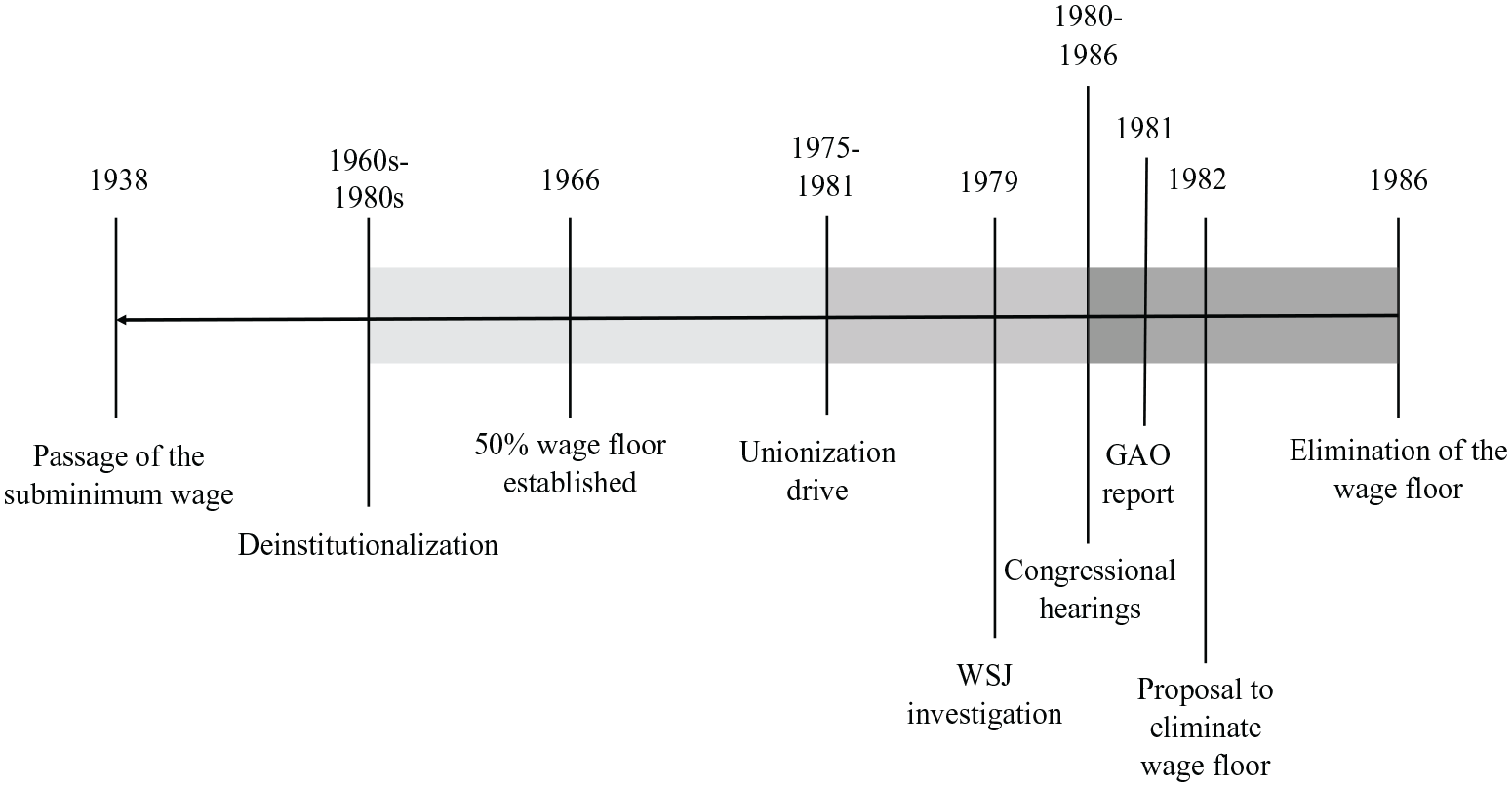
Timeline of the Payment of Subminimum Wages to Disabled Workers, 1938 to 1986
At the start of the 1980s, the subminimum wage was subject to national news coverage, a highly publicized government investigation, unionization efforts, and five bills to raise wages. As the Assistant Secretary of Labor stated in 1980, “For many years the sheltered workshop program has been relatively obscure with little attention focused upon it . . . it was only in recent years, as the disability rights movement gained momentum, that public attention has focused on sheltered workshops” (U.S. Congress 1980:29). 6 In particular, Wall Street Journal coverage (Kwitny and Landauer 1979a, 1979b, 1979c) sparked government investigations that uncovered noncompliance with statutory requirements in 60 percent of programs authorized to pay subminimum wages, and underpayments totaling $2.7 million in a limited sample of 500 programs between 1977 and 1979 (U.S. GAO 1981:3). 7 The executive director of the National Association of Rehabilitation Facilities (NARF), the leading professional organization of the employment programs industry, summarized these investigations’ effect on public discourse: “Currently, there is a certain public ambivalence to sheltered employment. Many advocacy groups regard sheltered workshops as exploitative and there is enough smoke with this fire to attract the attention of national news media” (U.S. Congress 1980:140–41). Leaders of the National Industries for the Blind (NIB), a major consortium of employment programs, similarly bemoaned the “unprecedented publicity” the subminimum wage received in 1979 to 1980 (U.S. Congress 1980:485). Secondary historical research identifies the subminimum wage as subject to “a huge amount of interest” during this period (Barnatt and Scotch 2001:119; see also Crandell 2022).
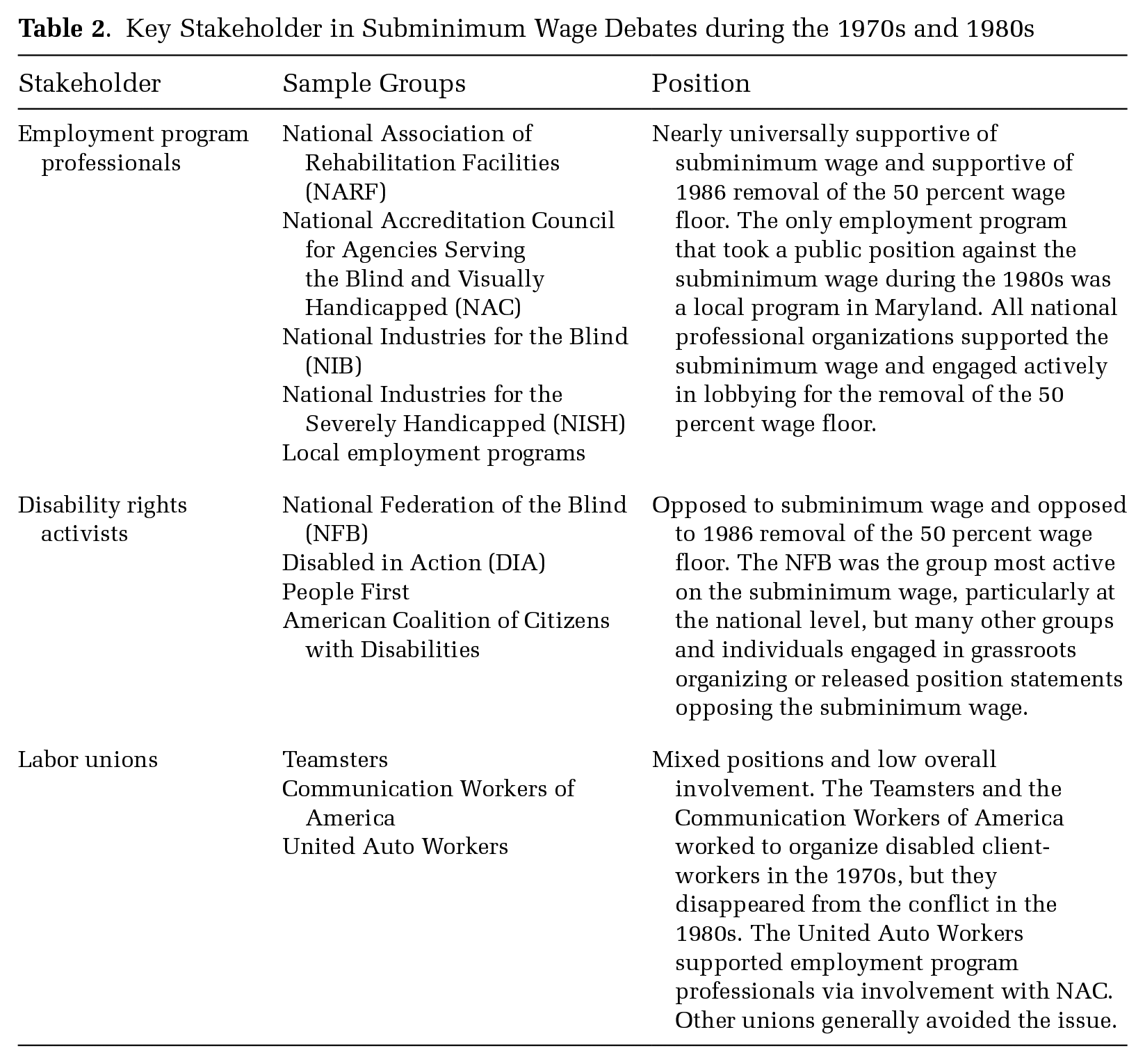
The acceleration of the disability rights movement was thus the recognized backdrop of congressional hearings during the 1980s, yet during these hearings, activists’ arguments were overshadowed by those of the better politically positioned disability employment program professionals. Table 2 summarizes stakeholders in subminimum wage debates and their positions. In the 1970s, professionals and the labor–disability coalition were relatively well-matched, with labor and disability rights organizers successfully unionizing several workshops and drawing public attention to their critiques of the subminimum wage. However, in the 1980s, labor unions withdrew from the issue and employment program professionals overpowered activists politically, gaining control of congressional hearings and mobilizing stigmatizing rhetoric to legitimize low wages. This shifting balance of power produced a systematic shift in tone in hearings on the subminimum wage from 1980 to 1986, with congressional representatives gradually adopting program managers’ own rhetoric and ultimately eliminating the wage floor in 1986 through bipartisan consensus.
Key Stakeholder in Subminimum Wage Debates during the 1970s and 1980s
Conflict between professionals, activists, and labor unions was more influential than the partisan alignments that shape labor law in other instances. Indeed, the most active critic of the subminimum wage during the late 1970s and early 1980s was conservative Representative Barry M. Goldwater Jr. (R-AZ). In response to Wall Street Journal coverage of the subminimum wage, Goldwater commissioned the 1981 GAO investigation, sponsored legislation against the subminimum wage, and was given an award by the National Federation of the Blind for his advocacy. Ten Democrats co-sponsored the 1986 amendments (U.S. Congress 1986a, 1986b). Congressional hearings were driven by a politically mixed group—the Subcommittee on Labor Standards was chaired by a Democrat in 1980, a Republican in 1982, and a Democrat again in 1985—suggesting their trajectory cannot be attributed to partisan control over hearings. The 1986 amendments were passed as stand-alone legislation, not as a rider to another bill, so their consensus passage reflects consensus acceptance of the entrenchment of the subminimum wage. 8 These unexpected partisan alliances indicate the subminimum wage was not understood through the lenses of power, exploitation, or profit that drive partisanship, requiring an alternative explanation for its 1986 entrenchment. I propose the rise of experts, the withdrawal of labor unions, and identity-based stigma as three intersecting factors that drove delaborization in this case and potentially in parallel cases.
The Rise Of Experts
Throughout the twentieth century, most subminimum wage employers operated as nonprofits and hired disabled people as in-house workers to carry out contracts with government agencies or for-profit corporations. In some cases, programs provided services beyond employment to workers, such as medical care. Few workers paid subminimum wages in segregated programs left these programs and moved into other jobs (U.S. GAO 1981, 2001), so these programs were typically career employers. As a U.S. GAO (1981:45) report summarized the model, “Although the handicapped employed in sheltered workshops receive training and therapeutic benefits from the workshops, the primary emphasis of the employment aspect of a sheltered workshop is to provide goods and services for sale to Federal, State, and local governments and in the commercial market.” This section traces the growth of the employment programs industry and its emergence as a professional lobby advocating subminimum wage entrenchment, highlighting the role of expertise in delaborization.
Emergence of the Disability Employment Programs Industry
The disability employment programs industry emerged in the wake of the deinstitutionalization movement. Prior scholarship treats deinstitutionalization as the cornerstone of twentieth-century disability history (Bagenstos 2017; Eyal et al. 2010; Kritsotaki, Long, and Smith 2016; Mechanic and Rochefort 1990). Figure 2 illustrates effects of this movement, demonstrating that the population of people with disabilities housed in state institutions peaked around 1960, then fell from the 1960s through the 1980s, although paths to deinstitutionalization varied by disability. 9 On the whole, deinstitutionalization is typically attributed to the mid-twentieth-century convergence of disability rights organizing and declining government capacity to shoulder the long-term costs of disability care (Eyal et al. 2010; Mechanic and Rochefort 1990). Fiscal conservatives drew on disability activists’ critiques of institutional conditions to justify massive cuts to services, yet in many instances neglected to replace institutions with the community-based services that organizers had envisioned (Bagenstos 2017; Bagnall and Eyal 2016). Effects of deinstitutionalization thus rippled into other spheres of social life, such as the carceral system (Ben-Moshe 2020; Harcourt 2006; Parsons 2018; Roth 2018), the welfare system (Dear and Wolch 1987; Gong 2019), diagnostic classification processes (Eyal et al. 2010), and, as examined here, labor policy and practices.
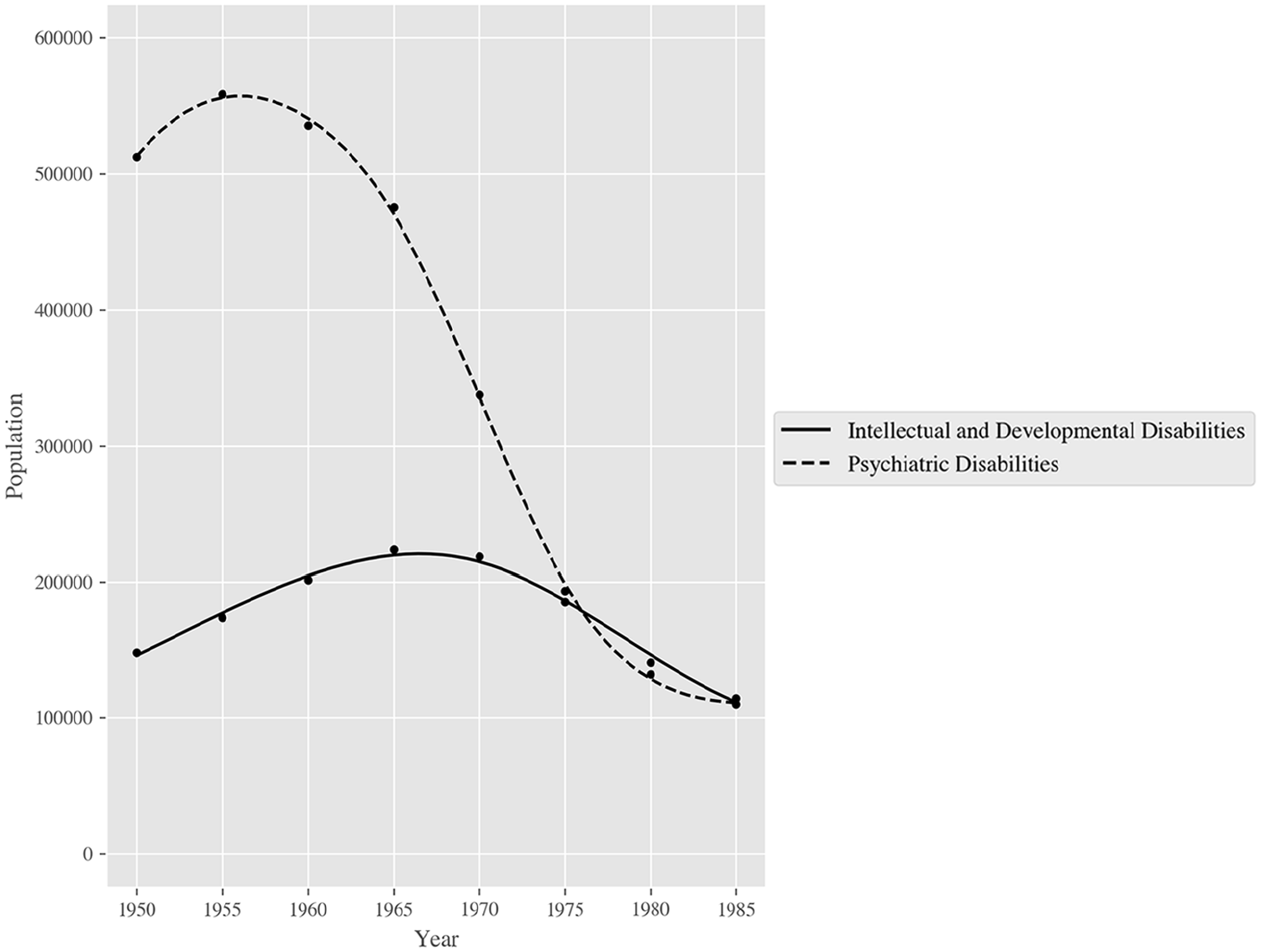
Populations of People with Intellectual and Developmental disabilities (I/DDs) and Psychiatric Disabilities Housed in State Institutions Annually, 1950 to 1985
Deinstitutionalization left in flux both a population (people with significant disabilities) and a set of problems related to that population (how the material needs of disabled people should be met and how disabled people should occupy themselves on a daily basis) (Abbott 1988; Eyal 2013). As large state institutions exercised less control over the lives and labor power of disabled people, disability employment programs stepped up to replace them, often through direct transfers of individual disabled people from institutions to employment programs. Representatives from the Department of Labor (U.S. Congress 1980:20–21, 1982b:24) and four national consortiums of employment programs (U.S. Congress 1980:153, 325, 1982b:4–5, 50, 59, 86, 1985:6, 36–37, 43, 115) all reported before Congress that the deinstitutionalization movement had pushed disabled people out of state or private institutions and into employment programs. These claims are supported by quantitative data on program growth. In a trend perpendicular to the plummeting institutional population displayed in Figure 2, Figure 3 documents a greater-than-threefold increase in the disability employment program population over the late 1960s and 1970s, the period of most rapid deinstitutionalization. The number of employment programs licensed to pay subminimum wages also increased from 978 to 3,877 over this period (U.S. GAO 1981:125). These findings concur with Beckwith (2016) and Crandell (2022), the two existing treatments of deinstitutionalization and subminimum wage labor.
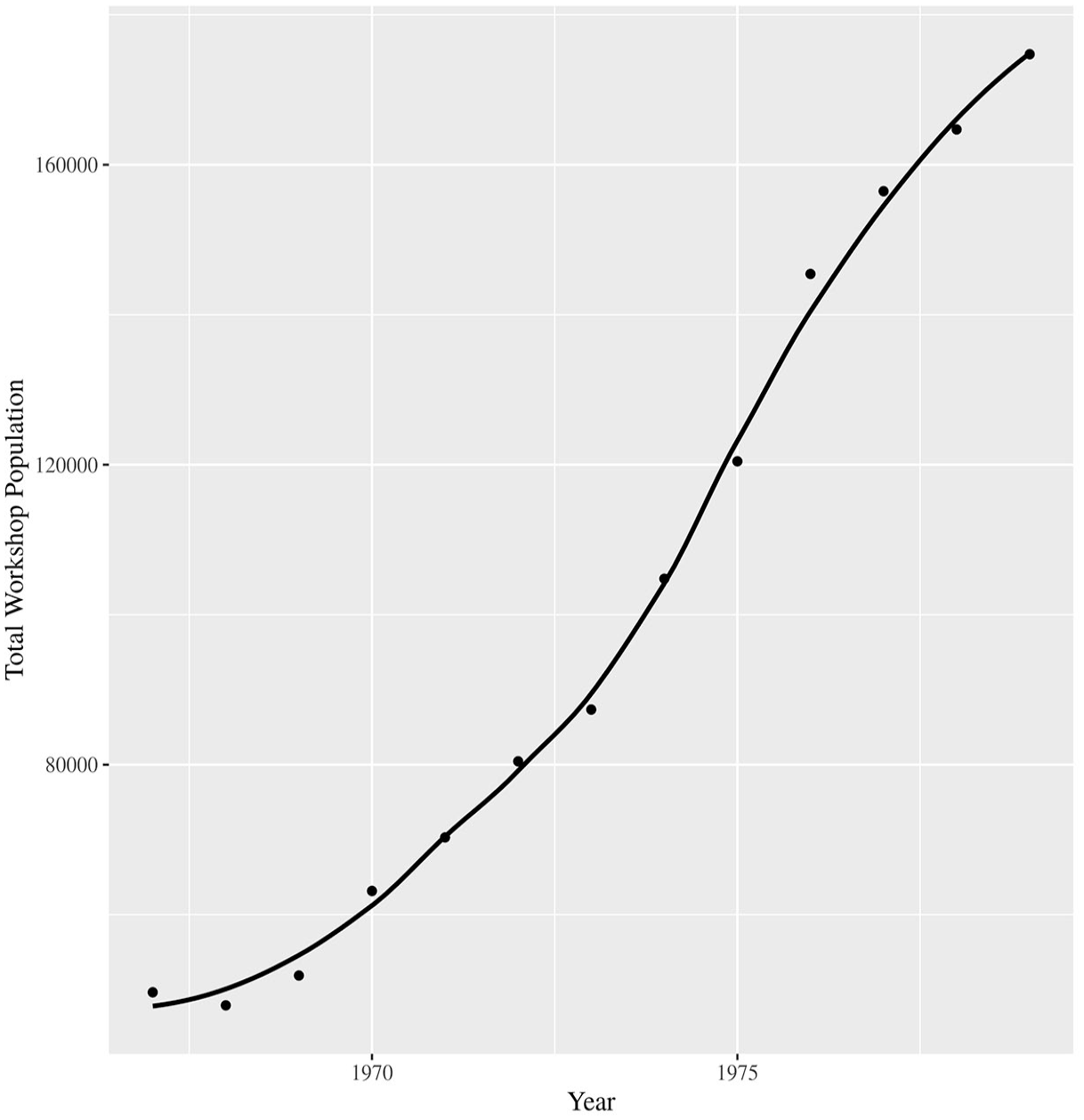
Total Population Employed in Disability Employment Programs, 1967 to 1979
By the 1980s, the management of disability employment programs thus represented an emergent profession. Estimates provided to Congress suggest the industry’s aggregate financial holdings totaled nearly half a billion dollars by 1980 (U.S. Congress 1980:49). The employment programs industry sits at the intersection of medical, social welfare, and business fields, and managers were drawn from these varied fields (Menz, Bordieri, and Esser 1985:70–85). Industry entrepreneurs advocated specialized training that blended disability services and management (Kaur 2019, 2021; Menz et al. 1985; Whitehead 1977:18), and government agencies and national consortiums of employment programs raised funds for educational degree programs in employment program administration (Kaur 2021; Tusler 2004:82).
The industry was highly organized: national organizations such as Goodwill administered large numbers of local programs, and other groups received resources and oversight from professional organizations, including the National Association of Rehabilitation Facilities (NARF) and the National Accreditation Council for Agencies Serving the Blind and Visually Handicapped (NAC). This professionalization unified logics, practices, and political priorities in the field, paving the way for professionals’ emergence as a political lobby and their mobilization of expertise in service of delaborization.
As the employment programs industry expanded, working conditions in this industry worsened. Figure 4 demonstrates the falling value of the subminimum wage relative to the federal minimum wage over the twentieth century. Average section 14(c) wage rates declined from nearly equal to the federal minimum wage in 1938, when the FLSA was passed, to around 55 percent of the federal minimum wage in the mid-1960s, to below 40 percent during the debates of the 1980s, to under 25 percent in 2007. The real value of the federal minimum wage also declined substantially over the late twentieth century (Mishel 2013), so this shift represents plummeting purchasing power for disabled workers, and a steep increase in the value extracted by employers.
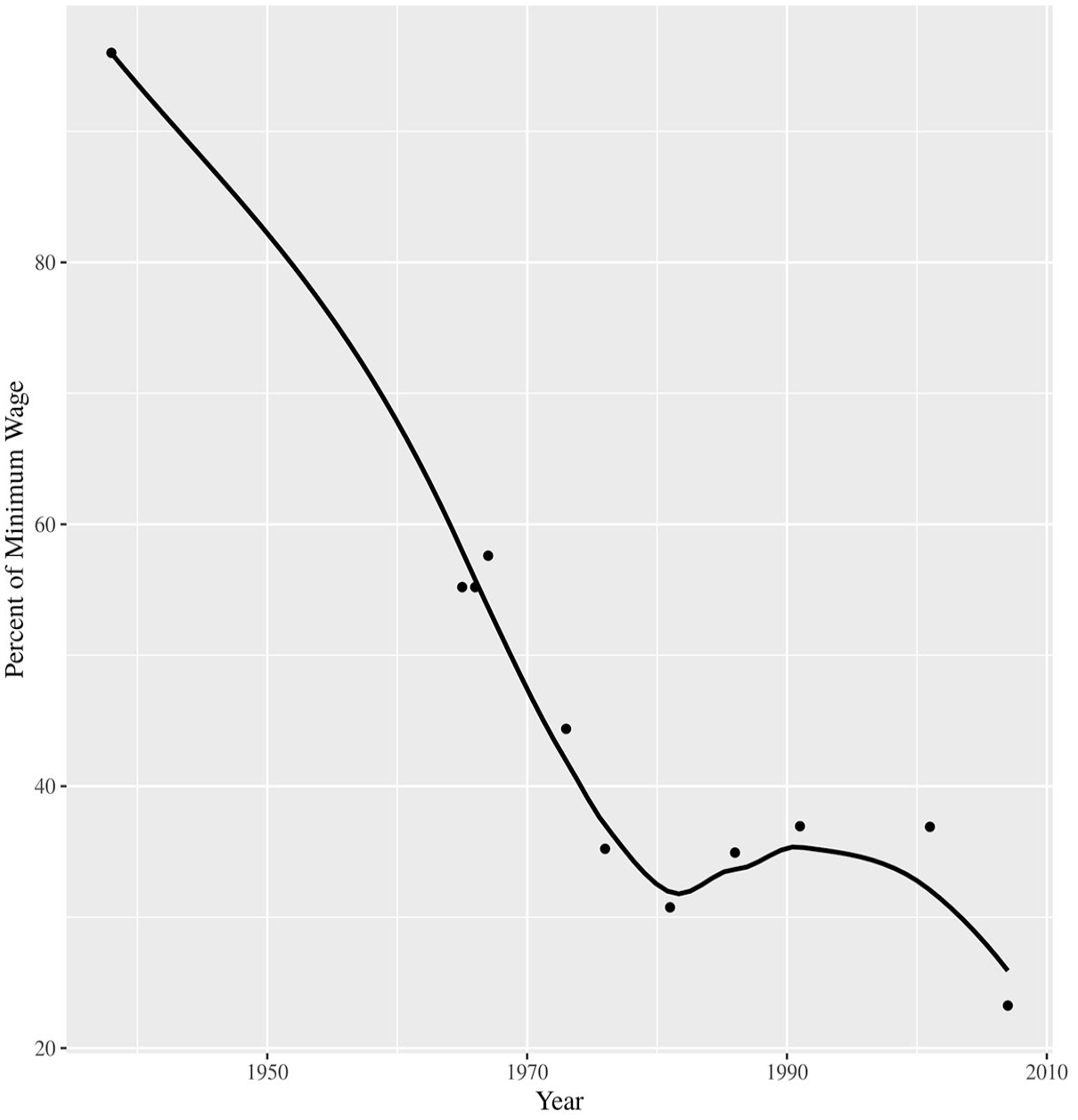
Average Wages Paid under Section 14(c) as a Percentage of the Federal Minimum Wage
The quantitative data presented in Figure 4 show that the 1986 amendments did not represent a watershed moment in the overall degradation of disabled workers’ labor, as the most significant declines in the relative value of subminimum wages occurred in the immediate preceding years. This research thus takes the 1986 entrenchment of the subminimum wage not as causally determinative, but as an empirical window into how contention was negotiated before Congress, and how the legislative process reified disabled labor as a service to the worker, who was subject to the jurisdiction of employment program professionals. The removal of the wage floor thus stood in for broader struggles over disability, welfare, and labor.
Prior to the 1986 amendments, the declining relative value of the subminimum wage can be attributed to the categorical substitution of work activity centers (and, to a lesser extent, evaluation and training programs) for sheltered workshops, a bureaucratic distinction. A loophole in the 1966 legislation that established the 50 percent wage floor exempted work activity centers (a classification designed for workshops that employed people with more severe disabilities) and evaluation and training programs from this wage floor. A year after the 1966 amendments, the Department of Labor reported that programs that paid sub-50 percent wages had responded to the new wage floor merely by filing as work activity centers rather than sheltered workshops (U.S. DOL WHD 1967:5). Many of these changes were in name alone, but they led to massive growth in wage floor-exempt programs (Beckwith 2016).
In the decade following the 1966 legislation, which saw a threefold overall population increase in employment programs, the disabled population employed in licensed sheltered workshops held approximately constant while the population employed in work activity centers increased ninefold (U.S. GAO 1981:126). Programs benefited economically from this loophole in the 50 percent wage floor, but in the late 1970s they came under scrutiny for these filing practices and other elements of their financial model. Program professionals thus sought to legitimize this loophole through the 1986 elimination of the wage floor, entrenching both their jurisdiction over disability services and their subsequent autonomy to set revenue-maximizing wage levels. 10
Lobbying Power
Employment program professionals leveraged ties to the state 11 and private industry to influence policy. The Javits-Wagner-O’Day Act of 1971 mandated that the federal government purchase specified services and supplies from programs with the mission of employing disabled workers, formalizing these ties. This legislation established the Committee for Purchase from the Blind and Other Severely Handicapped as a staffed government agency facilitating contract assignment through collaboration with two designated representatives of the employment programs industry: the National Industries for the Blind (NIB), a national organization representing 91 local agencies in 1980 (U.S. Congress 1980:451), and the National Industries for the Severely Handicapped (NISH), a coalition of six of the largest national employment programs (U.S. Congress 1980:37, 436, 1985:48). These employment programs contracted with many large private companies, expanding their political networks (Kwitny and Landauer 1979a). Program managers’ embedded ties to government actors granted them control over the legislative process. For instance, the NIB and the NISH exercised editorial control over the GAO report commissioned to investigate industry practices after critical media attention; they submitted over 50 pages of line edits pre-publication, including the requested removal of critiques and endorsement of the elimination of the 50 percent wage floor (U.S. GAO 1981:132–89). Alongside this bureaucratic influence, the employment program industry’s high organization and embedded ties to political actors produced extensive representation in congressional hearings, laying the institutional foundations for delaborization.
From 1980 to 1986, congressional hearings were dominated by representatives of disability employment programs, and these programs’ governing professional organizations, with the opposing disability–labor coalition contributing minimally to legislative discourse. During hearings before the Subcommittee on Labor Standards held in 1980, 1982, and 1985, 24 organizations representing program management delivered 93.5 pages of verbal statements and 501 pages of written statements, compared with 18.5 pages of verbal statements and 59.5 pages of written statements delivered by two social movement groups. Both social movement groups represented in subcommittee hearings opposed the subminimum wage, as did many disability rights groups excluded from congressional hearings. No labor unions testified before Congress. This overrepresentation allowed employment program managers to control the congressional conversation about the subminimum wage.
Program managers claimed their professional expertise was essential to the employment of disabled workers. For example, the Executive Director of the Dallas Lighthouse for the Blind dismissed claims of exploitation by emphasizing the professional expertise needed to manage disabled workers: “Without rehabilitative preparation we would not be able to employ blind people with such severe handicaps . . . it requires all the professionalism that trained rehabilitative staff can muster to employ them in a sheltered workshop” (U.S. Congress 1980:336, emphasis added). Similarly, United Cerebral Palsy stated of the subminimum wage, “[T]his is not merely a labor issue, for if it were, it would have a simple solution. We believe that this is a complex problem which involves labor, industry management, rehabilitation, and income support systems; to ignore any of these areas would result in giving a partial answer to the total question” (U.S. Congress 1980:530, emphasis in original). Managers consistently used the language of “service” and “clients” (as opposed to “labor” and “workers”) throughout the 1980 to 1986 hearings. In total, 17 of the 22 employment programs that testified in favor of the subminimum wage mobilized rhetoric of health or social welfare service provision in this testimony.
When critics of the subminimum wage named subminimum wage work as labor, program managers contested this framing and identified the subminimum wage as a purely technical matter. This contestation can be seen in the 1980 extended exchange between Representative Edward Beard (D-RI) and Harold Richterman (NIB director of rehabilitation): Mr. Richterman: [E]very year, when the minimum wage goes up 10 cents, 20 cents, we begin to have our headaches in the shop. Should we take anybody in any more. . . . I am not objecting to blind people making as much money as they can, but there is no money to make if he does not earn it. Mr. Beard: You sound like a big businessman. Mr. Richterman: My concern is with individual blind people, with rehab service. I have nothing to do with the business end. (U.S. Congress 1980:219–20, emphasis added)
Program managers’ efforts to frame the subminimum wage as a matter of “rehab service,” and distance themselves from the “business end,” supported their claims that the subminimum wage was subject to the expertise of professionals and divorced from labor policy and practices, historically more subject to social movement claims. Program managers contested not the concrete claims of labor movements, but the legitimacy of discussing the subminimum wage as a labor matter at all.
The Withdrawal of Labor Unions
Disability rights groups represented the primary opponent of the entrenchment of the subminimum wage, with labor unions participating only secondarily. Major disability rights organizations agitated against the subminimum wage through the 1970s and 1980s, including the National Federation of the Blind (NFB), Disabled in Action, the American Coalition of Citizens with Disabilities, activists with intellectual and developmental disabilities, and activists gathered for the 1978 White House Conference on Handicapped Individuals. Deaf activist Frank Bowe, founder of the major cross-disability organization American Coalition of Citizens with Disabilities, wrote against the subminimum wage in the late 1970s (Bowe 1978:186). The cross-disability group Disabled in Action (DIA), famous for its disruptive political action during the 1970s, maintained a committee opposing sheltered workshops and the subminimum wage (Campbell 1984; Heumann 2004). DIA leader Judith Heumann indicated that this committee emerged from the experiences of DIA members with physical and developmental disabilities who had faced pressure to accept subminimum wage work (Heumann 2004:182). Heumann (2004:420) reported that during the 1970s, developmental disability groups prioritized the subminimum wage to a significant extent. This claim is supported by developmental disability activists’ emphasis on the subminimum wage in oral history interviews (Barrows 2007; Meadours 2008; Petty 2008; Ward 2008). People First, an organization representing self-advocates with intellectual and developmental disabilities, organized against the employment programs industry during the 1980s (Galer 2014:14). In 1978, nearly 4,000 activists with a range of disabilities adopted multiple resolutions against the subminimum wage during the White House Conference on Handicapped Individuals (U.S. Department of HEW 1978a:70, 94, 113–14, 1978b:134). Finally, section 14(c) represented a long-standing priority for the National Federation of the Blind (NFB), which organized against the subminimum wage from the 1950s onward, via political lobbying, speeches and writings, disruptive public protests, and unionization drives in employment programs (Barnatt and Scotch 2001; Crandell 2022; Matson 1990; U.S. Congress 1980, 1982b, 1985). These grassroots groups stood alone against subminimum wage entrenchment following the withdrawal of labor unions from the debate.
The absence of labor unions from congressional hearings contrasts with their earlier rank-and-file organizing in employment programs. Between 1975 and 1981, the Teamsters (with some support from the Communication Workers of America) facilitated unionization drives in employment programs in eight states (Braille Monitor 1981a:316, 1981b:185–88; Hudson 1981; Inman 1979). In 1978, the Teamsters promised their support to blind workers seeking to unionize anywhere in the country (Braille Monitor 1978:256). These organizing efforts faced counterfire from local management (Braille Monitor 1978, 1981b; Hudson 1981), who appealed unionization votes to the National Labor Relations Board, claiming that employment programs provided a social service and were not subject to the provisions of the National Labor Relations Act. These appeals escalated to the Supreme Court in 1982, which upheld the decision of lower courts that disabled workers had the right to organize (Braille Monitor 1983:1). 12 James Gashel, an influential leader within the NFB, characterized these local organizing efforts as part of the failed push to prohibit the subminimum wage and raise wages to standard levels in this period (Gashel 2011:29–31). As he stated in a later oral history, “They were far more successful at [local organizing] than we were in the Congress at getting the Fair Labor Standards Act changed” (Gashel 2011:31).
In contrast to these local victories, labor unions were not only unsuccessful but wholly uninvolved in congressional debates preceding the entrenchment of the subminimum wage. Neither the Teamsters nor other unions testified in the 1980 to 1986 hearings, and no union took a public position on the 1986 amendments. This decreasing involvement with subminimum wage advocacy was reflected in the Teamsters’ declining coverage in the NFB’s monthly newsletter. From the late 1970s through around 1983, the Teamsters sent representatives to panels, conventions, and other events alongside disabled activists. However, they disappear from NFB records midway through 1984 and are not referenced again before the passage of the 1986 FLSA amendments.
The Teamsters’ disappearance from subminimum wage debates may be attributed to the threefold onslaught they faced during the 1980s: (1) the deregulation of the trucking industry, which devastated their core membership, (2) the legal problems of their president, and (3) internal conflict within the Teamsters’ national bureaucracy (Belzer 1994). The Teamsters’ deprioritization of section 14(c) is illustrative of the general defensive position that labor unions were forced to adopt during the Reagan years. Their declining advocacy against the subminimum wage suggests that as Reaganism took hold, unions faced so many competing priorities in the defense of their preexisting jurisdictional territory that they lacked the resources to expand this jurisdiction to disability employment programs. These findings suggest the relative weakness of the labor movement during the 1980s paved the way for delaborization, as manifested in the entrenchment of the subminimum wage.
Alongside Reaganism, extant conflict between labor unions and disability rights organizers may have inhibited action against section 14(c) from unions beyond the Teamsters. Like other jurisdictional struggles described in this article, this conflict represented an aftershock of deinstitutionalization. Disability rights groups advocated deinstitutionalization, whereas unions often represented professionals in institutions and fought to keep these institutions open so that these employees would not lose their jobs (Bagenstos 2012, 2017; Luterman 2019; Parish 2005; Simplican 2017). Disability activists have detailed this conflict in oral testimony (Calderon 2012; Carr 2004; Coleman 2004; Fay 2004; Gilhool 2010; Leon 2000). According to these activist and scholarly accounts, conflict over deinstitutionalization produced generalized animosity between labor unions and disability rights groups during the 1970s and 1980s. While the Teamsters and the Communication Workers of America did organize disabled workers against the subminimum wage in the 1970s, lingering divisions between disability rights groups and labor unions may have prevented other unions from stepping into the legislative fight against section 14(c).
Some labor unions went so far as to side with employment program managers. For example, a representative of the United Auto Workers sat on the board of the National Accreditation Council for Agencies Serving the Blind and Visually Handicapped (NAC) and advocated for employment program interests to the direct detriment of workers in these programs (Matson 1990:818–21). This example speaks to a recurrent tension in disability rights’ groups relations with labor unions: should unions represent disabled people themselves, or professionals working with disabled people? When these groups’ interests come into conflict—a recurrent theme of disability organizing (Pettinicchio 2019)—union loyalties are unpredictable. In the case of deinstitutionalization, labor unions generally sided with professionals, producing trenchant opposition to some disability groups. Similarly, disability activists and teachers’ unions have come into conflict over accommodations for disabled students (Heumann 2004:461; Steneberg 2000:196). While employment program professionals were not widely unionized during the 1980s, unions (who represented disability professionals in other contexts) may have identified the managerial professionals staffing disability employment programs, not rank-and-file disabled workers, as potential constituents. Labor unions’ choice to back either professionals or activists thus reflects one facet of jurisdictional conflict over disability, and their failure to consistently back activists in the case of the subminimum wage may have contributed to its 1986 entrenchment. Weaknesses in the coalition between labor unions and other progressive activists thus represent the second antecedent to delaborization.
Identity-Based Stigma
The institutional transformations outlined thus far—namely, the emergence of disability employment program professionals as a powerful lobby and the disappearance of labor unions from debate—positioned program professionals to mobilize disability stigma in service of delaborization. Two major dimensions of disability stigma legitimized the 1986 entrenchment of the subminimum wage: first, high levels of collective paternalism toward disabled people (Barriga 2012; Carney et al. 2023; Pettinicchio 2019), which naturalized professionals’ legislative authority despite the opposition of disabled self-advocates, and second, the stigmatization of disabled people’s purported “idleness,” which research on disability and capitalism identifies as a fundamental factor constituting disability as a social category (Carmody 2022; Gleeson 1999; Nibert 1995; Rose 2017; Russell 1998, 2019; Stone 1984). Disability employment program managers drew on these aspects of disability stigma to construct low-wage work as a social service subject to their professional expertise.
Disability rights organizing put professionals on the defensive, with one high-ranking industry representative railing against “this damned nonsense where the workshops are always wrong and somebody else is always right” (U.S. Congress 1980:218). Drawing on preexisting paternalism toward disabled people, professionals mounted a coordinated attack on the National Federation of the Blind (NFB) as the organization most actively opposed to the subminimum wage. Witnesses indicated that during a sales meeting in 1980, representatives of the employment programs industry conspired to ensure that NFB president Kenneth Jernigan be “ruined both personally and professionally within the next two years” (U.S. Congress 1980:50, 103–104). Professionals allegedly planned to discredit Jernigan to government officials to prevent NFB fundraising (U.S. Congress 1980:51). Separately, two lawyers informed the NFB that employment program managers led by the NAC had “asked [these lawyers] to carry out a campaign of lobbying and quite possibly litigation against [Jernigan] personally” (U.S. Congress 1980:5).
The NAC wrote to the Department of Labor in April 1980 to protest with “grave concern” their award of a $156,323 contract for “Job Opportunities for the Blind” to the NFB. The NAC argued that this grant “supports—and tacitly endorses—the activities of a group that attacks legitimate organizations of and for the blind that refuse to be dominated by NFB’s tactics” and asked, “What safeguards has the Department established to prevent the ‘Job Opportunities for the Blind’ contract from becoming an undisguised showpiece for NFB’s radical philosophy and militant methods?” (U.S. Congress 1980:342–43). Similarly, following 1979 coverage of exploitation in employment programs, the executive director of the Dallas Lighthouse for the Blind wrote to “suggest that The Wall Street Journal investigate the National Federation of the Blind, including the director of this organization” (U.S. Congress 1980:510). The Dallas Lighthouse further argued in this letter that “[i]t is very obvious that The Wall Street Journal has published this material on behalf of the National Federation of the Blind” (U.S. Congress 1980:510). Critiques of The Wall Street Journal as a mouthpiece for radical social movements may appear surprising, but they highlight the level of outrage incited by disabled people speaking for themselves and the level of political invisibility sought by program managers.
Indeed, beyond their specific critiques of the NFB, program professionals generally identified organizing as an inappropriate response to the situation of disabled people. As one issue of the NFB monthly newsletter, the Braille Monitor (1978:248, emphasis added), explained this phenomenon, When Congress passes a civil rights statute for the handicapped, the ink is barely dry before someone suggests that enforcement of the statute be taken out of the Office for Civil Rights and transferred to the Architectural and Transportation Barriers Compliance Board. The basis for this is that equal treatment for the handicapped must obviously be different in kind from equal treatment for other minorities or women—it is clearly a matter for “experts” in handicaps, for people who have studied us in graduate school. . . . Nowhere is this false notion more prevalent, and more damaging, than in the special labor laws set up.
This passage may overstate the uniqueness of disability, but it illustrates the process through which disability stigma (here manifesting in paternalism) enabled disability employment program professionals to seize jurisdiction over disability labor law. Returning to the 1980 exchange between Richterman, director of rehabilitation for NIB, and Representative Beard (D-RI), we see employment program managers’ delegitimization of disability. Beard, a skeptic of the subminimum wage, queried the NIB on their political divergence from disabled self-advocates: Mr. Richterman: I think it is unfair to suggest that those people here yesterday [NFB representatives] represent the blind of the United States. Mr. Beard: We in Rhode Island recognize the gentleman here, Mr. Beck [blind worker from NFB delegation]. . . . He is blind, to start off with. Some of the so-called leaders of the blind are not blind. They can’t have the same sensitivity to the problems of the blind. Mr. Richterman: Mr. Beard, I don’t accept this. I have spent 33 years in this business and I match my sensitivity in it with any person whether blind or sighted as far as the sensitivity and understanding of serving blind people. I would not accept that at all. . . . Our organization is primarily interested in serving blind people in the workshops. We don’t have the time or money to keep walking the halls of Congress. . . . It might be worthwhile, Mr. Beard, if someone would ask the Federation with the money they raise what are the services they provide? I think this would be a fair question to ask them. Perhaps the service they provide is going through the halls of Congress making friends with the Congressmen and we just have not got the time or money to do that. (U.S. Congress 1980:217–18, emphasis added)
These italicized statements posit political advocacy as the incorrect response to disabled people’s conditions of existence. The irony of these statements lies in the disproportionate lobbying power of the NIB and other organizations representing program professionals relative to the NFB, other social movement groups, or labor unions. The NIB received the greatest representation in subcommittee hearings of any single organization. Furthermore, the NIB’s government ties through their statutory role as a distributor of federal contracts under the Javits-Wagner-O’Day Act granted them far more opportunity to “make friends with the Congressmen” than the NFB or any other disability rights organizations, and the 1986 entrenchment of the subminimum wage fulfilled their legislative agenda to the direct detriment of activists. Yet the NIB’s treatment of “service provision” as the sole legitimate response to the situation of disabled people illustrates the ideational thrust of employment program lobbying. Employment program professionals framed disabled people’s work conditions as health and social welfare issues subject to their professional expertise, not labor issues subject to social movement or union claims. This framing reflects paternalism toward disabled people as a key aspect of disability stigma (Barriga 2012; Carney et al. 2023; Pettinicchio 2019).
The reconstitution of work as a form of care further reflects the long-standing stigmatization of disabled people’s supposed idleness. Program professionals portrayed disability as entirely dismal, with disabled people’s lives lacking all meaning but the meaning brought by low-wage work. As a letter to Congress from the president of the Rhode Island Association for the Blind stated, “As professionals in the rehabilitation of blind people, we truly believe that it is better . . . to have employment at a lower wage than no wage at all. Having a job—even a low-paying one . . . gives blind persons a reason for being. In fact, for many it may be the only purpose they have in life” (U.S. Congress 1980:517, emphasis added). These statements rely on the assumption that disability itself robs life of any “reason for being,” a deeply ableist claim. Professionals further drew on ideologies of the moral significance of work to construct low-wage labor as the appropriate cure for the posited meaninglessness of disabled lives. As argued by the National Industries for the Severely Handicapped (NISH), But even more important than a quantitative difference in wages earned is the opportunity to work. Few of us would deny the therapeutic aspect of a day’s work. . . . It means that there is a place to go where people are friendly, understanding, and accepting. A place where the person has a chance to make a real contribution, to be appreciated as a valuable member of a team effort, and to participate in a meaningful and stimulating environment . . . sub-minimum wages help make these achievements a reality. (U.S. Congress 1980:229)
At times, employment program professionals went so far as to suggest that low-wage work served a medical function comparable to treatment like physical therapy. For example, as argued by the National Association of Rehabilitation Facilities (NARF), “Work as a rehabilitation modality is just as critical to whole person rehabilitation as speech therapy or physical therapy or social adjustment training” (U.S. Congress 1980:322). For employment program managers, the therapeutic value of work supplanted the question of whether employees could survive on their wages. This treatment of work as care discounts work as a source of material subsistence, contributing ideologically to delaborization.
Legislators were swayed by program managers’ stigma-based jurisdictional logics, eventually adopting professionals’ framing of the subminimum wage as a technical issue related to service provision. For instance, Senator Don Nickles (R-OK), a sponsor of the 1982 bill to remove the 50 percent wage floor adapted and passed in 1986, confronted an NFB representative on these grounds: “I guess a lot of the thrust of your statement seemed to say that this would be for the benefit of the managers of these businesses, at the expense of the [disabled] individual. I find that very contrary to our previous panelists today, whom I believe are very sincere individuals who are working very sincerely in trying to help disadvantaged or handicapped individuals” (U.S. Congress 1982b:82). Similarly, in Representative Thomas Petri’s (R-WI) introduction to the 1985 subcommittee hearings that finalized the eventual bill, Petri stated, Whenever you consider any amendments to the Fair Labor Standards Act, you raise fears that you may be opening up all kinds of complicated and highly contentious issues, and this is understandable indeed. However, if the bill which is the subject of this morning’s hearings moves forward through the legislative process, I feel confident that we can insulate it from other Fair Labor Standards Act questions. For this issue is not really a labor standards issue at all, but rather a handicapped services issue. (U.S. Congress 1985:3, emphasis added)
By the time of the subcommittee hearings that finalized the 1986 bill, delaborization had been so successful that legislators appeared literally incapable of hearing opposing perspectives. After an extended presentation against the entrenchment of the subminimum wage by the NFB, Representative Austin Murphy (D-PA) replied, “So, really, you have no problem with this.” The NFB representative appeared taken off guard and reiterated (to no avail), “We have a lot of problem with it . . . we have a great deal of problem with it” (U.S. Congress 1985:73). As the acting executive director of the NARF summarized the disappearance of contention over the early 1980s, “It is our understanding that HR. 3091 [a 1982 proposal to remove the 50 percent wage floor] was never moved in the 98th Congress because of the political sensitivity of the FLSA. We understood and reluctantly accepted that fact. That is a major reason we are so pleased that this hearing is being held today. It helps acknowledge that the issue to be addressed today is employment of handicapped persons and not just another wage-hour law issue” (U.S. Congress 1985:8, emphasis added).
Delaborization represented a systematic transformation distinguishing between “employment of handicapped persons” as subject to the professional jurisdiction of self-styled disability experts, versus “just another wage-hour law issue” subject to labor claims. This rhetorical transformation drew on disability stigma, including paternalism toward disabled people, assumptions about the meaningless of disabled lives, and negativity toward the supposed idleness of disabled people. However, disability stigma alone was an insufficient precondition for delaborization. Rather, disability stigma was inextricable from institutional antecedents, including the rising political and economic power of employment program professionals and the crumbling labor–disability coalition. This analysis problematizes essentialist constructions of invisible work and offers an “existence proof” (Small 2009) of delaborization as a social process fueled by three interrelated antecedents.
Conclusions: Mechanisms Driving Delaborization
The late 1970s and early 1980s saw high levels of contention over the payment of subminimum wages to disabled workers, yet by 1986, contention disappeared from the Congressional Record, enabling the bipartisan passage of amendments entrenching the subminimum wage. This article develops delaborization as an emergent concept to explain the 1986 entrenchment of the subminimum wage. The rising power of employment program professionals, the crumbling disability–labor coalition, and ambient disability stigma helped program professionals achieve the legislative elimination of the floor on disabled workers’ wages in 1986.
As large state institutions were dismantled and professionals took control of disabled workers’ time use and labor power, these professionals leveraged government connections to achieve disproportionate influence over congressional debates and achieve the entrenchment of the subminimum wage. Weaknesses in the opposing coalition of disability rights groups and labor unions, which stemmed from preexisting animosity between these groups and the Reagan administration’s generalized attack on labor, limited this coalition’s capacity to mount effective opposition. Furthermore, preexisting disability stigma enabled program managers’ jurisdictional logics to take root in legislative discourse. This article does not reify the 1986 bill as the determinative moment in delaborization—as I described, the most significant declines in disabled workers’ wages occurred pre-1986—but uses the legislative institutionalization of wage floor loopholes as a window into stakeholder negotiations and the disappearance of labor frames. I use this empirical case to illustrate mechanisms driving delaborization, a phenomenon seen across sectors and historical periods with important consequences for the organization of work.
Events contributing to the erosion of the wage floor for disabled workers were path-dependent and cannot be generalized across all potential cases of delaborization, yet this analysis may sensitize scholars to mechanisms driving delaborization in other empirical cases. I identify expertise, the withdrawal of labor unions, and identity-based stigma as important but not necessarily exclusive mechanisms driving delaborization, and I encourage future research documenting other potential mechanisms (e.g., the spatial (re)organization of work [see Uğurlu 2013]). Ultimately, comparative research is needed to evaluate and extend the framework proposed here. Furthermore, comparative research may adjudicate among these three factors to assess which are most determinative, a judgment this article defers by naming them as three intersecting factors. In sketching out potential future analyses, I focus on workfare, prison labor, and household labor as the central cases of invisible work addressed in prior literature, although other comparisons may be generative for future research.
Preexisting collective paternalism toward disabled people (Barriga 2012; Carney et al. 2023; Pettinicchio 2019) and the stigmatization of disabled people’s purported idleness (Carmody 2022; Gleeson 1999; Nibert 1995; Rose 2017; Russell 1998, 2019; Stone 1984) made disabled workers vulnerable to the reclassification of their work as a social service. Other forms of identity-based stigma may also lay the groundwork for delaborization, although the mechanisms linking this stigma to delaborization vary. For example, studies of workfare and prison labor highlight the centrality of race to these labor regimes (Goldberg 2001; Hatton 2020, 2021; Krinsky 2007; Peck 2001; Soss et al. 2011). Racism contributes to delaborization through mechanisms such as the cultural construction of Black and Latino/a workers as “lazy” and in need of white governance (Soss et al. 2011). Similarly, sexist views of women’s natural inclination toward care work contribute to the invisibility of household labor (Daniels 1987; Federici [1975] 2012; Fortunati 1995; Hartmann 1981; Sarti et al. 2018), intersecting with racism in cases where household labor is outsourced to women of color (Liu 2017; Nakano Glenn 1992). Overall, comparing these cases to the subminimum wage highlights the role of identity-based stigma in delaborization, but—in contrast to extant literature on invisible work—identifies stigma as an insufficient prerequisite in and of itself. Instead, delaborization emerges from the interplay of stigma and institutional factors, including the rise of experts and withdrawal of unions.
The limited involvement of labor unions represents an additional antecedent to delaborization. This article shows that unions withdrew from the subminimum wage during the 1980s due to their beleaguered position during the Reagan years and their lingering bad blood with disability activists following deinstitutionalization. Research on the political dynamics of workfare has shown that during the 1990s, as workfare programs were rolled out, many unions distanced themselves due to the stigma of welfare (Goldberg 2001; Krinsky 2007; Simmons 2002). Krinsky (2007) identifies unions’ limited opposition to New York’s workfare program as a major factor in its successful institutionalization. Similarly, research on paid household labor identifies low unionization rates in this sector as a major factor in the low valuation of this work (Duffy 2011; Dwyer 2013). Furthermore, unions have been criticized for their limited concern with mass incarceration (Kilgore 2013), which may enable prisoners’ low wages. The 1986 entrenchment of the subminimum wage suggests unions’ relative neglect of certain forms of labor may enable delaborization in these sectors.
Finally, emergent professionals play a crucial role in delaborization. During the 1980s and 1990s, a new class of technocrats (often housed in think tanks) guided the conception and implementation of workfare (Oliker 1994; Peck 2001; Peck and Theodore 2010). By identifying welfare reform as a political priority and claiming jurisdiction over emergent forms of workfare, these policy technocrats established themselves as a dominant force in U.S. political life. Relatedly, recent work has highlighted the role of incarceration and reentry “experts” in overseeing prison work (Hatton 2021). Professional expertise may play a less obvious role in forms of delaborization documented primarily at cultural and interpersonal levels, such as household labor. However, when labor classification struggles rise to the legal/institutional level, professionals’ advocacy may be determinative: DeRock (2019) finds that staff in the statistics departments of international financial organizations exercise tremendous power over the exclusion of housework from GDP and other economic metrics. Anderson’s (2021) work on child labor offers an intriguing countercase, suggesting that professionals may play a determinative role in undoing delaborization; her work highlights how under some historical conditions, middle-class professional reformers made children’s labor visible and advocated for protections. Existing research suggests that across empirical cases, professionals’ identification of a population’s time use and labor power as a technical issue subject to their expertise may edge out labor or social movement frames and “thin” political discourse overall.
These last two mechanisms driving delaborization—the limited involvement of unions and professionals’ ascendance—grow entangled in cases where unions align with managerial professionals. Workfare and prison work exemplify these dynamics. Courts and legislatures have prevented incarcerated workers from unionizing (Fink 2016; Hatton 2020, 2021), yet correctional officers’ unions are among the most powerful bargaining units in the United States (Page 2011). These unions lobby for prison expansion, and thus the expansion of prison labor regimes, through claims to unique professional expertise (Page 2011). Welfare state workers, including those who administer workfare programs, are also unionized in some sites (Simmons 2002). Unions may treat these street-level bureaucrats as their constituents, rather than the workfare recipients they supervise, and thus fail to advocate for adequate conditions in workfare programs. I have suggested these dynamics contributed to the entrenchment of the subminimum wage, with unions treating employment program staff rather than disabled workers as potential constituents, but this alliance between unions and managerial professionals appears even stronger in other cases of delaborization.
Notably, the subminimum wage, prison labor, and workfare all emerged or were entrenched in the United States over the late twentieth century. Other forms of invisible work, such as college athletics and internships, also diffused over the same period. This timing suggests potential connections between delaborization and neoliberalism. The three antecedents to delaborization identified in this article are linked in extant literature to neoliberal dynamics. An extensive literature documents state and capitalist attacks on unions as a key component of neoliberalism (Belzer 1994; Eidlin 2018; Fantasia and Voss 2004; Richards 2010). I argued that this siege on unions contributed to their retreat from the subminimum wage; it may also have contributed to their withdrawal from other sites of delaborization, such as workfare, prison labor, college athletics, and internships. Additionally, some research identifies the “rule of experts” as a defining characteristic of neoliberalism (Babb 2018; Berman 2022; Collier 2017). While much of this research focuses on the influence of professional economists, other elements of the neoliberal technocracy have been subject to recent scholarly interest (Higgins and Larner 2017). The technocratic character of neoliberalism may have granted leverage to employment program professionals or to the emergent experts overseeing workfare or prison labor. Extant research has also shown how neoliberal actors and institutions drew on existing forms of identity-based stigma, particularly racism, to legitimize their regimes and deepen these social divisions (Soss et al. 2011; Wacquant 2009). Delaborization may thus be an especially potent strategy for legitimizing low wages and poor working conditions under neoliberalism, and it might be analyzed in future work as an aspect of neoliberal capitalism.
The concept of delaborization may also have utility for research on other historical periods. Future research on the subminimum wage might move backward or forward in time, investigating how the conditions for the (in)visibility of the subminimum wage differed between the 1930s and the 1960s, or between 1986 and the present day. Beyond disability, my findings have analytic continuities with Goluboff’s (2010) analysis of the “lost promise” of the civil rights movement. Goluboff (2010) shows that in the 1940s and 1950s, civil rights groups (especially the NAACP) turned away from the exploitation of working-class Black people and instead focused on segregation, especially as it affected Black elites. She argues that rather than seeking to eradicate exploitation, the civil rights movement narrowed its attention to anti-discrimination, a field that other scholarship shows professionalized over subsequent decades (Edelman 2016). This comparison illuminates some limitations of bipartisan professionalism decoupled from union organizing. Despite both movements’ success in arenas beyond labor, in Goluboff’s case, the activist retreat from sweeping progressive critiques of exploitation contributed to the professionalization of anti-discrimination and the depoliticization of racialized labor; similarly, the crumbling labor–disability coalition opposing the subminimum wage enabled professionals to seize jurisdiction and delaborize subminimum wage work. Extending this comparison to the present day, some scholars argue that contemporary racial contention may be resolved through the invisibilization of racial equity work (Wingfield 2019). The transmutation of grassroots anti-racist struggles into diversity consulting as a professionalized field rendering invisible the ongoing anti-racist labor of workers of color might be analyzed in future work as a contemporary manifestation of delaborization (for precedents to this analysis, see Bell and Hartman 2007; Wingfield 2019).
The sociological recognition of delaborization is a crucial step toward demystifying labor and improving conditions for workers whose labor is masked as such. Prior research reveals that the construction of labor as a service to the worker legitimizes low wages and brutal working conditions across sectors (e.g., Collins and Mayer 2010; Crain et al. 2016; Hatton 2020; Holmes 2013). The research program on delaborization that this article outlines might illuminate preconditions for the poor working conditions of prisoners, workfare recipients, student athletes, migrant workers, interns, care workers, graduate students, day laborers, and a range of other groups. The working conditions of the aforementioned groups are of great concern to sociologists in many subfields, most obviously the sociology of labor, but also the sociology of gender (via the invisibility of care work), the sociology of migration (via the treatment of migrant workers as beneficiaries of their own exploitation), political sociology (via prison labor and workfare), the sociology of education (via the work conditions of student athletes, graduate students, and interns), and the sociology of race/ethnicity (via the role of racism in delaborization across prison labor, workfare, and migrant labor), among other fields. Delaborization represents an essential concept for any intellectual agenda on work, necessitating that future research adopt the processual approach outlined here.
Footnotes
Acknowledgements
This paper’s greatest debt is to Michael Burawoy, who read and commented on too many drafts to count. Many others provided important feedback on the manuscript, including Kelsey Alford-Jones, Nadia Almasalkhi, Audrey Augenbraum, Linda Blum, Eliza Brown, Tessa Cookmeyer, Alinaya Fabros, Neil Fligstein, Heather Haveman, David Joseph-Goteiner, Armando Lara-Millán, Tyler Leeds, Cristina Mora, Christopher Muller, Nataliya Nedzhvetzskaya, Ari Ne’eman, Ángel Ross, Leslie Salzinger, Susan Schweik, Mary Shi, Eylem Taylan, Kim Voss, Loïc Wacquant, and members of the Center for Culture, Organizations, and Politics at UC-Berkeley. Additionally, I thank Payal Banerjee and Rick Fantasia for their support of my early work on these themes as an undergraduate at Smith College, without which I would not have undertaken the present analysis. This research did not receive any grant funding.
