



Abstract
Lawmakers are routinely confronted by urgent social issues, yet they hold conflicting policy preferences, incentives, and goals that can undermine collaboration. How do lawmakers collaborate on solutions to urgent issues in the presence of conflicts? I argue that by building mutual trust, networks provide a mechanism to overcome the risks conflict imposes on policy collaboration. But, in doing so, network dependence constrains lawmakers’ ability to react to the problems that motivate policy action beyond their immediate connections. I test this argument using machine learning and longitudinal analysis of federal crime legislation co-sponsorship networks between 1979 and 2005, a period of rising political elite polarization. Results show that elite polarization increased the effects of reciprocal action and prior collaboration on crime legislation co-sponsorships while suppressing the effect of violent crime rates. These relationships vary only marginally by political party and are pronounced for ratified criminal laws. The findings provide new insights to the role of collaboration networks in the historical development of the carceral state and elucidate how political actors pursue collective policy action on urgent issues in the presence of conflict.
This study evaluates the historical expansion of crime policy collaboration networks. Punishment scholarship typically reasons that political consensus has driven increases in criminal lawmaking since the 1970s (Beckett 1997; Garland 2001; Simon 2007), but this argument overlooks the rise of elite polarization—ideological divides and intergroup hostility among political elites 1 —since the 1960s. Growth in elite polarization has led to greater dissensus between lawmakers (Poole and Rosenthal 2001) and has created gridlocked legislatures that struggle to accomplish policy goals (Binder 2015). Given these contradictory trends, it is surprising that we know little about how lawmakers were able to establish the collaborations necessary for crime policy change in an era of political elite polarization and mass incarceration.
Crime policy collaboration networks are consequential for several reasons. A core tenet of democratic theory is that collaboration is necessary for policymaking. Without cooperation, bills stall in legislatures and cannot be ratified. Drafting and revising bills, voting, generating support, and mobilizing resources are essential to advancing legislation through the policy process (Jones and Baumgartner 2005). Scholars have also shown that collaboration influences political agendas. Collaboration affects which issues gain attention, which solutions are regarded as viable, and which policy images are encoded into law (Baumgartner and Jones 1993; Jones and Baumgartner 2005). Furthermore, crime policy collaboration shapes penal practices, policy implementation, and carceral logics (Goodman, Page, and Phelps 2017; Page 2011), and it can influence criminal law even when bills are unsuccessful (Campbell, Schoenfeld, and Vaughn 2019).
Despite the importance of collaboration for policymaking and penal change, prior studies have overlooked trends in crime policy collaboration networks, instead focusing on the social contexts that motivate policy adoption (e.g., Garland 2001; Wacquant 2009). While providing critical insight to penal change, the omission of state actors’ collaborative decision-making creates the “illusion of coherence” (Schoenfeld 2011:474) in current accounts of the carceral state and overlooks political conflicts that can jeopardize policy processes (Goodman et al. 2017; Rubin and Phelps 2017). We currently do not know how lawmakers navigated the divisive party politics of criminal lawmaking during a period of rising elite polarization.
In this study, I integrate insights from social exchange theory to advance a perspective that accounts for how network opportunity structures interact with political conflict to overcome collaboration dilemmas. When confronted with urgent issues in polarized policy environments, lawmakers rely on collaboration networks to establish mutual trust and alleviate risk. As a result, elite polarization increases network dependence in policy collaboration while also inhibiting responses to urgent issues beyond those networks. I test this argument in an analysis of an influential group of lawmakers—federal legislators—using longitudinal network data on 70,246 federal crime legislation cosponsorships between 1973 and 2005.
What makes crime policy special? Policymaking in most areas of U.S. law has declined since the 1970s (Baumgartner and Jones 2015:128–32), but criminal law experienced a dramatic surge of legislative activity. I argue that a particular set of historical conditions—rising crime rates and crime fear—established crime as an especially salient issue. Lawmakers could not afford the risks of either policy inaction or collaboration on unsuccessful, ineffective, or unpopular policy, which could jeopardize their political careers. Thus, the model introduces network dependence as a solution to the risk conflicts impose on policymaking for a wide range of salient issues, such as abortion, immigration, and gun control.
The analysis makes five primary contributions. First, whereas prior political sociology and criminology research assesses contextual effects on policy change (Behrens, Uggen, and Manza 2003; Duxbury 2021b; Olzak 2021; Soule and King 2006), my analysis provides the first insight to trends in the collaboration networks that draft, negotiate, and enact criminal laws. Second, theories of penal change have argued that increases in criminal law were driven by changes in social contexts that created political consensus on crime control, yet this view has been contested by studies pointing to conflicts within penal and policy fields (Goodman et al. 2017). By showing that the effects of reciprocal action and prior collaboration increase in the presence of elite polarization, my results suggest that network assurances provide a means to overcome political conflict in the collaborative tasks of criminal lawmaking.
Third, theories of policymaking detail spurts of policy activity driven by a sense of urgency that focuses political attention (Jones and Baumgartner 2005), yet little of this literature examines how elite polarization can undermine the collaboration necessary for policy change. Thus, this study contributes by developing and testing an account that describes how networks promote collaboration in the presence of elite polarization. Fourth, my results provide evidence of a “network–issue” tradeoff, where network dependence fosters imperfect policy responsiveness by restricting collaborations to networks, which, in turn, decreases the number of lawmakers available to collaborate on urgent issues.
Finally, traditional models of network behavior examine how network structure emerges from micro-level social interactions (Coleman 1990). More recently, scholars have called for greater attention to how social context can influence generative network dynamics (Doehne, McFarland, and Moody 2024; Mouw and Entwisle 2006). This study contributes by illustrating how longitudinal network models can be used to examine how contexts, in this case polarization, condition micro-level interactions to drive network change. As elite polarization continues to rise, these findings carry implications for the expansion of criminal law, but also for current prospects of criminal justice reform, network inequalities in the policy process, and solutions to conflict in collaborative social exchange.
Elite Polarization and Collaboration on Criminal Law
Political Actors and Criminal Lawmaking
Beginning in the early 1970s, the United States embarked on a massive expansion of criminal law. Whereas criminal laws accounted for roughly 2.5 percent of newly enacted federal laws in 1970, they accounted for 12.5 percent of newly enacted laws in 1998 (see Figure 1a). Undergirding the increase in criminal lawmaking was an uptick in crime policy collaboration. The number of cosponsors on most federal legislation declined by 40 to 50 percent between 1985 and 2004, but the number of cosponsors on federal crime legislation roughly tripled (see Figure 1b).
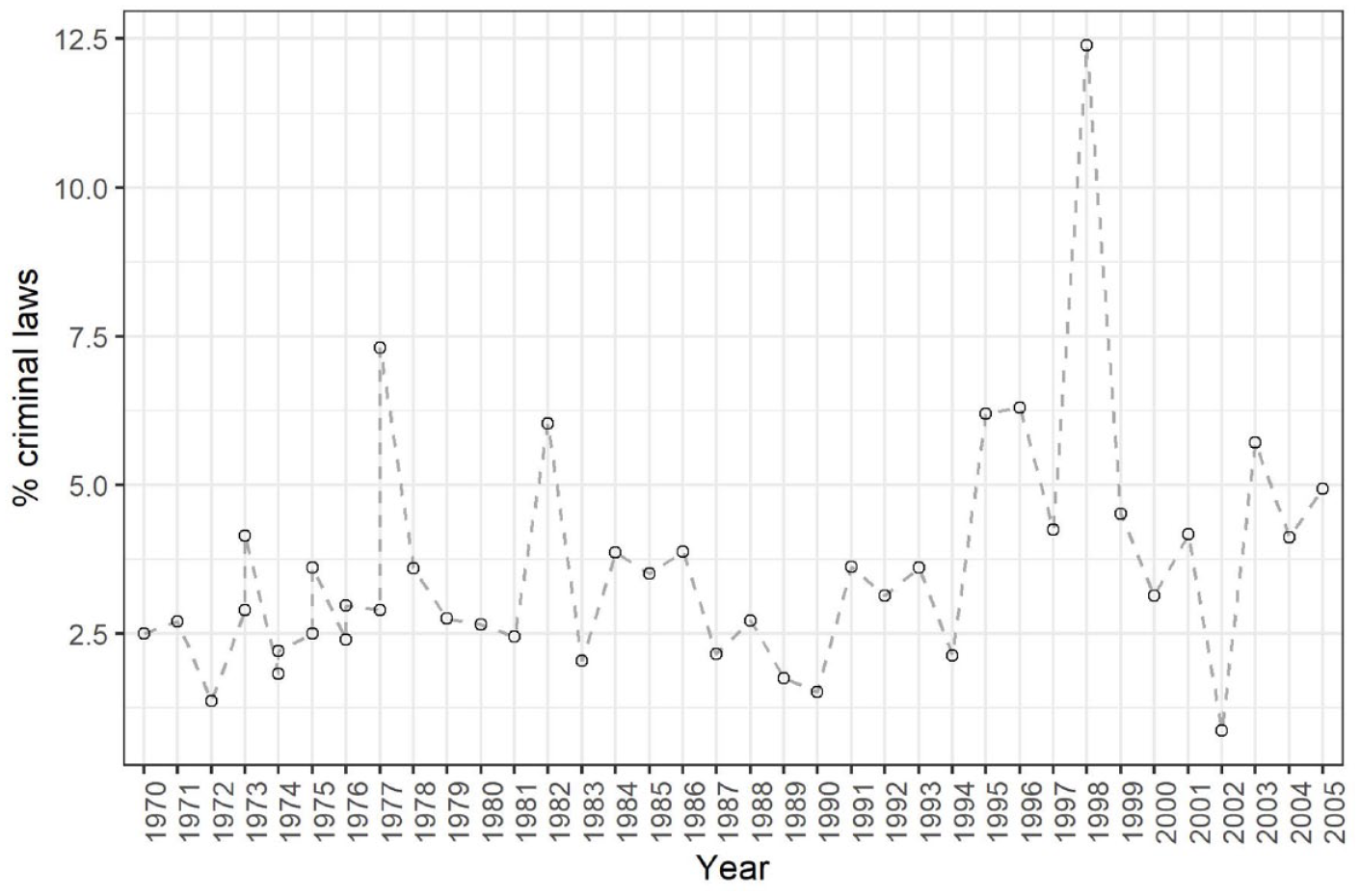
Trends in Criminal Lawmaking
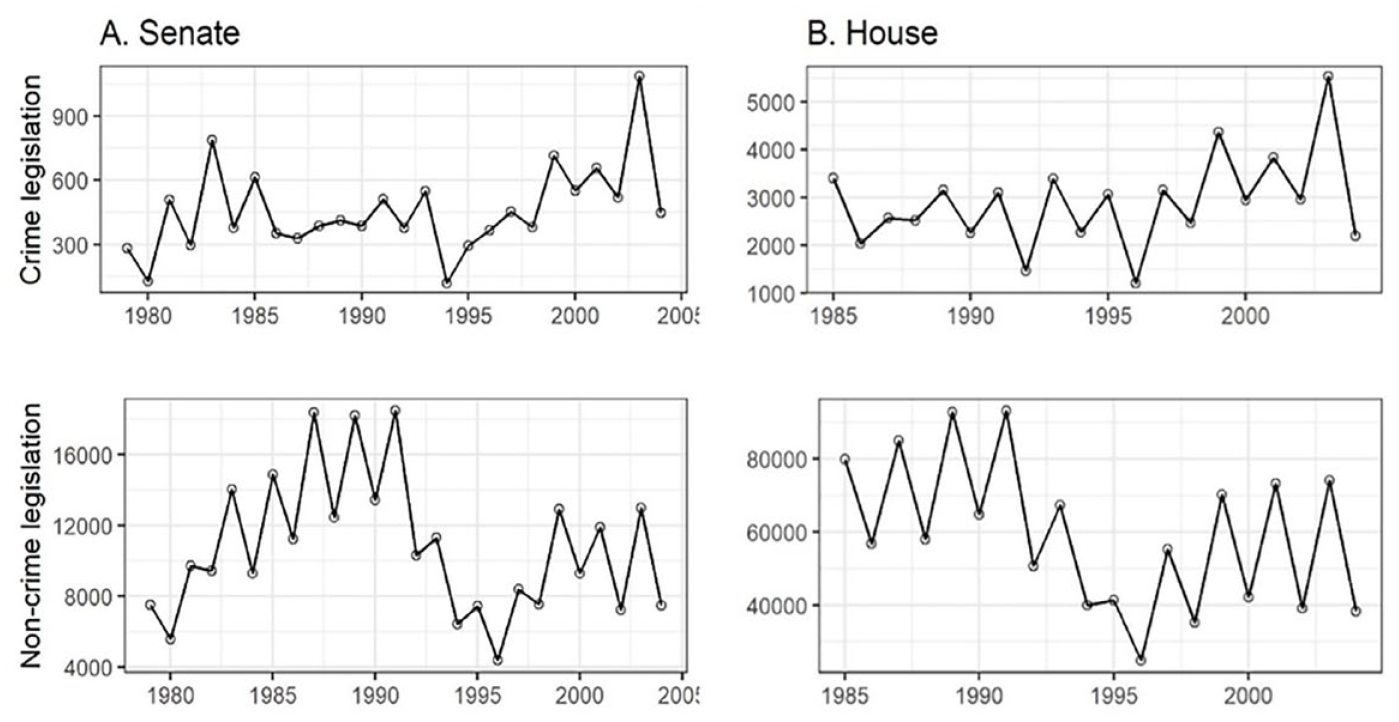
Trends in Crime Legislation Cosponsorship
Dominant theories of penal change take an institutional perspective to explain increases in criminal lawmaking. Research in this tradition emphasizes opportunities created by racial tensions during the Civil Rights era (Alexander 2010; Weaver 2007), the electoral viability of tough-on-crime politics (Beckett 1997; Simon 2007), public punitiveness (Enns 2016; Garland 2001), rising crime (Pfaff 2017; Spelman 2009), and interest group pressures (Gottschalk 2006; Page 2011). A common theme in these studies is the assumption of political consensus. The reasoning goes that, while policies in the 1960s were spearheaded by a coalition of Republicans and Southern Democrats (Weaver 2007), changing contexts fostered broad support for crime control, such that “neither party has been willing to deviate from the bipartisan consensus in favor of ‘getting tough’ [since the 1980s]” (Beckett and Sasson 2004:73).
Prior accounts of penal change emphasize contextual effects, but little research examines how criminal lawmaking unfolds within policy environments. As such, recent studies have critiqued the institutional focus of prior research. To these scholars, current explanations for criminal lawmaking overlook conflict between policy actors (Goodman et al. 2017; Rubin and Phelps 2017), omit individual and organizational incentives (Page 2011), and direct little attention to the individual-level mechanisms responsible for policy change (Schoenfeld 2011). In the words of Rubin and Phelps (2017:427, emphasis in original), prior “accounts imprecisely define the ‘state’ as the central actor rather than examining who is doing the work of policy change . . . and . . . the actors behind an expansive and depersonalized state.”
Elite Polarization and Policy Collaboration
Policymaking research also highlights conflict in policy processes. To Jones and Baumgartner (2005:88), “the requirement of cooperation adds considerable friction to the process of making public policy.” Lawmakers hold competing preferences, incentives, and goals that threaten collaboration. Unpopular legislation can penalize lawmakers in electoral cycles (Soule and King 2006; Stimson 1999). Legislators navigate the search for collaborators by looking to colleagues from similar states, who share their priorities, and who have reputations favorable to political prospects (Brandenberger 2018; Scholz, Berardo, and Kil 2008), and by aligning policy actions with their “rational anticipations” of public approval (Stimson 1999).
A large body of political science research reports that increases in elite polarization since the 1960s have worsened conflict in policy environments. Lawmakers currently hold more divided policy priorities and express more animosity toward the opposing party than they have in the past (Enders 2021; Poole and Rosenthal 2001). Studies also document increases in intraparty polarization that dovetail with interparty divides (Aref and Neal 2021; Groenendyk, Sances, and Zhirkov 2020; Noel 2016; Wronski et al. 2018). These studies report divisions in policy priorities within parties and negative perceptions of ideological opposites from the same party.
Recent research has begun to examine how elite polarization affects policy collaboration networks (Aref and Neal 2021; Desmarais et al. 2015; Moody and Mucha 2013). These studies show that elite polarization has generally depressed policy processes. Increases in inter- and intraparty polarization have been linked to reductions in legislative accomplishments (Binder 2003; Friedrichs 2022; Jones 2001). Ideological divides create disagreement on the necessity of policy, and animosity toward political opponents limits the choice set of collaborators. Neal (2020), for example, finds that hostile relationships between political parties in the U.S. Congress have increased since the 1970s. And Fowler (2006) finds that the mean number of cosponsors on bills in Congress has declined since the late 1980s.
In summary, the literature on penal change contradicts the literature on elite polarization by emphasizing political consensus during a time when collaboration within legislative chambers declined and lawmakers struggled to accomplish major policy goals and routine tasks necessary for the functioning of government (Binder 2015; Lee 2009). Thus, it is unclear how political actors were able to increase crime policy collaborations since the 1960s, when most stages of policymaking in most areas of law were hampered by elite polarization. I now introduce an explanation that addresses this puzzle by describing how network assurances alleviate the risks conflict imposes on collaboration.
Networks, Risk, and Crime Policy Collaboration
I argue that crime control policy presented a unique dilemma during the period of prison expansion that distinguished it from most other policy areas. On one hand, lawmakers’ ability to pursue policy action was hampered by growth in elite polarization. On the other hand, increases in crime and crime fear created a unique level of urgency behind crime control. The resulting double bind was such that lawmakers could neither identify routes to collaboration nor afford the political costs of inaction. Networks helped lawmakers alleviate the risk of crime policy collaboration by establishing trust, but in doing so, they limited lawmakers’ ability to respond to crime and crime fear beyond their network connections. Figure 2 outlines the conceptual model.
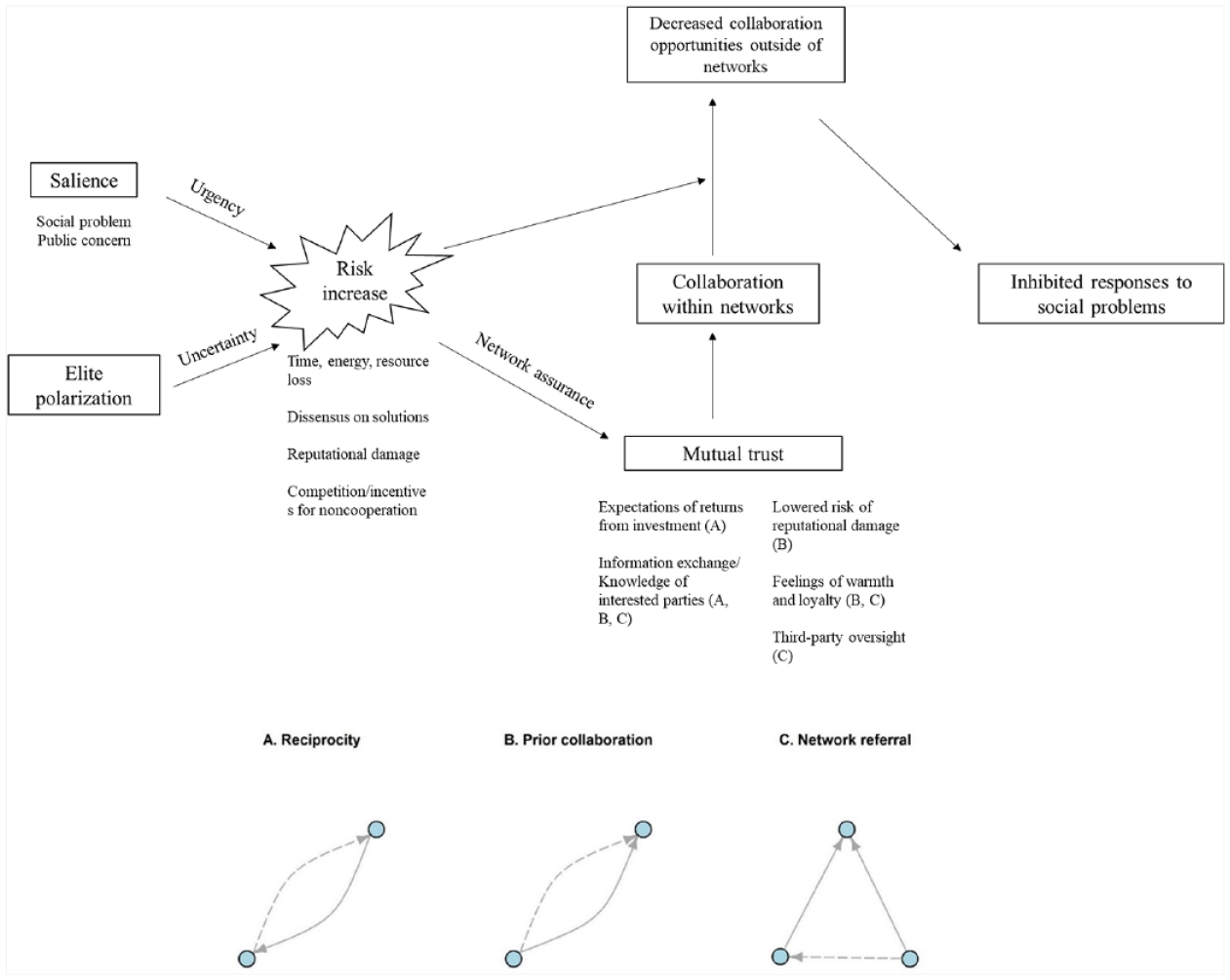
Conceptual Model of Policy Collaboration under Political Elite Polarization
Mutual Trust, Issue Salience, and Policy Collaboration
Policymaking requires large time and energy investments without guarantees that legislative efforts will be successful (Jones and Baumgartner 2005). Unpopular crime policies can incur reputational damage if they are viewed as harmful, invasive, or ineffective (Pickett 2019; Soule and King 2006; Stimson 1999). Political conflicts amplify these risks. Elite polarization lowers the likelihood of policy passage (Binder 2003, 2015; Jones 2001), meaning that time and energy investments in collaboration have diminished returns. Furthermore, lawmakers have incentives to limit cooperation to avoid handing political opponents policy victories (Lee 2009). Due to negative views of ideological and partisan opposites in polarized environments (Enders 2021; Noel 2016), unpopular policies can impede legislators’ efforts to pass policy by linking a legislator’s reputation to proposed legislation. Collaboration with unpopular legislators can also damage a focal legislator’s reputation, as status can “leak” through network relations (Podolny 2010). Thus, elite polarization heightens risks of investment loss, noncooperation, and reputational damage inherent in policy collaboration.
While elite polarization increases risk in policy processes, policy inaction also carries risk when salient issues draw public concern. Senses of urgency set policy agendas by directing political attention and creating public expectations of solutions (Jones and Baumgartner 2005). To Miller (2016:32), “security from violence is a core public good that the public expects state actors to publicly address and ameliorate.” Rising violent crime rates and crime fear during the period of prison growth increased the electoral costs of policy inaction, causing “soft on crime” lawmakers to be routinely and increasingly voted out of office for failing to promote public safety (Beckett 1997; Pickett 2019; Simon 2007). Thus, the double bind for lawmakers was such that urgency behind crime control necessitated policy action, while elite polarization hampered lawmakers’ ability to identify collaborators for crime control legislation.
Social exchange theorists argue that trust is necessary to overcome risk in collaborative tasks (Blau 1964; Coleman 1990; Granovetter 1985; Kollock 1994). Collaboration without trust creates “risk for the party who must invest resources before receiving a return” (Coleman 1990:175). One strategy for alleviating risk is to rely on networks. Networks build trust by establishing expectations of future returns, facilitating information exchange, creating feelings of warmth and loyalty, and limiting reputational damage. This suggests that, as elite polarization limits pathways to collaboration, lawmakers rely on networks to subvert risks of investment loss, noncooperation, and reputational damage. But, in doing so, lawmakers restrict collaborations to their networks rather than the full set of possible collaborators concerned with an issue. Thus, as elite polarization increases, direct responses to salient issues decline.
Network Mechanisms
I consider three mechanisms that should facilitate policy collaboration in the presence of elite polarization: reciprocal action, prior collaboration, and third-party referrals (see Figure 2). In policy settings, reciprocal action occurs when a legislator collaborates with another legislator because the second legislator has previously supported legislation proposed by the first legislator (Brandenberger 2018; Cranmer and Desmarais 2011; Mayhew 1974). Reciprocal action builds trust by establishing expectations of future returns from investments and facilitating information flow through established social ties (Axelrod 1984). As a result, reciprocal action typically increases in response to risk (Tsvetkova and Macy 2014). Brandenberger (2018), for example, finds that reciprocal action guides legislative cosponsorships on nuclear energy policy, aligning with Mayhew’s (1974) finding that senators “vote trade” to advance bills.
Prior collaboration is influential in shaping collaborative decisions. Prior collaboration increases information exchange and creates feelings of warmth and loyalty, each of which builds mutual trust (Granovetter 1985; Greif 2006; Kollock 1994; Uzzi 1997). Prior collaboration also limits marginal reputational damage from status “leakage,” as collaborators’ affiliations have been previously established (Podolny 2010). Consequently, prior collaboration tends to become more influential as risk increases (Kollock 1994; Podolny 2001).
Third-party referrals occur when a mutual affiliate facilitates a collaboration between two otherwise disconnected actors. Mutual affiliates act as intermediaries to collaboration and offer guarantees of proper role performance (Coleman 1990:182). Third-party referrals provide assurances as actors rely on mutual affiliates for information about collaborators’ incentives (Granovetter 1973; Macy 1991). In policy settings, third-party referrals occur when a legislator provides information about a third legislator’s priorities, interest in collaboration, or trustworthiness (Cho and Fowler 2010; Kirkland 2011; Scholz et al. 2008). Consistent with this mechanism, Cranmer and Desmarais (2011) find evidence of third-party referral effects in the 108th House of Representatives cosponsorship network (see also Fowler 2006).
Although networks enable collaboration by building trust, prior research identifies a “dark side” to network dependence (Hillmann and Aven 2011; Portes 1998; Uzzi 1997). Uzzi (1997) introduced the “paradox of embeddedness” to describe how network dependence can undermine economic exchange. Over-reliance on prior exchange partners and third-party affiliates decreases market efficiency by restricting exchanges to existing social ties and discouraging distributors from competing with one another to establish relationships with new exchange partners (see also Hillmann and Aven 2011). Portes (1998:15–18) similarly describes how network dependence constrains individual choices to network opportunity structures and discourages social exchange between groups.
I expect an analogous process in the context of policy collaboration. As elite polarization increases, lawmakers likely avoid collaboration outside of network opportunity structures to address heightened risks of investment loss, noncooperation, and reputational damage. Network dependence thus creates a self-reinforcing feedback loop by enabling collaboration within networks but hindering lawmakers’ ability to forge new collaborative ties beyond those networks. This suggests that elite polarization depresses policy collaboration beyond lawmakers’ networks and, as a result, decreases responses to salient issues.
Collectively, this argument provides three hypotheses. First, reciprocity, prior collaboration, and third-party referrals should each be positively associated with crime policy collaboration. Second, elite polarization should condition the effect of each network mechanism, such that the strength of reciprocity, prior collaboration, and third-party referral effects increase as elite polarization increases. Third, elite polarization should decrease the positive effects of crime rates and crime fear on crime policy collaboration. I now introduce the historical context to evaluate the consistency of these arguments with historical case studies.
Historical Context: Crime Control Collaboration in Congress
Although elite polarization has received limited attention in the literature on punishment, party politics are central to historical accounts of the carceral state. The earliest punitive laws are traced to conservative-led efforts in the 1960s. Looming Civil Rights victories cast a long shadow over segregationist platforms. Republican lawmakers scrambled for new campaign platforms, and Southern Democrats sought a means to reassert racial order (Beckett 1997; Weaver 2007). This led to a wave of Republican governors in staunchly Democratic southern states, where crime control provided one of few policy issues that could break through legislative gridlock (Campbell and Schoenfeld 2013).
Previously treated as a local problem, Nixon’s successful “law and order” presidential campaign launched crime control to the top of the national agenda. The percentage of crime bills in Congress focusing on drugs, violence, crime prevention, police, and prisons lurched from 17 percent in 1962 to 57 percent by 1982 (Miller 2016:119). Conservatives found begrudging allies in liberal Democrats and black politicians seeking accountability for violence against women and drug crime (Fortner 2015; Gottschalk 2006), and centrist “New Democrats” pounced on crime platforms to bolster their electoral prospects.
Although both parties had converged on crime policy by the 1980s, crime control politics continued to drive wedges both between and within political parties. Despite desiring action on violence against women, most liberal Democrats resisted the punitive inclinations of the party center, preferring prison furlough programs and an end to capital punishment. Republicans found themselves in an arms race against centrist New Democrats who introduced increasingly punitive legislation to convey toughness and electability (Beckett 1997; Murakawa 2014). For example, in 1991, Senator Joe Biden, a New Democrat, flexed his punitive bonafides by bragging that “the Biden crime bill [S-1241-102] before us calls for the death penalty for 51 offenses”—more than any prior bill—and “a wag in the newspaper recently wrote something to the effect that Biden has made it a death penalty offense for everything but jaywalking” (Biden 1991:S15708).
Electoral competition meant alliances between lawmakers became increasingly critical for passing crime control legislation. Nixon’s election not only realigned crime control politics, it also marked the beginning of elite polarization in Congress (Poole and Rosenthal 2001). Members of Congress were increasingly caught between two demands. On one hand, bipartisan crime bills were publicly popular, and New Democrats could subvert the electoral costs of catering to the “soft on crime” preferences of their liberal wing by working with Republicans. On the other hand, bipartisanship threatened to eliminate electoral advantages gained from appearing “tougher” than the opposing party. Prior to the 1994 electoral cycle, for example, Republican Representative James Sensenbrenner circulated a letter to his colleagues urging them to defeat Clinton’s omnibus Violent Crime Control and Law Enforcement Act to “give the crime issue to Republicans for the upcoming election” (Murakawa 2014:143).
Polarized congressional politics drove many lawmakers to rely on networks to collaborate on crime policy. A good example of this process comes from the Violence Against Women Act, first proposed by Senator Joe Biden in 1990. The Act stipulated that domestic and sexual violence be treated as criminal justice issues and directed funding to states to bolster local enforcement. Despite vocal support from Republican cosponsor Senator Orrin Hatch, the bill stalled for four years in Congress before finally breaking through legislative gridlock. In remarks on June 6th, 1994, California Democratic Senator Barbara Boxer—a known liberal and cosponsor of the Act—urged Congress to overcome the party politics that had blunted prior iterations of the bill: “Help Senator Biden push this crime bill through. . . . We have partisan differences around here. We fight about a lot of things. But as the President has urged us: let us move swiftly and on a bipartisan fashion on this crime bill” (Boxer 1994:S30).
Biden followed Boxer’s remarks by connecting the Act’s passage through the Senate to Boxer’s and Biden’s prior collaboration and Boxer’s ability to attract third-party support:
Although 5 years ago I wrote this bill—this bill, I might add, did not move until my friend from California [Boxer] came to the U.S. Senate. She was the original sponsor in the House on this legislation. But when she came to the U.S. Senate, all of a sudden I found that my exhortations to my colleagues took on a new dimension . . . when the distinguished Senator came and made the case with the passion and urgency that she does, things literally began to move. I am pleased to tell Senator Boxer and my colleagues that in the crime conference so far, the chairman of the conference, Mr. Brooks, and the president of the United States, through the Attorney General, have agreed to the language that the Senator and I introduced 4 years ago. (Biden 1994:S30)
Biden’s and Boxer’s collaboration was successful. The Violence Against Women Act was signed into law on September 9th, 1994, as part of Clinton’s omnibus Violent Crime Control and Law Enforcement Act. At the time of its passage, the Violence Against Women Act had secured bipartisan support from 225 cosponsors in the House of Representatives (186 Democrats, 38 Republicans) and 67 cosponsors in the Senate (51 Democrats, 16 Republicans). This was a marked increase from the 68 representatives (61 Democrats, 7 Republicans) and 26 senators (22 Democrats, 4 Republicans) who had cosponsored the original 1990 bill.
The case of the Violence Against Women Act shows how networks enabled senators to collaborate on major crime control legislation in the presence of divisive party politics. Despite preserving most of the language and content from the 1990 bill, Boxer’s integration into the Senate legislative network enabled Biden to leverage third-party referrals through Boxer and their prior collaboration to gain support and subvert opposition to New Democrats’ crime control agenda from both liberal Democrats and Republicans. This historical evidence lends support to the argument that political actors overcame elite polarization by relying on networks.
Data
I evaluate each hypothesis in an analysis of federal crime legislation cosponsorship networks in the U.S. Congress between 1979 and 2005. The national incarceration rate began to rise in 1973, meaning the start date aligns with the onset of prison growth. Recent reform efforts combined with decreases in the incarceration rate since 2008 raise questions about the end of mass incarceration (Clear and Frost 2015); however, there is consensus that most efforts to build the carceral state occurred between the 1970s and early 2000s (Alexander 2010; Clear and Frost 2015; Garland 2001; Hagan 2011; Hinton 2016; Simon 2007). The 1979 to 2005 period thus captures the window where most criminal legal expansion occurred.
The dataset for the analysis was compiled in a two-stage process that first identified relevant federal crime legislation and then used the identified bills to create cosponsorship networks. In the first stage, I included a preliminary set of crime-related legislation using codes provided in the Policy Agendas database. I then deployed machine learning to identify the subset of bills concerned with crime control. In the second stage, I constructed crime legislation networks using cosponsorships on the identified bills.
Federal Analysis
The federal focus offers several advantages for the current research. The period of prison growth is characterized by the federalization of crime control. Federal funding for state and local agencies; coordination between local, state, and federal justice programs; and federal sentencing all increased as the federal government became more involved in state and local crime control (Miller 2010). Although federal criminal codes only cover federal crimes, they set standards of enforcement that diffuse to states and localities (Hagan 2011). The federal government acts as a symbolic figurehead for criminal justice ideas, often diffusing criminal justice innovations from first-mover states to later adopters (Campbell and Schoenfeld 2013; Lynch 2009). Federal processes also proxy national trends in criminal lawmaking by capturing policy collaborations between legislators from every state and congressional district.
In addition to its symbolic function, federal-level analysis is advantageous because federal policy can directly influence crime control in states and localities. Some federal codes create incentives for changes in state criminal codes (e.g., the 1984 National Minimum Drinking Age Act). Federal policy can also create penalties that supersede state authority (e.g., the Drug Abuse Prevention and Control Act of 1970). Furthermore, federal policies can drive changes in local crime control by creating new agencies that staff, oversee, and lend support to local justice agencies. For example, the Omnibus Crime Control and Safe Streets Act of 1968 established the Law Enforcement Assistance Administration to increase funding and training for local police. Other federal policies, like the Violent Crime Control and Law Enforcement Act of 1994, establish grants to fund local law enforcement. The federal focus also aligns with foundational scholarship on the carceral state, which emphasizes federal policy and party politics (e.g., Beckett 1997; Hagan 2011; Hinton 2016; Miller 2010, 2016; Murakawa 2014; Weaver 2007).
Detecting Relevant Crime Legislation
I used major policy area codes from the Policy Agendas Project to identify bills with a primary focus on one or more of the following areas: criminal justice agencies; white-collar and organized crime; drug trafficking and control; criminal courts; prisons; juvenile crime and the juvenile justice system; child abuse, domestic violence, and family law; police, fire, and weapons control; criminal codes; and crime prevention. 2 Common provisions in these bills relate to sentencing, criminal codes, and funding for justice agencies. This yielded 10,348 bills, representing the universe of federal crime legislation between 1973 and 2005, and comprehensive information on the sponsor, cosponsors, and content of each bill.
The Policy Agendas codes provide important information on the number of crime bills, but two limitations must be overcome prior to analysis. First, duplicate bills are often introduced that oppose, modify, or reassert a prior bill’s content. In some cases, sequential bill introductions provide an opportunity for sponsors to attract new cosponsors as political environments shift, as was the case with the Violence Against Women Act. In other cases, bill reintroductions represent symbolic efforts by uncooperative politicians and do not reflect meaningful attempts to advance legislation. I address this second possibility using fuzzy string matching with Jaro-Winkler criteria to identify bills with duplicate content. I deleted all duplicate bills where reintroduction did not attract any new cosponsors. This removed 71 (3.5 percent) duplicate bills in the Senate and 423 (8.6 percent) duplicates in the House.
Second, Policy Agendas codes determine that a bill is related to crime, but some bills may be unrelated to crime control. I use machine learning to identify the subset of crime control bills. Topic models are beneficial as they can detect underlying topics that would be difficult to manually code in large corpuses of text (Blei, Ng, and Jordan 2003). Topic models group bills using word associations. The most frequently and exclusively occurring words are correlated to classify bills according to latent topics. Unsupervised topic models excel at detecting topics in text data, but they struggle at detecting framing (Nicholls and Culpepper 2021). For example, an unsupervised model could determine that the words “cocaine,” “drug,” and “narcotics” co-occur, but it would be less sensitive to the punitive orientation of a bill like the Anti-Drug Abuse Act of 1986, which increased sentencing disparities for powder and crack cocaine, or a reformist bill like the Fair Sentencing Act of 2010, which reduced those disparities.
I address this problem using semi-supervised topic modeling (Lu et al. 2011). Seeded latent Dirichlet allocation (LDA) uses a vector of initializing “seed” terms. In the first stage, a researcher provides a vector of terms that are used to create initial groupings. In the second stage, the terms are conditioned against the bill text data. This process iterates until the model converges, providing document assignments. This procedure allows me to anchor the model such that words that convey a crime control framing (e.g., “enforce,” “prevent,” “control,” “punish”) are linked to words that index crimes (e.g., “violence,” “drug,” “sexual,” “abuse”) and areas of criminal justice (e.g., “police,” “prisons,” “courts”) to ensure that language related to criminal justice reforms and other unrelated content does not appear in the final sample of bills.
I am interested in two latent topics: bills relevant to crime control and punishment, and those that are not. Following procedures outlined in prior studies (Duxbury 2023a; Grimmer, Roberts, and Stewart 2022; Nelson et al. 2021), I first specified a vector of seed terms based on a close reading of the bill descriptions. Next, I ran a seeded LDA on the bill descriptions using those terms. 3 I inspected results for classifications and term influence. I then updated seed terms to correct any instances where bills were classified erroneously, or uninformative words were given too much weight. I repeated this process until adding or removing seed terms no longer affected results. This yielded 43 seed terms (see Table 1). 4
Seed Terms and 10 Most Influential Terms from Seeded Latent Dirichlet Allocation
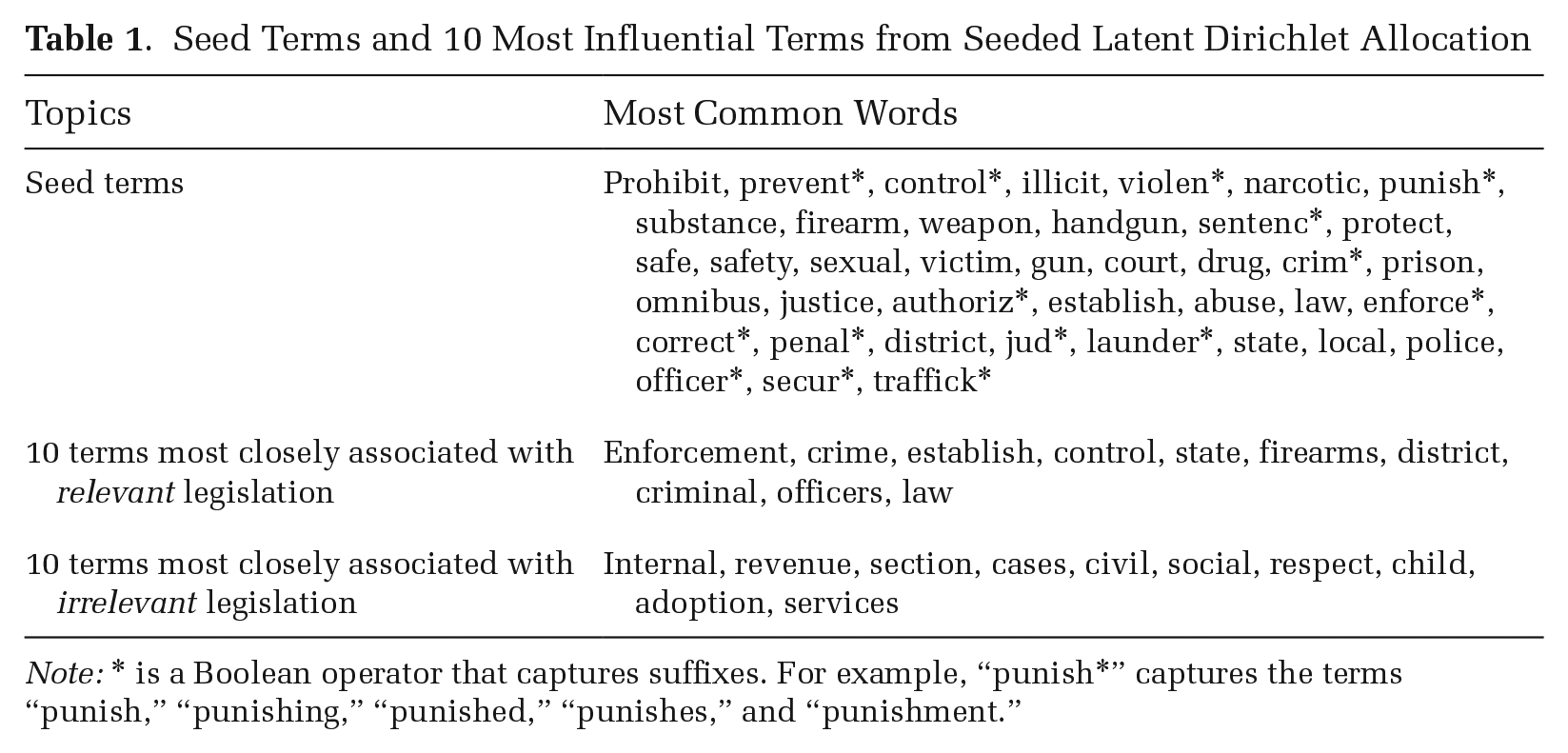
Note: * is a Boolean operator that captures suffixes. For example, “punish*” captures the terms “punish,” “punishing,” “punished,” “punishes,” and “punishment.”
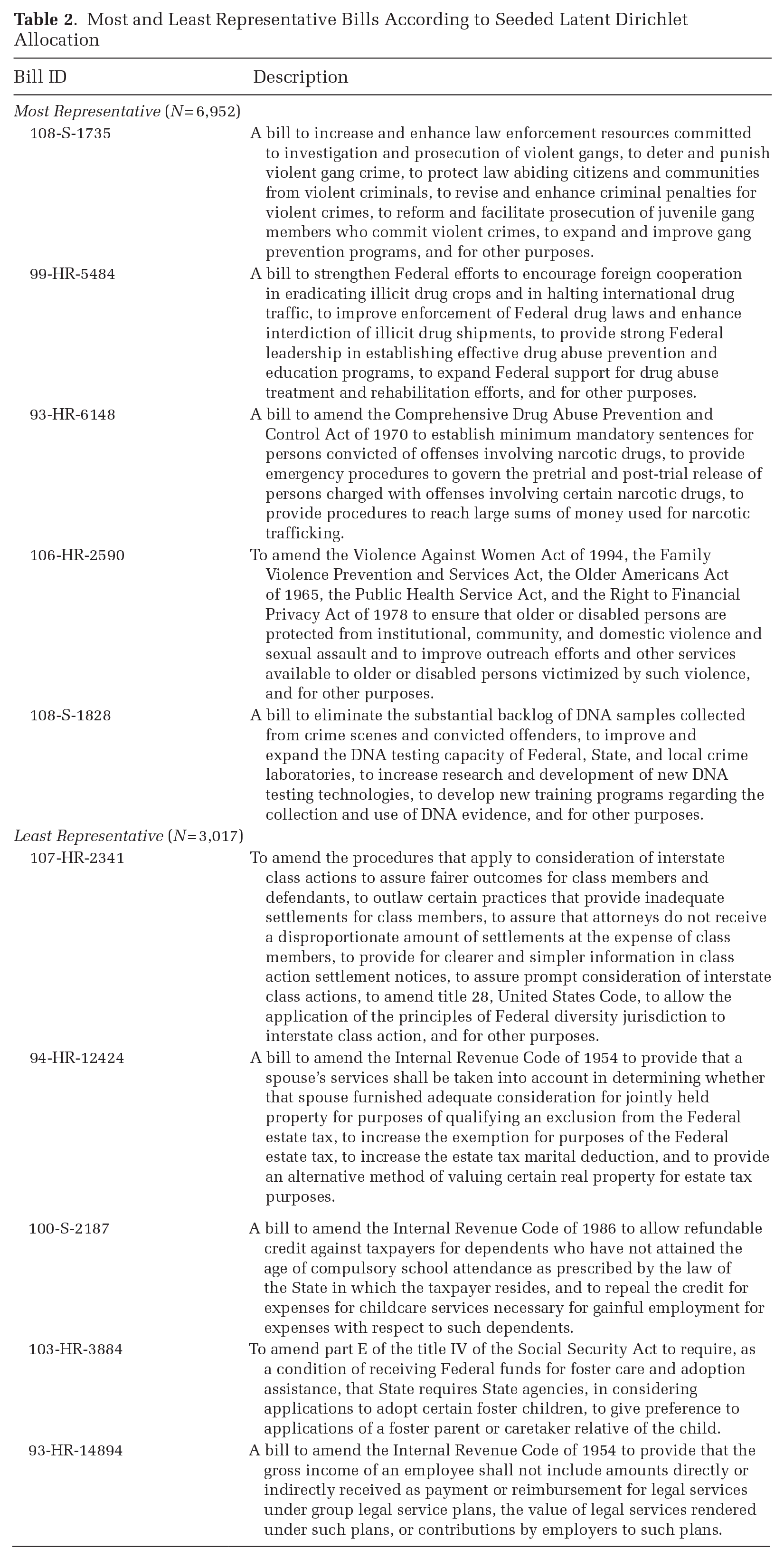
After convergence, seeded LDA provided a vector of codes with each bill’s primary classification and a quantitative measure of relevance equal to the weighted proportion of words that covary with a classification. Values close to 1 suggest high relevance, and values close to 0 suggest low relevance. Table 2 provides descriptions of the five most and least relevant bills. Most irrelevant bills focus on child services, tax code amendments, and civil case settlements. For example, the most relevant crime bill (108-S-1735) sought to improve investigation and prosecution of violent organized crime (relevance = 0.989), and the least relevant bill (107-HR-2341) proposed amendments to procedures on interstate class action (relevance = 0.012). In total, seeded LDA identified 6,952 bills (4,873 in the House and 2,052 in the Senate) with crime control content for network analysis, or 69.7 percent of the original sample.
Most and Least Representative Bills According to Seeded Latent Dirichlet Allocation
The final step is validation. I evaluated algorithm performance by first drawing a random sample of 100 bills from the unprocessed data, stratified to be proportional to the number of crime bills proposed each year, and then hand-coding the crime bills. I assigned crime control codes to bills that increased sentence lengths; created new criminal codes; allocated funds to justice agencies or created new agencies; increased criminal intelligence sharing; improved coordination between law enforcement; created new justice facilities (e.g., prisons); appointed new justice personnel; increased the powers of justice officials; increased crime witness or victim protections; or created new salary benefits for police or correctional officers.
Next, I compared the hand-coded data to codes assigned by seeded LDA using metrics common to machine learning. Recall is high at 0.80, indicating LDA has good coverage of the bills in the hand-coded data. False positives are also uncommon (precision = 0.72), meaning LDA rarely classifies irrelevant bills as related to crime control. The F1 score is the harmonic mean of precision and recall and is widely regarded as the gold standard for assessing algorithm performance (Duxbury 2023b; Nelson et al. 2021 Russo et al. 2023). The F1 score is 0.76, exceeding the most common benchmark of 0.7 needed to determine strong performance.
Cosponsorship Networks
Network data come from the cosponsorship histories of all federal legislators between 1973 and 2005. Cosponsorship data is the dominant method for measuring collaboration in Congress (Aref and Neal 2021; Briatte 2016; Cho and Fowler 2010; Cranmer and Desmarais 2011; Fowler 2006; Kirkland 2011; Kirkland and Gross 2014; Neal 2020). Cosponsorships occur when legislators sign onto a bill as a cosponsor. Legislators cosponsor bills to increase influence, signal policy positions, and out of a desire to solve social problems (Harward and Moffett 2010). Legislators can cosponsor bills or remove themselves as cosponsors at any point after a bill is introduced until the final date of a Congress or a bill comes up for a floor vote.
Each cosponsorship signals to the public and other political actors which legislators prioritize crime control and their views about the content of the legislation (Kessler and Krehbiel 1996; Wilson and Young 1997). A large number of cosponsors helps advance bills out of committee and conveys to party leaders that a bill is broadly popular (Kirkland 2011; Wilson and Young 1997). The number of cosponsors on a bill is positively correlated with the likelihood a bill will pass a floor vote and progress through legislative processes (Browne 1985; Dockendorff 2021; Sciarini et al. 2021; Woon 2008). Thus, cosponsorships reflect strategic collaboration decisions that help translate legislation into policy and signal legislators’ policy stances, with implications for their political careers and electoral prospects.
I obtained cosponsorship data from the Congressional Record of Proceedings and Debates of the U.S. Congress. Crime legislation cosponsorship relations were established when a focal legislator cosponsored a crime bill sponsored by a second legislator, forming a directed relationship between the two legislators (Cho and Fowler 2010; Cranmer and Desmarais 2011; Fowler 2006; Kirkland 2011). A larger number of cosponsorship ties reflects a stronger collaborative relationship. Legislation in the House of Representatives was limited to a maximum of 25 cosponsors prior to 1979. Thus, I truncate the House network data to begin observation in 1979. The Senate data contain 11,096 cosponsorships on crime control legislation between 297 senators, and the House data contain 59,150 cosponsorships on crime control legislation between 1,495 representatives. In total, the analysis examines daily occurrences of 70,246 crime legislation cosponsorships between 1,792 federal legislators from 1973 to 2005.
Analytic Strategy
Cosponsorship ties are relational events—they occupy discrete, ephemeral moments in continuous time. I use relational event models (REM) to examine the growth of the federal crime legislation cosponsorship networks. REM enables researchers to incorporate detailed information on the timing of event occurrence while also allowing for endogenous network processes—reciprocity, prior collaboration, and third-party referrals—that bias parameters in conventional regression analysis.
REM is a hazard (survival) model for relational event data. REM treats the evolving network as a sequence of discrete events occurring in continuous time (Butts 2008). Because cosponsorships are measured daily, the unit of analysis is the dyad-date. This means the analysis captures daily cosponsorship events over 32 years of crime policy change. The outcome variable is binary, capturing whether a cosponsorship occurred at a given dyad-date.
Let be the number of cosponsorship ties sent from legislator i to legislator j at date t and be the time-varying hazard rate. We can write the probability of observing :

with

where is the data matrix containing actor and dyad characteristics and endogenous network statistics, and is the baseline hazard. contain the coefficients representing the change in the frequency of cosponsorship associated with an increase in each predictor variable. A positive coefficient indicates that a specific variable, such as reciprocity, increases the frequency of crime legislation cosponsorships between a pair of legislators.
I constructed risk-sets such that legislators are only able to form cosponsorship ties during spells of activity (Brandenberger 2018). Legislators enter the risk-set when a sponsor introduces a bill, and they exit the risk-set after a floor vote. For bills that never come up for a floor vote, the sponsor remains at risk until the final date of a given Congress. For example, if senator j proposes a bill, 99 other senators can cosponsor that bill until it is voted upon or Congress ends, at which point j exits the risk-set as a target. 5 j may re-enter the risk-set as a target if j proposes new legislation in the future. Because legislators can propose multiple bills simultaneously, they can appear in the risk-set multiple times in overlapping time windows corresponding to each crime bill. Multiple legislators may also be included in the risk-set as targets simultaneously when multiple bills are introduced at the same time. Because the model for the hazard rate is a generalized linear model, I estimated REM as a logistic regression.
Network Measures
I calculated network measures using practices and procedures outlined in prior research on REM. Mathematical formulae are reported in Table 3. I measure reciprocity using a commonly used reciprocal action statistic that represents the number of prior ji cosponsorships. A positive coefficient indicates i is more likely to cosponsor crime legislation proposed by j if j has previously cosponsored crime legislation proposed by i. The coefficient for reciprocal action should be positively related to crime legislation cosponsorship. Prior collaboration is captured using the inertia measure (Butts 2008), which is the number of prior cosponsorships between two legislators. A positive coefficient for the inertia measure means legislators are more likely to cosponsor a crime bill if they have previously cosponsored a crime bill sponsored by the sponsoring legislator. I include a measure of triadic closure to capture third-party network referrals. The triadic closure measure increases in value when a potential cosponsorship occurs within an increasing number of open triplets (Brandenberger 2018). The measure captures the number of cosponsorships with a mutual affiliate shared by a focal pair of legislators. It should be positively associated with crime legislation cosponsorship.
Formulae for Measures Included in Relational Event Models.

Note: Where () is a weight function assigning greater weight to more recent cosponsorship ties, t is the current event time, is a past event time, a is a focal cosponsor, b is a focal sponsor, i is the set of all cosponsors, j is the set of all sponsors, is a decay parameter assigned by the researcher, and V() represents the node attributes of a and b, respectively.
Some legislators may be more willing than others to cosponsor crime legislation (Fowler 2006). I include a time-varying measure of cosponsor degree centrality (i.e., number of prior crime legislation cosponsorships) to control for differences in activity rates. Recency acts as a “bottleneck” for information processing in policy environments (Jones and Baumgartner 2005:17). I assign temporal weight with a half-life parameter of 20 to each measure to prioritize recent events (Brandenberger 2018). This means recent cosponsorships carry greater weight in the estimation of coefficients for network measures compared to temporally distal cosponsorships. Due to the long time period in the analysis, I calculate all network measures using a six-year rolling window. This addresses the possibility of left truncation, which can bias estimates when uncorrected (Stadtfeld and Block 2017). 6
Elite Polarization
I include a measure of political elite polarization that varies every two years to capture the level of polarization within each unique Congress. Elite polarization implicates ideological and relational aspects of inter- and intraparty conflict. I operationalize elite polarization using latent variable measurement and four indicator variables. First, to capture interparty ideological polarization, I incorporate the DW-NOMINATE measure, which is the most common measure of interparty polarization (Poole and Rosenthal 2001). This measure uses roll call votes to capture legislators’ policy preferences. Higher values reflect conservative preferences on social and economic issues, and lower values indicate liberal preferences. The interparty polarization measure is the absolute difference between the party means, where higher values indicate greater differences between party policy priorities. Second, to capture intraparty ideological polarization, I calculate the mean absolute within-party difference in DW-NOMINATE scores.
Network studies measure interparty polarization with the frequency of interparty collaboration (Desmarais et al. 2015; Moody and Mucha 2013; Neal 2020). Thus, the third measure is the percentage of same-party cosponsorships within a congressional session. The final measure of intraparty polarization relies on dense network subgroups (Aref and Neal 2021; Porter et al. 2005; Waugh et al. 2009). Dense subgroups represent clusters of legislators who cosponsor legislation with one another, and thus they incorporate information on political divisions not captured by party affiliation. I measure the number of densely clustered subgroups using a Leiden detection algorithm and modularity maximization to identify optimal fit. 7
I extracted the latent polarization measure using loadings from factor analysis, where higher values capture greater elite polarization. Results from factor analysis are consistent with a single construct in the Senate (eigenvalue = 1.69; RMSR = 0.08; standardized Cronbach’s α = 0.81) and in the House (eigenvalue = 2.70, RMSR = 0.09; standardized Cronbach’s α = 0.86). Because the number of densely clustered subgroups and same-party ties are endogenous to crime legislation cosponsorships, I lag the elite polarization measure by one Congress (two-year period) to ensure the correct order of variables. Tables S1 and S2 in the online supplement replicate the main analyses considering the moderating effect of each component in isolation.
Controls
Homophily refers to legislators’ preferences to cosponsor legislation with legislators who share social characteristics. In a period of rising elite polarization, the most important source of homophily is partisanship, or preferences to cosponsor crime legislation proposed by members of the same party (Lee 2009). I account for partisan homophily using a same-party variable. The measure takes a value of 1 if two legislators belong to the same party and equals 0 otherwise. I also control for gender, race, 8 and state homophily by measuring whether two legislators are the same gender, same race, or represent the same state. To account for age homophily, I include the absolute difference in age. The measure obtains lower values when two legislators have a similar age, and thus negative coefficients reflect age homophily. I include the absolute difference in DW-NOMINATE scores to account for ideological similarity, and I include the absolute difference in legislators’ time in Congress to account for overlapping tenure.
Legislators’ own backgrounds and political affiliations likely affect collaboration. I account for this possibility by including gender, party, age, and race as cosponsor attributes. This accounts for the possibility that Republicans, older legislators, white legislators, and men may be more likely to cosponsor crime legislation than Democrats, younger legislators, non-white legislators, and women. I control for legislators’ policy preferences using Poole and Rosenthal’s (2001) DW-NOMINATE measure. Higher values capture more conservative economic and social policy preferences. I also control for legislators’ time in congress, whether a legislator is a majority or minority party leader, and whether a legislator is a committee chair.
Prior research on penal change traces crime policy to crime, conservative politics, public opinion, and racial prejudice (Alexander 2010; Beckett 1997; Duxbury 2021b; Enns 2016; Pfaff 2017; Simon 2007; Spelman 2009). I include characteristics of the states that legislators represent to capture social contexts. First, I include the violent crime rate per 100,000 capita using data from the Uniform Crime Reports. I also include Duxbury’s (2021a) state-level crime fear measure to capture public concern with crime. I constructed this measure from responses to 102 surveys; it can be interpreted as the percentage of the state population that reports feeling afraid walking home alone at night.
Second, I include two measures to account for conservative public preferences: the percent Republican voters in the most recent election and “policy mood.” I use the state policy mood measure developed by Enns and Koch (2013). The variable is created from over 740,000 responses to roughly 500 survey questions. It ranges between 0 and 100, where higher values indicate support for liberal policy priorities (e.g., expanding social security, combatting racial inequality) and lower values indicate opposition. Third, I include Duxbury’s (2021b) state-level measure of “laissez-faire” racial prejudice. The measure is constructed from 102 surveys and responses to nine survey questions: belief that black people do not suffer from discrimination in general, in housing, in hiring, or in education; opposition to affirmative action for hiring and college admittance; belief that unequal access to education is not the source of racial inequality; belief that racial inequality would decline if black people worked harder; and belief that black people “complain too much about racism.” The measure ranges between 0 and 100 and can be interpreted as a weighted average of the responses to each question.
Finally, two possible sources of unobserved heterogeneity may problematize estimates. First, it is possible that unobserved period effects confound the effects of reciprocity, prior collaboration, and third-party referrals. I account for this by including date fixed effects, which eliminate all time trends and period effects. As a result, coefficients for the main effect of elite polarization are not estimable, although it is still possible to evaluate interactions with the polarization measure because the interactions vary within time period. This also holds constant all between-Congress variation and thus controls for differences in Congress characteristics, such as the party in power and changes in chamber rules (see Aldrich 1995).
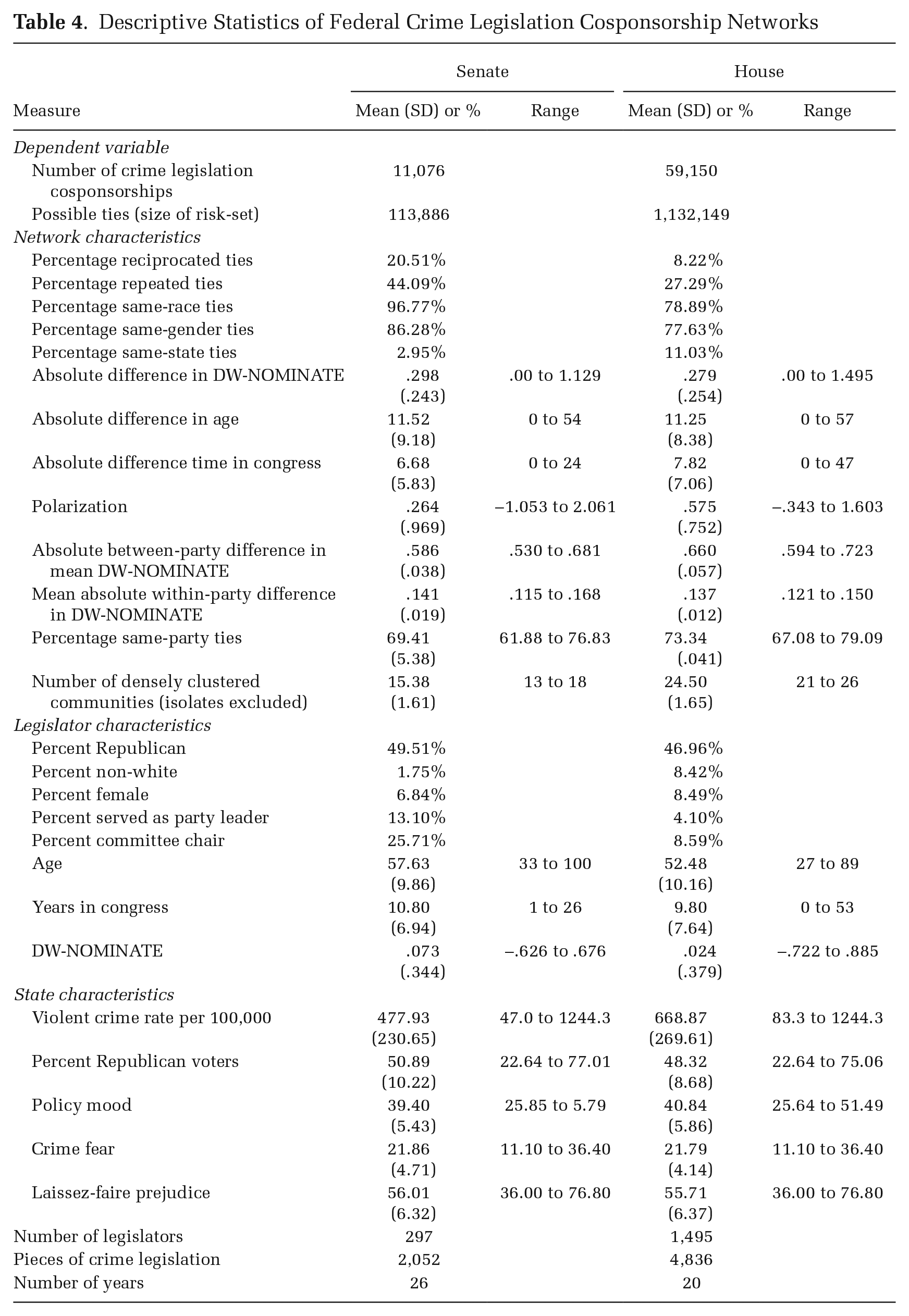
A second source of unobserved heterogeneity comes from the individual bills. Some bills are designed to signal legislators’ policy views but are not intended to be broadly popular or legally viable (Harward and Moffett 2010; Soule and King 2006). I include a vector of fixed effects for each bill to eliminate bill-level heterogeneity. This means differences in bill content are controlled in the analysis. Furthermore, because each crime bill is introduced by a single sponsor, the bill fixed effects also hold constant both time-varying and time-invariant sponsor characteristics. Thus, even though bill and sponsor variables are not specified, they are controlled in the model. I cluster standard errors on states to account for the nesting of legislators in states. Descriptive statistics are provided in Table 4.
Descriptive Statistics of Federal Crime Legislation Cosponsorship Networks
Analysis Plan
The analysis proceeds in three steps. First, I test hypotheses on network dependence by including interactions between elite polarization and reciprocity, inertia, and triadic closure. I then include interactions between polarization and the violent crime rate and crime fear to test hypotheses on diminishing effects of crime rates and crime fear. Finally, I evaluate differences in patterns of cosponsorship between political parties and ratified and non-ratified crime legislation. Because REM is estimated as a logistic regression, each interaction is not interpretable on its natural scale (Duxbury 2023a). I overcome this by interpreting marginal effects, which are robust to scaling. Figure S1 in the online supplement shows strong model fit for both the House and Senate REMs.
Results
Figure 3 shows that crime control legislation cosponsorships increased at the same time as elite polarization. Consistent with my hypotheses, these upward trends are mirrored by increases in reciprocal action, repeated cosponsorship, and triadic closure (see Figure 4). In the Senate, repeated cosponsorships increased from 26.2 percent in 1979 of all crime legislation cosponsorships to 43.2 percent in 2004, and reciprocal cosponsorships increased from 8.1 to 24.1 percent. In the House, the number of reciprocal cosponsorships increased from 4.1 to 9.2 percent between 1985 and 2004, and the number of cosponsorships that repeated prior cosponsorships increased from 15.4 to 32.2 percent. Suggestive of triadic effects, the weighted clustering coefficient (Opsahl and Panzarasa 2009)—the number of cosponsorships that occur within triangles divided by the number of cosponsorships in all open triplets—increased from 0.15 to 0.25 between 1985 and 2004 in the House, and from 0.19 to 0.38 between 1979 and 2005 in the Senate.
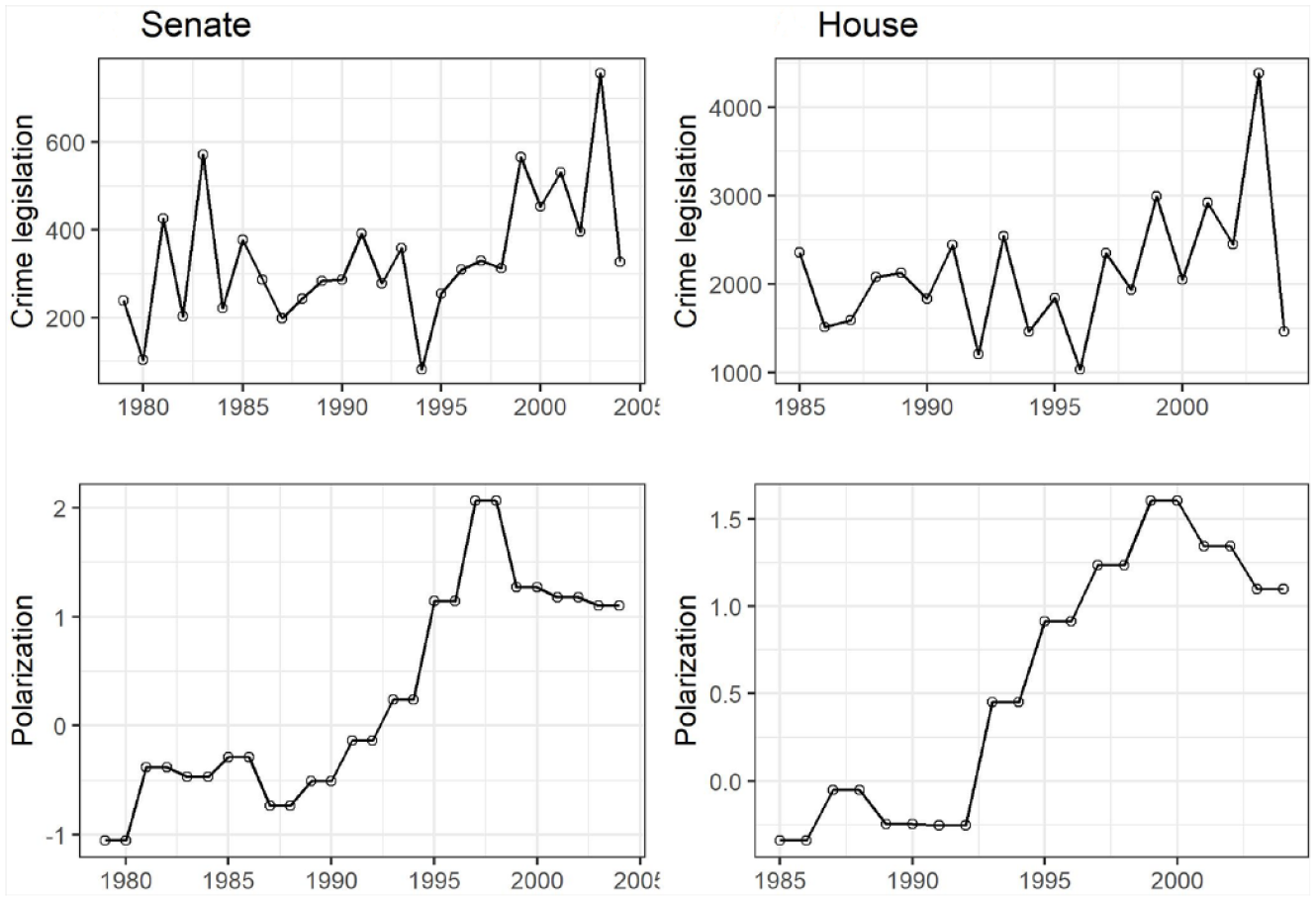
Annual Trends in Crime Legislation Cosponsorships (top panel) and Political Elite Polarization (bottom panel)
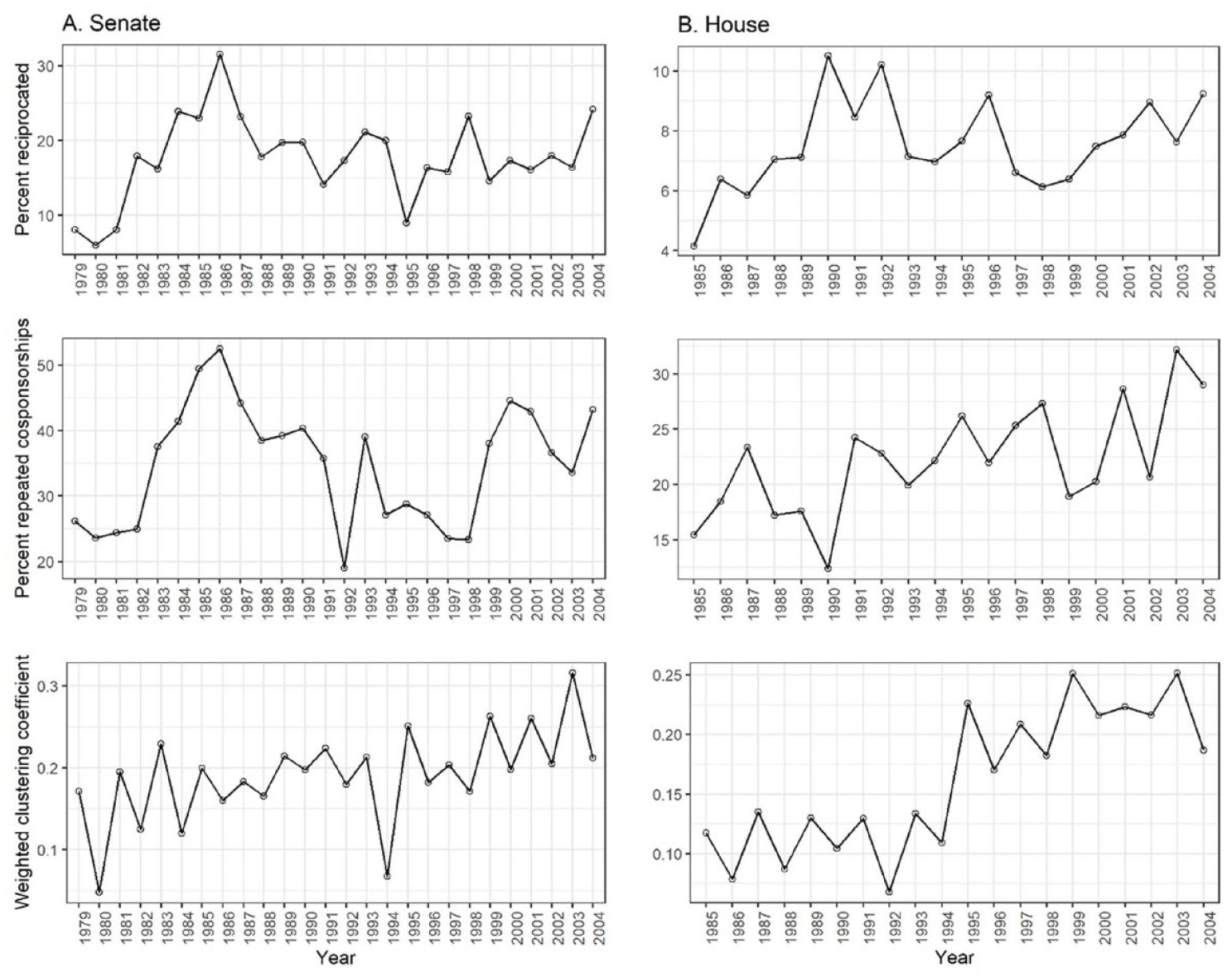
Trends in Crime Legislation Cosponsorship Networks, 1979 to 2005
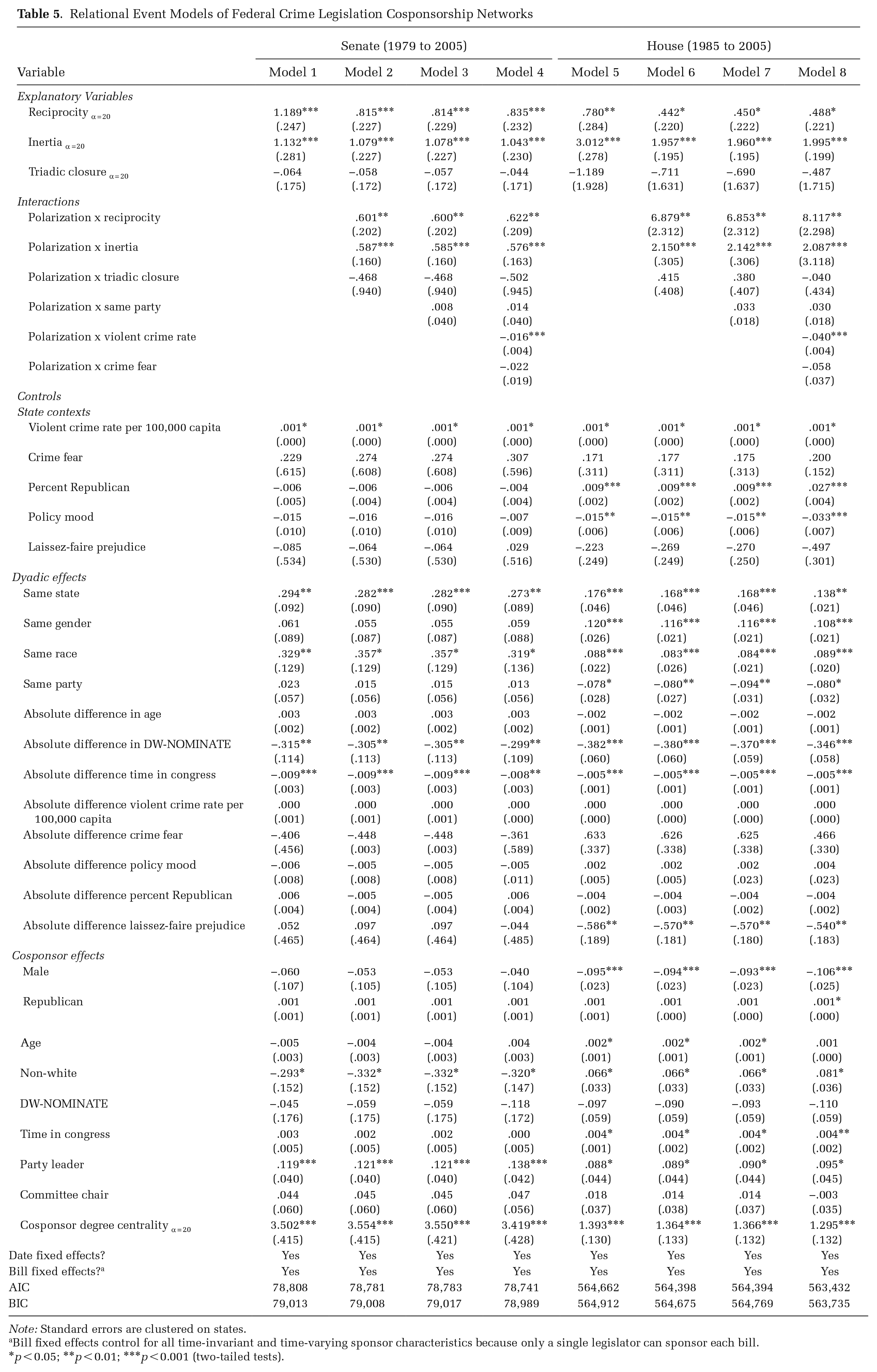
Table 5 presents REM results for crime legislation cosponsorship networks in the Senate (Models 1 to 4) and the House (Models 5 to 8). Models 1 and 5 are baseline models that include explanatory variables, all controls, date fixed effects, and bill fixed effects. Senators are more likely to cosponsor crime legislation if they represent states with high violent crime rates or if they are a party leader. The negative coefficient for the absolute difference in DW-NOMINATE indicates that senators tend to cosponsor crime legislation proposed by sponsors who have similar policy preferences. Senators are also more likely to cosponsor crime legislation if the sponsor is the same race, represents the same state, or has spent a similar amount of time in Congress. In the House, representatives are more likely to cosponsor crime legislation with representatives from the same state, who have similar policy preferences, and who have spent similar amounts of time in Congress, or if the cosponsor is a party leader.
Relational Event Models of Federal Crime Legislation Cosponsorship Networks
Note: Standard errors are clustered on states.
Bill fixed effects control for all time-invariant and time-varying sponsor characteristics because only a single legislator can sponsor each bill.
p < 0.05; **p < 0.01; ***p < 0.001 (two-tailed tests).
Results from network measures support hypotheses on the effects of reciprocity and prior collaboration. The positive coefficients for reciprocity and inertia indicate that legislators in both chambers of Congress are more likely to cosponsor crime legislation if the cosponsorship reciprocates or repeats a prior cosponsorship. However, in contrast to expectations, the coefficient for the triadic closure measure is not statistically significant. These results support the argument that reciprocal action and prior collaboration increase crime legislation cosponsorships, but they do not support arguments on third-party referrals.
To contextualize effect sizes, I calculate standardized coefficients for inertia and reciprocity and compare these standardized coefficients to the absolute difference in DW-NOMINATE. I focus on the absolute difference in DW-NOMINATE because it is the third-largest standardized coefficient in both chambers and because ideological alignment is regarded as a key impediment to policymaking (Binder 2015). In the Senate, a one-standard-deviation increase in inertia is associated with a 0.890 increase in the hazard of cosponsorship, and a one-standard-deviation increase in reciprocity is associated with a 1.04 increase. By comparison, a one-standard-deviation decrease in the absolute difference in DW-NOMINATE is associated with a 0.298 increase in the hazard of cosponsorship. In the House, the standardized coefficient is 0.323 for reciprocity, 1.010 for inertia, and −0.150 for the absolute difference in DW-NOMINATE. These results indicate that the standardized effects of reciprocity and prior collaboration are 2 to 6 times larger than the effect of ideological similarity.
Models 2 and 6 include interactions between elite polarization and reciprocity, inertia, and triadic closure to test hypotheses on the conditional effects of network assurances. Consistent with expectations, the interactions for reciprocity and inertia are positive in both the House and the Senate, and the interaction with triadic closure is not statistically significant. Model fit improves, indicating the interactions increase explanatory power. These findings suggest that legislators increasingly depend on reciprocal action and prior cosponsorship to guide crime legislation cosponsorships in response to elite polarization.
These results support hypotheses on the conditional relationship between polarization and network assurances, but one plausible confounder is that polarization did not increase network dependence, but instead amplified partisanship. In this explanation, rising elite polarization creates incentives to rely on party members to gain political advantage (Lee 2009). Models 3 and 7 evaluate this by including interactions between the same-party variable and polarization. Consistent with the main findings, the interaction is nonsignificant, model fit declines, and the interactions between elite polarization and network measures are robust. 9
Models 4 and 8 include interactions between elite polarization and the violent crime rate and crime fear. The interaction between crime fear and polarization is nonsignificant, and the interaction between elite polarization and the violent crime rate is negative in both the House and the Senate. In line with expectations, this result demonstrates that increases in the violent crime rate are associated with more frequent cosponsorships on crime control bills, but this relationship diminishes as elite polarization increases.
Figure 5 reports marginal effects for the interactions. In the Senate, the marginal effects of inertia and reciprocity are both nonsignificant when elite polarization is at its lowest value, but they are associated with a roughly 50-percentage-point increase in the probability of a cosponsorship per one-unit increase in either measure when elite polarization is at its maximum. The marginal effect of violent crime decreases by roughly 50 percent in the most-polarized compared to the least-polarized legislatures (p < 0.001). In the House, the marginal effect of inertia doubled in size (p < 0.01) between the least and most polarized years, and the marginal effect of reciprocity increased by 40 percent (p < 0.05). The marginal effect of the violent crime rate declines (p < 0.001) from a 0.001 increase in the probability of a crime legislation cosponsorship for each violent crime per 100,000 capita when polarization is at maximum, to a −0.003 decrease in the probability of a cosponsorship when polarization is at its minimum. Collectively, results show the effects of inertia and reciprocity both increased as a function of elite polarization, and the effect of the violent crime rate decreased and aligns with hypotheses on increasing network dependence and inhibited responses to crime rates under elite polarization.
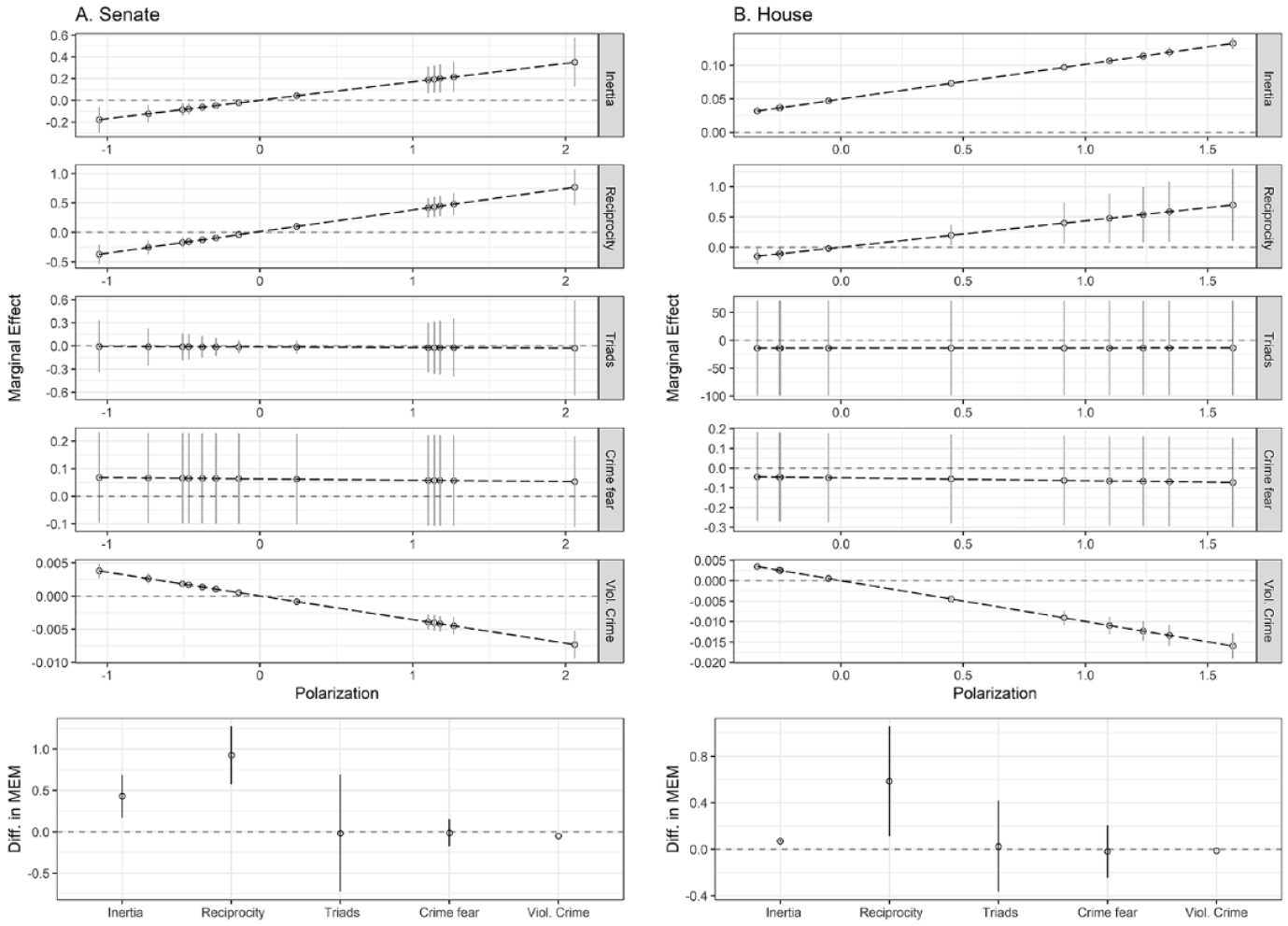
Marginal Effect of Context and Network Variables at Different Levels of Polarization
Differences by Political Party
Conventional accounts of the carceral state emphasize party politics. I examine how partisanship may moderate primary findings by re-estimating models using (1) only within-party cosponsorships, (2) only between-party cosponsorships, and (3) each party in isolation.
Figure 6a shows that differences between within- and between-party cosponsorships do little to moderate any of the marginal effects of interest in the Senate (complete results are in Tables S5 and S6 of the online supplement). This means reciprocity and prior cosponsorship increasingly guided senators’ cosponsorship decisions for both same-party and opposing-party crime bills as elite polarization increased. The right-hand panel of Figure 6a documents similar trends for the party-specific analysis: the effects of reciprocity and inertia do not vary between parties. However, while the main findings show no moderated effect for triadic closure, party-specific analysis uncovers divergent triadic effects among Democratic and Republican senators. As elite polarization increases, the effect of triadic closure increases for Democratic senators but decreases for Republican senators (p < 0.05). Similarly, while the violent crime rate has little effect on crime legislation cosponsorships among Republican senators at any level of polarization, polarization negatively conditions the effect of violent crime rates among Democratic senators.
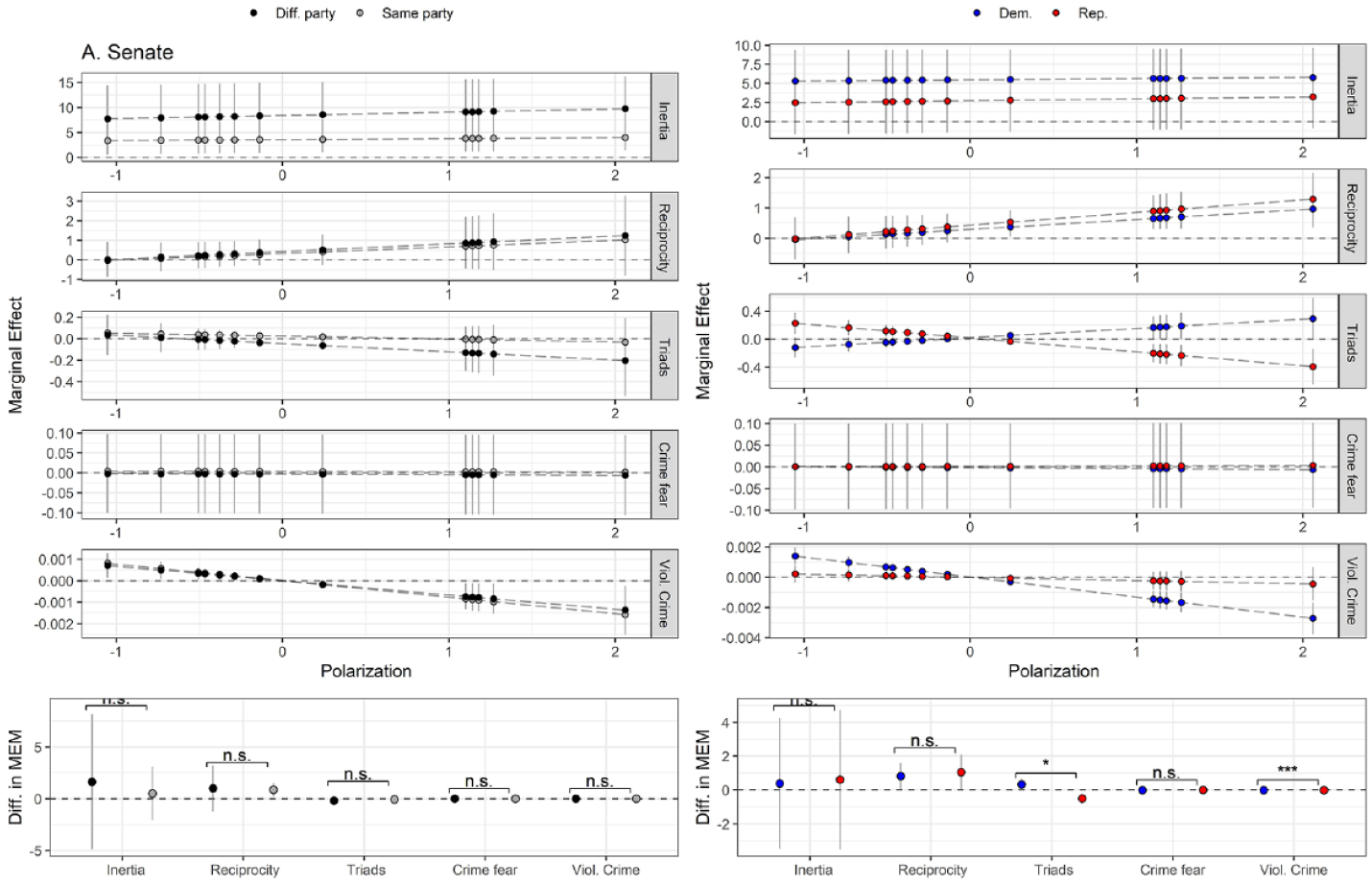
Marginal Effects at Different Levels of Polarization by Party, for the Senate
Similar patterns are evident in the House (see Figure 6b). There is little heterogeneity in any of the effects of interest when comparing between same-party and different-party cosponsorships or between parties, although the positive marginal effect of inertia increases more sharply as a function of elite polarization for Republicans than it does for Democrats (p < 0.001). These results show that the conditional marginal effects of reciprocity and inertia are not influenced at statistically significant levels by political party, although the conditional effect of violent crime in the Senate is limited to Democrats, and the conditional effect of triadic closure is positive for Democratic senators but negative for Republican senators.
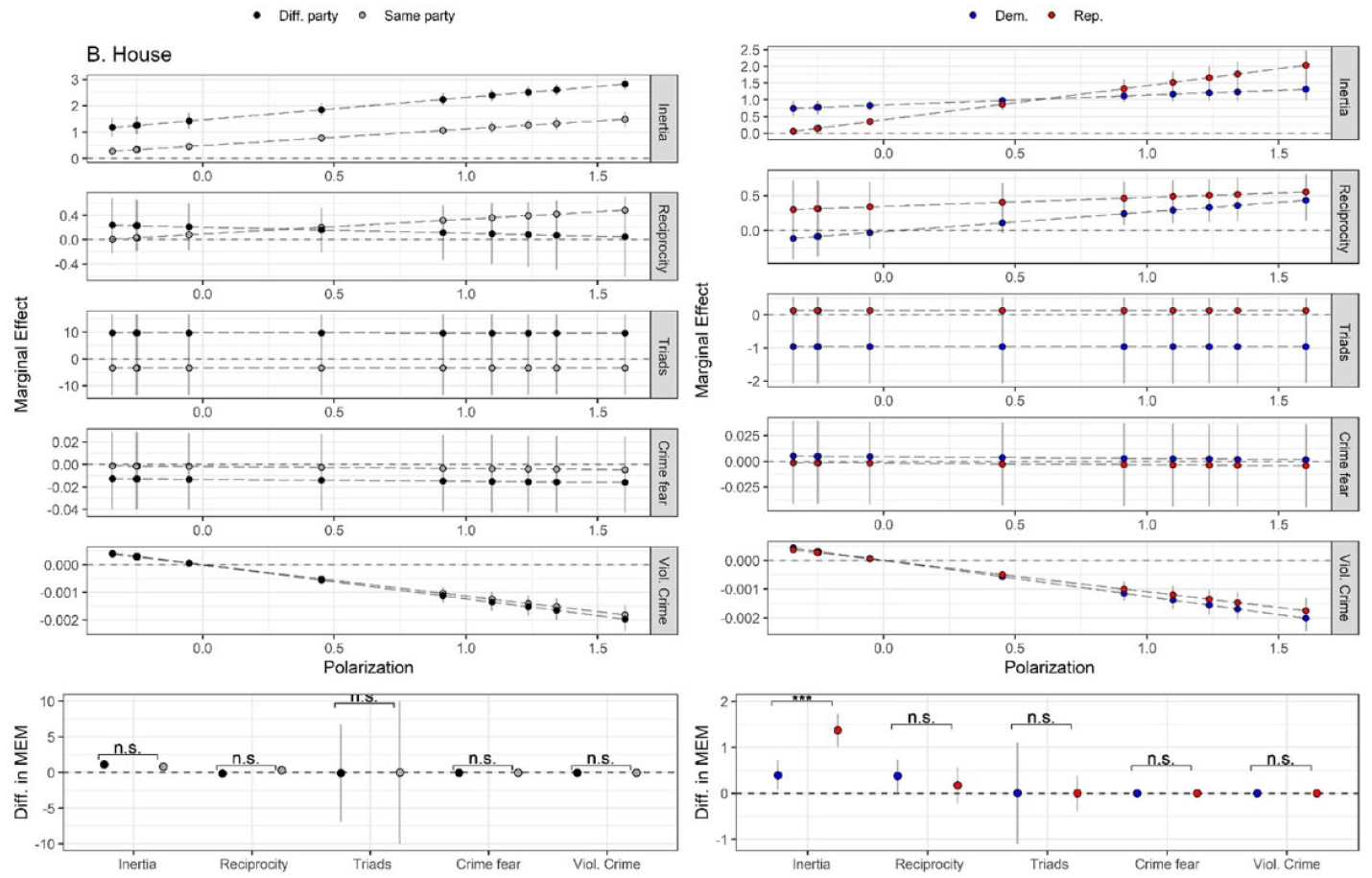
Marginal Effects at Different Levels of Polarization by Party, for the House
Ratified versus Unratified Crime Legislation
In the final set of analyses, I consider differences in network effects for ratified as opposed to non-ratified crime legislation. Because legislators inform their decisions about which policies to support based on their expectations about a bill’s success (see Soule and King 2006; Stimson 1999), network dependencies are likely to be greater for ratified criminal law.
Figure 7 shows that the marginal effects of inertia and reciprocity increase more sharply as a function of elite polarization for ratified crime legislation than they do for non-ratified crime legislation. Table S7 in the online supplement reports complete results. This means that, in polarized climates, reciprocity and inertia have larger effects on cosponsorships for ratified crime legislation than they do for non-ratified crime legislation. Furthermore, the marginal effect of violent crime rates on cosponsorships for ratified crime legislation declines as polarization increases but is nonsignificant at all observations for non-ratified legislation. This indicates there is no statistically significant effect of violent crime on cosponsorships for ratified crime legislation under moderate levels of elite polarization.
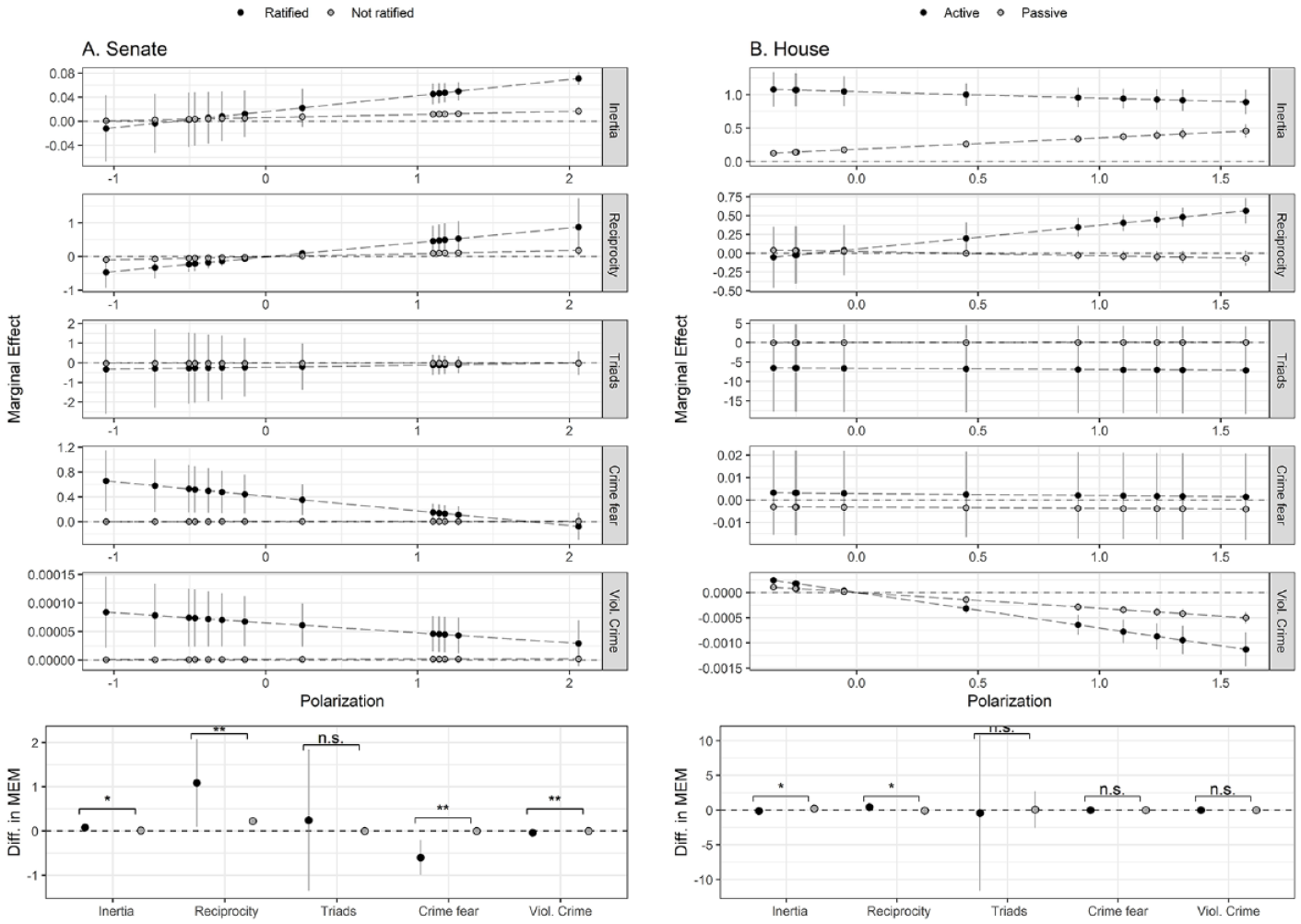
Marginal Effects for Ratified and Non-ratified Crime Legislation
A novel result to emerge in Figure 7 is the negative conditional relationship for crime fear. Although primary results uncover no effect of crime fear on crime legislation cosponsorship, the marginal effect of crime fear on ratified crime legislation is positive when polarization is at low values and declines at higher values. The effect of crime fear is greater in the Senate than in the House, but crime fear increases the probability of crime legislation cosponsorship in both chambers when polarization is at low values and becomes nonsignificant once polarization reaches high values. This result does not appear for non-ratified legislation and is consistent with research finding that public opinion matters most at late stages of policy processes when bills approach ratification (Soule and King 2006). These results show that (1) the conditional effects of reciprocity, inertia, and violent crime rates under elite polarization are stronger for ratified than non-ratified legislation, and (2) crime fear is linked to cosponsorships exclusively for ratified crime legislation, but this effect declines as elite polarization increases.
Sensitivity Analyses
The above results align with the argument that crime salience drove legislators to increasingly rely on networks to overcome the risks imposed by elite polarization when collaborating on crime policy. This implies that non-salient policy areas should not exhibit increasing network dependencies under elite polarization. Figure S3 and Table S4 in the online supplement evaluate this claim in an analysis of cosponsorships on transportation legislation. Transportation policy is a large area of federal policy that rarely sustains public attention or draws much concern during electoral cycles. Transportation problems may frustrate voters, but transportation is usually treated as a local issue rather than the responsibility of the federal government. Consistent with this reasoning, there is no evidence of a conditional effect of any network mechanism under elite polarization in these models.
A second possibility bears on the differences between active cosponsors—cosponsors who aid in drafting legislation—and passive cosponsors—cosponsors who do not assist in drafting legislation. Prior studies suggest that active cosponsorship is connected to personal relationships, and passive cosponsorship is linked to bill content (Russo et al. 2023). Figure S2 and Table S3 in the online supplement explore these differences in the crime legislation cosponsorship networks. Analyses uncover few differences in conditional network effects in the Senate, although the effect of reciprocity appears to be limited to active cosponsors in the House. These results suggest the main network effects of interest shape both active and passive cosponsorships in the Senate but are more heterogeneous in the House.
In summary, results support arguments on network dependence as a solution to the dilemma of crime policy collaboration under elite polarization. The effects of reciprocity and prior cosponsorships increase alongside elite polarization, and the effect of violent crime rates decreases, and these relationships shape cosponsorship decisions on both same- and different-party crime control bills. The conditional effects of inertia and reciprocity are greater for ratified legislation than for non-ratified legislation, and polarization decreases cosponsorship responses to crime fear specifically for ratified legislation. Collectively, results paint a picture of an otherwise gridlocked Congress that relied on networks to collaborate on crime control policy as elite polarization stymied legislative responses to violent crime and crime fear.
Discussion
Theories of penal change have focused on changing social contexts that create political consensus on crime policy, but this argument overlooks increases in elite polarization that have stymied policy action in most areas of U.S. law since the 1970s. I argued that lawmakers overcame the risk that elite polarization imposed on crime policy collaboration by using networks to establish mutual trust. Results show that reciprocity and prior cosponsorships grew increasingly important for crime legislation cosponsorship as elite polarization increased, while the effect of violent crime rates declined. Furthermore, the conditional effects of reciprocity and inertia are both greater for ratified crime legislation than they are for non-ratified legislation, and elite polarization decreases the effects of violent crime and crime fear on cosponsorships for ratified crime bills. Collectively, these results suggest that network assurances played an important role in guiding collaboration on criminal law as elite polarization hindered lawmakers’ ability to respond to violent crime rates and, in some cases, crime fear.
The finding that network dependence facilitates crime legislation cosponsorship carries insights for current research on the carceral state. Dominant theories of penal change argue that changing contexts create consensus on crime policy, but recent studies highlight how these accounts overlook conflicts between state actors that jeopardize policy processes (e.g., Goodman et al. 2017; Rubin and Phelps 2017). By analyzing lawmakers, results demonstrate how networks within policy environments enable collaboration on crime control legislation and play an important role in attracting collaborators to ratified criminal laws. Collectively, findings illustrate the importance of network structure in overcoming the divisive party politics that threatened collaboration on crime policy during the period of prison growth.
Recent studies on carceral state expansion contend that crime policy developed in historically contingent stages (Campbell and Schoenfeld 2013; Campbell, Vogel, and Williams 2015; Phelps and Pager 2016). Whereas policies during the early periods of prison growth were driven by increases in crime, responses to crime rates weakened in the face of “law and order” politics and political alignment on crime control. The finding that elite polarization suppresses the effect of violent crime on crime legislation cosponsorships advances these arguments by introducing elite polarization as a previously overlooked source of historical contingency in crime policymaking. Thus, results suggest that a portion of the historically contingent effect of violent crime on crime policy may be explained by increases in elite polarization.
My results also advance elite polarization and network dependence as overlooked factors in “top-down” and “bottom-up” arguments on penal change by directing attention to lawmakers’ collaboration decisions. Top-down arguments characterize political actors as opportunistic and relatively unaffected by crime or public opinion (Beckett 1997; Simon 2007; Weaver 2007). Bottom-up arguments, however, portray the public as fearful, concerned with crime, and exerting substantial pressures over policy (Enns 2016; Garland 2001; Miller 2016). Findings suggest the “top-down” and “bottom-up” nature of crime policy collaboration varied at distinct periods. Cosponsorships in the 1970s to mid-1980s were facilitated by crime and, for ratified bills, crime fear. However, as polarization increased into the 1980s, 1990s, and early 2000s, cosponsorships decoupled from crime and crime fear, and they were increasingly guided by network opportunity structures. Thus, results suggest that elite polarization shaped the timing of bottom-up and top-down political responses to crime, crime fear, and network structure.
Furthermore, my results provide insight to heterogeneity between political parties in responses to top-down and bottom-up concerns. In the Senate, only Democrats cosponsored crime control legislation in response to violent crime rates. This suggests bottom-up pathways are more relevant for explaining Democratic senators’ cosponsorship decisions, whereas top-down pathways characterize Republican senators’ cosponsorships. This finding aligns with accounts that portray Republican “law and order” politics as motivated by electoral opportunities, rather than rising crime (Alexander 2010; Beckett 1997; Simon 2007; Weaver 2007).
My findings add to research on how urgency shapes the policy process. Punctuated equilibrium theory argues that a sense of urgency directs political attention, motivates moments of rapid policy change, and disrupts policy inactivity (Baumgartner and Jones 1993; Jones and Baumgartner 2005). Prior studies on punctuated equilibrium have focused on aggregate trends, leaving open questions of how “the politics of attention” operates in the presence of elite polarization. Results suggest that, in the historical context of criminal lawmaking, network assurances promoted policy collaboration by alleviating risk inherent in policy collaboration on urgent issues during periods of polarization.
Findings also provide evidence of a “network–issue” tradeoff in polarized legislatures. Network assurances enable crime legislation cosponsorships in the presence of elite polarization, but they also constrain cosponsorships to lawmakers’ network connections. Consistent with the “dark side” of network embeddedness (Portes 1998; Uzzi 1997), results demonstrate that elite polarization is associated with diminished responses to crime rates and crime fear. This means the very network assurances that promote collaboration under polarization restrict lawmakers’ ability to address salient issues beyond those networks. And, because network clustering contributes to polarization (Levy and Razin 2019), this implies that while network dependence promotes collaboration within network clusters in the short-run, it may negatively affect policy in the long-run by creating more highly clustered and politically polarized networks. Future research should explore this possibility.
A key implication of these results bears on collaboration in other policy areas. Although the analyses focus on crime control legislation, the conceptual model pertains to the dual pressures of urgency imposed by issue salience and risks created by elite polarization. Thus, findings imply that networks should shape collaboration on other types of pressing policy (e.g., abortion, immigration, climate change), and “network–issue” tradeoffs are likely to characterize policy processes on many urgent issues during polarized periods. Elite polarization has continued to rise since 2005, so it is likely that network dependencies continue to enable and constrain collective policy action. Further research is necessary to evaluate this possibility.
The finding that networks shape crime legislation cosponsorship carries implications for crime control at lower levels of the criminal justice system. Sentencing policies affect outcomes in criminal courts, budget allocations determine the extensiveness of policing in localities, and some criminal justice policies create new justice agencies and institutions that determine prison capacities (Beckett 1997; Hagan 2011; Hinton 2016; Murakawa 2014). Because collaboration is necessary for policy change and implementation, results suggest that crime policy collaboration networks carry consequences for social control and punishment at lower levels of the criminal justice system. Future research should explore this possibility.
The federal focus of the analysis provides important advantages by capturing interactions between legislators from a comprehensive range of states and congressional districts, but it omits variation between the states. A promising direction for future research is to explore how crime policy collaboration networks in the states evolved and were affected by elite polarization. Furthermore, the focus on legislators restricts the analysis to a subset of all state and related actors. As recent studies direct attention to interest groups and penal officials (Gottschalk 2006; Lynch 2009; Page 2011), future studies should consider how actors occupying distinct roles, including lawmakers, penal actors, interest groups, and criminal justice agents, develop social, fiscal, and collaborative relationships that affect crime policy and penal change.
Finally, this study contributes by illustrating the utility of sociological research on Congress. A large body of political sociology and criminology directs attention to policy change (Behrens et al. 2003; Duxbury 2021b; Olzak 2021; Soule and King 2006), but sociologists have paid little attention to the legislative chambers where policies are conceptualized, written, negotiated, and enacted. This has led many sociologists to test the contexts associated with policy adoption but only speculate on the individual and relational mechanisms that intervene in the policy process. By taking a network perspective, we learn how networks shape crime control cosponsorship decisions and how network structure conditions the effect of a particular context—elite polarization—on crime policy collaboration.
In summary, although policy collaboration is necessary for penal change, few studies examine changes in crime policy collaboration networks during a period of elite polarization and criminal legal expansion. Results support the argument that network assurances enable federal legislators to collaborate on crime policy and that elite polarization suppresses legislators’ responses to crime rates. These findings isolate the role of network structure in crime policy collaboration, shed new light on historical contingency in criminal lawmaking, and suggest that networks enable and constrain policy collaboration in polarized legislatures.
Supplemental Material
sj-pdf-1-asr-10.1177_00031224241257614 – Supplemental material for Collaborating on the Carceral State: Political Elite Polarization and the Expansion of Federal Crime Legislation Networks, 1979 to 2005
Supplemental material, sj-pdf-1-asr-10.1177_00031224241257614 for Collaborating on the Carceral State: Political Elite Polarization and the Expansion of Federal Crime Legislation Networks, 1979 to 2005 by Scott W. Duxbury in American Sociological Review
Footnotes
Acknowledgements
I thank David Melamed, Andy Perrin, Steve Vaisey, Christopher Johnston, Holly Nguyen, Ben Grunwald, Sarah Lageson, Sarah Tahamont, Chris Smith, Naomi Sugie, and Frank Baumgartner for helpful comments. This paper benefited from feedback from attendants of the Duke Criminology Roundtable Workshop and Duke Worldview Lab.

Data Note
Some of the data used in this analysis are derived from Sensitive Data Files of the General Social Survey, obtained under special contractual arrangements designed to protect the anonymity of respondents. These data are not available from the authors. Persons interested in obtaining GSS Sensitive Data Files should contact the GSS at
Notes
References
Supplementary Material
Please find the following supplemental material available below.
For Open Access articles published under a Creative Commons License, all supplemental material carries the same license as the article it is associated with.
For non-Open Access articles published, all supplemental material carries a non-exclusive license, and permission requests for re-use of supplemental material or any part of supplemental material shall be sent directly to the copyright owner as specified in the copyright notice associated with the article.
