



Abstract
This article analyzes academic freedom worldwide with newly available cross-national data. The literature principally addresses impingements on academic freedom arising from religion or repressive states. Academic freedom has broadly increased since 1945, but we see episodic reversals, including in recent years. Conventional work emphasizes the uniformity of international institutional structures and their influence on countries. We attend to the heterogeneity of international structures in world society and theorize how they contribute to ebbs and flows of academic freedom. Post-1945 liberal international institutions enshrined key rights and norms that bolstered academic freedom worldwide. Alongside them, however, illiberal alternatives coexisted. Cold War communism, for instance, anchored cultural frames that justified greater constraints on academia. We evaluate domestic and global arguments using regression models with country fixed effects for 155 countries from 1960 to 2022. Findings support conventional views: academic freedom is associated positively with democracy and negatively with state religiosity and militarism. We also find support for our argument regarding heterogeneous institutional structures in world society. Country linkages to liberal international institutions are positively associated with academic freedom. Illiberal international structures and organizations have the opposite effect. Heterogeneous institutions in world society, we contend, shape large-scale trajectories of academic freedom.
Discussions of academic freedom have renewed urgency, following highly publicized crackdowns around the world. Turkish authorities have engaged in a “massive and continuous assault on academic freedoms” (Doğan and Selenica 2022:168), targeting critics of the Erdogan administration with dismissals, arrests, and criminal prosecutions, in addition to university closures and the installation of pro-regime rectors (Aktas, Nilsson, and Borell 2019; Baser, Akgönül, and Öztürk 2017). The Orban regime, proclaiming Hungary an “illiberal democracy,” has banned gender studies, exiled the Central European University, and sought to realign higher education with “traditional” values (Chikán 2018). China has sharply tightened scrutiny of universities and dismissed dissident professors (Scholars at Risk 2019). Nationalists in India have violently attacked professors and students (Bhatty and Sundar 2020).
In the United States, too, new challenges to academic freedom have emerged (Scott 2018). In 2022, Florida governor Ron DeSantis signed the Stop WOKE Act, which restricts how race and gender may be addressed in classrooms. Legislatures in Texas, North Dakota, Florida, and Iowa have proposed or adopted legislation to curtail tenure protections.
These recent examples are but episodes in a longer historical narrative. Academic freedom has generally increased worldwide in the past 60 years (Spannagel and Kinzelbach 2023), but with large country variations and notorious episodes of repression (e.g., during China’s Cultural Revolution).
The absence, until recently, of large-N cross-national and longitudinal data on academic freedom has limited systematic analysis of global change. As a result, the literature is not oriented toward explaining broad trends (for an exception, see Berggren and Bjørnskov 2022). Extant work is largely case-based and stresses the domestic or local determinants of academic freedom, such as restrictions (or protections) that emanate from national states or religious authorities (e.g., Connelly and Grüttner 2005; Doğan and Selenica 2022; Schrecker 1986).
This article, by contrast, seeks to understand the broad social forces that account for large-scale patterns in respect to academic freedom across countries and time. We distill generalizable arguments from the rich case-based literature and reorient the literature by focusing on the global. Local struggles over academic freedom do not occur in a vacuum. Broader institutional structures and norms variously support, or undercut, academic freedom. Our arguments draw on world society theory (Meyer et al. 1997), but also reimagine it. Prior scholarship has often envisioned world society as a monolithic structure that propels diffusion and conformity. We theorize how heterogeneous institutional structures in world society, reflecting multiple modernities, have divergent effects on academic freedom. Specifically, global trends and cross-national variations in academic freedom can be understood in terms of the expanding liberal international order of the post-1945 era and alternative illiberal visions of modernity that have coexisted and sometimes flourished alongside it.
We explore these questions with new cross-national and longitudinal measures of academic freedom from the Varieties of Democracy dataset, spanning 155 countries from 1960 to 2022 (Coppedge et al. 2023a; Spannagel, Kinzelbach, and Saliba 2020). We develop measures to operationalize our arguments and use panel regression models with country fixed effects to evaluate them. Over and above conventional arguments involving domestic sources of academic freedom, our models show that global liberalism offers, and global illiberalism withdraws, potent supports for the liberty to teach and the liberty to learn, which constitute the heart of academic freedom.
Background: The History Of Academic Freedom And State Of The Literature
What Is Academic Freedom?
A vast body of work, mainly in education and legal studies, debates the theoretical, conceptual, and normative bounds of academic freedom. We begin by locating our work in that landscape. In brief, we use a broad definition of academic freedom, one that maintains a clear distinction between academic freedom and general political rights.
Most easily apparent when it is absent (Tierney 1993), a minimal definition of academic freedom encompasses a teacher’s right to instruct, and a student’s right to learn, in a college or university unhampered by outside interference (Brickman 1968). It typically also includes self-governance and institutional autonomy, primarily from states and markets (Altbach 2001). From some standpoints, academic freedom also involves the right to use academic knowledge, above all from the social sciences, for social and political criticism (Connelly and Grüttner 2005). This extension to “extramural speech” is historically controversial, but it has been influential in many settings, not least the United States.
We adopt a broad view of academic freedom, inclusive of all these dimensions, intramural as well as extramural and individual as well as institutional (for further discussion of definitional issues, see Altbach 2001; Barendt 2010; Metzger 1988; Moodie 1996; Van Alstyne 1972; Yudof 1987). However, some go further and equate academic freedom with freedom of speech or expression more generally (Scott 2018). We do not. The latter is rooted in citizenship and offers a broad right to express opinions without government interference, whereas the former is rooted in but also circumscribed by academic expertise and position. Every citizen has the freedom of speech to address, say, the efficacy of vaccines, but only qualified professors, with degrees in relevant fields, have the academic freedom to do the same. 1 Academic freedom is thus narrower than freedom of expression in principle—and in practice it is even narrower still, as only academics with job security may enjoy it de facto (Hutchens 2011). Moreover, unlike public speech, academic expression is subject to quality controls by peers (i.e., peer review). Academic freedom is thus not simply an individual liberty akin to freedom of expression, but a unique type of professional freedom that is legitimated by the university’s truth-seeking authority and broader standing in society (Barendt 2010; Ben-David and Collins 1966).
Historical Context
Over the centuries, academic freedom emerged tentatively (Karran 2009). In the medieval period, it constituted “a feudal privilege” (Lenhardt 2002:277) but one sharply constrained by religious authority. Academics who flouted church doctrine became embroiled in religious struggles (Enders 2007). The emergent nation-state likewise set boundaries around academic freedom, as it sought to harness the university for national purposes (Perkin 2007; Riddle 1993).
Academic freedom gained institutional footing with the rise of the modern research university as the cultural base and organizational generator of high truth (Hofstadter 1961; Metzger 1961; Shils 1989). The research university’s overarching commitment to transcendent forms of explanation already implies a warrant to traverse freely across the terrain of ideas, unencumbered except by precepts of rationality and universality (Frank and Meyer 2020). The nineteenth-century Humboldt model enshrined these ideals (Altbach 2001) and carried them from Prussia to the United States and beyond (Hofstadter 1961; Metzger 1961). Variations of academic freedom crystalized. The German model largely emphasized academic freedom within the academic community, whereas the U.S. adaptation additionally claimed the right to extramural social and political speech (Shils 1989). In practice, of course, academic freedom waxed and waned, as non-university authorities periodically sought to co-opt or suppress academics and academic knowledge (indeed, university charters often came from states).
The Literature
Much of the academic freedom literature tackles the historically varying understandings of academic freedom and conceptual issues, addressing questions of how academic freedom ought to be defined, justified, and ultimately protected (e.g., Altbach 2001; Barendt 2010; Metzger 1988; Moodie 1996; Van Alstyne 1972; Yudof 1987). A related strand examines the issue on normative grounds and draws critical attention to ongoing attacks (Gerstmann and Streb 2006; Ignatieff and Roch 2018).
The conceptual and normative work is intertwined with rich case-based empirical studies of particular countries or historical episodes (e.g., Åkerlind and Kayrooz 2003; Doğan and Selenica 2022; Tap 1992; Tierney 1993; Tierney and Lechuga 2010). For example, Hofstadter (1961) and Metzger (1961) trace the development of academic freedom in the United States (see also Slaughter 1980). Others examine topics such as academic freedom during McCarthyism (Schrecker 1986) or under dicatorship (Connelly and Grüttner 2005). Contemporary empirical studies often draw on interviews to understand how academics conceive of academic freedom (e.g., Åkerlind and Kayrooz 2003) or experience repression (e.g., Doğan and Selenica 2022). Shaped by their case-based approach, these studies cast academic freedom largely as a domestic phenomenon, bolstered or threatened by proximate social/political dynamics. Scholarship with a regional or comparative lens can be found, but it remains fairly theoretical or does not seek to generalize (see, e.g., Zeleza [2003] for a descriptive account of academic freedom challenges in African universities, and Marginson [2014] or Ben-David and Collins [1966] for comparative arguments using illustrative country examples).
Some recent empirical work, however, has begun to draw on systematic and even cross-national data. For example, Greitens and Truex (2019) survey more than 500 scholars working in several countries to understand their experiences of Chinese state repression. Karran, Beiter, and Appiagyei-Atua (2017) summarize constitutional and legal protections for academic freedom in 28 European Union countries. Coming closest to our approach, Berggren and Bjørnskov’s (2022) recent study of 64 countries highlights the importance of democracy versus authoritarianism for academic freedom.
Overall, the prior literature is centered on conceptual and normative issues or detailed empirical case analyses rather than explaining large-scale empirical patterns of academic freedom. That said, the prior literature offers a wellspring of arguments and case examples that we distill into generalized claims. We draw on newly available high-quality quantiative measures (Coppedge et al. 2023a; Spannagel et al. 2020) to carry out the largest systematic study of academic freedom to date. We evaluate existing arguments and, more importantly, develop a novel sociological argument that enriches a literature still dominated by contributions from education and law. Our account roots academic freedom in the global context and also theorizes the heterogeneity of global forces over space and time.
Global Transformations Of Academic Freedom
We describe the large-scale trends in academic freedom from 1960 to 2022, which set the stage for our global arguments. Figures 1 and 2 present the world and regional averages of country academic freedom scores, drawing on the newly available Academic Freedom Index (discussed below) (Coppedge et al. 2023a; Spannagel et al. 2020). The Index captures the concept in its multiple dimensions: the freedom to research, teach, and disseminate findings without interference; the institutional autonomy of universities; academic expression related to political issues; and the extent to which universities are free from politically motivated surveillance or security infringements. Figure 1 presents global trends with three measures of academic freedom: a world average, a population-weighted world average, and a constant-case world average. Figure 2 depicts country averages in six world regions.
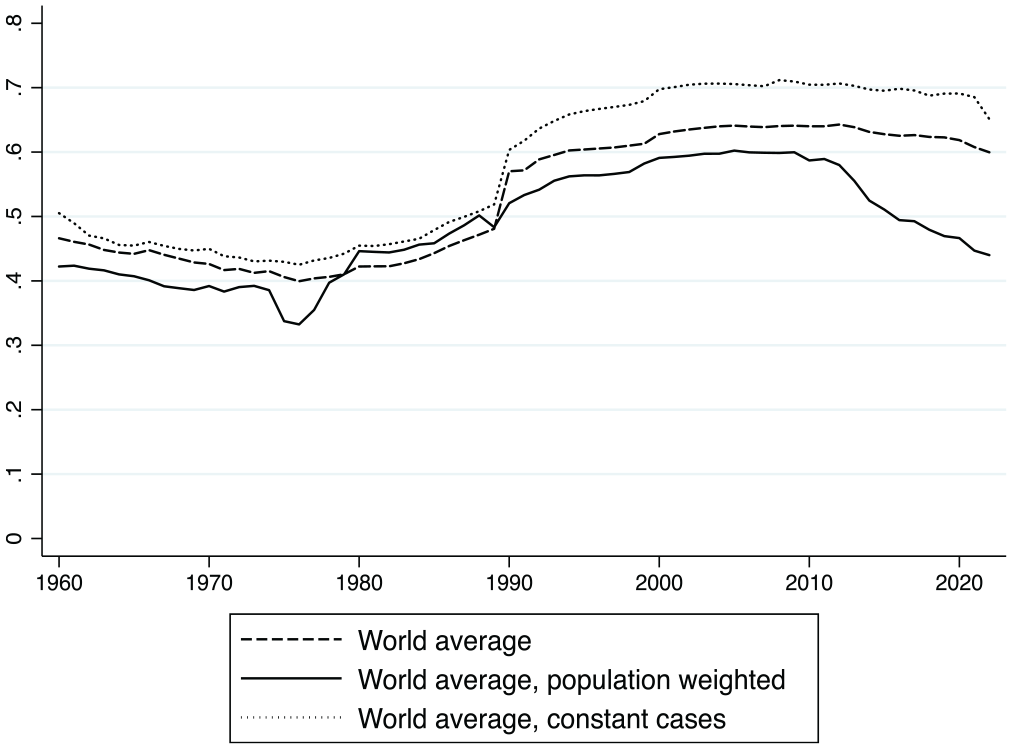
Trends in Academic Freedom at the World Level, 1960 to 2022
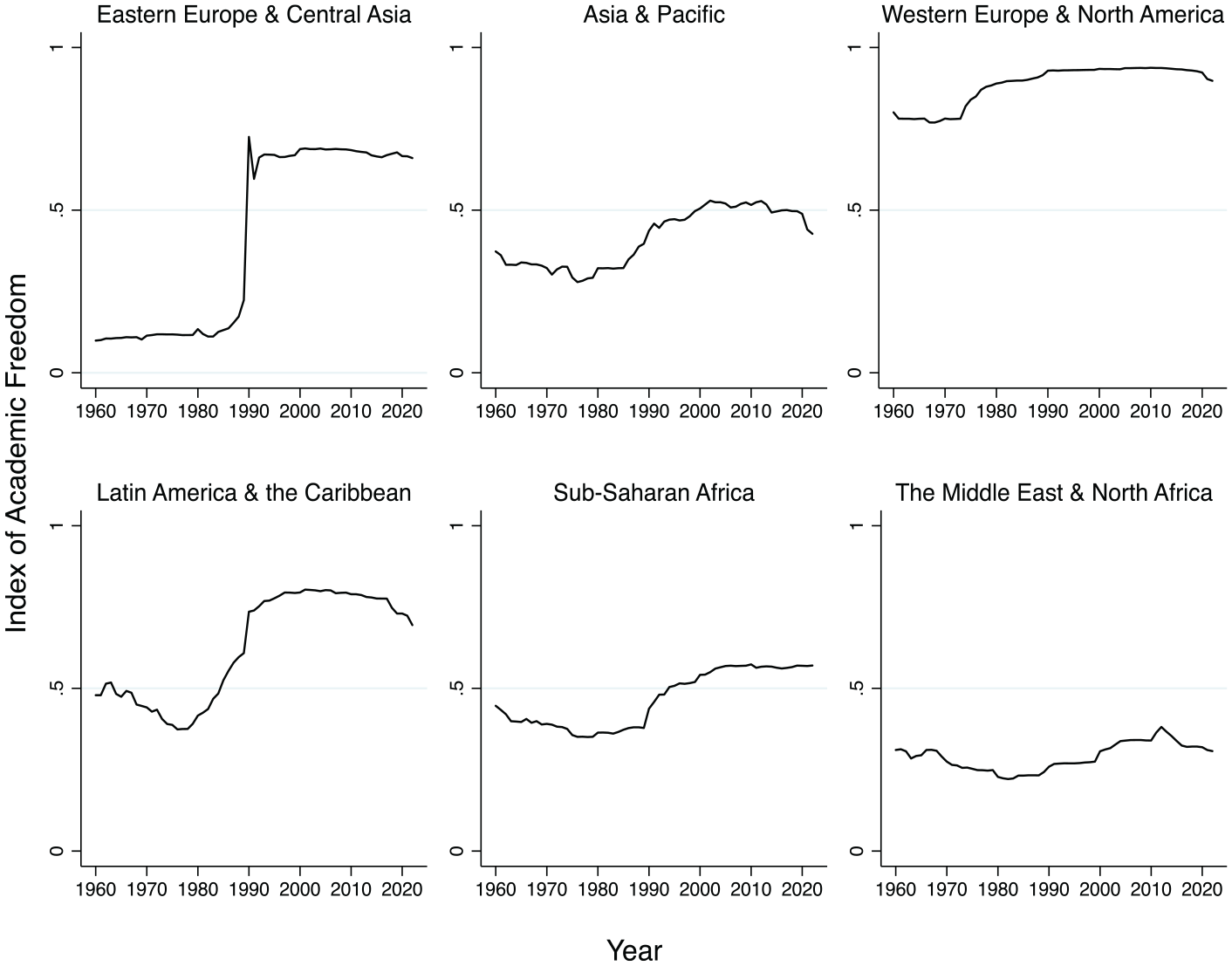
Trends in Academic Freedom by Region, 1960 to 2022
The first big takeaway from the figures is that academic freedom grew rapidly at the world level beginning in the 1980s until about 2000 and then leveled off with signs of incipient decline. The recent decline is especially stark in the population-adjusted world trend. The second, and for our purposes most important, takeaway is that the global trend is more-or-less recapitulated across regions, although with variations. In the West (Western Europe and North America), for example, the late-twentieth-century rise was more incremental than in most other regions, given that levels of academic freedom were already fairly high by 1960. In Eastern Europe, academic freedom was thoroughly quashed in the communist era, and then shot upward. In Latin America, the rise occurred only after the political turmoil and military coups in the 1960s and 1970s (Altbach 2001). The increase in the late twentieth century was considerably more muted in the Middle East and North Africa than elsewhere. These variations are important, but the key point for present purposes is that the global pattern roughly echoes across regions.
Against this backdrop, we raise the following questions: How do we explain the social foundations of academic freedom? And how might global dynamics help make sense of cross-national and historical variations from 1960 to 2022?
Explaining Cross-National And Historical Change In Academic Freedom
The case-based literature suggests many determinants of academic freedom. We distill generalizable arguments that may help explain cross-national and longitudinal variations.
Democracy and autocracy
Prior work unpacks the rich and complex ways that political democracy supports academic freedom, and conversely how autocratic regimes repress it. Autocratic states commonly impose severe restrictions on universities and academics, demanding loyalty over academic freedom (Cole 2017; Connelly and Grüttner 2005; Merton 1968). This occurred, for example, in Nazi Germany (Josephson 1996) and the Soviet Union (Smolentseva 2007), and it is occurring in Myanmar, where the ruling military junta suspended 11,000 academics in 2021 for failing to repudiate critics of the state (Reuters 2021).
The literature also chronicles the supportive role of democracy. The central imagery is that “democratic ideals and adherence to the principles of individual liberty and free expression” legitimate and sustain academic freedom (Cole 2017:862). Various mechanisms have been theorized. Democracy can increase the costs of repressive behavior, as authorities can be voted out of office. It can also institutionalize political values (e.g., openness and accommodation) that support respect for basic liberties and run counter to the use of repression (Davenport 2007). In summary, the first insight from the literature is that, on average, democracy is likely associated with higher levels of academic freedom (see also Berggren and Bjørnskov 2022).
Militarism and armed conflict
Along similar lines, prior work explains variations in academic freedom in terms of war and militarism. A core idea—borne out in World War I (Tap 1992), the Cold War (Schrecker 1986), the War on Terror (Bird and Brandt 2002), and various civil conflicts (Zeleza 2003)—is that states tend to grow more coercive, secretive, and intolerant in times of war and impose greater surveillance and control over academic research and teaching (Gerstmann and Streb 2006). Related are long-standing concerns about the effects of militarism on academic freedom, suggesting that in militarized contexts and times, the university becomes an extension of the national security state or the military-industrial complex (Giroux 2007). We thus propose that armed conflict and state militarism are negatively associated with academic freedom.
University governance (state control versus autonomy)
The literature also ties variations in academic freedom to the structure of university governance, that is, the means by which higher-education institutions are formally organized, managed, and operated (Clark 1983). Greater state control, in particular, may be associated with lower levels of academic freedom. In the United States, for instance, universities have been able to operate with a fair degree of autonomy from the state, with the large number of private institutions serving as a “powerful offset to state control” (Labaree 2017:18). Private institutions may be less susceptible to state intervention than public ones, as they are less reliant on state funding (Scott 2018), and perhaps less likely to breed political activism (Levy 2007). Moreover, academics in public universities may be directly employed by the state, facilitating additional pathways for control, for instance via political background checks prior to appointment. Although countries have generally moved toward market-centered models (Buckner 2017), we expect variations in university governance, especially along the public-private axis, to continue to shape academic freedom.
State religion
Many of the earliest attempts to curtail academic autonomy emanated from religious institutions. With the fragmentation of church authority in the Reformation and the subsequent ascendance of nation-states, however, religious controls dwindled (Riddle 1993), such that in the recent past, religious authorities typically have lacked widespread ability to limit academic freedom. A major exception is cases where state and religious authorities comingle. At the extreme, religious and state authorities are fused in theocracies, with sometimes dire consequences for academic freedom, as in post-revolutionary Iran (Mojab 2004). More common are countries with official state religions, which enshrine elements of religious authority in the law and create avenues through which religious doctrine may be imposed on research and teaching (e.g., Kraince 2008). We expect state religiosity to be associated with lower levels of academic freedom. 2
A Global Argument: Heterogeneous Institutionalized Models In World Society
As Figure 2 illustrates, broad trends in academic freedom are surprisingly similar across regions, despite substantial differences in levels of development, state militarization, religion, and the like. Academic freedom, we contend, is supported and legitimized (or undercut) by the global and transnational context. Consequently, cross-national and longitudinal patterns of academic freedom are shaped by evolutions in global institutional structures, particularly in countries strongly tied to those structures. Our arguments draw on world society theory but extend the perspective to better address the heterogeneity of institutional structures.
World society theory characterizes educational systems (and other facets of modern societies) as supported by a world environment filled with cultural scripts and organizational rules that define schools and universities and constitute their basic features in local contexts (Frank and Meyer 2007, 2020; Schofer and Meyer 2005; Schofer, Ramirez, and Meyer 2020). World society scholars often focus on patterns of homogeneity and isomorphism. Classically, the establishment of the post-World War II liberal institutions (e.g., the United Nations, the Universal Declaration of Human Rights, and a panoply of international nongovernmental associations) gave rise to a world organizational and cultural frame that produced much cross-national standardization (Boli and Thomas 1997; Meyer et al. 1997).
The success of world society theory in explaining global diffusion and conformity across a wide range of empirical phenomena has sometimes fostered the misperception that world society is monolithic, and thus the perspective only addresses convergence (Schofer et al. 2012). Indeed, a long-standing criticism is that the perspective is unable to account for diverse outcomes (Schneiberg and Clemens 2006). However, predictions of conformity are conditional on the institutionalization of strong and relatively unopposed international structures (Boyle, Kim, and Longhofer 2015; Schofer and Hironaka 2005).
The core of world society theory is not actually about conformity. The theory asserts a more general set of principles about the constitutive quality of global institutions and culture and the derivative properties of domestic actors and interests (Meyer 2010). Cohesive global norms favor widespread diffusion. But global organizations and culture can also anchor variants or alternatives to dominant models, producing patterns of limited cross-national diffusion and even divergence or fragmentation (Beckfield 2010; Boyle et al. 2015). The question of how to understand such opposition and contention is among the most pressing theoretical issues animating recent world society scholarship, in the face of mounting contemporary challenges to the postwar liberal order, ranging from attacks on democracy to pushbacks against LGBT rights (see Börzel and Zürn 2021; Bromley, Schofer, and Longhofer 2020; Ferguson 2022; Velasco 2023).
A new wave of scholarship on alternatives, opposition, and contention in world society has identified several complementary and overlapping processes. A first idea is that older transnational institutions, such as the Catholic Church, can provide bases for resistance to the dominant post-1945 liberal institutions, as in the case of abortion (Boyle et al. 2015). A second idea is that illiberal social movements and advocacy groups can commandeer the scaffolding of international organizations and institutions to challenge dominant liberal models and discourses. For example, conservative activists use United Nations conferences (Cupać and Ebetürk 2020) and international nongovernmental networks (Bob 2012; Velasco 2018, 2023) to mobilize against liberal sexuality and gender norms. A third argument highlights internal inconsistencies and contradictions in liberal institutions around which contention may arise (Kymlicka 1995). The huge expansion of the human rights regime has, in particular, provided a foothold for conservative attacks on liberal world society norms (Bob 2019), as in the assertion of religious rights to protect traditional family arrangements. In summary, contestations may arise from historical institutions like the church and from the post-1945 world society institutions themselves, which can provide organizational and discursive platforms for illiberal opposition.
We extend this line of work by theorizing heterogeneities in the institutional structures of world society itself. We draw on Eisenstadt’s (2000) concept of multiple modernities to address the varieties of institutionalized models and corresponding organizational structures in the international community (see also Jepperson 2002). In describing the state system, Eisenstadt points out there was never a single unified model of modernity, but rather an array of modern state forms, such as liberal, communist, and fascist. Indeed, he anticipates our global argument: [Variants of modernity] were international, even where their bases or roots lay in specific countries. The more successful among them crystallized in distinct ideological and institutional patterns that often became identified with a specific state or nation (as was the case with revolutionary France, and later with Soviet Russia), but their reach extended far beyond national frontiers. (Eisenstadt 2000:9)
What Eisenstadt did not emphasize (but see Jepperson and Meyer 2021; Ruggie 1982, 1998) is that these different models of modernity were rooted not only in important countries in the state system but also in the culture and organization of the international community. As we will detail, the post-1945 expansion of global institutions mainly involved liberal models—partly propelled by the dominance of the liberal United States (Ruggie 1982, 1998). However, these liberal institutions coexisted with legitimated illiberal alternatives that were also institutionalized in the international arena. The prime example is the communist sphere, which had its own cultural assumptions (equality over liberty, the collective over the individual) and international organizational structures (e.g., COMECON and the Warsaw Pact).
Bases for opposition in world society thus arise not only from traditional institutions (the church) or from footholds and fractures within dominant institutions. They also arise from the alternative institutionalized cultural programs in world society (i.e., the different models of modernity), which may limit the cross-national diffusion of dominant models by supplying legitimated alternatives (Strang and Meyer 1993).
We flesh out this argument through an account of changing global institutional structures since World War II and their implications for academic freedom. We revisit the idea that core world society institutions were built around one of several available cultural models circulating in the postwar period (Boli and Thomas 1999). We argue that global liberalism provided a key cultural foundation for academic freedom and trace its structuration and influence over time. In tandem, we track the evolving presence of globally institutionalized illiberal alternatives, beginning with communism and continuing with emergent illiberal structures on the rise today (often linked to Russia or China). We argue that such alternative structures in world society have legitimated waves of constraints on academic freedom and affected its fate globally, but especially in countries formally linked to those structures.
Liberal and Illiberal Structures in World Society and Academic Freedom
In the aftermath of World War II, liberal models became enshrined in prominent world bodies and normative instruments like the United Nations and the Universal Declaration of Human Rights (Ruggie 1982). They propelled large-scale social change in world society and across national contexts, promoting democracy, markets, and human rights—the waves of diffusion often described by world society scholars (Simmons, Dobbin, and Garrett 2006). 3
Liberal international institutions provided a powerful global foundation for academic freedom. In brief, liberalism elevates individual liberties and choices as the ultimate sources of agency and authority in society; it simultaneously dilutes the legitimacy of state and corporate bodies, diminishing them to aggregations of individual persons (Jepperson and Meyer 2011; Meyer 2010). In liberal models, the individual exercises, and should exercise, free and unencumbered actorhood (Zürn and Gerschewski 2021). Vis-à-vis academic freedom, these principles entail that knowledge can and should be discovered and disseminated by (rational) individuals in an unfettered pursuit of truth. This undercuts the legitimacy of intervention and censorship by supra-individual entities, such as the state and church.
Liberalism furthermore imagines the social and natural environments, the stage for human action, in highly rationalized terms. It shares this tendency with other models of modernity, including communism. Yet rationalization has a special prominence in the liberal frame because it facilitates human liberty by resolving the chaos and mystery that antagonize it. Even the liberal society itself is ultimately envisioned in rationalized terms—the venerated global “knowledge” society (Frank and Meyer 2020; Lerch, Bromley, and Meyer 2022; Schofer et al. 2020). These principles imply central roles for the university and for academics, greatly increasing their standing vis-à-vis religious and political bodies and legitimating the social importance of academic freedom, guided by reason and science.
Postwar liberal institutions thus promoted not only democracies, markets, and human rights, but also unprecedented global university expansion, on the premise that higher education anchors individual actorhood and grounds the liberal society in rationalistic and universalistic forms of understanding (Lerch, Bromley, and Meyer 2022). Universities multiplied in number and grew in enrollments and curricular coverage (Buckner 2017; Frank and Meyer 2020; Schofer and Meyer 2005; Trow 1972). Liberal institutions seeded academic cooperation (Finnemore 1993; Kosmützky and Putty 2016) and promoted the liberty to teach and learn and to apply academic expertise beyond university walls free from external hindrance. Indeed, the human-rights regime helped codify academic freedom as an ideal in Article 15 of the 1966 International Covenant on Economic, Social and Cultural Rights (ICESCR), which stipulated that ratifying parties “undertake to respect the freedom indispensable for scientific research and creative activity” (see Spannagel 2020).
As the world society literature has shown, the institutionalization of liberal norms and principles around academic freedom can have immense effects (Hironaka 2014; Meyer 2010; Schofer et al. 2012). Local groups, for instance, are more likely to aspire to academic freedom and demand it. Violations of academic freedom are more likely to be met with resistance, naming and shaming campaigns, or pressure from international and domestic groups, and so on.
Yet liberalism was ascendant in world society in the decades following World War II, not hegemonic. Most notably, the umbrella of communism linked to the Soviet Union spawned its own distinctly illiberal global and transnational institutional structures (Hedin 2016). In 1949, for instance, the Council for Mutual Economic Assistance (COMECON) emerged to promote cooperation among national planned economies. And in 1955, the Warsaw Pact established a military and political alliance that served as the communist alternative to NATO (the North Atlantic Treaty Organization) (Crump and Godard 2018).
The communist countries participated in some liberal international institutions in their heyday (Weitz 2019), but the structure of world society was, to a considerable extent, organizationally and culturally bifurcated. Communism provided a stark alternative to liberalism, with implications for higher education and academic freedom. The communist countries embraced many parts of the university, but they subordinated it to the state, for example, by limiting enrollments and curriculum according to ideologies of centralized manpower planning (Baker, Köhler, and Stock 2007; Lenhardt and Stock 2000). They further compromised academic freedom with faculty repression, the abolishment of certain academic degrees, and the closing of non-state institutions. State policy regulated the number of higher education institutions, the number of students, the range of specialties, the amounts of remuneration and fellowships, the content of curricula and textbooks, graduate employments, and so on. (Smolentseva 2007:952)
Of course, the “Sovietization” of universities in the communist world was neither uniform nor absolute, and Cold War competition also brought curtailments of academic freedom in the liberal West (notably McCarthyism). But communism, in principle, legitimated much greater state control over universities and academics, with one scholar describing the Soviet order as “one of the most controlled, ‘planned’, and statist systems of organized intellectual life ever developed” (David-Fox 2005:20).
The collapse of the Soviet empire and the end of the Cold War led to a period of liberal triumphalism, in which oppositions were muted (see Frank, Camp, and Boutcher 2010; Koo and Ramirez 2009; Simmons et al. 2006). For a few years in the 1990s at least, liberalism seemed unstoppable, leading one scholar to declare “the end of history” (Fukuyama 1992). Globalization and the celebration of markets chipped away at the importance of the state, and the human individual commanded even greater priority in economic, political, and social life (Frank and Meyer 2002; Lerch, Bromley, and Meyer 2022; Meyer and Jepperson 2000). Along with the Soviet empire, alternative transnational institutional structures withered, and liberal world society became more ambitious and interventionist (Börzel and Zürn 2021).
Liberal free markets brought their own challenges (Zeleza 2003), but universities and academic freedom flowered considerably during this period, increasingly independent of the state. Global protections for academic freedom expanded as liberal world society institutions grew more assertive. In 1997, for example, the UN’s Educational, Scientific and Cultural Organization (UNESCO) adopted an international recommendation outlining protections for academic freedom. And in 1999, the UN Committee on Economic, Social, and Cultural Rights recognized academic freedom as integral to the human right to education. Across many countries, curricula broadened, enrollments soared, and private institutions flourished, countering ideas of higher education as provided and guarded by the state (Buckner 2017; Levy 2006). At the same time, international student mobility rose, branch campuses multiplied, internationalized curricula expanded, and subjects built around universalistic (and thus global) assumptions gained even greater authority, revitalizing the university’s cosmopolitan roots (Buckner 2019; Knight 2004; Kosmützky and Putty 2016; Lerch, Bromley, and Meyer 2022; Zapp and Lerch 2020).
Soon, however, illiberal alternatives resurfaced, and these have intensified in recent years (Guillén 2018; Layne 2012; Mearsheimer 2019) amid re-assertions of nationalism and populism (Bonikowski 2017), a global democratic recession (Diamond 2016), and, most recently, Russia’s invasion of Ukraine and the specter of a major international war. Partly, the shift is economic and geopolitical: the relative hegemony of the United States and liberal Western powers has declined (Zakaria 2008), and openly illiberal powers such as China and Russia have become more assertive and demanded the construction of a multipolar international system to “replace the unipolar system dominated by the United States” (Boyle 2016:37).
The shift is also cultural. Liberalism has lost its preeminent legitimacy as the ultimate answer to social questions (Norris and Inglehart 2019), especially in the wake of the 2008 economic crisis and the attendant foundering of liberal institutions. This crisis of faith has manifested variously across the globe. In places with strong liberal traditions (e.g., the United States and Europe), illiberal visions have gained legitimacy, giving rise to events that earlier would have been hard to imagine, such as the election of Donald Trump and Brexit. Elsewhere, illiberal visions have solidified, resulting in sometimes severe attacks on liberal democracy and basic liberties. The common element is diminishing trust in the liberal model and a growing recognition of alternatives.
Once again, there is an upwelling of contestation in world society. Belying post-Cold War fantasies of a united liberal world order, international structures that legitimize alternative scripts are flourishing. Most salient are a set of international organizations that challenge liberal democracy and endorse authoritarianism (Bromley et al. 2020; Buranelli 2020; Cooley and Schaaf 2017; Debre 2022; Hadler and Symons 2018; Kneuer et al. 2019; Obydenkova and Libman 2019). For instance, the Shanghai Cooperation Organization emphasizes state security, sovereignty, and maintenance of the authoritarian status quo in Central Asia (Ambrosio 2008). Along similar lines, the Commonwealth of Independent States (CIS), a Russian-led organization that arose from the ashes of the Soviet Union, bolsters illiberal regimes in the region.
Today’s illiberal international structures are not as organized or unified as the communist sphere at the peak of the Cold War. Contemporary illiberalism in world society remains multimodal and decentralized—at least for the time being. There are hints of an emergent statist model of modernity akin to a “developmental authoritarianism” (Yang 2017), anchored in China’s growing global influence. But other alliances draw on religious frames, for instance, of “traditional values” or politicized Islam (Cupać and Ebetürk 2020; Hadler and Symons 2018; Lerch, Schofer, et al. 2022). We are dealing with multiple overlapping illiberal alternatives. Overall, a consolidated bloc with a shared cultural frame has, as yet, not emerged. Moreover, liberal world society, and its support for academic freedom, continues. For example, in 2020, the UN Special Rapporteur on Freedom of Expression lent its imprimatur to a special report on academic freedom (UN General Assembly 2020).
The resurgence of illiberalism is again providing a transnational basis for restrictions on academic freedom, undermining liberal preeminence and chipping away at formerly taken-for-granted liberal norms. As illiberal discourses and organizations flourish, states and political parties are ramping up controls and censorship of universities and academics (Douglass 2021; Lyer and Suba 2019). Attacks are on the rise, including killings, violence, disappearances, wrongful prosecution, imprisonment, loss of position, expulsion from study, travel restrictions, university closures, and military occupations (Scholars at Risk 2016:4). At their most extreme, the new restrictions pose sweeping threats to higher education itself; more commonly, they target particular university organizations and forms of governance, professors and students, and curricular contents and degree programs.
Given the multimodal nature of contemporary illiberal structures, the cultural foundations for these attacks vary. Hungary invoked “traditional values” in banning gender studies, whereas China marshalled authoritarian frames in prosecuting dissident professors. The general point is that illiberal models—sometimes borne of and often amplified by international structures—increasingly characterize universities and scholars not as autonomous and agentic actors, but as subordinates of the state, church, or other corporate bodies. For example, China is building a higher-education system “closely tied to state interests,” buttressing authoritarian rule (Perry 2020:1).
To summarize, world society is heterogeneous, not monolithic. Liberal institutions have dominated world society over the past 75 years, yet alternative illiberal institutions and cultural programs have been present all along. They were stronger during the Cold War, weaker in the neoliberal period, and are making a comeback today. The dynamics, we argue, have powerful implications for academic freedom. Liberal institutions help ground academic freedom in world society, and illiberal institutions do the opposite. These arguments may help explain the historical and regional trends in Figures 1 and 2.
Our world society arguments suggest three main hypotheses. The first, following established world society diffusion research, highlights the liberalizing influence of mainstream world society institutions:
Hypothesis 1: We expect higher levels of academic freedom in countries that are more embedded in the liberal global and transnational institutions of world society.
Our second and third hypotheses, reflecting our main theoretical contribution, highlight the effects of institutionalized illiberal alternatives in world society. On one hand, we expect the expansion of such structures to have a dampening effect on academic freedom worldwide. Alternatives are always available in liberal and illiberal settings, but they become more legitimate options when institutionalized on the world stage. Leaders and movements in diverse countries can more easily invoke them to justify restrictions on academic freedom, not only in illiberal authoritarian contexts but also in historically liberal settings like the United States (albeit often in milder forms). We thus formulate our second hypothesis:
Hypothesis 2: We expect lower levels of academic freedom during periods when oppositions to liberalism are globally prominent.
Yet an enduring insight of world society scholarship has been that embeddedness matters. Country linkages to international structures are an important conduit for the flow of culture, ideas, and norms (Boli and Thomas 1997). Extending this insight to our theory of heterogeneous institutional structures in world society, we suppose that countries with ties to illiberal structures will see strong negative effects on academic freedom:
Hypothesis 3: We expect lower levels of academic freedom in countries that are more embedded in the illiberal global and transnational institutions of world society.
Data And Methods
Our analyses use a country-year panel dataset spanning 1960 to 2022 with data on 155 countries, for 7,567 observations. Our panel data are unbalanced, given variations in countries’ sovereignty over this period and limitations in data availability for some countries (we report on robustness checks using constant cases). We compile our dependent and independent variables from a range of well-established sources of cross-national longitudinal data, as described below.
Dependent Variable: Academic Freedom Index
Our dependent variable consists of a new Academic Freedom Index released as part of the Varieties of Democracy dataset (Coppedge et al. 2023a; Spannagel and Kinzelbach 2023; Spannagel et al. 2020). The index measures the extent to which academic freedom is respected in a given country-year and is constructed from five expert-coded indicators (coded subsequent to the first establishment of a university in a given country): (1) the freedom to research and teach, which captures the extent to which scholars are free to develop and pursue their own research and teaching agendas without interference; (2) the freedom of academic exchange and dissemination, meaning the extent to which scholars are free to exchange and communicate research ideas and findings; (3) the institutional autonomy of universities (in practice); (4) campus integrity, which refers to the extent to which campuses are free from politically motivated surveillance or security infringements; and (5) freedom of academic and cultural expression, measuring the degree to which there is academic freedom and freedom of cultural expression related to political issues.
Each indicator is coded by multiple country experts, who are “typically scholars or professionals with deep knowledge of a country and of a particular political institution” and are usually citizens or residents of that country (Coppedge et al. 2023b:30). A small number of observations for the indicators were removed by the Varieties of Democracy team because they had fewer than three coders per country-year (Coppedge et al. 2023b:28), and we removed corresponding observations for the index. Each indicator is scored on a scale ranging from 0 (completely restricted/no autonomy/not respected by public authorities) to 4 (fully free/complete autonomy/fully respected by public authorities). The overall Academic Freedom Index is an interval measure ranging from 0 to 1, formed by point estimates drawn from a Bayesian factor analysis model including these five indicators (Coppedge et al. 2023b).
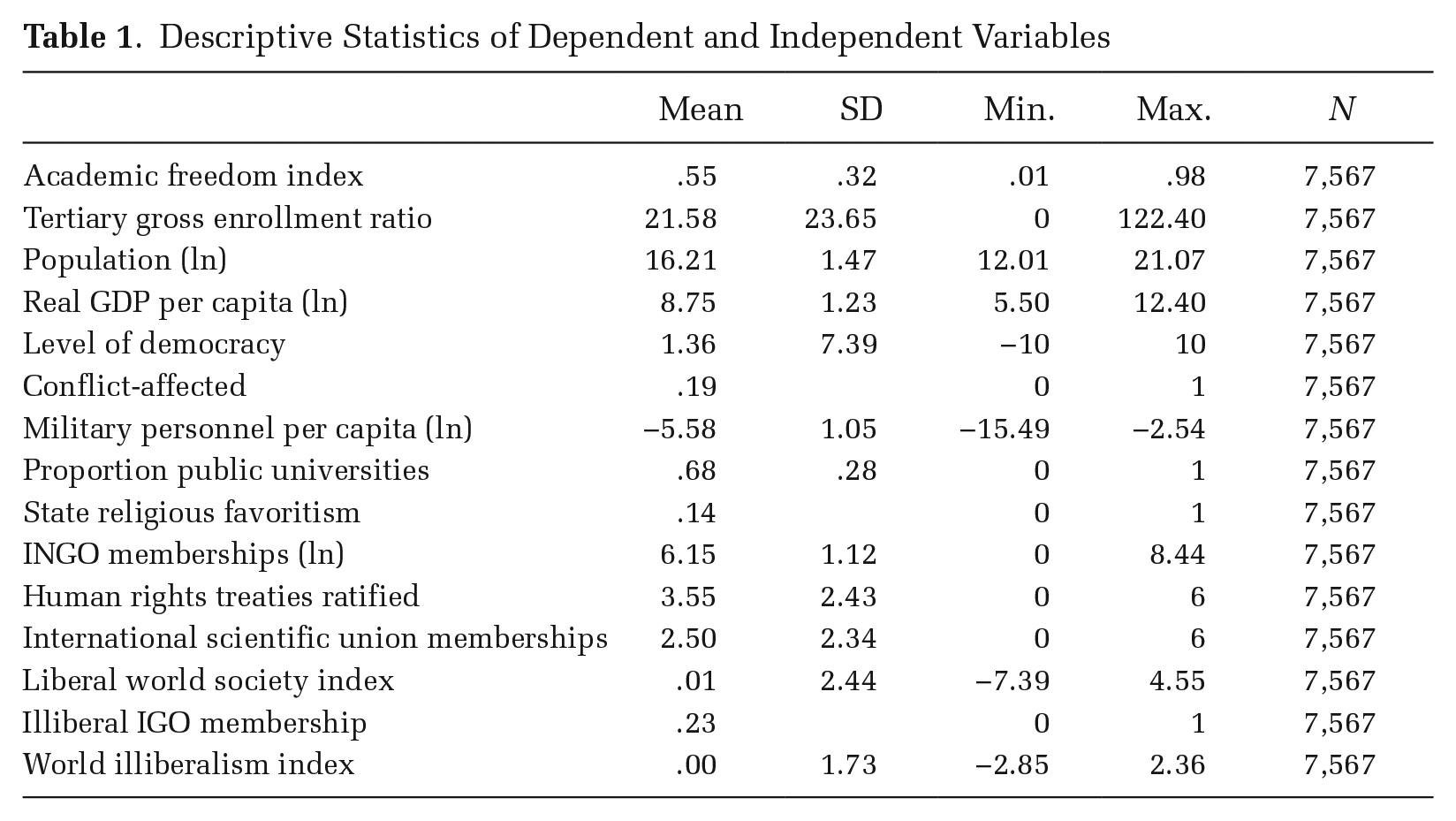
We are interested in academic freedom broadly defined, but we recognize the potential pitfalls of including all dimensions in a single index. For example, as noted earlier, not all conceptions of academic freedom include extramural expression. Moreover, the index aggregates individual and institutional dimensions of academic freedom, which may not always work in tandem (Barendt 2010). In the Appendix, we present robustness checks with each individual component to address such concerns. Table 1 presents descriptive statistics for our dependent and independent variables.
Descriptive Statistics of Dependent and Independent Variables
Independent Variables
We test our core arguments using a series of independent variables that capture countries’ connections to the liberal and illiberal institutions of world society and the evolving global context.
Memberships in international nongovernmental organizations
To proxy country embeddedness in the liberal global and transnational institutions of world society, we use three measures. Our first measure captures memberships in international nongovernmental organizations (INGOs), taken from the Yearbook of International Organizations (Union of International Associations 1960–2021). INGO memberships serve as conduits and receptor sites for dominant global scripts, and they embody core liberal principles of individual actorhood and free association (Boli and Thomas 1997; Frank, Hironaka, and Schofer 2000; Lerch 2019). The time-varying variable captures the total number of INGOs in which a country’s citizens hold memberships; we log the variable to reduce skewness.
Ratification of human rights treaties
Our second proxy for countries’ embeddedness in the liberal institutions of world society is narrower and more state-centric, measuring countries’ ratification of six core human rights treaties: the International Convention on the Elimination of All Forms of Racial Discrimination (ICERD), the International Covenant on Civil and Political Rights (ICCPR), the International Covenant on Economic, Social and Cultural Rights (ICESCR), the Convention on the Elimination of All Forms of Discrimination against Women (CEDAW), the Convention against Torture and other Cruel, Inhuman or Degrading Treatment or Punishment (CAT), and the Convention on the Rights of the Child (CRC). 4 The human rights regime is an integral part of the liberal world order, making countries’ ratifications of these treaties a suitable second proxy of liberal embeddedness. Our time-varying measure captures how many treaties a country has ratified in a given year. As mentioned earlier, one of the treaties (ICESCR) contains stipulations related to academic freedom. In robustness analyses, we test this treaty on its own (as it may be the most relevant for academic freedom) and test our human rights index without it (as it may be too closely related to our outcome).
Memberships in international scientific unions
Our final proxy for countries’ ties to global liberalism centers on the scientific rationalization of nature and society, which undergirds the liberal forms of strategic actorhood that are contingent on comprehensible and predictable contexts. To capture countries’ exposure to rationalization, we measure their memberships in six international scientific unions.
The largest such body in the world is the International Science Council, which arose from a merger between the International Council for Science (founded in 1931) and the International Social Science Council (founded in 1952). Its members include national academies of science and international unions of scientists. Using the council’s website, we coded a dichotomous variable measuring country memberships in the council in a given year via a national academy or similar scientific body.
We also collected data on countries’ memberships in five of the council’s constituent scientific unions, 5 focusing on those with membership data on their websites: the International Astronomical Union (founded in 1919), the International Union of Pure and Applied Physics (1922), the International Union of Theoretical and Applied Mechanics (1946), the International Union of Geodesy and Geophysics (1919), and the International Union of Psychological Science (1951). We coded five dichotomous variables measuring whether a country held a membership in each organization in a given year.
Our final overall measure ranges from 0 to 6 and captures the number of international scientific unions in which a country holds memberships in a given year. Many of these organizations highlight the importance of free scientific inquiry and exchange on their websites, indicating their relevance for our endeavor.
Liberal world society index
In addition to showing results for each of the liberal world society indicators described above individually, we also combine them into an overall liberal world society index. This was constructed by taking the z-score of each variable (INGOs, human rights treaties, and international scientific unions) and summing these scores.
World illiberalism
We theorize that curtailing academic freedom may be more legitimate in periods when illiberal models are prominent in world society. There is no standard way to measure world illiberalism. The closest is the Freedom House annual time series, which captures the percentage of countries in the world that are “not free” based on individual political rights and civil liberties (Freedom House 2023). This measure captures just one dimension of illiberalism and only begins in 1973. We created a more comprehensive index of world illiberalism using four time-varying world-level measures.
First, we used the “regimes of the world” variable in the Varieties of Democracy dataset to measure the proportion of autocracies in the world in a given year (Coppedge et al. 2023a). Like the Freedom House measure, this indicator captures the global prevalence of illiberal regimes—an important dimension of global illiberalism. This measure is correlated with the Freedom House measure at 0.89 but is available over the entire time span of our analysis.
Second, we used our variable of country memberships in “illiberal” international organizations (described below) to construct a measure of the proportion of countries globally that hold memberships in any such organization in a given year. This variable captures the degree to which internationally institutionalized illiberal models hold sway in the global context over time.
Finally, our index accounts for the relative global prowess of the two countries leading the most considerable challenges to the liberal model during our study period. Numerous countries exhibit illiberal tendencies (e.g., North Korea), but we focus on the leading standard bearers: Russia and China. During the Cold War, Russia served as the prime bulwark of illiberal communism, competing in a bipolar world with the liberal United States and its allies. Even today, Russia under Putin’s leadership has been a loud voice for an alternative, illiberal world order. China shares the communist legacy, but its illiberal influence on the global stage is more recent. Bolstered by its remarkable economic ascent, China today serves as a powerful challenger to the liberal system built by the United States and its allies.
We constructed two indicators to capture the global prowess of these countries vis-à-vis the standard bearer of the liberal system (the United States). One builds on traditional conceptions of power as military might. Using data from the Correlates of War National Material Capabilities (NMC) project Version 6.0 (Singer 1988), we created a measure of China’s and Russia’s military expenditures as a proportion of U.S. military expenditures in a given year. 6 To capture the economic dimensions of global power—especially relevant for China’s global standing—we also constructed a variable capturing China’s and Russia’s GDPs as a proportion of U.S. GDP in a given year. We used real GDP data from the Maddison Project (Bolt and Van Zanden 2020). 7
To construct our world illiberalism index, we took the z-score of each of the preceding variables and summed them. We recognize that the components capture distinct dimensions of global illiberalism, so we carried out robustness checks, dropping each from the index in turn to ensure our results are not driven by a single component (not reported, available upon request). Importantly, the overall index rises and falls as our argument would predict (see Appendix Figure A3): it is fairly high during the Cold War and declines after the fall of the Soviet Union, before rising again in the twenty-first century.
Memberships in “illiberal” international organizations
Beyond capturing the time-varying influence of illiberalism at the world level, we examine the role of country linkages to illiberal organizations in world society. Here, we draw on insights from a growing literature that identifies numerous intergovernmental organizations (IGOs) with a record of legitimizing illiberal models, especially vis-à-vis state repression (Ambrosio 2008; Bromley et al. 2020; Buranelli 2020; Cooley and Schaaf 2017; Debre 2022; Kneuer et al. 2019; Obydenkova and Libman 2019). As detailed below, we conceptualize memberships in these organizations not in direct causal terms but as a proxy for countries’ general embeddedness in transnationally legitimated illiberal models.
After surveying scholarship to identify “illiberal” IGOs active since the start of our analysis in 1960, we constructed a time-varying dummy measuring whether a country held membership or an observer- or partner-type status in any of the following organizations in a given year: Alianza Bolivariana para los Pueblos de Nuestra América (ALBA), Commonwealth of Independent States (CIS), Council for Mutual Economic Assistance (COMECON), Gulf Cooperation Council (GCC), League of Arab States (LAS), Shanghai Cooperation Organization (SCO), and Warsaw Treaty Organization (WTO, Warsaw Pact). Part 2 of the Appendix describes the organizations and justifies their inclusion. The overall measure builds on the indices used in Bromley and colleagues (2020), Lerch, Schofer, and colleagues (2022), and Schofer, Lerch, and Meyer (2022). 8 In robustness analyses, we checked alternative versions of this measure (e.g., excluding observers or measuring length of membership), as well as alternative measures constructed through different methods of identifying and measuring illiberalism in international organizations.
We also include indicators operationalizing the domestic foundations of academic freedom introduced earlier, along with standard controls.
Democracy
To test the effect of democracy on academic freedom, we include a measure of a country’s political regime in a given year using the combined polity score from the Polity5 Project, which is a time-varying variable ranging from −10 (strongly autocratic) to +10 (strongly democratic) (Marshall and Gurr 2020). A common problem in studies of repression is that associations between democracy scores and repression may be partly tautological, because the former tend to include some aspects of state repression (Hill and Jones 2014). Although the Polity5 measure does not explicitly measure restrictions on academic freedom, one of its components characterizes the competitiveness of participation and is coded for the extent to which oppositional competition is repressed (Marshall and Gurr 2020:26–27). Given the risk that this coding overlaps with repression in the university sector, we ran robustness analyses using only the “executive constraints” component of the polity measure, which is less vulnerable to this issue (see Cole 2016; Hill and Jones 2014). 9
Armed conflict
To gauge the relationship between armed conflict and academic freedom, we include a dichotomous time-varying measure of whether a country is a primary party to an international or internal war in a given year, using data from the UCDP/PRIO Armed Conflict Dataset Version 22.1 (Davies, Pettersson, and Öberg 2022; Gleditsch et al. 2002). The dataset defines armed conflict as “a contested incompatibility that concerns government and/or territory where the use of armed force between two parties, of which at least one is the government of a state, results in at least 25 battle-related deaths in a calendar year” (Pettersson 2022:1).
State militarism
To examine the effect of militarism on academic freedom, we include a measure for the size of a country’s military each year, captured by the number of military personnel per capita (data come from the Correlates of War National Material Capabilities [NMC] project Version 6.0 [Singer 1988]). NMC data end in 2016, so we supplement them with comparable data on military personnel from the World Bank’s World Development Indicators (World Bank 2023) and the Banks Cross-National Time-Series Data Archive (Banks and Wilson 2021). We log this variable to reduce skew. 10
State-oriented higher-education system
To test the argument that state controls over higher education enable restrictions on academic freedom, we use a time-varying measure of the proportion of higher-education institutions in a given country-year that are public (rather than private). Data come from the World Higher Education Database (International Association of Universities 2018). 11 We recognize the limitations of this operationalization. The public/private distinction may not capture the kinds of state controls likely to affect academic freedom (e.g., most German universities are public but constraints on academic freedom are rare). Moreover, complications arise in federal systems where state intervention in public institutions varies by subunit. Cognizant of these issues, we report analyses using alternative operationalizations.
State religiosity
To assess the extent to which a low separation between the state and religion has a deleterious effect on academic freedom, we draw on the Government Religious Preference 2.0 Dataset (Brown 2019, 2020). These data measure government favoritism toward 30 religious denominations. Using information on state-level religious policy, the scores assess state favor (or disfavor) toward each denomination in five issue areas: official status, public religious education, financial support, regulatory burdens, and freedom of practice. For each country-year, these five scores are collapsed into a single composite score for each denomination, which captures the state’s overall degree of favor (or disfavor) toward that religion. We used the composite scores for each denomination to generate a time-varying dichotomous variable that measures whether there is state favoritism toward any religion in a given country-year (excluding atheism). The composite ranges from 0 to 4, and we count scores of 3 and above as “favoritism,” following Brown (2019). 12
Tertiary enrollments
We control for the size of a country’s higher-education system by including a continuous measure for the tertiary gross enrollment ratio—total tertiary enrollment as a percentage of the population in the five-year age group immediately following upper-secondary education—taken from the World Bank’s Development Indicators (World Bank 2023).
Population
We control for a country’s population using a logged time-varying continuous variable (World Bank 2023).
Economic development
Finally, we include a control for real gross domestic product (GDP) per capita (logged) using data from the Penn World Tables Version 10.0 (Feenstra, Inklaar, and Timmer 2015), given the established expectation that greater development tends to be linked with lower levels of repression.
Model
Given our data structure (repeated country observations over time), we use panel regression models. Hausman tests adjudicating between country fixed- and random-effects models suggested the latter may be inconsistent. As such, we use models with country fixed effects in our main tables. These analyze within-country variation from year to year and control for unobserved time-invariant country differences (Wooldridge 2010). However, we also carry out robustness checks using alternative models, described below. We use cluster-robust standard errors to adjust for within-cluster correlation and heteroskedasticity, and we lag all independent variables one year to account for time ordering.
Findings
Table 2 presents the results of our fixed-effects panel models. In Models 1 to 5, we present the full suite of domestic variables alongside a stepwise introduction of variables measuring liberalism and illiberalism in the global context. The results are largely in line with our expectations and offer strong support for our world-level arguments.
Fixed-Effects Panel Models Predicting Levels of Academic Freedom
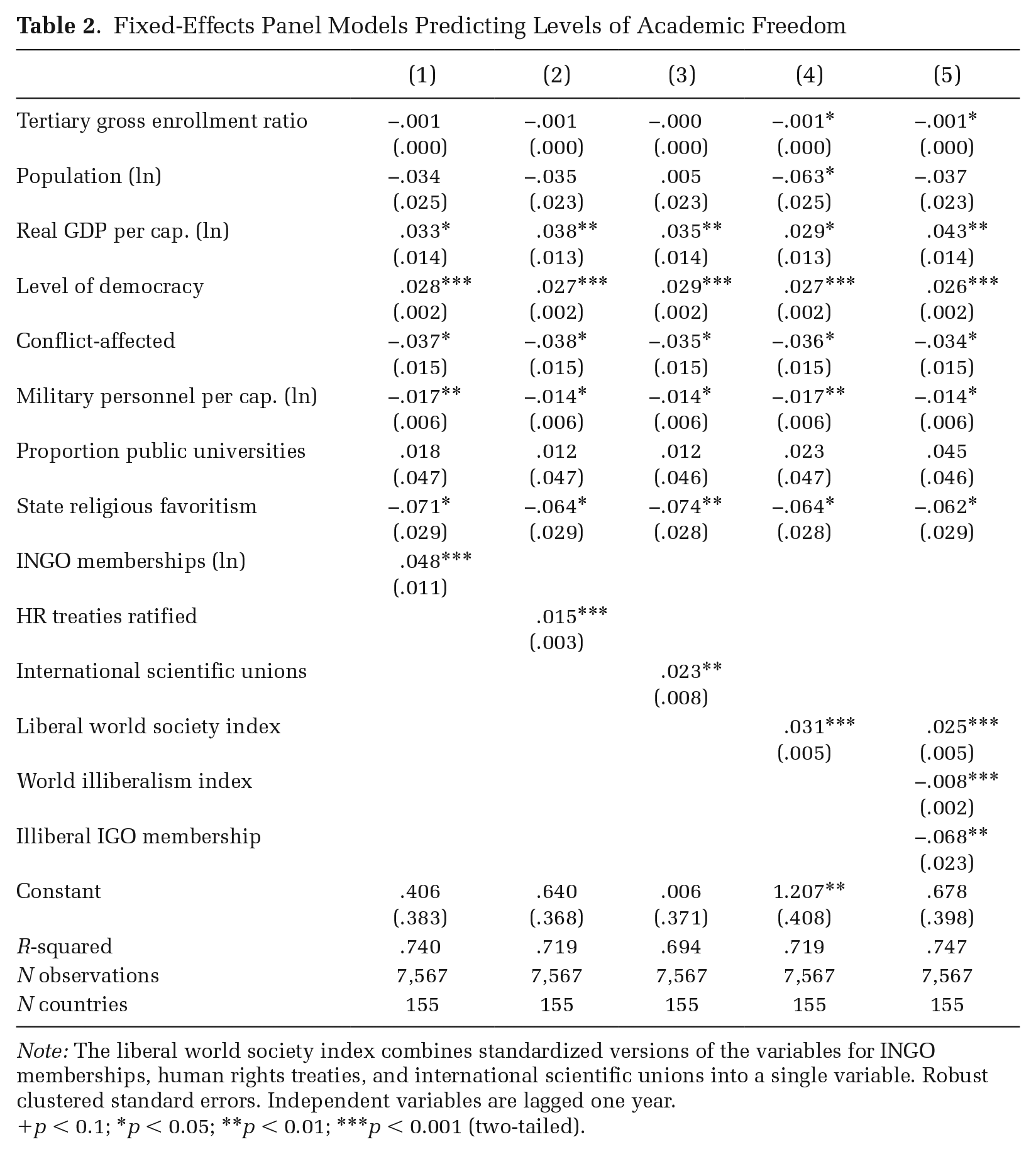
Note: The liberal world society index combines standardized versions of the variables for INGO memberships, human rights treaties, and international scientific unions into a single variable. Robust clustered standard errors. Independent variables are lagged one year.
p < 0.1; *p < 0.05; **p < 0.01; ***p < 0.001 (two-tailed).
In Model 1, the coefficients for tertiary enrollment and population are negative, but neither is statistically significant. GDP per capita shows a positive and statistically significant association with academic freedom, which fits with the general idea that incursions on freedom tend to be lower in developed contexts. The democracy variable shows a strong and highly significant association with academic freedom; the effect size is especially remarkable considering the range of the polity scale, translating into large boosts to academic freedom as countries transition from autocratic to democratic systems of government. Countries affected by armed conflict (p < 0.05) and those with larger militaries (p < 0.01) have lower levels of academic freedom, on average, lending support to well-established concerns in the literature about the harmful effects of war and state militarism on universities and academic life. In contrast, we find no significant effect for our variable measuring the statism of countries’ university systems, proxied by the proportion of universities that are public rather than private. Given limitations in this measure, we are cautious about drawing strong conclusions from this, and we thus report additional analyses. 13 We find a negative and statistically significant association between state religiosity and academic freedom, suggesting that even in our secularized era, religious curtailments of academic freedom may erupt in places where religious authorities hold political power.
Finally, we turn to our core arguments about the global and transnational forces that shape academic freedom. A country’s connections to the liberal institutions of world society, measured by INGO memberships, is positively associated with academic freedom. The large and highly significant coefficient is consistent with our argument that global liberalism provides a powerful foundation for academic freedom. Hypothesis 1 is supported.
Models 2, 3, and 4 introduce alternative measures of country ties to the liberal institutions of world society. The findings are remarkably consistent. We include ratifications of human rights treaties (Model 2), memberships in international scientific unions (Model 3), and scores on our liberal world society index (Model 4). Like logged INGO memberships, each variable shows a positive and significant association with academic freedom, lending further support to Hypothesis 1. We find higher levels of academic freedom when countries are more embedded in the liberal global and transnational institutions of world society.
Model 5 builds on Model 4, adding two measures of illiberalism in the global and transnational context: our world-level index proxying the time-varying strength of illiberalism in the global system, and our country-level dummy variable measuring national ties to illiberal IGOs. Both measures of illiberalism show negative and statistically significant correlations with academic freedom, demonstrating that the global and transnational environment is not monolithic in its support of academic freedom. Along both longitudinal and cross-national bases—that is, during periods when global illiberal institutions are stronger and among countries with greater exposure to those institutions—illiberalism undermines academic freedom, lending support to Hypotheses 2 and 3.
Additional Figures and Robustness Checks
Part 1 of the Appendix presents a series of additional figures and robustness checks. Figures A1 and A2 focus on our dependent variable, showing alternative versions of Figure 2—first showing trends in academic freedom by region with population-weighted variables (such that, e.g., China counts more than Japan) and second showing trends in academic freedom by region with constant cases. In both figures across all regions, the rises and falls of academic freedom are just as pronounced or even more so than they are in the original Figure 2.
Figure A3 turns to one of our key independent variables, plotting the world illiberalism index from 1960 to 2021. The trendline maps fairly cleanly onto major world-historical eras. World illiberalism tapers a bit with decolonization in the 1960s, then rises through the end of the Cold War, then plummets during the neoliberal heyday of the 1990s, and finally ascends again from roughly 2001 (9/11) toward the present. Challenges to the liberal script wax and wane over time, and the changing trajectories suggest clear linkages to big world-historical processes and turning points.
Appendix Table A1 presents a range of alternative specifications of our statistical models. Results are remarkably consistent. The first constrains our dataset to the period 1960 to 2015, considering that several of our independent variable datasets end before 2021. The second limits the analysis to constant-case countries to ensure the results reflect more than a changing case base. The third model pulls the International Covenant on Economic, Social and Cultural Rights (ICESCR) from our liberal world society index, as it may be too closely related to our dependent variable. The fourth model trades the liberal world society index for its three components, but instead of human rights treaty ratifications generally, uses ICESCR ratification. Its effect is insignificant, suggesting broad embeddedness in the human rights regime matters more than ratification of a single treaty, even one proximate to academic freedom. The next model replaces the combined polity score we use for level of democracy with the “executive constraints” component of the polity index, which has been used to circumvent the tautology issue (Cole 2016). This narrower measure has a strong positive effect like its broader alternative.
The next two models show additional domestic controls. One includes measures of political polarization (how much society is polarized into antagonistic political camps) and the strength of unions (the share of the population regularly active in independent trade unions), taken from the Varieties of Democracy dataset. Both may affect academic freedom: polarization by turning higher education into a battleground for “culture wars,” and general union strength as an imperfect proxy for academics’ ability to advocate for their professional rights. The variables show the expected associations (negative for polarization and positive for unions); our core findings are robust (although conflict loses significance). The next model controls for left-wing and right-wing party affiliation of the executive for a smaller set of democratic countries. Our findings remain consistent, and a right-wing affiliation shows a weakly significant negative association (p < 0.1).
The final three columns in Appendix Table A1 present alternative types of models. We first present a panel model with country random effects and regional dummies to ensure our illiberal IGO measure goes beyond regional differentiation. We then present a two-way fixed-effects model to account for time trends. When we include temporal fixed effects we are unable to include our world illiberalism index, which only varies by year. In the final model, we include a linear variable for time that allows us to keep the world illiberalism index in the model. In all cases, our findings hold up.
Appendix Table A2 checks alternative lags and ways of constructing our illiberal IGO measure. The first model changes the lag-times on the liberal world society index and the illiberal IGO dummy from one year to three years. The second model moves the lag-time even further, to five years. The third model excludes observers and partners from our illiberal IGO measure, the fourth replaces the dichotomous measure with a count of how many illiberal IGO memberships a country holds each year, and the fifth measures how many total years a country has been a member of any of our illiberal IGOs in a given year (coded 0 if a country is not a member in a given year). Our findings remain reassuringly stable across these checks.
The next two models use alternative measures of IGOs’ illiberal tendencies, following Debre’s (2022) analysis of regional organizations with an authoritarian penchant. We used her list of 70 regional organizations and her methodology to measure illiberal tendencies in these organizations. 14 Using members’ polity scores, we first calculated an overall autocracy score for each organization for each country-year, which runs from 1 (highly democratic) to 21 (highly autocratic), with 0 meaning no membership. 15 We then constructed a measure that captures the autocracy score of the most autocratic organization in which a country holds membership in a given year. A second measure captures the average autocracy score across all organizations in which a country holds membership each year. Our findings are consistent when using these measures.
As a final check, we used Debre’s (2022) list of organizations for an alternative approach to selecting illiberal IGOs. For each organization, we averaged members’ combined polity scores across an organization’s existence and then selected organizations with an average score below 0 (capturing closed anocracies and autocracies), a cut-off used in prior studies (e.g., Obydenkova and Libman 2019). 16 We then constructed a binary time-varying variable measuring whether a country held membership in any of these organizations in a given year. As the final model shows, our findings hold up. Indeed, the main takeaway from Appendix Tables A1 and A2 is that our main findings vis-à-vis the social foundations of academic freedom are robust to variations in measurement and modeling.
Finally, Appendix Table A3 disaggregates our dependent variable into its components: the freedom to research and teach, freedom of academic exchange and dissemination, institutional autonomy, campus integrity (freedom from politically motivated surveillance or security infringements), and freedom of academic and cultural expression. Overall, the findings are consistent across these dimensions, but there are some interesting differences. 17 For example, armed conflict does not have a significant relationship with institutional autonomy, suggesting that slow-changing facets of university governance are less vulnerable to war-related disruption than are academics’ day-to-day freedoms and the security of campuses. Another difference is that state religiosity affects primarily the freedom of academic and cultural expression (and campus security), suggesting religious authorities encroach on academics’ liberties when they use their voice for broader critique. Finally, the effect of illiberal IGOs loses significance for one of the index subcomponents: academic and cultural expression. Overall, the effects of our global and transnational variables are very consistent.
We also tested additional measures that are not reported in the Appendix but are available upon request. Most importantly, we investigated alternative ways of capturing state control over higher education, beyond our public/private measure. We tested an interaction between this measure and democracy, supposing that heavily public systems may primarily facilitate control in authoritarian settings. We also tested a measure of federalism and whether a country has a dedicated higher-education ministry. None of these showed significant associations with our outcome, casting doubts on this theme from the literature. We also tested measures of right-wing and left-wing populism. Our findings were unchanged.
We incorporated an additional indicator into our world illiberalism index, measuring the global number of social media users, to tap the idea that social media enables illiberal networking and amplifies illiberal discourses. The additional indicator did not change the index’s effect. We tested interactions between our liberal world society index and our world illiberalism and illiberal IGO measures to see whether illiberal alternatives reduce the positive influence of liberal world society institutions. Neither interaction was significant, suggesting liberal and illiberal institutional forces, in this case, operate largely in parallel. Finally, we tested a world-level measure of the global number of interstate wars to capture global fragmentation. Although this was significant, we decided not to include it in our world-level index, because it is less directly related to intensified illiberalism on the world stage. Overall, our robustness checks are reassuring. Our core findings are extremely stable.
Discussion And Conclusions
Higher education has become a bedrock institution in societies worldwide, with more universities educating more students in more fields of study than ever before (Frank and Meyer 2020). Academic freedom, as an ideal if not always a practice, stands at the heart of the institution’s modern form; already in nineteenth-century Germany, “universities were protected islands” (Connelly and Grüttner 2005:3).
We broaden the sociological discussion of academic freedom by generalizing from the case-based literature, constructing new arguments, and developing systematic cross-national quantitative analyses. Analysis of data from 155 countries over the past 63 years supports many insights derived from the prior literature: states that are more autocratic, more militarized, more religious, and affected by armed conflict are less hospitable to academic freedom.
We further argue that academic freedom is shaped by global forces, arising from heterogeneous institutions in world society. Specifically, the liberal international structures of the post-1945 era provide immense support for academic freedom, whereas illiberal structures in world society undermine it. We broaden world society theory to address these historical and contemporary oppositions. Our findings highlight the importance of competing liberal and illiberal institutions in world society, which nurture and curtail academic freedom, respectively.
This last contribution may prove the most fruitful for sociologists. We extend world society theory beyond its home territory of homogeneity and isomorphism and into the territory of heterogeneity and difference, by adapting Eisenstadt’s idea of multiple modernities to make sense of the diverse institutionalized models in the international community. World society scholars have long recognized departures from the simple diffusion story (e.g., linked to the communist sphere or particular regions) and endemic decoupling (e.g., Cole 2016). Indeed, classic work notes that world society is fractured by “inconsistencies and conflicts” (Meyer et al. 1997:172).
Our heterogeneous institutions argument provides a generalized framework to make sense of these oppositions, as well as isomorphic pressures. Competing international structures are one route to explaining divergent outcomes and patterns of decoupling (Schneiberg and Clemens 2006). National or regional differences may neither be purely local nor reflect “failures” of diffusion, as the literature often assumes. Instead, they may result from international structures that diffuse alternative models and thus limit convergence. Importantly, dominant institutions operate alongside such alternatives; that is, there is institutional heterogeneity: a focus on isomorphic diffusion versus divergence as an “either/or” is too simplistic, with many global domains marked by both (Ferguson 2022). Attention to heterogeneity in the global institutional environment allows us to make sense of both the sweeping diffusion of academic freedom, as well as regional and temporal countertrends.
Note that our argument is not about all oppositions to liberalism around the globe, which are innumerable. It is about alternative modernities—cultural/ideological movements or programs that are, to some degree, associated with and embodied in global institutional structures, often in self-conscious opposition to their liberal counterparts. It does not cover all local oppositional movements, and it is not simply about regional fragmentation (Beckfield 2010). Regional organizations may become nodes for oppositional mobilization, but regionalization by itself does not necessarily indicate the presence of alternatives (e.g., the European Union is steeped in liberal ideas).
By drawing attention to heterogeneous international institutions, we introduce a new agenda for scholars of world society and diffusion. World society theory is more than a theory of isomorphism; it is a theory about the importance of global context and country embeddedness. If the context is rife with contention, fragmentation, or opposing alternatives, isomorphism is not to be expected. Heterogeneities in the international community may arise in particular issue-areas from traditional structures like the church (Boyle et al. 2015) or from mobilized INGOs that leverage international fora (Velasco 2023). But the dominant structures of world society have been liberal, and internationally structured oppositions are often organized along illiberal visions of modernity. It is incumbent on world society scholars to analyze not only mainstream liberal institutions but also the alternative structures that have arisen throughout history, and to discern the alternative ideas and practices they support. Such analyses will improve scholarly predictions about isomorphizing patterns of diffusion versus diversity or fragmentation.
The 1990s and early 2000s were characterized by the preeminence of global liberal institutions. But looking back into history, heterogeneous international structures, large and small, successful and failed, are easy to find. Our approach may help explain many hitherto unexplained “failures” of diffusion. The 1920s and 1930s were roiling with internationalized mobilizations, bearing unnerving similarities to the present day. In addition to various statist and communist movements and alliances, fascist movements spread (into many liberal countries, too) and began to crystallize into international structures. The Cold War was dominated by liberal versus communist spheres, but it also saw a variety of alternatives, such as the Non-Aligned Movement (NAM) and the New International Economic Order (NIEO). The contemporary moment is filled with aspiring international programs, often illiberal but sometimes hard to categorize (e.g., the recently revitalized BRICs organization, founded by Brazil, Russia, India, and China). This global heterogeneity has likely affected diffusion (or lack thereof) in many of the domains studied by world society scholars. A central agenda for future research would be to better catalog and measure the alternative global structures that have arisen periodically—and examine their consequences for global diffusion.
Our argument is not that mainstream and alternative global institutions are now or ever were neatly separated. There may be overlaps in participation and shared ideas. The liberal international order and the communist sphere (as well as the fascists of the 1930s) all sought to bring about economic development and developed education systems to that end. But they diverged in the extent to which liberal individualism, and academic freedom, were integral to that project. Thus, we might see convergence in some domains and heterogeneity in others. The key point is that the global institutional structure can be and often is sufficiently differentiated in content and organization to sustain genuine alternatives in world society and enduring cross-national differences.
Contemporary challenges to liberal norms—such as attacks on democracy, women’s rights, and LGBT rights—are arising as a global wave. Our new world society framework offers tools to make sense of these oppositions, especially as they become increasingly anchored in international structures and diffuse globally. We are in conversation with the burgeoning literature (mainly in political science) on international illiberalism (Bob 2012), which highlights the role of illiberal international organizations in buffering members from liberal interference and stifling internal challengers (e.g., Debre 2022). We interpret their effect somewhat differently, as representing diffuse embeddedness in alternative cultural frameworks rather than direct ties to powerful illiberal actors. We see subtle processes of legitimation and diffusion at work, with linkages proxying exposure to alternative models that legitimate the molding of the university around political (or religious or nationalist) goals.
In addition to setting a new agenda for world society research, our article calls for greater sociological inquiry of academic freedom. Future work should marshal the newly available data to further address the social correlates of academic freedom. For example, we focus here on only certain types of challenges—those associated with illiberalism (e.g., nationalism, authoritarianism, and fundamentalism). We barely touch on incursions from the left (e.g., disruption of conservative campus speakers). And we barely touch on incursions from the market and the monied classes (commercialization, meddling donors). Recent erosions may open the university to all kinds of abridgements of academic freedom, which is an important question that future research could explore. Future studies could also complement our global account by drilling deeper into the effects of domestic platforms for illiberal ideas, such as populism. Such analyses may be especially fruitful for capturing the (re-)legitimation of illiberal alternatives in liberal democracies.
In summary, we illuminate enduring, and presently resurgent, illiberal challenges to academic freedom in societies worldwide. These challenges emanate not only from domestic political and religious authorities but also from world society, in which the dominance of liberalism—with its empowered agents of cultural inquiry and social change—can no longer be taken for granted. The global trajectory of illiberalism affects academic freedom everywhere. If the expansion of illiberal structures in the international community proves to be a lasting phenomenon, then the recent contractions of academic freedom may be but a foretaste of a dark feast to come.
Footnotes
Appendix
Acknowledgements
The paper benefitted from useful comments by participants in UC-Irvine’s Comparative Sociology Workshop and in research seminars held at the Institut Barcelona d’Estudis Internacionals, the Scandinavian Consortium for Organizational Research at Stanford, the Pontificia Universidad Católica de Chile’s Institute of Political Science, the Jack W. Peltason Center for the Study of Democracy at UC-Irvine, the University of Minnesota, and Cornell University. For detailed comments, we thank in particular: Tobias Berger, Wade Cole, Juliette Crespin-Boucard, John W. Meyer, and Francisco O. Ramirez, as well as reviewers and editors at the American Sociological Review.
Funding
Work on the paper was supported by the National Academy of Education/Spencer Foundation and the Jack W. Peltason Center for the Study of Democracy at UC-Irvine.
