



Abstract
How do bureaucracies pattern durable inequalities? Predominant approaches emphasize the role of administrative categories, which prioritize certain populations for valued resources based on broader regimes of human worth. This article extends this body of work by examining how categorical inequalities become embedded within administrative infrastructures and institutional pathways. I develop this argument through a case study of the United States’ refugee resettlement program. Drawing together previously unseen government statistics, expert interviews, and documentary analysis, I show that U.S. resettlement is organized through administrative pipelines that create path dependent imbalances in the distribution of scarce resettlement spaces. Social and political logics of immigrant worthiness are important, yet a full understanding of these imbalances requires attention to the tendency of pipelines to become self-reproducing. I identify three factors that account for this tendency: calculative rationales, administrative reactivity, and structured visibility. This three-part conceptualization of pipelines can be applied to other institutional contexts to study the origins, dynamics, and durability of social inequalities. My findings also demonstrate the analytically autonomous role of policy administration in shaping ethnoracial imbalances in immigrant selection.
Refugee resettlement is a humanitarian program that provides refugees a legal route to residency and citizenship in the wealthy countries of the Global North. For millions of refugees, resettlement offers the only realistic way out of long-term, potentially multigenerational exile in refugee camps and urban peripheries in the Global South (Fee and Arar 2019; UNHCR 2018). For some, it can be the difference between life and death. Despite its value, however, less than 1 percent of the global refugee population are resettled in any given year, with the United States accounting for half of all admissions historically (Martin and Ferris 2017). Many assume that social and political logics of immigrant worthiness shape who is resettled and who is overlooked (Chimni 2004; Gibney 2004; Loescher and Scanlan 1986). Such factors are undoubtedly important. The present article, however, shows that another, less visible process is also at work.
Drawing on a mixed-methods study of the U.S. federal resettlement program, I identify the importance of administrative pipelines to refugee resettlement. Pipelines are a meso-organizational form of procedural standardization that facilitate controlled, predictable, and efficient institutional practice. They appear across a range of settings as administrators work to complete time-delimited tasks in contexts of institutional pressure, uncertainty, and operational complexity. College administrators, for example, build pipelines with high schools to fill annual admission targets, and NGOs construct project pipelines to reliably demonstrate organizational success to funders. Importantly, these pipelines channel the allocation of valued resources to particular places and populations, thereby generating social inequalities. I likewise show that resettlement administrators standardize the provision of refuge by constructing transnational pipelines to meet demanding annual admission targets. Bridging organizational sociology and immigration research, I show that these pipelines create path-dependent forms of resettlement that concentrate scarce spaces among a surprisingly small number of geographically concentrated refugee groups.
In conceptualizing the role of pipelines in refugee resettlement, this article contributes to three bodies of social science literature. First, this article advances our understanding of bureaucratic standardization and inequality. To date, much of this work has focused on the construction of administrative categories and classification systems that make populations legible and standardize decisions about who is eligible and who should be prioritized for scarce resources (Fourcade and Healy 2013; Massey 2007; Menjívar 2023; Tilly 1999; Timmermans and Prickett 2022). These categorical standards institutionalize historically constituted regimes of human worth, making them powerful, albeit mundane, mechanisms of stratification (Brown 2020; Lamont, Beljean, and Clair 2014; Menjívar 2023). The present article advances this literature by demonstrating how categorical inequalities become embedded within procedural standards and administrative infrastructures (Timmermans and Epstein 2010) to shape durable, path-dependent inequalities. Specifically, I draw attention to the important but undertheorized role of administrative pipelines, which create institutional pathways of decision-making and resource allocation. Pipelines become self-reproducing as practitioners rely on them to demonstrate success and attain legitimacy (Krause 2014:14–38; Lipsky 1980:107–11), and they channel institutions toward the claims and concerns of particular populations (Anand, Gupta, and Appel 2018; Edwards et al. 2009). I offer a three-part conceptualization of why pipelines reproduce themselves (calculative rationales, administrative reactivity, structured visibility), and I show how it can be applied to understand durable inequalities in other settings, such as college admissions, grant-making, or international aid and development.
Second, this article offers insights for immigration scholars. Indeed, the question of how states select immigrants and build national populations has been generative for our understanding of bureaucracies and inequalities (Massey 2018; Menjívar 2023). Within this scholarship, policy administration is largely seen as an extension of political power (FitzGerald et al. 2018; Herd and Moynihan 2019; Nevins and Nevins 2002) and given limited autonomy to affect outcomes beyond the discretionary decision-making of “street-level bureaucrats” (Alpes and Spire 2014; Armenta 2016; Asad 2019; Gilboy 1991; Heyman 2000; Shiff 2021). Bridging organizational sociology with immigration literature, this article shows that the immigration bureaucracy plays a critical role in mediating recursive feedback loops between policy formation and implementation (Halliday and Carruthers 2007; Roberts 2020), affecting the design and outcomes of policies themselves. Failure to account for these dynamics risks reifying the state (Morgan and Orloff 2017; Mountz 2010) and misattributing policy outcomes to the motivations of particular groups (Healy 2000, 2004). Through the specific case of pipelines and resettlement, I show that meso-organizational processes and structures affect the ethnoracial composition of immigration streams in unexpected ways.
Finally, this article provides an empirical account of how refugees are resettled to the United States in the post-Cold War years. Despite its political salience, scholars have not comprehensively examined resettlement practices in the contemporary period, focusing instead on dynamics of refugee integration (Bloemraad 2006; Gowayed 2022; Watson 2022), the number of refugees resettled (Chimni 2004; Fee and Arar 2019), political histories of policy formulation (Gibney 2004; Loescher and Scanlan 1986; Tempo 2008), or resettlement’s place within broader processes of world-making and nation-building (Espiritu 2014; Lippert 1998). This gap stands in contrast to scholarship examining how the refugee category itself is administered, which unveils practices geared toward restricting access (FitzGerald 2019; Hamlin 2021; Mountz 2010) and excluding populations from its relative benefits due to geopolitics, racialization, or ethnic affiliation (Abdelaaty 2021; Mayblin 2017; Menjívar 2006). Drawing together a unique dataset, expert interviews, and fieldwork in Uganda, an important hub of resettlement processing, this article pulls back the curtain on the resettlement bureaucracy to provide a novel account of how this program fundamentally works. Doing so reveals the importance of transnational administrative pipelines in shaping path-dependent distributional imbalances. Given that other countries use these same structures of resettlement, my findings have global implications for how we understand this important humanitarian program.
In what follows, I first elaborate the empirical puzzle driving my analysis: that is, distributional imbalances in the resettlement of refugees to the United States. I then outline how immigration scholarship would explain these imbalances, suggesting that existing accounts are incomplete—in part because scholars have not had access to the unique data presented in this article. I then introduce my alternative account and situate pipelines in organizational literature on bureaucracies, standardization, and inequality. I trace why administrators turned to pipeline development during a reform period following the end of the Cold War, outline how pipelines generate path-dependencies, and offer some concluding remarks about how my three-part conceptualization of pipelines can be deployed in other settings to understand the patterning of durable inequalities.
Resettling Refugees
The 1951 United Nations Refugee Convention is the centerpiece of international refugee protection today. According to this Convention, a refugee is defined as someone living in a foreign country and unable to return home due to a “well-founded fear of persecution.” Exclusion from the protection of nation-state membership is therefore central to refugeehood, with the “international community” recognizing special obligations to these individuals until they can be reintegrated into citizenship (Goodwin-Gill and McAdam 2007). The UN Refugee Agency (UNHCR) was established alongside the Convention to meet these special obligations and facilitate the reintegration of refugees through three “durable solutions” (UNHCR 2003): return to their country of citizenship, permanent legal integration into their country of residence, or resettlement to a third country that offers legal entry and a pathway to citizenship. The first two solutions are increasingly out of reach due to the durability of conflicts and unwillingness of states to legally integrate refugees. Resettlement has thus emerged as the only way out of long-term, potentially multigenerational exile for many refugees across the globe today (Fee and Arar 2019; UNHCR 2018).
Despite its value, however, less than 1 percent of the global refugee population are resettled each year. This is because wealthy countries in the Global North provide few spaces, even as they prevent migrants from seeking safety at their borders by other legal means (Chimni 2004; Fee and Arar 2019; FitzGerald 2019; Mountz 2010). Moreover, unlike other areas of refugee law that protect against statelessness and expulsion for those at risk of persecution, there is no legal right to resettlement (Sandvik 2010). States ultimately decide who gets it, when, and how. But how do states decide which refugees to resettle? Who gets access to this valued humanitarian provision and who does not?
To address these questions, I draw on a case study of the United States’ resettlement program. The United States has a long history of resettling refugees (Taparata 2019), but its contemporary system stems for the 1980 Refugee Act, which federalized resettlement and created the Bureau of Population, Refugees, and Migration (“PRM,” previously the Bureau of Refugee Programs) to oversee the program (Martin 1982). As Figure 1 shows, the United States has resettled over three million refugees since 1980, which accounts for more than half of all those resettled globally during this period. The United States has also been the primary funder of the UNHCR and its resettlement work, meaning it has played a leadership role in this global program (Martin and Ferris 2017).
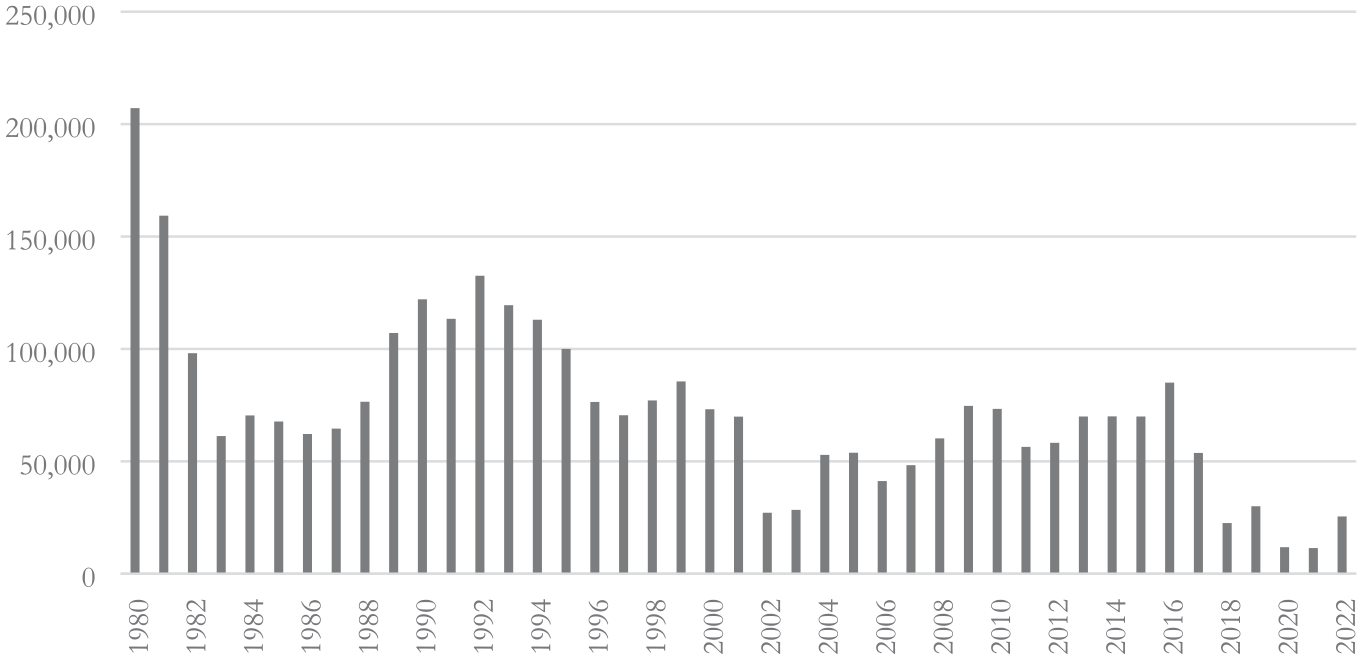
Number of Refugees Resettled from 1980 to 2022
As per the 1980 Refugee Act, resettlement to the United States is predominantly organized through an annual quota system (Martin 1982), which allocates a set number of spaces for the upcoming fiscal year across an open global category and five administrative regions (Africa, East Asia, Europe and Central Asia, Latin America and the Caribbean, and the Near East and South Asia). The quota is established by presidential determination and then approved by Congress along with an annual operating budget. Once approved, the UNHCR, U.S. embassies, and other NGO partners are mandated to refer cases under the quota, and U.S. Citizenship and Immigration (USCIS) officials are required to interview each candidate and assess their claim to protection and eligibility under domestic immigration law.
Formally, resettlement is guided by two selective logics. The first concerns individual vulnerability and humanitarian need. Evaluations and hierarchies of vulnerability are outlined in a range of bureaucratic criteria, including the UNHCR’s Resettlement Handbook, which provides practitioners “identification tools and systems” for assessing resettlement needs across the global refugee population (UNHCR 2011:215–16). The second is through special amendments to the 1980 Refugee Act passed in Congress, which relax eligibility criteria for groups of “special humanitarian concern.” 1 Three main bills affected admissions over the study period: the 1987 McCain Amendment, the 1990 Lautenberg Amendment, and the 2004 Specter Amendment. These bills cover, in order, Vietnamese who had been in reeducation camps after the Vietnam War; persecuted Jews and Christians in the Soviet Union or Southeast Asia; and religious minorities in Iran. In general, individuals proactively apply for resettlement through these programs.
How are refugees resettled through this system? Answering this question runs up against three data limitations. First, concerns around individual protection mean neither the U.S. government nor UNHCR provide individual-level data on refugees to directly assess the characteristics of those who are resettled compared to those who are not. Instead, data are aggregated at the national level, indicating, for example, how many Syrian or Sudanese refugees are resettled each year. Second, publicly available data only reflect the nationality of those selected. When making decisions, however, officials also consider factors tied to refugees’ country of residence (UNHCR 2011). For example, being a Syrian refugee in Iraq is different from being a Syrian refugee in Jordon or Turkey, leading to different considerations about individuals’ relative claims to resettlement. These considerations can be extended to almost all refugee nationalities, the vast majority of whom are displaced across multiple countries of residence. Finally, resettlement policy is infamously shrouded in secrecy (Thomson 2012), making it difficult to directly get at how the United States or UNHCR themselves assess or develop priorities.
To overcome these limitations, I secured statistical data through special request to the U.S. State Department that disaggregates admitted refugees by their nationality and country of residence at the time of resettlement. These data have not been analyzed by researchers. The State Department provided data on refugees admitted from 2002 to 2017, a period spanning George W. Bush’s first and Barack Obama’s final admission quota—the last available year at the time of request. I then merged this dataset with publicly available UNHCR statistics, which reflect the country of nationality and residency of all refugees under the Agency’s mandate. Together, this new database indicates the number of refugees admitted to the United States each year from specific country of nationality/residency dyads. I refer to these dyads as “refugee groups.” 2 For example, one observation indicates that 1,928 of the 3,424,237 Syrian refugees living in Turkey were resettled to the United States in 2017, compared to 3,578 of the 281,692 Somali refugees living in Kenya. In total, the dataset reflects 923,051 cases of resettlement spread across 94,853 observations of 7,267 unique groups.
Examining the data reveals surprising levels of distributional imbalance in refugee selection, such that a small number of groups receive a disproportionately large number of resettlement spaces. In fact, as Table 1 shows, refugees from just five countries-of-origin spread across 13 countries-of-residence constitute over half of all those resettled to the United States between 2002 and 2017. In order of size, from largest to smallest, these are Myanmarese refugees in Thailand and Malaysia (165,117); Bhutanese refugees from Nepal (94,675); Iraqi refugees in Jordon, Turkey, Syria, and Lebanon (93,929); Somali refugees in Kenya, Ethiopia, and Uganda (86,287); and Congolese refugees in Tanzania, Uganda, Rwanda, Kenya, and Burundi (42,737). In contrast, groups with pressing protection needs and large numbers such as Sudanese refugees in South Sudan (0 resettled) or Chad (882), Somali refugees in Yemen (7), Myanmarese refugees in Bangladesh (25), Angolan refugees in the Democratic Republic of the Congo (12), Afghan refugees in Iran (0) or Pakistan (6,150, for a population of over 1.5 million), Sri Lankan refugees in India (0), Palestinians living in Egypt (7), and Colombians in Venezuela (0) received almost no resettlement spaces at all.
Concentrations in Resettlement to the United States (2002 to 2017)
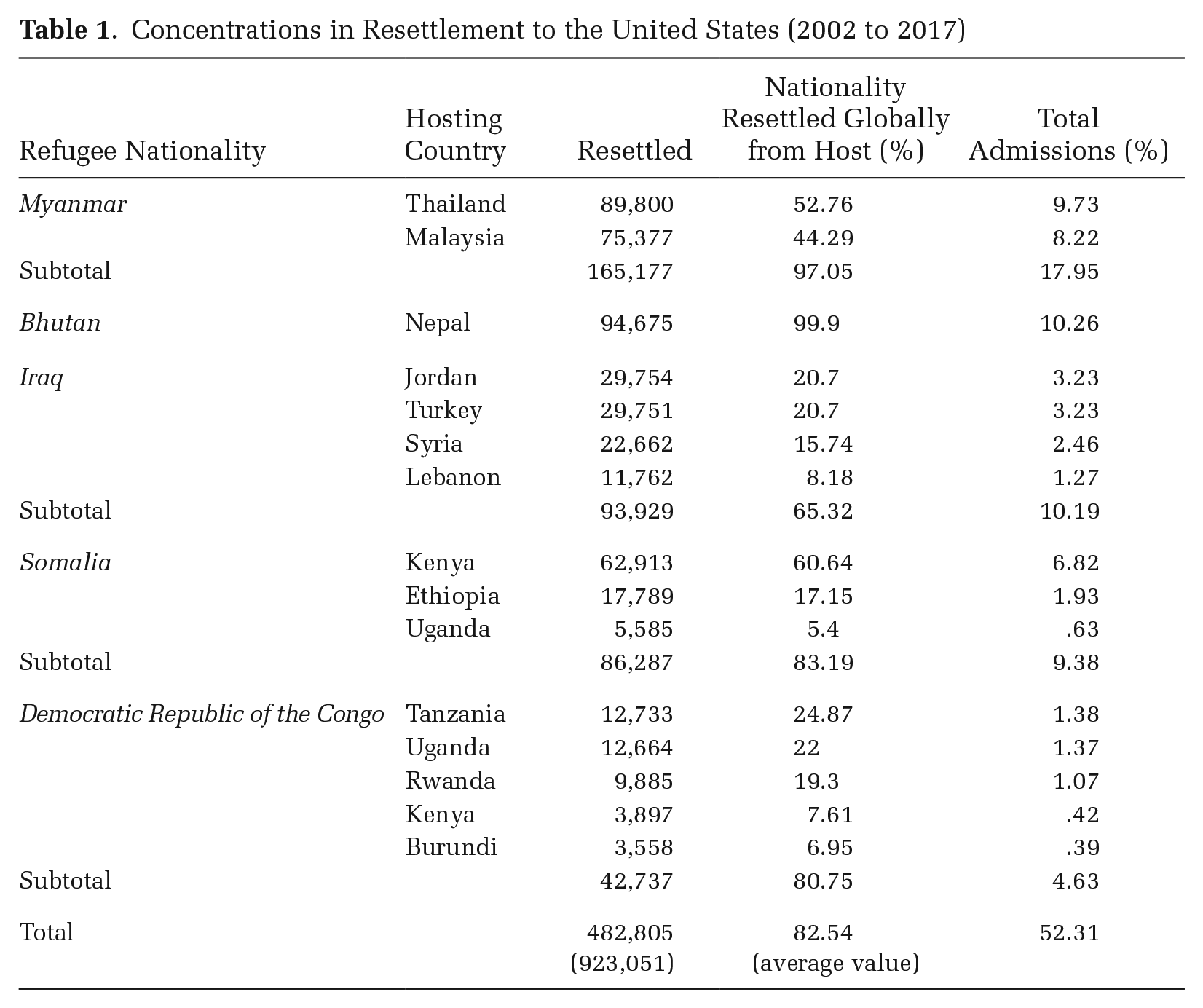
In a context of globalized demand for refugee resettlement, how are we to account for these imbalances? Why did the United States resettle 95,000 Bhutanese between 2008 and 2017? This amounts to 15 percent of the total spaces allocated over those years, with some years seeing as many as 30 percent of spaces going just to Bhutanese refugees living in Nepal. Similarly, why did the United States commit to resettle 60,000 Congolese refugees from across the Great Lake’s region despite recognized resettlement interests in other parts of the region? And what made Congolese refugees living in Rwanda, Uganda, and Tanzania distinct, such that over 80 percent of all those admitted came from just these three countries, despite Congolese living across sub-Saharan Africa? In an era where millions of refugees live in protracted situations of displacement across over 100 countries, why have almost a quarter of all resettlement spaces provided by the United States over the twenty-first century gone to refugees residing in just three (Kenya, Malaysia, and Thailand)? The remainder of the article sets out to answer such questions.
Explaining Imbalances
Existing scholarship anticipates ethnoracial imbalances in how states select immigrants. Accounts can be broadly organized by their level of analysis. One set emphasizes macro-level processes of policy formation that constitute some migrants as more “desirable” and “worthy” than others; a second emphasizes micro-level processes of frontline decision-making. I address each below and point to their limitations in explaining the pattern of distributional imbalance outlined above. Ultimately, I argue that a full account requires attention to meso-level dynamics that mediate social and political logics of refugee selection and structure the context within which frontline decision-makers work.
Macro Level: Immigrant Desirability and Worth
The admission of immigrants and selection of new members is a core property of the modern state (Torpey 1998) and a fiercely guarded aspect of national sovereignty (Hollifield, Martin, and Orrenius 2014). A rich and diverse body of research shows that states enact policies that facilitate the entry of individuals with desirable social and economic characteristics while restricting those deemed undesirable (Bashi Treitler 2004; FitzGerald and Cook-Martin 2014; FitzGerald et al. 2018; Ngai 2014; Rosenberg 2022; Watson 2018). These policies generate ethnoracial imbalances in immigrant selection and admittance by design, with path-dependent implications for the composition of the national population, given the effects of transnational social networks, immigration politics, and family reunification (Massey 1999).
At the level of formal discourse, refugee policy is distinct from other immigration policies in that it emphasizes deservedness over desirability. Put differently, refugees are provided admission based on humanitarian claims to protection, rather than their similarity to an ideal national population or capacity to economically contribute. Researchers, however, are generally skeptical about this deservedness/desirability divide. Indeed, the original legal definition of the refugee in international law restricted this status and its accompanying rights to Europeans displaced after World War II, and industrial states in the Global North resettled entire populations of displaced Europeans and integrated them into their economies (Gatrell 2011). As the refugee definition universalized over the twentieth century, these same states hardened their borders, restricted access to asylum, and favored the containment and return of refugees rather than resettlement (Chimni 2004; FitzGerald 2019; Mayblin 2017). Today, countries in the Global South generally have more open asylum policies, but these states similarly engage in discriminatory practices of refugee admittance (Abdelaaty 2021).
Scholars have also shown that refugee policy is an important venue in which states engage in international relations (Abdelaaty 2021; Arar 2017; FitzGerald and Cook-Martin 2014; García 2017; Gibney 2004; Lippert 1998; Loescher and Scanlan 1986; Tempo 2008). For example, states have admitted refugees to publicly condemn the regimes of nonaligned states, recuperate their image after military interventions, encourage defection, support collaborators, and provide platforms for opposition movements to organize. On the other hand, refugees lacking strategic importance or displaced from allied states have experienced a frosty reception and are at times refused refugee status entirely (Chimni 2004; Menjívar 2006). The title of Loescher and Scanlan’s (1986) classic book on U.S. refugee policy, Calculated Kindness, captures the essence of this dynamic well, and Gibney’s (2004:159) cross-national review concluded that the U.S. resettlement program has been “generous but not humanitarian,” given the role of foreign policy in determining its administration. States in the Global South also engage in forms of “calculated kindness,” leveraging their capacity to host, receive, and control refugees to secure political concessions and military and development aid from countries in the Global North, who want to keep refugees away from their borders (Arar 2017).
In summary, attention to racial projects, immigration politics, and international relations provide invaluable insights into why certain refugee groups are considered more worthy than others. Reference to these dynamics, however, cannot fully explain the subsequent concentration of resettlement spaces observed. Even as, or perhaps particularly because, the overall number of spaces is relatively low, the levels of distributional imbalance outlined earlier means other groups also deemed worthy receive very few spaces at all. If we take recognition of asylum claims at the U.S. border to indicate which refugees are deemed “worthy” (Menjívar 2023), we might, for example, expect Chinese, Egyptians, or Venezuelans to be featured prominently in resettlement channels. Yet, the United States has resettled an average of 35 Chinese, seven Egyptian, and less than one Venezuelan UNHCR-recognized refugees per year since 2002. Similarly, although U.S. officials have publicly declared their interest in resettling Darfuri refugees in Chad and Rohingya refugees in Bangladesh, as of 2017, they have only resettled 882 of the former and 25 of the latter. In contrast, the United States resettled almost the entire population of Bhutanese refugees from Nepal during this period (close to 100,000 people), and almost 90,000 and 75,000 Myanmarese refugees from Malaysia and Thailand.
As we will see, decision-makers with significant authority to shape resettlement report being frustrated and even perplexed by these imbalances. When pushed, however, they often account for them by characterizing resettlement as a “numbers game” or lamenting that programs “take on a life of their own.” Such statements push beyond political priorities toward other organizational and institutional factors.
Micro Level: Street-Level Bureaucrats
A second body of literature explains ethnoracial imbalances in immigrant admission by attending to the discretionary decision-making of street-level bureaucrats. Despite political control over immigration, rule-based bureaucracies leave room for administrative discretion and flexibility (Fassin 2011; Lipsky 1980; Marrow 2009; Watkins-Hayes 2009). This is because formal rules overlap and contradict; eligibility criteria are vague, open to interpretation, and often discordant with “real life” circumstances; resources are scarce or insufficient; and implementation requires expert judgment by design (Fassin 2011; Mountz 2010; Nevins and Nevins 2002; Shiff 2021). A large body of work shows that practitioners draw on stereotypes, biases, and prejudices to resolve “discordances” (Shiff 2021) between codified law, moral schemas, emotional complexities, and institutional imperatives (Alpes and Spire 2014; Asad 2019; Gilboy 1991; Heyman 2000; Jubany 2011; Watkins-Hayes 2009). In the context of migration policy, all these factors intersect to shape who is ultimately admitted and under what conditions.
These micro-level accounts are invaluable, but their emphasis on the discretionary decision-making of frontline practitioners cannot explain distributional imbalances across refugee groups. Indeed, while street-level bureaucrats in public welfare, customs and border enforcement, or asylum adjudication may encounter the full range of individuals moving through these institutions, frontline resettlement officials tasked with identifying and processing refugees administer specific sub-populations. This stems from the fact that eligible refugees are distributed across the globe, but the infrastructure to identify and process candidates is geographically concentrated. So, for example, while biases, stereotypes, and prejudices likely interact to shape why particular Congolese refugees are resettled from Tanzania over others, these micro-level factors cannot explain why a Congolese refugee living in Tanzania is far more likely to be resettled than a Congolese refugee living in the Central African Republic. Instead, we need to understand the broader organizational and institutional context that structures the work of frontline practitioners (Brown 2020).
The Missing Meso Level: Pipelines and Pathways
To overcome the limitations outlined above, I draw on organizational sociology to argue for greater attention to the meso level of policy administration. This level of analysis points to the institutional apparatus through which national priorities and politically articulated strategies of governance, such as which refugees to resettle and under what conditions, are implemented (Morgan and Orloff 2017; Roberts 2020:634). This apparatus includes public agencies and bureaucracies, but also, increasingly, contracted NGOs and other private actors (Mayrl and Quinn 2016). Paraphrasing Saperstein, Penner, and Light (2013:367), the meso level is where national resettlement priorities are forced to contend with entrenched bureaucracy, institutional inertia, and the everyday grind of hiring workers, training officials, building infrastructures, and adjudicating complex demands across geographically diffuse settings. Bureaucracies play a critical role in ordering these complex institutional, operational, and social worlds by routinizing institutional practice through standardized categories, rules, and procedures (Timmermans and Epstein 2010). As they do this, bureaucracies draw on a distinctive form of power tied to the valorization of efficiency, calculability, and predictability in modern life (Mann 2012; Scott 1999; Weber 2014). Scholars have demonstrated the need to delineate how these forms of instrumental rationality interact with the substantive rationality of values and interests to shape activities and outcomes in any given institutional context.
Such meso-organizational dynamics have been undertheorized in refugee and immigration studies. This likely stems from the difficulties collecting data within and across opaque, politically sensitive immigration bureaucracies, but also due to the over-determining role of the nation-state in extant scholarship (Loescher 2001) and related assumptions of strong political control over bureaucratic practice (see Marrow 2009; Mountz 2010; Nevins and Nevins 2002). Indeed, scholars often frame administration as a vehicle for political elites to maximize control by allowing them to circumnavigate normative and institutional constraint. For example, states have used “administrative burdens” (Herd and Moynihan 2019), such as excessive paperwork (Wyman 1985) and integration tests (FitzGerald et al. 2018; Rosenberg 2022), to restrict undesirable immigrants while maintaining formally colorblind laws and public discourses of non-discrimination. This view of the immigration bureaucracy is captured in an infamous 1940 memo written by the Assistant Secretary in the U.S. State Department, Breckinridge Long, in which he advised consulates receiving visa applications from European Jews to “put every obstacle in [their] way and to require additional evidence and to resort to various administrative devices which would postpone and postpone and postpone the granting of visas” (cited by Moynihan, Gerzina, and Herd 2022:24).
In contrast, I show that a full understanding of ethnoracial imbalances requires attention to the autonomous role of bureaucracies in translating political priorities into routinized practices. I draw attention to the role of administrative pipelines, which are meso-organizational forms of procedural standardization (Timmermans and Epstein 2010:72) facilitating the controlled, predicable, and efficient implementation of formal directives. Like all standards, pipelines need “to be plugged into a physical and cultural infrastructure that allows [them] to function” (Timmermans and Epstein 2010:79). In the case of resettlement, this includes roads, secure interview facilities, trained experts, political negotiations, abridged interview forms, and contracted security forces. Once infrastructurally embedded, pipelines generate strong incentives for their continued use, which creates a feedback loop making them self-reproducing forms of institutional practice. Three factors account for this self-reproducing tendency: calculative rationales, administrative reactivity, and structured visibility.
Data And Methods
The core of this study is a unique database reflecting all refugees resettled to the United States between 2002 and 2017. As noted, preliminary analysis revealed surprising distributional imbalances in resettlement over this period. To understand these imbalances, I collected two additional forms of data. The first is 27 expert interviews conducted between August 2017 and May 2019; 21 of these were with former and current desk-officers, senior administrators, and operation managers across the U.S. State Department, U.S. Citizenship and Immigration Service, the Department of Homeland Security, U.S.-headquartered NGOs, and the UN Refugee Agency. I focused on these individuals because they “play a key mediating role between strategic planning . . . and the day-to-day management of operations in the field. [They are] the center of an organization’s outgoing flows” (Krause 2014:178). Indeed, these administrators sit at critical nodes of decision-making, knowledge transfer, and resource allocation, which makes them central to what organizations fundamentally do (Currie and Procter 2005; Krause 2014).
Interviewees were identified based on their occupational position (e.g., being a regional desk officer or presidential appointee in the State Department) or their prominent role in shaping key moments of reform, as indicated in secondary literature, the Congressional Record, or through referral by other interviewees. This latter mode of identification was particularly important, as it connected me to individuals with critical insights but who were largely or entirely absent from official documentation or other research accounts. Interviewees were contacted by email, through LinkedIn, or through introduction by other interviewees. I also met two interviewees at an international conference for practitioners.
All interviewees had experience across at least two roles, providing them a privileged vantage into the inner workings of resettlement. Seven had left the resettlement sector and were either retired or working in academia. This latter group had all been involved in resettlement since before the 1980 Refugee Act, and they were more candid about their time in service. Sixteen interviews were done on “background,” meaning interviewees did not wish to be identified in published work. To respect this request, data from these interviews are not attributed in the manuscript. For readers’ benefit, I have numbered in-text references to interviews (e.g., interview 1, interview 2) so they can be cross-referenced. The additional interviews were with four individuals outside the U.S. government and UNHCR system, but who had significant insights given their consultancy work, and two individuals who were working on the ground referring Congolese refugees to the U.S. program. I interviewed these practitioners during qualitative fieldwork with Congolese refugees in Uganda, and they provided a grounded perspective on working at the frontline of the resettlement bureaucracy. I selected Uganda as my fieldwork site because it was a regional hub for the planning and implementation of the largest global resettlement program at the time of research for Congolese living across Africa’s Great Lakes region.
Following a tradition with roots in the sociology of knowledge (Bogner, Littig, and Menz 2009; Krause 2014:178), I sought to understand how the broader institutional context and shared frames of interpretation affected how experts implemented resettlement policy. Possessing disaggregated resettlement data was essential in this objective, as interviewees invariably reported that refugees were selected based on “need” (Krause 2014:26; Redfield 2008). Being able to draw on precise data bolstered my credibility with experts and helped guide conversation into more technical details. To take an example, a State Department official pulled out public informational documents during an interview to recount a routinized script about resettlement. Such documents provide a standardized presentation of what is in fact a variegated process (Mountz 2010:87–90). Prior to the interview, I had used my database to identify several instances where resettlement spaces had been distributed unevenly across populations in his region of operation. As I began to put these to him, he smiled, closed his packet, and said, “You’ve done your homework! I don’t think this spiel is going to work on you.” We subsequently had a generative discussion about the underlying rationales shaping specific decisions.
The collection and analysis of data broadly followed the abductive approach laid out by Timmermans and Tavory (2012). According to this approach, researchers should develop a “cultivated position” in the field through engagement with existing theory and then pursue findings that conflict with existing expectations. Through this process, I identified constant reference to admission quotas, “clean cases” (which I will elaborate below), “movement time,” and other institutional concerns, such as resettlement becoming a “numbers game” or programs “taking on a life of their own.” As Timmermans and Tavory suggest, I drew on grounded theory principles of collecting and analyzing data, and especially on iterative rounds of coding and memoing to inform decisions about whom to speak to and what to ask them.
Congressional hearings of the executive branch’s annual admission quota provided a second data source. According to the 1980 Refugee Act, the administration is required to submit and justify its assessment of resettlement needs to Congress. This “Proposed Resettlement Admissions” document outlines an operating budget and the year’s admission quota broken down into five administrative regions. According to the law, Congress is mandated to approve the executive’s proposal, and senior administrative staff and other stakeholders are called on to explain and justify quotas, priorities, and budgets during hearings. These hearings provide a rare glimpse into the justifications, rationales, and institutional dynamics guiding resettlement. Beyond congressional hearings, I also drew on State Department briefings, UNHCR official documents, and NGO reports from organizations such as Human Rights Watch and Amnesty International, which provided detailed portrayals of specific resettlement programs and broader refugee situations.
Resettling Refugees In A Post-Cold War World
This section draws on archival and interview data, and traces the emergence of pipeline development as a strategy to resolve tensions in the post-Cold War refugee regime. I show that efforts to reform resettlement around emerging humanitarian and human rights norms of distributional equity and individual vulnerability confronted institutional and operational constraints, leading to falling admissions and unmet quotas. The shift to pipeline development stabilized admissions by standardizing global resettlement work, but this system also created entrenched imbalances in who gets resettled and who is overlooked.
According to the 1980 Refugee Act, a central task of the refugee bureaucracy is filling the annual quota set by the executive branch and approved in Congress. This quota reflects the priorities of the administration, but it also provides the framework for annual planning and funding for the resettlement system as a whole. In this regard, the admission quota plays a dual function in mediating contention over competing values and coordinating complex activities across time and space (Berman and Hirschman 2018). In the years following passage of the Refugee Act, filling quotas was relatively straightforward—in fact, the administration frequently overshot the allotted number, leading to debate in Congress about whether the quota was a hard ceiling, target, or guideline. This ease stemmed from the almost indiscriminate resettlement of refugees from a small number of geopolitically significant groups during the Cold War (Gibney 2004; Loescher and Scanlan 1986; Tempo 2008); namely Cubans, displaced and religiously persecuted people from the Soviet Union, and refugees from Cambodia, Laos, and Vietnam. The concentration of operations and use of military bases to conduct legally-mandated processing requirements facilitated an almost industrial form of resettlement (Espiritu 2014; Mortland 2017).
As the Cold War concluded, however, numbers through these programs declined. For example, 25,000 to 35,000 Vietnamese refugees were resettled each year from 1981 to 1993. By 1997, this number dropped to 7,000, and it continued to decline to around 3,000 by 2002. Congressional hearings during this period reveal growing anxiety about these declines, which were seen to undermine U.S. strategic interests and threaten the domestic and international infrastructure that had been (expensively) built over the previous decades at a time of heightened government support for refugee policy. This infrastructure allowed the United States to resettle tens of thousands of refugees to locales across the country each year with limited federal input due to the role of civil society actors and the private sector. Funding for this system is based on resettlement numbers, however, such that declining admissions threatened its sustainability. Interviews revealed that a broad consensus emerged across government, special interest groups, and NGOs to find new priorities and “keep the business going” [interview 2]. State Department officials estimated that admissions of around 70,000 to 90,000 would be sufficient to keep the existing infrastructure intact. The question was therefore who to resettle (García 2017:15–65).
Buoyed by the growing assertiveness and legal authority of human rights norms in the post-Cold War years (Dezalay and Garth 2006), human rights activists and refugee advocates pressured the Clinton administration to expand access to resettlement and select refugees based on logics of humanitarian vulnerability (Boas 2007; García 2017; Sandvik 2010). As part of their efforts, advocates gave congressional representatives tours of camps in Africa and Asia to demonstrate widespread resettlement needs for populations largely absent from U.S. admission channels [interviews 1, 8, 13, and 18]. Members of the Black Congressional Caucus participated in these tours, and they used their leverage during the early Clinton years to pressure for reform. Advocates found strange bedfellows in congressional conservatives, who were pressuring the administration to tighten enforcement on the southern border to restrict “bogus asylum-seekers” and instead identify “real refugees” through the resettlement program.
Adding further weight, African states called on the United States to expand resettlement operations on the continent (Boas 2007; Sandvik 2010), in light of the starkly different responses to European refugees displaced following the breakup of Yugoslavia and African refugees displaced after the Rwandan Civil War. A retired former State Department official [interview 24] recalled a particularly tense conversation during a UN meeting with African state officials who pointed to this uneven response to accuse the United States of racial discrimination. The U.S. delegation rejected this claim, but the official remembered the strong effect it had on the group. Reporting a “fundamental change in our thinking and approach to resettlement,” the official recalled notions of “equity” becoming central to official discourse “once we returned to DC.” Indeed, distributional equity became an important value animating post-Cold War reforms. As a former government official put it to me, the aim of the reform period was to ensure “all refugees had access to resettlement. Not necessarily got resettlement but had access to it” [interview 18]. There was an understanding that achieving this goal required changing how the United States identified and processed refugees across the globe.
The Clinton administration responded to these pressures through a series of reforms aimed at rebuilding the system of refugee selection around principles of equity and individual vulnerability. These humanitarian norms were to act alongside U.S. strategic interests to guide resettlement in the post-Cold War years. According to interviewees familiar with this reform process, the United States looked increasingly to the UN Refugee Agency (UNHCR) to achieve these goals, as U.S. officials believed the Agency had the infrastructure, expertise, and legitimacy to refer cases based on the new priorities [interview 14] (Fredriksson and Mougne 1994). The State Department’s Refugee Bureau (PRM) also worked with the UNHCR to identify new groups in Africa and Asia with compelling needs and bolstered the capacity of the UNHCR’s Resettlement Division in Geneva to coordinate resettlement activities across its regional, country, and field offices. To aid in this effort, the United States funded the UNHCR to create a Resettlement Handbook to institutionalize resettlement expertise. First published in 1997 (UNHCR 2011:216), the Handbook lays out the process of identifying “a refugee’s objective need for resettlement [irrespective of] the desire of any specific actors, such as the host State, resettlement States, other partners, or UNHCR staff themselves.”
Political Priorities Meet Implementation
Despite financial and political backing, it quickly became clear that the new system was not working. Admissions continued to be predominated by declining Cold War-era programs, temporarily offset by the large number of refugees resettled from the former Yugoslavia. Moreover, the UNHCR referred very few cases to the United States despite its increased role. Between 1995 and 2000, for example, the UNHCR referred fewer than 1,000 of the four million registered refugees each year from Africa, undermining the goal of expanding access on the continent. A government official sent to the UNHCR to investigate low referrals recalled that [interview 14], From ’95, the [new referral system] hinged on [UN]HCR, but their staff were out there, and they didn’t want to submit cases. They were in these camps surrounded by thousands of people in dire need of all sorts of support and we were asking them to submit 100, 200 cases. They simply didn’t want to do this cherry-picking and so they didn’t refer anyone.
According to interviewees, this opposition to “cherry-picking” interacted with the UNHCR’s institutional culture at the time, which was at best ambivalent about resettlement. For most of the twentieth century, the Agency was marginalized from establishing resettlement priorities, and staff compared their work to a “travel agent” simply processing cases selected by states with little regard for their expert assessments (Fredriksson and Mougne 1994). In some parts of the world, most notably Africa, UNHCR officials had no experience with resettlement at all and did not consider it part of their protection plans [interviews 4 and 6]. Instead, the Agency had built a system of refugee management alongside regional states and the African Union that was relatively independent of donors.
The UNHCR also had an institutional memory of its role in the Southeast Asian refugee crisis, where open-ended programs in Thailand, Malaysia, and Hong Kong exacerbated crossings of the South China Sea, and an estimated 200,000 to 400,000 migrants died. The Agency’s role in these programs provoked intense criticism among staff (Fredriksson and Mougne 1994) and created the idea that resettlement can have damaging “pull effects,” encouraging intra-regional migration and compounding humanitarian crises. UNHCR country directors were cautious about stimulating such effects [interviews 4, 6, and 8]. Similarly, country and regional directors favored repatriation (Loescher 2001) and saw resettlement as undermining a refugee’s right to return. Finally, the Agency’s operational reliance on the good favor of refugee-hosting states led to a reluctance to initiate resettlement, which was seen to imply a condemnation of host-country conditions (Barnett 2001). The level of resistance was such that several UNHCR directors actively impeded resettlement operations in their regions [interviews 4, 8, and 9]. This opposition led several priority programs to go unmet, such as a program for Liberian refugees in Ghana, which was a frequent topic of discussion in congressional hearings after low referrals led to its premature closure.
Beyond issues of cherry-picking and UNHCR reluctance, a significant factor thwarting U.S. reform efforts was the geographically concentrated infrastructure inherited from the Cold War period. This infrastructure made resettling refugees based on individual need and distributional equity challenging [interviews 4, 9, and 14]. The declining ideological resonance of refugees in the post-Cold War years (García 2017) and growing concern about “illegal immigration” across the southern border meant an expensive retooling of resettlement infrastructure was unlikely (see Edwards et al. 2009). A particularly significant issue was the difficulty arranging the individual interviews required by the 1980 Refugee Act for each resettlement candidate. The U.S. Citizenship and Immigration Services (USCIS) has responsibility for this task, and it historically used asylum officers who volunteered to conduct “circuit rides” for several weeks before returning to their regular domestic position. Circuit rides involve small teams (typically one to five people, but sometimes more) of resettlement officers, supervisors, and other staff, such as fraud detection and national security officers, travelling to particular countries to conduct the final stages of refugee processing. To process the volume of cases required to meet referral targets, officers conducted tens if not hundreds of interviews a day. The geographic concentration of cases, use of military bases to transit refugees, and open eligibility criteria during the Cold War made this straightforward, as USCIS officers would travel to one or two processing locations and conduct standardized interviews (Espiritu 2014; Mortland 2017). The reformed system, however, required officers to process more complex and diverse cases across large geographic areas.
The Refugee Processing Centers (RPCs) that coordinate regional resettlement activities were also geographically concentrated following the end of the Cold War. RPCs play a key role in pre-screening cases, preparing refugee files, and organizing medical tests and security clearances. They also coordinate USCIS circuit rides, which require transporting and housing refugees, organizing accommodations for officials, and preparing facilitates for interviews. In 1995, there was only one RPC in the whole of Africa (Kenya) despite a continent-wide quota. This compared to RPCs in each of Thailand, Malaysia, Hong Kong, and Singapore due to the legacy of programs for Vietnamese, Cambodians, and Laotians. Similarly, given special regulations for Cuban admissions, there was not a single RPC in the Latin America and Caribbean region. Complications were compounded by low levels of automation and a lack of electricity or computers in some workplaces [interviews 9 and 14]. A senior official associated with the RPC in Nairobi [interview 14] recalled trunks of paperwork being transported from field offices by Jeep and charter planes, making processing expensive, time consuming, and prone to bureaucratic error and delay.
The Clinton administration decreased the annual ceiling several times in the late-1990s in response to unmet quotas, provoking heated debate at congressional hearings. During a particularly tense exchange, Senator Edward Kennedy challenged the Assistant Secretary of PRM and the Director of the Office of Refugee Resettlement about the decision to decrease admissions once more in FY2000: Many of us have been concerned by the continuing decline in admission ceilings in recent years, falling more than forty percent from 132,000 in 1993 to 78,000 in 1999 at a time when the number of refugees dislocated by civil war and global turmoil has increased. . . . Reductions in our refugee admission ceilings have sent the wrong signal to nations that engage in persecution [and] to refugees—that they are not welcome here.
Such comments were common during hearings of the period. Indeed, at the same hearing, Lavinia Limon, Director of the Office of Refugee Resettlement, was forced to concede that the domestic resettlement system was on the verge of collapse due to the decline in numbers. Responding to reports of resettlement agencies closing across the country, Limon reported that the administration was no longer able to “resettle people anywhere in the United States,” as admissions were inadequate to sustain the national infrastructure. Despite Limon and other State Department representatives testifying to the administration’s primary goal of changing this situation and “keep[ing] the national program going,” the already-reduced FY2000 quota was missed by 20,000 places.
Institutional changes after 9/11 only exacerbated existing challenges. Whereas USCIS officers previously focused on rooting out fraud (generally concerning national origin and family composition), the repositioning of immigration within the Department of Homeland Security emphasized security risk [interviews 9 and 14]. Assessing risk in the post-9/11 context required access to national criminal and security databases, a challenging and at times impossible requirement given the contexts that refugees are fleeing from. Furthermore, interviewers were tasked with assessing whether applicants had provided “material support for terrorist-related activities” (Nezer 2006) which became a cause of inadmissibility under the Patriot and Real ID Acts of 2003 and 2006. As has been well-documented, officials responded to the ambiguity of this provision with overly broad applications (Nezer 2006), leading to increased rejections and thus unmet quotas. Reflecting on their work during this time, a former USCIS official recalled the “center of gravity” shifting from “figuring out eligibility—were you really who you say you are—to security risk.” Laughing, the official said, “people today would freak out if they knew what our screenings used to look like!” [interview 14].
Complicating matters further, the post-9/11 context saw increases in the security requirements for government officials, with interview sites in certain areas requiring sentry towers, policed perimeters, and bullet- and blast-proof walls and glass [interviews 8 and 9]. The State Department’s security division would not allow staff to go to certain places; in other areas, especially in the Middle East, staff could only work out of cramped embassy buildings. An official familiar with these transitions reported a troubling increase in missed appointments, as candidates now had to make expensive and time-consuming trips to securitized embassies in urban areas. Again, this process of resettling refugees contrasted with the preferred one that saw thousands interviewed in short, multi-location circuit rides.
UNHCR reluctance, inadequate operational capacity, and elevated security requirements interacted to see admissions drop to 27,120 and 28,376 in 2002 and 2003, respectively, despite the Bush administration passing a 70,000 quota each year. Reflecting the importance of meso-level infrastructures to the functioning of resettlement and considerations of stakeholders, congressional support was attained to protect the domestic infrastructure by allocating funds on expected rather than real admissions. This was only a stopgap, however, and reforms were urgently needed to stabilize the program.
Pipelines And Pathways
Administrators created a “pipeline development process” to stabilize resettlement. Rather than “cherry-pick” particularly vulnerable refugees from across the globe, senior administrators worked with key state and nonstate stakeholders to identify refugee populations for priority processing and then built organizational, bureaucratic, and physical infrastructures to ensure their predictable, controlled, and efficient resettlement.
On the one hand, social and political logics of worthiness affect which groups are prioritized over others. In the post-9/11 era, for example, certain Muslim populations, especially in the Middle East, were designated for elevated security screening (Nezer 2006), and USCIS staff were required to operate under high levels of security to conduct interviews. Such constraints, which place excessive burdens on processing Muslim applicants, are designed to reduce their cross-border mobility (Herd and Moynihan 2019). Without strong political support for reducing such demands, these populations will simply not be prioritized [interview 1]. Similarly, domestic pressure groups, such as ethnic associations, religious organizations, NGOs, and veteran associations (García 2017:201), interact with foreign policy considerations (Abdelaaty 2021; Micinski 2018) to shape who is prioritized. National immigration politics and racialized notions of legitimate suffering also intersect to shape prioritizations (Boas 2007; Hyndman and Giles 2011; Sandvik 2010); this is likely reflected in the greater number of refugees from sub-Saharan Africa resettled compared to refugees from Central and South America, who are deemed threatening economic migrants and “bogus” asylum-seekers. To take a final example, prioritizations work alongside broader population management objectives, such as the “strategic use” of resettlement to alleviate “burdens” on allies or open possibilities for repatriation and local integration (UNHCR 2011:54–57)—the UNHCR’s two other “durable solutions” to refugee displacement alongside resettlement.
On the other hand, the administrative process of developing pipelines mediates these social and political logics, affecting how, where, and why pipelines are developed and used. Drawing on concrete examples, the following subsections identify three factors shaping pipeline development. First, I found that a calculative rationale is deeply embedded in logics of refugee resettlement, stemming from bureaucrats’ broader mandate to maximize benefits and minimize costs (Timmermans and Epstein 2010; Weber 2014). Specifically, administrators expect investments in pipeline development to “pay for themselves” by providing large resettlement numbers over multiple years. This shapes how, where, and why pipelines are developed and used. The second factor is administrative reactivity. Sociologists have demonstrated that quantitative measures exert disciplinary and normative pressure on administrators (Petzke 2021), leading them to reactively restructure institutional fields to reliably “meet targets” or “climb rankings” (Espeland and Sauder 2007; Sauder and Espeland 2009). A similar dynamic plays out in resettlement, where administrators report pressure to meet targets and fill quotas, leading them to search out “clean cases” that can be more easily processed and submitted. Existing infrastructures make certain populations “clean,” such that administrative reactivity generates an incentive to draw on and buildout existing pipelines—especially during times of political uncertainty. The final factor is structured visibility, which builds on a long line of scholarship showing that states construct and “see” populations through bureaucratic and physical infrastructures (Anand et al. 2018; Edwards et al. 2009; Scott 1999). The infrastructural embeddedness of resettlement pipelines similarly makes certain refugees more visible to officials and amplifies nested claims pushing for the extended use of pipelines to existing or new refugee populations. These three factors interact to create a feedback loop between pipelines and resettlement practices, ultimately channeling scarce spaces to a small number of geographically concentrated refugee groups.
Calculative Rationales
Building pipelines costs scarce administrative time, political capital, and financial resources as administrators must train, contract, and deploy experts; allocate UNHCR staff to clean up paperwork and conduct preliminary evaluations in preparation for large-scale processing; schedule USCIS circuit rides; build roads and secure interview sites; attain clearances and guidelines from Homeland Security; and create bureaucratic technologies such as abridged referral forms and security clearances. Given inadequate funding and the constant pressure to fill annual quotas, administrators come to expect these investments to “pay for themselves” by sustaining sizable refugee admissions over multiple years. An outcome of this calculative rationale is that investments in critical infrastructure will not be made until sufficient consensus is in place across key state and nonstate stakeholders for the resettlement of identified populations. An official familiar with this process described it as the “wink and nod system” [interview 1] in which administrators in the State Department and UNHCR gauge support for programs before initiating the next steps of negotiation and investment.
An example of how calculative rationales affect the development and use of pipelines can be seen in the divergent outcomes of a plan to resettle Congolese living in Rwanda and Sudanese living in Chad. Both groups were identified as potential priorities in the early-2010s given their long-term exile, high rates of officially recognized vulnerabilities, and advocacy from human rights groups and regional UNHCR offices. Both groups also posed political and operational challenges. Plans to resettle Congolese in Rwanda raised concerns about regional “pull migration” given that Congolese families and communities were spread across the Great Lakes region. Moreover, Congolese were located across rural camps, agricultural settlements, and cities poorly integrated by transportation and communication infrastructure. Sudanese in Chad, on the other hand, were a more discreet population made of those displaced from the Darfur region of western Sudan and living in geographically concentrated camps in the semi-arid region of eastern Chad. Accessing these camps, however, posed elevated security risks, with international organizations operating under a UN peacekeeping force and national military escort. Regardless, the State Department attained sufficient assurances to begin building processing infrastructure, and it increased resettlement for each population in the mid-2010s.
Several years later, however, the Congolese/Rwanda program had developed into a priority program for Congolese living across the Great Lakes, such that by 2016 this was the largest single source of refugees resettled globally. Conversely, the Sudanese/Chad program saw 150 departing in 2016 and 90 in 2017. I explored the reason for this divergent outcome with several administrators, including a State Department desk officer who oversaw both programs at the time. He informed me that the Chadian government had twice paused resettlement due to negotiations with Sudan. Processing eventually resumed, but these pauses undermined the calculative rationale at the core of the pipeline development process as they led to missed appointments, expired security clearances, and unmet referral targets. Commenting on the future of the program, the official suggested the United States was unlikely to pursue resettlement from Chad as the program was too “complex and expensive. . . . We’ve had to invest a lot of time and resources with very little results. Especially given our relationship, or I guess lack of relationship with Sudan, I don’t really see this program being viable moving forward” [interview 12].
Conversely, the United States and UNHCR had successfully negotiated with regional governments in the Great Lakes to facilitate Congolese resettlement, diminishing concerns about regional pull migration effects or interrupted processing. The success of the program encouraged the State Department to invest additional resources to expand resettlement capacity, including large processing facilities in Uganda and Tanzania with medical centers, rooms for departing refugees, secure interview sites, and attached accommodation for USCIS interviewers. A State Department desk officer commented on these facilities [interview 12, emphases added]: We just finished one in Tanzania. It’s the state-of-the-art way to do this. You can do concurrent pre-screening, USCIS interviews, medical interviews, cultural orientations, all in one place. . . . [That center] will pay for itself by the end of next year. That’s where we should be putting more money. We’ve also built a big medical center for the IOM in Uganda where they can do all their final checks, do all the medical stuff, do the final vaccinations, all in one place. Refugees can stay there during the five-day wait period before departure so we can check if anything comes up before they leave. [This is something] I’ll do when I travel. I think, will we be doing a lot more resettlement in this country in the foreseeable future? Is it worth building something here? Sometimes it is, sometimes it isn’t.
This quote reflects the calculative rationale that accompanies the construction of pipelines. It also demonstrates the feedback loop this rationale creates, as “successful” programs incentivize further investments, which in turn lead practitioners to allocate more spaces to these populations. Such dynamics are particularly consequential for populations that pose elevated operational complexities (such as Congolese distributed across multiple settlements, cities, and countries), as they require greater levels of investment. Once built, the existence of such pipelines reduces the likelihood that administrators will pursue resettlement for other populations.
Interestingly, several interviewees recognized the effects of this calculative rationale. An official involved in resettlement since the mid-1980s, for example, complained that recent reforms had made resettlement a “numbers game,” undermining the humanitarian objectives of the post-Cold War era [interview 9]: Back in [the 1990s], our focus was really on diversity, on making sure resettlement was available to as many in need as possible. That’s just not the case anymore. It’s a numbers game now. It’s about budgets, it’s about keeping numbers up and hitting targets. . . . We tell ourselves that we’re saving peoples’ lives. But we’re not. It just takes too long, requires too much planning, and it’s too selective by design.
The description of resettlement as a “numbers game” came up several times during interviews, indicating a reflexivity among practitioners about the calculative rationales shaping institutional practices. Officials also lamented the multiyear process of negotiating priority groups and building infrastructures as undermining the humanitarian objective of “rescuing” refugees in acute situations of vulnerability and risk. Regardless, administrative reactivity to annual quotas further compounds the effects of this “numbers game” on who is resettled and who is overlooked.
Administrative Reactivity
Resettlement to the United States is organized through an annual quota system. This quota reflects a diversity of interests and negotiated stakes and provides the operational framework for administering and funding the domestic and international resettlement system. For both reasons, there is significant emphasis on filling the quota, as not doing so can lead to funding shortfalls, staff layoffs, political contention, or the breakdown of hard-fought-for multilateral agreements. Given these stakes, administrators have developed bureaucratic technologies (e.g., time delimited referral targets) and professional norms (e.g., a common equation of missed targets with lost lives) that generate a strong reactivity to annual quotas (Espeland and Sauder 2007; Sauder and Espeland 2009). Put simply, administrators and practitioners experience a constant pressure to hit demanding referral targets with insufficient time and resources to do so. In response, they are constantly looking for what they term “clean cases,” that is, cases that can be relatively easily identified, processed, and resettled. Pipelines make “clean cases,” such that administrators have a strong incentive to keep drawing on them to meet quotas.
Returning to the Congolese example, reference to “clean cases” came up constantly in official rationales about why this population received elevated resettlement compared to other groups in the region. Indeed, the eligibility criteria for referrals had been extended several times, and as indicated above, senior administrators were committed to resettling large numbers of Congolese in the future. Reflecting on why Congolese had received such large numbers over other groups, an official who had worked across the U.S. government and UN system since the late 1980s remarked that it was about “numbers, politics, and meeting the ceiling. It’s that simple” [interview 9, emphasis added]: Obama’s final ceiling was 110,000. To process so many cases in a year is tough, so you need lots of clean cases and tons of operational capacity. . . . [We use a measurement] called “movement time.” This is the time between [US]CIS interview and departure. Congolese are going through in 4 to 6 months! That’s unheard of. That’s medical, security screening, wait period, everything. You don’t see that with Iraqis or Somalis. Forget about Syrians, it’s almost impossible. They’re just as needy, no one’s doubting it. But it’s a numbers game at the end of the day and the Congolese get you those numbers.
An officer charged with referring Congolese refugees to the United States reflected a similar view [interview 23, emphasis added]: We have really high referral targets, and so we’re often working hard to hit these targets, sometimes six or seven days a week just trying to get files in order before state interviewers come. . . . To meet my targets, I’m looking for clean cases where I can just do some checks and then submit. From my experience, I can say that the Congolese program has been one of the best for this, and it shows a real progression from where we were five, ten years ago.
These quotes demonstrate that officials frequently misattribute the “cleanness” of a case to the inherent characteristics of refugees rather than to the (geographically uneven) infrastructures built around such groups to facilitate their stable and efficient resettlement.
The interactive role of calculative rationales and administrative reactivity in shaping path-dependent forms of resettlement is further exemplified by the case of Somali refugees. Somalis were prioritized for resettlement in the late-1990s when the Kenyan government first threatened to close Dadaab Camp where most of the population lived. Recently embroiled in the ongoing civil war in Somalia—marked by the infamous Black Hawk Down Incident—and looking to expand resettlement in Africa, the Clinton administration committed sizable numbers to Somali refugees to encourage stronger asylum provisions in Kenya. Despite agreements, the administration quickly found it could not operate effectively in the camps due to security concerns. In response, the United States built processing infrastructure in and around Kakuma Refugee Camp—which opened in 1992 to host the so-called Sudanese Lost Boys—and bussed refugees from Dadaab to Kakuma for processing. A State Department official at the time told me that the expense of this program was unusual during that period but was needed to fulfil presidential priorities and “meet the needs” [interview 2]. The official also reflected on debates about these investments, given an understanding they would tie the administration to this population in years to come.
As the official predicted, Somalis would indeed come to occupy a large share of resettlement spaces in the early 2000s. Alongside a program for Meskhetian Turks, an ethnic-minority group dispersed across the former Soviet Union and processed largely through U.S. embassies, the elevated resettlement of Somalis during this time meant Muslims predominated resettlement channels between 2004 and 2006, despite the massive increase in administrative burdens on Muslim migration to the United States in the post-9/11 context. Speaking during the 2017 Trump travel ban, one State Department official noted to me that “ironically, Somalis really saved the program during those years” [interview 16]. This fact reflects how pipelines interact with the need to fill quotas to channel resettlement practice in ways unanticipated by the prevailing social and political logics of the time.
A final example comes from the resettlement of Bhutanese refugees living in Nepal. A priority program for Bhutanese was established under U.S. leadership in 2007 after a decade of multilateral negotiation about the fate of this group. Initially, the plan was to resettle those with pressing claims, with Nepal providing greater local integration for others, and Bhutan accepting a small number of returns. A decade later, however, 108,000 Bhutanese refugees had been resettled, with the United States alone admitting 95,000. These numbers essentially constitute the entire Bhutanese refugee population. Most strikingly, Bhutanese refugees who had migrated for work and settled across the subcontinent and Gulf states were invited to come back to Nepal to claim resettlement.
The Bhutanese program was a frequent source of puzzlement among interviewees, who often pointed to it to demonstrate the irrationalities of the system. For example, a human rights advocate who worked closely with the United States around its refugee policies expressed “bewilderment” at the program. He acknowledged there was little chance of refugees returning to Bhutan in large numbers, but he said many were well settled in Nepal and surrounding countries [interview 1]: I spent a lot of time in Nepal and in the camps at that time. You could make a very compelling case that many of the Bhutanese were well integrated. They were pretty much able to come and go from camps, and many had gone on to work and study in [the capital] Kathmandu. Some had even moved to India, and a lot of families had men working in the Gulf sending money back home. . . . Looking around the region, there were so many compelling claims for resettlement that relocating the whole Bhutanese population is a hard one to justify.
Another U.S.-based NGO official expressed similar bafflement, asking rhetorically, “What strategic interest was served in relocating the whole population?” [interview 11]. He answered skeptically, “It seems like we didn’t have any.” In fact, he said the only actor whose interests were served was the Bhutanese government, who were under pressure to accept returns. “The purpose of resettlement,” he noted, “is categorically not to reward refugee-producing states.”
I put the case of Bhutanese resettlement to an individual who had worked across two U.S. government agencies responsible for processing Bhutanese at the time [interview 9]. This person reported that once the program was started, the Bhutanese “were just easy to resettle.” Reflecting on the decision to build several high schools in the camps to ensure continuing education for teenagers likely bound for the United States, the individual said, “We really got sucked into the program. It kind of took on a life of its own. . . . It was just a positive program. And things were good on the domestic side too. People enjoyed resettling the Bhutanese. . . . It was an easy program.” The official framed these comments in terms of the broader political context of a rising Syrian refugee population, growing contention around refugee policies, and uncertainty about Obama’s second term and who he might prioritize. A senior Obama appointee reflected a similar sentiment [interview 4]: The Bhutanese program is an interesting one because we essentially relocated the whole population. A lot of people at the time, myself included when I came to office, were asking why the Bhutanese. Was there a strategic interest served? Not really. Were there compelling humanitarian concerns? No more than many other populations. In fact, many of those we resettled were quite well integrated. Were there no other options? Far from it! People were knocking at our door asking us to consider different populations. So, what can we say? I’m not sure I have a great answer for you. You could look at it as an example of bureaucratic inertia. I think there’s something to that. There was a lot of uncertainty at the time, especially when the Syrian war broke out, and we had this program that was working very well. It just made sense to continue it.
These expressions of uncertainty are striking coming from a senior administrator with significant authority over resettlement. The last few sentences, however, reveal the ways administrators draw on existing pipelines to fill annual quotas in contexts of operational complexity and political uncertainty.
Structured Visibility
The final factor shaping the development and use of administrative pipelines is the extent to which they make certain populations and their concerns more visible to the state. Put simply, the socio-material infrastructures through which pipelines are realized on the ground generate and amplify claims, sustain refugee/state interaction, and transnationally link social networks that influence their development and use (Anand et al. 2018; Edwards et al. 2009).
Demands for resettlement are a consistent feature of refugee politics (Moulin and Nyers 2007:361), such that the management of demands and expectations is a critical component of resettlement administration (UNHCR 2011:141–47)—including considerations about how many spaces should be allocated to avoid conflicts. As one official outlined to me, admissions should be set at a high enough level such that there is a steady stream of departures and individuals can feel a realistic hope of resettlement. After outlining this rationale, the official blithely articulated its purpose [interview 12]: “We don’t want people chaining themselves to our fence or protesting outside our offices. We don’t want people being attacked on the train when they’re going to work. And we don’t want to encourage fraud.” Moreover, the existence of ongoing, large-scale programs (including frequent visits of UNHCR and government staff to camps and settlements) provides a site of negotiation and advocacy for individuals seeking access to resettlement (Jansen 2008). Although success may be limited, this negotiation and advocacy leads to elevated resettlement for refugees who have access to existing infrastructures and officials.
Indeed, pipelines and infrastructures mediate administrative vision more generally and establish nested webs of social relations between state officials, refugees, and other stakeholders. The large-scale resettlement of Myanmarese refugees living in Malaysia and Thailand provides a compelling example of this dynamic. Myanmarese began arriving in Thailand and Malaysia at roughly the same time the Cold War-era programs for Vietnamese, Laotians, and Cambodians living in these countries were ending. There was thus an unusually high level of processing infrastructure in place (including Refugee Processing Centers in Thailand and Malaysia), and U.S. officials had strong relationships with Thai and Malaysian government officials. Moreover, key U.S. stakeholders, especially the religious charities that played a pivotal role in Cold War-era resettlement, were active in the camps when Myanmarese began arriving, and they became closely involved with these new arrivals. Myanmarese living in Thailand and Malaysia subsequently became the largest refugee population resettled to the United States over the past two decades, and millions of refugees have been processed for U.S.-bound resettlement from Thailand and Malaysia over the past 40 years.
A second instructive example comes from the resettlement of Somali Bantu refugees from Kenya, which began in the early-2000s and predominated U.S. resettlement channels between FY2004 and 2006. I heard numerous origin stories about this program during my interviews. In one version, a U.S. NGO worker who had been involved in the resettlement of the Sudanese Lost Boys witnessed violent discrimination against Somali Bantu refugees in Dadaab Camp around a water pump (Van Lehman 1999; and interview with author). He learned about the persecution of this group in Somalia and now in Kenyan camps (Besteman 2012) and led a multiyear campaign to prioritize this group for resettlement. In another version of events, a U.S. government official based in the Nairobi regional office met several Somali Bantu children who were playing soccer with her son outside her office. As she learned more about the group, she realized their marginalized situation and pressured for their resettlement. Both origin stories emphasize the importance of preexisting infrastructure in shaping how the state and its agents see refugee populations. As with the cases of Malaysia and Thailand cited above, recognizing how pipelines interact with resettlement practice helps explain the disproportionate number of refugees resettled from Kenya over the past three decades.
Discussion And Conclusions
Whereas scholars generally expect social and political logics of immigrant worth to shape who is resettled and who is overlooked, this study demonstrates that a less visible process is also at play. Specifically, I have shown that administrative pipelines play an important role in the resettlement of refugees to the United States. These pipelines mediate social and political logics of refugee selection, but they also become self-reproducing, ultimately concentrating scarce spaces in a small number of geographically concentrated groups. These findings have several implications for how we understand resettlement.
First, establishing priorities does not straightforwardly emanate from one set of interests (see Boas 2007; García 2017). Rather, the calculative rationale at the core of pipeline development patterns iterative rounds of negotiation across state and nonstate stakeholders, which affects who receives resettlement and who does not. This is not to say the U.S. State Department does not hold power. Rather, it is to say that this power stems in part from the capacity to link actors whose cooperation is required to fulfil tasks (Eyal 2013). Efforts to identify a single organizing logic to resettlement are thus misplaced, and researchers should be cautious in drawing generalizable inferences from single or small-N case studies. The pipeline development process instead proves to be a fairly flexible mode of procedural standardization, demonstrating that not all standards create a “standard world” (Timmermans and Epstein 2010).
Second, once priorities are set, pipelines become self-reproducing. The resulting imbalances affect the ethnoracial composition of the United States and access to this potentially lifesaving humanitarian provision. Indeed, my findings suggest refugees’ likelihood of being resettled is strongly conditioned by where they live. Concretely, my findings show that a Congolese refugee in Tanzania is far more likely to be resettled than a Congolese refugee in the Central African Republic because of where they were displaced to and claimed asylum. This difference does not straightforwardly stem from the relative “needs” of individual refugees in these two countries or the openness to resettling Congolese more generally. It is because of the system of pipeline development and the subsequent buildup of infrastructure in Tanzania. This argument has important ramifications for states, humanitarian agencies, and the individual decision-making of refugees. It also demonstrates the need for scholars to pay much closer attention to “host” and “transit” contexts in understanding dynamics of immigration and refugee governance (Abdelaaty 2021; Arar 2017; FitzGerald 2019).
Third, my findings raise questions about resettlement and its prominent position in global discourses of refugee humanitarianism (UNHCR 2018). As we have seen, some lament that the pipeline development process has turned resettlement into a “numbers game.” Others, however, take a more pragmatic view, recognizing that an expensive redesign of the Cold War-era system was unlikely given the declining geopolitical salience of refugees and growing attention to the southern border (García 2017). Building pipelines offered a cost-effective way of securing the global resettlement system and ensuring that each space approved in Congress would be filled. Indeed, numerous interviewees saw filling the quota as itself a humanitarian objective, provocatively equating unfilled slots with the loss of life.
Several senior administrators argued that the pipeline development system has been instrumental in expanding global resettlement capacity from 12 participating countries in 2002 to 32 in 2017. This is because the existence of (largely) U.S.-built processing infrastructures allow other countries to resettle refugees abroad at relatively low costs and instead focus resources on receiving refugees domestically. As a UNHCR official put it to me [interview 17], “Canada spends on integration what the U.S. spends on selection,” suggesting Canada’s capacity and willingness to participate in resettlement has been historically conditioned by the existence of U.S.-built infrastructures abroad. A Washington-based State Department official similarly referenced this rationale to reframe my questioning about distributional imbalances toward the strategic goal of building global capacity [interview 7]. This subtle shift from emphasizing distributional equity to building global capacity in official discourse demonstrates how forms of standardization become embedded in the cultural frames and normative understandings that officials bring to their work (Timmermans and Epstein 2010:79).
Available cross-national data indeed suggest that other countries use the same structures as the United States to resettle refugees. For example, Australia, Canada, and Scandinavian countries have comparable distributional imbalances to the United States, with some years seeing upward of 20 percent of admissions going to Bhutanese, Congolese, Iraqis, Myanmarese, or Somalis. These provisional observations suggest the distributional imbalances and geographic concentrations unveiled in this article are global in character. This has significant repercussions for refugees’ access to resettlement. Ultimately, further research is needed to fully explicate the underlying dynamics and driving forces concentrating and diversifying global resettlement pathways. Specifying the mechanisms through which inequalities are structured into the organizational infrastructures of transnational action would generate insights of relevance far beyond the case of resettlement.
This article focused on the distributional imbalances produced by administrative pipelines, but one could argue that this system of resettlement is inevitable given the complexities of global resettlement. Pipelines, however, emerge and appear legitimate in a very specific institutional context structured to a large extent by political decisions. For example, refugees are the most security-vetted immigrant group arriving in the United States, and critical security and health clearances are time sensitive, making small delays consequential. Removing or reducing such administrative burdens (Herd and Moynihan 2019) would decrease operational constraints and diminish the rationales and reactivities that make pipelines and pathways so durable. Likewise, providing greater financial support or tying funds to quotas rather than admissions would reduce some of the incentives to build and develop pipelines. More broadly, the institution of resettlement itself stems from states’ desire to control irregular population movements away from their territorial borders and assert sovereignty over “who gets in.” It is this control agenda that structures the conditions for pathways to emerge, such that alternative approaches to providing refuge that center the interests and agency of migrants—such as open borders, greater refugee control over resettlement decisions, or humanitarian passports/visas—would inevitably lead to different outcomes.
My arguments have broader relevance for immigration scholars. Social and political logics of immigrant worth are critical for who gets resettled and who does not, yet I have shown that meso-level processes play an analytically autonomous role in shaping outcomes. Immigration scholars tend to examine dynamics of policy implementation through street-level bureaucratic theory (Lipsky 1980), which fixes attention to the discretionary decisions of frontline bureaucrats (Alpes and Spire 2014; Armenta 2016; Asad 2019; Gilboy 1991; Heyman 2000; Shiff 2021) or officials’ tendency to make “policy on the fly” (Mountz 2010:31). In taking a processual, meso-level view, I reveal that immigration bureaucracies structure recursive cycles of implementation and formulation that shape how policies are conceived and outcomes patterned (Halliday and Carruthers 2007; Roberts 2020). In this regard, greater attention to meso-level dynamics may help bridge research on macro-level policy design and micro-level implementation by unveiling the mediating organizational context within which frontline administrators come to understand their role and the likely outcomes and expectations of their actions. I also show that administrators translate priorities, imperatives, and tensions into organizational infrastructures (Roberts 2020; Saperstein et al. 2013) that can channel institutional practice in surprisingly path-dependent ways. Failure to account for such meso-level dynamics risks reifying the state and misattributing policy outcomes to the preexistent motivations of particular policy stakeholders (Healy 2000, 2004).
Ultimately, more work needs to be done to specify the scope of meso-level dynamics across policy arenas with different geographic, institutional, and political configurations. I hope this article can stimulate and provide a roadmap for such work. One area for further exploration could be the role of meso-level dynamics in patterning institutional path-dependencies. Much of the existing scholarship explains path-dependencies through attention to immigration politics or the social structure of migration itself (Massey 1999). My approach instead attends to the socially-bounded and infrastructurally-embedded set of practices that mediate policy formulation and implementation. Future work could explore these dynamics in other policy areas, such as visa processing, border security, or internal enforcement. For example, how do apprehension quotas and the organizational infrastructure of border enforcement affect immigrant policing within the United States? Do administrators target particular regions and populations, making some places more dangerous for migrants? And does this become infrastructurally embedded to produce path-dependent forms of policing that concentrate harms and shape place-based immigration dynamics? Such questions can be explored across a range of settings to gain deeper understanding of immigration governance.
This article also leaves several questions open. For example, how, exactly, do different scales of institutional practice operate together? Here, I focused on meso-level processes of recursivity and organizational infrastructure. Yet, I also emphasized the importance of more macro-level political decisions and institutional logics, as well as more micro-level dynamics, such as UNHCR field officers refusing to “cherry-pick” cases. Ultimately, more work needs to be done to theoretically specify the link between these different levels, and to explore whether these linkages are consistent in form across time and institutional context. Similarly, future work should specify the scope of meso-level dynamics across immigration bureaucracies. For example, will bureaucratic mediation and the sorts of recursive cycles identified in this article look different in the context of border enforcement where activities are more geographically concentrated, arguably more political sensitive, and certainly better funded? Finally, I suggest but do not fully explore novel ways of approaching how professionals deal with “discordances” (Shiff 2021) in their day-to-day work. As we have seen, practitioners often lament that resettlement has become a “numbers game” or complain that programs “take on a life of their own.” These concerns sit alongside the more politically salient issues of discrimination that appear in media and academic accounts. Future research can explore how practitioners perceive and negotiate these different sources of inequality and how they become resonant in their professional lives.
Finally, this article offers insights into how bureaucracies pattern inequalities. To date, much of this research centers on categorical inequalities, examining how administrative categories are created, how people and resources are allocated to them, and how they are negotiated and administered by frontline practitioners in their working lives. I advance this scholarship by showing how categorical inequalities become embedded in procedural standards and administrative infrastructures that generate path-dependent forms of resource allocation. Standards differ across contexts, yet this article provides a model to understand how and why pipelines are developed and used, and what effects they have on the allocation of valuable resources across populations. Moreover, I provided a three-part conceptualization to understand the self-reproducing tendency of pipelines, identifying the role of calculative rationales, administrative reactivity, and structured visibility. Similar dynamics may occur in other settings where bureaucrats are tasked with allocating scarce resources in a time-delimited manner.
College and university admissions offices, for example, likely establish pipelines with certain schools to fill annual spots. Khan (2010) outlines such a dynamic in his account of how “pipelines” are formed between elite colleges and high schools. He shows that elite college admissions offices have a dilemma: although they have a large pool of candidates, they cannot know in advance who will accept their offers. This is important because untaken offers affect a school’s ranking and finances. Khan (2010:172–78) shows how admission officers establish relationships with high school counsellors who provide information about student preferences; admissions offices then “reward that school for good information and sanction it for bad information” by providing students places. Over time, such dynamics could lead to the establishment of pipelines (intentionally or inadvertently), creating durable, path-dependent inequalities in college admissions. In a not dissimilar way to post-Cold War resettlement reforms, we could also imagine colleges constructing pipelines to pursue diversity and equity priorities, thereby generating new admission pathways.
My conceptualization of pipelines can also be extended to the field of global development and aid. As with resettlement, administrators working in these fields confront far larger numbers of eligible and “in need” people than they can assist (Redfield 2008), and they often rely on ambiguous institutional logics (e.g., vulnerability frames) that provide inadequate guidance about who should get what. Agencies also experience pressure to demonstrate “success” to funders within annual budgetary and grant cycles, and in operational contexts marked by uncertainty and complexity. We may therefore expect such agencies to construct self-reproducing project pipelines that channel aid to geographically concentrated populations. Krause (2014) suggests such dynamics in her account of how humanitarian relief agencies standardize distributive decisions. She argues that agencies produce “good projects” that channel resources to populations that are easier to help, and these practices come to have a logic of their own shaping the allocation of resources and the kind of activities we are likely to see (Krause 2014:16). My three-part conceptualization of pipelines can illuminate these patterned forms of unequal resource allocation and their self-reproducing logics across such institutional contexts. Ultimately, I hope this article provides a roadmap for deeper understanding of the origins and dynamics of durable inequalities in contemporary life.
Footnotes
Acknowledgements
This paper has benefited greatly from the feedback of Julian Go, Heba Gowayed, Holly McCammon, Tim Bartley, Michelle Camacho, Patricia Ward, and my fellow participants in the 2022 ASA session on Marginalization and Legitimation. Feedback during a University of Chicago workshop helped improve the manuscript substantially, and I would particularly like to thank Andrew Abbott, Marco Garrido, and Nicole Marwell. Finally, this paper was greatly improved by the generous and thoughtful engagement of the ASR editors and three anonymous reviewers.
