



Abstract
How do parents decide what goods, experiences, and activities they can afford for their children during times of economic insecurity? This article draws on 72 in-depth interviews with U.S. professional middle-class families in which one parent is unemployed. Extending the concept of relational work, this study illuminates how the microfoundation of economic decisions is gendered. Families where fathers are unemployed take the approach of relational preservation: they seek to maintain a high threshold of expenditures on children and view curtailing child-related spending as a threat to their class status. These families see reducing expenditures on children as a parental, and especially paternal, failure. Families where mothers are unemployed take an approach of relational downscaling, lowering the threshold for essential expenditures on children. These families are reluctant to spend less on children’s education, but they do not view decreasing spending on other items, such as consumer goods, as threatening their class status. Gendering relational work reveals how inequalities within families are reproduced through meaning-making around expenditures on children, and it clarifies a key source of variation in parental economic decision-making.
Keywords
The ideologies and behaviors of professional middle-class parents are critical for producing gender, race, and social class inequalities (Calarco 2020; Hagerman 2018; Hays 1996; Lareau 2011; Pugh 2009). At the heart of these ideologies are decisions about spending time with and money on children. To provide advantages for their children, parents in the professional middle-class often rely on a neotraditional organization of family life, framing mothers as caregivers and fathers as providers (Cooper 2014; Stone and Lovejoy 2019). But what happens when affluent parents encounter economic constraints—for instance, when a parent loses their job—that undermine their visions of parenting? Parents have options: they could insist that any expenditure on children is “sacred” (Zelizer 1985), never to be relinquished, and worth incurring debt (Zaloom 2019). Alternatively, parents could decide that going without some of the material goods and experiences of an advantaged childhood can build a child’s character (Pugh 2009). The answer to how parents make this decision lies in the meaning of child-related expenditures for parents.
Economic decisions maintain and produce social relationships (Zelizer 2012, 2017). The meaning of an economic decision is contingent on the social relationship it involves. For example, if a friend asks to borrow $500, your decision about whether to lend the money may be shaped by the depth of the friendship, your willingness to bring discord into the friendship (if you refuse), and other considerations pertaining to your relationship with the borrower. This process of decision-making is referred to as “relational matching,” which highlights the work of matching relationships with commensurate economic transactions (Bandelj 2012; Mears 2015; Zelizer 2012). In a gendered social institution, such as the family, the microfoundation of economic transactions is itself gendered. I use “microfoundation” to emphasize the individual, interpersonal aspect of economic decision-making, which is shaped by broader norms at the meso and macro levels. These include norms at the institutional level of the family concerned with what parents owe their children and what spouses owe each other. Household economic decisions are an important way of configuring familial relationships, establishing relationship boundaries and altering them. Where and on what parents choose to spend money illuminates how they understand their parental obligations.
In this article, I focus on parental unemployment as a window on perceptions of economic insecurity, because concerns about expenditures on children may be particularly acute, and decision-making processes are easier to observe at such a time (Eisenhardt 1989). I draw on a unique dataset of interviews with 72 unemployed parents and their spouses, as well as follow-up interviews with approximately half of the participants. I found that parents in this study perceived some parental obligations, especially those concerning education-related expenditures, to be both expansive and sacred. Parents exhibited greater flexibility in other child-related expenditures, for instance, around enrichment activities, leisure, and consumer goods.
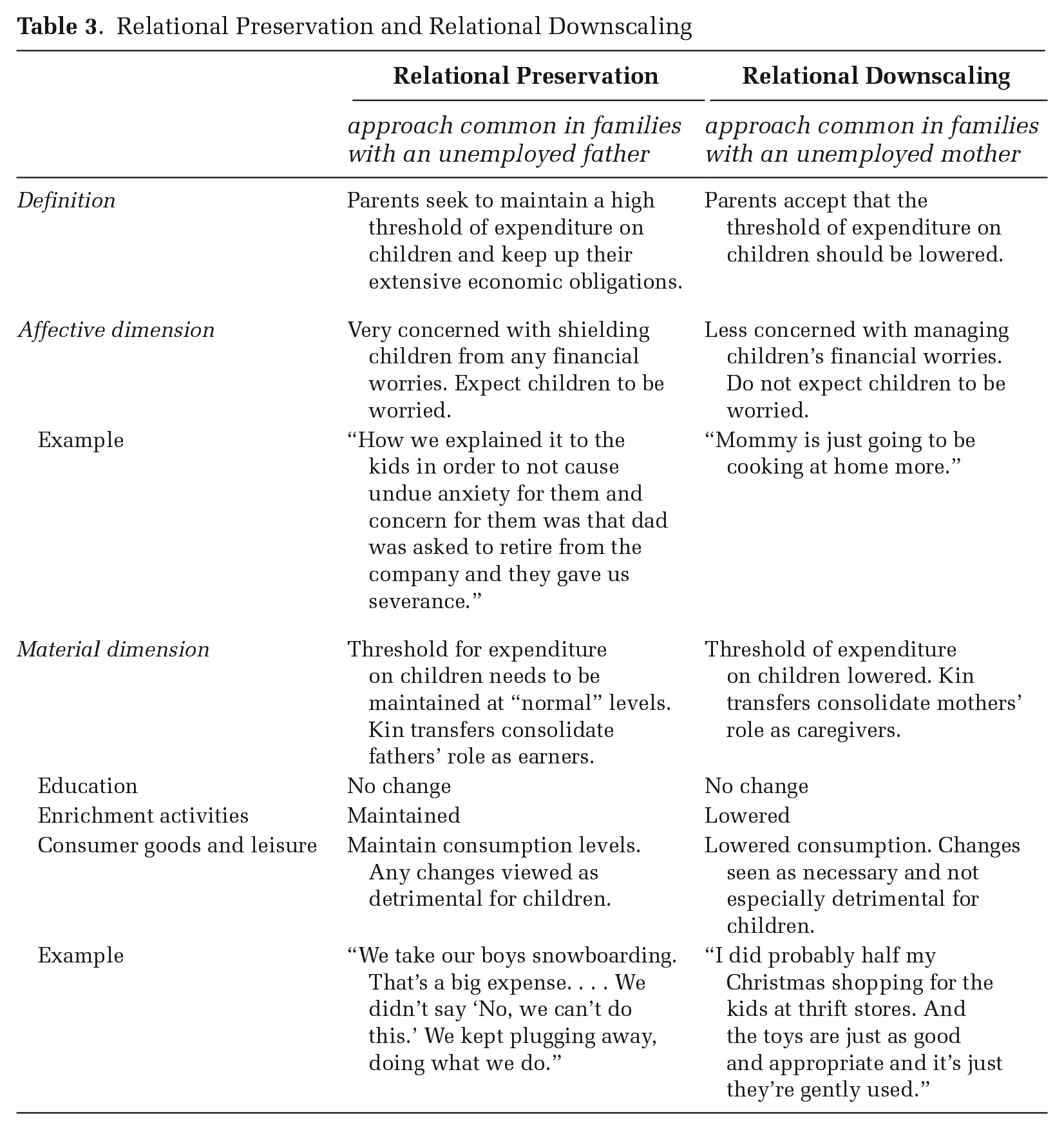
When the father was unemployed, parents took an approach of relational preservation. Relational preservation refers to how parents sought to maintain a high threshold of expenditures on children. Parents’ threshold for child-related expenditures remained high even during paternal unemployment, tethered to seemingly immutable conceptions of “normal” spending on children. These families saw any inability to maintain usual expenditures as a grave failing, usually of the father, and as a threat to the family’s social status.
By contrast, when the mother was unemployed, parents took an approach of relational downscaling: they accepted that the threshold of expenditures on children should be lowered. Both relational preservation and relational downscaling were intergenerational projects. Aside from drawing on their own assets, these families received significant monetary contributions from kin, which allowed them to continue with relational preservation or downscaling. Yet whereas kin transferred money to unemployed fathers’ families to help them contend with their high threshold of child-related expenditures, kin helped unemployed mothers’ families to enable mothers to stay at home.
The concepts of relational preservation and relational downscaling illuminate the gendered ways these economic decisions are made. 1 Through their decisions about child-related expenditures, parents seek to maintain a normative family form, which Smith (1993) called a “Standard North American Family”: a two-parent heterosexual household where the father is tasked with providing and the mother with caring. Parental responses about children’s expenses occur within this ideological context of the gendered division of labor. I divide relational preservation and downscaling into their “affective” and “material” dimensions, following Bandelj (2012). Affectively, with relational preservation, parents assumed that children would be distraught at parental unemployment. With relational downscaling, parents were less preoccupied with managing children’s worries. They emphasized that any form of material downscaling could be offset by having mothers at home. As such, these parents expected that any worry children had could be addressed by simply apprising children of a few changes in their daily lives. By establishing these gendered understandings of what parental unemployment should mean to children, relational preservation and downscaling set a course for parents to enact these materially, through the decisions they made about child-related expenditures during parental unemployment.
I draw on a gendered framework to bridge economic sociology and sociology of the family and make three key contributions in this article. First, within the paradigm of relational work, I develop a typology that illuminates the gendered microfoundation of household economic transactions. Relational preservation and downscaling offer a more precise vocabulary to describe how parents use economic decisions to establish gendered boundaries, practices, and obligations with their children. Second, by showing that fathers’ and mothers’ money hold different meanings for the professional middle-class families, this article identifies a key driver of how parenting practices vary even within one social class. Finally, this study offers empirical insights into how parents experiencing unemployment make decisions pertaining to expenditures on children.
Literature Review
The Gendered Meaning of Money in the Family
Zelizer’s (2012) concept of “relational work” explains how social relations are maintained and produced through economic decisions and transactions. 2 The relational work approach underscores the centrality of meaning-making regarding money. This approach probes beyond rational decision-making to unearth other dimensions, such as the affective, illuminating how money functions to demarcate obligations between people (Bandelj 2020). Obligations in relationships shape people’s decisions about what debts to settle, when to lend, when to obfuscate requests to borrow, or what investment risks to take (Hayes and O’Brien 2021; Polletta and Tufail 2014; Wherry 2008; Wherry, Seefeldt, and Alvarez 2019). Such decisions extend far beyond simply considering the monetary cost and are saturated with considerations of how each transaction may reconfigure a relationship.
Economic decisions are a way for people to align their expectations of and obligations toward their friends, associates, and family members by creating good “matches” between economic decisions and the appropriate relationship. Examples can include refusing to invest in a friend’s new business. Refusing a request for such an investment may mean re-aligning the boundaries of the relationship, potentially demoting it from a close friendship to an acquaintance-ship. If the requester was expecting investment but was refused, this would be an example of a “relational mismatch” (Mears 2015), where the economic decision and relationship boundaries are misaligned. Or one could help pay for a niece’s college education, thereby possibly deepening the aunt-niece relationship through this financial investment in the niece’s educational future. Relational work remains an overly capacious term that is “simultaneously broad and sparse” (Bandelj 2012:177). To guide empirical work, this concept needs to be further refined to more clearly name and describe the types of relationship obligations, boundaries, and practices that economic decisions help consolidate, including how relational matches are rendered viable.
Zelizer (1985, 2005) has argued that relational work is especially evident in the intimate realm of the household—marriage, love, sex. Yet, her call to use conceptual tools from economic sociology in the institution of the family has not been widely taken up. Within the domestic realm, men’s and women’s money is understood to serve different purposes, and is earmarked in gendered patterns for different expenses (Zelizer 2005). In the heterosexual household, money is deployed to demarcate the boundaries of marital relationships. Hegemonic conceptions of masculinity continue to require men to be responsible for economic provision for their families (Connell 2005), and to be the family breadwinners (Cooper 2000; Townsend 2002). Whereas income from men is seen as foundational for household finances, income derived from women’s economic activity is often seen as the “egg” or “pin” money or the “cream” (Charles and James 2005; Zelizer 2005).
Alternative cultural models of modern masculinity, such as models of “hybrid” masculinity (Bridges and Pascoe 2014; Connell and Messerschmidt 2005), may enable a different type of relational matching by allowing men to integrate caregiving (especially for children) with obligations of economic provision (Kaufman 2013; Marsiglio and Roy 2012). In actuality, research suggests that the egalitarian promise of alternative cultural models is not fully realized in the U.S. context; any cultural change indicated by hybrid masculinity does not pose a deep challenge to gendered systems of power (Bridges and Pascoe 2014). Hybrid masculinity can exist without a deep commitment to feminist principles (Hill 2022); it can provide a rhetoric for progressive men to emphasize their individual disadvantages under hegemonic masculinity instead of highlighting gender inequality (Bridges 2021). Indeed, hegemonic masculinity remains influential as a cultural model: an inability on the part of a man to comply with the male-breadwinner norm remains linked to a greater likelihood of separation and divorce (Gonalons-Pons and Gangl 2021; Killewald 2016). The pull of the male-breadwinner family structure is powerful even when couples profess egalitarian ideals (Daminger 2019). When conditions mitigate against the enactment of egalitarian ideals, men favor reverting to a male-breadwinner structure, rather than taking the reins as primary caregivers (Gerson 2009; Pedulla and Thébaud 2015).
Women’s money is seen as being central to women’s economic autonomy, although not necessarily central to household operations (Pepin 2019). Through relational work, couples earmark money earned by women in heterosexual couples as less integral to the household (Charles and James 2005; Gowayed 2019; Rao 2020a; Tichenor 2005; Zelizer 2005). They demarcate the boundaries of the spousal relationship by framing the husband as the earner and the wife as the caregiver. Within heterosexual families, expenditure on children is a critical part of economic decisions that couples make. Yet how these processes of relational work extend to expenditures related to children to potentially shape parenting approaches remains less well understood.
The Expensive and Expansive Project of Raising Children in the United States
Parenting ideologies of the professional middle-class are crucial for perpetuating, and even widening, social class inequalities (Calarco 2014, 2020; Kornrich and Furstenberg 2013; Lareau 2011). Among professional middle-class parents, the dominant cultural model of intensive parenting expects parents to expend a considerable range of resources, including their own time, emotional energy, and money, on fostering children’s development (Christopher 2012; Hays 1996; Lareau 2011). 3 Parental financial expenditures have increased since the mid-1970s and now include a wide range of items and financial investments on children’s behalf (Bandelj and Grigoryeva 2021). Parents spend a considerable amount of money on enrichment activities for children, viewing these as essential for developing young people who will be valued by future educational and occupational institutions (Lareau 2011; Levey Friedman 2013). Nurturing children’s “exploratory” cultural tastes by traveling widely and equipping children with knowledge of a vast assortment of cultural products and experiences has also become a (costly) part of the professional middle-class parenting project (Fielding-Singh 2017a; Khan 2011; Weinberger, Zavisca, and Silva 2017).
These expenditures are part and parcel of the privatization of risk, which perpetuates intergenerational social inequalities (Bandelj and Grigoryeva 2021; Cooper 2014; Jackson and Schneider 2022; Kornrich and Furstenberg 2013; Lunn and Kornrich 2018; Pugh 2015). The professional middle-class project of parenting thus requires enormous resources, which parents see as “sacred” (Zelizer 1985). Parents are reluctant to take investment risks with funds designated for children’s college expenses (Hayes and O’Brien 2021), and they may risk indebtedness as they try to ensure a high socioeconomic status for their children—goals that include postsecondary education (Zaloom 2019). Along with providing opportunities, experiences, and goods for their children, professional middle-class parents also use “symbolic deprivation” (Pugh 2009) to mold children’s morality by withholding some experiences and consumer goods. This is in contrast to lower-income families who practice “symbolic indulgence,” where parents provide goods and experiences for their children although doing so may considerably stretch their limited finances. Pugh (2009) argues that lower-income families do this to minimize moral threats denoted by a low-income status.
In heteronormative families where parents are married, intensive parenting is gendered (Cooper 2014; Hays 1996; Stone 2007). Mothers spend more time on childcare, are more likely to be deemed the primary caregiver, and are usually responsible for the “cognitive” and “invisible” household labor, including childcare (Bianchi et al. 2012; Daminger 2019; Daniels 1987). Mothers’ participation in paid work is often seen by parents as detracting from time and energy that could be spent with and on children, which gives mothers an acute sense of guilt (Collins 2021). By contrast, fathers often infuse intensive parenting with greater leniency and more fun (Fielding-Singh 2017b; Garner 2015).
The extensive costs of parenting in the United States now mean that parental expenditures on children are undergirded by grandparental support (Pfeffer and Killewald 2018), with the frequency and value of monetary gifts being highest in families in the higher socioeconomic strata (Schafer and Vargas 2016). White families are more likely than other groups to have kin networks that can provide money, advice, and support in times of need (Cornwell and Cornwell 2008). Disparities in initial wealth are compounded through the life-course (Friedman and Laurison 2019; Orr 2003; Yeung and Conley 2008), which contributes to the racialization of wealth (Killewald and Bryan 2018). This research, largely quantitative, explains how grandparents can function as “privatized insurance” (Pfeffer and Hällsten 2012), at times temporarily filling the financial gap for grandchild-related expenses caused by parental economic setbacks such as unemployment. However, this research is less able to show how monetary injections from grandparents shape parents’ decisions about which child-related expenditures are essential and which, if any, parents view as optional.
The Gendered Work of Intensive Parenting during Economic Uncertainty
Intensive parenting norms persist when families encounter economic uncertainty. An acute example of economic uncertainty is parental unemployment. Research on gender and unemployment illustrates the durability of gendered parenting norms, including during men’s unemployment (Damaske 2021; Rao 2020a). Professional middle-class men describe unemployment as a respite from the responsibilities of breadwinning, but they do not view it as a time to do more unpaid work at home (Damaske 2020). Unemployed mothers often find intensive mothering consoling after job loss, because this domestic role appears to deflect some of the stigma of unemployment (Rao 2020b). Material privilege enables families in the professional middle-class to adhere to these parenting ideologies by urging fathers, but not mothers, to focus on job-searching (Rao 2020a). These gendered responses to job loss indicate how material privilege, even during unemployment, fosters inegalitarian familial responses (Damaske 2021; Rao 2020a; Stone 2007; Stone and Lovejoy 2019). Thus far, research on gender and unemployment has not paid much attention to how unemployment connects with parenting ideologies to shape divergent parental decisions about child-related expenditures.
For professional middle-class parents who have an intense “fear of falling” (Lamont 2019), the context of economic uncertainty raises deep concerns about their children’s potential downward mobility. These families view the economy as uncertain, unequal, and based on a winner-takes-all model. Quantitative studies show that during economically tumultuous times, such as the Great Recession, wealthier parents increase their expenditures on children (Lunn and Kornrich 2018). Qualitative research proposes mechanisms for this finding. Cooper (2014) argues that in a context of economic insecurity, parents across social classes deploy economic and emotional strategies in different ways. Affluent parents try to control their children’s educational and occupational opportunities by pursuing a security project of “upscaling,” where they raise the bar of what it takes to feel secure to a dizzying height. By contrast, less advantaged parents pursue “downscaling,” where they lower the bar on what security means for them materially, and live with even less. Upscaling and downscaling are security projects pursued by parents to provide a sense of economic and emotional security, for their children in particular.
The material privilege of parents in the professional middle-class means they have access to an array of approaches, such as “concerted cultivation” (Lareau 2011), “symbolic deprivation” (Pugh 2009), “upscaling” of security (Cooper 2014), and the “conundrum of privilege” (Hagerman 2018) that they can deploy in their parenting. Although parenting beliefs and practices are shaped by social class, they are not determined by it. Within the professional middle-class, for example, Black parents’ approaches differ from those of white parents by often taking into account the fact that institutions may treat their children differently than white children (Choo and Ferree 2010; Dow 2019; Gonzalez 2022). Even white parents from the same social class can vary in how they parent. Researchers have illustrated this variation in white parents’ deliberate decisions about which schools to send their children to and which neighborhood the family should live in (Hagerman 2018; Underhill 2019). Examining within-class variation in parenting offers a dynamic understanding of how parents pick and choose from several parenting approaches and allows for understanding how economic insecurity in families can legitimize unequal gendered configurations within the family (Cooper 2014; Rao 2020a; Stone and Lovejoy 2019). In this article, I focus on precisely this issue of identifying and unpacking this gendered within-class variation.
Methods
Sample and Recruitment
I draw on interviews with 72 participants, including unemployed mothers and fathers and their spouses, and follow-up interviews with 35 participants (see Table 1). The larger study also included over 200 hours of intensive family observation (Lareau and Rao 2020). Given my focus on decisions about expenditure on children, I draw on interview data that capture beliefs and motivations, especially when triangulated (Small and Cook 2021). This research design allowed me to achieve theoretical saturation and collect qualitatively rich data (Roy et al. 2015; Small 2009; Weiss 1994). I discuss the same participants wherever possible, to make it easier for the reader to follow the various threads of participants’ understandings and decisions. Findings presented are representative of the study.
Sample of Interviewees
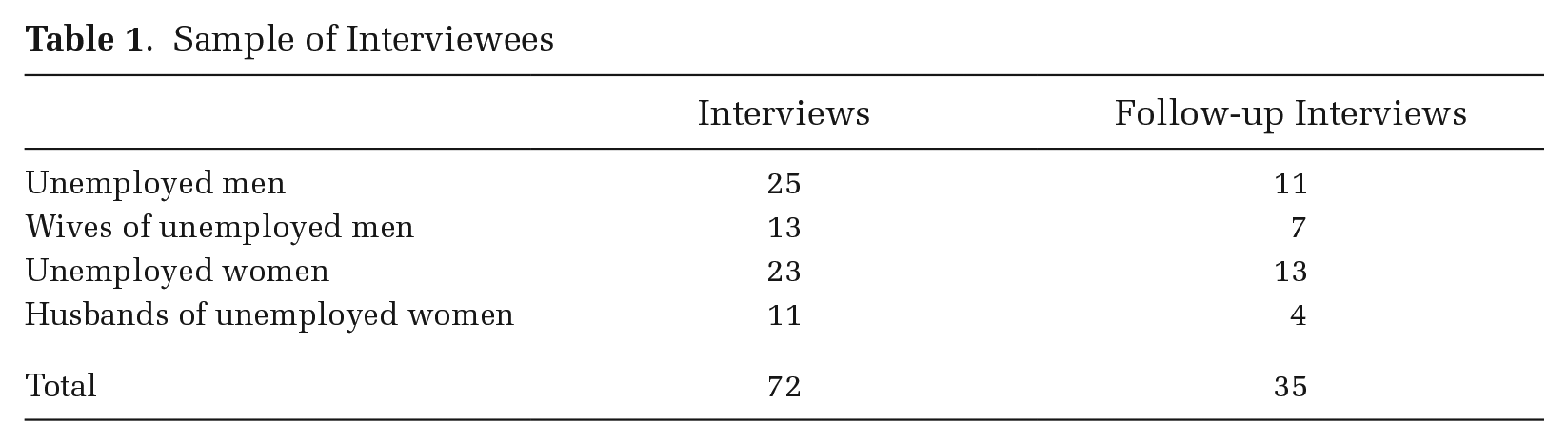
I recruited my non-random sample through workshops held by career coaches, online job-search clubs, parent list-servers, and online and hard-copy fliers posted in neighborhoods in a metropolitan area in the northeastern United States. My inclusion criteria required individuals to be currently unemployed or to have been unemployed until at most three months prior to the first interview, to be a heterosexual U.S. citizen, to have at least a bachelor-level degree, 4 to be married to a spouse who worked at least 20 hours a week, and to have children aged 22 or younger. (Although the legal age of adulthood in the United States is 18, I used age 22 as a cutoff, because in families of this social class, children usually remain financially dependent on parents until the end of college, and even beyond, into what is termed “emerging adulthood” [Arnett and Tanner 2005; Newman 2012; Zaloom 2019.]) I designed these criteria to capture experiences of unemployment in dual-earner families in the professional middle-class with dependent children (see Table 2). This study is relatively racially homogeneous; most participants are white. Throughout the article, I present the findings with this limitation in mind, offering analysis on how race may shape specific experiences. This research design captures the experiences of families in their most heteronormative configuration, a configuration that reflects a type of privilege that is key to perpetuating social class and gender inequalities. As such, this focus is conceptually warranted (Cooper 2017).
Descriptive Data on the Families of Unemployed Men and Unemployed Women
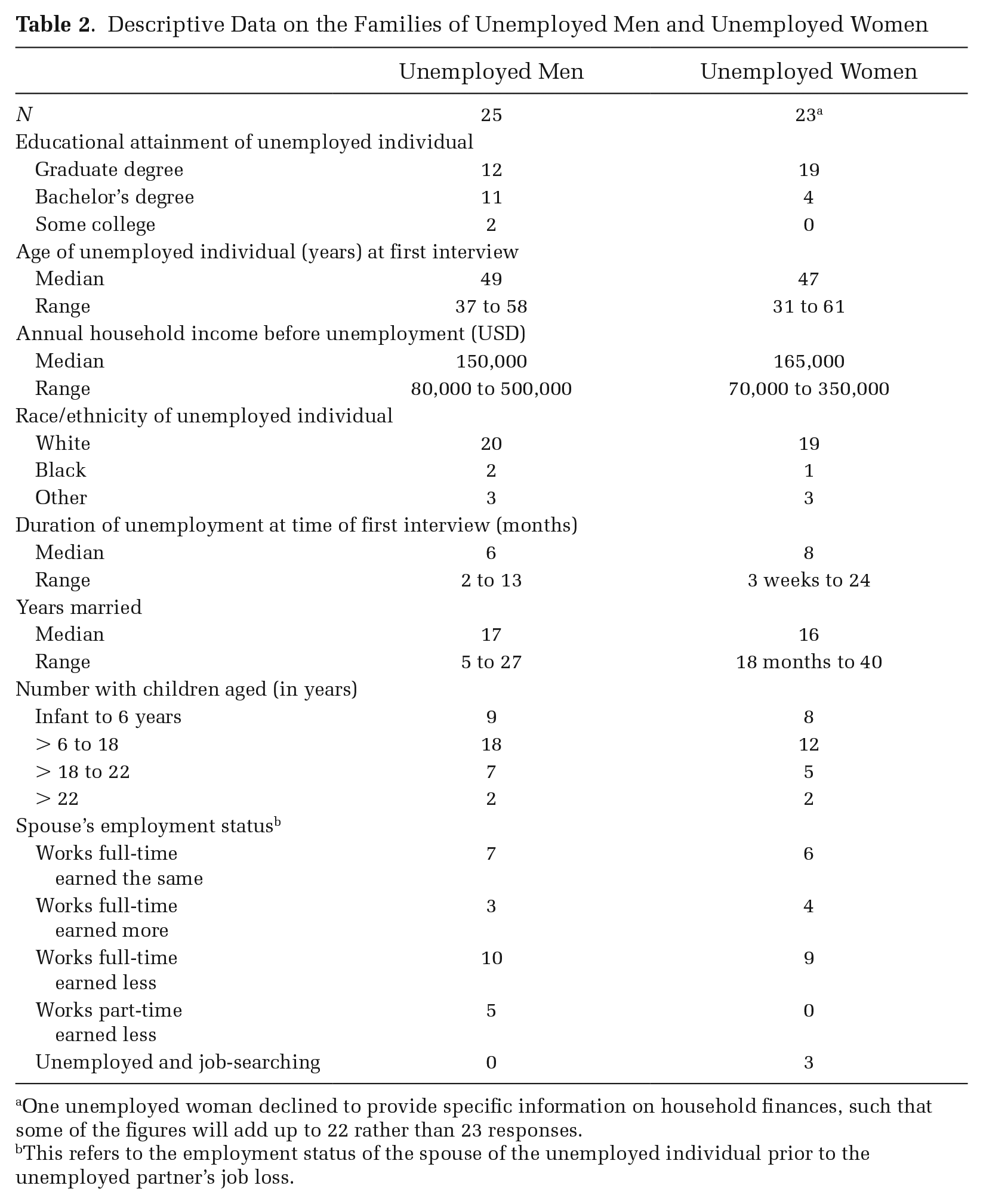
One unemployed woman declined to provide specific information on household finances, such that some of the figures will add up to 22 rather than 23 responses.
This refers to the employment status of the spouse of the unemployed individual prior to the unemployed partner’s job loss.
There are theoretical and empirical reasons for my focus on these dual-earner families in the professional middle-class. This social class has long been identified as crucial for reproducing gender inequalities and transmitting intergenerational advantage, especially in the face of economic uncertainty (Cooper 2014; Kornrich and Furstenberg 2013; Lunn and Kornrich 2018; Rao 2020a; Stone 2007). The beliefs and behaviors of these parents are thus important for understanding how some forms of privilege may be maintained, even in the face of economic setbacks (Cooper 2014). The aim of the overall project was to generate a comparison of the unemployment experiences of men and women. Dual-earner couples were necessary for a tenable comparison.
Data Collection
The unemployed men and women I interviewed were professionals who had been in occupations such as marketing and project management, and worked as lawyers, IT analysts, engineers, and financial analysts. All names are pseudonyms. Many participants had signed nondisclosure agreements to receive severance packages after losing their jobs, so I offered to change their occupation in any written work I produced, as one means of protecting their identity. I thus often provide lateral professions rather than a participant’s real profession.
The original interviews were conducted between 2013 and 2015, averaged two hours, and were mostly conducted in-person; the rest were conducted by phone or via online video call. Interviews were semi-structured, allowing me to ask general questions but providing flexibility to pursue individualized lines of questioning. The overarching interview guide contained questions about their role as parents, and what this looked like during unemployment; the state of their household finances; who they had received support from and what kind; job-searching, and so on. Data for this article are drawn primarily from questions focused on children: how professional status shaped parenthood; how job loss shaped their sense of self as a parent; financial expenditures on and goals for children; and changes in parenting. I conducted separate interviews with spouses. I reached out to all spouses; ultimately, about half of them participated in interviews. Most of these conversations took place in public spaces, usually cafés or restaurants.
Six months to a year after the original interview, I reached out to participants for follow-up interviews to understand how unemployment, including parenting, had evolved over time. I conducted follow-up interviews with approximately half the sample. Follow-up interviews averaged an hour. About a third took place over the telephone or via video conferencing, and the rest were conducted in-person.
Data Analysis
All the interviews were fully transcribed, by myself or a paid transcriptionist. I maintained memos on emerging themes, and on my role in the field. For this article, these practices were guided by a modified grounded theory approach (Charmaz 2006). Much of the literature on parenting for security was published during, not prior to, my data collection. I was thus relatively agnostic in terms of which sociological theories would be best suited to framing my research. I entered data collection armed with a knowledge of the literature on social class differences in parenting, but I knew far less about parenting during economic uncertainty. I kept up with this new research and often considered how my own data aligned (or did not align) with emerging studies.
My analytic codes were developed primarily from my own data. I coded transcripts and fieldnotes by reading them several times and paying attention to disconfirming evidence. I refined my coding categories through the process of open-coding. For example, the broader code of “maintaining children’s lifestyle” was divided into several subcategories, including “children’s enrichment activities” and “expenditure on children’s education.” I used the qualitative data analysis software Dedoose to facilitate coding.
Findings
“We’re Going to End Up Under a Bridge!”: The Affective Dimensions of Relational Preservation during Fathers’ Unemployment
In families with unemployed fathers, the affective dimension of relational preservation meant parents made assumptions about how children would respond to fathers’ unemployment (see Table 3). Whether fathers had been the primary earners or not, these families assumed children would be acutely distressed to learn of fathers’ unemployment. Parents sought to minimize children’s presumed concerns by constructing a careful narrative around the change in paternal employment status.
Relational Preservation and Relational Downscaling
Scott was a white father in my sample who provided a little more than half the family’s annual household income. Although Scott had been informed several months before that he would lose his job as part of a cycle of layoffs, he and his wife, Connie, decided to wait until his last day of work to inform their children. Scott said, “We didn’t tell the kids. I mean the kids didn’t know for many months.” Anticipating that their children would be very worried, they emphasized that unemployment was a normal part of life. In assuring children that job loss was not something to worry about, families with an unemployed father would often sketch out the family finances, in varying levels of detail, as a way of minimizing children’s concerns. In reassuring his teenage son, Scott told him, “We built a life around a little more than one but certainly less than two incomes.” Relational preservation further meant that families with an unemployed father sought to allay children’s perceived concerns by emphasizing how dads were focused on job-searching. Scott, for example, told his son that there were plenty of jobs to be had: “I was just talking to him and explaining that there are other companies. . . . We’ll be fine, don’t worry about it.”
Kevin and Tamara, a white couple in their 40s, also emphasized to their school-age children that because they had saved for economic setbacks, any financial repercussions for their children would be minimal. Kevin earned over two-thirds of his family’s annual household income of nearly $300,000. He had experienced a period of unemployment lasting close to a year. His wife described their children’s initial reaction: “My kids were like ‘Oh my God, we’re going to end up under a bridge!’” Tamara and Kevin tried to soothe their children’s concerns. Tamara said, “We were very clear with them that, you know, we’re not at risk of losing the house. We’re not going to take you out of [private] school.” Kevin and Tamara underscored their frugality and preparedness to their children: “We had to be very careful to say ‘We worked very hard, we put money away all these years. We were prepared. So, in significant ways this probably won’t affect you.’”
The parents I spoke with were reasonably confident that they had successfully protected their children from any deep worries about the father’s unemployment. For example, Robert, a white communications professional with two children under age 6, said, “This is a big dramatic change for me and for our marriage and on some level our family. But for the children, it’s somewhat of a non-issue.” Less commonly, offhand comments by children sometimes piqued parents’ worries about how their children understood the father’s unemployment. Connie, mentioned earlier, said, “One sad thing is, [my son] was so worried about money he wouldn’t ask for things. . . . I’ve noticed like, in their Christmas list this year, my son is much more like, ‘I want, you know, an old sock!’ . . . So there must be much more hidden worry about that than I realize.” For Connie and Scott, the affective dimension of relational preservation meant they were careful and refrained from “talking a lot around [the kids].” Still, Connie said, “Kids pick up. And I’m just kind of sad we didn’t pick up that he was so worried about it, you know?”
Parents saw protecting their children from worrying about money as an important part of their parental obligations. This additional dimension of intensive parenting, apart from being time-consuming, emotionally absorbing, and expensive, also requires that parents go to great lengths to protect children from worrying about finances. Connie, for instance, encouraged her son to maintain the same level of desire for consumer goods and experiences that he had before Scott lost his job: “What I’ve been saying all along is he’s allowed to want things. He’s allowed to take care of himself.” By reassuring her son that he could continue wanting things, Connie was affirming a set of financial obligations that she thought she and Scott owed to their children, which placed Scott squarely in the role of an economic provider in the family.
Affectively, relational preservation meant parents expected children to be extremely worried about paternal unemployment. But this expectation also took an emotional toll on fathers. Todd, a white unemployed father with three sons under the age of 10, was wounded that his unemployment led his eldest son to have a keen awareness of money: “And I think he has a better feel for—he realizes how much sneakers cost. The nice pair of sneakers that he wants is $130. . . . He’ll know that his hockey stick costs $20.” Their children’s awareness of the cost of various items was a blow to these parents. Todd said, “I think [my son] said something like ‘So we don’t have money.’” Todd sought to alleviate his son’s concerns, telling him, “We have some money saved up and the company’s going to pay Daddy for a few more months but I’m going to start looking around and, you know, try to find something.” Like other fathers, Todd emphasized that children did not need to worry, because the family had savings and he was looking for a new job. Todd recounted confidently reassuring his son: “I said ‘Yeah, everything will be fine.’” This incident is an example of a relational mismatch because Todd’s unemployment meant he was unable to provide what he (and his wife) believed he ought to provide for his sons in his obligations as a father. This incident revealed fractures in his economic provision for his children, leading Todd to reflect, “So that was just a hard day.”
For fathers like Todd, these moments of relational mismatch became especially poignant because they reinforced the idea that they were not fulfilling their responsibility to provide. A relational mismatch such as this led to a deterioration in Todd’s relationship with his sons and his wife, Kimmie. Speaking of his 10-year-old son, Todd said, “I think unfortunately he sees me getting upset or snapping here and there at Kimmie, or whatever, so I think it’s affecting him.” Kimmie added that their sons had noticed Todd’s moods: “They’re always complaining. Always: ‘He’s yelling.’ They’re always getting in trouble with him.” Relational preservation is meant to consolidate the father–child relationship by defining the father as an earner. But in cases of relational mismatch of this aspiration combined with Todd’s unemployment, attempts at relational preservation may be damaging for the relationship.
Frank, a white man who lost his job about five months before the interview, also found it difficult to protect his children from his own disappointments about not earning because of his job loss. He explained that although he would like to have a temper tantrum like his 3-year-old and let out his emotions, that was not possible: The tough thing is you know you have to always be on. . . . Like I can’t be stomping around throwing things because I’m angry and upset about the day’s events. Because everyone looks at you and is like “What’s the matter with you?”
If these families did not have relational preservation as their parental approach, the fathers could potentially have seen children’s awareness of costs and the need to minimize consumption as part and parcel of “symbolic deprivation” (Pugh 2009). Symbolic deprivation involves affluent parents pointing to meaningful goods and experiences their children do not have and thereby demarcating themselves as morally restrained and worthy parents. Instead, these parents were worried about not providing what they felt they ought to for their children. This may be because any “deprivation” felt by their children was not carefully curated by these parents and was thus more of a relational mismatch.
“Mommy Is Just Going to Be Cooking at Home More”: The Affective Dimensions of Relational Downscaling during Mothers’ Unemployment
In families with an unemployed mother, the affective dimension of relational downscaling meant the parents did not anticipate children would be worried about mothers’ unemployment. These families did not typically conceal mothers’ unemployment, but instead emphasized the positives of the situation.
Grace and Finn were a white couple in their 40s with an annual household income of $140,000, each bringing in about half. Finn emphasized how his wife’s job loss meant she had more quality time at home with their daughters: “Well, as Grace points out . . . they never had that much time (aside from weekends of course) to be together day-in, day-out all summer.” Finn painted a picture of an idyllic summer, possible only because of the time Grace now had: “We joined a pool. . . . They went to the pool a lot. . . . Grace did things with them like special trips and stuff like that. I think they had a great time.” Grace concurred, saying, “the bright spot in all of this was it was summer and I could now spend more time with my kids during the summer.”
Elliot was a white man whose wife, Claire, also white, lost her job. Claire had brought in two-thirds of their household income of about $300,000. Elliot related how he and his wife emphasized the positive side of her job loss, especially to their 10-year-old son, whom Elliot described as being “concerned at first.” Elliot said, “Quite frankly for a while I think they really enjoyed it. Mom was home a lot. She was always cooking and going on school trips. . . . She’s had the opportunity to do things she wouldn’t be able to do if she was working.” Affectively, relational downscaling predicated on highlighting the mother’s unpaid work was viable for these families, because their combination of race and social class meant norms of intensive mothering were paramount (Hays 1996; Stone 2007).
Even when couples were aware of downsides to women’s unemployment, relational downscaling meant that downsides were viewed merely as minor inconveniences. Finn recounted how they presented Grace’s unemployment to their daughters: “Mommy’s home and you’re coming home at 3:00 instead of at 5:30.” Finn anticipated their daughters might miss their usual routine: “I think [our daughters] might have enjoyed aftercare a little bit. Like when school’s done they would go to a separate program so they had some friends in that. I think they might have missed that a little bit.” This focus on the positives entrenched the conception of the maternal role as one where mothers’ unpaid work for children is paramount. This type of thinking around maternal relationships is deeply raced and classed: it is largely white, middle-class, heterosexual families that have a profound expectation that unpaid caregiving, especially for children, will be mothers’ priority (Dow 2016; Hays 1996).
Darlene, a white unemployed mother, was the primary earner in her family. Darlene and her husband, Larry, had an annual household income that was close to $250,000. Darlene earned just under $200,000, and when she lost her job, she viewed her teenage son, Parker, as being worried. Darlene and Larry sought to reassure him in a similar way as families with unemployed fathers, telling him, “We’ll still be in our house, we’ll still have Sprinkles [his pet lizard].” Friday dinners at a Japanese restaurant nearby had been a ritual for the family, but Darlene and Larry explained the degree of change they expected gently to Parker: “We just won’t go out to eat [sushi] as much.” They offset the loss of the ritual of going out for dinners to their son by saying that “Mommy is just going to be cooking at home more.” One implication of the affective dimension of relational downscaling is that the scope of the maternal role was revised to include time-consuming childcare and household work by mothers. By emphasizing children would get more time with and quality care from the unemployed mother, including more home-cooked meals, these families drew on gendered and classed scripts that value time-intensive household labor, which falls on women to either do themselves or outsource (Cairns, Johnston, and MacKendrick 2013; DeVault 1991; Fielding-Singh 2017a).
Relational downscaling was possible because these families highlighted an exchange where not only children, but also other family members, were seen as the primary beneficiaries of mothers’ job loss. Unemployed mothers spent time doing unpaid carework for their elderly parents and parents-in-law. Shira, a white unemployed attorney, helped out when her father and father-in-law needed care for several weeks. She said, “My life’s more hectic, because I’m at the hospital with my father-in-law . . . and my dad’s in the hospital. That has to be the priority. . . . I spent a lot of time at the hospital, so it wasn’t like I was all of a sudden having nothing to do.” When she was not at the hospital, Shira spent time on chores pertaining to these two men: “A medical student calls me every morning and every night—really sweet. And I call the nurse every morning to find out how [my dad] was overnight.” Downplaying mothers’ job loss made sense in these contexts, where mothers often engaged in caregiving not just for their children but for their elderly kin.
Parents in families where the mother was unemployed tended to downplay the importance of the mother’s income to the household finances, but even when they acknowledged it, they sought to alleviate children’s concerns by highlighting the positives: more and better-quality time for the children with their mother. These understandings were bolstered by the financial decisions families of unemployed mothers made, including accepting financial help from grandparents.
“We Want Our Kids to Be Even a Little Bit Better Off Than We Are”: The Material Dimensions of Relational Preservation during Paternal Unemployment
In families where the father was unemployed, the material dimension of relational preservation meant families viewed their “normal” levels of child-related expenditures as immutable. This applied to expenses ranging from education and enrichment activities to consumer goods and leisure. Kevin, a white man, said he and his wife, Tamara, decided “to maintain to the greatest extent those things that we had to, to avoid stressing out the kids.”
How much money did these families spend on their children and what did they use it for? As members of the professional middle-class, parents in this study had expansive notions of their obligations. They believed they should continue to provide excellent education, whether through maintaining residence in neighborhoods with the best public schools or through private schools. They also were determined to save and invest for college tuition and expenses, maintain children’s routines with babysitters, pay for enrichment activities, and provide expensive consumer goods (e.g., iPads and Uggs)—all so their children felt a sense of belonging in their affluent community. In Pugh’s (2009) study of how parents across social classes contend with children’s consumer desires, middle-class parents identified goods and experiences they did not provide as symbolically important in cultivating moral worth in their children. In contrast, in this study, couples typically sought to preserve child-related expenditures with the loss of the father’s, but not the mother’s, job.
As they anticipated fathers’ re-employment, parents were reluctant to cut back on any expenditures related to their children. In the overall sample, 32 of the 48 families had school-age children. Roughly one-third (nine families) had at least one child in private school, and the others lived in wealthy neighborhoods and described the public schools as “excellent.” Kevin, whose two children were in elementary and middle school, said, “They go to a private school. And my wife and I, even before the concept of losing a job ever came up, decided that that would be the last thing we would give up. . . . We want our kids to be even a little bit better off than we are.” Couples where the man was unemployed saw providing (expensive) education for their children as an immutable financial obligation, viewing their parental role as maintaining their social class status, if not facilitating children’s upward mobility. Typically, for the families in this study, private-school tuition fees were approximately $1,000 per month per child. Despite this expense, none of the parents had taken their children out of private schools and, like Kevin, expressed extreme reluctance to do so.
When it came to maintaining routines, children’s participation in their usual aftercare or with a specific babysitter were deemed important. Once he had lost his job, Robert, a white man, told his wife, Laura, “I think we should keep the nanny.” He described her reaction: “She looked at me like, ‘Well, yeah, we’re keeping the nanny.’ Like it was never even a question for her.” He added that one key reason for keeping their full-time nanny, whose salary was, in his words, “about $3,000 or $4,000 a month,” was to “intentionally [make] sure that our children’s lives were not impacted by this in any way that they would be aware of.”
For families with an unemployed father, relational preservation also required maintaining leisure expenditures, which they viewed as crucial to maintaining a sense of stability for their children. Brian and Emily, a white family, had two sons in high school. Brian, the primary earner, lost his job, and six months later, Brian and Emily were beginning to worry about maintaining their expenditures, including their mortgage payments. They were also concerned about Christmas. Their family usually spent time at a relative’s house in a ski resort town. Brian told me, “My boys love to snowboard. So, they’ve been asking me about it; they don’t want to miss that. . . . That’s the major expense, all the ski equipment, tickets.” Because they did not have to pay for lodging, Brian described the trip as getting “taken care of pretty conservatively.” Smiling, he said of the boys, “But yeah, they have a great time!” Emily explained that for her and Brian it was important to “continue to do [this] with our boys.” She explained how this maintained a sense of normalcy for their sons during a concerning time: “We didn’t say ‘No, we can’t do this.’ We kept plugging away, doing what we do.”
Six months after Brian’s job loss, Brian and Emily continued to find it important to maintain traditions, even expensive ones, by drawing on Emily’s income and their savings. For them, this was a way of maintaining a sense of what it was to be their family. Brian was wistful, thinking that his unemployment might prevent him from providing the kind of life he wanted to provide for his sons. Talking about his teenage sons’ college education—a few years away—he said, “[I]n my family my dad paid for it all. . . . My dad paid the tuition and I paid for my car, my gas, my food, my textbooks. . . . So I thought that worked out well so if I could do that for my boys . . . ” He trailed off.
Relational preservation meant there was also a deep sense in families with an unemployed father that any deviation from providing extensively for their children’s present and future educational needs, and any cuts to spending on enrichment activities and leisure, were seen as straying from parental, especially paternal, obligations. Todd was the primary earner in their family, and their savings had been depleted because this was his second bout of unemployment in four years. Pursing her lips, his wife Kimmie took stock of their financial setbacks: “I always pictured that I would give a better life to my kids. And now my kids are stuck in the same kind of life that I had. Which is, you know, watching my dad go through different layoffs and different jobs.” From Kimmie’s perspective, Todd’s unemployment entailed a relational mismatch between what he ought to provide for their children and what he was able to provide: there was no longer a smooth, appropriate match between what she saw as their parental obligations and their economic decisions pertaining to their children.
An overnight summer camp that cost $8,000 per child had become a symbolic sticking point between Todd and Kimmie. Their eldest son had gone to this camp for several summers. As Kimmie spoke about the importance of continuing to provide this experience for her boys, she recalled, “My parents, when they had not a nickel, two nickels to rub together, sent my brother and I to camp. They didn’t go on a vacation till like 15 years because they sent us to camp.” Todd was less convinced that the boys’ camp was a necessity. He said of his wife, “So she’s going to do what she wants.” In focusing on providing the summer camp experience for her children as integral to being an honorable parent, Kimmie was practicing symbolic indulgence (Pugh 2009). In deviating from the Standard North American Family (Smith 1993), paternal unemployment may pose a moral threat and signify to outsiders that their family is in trouble. Within this context, symbolic indulgence—usually deployed by lower-income families—may be appealing for Kimmie.
Kimmie’s adamant stance about maintaining expensive commitments appears to be an extension of the intensive parenting favored by parents in the professional middle-class, which is most often practiced by mothers, who are deeply involved with managing, or outsourcing the management of, children’s day-to-day lives (Christopher 2012; Cooper 2014; Hays 1996; Stone 2007). Kimmie’s insistence on maintaining their routine of going to this summer camp, Todd added, “impacts us financially, because she’ll spend money.”
These families were not at risk of homelessness or starvation. Their financial worries were of a different order: Kimmie and Todd had spent much of their savings and now had to decide whether to ask Todd’s parents or even his grandmother for more money than they had already provided over the years. Relational preservation combined with their dwindling cashflow was troubling enough for them to consider breaking into one of their two Individual Retirement Accounts that, combined, contained over $200,000. This step would have incurred a severe financial penalty.
At times, families with an unemployed father did curtail some child-related expenses that they deemed delayable. Often these were new expenses, rather than long-standing ones. One snag for Kevin and Tamara was the deep desire of their 6-year-old daughter, Rose, for a puppy. Tamara remembered: “We said to her, ‘Well, we can’t get a dog at the moment. That’s an extra expense.’” Even then, the notion that their children’s needs and wants might be slightly reduced to ease some of the family’s financial pressure was distressing for parents. Kevin explained that Rose felt disappointed, and “when we see somebody [with their dog] out in public [she will say], ‘Oh! I’m going to get a pet, too, as soon as my dad gets a job.’” These types of relational mismatches were sensitive for unemployed fathers, because they highlighted that their children were deprived of experiences and goods they might normally have. For Kevin, this experience struck a chord, and he ruefully said, “I guess that motivated me even more to find something to do.”
When fathers were unemployed, kin frequently stepped in to temporarily make up the shortfall between child-related expenses and household income. In families with an unemployed father, kin’s financial contributions reinforced the importance of the father’s re-employment. For example, when Frank, a white man, lost his job, his father started paying for childcare for his youngest daughter. Frank said, “My father has helped. . . . We had to send my daughter to daycare because she’s only 4 years old. That’s running $900 a month.” Frank’s wife worked full-time, and they deemed it important for Frank to have focused time to search for a full-time position. Without this help, Frank and his wife might have had to direct Frank’s time to caring for his daughter, thus, in their view, compromising his ability to look for a job.
Although rare, some couples with an unemployed father did emphasize the importance of children’s self-reliance and deviated from relational preservation. Sylvia and Marcus were a Black couple, and while Sylvia had been stably employed at the same corporate headquarters for close to two decades, Marcus had a more tumultuous employment history, marked by several periods of unemployment. When we met, Marcus had been unemployed for a year. They had two elementary-school-age daughters and few savings (a fact Sylvia attributed to Marcus’s job history). In Sylvia’s mind, although college was at least a decade away for their elder daughter, they could not save enough for their own retirement and their children’s higher education. She said matter-of-factly, “I already know now that we can’t afford to pay for them to go to college. They’re going to have to get student loans. I know that now.” She continued: I’ll help out where I can, but the one thing I’m adamant about is I will not touch any retirement money for a student loan. I will not do that. I listen to what Suze Orman [a financial guru] says: a bank will loan your child money for school, but they will not loan you money for retirement. So, I refuse to touch any retirement money.
The parents I spoke with were frequently concerned about the implications of unemployment for their retirement, but few framed it as being in direct conflict with their parental obligations, as Sylvia did. Sylvia and Marcus did not expect help from kin, such as their parents. Instead, they expected to provide financial support for their parents. It gnawed at Sylvia that she could not do as much financially for her own parents as she would have liked: “Another thing I think that kind of bothers me, that’s not [Marcus’s] fault . . . I wish I could do more for my parents. . . . But I can’t do for them and my household. That bothers me.” Specifically, Sylvia wanted to put a chairlift into her parents’ house so her mother, who had limited mobility, would be able to get around with more ease. That would cost about $10,000. She aspired to more than that though: “Ultimately like if I really, really had money, I would love to give them a little rancher, so there are no stairs.” The limited racial diversity in this study only allows for suggestive indications, but Sylvia’s comments align with research on race and intergenerational financial transfers. Transfers of money from children to parents are more common in Black families than in white families (Fingerman et al. 2011; Sarkisian and Gerstel 2004).
Although Sylvia said she valued self-reliance in her children, she and Marcus spent a considerable amount of money on educational resources for them. In her follow-up interview, Sylvia explained that as soon as Marcus was re-employed in a lucrative contract position, she had hurried to hire a weekly private tutor for her elder daughter. As affluent families experiencing unemployment, these parents did not typically make dramatic changes to their lifestyle. Instead, the incremental changes were often about forgoing luxury goods, and in some cases postponing extraneous educational and enrichment goods, such as a private tutor.
“I’m Not Worried. There’s Plenty of Money Saved Up”: The Material Dimensions of Relational Downscaling during a Mother’s Unemployment
In families where the mother was unemployed, the material dimension of relational downscaling meant the necessity of the mother’s job for maintaining child-related expenditures was typically downplayed by mothers themselves, and often fathers too. Padma, an Indian American mother in her 40s with two sons in elementary school, had worked in the healthcare industry and earned a six-figure salary, about half of what her husband earned. She said, “I’m not worried. There’s plenty of money saved up. I don’t think we’re in any kind of dire straits.” Maintaining spending related to children, especially educational expenditures, was also seen by these families as non-negotiable. Padma explained: “The children have nothing to do with job loss. They’re just children, they have nothing to do with it.” Claire, a white unemployed mother told me: “We dip into the savings so [our kids] can get what they’re supposed to have.” These parents were clearly defining the parent–child relationship as one where parents provide goods and experiences that, at the very least, maintain children’s membership in the professional middle-class.
In families with an unemployed mother, children’s education was also perceived to be an immutable expense. Gina, a Black woman, and her husband continued to send their younger daughter to private school (their older one was in college). Gina had an MBA from an Ivy League university and had worked in senior management in the private sector. Now unemployed, she said, “We always felt—well, I always felt—that they needed to go to private schools. . . . So [it was] me taking the lead to send them to private schools.” As with Kimmie, the wife of an unemployed father mentioned earlier, certain expenditures on children were tinged with the notion of what parents of their social class ought to provide for children. This was also evident in families where the mothers were unemployed. In these latter families, however, mothers’ re-employment was not seen as crucial to facilitating this expenditure. Gina, whose annual income was almost twice her husband’s, also framed her job loss as an inconvenience rather than a major disruption. Like Padma earlier, Gina explained, “We made enough that there was a good cushion . . . that kind of helped.” Gina and her husband had investment property, from which they received rental income, and Gina drew on her extensive savings to pay “my portion of the bills.” However, she added, “there clearly have been some changes in terms of our freedom with money, financial freedom.” She explained, “So, we would take vacations. Maybe a Caribbean cruise. . . . [Now] the vacations are driving here or driving there.”
As Gina indicated, these parents showed flexibility by reducing expenditures on their children, for instance, on babysitters and afterschool care that families with an unemployed father had deemed essential to maintaining a sense of stability for children. Mary Louise, a white anesthesiologist who used to earn $160,000, said that when she lost her job, “the sitters were furloughed.” She saw this as a common-sense reduction rather than an emotionally saturated one. The gap in childcare left by letting the babysitters go was filled by the unemployed mothers (for more, see Rao 2020b). Rather than “plugging away” (in the words of Emily, quoted earlier) and “keep[ing] the nanny” (Robert, quoted earlier) as families with unemployed fathers tried to do, families with an unemployed mother viewed a wide range of child-related expenditures as being optional, from outsourced childcare to enrichment and leisure activities. Kelly, a white editor who used to earn about $60,000 of her family’s total annual household income of $160,000, explained how her family recently decided not to go on an in-state vacation: “I’ve been talking about going to [place] for a weekend and getting a hotel, but that just turns into more money than what we have.” This was disheartening for Kelly, because it meant giving up creating family memories, as her sons are “never going to be 8 and 10 again.”
Relational downscaling, when it meant curtailing spending on children’s consumer items, did not strike families with unemployed mothers as threatening their social class status. Grace, an unemployed white woman, recently began shopping at thrift stores rather than department stores. She explained, “I did probably half my Christmas shopping for the kids at thrift stores. And the toys are just as good and appropriate and it’s just they’re gently used.” Grace explained this shift to her two elementary-school-age daughters in the following way: “‘Why pay so much for something new when somebody else has used it and now it’s your turn and we’ll pass it on.’ So, they understand.” Rather than being an indictment of not being able to provide a certain type of class status to their children, this change had upsides. Grace said, “My older daughter loves going to thrift stores because she can buy so much stuff for very little money and she’s kind of a little fashionista, so she thinks it’s great. ‘I have $10 and . . . I can buy like 20 things.’” Relational downscaling meant the rhetoric of providing more goods and experiences for their children than the parents themselves grew up with was not as dominant for families with unemployed mothers.
In families where mothers were unemployed, the monetary help provided by kin was often intended to allow mothers to stay at home and spend time with children. Julia, a white woman in her 30s, lost her job shortly before her son was born. As Julia was weighing her professional options, her mother-in-law intervened, offering financial support so that Julia could stay at home with her child. At our first interview, Julia had been job-searching and intended to get back into the labor force. By her follow-up interview, this was no longer the case: “My change of plans is because of the generosity and personal feelings that my mother-in-law has about staying at home with the baby. She stayed at home with her boys and really, really wants me to stay at home with her grandson.” To this end, Julia explained that her mother-in-law had asked how much money would enable Julia to stay at home and abstain from paid work: “‘Well, how much? How much would you need?’ And so I told her how much I would need, and she went home and talked to her husband and said, ‘That’s fine.’” Julia’s husband expressed some guilt over being gifted thousands of dollars a month by his mother and stepfather, but Julia justified this arrangement, “She’s very fortunate, and she wants to share her fortune.” Julia’s in-laws reassured Julia and her husband, “Do not feel bad about it. We are fine. You are fine.” This case illustrates how relational downscaling absolved the mother of the responsibility to provide a certain level of goods and experiences for her children, but reinforced the expectation for mothers to provide unpaid labor.
A similar process unfolded for Grace and Finn once Grace lost her job. Grace described their family as having only a small “shortfall” because of Grace’s job loss, even though she had earned half the total household income. Both Finn and Grace saw this shortfall, as Finn explained, as coming “primarily from the kids, who go to private school.” This was their single biggest expense, which led them to dig into their savings. Finn added, “Grace loves the [kids’] school . . . she wants the kids to stay in this school. . . . I don’t think she thinks we’ll ever pull them [out]. So, like, one way or another, we’ll make it work somehow.” Grace, who managed the bills in the family, said, “If we didn’t have tuition I think we’d honestly be fine on the one income. . . . The cash flow is not enough to pay the monthly tuition bill.” She added, “We’re still at a level in our savings where I’m sort of comfortable. But getting a little more nervous.” As Grace explained, there was a trade-off between seeing her savings account dwindle and paying her daughters’ school fees. One year after Grace had lost her job, her unemployment still did not grate on them, but Grace was mindful that it would do so when their savings dipped below a level with which she and Finn were both comfortable.
When I followed up with Grace a year after our original interview, and two years after she had lost her job, she was still unemployed and searching for a job. However, like most families in this study, Grace and Finn did not pull their children out of private school. Grace’s father-in-law stepped in to cover the school fees for both their daughters. Grace explained: “This is one of the ways that he’s assisting: by covering the tuition payments in the meantime.” She estimated that the tuition for each daughter was $15,000 per year, and the assistance amounted to a gift of $30,000 per year. Grace added, “That takes a huge load off our finances. It’s sort of a temporary measure until I’m back to work full-time; but in the meantime, it’s covering the shortfall that we have.” To thank Finn’s father for his financial help, Grace replaced the aide who visited her father-in-law a few times a week to check on his mail and groceries, and to see that his other daily, logistical needs were fulfilled. Women typically do carework for family members, especially the elderly and children. This “third shift” is often unpaid (Gerstel 2000). Relational downscaling was thus offset by increased demands on women’s time for unpaid work.
In some cases, as unemployment endured, relational downscaling was insufficient to counter the loss of women’s income to the household. Close to a year after she had lost her job, Darlene was starting to worry about money in a way she had not in our first interview. Darlene and her husband Larry had received what Darlene called a “nest egg” when Larry’s parents died a few years earlier. For her, this money was earmarked for their son’s college fund. She was troubled that as her unemployment endured, they might have to use it for daily expenses. She said, “That was supposed to be money for Parker’s college fund. And now I don’t want to dip into that because we need that money to buy groceries, or as usual, things happen, like what if one of the cars breaks down? Or, what if it’s a really cold winter and the heating bills are through the roof?” Darlene and Larry had not dipped into this money. But Darlene looked back at the earlier months of unemployment, when relational downscaling had offered a sense of protection, wondering whether “we were deluded into a sense of security.”
Discussion
Contributions to Research in Sociology of the Family
This article takes a step toward linking research on the sociology of the family with research in economic sociology to show how the meaning attributed to child-related expenditures—a touchstone for families in the professional middle-class—is shaped by which parent is unemployed. Zelizer (2005, 2012) called for our understanding of family dynamics to be deepened through the deployment of conceptual tools from economic sociology, but this call has not yet been extensively taken up. This study takes up the call and highlights the mutable meanings the same expenditures on children can have across families dealing with an unemployed parent. Relational preservation and downscaling extend the concept of relational work by illuminating the gendered microfoundation of household economic transactions. These concepts demonstrate how relationship boundaries, obligations, and practices among the professional middle-class are consolidated by a heightened, or lowered, sense of the affective and material accoutrements deemed necessary for maintaining their social class status. In this study, I have shown how relational preservation or relational downscaling unfold in parental responses vis-à-vis their decisions on child-related expenditures.
The relational work parents do, especially when it comes to demarcating the boundaries of the parent–child relationship and defining parental practices and obligations, is deeply gendered, where mothers (even when they earn as much as or more than fathers) are expected to fulfill a secondary role in economic provision in comparison to fathers. These families seek to maintain a normative family form for their children during parental unemployment. Relational preservation and downscaling are two sides of the same coin. Relational preservation is a response to threats to families’ social class status that reinforces the status of men as breadwinners. It is a form of masculine compensation when unemployment may undermine hegemonic ideas of masculinity for these fathers. Had unemployed fathers and their families leveraged alternative cultural models of masculinity—and fatherhood—which detach masculinity from economic provision (Kaufman 2013; Marsiglio and Roy 2012), they could have responded with relational downscaling. These alternative cultural models have arguably not gained mainstream salience. Research on gender and unemployment indicates that these cultural models have limited power, even when families have reason to adopt them (Damaske 2021; Rao 2020a). Relational downscaling is a response to threats to social class status in the families of unemployed mothers; it renders their husbands the breadwinners and enables women to be stay-at-home mothers, a set-up that is ideologically prized among white families in the professional middle-class (Hays 1996; Stone 2007).
Furthermore, financial assistance from kin helps all these families maintain their gendered approaches to relational preservation and downscaling. Kin provide financial assistance for childcare so fathers can search for jobs, and for expenses so unemployed mothers do not have to immediately return to paid work. Findings from this study support prior research that has found economic uncertainty, including unemployment, may exacerbate gender inequalities within families (Damaske 2021; Norris 2016; Rao 2020a). The present findings illuminate the important role of kin transfers in these processes.
This article also sheds light on another aspect of intensive parenting, in which parents, especially couples where the father is unemployed, often feel the need to shield their children from concern about the cost of goods. In this study, families with an unemployed father did not deploy the cultural framework of symbolic deprivation (Pugh 2009) to rationalize constraining spending on children. Instead, they behaved more like the lower-income families in Pugh’s study by insisting on symbolic indulgence. This may be because paternal unemployment is more likely to invoke a sense of moral trouble for these families. To counter this, and to position themselves as honorable parents, these families’ affective approach may not have included symbolic deprivation.
Contributions to Research on the Privatization of Risk
The privatization of risk in the United States means upper-class parents have “upscaled” notions of security for their children and the extensive parental investment it requires (Cooper 2014). This coincides with developments in parental spending and investment, which have increased across the social classes over the past decades (Kornrich 2016; Lunn and Kornrich 2018). Although there are still wide gaps between social classes, these narrow in states where public spending on children and families is generous (Jackson and Schneider 2022). The range of financial instruments that parents can access for child-related spending has also increased, from parental loans for children’s college education, to college savings accounts, stocks, bonds, and so on (Bandelj and Grigoryeva 2021). Prior research has illuminated social class differences in parental spending and investment, but the present study shows how the privatization of risk is gendered within a social class. Parental spending on and investments in children are shaped by different economic decisions. Extending this within-class difference, one implication of relational preservation in families of unemployed fathers is that these families may be more likely to take on debt for children than families of unemployed mothers, who take an approach of relational downscaling.
In the context of the privatization of risk, access to intergenerational wealth as an economic cushion becomes important. This study builds on research on how parental and grandparental wealth may be akin to private insurance, especially during economic setbacks (Pfeffer and Hällsten 2012; Pfeffer and Killewald 2018). In this study, grandparents’ financial help undergirds families’ conservation of the privileges of life in the U.S. professional middle-class despite (enduring) unemployment. Such intergenerational transfers of wealth are crucial in reproducing advantages. Relying on such extensive support from kin is not merely an issue of social class, but also of race. This study focused on gendered variation within social classes, but future research should pay attention to how the deep links between social class and race shape the accumulation of wealth in the United States (Keister 2004; Killewald and Bryan 2018). White families in the professional middle-class, who have a variety of resources at their disposal, may be particularly well-suited to weathering acute instances of economic uncertainty and shielding their children from some of its worst effects. Intergenerational support directed at securing advantages may potentially exacerbate the racialization of wealth.
Additionally, the justifications underpinning these intergenerational transfers are gendered: money transferred to families with unemployed fathers is designed to help families comply with relational preservation. This money is seen by families as earmarked to protect a father’s time, so that he can search for jobs rather than look after the children or do housework. In families with unemployed mothers, kin transfers for education (as with Grace and Finn), for vacations (as with Claire and Elliot), or to enable mothers to not engage in paid work at all (as for Julia and her husband) support relational downscaling by detaching mothers from having to provide economically. Kin transfers may thus have an adverse effect on gender equality within families of this social class.
Contributions to Economic Sociology: Using the Concepts of Relational Preservation and Relational Downscaling in Other Settings
As types of relational work, relational preservation and downscaling are not limited to the parent–child relationship or to the domain of the family. These concepts are likely to be most useful when the gendered microfoundation of a relationship is particularly salient. In the family, relational preservation and downscaling would pertain to other relationships, such as between adult children and their parents or between cohabiting partners. Monetary decisions made by cohabiting couples, for instance, about who owes how much toward shared expenses, may fruitfully be explained by using these conceptual tools. Cohabiting couples tend to be less traditional in their attitudes to gendered norms than heterosexual married couples (Sassler and Miller 2017), and this could mean they are more innovative and varied in their economic decision-making, rather than adhering to dominant expectations of masculinity and femininity.
Furthermore, before individuals enter into heterosexual marriage, or even relationships, they anticipate the economic obligations the relationship will require, whether they will be the breadwinners or even earners at all, and they “ramp up” or “downshift” their careers in light of their expectations (Bass 2015). Relational preservation and downscaling may also help explain the dynamics of intergenerational transactions involving money and care, such that while daughters do more, especially in terms of providing care for parents, they also receive more care and money from them (Fingerman et al. 2011; Suitor, Pillemer, and Sechrist 2006). Naming the economic dynamics of these relationships as relational preservation and downscaling allows us to better pin down how economic decisions are marshaled to reinforce the relationship between adult children and their elderly parents to achieve relational matching, such that economic exchanges and decisions correspond to the obligations of and aspirations for a relationship. These tools also illuminate how relationships may suffer when there are relational mismatches.
Although I have developed these concepts in the empirical context of the institution of the heterosexual married family, which is rife with a particularly complex entanglement of love and money, they can, to an extent, be transferred to other institutional contexts. One example is the institution of paid work, which is replete with assumptions about individuals’ family obligations. These assumptions, usually made by employers about the meaning of men’s and women’s paid work in their households, have been a key driver of the motherhood penalty and the fatherhood bonus, as well as gender inequality in terms of hiring and promotions (Correll, Benard, and Paik 2007; Glauber 2018; Rivera and Tilcsik 2016). During hiring, for example, employers make assumptions about which partner’s job is dispensable (Rivera 2017).
Another important example pertains to processes of downsizing, where employers favor retaining the jobs of white men (Bosky, Muller, and Williams 2022; Kalev 2014). Qualitative research shows these decisions are due to employers’ assumptions that affectively, the loss of (white) men’s jobs will be an emotional blow to the entire family, and that materially, these men’s incomes are essential to their families (Williams 2019). This is the workplace stepping in to facilitate relational preservation in the family. Employers may be viewed as engaging in relational downscaling by often assuming that women’s income, no matter how high, is secondary in their households, and its loss is neither affectively nor materially as acute as that of (white) men’s income (Tobias Neely 2022).
The concepts of relational preservation and relational downscaling can also be useful for understanding other types of economic decisions that are important for economic sociologists, such as investing and lending. When it comes to “relational investing,” for instance, women are generally less tolerant than men of risk, and certainly where earmarked goods are concerned (Hayes and O’Brien 2021). Using these new concepts to describe men’s and women’s different approaches can help retain the focus on gendered differences in relational work in a variety of domains.
Conclusions
There are several explanations for parents’ varying responses to child-related expenditures during periods of unemployment. These explanations depend on whether the unemployed fathers and mothers in the study, and their families, are comparable to each other. They pertain specifically to the following: the income of the unemployed parent (relative to that of their spouse); the family’s total resource base; the different needs of children; and the duration of parental unemployment. In my sample, the relative income of unemployed men and women was comparable, and thus cannot explain the different approaches between families of unemployed men and unemployed women. Beyond relative income, perhaps the total resource base, encompassing different aspects of wealth, may matter more regarding the extent to which curtailing child-related expenditures strikes parents as a failure of their parenting obligations. Total resource bases could be an explanation for the results if families with unemployed fathers systematically differed in individual and household income from families of unemployed mothers in this study. In addition to income, the interviews asked about monthly expenses, debt, assets (e.g., equity in houses), and various types of savings (e.g., accounts for retirement and 529s for educational expenses); although the interview was not an extensive financial audit of families, I found that the financial information was nonetheless comprehensive and did not indicate that families with unemployed fathers differed from those with unemployed mothers in terms of their total resource base, so this does not explain the differences in rationale uncovered in this article.
Another explanation could be that somehow the sample of families of unemployed fathers had children who simply, and objectively, required greater expenditures (e.g., linked to special needs). However, that does not appear to be a factor either, and indeed the one expense families of unemployed mothers and unemployed fathers were adamant on meeting was any current educational expense. The flexibility typically arose from how families divergently viewed expenditures on items such as enrichment activities, leisure, and consumption goods for children. Finally, on average, women had been unemployed somewhat longer than men, but there were no discernable differences in terms of clustering of unemployment durations around a particular number of weeks.
Understanding these dynamics of parental responses to unemployment took years of data collection and necessitated methodological trade-offs (Hammersley and Atkinson 2007). I prioritized understanding parental decision-making about expenditures on children through interviews with both spouses (wherever possible), which was a time-consuming endeavor. The biggest limitation was that I could not gather data on children’s perspectives. Even very loquacious and forthcoming participants (e.g., those who admitted to experiencing depression during unemployment) were reluctant to allow me to interview their children. Their reticence seemed to be part of their project of controlling the narrative around their unemployment. In other families, children were too small to understand what unemployment meant (see Table 2 for age of children), and therefore would not have been appropriate participants in this study. Thus, this research was directed toward the ways unemployed parents sought to parent and did not cover children’s perceptions of their parenting.
Additionally, as in most qualitative studies, the individuals who decided to participate in my study might have biased my findings. Unemployment may have been financially devastating even for families in the professional middle-class, and some may have chosen not to participate in this study for this reason. Moreover, they may not have been involved in the sites from which I recruited most of this sample. These findings may not fully capture deep financial distress and the way that distress shapes parenting, even among the professional middle-class.
The final limitation of this study relates to race and gender. My sample is largely, although not entirely, white. Parenting concerns and styles, including in the same social class, vary by race (Barnes 2016; Dow 2019; Gonzalez 2022), and so does the ability to accumulate wealth for children (Bandelj and Grigoryeva 2021). This sample does not contain enough racial variation to tease out how, among a sample of unemployed families, parenting in the professional middle-class may be shaped by race. This study does not offer an analysis of whether parenting practices differed according to the child’s gender. Because the family is a key socializing force, especially when it comes to gender, future research should deepen the analysis of parental response to unemployment vis-à-vis children’s gender.
Hardship, especially in the U.S. context, has often been seen as invaluable in producing resilient and courageous individuals. If that remained the case, then we would have expected to see relational downscaling as the key parental response in terms of child-related expenditures. But as these findings show, this is not the only way of understanding parental obligations for these professional middle-class parents. In striving to provide their children with a childhood of uninterrupted privilege, these parents are engaging in the intergenerational reproduction of advantage that may widen social class inequalities in the next few decades. Relational preservation and downscaling emphasize that in the shorter term, these practices, including financial support from kin, perpetuate gender inequalities within these nuclear families.
Footnotes
Acknowledgements
I thank Chana Teeger, Rachel Ellis, Peter Francis Harvey, Megan Tobias Neely, Gözde Guran, Rhacel Salazar Parreñas, Kimberly Kay Hoang, Patricia Tevington, Betsie Garner, Sam Friedman, Mike Savage, Yasmin Ortiga, Forrest Zhang, Matthew Hammerton, Yoo Guan Tan, and participants of the “Affluence/Wealth” session at the 2019 ASA annual conference in New York for providing feedback on earlier versions of this paper.
Funding
The research presented in this article was supported by the NSF DDRIG Award Number 1538951.
