



Abstract
Religions seem to defy the law-of-demand, which suggests that all else equal, an increase in the cost of an activity will induce individuals to decrease the resources they spend on that activity. Rather than weakening religious organizations, evidence shows that the sacrifices exacted by religious practices are positively associated with the success of those organizations. We present the first strong evidence that this association is neither spurious nor endogenous. We use a natural experiment that rests on a peculiar time-shifting feature of Ramadan that makes the fasting duration—our measure of sacrifice—vary not just by latitude but from year-to-year. We find that a half-hour increase in fasting time during the median Ramadan day increases the vote shares of Islamist political parties by 11 percent in Turkey’s parliamentary elections between 1973 and 2018, and results in one additional attendee per 1,000 inhabitants for voluntary Quran courses. We further investigate two mechanisms, screening and commitment, that could explain the effects we find. By testing their divergent implications, we infer that commitment is the mechanism triggered by sacrifice, which drives up the intensity of religious beliefs and participation that in turn bolster the success of religious organizations.
Most religions require their followers to engage in practices that involve the expenditure of significant amounts of time and money. Some practices are also physically or psychologically taxing. Examples include bodily alterations (e.g., circumcision or tattoos), onerous and expensive rituals, and restrictions of diet, dress, and sexual mores. Despite making members endure such costs, the persistence of religious communities and organizations has puzzled scholars. A simple cost-benefit analysis suggests that an increase in the cost of an activity should, ceteris paribus, reduce individuals’ engagement in that activity. Yet religions seem to defy this basic “law-of-demand.”
Theories that purport to explain this puzzle can be grouped into two broad categories, namely screening and commitment (Aksoy and Gambetta 2016). Laurance Iannaccone’s (1988, 1994) religious club good model falls into the screening category (and to its flipside signaling [Gambetta 2009]). Commitment is exemplified by various adaptive preference formation mechanisms, such as cognitive dissonance reduction (Elster 1998; Festinger 1957; Sherkat and Wilson 1995) and self-perception theories (Bem 1965; Sosis 2003).
Through analytically distinct mechanisms, both screening and commitment predict that the cost of religious practices can increase the success of religious organizations. Robust empirical evidence for this prediction, however, is limited. Studies show that religious sects and organizations that have more onerous rituals are also more successful in generating group cohesion (e.g., Sosis and Bulbulia 2011; Stark and Finke 2000; van Tubergen et al. 2021). Those studies, however, rely on observational data that cannot rule out the possibility the association is spurious or endogenously produced (Marwell 1996). Of course, it is close to impossible or ethically contentious to experimentally manipulate the cost of religious practices, which exacerbates the difficulty of finding causal evidence. A further difficulty for empirical studies is that it is nearly impossible to operationalize the cost of religious practice as a distinct and well-defined concept: measures that seemingly capture the cost of practice, such as frequent religious participation or time spent in religious activities, are endogenous to and overlap with the success of religious organizations and communities, and this hinders empirical testing (Marwell 1996).
Additionally, the screening and commitment mechanisms are rather general, and their implications should apply to any religion. Yet, empirical research has been mostly conducted in the West with a focus on Christian denominations (Kurien 2022; for a similar description of the paucity of research on different world religions and regions, see Adamczyk and Hayes 2012). Chen (2010) and Berman (2011) are exceptions and apply the club good model to Islam, but they do so indirectly, not testing the model vis-a-vis its alternatives. Thus, the Western focus of empirical research limits the generalizability of its findings.
In this study, we use a natural experiment, which overcomes these shortcomings in three ways. First, we measure the cost of the religious practice by the length of Ramadan fasting. Fasting must be maintained daily between sunrise and sunset, and its duration varies literally by nature (Campante and Yanagizawa-Drott 2015): the time between sunrise and sunset changes both by latitude and by the period of the year in which Ramadan falls, which is determined by the lunar calendar. These variations are independent of our variables of interest, religious commitment and a religious movement’s success, and can therefore be exploited to test rigorously whether the length of fasting causes a change in them.
Second, because of these exogenous variations, we can describe and measure the cost of a religious practice in a clear and well-defined way. Furthermore, our measures of religious commitment and religious organizational success are operationally distinct from the cost of the practice. We achieve this by analyzing two outcome variables: Quran course participation rates and electoral support for Islamist political parties. The Quran courses are voluntary and require significant sacrifice. Participation in these courses thus serves as a good indicator of the local demand for religion (Aksoy and Billari 2018). Electoral support for Islamist parties, especially where ballots are secret, is voluntary too, and as such provides a strong indicator of religious organizational success, for both substantive and methodological reasons (as we will elaborate on below).
Third, by applying our empirical study to Turkey, a Muslim-majority country, we can test whether the theoretical arguments developed in the Western context hold there too. In doing so, we contribute to the understanding of the peculiar interplay between politics and religion and the success of political Islam in Turkey (Aksoy and Gambetta 2021).
In addition to conducting a rigorous test of the effect of the cost of religious practice on the success of religious movements, using a unique dataset that includes new province-level data and three individual-level representative surveys, we investigate the causal pathways, disentangle different explanatory mechanisms, and conduct repeated and independent tests of those mechanisms. Our analyses result in a theoretical contribution to the understanding of how onerous religious practices affect further religiosity and religiously connoted political engagement.
The theoretical mechanisms we test in this study have policy implications. For example, our study helps assess possible repercussions of restrictive cultural policies that have recently spread in Western Europe and beyond (e.g., veil and minaret bans). Such policies increase the cost of religious practices by directly restricting certain practices and indirectly exacerbating discrimination in the labor market and in other social relations (Open Society Foundations 2018). In the concluding section, we discuss possible implications of our study for these policies and Muslim immigrants’ integration in host societies.
Literature on Screening and Commitment: Theory and Findings
As the cost of a particular religious practice increases, the proportion of people who follow that practice should decrease. This prediction follows the “law-of-demand” in economics, whereby an increase in the cost of a good or activity should induce individuals to reduce the amount of the good they consume or the activity they engage in. 1 This law-of-demand should also apply to religion. As Stark and Finke (2000:100) propose, all else equal, “people will seek to minimize their religious costs.” Yet, two sets of mechanisms, screening and commitment, predict the opposite outcome (Aksoy and Gambetta 2016).
Screening Mechanisms
In Iannaccone’s (1994) seminal model, religious organizations and communities act like clubs that provide services for their members. These services include social events, assistance to needy members, well-organized ceremonies for key life junctures, physical spaces in temples, and access to schools, sport grounds, and training opportunities (McBride 2007). According to the model, a member’s contribution has positive externalities: by contributing more time and effort to the community, a member increases the benefits other members receive. Moreover, producing high-quality community services requires contributions from several members. Such club-like communities are vulnerable to free riders—individuals who try to mimic being religious to enjoy the benefits without contributing to the community (think of Moliere’s Tartuffe). Non-religious clubs tackle the free-rider problem by charging a membership fee. In religious communities, the membership fee is replaced by costly practices that only truly religious members can afford. The costlier the practice, the easier it is for religious organizations to screen free riders, hence the better the quality of goods and services the organization provides. There is an upper limit, though, to how costly a practice can be before members—even the truly pious—begin to leave, despite the benefits of the organization.
Expanding on Iannaccone’s club good model, Stark and Finke (2000) discuss two ways through which costly religious practices increase the quality of the goods religious communities produce: “by exclusion” and “by example.” The former corresponds to screening. Due to costly practices, “potential free-riders, those with only low levels of commitment, are excluded and thereby prevented from exploiting the group,” which in turn makes the rewards of belonging to the religious community more intense (Stark and Finke 2000:148).
Signaling theory, first developed in economics (Spence 1974) and biology (Zahavi 1975) and later applied to the study of religion (Irons 2001; Sosis 2003; Sosis and Alcorta 2003) and sociology (Gambetta 2009), is highly relevant for the screening mechanism. Signaling theory applies to situations in which different types of actors, such as highly committed pious practitioners and low-commitment free riders, coexist. In such situations, free riders would like to pass as truly religious to join and benefit from religious communities without contributing. Increasing the cost of the practices can discriminate them from the truly pious: the latter can afford to engage in demanding religious practices because of their beliefs and need no further incentive, whereas free riders would find the cost of these practices too high. Engaging in these practices therefore stands as a signal of genuine faith and helps the community decide whom to welcome and whom to reject.
Screening and signaling function together: they are complementary ways of looking at the same selection process from the point of view of the selectors and the selectees, respectively. Screening and signaling models are widely used to make sense of various social and religious phenomena. For example, Follert and Daumann (2021) applied Iannaccone’s (1994) model to organized schools of thought in academia. Members of these schools benefit from the reputation and services the school provides, and each member’s scholarly achievements affect other members’ reputations. This creates incentive structures in schools that are similar to those in religious sects, and underperforming members are screened out. Patel (2012) uses the signaling model to explain how stricter forms of veiling seem to be spreading in some Muslim countries. According to Patel (2012), veils signal piety, an unobservable characteristic that is an important asset in the marriage market. This creates incentives for veiling, even for individuals who are not pious. The pious, in turn, choose even stricter and costlier forms of veiling to distinguish themselves in the marriage market from the less pious. Aksoy (2017) likewise uses a signaling model to explain why mothers veil more often and more strictly than similar childless women, for the larger the family, the higher the incentives for a pious reputation.
Prior work shows empirical support for screening. Stark and Finke (2000) discuss the religious practices of Jehovah’s Witnesses as an example of screening. Not all Jehovah’s Witnesses engage in voluntary missionary work, but those who do for at least four hours a week are known as “publishers.” Nominal members are effectively free riders who are excluded by the Witnesses from congregational life (e.g., they are reprimanded by the leaders and are often excluded from the membership statistics of the group). Supporting the club good model, identification with the denomination and compliance with Witnesses’ norms are much higher among the publishers than among the nominal members. Stark (1998) reports similar differences between active and nominal members among Mormons. Similarly, Sosis and Bulbulia (2011) show that religious sects and organizations that have more onerous rituals are also more successful in generating group cohesion. In the Netherlands, Salafist mosques, which have a stricter ideology, generate stronger social media presence and a more cohesive internet community than do other mosques (van Tubergen et al. 2021). Looking at Canada, Dilmaghani (2018) reports that religious intensity of those affiliated with an organized religion is higher in provinces with a higher ratio of the unaffiliated, resonating with the screening mechanism. Thomas and Olson (2010) also find support for the model, showing that congregational strictness in the United States positively and directly affects congregational strength and growth. Campante and Yanagizawa-Drott (2015) find that longer Ramadan days have a negative effect on economic growth in the Muslim world but a positive effect on subjective well-being. They interpret the latter finding as evidence of screening, arguing that costlier practices screen out the less committed, reducing free-rider threats, and thus increasing the provision of religious club goods and subjective well-being. 2
There is some counter evidence for screening, too. In a study of southeastern Peru, Hager (2021) finds lower levels of community cohesion in villages where Protestant missions took root. Low levels of cohesion are observed even within the church communities, particularly among the stricter Pentecostal missionaries. Notably, Stolz and Favre (2019) report significant growth of evangelical, fundamentalist, and Pentecostal/Charismatic denominations in Switzerland from 1970 to 2013, but such growth is not associated with the strictness of the denomination.
The evidence for or against the screening mechanism relies on observational data. Hence, the possibility that the associations found between strictness of practice and cohesion among the faithful are endogenously produced cannot be ruled out. Campante and Yanagizawa-Drott (2015) is an exception, as their study uses a natural experiment to understand how religious practice affects economic growth and subjective well-being, neither of which is a good indicator of the success of religious organizations. Moreover, it is empirically difficult to operationalize the cost of religious practice as a distinct and well-defined concept. For example, Stark and Finke’s (2000) case studies of Jehovah’s Witnesses and Mormons are illustrative of screening, but this work has empirical difficulties regarding the endogeneity of the cost of practice, religious commitment, and organizational success. Strength of identification with Jehovah’s Witnesses and willingness to sacrifice time and effort for Jehovah’s Witnesses could be endogenous. Is high commitment among the publishers the result of the higher cost imposed by Jehovah’s Witnesses on being a publisher? Or do individuals who already strongly identify with the Witnesses also self-select into being publishers? For ethical reasons, one cannot find out experimentally which of these alternative pathways obtains by manipulating the cost of being a publisher and then measuring the level of commitment. Natural experiments, such as we use here, are the best available option.
Commitment Mechanisms
Another set of mechanisms predicts that a higher religious effort increases religious commitment without necessarily invoking signaling or screening (Durkheim [1912] 1995). These mechanisms work through different causal pathways, three of which can be clearly identified.
The first argues that shared collective suffering inflicted by painful rituals promotes group identity, solidarity, and cohesion (Bastian, Jetten, and Ferris 2014). The pain makes the experience memorable. In addition, by being shared, painful experiences make the others who take part more salient. This process would increase religious participation even among the less religious through conformity and social pressure (Kuran 1995). Hence, the less religious may also feel the urge to keep up with costly rituals. Supporting this argument, Baker (2010) finds a relationship between the behavioral strictness of U.S. congregations and a more enthusiastic, emotive worship and an increased commitment to the community.
The theory of cognitive dissonance reduction provides an alternative psychological mechanism through which sacrifice increases commitment (Festinger 1957; Sosis 2003). Individuals who endure a costly religious ritual, particularly those who are not normally religious, will experience a cognitive dissonance. One way to reduce this dissonance is to drop out of participation; another is to align inner beliefs with high religious effort. This mechanism does not explain why the less religious participate in high-effort religious activities in the first place, but once they do, rearranging upward their inner religiosity will help reduce cognitive dissonance. This increase in religious commitment to reduce cognitive dissonance is an example of what Elster (1998, 2016) calls adaptive preference formation. Such a phenomenon occurs when preferences are adjusted, often unconsciously, to match perceived realities or possibilities. The fox convinces itself that the unreachable grapes are sour and those it can reach are sweet. The adaptive preference mechanism is analytically distinct from Iannaccone’s (1994) economic model, which relies on changes in religious “productivity” rather than a change in preferences in generating commitment. In adaptive preference formation, preferences themselves shift (Sherkat and Wilson 1995).
The third underlying mechanism of commitment draws from self-perception theory (Bem 1965, 1972; Sosis 2003), which posits that individuals are not always fully aware of their own preferences, attitudes, and beliefs. To infer one’s own mental states, individuals observe their own behavior, just as an observer would do. When individuals voluntarily endure a lengthy Ramadan fasting, for example, they infer that to do that they must be very religious. Elster (2016) too mentions preference change through self-learning. When one chooses an option of which one has little experience, as Elster (2016) argues, trying it out could make people change their mind and rank it differently vis-à-vis some other alternative. Other work extends self-perception theory, arguing that people may infer their own beliefs by observing the actions of others, with whom they share a sense of identity (Goldstein and Cialdini 2007). When people observe in-group others endure a costly practice, they surmise “by association” that they themselves must be highly religious too, the more so the higher the sacrifice. Similarly, Stark and Finke (2000) discuss how costly religious practices can increase commitment “by example.” People take cues from the behaviors of typical others around them. If those others display high levels of commitment and confidence in religion despite the rising costs of practice, people will respond by increasing their own level of commitment. As an extreme example, religious suicide attacks seem to have that effect (Gambetta 2006).
Some of the commitment mechanisms play a role in Iannaccone’s (1994) club good model and are discussed in later work that extends this model (Stark and Finke 2000). For instance, Iannaccone’s (1990) human capital model explains how commitment can increase among members of religious communities who persist despite high effort (see also Carvalho 2013). In addition, screening/signaling and commitment mechanisms are not mutually exclusive and could operate simultaneously (Stark and Finke 2000). Free riders are excluded, but other members could become more devoted through one or more of the commitment mechanisms. Nevertheless, screening is analytically distinct from the commitment mechanisms. For screening to work, the less committed and free riders who cannot credibly signal their commitment should be excluded from religious communities. The commitment mechanisms, however, do not require any signaling or screening process to take place. They operate gradually, often subconsciously, to drive up religiosity alongside high effort, for weakly and strongly religious individuals.
Ramadan Fasting, Islamic Votes, and Quran Courses
The holy month of Ramadan is a spiritual period during which community service and charity activities intensify. During that month, Muslim faithful are required to abstain from eating, drinking, smoking, and sexual activity between sunrise and sunset. Fasting and going without water for hours are physiologically demanding: observant Muslims lose weight, may experience transient mental difficulties and headaches, their labor supply is reduced, and in utero exposure to fasting reduces birth weight (Almond and Mazumder 2011; Campante and Yanagizawa-Drott 2015; Oosterbeek and van der Klaauw 2013). Despite these difficulties, over 80 percent of Muslims report they adhere to the practice (Pew Research Center 2013). A special daily religious service (teravih) is held at sunset when these restrictions cease, and the faithful then typically share a meal with family or larger groups (iftar).
An important issue is whether fasting can be faked (Gambetta 2009): could a mimic, in the mold of Tartuffe, secretly indulge in food and water? Mimicry would spare people the sacrifice and undermine the screening mechanism; yet there are barriers to faking. First, fasting is typically a communal activity during which believers spend quite some time together (Irons 2001). Moreover, suffering from hunger and thirst engender physical manifestations, such as bad breath and white tongue, symptoms that others in close proximity can perceive. Breaking the fast prematurely is regarded as a serious religious sin. Sinners receive a severe penalty of 61 additional days of fasting. This punishment may be ineffectual when imposed on staunch unbelievers but would be a deterrent for the feebly faithful. Finally, to be caught faking carries reputational costs with the community at large, as one would be perceived as disloyal, weak of will and morals. These barriers should reduce mimicking compliance with Ramadan rules to a marginal phenomenon.
We have two main dependent variables: popular votes for Islamic political parties and participation in voluntary Quran courses. These are sound outcome variables for substantive and methodological reasons. On the substantive side, other than in theocracies, religious organizations’ power is demonstrated through the strength of religious political parties and their electoral achievements. The electoral success of Islamic parties directly affects the wider benefits that Muslim religious communities receive (Aksoy and Billari 2018; Aksoy and Gambetta 2021). Quran courses are voluntary and cover topics about religion and the Quran. They are run by the Turkish Presidency of Religious Affairs. There are different versions of the Quran courses, some are run during the summer and others are tailored for students who attend alongside secondary school. A typical course involves around 12 to 18 hours of study per week for a total of 34 weeks. In short, they require a significant sacrifice, and attendance provides a strong incentive-compatible measure of local demand on religion.
On the methodological side, we benefit from three advantages. Both voting and Quran course participation can be measured more reliably behaviorally than attitudinally. Next, data on both outcomes are of high-quality and available historically. Finally, in both counted votes and Quran course participation rates, measurement error and social desirability bias should be negligible.
Hypotheses
A key aspect of fasting is that its duration in Ramadan changes exogenously as the day-length changes by latitude and the solar calendar month in which the holy month falls. How do we expect a longer Ramadan fasting to affect Islamist votes and Quran course participation? The “law-of-demand” suggests that as the cost of fasting increases due to increased duration of the fasting day, the proportion of people who fast should decrease. As more people abandon religion due to this higher cost of practice, the demand for religion should decrease, arguably the electoral base of Islamist political parties would weaken, and their vote share also decrease. Yet, screening and commitment mechanisms predict the opposite.
According to the screening mechanism, when Ramadan days get longer, hence fasting costlier, Islamic organizations and communities should become better able to screen their less committed members and free riders. This would ensure that remaining members are highly committed, which, in turn, improves organizational capacity. The quality of goods and services provided by the communities, including Quran courses, would improve. This would then increase the demand for these goods and services. Islamist political parties and their grassroots organizations would also benefit from this increase in fasting duration. These organizations place Islam at the core of their activities. For example, Milli Görüş, the youth movement of political Islam in Turkey (from which Erdogan’s AK Parti branched out), argues that the solution to most of the country’s problems is a return to Islamic values and “to adopt the Muslim way of life” (Yang and Guo 2015:2–3). The less committed and free riders who cannot keep up with longer fasting would be screened out of these organizations. This would ensure that the remaining members are highly committed to Islam and to the political goals of the Islamist organizations. The Islamist party’s canvassers, who are often members of the party’s Islamic grassroots organizations, would work more enthusiastically, the party organization would deliver services and goods for their voters more efficiently, and hence the party would be better able to convince the public to vote for them.
The commitment mechanisms also predict that religious commitment will increase as the duration of fasting in Ramadan gradually increases. An increase in religious commitment, in turn, should increase the demand for religious goods and services (including Quran courses) and support for Islamist political parties, which naturally look after the interests of the religious.
Of the three commitment mechanisms, cognitive dissonance reduction may be particularly applicable to Ramadan fasting because, as we will explain, the seasonal changes in Ramadan fasting daylength are gradual. The theory predicts that if the cost of a certain practice is very large or increases abruptly and dramatically, then a person is more likely to abandon the practice and less likely to revise their inner beliefs because quitting (or just pretending while free riding) is justified by the large cost. By contrast, if the costly practice initially misaligned with inner religiosity is freely chosen, and its cost increases gradually in small steps rather than by abrupt changes, then inner religiosity is more likely to shift upward to match the publicly observed high religious effort (Aksoy and Gambetta 2021).
This does not imply that cognitive dissonance reduction is the only commitment mechanism that could be at play. Fasting is a shared and effortful practice. As such, it is expected to increase cohesion and commitment in Muslim communities, the more so the longer the fasting duration. Even the less religious may feel the urge to keep up with fasting in Ramadan with long days due to conformity and social pressure. Hence, religious commitment may increase as Ramadan fasting gets longer, even among the less religious. Self-perception theory also predicts that when individuals or their in-group voluntarily endure a lengthy Ramadan fasting, they infer that they themselves must be very religious.
To summarize, both the screening and commitment mechanisms predict that the longer the duration of Ramadan fasting, the higher participation will be in voluntary Quran courses (Hypothesis 1) and the greater the vote shares of Islamist political parties (Hypothesis 2) (see Table 1 for a summary for the hypotheses).
Summary of Hypotheses Predicted by Screening and Commitment Mechanisms
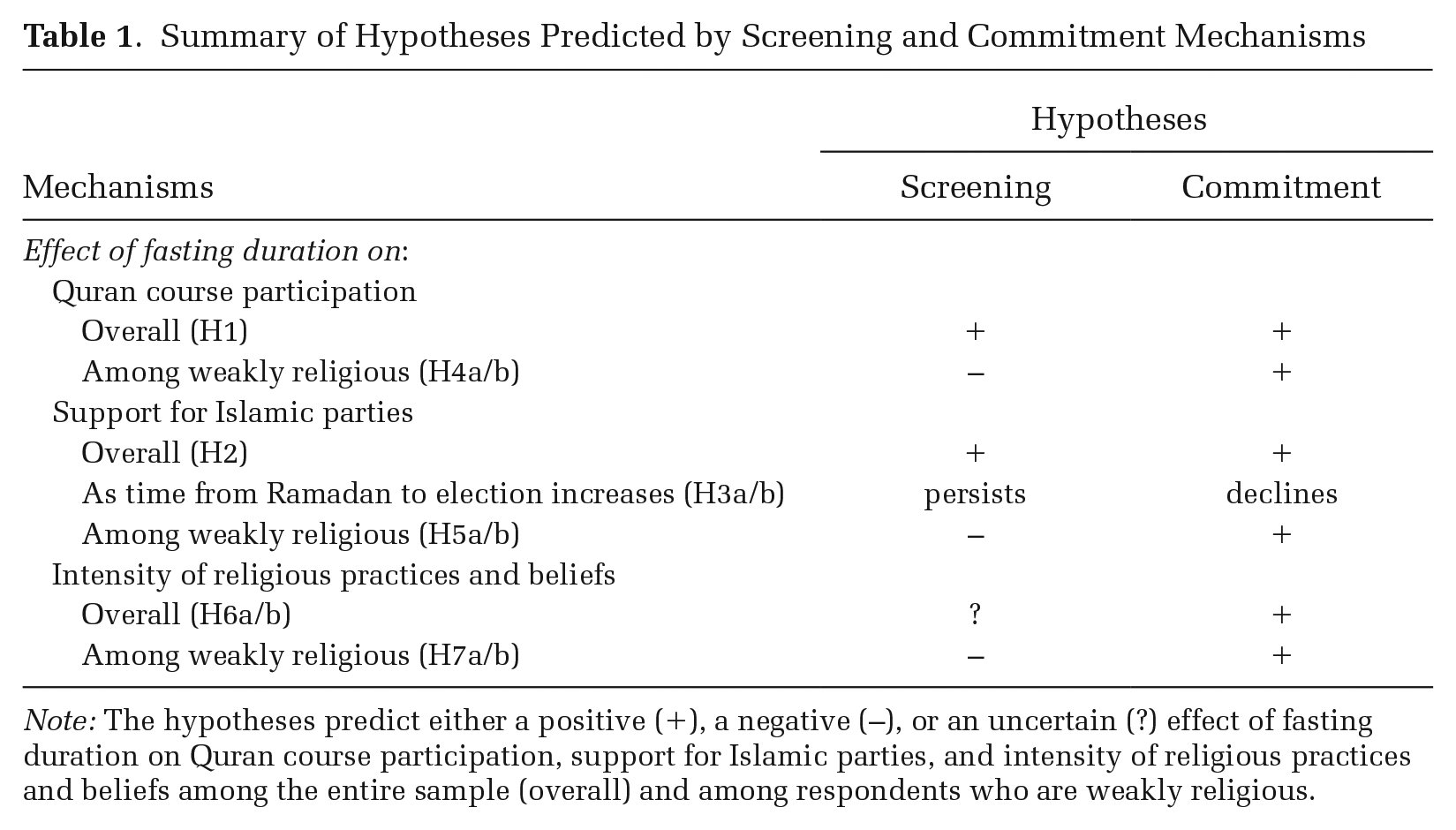
Note: The hypotheses predict either a positive (+), a negative (–), or an uncertain (?) effect of fasting duration on Quran course participation, support for Islamic parties, and intensity of religious practices and beliefs among the entire sample (overall) and among respondents who are weakly religious.
Disentangling Screening and Commitment
Both screening and commitment predict a positive effect of fasting duration on Quran course participation rates and support for Islamist political parties, but they carry different implications that can help us distinguish their respective contribution to our core effects.
First, the distance in time between Ramadan and the first subsequent election may help us disentangle the commitment mechanisms from screening. 3 Screening would change the composition of religious organizations: when fasting becomes costlier, individuals who are less religiously engaged distance themselves from religious organizations and communities. This should bring about structural changes in Islamist organizations, and Ramadan daylength variations should have a longer-term effect. The commitment mechanism, by contrast, relies on psychological states, such as cognitive dissonance, self-perception, or sense of group identity, that are more likely to wane as the fervor induced by longer fasting fades from memory (Fridhandler 1986). Hence, if an election takes place many months after Ramadan, the effect of daylength on Islamist votes should either persist or weaken depending on whether screening or commitment is the mechanism that matters most (Hypothesis 3a versus 3b).
Another set of diverging implications concerns the heterogeneity of the effects. Screening predicts that religious organizations and parties would flourish, and their remaining members become more committed, following a Ramadan with longer days. But individuals who are not prepared to bear the costs of longer fasting should reduce their religious participation and ultimately screen themselves out of the religious community altogether. This implies that people who are weakly religious would turn away from religious communities and Islamist political parties. The screening mechanism thus predicts that among the weakly religious, the effect of the duration of Ramadan fasting on Quran course participation rates and support for Islamist political parties should be negative (Hypotheses 4a and 5a).
By contrast, the commitment mechanism predicts that as fasting days lengthen, individuals who fast, including the feebly religious, should become more committed. The self-perception theory (e.g., commitment), and the mechanism that works through shared experiences of hardship, predict that even some weakly religious individuals will start fasting as fasting gets gradually longer: religious identity in the community will strengthen, compelling some who are weakly religious to fast, and as self-perception theory and commitment by example predict, some individuals will infer that they too must be highly religious as people around them continue fasting despite the increased duration (Hypotheses 4b and 5b).
Finally, we can distinguish the screening and commitment theories through their direct effects on individuals’ religious practices and beliefs. As fasting duration increases, the commitment mechanism predicts that the frequency of fasting and the strength of religious beliefs should increase, even among the weakly religious. The screening mechanism predicts that religious effort should decrease among the weakly religious. In which direction this effect alters the average level of religious effort in the population, however, cannot be predicted from screening, for a reduction among the weakly religious may be compensated for by an increase among the strongly religious. So, the overall effect of fasting duration on religious practices and beliefs predicted by the club good model is uncertain. These predictions constitute Hypothesis 6a versus 6b and Hypothesis 7a versus 7b (see Table 1).
Natural Experimental Design
Our hypotheses are about the effects of exogenous changes in fasting duration. But how do these changes occur? A peculiar feature of the timing of Ramadan was first exploited by Campante and Yanagizawa-Drott (2015). The starting day of Ramadan is determined by the lunar calendar, which is shorter than the solar calendar. Each year, therefore, Ramadan shifts backward by about 11 days. When it falls in the summer, days are longer and hence fasting is more demanding to bear. Moreover, the more distant an area is from the equator, the higher the temporal change in Ramadan daylength, providing further independent variation in the cost of religious fasting.
These cyclical time changes in Ramadan allow us to carry out a “natural experiment,” that is, a design that “[exploits] some external event or institutional condition that creates exogenous variation in the social process of interest” (Gangl 2010:28). Such designs, as opposed to typical observational studies, circumvent the problem of endogenous choice into treatment. In our case, the fasting duration varies by “nature” literally, and hence is arguably exogenous to the system of variables we are interested in. For example, the design circumvents reverse causality, for neither votes for Islamist parties nor Quran course participation rates can affect fasting duration. Moreover, it is difficult to imagine confounder variables that cause both the cyclical changes in fasting duration and our outcome variables. The cyclical changes in fasting duration occur due to the interaction between latitude and time. One can think of confounders associated either with latitude and outcomes (e.g., provinces of certain latitudes could be traditionally more or less religious) or with time and outcomes (e.g., popularity of Islamist parties or religiosity may be particularly high at certain periods), such confounders can be addressed by fixed effects of provinces and time in statistical models.
To be clear, confounders that vary by both latitude and time in a way to precisely track the changes in fasting length induced by the interaction of latitude and calendar cannot be accounted for by those fixed effects. Such confounders, if there are any, would be a threat to causal identification. It is, however, difficult to think of such confounders that operate over the span of decades we consider here. In addition, we carry out various placebo tests and robustness checks (e.g., by controlling for lagged values of outcome variables) that would hint to the existence of such confounders. Overall, this design approximates an “experiment” in which fasting duration is assigned to provinces exogenously.
Empirical Context
Our study uses data from Turkey, several properties of which make it a suitable research site. We describe the geographic, political, and religious landscape in Turkey in some detail, to show the extent to which Islamic political parties represent the pious denizens of the country. We also describe the social and political background of Quran courses, participation in which constitutes our other dependent variable.
First, Turkey is one of the most northern Muslim-majority countries. This means seasonal shifts in Ramadan daylength vary considerably over time. Figure 1 shows Turkey’s northernmost (Sinop) and southernmost (Hatay) province and their respective lengths of Ramadan days since the 1970s.
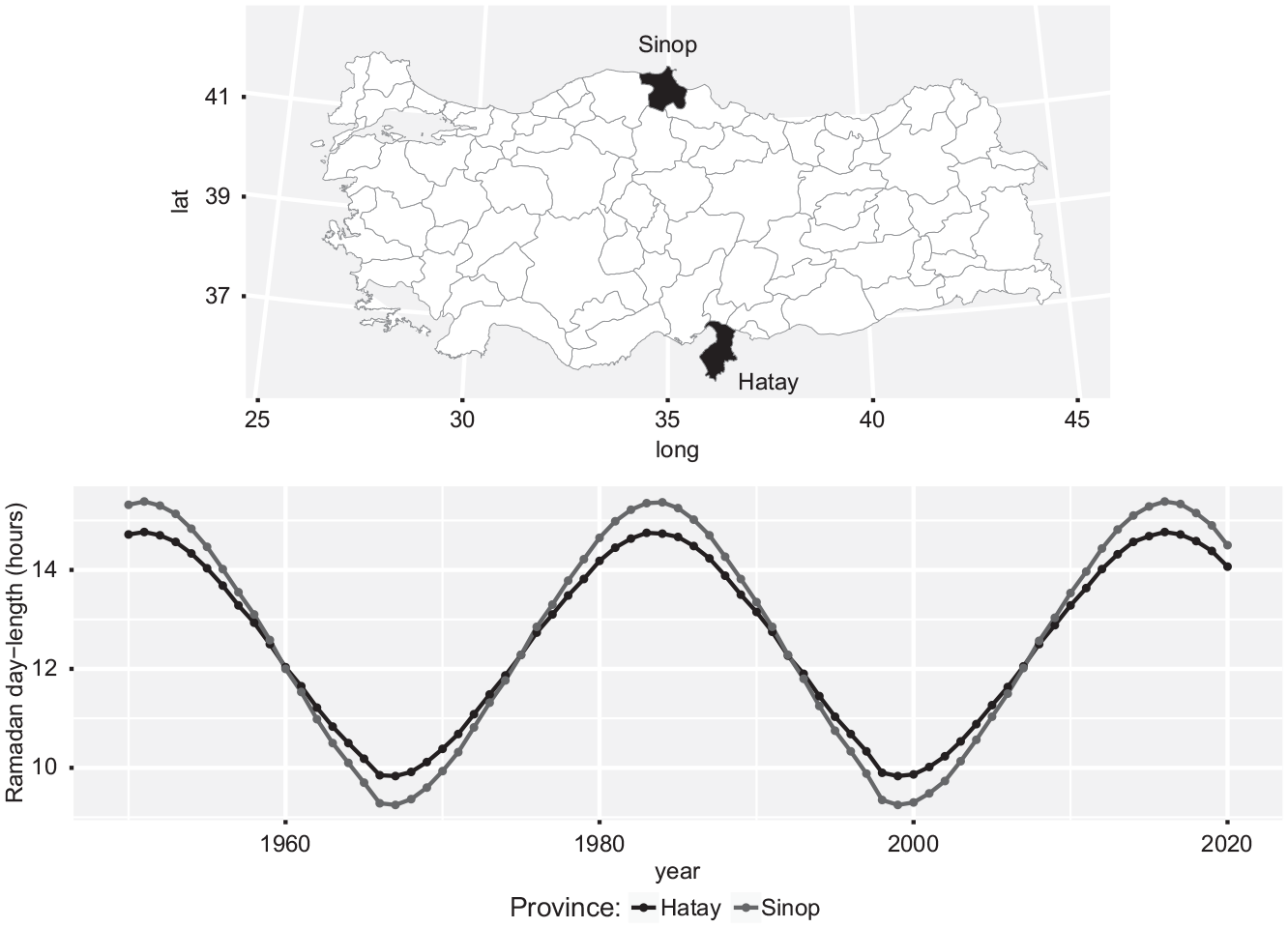
Upper Panel: Turkey’s Provinces with the Most (Sinop) and Least (Hatay) Northern Provinces Highlighted; Lower Panel: Change in Ramadan Daylength in Sinop and Hatay over Time
Second, Turkey has had a string of political Islamic parties dating back to the early 1970s, which has built on a continual Islamist movement. This continuity of political Islam helps us observe long-term trends in Islamic votes and identify the effects of the long Ramadan daylength cycles.
Turkey experienced a state-controlled modernization and secularization program after 1923. Ziya Gökalp, a sociologist who was influenced by Durkheim and played an important role in this early program, promoted Turkish nationalism as the cultural basis of the new republic (Bellah 1958). This vision aimed at liberating the individual from religion and tradition (Mardin 2010). This program created a secular and urban cleavage, but most citizens remained poor and pious (Yavuz 1997). Devout Muslims felt rejected by the secular ruling cadres (Somer 2017). Turkey’s political Islam challenged this state-controlled modernization program and appealed to the marginalized and pious denizens with a prosperity and democracy discourse (Turan 2007).
The National Order Party (MNP), founded in 1970 by Necmettin Erbakan, was one of the first of these Islamist political parties (Özbudun 2006). The MNP was quickly shot down by the constitutional court after the military coup of 1971 and then replaced by the National Salvation Party (MSP). The MSP put forward an explicitly Islamist political agenda, known as National Outlook (Milli Görüş). This agenda prioritized a moral and spiritual awakening as a means of achieving economic prosperity. The MSP saw westernization and the abandonment of Islamic principles as the main causes of economic underdevelopment and called for a return to Islamic roots. The MSP was shut down after a military coup in 1980 and was reorganized in 1983 as the Welfare Party (RP). The RP enjoyed moderate political success. In 1994, Recep Tayyip Erdogan, the RP’s candidate, was elected as Istanbul’s Mayor.
A key turning point in Turkey’s political landscape came in 1998. After a military intervention, the constitutional court shut down the RP for violating the constitution’s secularist principles. Erbakan was banned from politics. This paved the way for a new generation of politicians to spearhead the Islamic movement. The traditionalists of the RP reorganized under the Felicity Party (SP), and a new branch formed the Justice and Development Party (AK Parti). In its first elections in 2002, the AK Parti secured 34 percent of the votes and found itself the sole party in the government. The AK Parti went on to win all parliamentary elections since then and has gradually consolidated its power. Except for the 1983 elections marred by the 1980 military coup, in all parliamentary elections since 1973, at least one Islamist political party participated. Turkish democracy has been imperfect, but elections, especially those before 2015, are considered to have been relatively free and fair (Akkoyunlu 2017).
The resilience of Islamist political parties has been due to a machine-like grassroots movement organized at the level of neighborhoods. This movement provided Islamic parties with strong local networks, close interactions with residents, and an arguably legitimate representation of the pious. The AK Parti expanded on this grassroots movement by investing heavily in a capillary local welfare system (Aksoy and Billari 2018; Aksoy and Gambetta 2021; Buğra and Keyder 2006). In this system, funds raised by local organizations through charity and private donations are channeled by local municipalities to assist marginalized groups. Religious motivations are central to this system, as Islamic values are often used to facilitate charitable giving and social assistance (Buğra and Keyder 2006).
The AK Parti Era
The AK Parti had its origins in this long tradition of Islamist political parties and their grassroots organizations (Mecham 2004). But in terms of the scale of power it obtained, the AK Parti era represents a marked upward shift. Figure 2 shows the vote shares of Islamist political parties in Turkey’s provinces in four time periods. The decades after 2000 were dominated by the AK Parti. Although geographic differences in Islamic votes do not seem to have changed substantially from the 1990s to the period after 2000—Islamist parties have traditionally been strong in the hinterland—the overall vote share of the AK Parti in nearly all provinces has gone up.
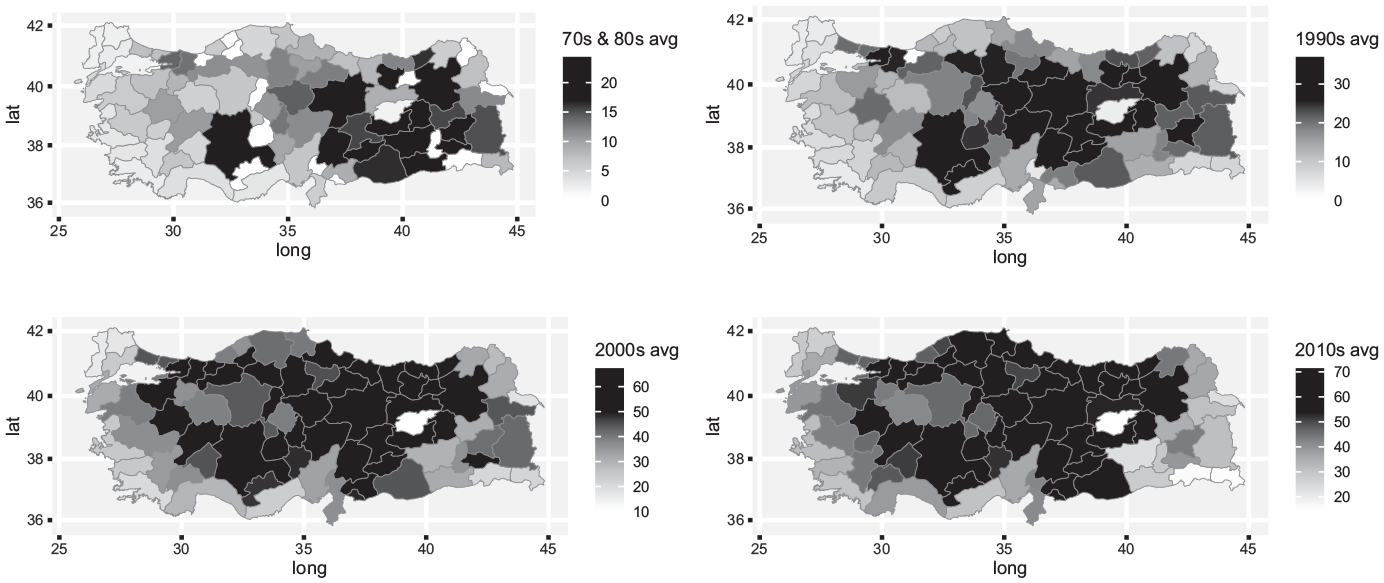
Geographic Distribution of Votes for Islamic Political Parties, Province Averages in 1970 to 1989, 1990 to 1999, 2000 to 2009, and 2010 to 2018
The AK Parti came to power in 2002 after an economic crisis. It initially started as a moderate party, presenting itself as a platform that gave voice to poor, marginalized, and religious citizens. During this early period, the party stressed economic prosperity and democratization. Turkey’s process of ascension to the European Union was revitalized, and a series of new harmonization laws and democratic reform packages were introduced in the Turkish legal system. These reforms checked the power of the secular army on politics and enabled political movements, particularly Islamist movements, to grow (Özer 2015).
As it gradually consolidated power, the AK Parti started to dismantle the secular tradition and institutions and, as some argue, put in motion an “Islamization” agenda (Kuran 2018). Erdogan declared that “raising a pious generation” was a policy goal. The AK Parti lifted the ban on veiling in public offices and schools, and it expanded the capacity of state-funded religious vocational schools (Imam-Hatip). It increased the budget of the sole religious authority of the country, the Turkish Presidency of Religious Affairs (TPRA), by fourfold (Aksoy and Gambetta 2021). The number of religious personnel (e.g., imams, preachers, teachers, office staff) working for TPRA increased from around 80,000 in 2006 to 130,000 in 2020. During this period, as Öztürk (2016) argues, the TPRA turned into a state apparatus that disseminates the ideology of the AK Parti.
Finally, in 2012, the AK Parti government removed the minimum age requirements to attend the voluntary Quran courses organized by TPRA. TPRA also increased the number of Quran courses by employing more staff and expanding to the secular school system. The number of Quran courses shot up from around 4,000 in 2002 to nearly 19,000 in 2020. Figure 3 shows median Ramadan daylength, Islamic vote shares, and the number of individuals who attended Quran courses per 1,000 citizens, by province. A sharp increase in Quran course participation rates after 2012 is apparent.
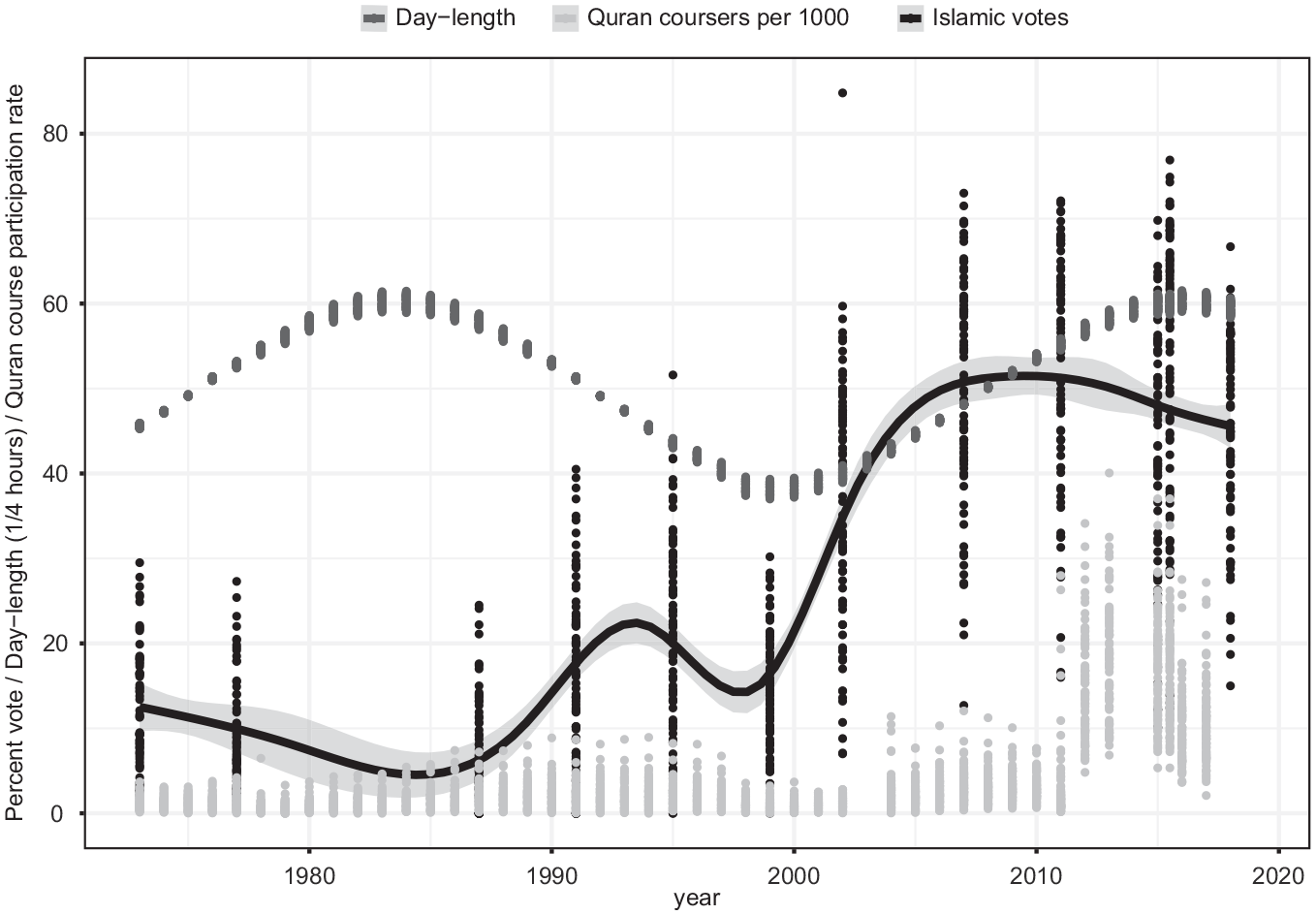
Vote Shares of Islamist Parties, Quran Course Participation Rates per 1,000 Inhabitants, and Average Daylength during Ramadan
Data
We test our hypotheses using four data sources: a longitudinal province-level dataset that enables rigorous tests of Hypotheses 1, 2, 3a, and 3b; two additional individual-level surveys, “Life in Ramadan,” conducted by KONDA (2014), that allow us to test all hypotheses but 1 and 4a/4b cross-sectionally; and Turkey’s Demographic and Health Survey (2008 to 2013 waves), which allows independent individual-level tests of Hypotheses 1, 4a/4b, 6a/6b, and 7a/7b. We also use six waves (1990 to 2018) of the World Values Survey for exploratory analyses.
Province-Level Data
Islamic votes, which we obtained from TurkStat, reflect the vote shares of MSP in 1973 and 1977, RP in 1986 to 1996, FP in 1999, and the sum of AK Parti and SP after 1999. 4 The number of Quran course attendants was reported by TurkStat annually (with gaps); we use these data to calculate attendants per 1,000 inhabitants since 1973. Annual province populations also come from TurkStat. 5
We matched these data with the median daylength in the most recent Ramadan that precedes the election when we predict election results, and in the previous year when we predict Quran course attendance. We calculated daylength based on provincial sunrise and sunset times published by Bogazici University Kandilli Observatory.
We calculated center-left vote share from the (sum of the) vote shares of CHP, DSP, SHP, and HP. We also collected data on GDP growth, the number of Mosques (both as a static value and a dynamic annual measure per 1,000), religious personnel per 1,000 in 2016, and a measure of the prevalence by province of non-orthodox Muslims, known as Alevis, who do not generally fast during Ramadan (World Directory of Minorities and Indigenous Peoples 2018) and are traditionally distant from political Islam (Tahire and Göker 2000).
Province GDPs were available from TurkStat since 1988, except for 2002; we used these data to calculate a yearly growth rate. The static values of the number of mosques and religious personnel were reported by TPRA for 2016. The dynamic measure of the number of Mosques was reported by TurkStat annually since 1981 (with gaps). Proportion of Alevis was based on a KONDA (2007) survey and was calculated at the NUTS-1 level.
Descriptive statistics of all variables for all datasets can be found in Part A of the online supplement. When we analyze province-level data, we use multiple imputation of missings in Quran course attendance and dynamic control variables (Van Buuren 2007). See Part B of the online supplement for details of missing data and imputation.
KONDA Survey on Life in Ramadan
The Life in Ramadan survey was conducted right after the Ramadan of 2014, with 2,720 respondents across the country. The sample was representative and gathered with a stratified approach. The survey was specifically conducted to assess Ramadan fasting, and it includes rich data on religious beliefs and practices (for further details, see KONDA 2014).
Based on a respondent’s region, which was reported at the NUTS-1 level, we assigned a measure of median Ramadan daylength in 2014. This variable takes four values (1 to 4) from shortest to longest. We also constructed an alternative coarser measure, with three daylength categories, for robustness checks.
The survey included a question on how many days the respondent fasted during the last Ramadan (0 to 30), a measure of self-reported religiosity with four answer categories from non-religious to highly religious, and how often (1 = never to 5 = always) the respondent attended evening prayers during Ramadan.
Here we address a measurement concern. Quran course attendance and Islamic votes in our province-level dataset rely on registry data and hence do not suffer from overreporting or social desirability. In surveys, however, respondents have been shown to overreport religious participation due to social desirability, failure of memory, or differential nonresponse (Hadaway, Marler, and Chaves 1993). The measures of Ramadan fasting, religiosity, and prayer frequency included in this dataset and in TDHS (see the next section) could thus be inflated. However, our results of interest are the variations in religious behaviors comparing two exogenously given variations: survey year and northern versus southern latitudes. Because it is hard to conceive of a plausible reason why survey subjects should overreport their religious behaviors more in some years than in others, or more in northern latitudes than in southern ones, overreporting should not be a threat to our results.
The survey asked respondents which political party they would vote for if there was an election that day. We created a binary variable indicating if the respondent selected the AK Parti (coded as 1) versus any other parties (coded as 0).
The survey included a question on how respondents described their “life-style.” The answer categories were modern, traditional conservative, and religious conservative. We collapsed the latter two categories and created a binary variable indicating whether respondents described themselves as modern (coded as 0) versus conservative (coded as 1).
As control variables, we included education (seven categories from illiterate to graduate degree, treated as continuous), household income per capita (in TL), respondent’s denomination (Sunni = 1, Alevi or any other denomination = 0), age in years, gender (1 = female, 0 = male), the number of people in a respondent’s household, urbanicity (metropolitan = 1, smaller urbanicity = 0), ethnicity (Turkish = 1, other = 0), and whether the respondent was from a predominantly Kurdish region (i.e., East or South East). The KONDA survey had no information on Quran course participation.
Turkey’s Demographic and Health Survey
The 2008 and 2013 TDHS surveys we use were based on representative samples of Turkish households. TDHS only interviewed women of reproductive age (15 to 49). The 2008 sample only included ever-married women; the 2013 sample included all women. To facilitate comparison of the 2008 and 2013 samples, we restrict the 2013 sample to ever-married women. Response rates were over 90 percent. Further details of TDHS can be found in Hacettepe University Institute of Population Studies (2008 to 2014).
The surveys indicate the province of the respondent; we use these data to merge the median daylength during Ramadan of 2008 and 2013. This will be our main independent variable. In addition, the survey included a question on whether the respondent fasts regularly (1 = yes, 0 = no), which we use as a dependent variable, and prays regularly (1 = yes, 0 = no), which we use as a measure of religiosity.
Respondents were also asked if they ever attended a Quran course (1= yes, 0 = no), which we use as a dependent variable. This measure is not ideal because we are interested in a change in attending a Quran course in 2013 compared to 2008. An ideal variable would record if the respondent attended a Quran course in the previous year or the past five years. With our data, the variable can be 1 in 2013 even if the respondent attended the Quran course before 2008. To address this issue, when we predict Quran course participation, we restrict the sample to respondents who were 21 or younger by the time of the survey. This way, we ensure that most respondents in 2013 were not eligible to attend a Quran course in or before 2008, for they would be younger than 15, which was the minimum age requirement. We report sensitivity analyses in the online supplement, where we include respondents of older ages in the analyses.
We use the following variables as controls: province and survey-year fixed effects, age in years, marital status, ethnicity, income, urbanicity, education, household wealth, and the number of children a woman has (see Part A of the online supplement).
World Values Survey Trend Data
We use the World Values Survey (WVS) Trend Dataset (Haerpfer et al. 2021) for exploratory analyses. This dataset compiles the WVS waves from Turkey collected in 1990, 1996, 2001, 2007, 2011, and 2018. It includes the frequency of mosque attendance (seven categories, recoded and normalized as 0 [never] to 1 [more than once a week]) and subjective importance of religion (four categories, recoded and normalized as 0 [not at all] to 1 [very]). It also measures the party the respondent would vote for in the next election. We recorded this variable as 1 if a respondent indicated an Islamist party (coded the same as the province dataset, see above) and 0 otherwise. We use gender, education, and age as control variables. WVS does not consistently register the geo-location of respondents in Turkey, so we cannot analyze the effect of Ramadan daylength. Nevertheless, these data enable us to analyze how the association between religiosity and the likelihood of voting for Islamist political parties changed over time.
Results
The results show that Ramadan daylength has a large effect on both Quran course participation rates and Islamic votes. A half-hour increase in Ramadan fasting length results in about one more Quran course attendant per 1,000 residents of a province in the following year. The same increase in fasting hours in the Ramadan before a general election increases the vote share of Islamic parties by about 3.5 percentage points. To appreciate how large an effect this is, consider that it corresponds to an 11 percent increase relative to the overall mean vote share of Islamic parties, which is 31 percent. Ramadan daylength, however, does not have significant effects on electoral turnout, center-left votes, or, as a placebo test, population (see Table 2). 6
Effect of Fasting Hours (Daylength) during Ramadan on Various Outcome Variables Based on Regression Models That Include Fixed Effects for Provinces and Election Years
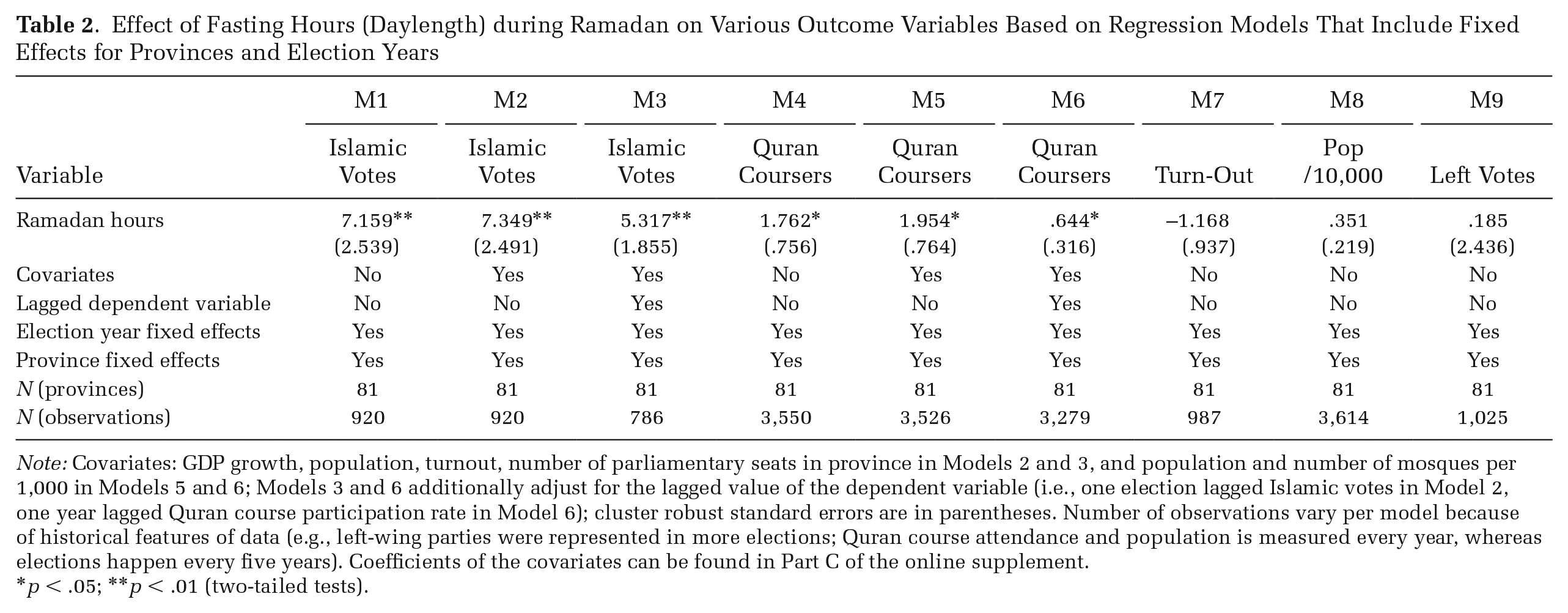
Note: Covariates: GDP growth, population, turnout, number of parliamentary seats in province in Models 2 and 3, and population and number of mosques per 1,000 in Models 5 and 6; Models 3 and 6 additionally adjust for the lagged value of the dependent variable (i.e., one election lagged Islamic votes in Model 2, one year lagged Quran course participation rate in Model 6); cluster robust standard errors are in parentheses. Number of observations vary per model because of historical features of data (e.g., left-wing parties were represented in more elections; Quran course attendance and population is measured every year, whereas elections happen every five years). Coefficients of the covariates can be found in Part C of the online supplement.
p < .05; **p < .01 (two-tailed tests).
These results, which strongly support Hypotheses 1 and 2, are robust when controlling for several variables, including the lagged values of the dependent variables. Note that the models in Table 2 include year and province fixed effects, which adjust for the effects of all observed and unobserved variables that are constant over time in a province and any year-on-year shifts in political preferences or demand for Quran courses that are constant across provinces. In other words, the models estimate an effect of within province change in Ramadan daylength on within province change in Quran course attendance and Islamic votes, while accounting for country-level time trends. The causal identification of the effect of Ramadan daylength rests on the idiosyncratic variation of daylength due to the interaction between latitude and seasonal cycles of Ramadan. 7
The TDHS data enable an independent test of Hypothesis 1 (as well as Hypotheses 4a/4b, 6a/6b, and 7a/7b, see Table 1). We fit the same regression model with province and year fixed effects to TDHS, predicting the likelihood of having attended a Quran course. Results show a significant effect of Ramadan daylength on Quran course attendance probability, which is robust when controlling for several covariates (see Table 3, Models 1 and 2). Figure 4 (right panel) shows the change in Quran course participation prevalence versus change in Ramadan daylength, calculated using data from TDHS.
(Heterogeneous) Effects of Fasting Hours (Daylength) during Ramadan on Individual Probability to Attend Quran Courses and Fast Based on Regression Models That Include Fixed Effects for Provinces and Years
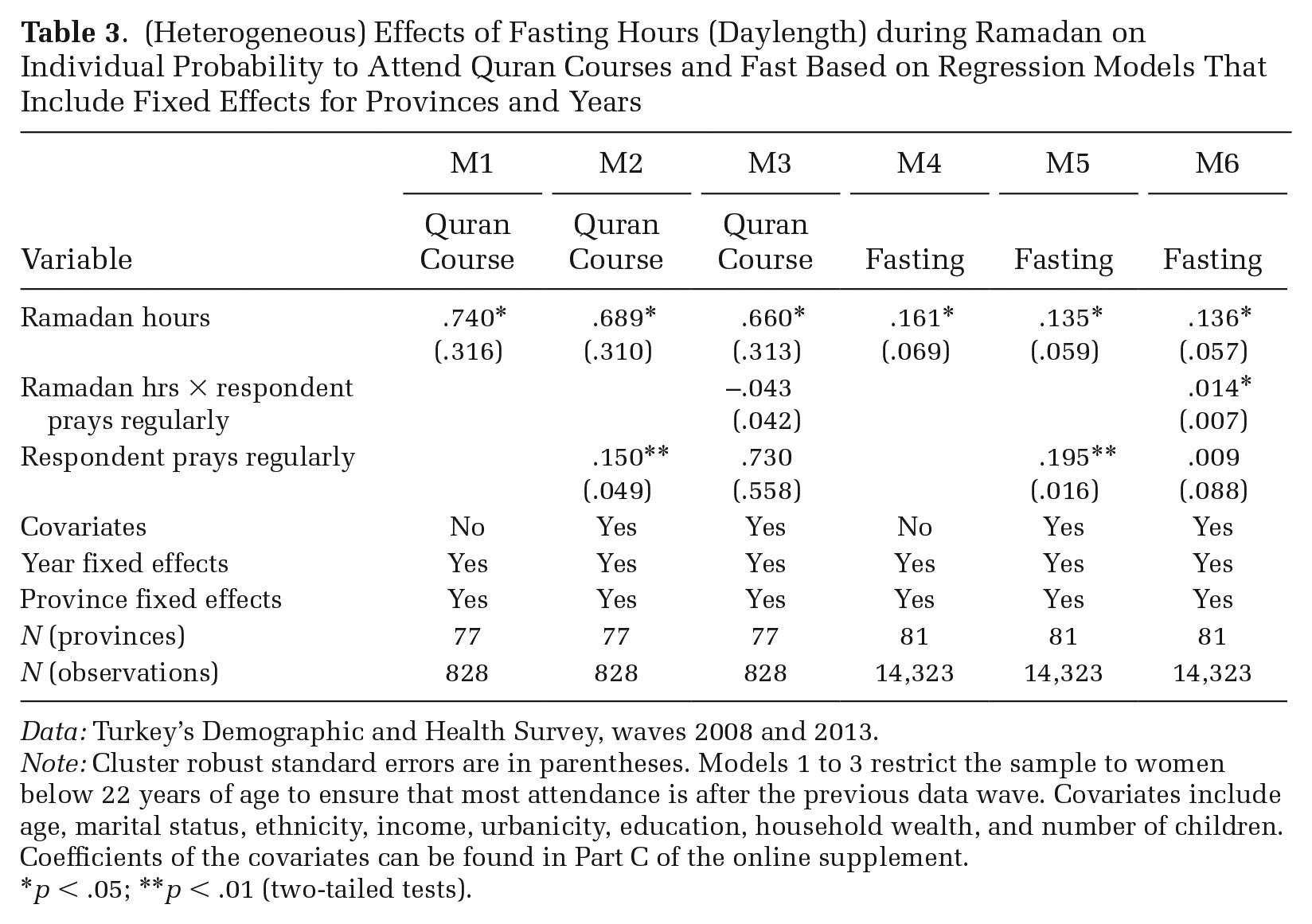
Data: Turkey’s Demographic and Health Survey, waves 2008 and 2013.
Note: Cluster robust standard errors are in parentheses. Models 1 to 3 restrict the sample to women below 22 years of age to ensure that most attendance is after the previous data wave. Covariates include age, marital status, ethnicity, income, urbanicity, education, household wealth, and number of children. Coefficients of the covariates can be found in Part C of the online supplement.
p < .05; **p < .01 (two-tailed tests).
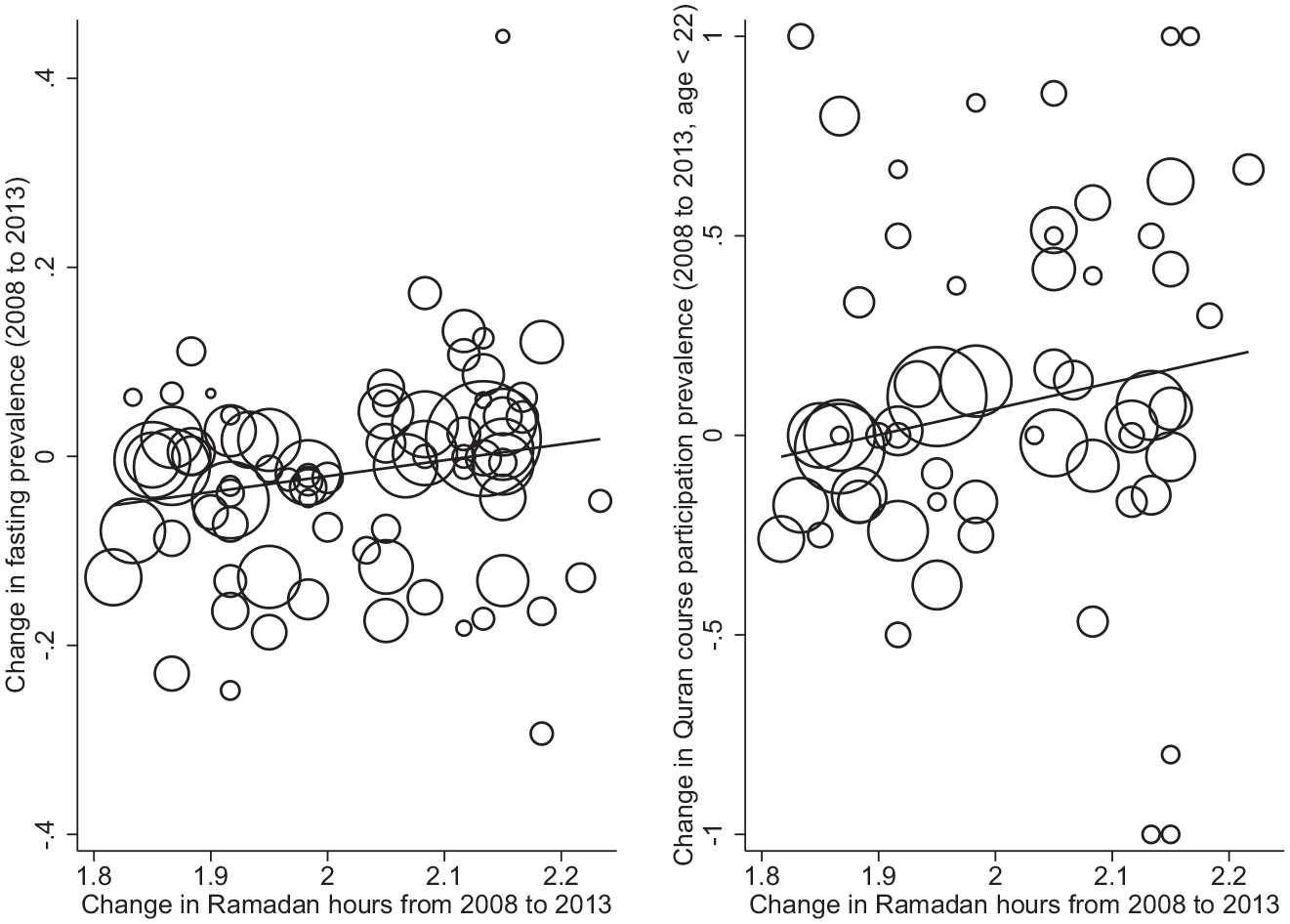
Change in Fasting Prevalence and Quran Course Attendance Prevalence versus Change in Ramadan Daylength in Hours from 2008 to 2013, by Province
The KONDA survey enables an independent test of Hypothesis 2, that the longer the duration of Ramadan fasting, the greater the vote shares of Islamist political parties. We fit a Structural Equation Model (SEM) to test Hypothesis 2, and all other hypotheses but Hypotheses 1 and 4a/4b in a single model. Figure 5 (panel A) presents the model as well as estimated path coefficients. In the model we use daylength (i.e., fasting duration) in the respondent’s region as an instrument for a latent variable religiosity (Rel.). Latent religiosity is measured by three items: self-reported subjective religiosity, the number of days fasted, and the frequency of attending prayers. Latent religiosity, in turn, affects the likelihood of voting for an Islamist party (i.e., AK Parti). The correlation between the disturbance terms e1 and e2 captures endogeneity between (i.e., the effects of unobserved confounders on) latent religiosity and Islamic votes. The model is fitted with Full Information Maximum Likelihood to handle missing data. We find a strong positive total effect of daylength on the likelihood of voting for Islamist AK Parti (total effect = .03, standard error = .009, p < .001). Overall, we find strong support for Hypotheses 1 and 2 using independent data sources and different analysis methods.
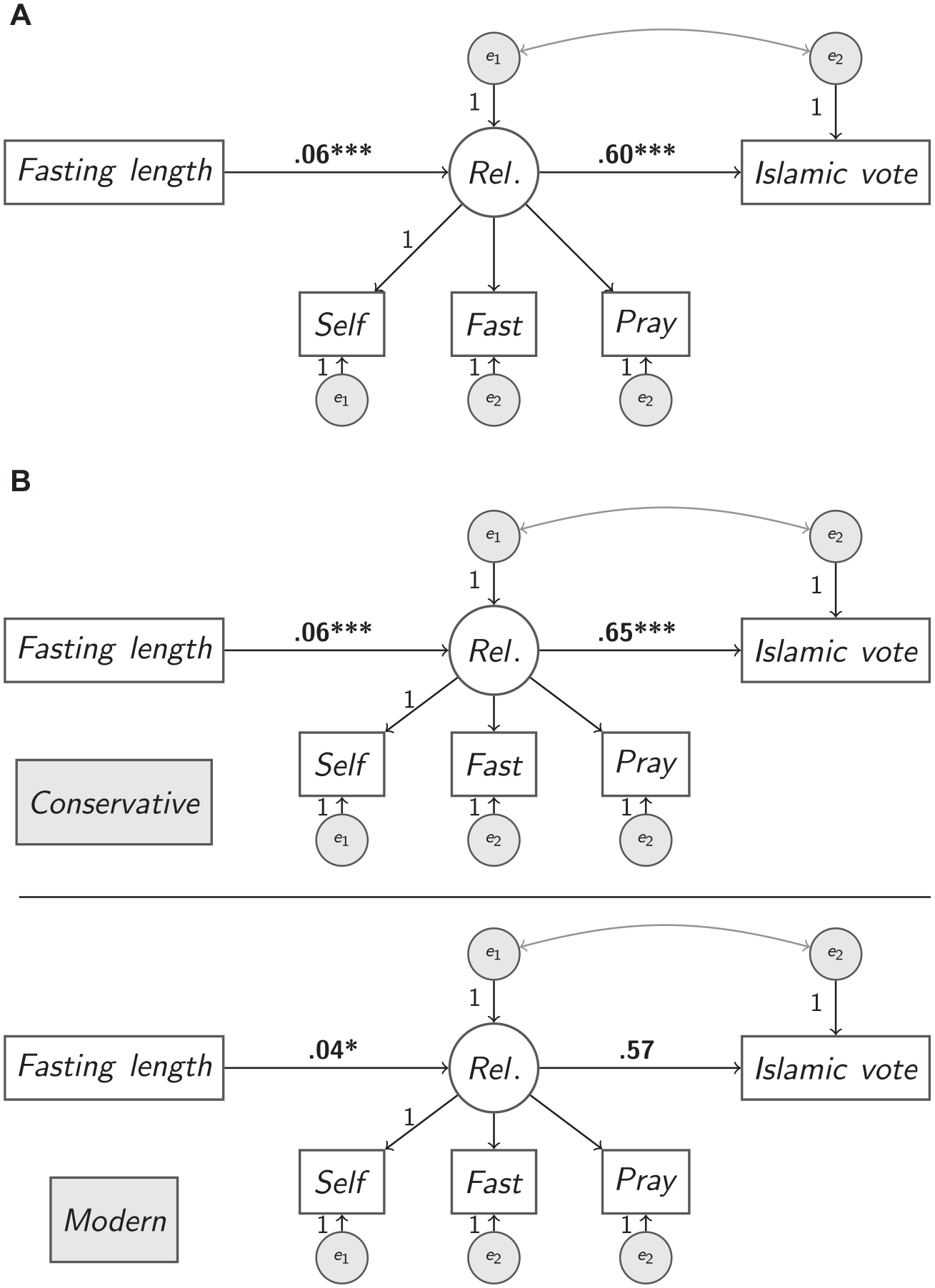
Structural Equation Models Fitted to the KONDA (2007) Data
Robustness Checks
The robustness checks with province-level data include testing interactions of the daylength variable with the proportion of Alevis, mosques, and religious personnel; allowing the effect of daylength to vary across provinces (i.e., random slopes); allowing the election year effects to vary across provinces; and predicting Islamic votes dropping the 12 elections and 81 provinces one-by-one and re-estimating the effect (see Part E of the online supplement).
The SEM results are robust to using the alternative coarser measure of daylength (three categories) and a binary version of days fasted (zero days versus full 30 days fasted), and to controlling for lifestyle (modern versus conservative) in the model in Figure 5, panel A. Note that results in Figure 5 are based on Full Information Maximum Likelihood estimation. Results are robust to using the more conventional two-stage least squares estimation by instrumenting self, fast, and pray variables separately on fasting length (see Part F of the online supplement).
Finally, we fitted models to TDHS while changing the age cutoff in sample selection in predicting Quran course participation rates (see Part G of the online supplement). As expected, the effect of Ramadan daylength on Quran course participation probability decreases as we gradually include older respondents in the analysis; in the 2013 survey, for example, these respondents would have participated in a Quran course before the previous data wave obtained in 2008. Results of these robustness checks make us more confident that the effect of Ramadan daylength is genuine.
Disentangling Screening and Commitment Mechanisms
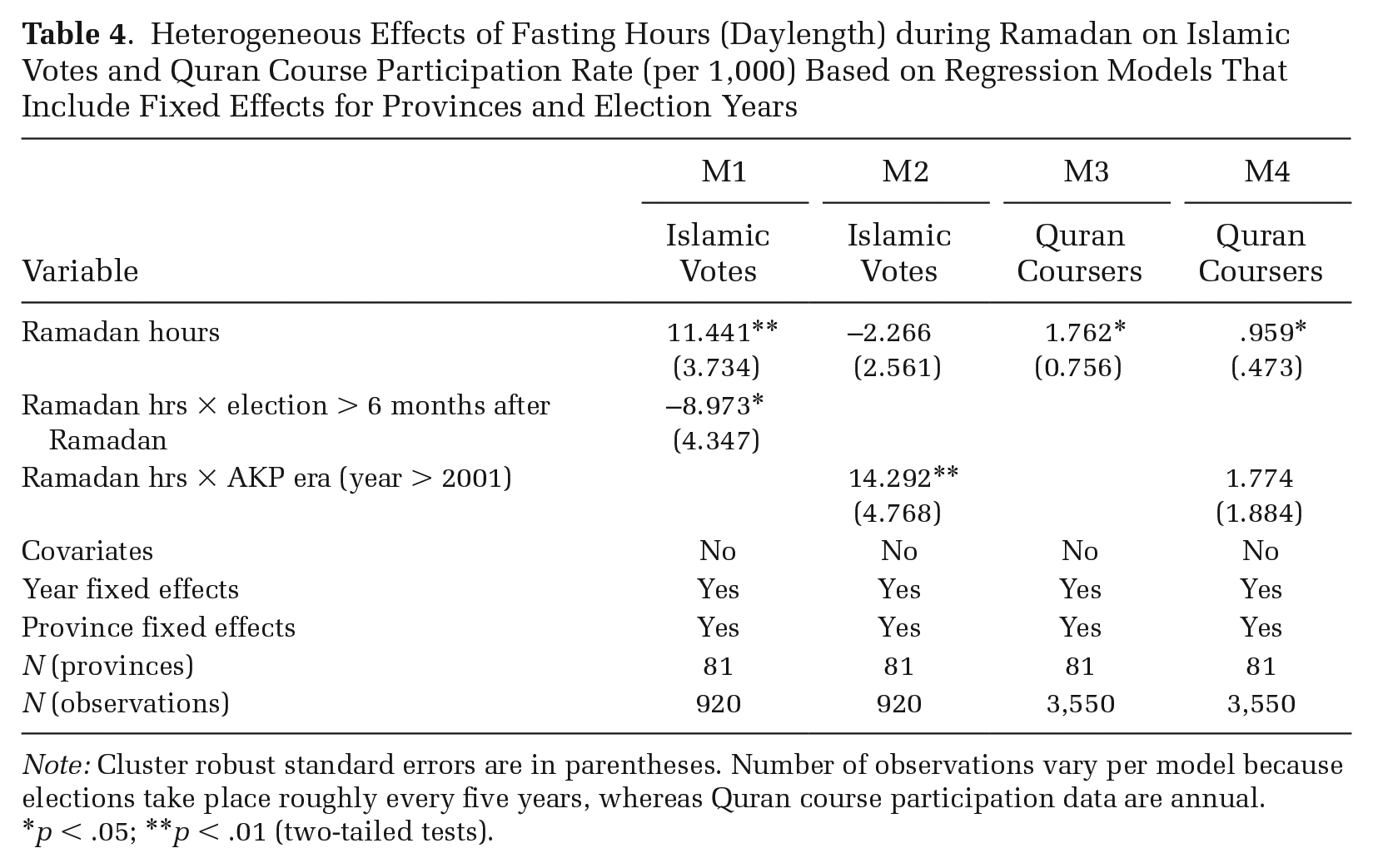
We test Hypothesis 3a versus 3b by checking whether the effect of daylength on Islamist votes persists or weakens overtime. This we do by adding an interaction between Ramadan daylength and a binary variable that indicates if the time between the last day of the most recent Ramadan and the election day is more than six months (Model 1, Table 4). The interaction coefficient shows that when the election is within six months after Ramadan, the effect of Ramadan daylength on the vote shares of Islamist parties is around 11 percentage points, but when the election is more than six months after Ramadan the effect drops to 2.5 (11.44 − 8.97). Figure 6 illustrates this interaction by displaying the association between Ramadan daylength and Islamist votes depending on the time span between Ramadan and elections. In both panels, we see a positive association, but the slope is steeper in the former, when elections are within six months after Ramadan. This finding supports Hypothesis 3b.
Heterogeneous Effects of Fasting Hours (Daylength) during Ramadan on Islamic Votes and Quran Course Participation Rate (per 1,000) Based on Regression Models That Include Fixed Effects for Provinces and Election Years
Note: Cluster robust standard errors are in parentheses. Number of observations vary per model because elections take place roughly every five years, whereas Quran course participation data are annual.
p < .05; **p < .01 (two-tailed tests).
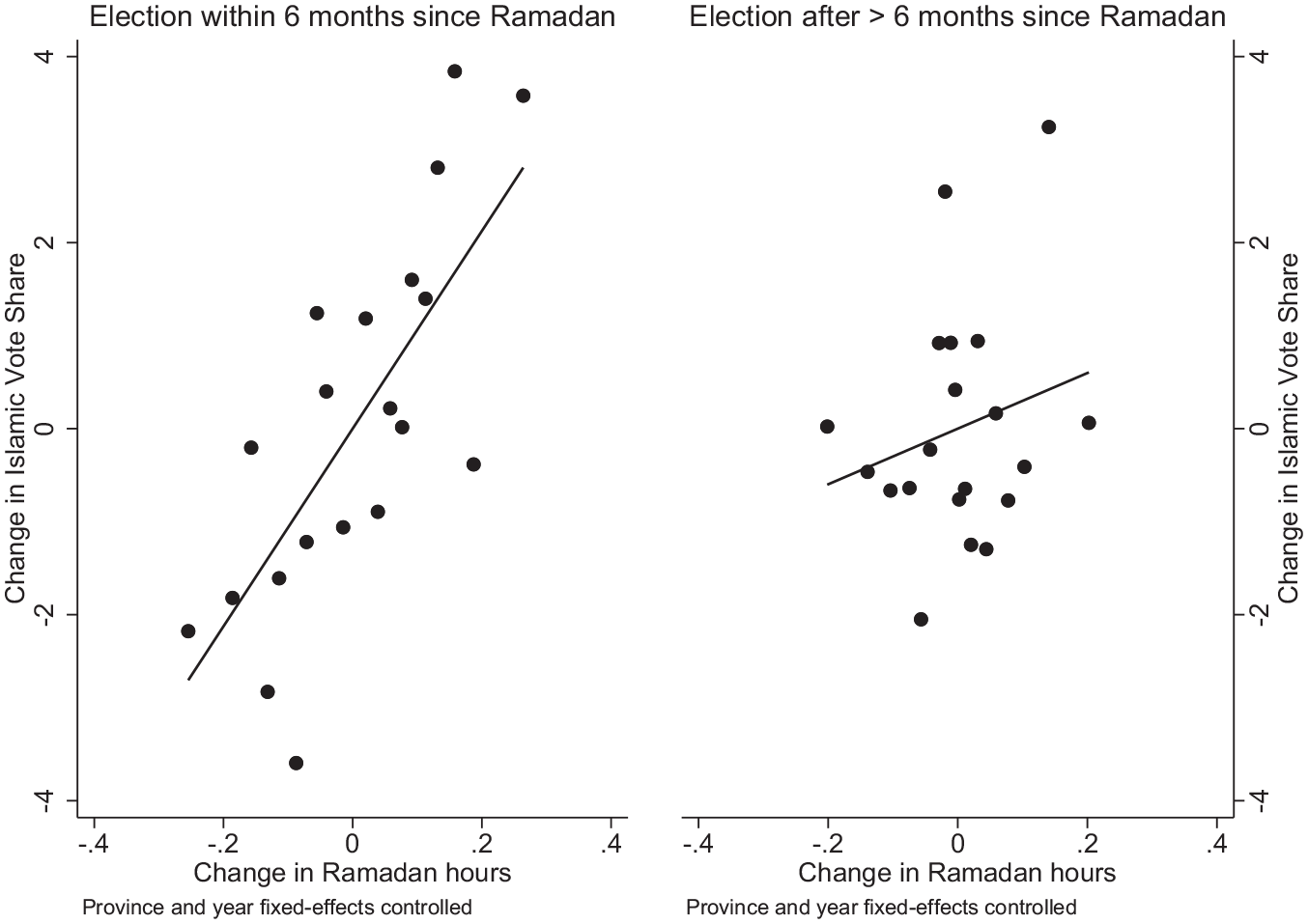
Binned Scatter Plot of the Association between Islamic Vote Shares and Ramadan Daylength Broken Down by Distance between the Most Recent Ramadan and Election Day
Hypotheses 4a versus 4b and 5a versus 5b are about heterogenous effects of fasting duration on Quran course participation and Islamic votes, respectively. The province-level dataset does not include a measure of individual religiosity. Hence, we turn to individual-level surveys. The analysis of TDHS shows there is no statistically significant interaction effect between religiosity (whether the respondent prays regularly or not) and Ramadan daylength on Quran course participation (see Table 3, Model 3). Even among respondents who do not pray regularly, Ramadan hours have a significant positive effect on the likelihood of attending a Quran course (coefficient = .66, p < .05). This finding supports Hypothesis 4b and rejects Hypothesis 4a.
The KONDA survey allows a test of Hypothesis 5a versus 5b. We carry out a multiple-group analysis to capture effect heterogeneity. Respondents report their lifestyle as “modern” or “traditional and religious conservative.” We fit the SEM model for these two groups separately. We use this variable, rather than self-reported religiosity, to group respondents for the following reasons. First, the commitment theories predict that self-reported religiosity should be affected by Ramadan daylength. Grouping based on an endogenous variable would result in selection bias. Moreover, using self-reported religiosity to group participants would prevent us from fitting our desired model in a multiple-group framework, because self-reported religiosity already appears in the model as one of the mediating variables. The lifestyle variable, on the other hand, should not be endogenous to Ramadan daylength, as it is a more general construct referring to respondents’ overall lifestyle. Additionally, it sufficiently reflects respondents’ commitment to traditional and religious norms, hence allowing us to distinguish and compare the weakly and strongly religious. For example, among conservatives, the average of self-reported religiosity variable is 2.97 (out of a maximum of 4), the average number of days fasted during Ramadan is 22, and the average value of Mosque attendance during Ramadan is 3.5 (out of a maximum of 5). The same values for “moderns” are, respectively, 2.42, 14.3, and 2.37.
Figure 5, panel B, shows the multiple-group SEM with the estimated path coefficients. The results support Hypothesis 5b at the expense of 5a. Among the weakly religious, the indirect effect of daylength on Islamic votes via religiosity is positive. The estimated structural coefficients are similar among conservatives and moderns, although statistical power among the moderns is lower due to a lower N. In fact, a test of difference of the two structural coefficients between the conservatives and moderns shown in Figure 5, panel B, is insignificant (χ 2 (2) = 1.56,p = .46). Hence, these two groups can be collapsed into the single group setup in Figure 5, panel A. These findings support the commitment mechanism.
Hypotheses 6a versus 6b and 7a versus 7b are about the effect of fasting length on religious practice and beliefs. Again, the province-level dataset does not have measures of these variables. The TDHS and KONDA surveys do, which allows us to test the hypotheses. The results support Hypotheses 6b and 7b. Analysis of the TDHS data shows that fasting length has a significant, positive effect on the probability of fasting (see Model 4 in Table 3 and the left panel of Figure 4), even among respondents who do not pray regularly (see Model 6 in Table 3, which includes an interaction between Ramadan hours and praying frequency, the main effect of Ramadan hours of .14 applies to respondents who do not pray regularly). Analysis of the KONDA survey shows, with the multiple-group SEM in Figure 5, panel B, that fasting length has a significant positive effect on religiosity overall, and even among the weakly religious moderns.
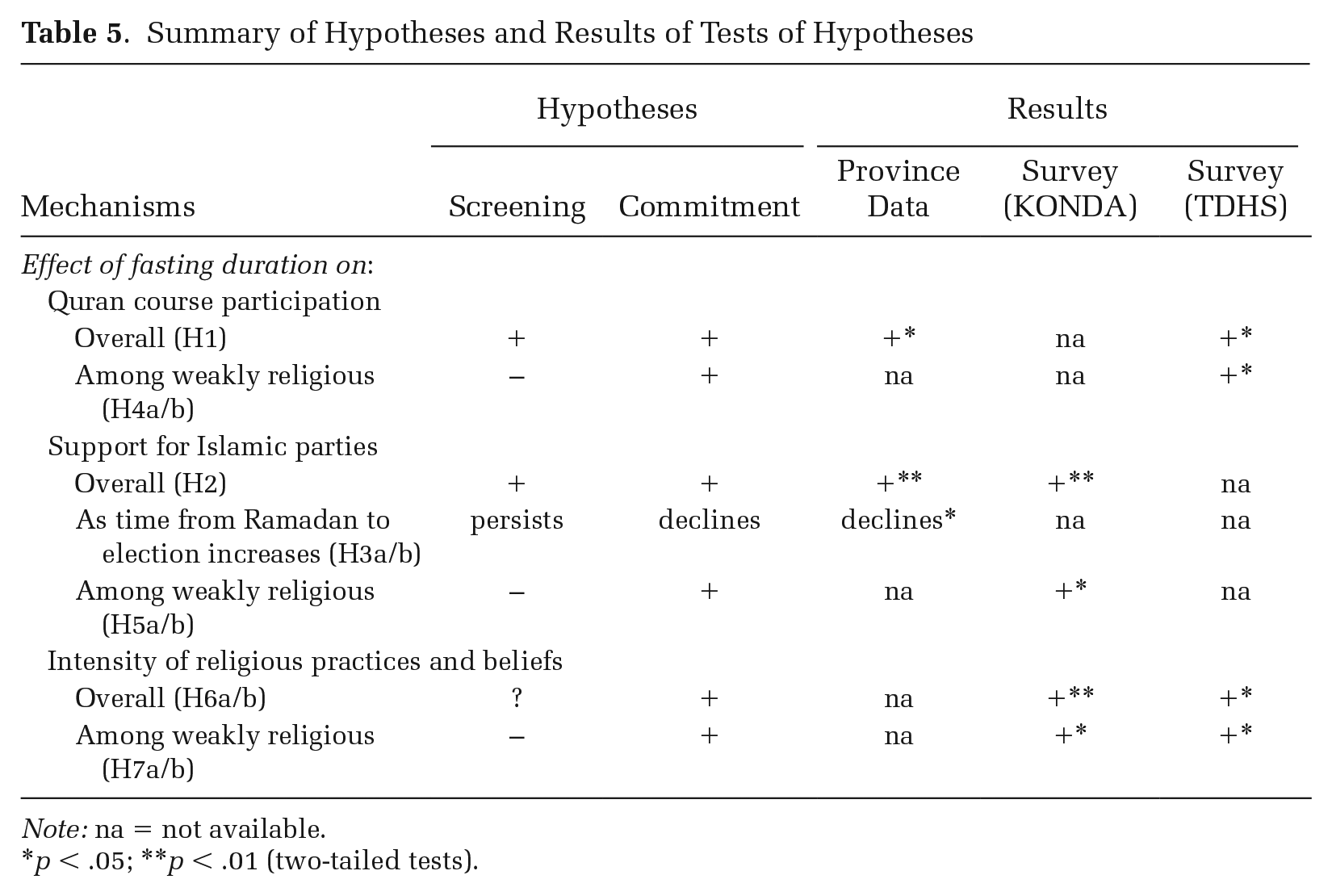
In summary, the results based on the TDHS and KONDA survey data are largely consistent, supporting the commitment theories rather than the screening mechanism. In addition, the SEM framework presents a clear diagram of the causal pathways. Religiosity fully mediates the effect of fasting daylength on votes for Islamist parties. In fact, we can conduct a formal test of full mediation by testing a direct path from fasting length on Islamic votes. This test is also called an “overidentification” test of the “exclusion restriction” of the instrumental variable model (Bollen 2012). The path from fasting length on Islamic votes is not identified in the pooled analysis in Figure 5, panel A, for one needs more instruments than regression equations to identify a direct path from the instrument to the outcome. But that path is identified in Figure 5, panel B, due to the multiple-group setup and cross-group equality constraints. The result of this test in the multiple-group setup is highly insignificant (χ 2 (2) = .00, p = .99), indicating full mediation. This implies that the sacrifices made through longer fasting increases Islamic votes through increasing individual religiosity, even among the weakly religious, supporting the commitment mechanisms rather than screening. This also means there is no evidence in the data against the “exclusion restriction” of the instrumental variable model. Table 5 presents a summary of the results of the tests of all the hypotheses.
Summary of Hypotheses and Results of Tests of Hypotheses
Note: na = not available.
p < .05; **p < .01 (two-tailed tests).
The AK Parti Era
As we discussed earlier, the AK Parti era brought about a significant change. The AK Parti successfully replaced the former secular ruling elite, contained the power of the secular army on politics, and supported Islamist organizations. With the help of the Presidency of Religious Affairs, it expanded its reach to pious citizens. In Table 4, we report analyses that include interactions between Ramadan hours and the AK Parti era (see Models 2 and 4). These interactions show that the effect of Ramadan fasting duration on Islamic votes is much stronger under the AK Parti rule than it was before. In fact, the effect on Islamic votes before the AK Parti is insignificant. The effect of fasting duration on Quran course participation, however, does not significantly differ before and during the AK Parti era (see Model 4 in Table 4). The effect of Ramadan hours on Quran course participation is positive and significant both before and during the AK Parti era.
How can we explain a very strong effect of Ramadan hours on AK Parti votes but no effect on Islamic votes before the AK Parti, whereas the effect of Ramadan hours on Quran course participation is significantly positive before and during the AK Parti rule? Figure 7 shows the association between religiosity and the likelihood of voting for Islamist parties between 1990 and 2018, estimated using WVS. The AK Parti came to power in 2002. The difference between pre- and post-2002 regarding this association is striking. Before the AK Parti, there is only a very small association between religiosity as measured by the frequency of Mosque attendance and subjective importance of religion and the likelihood of voting for Islamist political parties. During the AK Parti rule, this association increased significantly and substantially. This shows that AK Parti has been much more successful at “converting” religiosity into votes than were earlier Islamist parties. In 2018, for example, someone at the highest end of the religiosity spectrum has a nearly 50 percentage-points higher chance of voting for the AK Parti than someone from the lowest end of religiosity; the same difference was only around 10 percentage points in 1990. The AK Parti appears to have mobilized the pious much more successfully than its predecessors, most likely due to key political decisions it made, such as lifting the veil ban, investing strongly in the Presidency of Religious Affairs and religious vocational schools, and boosting a capillary welfare system. In doing so, the AK Parti appears to have benefited from increased religiosity due to longer Ramadan fasting duration.
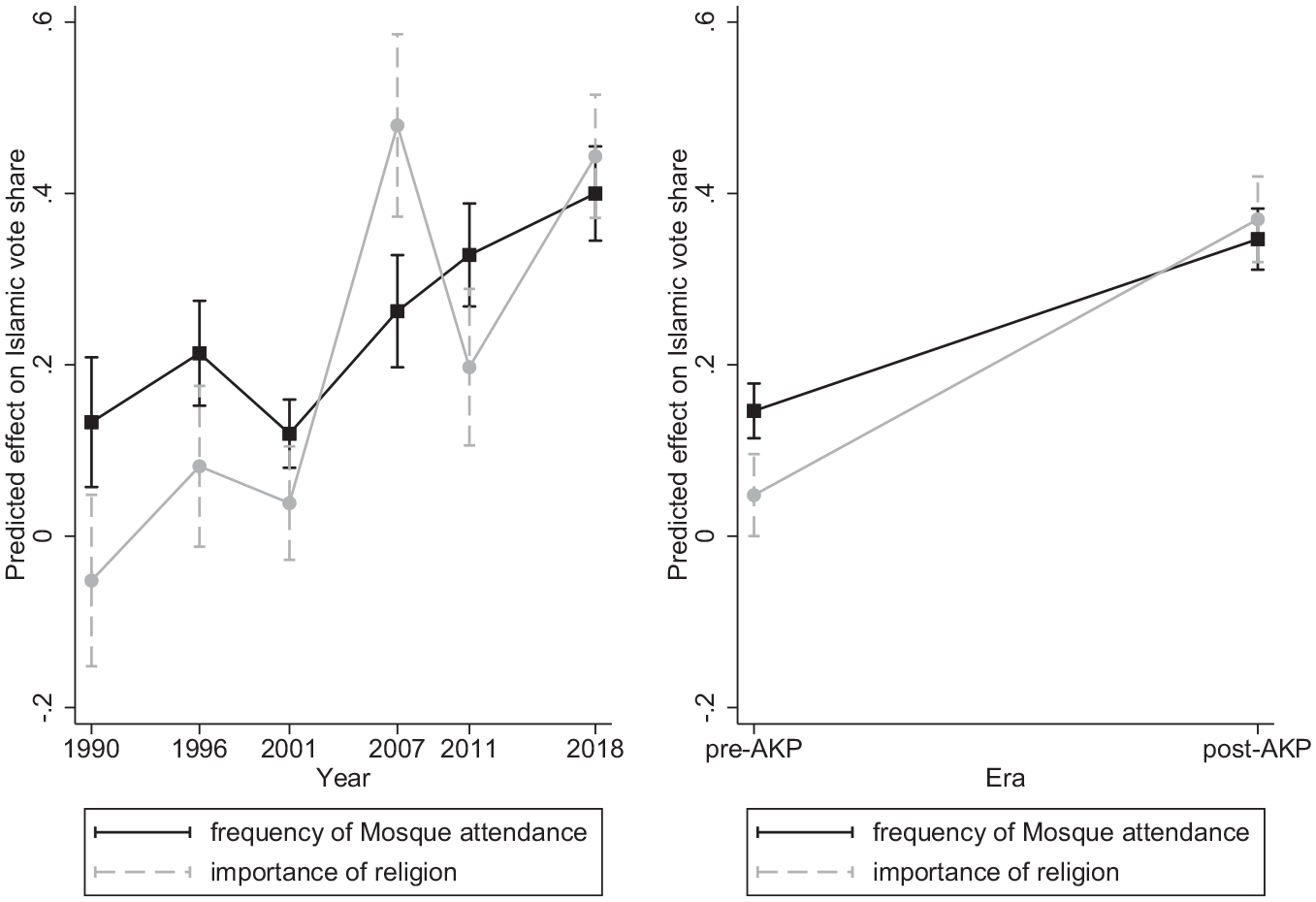
Associations between Indicators of Individual Religiosity (Mosque Attendance and Subjective Importance of Religion) and the Likelihood of Voting for Islamist Political Parties by Year (Left) and Pre- versus Post-AKP Era (Right) (Pre-AKP era is before 2002, post-AKP era is after 2002)
Discussion and Conclusions
We tackled the long-standing puzzle as to why religious organizations and communities thrive despite imposing costly religious practices for their adherents. We offered a theoretical framework with two sets of mechanisms that can explain how costly practices may play a positive role in the diffusion and resilience of religious organizations and communities, namely screening and commitment. The evidence for these mechanisms, although ample and diverse, has thus far been associational. In this study, we presented evidence obtained from a natural experiment that can arguably be interpreted as causal. Using this natural experimental design and building complementary datasets at the provincial- and individual-level, we rigorously tested the prediction made by both sets of theoretical mechanisms.
We studied the share of residents who attend voluntary Quran courses and the share of votes received by Islamist parties in 12 political elections in Turkey as indicators of the success of religious organizations. We observed the effect on Quran course participation and the share of votes of the length of the Ramadan day—which has substantial exogenous yearly variations generated by latitude and a peculiar feature of the Ramadan month. These variations alter the cost of adhering to the behaviors prescribed for that holy month, in particular abstaining from food and drink from sunrise to sunset. We found that the longer the time of fasting the Muslim faithful must endure, the higher were both Quran course participation rates and the share of votes for Islamist parties in the subsequent election. The effect on Islamic votes was large and mainly present during the era dominated by the AK Parti.
The screening and commitment mechanisms both predicted this outcome, but through different channels. The former mechanism would help organizations’ success by purifying their ranks of free riders who, unwilling to bear too high a cost for the benefit of belonging, peel off to various degrees; the latter, through various psychological processes triggered by the extra effort spent on religious practices, would intensify religious engagement.
These two mechanisms carry divergent implications, and through analysis we can disentangle one from the other. Based on different data sources and statistical approaches, the findings all supported the commitment mechanisms: Ramadan daylength increases votes for Islamist parties by increasing religiosity, even among the weakly religious individuals; and our key effect on Islamic votes declines as the time between Ramadan and elections lengthens. These results thus suggest that the screening mechanism predicted from Iannaccone’s (1994) club good model cannot explain our findings.
This, however, does not imply that the screening prediction is incorrect in all settings. For screening to take place, the changes in the cost of religious practices must be within a certain range. If, say, fasting length becomes unbearable even for the most religious (e.g., in the Arctic Circle where days are extremely long during summer), this will likely dissolve religious movements due to the extreme sacrifices that would be required. Or, if changes in fasting length are too small, this will not pose a strong enough deterrent for the mimics, hence screening will not take place. We cannot know ex-ante if changes in fasting duration we observe fall into the required range for screening to kick in. Depending on the level and the change in the cost of practice, commitment or screening may be the stronger force. What we can conclude from our results is that screening is not the prime driver given the change in fasting duration that we observe empirically.
The commitment mechanisms that our results support have implications for restrictive cultural policies that have recently spread in Western Europe and beyond. Examples of these policies include the 2004 French law that banned displaying “conspicuous” religious symbols in state schools and hospitals. Likewise, in 2010 five EU states (France, Belgium, Austria, Bulgaria, and Denmark), and in 2018 the Netherlands, passed a national ban on face veils. In 2016, the French government inserted an amendment to the Labor Code that gave private businesses the possibility of banning their employees from wearing religious dresses and artefacts (Open Society Foundations 2018). One can argue, based on our study, that such policies will be counterproductive because they increase the cost of religious practices, not only by directly restricting certain practices but also by exacerbating discrimination in the labor market and in other social relations. As we show here, such exogenous increases in costs of religious practices may in fact increase Muslims’ commitment to religion and Islamist organizations, and hence hinder their integration. If such legislations also trigger screening mechanisms in addition to commitment, the resulting effect would be even stronger. The effects produced by such legislation may be small relative to other macro-level factors, such as labor market discrimination or educational inequalities between natives and immigrants, but emerging evidence suggests such legislation has significant effects of its own. Abdelgadir and Fouka (2020), for example, show that the headscarf ban in France increased French Muslims’ identification with Islam and reduced their identification with France independent of other macro-level factors, evidence that levying higher sacrifices could counterintuitively increase commitment to religion.
To summarize, our study offers several contributions to the literature. First, theoretically we show that costly religious practices can increase commitment to religious causes even without a mechanism that screens out the less engaged free riders and mimics. Second, methodologically our analyses show the potential of natural experimental designs in addressing long-standing sociological questions. Third, by documenting an empirical link between religious effort and support for Islamist parties and identifying its causal pathways, we contribute to the understanding of the curious interplay between politics and religion and the success of political Islam in Turkey.
Supplemental Material
sj-pdf-1-asr-10.1177_00031224221101204 – Supplemental material for Commitment through Sacrifice: How Longer Ramadan Fasting Strengthens Religiosity and Political Islam
Supplemental material, sj-pdf-1-asr-10.1177_00031224221101204 for Commitment through Sacrifice: How Longer Ramadan Fasting Strengthens Religiosity and Political Islam by Ozan Aksoy and Diego Gambetta in American Sociological Review
Footnotes
Acknowledgements
We thank Krzysztof Krakowski, Max Schaub, Richard Sosis, Werner Raub, David Voas, and the ASR editors and four anonymous reviewers for their comments on earlier drafts, and the participants of the Collegio Carlo Alberto Politics and Society Seminar, Nuffield College Sociology Seminar, UCL Quantitative Social Science Seminar, and the Annual Raymond Boudon Lecture of the European Academy of Sociology for useful suggestions.
Funding
Aksoy acknowledges financial support from the British Academy (grant no. SRG20\200045).

Notes
References
Supplementary Material
Please find the following supplemental material available below.
For Open Access articles published under a Creative Commons License, all supplemental material carries the same license as the article it is associated with.
For non-Open Access articles published, all supplemental material carries a non-exclusive license, and permission requests for re-use of supplemental material or any part of supplemental material shall be sent directly to the copyright owner as specified in the copyright notice associated with the article.
