




Abstract
Geopolitical competition and conflict play a central role in canonical accounts of the emergence of nation-states and national identities. Yet work in this tradition has paid little attention to variation in everyday, popular understandings of nationhood. We propose a macro-historical argument to explain cross-national variation in the types of popular nationalism expressed at the individual level. Our analysis builds on recent advances on the measurement of popular nationalism and a recently introduced geopolitical threat scale (Hiers, Soehl, and Wimmer 2017). With the use of latent class analysis and a series of regression models, we show that a turbulent geopolitical past decreases the prevalence of liberal nationalism (pride in institutions, inclusive boundaries) while increasing the prevalence of restrictive nationalism (less pride in institutions, exclusive boundaries) across 43 countries around the world. Additional analyses suggest the long-term development of institutions is a key mediating variable: states with a less traumatic geopolitical history tend to have more established liberal democratic institutions, which in turn foster liberal forms of popular nationalism.
Geopolitical competition and conflict play a central role in canonical theories of nation-states and national identities (Centeno 2003; Hechter 2000; Mann 1995; Tilly 1975). This rich and wide-ranging literature provides comprehensive accounts linking geopolitical processes to the emergence of the nation-state as a principle of political organization (Mann 1995), the spread of the nation-state across the globe (Wimmer and Feinstein 2010), and the rise of anti-imperial and anti-colonial liberation movements (Breuilly 1982; Go and Watson 2019; Hiers and Wimmer 2013). Work in this tradition has examined variation in the types of political structures and ethnic hierarchies that arise due to disparate trajectories of nation-state formation (Wimmer 2002, 2018) or distinct histories of colonialization (Olsson 2009) and de-colonization (Go and Watson 2019), but it has not paid much attention to popular understandings of nationhood. Conversely, work that has examined cross-national variation in popular nationalism (e.g., Ariely 2012; Hjerm 1998; Kunovich 2009) has paid little attention to the geopolitical factors that are central to macro-historical theories of nationalist beliefs and politics (for a partial exception, see Wimmer 2017a).
In the present article, we address this gap and argue that to understand cross-country differences in popular nationalism, we must account for the conflictive and relational processes associated with geopolitical competition and rivalry between nation-states. As our analysis shows, experiences of what we call geopolitical threat left a lasting imprint on how rank-and-file nationals relate to the “imagined community”—to borrow Benedict Anderson’s phrase. In documenting this association, we link macro-historical theories about the rise of the modern nation-state as a political model to variation in the way this model is expressed through the national identities it gave rise to and that now sustain it.
Our analysis also points to the institutionalization of liberal democracy as one specific mechanism mediating the association between past geopolitical threat and popular nationalism. Standard theories of nation-state formation point to the democratizing properties of geopolitical competition (through the downstream effects of mass conscription and broad taxation) as well as the importance of democratic institutions in shaping the kinds of nationalism that emerged the world over (Mann 1995). We suggest another pathway: conflictual and traumatic geopolitical histories may disrupt the consolidation of liberal democratic institutions (Linz and Stepan 1996), which may in turn lead to more exclusionist understandings of nationhood. We thus complement recent work that foregrounds the role of conflict in the rise and consolidation of democratic institutions (Acemoglu and Robinson 2006; Kadivar 2018; Kadivar, Usmani, and Bradlow 2020; Usmani 2018) but treats conflict as an endogenous process pitting political elites against the majority within states. In contrast, our model emphasizes conflict within and beyond a state’s territorial bounds, highlighting the consequences of secessionist conflict and geopolitical trauma—whether in Europe where war and insurrection were key to the process of state formation or in post-colonial contexts where nations were forged in the liberation from foreign rule and in waves of sectarian conflict that colonial policies sowed the seeds for. Our analysis thus responds to calls by historical social scientists to foreground geopolitics in macro-comparative analyses of nations and nationalism (Mann 2004; Rokkan 1975, 1980).
Conceptually and methodologically, we build on an emerging research program in sociology and political psychology that has developed ways to measure cultural schemas in a range of domains (Boutyline 2017; Goldberg 2011; Taylor and Stoltz 2020), including rank-and-file understandings of nationhood (Bonikowski and DiMaggio 2016). Following key ideas in cultural sociology—that social meaning is embedded in relational networks or a “cultural matrix” and cannot be easily reduced to sets of independent attributes (Edelmann and Mohr 2018; Emirbayer 1997; Mohr 1998)—these approaches take into account multiple attitudinal dimensions and map the interrelationships between them. The measures yielded by these approaches are consistent with theoretical models that liken attitudinal response patterns to cognitive schemata, or linked representations through which people perceive and organize information around difference and belonging—in our case, attitudes, idioms, and meanings related to the nation-state (Brubaker, Loveman, and Stamatov 2004).
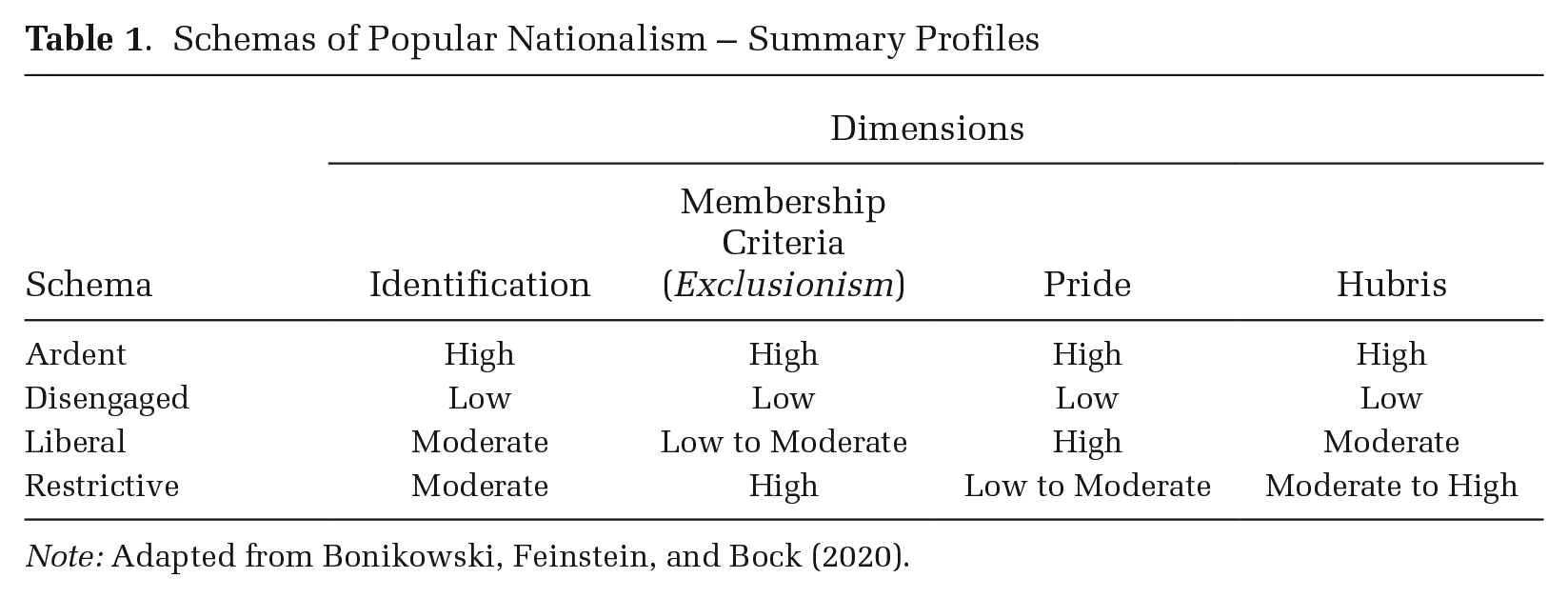
To support our argument, we draw on work by Hiers and colleagues (2017) and expand the geopolitical threat scale they developed to include a total of 43 countries around the world that are featured in the International Social Survey Programme (ISSP). We then implement the same latent class analysis suggested by Bonikowski and DiMaggio (2016), and—based on a set of 26 items related to national identification, membership criteria, pride, and hubris—identify four distinct schemas of popular nationalism: ardent, disengaged, liberal, and restrictive (see Table 1 for an overview). In a series of multinomial logistic regression models, we then show that recurrent and ongoing conflicts as well as traumatic losses in a nation’s past predict (1) a significantly lower prevalence of liberal nationalism (schemas of nationhood that combine pride in the nation with symbolic boundaries that are relatively permeable) and (2) higher shares of restrictive nationalism (schemas that combine restrictive boundaries vis-à-vis outsiders with lower levels of pride in the nation). We demonstrate that the associations between geopolitical threat and popular nationalism are robust to a wide range of individual- and country-level control variables. In the final step of our analysis, we find support for the importance of democratic institutions: the degree to which states have a tradition of liberal democratic governance is a key mediating variable linking geopolitical threat to popular expressions of nationalism.
Schemas of Popular Nationalism – Summary Profiles
Note: Adapted from Bonikowski, Feinstein, and Bock (2020).
Geopolitical Threat And Popular Nationalism
As a doctrine or political ideal, nationalism presumes the existence of a bounded “imagined community” (Anderson [1983] 2006) with a distinct set of interests that, as indicated by the hyphen in “nation-state,” is tightly coupled to a state. The territorial integrity of that state—the idea that its territorial borders cohere to the frontiers of the “imagined community”—is one of the central tenets of this conceptual mode of politics (Brubaker 2010). As a result, the state is tasked with protecting the interests of its distinct national community by safeguarding its sovereignty and serving as a bulwark against foreign rule (Breuilly 1982) while promoting the welfare of its members and guaranteeing their equal treatment before the law (Wimmer 2002). From the viewpoint of rank-and-file nationals, these ideals are part of a “cultural compromise” (Wimmer 2002) between them and the state—a set of promises that shape expectations as well as popular understandings of nationhood.
Yet, not all nation-states are able to deliver on these promises or live up to these ideals in the same way. On the one hand, in countries like Switzerland that never lost their independence or any territory in wars, and never had to contend with secessionist uprisings, the development of liberal democratic institutions went essentially uninterrupted. On the other hand, countries like Canada and Spain have had recent or ongoing experiences with secessionist movements that credibly threatened the unity of the nation-state, and others like India and Greece are embroiled in ongoing conflicts over parts of “their” territory. At the extremes, countries like Hungary and Turkey lost substantial territory and were subject to foreign rule for significant parts of their modern history.
In our view, these experiences of geopolitical loss and conflict are consequential for structuring cognitive representations of the nation. Our argument builds on a rich literature in social and political psychology that suggests threats to social collectives like the nation-state can profoundly shape collective identification. “Rally around the flag” effects are a classic case: perceived threats to the nation often intensify attachments to the ethno-national ingroup, amplify affinities for leadership, and increase support for military operations. This process was demonstrated in Feinstein’s (2018) analysis of rally outcomes during the 2014 Gaza War and in a survey experiment in the United States, where a statement framing Iran’s nuclear ambitions as a threat to Americans increased the salience of national hubris (one specific component of national identity) and support for military action (Feinstein 2016).
However, perceived threats to the national community affect not just the intensity of national identification but also the boundaries of membership. Research on attitudes toward migration and xenophobia shows that “sociotropic concerns” about how immigration undermines the welfare of the national community, rather than economic interests, drive opposition to immigration (Hainmueller and Hiscox 2010; Hainmueller and Hopkins 2014; Wimmer 1997). Speaking to similar dynamics, several studies link terrorist attacks to upticks in exclusionary attitudes and ingroup preferences (Collins 2004; Huddy and Feldman 2011; Legewie 2013). For instance, Bonikowski and DiMaggio (2016)—who unpack nationalist cleavages in the United States using the same typology of popular nationalism that we leverage here—find a marked increase in ardent and restrictive nationalists and a corresponding decrease in the share of liberal nationalists following 9/11.
This work generally builds on a variant of the “group-threat” theory (Ellemers, Spears, and Doosje 2002), which posits that people interpret threats to social collectives as threats to themselves and, in response, increase their identification with ingroups, intensify the ingroup biases they exhibit, and become more hostile toward “others” (Albertson and Gadarian 2015; Mayda 2006). The underlying mechanism is rooted in the psychological utility of collective identities: identification with salient social collectives can restore a sense of security by aligning the self with a more powerful entity that can provide support and a feeling of stability (Kay et al. 2009; Mack 1983; Wimmer 2013).
However, these processes may play out differently in countries where the state is either geopolitically weak and unable to provide a strong point of reference or is itself the source of insecurity. Gorman and Seguin (2018) explicitly examine the role of insecurity and argue that in contexts where the state is not a reliable source of protection, other (non-national) forms of collective identification, such as inclusive, supranational alternatives, will become relatively more attractive. When one’s state is the cause of threat—either by actively repressing certain groups or neglecting to provide adequate security—one reaction might be to look to global players for support and hence develop broader “global identities” (Gorman and Seguin 2018). Alternatively, an unrestrained and belligerent state apparatus could lead people to embrace more narrowly defined tribal modes of identification rather than adopting a state-centered “civic” identity. As Hiers and colleagues (2017) suggest, experiences of geopolitical weakness may mean the nation rather than the state becomes the main locus of identity: because the state has not proven itself to be a reliable source of security, residents of weaker states may embrace more narrow “nationalist” or ethnic forms of identity rather than civic-oriented alternatives.
Whereas research done in the group-threat paradigm is generally concerned with current episodes of threat to the national community, our argument emphasizes the long-term, path-dependent consequences of past weakness and conflict. Although potentially related—past conflict can mean a weak current state—the two are conceptually and empirically distinct. Germany and Poland can currently provide security and stability for their citizens, but their geopolitical histories include defeats in wars and the loss of significant parts of their territories and even their sovereignty. While potentially long in the past, the events we examine involve major traumatic episodes that threatened the integrity or very existence of the nation-state and are of a different magnitude than the transient shocks or triggers frequently emphasized in the group-threat tradition. Thus, we expand the temporal scope of work that links geopolitical threats such as terrorist attacks to changes in group-level identification (e.g., Legewie 2013), emphasizing enduring shifts in national understanding rather than the temporary changes that follow episodic threats.
We hypothesize two main mechanisms linking geopolitical trauma from the past to popular nationalism in the present day. The first involves the shaping of collective memories. These memories may be transmitted through communicative practices: for example, some populists draw on geopolitical conflicts from bygone eras to discursively construct common enemies and to present themselves as wartime leaders of nations besieged by threats from elites and minorities (Dessewffy and Nagy 2020; Mols and Jetten 2014; Sakki and Pettersson 2016; Wodak and Forchtner 2014). Beyond these communicative processes, Assmann (2011) argues that folk memories can be reproduced through cultural channels or via more sedimentary, diffuse modes of transmission requiring no actual discursive action. For example, geopolitical losses can become part of a collective memory encoded in instruments such as school curricula (Darden 2013), embedded in cultural norms (Gelfand et al. 2011), and enacted in everyday “banal nationalism” (Billig 1995) so that in effect, “[t]he nation state acts as an information system linking traumatic or joyous events in history to a particular territory” (Dijink 2002:6).
The second mechanism derives from the development and stability of institutional arrangements, especially those that protect individuals from harassment by their own states. The core tenet of liberal democratic governance is that a restrained state protects individuals not only from external threats, but also from arbitrary use of state force as codified in the protection of property rights, checks and balances on executive power, and the enshrinement of civil liberties. As individual liberties and electoral procedures become institutionalized and citizens come to believe in their fairness and endurance, predictability creates incentives for civic-minded political loyalties (Anderson et al. 2005). Or as Elkins and Sides (2007:694) summarize: “[t]hough long-standing democracies are not necessarily devoid of disaffection, a longer history of democracy should create greater attachment to the state among its constituent groups.” These processes are also compatible with arguments in cultural sociology that emphasize the “schematizing power of institutions” (Bruner 1990:58), as institutional arrangements may powerfully shape cultural schemas over time (Fishman and Lizardo 2013)—in our case, schemas related to the nation-state. Democratic governance may thus come to inculcate a kind of national attachment that is compatible with liberal principles (Elkins and Sides 2007).
However, a turbulent or conflict-ridden experience of nation-state formation and ongoing threats to the integrity of the state’s territorial borders could hinder the development and deepening of liberal democratic institutions, an argument in line with work on political development (e.g., Cervellati, Fortunato, and Sunde 2011; Svensson 1998). For example, “rally around the flag” effects may expand the reach of executive power and increase the likelihood of militarization (Feinstein 2018), which may in turn disrupt processes of unarmed mobilization and contentious civil society–level politics that are instrumental to deepening liberal democratic institutions (Kadivar 2018; Kadivar et al. 2020).
Indeed, a long history of unarmed mobilization was key to developing durable democratic institutions in post-apartheid South Africa (Kadivar 2018). In contrast, such mobilization was less prevalent or even nonexistent in contexts like the Philippines, Turkey, and Hungary. Unsurprisingly, these are places where populist leaders situated themselves in the political landscape and became fixtures in the sphere of institutional politics: in the Philippines, Rodrigo Duterte has followed a long line of Filipino politicians who tapped into a “national subjectivity that carries a lingering anxiety about freedom and sovereignty” (Webb and Curato 2019:63); in Turkey, Recep Erdoğan drew on geopolitical conflict from the distant past to treat “national history as a battlefield” and discursively position the AKP as a bastion against Western interests and fifth columns within the country (Taş 2020:6–10); and in Hungary, Viktor Orbán instrumentalized historical repertoires—the notion that “[h]istory forces Hungarians to confront enemies greater than themselves” (Dessewffy and Nagy 2020:11)—to erode democratic institutions in the country.
Conceptualizing And Measuring Popular Nationalism
To empirically track the association between geopolitical threat and nationalist beliefs in the present day, we build on recent advances in conceptualizing and measuring popular nationalism. These advances have moved away from narrowly defined conceptions of nationalism and sidestep the normative dichotomies that are part of distinctions popular in the political psychology literature, such as the distinction between putatively good “patriotism” and its evil twin “nationalism,” or “blind” as opposed to “constructive” patriotism (Schatz, Staub, and Lavine 1999). Using these approaches, we take seriously Brubaker’s (1996:10) contention that nationalism is not a coherent ideology individuals embrace to a larger or lesser extent, but “a heterogeneous set of ‘nation’-oriented idioms, practices, and possibilities that are continuously available or ‘endemic’ in modern cultural and political life.” Individuals organize this heterogenous set of cultural material in the domain of nationalism into discrete cognitive schemas (Bonikowski and DiMaggio 2016; Brubaker et al. 2004).
To recover these schemas in survey data, we use latent class analysis (LCA) to identify subpopulations with similar mental representations of the nation based on responses to a wide range of attitudinal survey items. This approach follows a long tradition in cultural sociology that assumes the relationship between different attitudes, attributes, and actors is what ultimately provides meaning to cultural phenomena (Emirbayer 1997; Mohr 1998; Mohr and White 2008). Seen through this lens, the meaning of any one attitude (e.g., pride in sporting achievements) or latent dimension (e.g., national pride) becomes difficult to ascertain in isolation from other domain-specific attitudes (e.g., importance of ancestry for national membership) or dimensions (e.g., national membership criteria). 1 In effect, we posit that having a high level of national pride points to a qualitatively different view (schema) of the nation when accompanied by strict membership criteria (especially criteria that emphasize ascriptive characteristics) as opposed to a high level of pride accompanied by an inclusive conception of the “national community.” And indeed, these schemas of nationalism have distinct associations with a range of outcomes, from anti-immigrant and anti-Muslim attitudes (Simonsen and Bonikowski 2019) to support for right-wing politicians (Bonikowski, Feinstein, and Bock 2020) above and beyond the variables usually associated with positions on these issues.
As we detail in the next section, our preferred latent class model yields the same four-fold typology of popular nationalism proposed by Bonikowski and DiMaggio (2016), and although the share of respondents assigned to each cluster varies across time and place, the configurations of latent classes are stable across time and can be meaningfully compared across countries (cf. Bonikowski 2016). Broadly speaking, two of the four classes are diametrically opposed and starkly contrast levels of overall engagement with the nation: “ardent” nationalists show high levels of pride and strict demands for membership across all dimensions, in contrast with “disengaged” nationalists who rank low on all aspects of national identity. 2 The remaining clusters differ chiefly along the membership dimension: “restrictive nationalists” are characterized by strong or exclusive demands for membership and moderate levels of pride, in contrast with “liberal” or “creedal” nationalists who combine high levels of identification and national pride with relatively permeable symbolic boundaries (Bonikowski 2016; Bonikowski and DiMaggio 2016).
Within these general patterns, there is important variation. For instance, liberal nationalists may assign the lowest weight to ascriptive attributes like religion when defining their national membership criteria, but—true to the label—still accord significant importance to civic or “liberal”-oriented attributes like obeying the rule of law. Similarly, restrictive nationalists score low on most items probing national pride but report relatively high levels of pride in their nation’s sporting achievements, artistic accomplishments, and history. Therefore, the differences between the two classes are not simply a function of aggregate differences in pride or exclusionism, but the result of distinct patterns of nationalist beliefs across and within dimensions.
Capturing these cross-cutting patterns would be difficult to achieve with conventional approaches to dimensionality reduction that scale down input variables into sets of unidimensional factors (factor analysis, principal component analysis). Yet, these patterns are critical to understanding the effects of geopolitical threat on popular nationalism. For one, such effects may be heterogenous in important ways within dimensions (national identification, pride, membership, hubris). Take the example of national pride. Based on our earlier discussion, we expect geopolitical threat will depress confidence and pride in the nation-state (Gorman and Seguin 2018; Wimmer 2017a). However, to the extent that past trauma is leveraged by populists and demagogues, it could very well activate “rally around the flag” effects (Feinstein 2016) and result in higher levels of “hot nationalism”—that is, high degrees of national identification, pride, hubris, and exclusionism. Further still, geopolitical threat could concomitantly lead to high levels of national pride in certain domain-specific areas and low levels of pride in others—a pattern consistent with restrictive nationalism. We see both of these dynamics unfolding in Turkey, where most respondents are either ardent nationalists (48 percent) or hold restrictive schemas of the nation (21 percent) and where populists often cite the Ottoman conquest of Constantinople to contrast ancient, mythical glory with geopolitical losses incurred after the dawn of the Republican era and the formation of the modern nation-state (Taş 2020).
Our latent class models allow us to capture variation in nationalist beliefs that involve shifts in more than one dimension and to therefore move beyond analyses that only look at shifts in popular nationalism on a single dimension such as national pride (Wimmer 2017a) or hubris (Feinstein 2016). This allows us to account for effects of geopolitical threat that are heterogeneous within and across dimensions. Beyond its effects on pride, we expect higher degrees of national trauma will tighten membership criteria (following Hiers et al. 2017; see also Feinstein and Bonikowski 2019). Yet, the meaning of these shifts is difficult to fully understand when analyzing dimensions separately. Relatively open membership criteria are substantively different when paired with high levels of pride in the achievements of the national community as opposed to being part of a pattern that involves disengagement from the nation across all dimensions. Similarly, a high level of national pride yields a substantively different schema of the nation when paired with membership criteria that strongly binds the imagined community along ascriptive, quasi-ethnic lines as opposed to more inclusive, “civic”-oriented parameters.
Taken together, geopolitical threat is likely to have uneven effects on popular visions of the nation—raising attachments to the imagined community along (or within) certain dimensions while lowering it along (or within) others. Therefore, we do not expect geopolitical threat to robustly shape nation-state schemas that are “all-in” (ardent) or “all-out” (disengaged). Rather, our most consistent theoretical expectation is that national trauma significantly shapes schemas of nations that exhibit cross-cutting characteristics.
Based on the overall differences between these schemas and our discussion above, our core hypotheses may be summarized in the following two ways. First, in countries with a more traumatic geopolitical history, there will be lower shares of nationalists who combine high levels of confidence and pride in the nation-state with an inclusive vision of the national community (liberal nationalism). In those same countries, we expect a higher prevalence of schemas that combine lower levels of pride with exacting demands for membership (restrictive nationalism). Second, we expect these associations will be mediated by the development and consolidation of liberal democracy over time.
Data And Analysis
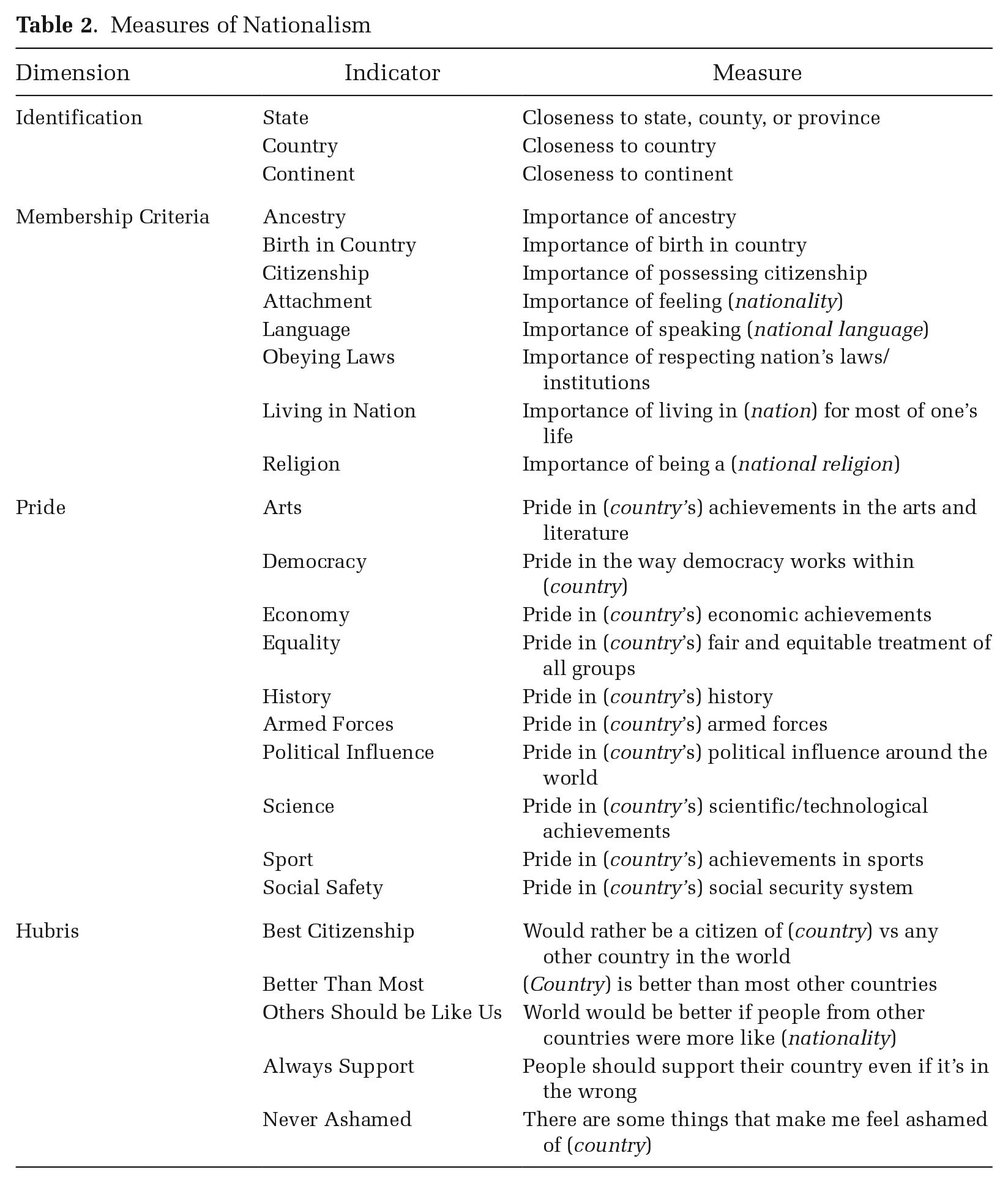
For our analysis, we draw on the 1995, 2003, and 2013 waves of the International Social Survey Programme (ISSP). Each wave features a National Identity module that includes 26 items measuring different aspects of national identity, which tap into four dimensions of nationalism: identification, membership criteria, pride, and hubris. Summaries of the items are provided in Table 2 and descriptive statistics in Table C3 of our online supplement. We drop South African respondents from the 2013 wave as their response scales for key nationalism indicators differed from the scales provided to respondents in other countries. The main results presented also exclude Israeli respondents and individuals who are not citizens in their survey country—as well as all Japanese respondents from the 1995 wave where the citizenship question was not posed. Both of these restrictions are addressed in robustness tests and do not affect our results. After pooling the remaining respondents across the three waves, we arrive at a sample of 111,605 individuals nested within 86 country-years and 43 countries.
Measures of Nationalism
Our analysis proceeds in three main steps. First, we use a latent class model that uses the responses on the 26 nationalism items to assign each respondent to one of four mutually exclusive population clusters with similar schemas of the nation (cf. Bonikowski 2016). Second, we use respondents’ cluster membership (ardent, disengaged, liberal, or restrictive) as the dependent variable in a series of multinomial logistic regression models where geopolitical threat is the key independent variable. Finally, we estimate a path model to explore the mediating effects of institutional legacies.
Identifying Schemas of Popular Nationalism: Multigroup Latent Class Analysis
In this first step, we follow the approach specified by Bonikowski and DiMaggio (2016) and use latent class analyses to cluster individuals based on their pattern of responses to the set of nationalism items summarized in Table 2. For our analysis, it is important that classifications are comparable across time and space. To this end, we impose constraints on the measurement portion of our models (Magidson and Vermunt 2004; McCutcheon 2002). More specifically, we run multigroup, structurally equivalent LCAs where “intercepts” and “slopes” for each indicator are restricted to be equal across nation-states and survey waves (yielding equal item-response probabilities), but class proportions are free to vary across the grouping units (Kankaraš, Moors, and Vermunt 2011). We fit this model using Latent GOLD 5.1 (Vermunt and Magidson 2016).
When estimating LCAs, goodness-of-fit statistics and theory are used to arrive at the most interpretable and parsimonious “cluster solution”—the choice of how many latent classes a set of respondents should be divided into (Magidson and Vermunt 2004). We settle on a four-cluster solution that fits the data well and generates classes that are appreciably different from one another (for the fit statistics that guided our model selection process, see Figure A1 in the online supplement). Ideally, a latent class variable would fully explain the covariation between indicator items given a respondent’s cluster membership, otherwise known as the local independence assumption (Bollen 2002; McCutcheon 2002). As this is rarely achieved in practice, allowing additional covariation between indicators is sometimes necessary. In our study, we add direct effects between the 11 pairs of nationalism items with the largest bivariate residuals. Table E1 in the online supplement summarizes a number of tests showing that our classification results are robust to different parameterizations of the LCA model, different starting values of the estimation, and different exclusion criteria for the cases analyzed. None of these choices influence the results of our regression models. Because the four latent classes yielded by our LCA are virtually identical to those identified by Bonikowski (2016) in his analysis of the 2003 wave of the ISSP, we apply the same labels.
The radar plot in Figure 1 illustrates the distinct response patterns of the latent classes and shows the four subpopulations exhibit different responses on these items reflecting substantively different schemas of popular nationalism. The innermost polygon represents the class of disengaged nationalists: individuals who do not have a strong attachment to the nation on any of the dimensions measured. The counterpart are the ardent nationalists, represented by the outermost polygon, who most strongly endorse all items. The two remaining classes—liberal and restrictive—present interesting variations. Liberal nationalists score relatively high on items about pride in national institutions, but they have a fairly open concept of membership, scoring especially low on items that probe the importance of ascriptive characteristics for membership. Restrictive nationalists display the opposite pattern, scoring relatively low on the pride items but very high on items that place high demands on national membership. As discussed earlier, within these general patterns there are important differences, as restrictive nationalists score relatively high on items related to pride in sports, art, or history. Differences between liberal and restrictive nationalists are smaller on the hubris and closeness items, where both groups occupy the middle ground between the ardent and disengaged classes.
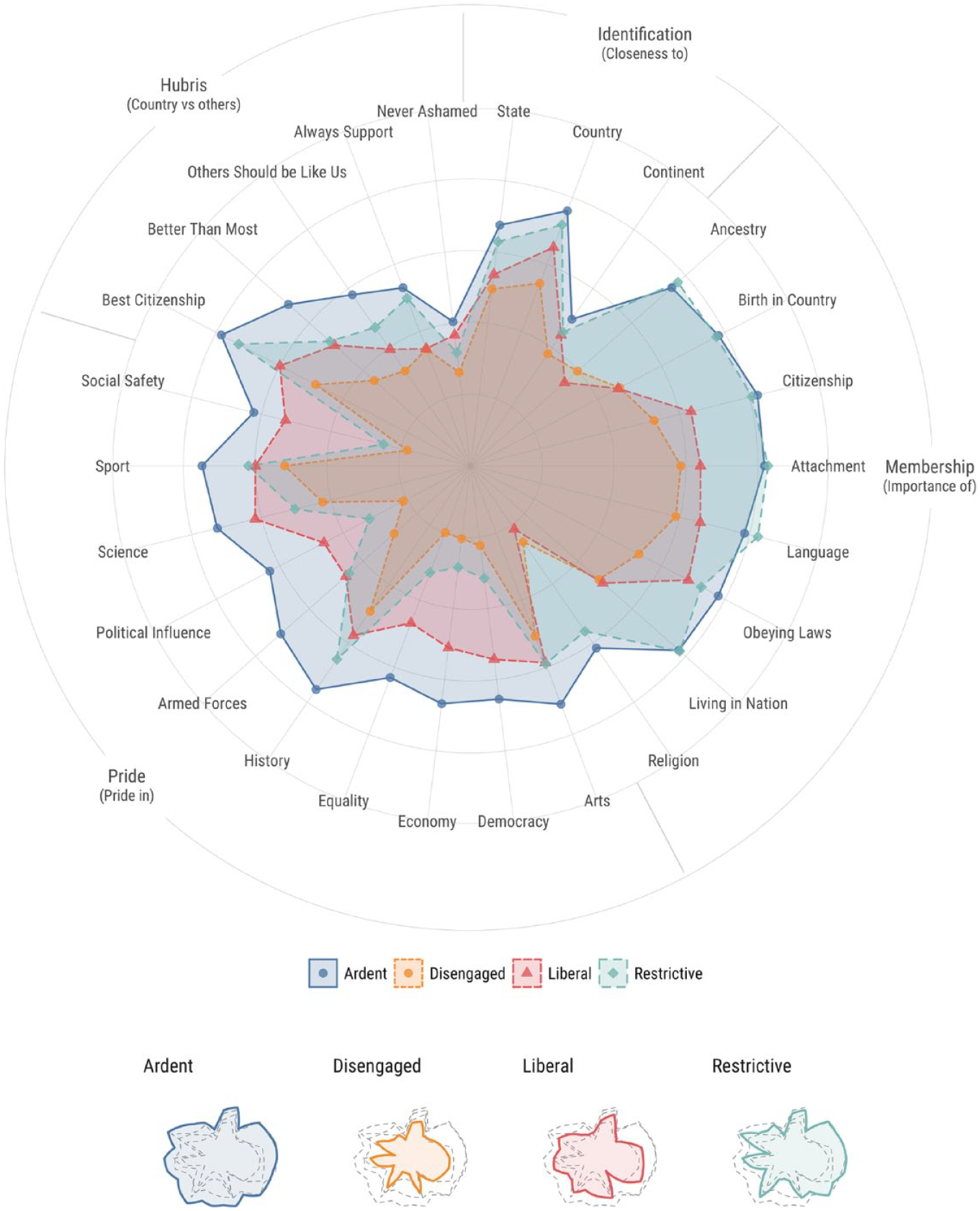
Aggregate Means for Indicator Items for the Four Latent Classes
Figure A2 in the online supplement gives country-level summaries of our classifications. Overall, the largest share of respondents—about 38 percent—fall in the “liberal” cluster. The disengaged and restrictive classes comprise just under a quarter of respondents (23 and 21 percent) each, and ardent nationalists constitute the remaining 17 percent. As Figure A2 illustrates, latent class distributions vary markedly across the countries in our analysis. The share classified as liberal ranges from just 1 percent in Bulgaria to 82 percent in the Netherlands; in some countries—like Sweden, Poland, and Italy—around 5 percent of the population are classified as “ardent” nationalists, whereas in others, this share is closer to 50 percent (United States) or higher (68 percent in India).
Looking across survey waves and accounting for the different countries included in each wave in a fixed-effects model, we see small increases in the share of the ardent category from 1995 to 2013, a nontrivial decrease in the share of disengaged nationalists, and a corresponding increase in the share classified as liberal. But this variation is substantially smaller than the variation across countries. Of the 29 countries to appear in multiple ISSP waves, the intra-country correlation coefficient for latent class proportions ranged from .79 (share of ardent nationalists) to .92 (share of restrictive nationalists).
Measuring Geopolitical Threat
To measure geopolitical trauma and loss, we follow Hiers and colleagues (2017), who developed a scale that combines two dimensions of geopolitical history: loss of territory or sovereignty on the one hand, and threats to the integrity of the nation-state due to long-term conflicts (internal or external) on the other. On each dimension, countries are scored from 0 to 2, and the scores are then combined into a simple additive scale with a theoretical range from 0 to 8, with countries in our sample scoring between 0 and 6. It is worth re-emphasizing here that this scale scores past threats to the nation and is thus distinct from measures of threat or vulnerability that focus on current geopolitics, such as the insecurity index used by Gorman and Seguin (2018)—a measure we include as a control variable in our regression models. We also note that as in Hiers and colleagues (2017), the temporal horizon for these events is the period starting with the foundation of a country as a modern nation-state. Narratives that refer to prior statehoods may play a role for some cases of popular nationalism, but they will be less salient, on average. From a purely practical standpoint, expanding the analytic horizon to include pre-nation-state events would make it impossible to find a consistent cut-off point.
For the countries in our data that were also featured in their analysis, we use the scores published by Hiers and colleagues (2017), which covers 28 of the 43 countries in our study. For the 15 remaining countries, we apply the coding procedure outlined to derive appropriate geopolitical threat scores. A research assistant who was not involved in the remainder of the analysis and blind to the rest of the data did the coding. When there were ambiguities on how to score a particular country, we created alternative codes that we use in robustness tests. We provide a summary of our rationale in Part B of the online supplement and refer readers to Hiers and colleagues (2017:366–69) for a detailed description of coding procedures.
Institutional Characteristics: Liberal Democratic Institutions and Traditions
To assess how democratic institutions may mediate the relationship between geopolitical history and popular nationalism, we include the liberal democracy score assigned to a country in the Varieties of Democracy (V-Dem) project (Pemstein et al. 2019). Specifically, we include the v2x_libdem (a 0 to 1 scale) variable in our analysis, an index that approximates the degree to which executive power is regulated through checks and balances, the protection of civil liberties, due process provisions, and other institutional mechanisms (Coppedge et al. 2019). As a measure of the degree to which liberal institutions are entrenched in a country over time, we follow Elkins and Sides (2007) and create a variable that sums up a country’s democracy scores since nation-state formation, in effect capturing the “stock” of liberal democracy in a nation-state, or the years of liberal democratic governance weighted by variation in the degree of liberal democracy. To facilitate the comparison of coefficients, we standardize both variables.
Analysis and Results
Our outcome of interest (the schema of nationalism a respondent holds) is a nominal variable, so we fit multinomial logistic regression models and cluster standard errors at the country level to correct for the multilevel structure of the data. 3 To classify respondents, we use model parameters from our latent class analysis and assign respondents to the cluster with the highest probability of membership (Magidson and Vermunt 2004). Previous research indicates that when a latent class model gives results with a high classification certainty, as evinced by an entropy value above .8, treating the class assignments in this way is a valid strategy (Clark and Muthén 2009). As a robustness check, we re-estimated our models using a “three-step” procedure that explicitly corrects for classification uncertainty. The estimates yielded by these models are substantively the same as the ones we report here: although standard errors are slightly larger in some cases, so are coefficient estimates, and our key parameter estimates remain statistically significant at conventional levels. Substantive conclusions are identical no matter the approach used. Because there is no established procedure for calculating quantities of interest such as predicted probabilities or marginal effects from these models, we present the results from our multinomial logistic regressions.
To maximize coverage and variance at the country level, we pool across all three survey waves of the ISSP and include survey-year fixed effects. Even when pooling data across all waves of the ISSP, we are still left with a limited number of countries—consequently, a maximalist strategy of including every possibly interesting covariate runs into degrees-of-freedom problems. Similarly, stepwise approaches that enter all possibly interesting covariates and retain those that are statistically significant are problematic as they capitalize on sampling error (Thompson 1995). We thus present a series of models where we include the geopolitical threat scale alongside variables in each of the four groups we summarize in the following section. This strategy also allows us to tease out which factors in addition to past geopolitical threat are associated with formulations of popular nationalism.
Country-Level Control Variables
Previous research has proposed a number of country-level variables that shape rank-and-file attitudes toward the nation. We group these variables into four main categories. In the online supplement, Table C1 lists the sources for these variables, and Table C2 provides basic descriptive statistics.
Economic development, insecurity, population
Gorman and Seguin (2018) argue that individuals on the margins of the world polity and in insecure positions are more likely to embrace global identities. Combining two variables from the State Fragility Index and Matrix (Marshall and Elzinga-Marshall 2017)—levels of state-provided security and vulnerability to political violence, as well as a state’s tendency to repress portions of its population—they construct an index ranging from 0 to 6, with higher values signaling higher levels of insecurity, an index we include in our regressions. As a related measure, we use the GDP per capita (logged) as an indicator of economic security and development, a measure that previous research has shown to be associated with various dimensions of national identity (Elkins and Sides 2007; Jones and Smith 2001b; Kunovich 2009). Finally, we control for logged population because larger countries have different profiles of popular nationalism and may exhibit lower levels of pride than smaller nation-states (Dahl and Tufte 1973).
Nation-state formation, history
A second set of variables often considered in research on national pride relates to the history of nation-state formation or particular episodes along the arc of a nation’s past. For example, having been an Axis power in WWII may depress national pride due to the shame felt by citizens of countries responsible for the major atrocities committed during the war (Elkins and Sides 2007). Similarly, membership in the British Empire may be associated with lower levels of national pride, as this may have strengthened subnational ethnic identities to the detriment of national alternatives (Ali et al. 2019). This points to the possibility that individuals nested within former colonies might have more permeable conceptions of national membership. Furthermore, individuals in post-communist states may have lower levels of pride because their countries struggled to cultivate functioning market economies and civil societies (Howard 2003). These countries may exhibit systematically different patterns of popular nationalism than their non-communist neighbors. Beyond these specific historical constellations, countries with a longer history as nation-states may have a “thicker” or more settled nationalism, which may yield more exclusive understandings of the national community (Koopmans et al. 2005). In our analysis, we use dummy variables that indicate whether a country was formerly communist, an Axis power, or a British dependency, along with a variable that indexes the years since a country’s nation-state formation. All of these variables serve as controls in our analysis.
Diversity and inequality
Previous research examining the relationship between diversity and popular nationalism comes to competing conclusions. One line of inquiry centers on the level of national identification among minorities. Departing from studies that foreground the demographic (Mummendey et al. 1999) or political position of ethno-racial subpopulations (Pratto, Sidanius, and Levin 2006), this research is driven by the expectation that minorities identify less strongly with the nation. Studies testing this expectation are inconclusive, with some reporting associations in line with this hypothesis (Staerklé et al. 2010), and others failing to do so (Masella 2013; Robinson 2014) or finding them inconsistently (Smith and Kim 2006).
Similarly, research on the relationship between diversity, inequality, and the membership dimension of nationalism come to uneven conclusions. Some studies suggest persistent exposure to diversity will lead to a softening of membership criteria and a more civic form of nationalism (Breton 1988). A more recent line of work, however, emphasizes the perceived threat that diversity can pose to the dominant group’s identity, thus increasing preferences for more rigidly defined “ethnic” boundaries of the nation (Jones and Smith 2001a; Kunovich 2009; Triandafyllidou 1998). In our study, we include Fearon and Laitin’s (2003) indices of ethnolinguistic and religious fractionalization as controls for diversity.
Supporting his exchange-theoretic and power-configurational account of nationalism and in line with theories that emphasize diversity, Wimmer (2017a) shows that power-sharing arrangements that include ethnic minorities lead to higher levels of ethnic pride, accounting for a host of other factors. Following his lead, we include the share of a country’s population excluded from power as a covariate in our analysis (Wimmer 2017a), as well as a measure of income dispersion (the Gini coefficient).
Globalization and migration
Several studies have unpacked the relationship between globalization and aspects of national identity with varying results: some research shows that globalization erodes identification with the nation-state (Ariely 2019; Kunovich 2009), yet other researchers claim to find evidence for a backlash against nationalization and the insecurities it brings (Bekhuis, Lubbers, and Verkuyten 2014). Following the custom in this line of work, we use the Globalization Index of the KOF Swiss Economic Institute (Dreher 2006) to capture a country’s exposure to globalization.
Similarly, the presence of migrant populations has been linked to restrictive attitudes toward migration and restrictive views about the rights immigrants should be afforded (Coenders, Lubbers, and Scheepers 2009). More generally, a large research program examines how demographic change translates into elevated perceptions of threat among natives (Kaufmann and Goodwin 2018). Accordingly, we include controls for foreign-born share of the national population and a country’s net migration rate in our analysis.
Federalism
Like democratization (one of our focal independent variables), federalism may shape the relationship between geopolitical threat and popular nationalism. More specifically, the degree to which a country’s politics are centralized or retain autonomy for provinces may correlate with the kinds of tensions captured in the “internal threat or conflict” dimension of the GPT scale, and may in turn shape popular nationalism (Elkins and Sides 2007). To account for this possibility, we distinguish states that are unitary from those that have a federal structure or are confederations. We enter this variable alongside the measures of liberal democracy and cumulative liberal democracy discussed earlier.
Individual-Level Control Variables
To account for compositional differences across countries, we include a range of individual-level variables. We know younger people are less proud of their countries than their elders, and the less educated are more attached to their nations than the better educated. Concerning the membership dimension, we know youth, higher education, and higher socioeconomic status are associated with more tolerant attitudes toward immigration (Hainmueller and Hiscox 2010; Hiers et al. 2017). Finally, religious individuals might have different attachments to the nation than do non-religious people in some cases (Wimmer 2017b).
Missingness is limited on our individual-level controls, but to preserve sample size, we create separate categories for missingness on the marital status, religiosity, education, and income variables. The question on religiosity was not asked in Turkey, so the entire country falls in the “missing” category. In a robustness test, our results do not change if we omit one country at a time from our analysis (including potentially high-leverage observations such as Turkey or the United States).
Results
Before proceeding to the results of our multivariate analysis, Figure 2 presents the bivariate relationship between the geopolitical threat score of a country and the share of respondents assigned to each of the four latent classes (across all three waves of the ISSP; we present analysis by survey wave in the online supplement). In the final two panels, we see that countries scoring higher on the geopolitical threat scale have lower shares of liberal nationalists and higher shares of respondents holding restrictive schemas. As Figure A3 in the online supplement illustrates, this pattern is robust when looking at each wave of the ISSP separately. In the first two panels of Figure 2, we see that as GPT rises there is a slight increase in the proportion of ardent nationalists and a slight uptick in the share of individuals with a disengaged schema. However, if we look at different waves of the ISSP, these associations are not robust: we find no association between geopolitical threat and ardent nationalism in 1995 and 2003; in the case of disengaged nationalism, there is no association in 2013 (see Figure A3 and additional analyses in the online supplement).
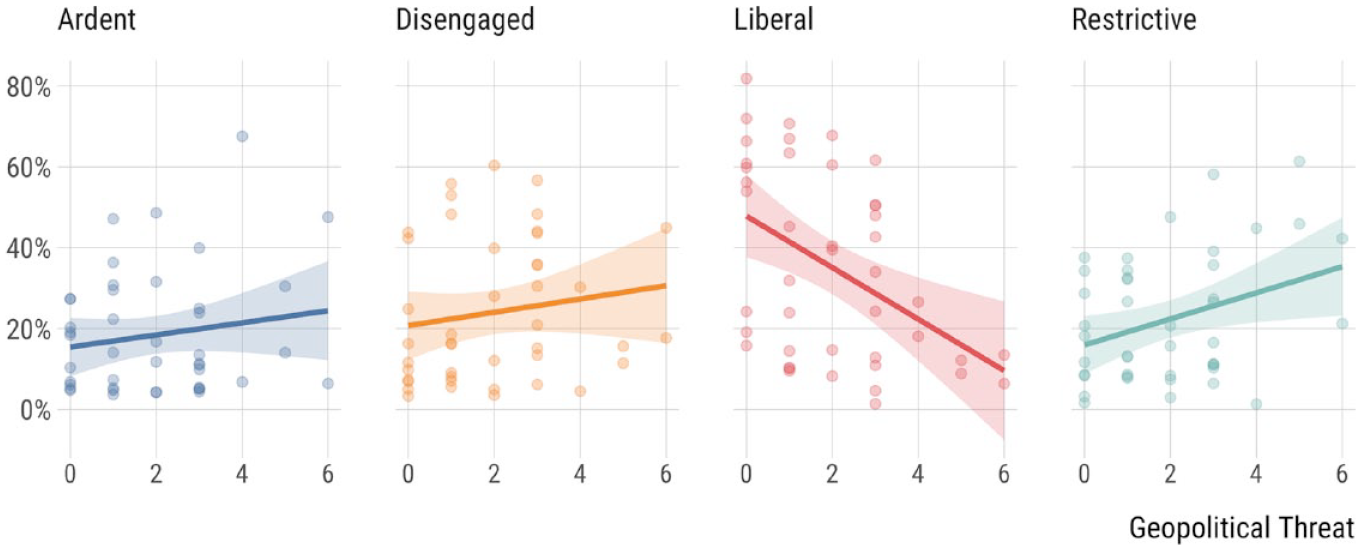
The Relationship between Aggregate Latent Class Distributions and Geopolitical Threat Pooled across All Waves of the ISSP
Tables 3 and 4 present summaries of different multinomial logistic regression models. As each model consists of three sets of coefficients, full regression tables get unwieldy. To maintain legibility, we present only the key coefficients for the geopolitical threat variable in Table 3 and the coefficients for the liberal democracy indices in Table 4, relegating full country-level regression results to the online supplement. Because our core theoretical expectation is a shift in the relative prevalence of liberal nationalism, we present our results with liberal schemas of the nation as the omitted reference category. The first set of columns in Table 3 (Model 1) represents a specification that only features individual-level variables and the geopolitical threat scale but no country-level controls. The models that follow introduce country-level control variables in the groups we summarized above.
Multinomial Logistic Regression Predicting Schema of Nationalism – Coefficients for Geopolitical Threat
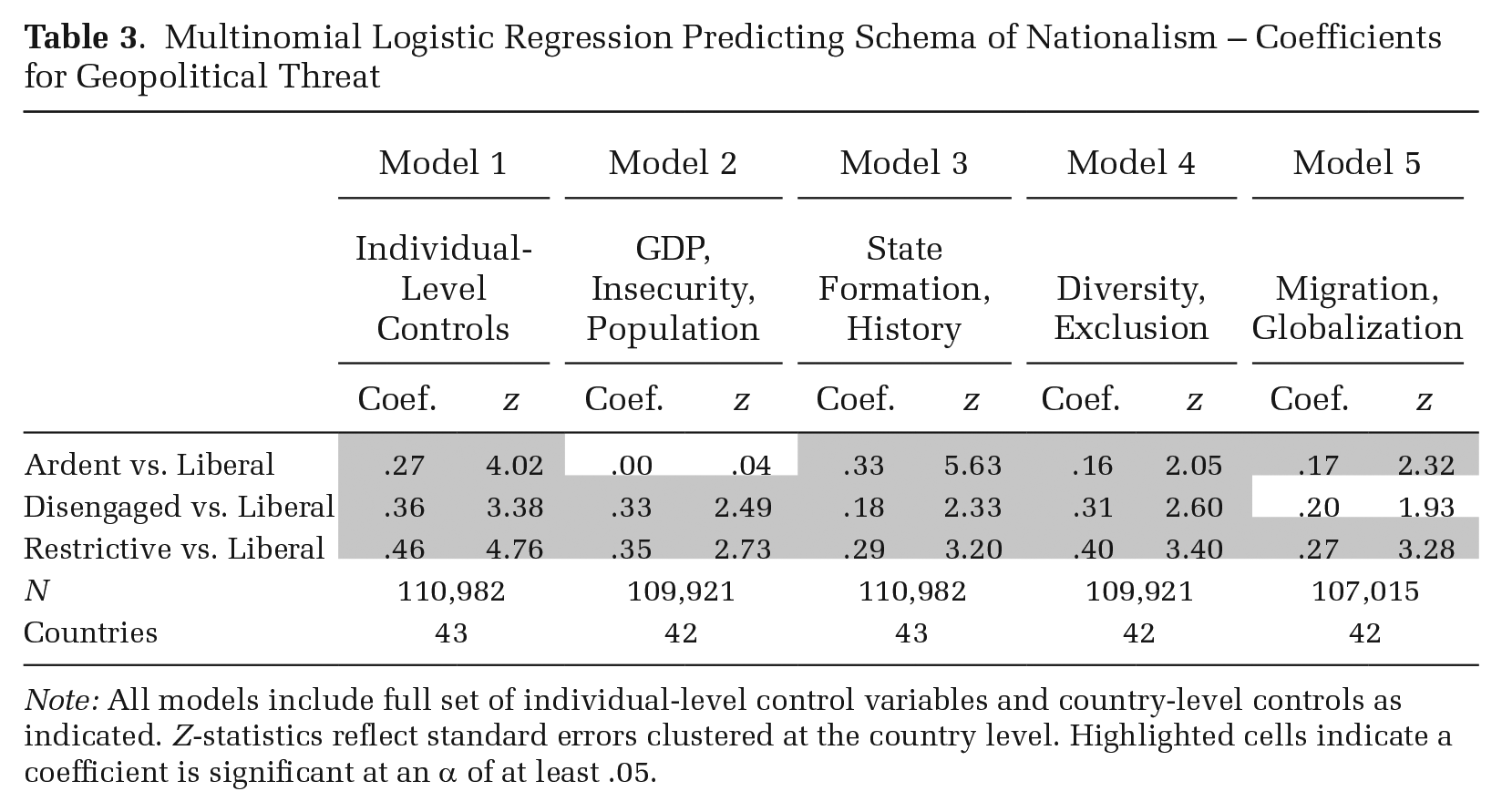
Note: All models include full set of individual-level control variables and country-level controls as indicated. Z-statistics reflect standard errors clustered at the country level. Highlighted cells indicate a coefficient is significant at an α of at least .05.
Mu ltinomial Logistic Regression Predicting Schema of Nationalism – Including Controls for Liberal Democracy
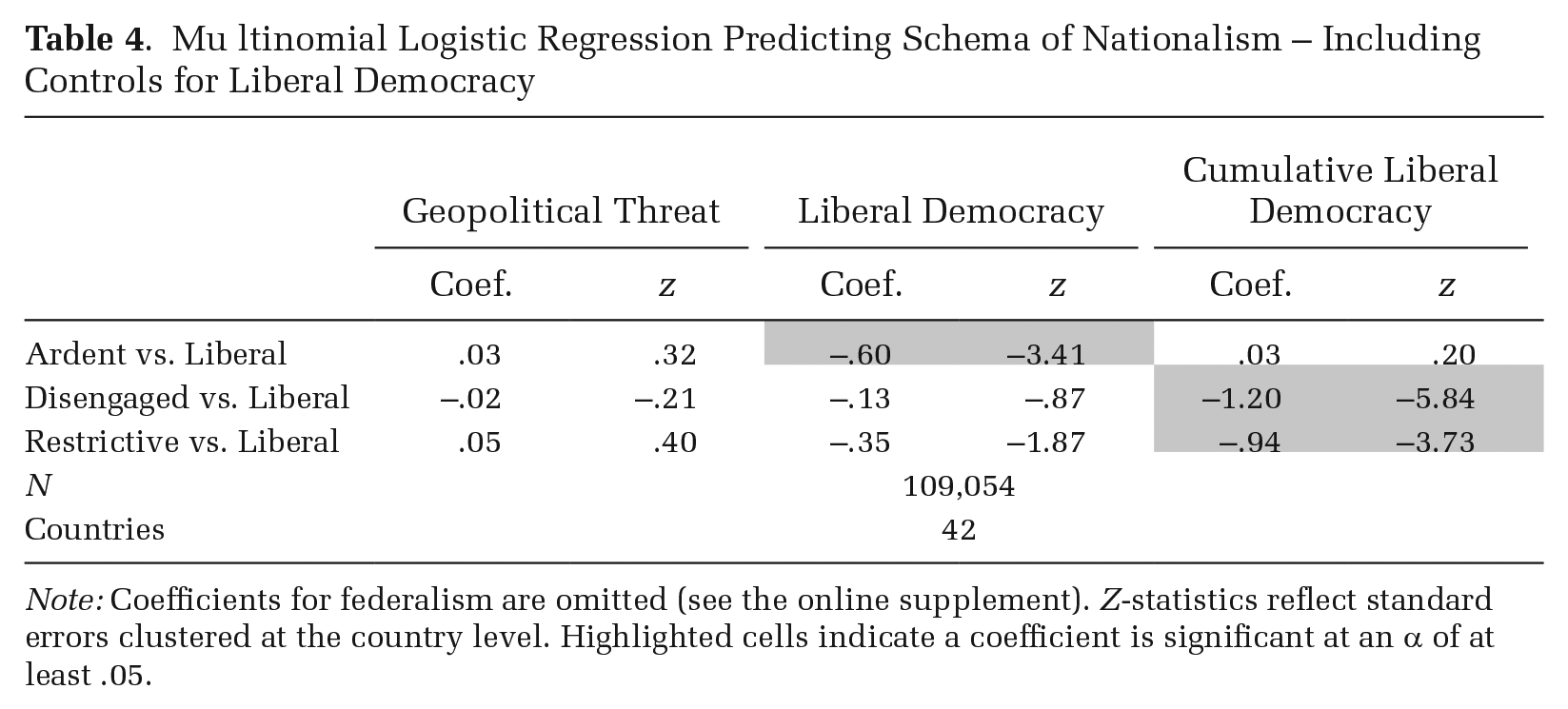
Note: Coefficients for federalism are omitted (see the online supplement). Z-statistics reflect standard errors clustered at the country level. Highlighted cells indicate a coefficient is significant at an α of at least .05.
Looking across all models in Table 3, we see positive coefficients. Holding a liberal nationalist schema is the omitted reference category, so this indicates that in countries that rank higher on the geopolitical threat scale, non-liberal forms of popular nationalism (ardent, disengaged, and restrictive) are relatively more prevalent than in countries with a more tranquil geopolitical past. The most consistent finding is that, net of other factors, the higher the GPT score in a country, the higher the share of restrictive schemas. In Models 1 through 5, the coefficient indicating the relative probability of liberal versus restrictive nationalism is statistically significant at the 5 percent level or higher, ranging in magnitude between .27 and .46.
Because regression coefficients express the relative probability of an individual holding an ardent, disengaged, or restrictive schema of nationhood as compared to a liberal schema, the absolute prevalence of any one type of popular nationalism might not differ across levels of geopolitical threat, but relative to the reference category (liberal nationalism)—if, for instance, the likelihood of holding a liberal schema of nation changes dramatically relative to the other outcome categories. To make this legible, Figure 3 plots the marginal predicted probabilities for each schema of nationalism setting geopolitical threat at either 1 (the second lowest value in our sample [e.g., Ireland, Sweden]) or 5 (the second highest value in our sample [e.g., Cyprus, the Philippines]). These probabilities also provide a sense of the magnitude of the associations as the multinomial logistic regression coefficients do not have an intuitive interpretation.
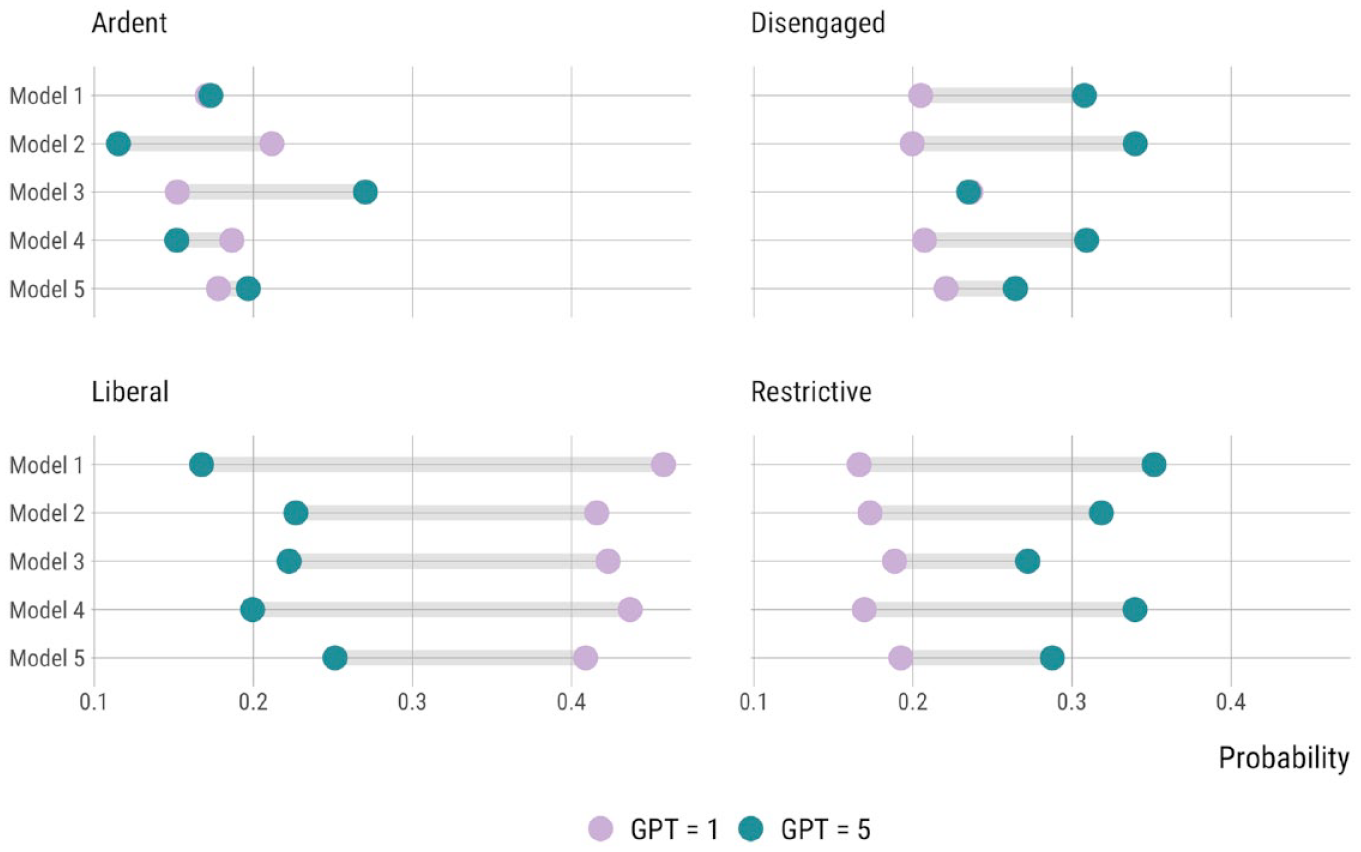
Marginal Predicted Probabilities of Types of Popular Nationalism at GPT Values of 1 and 5
In Figure 3, the two panels on the bottom row illustrate lower levels of liberal nationalism and higher levels of restrictive nationalism at higher levels of geopolitical threat, a finding in line with our country-level analysis shown in Figure 2. In Model 1 (featuring only individual-level controls), we predict that in a country with a geopolitical threat score of 1, roughly 46 percent of respondents would hold a liberal schema of nation, whereas in a country with a GPT score of 5, this share would be 29 percentage points lower (17 percent). In turn, the share of individuals classified as restrictive nationalists would more than double from 17 to 35 percent. This pattern withstands the inclusion of country-level control variables in Models 2 through 5, although it differs in magnitude. For example, the share of restrictive nationalists is smaller (about 6 percentage points at a GPT value of 5) when controlling for migration and globalization in Model 5.
Turning to the two panels in the top row of Figure 3, in four of the models, higher levels of GPT are associated with a higher share of respondents classified as disengaged, whereas in Model 3, there is no difference. Changes in the predicted probabilities of ardent nationalism are much more variable still, showing no consistent pattern.
The coefficients for the other individual- and country-level variables can be found in the online supplement. In line with previous research, individuals with the highest levels of education are less likely to hold restrictive and ardent schemas of the nation, and older people are more likely to do so. A few findings about the country-level control variables are worth noting. The index of insecurity we adopted from Gorman and Seguin (2018) predicts higher levels of ardent nationalism, and higher GDP per capita is associated with higher levels of liberal nationalism and lower shares of the three other schemas. Furthermore, the share of the population coded as excluded, a key variable in Wimmer (2017a), robustly predicts a shift away from liberal nationalism and toward disengaged nationalism, broadly in line with theoretical expectations.
Liberal Democratic Institutions as a Mediating Factor
As summarized in Table 4, our final model illustrates the importance of liberal-democratic institutions, showing that cross-national variation in cumulative liberal democracy accounts for a large part of the relationship between geopolitical threat and the distribution of nation-state schemata in the present day. Once we include our two democracy covariates, the coefficient capturing the effect of GPT on restrictive (vis-à-vis liberal) nationalism declines substantially to about .05 and is no longer statistically significant. 4 Of the liberal democracy measures, only the cumulative liberal democracy score reaches statistical significance at the .05 level, and the measure of current democratic institutions is only significant at the .1 level. Because both liberal democracy indicators are standardized, we can compare coefficients to get a sense of their relative magnitude. Further supporting our hypothesis that the link between liberal democracy and popular nationalism is primarily driven by long-term historical processes, the coefficient capturing the effect of cumulative democracy on restrictive (vis-à-vis liberal) nationalism is over 2.5 times as large as the coefficient associated with the current level of democracy (the latter measure is also statistically insignificant).
Figure 4 depicts a set of predicted probabilities yielded by our final model. As the plot illustrates, differences across the geopolitical threat scale have a modest association with popular nationalism once institutional factors are accounted for. At a GPT score of 5, the predicted share of restrictive nationalists is only 3 percentage points higher than the predicted share of restrictive nationalists at a GPT score of 1. Conversely, moving from the 25th to the 75th percentile on the cumulative liberal democracy scale has a significant and sizeable effect on the predicted share of liberal (22 to 49 percent) and restrictive (28 to 13 percent) nationalists in a country. The difference for a corresponding move along the current liberal democracy scale is much more modest (34 to 41 percent for the predicted share of liberal nationalists; 22 to 19 percent for the predicted share of restrictive nationalists).
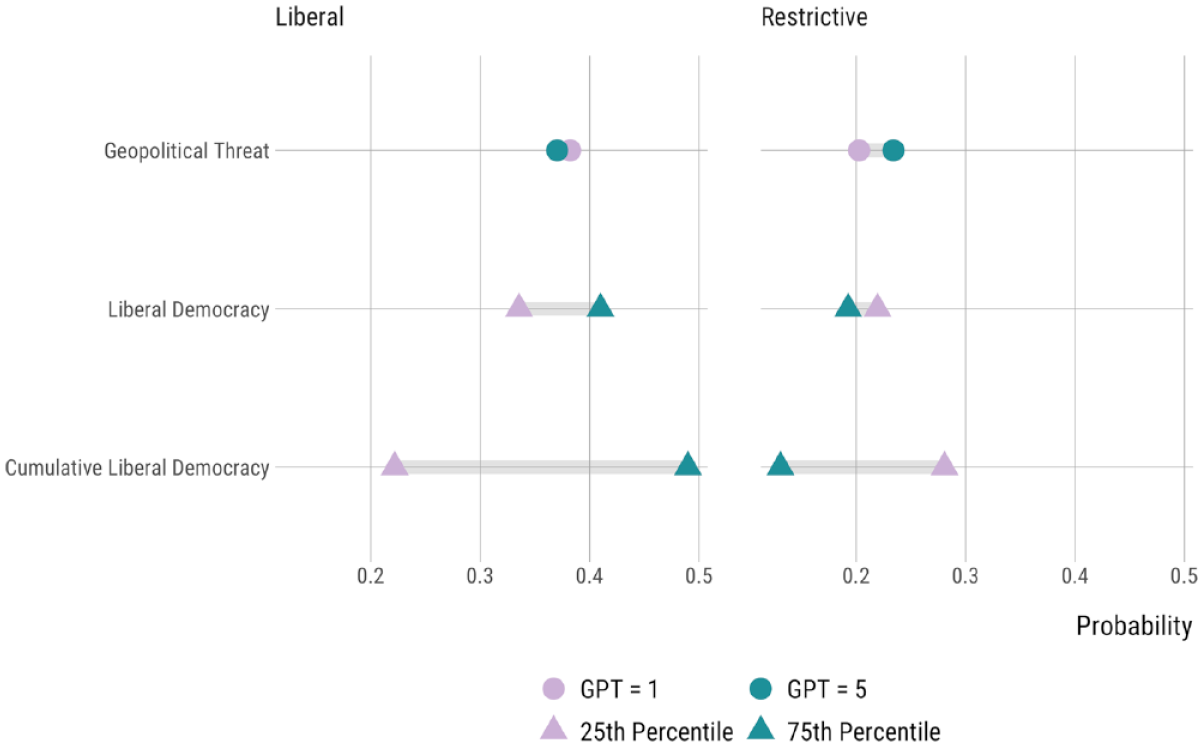
Marginal Predicted Probabilities of Types of Popular Nationalism; Controlling for Liberal Democracy and Cumulative Liberal Democracy
To further explore the role of democratic institutions intimated in the regression results above, we return to the country level (pooling across all available waves of the ISSP) and estimate simple path models to predict the share of the population classified as liberal and restrictive nationalists (see Figure 5). Each path diagram shows the relationship between geopolitical threat and the two types of nationalism, entering both the liberal democracy score and the cumulative liberal democracy score as mediating variables. To facilitate comparisons, coefficients of regression pathways are standardized.
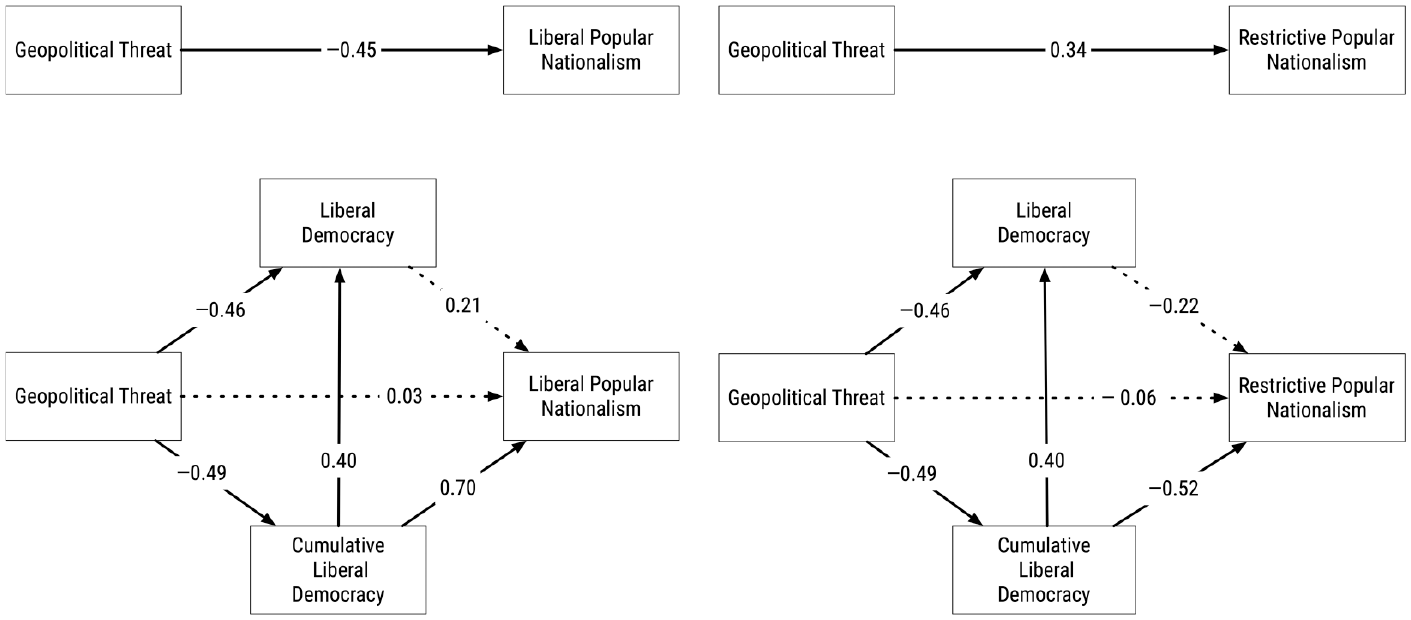
Path Model Relating Geopolitical Threat to Country Share Classified as Liberal and Restrictive Nationalists
In accordance with an expectation that a history of geopolitical loss and internal conflict inhibit the development of robust democratic institutions, we find that geopolitical threat robustly predicts both the current score on the liberal democracy scale and the cumulative score. In turn, these scores predict the share of liberal and restrictive nationalism in the expected directions. Given the nature of our data, we cannot rule out that these results also reflect endogenous processes—for example, if democracies are systematically less likely to participate in wars and thus score lower on the GPT scale. 5 However, as we demonstrate in Table E2 of the online supplement, the “external conflict” dimension (which would most closely capture the potentially endogenous relationship in question) does not appear to be driving our results; moreover, the results of our path models do not change if we remove the “external conflict” dimension from our aggregate scores altogether.
Overall, our findings are consistent with our argument that emphasizes the importance of historical processes: the path from the cumulative score to the share of liberal or restrictive nationalists today is significantly stronger than the path from the current score, which is substantially smaller in magnitude and does not reach statistical significance in either model.
Discussion And Conclusions
In his canonical account of nationalism over a century ago, Ernest Renan ([1882] 1992) proclaimed that nations are made in triumph and grief. But triumph and grief are not equally distributed—geopolitics creates winners and losers. Our analysis shows this variation matters not only in terms of institutions, development, and national power, but also in how it shapes the mindscapes of rank-and-file nationals. In countries with a more turbulent geopolitical past, substantially fewer people hold “liberal” schemas of the nation. In turn, these countries have a higher incidence of schemas we call “restrictive.”
When looking at individual components of nationalism such as pride, membership, hubris, and identification, the effects of geopolitical trauma might appear contradictory, increasing affinities or attachments toward the nation along some dimensions while decreasing it along others. Moreover, these effects may be heterogenous within dimensions as well: for instance, when political entrepreneurs instrumentalize geopolitics, they may drum up pride in certain aspects of the nation (e.g., the ancient past) while decreasing it in other areas (e.g., modern-day influence) (Taş 2020). Because we conceptualized and measured popular nationalism as a set of cognitive schemas, we were able to track these cross-cutting dynamics and retrieve meaning from their interrelationships.
More specifically, we were able to show that higher levels of geopolitical threat translate to higher shares of restrictive nationalists within a country: that is, individuals with schemas that combine relatively high levels of national identification and hubris, low (but uneven) levels of national pride on aggregate, and stringent views on national membership across a range of criteria. Framed differently, geopolitical trauma does not simply or exclusively lead to a decrease in national pride (cf. Wimmer 2017a), nor does it linearly yield an “ethnicization” of citizenship where membership is defined in terms of ancestry (cf. Hiers et al. 2017). Our results are therefore in line with arguments that suggest a focus on common descent is too narrow an indicator to usefully capture distinct understandings of nationalism (e.g., Brubaker 2004:136); and “ethnic” nationalism is not uniquely exclusionist when compared to “civic” nationalism (Brubaker 2004), an argument since supported in empirical work by Simonsen and Bonikowski (2019).
Our approach to identifying varieties of popular nationalism builds on the latent class specifications proposed by Bonikowski and DiMaggio (2016) in their analysis of the United States. We demonstrate that their conceptual and methodological approach can be robustly applied to a wide range of countries and thus afford a systematic analysis of how rank-and-file understandings of nationhood vary across time and space. Our sample includes a wide array of contexts: post-colonial countries; settler societies such as the United States, Canada, Australia, and New Zealand; and European countries that figure prominently in “canonical” studies of nationalism. The measure of geopolitical threat we adopt from Hiers and colleagues (2017)—and which we expand to include non-European societies—broadly captures the consequences of geopolitical loss in these different contexts. Our results are robust to alternative coding schemes as well as the addition of specific control variables that capture other aspects of geopolitics.
That said, our analysis does not specifically interrogate variation in popular nationalism among post-colonial countries, whether in respect to their specific histories of colonialism or their unique trajectories of anti-colonial nationalism. Doing so would not only require a different coding of the geopolitical threat scale, but a dataset that provides measures of popular nationalism in a wider range of post-colonial societies. The ISSP’s coverage is too limited in this regard to allow for a systematic analysis of the kind we conducted here. We see this as an important and fruitful avenue for future research.
Another avenue for future work might be to push the level of analysis below the country level by examining the relationship between geopolitics and popular nationalism at lower levels of aggregation, whether defined by territory (e.g., Quebec or other provinces in Canada, Mindanao or other islands in the Philippines, Gujarat or other states in India) or ethnicity (e.g., different populations within countries [cf. Gorman and Seguin 2018]). Assessing the relative importance of country-level versus sub-state factors in a multilevel modeling environment could help address the extent to which the nation-ness of countries as disparate as France, the United States, and Japan align or differ. Given the limitations of our data and the focus of our argument, we did not systematically explore these possibilities.
It is worth emphasizing that the associations we do observe in this study are in expectation—that is, any particular country may deviate from what a specific score on our geopolitical threat scale would predict. Surely a number of variables, including some we control for in our regression models, but also some outside the purview of this article, shape the structure of popular nationalism in countries—including other sorts of legacy effects. Beyond collective memories of victimhood or conflict, nationalist imaginaries may draw on narratives of exceptionalism that flow from a deep “belief in the cultural uniqueness, moral superiority, and predestined (for some, divine) mission of the nation” (Feinstein and Bonikowski 2019:749). This is consistent with the narratives and myths associated with Christian nationalism in the United States, in which America is venerated as a redeemer nation whose superiority and imperial ambitions were ordained by God (Whitehead and Perry 2020). With these caveats in mind, the fact that the relationships between geopolitical threat and popular nationalism are both statistically and substantively important across a range of model specifications gives us confidence they are not spurious associations.
In the second part of our analysis, we empirically examined one specific conduit for these legacy effects: the development and robustness of liberal democratic institutions. Here our analysis broadly confirms Michael Mann’s (1995) argument: the institutionalization of liberal democracy favored the development of milder, more inclusive forms of nationalism, and its absence amplified more exclusionary strains. Recent work points to the importance of contentious but non-violent mobilization for the deepening and longevity of democracy (Kadivar 2018; Kadivar et al. 2020). Our results imply that these democratization processes might be more fragile in the face of internal and external conflicts that threaten a state’s territorial integrity.
We focus on the legacies of past conflict and the cumulative effects of institutions, but our findings also point to troubling endogenous processes whereby the erosion of liberal norms and institutions over time could lead to lasting shifts in the popular understanding of nationhood. Xenophobic right-wing sentiment appears to be on the rise in many countries, and populists are gaining access to the levers of political power, so developing an understanding of how authoritarian movements are conditioned by legacies of the past will be critical. Combining a comprehensive conceptualization and measurement of popular nationalism with an analysis of the macro-level factors that structure variation across time and space can complement the growing line of work on the varieties of popular nationalism in modern democracies.
Supplemental Material
sj-pdf-1-asr-10.1177_00031224211011981 – Supplemental material for How Legacies of Geopolitical Trauma Shape Popular Nationalism Today
Supplemental material, sj-pdf-1-asr-10.1177_00031224211011981 for How Legacies of Geopolitical Trauma Shape Popular Nationalism Today by Thomas Soehl and Sakeef M. Karim in American Sociological Review
Footnotes
Acknowledgements
For insightful comments on earlier versions of this manuscript, we thank John Hall, Andreas Wimmer, and members of the Canada Research Chair in International Migration research group. The manuscript also was improved by generous and constructive comments from the editors of ASR and four anonymous reviewers. Matvey Lomonosov provided excellent research assistance.

Notes
References
Supplementary Material
Please find the following supplemental material available below.
For Open Access articles published under a Creative Commons License, all supplemental material carries the same license as the article it is associated with.
For non-Open Access articles published, all supplemental material carries a non-exclusive license, and permission requests for re-use of supplemental material or any part of supplemental material shall be sent directly to the copyright owner as specified in the copyright notice associated with the article.
