




Abstract
There has been a long-lasting debate over whether increasing ethnic diversity undermines support for social welfare, and whether this conflict thesis applies not only to the United States, but also to European welfare states. In their 2016 ASR article, Schmidt-Catran and Spies analyzed a panel (1994 to 2010) of regional units in Germany and concluded that this thesis also holds for Germany. We argue that their analysis suffers from misspecification: their model specification assumes parallel time trends in welfare support in all German regions. However, time trends strongly differed between Western and Eastern Germany after reunification. In the 1990s, Eastern Germans’ attitudes adapted to a less interventionist Western welfare system (“Goodbye Lenin effect”). When allowing for heterogeneous time trends, we find no evidence that increasing proportions of foreigners undermine welfare support, or that this association is moderated by economic hardship (high unemployment rates). We conclude with some general suggestions regarding the conceptualization of context effects in spatial analyses.
Keywords
Sociologists have long been interested in the effects of ethnic and racial diversity. Classical theories of intergroup conflict (e.g., Blalock 1967; Blumer 1958) argue that ethnic diversity should lower solidarity. Much empirical research in this tradition focuses on the effects of immigration on welfare attitudes. Following this work, one would expect individuals to believe that resources such as welfare benefits should primarily be reserved for in-group members. This “conflict hypothesis” states that increasing proportions of out-groups (e.g., migrants) with access to those benefits should lower natives’ general support for social welfare spending.
Empirical support for this hypothesis is mixed, with negative, null, and even positive effects reported in the literature (see, e.g., Brady and Finnigan 2014; Eger 2010; Eger and Breznau 2017; Kwon and Curran 2016; Mau and Burkhardt 2009). Some authors argue that the conflict-laden relationship between immigration and welfare support may only hold for countries like the United States characterized by a means-tested, tax-financed welfare regime and a multi-ethnic society (e.g., Alesina and Glaeser 2004). However, in their 2016 American Sociological Review article, Alexander W. Schmidt-Catran and Dennis C. Spies challenge this conclusion (Schmidt-Catran and Spies 2016; henceforth SCS). SCS show that a negative relationship between immigration and welfare attitudes can also be observed in Germany, a European-type welfare regime with a contribution-based, highly work-oriented welfare system and comparatively restrictive regulation of immigration.
Whereas most prior research relies solely on cross-sections, SCS draw on regional panel data combined with repeated cross-sectional surveys on the individual level. This approach allows them to use advanced longitudinal methods (fixed-effects regressions). In a practical sense, the authors provide a highly valuable contribution: many European countries recently experienced strong inflows of immigrants. If SCS’s conclusions are right, these countries might expect increasing ethnic conflicts to lead to eroding public support for welfare spending.
According to SCS, “[w]ithin or fixed effects should provide a better estimate because they control for any unobserved heterogeneity between the units of analysis (Allison 2009)” (p. 248). However, fixed-effects methods also rely on assumptions. Namely, it is of crucial importance that the time-varying treatment variable does not correlate with unobserved time-varying heterogeneity (which is called the “strict exogeneity assumption”; see Brüderl and Ludwig 2015). Strict exogeneity implies parallel (homogeneous) time trends among treatment groups. In the context of SCS’s research question, this means regional units with low proportions of foreigners should show the same trend in support for welfare spending as regions with high proportions of foreigners would show in the absence of treatment (counterfactual trend).
We argue that this assumption is not met in the data at hand. When correcting for the violated assumption by allowing for heterogeneous time trends in Western and Eastern Germany, we find no evidence that increasing levels of foreigners undermine welfare support. This null result also applies to contexts where SCS expected (and observed) the conflict thesis to be particularly relevant, such as regions with high rates of unemployment. Thus, SCS’s main results are spurious, invalidating their key conclusions.
Our discussion has implications beyond SCS’s study. The large improvement in the availability of geographic data certainly opens up an immense potential to deepen our understanding of social processes we are strongly concerned with in our discipline. But one also has to bear in mind that spatial analyses entail additional inferential risks. In particular, regional units frequently develop in different ways over time. If those different development paths are not adequately captured in regression analyses, one risks biased estimates.
SCS Analyses and our Replication
SCS use data from the German General Social Survey (GGSS; known as ALLBUS in Germany, for details see GESIS 2013). Data from the survey years 1994, 2000, 2004, and 2010 are pooled. The outcome variable used in all analyses is an ordinal measure on whether respondents favor that welfare benefits (1) decrease, (2) stay about the same, or (3) increase.
SCS merged these individual-level data with regional data from official statistics. The central treatment variable is the proportion of foreigners in a region (in % as a proxy for the proportion of migrants). They analyzed effects of the regional proportion of foreigners on respondents’ welfare attitudes, and also interaction effects with the regional proportion of unemployed. In their main analyses, SCS specified these context variables on the level of 96 Regional Area Units in Germany (i.e., Raumordnungsregionen, RORs hereafter).
Because the outcome is an ordinal variable, SCS used ordered probit regressions. The data have a three-level structure. The regional units represent the highest level; these are observed four times, and each time inhabitants are surveyed. To make full use of the panel structure of the regional data, SCS proposed to estimate fixed-effects models for the regional level. 1 Because standard fixed-effects models are not available for ordered probits, SCS used hybrid models (Allison 2009:42). In these models, all regional-level effects are separated into “between” and “within” effects. For causal interpretations the within effects are interesting, because these give the (approximate) effects one would obtain with fixed-effects models.
For our replication, we use the same model specification as SCS. Besides the central treatment variable, several individual (e.g., sex, education, employment status) and regional-level (unemployment rate and GDP) controls enter the regression. The model also includes a dummy for Eastern German regions. Finally, we model a common time trend by including dummies for the survey years.
Panel 1 in Table 1 replicates SCS’s analyses. Only the central effects are presented (the within effects; the full models can be found in Table B2 in the online supplement). We succeeded in reproducing SCS’s results (results differ only marginally, because we improved SCS’s specification slightly; details and a comparison with SCS’s original results can be found in Part B in the online supplement). The first model (Model 1a) contains the main effect of the proportion of foreigners (measured in percent). The within effect of this variable is –.16 (p < .001). This means an increase in the proportion of foreigners is significantly associated with decreasing support for welfare spending, which SCS interpreted as strong evidence for the conflict hypothesis.
Hybrid Ordinal Probit Regressions of Welfare Attitudes on the Proportion of Foreigners (Only Within Effects Reported)
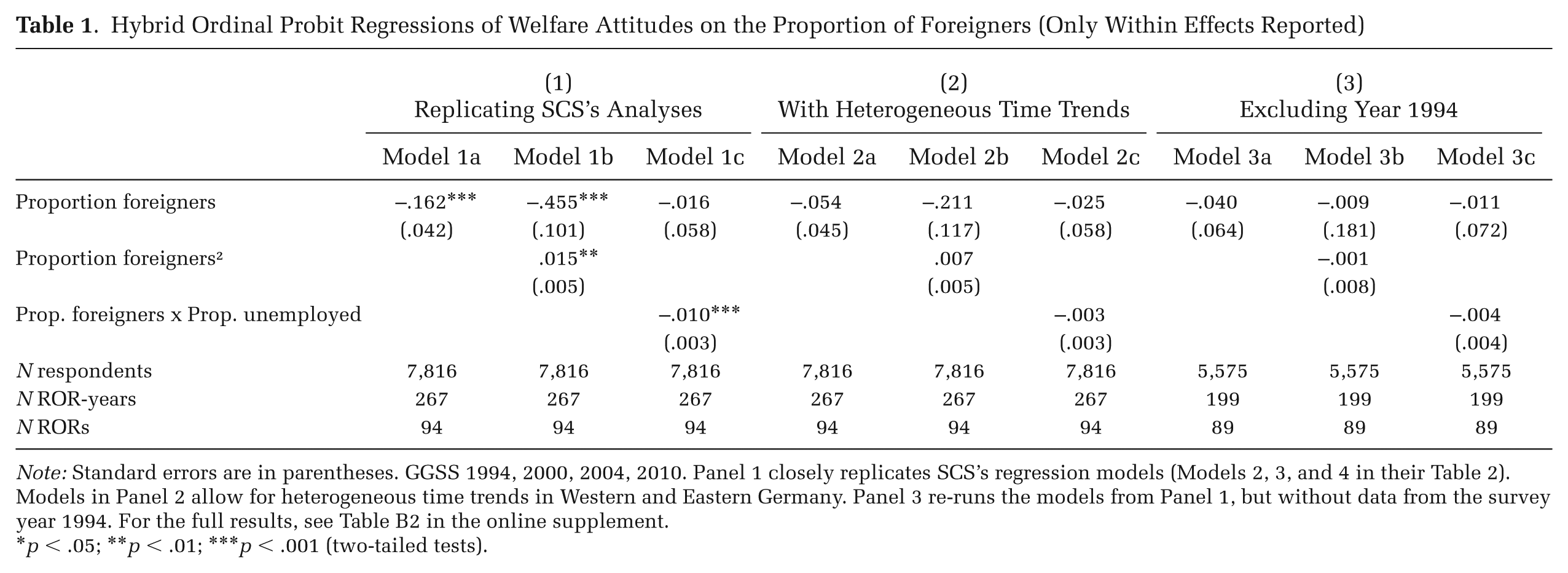
Note: Standard errors are in parentheses. GGSS 1994, 2000, 2004, 2010. Panel 1 closely replicates SCS’s regression models (Models 2, 3, and 4 in their Table 2). Models in Panel 2 allow for heterogeneous time trends in Western and Eastern Germany. Panel 3 re-runs the models from Panel 1, but without data from the survey year 1994. For the full results, see Table B2 in the online supplement.
p < .05; **p < .01; ***p < .001 (two-tailed tests).
SCS tested two prominent moderator hypotheses. First, a frequent assumption in the literature is that conflicts caused by immigration are often evident in initial phases of immigration, because native citizens are not yet accustomed to cultures of ethnic diversity (Allport 1954; Quillian 1995). Consequently, SCS tested for nonlinear effects of the proportion of foreigners. Second, conflicts caused by immigration might be especially intense in times of economic hardship, because natives might blame immigrants for the poor economic situation, or because competition for welfare resources intensifies in those times (Quillian 1995; SCS 2016:245). Therefore, SCS tested for an interaction between the proportion of foreigners and regional unemployment rates.
Models 1b and 1c (Table 1) give the results of our replication. The significant negative effect for the linear term together with the significant positive effect for the squared term in Model 1b suggests the negative association between an increase in foreigners and welfare support shows up mainly in regions where few migrants live. The significant interaction effect with unemployment in Model 1c suggests the negative effect of higher levels of foreigners mainly exists in regions with high unemployment rates. Both results provide further evidence for the conflict hypothesis.
East is not West: Allowing for Heterogeneous Time Trends
In the following we will argue that SCS’s results are biased due to violations of the parallel trend assumption. Eastern and Western Germany evolved along quite different development paths after reunification. Before 1990, these two parts of Germany were separate countries: the former Federal Republic of Germany (FRG) and the former German Democratic Republic (GDR). Even after reunification, Eastern and Western Germany still strongly differ in many aspects, including central variables in the analyses.
First, as Table A1 in the online supplement shows, at the state level there is no overlap between these two parts of Germany concerning the treatment variable proportion foreigners: Eastern German states range between 1.0 and 2.8 percent, and Western German states between 4.9 and 15.3 percent. (On the ROR level there is a minimal overlap: East between .8 and 4.0 % West between 3.3 and 17.6 percent.) This is because in the GDR only a few non-natives of befriended socialist countries were allowed to enter the country. After reunification, Eastern Germany had the same immigration legislation as in Western Germany, but few migrants moved to Eastern Germany (also Western Germany did not see much net-immigration between 1994 and 2010). Thus, even in 2010, East/West (almost) completely separates the treatment variable.
Second, the outcome variable (support for welfare spending) followed heterogeneous time trends in Eastern and Western Germany (see Figure 1). 2 In Western Germany, each year about 20 percent of respondents thought welfare spending should be increased, another 20 percent said it should decrease, and 60 percent, on average, said it should stay as it is. In contrast, in Eastern Germany, welfare support was much higher in 1994: about 60 percent of respondents were in favor of increasing welfare spending, 40 percent favored a constant level, and virtually no one wanted it to decrease. This changed dramatically by 2000: now only 36 percent supported an increase, and 60 percent were in favor of a constant level. Finally, by 2010, Eastern Germans’ support for welfare spending had adapted closely to Western standards.
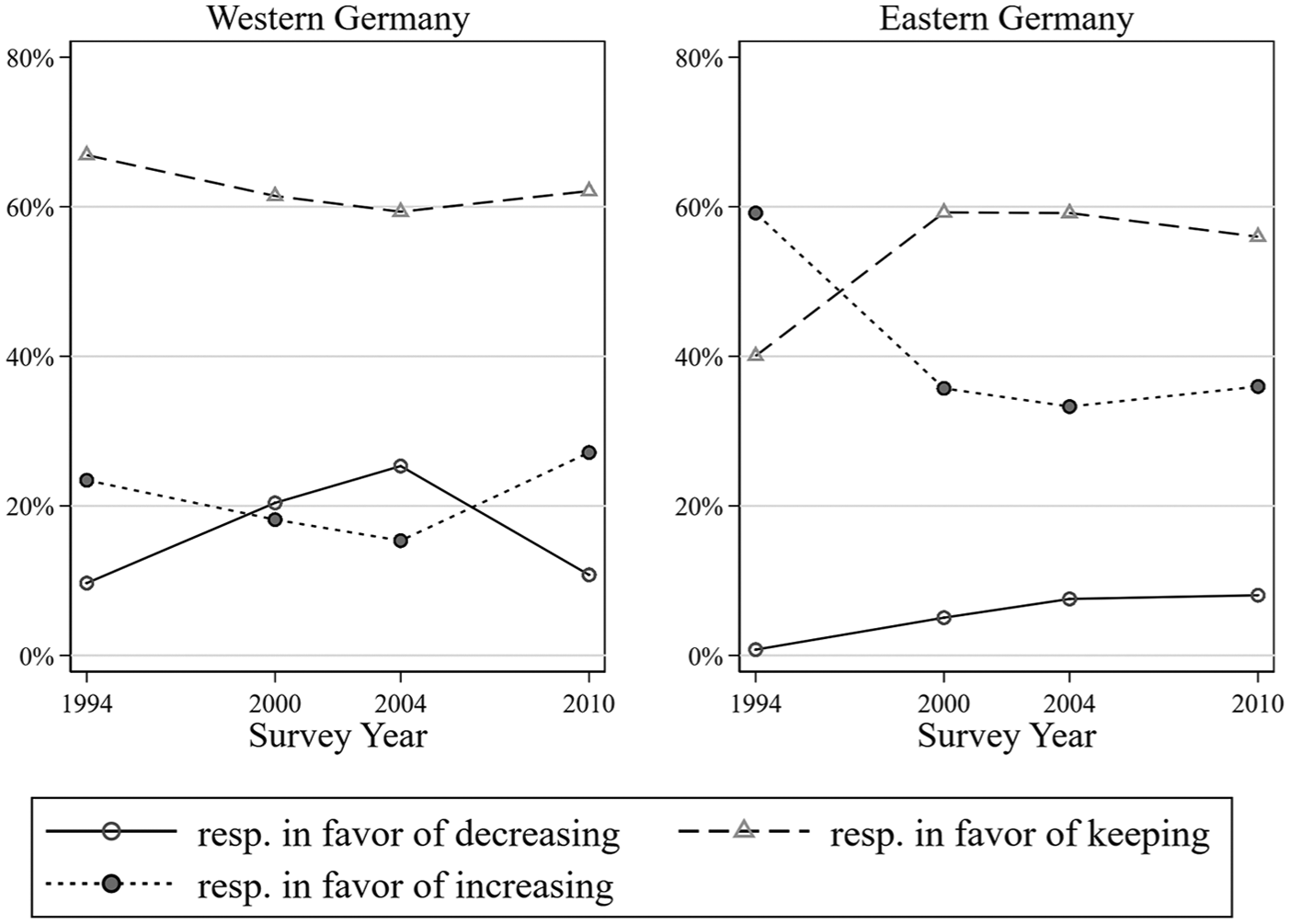
Proportion of Respondents in Favor of Decreasing, Increasing, or Keeping Welfare Benefits at About the Same Level
The exceptional high support for welfare shortly after reunification and the ensuing sharp drop can be explained by two historical processes. In 1994, citizens in Eastern Germany (who mainly grew up with the socialist system of the GDR) were still more in favor of state interventions than were citizens in Western Germany. However, after German reunification, Easterners lived under the Western political regime, and gradually their (welfare) attitudes adapted to those of Western Germans. In addition, cohort replacement effects took place, so that more and more cohorts in Eastern Germany grew up under a democratic political system. Both mechanisms together produced less support for state interventions in Eastern Germany; this has been called the “Goodbye Lenin effect” (Alesina and Fuchs-Schündeln 2007; Andreß and Heien 2001; Svallfors 2010).
Bringing the pieces together we present a scatterplot of the proportion of respondents favoring welfare extension by the proportion of foreigners (Figure 2). This plot clearly shows what is going on in the data: the treatment variable almost completely separates East/West. Furthermore, we see how the Goodbye Lenin effect operated in Eastern Germany: here the 1994 observations are systematically higher. In Western Germany, they are spread out evenly. Only in Eastern Germany is there a negative association between the proportion of foreigners and welfare attitudes, which, however, is most likely driven by the general change in welfare attitudes shortly after the German reunification and not by conflict-laden immigration. 3
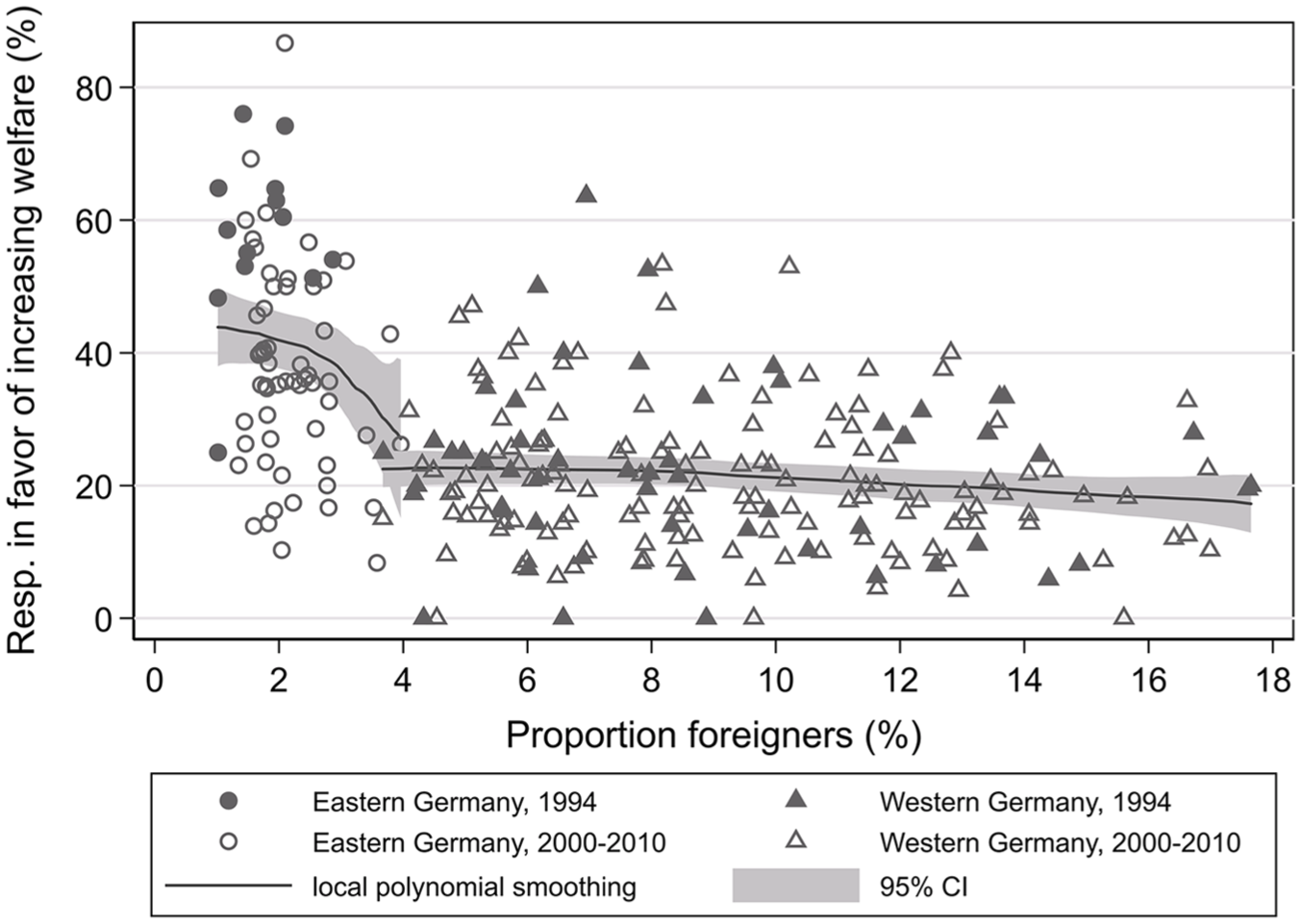
Proportion of Respondents in Favor of Increasing Welfare Benefits by Proportion Foreigners
These pronounced regional differences need to be incorporated into the regression analyses. SCS tried to tackle this issue by including a dummy variable controlling for Eastern versus Western Germany. This is not sufficient because a dummy variable controls only for different levels. However, as we showed there are heterogeneous trends. If time trends are not parallel, treatment effect estimates will be biased. In the data at hand this will produce a spurious effect of proportion of foreigners on welfare support. This can be seen in Panel 2 (Table 1) where we allow for different time trends in Eastern and Western Germany. Technically, we add interaction terms between the year dummies and the East dummy. The within effect of proportion foreigners on the ROR level in Model 2a drops to –.054 and is no longer statistically significant (p = .23).
Another approach for tackling the problem is grounded in the insight that from 2000 to 2010, welfare support largely developed similarly in both parts of Germany (albeit on different levels, see Figure 1). Heterogeneous trends are mainly produced by the Goodbye Lenin effect that operated in the 1990s. To get rid of the problem of heterogeneous time trends, one could thus simply drop the observation year 1994. The remaining three survey years should still provide sufficient data (5,575 respondents, 199 ROR-years) to get a reliable estimate of the foreigner effect. Therefore, in Panel 3 (Table 1) we present results with SCS’s original specification (common time trend) but dropping the year 1994. With this second approach, the within effect of foreigners again becomes much smaller (–.040) and is no longer statistically significant (p = .53).
Finally, we suspect the moderator effects reported by SCS are affected by heterogeneous time trends in Eastern and Western Germany. A low level of foreigners and a high unemployment rate characterize Eastern German regions shortly after reunification (see Table A1 and Figure A1 in the online supplement). Therefore, if we observe strong negative effects especially in regions with low proportions of foreigners and high unemployment, it could simply be because these regions were particularly affected by the Goodbye Lenin effect. Models 2b/2c and 3b/3c in Table 1 show the results if we allow for heterogeneous time trends or drop the year 1994. The main and interaction effects are now considerably lower and are not statistically significant. The conditional effect plots in Figure C1 in our online supplement show what this means. The patterns of the marginal effects dramatically change, and even in regions that are thought to provide the most favorable conditions for the conflict thesis, we no longer see significant effects of the proportion of foreigners.
Overall, our analyses show that even the moderator effects reported by SCS were most likely produced by the Goodbye Lenin effect. Regions with low proportions of foreigners and high unemployment were mainly Eastern German, and there the convergence to the attitudes held by Western Germans (artificially) produced a negative association between proportion foreigners and welfare support.
Robustness Checks
We performed several robustness checks to see whether our null results still obtain when using alternative specifications (these and further robustness checks can be found in Part D of the online supplement).
In their analyses, SCS excluded all ROR-years with fewer than 10 respondents “to guarantee representativeness” (SCS:248). In our opinion, this selection jeopardizes “representativeness” by arbitrarily excluding randomly drawn sample points. Furthermore, SCS kept respondents in the analysis who indicated having “no opinion” on welfare spending (17 percent). This was done by imputing the value 2 (welfare benefits should stay about the same). This might have lowered statistical power by adding random noise. We estimated models where we both include all ROR-years and exclude respondents with no opinion (Table D1). We find the same patterns as reported in Table 1. Thus, we again find no negative effect of proportion foreigner on welfare support once allowing for heterogeneous trends.
One could argue that SCS’s interaction specification did not fit well with their moderator thesis: “the higher the unemployment rate, the more negative is the effect of foreigners on natives’ attitude toward providing welfare” (SCS:242). SCS used a classical interaction specification. However, as Giesselmann and Schmidt-Catran (2018) show, this specification mixes within- and between-variation. In our opinion, it corresponds better to their moderator thesis to use only the between-variation in the unemployment rate as a moderator (the region-specific mean unemployment rate; this strategy is explained in more detail in Part D2 of the online supplement). Doing so again supports the conclusion that no moderator effects are discernible (Table D2).
In their online supplement, SCS provide alternative estimates at the level of federal states (Bundesländer). These estimates show even stronger evidence for the conflict thesis (stronger negative effect sizes). We therefore replicated all analyses on the state level (Table D3). Again, effects lose significance once heterogeneous time trends are included. Thus, on the state level, we again find no support for the conflict thesis.
Summary and Conclusions
Increasing global integration and migration, as well as the better availability of regional context data, have renewed scientific interest in the effects of ethnic diversity (Abascal and Baldassarri 2015:725). SCS (2016) contributed to this literature by analyzing regional units in Germany from 1994 to 2010. In this comment, we argued that their main finding of a negative effect of immigration on support for welfare spending is spurious. Two social processes in the aftermath of German reunification—Eastern Germans converging to the welfare attitudes of Western Germans, and foreigners increasingly migrating to Eastern Germany—happened simultaneously in the same historical period, but without any causal connection. The strong effects SCS found were mainly driven by the huge decline in welfare support that happened in Eastern Germany in the 1990s. This decline, however, most likely was not caused by the influx of migrants (conflict hypothesis), but by Eastern Germans adapting to a less interventionist Western welfare system (Goodbye Lenin effect).
SCS disregarded these heterogeneous time trends in Eastern and Western Germany. Once one allows for heterogeneous time paths, we no longer find evidence of an effect of immigration on welfare support. We also observe no compelling evidence for the two moderator theses tested by SCS. The negative effect of foreigners is not consistently stronger in regions that are not yet used to migration or that suffer from unfavorable economic conditions (high unemployment rates). Hence, we see no empirical basis for SCS’s conclusion that the conflict hypothesis generalizes to European-type welfare regimes (cf. SCS 2016:257).
Suggestions for Future Research
We conclude with some general suggestions for future research on context effects. First, when analyzing regional data bound to specific administrative or historical territories, one should always reflect about spatial patterns that could contaminate results. For the case at hand, other authors have concluded that one should treat both parts of Germany—despite reunification—like separate countries (Andreß and Heien 2001). The historical process of the German reunification discussed in this comment is but one example. Other examples are different development paths taken by “red” versus “blue” states in the United States (Gelman et al. 2008), or regional areas being locked in specific path-dependencies caused by their economic or geographic peculiarities (Martin and Sunley 2006).
Theoretical reflections can help us notice such heterogeneity. Also, statistical and visual tools are beneficial in spotting spatial patterns that are not adequately captured in data analyses. A first simple method is to check if residuals (i.e., unexplained variance) follow any suspicious non-random pattern. Our online supplement (Figure D1) provides an example for this. An alternative possibility would be to plot residuals (or their autocorrelations) on a geographic map (for examples, see Darmofal 2015). Marked shifts in the level of residuals that occur at borders of regional units indicate a special form of an omitted variable bias: a (social) mechanism that is not yet well-reflected in one’s data analyses and that is bound to specific regional areas. Visualizations typically allow for much higher transparency on the consistency of results than does summarizing evidence solely in regression tables (Healy and Moody 2014).
Second, detecting such patterns would not only allow for a better specification of regression models, but it would also provide insights into where to look for the social mechanisms that caused context effects. In pooled regression models, one can include interaction terms to capture unique time trends for distinct regions. Even more, one could allow for a separate trend for each region (Brüderl and Ludwig 2015). These models provide valuable insights into the question of a convergence or a deepening division of trends (in social attitudes) across different regions (Firebaugh 2008).
Finally, although we tried to demonstrate that the conflict hypothesis did not apply to Germany in 1994 to 2010, we cannot determine whether it will apply to other European-type welfare states. Many European countries that are not yet well accustomed to ethnic diversity are currently experiencing a strong inflow of refugees. At the same time, they are often facing economic hardship and rising anti-foreigner resentments. A better understanding of the possible associations between immigration and welfare solidarity is thus important. SCS introduced an innovative research design for this endeavor, and we hope our comment encourages researchers to utilize this design in an even more fruitful way.
Supplemental Material
Auspurg_online_supplement – Supplemental material for Does Immigration Reduce the Support for Welfare Spending? A Cautionary Tale on Spatial Panel Data Analysis
Supplemental material, Auspurg_online_supplement for Does Immigration Reduce the Support for Welfare Spending? A Cautionary Tale on Spatial Panel Data Analysis by Katrin Auspurg, Josef Brüderl and Thomas Wöhler in American Sociological Review
Supplemental Material
Replication_Files_Auspurg_Bruederl_Woehler – Supplemental material for Does Immigration Reduce the Support for Welfare Spending? A Cautionary Tale on Spatial Panel Data Analysis
Supplemental material, Replication_Files_Auspurg_Bruederl_Woehler for Does Immigration Reduce the Support for Welfare Spending? A Cautionary Tale on Spatial Panel Data Analysis by Katrin Auspurg, Josef Brüderl and Thomas Wöhler in American Sociological Review
Footnotes
Acknowledgements
For helpful suggestions we thank participants of the conference “Analytical Sociology” at Venice International University, November 2017. This paper was written while Katrin Auspurg was a visiting scholar at New York University. We are grateful for comments on earlier versions we received from three anonymous reviewers and from the editors.
Data Note
We used micro data from the ALLBUS 1980–2010 (GESIS 2013) and regional data provided by the federal statistical office (https://www-genesis.destatis.de). Replication files (Stata do-files and the regional data) can be found in the  accompanying this article.
Notes
References
Supplementary Material
Please find the following supplemental material available below.
For Open Access articles published under a Creative Commons License, all supplemental material carries the same license as the article it is associated with.
For non-Open Access articles published, all supplemental material carries a non-exclusive license, and permission requests for re-use of supplemental material or any part of supplemental material shall be sent directly to the copyright owner as specified in the copyright notice associated with the article.
