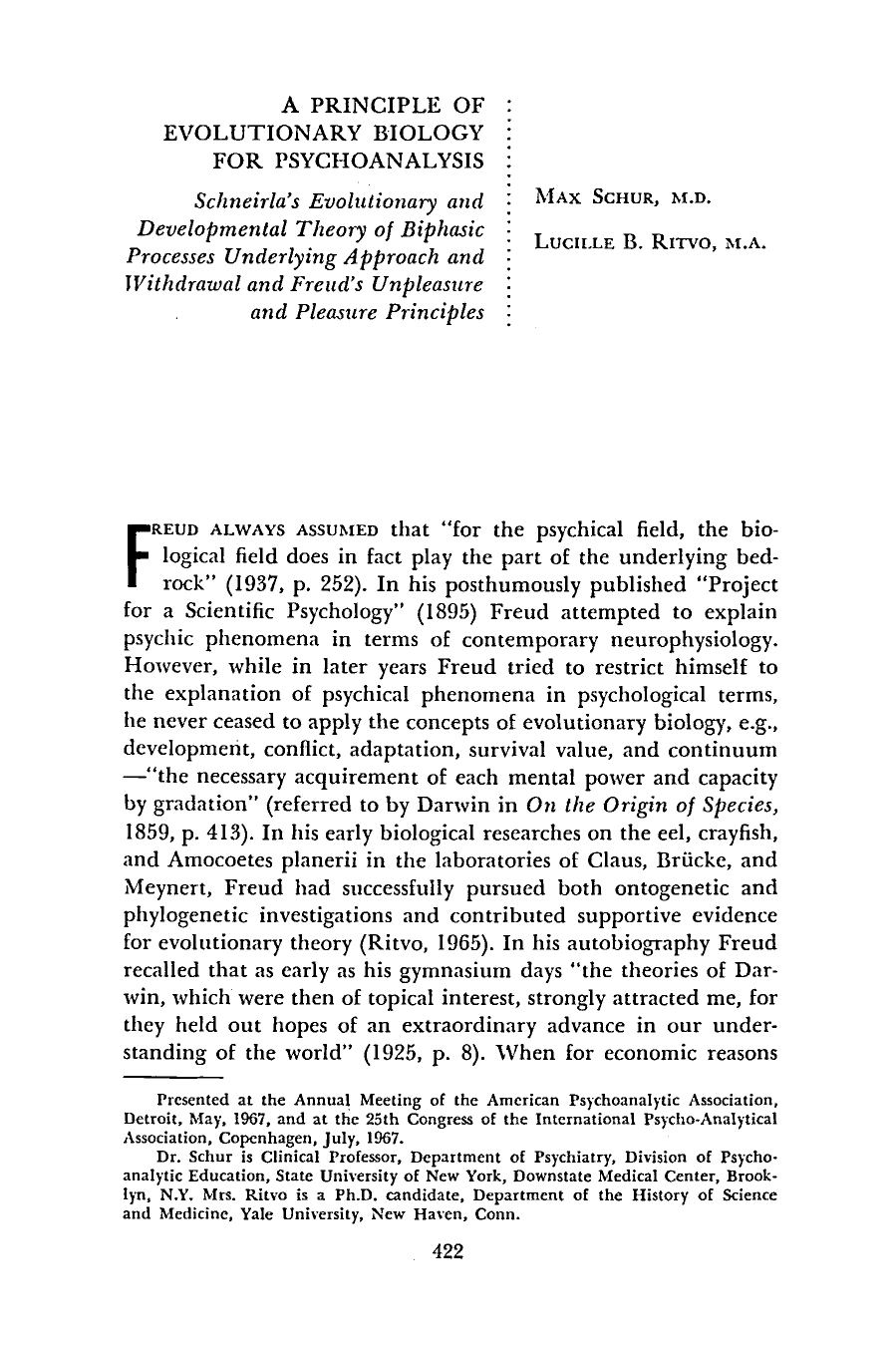
A Principle of Evolutionary Biology for Psychoanalysis: Schneirla's Evolutionary and Developmental Theory of Biphasic Processes Underlying Approach and Withdrawal and Freud's Unpleastire and Pleaswe Principles
Restricted accessResearch articleFirst published online April, 1970
A Principle of Evolutionary Biology for Psychoanalysis: Schneirla's Evolutionary and Developmental Theory of Biphasic Processes Underlying Approach and Withdrawal and Freud's Unpleastire and Pleaswe Principles
Benjamin, J. (1965), Developmental biology and psychoanalysis. In: Psychoanalysis and Current Biological Thought, ed. N. S. Greenfield & W. D. Lewis. Madison: University of Wisconsin Press, pp. 57–80.
2.
Darwin, G. (1859), On the Origin of Species.London: Watts, 1950.
3.
Fechner, G. T. (1848), Nanna, oder das Seelenleben der Pflanzen.Leipzig: L. Voss.
4.
Fechner, G. T. (1873), Ideen zur Schöpfungs– und Entwicklungsgeschichte der Organismen.Leipzig: L. Voss.
5.
Freud, S. (1892), Letter to Josef Breuer. Standard Edition, 1: 147–148. London: Hogarth Press, 1966.
6.
Freud, S. (1895), Project for a scientific psychology. Standard Edition, 1: 283–397. London: Hogarth Press, 1966.
7.
Freud, S. (1900), The interpretation of dreams. Standard Edition, 4 & 5. London: Hogarth Press, 1953.
8.
Freud, S. (1911), Formulations on the two principles of mental functioning. Standard Edition, 12: 213–226. London: Hogarth Press, 1958.
9.
Freud, S. (1913), Totem and taboo. Standard Edition, 13: 1–161. London: Hogarth Press, 1955.
10.
Freud, S. (1915a), Instincts and their vicissitudes. Standard Edition, 14: 111–140. London: Hogarth Press, 1957.
11.
Freud, S. (1915b), The unconscious. Standard Edition, 14: 159–215. London: Hogarth Press, 1957.
12.
Freud, S. (1920), Beyond the pleasure principle. Standard Edition, 18: 7–64. London: Hogarth Press, 1955.
13.
Freud, S. (1925), An autobiographical study. Standard Edition, 20: 3–74. London: Hogarth Press, 1959.
14.
Freud, S. (1927), The future of an illusion. Standard Edition, 21: 3–56. London: Hogarth Press, 1961.
15.
Freud, S. (1937), Analysis terminable and interminable. Standard Edition, 23: 209–253. London: Hogarth Press, 1964.
16.
Maier, N. R. F. & Schneirla, T. C. (1935), Principles of Animal Psychology. New York: McGraw.
17.
Ritvo, L. B. (1963), Darwin of the mind. Master's thesis, New Haven: Yale Medical Historical Library.
18.
Ritvo, L. B. (1965), Darwin as the source of Freud's neo–Lamarckism. This Journal, 13: 499–517.
19.
Schneirla, T. C. (1956), Interrelationships of the “innate” and the “acquired” in instinctive behaviour. In: L'instinct dans le comportement des animaux et de Phomme.Paris: Massin, pp. 387–452.
20.
Schneirla, T. C. (1957), The concept of development in comparative psychology. In: The Concept of Development: An Issue in the Study of Human Behavior, ed. C. B. Harms. Minneapolis: University of Minnesota Press, pp. 78–108.
21.
Schneirla, T. C. (1959), An evolutionary and developmental theory of biphasic processes underlying approach and withdrawal. In: Nebraska Symposium on Motivation, ed. M. R. Jones. Lincoln: University of Nebraska Press, pp. 1–42.
22.
Schneirla, T. C. (1961), Analysis of socialization in a mammal. Amer. J. Orthopsychiat., 31: 223–253.
23.
Schneirla, T. C. (1962), The theory of the parent–infant relationship. Int. J. Psycho–Anal., 43: 243–245.
24.
Schur, M. (1961), Animal research panel: a psychoanalyst's comments. Amer. J. Orthopsychiat., 31: 276–291.
25.
Schur, M. (1966), The Id and the Regulatory Principles of Mental Functioning. New York: International Universities Press.
26.
Schur, M. & Ritvo, L. B. (1970), The concept of development and evolution in psychoanalysis. In: Development and Evolution of Behavior: In Honor of T. C. Schneirla, ed. by L. Aronson, D. Lehrman, J. S. Rosenblatt, & E. Tobach. San Francisco: W. H. Freeman (in press).
27.
Wundt, W. (1912), Elemente der Völkerpsychologie, Teil II. Leipzig: A. Kroner.