



Abstract
At times, radicalized rightwing movements may influence political institutions to the point of weakening core democratic practices and promoting the tools of autocrats. We advance a theory of social movement partyism, arguing that formal political parties and social movements may forge an alliance through a relational opportunity-mobilization exchange, whereby the party provides political opportunities to the movement and the movement offers a highly energized base of support. In this environment, elected officials will be moved to take action in the electoral arena consistent with movement goals. We use a quantitative dataset at the House District level to examine the impact of the hate movement on members of Congress voting to object to certifying the presidential election results on January 6, 2021, net of a host of individual and social contextual variables. We find Congress members from districts with high levels of hate movement organizations, especially those formed in the Trump era, were more likely to object to the election results. We provide a reliability check using a model looking at additional measures of anti-democratic activity and autocratic tools. Our results provide strong support for our contention that social movement partyism involving an extremist movement influenced recent anti-democratic and authoritarian actions on the part of elected officials in the United States.
Introduction
Radicalized rightwing movements may influence political institutions to the point of weakening core democratic procedures and threatening the constitutional order. On January 6, 2021, a right-wing mob of several thousand people violently stormed the US capitol building attempting to disrupt the final certification of the November 2020 presidential elections. The mob included members of the Proud Boys, a group who helped plan the Capitol breach, and demonstrators who attended a rally in support of President Trump earlier in the morning. Lawmakers inside hid from the crowds and barricaded themselves in their chambers and offices. Once the radicalized protesters were cleared out by Capitol police and the National Guard, Congress resumed roll call voting on certifying the Electoral College results throughout the evening hours. Some members of Congress took institutional collective action with the same goal as the insurgents, with eight US Senators and 139 members of the House of Representatives objecting to certify the election results in spite of the fact the Trump Administration’s Attorney General and the Department of Homeland Security’s Cybersecurity and Infrastructure Security Agency found no evidence of voting irregularities.
In this article, we explore the association between extremist social movements and party voting inside the legislative branch of government. Specifically, we examine the relationship between hate groups and the Republican Party (GOP) at the time of the insurrection and how this alliance influenced both the January 6th vote and other anti-democratic activities supporting autocratic behavior. We suggest that the Republican Party was operating in coalition with extremist social movements in 2020 and the years before in an instance of social movement partyism, where a social movement and political party act in concert and the party becomes radicalized and employs extra-institutional action, such as protest, building occupations, or violates institutional norms, for example, by using tactics to delay or avoid normal procedural operations. Social movement partyism has been observed in both left and rightwing political parties and movements, and in different parts of the world (Anria, 2018; Wouters et al., 2021). Movement partyism does not always involve extremism, which we define as the pursuit of actions and ideologies well outside the mainstream, 1 but becomes especially worrisome when the aligned movement and party share extremist and autocratic behaviors and goals.
We build on the scholarship on social movement-party relationships by describing the process through which such an alliance can be forged, suggesting it occurred through a relational opportunity-mobilization exchange. In the case we examine, the Trump-led GOP provided the hate movement with political opportunities, and the movement supported Trump’s GOP by mobilizing in support. This exchange began when Donald Trump ran an ethnonationalist campaign for office in 2015, and continued through January 6, 2021 and beyond, when a highly energized faction of the hate movement worked to help him attempt to retain power. The hate movement, with its history of working to suppress constitutional rights, has a strong organizational infrastructure and provided the Trump GOP with highly energized leaders and members who possessed social network ties across social and geographic boundaries. We provide historical evidence demonstrating the political opportunities promised and delivered by the Trump campaign and administration, as well as evidence the hate movement mobilized to influence elections and lawmakers in response.
While scholarship is convincing in its evidence regarding earlier rightwing movements (such as the Tea Party and the Christian Right) as a force propelling the Republican Party toward extremism (see McKenna and O’Donnel, 2024), few scholars have examined the alliance between hate movements and conservative political parties. Scholars have documented close ties between right-wing extremists and political parties in many contemporary European countries, such as Germany’s National Democratic Party, Austria’s Freedom Party, the British National Party and the Hungarian Civic Alliance (Fidesz-MPSZ) (Futrell et al., 2018; Gest, 2016; Greskovits, 2020). Moreover, the United States has a long history of white supremacists and sympathizers in Congress (Weil et al., 2022). However, studies of contemporary social movement impacts on Congress have tended to focus on the influence of progressive movements rather than conservative (with some notable exceptions, see McVeigh, 2009; McVeigh & Estep, 2019; Perlstein, 2009). Our study makes a contribution by studying impacts of extremist movements on several instances of anti-democratic Congressional action.
Social Movement Partyism and the Opportunity-Mobilization Spiral
While some suggest political parties have almost always been comprised of organized interests and social movements (McAdam & Kloos, 2014) and others describe a more recent emergence of this strong alignment (Amenta, 2022; Skocpol, 2020; Tarrow, 2021), there is substantial evidence these alliances became even more pronounced and enduring in the late 20th and early 21st centuries. Since 1960, the political parties have become highly polarized, driven largely by a Republican Party that moved much farther to the right (Davidson et al., 2020; Skocpol, 2020). Increased gerrymandering coupled with campaign finance law changes that allow powerful external interests to provide undisclosed amounts of money to fund campaigns have reduced the ability of the parties to control elections (Almeida & Van Dyke, 2014; Amenta, 2022; McAdam & Kloos, 2014; Milkis & Tichenor, 2019; Tarrow, 2021). For Republicans, these factors, coupled with powerful rightwing media allies, have enabled conservative movements to move to the center of the party, playing an important role in mobilizing voters and setting the Republican policy agenda (Schlozman, 2015; Skocpol, 2020; Tarrow, 2021). Scholars document how successive waves of conservative movements have largely taken over the Republican Party since the early 1970s, including evangelical Christians, gun owners, and the Tea Party movement more recently (Amenta, 2022; McAdam & Kloos, 2014; Schlozman, 2015; Tarrow, 2021). We provide evidence here that the GOP in 2016 to 2020 was acting in alliance with the hate movement in a relationship of social movement-partyism.
Almeida (2010) first used the term social movement partyism in his study of Latin American political parties that were closely aligned with social movements and engaged in extra-institutional tactics like protests. We further develop the concept here and argue social movement partyism is characterized by three phenomena: (1) demonstrated evidence of movement influence on party positions and policy; (2) social movement supporters holding powerful party positions; and (3) use of extra-institutional, and sometimes institutional norm-violating, tactics by institutional actors such as elected officials. Extra-institutional action may include participating in protests and demonstrations, and norm-violating institutional action can include staging walkouts during votes or using procedural tactics to delay regular order. When a party is aligned with extremist social movements, the actions taken by party members may undermine democratic practices. These three characteristics were evident in the period surrounding January 2021 in the relationship between extremist conservative movements and the Republican Party.
We follow scholars such as Emirbayer (1997) and McAdam et al. (2001) who argue aspects of contention are not static phenomena but rather are produced within dynamic, transactional contexts, and suggest the mechanism behind the development of this relationship and influence is a relational opportunity-mobilization exchange. Political parties have an interest in aligning with movements that have the capacity to mobilize voters and have a strong organizational infrastructure, including leadership, a network of supporters, and resources (Anria, 2018; Almeida et al., 2021; Schlozman, 2015). Movements may join an alliance with a political party to gain access to political allies and opportunities. The relationship between the movement and party is dynamic and unfolds over time through an exchange sequence. As with the building of any coalition, bridge builders or mediators, with ties to both sides may encourage their associates to begin working with the other party (Bystydzienski & Schacht, 2001; Obach, 2004; Rose, 2000). The presence of political insiders is both a characteristic of and a generative feature of social movement partyism (Stearns & Almeida, 2004).
The relationship may be initiated by either the party or the movement. Candidates may make statements supporting the goals of the movement, thereby communicating that they and their party will provide the movement with political opportunities. This in turn provides movement members with a powerful incentive to help supportive party candidates get or remain elected. Movements may also initiate the relationship, mobilizing to pressure candidates to support movement goals and offering electoral assistance if they do. Such was the case with the Townsend movement in the 1930s and the means through which they were able to influence the passage of old age assistance (Amenta et al., 2005). Once the movement partyism relationship is in place, members of the party act as social movement insiders, representing the interests of the movement and acting to advance movement goals. For extremist movement party relationships, the policy influence may involve anti-democratic and autocratic actions within the state.
Small or fleeting movements that lack significant organizational structure will be unlikely to forge an alliance with a political party because party members are looking to collaborate with movements that have sufficient organizational networks and resources to help party candidates win elections. We do not expect that extremist conservative movements exerted influence on the GOP in the years surrounding 2020 primarily via protest events, but rather because of their strong organizational infrastructure. Although social movement scholarship typically assumes that movements have an impact because of the disruption they cause through collective action (Andrews, 2001), numerous studies find that protest events have little impact on outcomes such as Congressional and parliamentary voting (Giugni, 2007; Olzak et al., 2016; Soule et al., 1999), including for rightwing parties (Wouters at al., 2021). Research suggests it is not protest activity but movement organizational presence that has an impact on Congressional votes (Andrews, 2001, 2004; Johnson et al., 2010; McCammon et al., 2001; Olzak et al., 2016; Schlozman, 2015). Olzak et al. (2016), for example, find that while social protest does not impact the passing of environmental bills, passage is more likely when there are higher numbers of environmental organizations.
While disruptive action can help a movement generate attention, long-term change and influence occurs through the presence of strong organizational infrastructure (Andrews, 2001). A movement with a strong infrastructure has leaders who are embedded within communities and have connections to informal networks that cut across geographic and social boundaries. They have the ability to communicate “to various audiences including participants, potential recruits, opponents, and state actors” (Andrews, 2001, p. 76). The movement has a strong resource base of volunteer members who may provide labor and money to help or hinder members of Congress from getting re-elected. If a policymaker adopts policy positions or takes actions desired by the movement, movement members may support their re-election; if not, they may instead vote for competitors who do. We expect that this mechanism of influence has occurred in extremist movements’ influence on rightist parties more generally, and with the January 6th vote that we examine here.
Social Movement Partyism Between the GOP and the Hate Movement
The Trump GOP and the hate movement participated in a relational opportunity-mobilization exchange starting with Trump’s 2016 presidential campaign and persisting afterward. Trump and his campaign courted racist support, using rhetoric and promoting policies that appealed to racists and hate group members, implying that his election would provide them with political opportunities. He ran what McVeigh and Estep (2019) characterize as a white nationalist campaign, linking the economic grievances and anger shared by millions of largely rural and suburban white Americans to racial, ethnic, and religious resentments. White racists took the opportunity and played an influential role in Trump’s election (Fording & Schram, 2020; Hooghe & Dassonneville, 2018; McVeigh & Estep, 2019). Eddington (2018) found a dominant presence of white supremacist groups using Trump’s MAGA (Make America Great Again) hashtag on Twitter in November, 2016. After the election, white supremacists met in Washington DC and celebrated with Nazi salutes and chants of “Hail Trump!” (Bradner, 2016). Trump’s election “vastly transformed how white supremacists perceived their political power” (Simi & Futrell, 2020, p. 124), inspiring them to increase their participation in politics—an opportunity-mobilization exchange.
Upon assuming office, Trump immediately enacted policies, such as dramatic restrictions on immigration, that were endorsed by hate groups. He repeatedly voiced support for white supremacist positions and appointed individuals linked to hate groups to key positions, including Attorney General, National Security Advisor, and Secretary of State. Trump opened the door to hate group insiders in his presidential administration to such an extent that the Southern Poverty Law Center (SPLC) issued a statement in May of 2018 saying, “We’re deeply alarmed by this trend of people associated with hate groups joining the Trump administration” (Beirich, 2018).
Via numerous tweets and public statements, Trump signaled support for the hate movement. At a nationally televised Presidential Debate with candidate Joseph Biden during the 2020 election, Trump refused to condemn white supremacist and militia groups, saying instead, “Proud Boys, stand back, and stand by!” Members of the Proud Boys were thrilled and took his request to heart. Membership in the organization reportedly tripled following his remark (Teh, 2022). According to the SPLC, the period of Trump’s active involvement in politics (2016–2020) witnessed some of the highest levels of hate group activity that have been recorded over the past 20 years. After encouragement from the executive branch, hate groups supported autocratic action aimed at helping the party remain in power in 2021. This sequence of events illustrates an opportunity-mobilization dynamic. The political party offers opportunities to the movement, the movement responds by mobilizing. In the case we examine here, we suggest hate groups answered Trump’s appeal to remain in office and hypothesize higher numbers of hate groups in a Congressional District will be associated with a Congressmember objecting to the November election results. We expect that those groups that formed during the Trump era in response to his encouragement will be especially likely to exert influence.
Hate groups have a history of seeking political influence and exerting effort to sway elections. While known for clandestine and sometimes violent actions, they also have a vested interest in election outcomes and the undermining of democracy. The Klan originated as a force to obstruct Black electoral participation during Reconstruction. In the 1920s, they worked to hinder Eastern and Southern European American political involvement, and in the 1960s, the Klan and Citizens’ Councils mobilized to preserve Jim Crow and suppress Black Voting Rights. Fording and Schram (2020) argue that in the 2000s, many white supremacists joined more mainstream political movements like the Tea Party, introducing anti-democratic and racist ideologies. Since the rise of Trumpism, white supremacists have been engaging in conventional actions and politics, including distributing flyers on college campuses (Anti-Defamation League, 2018) and running for local political office (Mak, 2021). The KKK explicitly endorsed Trump in the 2016 election. Thus, the hate movement has a history of action, fundamental ideology, and interest in politics which aligns with autocratic interests in disenfranchising voters (Amenta, 2022; McAdam & Kloos, 2014).
Why might a political party align itself with the hate movement? The hate movement is one of the nation’s oldest, most established social movements, with a strong infrastructure stemming from its long ties to structures of institutionalized racism, subordination, and political exclusion established by Western colonialism (Smedley, 2018). McVeigh et al. (2014) demonstrate the former presence of Klan chapters in the 1920s continued to impact voting in Southern counties even in 2000. They argue an enduring Klan infrastructure and the resulting communities of Klan-influenced ideology are the mechanisms behind this association. A vast range of hate organizations have emerged alongside the Klan and now dominate the movement. Rejecting the more dramatic attire, such as white robes, and rhetoric characteristic of white supremacist groups of the past, many contemporary hate groups present themselves as the “alt-right” and moderate their appearance and messages to broaden their appeal (Allen, 2016; Perry, 2000; Simi & Futrell, 2020). Apart from formal organizations, new white supremacists connect through dispersed, covert social networks and coordinate through encrypted social media platforms (Simi & Futrell, 2020). Thus, the movement counts a wide geographical presence, as evidenced by 29% of Americans personally knowing someone with white supremacist views (Simi & Futrell, 2020).
The opportunity-mobilization driven alliance between the party and hate movement is not confined to the executive branch. Members of Congress who live within the same social environment as members of extremist groups are exposed to them and their viewpoints much like they are exposed to other conditions in their district that have been shown to influence Congressional voting such as racial demographics (Black, 1978; Hutchings et al., 2004), economic conditions (Ansolabehere et al., 2001), and immigration (Facchini & Steinhardt, 2011). Over 25% of Republican Congressional districts have at least a dozen hate groups. Representatives visit their districts, talk to constituents, meet with community organizations, read news articles, engage with social media, and are exposed to hate movement propaganda and constituents via these interactions and experiences. Extremist beliefs promoted by hate groups may be reinforced for elected officials when national party leaders, such as those in the executive branch, explicitly endorse them.
Evidence demonstrates state and national elected officials had ties to hate groups in the late 2010s. The Institute for Research on Human Rights (2022) found that 20% of Republican state legislators had joined Facebook groups of rightwing extremists, including white nationalist, anti-immigrant, paramilitary, and QAnon by 2020. News sources document that Congressional Representatives Boebert, Taylor-Greene, Biggs, and Gaetz all attended rallies with hate and militia group members in the years preceding January 6th. Numerous news sources link members of Congress, including those named above plus Representatives Cawthorn and Gohmert, to the hate and militia groups who planned the events of January 6th, and several of them attended the rally that preceded the riot and vote certification that day. A House Representative from Texas tweeted on January 3, 2021, that he had just met with the Stop the Steal Movement and he looked forward to doing his “duty” on January 6. Even members of Congress without ties to hate groups may have felt pressure to accede to demands of the movement/party alliance on January 6th because of pressure from President Trump and his supporters. Those who did not do so faced the threat of a Trump endorsement of a legislative competitor and loss of support among extremist constituents.
In sum, we propose the following hypotheses:
H1: Republicans from congressional districts with larger numbers of hate groups were more likely to object to certifying the election.
H2: Republicans from congressional districts with larger numbers of hate groups formed after Trump took office were more likely to object to certifying the election.
Methods
The study analyzes congressional voting on the certification of the electoral college votes for the 2020 Presidential Elections on January 6, 2021. We examine how US House of Representatives members voted on the certification of the Arizona or Pennsylvania vote totals. We reduce the population of the 435 representatives to just the 208 Republican House members because no Democrats voted against certification and are not part of the population we would expect to do so. 2 We follow Gillion’s (2012) suggestion that examining movement activity and Congressional voting behavior at the individual district level is the most accurate means of assessing movement impact. Thus, our unit of analysis is the congressional district.
The dependent variable for our analyses is a vote to reject the certification of either the Arizona or Pennsylvania election vote totals. According to the Congressional Record (2021), 139 of the 208 Republican House members objected to certifying either of the states’ vote totals, whereas 69 of them either voted against the objection or abstained. The variable we include in our analysis is dichotomous, with a one representing a positive vote on objecting to the certification of either the Arizona or Pennsylvania results. Our analyses explore the factors that explain this variation.
We include two measures to explore the impact of the extremist hate movement on the January 6th vote. One variable measures the number of hate groups in the House members’ local area. These data come from the SPLC’s Intelligence Project, which has been tracking hate groups since 1990. The Southern Poverty Law Center (2021) defines a hate group as “an organization or collection of individuals that. . .has beliefs or practices that attack or malign an entire class of people, typically for their immutable characteristics. . . Hate groups vilify others because of their race, religion, ethnicity, sexual orientation, or gender identity.” They gather data from a range of sources, including hate group publications, law enforcement, field sources, the news media, and by conducting their own investigations. While the SPLC data on extremist groups has received some criticism (Chermak, 2002; Freilich & Pridemore, 2006), a recent study conducted an audit of their hate group listings against group mission statements and found a relatively small number that were questionable (Olzak, 2022). Further, it remains one of the only available data sources on national hate groups and is widely used by scholars (Adamczyk et al., 2014; Asal et al., 2020; Chermak et al., 2013; Cunningham, 2018; Jendryke & McClure, 2019). The variable we employ represents a count of the number of hate groups located in the Congressional district. We exclude Black separatist groups such as the Nation of Islam from our analyses as well as Black Israelite organizations because, while they may at times take extremist positions, they were formed in response to white supremacy and work to advocate for Black civil rights (Hall, 2013), so we would not expect them to collaborate with white supremacist groups or participate in efforts aimed at voter suppression. We predict that the number of hate groups will be associated with a vote objecting to certification of the electoral results. 3
Our second measure of extremist movements consists of a count of hate groups that appeared in the House members’ local district after 2015. This measure was also constructed from the SPLC data and represents the activity of hate movements formed during the Trump era, a time when hate movement perspectives were legitimated at the executive level. Many of these organizations likely mobilized in response to the perceived political opportunities provided by the Trump administration, and therefore would have been energized by his attempt to remain in power. We expect that representatives from districts with more Trump-era hate organizations will be more likely to object to certifying the election.
We include several control variables measuring characteristics of individual House members. Three measure ideological positions. One is the DW-NOMINATE measure, a scaled variable representing Congressmen’s relative ideological positions ranging from ultraliberal to ultraconservative (Lewis et al., 2021; Poole, 2005). Scores range from −1 representing ultraliberal to 1 representing ultraconservative. We expect this measure to have a positive association with a vote against certifying the election. 4
The second measure of ideological position also used DW-NOMINTE data. It represents the extent to which the Representative’s House votes exhibit loyalty to the Republican Party. This variable measures how frequently a member votes with the plurality of their party, measured as a percentage of all the member’s roll call votes. We predict that those Republicans more loyal to the party will be more likely to object to the election results.
The third measure of ideology evaluates the impact of membership in the Freedom Caucus in the House of Representatives. The Freedom Caucus grew out of the Tea Party and represents an institutionalized rightist movement. The measure is in the form of a dummy variable coded “one” if the Congressperson was a member of the Freedom Caucus in 2020. Given that Freedom Caucus members are highly conservative, we hypothesize that this variable will be positively associated with a vote against certifying the election. These data come from the Pew Research Center (Desilver, 2015).
To ensure that other personal characteristics of the Representative are not driving the results, we include several additional measures. These include a measure of the individual’s age in years, their years of tenure in the House of Representatives, race using two dummy variables for white and Latinx (where 1 = yes), religious affiliation (with 1 = Protestant), and their gender identity (with 1 = female). Our election and demographic data were compiled by the news organization Daily Kos (Daily Kos Elections, 2021), and were gathered from reputable sources. 5
We include two measures of past election results for the district to capture the political viewpoints of constituents and the candidate’s vulnerability to a future election loss. One measures the vote share the House member received during their last election. Representatives in solidly Republican districts may have cast this vote because they felt safe aligning their vote with the extremist base or to prevent competition in their primary from a candidate even farther to the right. These data come from the MIT Election Data and Science Lab (2021). We also include a measure of the percent of voting members in the district who voted to re-elect President Trump, which we collected from the Daily Kos news organization (Daily Kos Elections, 2021). We would expect that representatives of more pro-Trump districts would be more likely to attempt to keep him in office by voiding the results of the election.
We also include several measures of social and demographic conditions in the district. The change in the white population measure represents the change in the percentage of the voting age population that is white from the 2010 Census to 2014–2018 in the American Community Survey (ProximityOne, 2019). We include a measure of the median income in the district based on research demonstrating that income is associated with support for Trump (McVeigh & Estep, 2019). These data also come from the American Community Survey. We also include a control for the total population of the district from the American Community Survey, and three dummy variables representing the region, including the West, South, and North Central, with the Northeast as the reference category. Each of these were coded 1 if the district was in that region and 0 if not.
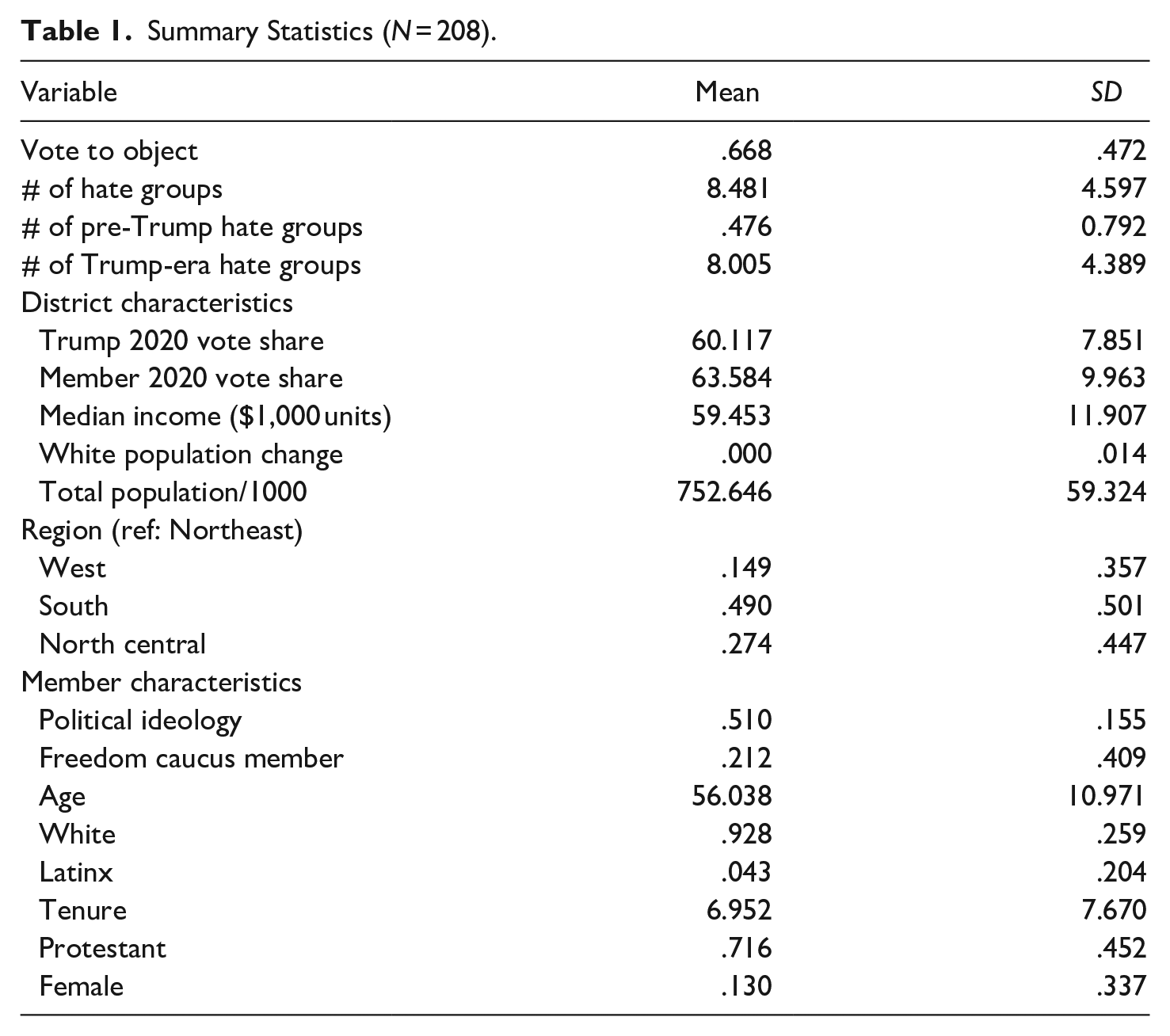
Table 1 provides descriptive statistics for the measures we describe above.
Summary Statistics (N = 208).
Estimation Technique
Because our dependent variable is a dummy variable measuring whether the Representative voted in favor of objecting to certify either the Pennsylvania or Arizona election results, we employed logistic regression analytic techniques with robust standard errors.
Findings
Hate Groups, the Republican Party, and Election Decertification
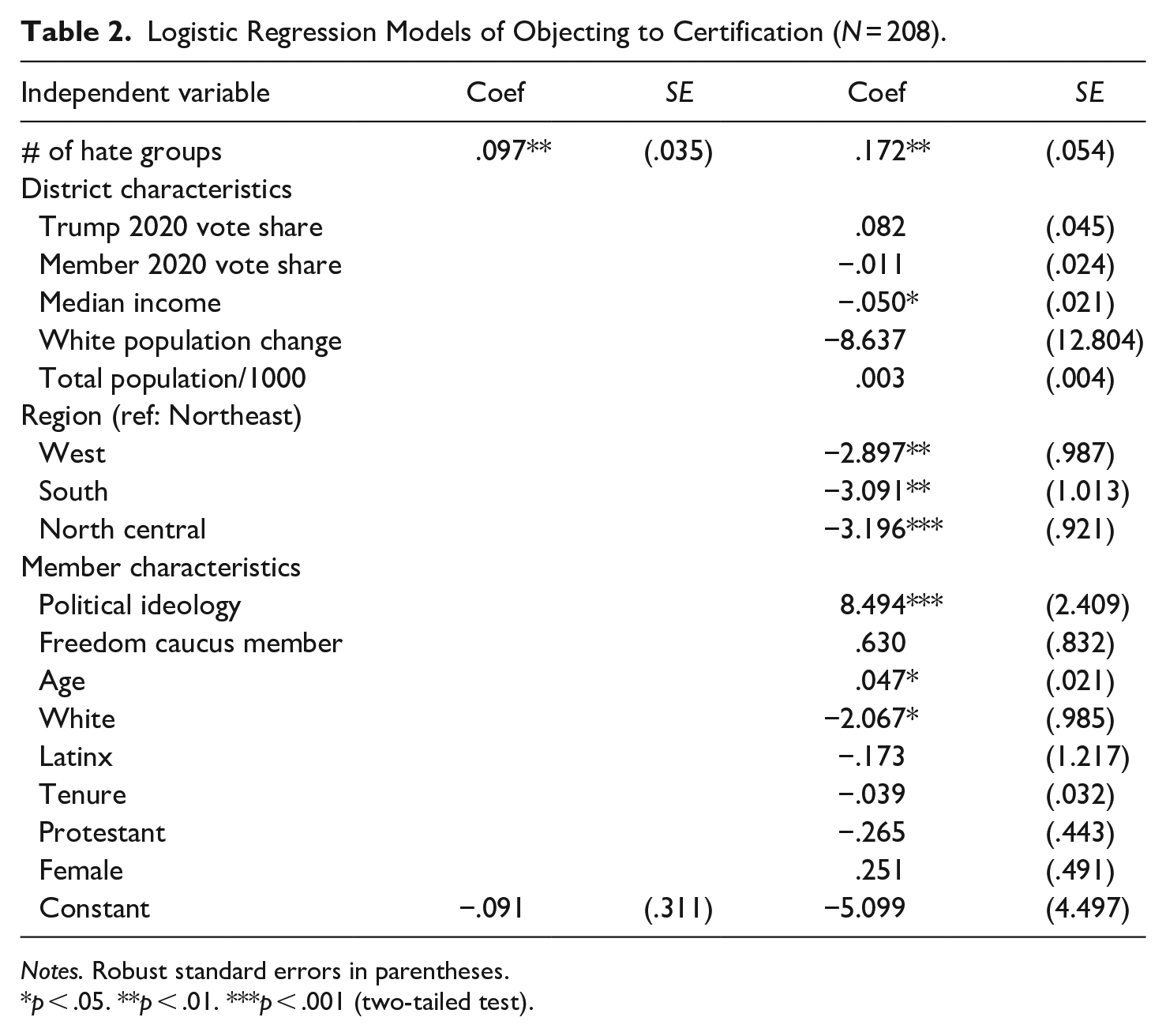
We start by investigating the patterns of association between hate activity and objecting to election certification at both the bivariate and multivariate level. In our first model, the coefficient for the variable that measures hate group activity is positive and statistically significant (see Table 2, Model 1). This indicates that members who represent districts with more hate groups were more likely to object to election certification than members from districts with fewer hate groups. These results remain when we add a host of controls (see Table 2, model 2). A two-standard deviation increase in the number of hate groups in a district—which corresponds to an increase of roughly nine hate groups—is associated with a .19 increase in the predicted probability of objecting to election certification. This provides clear support for our hypothesis that the members who were most likely to support decertifying the election came from districts with a large presence of hate groups.
Logistic Regression Models of Objecting to Certification (N = 208).
Notes. Robust standard errors in parentheses.
p < .05. **p < .01. ***p < .001 (two-tailed test).
Hate Groups in the Trump Era
Next, we explore the possibility that the entrance of Trump into the political arena emboldened a new generation of hate groups to adopt a strategy that targeted institutional actors. We evaluate the possible influence of the Trump-era organizations by examining the estimated effects of two categories of hate groups: those that were established prior to the Trump era (i.e., before 2016) and those that were established during the Trump era (i.e., in 2016 and afterward).
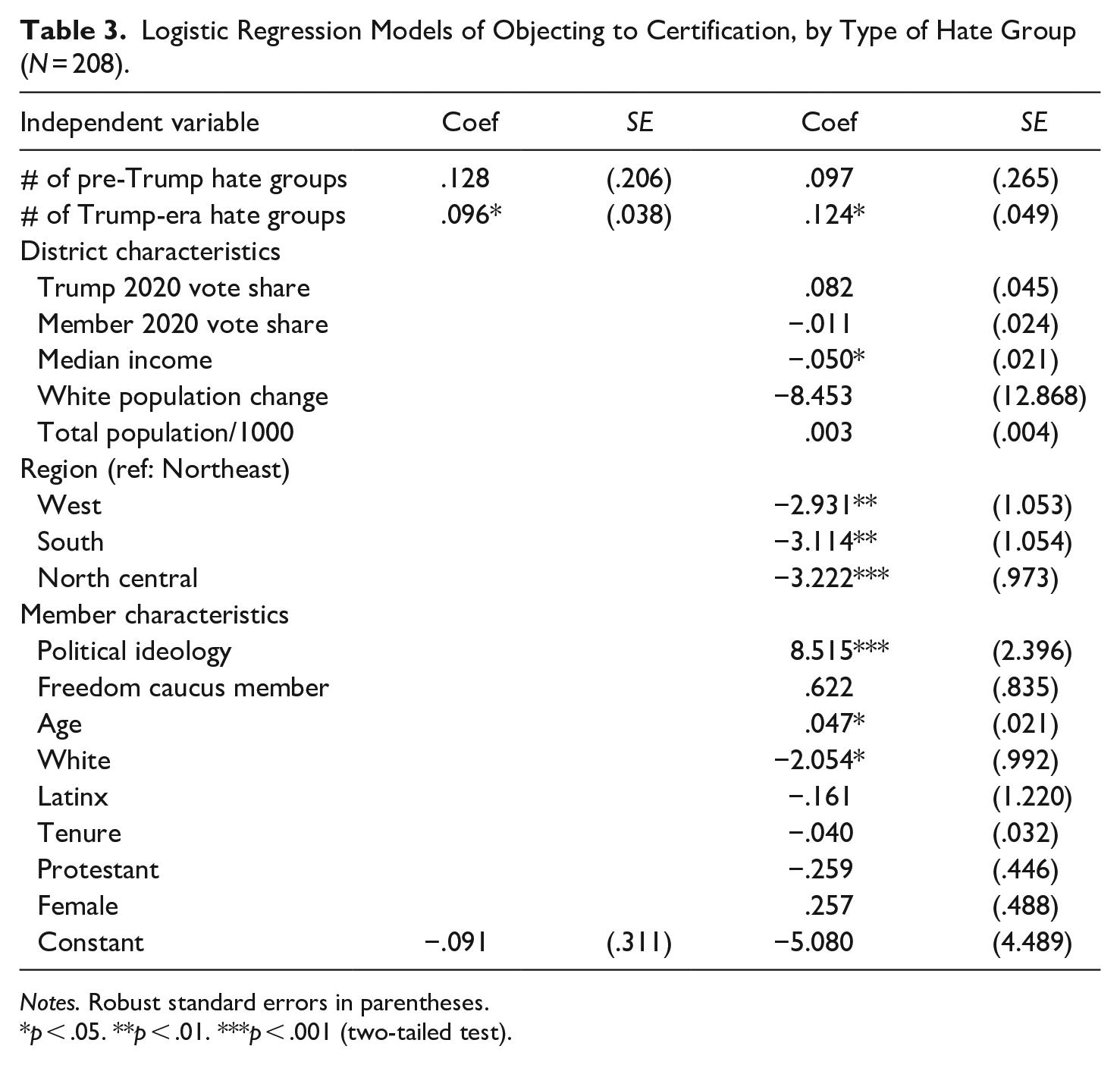
Table 3 presents estimates from two models, one including variables for the two types of hate groups and another that includes these variables as well as a set of control variables (the same in the earlier multivariate model). The coefficients for the number of hate groups from the pre-Trump era are positive, but not statistically significant. By contrast, the coefficients for the number of hate groups from the Trump era are positive and statistically significant. The estimates suggest that the influence of hate groups derives from the activities of those groups that were established during the Trump era. As a result, the Republicans most likely to object to certification represent those districts that have an active base of recently formed hate groups, supporting our proposed opportunity-mobilization model. Having an active base of older hate groups appears to have little effect on the autocratic behavior of Republicans. To provide some perspective on these estimates, Figure 1 reports average marginal effects for hate group activity.
Logistic Regression Models of Objecting to Certification, by Type of Hate Group (N = 208).
Notes. Robust standard errors in parentheses.
p < .05. **p < .01. ***p < .001 (two-tailed test).
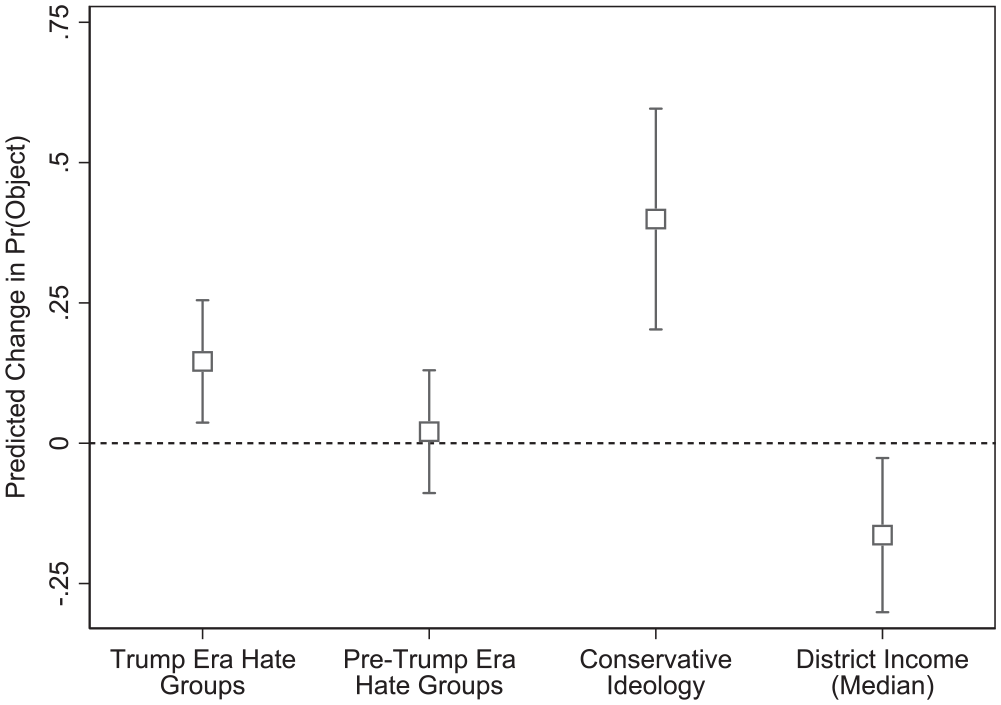
Standardized effects of key covariates on objecting to certification, by type of hate group (N = 208).
An Isolated Moment or Part of a Broader Movement?
In bringing novel evidence to bear on the question of why democratically elected members of Congress participated in autocratic activities, the results of this analysis point to the emergence of social movement partyism as a potential explanation. However, it remains possible that the vote surrounding election decertification was a strictly symbolic act, one limited to a specific moment in time when the theater of politics was particularly dramatic and perhaps even largely inconsequential. In this section, we assess the robustness of hate group influence by exploring whether the results are capturing events specific to election decertification or if instead they speak to broader attempts to erode democracy.
We look at four other forms of anti-democratic and autocratic behavior. The first is whether a member signed an amicus brief asking the Supreme Court to overturn the results of the election in Georgia, Michigan, Pennsylvania, and Wisconsin. The second is whether a member voted against the formation of the Select Committee to Investigate the January 6 Attack (as reflected in roll call vote #154 for House Resolution 3233). The third activity is whether a member voted against the For the People Act (as evidenced by roll call vote #62 on House Resolution 1). The fourth activity is whether a member voted against the John R. Lewis Voting Rights Advancement Act (according to roll call vote #260 on House Resolution 4). Participation in these activities is added together to create an index that reflects the extent to which a member has been involved with anti-democratic activity. In theory, the outcome ranges from 0 (participated in no anti-democratic activities) to 4 (participated in all anti-democratic activities), but as an empirical matter, it ranges from 1 to 4 because every House Republican participated in at least one anti-democratic activity.
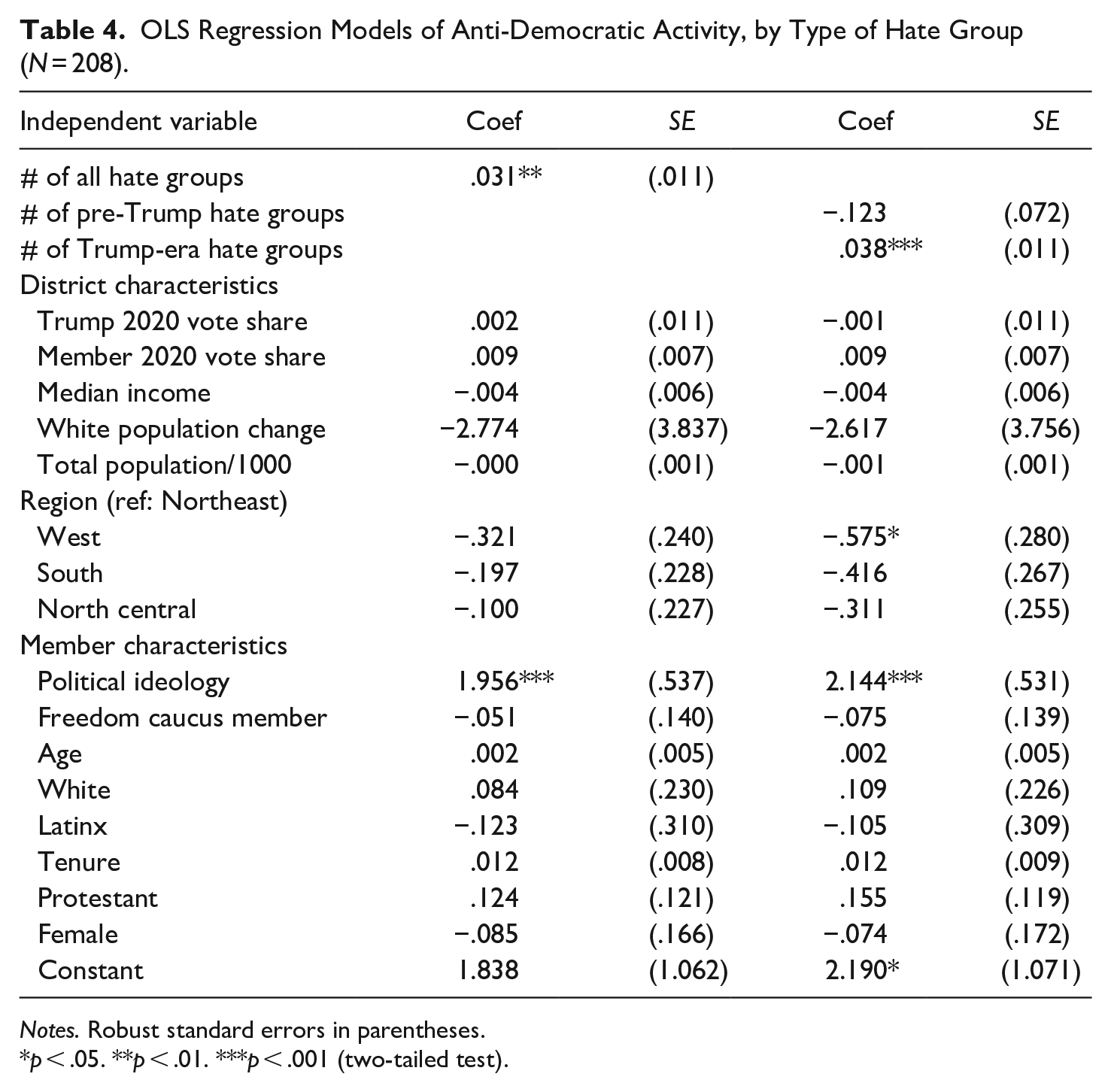
We use this index as the dependent variable for a linear (OLS) regression model and include the same set of independent variables found in the multivariate models that examine objecting to election certification. As with those models, we also examine whether Trump-era hate groups exert a stronger influence than hate groups founded before the Trump period. According to these models, hate group activity exerts a positive and statistically significant effect on other forms of anti-democratic activity (see Table 4). Members from districts with higher levels of hate group activity engage in more autocratic activities than members from districts with lower levels of hate group activity. The second model examines the different effects of hate groups that were founded before and during the Trump era. As with election decertification, these estimates indicate that Republican members of the House were more responsive to the activity of hate groups that were established during the Trump era. Together, these results suggest that hate groups—particularly those founded in the context of Trump’s highly combative and bigoted rhetoric—have shaped events beyond the vote to decertify the election. Indeed, the breadth of their influence is evident across several measures of anti-democratic activity.
OLS Regression Models of Anti-Democratic Activity, by Type of Hate Group (N = 208).
Notes. Robust standard errors in parentheses.
p < .05. **p < .01. ***p < .001 (two-tailed test).
Discussion and Conclusion
The results of the analyses support our hypothesis that a condition of social movement-partyism underlays the Congressional vote on January 6th and other anti-democratic votes and actions shortly before and after. We proposed three distinctive conditions characterize the phenomenon: (1) social movement influence; (2) the presence of movement insiders in positions of power in the party; and (3) party members engaging in extra-institutional and sometimes institutional, norm-violating, action. The historical and quantitative evidence provided here demonstrate that all three were present in the time period we examine here. One hundred thirty-nine Republican members of Congress took anti-democratic action on January 6th, acting in alliance with organized extremists. The party members most likely to object to the certification of the election had a strong presence of hate groups in their districts, especially Trump-era hate groups. Further analyses demonstrate the alliance is associated with autocratic actions and rhetoric. These results have implications for scholarship on social movement impacts on Congressional and parliamentary voting and democratic erosion. They also have profound implications for our understanding of the contemporary Republican Party; the results show that its embrace of voter suppression measures and autocratic actions in 2021 and beyond were influenced by factors beyond the executive branch. Social movement partyism represents a coalition between movements and a political party in its strongest form and may help us understand other cases of both democratic erosion and rapid progressive political change in other times and places.
Our research contributes to understanding the organizational basis of autocratic behavior by elected officials. We found a powerful association between Trump-era hate group organizations and autocratic behavior of elected officials. The more post-2015 hate groups in a congressional district, the more likely the legislator was to object to certifying the election and engage in additional voter suppression efforts. These results are consistent with the opportunity-mobilization exchange dynamic we propose as a mechanism underlying the hate movement influence. Trump’s ethnonationalist campaign signaled he would provide political opportunities to the hate movement if elected, and hate groups responded by mobilizing to help get him elected. Once elected, the executive promoted policies consistent with hate movement goals and appointed hate movement insiders to positions within his administration. Consistent with political opportunity theory (McAdam, 1999; Tarrow, 1998; Tilly, 1978), hate groups mobilized in response and worked to help him retain power. Hate groups have helped push a major national party to the extreme right, going from obstruction of the Democratic agenda to full blown anti-democratic activity. Such actions in their totality contribute to the normalization of autocratic behavior by elected officials and candidates running for public office.
Our results support the contention that American democracy is in danger. When the majority of Republicans in the House of Representatives objected to the results of a legitimate and fair Presidential election, they were attempting the wholesale disenfranchisement of millions of American voters. While the vote may have been a partially symbolic nod to their extremist base, since Democratic control of the House made the attempt unlikely to succeed, their action was only one in a broad set of autocratic efforts to overturn the results of the election. The Trump administration and allies were investigated for taking similarly autocratic actions, such as pressuring state election officials to find additional votes and submit false slates of electors. This and other efforts at disenfranchising millions of citizens, the demonizing of political opponents, and the alliance with violent groups, represent a weakening of democracy (Levitsky & Ziblatt, 2018).
Footnotes
Acknowledgements
The authors would like to thank the journal’s reviewers and editors for their helpful feedback, as well as Daniel de Kadt, David Meyer, Sarah Soule, and Ed Walker for helpful comments on a draft of the manuscript. Earlier versions of this article were presented at the American Sociological Association conference in Los Angeles in August, 2022, and the Mobilization conference in San Diego in June of 2023.
Data Availability Statement
The data underlying this article will be shared on reasonable request to the corresponding author.
Declaration of Conflicting Interests
The authors declared no potential conflicts of interest with respect to the research, authorship, and/or publication of this article.
Funding
The authors received no financial support for the research, authorship, and/or publication of this article.