



Abstract
Despite its western Christian origin, the notion of religious fundamentalism has been employed by western and non-western scholars alike to describe a variety of religious groups perceived to manifest antagonism to aspects of modernity and secularism, especially western ideals of gender equality as enforced in many cases by state policies. Within religion and gender studies and Gender and Development scholarship, fundamentalism has been often invoked in reference to faith communities opposing feminist ideals, but without due recognition being given to the western metaphysics of feminist theories of gender, or the epistemological and ethical problems of “naming” such communities as “fundamentalist” within Western/Anglophone scholarship. This lack of reflexivity risks essentializing religious communities as being opposed to feminist gender ideals when their reactions might reflect more complex underlying reasons, and can also be counterproductive in effectively responding to gender inequalities and women’s abuse in religious societies. This paper proposes that a more intimate engagement with non-western religious traditions grounded in a study of theological teachings and the lived religious experience of specific communities can remedy such tendencies and achieve a better understanding of the nexus of gender, faith, and tradition/modernity in diverse cultural contexts. It illustrates this by drawing key insights from a study of conjugal abuse in an Orthodox Täwahәdo community in Ethiopia that demonstrated intricate associations between understandings of and attitudes toward conjugal abuse and the local religious tradition, the significance of a culture-as-religion discourse in the maintenance of rigid gender norms, and the potential of Orthodox theology to counter ideas about abusiveness that contributed to its implicit tolerance. The paper relates these findings to Ethiopian women activists’ efforts and the multi-religious societal fabric of Ethiopian society to explore the possibilities for integrated responses to intimate partner violence in the country.
Keywords
Introduction
Despite its western Christian origin (Harding, 2000), the notion of religious fundamentalism has been employed by western and non-western scholars alike to describe a variety of religious groups, from Islamic political movements originating in the Arabian Peninsula, South Asia, and North Africa to eastern religious expressions associated with Buddhism, Sikhism, and Hinduism (Choueiri, 2010; Hawley, 1994; Marty & Appleby, 1991). The term is applied to these diverse religious groups most often on the basis that they manifest antagonism to aspects of modernity and secularism in relation to faith-based moral tenets, place emphasis on original or authentic religious traditions or texts, and take issues, particularly with western ideals of gender equality and feminist social ideals. While some theorists have insisted on conceptualizing “religious fundamentalism” strictly in reference to American Protestant history (Wood, 2014, p. 133), others have deployed the concept with generalizing usages (Zamfir, 2018, p. 4). Scholars generally seem to be divided when they assess the benefits of the term in contrast to the limitations and the challenges it begets. In a volume of essays that examine the application of the term internationally, Wood and Watt (2014) discuss arguments made in favor of the usage of the term, such that the term summarizes “something” that is not captured by other existing terms and is as “real,” “captures a form of religiously motivated resistance to certain features of modern secularism that, ironically or paradoxically, also incorporates certain ideological and material aspects of the modern age” (p. 4), and is broadly representative of a pattern, recognizing differences between colonized and non-colonized groups. Arguments that problematize the concept or oppose it rather argue that the concept is too specific to American Protestant theology and that calling Jews or Muslims fundamentalists is like calling “Christians Sunnis or Shiites,” that the word is too vague to be of any help, that the “important something” that proponents claim fundamentalists to share is perhaps more their idea of what these groups are and serves as an umbrella term to label what scholars disagree with, that historical fundamentalism in America was too complex to extrapolate the characteristics that would need to be quintessential to fundamentalism for applying the concept analogously to other religious expressions, and that, really, fundamentalism is a reaction of western secularism that marginalized religion in the private sphere (Jelen, 1993, pp. 68–71; Wood, 2014; Wood & Watt, 2014).
Although the category of fundamentalism may have a place in our conceptual repertoire, serious discussions need to be had on the cardinal usefulness of this terminology for understanding what it propounds to be its subject matter, how that subject matter should be defined, and the process by which the relevance of the category can be assessed for any religious group or religious tradition prior to its cross-cultural deployment. This is especially urgent if we recognize the historical and continuing dominance of western epistemology and conceptual repertoires within Anglophone scholarship and representations of the world, making the transposition of any generalizing concept or theoretical framework to describe non-western belief systems and experiences a complicated affair (Istratii & Hirmer, 2020).
If there is indeed a type of religious “intransigence” or strictness, to use some of the terms employed by other scholars, 1 emerging in interaction with western modernity and its paraphernalia, in many cases this cannot be separated from colonial histories and their consequences (Choueiri, 2010; Harding, 2000; Marty & Appleby, 1991; Wood & Watt, 2014). How might a single term help to shed light on complex interactions between colonizing and colonized parties in different geographies, temporalities and communities? Moreover, should not fundamentalism-related responses be differentiated from a degree of defensiveness originating in a natural incommensurability of diverse worldviews around gender in the world, and, if so, how might this differentiation be achieved? If objections to gender equality or other feminist ideals are crucial to the conceptualization of fundamentalism, it ought to be recognized that such ideals have been underpinned by western metaphysics of humanity and gender (Istratii, 2020a), which historically resulted in numerous instances of west-centric generalizations in feminist theory, such as in identifying all women’s experiences with the experiences of middle-class North American and Western European women (Arndt, 2000; Escobar, 1995, pp. 177–182; Mohanty, Russo & Torres, 1991; Njiro, 1999, pp. 47–48). Thus, if religious communities in diverse cultural contexts respond critically or defensively to gender equality ideals being promoted internationally, such as via Gender and Development paradigms and the Sustainable Development Goals “speak,” this might be a response to what they perceive as the West’s historical impositions of theories and priorities onto the “other.” At a more practical level, can such internationalized terminologies increase our understanding of context-specific gender-related issues, such as gender inequalities or gender-based violence (GBV), including intimate partner violence, to help identify appropriate strategies to alleviate those? The aim behind raising such questions is not to suggest a better usage of the term, but rather to draw attention to the “epistemological situatedness” of both the concept and the theorists who employ it, which deems its deployment internationally inherently problematic and circumscribing as it can shed limited light on the nature of gender relations in diverse societal contexts, and it risks essentializing (certain) religious communities as being opposed to western feminist gender ideals when their reactions might reflect more complex underlying reasons (without denying possible gender asymmetries). This can alienate religious communities and be counterproductive in effectively responding to gender inequalities and related issues in tradition-oriented religious communities.
The term “religious fundamentalism” has been adopted also in the writings of many religious and gender scholars and Gender and Development activists, in relation to which I situate this essay’s analysis. Writers located in a western feminist paradigm that applies a gender analytical framework to gender inequalities and GBV have tended to perceive institutionalized religious systems as hierarchical and “patriarchal”, a concept rarely robustly defined, and as conducive to women’s abuse (see literature overview in Istratii, 2019a, 2020a). As I have demonstrated previously, such assumptions are influenced by a long genealogy of western feminist thought that has tended to identify binary gender arrangements and norms with social sexism, as well as feminist critiques of Christian biblical traditions that have been uncritically transposed onto non-western religious communities (Fiorenza, 1984; Istratii, 2019a, 2020b; Juschka, 2001). Interestingly, the continuation of these assumptions has combined with a limited recognition of historical epistemological inequalities and a general ignorance within the West about the distinctive theological and exegetical characteristics of non-western religious traditions, including those of a Christian theology.
This paper proposes that a more intimate engagement with non-western religious traditions grounded in the historical and lived realities of specific communities can remedy such tendencies and can achieve a better understanding of the nexus of gender, faith, and tradition/modernity in diverse cultural contexts. Such an approach is especially relevant in analyzing and addressing gender issues in Orthodox Christian societies too. Despite presenting cross-cultural variations, Christian Orthodox communities have generally perceived theology as inseparable from day-to-day religious praxis (Istratii, 2019a, 2019b). Consequently, any gender-sensitive analysis in such societies must integrate a study of the theology of the respective Church tradition, as this has been understood and communicated historically in its context of development, to make a better sense of lay and clergy discourses and to relate these to societal issues, gender norms, or intimate partner violence with some accuracy. This can be illustrated well in an anthropological study of conjugal abuse that was completed in an Orthodox Täwahәdo community in Ethiopia’s Tigray region between 2016 and 2017 (Istratii, 2019a, 2020a). As anticipated by western feminist theories, religious and gender configurations in this community informed conjugal abuse realities and responses to it, but they explained neither the different facets of the problem nor women’s help-seeking attitudes. To understand conjugal abuse with the nuance is deserves, it would be important to account for the interface of religious idiom with folklore beliefs, material factors, human psychology and forces of modernization, all of which influenced local perceptions and responses to the problem in complex and interdependent ways.
Current approaches to redress intimate partner violence in Ethiopia have yet to systematically integrate religious parameters, which reflects complex historical and political reasons that may combine with a limited understanding of Orthodox theology and how this has been historically embodied by clergy and laity among state authorities, civil society, and other activist groups. By presenting key ethnographic insights of this study (the full research has been presented and contextualized in the available Ethiopian literature in Istratii, 2021), I demonstrate the need for a more integrated approach that can better account for and leverage religious discourses productively. To achieve this, I structure the essay as follows: the first section provides a closer analysis of the engagement of religious and gender studies and the field of Gender and Development with “religion” to evidence some of the problematic assumptions outlined earlier. The next section discusses why these approaches can be misguiding and unhelpful in Orthodox societies, and presents an alternative approach for local engagement in such societies. The following section turns to the anthropological study completed in Ethiopia to discuss some key findings that illustrate the argument of this paper. The final section takes a more exploratory tone to look at Ethiopian state responses to intimate partner violence, some of the effects of women’s activism in this area in recent years, and its engagement with religious beliefs and stakeholders in responses to intimate partner violence, and discusses how these different realms may be bridged together given Ethiopia’s complex religio-political landscape and the recent war in Tigray region.
It should be noted that I write this paper as an Eastern European Christian Orthodox woman who has worked since 2016 to produce evidence and inform responses to domestic violence in East Africa and international migrant and diaspora communities in the UK as Lead of Project dldl/ድልድል. The choice to focus the paper on Ethiopia reflects my life’s contingencies and recent regional specialisation, but I could have used as an example any other Eastern or Oriental Orthodox community that I have been previously exposed to to illustrate the argument of this paper. As a proponent of epistemological decolonisation, I am aware that my analysis might be misunderstood as an intention to represent current realities or to suggest what should be done in Ethiopia to respond to the problem, which is not the case. I am a firm believer that responses should be locally-grounded and Ethiopia-led, as exemplified in the work done by the Ethiopian Women Lawyers Association (EWLA), the Setaweet Movement and many indigenous faith-based organisations responding to GBV in the country including the development wings of the Ethiopian Orthodox Täwahәdo Church (EOTC DICAC) and other religious institutions in the country. The second part of the paper is, hence, only a tentative and preliminary effort to explore how integrated and collaborative, inter-sectoral responses in the country may be fostered better in response to the theme of the special issue. Since the paper was authored in 2019, despite making an effort to update it throughout the years, this does not reflect recent developments in Ethiopia and it should not be taken as a comprehensive analysis.
Approaches to “Religion” and “Gender” in Religious and Development Studies
A problematic reception of the concepts of “gender” or “gender equality” and feminist interventions in non-western societies has been well documented in the international development literature (Istratii, 2017; Mannell, 2012; Mukhopadhyay & Wong, 2007; Para-Mallam et al., 2011; Wendoh & Wallace, 2005). When different writers discuss the reasons behind these responses, they tend to speak about local politics, misunderstandings of the concept of gender, or hierarchical models of development (Bryan & Varat, 2008; Cornwall et al., 2007; Moser, 2014; Moser & Moser, 2005; Mukhopadhyay & Wong, 2007; Smyth, 2010). However, when such reactions are expressed by religious communities or on religious grounds, many writers quickly assume that “religious fundamentalism” and patriarchal interests are at fault (AWID, 2011; Balchin, 2008; Horn, 2012; Sandler & Rao, 2012; Vaggione, 2008). Those who employ the term rarely provide any justification for their choice of terminology, seemingly assuming that the feminist standards they uphold are superior to the faith-based gender ideals invoked by religious communities, and should have normative force internationally.
Butler (2008) hinted at the problems of such an ethnocentric tendency when she wrote about Western European states’ naturalization processes vis-à-vis migrant communities. She described a situation whereby the state’s acceptance of homosexuality was being assumed as normative and was considered advanced to the “primitive” traditional gender worldview of the migrants (Butler, 2008). Within Gender and Development practice, similar standards are enforced when white feminists’ concepts and ideals of gender equality are promoted as normative. This combines with a lack of reflexivity among advocates that the gender ideals they propound are underpinned by what is inherently western gender metaphysics, 2 which makes them different from, and potentially incompatible with, non-western belief systems and their understandings and standards of gender. Feminist proponents have generally failed to address an important ethical question that underlines cross-cultural diversity and should be at the heart of international development practice: given that the world comprised variable belief systems, which may have different understandings of gender and gender norms, how ethical is it to propose western feminist (or other dominant) standards of gender relations as normative onto the world and to assess “fundamentalist” tendencies on the basis of others’ acceptance or rejection of these?
While objections to the improvement of gender equality and women’s and girls’ conditions can be and are often framed in religious terms to reinforce culturally acceptable gender standards and rigid gender norms, negative responses to feminist ideals can sometimes reflect genuine incompatibilities between faith-based understandings of gender identity and relations, and those promoted in the secular international development industry. In a detailed study of the domestication process of the Convention on the Elimination of All Forms of Discrimination Against Women (CEDAW) in Nigeria that I have previously discussed (Istratii, 2019a), Para-Mallam et al. (2011) cited the testimonials of Christian and Muslim organizations who expressed objections to the introduced definitions of gender equality. For example, they cited Ruth Dul, Senior Programme Officer of the Christian Urban and Rural Development Association of Nigeria (CRUDAN), who traced ideals of man-woman equality to theology and the divine creation (Para-Mallam et al., 2011, p. 18). Many others found the gender equality ideals set out in the CEDAW document contradictory to religious norms and values around marriage and abortion.
Faith-based rationalizations are rarely considered carefully by mainstream feminist theorists, especially within the Gender and Development paradigm (for a discussion of this literature see Istratii, 2017). In most cases, faith-based oppositions to a secular gender language are appraised as ideological discourse, the reinforcement of patriarchal traditions by clergy and religious teachers, or the product of a “false consciousness” among religious women. It is often forgotten that the gender paradigm is itself the product of an ideological struggle that unfolded within western societies (Istratii, 2017, 2019a). As I have elaborated in my doctoral study and monograph, which deconstructed feminist theories of gender within western epistemology since the 14th century (Istratii, 2019a, 2020a), the concept of “gender” was in fact introduced to “denaturalise” sex (Delphy, 2001, p. 418) whose rigidity was perceived by feminist activists and writers to reinforce gender-based societal inequalities (Butler, 1990; Crenshaw, 1989; Gatens, 1983; Mohanty, 1988). Underlying these gender conceptualizations was a transition in how the human self was itself conceptualized within western thought, demonstrated well by Nicholson (1994): after theology lost its authoritative place in western societies, the human self was opened to scientific explorations. In the 20th century, human personalities were increasingly conceptualized as reflective of social processes, but they still did not eschew assumptions that “biology is the site of character formation.” (Nicholson, 1994, p. 81). With anti-Enlightenment critiques emerging, these biology-founded positions started to weaken too. More recent paradigms have aimed to counter and subvert humanist notions of a “natural” gender and to replace them with social constructionist metaphysics of humanity and gender (Alcoff, 2006, pp. 139–144; Haslanger & Ásta, 2017). Such epistemological assumptions have underpinned also cognate concepts, including gender equality, women’s agency and empowerment, and GBV (Istratii, 2017, 2019a; Mahmood, 2005).
These conceptualizations and the gender-sensitive interventions that are developed on their premises can be problematic when they are applied to tradition-oriented religious communities espousing different understandings of humanity and gender, which tend to be interconnected. For example, numerous writers working in Africa who have criticized the easy transposition of western gender theories cross-culturally have not only demonstrated more egalitarian gender systems in their societies but have also invoked counter-understandings of gender founded on spiritual and transcendental dimensions (Amadiume, 1987; Kolawole, 1997; Mahmood, 2005; Nnaemeka, 1998; Oyěwùmí, 1997; Oyěwùmí, 2005; Steady, 2005). In the CEDAW case mentioned earlier, the African Anti-Abortion Coalition opposed the Bill’s domestication in Nigeria for promoting alternative sexualities and subverting traditional Nigerian cultures, motherhood, and family life (Para-Mallam et al., 2011, p. 39). While some such oppositions might reflect misunderstanding of feminist aims, the cultural and religious sensibilities that underline them need to be considered carefully because they are often raised also by women and can reflect genuine cross-cultural differences that can help to explain faith-informed opposition to mainstream gender programs and approaches.
In a paper referring to the opposition of Christian Churches to the Convention on preventing and combating violence against women and domestic violence in Eastern Europe, for example, Zamfir (2018) described this as “religious fundamentalism” (p. 10). However, in her analysis, she reported that Polish Bishops and Romanian Orthodox clergy present agreed that violence affecting women was an important issue in their societies that needed to be addressed; the latter were rather uncomfortable with the Convention because they felt that this imposed a feminist ideology of gender not espoused within theological understanding (Zamfir, 2018, p. 11). Zamfir argued that these parties read into the document more than it actually suggested, including an intention in the Convention to subvert biological sex and its animosity to traditional religio-cultural values. While religious leaders are oftentimes part of the problem by reinforcing culturally acceptable gender ideas and norms in their religious teachings and practices, it is important not to quickly assume that objections expressed by them are always a reflection of patriarchal oppositions to gender equality. On the basis of the earlier analysis, the bishops’ perception would not be unreasonable since mainstream feminist conceptualizations of gender have moved toward a social constructionist ideal, increasingly advocating for gender fluidity. Moreover, given that clergy tend to be seen as part of the problem by many feminist advocates, their objections to feminist aims might be a sign of defensiveness. The bishops’ responses should have been contextualized within wider international GBV activist trends, which have favored cultural, social constructionist, and feminist explanations of domestic violence (Bowman, 2003; Narayan, 1977; Vlopp, 2001) and have tended to portray cultural and religious institutions as conducive to female subordination and partially responsible for women’s and girls’ abuse (Green, 1999; Heise, 1998; Heise, 2012; Le Roux et al., 2010; Merry, 2009; Terry & Hoare, 2007; UN Study on Violence against Women, 2005).
Furthermore, in her analysis, Zamfir (2018) observed that biblical passages and stories were often invoked by these religious groups to reinforce the subordination and victimization of women (p. 6). Here she echoed gender and religious studies paradigms influenced by Fiorenza’s (1984, 1989) “hermeneutics of suspicion,” an approach Fiorenza had proposed toward a feminist critical reading of biblical texts. However, she did not recognize that these hermeneutics were conditioned to the sociological context in which they had emerged, and that they had limited applicability to eastern Christian traditions since the latter developed distinct exegetical approaches that have engendered biblical interpretations distinct from those that western feminist theologians started from Istratii (2018). It is for this reason that various female religious scholars and theologians have argued in recent decades for feminist activism in gender and religious studies to approach non-western religious traditions with a phenomenological humility and to first try to understand them from “within” prior to proposing responses to gender-related inequalities (Gross, 2004; King & Beattie, 2004; Vuola, 2009; Young, 2002, p. 36). As a case in point, in her article, Zamfir spoke about the ways in which the local Churches understood certain Old Testament stories and New Testament teachings on marriage, but without placing such teachings in the Churches’ exegetical traditions and the faithful communities’ lived experiences with these. For example, the Romanian Orthodox Church has always explained the Holy Scriptures in reference to an embodied Holy Tradition informed by the teachings and deeds of the apostles, accepted explanations provided by Church Fathers, and Church synodical decisions. Consequently, the equality of man and woman has been established and taught in accordance with an Orthodox phronema maintained in the Church’s Holy Tradition, which is rarely acknowledged by feminist commentators (Istratii, 2018). Emphasis is rather or solely placed on inequitable attitudes that may invoke religious rationalizations, without any attention being given to how these relate to established ecclesiastical discourses and vernacular faith experiences.
Portrayals of religious traditions as inherently unequal could reflect both the persistence of ethnocentric feminist or other West-centric assumptions and a limited engagement with non-western Christian theological and exegetical systems, which is the product of the specific history of Anglophone studies of “religion” deeply influenced by western Christian theology, that neglected the historical, vernacular and context-specificity of other religious traditions (Asad, 1993; Geertz, 1973; McCutcheon, 2001; Saliers et al., 2010; Sutcliffe, 2004). I argue that the vestiges of these paradigmatic shifts have also survived within international development engagement with “religion,” as seen in binaries that separate religion from culture, belief from reason, and other reductionist theoretical premises (Deneulin & Rakodi, 2011; Rakodi, 2011).
The path-dependent epistemologies of “gender” and “religion” outlined above cannot capture and explain the diverse and distinct intersections between belief systems, folklore practices, and gender subjectivities as encountered cross-culturally. I believe that Mahmood (2005) has precisely demonstrated this in her seminal study of the women’s da’wa movement in Egypt, in which she problematized the theoretical categories favored within western epistemology for the analysis of gender subjectivity and agency. She argued that liberal-progressive or post-structuralist theorizations were unable to explain the modalities of agency that she observed among the community of female mosque believers in Egypt (Mahmood, 2005, p. 5). Taking a people-centered, cosmology-specific, and humble approach she achieved to develop a more profound inquiry into the constitution of the pious self that the mosque movement adherents strove to fulfill, evidencing the historically contingent arrangements of power that produced this normative subject.
For many non-western religious expressions, an engagement with local exegetical traditions approached from a historical lens that pays due attention to invocations of authoritative texts and practices by individuals of different positionalities offers a more appropriate methodology. It is worth citing again Talal Asad’s anthropological directions for the study of Islamic traditions that I have used in previous writings: If one wants to write an anthropology of Islam one should begin, as Muslims do, from the concept of a discursive tradition that includes and relates itself to the founding texts of the Qur’an and the Hadith. Islam is neither a distinctive social structure nor a heterogeneous collection of beliefs, artifacts, customs, and morals. It is a tradition. (Asad, 1986, p. 14, cited in Istratii, 2019a, 2020a).
This conceptualization of religious traditions speaks about the need to study those in reference to the experience of the believers and the texts or traditions they invoke to justify or rationalize their vernacular embodiments, opening also the idea of “tradition” to contemporary adaptation and remaking. Expanding on Asad’s conceptualization, Mahmood placed emphasis on the performative reproduction of Islamic traditions by invoking an Aristotelian approach to ethics. She found that “tradition” was always in conversation with contemporary conditions and discourses, which became conducive to adaptations and citations that enforced and preserved its authoritativeness (Mahmood, 2005, p. 117).
Believers who identify as Orthodox Christians in Eastern Europe, East Africa, or other parts of the world, are anticipated to think about life and respond to different life situations through a roughly Christian Orthodox lens. Drawing from Asad and Mahmood’s analytical language, it could be said that theological teachings in these Churches have been understood through discursively perpetuated ecclesiastical traditions as preserved and exemplified in the lives and writings of prophets, apostles, and saints. Laities are not necessarily or always deeply versed in this theology and do not fully or always embody an Orthodox phronema or mindset (after all this is an aspired state that they should rather strive toward), but they are anticipated to be familiar with the key concepts and standards of the faith as reproduced in liturgical life and sermons, religious books or other communications that address the lay public. Moreover, due to the emphasis placed on “correct” and immutable belief in these Church traditions (“ortho” + “doxa”), combined with a long history of theological controversies known as heresies, Orthodox Christian believers tend to be very cautious of any deviation from traditional practice that might be considered heretical.
Simultaneously, such traditions have shown a historical tendency to be accommodating to pre-Christian worldviews and norms for the sake of not alienating possible adherents or creating unnecessary hostility (Istratii, 2018). As a result, they have syncretistically existed with diverse cultural systems and worldviews, which have inevitably influenced theological articulation and religious experience. My own existence in diverse Orthodox societies and long-term anthropological research shows that even when practices are innovated in the discursive perpetuation of folklore religio-cultural life, they may still be identified with the authoritative religious tradition (Istratii, 2019a). As a roadmap for conducting research in such communities, the “lived theologies” that have defined these traditions must be understood contextually in a manner that does not isolate such a study from the historical context of their development and the articulation of religious teachings by ecclesiastical authorities and clergy in communities, but neither equates them to the vernacular embodiments of the faithful and the clergy. Such an approach was followed for the study I conducted in Ethiopia, to which I turn next.
Research on Conjugal Abuse in Northern Ethiopia
The research on conjugal abuse discussed in this paper took place in the historical capital of Ethiopian Orthodox Christianity, Aksum, in Tigray region, and sought to embed an analysis of conjugal abuse and attitudes toward it in the local religio-cultural worldview and the participants’ vernacular realities and life stories. The study employed a participatory ethnographic approach that centered on researcher’s self-awareness and placed more interpretative power in the hands of the research participants to minimize the inevitable biases of subjectivity in anthropological, cross-cultural research (see the detailed discussion in Istratii, 2021).
At the methodological level, a close study of Ethiopian Orthodox Täwahәdo theology working with official texts and relying on interviews with theologians and Church historians in Ethiopia was followed by ~10 months of ethnographic fieldwork in Ethiopia. Of this period, 6 months were spent residing in the countryside and the rest in the cities of Aksum, Meqele, and Addis Ababa. Research participants included domestic violence and GBV experts, scholars, and theologians at traditional Church schools, and in the modern theological colleges, monks and nuns at nearby monasteries, clergy in the city of Aksum and the surrounding villages, members of the Maḫәbärä Qәdusan, the “Association of Saints” under the Sunday School Department of the Church (an especially influential department among the younger generations) and lay men and women in rural and urban settings. The sample included also victims and survivors of conjugal abuse who emerged from the general population and chose to disclose their experiences to the researcher. In addition, six gender-segregated participatory workshops were held, four with rural male and female residents and two with members of the Maḫәbärä Qәdusan in the city of Aksum. In total, the study engaged 244 informants.
When invited to define abusive behavior in conjugal cohabitation, the research participants of this study overwhelmingly spoke about conflict, arguments, and disagreements that could escalate and even result in physical assault, typically by the husband against the wife. Frequent reasons given for conflict and husband abusiveness included men getting drunk, going to other women, or refusing to contribute money as breadwinners. Both male and female interlocutors tended to consider women partially responsible for conjugal conflict in cases where a wife failed to uphold a non-confrontational attitude toward her husband at all times. A few also associated conjugal conflict with incompatibilities between the characters of the spouses or a lack of intimate communication and understanding between the two. Other types of abuse that participants identified included gender asymmetries, such as an unfair division of labor between spouses and the persistence of early marriage for girls despite state legislation stipulating 18 as the minimum marriage age. Both female and male interlocutors perceived the extensive abandonment of wives by husbands as abuse, especially when this was accompanied by men’s failure to provide child support. Despite being reported in previous studies from Ethiopia, sexual coercion in marriage was rarely talked about and only in cases where women were concerned about the transmission of diseases and knew that their husbands slept around. Cumulatively, these forms of abuse were attributed to (men’s) characterological defects, relationship issues, and a “past” or “old” inegalitarian mentality that was believed to persist among a section of the society, comprising both men and women and to foster a toleration of gender asymmetries and bad behavior toward women in society.
Contrary to recent demographic studies from Ethiopia that reported large percentages of men and women justifying wife-beating in certain situations (Central Statistical Agency of Ethiopia, 2006; Central Statistical Agency Ethiopia & ICF International, 2012; Central Statistical Agency of Ethiopia and the DHS Program ICF, 2016), this study’s research participants considered all the abusive behaviors that they described to be wrong and harmful, declaring that these were condemned both within the culture (bahәl) and the faith (haymanot), a distinction that they suggested despite not having asked the question in this manner. I reiterate some testimonials presented in my complete study: a young male interlocutor said about conjugal abuse: “This is a very inappropriate act. Within haymanot, it means abusing oneself because the married couple is considered to be one (one body/flesh)” while a female interlocutor explained: “It (bahәl) doesn’t allow physical violence, because if you hate the other person, you just give him/her an answer and you let him/her go with respect, but you don’t physically hit [them].” While it is likely that some interlocutors adjusted their responses to portray their culture or faith in a more positive light to the researcher, the overall ethnographic experience revealed strong religio-cultural standards of morality and values that emphasized mutual help, respect, and righteousness, neighborly interference to stop conflict and societal sanctions in the form of the clergy’s criticism and shaming of the perpetrator. The theological analysis, in turn, revealed that conjugal violence is not condoned within the Church, which echoed in rural and urban clergy’s incessant teaching to live peacefully within marriage and not to argue with each other. Still, an implicit sort of tolerance of the problem was visible in norms and practices governing local institutions, such as the village police unit or the social court, which were considered ineffective in dealing with women’s reports of conjugal violence, as well as most women’s choice to endure and be secretive when they dealt with an abusive partner. Such attitudes and realities proved to be underpinned by a host of sociocultural, practical and psychological factors, which interfaced in complex ways with clergy discourses, spiritual concerns and deeper understandings of human nature and individual personalities espoused by the larger community.
To external observers, the Ethiopian Orthodox Täwahәdo tradition might present some characteristics that could warrant the characterization of “strictly observant” faith, especially in its adherence to gender norms and practices reminiscent of Old Testament traditions, such as around baptism, marriage, and divorce. The Church tradition has been described by some as patriarchal and has been associated with women’s historical oppression (Hammond, 1989; Megerssa, 2002; Moges, 2009; Pankhurst, 1992). Other scholars have attributed high rates of violence against women to cultural parameters that they consider to have religious influences (Beyene, 2015; Gurmu & Endale, 2017; Jemberu, 2008; Panos Ethiopia & HBF, 2002). Still, a close engagement with the soteriological theology of this Church evidences a faith centered on human betterment with a pragmatic grasp of human “passions” and flexibility for addressing those (Wondmagegnehu & Motovu, 1970). The EOTC defines itself through its strict adherence to what it understands as “correct” doctrine, following what is considered an immutable, theopneust (divinely inspired/guided) exegetical tradition (Alehegne, 2012, p. 115; Cowley, 1980; Matthew, 1936; Mekarios, 1996). Its theology has been premised broadly on apostolic and Patristic teachings of non-violence, forgiveness, and self-sacrifice.
The research conducted in Ethiopia suggests that this faith tradition does not inherently contradict ideals of gender equality since it understands man and woman to have been created in the image of God. However, a review of related theological writings on gender relations, marriage, and domestic violence (Cherinet, 2005 EC; Cherinet, 2015; Mandelfro, 1976; The Ethiopic Didascalia, 1920; Tzadua & Strauss, 1968) juxtaposed to the ethnographic experience and findings suggested that the Judaic heritage of this Church tradition has been emphasized more strongly in vernacular religious experience, which I would argue has contributed to the continuation of certain gender asymmetric practices. Moreover, the analysis indicated internal variations, with the Church upholding some tenets very rigidly (such as the precondition of bodily virginity in marriage) and enforcing other tenets quite loosely (such as the prohibition of divorce), most likely reflecting a society where (female) bodily virginity was historically pronounced and where divorces have been quite frequent and inevitable. In other words, like other Christian Orthodox traditions, this Church tradition has been embedded in the people’s folklore beliefs and practices and this might have fostered unhelpful attitudes contributing to conjugal abuse or its tolerance. These nuances could not be captured without taking a simultaneously theology-informed and empirically grounded approach centered on the discourses of lay people and clergy while suspending a quick dismissal of the tradition as being hostile to women.
Not unrelated to historical weaknesses affecting traditional Church education (Dagne, 1970; Kalewold, 1970), in this research the average village priest was found to be unprepared to pronounce religious teachings of marriage in ways that were sufficiently informed by the theology of the Church. Hence, despite official teachings about man and woman having been created alike with equal authority over the creation (The Book of the Old Testament, Genesis and Exodus, 1999 Ethiopian Calendar), and an understanding of male headship premised on sacrificial love after the Christ-Church marriage prototype (The Ethiopic Didascalia, 1920, p. 4–5; Tzadua & Strauss, 1968, p. 80) local clergy have not eschewed the influence of folklore norms and some may have unwittingly contributed to the continuation of gender asymmetrical discourses in their societies (Cherinet, 2015). For example, while the clergy in the study areas generally taught about the equality of man and woman and considered a gender-based division of labor in marriage to be “cultural” and not “religious,” I have demonstrated that some invoked the story of Genesis in a manner that rather unwittingly affirmed a normative gender-based arrangement in marriage not taught by the Church (see Istratii, 2019a).
In the context of the participatory workshops that were held with rural and urban residents, research participants were invited to list the most influential local institutions they resorted to when they faced marriage-related issues. The clergy were almost unanimously identified as the primary point of reference (see Table 1). Even though priests were increasingly criticized by laypeople for the shortfalls they presented in their own married lives, their teachings were still deeply valued, as they were generally identified with the “Word of God.” Most couples seemed to have a spiritual father so when issues emerged in the family, the disgruntled spouse typically approached the priest to ask for their advice and mediation. In numerous testimonies, the clergy were described as generally supportive and were even reported to help victimized women to exit harmful abusive situations when and as they could. Importantly, as mentioned earlier, while priests emphasized the preservation of life-long marriage, they did not generally oppose divorce when the situation was irreversible and harmful to the woman.
Most Influential Institutions Laypeople Resorted to When Facing Conjugal Problems.
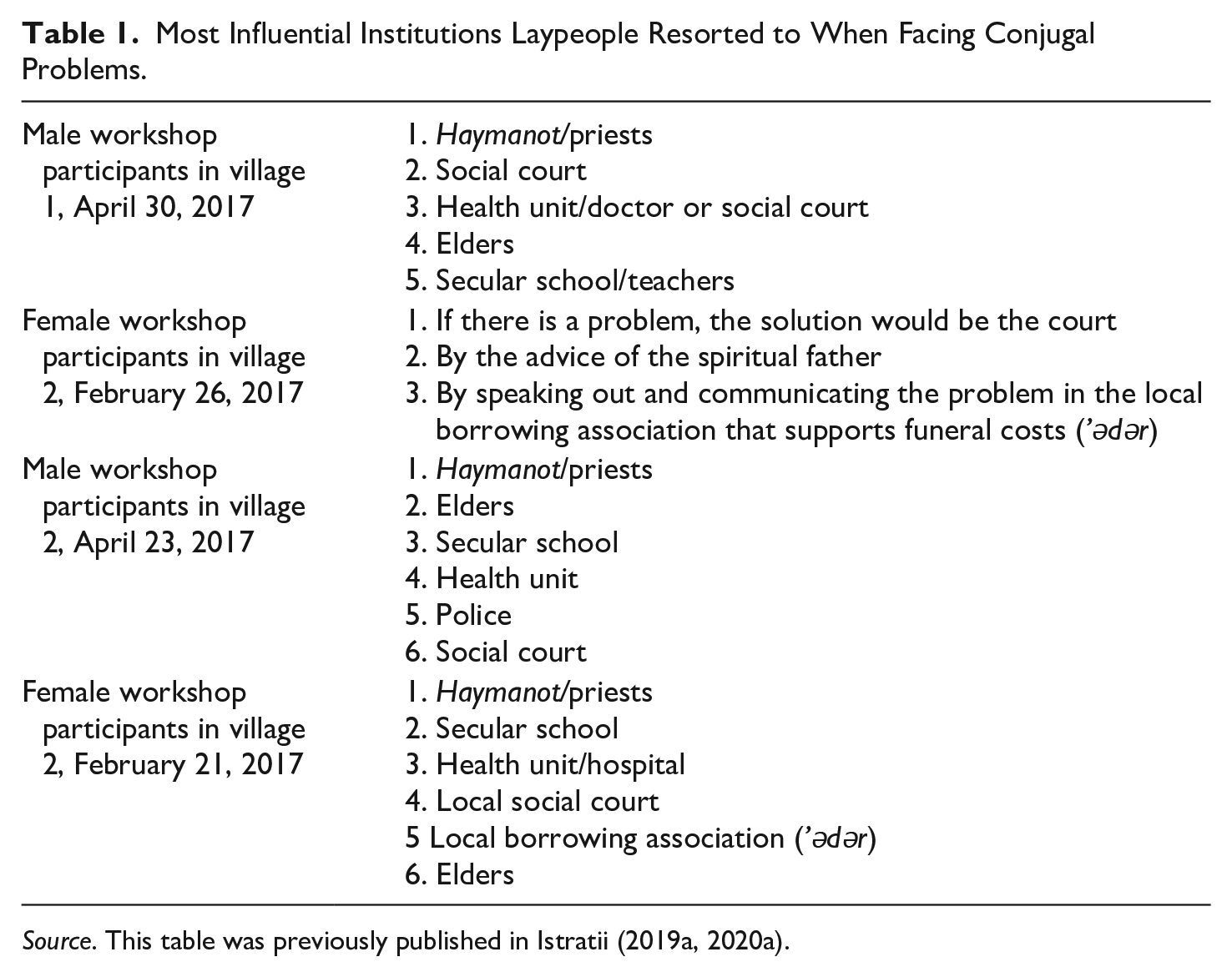
Source. This table was previously published in Istratii (2019a, 2020a).
While many members of the laity differentiated the teachings of the faith (haymanot) from their culture (bahәl) and local social norms, others identified the religious tradition that they cherished with their culture and often invoked this overlap to justify the continuation of social norms, even those with potentially harmful effects. This culture-as-faith discourse emerged, for example, around alcohol consumption at the religious gatherings that were convened regularly for the veneration of saints or other religious feasts. Despite being an accepted norm for both laity and clergy to be served and to consume the traditional beer (sәwa) on such occasions, there was a well-known problem of excessive drinking in the local society associated with cases of male abuse against wives and children. When asked about the harms of alcohol consumption, my interlocutors agreed that drinking with measure was acceptable within the faith, and rather placed responsibility on the individual for excessive consumption and a lack of restrain. While numerous laypeople and clergy criticized the religious gatherings for having lost their spiritual character and having become mere socializing events, the society still propagated these as “religious” practices and no explicit or organized efforts were made to alter pernicious or unhelpful habits reinforced through this practice.
The research suggested that this was partially the case because those who wished to distance themselves from widely accepted vernacular practices presented or perceived as religious in society risked being described as a “deviant” or a heretic. In the words of a young male interlocutor, “[a]ny deviation begets suspicion in this society. In our society, any revolution is unacceptable, in every aspect: private, religious, cultural, political, or economic.” A young female shop owner in the city of Aksum insisted that if one tried to question the superficiality of certain practices and to speak of a more conscientious faith, others were likely to become judgmental and antagonistic and call this person a Penṭe. This essentially described a deviant from the Orthodox faith who became influenced by the Pentecostal movements spreading fast in Ethiopia and alarming many indigenous Orthodox Christians. Importantly, it was not the priests who seemed to deploy the discourse of deviance but rather certain laypeople. The latter tended to filter their understanding of the religious tradition through a “strictly observant” cultural lens that was critical of any co-religionist deviating from what they perceived as an authoritative religious practice. I would argue that rather than the clergy’s partially enculturated teachings, which were conducive to some gender rigidities, the stubborn adherence to culture-specific understandings and norms by a dominant section of the lay community was more conducive to reinforcing problematic gender norms in marriage that could foster conflict and abuse.
At the more fundamental level, local beliefs about the human personality interacted with Orthodox adherents’ religious worldviews and folklore understandings of gender identity, influencing and shaping society-wide responses to abusive behavior. Within the research participants’ narratives, abusive behavior, and especially physical violence, was associated with a flawed human nature and individual personality, encompassed in the multidimensional notion of bahri. In this schematic, roughly speaking, every individual shared a fallen human nature and was believed to have a unique “natural” personality of sorts, which was understood to be sin-prone and susceptible to evil spiritual forces. This worldview seemed to lead people to believe in a degree of inevitable human fickleness and flawed behavior. I have proposed that this resulted in a level of resignation toward men’s abusive behavior in the wider society. Additionally, gender standards that expected women/wives to be non-confrontational, in combination with many women’s perception that men were generally less spiritual (and, thus, more susceptible to evil social or spiritual influences) seemed to combine with a general intolerance of female violent behavior and many women’s tolerance of male abuse. In other words, the tendency among community members to relate (male) abusiveness to a human “natural” personality combined with a tangible unwillingness on behalf of society to hold structural, normative, or other sociological factors responsible for the problem.
A closer look at the influence of spiritual parameters on conjugal attitudes and behavior suggested that faith was salient in both men’s and women’s lives but in distinct ways. Select interviews with male participants suggested that a faith-based conscience, but especially ideals of morality and righteousness, could potentially serve as a buffer against human “passions” that were believed to lead some men to engage in hurtful or abusive behavior toward spouses, including committing adultery or abandoning their wives. Among women, faith was mostly invoked in distressful conjugal situations and in discourses of coping but was never used to justify the abusive or wrongful behavior, and was rather invoked to condemn it. Women often endured difficult situations to avoid divorce, in which case they risked being considered “bad” wives, which could significantly reduce their options to remarry. The patriarchal organization of the family and local livelihoods made women vulnerable to poverty if they divorced and if they could not remarry to secure the support of a male breadwinner. These incentives were usually interwoven with psychological reasons, with fear and shame being most salient in women’s narratives. Some victims of conjugal abuse reportedly decided to endure abusive husbands because they loved the men and hoped that they could change. Some narratives suggested that spiritual concerns could make some women reluctant to take formal action against abusive partners or practice forgiveness.
The study that was completed in Aksum revealed a complex interplay of religious beliefs, clergy discourses, and folklore cultural practice, pointing also to the potential resourcefulness of Orthodox theology to address pernicious tendencies and understandings. Previously completed studies on intimate partner violence and GBV in Ethiopia (e.g. Yigzaw et al., 2010, p. 44) and feminist activist efforts in the country have rightfully stressed the importance of education and awareness-raising regarding gender asymmetries for changing attitudes and norms and the need for consolidating the legal and institutional framework for dealing more effectively with conjugal abuse. In Aksum and other Orthodox societies of Ethiopia, as I have argued in my doctoral thesis, such efforts would need to be informed by the local religio-cultural dynamic which this paper has roughly presented. In essence, justifications of folklore practices and norms were couched in what the large majority invoked as their authoritative religious tradition, even if folklore practices deviated from a complete or accurate understanding of Church teachings. In view of a dominance of cultural practices and norms grounded in this Church’s Old Testament heritage, I have proposed that an Orthodox apostolic theology of marriage, when articulated with sensitivity to the cultural deployment of religious discourse by the laity, could counteract discourses that seemed to sustain a traditionally patriarchal model of marriage and a gender-based division of labor associated by many participants with conjugal asymmetries and, subsequently, with marital conflict. It could also offer the theological language for contributing to the cultivation of more supportive and egalitarian models of conjugal cohabitation. 3
Ultimately, the effect of any institutional intervention in Ethiopian Orthodox communities would be inevitably mediated by more fundamental beliefs that research participants espoused about human nature and individual personality. The emphasis placed on the personality of the abuser, combined with often cited local sayings that one could not change a person who did not want to change themselves, suggested that structural interventions would not be perceived to be sufficient to alter human behavior. I would argue that intimate partner violence interventions should cultivate the idea that people can improve and that abusiveness need not be an incorrigible behavior or inevitable illness. Since conceptualizations of the human personality were embedded in a faith-informed worldview of an on-going spiritual strife between good and evil, it would seem appropriate for the Church and affiliated organizations to employ religious discourses to develop such a counter-discourse in the local communities, including the Church’s teaching of spiritual growth and achieving “likeness with God,” which was not generally taught explicitly by clergy in the village context, as far as this research revealed.
These strategies are proposed for the majority of rural residents, who would be receptive to and could be influenced by the clergy’s advice. There were many others in the local society who were more oriented toward urban lifestyles and norms, even though they continued to speak of the religious tradition with respect and veneration and seemed to listen to the clergy’s teachings. This includes couples in irregular unions, unions not formalized through religious, cultural, or state institutions, and others who had previously divorced and had lost access to their spiritual father and felt ashamed to approach them for counsel. The stories shared by the participants pointed also to psychological factors, such as attachment-related issues as a result of childhood trauma, intergenerational violence trauma, or other collective trauma, such as related to war. These observations point to the need for integrated approaches that engage state-led institutions, secular domestic violence providers (e.g. psychologists, women’s organizations, state-led agencies), and religious stakeholders. Such a collaborative, cross-sectoral approach, albeit desirable, would likely be challenged by different understandings and etiologies of the causes of abusive behavior espoused by different stakeholders, an intricate politico-religious history of Ethiopia, and an evolving state-faith relationship, which I briefly turn to in the final section of this paper.
The Challenges of Achieving Integrated Intimate Partner Violence Alleviation Strategies
A state-church working relationship might be challenged by Ethiopia’s complex political history, whereby Ethiopian Orthodox Christianity was promoted as the dominant faith in a multi-religious society, and the rise of secular government in socialist Ethiopia and the post-Derg regime. While the state has adopted a constitution that separates the state from religious affairs, the secular and the religious were never isolated from each other in Ethiopia’s political history (Haustein, 2020). The coming into power of Prime Minister Abiy Ahmed, an avid supporter of Pentecostalism, could be seen as a new type of resurgence of religious expression in public political life (Ethiopia: In Defense of the Secular State, 2018; God wants Ethiopians to prosper, 2018). In recent years, the Ethiopian state seems to have been caught between the constitutional commitment to separate state from religious affairs and the tactical need to invoke religious language to serve political priorities, as manifest in efforts to work through religious leaders to promote peace among Ethiopia’s numerous ethnic groups (Abbink, 2011; Haustein & Østebø, 2011; Tolera, 2017). These different dynamics would need to be navigated carefully in any effort to integrate state-led initiatives with efforts undertaken by religious institutions to address intimate partner violence, although the precedent of locally grounded non-governmental organizations (NGOs) or faith-based organizations working with religious leaders to address gender-related issues might offer some concrete pathways for how such collaborations may be initiated and fostered (Haustein & Tomalin, 2019).
Initiatives to address intimate partner violence emanate from a long history of efforts among women activists to address gender inequalities in the country. One of the organizations that played a leading role in bringing domestic violence to the forefront of state policy was the Ethiopian Women Lawyers Association (EWLA), established according to its website in 1995. EWLA staff who were interviewed in the context of this study believed that their campaign to raise awareness around the deficiencies of the legal framework on domestic violence in Ethiopia had led to a positive response by the state, triggering the establishment of other associations and NGOs to complement EWLA’s work (see also Abye, 2016). Indeed, the post-revolutionary Ethiopian state took active steps to institute women’s rights and to criminalize intimate partner violence. A Proclamation attached to the 1960 Civil Code led to the re-articulation of what were previously visibly patriarchal family laws (Singer, 1970, p. 74). One of the most pertinent sections of the Civil Code specified that: (1) “The husband is the head of the family,” and (2) “unless otherwise expressly provided by this Code, the wife owes him obedience in all lawful things which he orders” (Civil Code Proclamation No. 165/1960, 1960). This provision on headship was entirely omitted in the Revised Family Law (2000), and the section Management of the Family was rearticulated under principles of equality (The Revised Family Law 2000, 2000). Article 35 in the country’s Constitution also includes regulations to redress “the historical legacy of inequality and discrimination suffered by women in Ethiopia” through affirmative measures (Constitution of the Federal Democratic Republic of Ethiopia, 1995).
An examination of the National Action Plan for Gender Equality (NAP-GE) 2006–2010 evidences that the previous government of Ethiopia had attuned to international efforts to promote gender equality, delineating concrete plans to address women’s issues and domestic violence in the country. The NAP-GE 2006–2010 also outlines working with religious institutions in order to “[e]nforce constitutional and legal prohibition of Violence against Women,” but it is not clear what exactly is meant by “religious institutions” and if this pertains to working with community-based clergy reciprocally or sensitizing religious institutions from within. Women’s issues acquired new momentum under Prime Minister Abiy Ahmed, with numerous pioneering female activists being promoted to high-ranking positions (Brown, 2019). In recent years, feminist concerns have also gained renewed attention as a result of the Setaweet Movement, a feminist initiative established in 2014. As opposed to EWLA, which has worked for the most part to improve women’s wellbeing and safety without self-identifying as a feminist initiative (a decision that seems to have been strategic in view of local mixed sentiments about feminism), Setaweet openly describes itself as “the first feminist movement and business in Ethiopia” (Ali, 2019; Ayalew, 2016).
Approximations between religious stakeholders and women’s associations or feminist initiatives working to address women’s abuse could be challenged by assumptions that religious institutions have been conducive to women’s abuse, although such sentiments may not be openly stated due to deep respect toward the Orthodox Church and faith. The women’s organizations that were approached in Addis Ababa, including EWLA, never spoke critically about the religious tradition but did not report systematic efforts to work with religious leaders. However, EWLA’s strategic choice not to identify itself as feminist and the “charity”-motivated activism of many of its members, as documented by Abye (2016), suggests that faith and religious values might have been a salient parameter in this decision-making, which leaves room for a closer collaboration with religious institutions. On the other hand, preliminary ethnographic insights into Setaweet’s modus operandi suggest that the organization has been focusing on challenging “patriarchal” and “hegemonic” representations of women and gender ideals, which it understands to be maintained often in cultural or religious imaginary (Alemayehu, 2018). As opposed to EWLA, Setaweet seems less hesitant to claim feminist ideals, but these have generally been defined in relation to Ethiopian indigenous philosophical thinking, as opposed to western feminist understandings, considering also the religio-cultural sensibilities of the public. If, as Alemayehu (2018) writes, Setaweet is open to exploring the issues it addresses together with Ethiopian women and without presuming the answers, an integrated approach to working with clergy should be possible (especially p. 58). In fact, more recent communications with Setaweet staff (including at a recent conference that I co-delivered with partners in Ethiopia) revolved precisely around the importance of working together with religious stakeholders and integrating theology in responses to women’s abuse (Project dldl/ድልድል and EMIRTA, 2022).
At a more fundamental level, collaborations across feminist and religious stakeholders could be hindered by a lack of understanding of Ethiopian feminist concerns within the Ethiopian Orthodox Church, not least because these might be identified with western feminist expressions and be perceived as hostile to religious institutions, but also as a result of actual incompatibilities between a western feminist and an Ethiopian Orthodox ideal for gender relations (Project dldl/ድልድል and EMIRTA, 2022; Reta, 2020). At the more practical level, the decentralized structure of the EOTC has meant that priests in rural areas have followed practices that might not reflect Church teaching or canons, such as clergy continuing to be present at marriage ceremonies involving under-age girls. As discussed earlier, certain sections of the clergy may feel compelled to continue practices that are deeply associated with the inherited religious tradition in the public’s imaginary, and where deviations would associate them with Pentecostalism. While there is clearly a need for the clergy to be supported by state-led programs and for them to work together with Ethiopian feminist and women’s organisations, as well as more secular providers in building preparedness to respond to victims/survivors and perpetrators appropriately and sensitively, finding bridges between the different stakeholders will require considerable negotiation and good-will on all sides.
The analysis provided thus far has not considered the recent war in the region of Tigray and the violence affecting other parts of the country. While the implications cannot possibly be explored here, given the fluidity of the situation in Ethiopia, the conflict has revealed even further the blurred relationship between state-led and religious affairs, with the Prime Minister being advised by a preacher affiliated with the EOTC who has publicly deployed religious language to promote state interests. The politicization of religion in the current era in Ethiopia, with ethnicity having become a key dividing factor in the Orthodox Täwahәdo community, and other internal issues affecting the Church in Oromiya and other regions of Ethiopia, would challenge an integrated state-led effort to respond to intimate partner violence in the country’s Orthodox population today.
Conclusion
The concept of “religious fundamentalism” has often been used within religion and gender studies and Gender and Development practice to explain religious oppositions to feminist aims, without acknowledgment of the epistemological biases and cross-cultural limitations of the category. The study of conjugal abuse in an Ethiopian Orthodox community presented in this paper helps to add nuance to debates around religious objections to social change concerning gender issues, evidencing the need to distinguish (but not to separate) the study of theology from vernacular religious experiences and to acknowledge the subtle dynamics between religious discourse and folklore practices and norms. The study revealed a strict adherence to certain gender norms and practices in the life of communities reminiscent of popular definitions of “fundamentalism,” but these were, surprisingly, fostered through cultural life and in many cases more so by laity than by clergy. As a result, potentially pernicious norms and practices valued within the culture continued by being framed in religious idioms that granted them authoritativeness in the perception of the majority. The paper’s analysis stresses the urgency for a more critical engagement with non-western religious traditions that understands how laity and clergy deploy the culture-as-religion discourse to maintain practices and social norms and that is open to employing theological teaching to facilitate normative, attitudinal, and behavioral change, where this is appropriate and desirable.
Footnotes
Acknowledgements
I would like to acknowledge that the current paper is based on and expands the previous blog post “By Whose Standards? Religious Fundamentalism, Gender Equality and Cross-Cultural Differences” published by the Woolf Institute, University of Cambridge: https://www.woolf.cam.ac.uk/blog/by-whose-standards-religious-fundamentalism-gender-equality-and-cross-cultural-differences. The paper also reproduces arguments put forward in Istratii (2017) and key parts from my doctoral study (Istratii, 2019a) presented in Istratii (2020a,  ) although these have been summarized and rephrased to fit the argument and tone of the current paper.
Declaration of Conflicting Interests
The author declared no potential conflicts of interest with respect to the research, authorship, and/or publication of this article.
Funding
The author disclosed receipt of the following financial support for the research, authorship, and/or publication of this article: The current paper was authored in 2019 and relies on the author’s PhD research that was funded with the support of numerous grants, including fieldwork grants by SOAS University of London and the French Center for Ethiopian Studies (CFEE), a SYLFF Research Abroad grant by the Tokyo Foundation, and language acquisition grants from SOAS University of London. No funder has influenced the selection of the topic or the argument of this paper. The paper also builds on insights acquired during the author’s more recent research projects funded by the Harry Frank Guggenheim Foundation (Distinguished Sholars Award 2019) and UK Research and Innovation (Future Leaders Fellowship, Grant Ref: MR/T043350/1).