



Abstract
We investigate the antecedents of affective polarization in the American public, and focus specifically on the driving role of exposure to darker forms of campaign communication (negativity, incivility, populist rhetoric) and the intervening role of individual populist attitudes. Experimental evidence was gathered among a sample of US respondents (MTurk, N = 1,081); respondents were randomly exposed to a campaign message from a fictive candidate framed either positively or negatively, and afterwards asked to express their attitudes towards Democrats and Republicans. Results show that exposure to harsher forms of campaign negativity (character attacks associated with political incivility and populist messages) drives affective polarization upwards when compared to exposure to positive messages. We also show both a direct and moderating effect of populist attitudes: populist individuals are more likely to “like” negative campaign messages (they find them more amusing and fairer) and report higher levels of affective polarization. Furthermore, exposure to negative messages is associated with greater affective polarization particularly among respondents high in populist attitudes.
Introduction
The optimistic belief that politics is ultimately about finding the best way to cooperate toward optimal governance is severely tested by even the most cursory glance at political newscasts. During a May 24, 2020, protest in front of Kentucky State Capitol, several protesters staged the hanging and lynching of Democratic Governor Andy Beshear using a puppet with his features and wearing a sign reading “Sic semper tyrannis”—a phrase translating to “thus always to tyrants” and attributed to the assassins of Julius Caesar and Lincoln 1 ; children could be seen among the cheering crowd, and Lee Greenwood’s “God Bless the USA” was blasting in the background. Only a handful of weeks before, armed militias “occupied” the public grounds of the Michigan State Capitol and forced the ongoing legislative session to be cancelled for fears of violence against lawmakers 2 —a chilling prelude to the infamous January 6, 2021, storming of the US capitol that prompted the second impeachment of president Trump. These events are particularly indicative of the deep rift existing between competing ideological stances in today’s America.
Ideological polarization—that is, entrenched differences over policy issues across opposing camps (Abramowitz & Saunders, 2008; Fiorina et al., 2010), such as the lack of consensual position on immigration policies (e.g. Oosterwaal & Torenvlied, 2010)—is not a new phenomenon. Parties disagree. A good normative argument can be made that they are expected to do so—how can they otherwise provide a comprehensive ideological supply to voters across all political spectrums to represent them? But in recent times, the rift between opposing camps comes with a deeper and affective component. In contrast to ideological polarization, affective polarization includes a sentimental judgment about the in-group and the out-group (e.g. Iyengar & Krupenkin, 2018; Iyengar et al., 2012, 2019)—and, more specifically, a marked fondness for the in-group coupled with negative sentiments and deep dislike for the out-group. Affective polarization is rooted into positive and negative self-identification with, respectively, the (partisan) in- and out-groups. As Liliana Mason points out, “[h]umans are hardwired to cling to social groups” (Mason, 2018, p. 8), and indeed the idea that self-identification with (partisan) groups is associated with prejudices, stereotypes, and discriminatory behavior against those who do not belong to that group is well studied phenomenon (e.g. Billig & Tajfel, 1973; Tajfel et al., 1971). The theory of social identity (Tajfel & Turner, 1986) argues that such identity is part of an individual’s self-concept, and that all individuals strive to maximize positive evaluations of this image of the self. Social categorization (e.g. Hogg & Abrams, 2003) can help maximize positive evaluations of the self, by affectively comparing the social group an individual belongs to (“in-group”) with other social groups (“out-group”). This comparison is a cognitively effortful task, which can be heuristically simplified by exaggerating intergroup variability (i.e. the differences between “my” group and the “other” group), while downplaying the perceived intragroup variability (Fiske & Taylor, 2013, p. 283). Perceived group homogeneity applies in particular to the out-group, as individuals are implicitly more likely to assume that “‘they’ are all alike” (Fiske & Taylor, 2013, p. 285; see also, e.g. Duck et al., 1995; Linville et al., 1989). This “opens the door to group conflict. The human inclination is to prefer and privilege members of the in-group. [. . .] Under circumstances of threat of competition, however, the preference for the in-group can lead to outright hostility towards the out-group, particularly when competition is a zero-sum game” (Mason, 2018, p. 12).
Affective polarization is on the rise. For instance, Iyengar et al. (2019, p. 132; see also Iyengar & Krupenkin, 2018, p. 204) show via longitudinal data from 1978 to 2016 that the difference in “feeling thermometer” ratings between the in- and the out-party has significantly increased over time. Most important, this rift can be mainly associated to increasingly worse evaluations of the out-party (Iyengar & Krupenkin, 2018; Iyengar et al., 2019). Yet, when it comes to contemporary politics, affective polarization and negative partisanship are not exceptional in their antagonistic character. Election campaigns, especially in the United States but not exclusively (Nai & Walter, 2015), are increasingly framed in terms of attacks against political opponents (Geer, 2006, 2012). And political hostility—against the ruling class and/or political and social out-groups—is also a staple of the rise of populism as an ideology (Mudde, 2004), communication frame (Jagers & Walgrave, 2007), or individual attitudes (Akkerman et al., 2014; Rico et al., 2017). Politics, in the first decades of the new millennium, is decidedly negative in tone. With this in mind, it is rather surprising that these three strands of literature—affective polarization, campaign negativity, and populism—have mostly evolved on separate tracks. To be sure, evidence exists that links negative campaigning with affective polarization. For instance, Iyengar et al. (2012), triangulating survey data and content analysis of campaign ads for the 2004 and 2008 US presidential elections, show that the discrepancy between supporters of the sponsor of an attack (“in-group”) and the supporters of the target of an attack (“out-group”) becomes larger with the number of negative ads aired in a given state. Similarly, Martin and Nai (2024) discuss results of a large-scale investigation of multiparty elections across the world and show that higher levels of campaign negativity are associated with upticks in affective polarization in the public (see also Nai & Maier, 2023). Yet, by and large, no investigation exists, to the best of our knowledge, that tackles dynamics of affective polarization, campaign negativity, and populism jointly.
This article is a part of the Triple Special Issue “The Emotional Side of Populist Support: Key Affective Mechanisms at Test.” In the article, we contribute to the existing literature on the drivers of affective polarization by investigating the role of exposure to negative messages and the conditions under which such role is more likely to be consequential. In line with work testing for the heterogeneous effects of exposure to political information (Kam & Trussler, 2017), we test for the assumption that exposure to negative campaigning messages fosters affective polarization, and that this is especially the case among voters holding strong populist attitudes. We do so via new experimental evidence gathered in late 2019 from a convenience sample of US voters (MTurk, final N = 1,081). Our preliminary results show that exposure to the harsher forms of campaign negativity (character attacks associated with political incivility and populist messages) fosters affective polarization when compared to exposure to positive messages. Most important, our results show both a direct and moderating effect of populist attitudes. Populists are more likely to “like” negative campaign messages (they are significantly more likely to find them amusing and fair) and are more likely to report higher levels of affective polarization. Furthermore, exposure to negative messages is associated with greater affective polarization particularly among respondents scoring high in populist attitudes.
Data and materials for replication are available at the following Open Science Foundation (OSF) repository: https://osf.io/pk5tc/
Dark Campaigns, Populism, and Affective Polarization
Dark Campaigns and Affective Polarization
It seems natural to expect that exposure to negative campaigning messages fosters affective polarization—conflict spawns conflict. Regardless of the side of the political divide one is when exposed to a political attack—that is, regardless of whether they are ideologically aligned with the sponsor or the target of such attacks—campaign negativity can provide good reasons to dislike the opponents even more. For ideologically congruent negative messages, attacks can reinforce previously held beliefs about why opponents are unworthy of our vote (or political affection) and reinforce the sentiment of righteousness associated with the in-group. Similarly, ideologically incongruent negative messages, that is, attacks from the opponents against a candidate of the in-group, are likely to reinforce the negative sentiments associated with the opponents—especially because attacks suffer from a normative disadvantage in the first place and are particularly disliked by the public at large (Johnson-Cartee & Copeland, 1989; Fridkin & Kenney, 2011). More in general, exposure to negativity has been shown to generate negative sentiments of contempt, a feeling of revulsion “elicited by appraisals that a person has an undesirable trait, such as bad character or incompetence” (Roseman et al., 2020, p. 5). More than other negative emotions (such as anger, rage, or fear), it is contempt that seems to drive candidate assessments after exposure to attack politics (Roseman et al., 2020). All in all, political attacks across partisan groups are likely to cement the conflict lines separating the groups.
Yet, evidence that supports this intuition is surprisingly scarce and circumstantial. Iyengar et al. (2012), triangulating survey data and content analysis of campaign ads for the 2004 and 2008 US presidential elections, show that the level of negative campaigning (and the enhanced media coverage of confrontational exchanges between candidates) correlates with the observed affective polarization among partisans—the discrepancy between supporters of the sponsor of an attack (“in-group”) and the supporters of the target of an attack (“out-group”) becomes larger with the number of negative ads aired in a given state. These aggregated dynamics make sense within the larger framework of negativity in politics, especially in light of evidence suggesting that news media tend to extensively cover negative advertising (Geer, 2012), and exposure to media reports covering conflict and partisan polarization tends to increase affective polarization (Levendusky & Malhotra, 2016). The starting point of our empirical investigation is thus the experimental expectation that exposure to negative campaign messages fosters affective polarization (H1).
Populist Attitudes and Affective Polarization
In this article, we argue that the individual attitudinal profile of those exposed to attack politics—and, more specifically, whether or not they hold populist attitudes—is likely to moderate the effect of campaign negativity on affective polarization. The idea that individual differences moderate the effectiveness of (negative) messages is central to recent research about campaign negativity (Fridkin & Kenney, 2011, 2019; Nai & Maier, 2021). For instance, evidence exists that extraverted individuals are more likely to be mobilized by negative messages (Weinschenk & Panagopoulos, 2014), that the use of “aggressive metaphors” in political communication mobilizes voters with “aggressive traits” (Kalmoe, 2019), and that character attacks are more effective to depress positive attitudes toward the target of the attacks among respondents scoring high in psychopathy (Nai & Maier, 2021).
Looking more specifically at individuals holding populist attitudes—that is, holding attitudes that reflect support for “sovereignty of the people, opposition to the elite, and the Manichean division between ‘good’ and ‘evil’” (Akkerman et al., 2014, p. 1331)—strong reasons exist, first, to assume for them a marked preference for a more muscular and dark approach to politics. At the elites level, populists themselves have been shown to have a darker and more aggressive personality profile (Nai & Martinez i Coma, 2019); they display “bad manners” (Moffitt, 2016) and a “low” style of politics (Ostiguy, 2009), and are known in general to introduce “a more negative, hardened tone to the debate” (Immerzeel & Pickup, 2015, p. 350). In comparing the campaigning profile of 195 candidates having competed in 40 recent national elections worldwide, Nai (2021) shows for instance that populists tend to use campaign messages that are substantially more negative and include more character attacks and fear appeals than campaigns by mainstream candidates.
The association between populism and a more negative approach to politics is also supported by evidence at the individual level. Support for populist parties and movements is particularly strong among voters with “darker” personality profiles (low agreeableness; Bakker et al., 2016; but see Fatke, 2019), and strong evidence exists of a positive association between populist attitudes and feelings of political anger (but not fear, in line with the appraisal theory of negative emotions; Rico, 2025 in this Special Issue, Part Three; Rico et al., 2017; see also Aytaç et al., 2025 and Demasi et al., 2025, this Special Issue, Part Two). In other words, evidence from the public and political elites seem to converge toward the idea that populism and negative politics are likely to go hand in hand.
Similarly, populist attitudes should be associated with greater affective polarization. Populism, at least in its more common conceptualization, is built on an antagonistic core, based on two principal conflict lines. Vertically, the populist worldview conceptualizes political dynamics as a struggle between the “pure” people, composed by individuals that are sovereign by nature, and often underprivileged or misunderstood (Mudde & Rovira Kaltwasser, 2013), and out of touch elites “who live in ivory towers and only pursue their own interests” (Jagers & Walgrave, 2007, p. 324). Horizontally, populism is foundationally built on the promotion of the in-group via the exclusion or stigmatization of the out-group, politically or culturally defined. In this sense, populism is conflict between the in-group and the out-group; “in its Manichean inclination to split society into two antagonistic camps, populism is inherently adversarial and polarizing” (Rico et al., 2017, p. 449). Behavioral evidence seems to support this general attitudinal claim; for instance, individuals with populist attitudes then to showcase a heightened consumption of hyperpartisan news (Stier et al., 2020), whereas Hameleers et al. (2017) show that respondents with populist attitudes tend to select news promoting the overarching populist narrative about the existence of a vertical conflict line. In a nutshell, both populism and affective polarization reflect a widening chasm between the in-group and the out-group, and should naturally go hand in hand.
These insights allow us to expect respondents holding stronger populist attitudes to showcase a preference for negative messages (H2; observational). We also expect both a direct and moderated effects of populist attitudes on affective polarization; on the one hand, respondents holding stronger populist attitudes should score higher on affective polarization (H3; observational); on the other hand, because of the hypothesized direct effects, the positive effect of campaign negativity on affective polarization should be especially strong among respondents holding stronger populist attitudes (H4). Because of its adversarial Weltanschauung, populism as political attitude is likely to lower the threshold for the rejection of negative messages, thus enhancing their impact on affective polarization. Regardless of whether they are exposed to an attack against them or against their opponents, individuals high in populist attitudes are likely to find in the attacks renewed reasons to loathe the out-group. This last hypothesis, “at the nexus of observational and experimental research” (Kam & Trussler, 2017, p. 789), is the overarching expectation guiding our investigation.
Data and Methods
Data
We test these expectations via experimental evidence gathered among a convenience sample of US respondents. We recruited participants in December 2019 via the Amazon MTurk online platform and invited them to fill a short survey against a small compensation ($0.7; initial N = 1,106). MTurk samples are opt in, and as such cannot be assumed to be representative of the population. This being said, they are frequently used following evidence that they tend to yield results that are rather aligned with those coming from “traditional” samples. For instance, the comparison discussed in the study of Berinsky et al. (2012) shows that MTurk samples are more representative of the US population than other types of convenience samples. Clifford et al. (2015) show that MTurk samples are quite effective in reflecting the psychological divisions of liberals and conservatives in the US electorate. All in all, if their lack of representativeness should not be set aside, good reasons exist to believe that MTurk samples can offer an affordable and reliable alternative (Hauser & Schwarz, 2016; nonetheless readers should see, for a more critical take, Ford, 2017; Harms & DeSimone, 2015). To filter out “shirking” respondents that only skimmed through the questionnaire we included an attention check (Berinsky et al., 2014); respondents that failed such attention check (N = 25, 2.3%) are excluded from the main analyses. The analyses are run on a final sample of N = 1,081. The composition of the sample is described in Table A1 (Supplemental Appendix A).
Protocol
Participants were randomly exposed to a mock newspaper article about a campaign rally featuring a speech by a fictive Republican candidate (Paul A. Bauer). Multiple different versions of the same article were created, to simulate exposure to positive or negative campaign messages, with respondents randomly exposed to only one version. Bauer either promoted his policy positions on lower taxation for the automobile industry (“positive campaigning,” used as control group in all analyses), or attacked his Democrat opponent, the equally fictive Carl B. Meyer, on that same issue either via policy or character attacks (e.g. “Mayer’s inexperience is bad news [. . .,] he is wrong”). Character attacks came furthermore in different forms, in turn including or excluding elements of campaign incivility (e.g. “Mayer is an imbecile [. . . and] his policies are bullshit”) and/or populist appeals (“Mayer is just another example of Washington elite, a politician detached from reality”). A third factorial treatment, which we will not investigate in this article because less relevant theoretically, also exposed respondents to character attacks that included/excluded fear appeals. See Supplemental Appendix B and Figure 1. 3 In total, accounting from the presence/absence of these elements, 11 different versions of the article were created, for as many experimental groups.
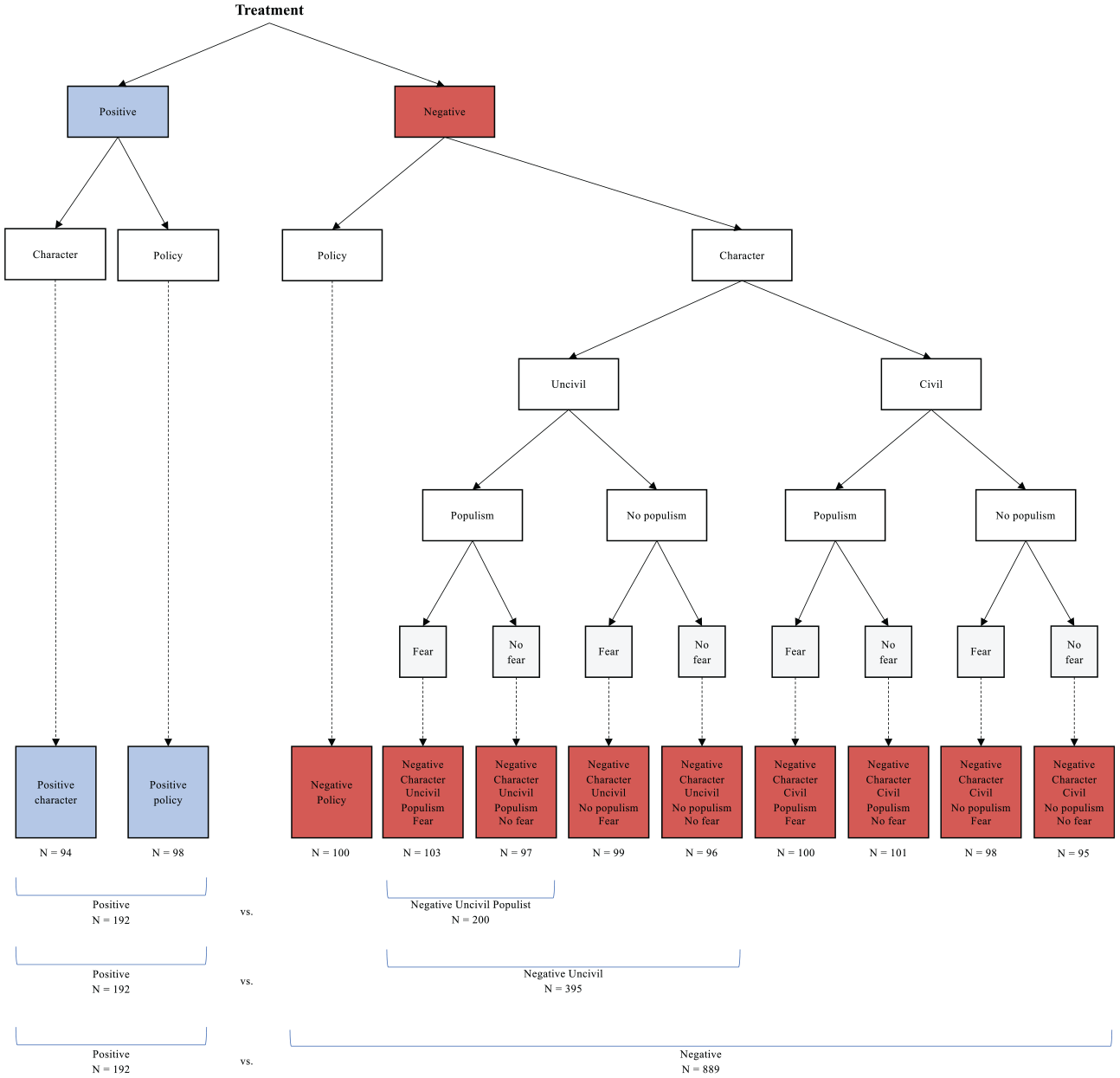
Experimental setup and factorial combination of treatments.
Our analyses will compare the effects of exposure to positive messages (N = 192) with exposure to three types of messages: negative (N = 889), negative uncivil (N = 395), and negative uncivil populist (N = 200) messages. As such, our investigation will test for the (direct and moderated) effect of increasingly “harsher” levels of campaign negativity on affective polarization. The first level focuses on negativity in general, which also includes relatively tame policy attacks. The second level focuses on character attacks that also include an uncivil element, that is, the use of rude and disrespectful language that “violates some agreed upon standard of society” (Maisel, 2013, p. 204) related to courtesy and reciprocity (Brooks & Geer, 2007), thus challenging the norm of cooperative communication (Bormann et al., 2022). The third level adds to this an additional aggressive component in the form of populist anti-establishment rhetoric that attacks political elites (Jagers & Walgrave, 2007). Supplemental Appendix B presents more details about the protocol and treatments. Figure 1 illustrates the logic of the factorial experiment and group comparisons used.
Randomization checks shows that respondents are not significantly different across all 11 experimental groups in terms of their gender, age, education, or partisan affiliation. Similarly, t tests based on message perceptions after exposure show that experimental manipulations were largely successful. Compared to respondents exposed to the positive treatments, participants who were exposed to a negative treatment were significantly more likely to evaluate the message as “negative,” t(1,079) = −21.65, p < .001. Respondents exposed to a negative message that also included incivility were significantly more likely to evaluate the message as “harsh” than respondents exposed to a negative message without incivility, t(787) = −12.25, p < .001. Finally, respondents exposed to a negative message that also included populist elements were significantly more likely to agree that the message was “criticizing the political establishment” than respondents exposed to a negative message without such populist elements, t(787) = −5.58, p < .001.
Measures
Partisanship and Affective Polarization
Partisan identification was measured following the protocol used in the American National Election Study. Respondents were first asked whether they usually think of themselves as a Democrat, a Republican, or an independent; in the first two cases respondents were then asked if they would strongly call themselves a strong Democrat or Republican (yes, no); respondents initially identifying as independents were asked whether they would think of themselves as closer to the Republican Party or to the Democratic Party (or neither). The combination of these variables yields a five-point symmetric scale ranging from “Strong Democrat” to “Strong Republican.”
The measurement and conceptualization of affective polarization requires a particular attention (e.g. Druckman & Levendusky, 2019). Drawing inspiration from recent research (Iyengar et al., 2012, 2019) we measure affective polarization as the extent to which respondents hold strong negative opinion for the out-party while holding strong positive opinions about the in-party. In two subsequent batteries, both appearing after the experimental component, we asked respondents whether they agree or disagree with the fact that Republicans, then Democrats, can be described as “patriotic,” “closed-minded,” “intelligent,” “hypocritical,” “selfish,” “honest,” “open-minded,” “generous,” or “mean” (from 1 “disagree strongly” to 7 “agree strongly”). After reversing the coding of some items, and accounting for respondent’s partisanship, we calculated the mean score across these qualifying adjectives to obtain a measure of positive sentiments for the in-party (e.g. high scores on positive adjectives and low scores on negative ones). The same procedure was used to obtain a measure of negative sentiments for the out-party (high scores on negative adjectives and low scores on positive ones). 4 Unsurprisingly, positive sentiments for the in-party are significantly correlated with negative sentiments for the out-party, r(965) = .32, p < .001. The average score across these two variables yields a measure of affective polarization that reflects positive opinions of the in-group and negative opinions of the out-group. The obtained variable ranges from 1 “very low” and 7 “very high” (M = 4.92, SD = 0.88). Because a clear out-party cannot be identified for them, respondents classified as independents in the partisanship variable described above (N = 114, 10.6%) are excluded from the measure of affective polarization. Interestingly, respondents identifying with the Republican party are significantly less likely to score higher on affective polarization than Democrats, r(965) = −.20, p < .001, which is perhaps a reflection of the controversial personality profile of the US President at the time of data collection, Donald J. Trump (Visser et al., 2017). Higher scores on the affective polarization variable are also measured for females, r(964) = .08, p = .010, and for older respondents, r(965) = .19, p < .001. Inversely, respondents with higher education levels report lower affective polarization, r(965) = −.08, p = .018. A critical assessment of affective polarization measures argues that those might mostly reflect “weariness of outpartisans” (Yair, 2020, p. 1). With this in mind, we will replicate all our analyses using an alternative measure of affective polarization, based on reversed score on the “feeling thermometer” for the out-party. Results with the two different measures are, broadly speaking, converging (see Supplemental Appendix A), suggesting measurement issues should not be excessively severe in our case.
Populist Attitudes
We measure the extent to which respondents hold populist attitudes via the battery described in Akkerman et al. (2014). This is, by far, not the only available measure of populist attitudes, but is likely the most diffused one. Furthermore, it scores comparatively well in terms of internal coherence, external validity, cross-national validity, and conceptual breadth (Castanho Silva et al., 2020). Prior to the experimental component, respondents were asked whether they agree or disagree with a series of six statements about the nature of political power and the role of elites (e.g. “The people, and not politicians, should make our most important policy decisions,” “I would rather be represented by a citizen than by a specialized politician”; from 1 “disagree strongly” to 7 “agree strongly”). Recent research discusses the unidimensional or multidimensional nature of populist attitudes, both conceptually and empirically (e.g. Wuttke et al., 2020). In our data, a factor analysis (principal component analysis) reveals the existence of only one underlying dimension, explaining 46% of the overall variance (Eigenvalue = 2.78). We thus proceed with one unitary measure of populist attitudes. The average score over these six items (α = .76) yields a measure of populist attitudes that varies between 1 “very low” and 7 “very high” (M = 5.34, SD = 0.99). Respondents identifying with the Republican party are slightly more likely to have higher scores on the index of populist attitudes, r(1,079) = .08, p = .008, whereas no significant differences exist for gender, age, or education.
Covariates
Models including moderation effects between exposure to campaign messages and individual differences (populist attitudes) will be controlled by respondents’ gender (female, male), age (in years), and education level (ordinal variable identifying the higher level of education attained).
Models are furthermore controlled by respondent’s “dark” personality profile. 5 The questionnaire included a 12-item battery, the so-called “Dirty Dozen” (Jonason & Webster, 2010), to measure the three traits within the “Dark Triad” personality inventory (narcissism, psychopathy, Machiavellianism). Respondents were asked whether thy agree or disagree with a series of statements about themselves (e.g. “I tend to want others to pay attention to me,” “I tend to be unconcerned with the morality of my actions,” “I tend to manipulate others to get my way”); the average of three sets of four statements yield scores for each trait in the Dark Triad inventory. The average score across the three “dark” traits of narcissism, psychopathy, and Machiavellianism (α = .83) reflects a unified measure of personality “dark core” (e.g. Book et al., 2015; Moshagen et al., 2018). The variable varies between 1 “very low” and 7 “very high” (M = 3.07, SD = 1.41) and will be used in our models as covariate. All covariates were measured prior to the experimental component.
Results
Populists Like Negativity
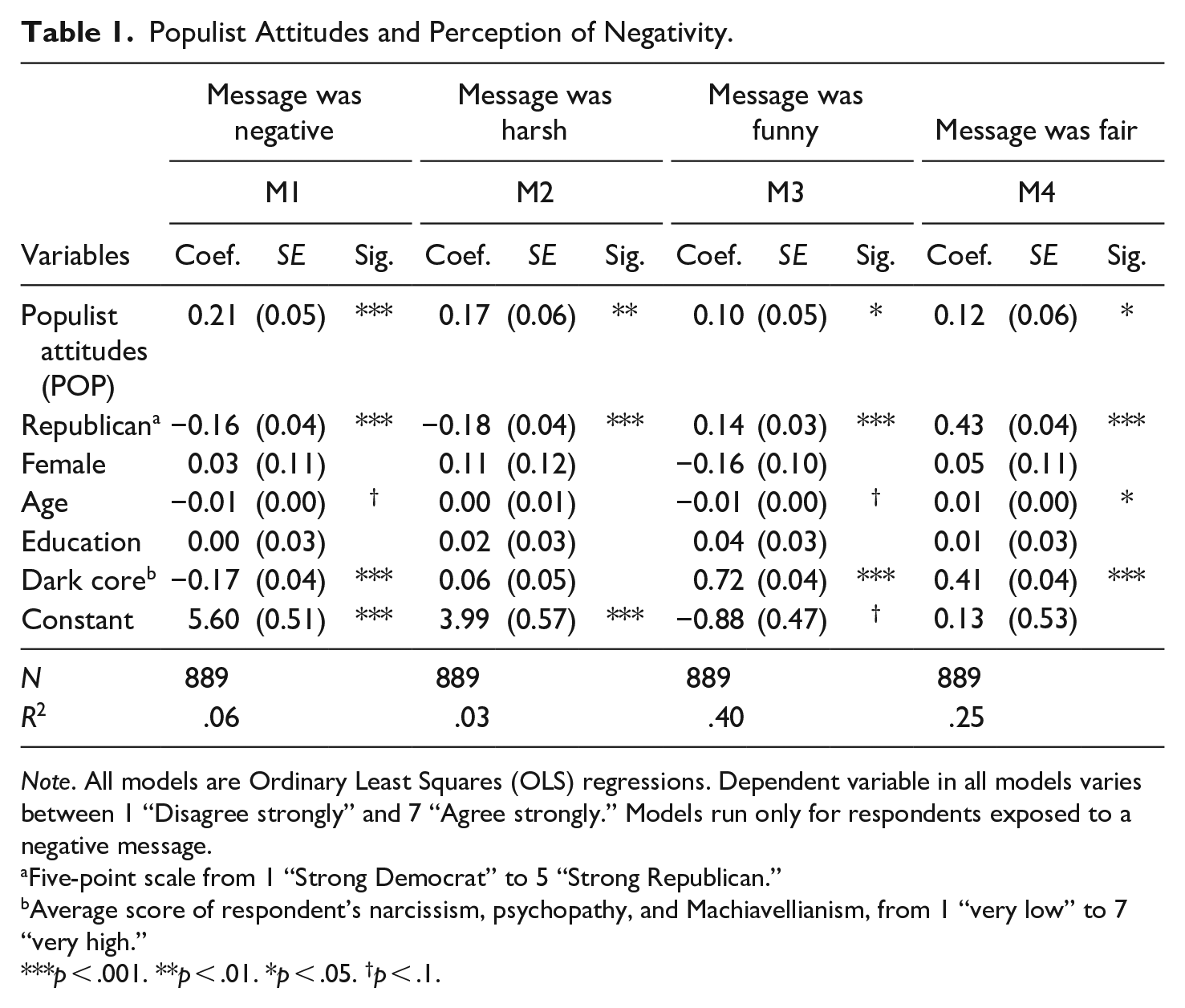
Table 1 report the results of a series of models that regress, for respondents exposed to a negative message, their perception of such messages as negative, harsh, funny, and fair, on their level of populist attitudes, plus controls.
Populist Attitudes and Perception of Negativity.
Note. All models are Ordinary Least Squares (OLS) regressions. Dependent variable in all models varies between 1 “Disagree strongly” and 7 “Agree strongly.” Models run only for respondents exposed to a negative message.
Five-point scale from 1 “Strong Democrat” to 5 “Strong Republican.”
Average score of respondent’s narcissism, psychopathy, and Machiavellianism, from 1 “very low” to 7 “very high.”
p < .001. **p < .01. *p < .05. †p < .1.
Interestingly, and most likely hinting at motivated reasoning at play, respondents closer to the Republican party were less likely to find the messages—all sponsored by a fictive Republican candidate—as negative or harsh, but more likely to find them funny and fair. Also interestingly, and confirming trends in the literature (e.g. Nai & Maier, 2021), respondents with a “darker” personality profile were strongly and significantly more likely to have a positive opinion about the negative messages (models M3 and M4). Age, gender, and education only marginally affect respondents’ perceptions of the negative messages.
Most important, Table 1 shows that respondents with stronger populist attitudes are significantly more likely to appreciate negative messages—they find them funnier (M3) and fairer (M4). If the magnitude of these effects is more marginal when compared to the strong effect of dark personality, it exists above and beyond this latter and its direction is unquestionable. Populist voters like negative campaigning, which confirms trends shown at the elite level (e.g. Nai, 2021).
Negativity, Populism, and Affective Polarization
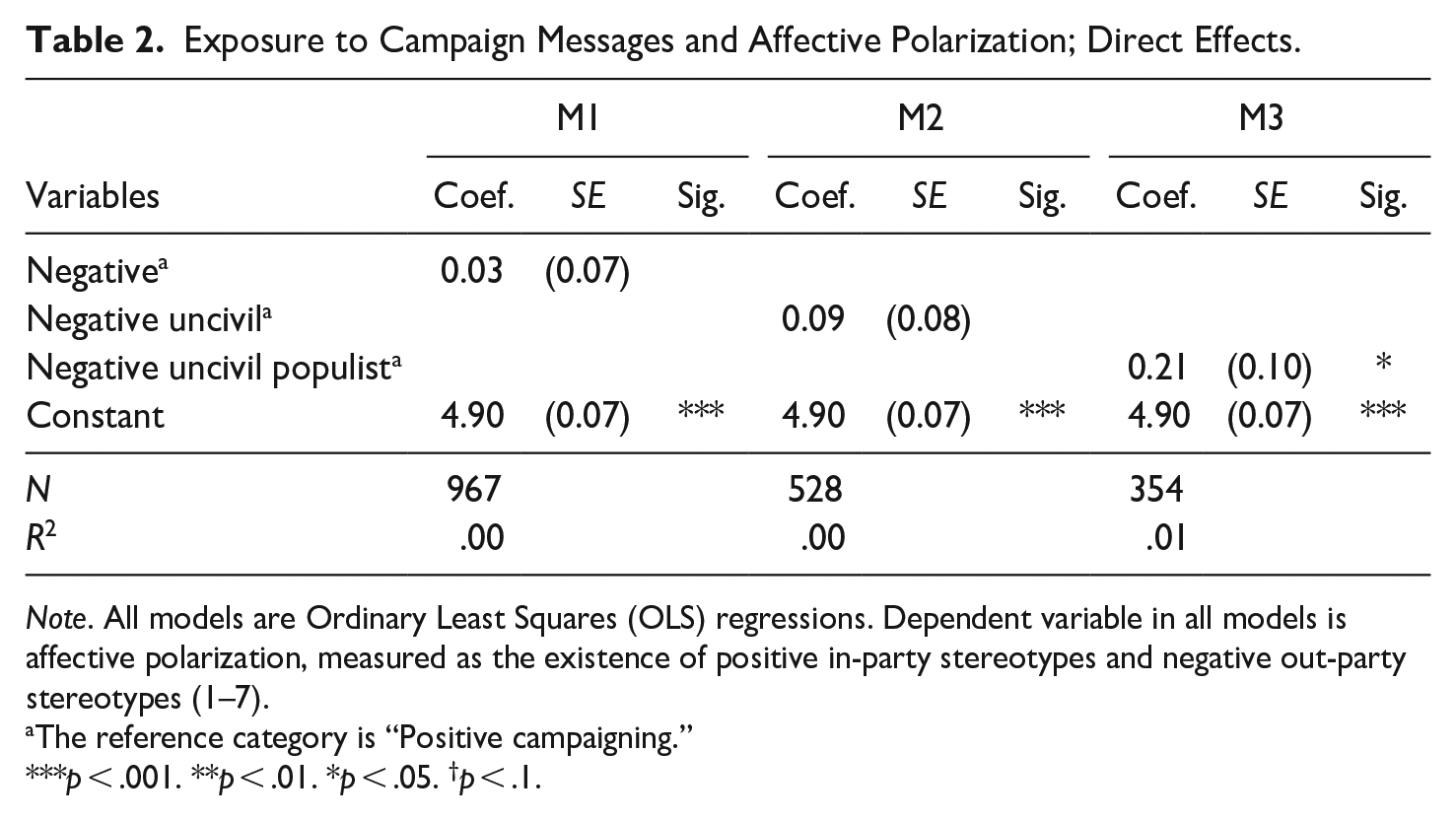
Table 2 tests for the effects of exposure to negative messages on respondents’ levels of affective polarization. The table presents, in turn, the effects of exposure to negative (M1), negative uncivil (M2), and negative uncivil populist (M3) messages, always estimated when comparing to exposure to a positive message (reference category).
Exposure to Campaign Messages and Affective Polarization; Direct Effects.
Note. All models are Ordinary Least Squares (OLS) regressions. Dependent variable in all models is affective polarization, measured as the existence of positive in-party stereotypes and negative out-party stereotypes (1–7).
The reference category is “Positive campaigning.”
p < .001. **p < .01. *p < .05. †p < .1.
The table shows a small but significant effect for exposure to the harshest type of campaign message (M3). Compared to respondents exposed to a message promoting the candidate, those exposed to a message where the candidate criticized the opponents in an uncivil way and via populist appeals scored 0.2 additional points on the affective polarization scale—indicating, as expected, a polarization potential for exposure to negative campaigning (Iyengar et al., 2012). Beyond the effects of negativity, this result is in line with recent research showing that exposure to populist messages can, under certain circumstances, widen the affective divide among citizens (Hameleers & Fawzi, 2020).
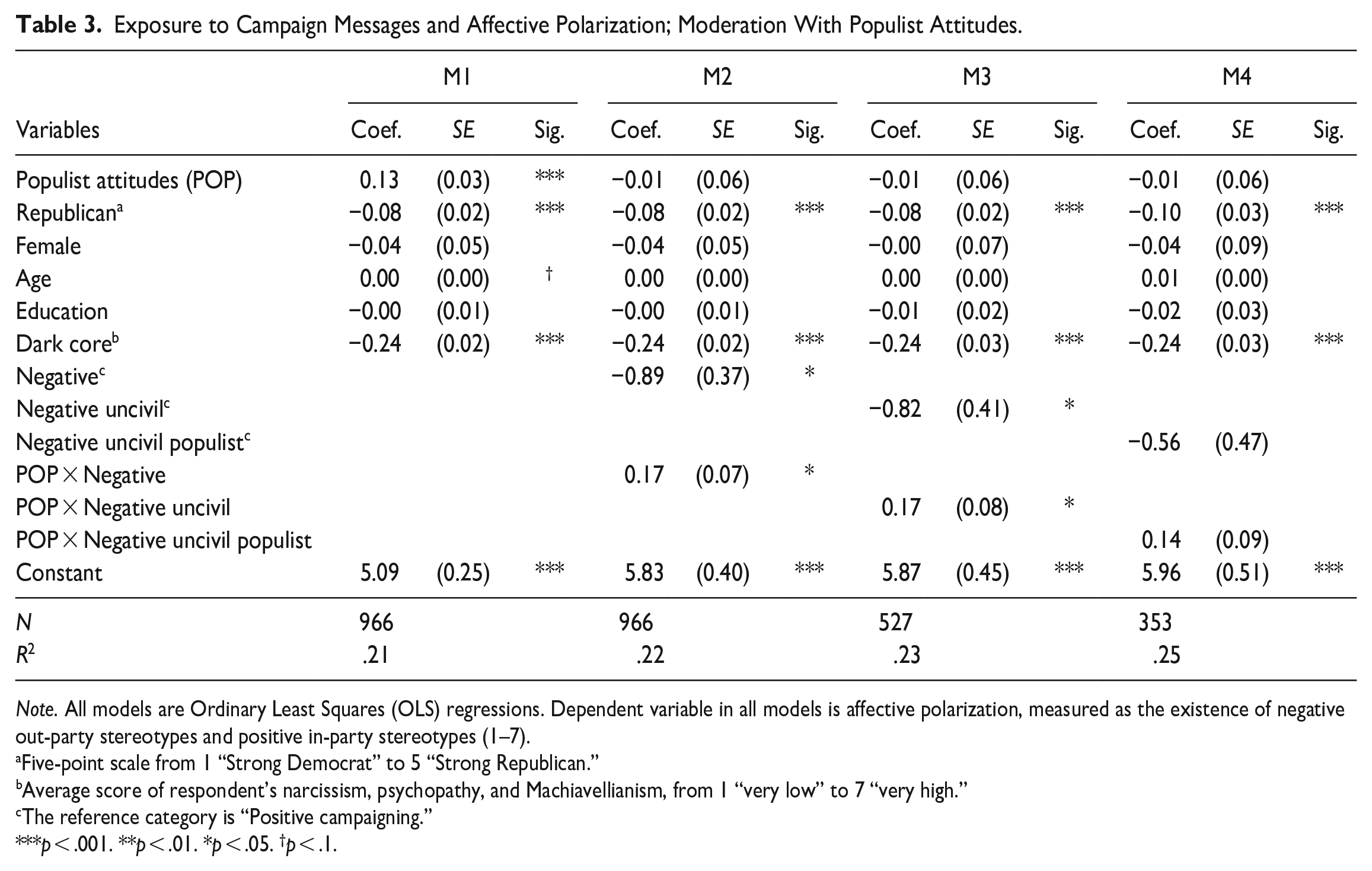
Table 3 investigates the joint effect of individual differences and exposure to negative messages to drive affective polarization. Model M1 only includes the direct effect of individual predictors and covariates, and works as baseline for models M2 to M4 with moderation effects. M1 shows a significant positive association between populist attitudes and affective polarization; compared to respondents with the lowest ratings on the populism scale, respondents with the highest ratings score almost one additional point on the affective polarization scale, ceteris paribus. Interestingly, higher dark personality scores are significantly associated with lower affective polarization.
Exposure to Campaign Messages and Affective Polarization; Moderation With Populist Attitudes.
Note. All models are Ordinary Least Squares (OLS) regressions. Dependent variable in all models is affective polarization, measured as the existence of negative out-party stereotypes and positive in-party stereotypes (1–7).
Five-point scale from 1 “Strong Democrat” to 5 “Strong Republican.”
Average score of respondent’s narcissism, psychopathy, and Machiavellianism, from 1 “very low” to 7 “very high.”
The reference category is “Positive campaigning.”
p < .001. **p < .01. *p < .05. †p < .1.
The remaining models in Table 3 introduce interaction terms between exposure to negativity and individual populist attitudes. Models M2 and M3 show a significant positive interaction term for exposure to, respectively, a negative message and a negative uncivil message. Figure 2 substantiates the significant interaction in model M2 with marginal effects, where all other covariates are kept at their mean value. As the figure shows, a positive association between populist attitudes and affective polarization, also noted in the baseline model, exists particularly among respondents exposed to a negative message. As expected, negativity activates the negative perceptions of populists, and entrenches them into a more antagonistic stance against their political opponents.
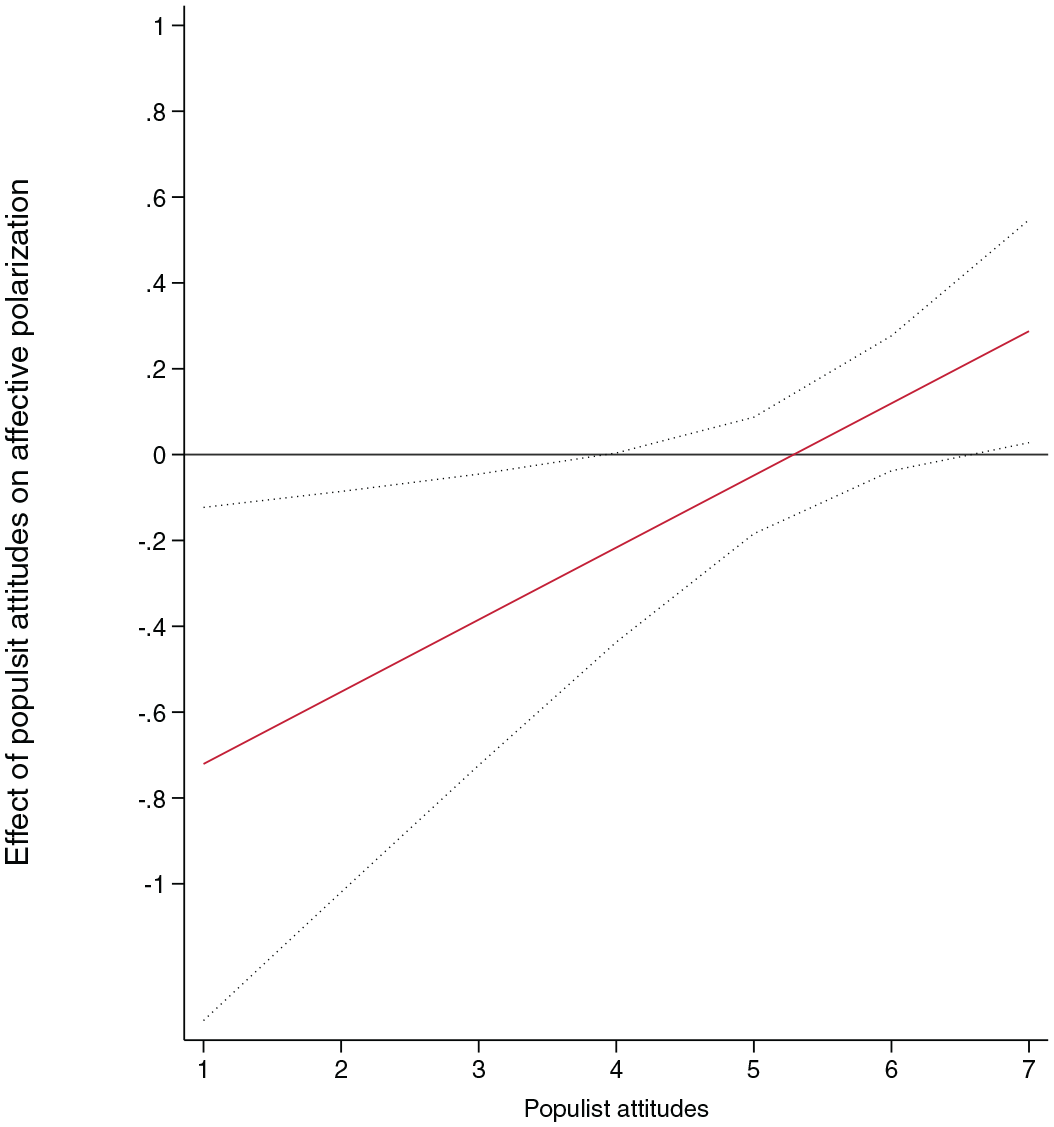
The joint effect of populist attitudes and exposure to negative messages.
A similar effect exists also for the two harsher forms of negativity, albeit in slightly weaker terms, especially for exposure to negative uncivil populist campaigns (M4), for which no significant interaction exists with populist attitudes—even if this could be simply due to the smaller size on which the model is run.
Partisanship and Other Robustness Checks
Because respondents were exposed to partisan political messages (all messages were sponsored by a fictive Republican candidate), their partisan attachment could potentially play a confounding role—especially in light of its significant association with both populist attitudes and affective polarization, as discussed above. With this in mind, Table 4 presents a series of models where the effects of populist attitudes (M1) and of the three forms of campaign negativity (M2–M4) are moderated by respondents’ partisan attachment. Populist attitudes do not play a stronger role on affective polarization depending on the ideology of the respondent: the interaction term between populist attitudes and party identification is not significant, and very weak. We do see some significant interactions between exposure to campaign messages and partisan identification; for instance (M2), affective polarization is higher after exposure to a negative message (vs. a positive one) especially for respondents close to the Republican party. These effects are however extremely weak, and all things considered marginal. Table 5 goes a step further and estimates the moderating role of partisanship for the interaction effect between populist attitudes and exposure to campaign negativity, discussed earlier. As shown in the table, none of the three-way interaction terms (partisanship × populist attitudes × exposure to campaign negativity) significantly alter the levels of affective polarization of respondents. A series of additional models, reported in the Supplemental Appendix (Supplemental Table A6), show that the significant interactions between populism and exposure to negative messages discussed above resist the inclusion of interactions between partisanship and exposure to the same messages. All in all, we can confidently exclude a major confounding role of partisan attitudes in the main trends discussed above.
Exposure to Campaign Messages and Affective Polarization; Moderation With Partisan Identification.
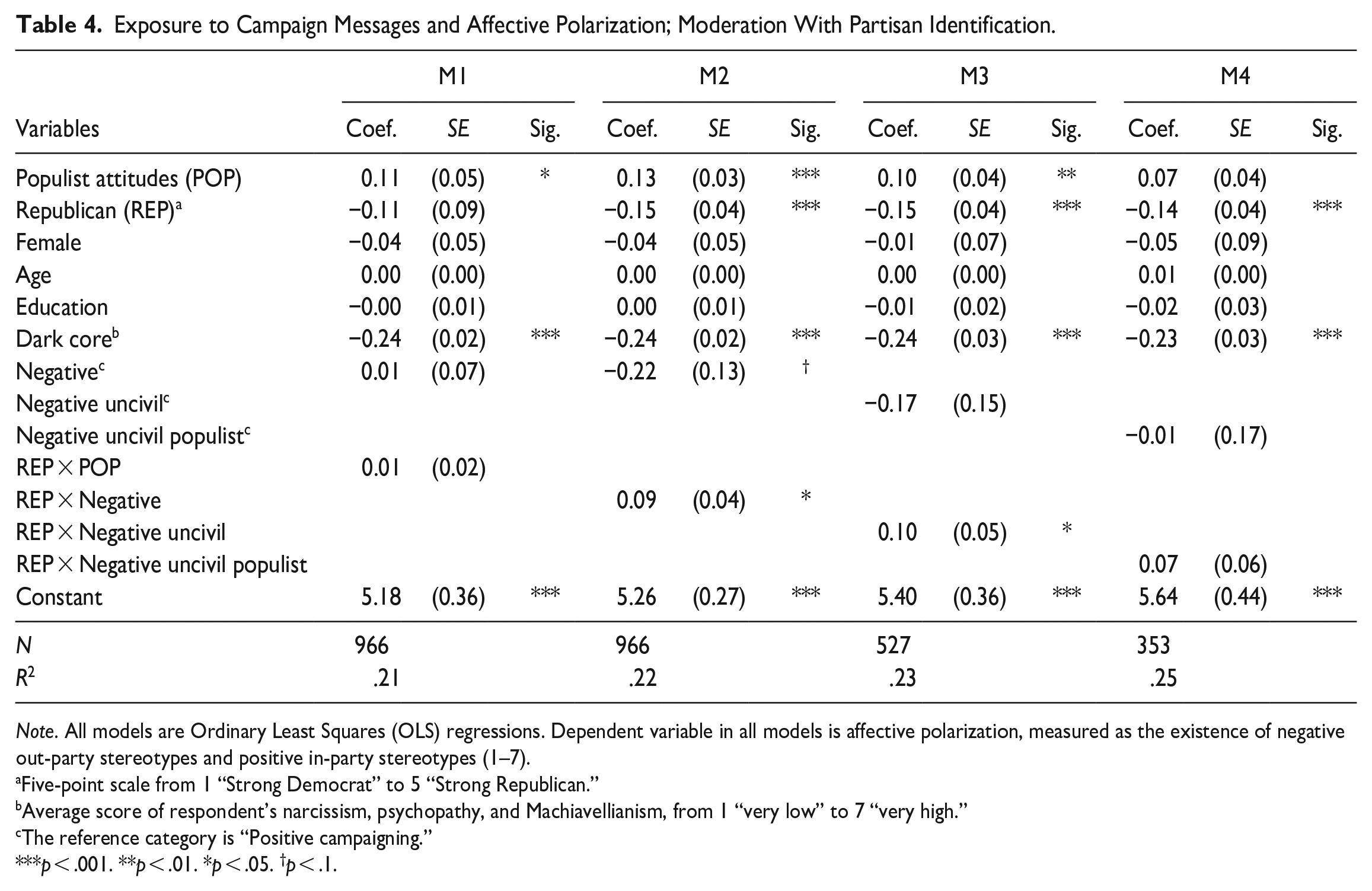
Note. All models are Ordinary Least Squares (OLS) regressions. Dependent variable in all models is affective polarization, measured as the existence of negative out-party stereotypes and positive in-party stereotypes (1–7).
Five-point scale from 1 “Strong Democrat” to 5 “Strong Republican.”
Average score of respondent’s narcissism, psychopathy, and Machiavellianism, from 1 “very low” to 7 “very high.”
The reference category is “Positive campaigning.”
p < .001. **p < .01. *p < .05. †p < .1.
Exposure to Campaign Messages and Affective Polarization; Moderation With Populist Attitudes and Partisan Identification.
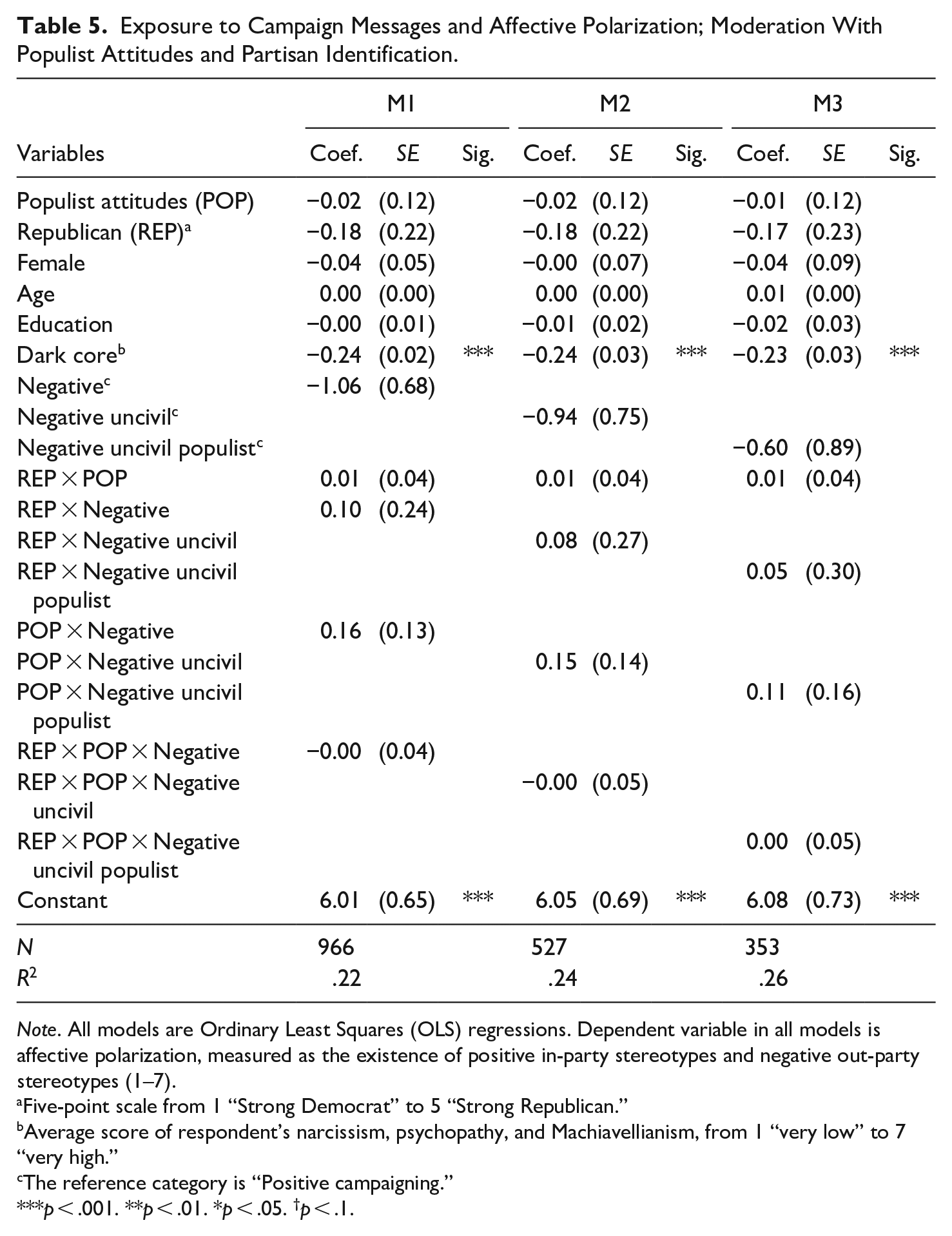
Note. All models are Ordinary Least Squares (OLS) regressions. Dependent variable in all models is affective polarization, measured as the existence of positive in-party stereotypes and negative out-party stereotypes (1–7).
Five-point scale from 1 “Strong Democrat” to 5 “Strong Republican.”
Average score of respondent’s narcissism, psychopathy, and Machiavellianism, from 1 “very low” to 7 “very high.”
The reference category is “Positive campaigning.”
p < .001. **p < .01. *p < .05. †p < .1.
Models replicated with an alternative measure of affective polarization (reversed score on the “feeling thermometer” assigned to the out-party, 0–100; M = 74.4, SD = 26.5) show results that are broadly in line with the main ones. Table A2 (Supplemental Appendix A) indicates that exposure to the harsher campaign message (negative uncivil populist) increases negative feelings for the out-party. Table A3 shows no direct effect of populist attitudes, contrarily to the main effects with the original measure; nonetheless, the interactions between campaign negativity and populist attitudes are in the expected direction. We have also replicated the main models on the whole sample, that is, without excluding respondents that filed the attention check. Results, presented in Supplemental Tables A4 and A5, are virtually identical to the main results that exclude such respondents. Supplemental Tables A7 and A8 contrast the effects for the “harshest” type of campaign messages (negative uncivil populist) with the effects of less harsh messages (negative uncivil and simply negative), and show that harsher versions tend to have stronger effects, even if this is not more so for respondents with populist attitudes. Finally, Supplemental Table A9 tests for the effect of the additional experimental condition in our data that we are not investigating in this article—the use of fear appeals. Results indicate that fear does not drive affective polarization directly, but it does so for respondents higher in populist attitudes—conceptually in line with the results discusses in this article. Further investigation on the specific effects of fearmongering on affective polarization seems thus indicated, in line with research pointing to attitudinal effects of negative emotional cues in campaign messages (e.g. Brader, 2005).
Discussion and Conclusion
Many indicators suggest that politics is getting increasingly darker. In this article, we have explored the underpinnings of an individual manifestation of this generalized phenomenon—affective polarization, that is, the extent to which individuals frame their belonging to political tribes along affective lines, predilecting the in-group and deeply disliking the out-group (e.g. Iyengar & Krupenkin, 2018; Iyengar et al., 2012, 2019). We have investigated two of such underpinnings, in terms of both the political supply and individual differences: the exposure to darker forms of campaign communication (Geer, 2012; Lau & Pomper, 2004), on the one hand, and the presence of individual populist attitudes (Akkerman et al., 2014; Rico et al., 2017), on the other.
To lift the lid on the causal mechanisms linking exposure to campaign negativity and affective polarization, both directly and under the joint influence of populist attitudes, we have set up an experiment with a convenience sample of US respondents (MTurk, final N = 1,081) where respondents were exposed to increasing levels of campaign negativity from a fictive candidate. In line with recent research highlighting the fundamental role of individual differences in moderating the effectiveness of (negative) campaign messages (e.g. Fridkin & Kenney, 2011, 2019; Nai & Maier, 2020; Weinschenk & Panagopoulos, 2014), we have tested the general assumption that exposure to negative campaigning messages fosters affective polarization, and that this is especially the case among voters holding strong populist attitudes.
Results show that exposure to the harsher forms of campaign negativity (character attacks associated with political incivility and populist messages) drive affective polarization upwards when compared to exposure to positive messages. The effect is not particularly strong, but is significant and in the expected direction. Most important, our results show both a direct and moderating effect of populist attitudes. First, populist individuals are more likely to “like” negative campaign messages (they are significantly more likely to find them amusing and fair). Second, even controlling for several potentially important covariates (including partisanship, gender, age, education, and dark personality traits), respondents scoring higher on populist attitudes are more likely to report higher levels of affective polarization. Third, exposure to negative messages is associated with greater affective polarization particularly among respondents scoring high in populist attitudes.
These results come with some caveats. They are, first, only stemming from a single study with a convenience sample. Even if we are confident about the protocols we have implemented for sampling and data collection, unwanted influences due to the circumstantial nature of single experiments cannot be ruled out. Further research should strive to replicate the trends discussed here with different samples, ideally also outside of WEIRD populations (even if of course the partisan dynamics outside of the US case are radically different). Second, and somewhat relatedly, further research should investigate the confounding role of experimental components that we have voluntarily kept constant in our study—most notably the fictive versus real nature of the sponsor and targets of attacks, and their partisan affiliation. Especially in light of evidence suggesting an asymmetric ideological polarization among Republicans and Democrats (Russell, 2018; Skocpol & Williamson, 2016), and the existence of differences in psychological profiles between liberals and conservatives (e.g. Carney et al., 2008), the fact that in our experiment the attacker is always a Republican could have played a role. Campaign negativity seems somewhat more “in character” for conservative candidates, as shown in US (Lau & Pomper, 2001) and comparative (Nai, 2020) research. While this is unlikely to be the main driving force of all effects throughout, it could perhaps have affected message credibility. Further research should thus ideally also experimentally manipulate the partisan identification of the attacker. Similarly, the fact that both the attacker and the target in our experiment are males is noteworthy. Evidence suggests that the gender of candidates could matter when it comes to the dynamics of attack politics and incivility (e.g. Maier & Renner, 2018); campaign negativity is often seen as riskier for women, because at odds with stereotypical societal expectations that see them as playing a more positive and caring role (Banducci et al., 2012). In our case, setting the stage as attacks exclusively between men perhaps reduced the risk that the attacks backlashed in the first place due to violation of gender stereotypes. Here again, further experimental research able to disentangle gender differences in attacker and targets is warranted. Still at the level of the experimental protocol, the fact that the “control” condition in our experiment was a positive message (advocacy) and not a neutral condition likely drives part of the results by increasing the contrast between different messages—even if robustness checks suggest that increasing harshness in negative messages matters, regardless of the reference category. Finally, the effects shown are relatively clear and in the expected direction, but remain modest in size—even if, to be fair, attitudinal changes after exposure to a single informational stimulus should not be expected to be particularly large. Further research able to replicate these effects is necessary—ideally also including a longitudinal component able to assess for the persistence of the effects induced by exposure to the experimental stimuli (Dowling et al., 2020), or by relying on exposure to repeated messages (Ernst et al., 2017; Nai & Seeberg, 2018). Given that in campaign times voters are exposed to a virtually endless stream of negative communication, it could be easy to imagine that even small effects cumulate to produce more severe rifts. Yet, with all this in mind, and especially because our results come from a convenience sample, we would encourage readers to see the trends discussed in this article as preliminary.
These limitations notwithstanding, our results provide new individual (micro) evidence in line with dynamics of “polarizing populism” shown at the electoral system level (e.g. Handlin, 2018). Furthermore, they pave the way for a new and integrated research on affective polarization, able to include insights from disciplines that have mostly developed on parallel tracks—in this case, campaign negative and populist attitudes—but all share a normative desire to understand the mechanisms of “dark” and negative politics. Further research should expand toward a more complex understanding of the intervening role of individual antagonistic attitudes, for instance in terms of dark personality traits (Nai et al., 2023), ressentiment (Capelos et al., 2025 in this Special Issue, Part Two), or authoritarianism (Veit et al., 2025 in this Special Issue, Part Three).
Supplemental Material
sj-docx-1-abs-10.1177_00027642241242056 – Supplemental material for Polarized Populists: Dark Campaigns, Affective Polarization, and the Moderating Role of Populist Attitudes
Supplemental material, sj-docx-1-abs-10.1177_00027642241242056 for Polarized Populists: Dark Campaigns, Affective Polarization, and the Moderating Role of Populist Attitudes by Alessandro Nai and Jürgen Maier in American Behavioral Scientist
Footnotes
Declaration of Conflicting Interests
The author(s) declared no potential conflicts of interest with respect to the research, authorship, and/or publication of this article.
Funding
The author(s) disclosed receipt of the following financial support for the research, authorship, and/or publication of this article: The authors acknowledge financial support from the Amsterdam School of Communication Research (ASCoR), University of Amsterdam. The study received full ERB approval from the University of Amsterdam on 18 November 2019 (ref. 2019-PCJ-11498).

Supplemental Material
Supplemental material for this article is available online.
Notes
Author Biographies
References
Supplementary Material
Please find the following supplemental material available below.
For Open Access articles published under a Creative Commons License, all supplemental material carries the same license as the article it is associated with.
For non-Open Access articles published, all supplemental material carries a non-exclusive license, and permission requests for re-use of supplemental material or any part of supplemental material shall be sent directly to the copyright owner as specified in the copyright notice associated with the article.
