



Abstract
In a time of declining support for democracy and intensifying rivalry between democracies and autocracies, understanding how nondemocratic nations portray U.S. elections is vital. And yet, despite the enormous attention U.S. presidential elections attract around the world, the manner in which international media makes sense of U.S. campaigns remains unclear, with only a limited number of comparative studies conducted and even fewer looking at non-Western, nondemocratic nations. Furthermore, current comparative frameworks remain biased toward Western conceptualizations of media and their role in democratic countries, with nondemocratic or transitional democracies used to support theoretical models developed elsewhere. Thus, this study offers strategic media narratives as an alternative means to understand transnational similarities and differences in election reporting emerging from four non-Western, nondemocratic nations by comparing their coverage of the 2020 and 2016 U.S. presidential campaigns. Results show substantial shifts in the nature of coverage, albeit with some similarities between campaigns. Trump remained negatively discussed in both elections, but with reporting in 2020 associating his leadership character to his policies. Whereas Clinton was negatively covered in 2016, Biden was neutrally discussed in 2020 with focus on his character and policies drawn in contrast to Trump. Both political parties were negatively covered, with Chinese, Russian, and Iranian narratives associating Republicans and Democrats as pursing confrontational relations with each nation. Most importantly, discussions of U.S. democracy were substantially more frequent and negative in 2020 compared to 2016. Taken together, the study contributes theoretically and empirically to the study of comparative election research by theorizing the role of narratives in international campaign coverage, addressing the gap in research into nondemocratic media reporting of international elections, and provides one of the few cross-time comparisons enabling insight into the drivers of how and why coverage of U.S. elections change.
U.S. presidential elections attract enormous attention around the world (Curran et al., 2017; Guo & Vargo, 2017), perhaps none more so than the 2016 election when then candidate Trump captured the imagination of global audiences as an anti-establishment political outsider. Indeed, Trump’s candidacy became a global harbinger with his messaging resonant with awakening anti-establishment, populist movements around the world. Consequently, many of the circumstances that ushered in the 2016 Trump presidency in the U.S. reflected global political currents as well; including declining trust in elites and democracy, rising populism and authoritarianism, and fears of migration and economic inequality (Norris & Inglehart, 2019; Wike et al., 2019).
However, by the end of Trump’s term, global evaluation of his performance were decidedly negative. As data from Pew shows, America’s global reputation declined throughout the Trump presidency with Trump’s unpopularity having a significant impact on America’s overall image. The effect was most notable from United States allies with the United Kingdom, France, Germany, Japan, Canada, and Australia all registering record lows (Wike et al., 2020). More broadly, U.S. soft power appeal declined a well, with the U.S. falling from number one in McClory’s 2016 Soft Power 30 index down to five in their 2019 rankings. As Methieson (2021) warned during the 2020 election campaign, the U.S. faced significant challenges in rebuilding its global reputation due to Trump’s repeated attacks on American institutions and its electoral process; whereas America’s biggest selling point for global leadership was its success as a democracy, Trump’s actions had hindered such claims to exceptionalism.
As U.S. audiences continue to grapple with the after-effects of the 2020 election, equally important is understanding how other parts of the world reported on and made sense of the presidential race. Not only do international audiences rely on news media to learn and make judgments about foreign countries and the world at large (Lippman, 1922; Wanta et al., 2004), but U.S. presidential elections in particular represent important global media events showcasing American democratic culture (Hinck et al., 2019; Kluver et al., 2019), with U.S. democracy itself seen as emblematic of Western democratic values.
And yet, the manner in which foreign media make sense of U.S. elections remains unclear (Van Aelst et al., 2018) with only a limited number of comparative studies and even fewer conducted outside of Western contexts (Esser, 2019; Hanusch & Vos, 2020; Van Aelst et al., 2018). Given the importance of U.S. elections as manifestations of democratic culture, especially in a time of declining support for democracy and intensifying rivalry between democracies and autocracies (Diamond et al., 2016; Freedom House, 2019; White House, 2021a, 2021b), understanding how nondemocratic nations portray U.S. elections is vital.
Building off of previous research comparing Chinese, Russian, Iranian, and Arabic media portrayals of the 2016 U.S. elections, this study examines the shifts in coverage among these nations’ reporting of the 2020 presidential race through the framework of strategic media narratives. In doing so, it contributes both theoretically and empirically to the study of comparative election research by offering an alternative means to understand foreign media coverage of U.S. presidential campaigns and addresses the gap in research into nondemocratic media reporting of international elections, while empirically offering one of the few cross-time comparisons, thereby providing insights into the drivers of how and why coverage of U.S. elections change.
Comparative Election Research: Tenants, Assumptions, and Limitations
According to Esser and Strömbäck (2012) comparative election research aims to describe and explain transnational similarities and nation-specific differences in news logics and reporting styles. These news logics are the joint product of media and political exchanges and reflect journalists’ presentation of campaign messages realized under macro, meso, and micro level contexts; with the predominate theoretical framework for examining them anchored in the mediatization of politics scholarship (Strömbäck & Kaid, 2009) and Hallin and Mancini’s (2004) typology of media classification systems. Accordingly, comparative election studies generally examine campaign content reported by traditional news media, apply content analyses using news frames as their predominate methodological lens, and tend to focus on a core set of reporting features as dependent variables such as media depoliticization, personalization, interventionism, and negativity (Esser, 2019; Hanusch & Vos, 2020).
However, despite this common set of variables, basic comparison of findings remains difficult due to studies’ operationalizing and interpreting these features differently, leading to mixed results (Esser, 2019). For instance, Nord et al. (2017) compared Italian, Swedish, and United Kingdom coverage of the 2016 U.S. election and found that despite differences in media system classifications similar reporting patterns emerged. Furthermore, in comparing eight European countries’ coverage of the 2008 U.S. election, Vliegenthart et al. (2010) found clear differences in visibility, tone, and game framing; but repetition of the study in the 2016 U.S. election showed these country-specific differences disappearing (Van Aelst et al., 2018).
One explanation of the common coverage of the 2016 U.S. election is the argument for the transnationalization of media practices. Here, modernization and globalization are seen as two exogenous factors influencing the diffusion of reporting leading to the “Americanization” of campaign communication through similar transnational news-value cultures (Blumler & Gurevitch, 2001; Esser & Strömbäck, 2012; Van Aelst et al., 2018). However, others more recently have challenged this perspective, citing the impact of new regulatory environments and cultural-specific uses of new media as impacting campaign reporting (Kiyohara et al., 2018). Moreover, the broader effects of globalization on media are argued as functioning not as a homogenizing force, but one strengthening the power of local, national, and regional media systems (Flew et al., 2016); with factors such as populism leading to a reassertion of national policy and political priorities in media (Flew, 2020).
Additional critiques of this framework comes from those pointing out that comparative studies analyze these dynamics primarily in advanced democracies (Hallin & Mancini, 2012; 2017), and use “transitional democracies and nondemocratic countries. . .to support or refute theoretical models developed elsewhere” (Gunaratne, 2010; Mellado et al., 2017, p. 945).
Indeed, the model developed by Esser and Strömbäck (2012) is derived from democratic theory, and assesses news reporting according to democratic norms (Esser, 2019), raising issues when extending it to nondemocratic media systems.
Thus, as Esser (2019) concludes in his review of comparative election research, future research examining non-Western media is needed to help serve as a “counterweight to the strong Anglo-American character” and assumptions of election communication research (p. 1125), with more purposeful and novel explanations describing comparative election dynamics required.
This study answers that call by conceptualizing foreign media coverage of U.S. elections through the framework of strategic media narratives and compares how nondemocratic, non-Western media systems covered the 2016 and 2020 U.S. presidential elections.
Strategic Narratives, Media, and U.S. Elections
Whereas most comparative election research utilizes frames as their analytical method, this study proposes to focus more broadly on strategic media narratives. According to Miskimmon et al. (2014) strategic narratives are “representations of a sequence of events and identities” whereby political actors attempt to give determined meaning to the past, present, and future in order to achieve political objectives” (p. 5). Hinck et al. (2019) argue that such narratives are articulated in news media more broadly as well, and examined the emergence of such narratives within Chinese, Russian, and Arabic language media reporting on the 2016 U.S. election. Accordingly, media present audiences with repeating storylines, socially constructing their worldviews, and bind them into a shared socio-political culture (Carey, 2008). From an ontological standpoint, narratives create cognitive order for both individuals and political collectives as a means to make sense of their environments, often by defining their own identity and interests in contrast to others (Agius, 2017; Combes, 2017; Mitzen, 2006), and can bolster government legitimacy and national cohesion (Hinck et al., 2019, 2022; Huysmans, 1998; Krolikowski, 2018). As Roselle et al. (2014) argue, strategic narratives are soft power in the 21st century. As such, analysis of strategic media narratives offers an alternative means to understand the broader reporting styles and practices of nondemocratic media reporting of U.S. elections.
Accordingly, in the case of U.S. presidential elections, the candidates chosen and the policies they advocate not only hold significant implications regarding U.S. prosperity at home and abroad, but also implicate international norms and the attractiveness of democratic values. Thus, U.S. elections are not only about American politics; the manner in which they are reported reveal information about the identities, values, and interests of those reporting upon them as well (Hinck et al., 2019; Kluver et al., 2019). Hence research shows foreign media deploying national spin to interest and relate overseas events to their domestic audiences (Curran et al., 2017), with geopolitical interests and political ideology driving factors contributing to diverging coverage of international events among democratic and nondemocratic states (Adegbola et al., 2022; Gehlbach & Sonin 2014; Watanabe, 2017).
U.S. elections then provide opportunities for nondemocratic countries with close state–media relations to construct narrative patterns that strategically resonate and affirm the host nation’s political values while highlighting U.S. democracy’s attractiveness—or lack thereof—by accentuating differences between their own political systems and the United States’s (Hinck et al., 2019). Importantly, as media ecologies represent systems of discourse with their own set of enduring symbols, rules, and roles that create stable forms of news and political information (Miskimmon et al., 2017), recurring plotlines or stories regarding U.S. elections may emerge. However, questions remain as to whether the character of such media systems drive the campaign coverage or whether exceptional campaign contexts can account for differences over time (Van Aelst et al., 2018). Moreover, while state identities are subject to change, more often they remain stable—absent some crisis—with geopolitical interests more enduring as well (Mälksoo, 2018; Subotić, 2016).
To better understand how these dynamics play out, this study examines the shifts in Chinese, Russian, Iranian, and Saudi/Arabic media coverage of the 2016 and 2020 U.S. presidential elections and asks the following research questions. First, given evidence from past research pointing to the personalization of election campaign coverage and media focus on candidate personality traits (Holtz-Bacha et al., 2014; Langer, 2010; Nord et al., 2017; Van Aelst et al., 2012, 2018), this study asks:
RQ1. To what extent were the candidates portrayed differentially in Chinese, Russian, Iranian, and Saudi media in 2020 and 2016?
Second, although the presidential candidates make-up the principle agents in narratives about U.S. campaigns, they also function as representatives of their respective parties. Hence, to be successful, not only must they garner enthusiasm and support for their platforms from their base in order to win the election but can also find themselves constrained by their congressional opponents, especially given the rise of negative partisanship and the polarization of U.S. politics (Abramowitz & Webste, 2016; Andris et al., 2015). Moreover, party dynamics can signify internal dysfunction and rifts among political elites, while also impacting partisan views toward foreign nations (Deyermond, 2012; Gries & Crowson, 2010). Thus, given the nature of America’s two-party system, as well as the availability of comparative data from the 2016 election, this study asks:
RQ2. To what extent were the Republican and Democratic parties portrayed differentially in Chinese, Russian, Iranian, and Saudi media in 2020 and 2016?
Finally, given the emblematic nature of U.S. democracy and its oppositional values toward nondemocratic states, as well as the role of strategic narratives in bolstering state identity and regime legitimacy (Hinck et al., 2019, 2022), this study asks:
RQ3. To what extent were narratives about the U.S. democratic system portrayed differentially in Chinese, Russian, Iranian, and Saudi media in 2020 and 2016?
Method
Selection of Cases
Four countries were selected for comparative analysis: Russia, China, Iran, and Saudi Arabia. These countries were chosen for two reasons: first, they represent four of the five leading authoritarian states noted for containing the spread of democracy and challenging the liberal international order (Diamond et al., 2016). Moreover, all four have close state–media relations evident by Reporters without Borders 2021 World Press Freedom index placing them all near the bottom of its 180-country index (China: 177, Russia: 150, Iran: 174, Saudi Arabia: 170) (Freedom House, 2022). Taken together, then, these four countries represent influential non-Western, nondemocratic media systems.
Second, selection of these four countries enables cross-time comparisons between the 2016 and 2020 U.S. elections. For this study, data from the 2016 U.S. election came from previous research published by Kluver et al. (2019) and Hinck et al. (2019) examining Chinese, Russian, Iranian, and Arabic language reporting. For the 2020 analysis, Saudi Arabia was chosen as a comparison point for the 2016 Arabic language data; although, this decision presents some limitations in that the 2016 Arabic language dataset came from a broader swath of Middle Eastern media sources beyond just Saudi outlets.
Data Collection
Data for the 2016 campaign was collected using the Multilanguage Media Monitoring System. Articles came from 66 different media sources chosen for their prestige, authority, circulation, and variety of viewpoints. This included 23 Arabic language sources, 20 Chinese, 16 Russian, and 6 Iranian (for a full break down of sources see Kluver et al., 2019 and Hinck et al., 2019). A total of 1,816 articles were analyzed (781 Chinese, 522 Russian, 275 Arabic language, and 238 Iranian). Articles were collected from 1 week prior to the first presidential debate and continued 1 week post-election day. Because U.S. presidential elections are known for their particularly long campaign season, this time period was chosen as each debate marks an important media event, and thus considers when foreign media were most likely to begin covering the U.S. campaign in earnest. In identifying articles for analysis, researchers piloted various search terms within each region’s native language to best capture a compatible and relevant corpus of articles focusing on the presidential campaign. These terms included: “presidential debate,” “U.S. presidential election,” “Trump,” and “Clinton.”
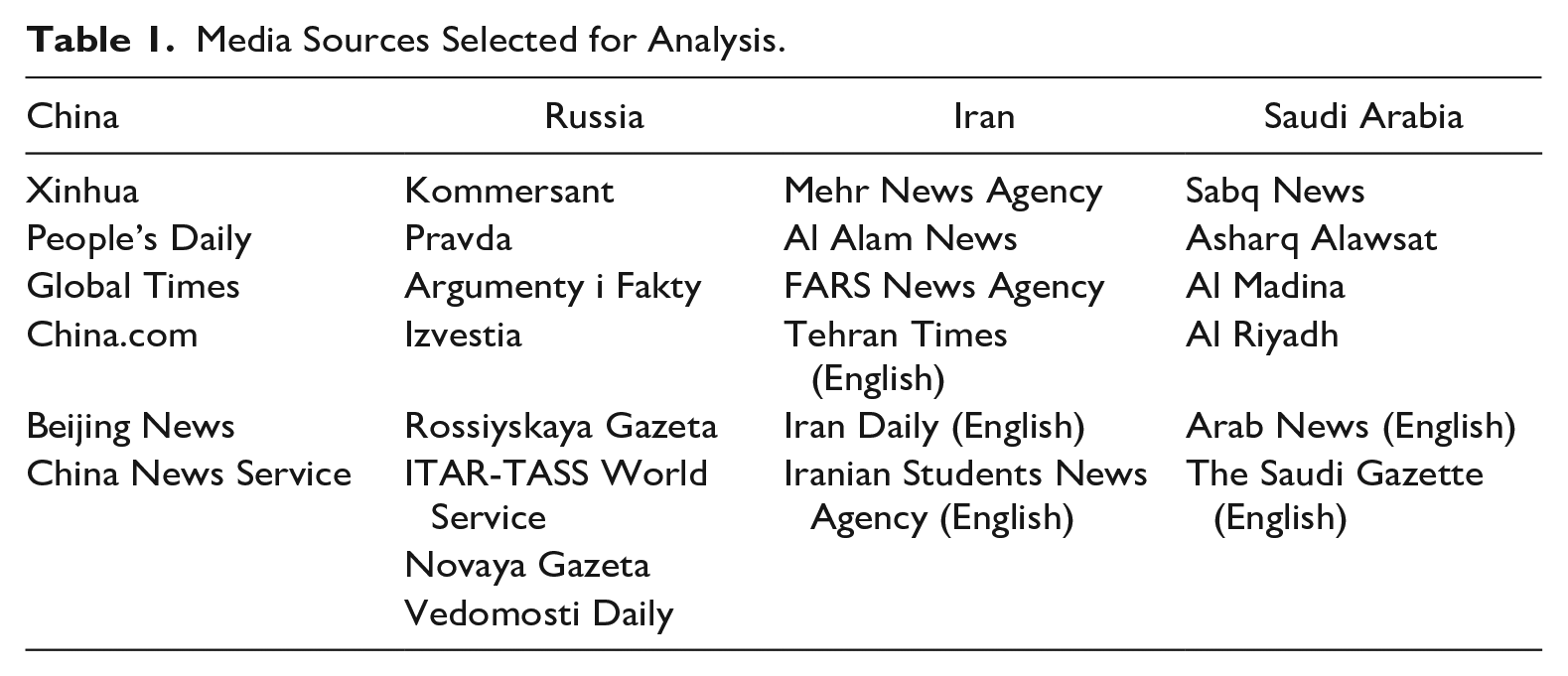
For analysis of the 2020 election, data was collected using the Factiva database. Again, sources selected were chosen for their prestige, authority, circulation, and variety of viewpoints, but also availability on the Factiva platform. Articles came from a total of 26 media outlets, including 6 Chinese, Iranian, and Saudi Arabian outlets and 8 Russian outlets (see Table 1). The search terms were selected after piloting various words and phrases in their native language, taking into account their relevancy, frequency, and capacity for comparative analysis. However, unlike the 2016 campaign where both candidates were not currently serving in the U.S. government, researchers had to avoid erroneous articles discussing Trump’s actions as president outside of the context of the 2020 election campaign. Thus, researchers settled on collecting articles that mentioned both “Biden” and “Trump” in some capacity. The time period for analysis also began 1 week prior to the first presidential debate but continued 3 weeks past election day to the end of November given Trump’s unprecedented contestation of the election results. In total, over 3,500 articles across all data sources matched the search parameters. To create a more manageable corpus of data for analysis, researchers conducted a systematic—random sample of the data at a 95% CI with each country representing its own population. This led to 866 articles collected for analysis, including: 155 Chinese articles, 267 Russian, 257 Iranian, and 187 Saudi Arabian.
Media Sources Selected for Analysis.
Data Analysis
The study employed a mixed-methods design to best capture comparisons among countries and across elections regarding their media narratives covering the two U.S. elections. First, the study used a quantitative content analysis, refining the coding schema developed by Hinck et al. (2019) and Kluver et al. (2019). Each article was treated as the unit for analysis with data reported in this study coming from three of the seven variable categories (candidate portrayals, party dynamics, and democracy narratives). Within these 3 categories were 10 sub-topical variables independently coded.
Operationalization of Coding Categories
Candidate portrayals included: (1) direct discussion of the individual candidates, which required more than just their mention within the articles and excluded the use of their names in reference more broadly to their political campaigns; (2) valance scores—positive, negative, neutral, or not applicable—with inclusion of both negative and positive characterizations coded as neutral; (3) references to either candidates as representing “dangers” to the respective nation or the international community if elected; and (4) references to either candidates as the preferred nominee for the respective interests of the country reporting on them.
Party dynamics likewise included (1) direct discussion of either the Republican or Democratic parties; (2) valance scores toward either party; and (3) an additional category referring to unity or disunity in either party. Disunity was characterized by mixed support, infighting, or disagreement regarding policies within the parties. Unity was characterized by expressions of support for their respective parties and/or candidate, including the party’s policies and platforms.
Finally, three democracy-related variables were coded for both their occurrence and valance: (1) characterizations of the U.S. system as democratic, defined by the degree to which the election was representative of the “will of the people.” This included discussion of differences between the popular vote and Electoral College and the extent to which individuals could choose candidates reflecting their interests; (2) the legitimacy of the U.S. democratic system, defined by the proper enactment of democratic procedures, including the degree to which issues like voter fraud impact election results as well as more general feelings regarding the reported “fairness” of the election; and (3) the desirability of democracy more broadly, defined by the extent to which democracy was viewed as an overall “good” form of government allowing a country to govern itself effectively.
Intercoder Reliability
All coders underwent similar training and were supervized by the same researcher from the 2016 studies. For the 2016 data, three coders were trained to analyze the Chinese and Arabic data with two coders trained to analyze the Russian and Iranian data. For the 2020 dataset, three coders were trained to analyze the articles from all four countries. In doing so, coders went through primary three phases of training. First, they were introduced to the codebook and went over the operationalization of each category with examples from the articles used as illustration. Two pilot studies were then conducted with coders meeting and discussing differences at length, resulting in subsequent clarifications to the codebook. Second, coders were assigned a larger sample of articles which were then assessed for initial intercoder reliability, with remaining divergences discussed and additional examples identified for clarification. Third, coders were given a final, larger sample of articles assessed for reliability before completing their individual coding assignments. For both the 2020 and 2016 datasets, a minimum of 10% of all articles were included for intercoder reliability.
Coders from the 2016 studies reached an average pairwise percent agreement of 86.1% and those for the 2020 dataset reached average pairwise percent agreement of 84.9%. Although pairwise percent agreement is a more liberal measure of interrater reliability, this measure is considered particularly useful for binary decisions and frequently used in international comparisons of media reporting (Hinck et al., 2019; Kluver et al., 2019; Krebs, 2015; Van Aelst et al., 2018).
Qualitative Analysis
Whereas the content analysis allowed for clearer quantitative comparisons among the cases and between the two elections, to identify the narrative themes within the data a qualitative narrative analysis was employed following a grounded theory approach (Strauss & Corbin, 2015). First, one coder read through all of the articles in their entirety before beginning to make initial codes related to the three topics of interest (candidates, parties, democracy). Next, these initial codes were grouped into larger thematic categories with the text mining program KH Coder used to validate and identify additional codes before writing up the results. In both stages the coder focused on inductively identifying the narrative themes present in the articles following Miskimmon et al.’s (2014) definition of narratives, with attention placed on their temporal dimensions and consideration of the acts, agents, scenes, instruments, and motives embedded in the reporting. This was the same process by which the 2016 dataset was previously analyzed, with the same individual conducting the qualitative analysis for the 2020 dataset to ensure internal reliability.
Results
RQ1. To What Extent Were the Candidates Portrayed Differentially in Chinese, Russian, Iranian, and Saudi Media in 2020 and 2016?
Candidate Portrayals in the 2020 Election
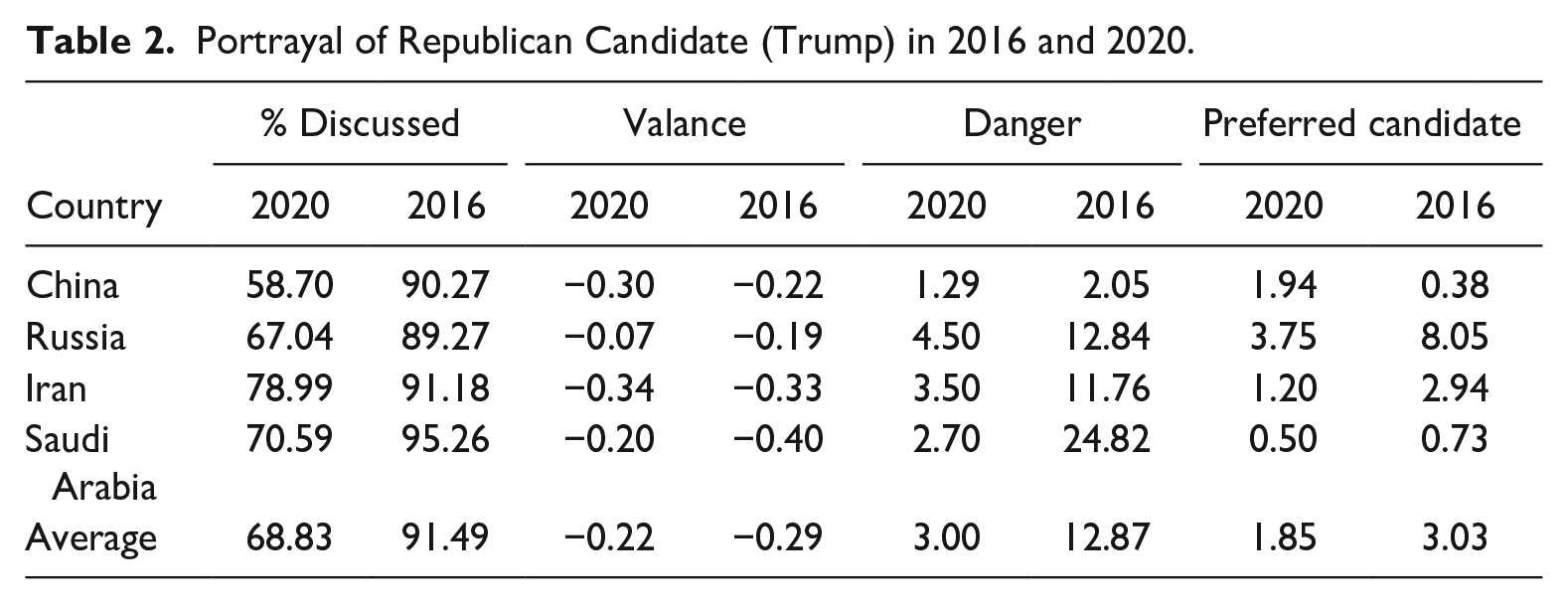
The majority of articles across all four cases characterized the 2020 presidential candidates in positive, negative, or neutral terms. On average, articles clearly characterized Trump (68.8%) more often than Biden (61.6%). All four countries negatively characterized Trump, with Iranian media doing so most often (m = −0.34), followed by Chinese media (m = −0.30) and Saudi Arabian media (m = −0.20); although Russian media characterized Trump only in a slightly negative to neutral manner (m = −0.07). Biden, on the other hand, was characterized more neutrally, with a slightly positive valence in Chinese (m = 0.08) and Saudi media (m = 0.07) and a slightly negative valence in Russian (m = −0.04) and Iranian media (m = −0.02).
All four countries rarely framed either presidential candidate as posing an explicit danger, with 3.0% of all articles doing so for Trump and 2.67% for Biden. Russian media were most likely to label both candidates as dangerous, doing so with Trump in 4.5% of articles and Biden in 5.6%. All four cases more often mentioned Biden as the preferred candidate (10.25%) compared to Trump, averaging 10.25% and 1.85% respectfully. Moreover, Saudi media rarely reported Trump as the preferred candidate (0.50%) while doing so for Biden in 11.2% of articles. Iranian media were more than 10 times as likely to report preference for Biden compared to Trump (12.8% vs. 1.2%), while Chinese media signaled a preference for Biden four times as often compared to Trump (8.39% vs. 1.94%); and Russian media doing so twice as often (8.4% vs. 3.76%).
Comparisons Between Candidate Portrayal in 2020 and 2016
In both 2020 and 2016 Trump was more frequently discussed than the Democratic candidates, more negatively covered on average, and reported less often as the preferred candidate. Most notably, Russia’s preference for Trump in 2020 was half as frequent as in 2016 with China the only country to report an increase in preference for Trump, but doing so in only 1.94% of articles in 2020 compared to 0.38% of articles in 2016.
All four countries’ direct discussion of President Trump decreased from 2020 to 2016.
Likewise, references directly labeling Trump as a danger also decreased. Although direct references to Trump as a danger were on average more frequent than those toward both Biden and Clinton, by 2020 coverage labeling Trump as a danger was, on average, similar to Biden (3.0% vs. 2.66% respectfully).
Regarding shifts in valence, Chinese media showed an increase in negative valance toward Trump while Russian media portrayed Trump more neutrally in 2020 compared to 2016 (see Table 2). Trump’s valence in Iranian media remained virtually the same while Saudi media portrayed Trump half as negatively in 2020 compared to Arabic media more broadly in 2016. In sum, excluding Russia, Trump was covered negatively in both election years.
Portrayal of Republican Candidate (Trump) in 2016 and 2020.
Differences in reporting on Biden in 2020 and Clinton in 2016 were more mixed. Like Trump, all four countries’ direct discussion of the Democratic candidate decreased from 2020 to 2016 while direct references to Biden as a danger, compared to Clinton, also fell (see Table 3). Notably, Chinese and Saudi media less frequently reported preference for Biden compared to Clinton while Russia was nearly twice as likely to prefer Biden in 2020 compared to Clinton in 2016. Iranian media reported similar preferences for Biden in 2020 and Clinton in 2016.
Portrayal of Democratic Candidates (Biden/Clinton) in 2016 and 2020.
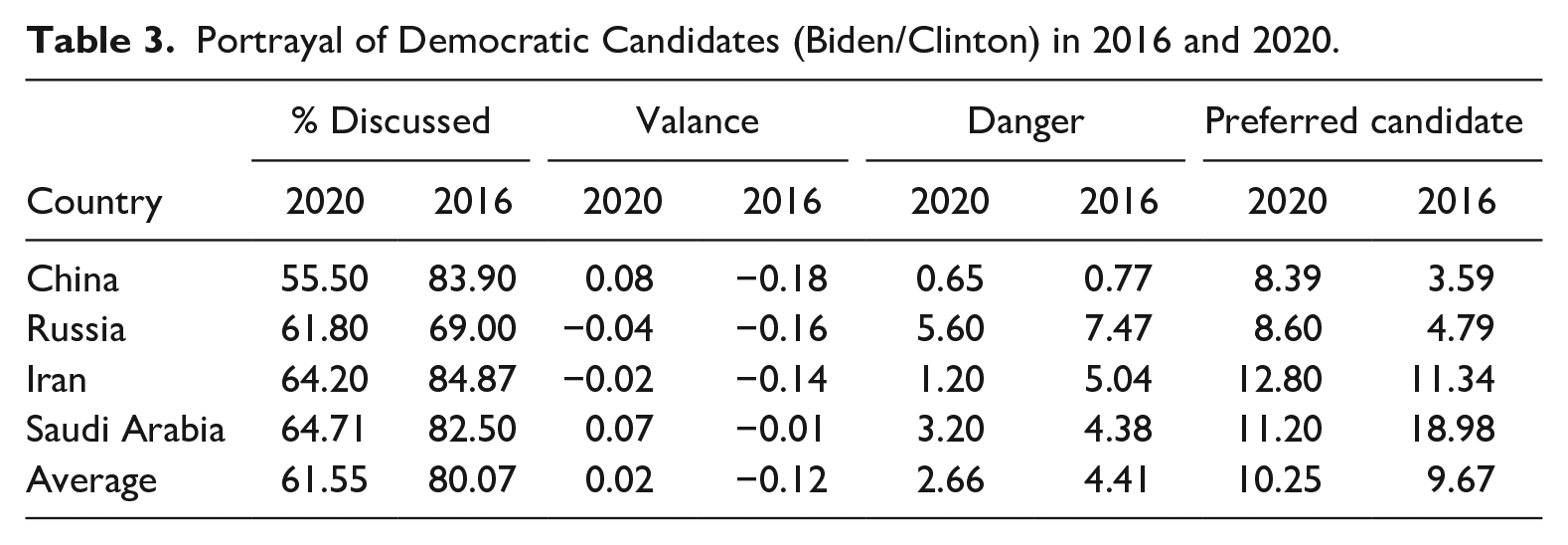
Regarding differences in valence, Biden was neutrally discussed by all four countries while Clinton was negatively discussed within Chinese, Russian, and Iranian media, and neutrally covered in Arabic media.
Narrative Comparison of Candidates
In 2016, narratives discussing Trump and Clinton stressed both candidates’ various scandals and emphasized their high unfavorability ratings while comparing Clinton as an establishment politician and Trump as a political outsider (Hinck et al., 2019; Kluver et al., 2019). In 2020, however, this unpopular, scandal narrative was largely gone—with only Russian media frequently covering Biden’s Burismo scandal in 2020. Instead, the 2020 narratives of the candidates revolved around Trump’s behavior and actions in office over the past 4 years with depictions of Biden coming primarily in contrast to Trump.
In Iranian media, the election took on an especially personalized tone. Trump’s loss was rejoiced. Reports noted how “Iranian officials have been celebrating U.S. President Donald Trump’s downfall in the presidential election” as “Tehran is happy with the defeat of the ‘maximum pressure’ guy.” 1 Throughout the campaign Trump was reported as having “no principles” 2 and called a bully, liar, racist, mad, and stupid; with “Trump’s insistence to appear as a strong, resolute, energetic and impulsive man [being] a blatant attempt by him to cover up his cultural poverty, political ignorance, and intellectual immaturity.” 3 Commenting on his 4 years in office, Iranian media reported the “cornerstone of Trump’s policies” were “Violating international treatises, from environmental [deals] to the inhumane economic sanctions against the Iranian nation and supporting terrorism and racism” 4 of which the “international community has. . .been witness to” with “Trump’s destructive presence on the world scene. . . violating all global laws and destroying the pillars of the international system.” 5
In contrast, Biden was explained as domestically seeking “to heal. . .the U.S. and reduce the divides created during this election” 6 while internationally having “a great deal of work to do in repairing the damage this president [Trump] has done to America’s standing around the world.” 7 As such, Biden was reported as attempting “to return to these [international] agreements and restore predictability and normalcy to U.S. foreign policy” 8 with his administration’s “tone. . .likely to be more diplomatic.” 9 While Biden was stated as being “more promising” 10 than Trump for Iran, such positive characterizations of U.S.–Iran relations were overshadowed by expectations of continuing U.S. pressure, with Iranian officials withholding from “rejoicing over Joe Biden’s victory. . .[and] remains distrustful of the U.S. foreign policy even under a new Democratic leadership.” 11
Saudi media likewise criticized Trump and his 4 years in office but offered more explicit praise for Biden. Trump was described as “waffling when asked to denounce racist groups like the ‘Proud Boys’” 12 and “not just foolish but also dangerous” in deciding to stop funding the WHO during a pandemic. 13 When reporting on how his administration handled COVID-19, Saudi media characterized the Trump administration as “handling it the way it handles everything: it likes to sow confusion, it isn’t transparent, it isn’t fully telling the truth.” 14 Internationally, it was reported that: “US allies, particularly in Europe, but also in Asia, have been frustrated by Trump’s impulsiveness and unpredictability” 15 as “For the last 4 years the Trump administration has proved tough to handle, creating huge uncertainties as to what it would do next.” 16
In contrast to all this, “one of Biden’s first decisions as president” would be “to join the WHO” 17 with Biden’s approach to COVID-19 “more cautious.” 18 Internationally, Biden was “expected to allay” the fears of U.S. allies by “reaching out to historic allies and reinforcing the old alliances” to which “Most of Europe will welcome” with Biden “ditching. . .the isolationist, anti-free trade Trump approach.” 19 Biden was personally lauded as experienced and capable: “Biden is, at heart, an internationalist, an institutionalist, and from an older generation of what the longstanding US interests and relationships are in the Gulf and the wider Middle East.” 20 He was even characterized as “The most experienced and knowledgeable American politician in the world” and thus, “an encyclopedia and a reference in international affairs.” 21
For China, Trump too was severely criticized, primarily for pursuing his America First policies, his trade war with China, blaming the pandemic on China, and attempting to isolate China. However, rather than attacking his character directly, Chinese criticisms of Trump primarily revolved around his policies, to which Biden was again reported to reverse. As one article explained: “The U.S. tariffs imposed on China have also proved to be harmful to others and itself. American economists have pointed out that this is Trump’s worst policy and is expected to be abandoned by Biden soon.” 22 Likewise, “If Trump is re-elected, the decoupling between the United States and China will intensify, forcing Asian countries to choose sides when facing severe economic threats” but “If Biden wins, it may start a (slow) process to heal US–China relations.” 23 Accordingly, Chinese media recommended: “Biden should abandon Trump’s arrogance and prejudice and strive for common prosperity with China, instead of suppressing China.” 24
Nonetheless, some articles noted that Trump’s actions benefited China. As Global Times reported, “President Trump’s failed domestic and foreign policies have made ‘China great again.’” 25 Likewise, “Because President Trump dismissed multilateral organizations and cooperative efforts. . .The isolationist stance of this administration [is] helping Beijing fill the leadership vacuum” with “The Trump administration’s policies hav[ing] facilitated Beijing’s image improvement.” 26 Although Chinese media preferred Biden, this preference was more out of comparison to Trump. As Global Times explained, although “Biden is unlikely to continue Trump’s raid, repetitive, and messy rollercoaster-style approach to China” nonetheless “being less chaotic does not necessarily mean less confrontation” as Biden too has “promised to lead a coordinated campaign to ‘press, isolate and punish China’.” 27
Even Russian media appeared to have turned on Trump in 2020, preferring a Biden presidency. Trump was called a “narcissistic New York billionaire, connoisseur of luxury and beautiful life” 28 with his personal character “unpredictable and incompetent.” 29 Russian media appeared disillusioned by Trump, characterizing him as failing to make good on his word. As Izvestia reported, whereas “President Trump. . .repeatedly pledged to ‘drain the Washington bog’” he “failed to do so.” 30 Likewise, “His constant statements that positive US–Russian relations are beneficial to the United States remain only words and do not find confirmation in deeds.” 31 Trump’s foreign policies were described not only as “‘chaotic’ at best,” 32 but even strengthening Russia’s adversaries by having “consistently increased the American contribution to the North Atlantic Alliance and strengthened its eastern flank near the borders of the Russian Federation.” 33 As Novaya Gazeta summarized: “the Kremlin is silent—a victim of its own show—off and blunders, which at one time made a bet on Trump [and] received nothing from this.” 34
In contrast, Biden was reported as “re-establishing American leadership on the global stage following Trump’s attempts to ‘interrupt multilateral diplomacy and destroy fragile pacts’” 35 with a Biden administration “more useful for solving important international issues,” 36 including negotiating arms treaties with Russia. 37 Nonetheless, Biden was casted as an “anti-candidate” 38 to Trump as “many [in America] want a candidate” free from the “daily scandals” and “every minute quarrels” of the Trump presidency. 39 Like Clinton in 2016, Russian media viewed “Biden [as] the flesh of the American establishment,” but this time, however, American voters preferred the establishment candidate, but doing so because “They voted not so much for Biden as against Trump.” 40 Consequently, Biden’s election was reported as a “feeble success” in that “Unlike the presidents who energized the masses and received a broad mandate, Biden did not create any bright platform, did not rally society around new ideas.” 41 Thus, “This campaign was about Trump from start to finish.” 42
RQ2. To What Extent Were the Republican and Democratic Parties Portrayed Differentially in Chinese, Russian, Iranian, and Saudi Media in 2020 and 2016?
Party Portrayals in the 2020 Election
The Democratic and Republican parties were mentioned on average in 14.2% and 13.1% respectively in the 2020 election. Both parties were presented in negative terms across all four countries: Democrats (m = −0.21); Republicans (m = −0.23). Notably, Iranian media most negatively portrayed the Democratic Party (m = −0.31) compared to Chinese (m = −0.14), Russian (m = −0.20), and Saudi (m = −0.17) media. Additionally, Russian media portrayed the Republican Party least negatively (m = −0.06) compared to Saudi (m = −0.22), Iranian (m = −0.30), and Chinese (m = −0.33), media.
Party unity appeared not to play a considerable factor in the four countries’ reporting on the 2020 election. Less than 5% of articles within each country referenced Democratic unity in some manner. Likewise, Chinese, Russian, and Saudi media only referenced Republican unity in less than 6% of articles, although Iranian media did so in 9%.
Comparisons Between Party Portrayals in 2020 and 2016
All four countries’ discussion of the two major political parties decreased from 2020 to 2016 (see Table 4). Russian media most notably showed more than half as many references to both the Republican and Democratic parties from 2020 to 2016. Across all four countries’ reporting, references to unity in either parties remained infrequent with references to disunity in both parties substantially decreasing from 2020 to 2016. In both cases discussion of disunity was nearly nonexistent across all four countries in 2020.
Portrayals of the Republican Party in 2016 and 2020.
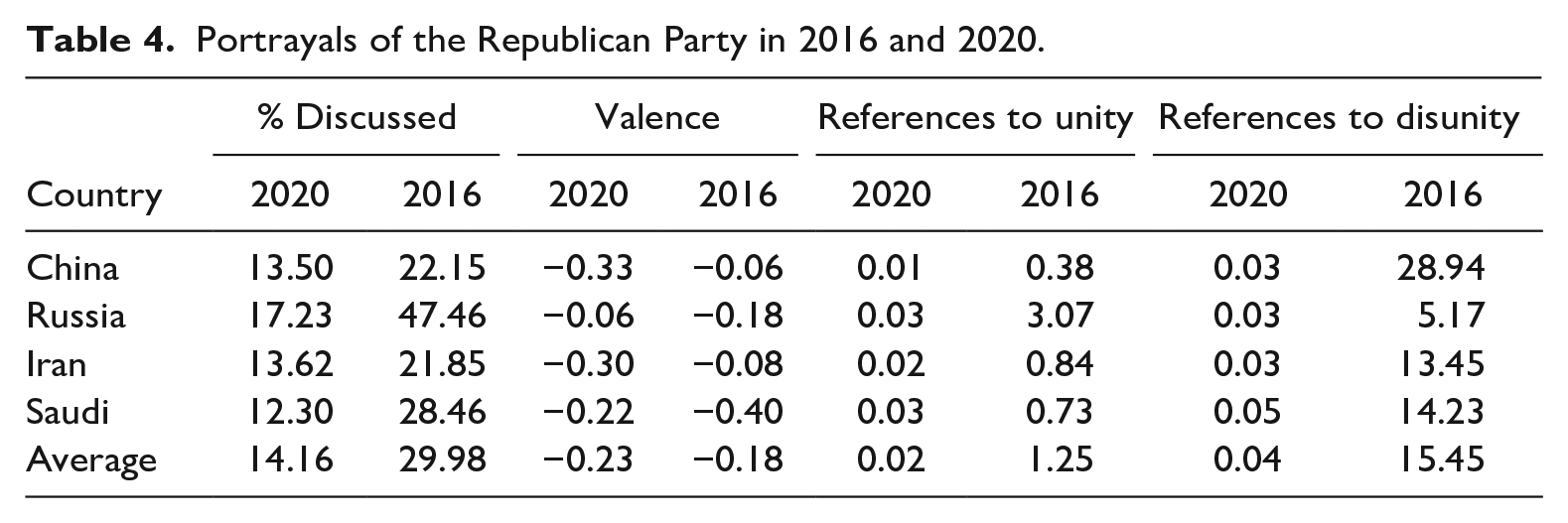
Comparison of Republican Party valance scores shows mixed results by country when comparing the 2020 election to 2016. Here Chinese and Iranian media saw a substantial increase in negative valence scores from 2020 to 2016. Russian media, however, shifted toward a more neutral presentation of the Republican Party in 2020 compared to its negative coverage in 2016. Saudi media presented the Republican Party negatively in 2020, but nearly half as so relative to Arabic language media in 2016.
The Democratic Party was covered more negatively in 2020 compared to 2016 in Saudi, Chinese, and Iranian media (see Table 5). Here the Democratic Party’s negative valance scores doubled in Chinese media, nearly quadrupled in Iranian media, and shifted from neutral coverage by Arabic language media more broadly in 2016 to negative coverage in Saudi media in 2020. In contrast, Russian media, while still negative, witnessed a substantial drop in the extent to which the Democratic Party was negatively portrayed.
Portrayals of the Democratic Party in 2016 and 2020.
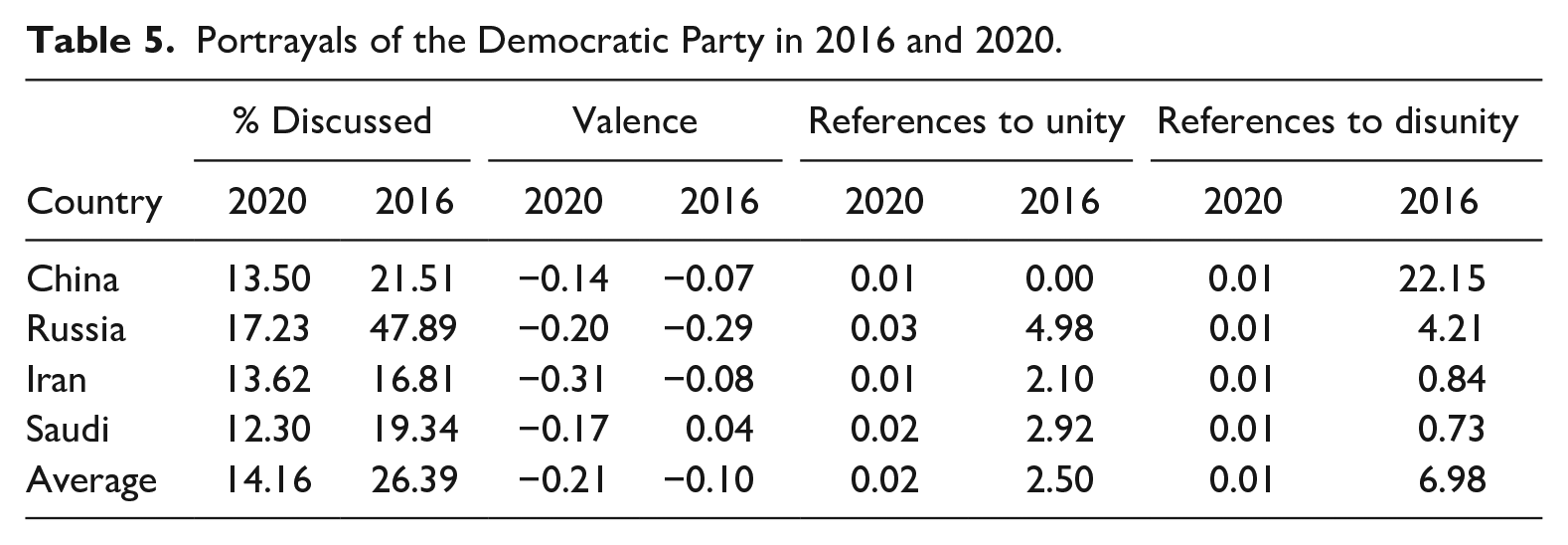
Narratives of the Parties
During the 2016 election, both parties held contentious primaries with debates raging over both their respective future directions. Whereas Trump most notably represented a break in traditional Republican Party values and policies, debates between the moderate and progressive wings of the Democratic Party (represented by Clinton and Sanders respectfully) also emerged. This, in combination with Clinton and Trump’s high unfavorability ratings, fueled discussions lamenting the two-party system and divides within the parties along establishment and outsider factions (Hinck et al., 2019).
However, these discussions stemming from the candidates were largely absent in the 2020 election. Instead, both parties appeared relatively unified behind their respective nominees. For Democrats this was coming together to support an imperfect, albeit moderate, consensus candidate in Biden in opposition to the incumbent president; for Republicans, this unity emerged as a function of Trump’s personal influence. Indeed, despite Trump’s election loss, all four countries reported upon the staying power of “Trumpism.” As Saudi media explained, regardless of whether Trump loses the election, “the legacy he built in his first term is guaranteed” 43 as the “appeal of ‘Trumpism’ in the US remains strong with key groups.” 44 This was evident not only by “millions of Americans [having] embraced Trumpism” but also “Trumpism” becoming the “mainstream doctrine championed by the likes of Fox News and other conservative media outlets.” 45 Likewise, Iranian media reported “even if Trump goes, it is clear that he will leave behind him the legacy of Trumpism” which has “imprinted the US Republican Party with its dangerous character” and “established a popularity that will remain, for the most part, effective and influential for many years coming.” 46 As Russian media explained, “‘Trumpism’, which has a social base, will not go anywhere” 47 and “Trumpism is not an accident, but a stable phenomenon.” 48 As Chinese media stated: “Trump firmly controls the Republican Party’s base camp of voters, and Republicans are afraid of angering the president’s supporters” with “Republican leaders and most of the party’s House of Representatives still support[ing] Trump’s challenge to the election results.” 49
In terms of shifts in the valence scores of the parties, in Chinese media, the rise in negative coverage of the Republican Party came primarily through association of the party’s support of the Trump administration’s antagonism toward China. For instance, “the campaign interests of the Republican Party and the Trump administration are eroding the normal relations between China and the United States” 50 with “Washington. . .under the control. . .by shameless politicians like Pompeo, who are extremely dangerous elements who destroy the existing order of the world and threaten the future of all mankind.” 51 Furthermore, the Republican Party was reported as supporting the Trump administration’s attacks on China as an election tactic: “The Republican Party’s strategy is to throw the pot over to China, and intensifying the tension between China and the United States” to “help increase the anger of American voters toward China.” 52 Nonetheless, some fractures were present as “officials from the Republican National Committee” told “White House advisers” that their “inattentive attitude towards the virus has made Republicans more dissatisfied.” 53 The Democratic Party too was reported as wanting to contain China, and thus “the Democratic Party establishment and the Republican Party establishment have a lot in common” in that “During Obama’s presidency, the United States not only led or participated in the creation of new chaos in the Middle East, but also implemented the ‘Asia-Pacific rebalancing’ strategy around China.” 54
In Iranian media, the rise in negative coverage of the Republican Party coincided with negative depictions of the Democratic Party. Both parties were equated as pursuing policies harmful to Iran. Reports noted how the manner in which “Republicans and Democrats have dealt with Iran has been no different” as “The history of the two parties’ policies toward Iran shows that both parties have sought to create challenges against the Iranian nation and bring the nation to a dead end.” 55 Thus, while the Republican Trump administration used a “bullying approach” to which Democrats criticized, here “The Democrats’ words and actions, nevertheless, do not match. In fact, while they pursue the same bullying policies, they pretend that they are after friendly ties and interaction with other countries.” 56 Likewise, domestically both parties were condemned for their extremes wings: “Both right wings. . .are responsible for growing tyranny in the nation’s fantasy democracy” with the “conditions” of U.S. democratic politics “today more dismal and disturbing than ever before.” 57
In Saudi media, the attacks against Democrats largely came through reports admonishing their left wing and calls for reconciliation with Republicans. As Arab News reported “The Democrats. . .have become a kind of social-revolutionary party. . .supported by big multinational corporations.” 58 Biden was described as pitted against his party, with establishment democrats blocking his attempts to “advance the cause of establishing a Palestinian state” as “the Democrats, have defined the American policies that support Israel” 59 while the “far-left Democrats are expecting Biden to lean toward their agenda.” 60 Here, Saudi media suggested that “Biden needs to clearly condemn all the violent acts committed by the two main radical-left groups. . .Failing to do so would steer the country toward greater chaos and frustration.” 61 Indeed, multiple articles warn the Democratic Party not to indulge in their election victory, including “strategists need[ing] to ask themselves why, under these favorable conditions, a ‘blue wave’ never materialized” and that: “Democrats [need] to draw the right lessons from the election results. . .last week’s results proved that he [Trump] is a symptom of deeper, longer-term trends in American society that its liberal-progressives can’t, and maybe don’t even want to, understand or engage.” 62 Thus, “the magnitude of his [Trump] support is extremely troubling, and requires a national dialogue” but “given the ugly rhetoric that dominates many pro-Biden supporters against Trump” the Democrats are “no different than the hate they complained about from Trump supporters.” 63 Hence, “It is clear America will remain a divided country. The roar of hate, anger, and demonization on both sides will only grow louder, and you can’t just blame that on one side.” 64
In Russian media, the decrease in coverage of both parties was likely due to Russia’s disillusionment with the Trump administration and resignation over the fact that Russia would face conflictual relations with the Untited States regardless of which party is in power. Reports noted that both the “Washington establishment” 65 and “Republicans” proved “inconvenient for Russia.” 66 Whereas reports referenced Russian legislators greeting Trump’s 2016 victory with “friendly applause” 67 and having “drank champagne for Trump’s [2016] victory,” these articles pointed out that Russia faced “nearly five dozen sanctions and the destruction of arms control treaties” under the Trump administration. 68 Accordingly, “the main problems of the last four years has been the illusion about Donald Trump’s intentions to make friends” in part because “everyone in Washington. . .does not allow Trump to get along with Moscow.” 69 Indeed, Russian media reported continuities in U.S. policy toward Russia: “Russian-American relations began to sink under Barack Obama, and reached the bottom under Donald Trump” and thus “It is unlikely that some kind of restoration awaits them under Joe Biden.” 70 In this case: “the experience of the last four years has shown that it does not matter at all who the president” or whether they are “‘systemic’ or ‘anti-system.’ We see an absolutely clear trajectory of relations with Russia, which has been going down for a long time under different American leaders.” 71
RQ3. To What Extent Were Narratives About the U.S. Democratic System Portrayed Differentially in Chinese, Russian, Iranian, and Saudi Media in 2020 and 2016?
Country Differences in 2020 Portrayals of Democracy
All four countries portrayed the democratic nature of the U.S. system negatively: Iran (m = −0.28), China (m = −0.27), Russia (m = −0.22), and Saudi Arabia (m = −0.18). Narratives regarding the democratic nature of the U.S. system were discussed in approximately 50% of Saudi Arabian and Russian media, 40% in Chinese media, and 35% in Iranian media.
Narratives describing the legitimacy of the U.S. election process were again negative across all four cases: Russia (m = −0.45), Saudi Arabia (m = −0.27), China (m = −0.27), and Iran (m = −0.26). Russian media most often discussed the legitimacy of the U.S. election process in 52% of articles, followed by 41% in Saudi Arabian articles, 35% in Iranian articles, and 24% in Chinese articles.
Narratives regarding the attractiveness or desirability of democracy were also negative across all four cases: China (m = −0.29), Iran (m = −0.17), and Russia (m = −0.16), although least so in Saudi Arabia (m = −0.08); with this category discussed in 45% of Russian articles, 42% Iranian, 38% Saudi Arabian, and 36% Chinese.
Comparisons Between 2020 and 2016
Comparing coverage from 2020 to 2016, results show substantial increases in reporting by all four countries regarding all three categories relating to the democratic nature and appeal of the U.S. political system with discussion related to the democratic nature and legitimacy of U.S. system showing substantial increases in negative portrayals (see Table 6). Discussions over the democratic nature of the election were six times as frequent in 2020 compared to 2016; discussions of the legitimacy of the election were more than three times as frequent; and discussions over the desirability of democracy were more than seven times as frequent. In the case of the first two, negative valence scores increased threefold, while the latter category remained relatively consistent and negative.
Democracy Narratives in 2016 and 2020.
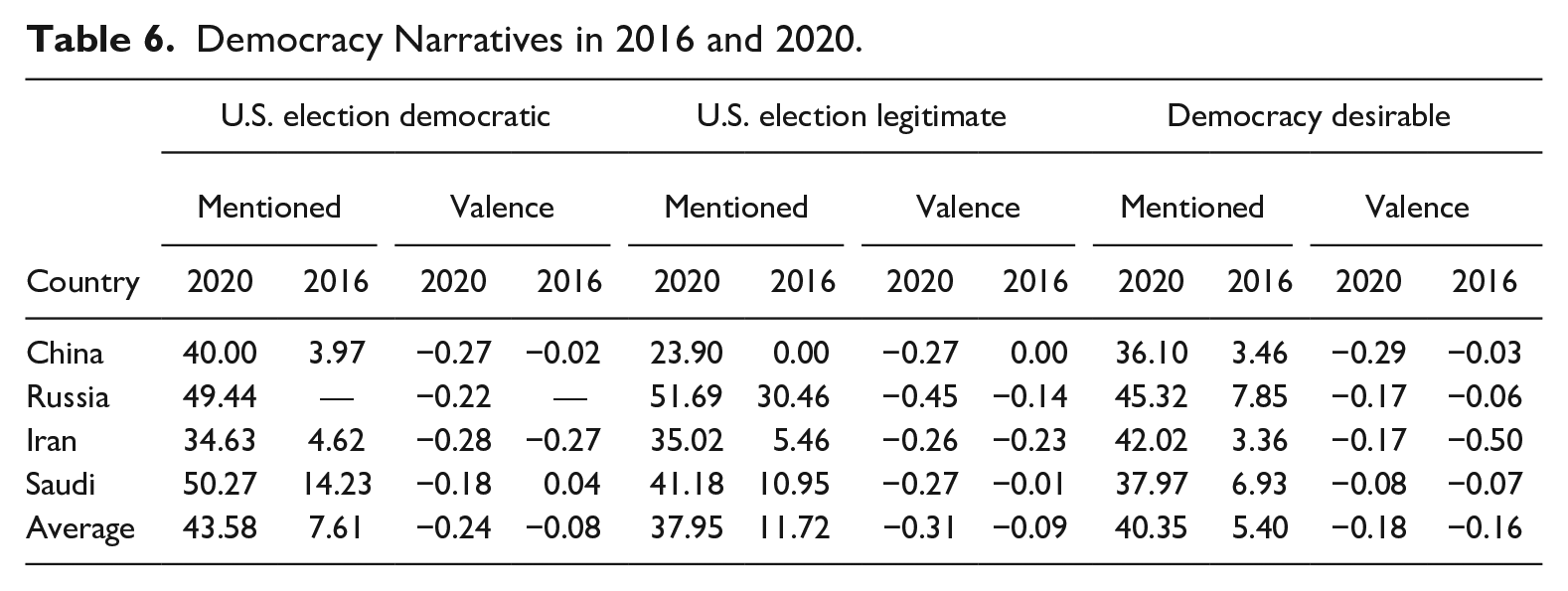
Most notably, while Chinese, Russian, and Saudi/Arabic media shifted substantially in their negative reporting regarding the democratic nature and legitimacy of the 2020 election compared to the 2016 election, Iranian media remained relatively consistent in their coverage of both. However, when discussing the desirability of democracy, Iranian media decreased its degree of negative portrayal, while Russian and Chinese media sharply increased their negative depiction of democracy, shifting from more neutral presentations in 2016 to decidedly negative in 2020. Saudi media, on the other hand, showed relatively consistent portrayals in 2020 compared with Arabic language media portrayals more broadly in 2016.
Narratives of the U.S. Democracy
In 2016, narratives regarding the democratic nature of the U.S. elections revolved around discussion of both candidates as undesirable, suggesting the two-party system doesn’t represent the American people’s desires; critiques over the deliberative purpose of the campaign as the debates were reported as not influencing American’s perceptions of the candidates, nor informing them of policies; and critiques over the U.S. electoral college system as unrepresentative of American people (Hinck et al., 2019).
More broadly, however, these elements coalesced into different overarching storylines regarding what the 2016 election signified for each country. For China, these elements were emplotted in ways stressing the U.S. system as ineffective with the candidates unable to address America’s woes while implying the Chinese system was more effective. For Russia, emphasis was on the broader global scene whereby the effects of globalization placed elites and the political establishment as out of touch with normal Americans; supporting Russia’s anti-Western narrative of international affairs in which American democracy represented the corrupt, immoral, decadent, and hypocritical West to which Russia was leading the world in opposition of. For Arabic audiences, democracy as an abstract ideal remained promising, but with the manner in which the U.S. campaign unfolded concerning with American politics seen as corrupted by money and Trump’s support by the American people alarming given his Islamophobic rhetoric and authoritarian proclivities (Hinck et al., 2019).
In 2020, many of these narrative elements were also present, albeit some were magnified. For instance, when covering the debates, Iran reported the “first debate was a rage-fest of two old men ranting about useless matters while failing to tackle any serious matter in local or foreign U.S. affairs.” 72 Hence, “It was mainly 90 minutes of criticism, accusations, and personal verbal attacks.” 73 Not only were U.S. audiences left uninformed and affronted, with polls showing that “69% of those surveyed said they were upset, and only 17% said they felt that the debate provided them with information” 74 but so too were global audiences: “The debate was met with online ridicule by people from all around the world.” 75
Likewise, Saudi media reported that the first debate was “surely the ugliest in the nation’s history” while “largely devoid of substance” with a “sulfuric tone. . .that was most off-putting. . . In other words, it is hard to see how this freak show changed much of anything.” 76 Indeed, citing a Monmouth University poll, Saudi media noted “only a minuscule 3 percent said it was very likely to affect their vote.” 77 Thus, “The debate was largely sound and fury, signifying nothing; nothing that is, but the horrendous corrosion of the American political discourse.” 78
Chinese media focused its criticism by referencing how U.S. media and audiences characterized the debates. As Xinhua reported: “‘Noisy’, ‘chaotic’, ‘shameful’ and ‘worst in history’. . . This is the evaluation of the debate by American public opinion” adding “Some [US] commentators used ‘a mess’ to describe this debate, thinking that ‘this is not a debate at all’” as “more than 70% of American voters said that the debate would not have much impact on them.” 79 Hence, “neither Trump nor Biden presented new campaign information in this debate. The policy proposition lacks details and the focus is not on how to solve the problem” 80 to which “the American people became the ultimate losers.” 81 Consequently, the debate “may ‘further weaken global confidence in American democracy’.” 82
Similar reporting came from Russia, as reports noted: “‘Scandalous’, ‘provocative’, ‘useless’, ‘shameful’—this is how the American press described the first debate.” 83 Thus, “Given that, on average, only 10% of voters in the United States are undecided about their choice this year, the debate is rapidly losing its ascribed decisive importance.” 84 Even when reporting on the second, less confrontational debate, Russian media noted that, despite it turning “out to be surprisingly calm and fruitful” it “is unlikely to have any influence on the outcome of the vote.” 85
In terms of the Electoral College and the representativeness of the U.S. system, Chinese media took the sharpest aim. Global Times reported: “this election exposed. . .major flaws in the US election system,” namely, “the design of the ‘winners take all’ system of the US Electoral College [which] often allows candidates who have received fewer votes to win.” 86 Indeed, the candidate receiving “the popular vote has lost many times, showing that American democracy is under-represented.” 87 Consequently, “[US] Society is extremely torn and American democracy. . .[is] on the verge of collapse,” 88 especially given the 2016 results where “Trump [was] not elected by universal suffrage” with “the Republican Party, which controls the Senate” unable to “represent the wider population” given their fewer popular votes as well; thus, “Under such circumstances, whether the US political system can work is a question.” 89
For Iran, focus remained more on the problems of the two-party system. Tehran Times reported: “Minor political parties don’t have the financial influence to conduct major campaign rallies like those done by the Republicans and Democrats” and therefore “Money and media can tip the balance towards one nominee, like when Trump lost the popular vote yet won the Electoral College” with Trump “because of his lack of knowledge in actual politics and foreign affairs” making “him an easily molded target for major companies and banks—[for] those who actually control the U.S.” 90 Consequently, these “matters jeopardize the basic foundations of democracy, where companies and foreign parties lobby to get their preferred candidate to the office and in turn get the latter to do their dirty work.” 91
Russian and Saudi media maligned the electoral system less. Nonetheless, Russian media repeatedly noted that “The American electoral system is archaic, indirect, and extremely confusing” 92 while Saudi media made sure audiences knew that it was “the Electoral College, which has a decisive role in choosing a candidate, regardless of the votes obtained at the ‘popular’ national level.” 93 Because of the nature of swing states, Saudi media commented how “Identity plays a crucial role in politics in these areas” 94 and that “It does not take more than a brief glance at the Electoral College map to realize the entrenched political divide between the coastal-urban blue of the Democrats, and the huge swathe of Republican red occupying rural America.” 95
The 2020 election was unique, however, with Trump’s dogged refutation of the results. His team’s efforts to overturn the election received substantial coverage from all four countries, but with all concluding they were unsubstantiated and would fail. As Iranian media reported: “While there is no evidence of the kind of widespread fraud Trump has been alleging, he and his legal team have nonetheless been working to cast doubt on the integrity of the election and trying to overturn voters’ will” despite “Biden [having] won by wide margins in both the Electoral College and popular vote.” 96 Likewise, Saudi media explained: “Trump’s unprecedented attack on the US election system. . .was deemed to be no longer valid, [as] his legal team has not yet succeeded in presenting any evidence that the courts will accept.” 97 Similarly, Chinese media concluded: “Trump’s actions to challenge the results of the election in courts across the country were not effective. . . Most American media believe that Giuliani’s claims are not supported by evidence.” 98 Russian media stated, “As noted by Fox News, election fraud is a very rare phenomenon in the United States” and does “not significantly affect the voting result.” 99
Nevertheless, the contested nature of the election spurred narratives of U.S. decline and fall from exceptionalism, emphasizing America’s historical polarization. As Chinese media reported, “This is probably the most torn election since the outbreak of various social unrests in the United States in the 1960s” 100 with Xinhua going back further: “This election is generally regarded as one of the most divided elections in the United States so far. Today’s American politics and society are more polarized than at any time since the American Civil War.” 101 Consequently, “Many voters are confused and worried” as “Many media and people worry that once the elections are controversial, they may cause chaos and even social unrest.” 102 Internationally, “for bystanders, this election seems to have changed the impression of a beacon of democracy left by the United States to the world” 103 with the United States having lots the “moral high ground. . .as a developed Western country” as “Only developing countries. . .have serious disputes over the election process.” 104 Thus, “countries that have been accused of lack of democracy in elections by the United States” have now “strongly questioned” the “‘moral superiority’ advocated by the United States.” 105
As Russian media reported, “Amid a string of political scandals in the United States, the once-inexhaustible enthusiasm for a ‘stronghold of democracy’ is ebbing” with the “charm of [the US’s] bipartisan system, freedom of the media, a system of power rotation. . .crumbling.” 106 U.S. politics were characterized by “the division of power between different groups of elites, and not about the participation of civil society in government” 107 with “The electoral situation in the United States. . .not quite match[ing] the democratic culture of the United States” 108 and occurring within “an atmosphere of unprecedented political polarization and ideological division.” 109 Consequently, “the American system will not withstand the split and is about to collapse under the weight of internal conflicts” 110 with the election having “showed that a united America, an America of democratic ideals does not exist.” 111
As Iranian media reported, the “election has created fissures and divisions in the country. . .rarely seen in recent American history” 112 with “the American people hav[ing] lost their confidence in their government.” 113 As such, the “United States has not been so dis-united since the end of the Civil War” 114 with “some experts argu[ing] that the U.S. is on the brink of a civil war.” 115 Hence, the election showed the “fake grandeur of the United States’ democracy” 116 and “exposed the falsity of democracy in the United States” as “The country that claims to be the largest democracy in the world and is governed by the oldest democratic traditions, is currently experiencing conditions against which all the accusations that have long been directed against others.” 117
Finally, as Saudi media reported, the campaign marked “a threat to the republic” as “both major parties hate and denigrate each other so virulently that they simply cease to truly debate one another on the issues.” 118 Accordingly, the United States became “the ‘United States of Anger’” with social unrest, economic malaise, and COVID-19 sharpening divisions in society. 119 Thus, Saudi media noted how the election was not just about Trump and Biden, but with “‘Brand America’ itself on the ballot” with a Trump victory potentially marking “the end of US soft power.” 120
Discussion
Although this study found some similarities in nondemocratic media narratives reporting on the 2020 and 2016 U.S. presidential elections, more pronounced were the shifts in coverage.
First, regarding the candidates, Trump remained negatively discussed in both elections, but with discussions of him moving away from personal characterizations and scandals toward criticism leveled at his leadership character vis-à-vis his policies. Similarly, discussion of Biden revolved primarily around his policies rather than character or scandals; but done so more in contrast to Trump, rather discussed in his own right. Furthermore, although Clinton was negatively covered in 2016, all four countries in 2020 neutrally presented Biden. In both cases, the number of articles directly discussing the presidential candidates declined from 2016 to 2020. Taken together, these findings stand in contrast to previous research showing low levels of issue/policy discussion and greater personalization of coverage, along with higher levels of negative views toward the main candidates (Holtz-Bacha et al., 2014; Nord et al., 2017; Van Aelst et al., 2012, 2018).
The most likely explanation for this comes from Trump’s incumbent status and the uniqueness of his policy agenda. Indeed, Vliegenthart et al. (2010) suggest that the incumbent status of U.S. presidents can affect the tone of newspaper coverage during elections. In this case, the 2020 campaign appears to have been a referendum on Trump, with his policies, and the values imbued in them and his character, forming what Curran et al. (2017) calls “crystallizing moments” in which international media project unified meanings onto international events and elections.
Second, however, when turning to coverage of the parties, the results reflected higher levels of negativity more aligned with previous studies. Here both the Republican and Democratic parties were viewed negatively, with the Democratic Party nearly doubling in negative scores during the 2020 election compared to 2016. Thus, whereas Biden was viewed as offering an alternative to Trump, discussion of the two parties in 2020 highlighted their similarly detrimental policy agendas, behaviors, and interests. In this case, political ideology and geopolitical interests may best explain these results with China, Russia, and Iran all reporting on the continuities of U.S. foreign policy in which the United States had in the past, and would continue, targeting each nation, albeit for different reasons.
Third, and perhaps most clearly, this study found substantial shifts in the frequency of reporting and degree of negativity in which the four countries discussed U.S. democracy during the 2020 campaign. In this case, the results reflect public opinion polls highlighting the global decline of support for democracy (Freedom House, 2019; Wike et al., 2019, 2020). Undoubtedly, Trump’s 4 years in office and behavior during the election helped contribute to this. However, events occurring in the United States—like the Black Lives Matter protests, increased polarization, concerns over COVID-19, and a weak economy—and the manner in which the two political parties addressed these issues provided substantial fodder for foreign media to paint a negative portrait of ineffective U.S. politics. As Van Aelst et al. (2018) argue, the degree of negativity in election coverage is important in that it can influence distrust in politics more general. In this sense, U.S. democracy appears distrusted not only internationally, but also domestically in the United States, holding significant implications for United States and democracy’s soft power.
Despite these differences in coverage between the 2020 and 2016 elections, some similarities emerged. First, the narrative results found common topoi by which U.S. democracy was negatively characterized. This included substantial criticism over the deliberative purpose of the presidential debates and the extent to which they actually informed and influenced voter preferences. Additionally, the Electoral College was seen as antithetical to democratic expression, with connections to past elections made to stress instances where the elected candidate and Senate were unrepresentative of the broader American public. Furthermore, America was viewed as polarized and divided, unable to come together and resolve the pressing issues facing the country, with such issue narratives used to critique America’s claim to democratic exceptionalism by portraying U.S. democracy as hypocritical and ineffective.
On the international level, the narratives constructed in each country appeared to reflect their geopolitical interests and concerns, largely bolstering their sense of self-identity. Iran remained critical of U.S. policy and used the election to support its own identity narrative as a strong, resolute people who victoriously withstood U.S. aggression. Chinese media used the election to demonstrate its rise vis-à-vis the United States; with U.S. antagonism and attempts to contain China, both highlighting it as a power worthy enough to be concerned with, while also presenting an external enemy to promote national cohesion. For Russia, however, the 2020 campaign offered a more introspective moment. The glee from Trump’s surprising victory in 2016 turned to melancholy in 2020, as Russian media portended continued conflictual relations with the United States. Thus, the anti-establishment narrative pushed in the past appeared no longer resonant, with Trump unable to reorient U.S. politics in ways conducive to Russia’s agenda.
Finally, for Saudi Arabia, Biden’s promise to return America to global leadership was exulted. Despite its nondemocratic system, Saudi Arabia remains a close-U.S. partner in the Middle East, and as such appeared to view a more predictable and dependable United States as particularly conducive to its interests. Because of this, Saudi Arabia represents a unique case to China, Iran, and Russia in that its identity was not drawn in contrast to the United States. Accordingly, the absence of strong identity narratives pitting itself against the United States, and more positive evaluations of U.S. leadership in the form of characterizing Biden as embodying American internationalism, adds further credence to the importance and nature of strategic narratives in shaping national media coverage of U.S. elections in ways supportive to different nations’ identities.
Conclusion
This study compared nondemocratic media coverage of the 2020 and 2016 U.S. presidential elections. In doing so it offered strategic media narratives as an alternative way to understand transnational similarities and differences in comparative election reporting, specifically by theorizing the ways in which non-Western, nondemocratic nations report on U.S. elections. While this study helps address the gap in research into nondemocratic election reporting, future research should employ a similar framework to Western democratic nations as well in order to bridge the divide between the two groups (Esser, 2019). Indeed, in a time of increasing geopolitical rivalry between democratic and nondemocratic countries, examining the manner in which these nations strategically define their interests and identities through narratives may help identify ways to promote common understanding, and hopefully, locate transcendent stories by which shared meaning can be created.
Footnotes
Declaration of Conflicting Interests
The author declared no potential conflicts of interest with respect to the research, authorship, and/or publication of this article.
Funding
The author received no financial support for the research, authorship, and/or publication of this article.