




Abstract
The present study examines the costs of discrimination and cultural-linguistic differences for the development of migrants’ sense of belonging to the receiving society. Focusing on Latin Americans in Spain allows shedding light on the cultural and linguistic mechanisms involved in this process. Migration scholars have long recognized the importance of belonging as a key indicator of integration. An analysis of belonging has clear relevance to settlement policies and programs to prevent social fragmentation or isolation of immigrants. This article takes a fresh approach to explore the development of migrants’ sense of belonging to the receiving society by drawing on an original survey data set collected in 25 highly diverse territories in Spain (N = 2,648). The results show that cultural and linguistic affinity matter: There is a greater predisposition among immigrants born in Latin America to identify themselves as Spaniards, compared with other immigrant groups. However, self-reported discrimination and deficient residential settings seem to be hindering the development of a significant feeling of belonging to Spain, also among Latin Americans. Public policies aimed at decreasing discrimination against migrants, as well as improving migrant neighborhoods, will favor the integration of these immigrants and their descendants.
The current “age of migration” has challenged the traditional link between people and places (Castles, 2014). Migration introduces new senses of belongings in complex interaction with previous senses of belonging (Portes et al., 2012; Simon & Tiberj, 2018). Although individuals can adopt multiple identities (Waters, 1996), acquiring a new feeling of belonging to the host society involves costs, such as cultural adaptations and changes in the identity of individuals.
The migration literature considers the development of a sense of belonging to the receiving society as a desirable societal outcome—for example, well-being, social cohesion, and so on (for review, see Painter, 2013). Low levels of belonging after years of residence can be considered markers of conflictive processes regarding intercultural relations and social cohesion (Fonseca, 2019). Building on previous research, this article seeks to identify predictors of migrants’ sense of belonging to Spain. These predictors will shed light on the nature of the costs that this process has had over the years. Specifically, the case of Latin Americans in Spain allows us to test the hypothesis that cultural and linguistic proximity favors these changes.
The results suggest that Latin Americans identify more easily with Spain compared with other migrant groups given their greater cultural proximity. However, feeling discriminated against and self-reported adverse residential conditions negatively affect their levels of identification with the host country. The observed effect of self-reported discrimination connects with a wide range of consistent evidence on how integration processes slow down if individuals feel discriminated against: Experiencing the new society as xenophobic hinders the integration of immigrant individuals at an identity level (Berry et al., 1989).
The effect of residential satisfaction on identity has only recently received attention in academia. Previous studies showed that residential satisfaction is strongly influenced by the characteristics of their residential environment, such as the state of the buildings, types of urbanization, or existing public services (Adriaanse, 2007; Jansen, 2014). At the same time, poor residential conditions have proven to decrease the identification of the inhabitants with their residential spaces (Adriaanse, 2007; Dekker et al., 2011). The results of this study show that the residential conditions of migrants will affect the development of their feeling of belonging to the host country.
The Sense of Belonging Among Migrants
A sense of belonging is linked to desirable societal outcomes such as social cohesion, social inclusion, social capital, and well-being. According to Painter (2013) the “belonging/identity dimension of citizenship refers to feelings of membership in a community, of being part of a collective we, which facilitates acting together for common purposes” (p. 5). The migration literature has used interchangeably the two terms sense of belonging and identity, which can be seen “as indicators of the same broad dimension” (p. 5).
Even though this dimension remains elusive, a body of research has sought to capture its social expressions. Akerlof and Kranton (2002) stressed two aspects of belonging and identity building that are central for understanding cultural integration of immigrants. First, individuals internalize categorizations and prescriptions through a process of identification with respect to other members of the same cultural group. Second, cultural identity is also dependent on how outsiders perceive these individuals. In her seminal work, Mary Waters (1990, 1996) addresses the costs of belonging by looking at “symbolic ethnicities” in the United States. She shows that identity is optional and flexible for middle-class Whites, contrasting it with the socially enforced identities of non-White Americans. Her work shows that choices on identity and belonging are severely limited among racialized individuals and those with accents and poor knowledge of the language of the native population.
The literature further shows that when it comes to migrants and subsequent generations, some adopt a hyphenated identity, combining both their home country’s identity and that of the host country (Bloemraad, 2007). In some cases, however, these subsequent generations are constrained to integrate into specific segments of society that are available to them (Portes & Zhou, 1993). In this vein, some studies have captured the influence of costs and incentives on cultural integration of minorities. Lazear (2007) shows that these costs and incentives may depend on various factors such as the size of the groups, the existence of conflict, and the economic gains from interactions with natives, while Akerlof and Kranton (2002) focus on cultural identity as a crucial source of the benefits or losses related to intergroup relations.
National Origin
Sharing a common place of origin favors interaction during the migratory process. Migrants from the same country or region share resources more frequently, and migrations into an ethnic enclave is common. However, a controversial question is still pending in the literature: Is there a “postcolonial bond” between former colonies and their colonizer that could favor the development of an identity toward the receiving society?
This is a challenging question with no simple answer. When we consider the arrival in Europe of the “postcolonial constellations” of the former European empires (Joppke, 2005), we can observe contrasting situations. In the specific case of Spain, various factors have to be considered. Three centuries of colonial history have significantly influenced culture and language in a bidirectional, asymmetric, and cumulative way between Spain and most of the Latin American countries. The linguistic proximity is crucial for increasing the ability of foreign-born individuals to access social services, as well as co-ethnic enclaves (Gustafson & Cardozo, 2017).
Additionally, as Joppke (2005) notes, Spain, itself recently a poor land of emigration, has built a “panethnic ‘historical and cultural’ community” (p. 95) that gives privileged status to all postcolonial immigrants. Thus, in the case of Latin Americans in Spain, there are factors within their postcolonial condition: Having greater linguistic proximity adds to having fewer barriers in terms of immigration policies than other origins. From the previous arguments, I will test the following hypothesis.
Hypothesis 1: Immigrants from Latin American countries will show higher levels of Spanish identification than those immigrants from other origins.
Discrimination
Migrants often face discrimination in a wide range of situations, for example, housing, employment, education, health care, and daily random social interaction. The critical socioeconomic, psychological, and physiological consequences of perceived discrimination have been well documented (Ko & Hong, 2019). Particularly, accumulated negative experiences based on identity are established risk factors for acute and long-term chronic mental health problems for several minority groups (e.g., Gattis & Larson, 2017).
Numerous studies suggest that integration processes slow down if individuals feel discriminated against and in contexts that are perceived as hostile or xenophobic (Berry et al., 1989). Furthermore, individuals from minorities who experience stigmatization, discrimination, and othering in the host society may resort to self-protective procedures such as the reinforcement of reactive and militant identities (e.g., Jiménez, 2008), expressing an increased endorsement of their heritage culture (Cobb et al., 2017) as well as a decreased acceptance of the host country’s culture (Alba, 2005). In this vein, I make the following hypothesis.
Hypothesis 2: Higher self-reported discrimination will be negatively associated with the development of a significant sense of belonging to the receiving society.
Residential Satisfaction
To what extent are you satisfied with living in your neighborhood? Adriaanse (2007) first described this question as an “affective state,” a “global attitude of a resident (or household) towards his dwelling, the social climate of the neighborhood and the internal neighborhood reputation” (p. 301). Residential satisfaction captures a subjective assessment, based mainly on the resident’s perceptions, observations, and impressions, which overlaps with the effect of the objective aspects of the territory (Jansen, 2014).
Recently, residential satisfaction has received attention as a mediating variable in the formation of identity and the feeling of belonging to their residential environment. Several studies show that poor residential satisfaction can cause a decrease in the identification of the residents with their residential spaces as well as a greater degree of uprooting (Adriaanse, 2007; Dekker et al., 2011). Likewise, the affective state that individuals feel with respect to their residential environment will condition certain behaviors and attitudes to keep their coherence with the environment, making residential satisfaction a predictive variable of behavior.
Although the existing empirical studies on residential satisfaction provide rich insights, research considering the residential satisfaction of migrants is still incipient (Lin & Li, 2017). There is still no evidence of the relationship between residential satisfaction and migrants’ feeling of belonging to the host society. Nevertheless, it seems reasonable to test the following hypothesis:
Hypothesis 3: Individual residential satisfaction among foreign-born individuals will be associated with a significant feeling of belonging to the host country.
The Spanish Case
Analysis of English-speaking countries has dominated scholarly literature on the determinants of identity among migrants. Developing empirically informed research that incorporates other cases can contribute to advancing our knowledge and the undertheorized mechanisms of cultural proximity on identity building of migrants in the receiving society. The case of Spain is analytically useful for several reasons. First, Spain provides a context of deep changes in terms of diversity as a new immigration country, after an extraordinary “immigration boom” that brought the share of the foreign born from near 4% of the total population to around 14% in less than a decade (Arango, 2017, p. 510). By 2019, the number of foreign-born residents was exceeding 6.7 million, making Spain one of the main European destinations for both intra–European Union (EU) and non-EU migrants.
Second, the migrant population in Spain is not only sizable but also increasingly diverse in terms of national origins. By 2017, Latin Americans were the largest migrant community, accounting for 38% of all foreign-born residents, followed by migrants originating from the 28 EU countries, adding 29.1% to the foreign-born population. Other than from Latin America and the EU, Moroccans (13%) were in 2017 the largest group by national origin, well ahead of China (3.1%), the next largest non-Latin American non-EU group.
Last, as Joppke (2005) notes, Spain and Portugal have institutionalized preferential responses to postcolonial immigrants from their old empires. In Spain, whereas the standard naturalization process requires a qualifying period of 10 years of prior legal residence for foreigners to be entitled to claim the Spanish nationality, some groups originating from countries that share past colonial ties with Spain—mostly Latin American countries—benefit from a fast-track access after only 2 years of residence (see the “Introduction” to this Special issue).
The Spanish case can help better understand the challenging topic of the cost/incentives for identificational integration of “postcolonial constellations” arriving in Europe. Additionally, it can help understand other international cases of cultural-linguistic proximity to the receiving society. Thus, this study aims to provide evidence of the combined effect of cultural-linguistic proximity and institutionalized selective immigration policies on the integration of immigrants at an identity level.
Data and Methods
To answer the above mentioned research questions, I use data from the 4th survey on intercultural coexistence at the local level in Spain 2017 performed by Instituto Universitario De Investigación Sobre Migraciones, Eticidad Y Desarrollo Social—Universidad Autónoma de Madrid (IMEDES-UAM; Giménez et al., 2018) in 26 highly diverse territories (a combination of municipalities and certain districts in larger cities). 1 In this survey, a total of 2,648 face-to-face (70%) interviews were household interviews, through the generation of random routes, and 30% street-based interviews, selecting some crowded streets for each area. Gender, origin, and age quotas have been applied to each territory. The general characteristics of super-diversity identified by Vertovec (2009) in certain contexts in Britain appear in a similar fashion in these territories. On average, 29.9% of the population of those territories is foreign born. Foreign nationalities with the greatest presence are Moroccans (15.3%), Romanians (10.1%), Ecuadorians (7.3%), and Pakistanis (6.5%).
The variable feeling of belonging to the host country (dependent variable [DV]) was built as a dummy variable from questions such as “To what extent do you feel you belong to the following groups? Do you feel Spaniard?” Their answers were chosen from the following four categories: a great deal, a lot, very little, and not at all.
Discrimination (Independent Variable [IV])
A battery of 12 questions capture the self-reported experience of discrimination in the past year: During the last year, have you ever felt mistreated or discriminated against in (name of the neighborhood) by . . .? 1) your skin colour or your physical traits; 2) your origin; 3) your cultural customs; 4) your political ideas; 5) your language; 6) your religion.
And Question 44: Have you suffered because of being a foreigner . . .? 1) bad tone; 2) malicious comments; 3) suspicion/distrust; 4) contempt/disrespect; 5) verbal threat; 6) physical aggression.
The first six items are measured on three categories of scales: never, 1 or 2 times, and 3 times or more, which I transform into a group of dummy variables: no (0 = never) and yes (1 = 1 or 2 times + 3 times or more). The second block of questions were already measured as dichotomous variables (yes/no). I build a simple dummy variable for each individual (0 = not felt discriminated against; 1 = felt discriminated against).
Residential Satisfaction (IV)
“To what extent are you satisfied with living in (name of the neighborhood)? (1 = not at all satisfied, 5 = totally satisfied).”
The following control variables of sociodemographic characteristics (Table 1)are included in the first step of analysis: gender (0 = male; 1 = female), age (18-99 years), educational level (0 = lower than University degree; 1 = university degree), household income level (1 = lower, less than €1,100 per month; 2 = middle, around €1,100 per month; 3 = higher, more than €1,100 per month), and time living in Spain (measured in number of years). The second model includes discrimination, and residential satisfaction, also considering the sociodemographic controls. The third model considers the effect of the region of origin (1 = born in Latin America; 0 = born in another region), considering the sociodemographic controls, as well as the rest of the independent variables that have a significant effect in the previous model.
Descriptive of Variables.
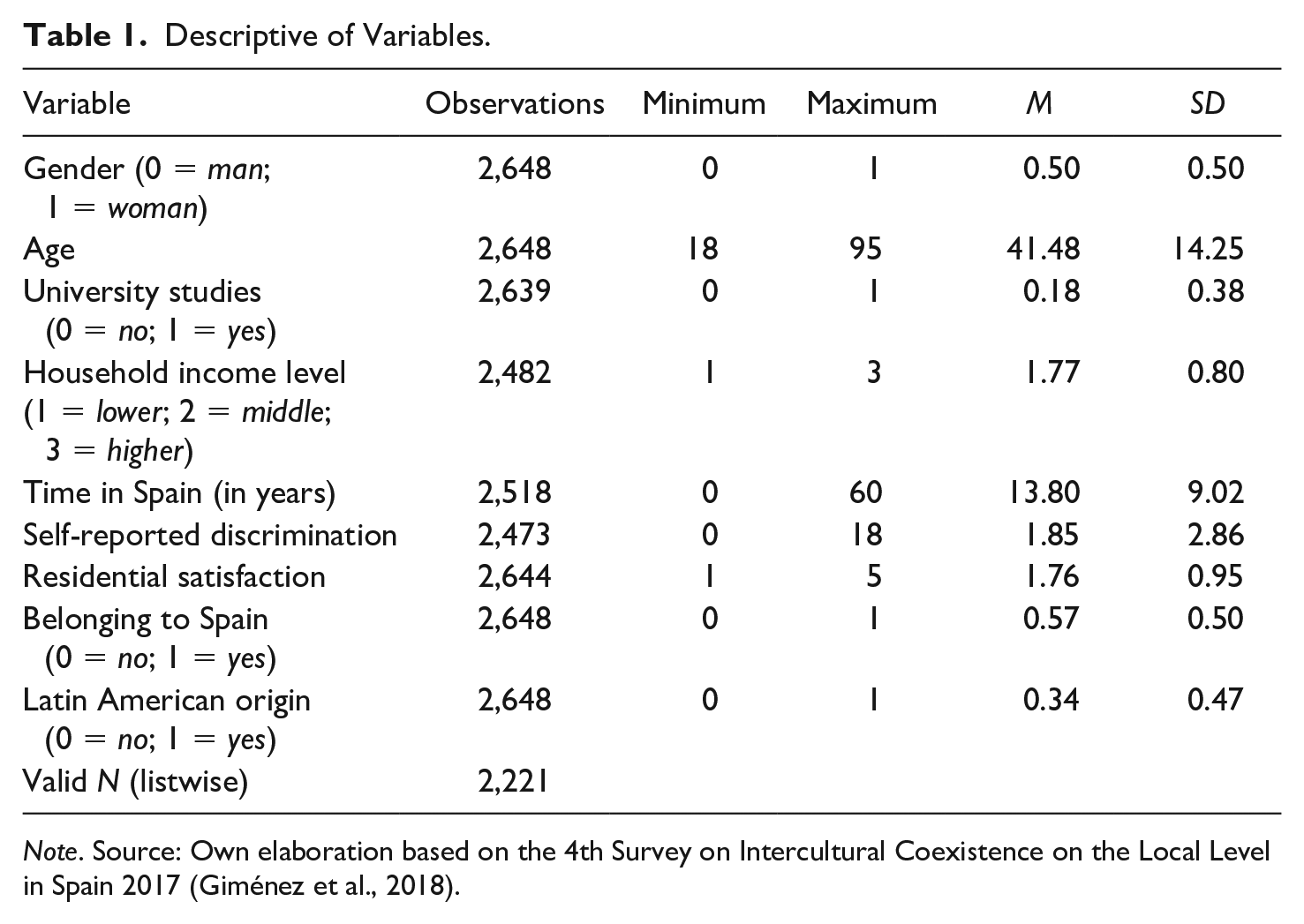
Note. Source: Own elaboration based on the 4th Survey on Intercultural Coexistence on the Local Level in Spain 2017 (Giménez et al., 2018).
Results
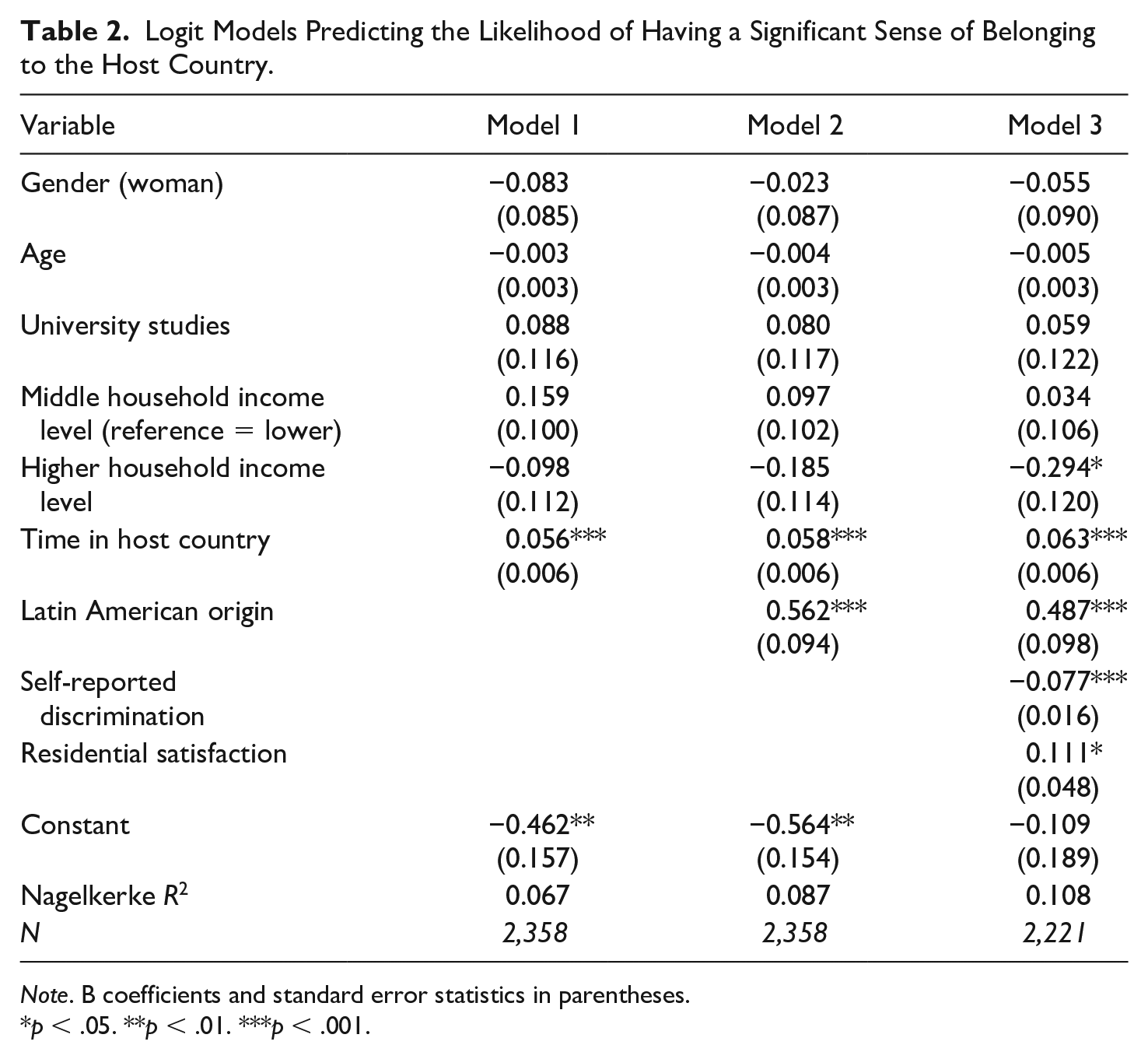
The first logit specification includes the sociodemographic predictors (Model 1, Table 2). The results in this model show that only the time of residence in the receiving society shows a positive association with the sense of belonging to the host country. The rest of the sociodemographic variables do not show any significant effects on the dependent variable.
Logit Models Predicting the Likelihood of Having a Significant Sense of Belonging to the Host Country.
Note. B coefficients and standard error statistics in parentheses.
p < .05. **p < .01. ***p < .001.
In the second specification, the results show that migrants born in Latin America are more likely to develop a significant sense of belonging to Spain compared with other national groups. The robustness of these results has been verified with additional tests, comparing the effect of the Latin American origin with other regions (Asia, sub-Saharan Africa, the Maghreb, Western European and North American countries, and Eastern Europe). All the results indicate that migrants from Latin America are the most likely to express a feeling of belonging to Spain, compared with those from any other origin.
In a third model, the dependent variable shows a statistically significant association with having Latin American origin, residential satisfaction, and self-reported discrimination. Migrants who report feeling discriminated against are less likely to express a significant level of sense of belonging to their country of residence. Furthermore, those who express higher levels of satisfaction with their residential environment are more prone to express a feeling of belonging to Spain. When all the variables are considered in this specification, those with higher income levels show lower levels of identification with the host country.
In sum, the following hypotheses are confirmed: immigrants originating from Latin American countries show higher levels of Spanish identification than those immigrants from other origins (Hypothesis 1), higher self-reported feelings of discrimination are negatively associated with the development of a significant sense of belonging to the receiving society (Hypothesis 2), and residential satisfaction is associated with a significant level of identification with the host country (Hypothesis 3).
Conclusion
This study draws on a large, representative sample of foreign-born individuals in Spain to test whether a significant sense of belonging to the host country could be predicted by people’s origins, self-reported discrimination, and residential satisfaction. The results are clear: Being born in Latin America, residential satisfaction, and lower self-reported discrimination were uniquely predictive of developing a significant feeling of belonging to Spain.
Being of Latin American origins in Spain is associated with a greater propensity to develop belonging to the host country, compared with other origins. This suggests that cultural-linguistic proximity with the majority culture seem to reduce the costs of developing a new sense of belonging to the receiving society, while a higher level of social othering—related to larger cultural-linguistic differences—increases the costs. The positive effect of being Latin American in the identification of this immigrant group in Spain reflects the combined effects of institutional selective policies (i.e., fast track to naturalization) and a cultural-linguistic proximity to the host society. But, also, in contrast, it reflects higher barriers to immigrants from other origins.
Thus, lower institutional (Joppke, 2005) and cultural-linguistic barriers of this group (Gustafson & Cardozo, 2017) would facilitate a greater integration at an identity level. Also, fewer institutional and cultural-linguistic barriers may induce group dynamics that may help reduce the acquisition costs of the new identity among Latin American migrants in Spain, since the individuals’ perception of their own social status in the receiving society is central to the development of this bond.
These results echo, for example, with Liebow’s (1967/2003) ethnographic work on “streetcorner men,” where he shows how the lack of proper work leads Black men living in poor neighborhoods to adopt identities that harshly reject the market value of work. Similarly, devaluing belonging to a society that does not offer residential opportunities or that is hostile toward some individuals, can help avoid guilt for not being able to avert these conditions. These results connect with the main factors identified by Akerlof and Kranton (2002) for the emergence of opposition cultures: social exclusion and the lack of economic opportunities.
Moreover, the negative effect that having higher income levels has on migrants identification with the host society, including among migrants from Latin America/as, suggest that, with the same level of discrimination and residential dissatisfaction, families with higher income levels can afford to avoid the cost of developing a significant identification with a (hostile) receiving society. These observations are consistent with Akerlof and Kranton’s study (2002), which show that higher socioeconomic levels among immigrants can reduce the costs of adapting to a new country, since expressing a significant Spanishness might not be a crucial source of benefit related to their intergroup relations. Further research is needed to explore the role of the identity-protective cognition mechanisms related to the socioeconomic position of migrants as well as the effect of having Latin American origins on the perceived social status of immigrants in Spain.
Finally, it is important to note that conflicts in intercultural relations may be connected to restrictive definitions of belonging to the nation, sometimes accompanied by xenophobic discourses. These situations often result in lower levels of a sense of belonging among migrants. In this regard, scholars have examined reactive identities among nationals with migrant ascendants that show high levels of rejection of their own nationality (Alba, 2005). Yet the observed effects of discrimination and residential unsatisfaction on belonging might be passed on to next generations: Like Portes et al. (2012) point out, “Immigrant parents do affect the self-identity of their children” (p. 25).
Identification with the host society is not produced in a vacuum. The ways in which migrants forge a sense of belonging to the host society are directly related to their daily conditioning factors. The individuals’ perception of their own social status will be central to the development of a significant feeling of belonging to the receiving society. Public policies aimed at decreasing discrimination against migrants, as well as a residential improvement in the neighborhoods in which they are often concentrated, will favor the sense of belonging to the receiving society of these immigrants and their descendants. More research is necessary to identify the separate effects of this set of factors affecting Latin American immigrants, including ethnic and racial categories, as well as a comparison with other international cases.
Footnotes
Acknowledgements
I would like to thank Guillermo Cordero, Santiago Pérez-Nievas and Marie-Laure Mallet for their valuable comments that have improved this paper.
Declaration of Conflicting Interests
The author declared no potential conflicts of interest with respect to the research, authorship, and/or publication of this article.
Funding
The author(s) disclosed receipt of the following financial support for the research, authorship,and/or publication of this article: This article and its open access publication is based upon work funded by COST Action 16111 EthmigSurveyData ( ), supported by COST (European Cooperation in Science and Technology) and funded by the Horizon 2020 Framework Programme of the European Union; the University of Oxford; the Universidad Autónoma de Madrid, and the Casa de Velázquez in Madrid.