




Abstract
Americans are politically polarized in their views on environmental protection, and scholars have identified structural and cultural drivers of this polarity. Missing from these theories is a consideration of the emotional dynamics at play in environmentally relevant interactions between liberals and conservatives. Based on analyses of in-depth interviews conducted with 63 politically and socioeconomically diverse residents of four communities in Washington State, we find evidence of important common ground across the political spectrum. Our participants voice support and respect for environmental protection and convey a shared image of an ideal environmentalist: a conscious, caring, and committed individual who seeks to reduce their personal environmental impact. We see political differences arise when our participants evaluate their own relationship with the environment against this ideal environmentalist. Liberals are more likely to align with or admire the ideal environmentalist and conservatives are more likely to challenge or denigrate the ideal. Emotions and competing claims for moral worth, we suggest, play a role in making these political differences polarizing.
Political Polarization and Political Differences in the Environmental Arena
Political polarization has emerged as a central cultural issue over the past several decades in media and academic discourses alike (Fiorina & Abrams, 2008; Fisher et al., 2013; Leong et al., 2020). Polarization refers to the “simultaneous presence of opposing or conflicting principles, tendencies, or points of view” (Fiorina & Abrams, 2008, p. 566). As DiMaggio et al. (1996) point out, however, polarization can be both a state and a process. In a contemporary political climate where concern centers primarily on increasing polarization, we focus on polarization as a process and consider political polarization to involve a widening distribution and extremity of opinion over time (DiMaggio et al., 1996). Whereas political difference is an inherent and necessary condition of democracy, political polarization is widely held to have negative impacts on “social and political stability” as it becomes increasingly difficult to reach broad consensus on cultural, moral, and political issues (DiMaggio et al., 1996, p. 693).
An extensive body of literature maps the history and recent intensification of political polarization in the US specifically (Abramowitz & Saunders, 2008; DiMaggio et al., 1996; Webster & Abramowitz, 2017). Data from the Pew Research Center shows that across a number of cultural issues, ranging from gun control to the legitimacy of elections, the American public is far more divided than that of the United Kingdom, Germany, and France (Silver, 2021). In a two-party system that relies heavily on wedge-issues to mobilize support, the ability to polarize and galvanize is part and parcel of American electoral success. As a result, Americans are increasingly turning to partisan and cultural tribalism in order to make sense of the world around them (Haidt, 2012).
While some issues have been consistently polarizing over time, others have been swept into the maelstrom of division more recently. The issue of environmental protection is a clear example of this. In the 1960s, during the birth of the environmental movement, both the American public and its political representatives rallied around environmental issues as a reprieve from growing domestic tension over the Vietnam War (Dietz, 2020). But by the late 1970s, around the time scientists began calling for the US Government to implement policies to mitigate growing greenhouse gas emissions leading to climate change, the bipartisan consensus over environmental protection became increasingly strained (Rich, 2019). Dunlap and McCright (2008) offer a comprehensive historical overview of this trend, demonstrating that since the 1980s the US has witnessed “a growing divide along party lines over environmental protection” (p. 26), and more specifically how to achieve environmental protection. Republicans tend to be less accepting that the climate is changing—and even less so that these changes are due to anthropogenic causes—and are strongly opposed to regulatory and policy responses to environmental issues. Democrats, alternatively, are widely accepting of the notion of human-caused climate change and show strong support for a range of environmental regulations (Gustafson et al., 2020; Hornsey et al., 2016). 1
Although polarization persists, over the past decade, Americans have grown more accepting of the evidence for climate change. In 2015, Howe et al. (2015) found that 63% of Americans agreed the climate is changing. Yet Americans remain deeply polarized over what environmentalism looks like, and to what extent environmental issues, such as climate change, require political and cultural responses. Two recent studies find Americans share a desire for a decarbonized future but largely still disagree over the policy pathways necessary to achieve it (Gustafson et al., 2020; Miniard et al., 2020). Republicans still mostly view decarbonization in terms of economic utility and remain wary of state-led regulatory initiatives, whereas Democrats tend to see measures of individual environmental behavior, such as carbon footprints, as carrying moral weight and are widely supportive of policies like carbon pricing and rebates for renewable energy (Horne & Kennedy, 2017).
A wealth of literature points to differences in how liberals and conservatives practice proenvironmental sentiments and more recent studies indicate that proenvironmental beliefs and behaviors are seen as stereotypically liberal. Research on environmental values indicates that liberals are more likely than conservatives to hold biospheric values—values that support the protection of nature regardless of the benefits for oneself or humans generally (Bouman et al., 2020). Studies of environmental concern likewise indicate that US liberals tend to express stronger levels of concern than conservatives (McCright & Dunlap, 2010). Research focused on proenvironmental behaviors (PEBs) finds some political differences in engagement in PEBs, with liberals engaging more frequently than conservatives (Gifford & Nilsson, 2014). But recent evidence finds that people tend to underestimate conservatives’ level of engagement in PEBs while accurately estimating liberals’ engagement (Van Boven et al., 2018). Further, people see environmental behaviors as constituting a politically liberal cultural practice, which can affect environmental norms, possibly making liberals more likely than conservatives to engage in proenvironmental actions (Geiger et al., 2020).
The topics of political polarization and political differences in environmentalism in the US have received considerable scholarly attention and a robust body of literature seeks to explain why Americans are politically divided over environmental protection. Although much of this work focuses on structural drivers, there are cultural accounts of polarization that point to differences in values, beliefs, and practices between liberals and conservatives in the US. However, little research examines the affective or emotional dynamics of polarization over the environment—particularly, the emotional dynamics of competing claims for moral worth in the environmental context. The broad focus of our research is to try to understand how political differences can become politically polarizing. We approach this goal by asking: how do liberals and conservatives perceive the moral significance of environmental protection? What beliefs and practices do people associate with caring about the environment? And, are there differences in how liberals and conservatives evaluate their own and others’ contributions to environmental protection? Next, we review existing structural and cultural explanatory frameworks of environmental polarization before presenting the conceptual framework we advance in this paper alongside the literature supporting this framework. Then, we build out our conceptual framework as we present and discuss analyses of 63 interviews conducted with a politically and socioeconomically diverse sample of Washington State residents.
Existing Explanations of Political Polarization and Political Differences in the Environmental Arena
Two prominent bodies of research explain polarization over environmental protection. The first calls attention to the political economy of information as a driver of division (Brulle, 2014; Brulle et al., 2021; Farrell, 2019; Fisher et al., 2013; Oreskas & Conway, 2010). In the domain of public perceptions of climate science, scholars reveal that fossil fuel companies have invested significant funds to incite uncertainty over the evidence of anthropogenic climate change (Farrell, 2019; Oreskas & Conway, 2010) and fear over the possible economic impacts of climate change mitigation (Brulle & Roberts, 2017). Complementary evidence identifies an extensive and aggressive funding ecosystem on the American neoconservative and religious right which has worked to shape the modern Republican Party and right-wing media outlets into bastions of climate change skepticism and anti-environmental regulation (Brulle, 2014; Brulle et al., 2021). Similarly, Fisher et al. (2013) show that under a Republican-controlled Senate, the issue of climate change was discussed less often and met with more opposition than under a Democratic-controlled one. While the authors suggest that polarization over climate change in the US exists most acutely in these elite spaces of power (p. 88), they also argue that elite polarization is not mirrored by the broader public. Yet others claim that messaging from political and media elites, particularly on the American right, tends to override scientific consensus in informing their followers how to think about specific issues such as climate change (Brulle, 2014; Carmichael & Brulle, 2017) or, more recently, COVID-19 (Hamilton & Safford, 2021). This top-down dissemination of politicized opinion can drive polarization.
The second set of frameworks seeking to explain political polarization focuses on cultural and social psychological drivers. Much of this literature interrogates individual-level attitudes, beliefs, and knowledge to explain why Americans are polarized over the environment (Dunlap & McCright, 2011; Gustafson et al., 2020; Heath & Giord, 2006; McCright et al., 2016). This literature consistently finds political orientation is among the strongest predictors of climate change opinion. In a meta-analysis of research aimed at explaining climate change opinion in the US, Hornsey et al. (2016) find that “traditional societal fault lines of gender, age, sex, race, and income seem of little relevance” (pg. 624) in explaining climate change opinion, and are instead “overshadowed in predictive power by values, ideologies, and political affiliation” (pg. 625). In particular, party affiliation emerged as the strongest predictor of one’s acceptance of climate change, with Republicans far less accepting than Democrats. In addition, and concomitant with American conservatism, other measures of significant explanatory value include free-market ideology and individualistic and hierarchical worldviews (Heath & Giord, 2006; Hornsey et al., 2016).
In addition to these cleavages in cultural beliefs, scholars have also focused on differences in moral frameworks as generative of political polarization. The premise here is that polarization reflects, in part, competing claims over morality in the public sphere. For instance, moral foundations theory holds that liberals and conservatives draw on different issues when evaluating right and wrong, and good and bad. Building on a wealth of survey and experimental data, its proponents suggest that there are five prominent moral foundations in the contemporary United States: care, fairness, loyalty, authority, and sanctity (Graham et al., 2009). Liberals, they argue, primarily draw on care and fairness in their moral frameworks while conservatives have a wider “moral palette,” so to speak, and draw on all five moral foundations (Haidt, 2012; Haidt & Graham, 2007). Within moral foundations theory, scholars have drawn attention to “moral emotions”—emotions “that are linked to the interests or welfare of either society as a whole or at least of persons other than the judge or agent” (Haidt, 2003, p. 267; see also Lewis, 2016; Tangney et al., 2007).
A disparate literature indicates that moral foundations play a role in polarization over environmental protection, that moral worth is an important component of social status, and that environmental beliefs and practices are relevant to moral worth. Feinberg and Willer (2013) applied moral foundations theory in an environmental issue context. The authors aimed to determine whether liberals and conservatives could be prompted to increase their support of environmental protection by framing the appeal using different moral foundations. In one vignette in their experiment, they described the environmental issue in the language of care and harm, and in a separate vignette, described the same issue as one of sanctity and purity. The authors found that regardless of the framing, liberals espoused proenvironmental attitudes. But the conservatives who read the sanctity/purity vignette expressed more proenvironmental attitudes than did those in the care/harm condition. These patterns are supported by qualitative research into the emotional dynamics of environmental politics and politicized disputes over environmental protection (Hochschild, 2016; Warner, 2019). Considerable evidence indicates that moral worth is an important element of social status and belonging, particularly in the US context (e.g., Lamont, 1992, 2000; Sherman, 2009). And recent studies suggest that liberal environmental beliefs and practices are associated with higher social status than conservatives’ (De Keere, 2020; Kennedy & Horne, 2020). Taken together, cultural and social psychological accounts of polarization point to contestations over claims of the moral worth of one’s relationship with the environment, although evidence suggests that liberals’ relationships with the environment are associated with higher status than conservatives’.
We argue that existing accounts of polarization within environmental sociology underestimate the importance of morality and emotions. We present a preliminary conceptual framework to take these concepts into account in order to better understand why differences in how liberals and conservatives approach their relationship with the environment might become polarized and polarizing. Our contribution to the literature on political polarization is to suggest that morality and emotions play an under-recognized role in explaining why political differences become polarizing as we put forward a conceptual framework for better understanding political polarization over environmental protection. Our argument is as follows: first, there is a strong and widespread value for protecting the environment. Second, the dominant or hegemonic image of a person who cares about the environment reflects politically liberal beliefs and practices. Finally, liberals and conservatives respond in polarized and polarizing ways to the experience of being evaluated against this hegemonic archetype. This framework emerged through an inductive study of people’s relationships with the environment, which we describe next.
Data and Methods
The framework we summarized above is the result of a multi-year study of people’s relationships with the environment. The data for this article are drawn from a qualitative dataset comprising 63 semi-structured interviews collected between 2016 and 2017. A team of four researchers, including the lead author of this paper, interviewed people in four communities in Washington, varying in population size and county-level voting patterns. We selected a range of communities for several reasons. First, past research indicates that the size of a community one lives in conditions one’s relationship with the environment (Armstrong & Stedman, 2019); thus, we sampled from rural areas, towns, and cities. Second, Washington State is divided in its political representation, with counties in the western part of the state more likely to elect Democrats and those in the eastern part of the state more likely to elect Republicans. We sampled two communities from western Washington and two from eastern Washington. The four communities, ordered from smallest to largest (and using a pseudonym for the two small towns to protect participants’ identities), are Whitman, Pacifica, Pullman, and Olympia. Whitman and Pullman, both located in the same county in eastern Washington, have a balanced voting base, with Democrats and Greens receiving 49% of the vote in 2016 and Republicans and Libertarians receiving 50% (Washington Secretary of State, 2016). This is county-level data, however, and our sampling found Whitman to be predominantly conservative while Pullman leaned liberal. Pacifica and Olympia are both located in the western half of the state and predominantly vote liberal. In 2016, Democrats and Greens received 71% of the vote in Pacifica, and 56% of the vote in Olympia (Washington Secretary of State, 2016).
Summary of Sample Characteristics Organized by Political Ideology.
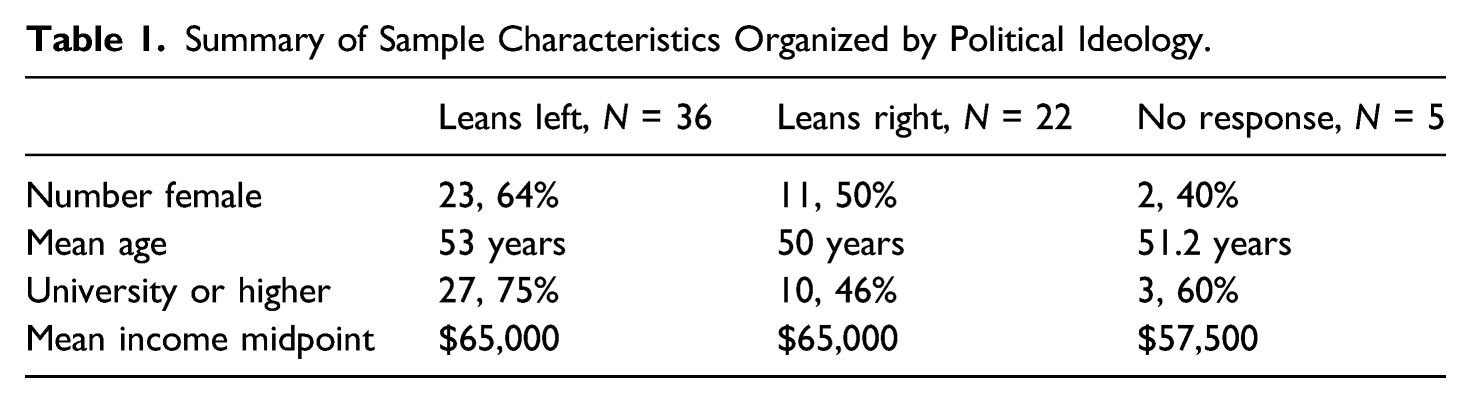
We structured the interview guide around four subsections that explored participants’ definitions of the environment and emotional responses to imagining the environment, environmental problems, environmentalists, and people with low and high levels of environmental impact. We also asked participants to estimate their level of concern for the environment, perception of ideal responses to environmental issues, and sense of their own and others’ responsibilities vis-à-vis the environment. The interviews ranged in duration from 45 minutes to 3 hours. At the end of the interviews, participants completed a brief questionnaire to record socio-demographic details like political ideology, income, and education. We conducted interviews in participants’ homes, places of work, or local cafés and gave each participant a $20 gift card to recognize their contribution. We began analysis immediately after each of the interviews using a structured analytic memo template designed to identify emotions in the interview (Flam & Kleres, 2015) and emerging themes related to environmental concerns and responsibilities. Analytic memos are a technique used for identifying themes in a qualitative dataset in the early stages of research, and can be a valuable tool for generating coding themes during and after data collection (Saldaña, 2016). Through the memoing process, we abductively identified themes and subsequently conducted line-by-line analysis of the interview transcripts (Timmermans & Tavory, 2012). We coded all interviews using an initial list of 13 codes generated through analysis of the memos and adjusted these codes as we moved through analysis of the transcripts.
Morality, Emotions, and the Environment
Our conceptual framework is structured on three patterns that we identified in our analyses. First, our participants value environmental protection and believe others do as well. Second, there is a loose consensus on what society’s ideal environmentalist looks like. The third pattern of note is that liberals and conservatives are polarized in how they relate to the ideal environmentalist. Polarization, we argue, is contoured by the degree to which participants accept the premise that the ideal environmentalist has moral authority and plays out in participants’ emotional responses to the cultural ideal.
It is Good to Be Green
The first pattern we present is the ubiquitous value for environmental protection. We asked participants to rate how important, on a one-to-ten scale, they felt it was that the environment be protected and how responsible they felt for protecting the environment. Among the 22 right-leaning participants who answered the question, all but three who answered “five out of ten” estimated the importance to be at least seven and as high as ten. Among 36 left-leaning participants, all but two participants rated the importance at nine or higher. Although we heard liberals convey a more intense feeling that the environment should be protected, conservatives also tended to approach this question as an obvious one. As Darren, a 57-year-old conservative man in Whitman, stated, Everybody wants the same thing. They want to clean the environment. If you don’t, you’re a damn fool. That’s all there is to it... I’m pretty sure if you took a poll, you know, you could come up with some pretty good averages about what everybody wants and prefers. We want a safe place, you know, a clean place. These are things everybody wants. You know, this ain’t foreign shit; it’s what everybody wants.
Annie, a 59-year-old liberal in Olympia, conveyed a similar sentiment: “I can’t imagine any one person saying ‘ugh, I just hate the outdoors. Hate it. I hate our natural world.’ I’m sure everyone feels, to some degree, a love of our natural world.” Across our interviews, we witnessed strong and generally bipartisan support for environmental protection alongside many statements conveying negative sanctions toward anyone who does not care about protecting the environment.
We also heard participants across the political spectrum imbuing environmental protection with a moral valence. For instance, Greg, a 65-year-old conservative in Olympia, told us he thought environmental protection was a civic duty. He explained, “if you are going to take the benefits and the rewards from the environment, you have to pay your dues. Otherwise, it ain’t right.” And Judy, a 52-year-old liberal in the same community, agrees, saying that in her mind, protecting the environment is a core part of not harming others: I feel like it’s my responsibility to care for her [the earth]. Like I cared for my dad when he was ill or like...I would care for a child if I had children. It’s not any different than that. I feel like it’s part of our responsibility as good people, because if we don’t take responsibility, well we’re already up in quite a mess because we haven’t been taking responsibility.
We argue that these comments suggest that one’s relationship with the environment is a widely accepted site of moral evaluation, in which behavior seen as being pro-environmental receives positive moral evaluation. As scholars (Schein & Gray, 2018; Stets, 2015) suggest, moral evaluations produce emotional responses, especially “moral emotions” such as shame, guilt, and pride, in both those leveling the evaluations and in those receiving them. Therefore, understanding what constitutes a moral environmental relationship culturally is paramount to unpacking how political difference mediates that relationship.
Imagining Environmentalists
The second pattern relates to our participants’ understanding of what a “good” relationship with the environment entails. When asked to tell us who they pictured when they imagined an environmentalist and who they knew or imagined as being concerned about the environment, participants raised four types of environmentalists, ordered here from least to most frequently mentioned: the professional, the activist, the conservationist, and the conscious consumer. Because the professional (someone who conducts research on environmental issues) was only mentioned by four participants, we set aside that category.
Activism and political engagement are less prominent and more contentious in our participants’ cultural imaginaries of environmentalism than we expected. Of 70 descriptions of an environmentalist (as some participants offered more than one illustration), only 17 mentioned activism. Of the ten liberal participants who associated environmentalism and activism, we coded five as having positive perceptions and five as having neutral or mixed evaluations of activism. Annie, quoted above, is a good example of a liberal who perceives activists positively. When asked to picture an environmentalist, Annie visualizes “famous folks who have done activist work and have really gotten out there and have battled truly.” Brian, a 48-year-old liberal in Pullman, pictured environmentalists as “passionate about saving the environment” and elaborated: “Someone who is perhaps at times unrealistic about it, but their heart’s in the right place, you know, an activist.” Brian’s comments are emblematic of liberals who expressed a neutral or mixed perception of environmental activists. It was uncommon for us to hear liberal participants evaluate themselves or others against a standard set by activists, an important distinction that we return to later. Among the seven conservatives who mentioned activists when they pictured an environmentalist, two were mixed and five were negative. Like Scott, a 57-year-old conservative, who says that he generally thinks positively about activists and then qualifies this evaluation: But I also have a difficult time with them when they impact industry, like, for example, if the lumber companies have the rights to log the forest and they do it in an appropriate way, I think it’s fine. When somebody comes in and interrupts that by sitting in a tree or climbing a tree and getting in the way, I have a problem with that.
Scott’s comments reflect McCright and Dunlap’s (2010) argument that Republicans are less likely to be critical of industry and suggest that he is unlikely to confer approval to someone for environmental activism and likely to negatively sanction activists who, in his view, unfairly impact industry. Others imputed negative personality characteristics based on a person’s engagement in activism. Tina, a conservative who is 47-years-old and lives in Whitman, tells us she thinks of activists as aggressive and judgmental. Sarah, a conservative and retired teacher in Pacifica describes activists as, “angry and too extreme.”
Although we were surprised that so few participants associated environmentalism with activism, Hornsey et al. (2016, p. 623) suggest the weak link between green identity and acceptance of climate change may be related to a tendency for people to “perceive stigma around activist identities.” As Craddock (2019) shows in their study of anti-austerity activism in the UK, social movements often implicitly define the criteria for what constitutes an “ideal activist” identity. To achieve this identity, “individuals need to have relevant lived experiences, be motivated by the ‘right’ things, and do ‘enough’ of the ‘right’ type of activism” (Craddock, 2019, p. 145). This results in “ideal activist” identities often being perceived as unattainable by those within the movement and extreme or harmful by those outside of it. In our study, liberals were more likely to evaluate activism as positive or mixed, while conservatives evaluated activism as mixed or negative. The negative judgments of activists either centered on an argument that their passion for the environment harms communities and the industries that support them or a perception that their approach is ineffective. No one in our sample indicated that environmental activism is an ideal against which they evaluate themselves. We attribute this, at least in part, to the unattainability and extremity of the environmental activist identity and take it to indicate that among our sample, activism does not play a role in contouring people’s sense of what a morally good relationship to the environment entails. However, many of our participants, both liberal and conservative, compared and evaluated their contributions to the archetype that we label the “ideal environmentalist.”
The Ideal Environmentalist
Participation in “green” or “eco-friendly,” consumer-based activities represents the most common way our participants understand what it looks like to care for the environment and evaluate their own contributions to environmental protection. Through our analyses, we identified three themes that coalesce into the ideal environmentalist: consciousness, care, and commitment. Although most comments grounded these ideals in consumer practices, others (mostly conservatives) spoke to individuals’ role as someone who leaves a place better than they found it.
The ideal environmentalist is “conscious” of their role in environmental problems. For instance, Scott, quoted earlier in his remarks about the limits of activism, speaks much more positively about environmentalists as conscious consumers. He says being an environmentalist means, “Being aware. Being that global consumer, that global citizen.” Amber, a 33-year-old conservative in Pullman, says that when she pictures an environmentalist, she imagines someone: “more conscious about their decisions, maybe as far as purchasing food, water, and then how they dispose of the trash, food, and water.” Sharon, a 59-year-old liberal in Pacifica, invokes both the awareness of the ideal environmentalist and their commitment to reducing their impact: “It’s people who are aware of their impact and want to do what they can to make sure they are not harming the earth.” Sheri, a 47-year-old conservative in Whitman, suggests that the label “environmentalist” should refer to anyone who is aware that they are affecting and affected by their environment and is “wise and thoughtful about the things they consume.” In our sample, most people—both liberals and conservatives—associate environmentalists as people who are conscious of environmental issues and their role in those issues.
There is also a general consensus that the ideal environmentalist is “caring.” Annie, quoted earlier in her positive remarks about activists, says, “I think anyone who has care and concern could be termed an environmentalist.” Others unpack what caring looks like in practice. Ed, an 82-year-old conservative, offers a similar comment: “Someone who cares about the planet and acts on that concern to make sure they aren’t using up too much.” Caitlyn, a 38-year-old liberal who lives in Pacifica, stresses the connection between conscious consumer choices and caring. She explains that when she sees people buying organic and eco-friendly products at the grocery store, she “can tell they care more about their bodies, and the environment too.” Harriet is a 72-year-old conservative who also lives in Pacifica. She tells us, “When you care for the environment, you don’t throw garbage out of your car...You pick up after yourself...You just leave it like you found it. The same with the ocean. You can take a fish. You can’t overfish.” These comments, taken together, imply that a key component of being a good environmentalist is caring, and expressing that care through eco-friendly practices.
Finally, the ideal environmentalist is “committed” to reducing their impact on the environment, although liberals and conservatives differ in their perception of what practices connote commitment. Liberal participants’ understanding of commitment largely centered around consumption practices. For instance, Myra, a 45-year-old liberal in Pullman, says: “environmentalists are just more committed. They shop at farmers markets, they’re not lazy.” Angela, a 39-year-old liberal in Pullman, qualifies this sentiment further, explaining that she thinks of an environmentalist as someone “committed to not hurting the environment, towards having a positive impact on the environment.” For many participants, the ideal environmentalist is someone who demonstrates commitment by making daily, pro-environmental choices. Addy, a 40-year-old liberal in Pacifica, offers concrete examples: “Biking instead of driving, or really watching your water consumption. For me, it’s food is the biggest thing. Buying organic.” Conservatives also valued commitment, but saw commitment as something more place-based and involving direct connections with the physical environment. For instance, Tina, quoted earlier, told us her husband should be considered an environmentalist because “he is taking care of the land,” referring to his work managing the family’s large farm. And Bill, an avid outdoorsman, argues that his commitment to spending time in nature and his financial contributions to wilderness protection (through fishing licenses) is evidence that he should be considered an environmentalist: “I’m going camping, hunting, fishing - leaving it as I found it, right? I think simple things like that -- and the money we hunters spend to protect the environment -- that’s part of being an environmentalist.” It is in the elaboration of what constitutes a “good” human-environment relationship that we see political differences. And it is in the emotional dynamics of such differences that we identify the possibility of political polarization.
Relating to the Ideal Environmentalist
The final thematic pattern we present captures the political variation in how people respond to the ideal environmentalist. We noted four prominent emotions—pride, guilt and shame, and anger. These moral emotions arose when participants responded to our questions about whether they would define themselves as environmentalists and about the ways in which they put their value for the environment into practice.
Pride
For those who feel positive about their relationship with the ideal environmentalist, pride was a common emotional response. Kemper (1987) defines pride as “a feeling of satisfaction that focuses on the self as worthy” (p. 279). Scheff (2014) clarifies this further by noting that pride is not only “a favorable view of self, but one that has been earned” (p. 256) through behavior that we perceive to be seen as positive in the eyes of others. As a moral emotion, pride is self-conscious. This category of moral emotions involves those in which the individual becomes an object to their own actions (Haidt, 2003; Turner & Stets, 2006). Shame (see next section) is also a self-conscious emotion, leading Scheff (2014) to situate it opposite pride on an emotional axis and suggest that both emotions “are signals to the state of a relationship” (p. 257). Pride, he posits, marks a secure social bond or “connectedness” (p. 257).
When asked, “What does an environmentalist look like?” those for whom pride is a dominant emotion answer: “me.” For example, I asked Eileen what she pictures when I say “environmentalist” and she tells me, “I picture myself. That is a big part of what I do in my life.” Eileen and her husband, both politically liberal and in their 60s, are dedicated to environmental advocacy and activism and list the many choices they make in their daily practices to reduce their impact: they are vegetarian, they drive a hybrid car, they only buy recycled paper products. Eileen characterizes the ideal environmentalist as someone whose daily practices are largely similar to her own. Her statement, “I picture myself” resonates with pride. We saw other instances of pride when participants wanted to show us things in their home that demonstrated their alignment with the ideal environmentalist. Ina, a 64-year-old in Pullman, conveyed a sense of pride with her skills at reusing what would otherwise be waste. She tells us, “The Chinese restaurant owners are saving me all their rice bags. [laughing] I’ll show you later. I use them for laundry. I use them for hauling things. Like I said, I’ve been given hundreds of them. Changing the world one bag at a time.” We observed expressions of pride most frequently when participants identified points of alignment between their actions and the ideal environmentalist. Ben, a 77-year-old liberal in Pacifica, tells us about his decision to install solar panels on his house in the coming months. He says it has been, “a conscious decision to do the solar panels.” We ask if he thinks the decision will improve his quality of life and he tells us, “Yeah it will make me feel more responsible” and jokes that once he has the panels installed, “I can snub my nose at other people.” In our sample, most of the people we heard conveying pride in their relationship with the environment identified as liberal—they also tended to be older. Younger liberals were more likely to describe a panoply of eco-friendly practices in which they were engaged alongside a sense of shame or guilt that they were not doing enough. Older liberals stand out from our other participants in their confidence that their values and practices are in line with a morally good relationship with the environment.
Guilt and Shame
Both guilt and shame are negative, self-conscious moral emotions that involve a sense of dissatisfaction with the self, “for failing to live up to [one’s] standards or goals” (Stets, 2015, p. 447; see also Scheff, 2000, 2014). While often used interchangeably colloquially, within the study of emotions shame and guilt are differentiated by the source of the emotion (Deonna & Rodogno, 2012; Kemper, 1987; Stets, 2015). Shame, which comes from the violation of a value, is not tied to a specific behavior or act and emerges through the perception of a negative moral sanction by others. This is in step with Scheff’s (2014) claim that like pride, the source of shame is rooted in the social bond, although the consequence of shame is a “threatened” or “disconnected” one (p. 257). Guilt, on the other hand, comes from the violation of a norm. It is tied to a specific behavior and emerges through a direct negative moral sanctioning of the self.
Participants conveyed or described a sense of guilt or shame, either when evaluating their own relationship with the environment or their perception of others’ evaluations of their relationship with the environment. Participants who conveyed guilt often referred to specific consumption practices that evoked this emotion. We heard more pronounced expressions of shame when participants sensed the ideal environmentalist was out-of-reach for them more broadly. Most of these participants communicate a perception that being a conscious, caring, and committed consumer is a mark of moral worth and social status. Yet they evaluate their own daily practices as being distant from this ideal and they do not see a way to bring their practices in line with the ideal. For instance, Travis, a 29-year-old liberal in Olympia, tells us that when he sees people buying heavily packaged goods, he feels, “slightly grossed out.” He explains why: “Um, just because...my cart wouldn’t be that different from theirs.” He tells us he “wouldn’t feel morally superior to them” and is embarrassed that he buys heavily packaged convenience goods. Carissa, a 37-year-old liberal in Olympia, seems to reflect the ideal environmentalist: she lives in a shared house, grows vegetables in a large garden, keeps bees out of a desire to support pollinators, buys her clothing at thrift stores, and generally tries to consume as little as possible. Yet she tells us she sees a chasm between her ideals and her actions. When we asked if she considered herself to be an environmentalist, she tells us, “No! My immediate, like, word association, is guilt. And like, I should be doing more.” And Caitlyn, quoted earlier, describes guilt as being a side-effect of any shopping, particularly around food and clothing. For example, she says “every time I buy something I always feel guilty afterwards. It’s like I know I shouldn’t have bought that. It's like ‘I really liked it, it looked really cute on me, so I’m going to get it’, but then it’s like (whispering) ‘why did I do that?’” Participants’ guilt is not centered on not being a more engaged activist, but squarely situated around their consumption patterns. This, we argue, is evoked when they perceive a gap between their actions and the ideal environmentalist.
Some participants expressed shame and a sense of inferiority when interacting with people who reflect the ideal environmentalist. Like Avery, a 45-year-old liberal in Pullman, who says when she sees her neighbors who have a hybrid car and eat a vegetarian diet, she thinks, “oh, they’re better than us.” Comments from Cheryl, a 61-year-old liberal in Olympia, adds detail to what makes these people “better”: “I guess they’re less impulsive, that’s part of it. They’re really thinking about what they’re buying and how it’s affecting things.” When we ask her how that feels, she tells us, “It’s just another way that I’m not measuring up. It’s a theme of this lifetime.” Participants who described shame did so alongside comments that drew attention to the distance between their lifestyle (rather than specific behaviors) and what they saw as an ideal lifestyle. In our sample, most of the people expressing shame identified as liberal and female.
Anger
Whereas pride, shame, and guilt were predominantly conveyed by our liberal participants, anger was felt across the political spectrum. Widely held to be a primary, or first-order, emotion, Kemper (1987) claims anger “results from interaction outcomes in which expected, customary, or deserved status has been denied or withdrawn by another actor who is seen to be responsible for the reduced status” (p. 275). As such, anger is an other-critical moral emotion (Haidt, 2003; Stets, 2015; Rozin et al., 1999) in which the object is not the self but, instead, lies in the other. Whereas Kemper (1987) linked anger with status devaluation, Stets (2015) suggests it can also emerge through the perception that another is responsible for blocking one’s goals (p. 447). Among our participants, anger was present in response to both status devaluation and goal blocking.
We witnessed liberals expressing anger toward conservatives for not caring enough about the environment (i.e., blocking their goal of environmental protection) and conservatives conveying anger toward liberals for virtue-signalling and moral righteousness (i.e., responding to perceived status devaluation). Turning first to liberals, we note that regardless of whether the participant conveyed pride or guilt or shame about their own impacts on the environment, many described a sense of frustration and anger toward conservatives who they sensed lacked concern for the environment. In our interview with Elena, a liberal in Pullman, we asked if she thought most people support environmental protection: “No, I don’t think so. Especially Republicans. Their approach is much more self-centered I think.” We asked Shelby, a 40-year-old liberal in Pullman, what emotions came to mind when she thought of the environment and she told us her emotions were, “positive. Except when I think of Republicans.” She elaborates, “Republicans are so worried about profit and, you know, they don’t really care about the environment.” Similarly, when we asked Kim, a 38-year-old liberal in the same community, to picture someone with a large environmental footprint, she said, “redneck Republicans!” Laurel, a 67-year-old liberal in Olympia, conveyed a sense that people in Republican states are less likely to take care of the environment and tells us that although she tries not to “give judgments,” that she does, “look down on those people whether they’re aware of it or not. I’m pretty scornful about the fact that they behave that way.” In a particularly emotional interview, Lexi, a 21-year-old liberal, describes her reactions to seeing someone litter a compostable plastic cup at a coffee food truck where she works. She describes saying to the woman who littered: “‘You’re a disgusting human being’.” Lexi says, “Needless to say, I got a lot of dirty looks but I was like ‘I do not care.’” In fact, she told us, she wanted to tell the crowd of onlookers, “I’m a big girl; I will tackle you all to the ground and I’ll rub your face in the dirt until you say you’ll compost it.” She wraps up her story: “I have become, like, this crime fighting environmentalist.” Although Lexi’s story is uniquely visceral, conveying anger and a desire to shame people into “good” behavior are common themes among our liberal participants. Even those who berated themselves for not being “good enough” environmentalists established a clear boundary between good people and bad people based on their awareness, care, and commitment to environmental protection.
Conservatives conveyed anger and frustration in response to their perceptions and experiences being negatively sanctioned by liberals for not aligning with the ideal environmentalist. Much the same way the libertarians in Hochschild’s (2016) research described feeling unfairly condemned by upper-middle class progressives; most conservatives in our study had a combative relationship with the ideal environmentalist. The first example we offer is from Bill, quoted earlier, who told us he knows liberals would say he is unethical for hunting. He retorts that these urban liberals misunderstand the state of the environment, Because we are actually out there seeing it, experiencing it. It’s easy to be a backseat driver, right? And sit back in your fancy little apartment in Seattle up on the 15th floor and say ‘I’m scared about the environment.’ When was the last time they were outside? If you’re not outside to experience it and actually know ... how can you judge?
Bill’s comments convey anger as well as a desire to reclaim the environmentalist identity for himself and those like him. His comments also illustrate a pattern of accusing liberals of having a hypocritical relationship with the environment. Other participants made the same suggestion, like Greg, quoted earlier, who argued that activists protesting oil refineries are undermined by their own reliance on plastics and internal combustion engines. Similarly, Jeff, a 45-year-old conservative, tells us he thinks people who drive a Prius “are all, ‘look at me! Look at me!’” but that the environmental impacts of the car’s batteries render what he perceives as their claims of superiority unsubstantiated. Jeff perceives the Prius driver as making claims of being more virtuous and expresses anger in response. The anger conservatives conveyed tended to be defensive (like Bill saying, “how can you judge?”) rather than offensive (like Lexi saying, “You’re a disgusting human being”).
General Discussion and Conclusion
Our broad goal in this paper was to understand why political differences in how liberals and conservatives approach their relationship with the environment might become politically polarizing. To orient our analyses toward this goal, we posed the following questions: how do liberals and conservatives perceive the moral significance of environmental protection? What beliefs and practices do people associate with caring about the environment? And, are there differences in how liberals and conservatives evaluate their own and others’ contributions to environmental protection? Drawing from a dataset of interviews conducted with a politically diverse sample of Washington State residents, we put forward a conceptual framework that incorporates morality and emotions in order to better understand political polarization. Central to this framework is the notion of an ideal environmentalist. This ideal reflects the ways that liberals tend to demonstrate commitment to environmental protection and we see differences in how liberals’ and conservatives’ emotional responses to this ideal, and its attendant claims to moral authority.
A great deal of existing research indicates that liberals are more likely than conservatives to engage in eco-friendly consumption and waste practices (e.g., recycling and buying products that purport to have environmental benefits). And recent studies indicate that people stereotype liberals as caring more about the environment than conservatives (Geiger et al., 2020). Arlie Hochschild’s (2016) multi-year, ethnographic study of Tea Party supporters in Louisiana substantiates the idea that conservatives sense that liberal elites set the terms by which people’s relationships to the environment are evaluated. Hochschild’s participants wanted to demonstrate that they cared about environmental protection, but that they did not support strong state regulation. In their experience, rejecting regulation was tantamount to not caring for the environment in the eyes of well-educated liberals, and they felt their moral worth was being challenged by these liberals. The patterns in Hochschild’s work speak to the role of environmental narratives in shaping debates over environmental governance and echo Warner’s (2019) assertion that “polarization happens when a new narrative gains legitimacy by problematizing existing environmental norms” (p. 3). There is some evidence that liberal narratives of environmental protection problematize conservative narratives. As a general example, a Dutch study found that there is a hierarchy of environmental beliefs and that liberals’ beliefs are associated with higher social status than conservatives’ (De Keere, 2020). Taken together, these findings constitute a precedent for our ideal environmentalist. The people we studied view environmental protection as morally good and they are aware of social stereotypes that connect individual efforts to care for the environment with behaviors that liberals practice more than conservatives. Our participants also conveyed a sense that liberals’ beliefs and behaviors are granted more status than conservatives’.
Against a backdrop where claims to moral authority are a part of maintaining social status hierarchies (Lamont, 1992, 2000), it is not surprising that we see resistance to the ideal environmentalist from people whose practices do not align with this ideal. Many liberals in our sample took for granted that the ideal environmentalist, who shops with eco-friendly labels in mind and tries to curb their use of resources, is the standard against which individuals’ efforts to protect the environment ought to be judged. This presumes a hierarchy, with the ideal environmentalist at the top. Although we spoke with liberals who admired activists, we did not speak with anyone who incorporated activist practices into their framework of what a morally good relationship with the environment entails.
We focused on our participants’ emotions in order to understand their responses to the ideal environmentalist and its place at the pinnacle of individual relationships with the environment. We spoke with liberals who communicated pride—who told us about the practices they employ to reduce their impact on the planet. These participants clearly see environmental protection as morally good and, further, associate their daily practices with what an ethical relationship with the environment looks like. We also spoke with liberals who accepted the terms of the ideal environmentalist but evaluated either their behaviors or practices as falling short of this ideal. Those who identified specific behaviors that they engaged in, like buying new and conventionally produced clothing, as morally bad, communicated their guilt in our interviews. And those who evaluated their home energy, eating, and transportation practices as distant from the ideal environmentalist, conveyed a sense of shame—a perception that their lack of alignment with the ideal rendered them lower in the social hierarchy. Ridgeway and Nakagawa (2017) conducted a series of survey experiments to address the question, why do we defer to status hierarchies? Their answer is that those who accept status hierarchies and crucially, accept that they occupy a lower tier in that hierarchy, are more likely to be seen as “reasonable” and accepted by the group than those who challenge the status hierarchy. We did not interview liberals who conveyed anger at the sort of people who conveyed guilt. The people who conveyed guilt, all politically liberal, implicitly accepted a status hierarchy that associated the ideal environmentalist with moral worth. But we did interview liberals who conveyed intense anger at conservatives who they perceived as not caring about the environment. And we interviewed conservatives who vehemently rejected the pre-eminence of the ideal environmentalist. These emotional dynamics, we suggest, constitute part of the fabric of political polarization over environmental protection.
We hope that by demonstrating the widespread support for environmental protection and shedding light on the emotional dynamics of environmental issues our research will animate future research on the emotional dynamics of political polarization over environmentalism and polarization more broadly. Recognizing that while industry-led climate skepticism campaigns can shape public discourse and widen the gulf between liberals’ and conservatives’ environmental beliefs, such campaigns are more likely to be effective when they speak to already-existing emotional dynamics and contestation over moral worth. Although our study takes place in the environmental context, we suggest this same dynamic could apply beyond this specific setting to any morally contested topic. In our case, the polarization seems to be conditioned by political ideology, but this framework could apply in cases conditioned by religion, nationality, or other axes of difference.
There are several limitations and further questions to address in future research. First, our study was conducted in a single state that may be unique in these dynamics. We encourage future research investigating whether similar dynamics exist elsewhere, although we note similarities between our conservative respondents’ emotions and the emotional dynamics that Hochschild (2016) documents in Louisiana and Warner (2019) observes in New England. A second limitation is that in focusing on political polarization, we did not account for variation across gender, class, race, or age. We focused on politics as a first step because political variation was most apparent to us in our analyses and previous research suggests political ideology and party affiliation overshadow gender, class, race, and age in explaining polarized views on climate change (Hornsey et al., 2016). However, since we noticed that older liberals were more likely to see themselves as reflecting the ideal environmentalist with younger liberals conveying considerable guilt over behaviors out of sync with the ideal, we are interested in future research examining how perceptions and evaluations of the ideal environmentalist vary by age. It is also possible that a larger sample of young Americans might reveal less consensus on the centrality of consumer-based responses to environmentalism. Finally, more work is needed to build out our framework, to unpack what it means that so many people value environmental protection yet so much conflict exists over state-led efforts to do so; to explore the mechanisms that render the conscious, caring, committed consumer such a powerful figure in our cultural imaginary; and to capture expressions of emotion more purposively. We are excited at the possibilities for a future focus on the emotional drivers and dynamics of political polarization over the environment and the solutions such research might generate for bridging divisions between people who share a deep appreciation for the natural environment.
Footnotes
Acknowledgments
We extend our gratitude to Dr. Corrigall-Brown and Max Chewinski for their work in coordinating this issue and to two anonymous reviewers for their thoughtful and informed feedback.
Declaration of Conflicting Interests
The author(s) declared no potential conflicts of interest with respect to the research, authorship, and/or publication of this article.
Funding
The author(s) disclosed receipt of the following financial support for the research, authorship, and/or publication of this article: Funding for this project was provided through a New Faculty Seed Grant from Washington State University and from the Social Sciences Research Council of Canada (IDG 430-2019-0011).
Note
Author Biographies