



Abstract
Protest emerges in different forms in different countries. A strategy is presented here to deal with country-specific forms of protest by developing equivalent instead of identical measures in 13 advanced democracies around the world. The main substantive results show, first, a clear distinction between direct forms of protest and organizational actions. Yet the specific compositions of these two modes differ between countries. Second, common cross-national subsets of items comprising only three forms for direct actions (demonstrating, petitioning, boycotting) and also for organizational protest (humanitarian/charitable, self-help, consumer organizations). Third, several forms of protest can be used as country-specific expansions of the common three-item sets. Apparently, constructing equivalent instead of identical measures for protest is most important for the detection of relatively small sets of common cross-national indicators and for the accompanying disclosure of country-specific forms of protest. Due to the small percentages of protesters, applying equivalent measures and identical measures of protest largely produces the same results for the positioning of countries from a cross-national perspective.
Similar But Different
Striking is one of the most popular forms of political participation in France and usually combined with demonstrations and street blockades. Whereas in neighboring Germany demonstrations and street blockades are not uncommon, strikes are very rarely used for political purposes. Instead, relatively popular protest forms of participation in Germany are so-called “Bürgerinitiative” (literally: “citizens’ initiatives”), which are typical for the German political culture but unknown in France. In a similar way, the Dutch have been cultivating “inspraak” (literally: “have a say”) for a very long time as a rather decent form of political involvement next to demonstrations and street blockades, without worrying much about the fact that no other democracy is characterized by this form of political involvement. Given these evident differences between the repertoires of political protest in these three countries, the question arises how a meaningful cross-national comparison could look like. On the one hand, we could restrict the analyses to, for instance, demonstrations and street blockades as shared forms of protest. Obviously, the simple neglect of country-specific phenomena will underestimate the scope and level of political protest—the French should not be denied to strike for political reasons just because the Germans and the Dutch do not use this activity as a form of political participation. On the other hand, it is clear that taking into account every form of local political folklore will impede comparative analyses considerably and, in the end, destroy any opportunity for general explanations. How, then, can we avoid the Scylla of underestimating protest by focusing on common forms only and the Charybdis of debouching into idiosyncratic approaches in comparative research?
The problem of dealing with similar phenomenon in distinct contexts has a long tradition in comparative research. Usually, the starting point is to acknowledge that identity is neither possible nor desirable: Two phenomena might look the same in different contexts but actually be rather different (as the example of strikes clearly shows). Instead, the common recommendation is to search for similar phenomena in different context and to establish their equivalence (see van de Vijver, 1998; van Deth, 1998, 2009). Although protest data from major surveys are widely used, only very few scholars address the problem of cross-national or longitudinal comparability. In an extensive analyses of the items for political participation in the European Social Survey, García-Albacete (2014) carefully constructed equivalent scales for “institutional” and “noninstitutional” participation in 17 European countries. Remarkably, these scales do not contain the same items in each country (García-Albacete, 2014). Mainly relying on similar indicators in the European Values Survey Quaranta (2013) presented detailed analyses of the construction of cross-nationally equivalent scales for political protest. His work shows that an additive scale based on five items can be used in 20 European countries (only Portugal presents some complications; Quaranta, 2013). Apart from these two examples, hardly any attention is paid to equivalence problems in protest research.
The aim of this article is to explore the similarities and differences in protest among the citizenries of major democracies around the world. As it turns out, specific forms of protest widely available in cross-national research cannot be simply used as indicators for a more general concept of protest. To deal with this problem, the analyses presented consist of three steps. First, it is shown that the latent structures underlying specific forms of protest differ across countries and therefore cannot be used to construct adequate measures. In a second step, the requirement of identical measures is replaced by the condition of equivalence; that is, we allow for country-specific differences in the forms of political protest in different countries. The equivalent but different measures for protest constructed in this way are used in the final step to compare the scope and level of protest cross-nationally. The main conclusion is that for exploring protest among countries in meaningful ways the evident differences in the use of specific forms of protest in different countries has to be taken into account systematically.
Measuring Protest in Comparative Research
Protest can be loosely defined as speaking out against some policy or course of action. The list of typical forms of protest is endless and includes such actions as demonstrations, rallies, marches, walkouts, suicides, blogs, petitions, guerrilla gardening, reclaim-the-street parties, or boycotts. Its main characteristic is that protest implies objecting something, showing disapproval or disagreement (usually in public), which is most clearly expressed by the label “contentious politics” (Lichbach 1997; Tilly & Tarrow, 2006). Many political scientists consider protest to be a distinct mode of participation within the broader repertoire of political participation. 1 Data-reduction techniques used to uncover various dimensions traditionally show that, broadly speaking, five distinct modes of participation can be identified: (1) voting, (2) campaign activities, (3) contacting officials or politicians, (4) protest (and new social movements), and (5) social or civic participation (Sabucedo & Arce 1991; van Deth, 2001a). Variants of such distinctions include, for the United States, Verba and Nie’s (1972) seminal depiction of four major modes (“voting,” “campaign activity,” “communal activity,” and “particularized contacting”) and Verba et al.’s (1995, p. 72) distinction between four modes of participation, broadly labelled as “voting,” “campaign,” “contact,” and “community.” Especially the Political Action project stimulated the recognition of protest as a distinct mode of participation (Barnes et al., 1979). Combining these approaches Parry and his colleagues found six main types of political participation in Britain: “voting,” “party campaigning,” “collective action,” “contacting,” “direct action,” and “political violence” (Parry et al., 1992, pp. 50ff), with protest activities positioned under “collective action” and “direct action.” More overarching attempts also deal with newly arising creative and internet-based modes of participation resulting in a “new taxonomy” of the repertoire of political participation empirically distinguishing between “voting,” “conventional participation,” “protest,” “volunteering,” “political consumerism,” and “digitally networked participation” (Theocharis & van Deth, 2018).
By stressing its contentious nature, almost any nonpolitical activity can be turned into protest sometimes (van Deth, 2001b) and data bases on political activism contain information about hundreds of distinct actions and event. 2 Based on an extensive review of the literature, Quaranta (2015, p. 24) concludes that ‘“political protest” or “unconventional participation” can be understood as a direct form of political participation taking place without the intermediation of institutional actors’ (Quaranta, 2013, p. 460) echoing the original position taken by Marsh (1977) 40 years ago. Because such conceptualizations necessarily remain rather vague, most authors simply present a list of typical examples of protest manifestations such as “demonstrations of various kinds, [ . . . ] boycotts, strikes, invasions of property, or even more forceful methods’ (Marsh, 1977). All major international comparative survey programs—European Social Survey, World Values Survey (WVS), International Social Survey Programme—contain a short battery of five or six protest items. The level of protest is typically measured by computing an additive index; that is, the level of protest is considered to be proportional to the number of protest actions used. In addition, many surveys also cover activities in social movements or voluntary associations and very similar indexes are computed for these activities too.
For our empirical exploration of the similarities and differences in political protest in various countries, the sixth wave of the WVS 2010-2014 is selected here.
3
This data set contains the following question for measuring protest activities: I’m going to read out some forms of political action that people can take, and I’d like you to tell me, for each one, whether you have done any of these things, whether you might do it or would never under any circumstances do it: • Signing a petition • Joining in boycotts • Attending peaceful demonstrations • Joining strikes • Any other act of protest?
In addition to its wide coverage of different countries the advantage of using the WVS data set is that the protest items are phrased neutrally and avoid terms such as “illegal” or “unofficial” used in other surveys. Besides, by adding the item “any other act of protest” the WVS-battery in principle covers newly arising forms of protest. Because we are interested in actual behavior and not in attitudes toward forms of protest only the response “have done” is considered here.
Following the general conceptualization of protest to imply objecting to something, showing disapproval or disagreement, a second set of indicators deals with activities in social movements and voluntary associations. Six of the organizations included could be relevant for protest: Now I am going to read off a list of voluntary organisations. For each organisation, could you tell me whether you are an active member, an inactive member or not a member of that type of organization? • Labour Union • Political party • Environmental organisation • Humanitarian or charitable organisation • Consumer organisation • Self-help group, mutual aid group’
The distinction between “active member” and “inactive member” seems to be rather ambiguous and so the two behavioral responses are combined here.
The two sets of questions have been included in the WVS-questionnaire 2010-2014 for 13 established democracies spread all over the world. The use of this selection here is based on the consideration that it does not make much sense to expect equivalent modes of protest in democratic and nondemocratic political systems. Moreover, the degree of democratization is a (co-)determinant of political participation and therefore the selection of countries includes long-standing democracies such as Sweden, The Netherlands, and the United States along with younger democracies such as Poland and Cyprus. The relatively large differences in this respect, however, also present a challenge for the detection of comparable measures. The selected countries and the main fieldwork characteristics are listed in the first three columns of Table 1. The additional information in the right-hand side of this table shows that in the pooled set of countries, a majority has been involved in direct protest or organizational activities. At the same time, very large cross-national differences in the spread of protest are clear: Whereas almost 90% of the New Zealanders were involved in one or more activities, this figure does not reach 30% among Romanians. Moreover, direct and organizational activities apparently come together, with relatively large or small parts of the populations being involved in each of the two. These cross-national differences reflect the strong context-dependency of protest documented by many researchers (see, e.g., Mascherini et al., 2011; Norris, 2002; Vráblíková, 2013, 2016).
Selected Countries, Fieldwork, and Spread of Protest.
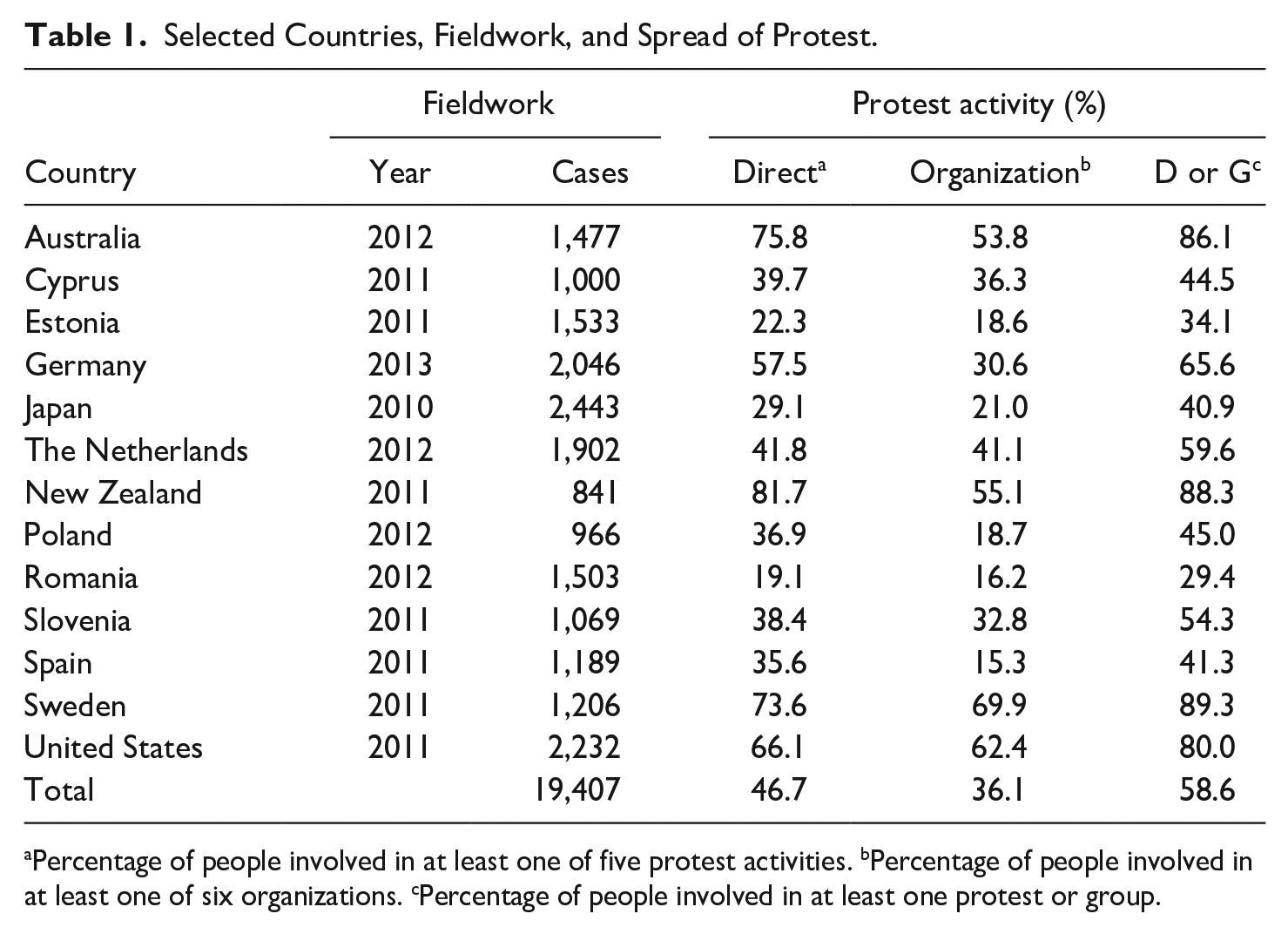
Percentage of people involved in at least one of five protest activities. bPercentage of people involved in at least one of six organizations. cPercentage of people involved in at least one protest or group.
Modes of Protest Distinguished
The next step in conventional approaches in cross-national research is to follow Sartori’s (1970) famous advice to climb the “ladder of abstraction”; that is, we consider the phenomena depicted as specimens of a more general concept. This strategy treats apples and pears as specimens of “fruit” or Catholicism and Islam as specimen of “religions.” Neither “fruit” nor “religions” can be observed directly and each relies on potentially different indicators. In our case, the 11 items selected as forms of protest are considered to be specimens of the more abstract concept “protest”—and we want to compare protest between different countries irrespective of the specific indicators. Standard multivariate data-reduction methods for such purposes include factor analyses and scaling techniques, each based on different behavioral presumptions about involvement in distinct modes of participation.
The basic idea behind factor analytical approaches in participation research is the presumption that being active in one form makes it more likely to be involved in another form that belongs to the same mode of participation. Table 2 shows the result of factor analyses for the pooled data set based on product-moment correlations (left-hand side) and on tetrachoric correlations to take into account the fact that all variables are dichotomized 4 (right-hand side). The results of these two analyses are strikingly similar and confirm much of the common wisdom in this area. First, the two major sets of protest activities are clearly distinct from each other (orthogonal rotations applied). Second, being active in a labor union evidently is not alike activities in other organizations: This item cannot be placed satisfactorily in the latent structure based on tetrachoric correlations and fits rather poorly when product-moment correlations are used. In a similar way, the positioning of party activities is not very convincing either, with relatively low loadings and extraction coefficients. Apart from these minor complications, these first analyses of the pooled data set, we obtain measures for two distinct modes of protest, which we will label “organizational actions” and “direct actions.”
Dimensions of Protest Activities in 13 Established Democracies (Pooled Data Set; Factor Analyses with PCA; Loadings).
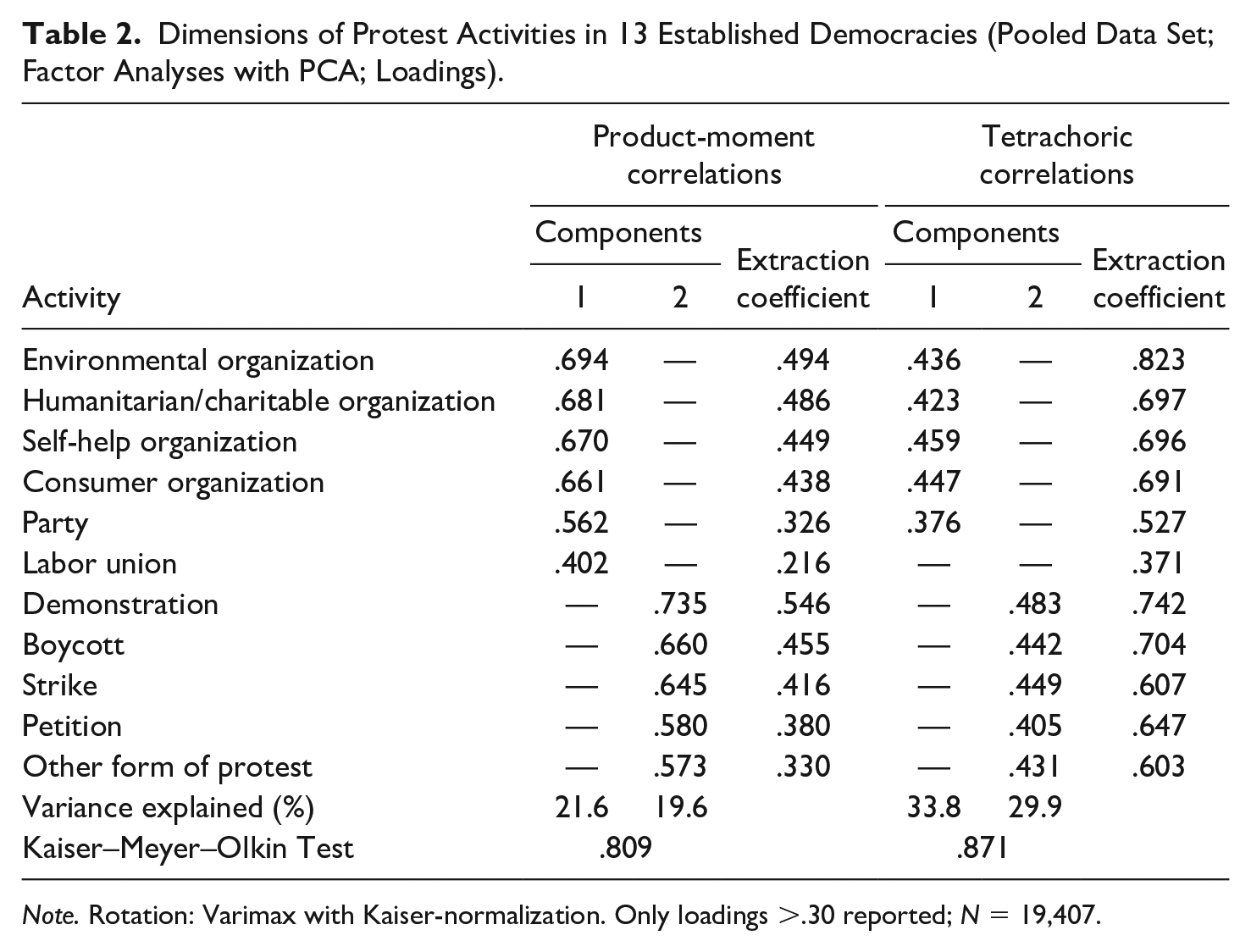
Note. Rotation: Varimax with Kaiser-normalization. Only loadings >.30 reported; N = 19,407.
Applying factor-analytical models to explore protest data has been criticized from the very beginning of empirical research in this area in the 1970s. Although the predictable objections against using dummy variables for these techniques can be countered by using tetrachoric correlations, much more important is the question whether the underlying behavioral assumptions about the structure of protest are appropriate. Factor-analytic techniques are based on correlations between items (what-comes-with-what) and this presumption about the nature of a latent construct “protest” might be challenged. Alternatively, the seminal work of Marsh in the early 1970s was already based on the idea of a single dimension of protest that would combine the various forms of protest hierarchically. By indicating which actions somebody has taken the implicit question: “how far are you prepared to go? [italics in original]” (Marsh, 1977, p. 48) is answered. For this presumed structuring of forms of protest into a latent construct, the various activities will “genuinely traverse a single dimension from positive-to-negative, from the commonplace to the extreme” (Marsh, 1977, p. 48). In other words, if various forms of protest fulfil this requirement they constitute a one-dimensional cumulative scale (usually known as a Guttman scale).
A sophisticated approach to explore the existence of cumulative scales on the basis of the internal structure of a set of items has been presented by Mokken (1971). His multiple nonparametric stochastic scaling model belongs to the class of item response theory approaches and overcomes the deterministic character of Guttman-scaling. It mainly relies on the computation of two homogeneity criteria (Loevinger’s H) based on pairwise comparison of covariances to decide whether the items meet the presumed relationships (Mokken, 1971, pp. 148-153; van Schuur, 2003). 5
More important than the technical aspects of the Mokken’s model is the fact that is seems to represent the behavioral presumptions underlying citizens’ choices of specific forms of protest. First, answering the question “how far are you prepared to go” implies cumulative scaling not correlational analyses. Second, as a stochastic model Mokken scaling takes into account that people do not always follow strict rules, make errors, or might be confused. Third, Mokken’s model detects multiple scales and avoids the idea that modes of participation are unrelated as implied by the idea of orthogonal multidimensional latent structures. Table 3 shows the results of Mokken-scale analyses of the pooled data set of protest items. 6 The total set of 11 items constitutes two distinct scales: one strong scale for “direct action” and another moderately strong for “organisational action.” Furthermore, the responses to the item being active in a labor union do not fit into the pattern discerned. Clearly, the results of the Mokken-scaling procedure and the factor analyses presented in Table 2 reveal the very same latent structure. Because the behavioral presumptions of the scaling approach are more in line with the idea of protest as a cumulative concept, all further analyses will be based on this model.
Dimensions of Protest Activities in 13 Established Democracies (Pooled Data Set; Mokken-Scale Analyses; Difficulty and Loevinger’s H).
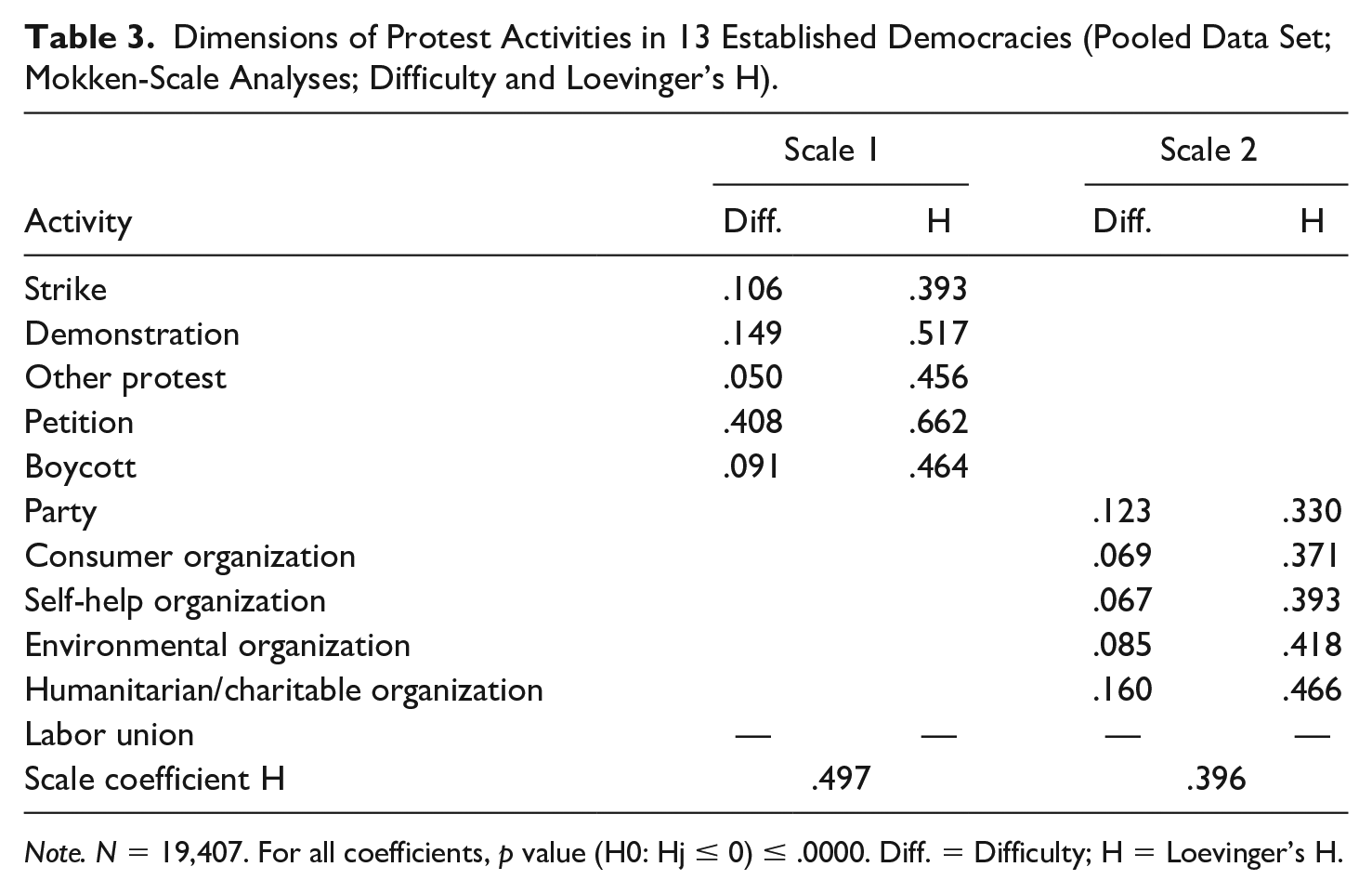
Note. N = 19,407. For all coefficients, p value (H0: Hj ≤ 0) ≤ .0000. Diff. = Difficulty; H = Loevinger’s H.
Cross-national comparisons of protest seem to be unproblematic: Of the forms of protest selected, only activities in labor unions are excluded; the remaining 10 items consistently form two distinct modes of protest with very plausible theoretical meanings and acceptable technical specifications for each of the data-reduction techniques applied. Yet, the crucial question is whether these findings can be reproduced for each country in our data set. The results of these attempts are disenchanting. As can be seen in Table 4 the structure obtained for the pooled data set is only perfectly reproduced in New Zealand and with similar structures in Romania and Slovenia. A distinction between the two dimensions uncovered so nicely for the pooled set is not available in the United States (showing a single dimension combining most items) and part of a three-dimensional structure in Australia and Poland. In Sweden, the four direct action items form a scale, whereas organizational activities are included in two additional scales. Finally, activities in labor unions and political parties cannot be included in scales in six and four countries, respectively. The item strikes present problems in Germany and the United States and other forms of protest in Cyprus and Poland. Apparently, the simple use of the results of the pooled data set for cross-national research is highly misleading because protest seems to be characterized by differently structured forms of protest in each country. What to do?
The Dimensions of Protest in Established Democracies (Country Results; Mokken-Scale Analyses; Loevinger’s H).
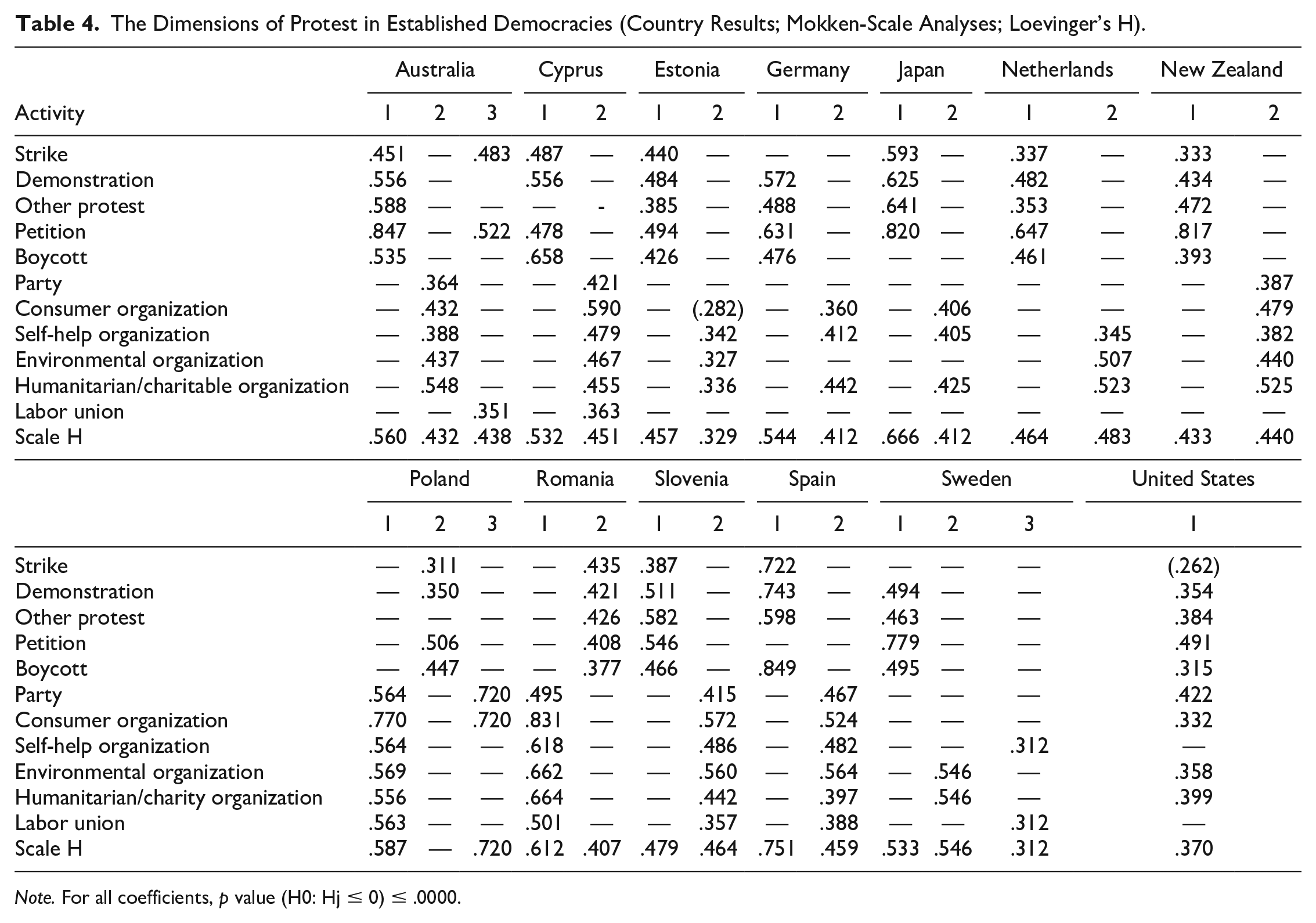
Note. For all coefficients, p value (H0: Hj ≤ 0) ≤ .0000.
The Challenge of Equivalent Measures
The striking differences between the latent structures in various countries and the impossibility to reproduce the results from the pooled data set at the country level indicate that we cannot simply compare protest by applying identical measures. Instead, equivalent measures have to be developed taking into account the country-specific meanings of protest. Such challenges of comparability and the construction of equivalent measures have been stressed in textbooks (see Gschwend & Schimmelpfennig, 2007; Landman, 2008) as well as handbooks on comparative politics (see Landman & Robinson, 2009). Although the importance of dealing with equivalence is widely acknowledged attempts to handle similar but different indicators in comparative research are the exception not the rule. This situation is mainly due to the complicated logical and empirical aspects of the identity-equivalence problem as well as to the fact that considerable information on the specific meaning of concepts in different contexts is required. As the example of strikes and the measurement of protest in the first paragraph of this article suggests it is clear that, when dealing with challenges of comparability and equivalence, the “problems are severe and it is easier to explicate them than to suggests ways of dealing with them” (Verba, 1969, p. 64).
Approaches to construct equivalent measures distinguish between ex-ante and ex-post strategies depending on the question whether fresh data are collected and specific precautions can be taken, or that we are confronted with handling existing information. Because most cross-national research is based on secondary data analyses the focus here will be on pragmatic solutions for handling existing data. Consequently, epistemological complications of “travelling” theories and concepts are excluded (Byrne & van de Vijver, 2010; van de Vijver & Leung, 2010; van Deth, 2013). Besides, we are confronted with the question how to deal with similar phenomena in different contexts and so harmonization strategies do not suffice. Figure 1 summarizes the five main strategies for establishing equivalence. Since no common structure could be detected for the 11 protest items selected increasing the level of abstraction (Strategy 1) did not work so far. The same argument eliminates the reliance on inference and the use of a common set of indicators (Strategies 2 and 3). This leaves us with the exploration of internal consistency (Strategy 4) or external consistency (Strategy 5) among a noncommon set of indicators. For the construction of equivalent measures of protest this last strategy seems especially appropriate.
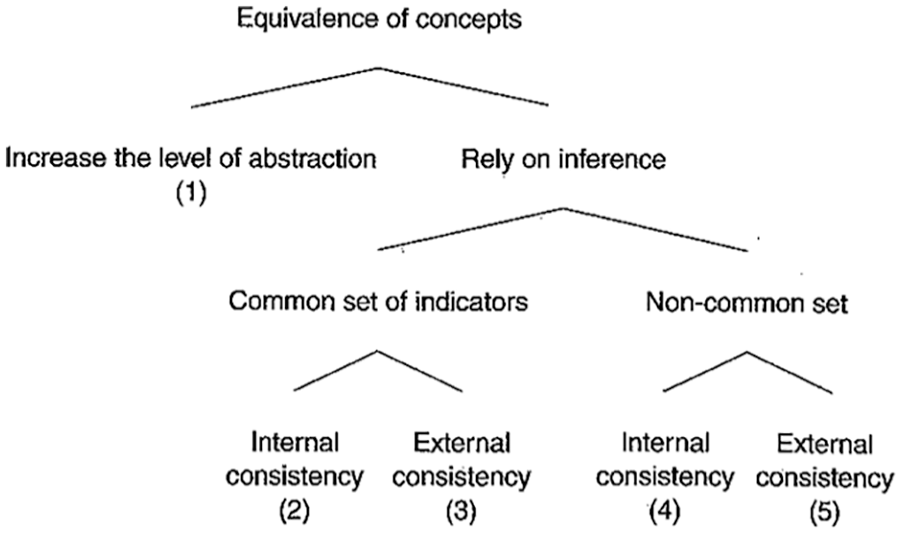
Main Strategies for Establishing Equivalence.
Although the use of different sets of indicators for different situations is recognized as a valuable strategy, it still is not widely used. For instance, Chen (2008) concludes that “both common and culturally specific features should be included in the measurement” (p. 1015) but failed to implement her own wise advice. A very interesting solution to this challenge of combining common and specific features in comparative research was presented by Przeworski and Teune (1966) a long time ago. Their identity-equivalence procedure starts with the selection of a subset of interrelated items that show similar latent structures in the pooled cross-national data set and for each of the countries considered. This subset of selected indicators is assumed to have cross-national validity for some concept; that is, the items selected consistently form a scale regardless of cross-national differences. The largest common subset of selected items is called the identity set. In the next step, the item set for each country is analyzed separately in order to select additional indicators that are related to the identity set in some nation-specific way. The result can be that—apart of the common identity set—scales with different sets of items are found for each country. This provides the opportunity to create longer and thus potentially more valid scales. The cross-national equivalence of these nonidentical scales is based on the availability of the identity set.
The identity-equivalence procedure has been successfully used to construct equivalent measures for political participation by van Deth (1986) and by García-Albacete (2014, pp. 27-34)—both relying on different sets of indicators for different countries and not on identical sets of protest forms as Quaranta (2013) proposes. Especially the different positions of strikes, other forms of protest, party activities, and activities in labor unions in various countries shown in Table 4 requires a strategy enabling the inclusion of nation-specific indicators for protest in different countries. Because the distinction between direct actions and organizational actions can be found in the pooled data set as well as in twelve countries (the one-dimensional structure for the United States being the only deviation), we develop distinct measures for each of these main modes of protest. For these modes, the two initial sets of five and six items will be analyzed separately.
Even among the five forms of direct action it appears to be impossible to construct an identity set with more than three items. Demonstrating is the only item present in all scales for direct action; petitioning and boycotting are missing in Spain and Japan, respectively (see Table 4). These three items appear to form the largest identical subset of items that can be used to construct identical—and rather strong—cumulative scales in each of the countries and in the pooled data set (see upper part of Table 5). 7 This relatively strong correlation between demonstrating, petitioning, and boycotting has been reported by other researchers as well and seems to establish the core of protest all over the world. The next step is to try to expand this three-item identity set in each country with country-specific additions; that is, by trying to add the items strikes and/or other forms of protest to the scale in each country separately. These efforts prove to be rather successful: Only in Japan the measurement of direct action is restricted to demonstrations, petitions, and boycotts. In 10 countries strikes appear to establish a specimen of direct action; in nine countries the same applies to other forms of protest. As a result, we obtain equivalent measures of direct action with different sets of items in different countries (mostly with strong scales). More important, we obtain vital substantive information about the nature of protest in various countries: Direct action consists of partly different activities in such countries as Japan, Australia, Cyprus, or Germany.
Core Set and Country-Specific Expansions for Direct Action (Country and Pooled Data Results; Mokken-scale Analyses; Loevinger’s H).
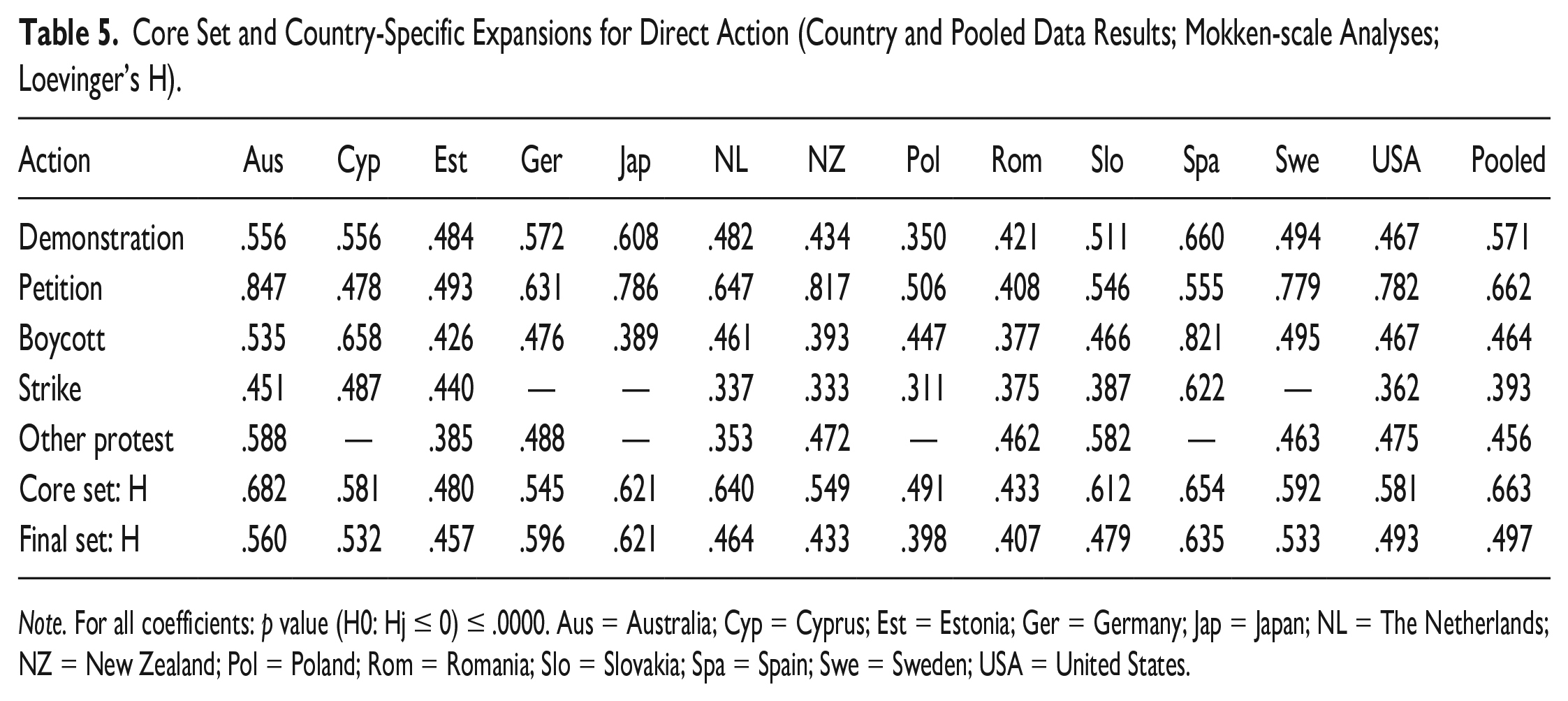
Note. For all coefficients: p value (H0: Hj ≤ 0) ≤ .0000. Aus = Australia; Cyp = Cyprus; Est = Estonia; Ger = Germany; Jap = Japan; NL = The Netherlands; NZ = New Zealand; Pol = Poland; Rom = Romania; Slo = Slovakia; Spa = Spain; Swe = Sweden; USA = United States.
The attempts to construct equivalent measures for organizational activities start with the same problems as the analyses of indicators of direct action: only one item (humanitarian/charitable organizations) is present in scales for this mode of protest in each country (see Table 4). Of the remaining items activities in self-help groups are excluded in one country (the United States). The same applies to consumer groups in two other countries (The Netherlands and Sweden) and to environmental organizations (Germany and Japan). Trying to find the largest common subset of items in all countries and in the pooled data set turns out to be possible for activities in only two groups: humanitarian/charitable and self-help organizations. Since all complications finding an identity set are clearly related to the Swedish results and a common subset of only two items is a rather meagre starting point, an identity set of three items is preferred here. Exploring all combinations of three items among the four most frequently included in scales for organizational activities—humanitarian/charitable, self-help, consumer, or environmental organizations—only the subset consisting of the first three activities proved to be reproducible in all countries but Sweden 8 as well as in the pooled data set (see upper part of Table 6). The next step consists of attempts to expand this identity set in each country separately with one or more of the remaining items. Obviously, the first candidate to be tested for this purpose is the item referring to activities in environmental organizations. Of the remaining two items—parties and labor unions—the former appears to be most suitable to be included in country-specific scales.
Core Set and Country-Specific Expansions for Organizational Protest (Country and Pooled Data Results; Mokken-Scale Analyses; Loevinger’s H).
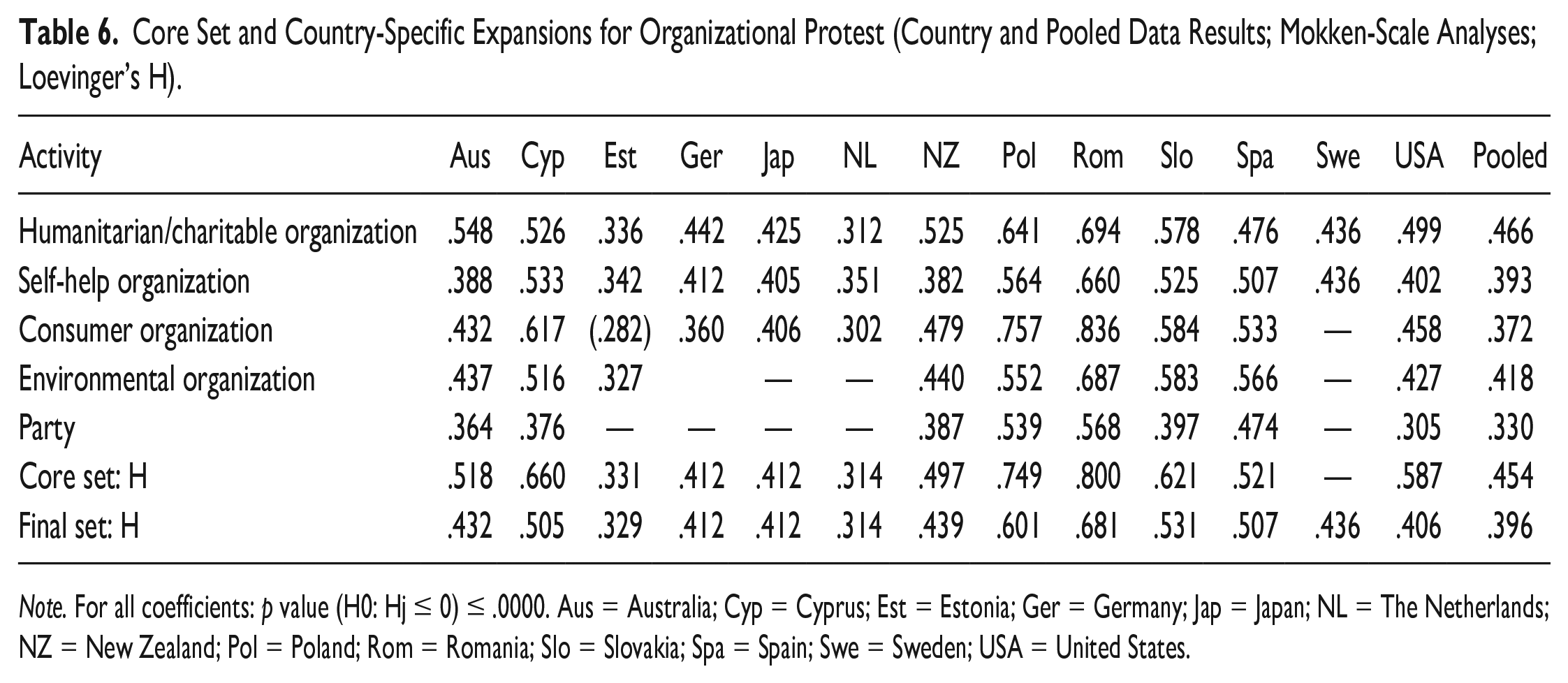
Note. For all coefficients: p value (H0: Hj ≤ 0) ≤ .0000. Aus = Australia; Cyp = Cyprus; Est = Estonia; Ger = Germany; Jap = Japan; NL = The Netherlands; NZ = New Zealand; Pol = Poland; Rom = Romania; Slo = Slovakia; Spa = Spain; Swe = Sweden; USA = United States.
As the results in Table 6 show organizational protest is restricted to humanitarian/charitable, self-help, or consumer organizations in Germany, Japan, and The Netherlands. Furthermore, in Estonia this mode of protest also includes being active in environmental organizations. In the remaining eight countries, activities in both environmental organizations and in political parties are specimens of organizational protest. Although these findings corroborate the usual complications in compiling measures for activities in voluntary associations (Morales, 2009; van Deth & Kreuter 1998), the results are especially interesting from a substantive point of view. First, the cross-national common core of organizational protest consists of activities in three organizations only: humanitarian/charitable, self-help, or consumer groups. Second, in the majority of the countries studied activities in both environmental and in political parties also can be seen as forms of organizational protest. Especially the inclusion of party activities is remarkable, since such actions usually are considered to be a form of institutionalized political participation. Apparently, political parties function as a protest group in many countries but certainly not everywhere.
Applying Equivalent Protest Measures
With the construction of cross-national equivalent scales for the two major modes of protest, the level of direct action and organizational activities can be measured by counting the number of actions and activities for each respondent. Obviously, these additive scores have to be rescaled by taking into account the number of protest forms available in each country. Figure 2 shows the combined means for these two modes of protest. The results corroborate the usual large cross-national differences in the levels of protest. The levels of direct and organizational protest are high and almost equal in the United States—for all other countries the average level of direct actions is higher than the level of organizational activities. This last discrepancy is especially salient in Germany and Spain but also in Sweden, New Zealand, and Australia. Broadly speaking the two modes of protest come together: In countries where one of them is low or high, the other will also be low or high, respectively.
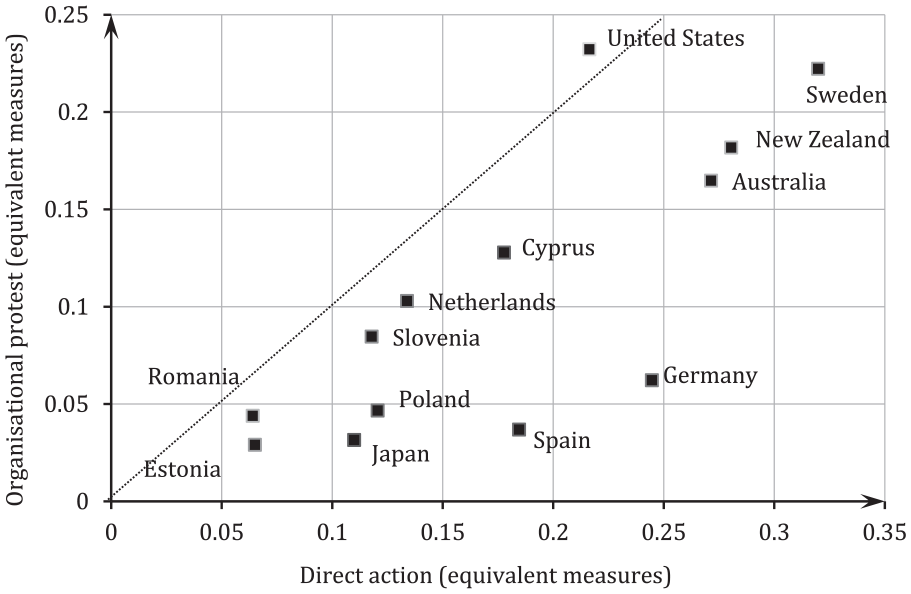
Direct Action and Organizational Protest in Various Countries (Means).
The results summarized in Figure 2 do show the substantive gains to be obtained in comparative research when equivalent measures are applied. The crucial question is, of course, whether these results could not have been arrived at without the time-consuming search for equivalent measures. This question can only be answered if we know how the results based on nonequivalent measures of protest would look like. For this comparison, several variants are available. First, we can simply rely on scientific laziness and use the two batteries of questions as included in the survey (face validity). As a second variant, we could consider the identity sets detected in the previous section as minimum common sets of indicators for the two modes of protest and leave country-specific forms of protest aside.
A comparison of the two identical measures for direct action with the results obtained with the equivalent measure is presented in Table 7. The high correlation coefficients between the distinct measures underline that the three instruments are very similar—any other result would have been highly problematic for the idea that we are dealing with distinct measures of similar phenomena. Moreover, although all differences are statistically significant, the absolute differences are rather modest due to the fact that only small parts of the populations are involved in specific forms of protest. The use of any of the three measures, then, does not imply different substantive conclusions for the cross-national comparisons of the levels of direct action. Apparently, the major gain of applying equivalent measures here lies in the selection of different forms of protest; not in the resulting estimated levels. Country-specific distinctions hardly allow for more specific conclusions: whereas, for instance, in Spain the result for the equivalent measure deviates strongly from the measure based on the survey battery, the results for the core set are more or less the same. In the United States, the pattern is exactly the opposite.
Equivalent and Nonequivalent Measures for Direct Action Compared (Means, Differences, and Correlations).
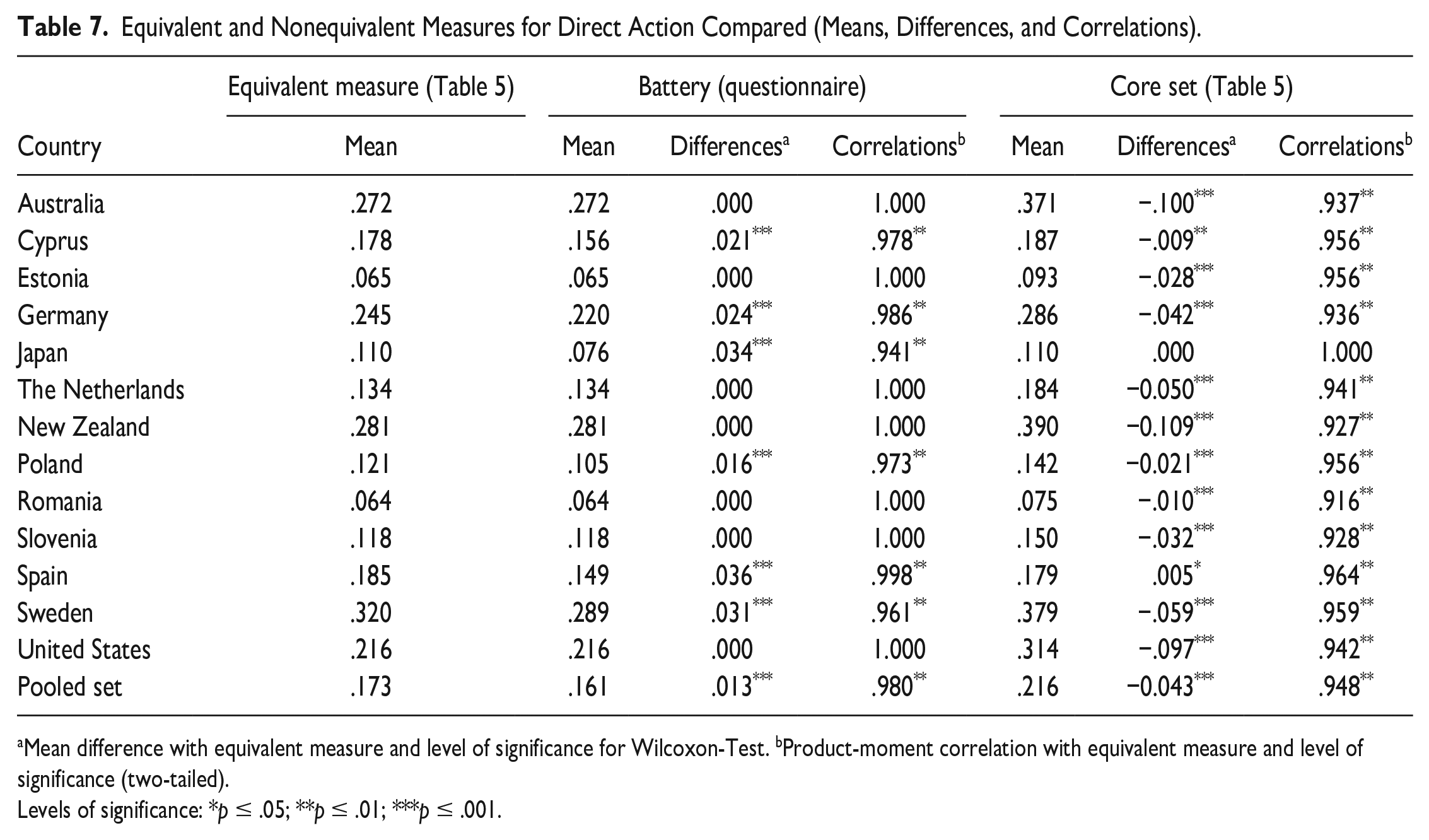
Mean difference with equivalent measure and level of significance for Wilcoxon-Test. bProduct-moment correlation with equivalent measure and level of significance (two-tailed).
Levels of significance: *p ≤ .05; **p ≤ .01; ***p ≤ .001.
Similar computations for the cross-national comparisons of the level of organizational protest using the three measures available are summarized in Table 8. The absolute differences in this case are even smaller than for direct actions and several differences do not reach an acceptable level of statistical significance in Cyprus, New Zealand, Spain, and Sweden when the results for the simple questionnaire battery are compared with the equivalent measure; and in Poland for comparisons with the results obtained for the core set. The rather low percentages of people involved in various organizational actions (see Table 1) clearly make the selection of specific items largely irrelevant to estimate the level of this mode of participation in cross-national comparisons. Plain differences between the results obtained with the three measures can be found in Slovenia and the United States, but the general positions of the countries in comparative perspective does not depend on the selection of a specific measure.
Equivalent and Nonequivalent Measures for Organizational Protest Compared (Means, Differences, and Correlations).
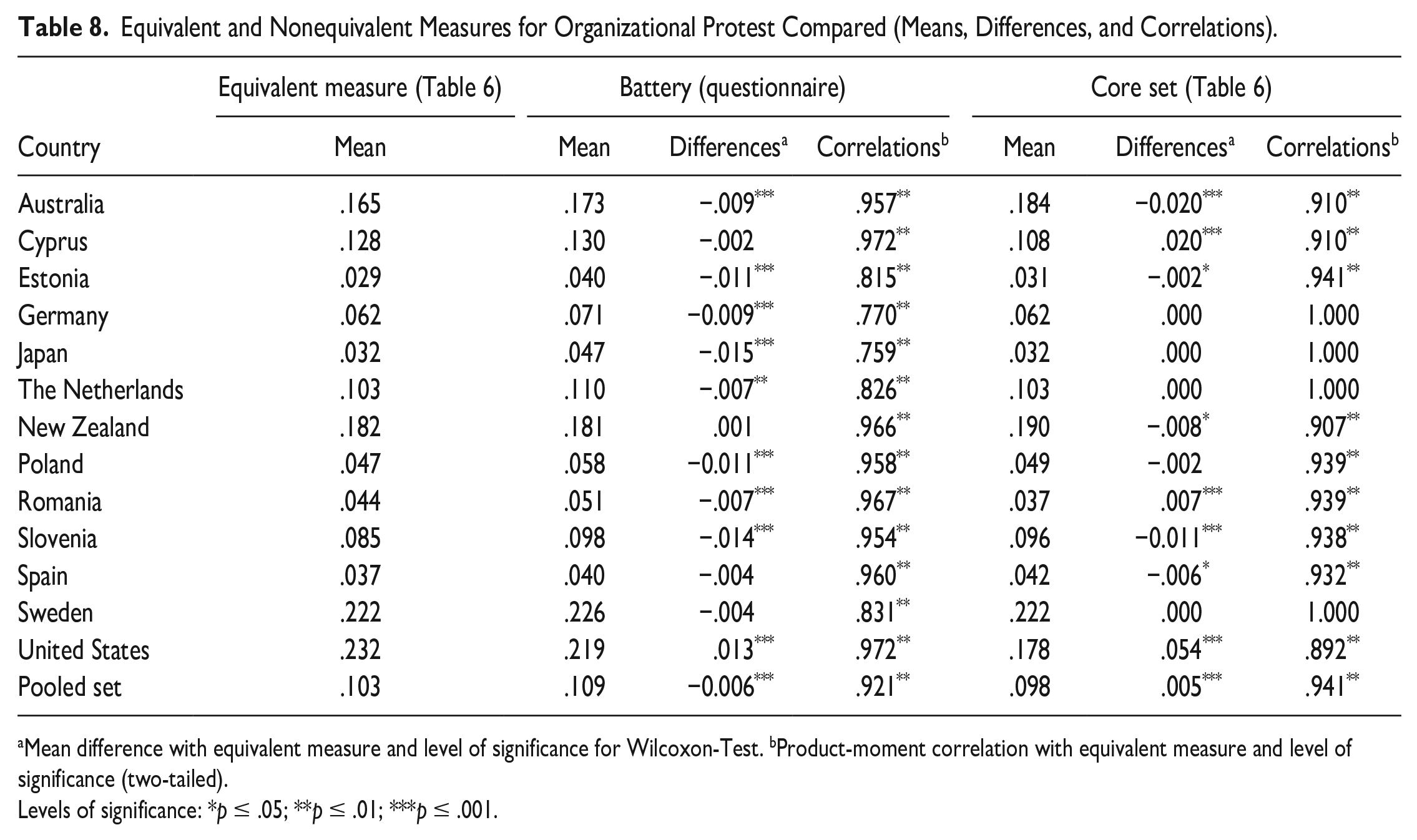
Mean difference with equivalent measure and level of significance for Wilcoxon-Test. bProduct-moment correlation with equivalent measure and level of significance (two-tailed).
Levels of significance: *p ≤ .05; **p ≤ .01; ***p ≤ .001.
Conclusion
Protest emerges in different forms in different countries. Cross-national and longitudinal research has corroborated this observation long ago and documented the context dependency of protest. Yet systematic approaches to deal with these apparent peculiarities are very rare. This article presents a strategy to deal with country-specific forms of protest in comparative research by developing equivalent instead of identical measures for protest in 13 advanced democracies around the world. The urge of this strategy is strongly underlined by the fact that the appealing two-dimensional structure of protest found for the pooled data set cannot be reproduced at the country level.
Substantive results became visible in each step of the attempts to develop equivalent cross-national measures of protest. First, a clear distinction between direct forms of protest (e.g., demonstrating or petitioning) on the one hand and organizational actions (e.g., supporting humanitarian or self-help organizations) on the other hand can be found in each country considered as well as in the pooled data set. Yet the specific composition of these two modes of protest is not identical in various countries. Second, the country-specific sets of items to measure direct action or organizational protest each reveals a cumulative ordering of the selected forms of protest—corroborating the behavioral presumption underlying the people’s choice of specific forms of action. The search for a common cross-national subset of items that represents the two modes of protest in the same way in each country shows that direct action comprises of only three forms (demonstrating, petitioning, boycotting), and organizational protest also of only three forms (humanitarian/charitable, self-help, consumer organizations). Third, various forms of protest can be used as country-specific expansions of the common three-item sets constructed. In this way, cross-national equivalent measures are obtained for each of the two modes of protest distinguished, each based on different sets of items for several countries. The application of these measures shows, finally, the usual large cross-national differences in the levels of protest. Broadly speaking, the two modes of protest come together: In countries where the level of one of them is low or high, the other will also be low or high, respectively.
Footnotes
Declaration of Conflicting Interests
The author(s) declared no potential conflicts of interest with respect to the research, authorship, and/or publication of this article.
Funding
The author(s) received no financial support for the research, authorship, and/or publication of this article.
