




Abstract
Popular models portray that high inequality induces elites to sponsor coups and reverse democratization as a means for repressing redistributive demands. Challenging this prediction, Latin America shifted from a historical pattern of systematic democratic breakdowns to one characterized by the resilience of democracy despite extreme levels of inequality. This article argues that the reminiscence of state-led repression under democracy explains why elites more regularly waive coups as solutions to distributive conflict in Latin American democracies. I call this state segmentation, a concept that describes the asymmetries between the enforcement of citizenship rights for those in privileged positions and for the poor. Wherever state segmentation is high, the odds of democratic breakdown should be lower. I test the argument using logistic regression models to predict the probability of coups and mandate interruptions considering different levels of state segmentation in Latin America using V-Dem data. Results show that asymmetries in access to citizenship rights indeed prevent democratic breakdowns.
The distributive conflict approach has become a popular explanation for the emergence and fall of democratic regimes based on how income inequality alters the costs of political competition to elites (Acemoglu & Robinson, 2000, 2005; Boix, 2003). This approach reinforces the traditional understanding in social science that inequality prevents democracy (Dahl, 1973; Lipset, 1959; Przeworski et al., 2000; Rueschemeyer et al., 1992). Challenging this idea, however, Latin America as well as other third wave cases (Huntington, 1993) present several unequal yet durable democracies. By “unequal” democracy, I mean that income inequality is high but the procedures of democracy are present, and by “durable” I mean that such procedures remain in place without interruption. Assuming 1 that elites are indeed pivotal in determining whether democratic regimes are maintained or replaced, why do they cope with democracy in contexts of extreme inequality? In this article, I argue that elites’ attitudes toward political regimes are affected by the state’s capacity to shield those at the top from redistributive demands. Democracies, contrary to what previous models portray, can effectively repress the poor, therefore granting such protection.
Some revisions of the distributive conflict approach highlight the effect of other variables beyond inequality in order to explain elites’ commitment to democratic rule, such as the abundance of natural resources (Dunning, 2008), the strength of conservative parties (Ziblatt, 2017), and the participation of ousting autocrats in the elaboration of the constitutional rules of the emerging democracies (Albertus & Menaldo, 2018). Authors portray the advantages of democracy for elites in securing assets from, not the poor, but the state (Albertus, 2015; Albertus & Gay, 2017; Ansell & Samuels, 2014), while others assert that distributive conflict has little impact on elites’ decision-making process during transitions (Haggard & Kaufman, 2016). All these focus on the role of redistribution, leaving aside that of repression.
Research shows that economic inequality fosters political inequality, suggesting that democracies with high inequality perform worse in protecting the civil rights of the poor (Cole, 2018; Dubrow, 2007, 2014). But could it be that it is this asymmetry what prevents such democracies from collapsing? The argument put forward here is that indeed the effectiveness of citizenship rights is unevenly distributed across the socioeconomic ladder in several democracies, constituting what I conceptualize as state segmentation. Because of this asymmetry in the enforcement of citizenship, the state regularly violates the rights of the poor, increasing their cost of mobilization and decreasing the costs of democracy to elites, thus preventing the latter from sponsoring regime reversals. To test the implications of this theory, I use V-Dem data for Latin America, a region that historically experienced democratic breakdowns but one in which coups became scarce after the third wave of democratization. I estimate the association between the asymmetry of citizenship rights and the probability of experiencing democratic breakdown through a coup, as well as the odds of experiencing the interruption of a presidential mandate through legal means such as an impeachment trial. Results portray that cases where citizenship rights are effective to the elite, but less effective to underprivileged groups, are less likely to experience political instability and much less likely to suffer regime breakdown.
The article offers two contributions: (a) the introduction of the concept of state segmentation, which describes how democracies violate citizenship rights and (b) the assessment of how state segmentation affects democratic survival. These challenge a frequent interpretation of Latin American states, that is, that uneven enforcement necessarily reflects state and institutional weaknesses and dysfunctionalities (see Brinks & Botero, 2014; Brinks et al., 2014; Fukuyama, 2004; Luna & Soifer, 2017; Soifer, 2013). Instead, I argue that uneven enforcement of citizenship rights benefits elites and helps them endorse democratic continuity in contexts of high inequality.
The mechanisms by which states skew the effectiveness of citizenship rights in detriment of the poor and marginalized groups are diverse: police brutality against demonstrations, harassment in low-income communities, mass incarceration, uneven access to courts, and inaction against private militias are but a few. These mechanisms increase the costs of participation and contestation for poorer citizens and secure elites’ position against redistributive threats. While mechanisms may differ, they are all triggered by state segmentation. The latter supply the demand for repression in substitution of previous formal authoritarian institutions. In a nutshell, state segmentation prevents democratic breakdowns because it equips democracies with efficient repressive mechanisms.
The article is divided into five sections. First, I discuss the unexpected resilience of unequal democracies in light of the distributive conflict model. Second, I unpack the concept of state segmentation and present my argument regarding its role in the resilience of democratic regimes in contexts of high inequality. Third, I present the data and methods. Last, I present the results, closing the article with a Discussion and Conclusion section.
High Inequality and Democracy
Democracies can be defined in procedural terms as those regimes in which civilian rule is elected through free and fair elections and where different branches of government keep one another accountable (see Przeworski et al., 2000; Schumpeter, 1934/2013). Societies with very different patterns of income distribution can thus be considered democracies, depending on how political power is organized. Distinguishing democracy from the social goods that many expect it to deliver is key for understanding how different social features help or hurt the probabilities that countries have of becoming and remaining democratic (Altman & Pérez-Liñán, 2002). These goods account for the “quality” of democracy (see also Morlino, 2004), while procedures account for the basic distinction between democracies and nondemocracies.
Current theories of democratization 2 and democratic survival rely heavily on the opportunities and constraints that elites, notably economic elites, face. Economic elites can be understood as individuals capable of influencing politics due to their economic resources and their position in business organizations and the corporate world (see López, 2013a). The argument first developed by Acemoglu and Robinson (2000, 2005) and Boix (2003) 3 sustains that democracy and democratic reversals result from the economic elites reacting to distributive demands of the poor. When facing distributive conflict, the argument goes, elites can respond by either repressing the poor through an authoritarian regime, or by granting them a credible commitment to redistribution through democratization. Because the cost of redistribution (to elites) is a function of income concentration, the prediction is that democracies in contexts of high inequality will be short lived. In light of the current trend of income concentration, several scholars add to this idea as they foresee a democratic recession (Diamond, 2015; Kurlantzick, 2013; see also Levitsky & Way, 2015, for an opposite view) and increasing vulnerability of current democracies (Levitsky & Ziblatt, 2018).
On the other hand, democracies with high levels of inequality are more numerous and more durable today than in any time in history. As observed in Figure 1, almost half of democracies show high levels of inequality and the share of unequal countries that are democracies increased steadily in recent decades.
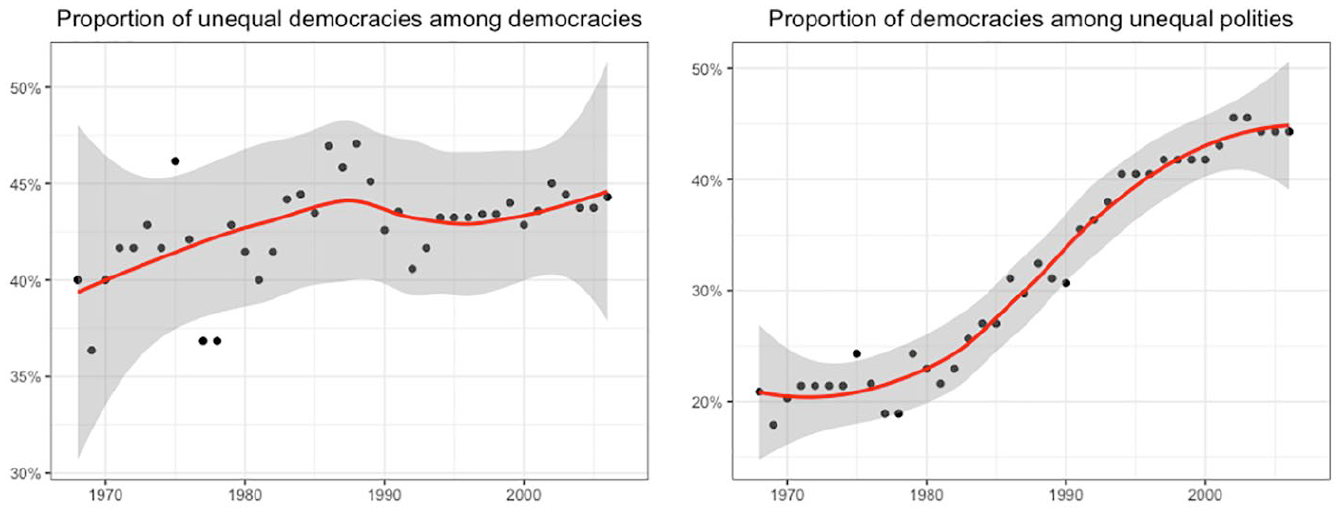
Unequal Democracies in the World.
Latin America, commonly held as the most unequal region in the world, inflates the rate of unequal democracies. While democratic rule consolidates in the region, the assumed causes of authoritarianism remain in place, among them income inequality (Blofield, 2011a). Since democratization, Latin American elites have been challenged by unions, left-wing parties, social movements and guerrillas, while also facing extreme levels of criminal violence. Moreover, research shows that elites in the region acknowledge inequality as the cause of social conflict (López, 2013b, 2016; Reis & Moore, 2005). However, elites less often pursue democratic reversals.
Revisions of the distributive conflict approach have concentrated in discussing the causes of elite support of democratization in contexts of high inequality (Albertus, 2015; Albertus & Gay, 2017; Ansell & Samuels, 2014), but have generally not addressed why elites remain loyal to democracy afterward (exceptions are Albertus & Menaldo 2018; Dunning, 2008; Ziblatt, 2017). A criticism often made to the distributive conflict approach relates to its strong assumptions of rationality, which often contrast with observed outcomes (Weyland, 2019). Originally, distributive conflict theory assumes that economic elites hold perfect information about the distributive consequences of future regimes, and are capable of predicting the course of action of the poor under different political institutions. This expectation contrasts with research showing that elites’ understanding of the poor and the threats they pose is culturally bounded and inefficient (Blofield, 2011b; López et al., 2020; Reis & Moore, 2005). It is less demanding to assume that elites’ update preferences based on their own experience.
In Latin America, elites gradually learned that autocratic regimes offer instant protection but provide weak long-term commitments to property rights and personal security (Albertus, 2015; Albertus & Gay, 2017; Hagopian, 1996/2007; Weffort, 1989). Elites could very well have been convinced that autocracy was in their best interest, while experiencing it, only to find out later that unequal democracy provided higher returns. This process is well illustrated by the case of Chile, where elites experienced an autocratic regime from which they benefited greatly. Chilean economic elites and upper classes supported autocratic rule, even throughout the democratic transition, but changed their preferences afterward.
Beyond Chile, it is well-established that the other military dictatorships that emerged in South America between the 1960s and 1970s were backed by elite coalitions (Collier & Cardoso, 1979; Grimes & Pion-Berlin, 2019; O’Donnell, 1973). These cases support the traditional idea that elites prefer to repress the poor through autocratic rule, as the support of South American elites for military regimes was clearly related to their desire to exclude populist rulers, suppress left-wing movements, and prevent redistribution. Nonetheless, by the early 1990s all autocratic regimes in the region were extinct.
Whether elites in fact endorsed democratization may vary from case to case. This could be an accurate description of the cases of Argentina, Uruguay, and Brazil, but it is hardly the case in Chile where economic elites backed the authoritarian regime until its last breath. Despite variation in the processes that led to democratization in Latin America (see Haggard & Kaufman, 2016; Higley & Burton, 2006; Higley & Gunther, 1992), the current scenario is one of durable democracies in which elites do not signal a preference for a reversion to authoritarian rule.
Most of Latin America’s democracies resisted economic recession in the late 1990s, and the emergence of left-wing governments in the 2000s. Elites continued to endorse formal democratic institutions despite the actions of organized political groups demanding redistribution and recognition, such as the MST in Brazil, the Piqueteros in Argentina, and the Mapuche in Chile. Elites also faced unorganized poor who threatened them with criminal violence. Despite an apparent perfect storm of inequality, only in a few cases did elites decide to coordinate coups, such as in Venezuela in 2002, Honduras in 2009, and more recently in Bolivia in 2019.
In most cases, and despite the fear of democracy that they might have had, elites learned that democratic regimes in many regards provide greater returns if compared with authoritarian ones. Several instances facilitate this new adherence to democratic rule. For once, elites were able to organize around conservative parties and interest groups in order to shape the tax code in their favor and block redistributive projects (Bogliaccini & Luna, 2019; Fairfield, 2015). Nonetheless, that type of coordination does not prevent the poor from revolting, which is the predicted consequence if no redistribution takes place. In the absence of redistribution, regime stability requires repression.
Coups Versus Legal Oustings
Coups can be defined as the forceful removal of rulers or suppression of government branches (in the case of a self-coup) through unconstitutional means (see Linz & Stepan, 1978). A coup in a democracy implies the suspension of that regime, as elected leaders no longer rule and/or government branches no longer keep each other accountable. Throughout the 20th century, elites in Latin America sponsored military coups against freely elected rulers to shield from distributive claims. This reality backed theories that associate elite interest with autocratic rule (e.g., Mainwaring and Pérez-Liñán, 2013; O’Donnell, 1973; Rueschemeyer et al., 1992). Contemporary elites know from past experience that coups are feasible endeavors, and an important resort to foster protection in the face of distributive threats. The rationale is straightforward: more distributive claims call for either redistribution or repression, and given that elites might prefer not to redistribute, a fast shift toward a repressive regime seems their best alternative. If this mechanism was constant in Latin America, we should have continued to observe regressions toward authoritarianism in the region. Contrastingly, there are few clear cases of coups in the post-1975 period, such as Bolivia (2019), Ecuador (2000), Honduras (2009), Peru (1992), and Venezuela (2002). Of those cases, only the coups in Bolivia, Honduras, and Venezuela can be clearly assumed as events in which distributive conflict drove elites to sponsor a coup against a left-wing incumbent. Distributive conflict was also relevant in Peru given the threat of a Marxist inspired guerilla, which helped justify President Fujimori’s self-coup.
Meanwhile, constitutional removals of acting presidents in the form of impeachment trials were more frequent and in a way replaced coups in the region, as argued by Pérez-Liñán (2007). Some impeachments targeted left-wing administrations, such as the ousting of Lugo in 2011 in Paraguay and that of Rousseff in Brazil in 2016. As coups, legal interruptions promoted by impeachment trials are also a symptom of instability. Nonetheless, the implications for democracy are completely different in one case and in the other. Impeachment trials remove unwanted rulers within the boundaries of law, while coups represent a break with the existing constitutional order.
The consequences of impeaching an acting president and those of removing him or her by force are thus completely different. Had President João Goulart been impeached in the mid1960s in Brazil, instead of overthrown by a military coup, the political history of that country would have been certainly very different. Goulart was already substituting Jânio Quadros, who resigned. If Congress had managed to impeach Goulart, it would be up to the Congress itself to appoint his substitute through an indirect election. 4 Instead, the coup brought a military junta in his place, inaugurating over two decades of autocratic rule. Autocratic rule in Brazil, as that of Argentina, Chile, and many other cases in the region, was initially effective in insulating the elites from redistributive demands, but later proved to be a source of important externalities, including weak commitment to property rights, which led elites to abandon authoritarian coalitions in support of democratization (Albertus, 2015; Albertus & Gay, 2017; Hagopian, 1996/2007; Weffort, 1989).
In trying to avoid the unintended consequences of coups, elites promote legal oustings. This usage of democratic formality relates to Levitsky and Ziblatt’s (2018) concept of constitutional hardball, which facilitates the deterioration of democratic regimes. The shift from coups to impeachments erodes rules of mutual tolerance between elites, weakening democracies. But the institutional bases of political regimes remain unaltered in the immediate aftermath of legal oustings, preserving the basic procedural traits of democratic rule and, to some extent, preventing democratic breakdown.
This is not to say that political instability in the region is over, far from it. As noted, the implication is also not that Latin American democracies present high or constant levels of democratic quality. Some cases in the region experienced democratic improvement, others suffered erosion and many more stagnated (see Mainwaring & Bizzarro, 2019). What is novel in the region is that conflict resolution more often takes the form of legal interruptions of presidential mandates, such as those allowed by impeachment trials and less often in the form of democratic breakdowns.
State Segmentation: Concept and Theory
The limited coverage of citizenship rights in Latin America is a matter of extensive research (e.g., Brinks, 2007; Brinks & Botero, 2014; O’Donnell, 1993). Such limitation is commonly understood as a manifestation of low stateness, low state capacity and institutional inefficiency (see Brinks and Botero, 2014; Brinks et al., 2014; Fukuyama, 2004; Luna & Soifer, 2017; Soifer, 2013). This literature adds to a long tradition in Latin American and latinamericanist scholarship regarding the duality of authority structures in the region (e.g., Lambert, 1967; Sarmiento, 1874; Taylor & Bacha, 1976; Weissman, 2014).
Those authors account that citizens can receive radically different treatment from the state, depending on their position in the socioeconomic structure. Instead of mitigating it, democratization sharpens this contrast because elites now experience the rule of law, while the poor remain vulnerable to arbitrary state action. It can be said that, by implementing different patterns of interaction with different segments of the population, the state segments the enforcement of citizenship rights. State segmentation can thus be defined as a form of political inequality, resulting from the uneven coverage of formally assured citizenship rights. Rights are not violated by incumbents to retain power, as observed in competitive authoritarian regimes (Levitsky & Way, 2010). Instead, state actors violate citizenship rights by skewing the distribution of goods and the use of force, protecting the well off from the worse off. The mechanisms of state segmentation are for the most part informal and violate the assumption of political equality that lies at the normative core of democracy. But they do not necessarily harm the procedural aspects of democracy.
In Latin America, it became clear that the segmentation of state action is a part of, and not a deviation from, the region’s political equilibria. Previous research has accounted for other forms of segmentation in the region. For instance, Luna (2014) portrays the segmentation of party–voter linkages as a key mechanism in attending both the poor and the rich without altering the overall pattern of income concentration. In a related argument, Holland (2017) describes how some basic needs of the poor can be contemplated by the politicians’ decision to waive law enforcement, generating income through illegal and informal channels without taxing the rich. Both theories indirectly relate to state segmentation and portray equilibrium patterns that prevent more meaningful redistribution from taking place.
Distributive conflict theory predicts that, unless elites credibly commit to redistribution, high inequality will prompt the poor to coordinate and revolt, taking over the state and expropriating accumulated resources. In that scenario, elites’ venue for self-defense is repression. Because authors dismiss the possibility of repression under democracy, traditional models of distributive conflict portray that elites must choose between redistribution and repression and, by doing so, between democracy and autocracy (Acemoglu & Robinson, 2005; Boix, 2003). 5 State segmentation, on the other hand, portrays the continuity of repressive procedures in well-established democracies, thus substantially changing the incentives for elites and the poor.
Segmented states are efficient in repressing demands for redistribution and recognition. Franklin (2020) shows that states in Latin America tend to respond to public demonstrations by increasing the levels of state violence perpetrated against nonpolitical actors, whereas the effect is the opposite for formal political groups. In other words, state violence and terror are more likely to be experienced by common, unorganized citizens who would benefit from redistribution and would otherwise have strong incentives to demand it. Examples of brutal dispersion of peaceful and spontaneous demonstrations could be seen in 2019 in Chile and Ecuador, as well as in Brazil in 2013. Organized minorities claiming recognition are also less likely to be protected by courts (Perricone, 2020) and state perpetrators of human rights violations are less likely to respond judicially (Brinks, 2007).
State segmentation also accounts for the repression of the poor in more subtle and frequent ways. Arbitrary searches, routinary harassment and other forms of rights violations remind the poor of the costs of mobilization and contestation. These conditions lead many to comply with social injustices, even though the legal framework is, in theory, to their advantage. Regarding human rights abuses in Latin American slums, for instance, locals commonly advise to keep a low profile instead of denouncing police misconduct.
As an alternative to protest and activism, poorer citizens can use the tools of democracy and elect politicians that are more responsive to their claims. A well-known phenomena in Latin America was that of the pink tide, a succession of left-wing administrations in the region during the 2000s which was in part the outcome of demands for social justice and effective citizenship rights (Grugel & Fontana, 2019). The administrations of PT in Brazil, Frente Amplio in Uruguay, MAS in Bolivia, the MVR (later rebranded as PSUV) in Venezuela and others managed to incorporate large sectors of society, reducing inequality and engaging in different levels of conflict with economic elites. In two of those cases, Venezuela and Bolivia, elite coalitions promoted coups against incumbents. In the other cases, elites were for the most part reassured that states would not be reformed. As Brinks and Botero (2014) note, the levels of state violence increased after democratic transitions, a reality that remained unaltered after the left-turn.
Elites, on the other hand, experience a well-functioning rule of law and would hardly fear being victimized by state arbitrarily. Segmented states in unequal democracies offer elites the possibility of supporting regimes that are effective in their repression of the poor, as well as in providing a credible commitment to the elites in regard of their own civil rights. To elites, state segmentation signals that repressive forces are on their side. To the poor, state segmentation represents higher costs for collective action and at times life under siege. It is a continuous reminder that they are susceptible to state violence. Of course, poor citizens organize around unions and social movements anyhow, and get important concessions. But they do so at significantly higher costs.
Although state segmentation benefits elites, the implication is not that states are segmented by design, nor that state actors and elites always converge. Segmented states more likely result from contingent historical processes anchored in authoritarianism (López, 2018). For the present argument, what is crucial is that segmented states, once in place, modify the incentives that elites are likely to perceive regarding democratic rule.
Summary of the Argument
I assume that elites are pivotal to regime stability and regime change, and that elites act in pursuit of (a) securing their assets from expropriation by the state and (b) securing their assets from rebellious poor. High inequality increases the costs of redistribution vis-à-vis repression, in theory making repressive (autocratic) regimes preferable to nonrepressive regimes. Nonetheless, autocracies increase the risk of expropriation by the state, prompting elites to reconsider the benefits of liberal institutions. After democratization, state segmentation prompts state actors to reproduce repressive patterns of interaction with the poor. Elites soon learn that this new scenario provides greater returns and guarantees compared with previous autocratic rule. Consequently, elites prefer to rely on repression within democracy instead of reversing the regime back to authoritarianism. It follows that democracies with high state segmentation should be less likely to experience democratic breakdown.
What State Segmentation Is Not
Because this is a wide covering concept, it is important to clarify what should not be taken as state segmentation. State segmentation is not truncated vertical accountability. This does not contradict that unequal democracies may have, as they often do, elite biased outcomes in terms of political representation (Bartels, 2018; Gilens, 2012), nor does it dismiss the relevance of money in politics (Diamond, 2008; Hacker & Pierson, 2010). State segmentation derives from the interaction between citizens and the state, not voters and politicians.
State segmentation is not rent seeking. The idea that economic elites often extract resources from the state in the developing world is well-established (see Bates, 1981), but this is not directly related to state segmentation as it could occur regardless of it. On the other hand, state segmentation can facilitate the exploration of cheap labor and modern slavery, because it undermines the citizenship rights of the poor and may foster informality. Elites can thus profit from state segmentation, but this is not directly related to the causal link between state segmentation and democratic durability, because elites would, presumably, also be able to exploit the poor in autocratic regimes.
State segmentation is not, nor implies, competitive authoritarianism (Levitsky & Way, 2010) nor illiberal democracy (Zakaria, 1997). Such regimes are accounted in the literature as those in which elections and the separation of powers are present but systematically violated by incumbents. There are implications of state segmentation for the quality of democracy, but not for the procedures of democratic rule. Democracies with segmented states can be accounted as full democracies, from a procedural perspective, if they fulfill the prerequisites described in the literature: free elections and separation of powers. Those attributes are only partially present in cases of competitive authoritarianism.
Finally, state segmentation is not segmented representation (Luna, 2014) or forbearance (Holland, 2017), although these are close concepts, as noted. The difference between state segmentation and those accounts is that state segmentation is not directly related with party–voter linkages. State segmentation is not a derivation of accountability, representation, or distribution, but one of citizenship rights.
Alternative Explanations
Other revisions and updates of the distributive conflict framework offer important alternative or complementary explanations to the one I am proposing. Nonetheless, they often focus on why transitions to democracy occur in unequal settings, less on why such cases remain democratic. In a sense, scholars seem to assume that the causes of democratization and those of democratic stability are the same. Some revisionist accounts indicate that there are other variables that should interact and potentially change the effect of inequality on democratization. For instance, Acemoglu et al. (2011) and Soifer (2013) explain unequal democracies by adding the impact of state capacity to the distributive conflict model. According to those authors, elites are more likely to endorse emerging democracies whenever they believe that states will not be capable of implementing redistribution. Similarly, Albertus and Menaldo (2018) posit that elites accept democracy when they are able to intentionally craft state incapacity by designing constitutional constraints during transitions. In common, those propositions rely on state incapacity as a key explanatory variable for why democracy consolidates in contexts of high inequality.
Although Latin America inspired two out of the three mentioned studies, the set of unequal but durable democracies in the region includes important cases that are accounted as having high state capacity. For instance, Chile is often portrayed as a champion of state capacity in the region, but also as a case where democracy became stable at high levels of income inequality. Other cases, such as Paraguay and Brazil, implemented new constitutions after democratization and did not experience coup attempts since. Variation in state capacity and in having preauthoritarian or postauthoritarian constitutions does not seem to fully explain regime continuity in the region.
Commonly assumed as facilitating autocracy, another variable that was theorized as altering the effect of inequality on democratic rule is the abundance of natural resources, as argued by Dunning (2008). The author argues that the costs of redistribution decrease when elites are able to attend distributive demands using natural resources instead of their own wealth. This would allow elites to cope with democracy in unequal settings. His main case is, ironically, Venezuela. Latin American countries are predominantly dependent on the revenue from natural resources. Yet, among the cases of greater dependency on oil, gas, and minerals we find varying levels of democratic stability, with Venezuela’s collapse on the one extreme and Chile’s regime stability on the other.
Another intervenient variable analyzed in the pertinent literature is the strength of conservative parties. Looking at Europe, Ziblatt (2017) posits that democracy’s survival occurs when elites succeed in organizing conservative parties before competitive politics is fully installed. Preexisting party organizations would then prevent the distributive outcomes of democracy and, by doing so, also allow elites to accept democratic rule. The argument is compelling and mirrors Gibson’s (1996) comparative study of (the lack of) conservative parties in Argentina.
On the other hand, democratic survival is unlikely to be attached to the strength of parties of any kind in Latin America. Elites often rely on new and ephemeral right-wing parties, as more clearly seen in Peru (Levitsky & Cameron, 2003). In Brazil, conservative parties were weakened during and after regime change, forcing elites to ally with center and center-left parties instead. Argentina lacked any competitive conservative party for most of its recent history. It is true that, possibly due to the absence of strong conservative parties, elites traditionally relied on the military to prevent undesired distributive outcomes, a fact that suits Ziblatt’s argument. However, conservative parties remain weak (as do most parties) in current times.
Finally, alternative accounts to the distributive conflict approach offer causal explanations that are not centered on games between elites and the poor, but instead on games within different sectors of the elite. In that vein, some authors argue that elites endorse democracy to protect assets from the action of autocrats (Albertus, 2015; Albertus & Gay, 2017; Ansell & Samuels, 2014). 6 This is part of the argument put forward here as well, as I assume that the elites endorse liberal institutions aiming for protection. My approach is thus complementary to theirs.
All mentioned revisions of the distributive conflict framework neglect the role of repression by focusing on redistribution alone. Furthermore, those accounts focus on regime change but say little about regime durability. Contrary to what these authors sometimes seem to imply, the original proposition by Acemoglu and Robinson (2005) does not suggest that inequality always prevents democratization, but that democracies in unequal settings should be short-lived. Why unequal democracies endure, not why they emerge, is the main puzzle that previous models let uncovered. Among the studies reviewed above, only Albertus and Menaldo’s (2018), Dunning’s (2008), and Ziblatt’s (2017) offer specific theories for democratic durability, while accepting inequality as the main cause of regime change.
There are of course alternative explanations beyond the scope of the distributive conflict approach. Studies in international relations point to the role of international markets in creating the conditions for democratization (Frieden, 1992; Roberts, 1998). Campello and Zucco (2016) show that the fate of Latin American incumbents is tied to exogenous economic conditions. Their assessment of the popularity of incumbents and the likelihood of electing successors could be transposed to that of regime stability. But economic exogenous shocks were particularly hard during the 1990s in Latin America, to no apparent effect regarding democratic breakdowns.
Given the scarcity of coups in the region one might question whether coups are indeed an option. From a collective action point of view, it is clear that elites in Latin America have the resources to stage coups. What makes them less frequent in current times has to do with a number of factors, including, presumably, the effect of global markets. Although external incentives to sustain market economies and democratic rule are virtually the same for all cases, some turn out to be stable unequal democracies and some do not. It follows that within-case variables must play an important role.
Another possible explanation relates to the left-right divide. A classic distinction between left-wing governments in Latin America points to the cases of “good left,” which includes the cases of Brazil under PT and Chile under the Concertación, and those of “bad left,” which includes Venezuela under Chavismo (see Blofield, 2011b; Levitsky & Roberts, 2011). Good or bad being relative to business perspectives. In that sense, Mainwaring and Pérez-Liñán (2013) and Campello (2015) argue that democratic stability lies not only on the left abandoning its revolutionary aspirations but also on their adherence to the market economy. In their account, elites’ attachment to democratic regimes would reflect the left’s commitment with market fundamentalism. Although the contrast between market-friendly and market-enemy lefts should have a significant effect on elites’ overall strategies, it fails to predict the events in which economic elites turn against “good left” administrations. Neither the administrations of Rousseff in Brazil nor that of Bachelet in Chile implied a shift toward a revolutionary path. This was not elites’ perception of matters however, which indicates that their interpretation of conflict may be somewhat disconnected with what left-wing administrations are actually implementing.
In that sense, Weyland (2014, 2019) argues that elites overestimate threats from below, acting based on bounded rationality. His is not a rival theory to my own, but another way of framing how elites react during crises. Bounded rationality is not incompatible with my explanation, as I expect elites to act on imperfect information. I also argue that elites update their regime preferences based on their experience. The question is not whether elites use cognitive shortcuts or not, but what are the elements that inform their decision-making processes.
I thus argue that elites react mainly based on their perception of security, which is based on the institutional and informal guarantees that neither the state nor the poor will expropriate their wealth. As noted, there are good models for why elites react to distributive conflict with the poor (Acemoglu & Robinson, 2005; Boix, 2003) and good models for why they fear distributive conflict with the state (Albertus, 2015; Ansell & Samuels, 2014), but such models are incompatible and reach opposite conclusions. The first suggests that elites in contexts of high inequality will resort to coups in order to shield from the poor, while the latter predicts that elites will sustain democracy to prevent expropriation in the hands of autocrats. My theory reconciles those propositions by describing how segmented states account for scenarios that are both fully democratic, in a procedural sense, and highly repressive, thus protecting elites from the state and the poor. Having learned the benefits of democracy under state segmentation, economic elites should avoid ruptures, all else constant. This does not imply that other revisions, such as Albertus and Menaldo’s (2018), Dunning’s (2008), or Ziblatt’s (2017), are incorrect or rival to my own, but that the effect of segmentation should be relevant even if accounting for those other factors.
Data and Method
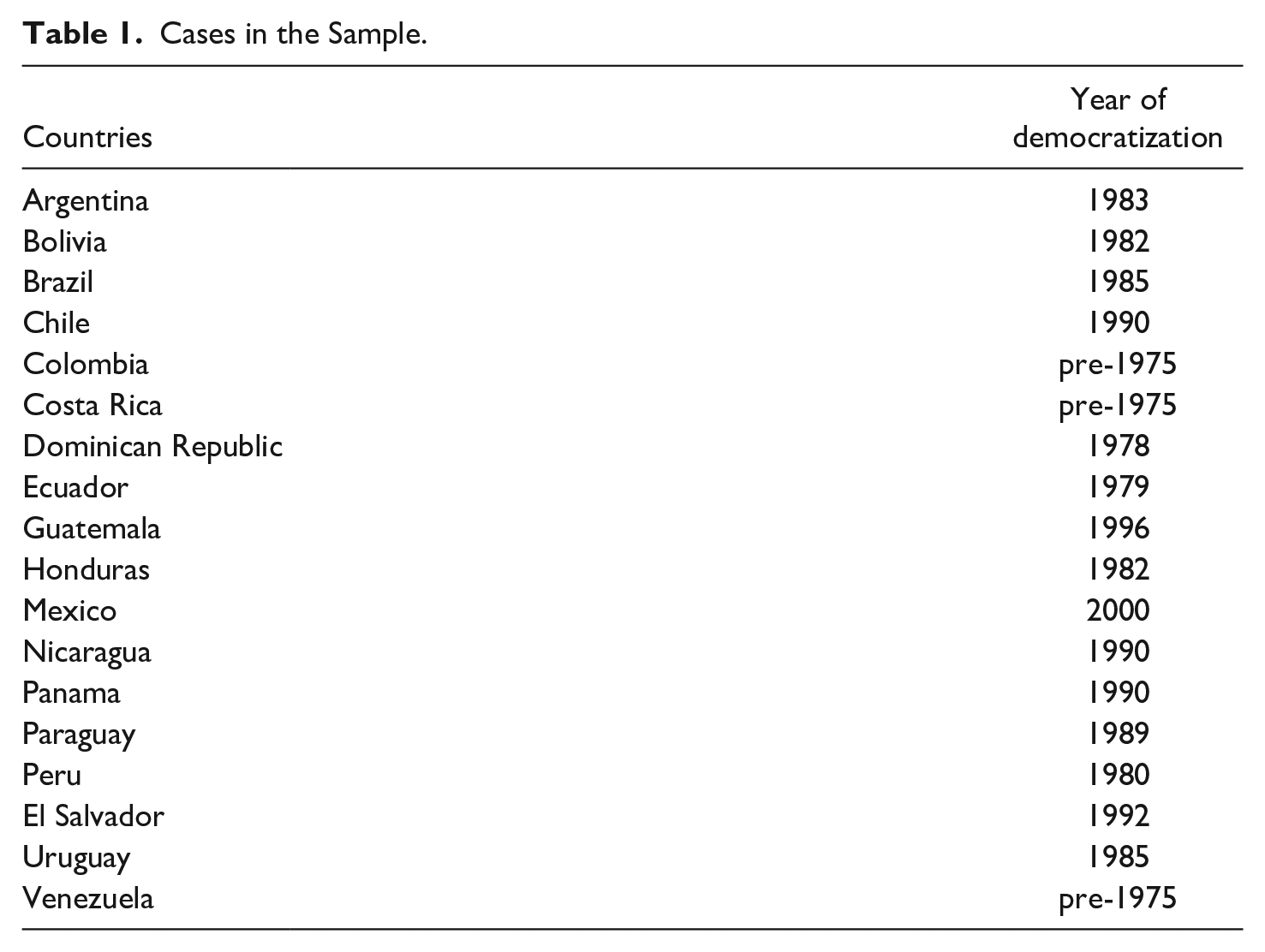
The sample includes data from 18 cases in Latin America from 1975 7 to 2016. Countries enter the data set as they democratize, in the case that they were not yet a democracy by 1975. The year of democratization is coded after historical record, as shown in Table 1.
Cases in the Sample.
The focus on Latin America offers important advantages. First, this is a region marked by high-income inequality and, more so in the recent past, high regime volatility. Most of the world’s unequal democracies, which are the cases I aim to explain, are in Latin America. Second, the region shares a common colonial history, similar political institutions, economic structure, and culture, which facilitates comparisons.
Input Variable
To provide evidence about the effect of state segmentation in preventing political instability and democratic regressions I use data from the Varieties of Democracy Project (V-Dem). V-Dem offers three variables that directly speak to the concept of state segmentation: (a) the effectiveness of the civil rights of the poor compared with the rich (in a 5-points scale, including 0); (b) the effectiveness of the civil rights of unprivileged groups compared with the rich (in a 5-point scale, including 0); and (c) the effectiveness of rights throughout the territory (in a 3-point scale, including 0; see Sigman & Lindberg, 2015). As do all V-Dem indicators, the variables result from a global expert survey. I account for the impact of each of those three variables and also combine them in an additive index resulting in a 10-point scale, which I operationalize as a proxy for state segmentation. Higher numbers imply more violations of rights of the poor and underprivileged groups and regions in contrast to the well assured rights of the elite. In Figure 2, we observe the contrast between the average levels of state segmentation in the three regions of the world where democracies prevail. As seen, Latin America stands out for its levels of violations of citizenship rights of the poor, unprivileged groups and regions.
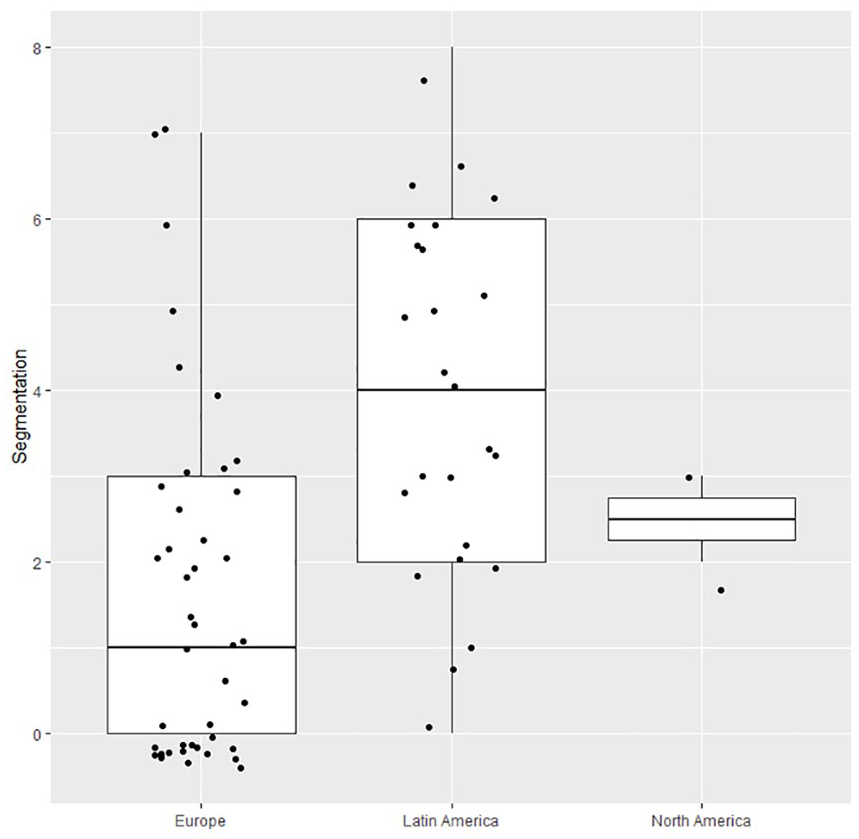
Box-plot of state segmentation in 2016.
State segmentation can also be assumed as of ordinal nature, ranging from low segmentation to high segmentation. To address this alternative I clustered low scores (≤4), as well as high scores (≥7) in a three points ordinal measure of segmentation
Outcome Variables
The data distinguishes interruptions of presidential mandates through legal means, such as impeachment trials and resignations, from coups d’état, that is, breaks in the constitutional order that suspend the democratic regime. The coding for interruption of presidential mandates comes from Pérez-Liñán’s (2007) data set, and was updated for recent interruptions (e.g., Paraguay 2011, Brazil 2016). Coups are coded after Przeworski (2013) until 1999, with the addition of Peru’s 1992 self-coup. Recent coups were coded using the same criteria as Przeworski et al. (2000). Those are: Ecuador 2000, Venezuela 2002, and Honduras 2009.
Legal interruptions of presidential mandates and coups are fundamentally different. For instance, impeachment trials do not imply the violation of constitutional order as long as they are predicted by law, the implication being that democracy remains at least in procedural terms. Impeaching the president or pressing for his or her resignation, instead of removing him or her by force, can be interpreted as elites actually preventing a coup. On the other hand, mandate interruptions are a strong sign of political instability and should not be encouraged by state segmentation. Given that impeachments and resignations are more democratic procedures if compared with coups, the effect of state segmentation in the odds of observing a legal interruption should be negative but not as strong as the effect observed in the odds of experiencing a coup.
Control for Alternative Explanations
As noted, there are three main revisions of the distributive conflict framework that offer explanations for why unequal democracies survive. The first accounts for the effect of strong conservative parties (Gibson’s, 1996; Ziblatt, 2017). I code the presence of such party organizations if at least one proclaimed or socially acclaimed right-wing party, founded prior to regime change, either held or holds the presidency since democratization or is one of the majoritarian parties in congress in subsequent legislatures.
The second alternative model posits that unequal democracies endure when their constitutions were written by representatives of ousting autocrats during or prior to transitions (Albertus & Menaldo, 2018). To account for that explanation, the presence of an authoritarian constitution was coded following historical record, whenever the constitution in place was conceived during nondemocratic times.
The third alternative explanation is that resource abundance allows elites to attend redistributive claims at lower costs (Dunning, 2008). To account for the potential effect of resource abundance I rely on Haber and Menaldo’s (2011) measure of resources (metals and energy) per capita.
Controls
I control for levels of income inequality using the standardized Gini coefficients in the SWIID data set (Solt, 2016), for the level of democracy as measured by the Polyarchy Index in the V-Dem data set, a logged measure of GDP per capita also from the expanded version of V-Dem, and account for fixed effects by country.
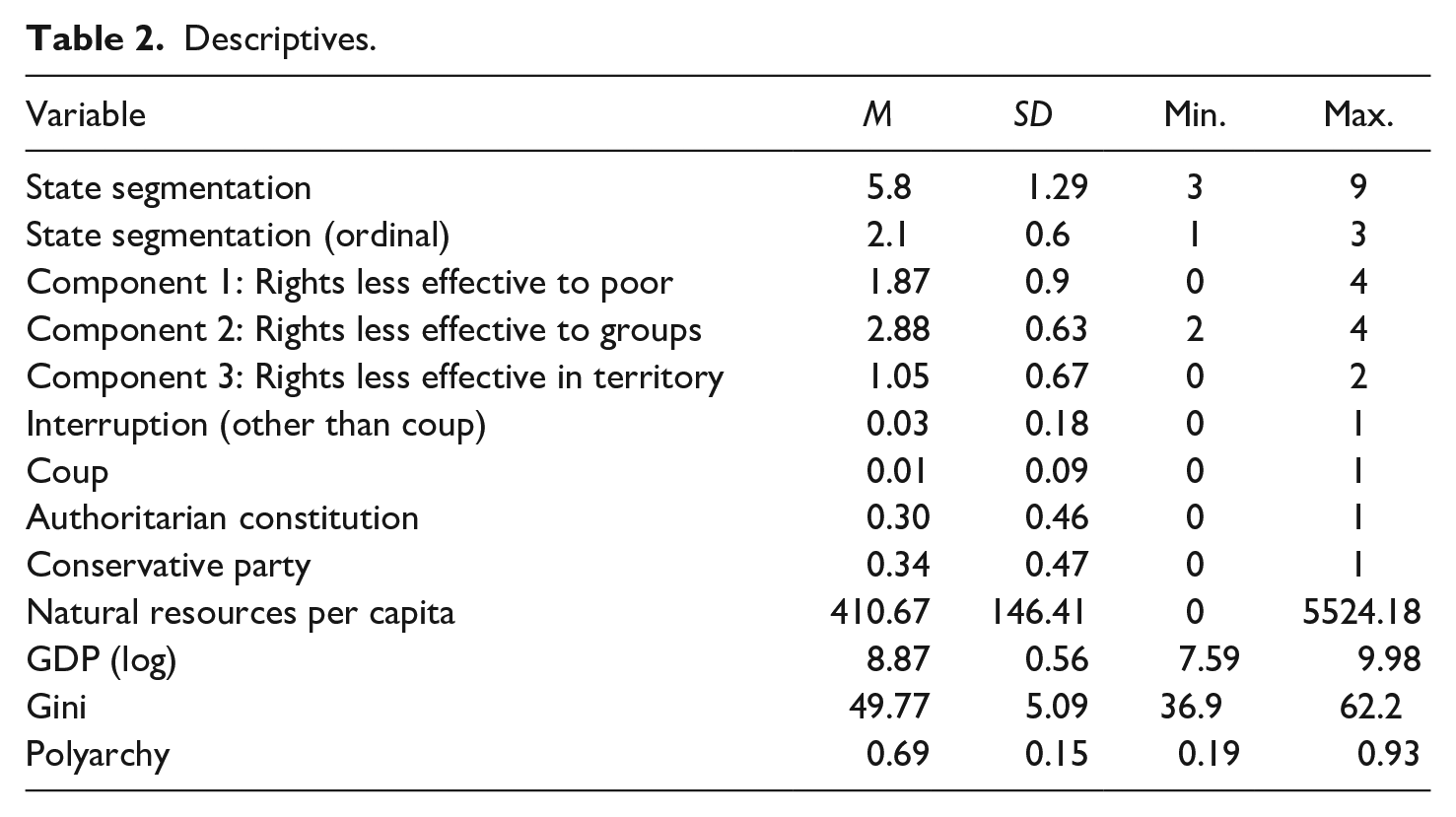
Descriptives for the proxy of segmentation, outcome variable and other covariates can be seen in Table 2.
Descriptives.
Regression Models
I use logistic models to predict the events of legal interruptions of a presidential mandate and the events of coups, the latter implicating a democratic breakdown. As stated before, the negative association between state segmentation and coups, that is, the idea that the segmentation of the coverage of citizenship rights elites prevents democratic breakdowns, is the fundamental one for the present theory.
Democratic breakdowns are rare events in contemporary Latin America. To account for potential biases and problems of separation I modeled the data using penalized logistic models (see King & Zeng, 2001). I also use multinomial logistic models in which the dependent variable assumes one of three values: 0 (no interruption), 1 (legal interruption), and 2 (coup).
All models for Latin America account for the alternative explanations and controls described above, and for either fixed or random effects of countries. I also estimate logistic models with random effects for the full V-Dem data set, including autocracies and democracies between 1900 and 2008, without accounting for the aforementioned alternative explanations. The results of the latter are presented in the appendix. Replication data are offered as supplementary material (available online).
Results
After transitions, the new Latin American democracies inherited much of the repressive apparatus of previous autocratic rule (López, 2018). Consequently, these new democracies distribute citizenship in uneven ways, in what can be called state segmentation. Figure 3 displays the evolution of state segmentation in Latin America since democratization.
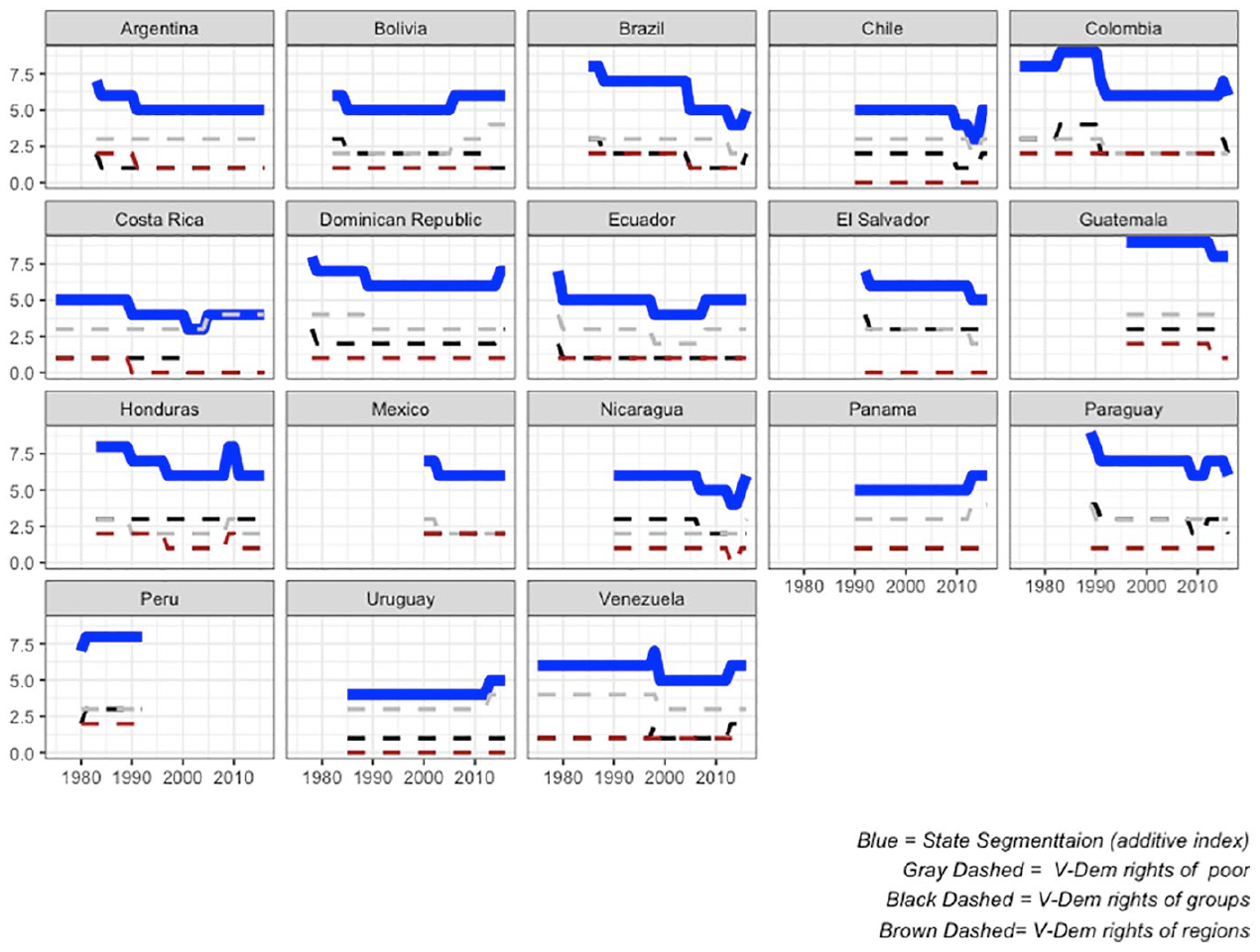
State segmentation since democratization.
Latin American countries tend to have high state segmentation. High scores are observed in some of the region’s largest and more durable democracies, such as in Mexico, Brazil, and Colombia. As elites experience democracies in which states segment the distribution of civil rights, they learn that liberal institutions can coexist with effective repression of the poor and marginalized groups. Having a reference of how an authoritarian alternative would look like, their experience of state segmentation helps change their strategies regarding democratic continuity.
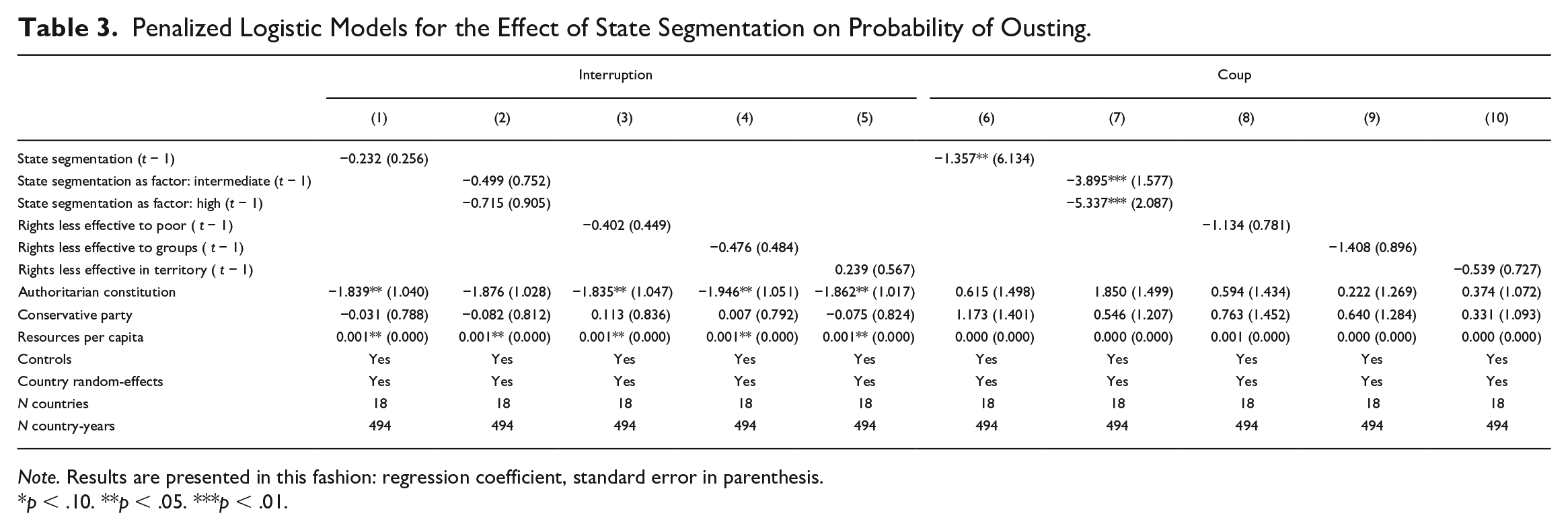
Cases of democratic breakdown did occur after the third wave in the region however. If the present argument holds, we should observe differences in the levels of state segmentation between the cases in which democracy survived and those where it did not. Table 3 displays penalized logistic models for the effect of state segmentation on legal interruptions of presidential mandates and coups, the latter representing democratic breakdown.
Penalized Logistic Models for the Effect of State Segmentation on Probability of Ousting.
Note. Results are presented in this fashion: regression coefficient, standard error in parenthesis.
p < .10. **p < .05. ***p < .01.
As citizenship rights become more segmented between economic and social groups, or across the territory in each country, the odds of experiencing democratic breakdowns tend to diminish, as seen in Model (6) of Table 3. This negative association becomes even more salient at higher levels of segmentation, as described in Model (7) of the same table. The effect over legal oustings is much more modest.
Current theories of distributive conflict portray that wherever inequality is high, elites should more frequently resort to coups in order to reverse democratization. Assuming a scenario of high inequality (Gini = 0.6), the predicted probability of coup when segmentation is low (≤4) is 0.02 in Latin America, which is already a low probability. At intermediate levels of state segmentation, the predicted probability diminishes to 0.01. If one assumes high levels of state segmentation (≥7), the predicted probability further reduces to 0.005, four times lower than the predicted probability at low levels of segmentation. Regarding episodes of legal ousting of the incumbent, predictions portray a probability of 0.1 at low and intermediate levels of state segmentation, which is very high for such an extreme event. That probability diminishes to 0.06 when assuming high levels of state segmentation.
The negative association between state segmentation and democratic breakdown resists the inclusion of the three main alternative explanations—within the scope of the distributive conflict framework—for why unequal democracies endure. As predicted in the literature, the models in Table 3 portray that constitutions written during authoritarian times are indeed present in more politically stable cases, that is, those where interruptions of presidential mandates are less frequent. However, models do not portray a negative association between having an authoritarian constitution and experiencing a coup. The presence of strong conservative parties seems to be indifferent for either outcome. Finally, the increase in natural resources per capita is slyly associated with political instability in Latin American democracies, but not with breakdowns.
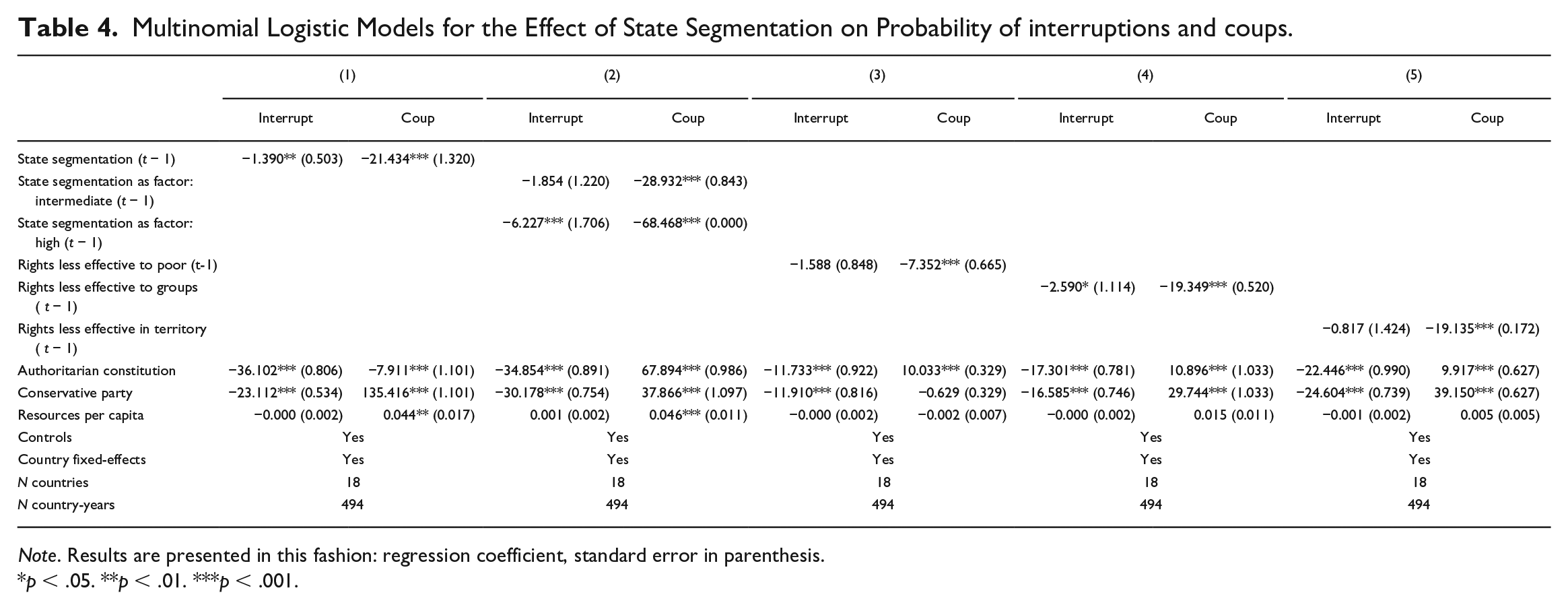
Table 4 displays results for multinomial logistic models. Results go in the same direction as those of penalized models. The implication is again that countries that experience higher state segmentation are less prone to interruptions of any kind, and are more likely to experience legal interruptions of a presidential mandate than they are of experiencing coups. Results add evidence in favor of the argument that elites will avoid democratic reversals when in presence of high state segmentation, despite the redistributive pressures typical of highly unequal settings.
Multinomial Logistic Models for the Effect of State Segmentation on Probability of interruptions and coups.
Note. Results are presented in this fashion: regression coefficient, standard error in parenthesis.
p < .05. **p < .01. ***p < .001.
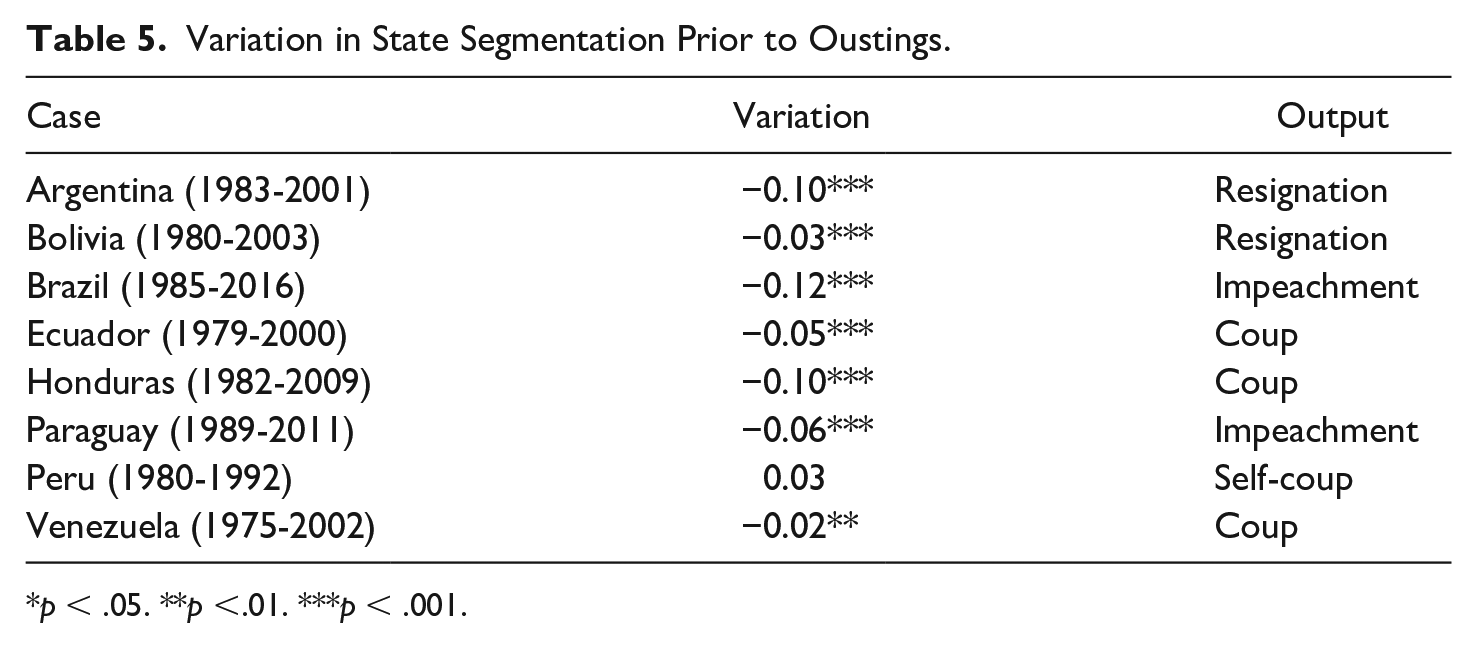
Another angle to this process regards the evolution of cases in which interruptions of presidential mandates did occur. Table 5 displays the evolution of segmentation in positive cases within a sample of one interruption per country.
Variation in State Segmentation Prior to Oustings.
p < .05. **p <.01. ***p < .001.
With the exception of Peru, who suffered a self-coup by the hands of Alberto Fujimori in 1992, all other cases present significant negative variation of state segmentation prior to interruptions. The average reduction in state segmentation is substantial in Brazil prior to 2016, when leftist president Dilma Rousseff was ousted through an impeachment trial (see also Figure 3). After 13 years of left-wing rule of the PT, during which the country experienced significant reductions in income inequality, elites coordinated the replacement of President Rousseff by her conservative vice-president Michel Temer. Another case where reduction of segmentation was substantial according to V-Dem measures is Honduras prior to 2009, the year when military forces removed President Emanuel Zelaya from office.
Interruptions of presidential mandates cannot be attributed to variations in state segmentation alone, or mainly. But the patterns observed indicate that state segmentation plays a role and helps explain why elites choose one strategy or the other. In Argentina for instance, the resignation of Fernando de la Rua in 2002 was clearly the consequence of the economic meltdown and rioting that took over the country. However, considering the levels of political instability that followed de la Rua’s resignation, the fact that the regime did not collapse deserves further justification. Had it occurred at any other time in the country’s history, the social landscape of the early 2000s in Argentina would have merit a coup. All in all, the data show a pattern that is compatible with the theory of state segmentation: higher state segmentation diminishes the probability of democratic breakdown, and oustings are preceded by reductions in state segmentation.
Discussion and Conclusion
The present study aimed at solving an important puzzle left unanswered by the proponents of the distributive conflict framework as well as by their critics and revisionists: why do unequal democracies endure? As noted, several studies build on the assumption that elites contrast the costs of redistribution to the costs of repression when deciding their next political move, in the aim of preventing the poor from expropriating (either through taxation or by force) their wealth and resources. The assumption that elites have more incentives to sustain autocratic regimes in contexts of high inequality was challenged by Ansell and Samuels (2014) and Albertus (2015), among others, who claim that elites also need to shield against autocrats and might support democracy in order to foster property rights. By adding the state as a source of threats, those authors show that elites’ decision making is much less straightforward than previous theories portray. Nonetheless, the state can also be a source of protection against the poor.
Building on this apparent contradiction, I argued that elites have antithetical preferences for both liberal and repressive institutions as they need to secure individual rights but also need to shield from the redistributive demands of the poor. I proposed the concept of state segmentation to describe how current Latin American democracies combine liberal institutions with informal procedures that result in violations of the citizenship rights of the poor and underprivileged groups. State segmentation is a key but overlooked variable that helps explain why elites cope with democracy in contexts of extreme inequality, such as those present in Latin America.
The uneven distribution of the rule of law is regularly assumed as a factor that compromises democracy in Latin America and elsewhere in the developing world, as in O’Donnell’s (1993) classical account of brown areas. From a normative point of view, it is clear that the uneven effectiveness of civil rights hurts the quality of democracy (Altman & Pérez-Liñán, 2002) as it contradicts our expectations of equal treatment under the law. An argument could be made that, precisely because of this counterintuitive outcome, regimes with segmented states cannot be considered “true” democracies. This can be the case if one adopts a normatively charged conceptualization of democracy, in line with O’Donnell (2004) and Morlino (2004). Alternatively, democracies with segmented states could be considered diminished subtypes, in the lines of Collier and Levitsky’s (1997) classical strategy of concept formation. It remains that competitive regimes with freely elected civilian rule, separation of powers, and a formal set of political and social rights compatible with the ideal of democracy—shall we call them democracies or not—may find equilibrium and become more durable when equipped with informal mechanisms of repression.
Most countries in Latin America, a region historically characterized by the prevalence of coups and the imposition of authoritarian regimes, have for the first time experienced decades of uninterrupted democratic rule. In support of my argument, I have shown that countries with more segmented states are much less likely to experience democratic breakdown. This is not to say that elites in the region have become democrats. As shown, they now more frequently use the formal tools of democracy, such as impeachment trials, to oust undesired rulers. By doing so they often bend the purpose of such institutions, promoting new forms of political instability. Concordantly, the increase of antidemocratic sentiments among the population and the growing sympathy of the well off for far right leaders add to the fragility of democratic sentiment in the region. It remains that these unfavorable conditions for democracy no longer tend to result in regime breakdown.
Beyond Latin America, democratic durability in highly unequal cases such as South Africa, Botswana, and Israel suggest that the mechanisms portrayed here could travel to other regions where democracy meets repressive states. Increasing segmentation of citizenship rights also describes recent trends in advanced economies, as in the case of the United States. While the processes highlighted here tell a very Latin American story, the data corroborates that the segmentation of citizenship rights is likely to be negatively associated with coups in democracies beyond the region (see the appendix).
The implications of the present argument for future research and developmental policy are substantial, as we learn that elites may cope with democracies for their undemocratic components. The assumptions guiding my theory do not need to lead to a fatalistic view of stable democracies in developing. But the argument does posit that the unexpected resilience of democracies in contexts of high inequality owes in part to such violations.
Footnotes
Appendix
Table A1 shows estimates for the entire V-Dem data set and for the third wave period, in both cases accounting for autocracies and democracies. The association between state segmentation and democratic survival is estimated with interaction terms accounting for the effect of being a democracy and experiencing segmentation of citizenship rights in different levels. Results indicate a negative association between two components of segmentation and coups: ineffectiveness of citizenship rights for the poor and for social groups. The data provides grounds for the generalization of the argument, but also portrays it as much more relevant for Latin America. It remains that democracies that skew the effectiveness of citizenship rights are less likely to experience coups.
Acknowledgements
I am in great debt with Professors Juan Pablo Luna and David Altman at the Pontificia Universidad Católica de Chile, and Steven Levitsky, Frances Hagopian, and Scott Mainwaring at Harvard University, who generously commented on previous versions of this article and supported me during different stages of the research. Many thanks also to my former colleagues in the graduate program in political science at PUC Chile, in particular Maria Marta Maroto and Tomas Dosek, who encouraged me to develop the theory of state segmentation, and to two anonymous reviewers.
Declaration of Conflicting Interests
The author declared no potential conflicts of interest with respect to the research, authorship, and/or publication of this article.
Funding
The author disclosed receipt of the following financial support for the research, authorship, and/or publication of this article: Funds were received, while working on this article, from CONICYT in Chile and from the Wenner Gren Foundations in Sweden.
Supplemental Material
Supplemental material for this article is available online.