



Abstract
Local political leaders as well as international organizations have embraced participatory budgeting in response to problems of political exclusion and citizens’ dissatisfaction with representative democracy. This article provides a framework to highlight important aspects of the politics of participation. The framework allows scholars to explore how factors external to spaces of participation interact with aspects of participation within them. The framework conceptualizes participatory budgeting as political spaces, whose boundaries are shaped by ideologies, interests, and patterns of social exclusion. In dynamic spaces, such boundaries are constantly renegotiated and contestation helps maintain their openness. In static spaces, by contrast, predefined boundaries are imposed on participants who may accept or reject them. Empirical examples of participatory budgeting illustrate the usefulness of this framework. The article ends by discussing key avenues for further research.
Introduction
As widening socioeconomic gaps shape people’s opportunities for equal representation in many parts of the world, researchers and democratic theorists are exploring in new ways of involving citizens in politics. In particular, studies of reforms aimed at empowering those who lack material resources and are systematically marginalized are now numerous (e.g., Montambeault, 2019; Sintomer et al., 2016; Touchton et al., 2017). Among other aspects, this research has examined effects of participatory reforms on people’s well-being (Boulding & Wampler 2010; Gonçalves, 2014; Heller, 2001; Touchton & Wampler, 2014), as well various structural, institutional, and political factors that influence outcomes (e.g., Baiocchi & Ganuza, 2015; Baiocchi et al., 2011; McNulty, 2015, 2018; Saguin, 2018; Sintomer et al., 2016; Wampler, 2007). But what roles do citizens actually play in these new political arenas? This question appears increasingly important as participation is being promoted worldwide by many and varied kinds of actors, including the World Bank and other international organizations that are not typically associated with advancing political equality (see Baiocchi & Ganuza, 2014; Goldfrank, 2012; Sintomer et al., 2016). At the heart of current debates is the issue of how people’s political freedom within these new spaces may be shaped by such factors as ideology, interests and patterns of social exclusion, and what possibilities people may have to challenge such boundaries.
Participatory budgeting has a special status among these new forms of participation, having been the first significant “democratic innovation” to be advocated as a universal model to be adopted in various new contexts (Geißel & Joas, 2013; Sintomer et al., 2008, 2016; Smith, 2009). Several case studies of participatory budgeting have analyzed citizens’ possibilities to participate on equal terms, take initiatives, and hold municipalities accountable (Abers, 2000; Baiocchi, 2005; Holdo, 2016a; McNulty, 2018; Rodgers, 2007; Wampler, 2007). In a few cases, citizens seem to have been empowered by participation but in many cases they seem not to. Several studies have explained these different outcomes through factors external to the process, such as available resources, degree of decentralization, and political commitment to inclusion. These factors seem crucial, but in intricate ways they also depend on interactions with participants, who bring into spaces of participation their own interests, views, and resources (see also Baiocchi & Ganuza, 2014; Holdo, 2016a, 2016b; Goldfrank, 2007, 2012). The aim of this article is to bring to the fore the place for contestation within these spaces.
This article develops a framework that allows researchers to explore how factors external to participatory institutions interact with aspects of participation within them. Beginning with the notion that policies of participation create spaces in which participation occurs, this article seeks to highlight how people that enter such spaces often engage in contestation regarding their boundaries. Among the various kinds of boundaries that may shape participation, I focus on three that appear most clearly in the case study literature on participatory budgeting: ideological assumptions as to what participation is about and what it can be used for; ideas about public interests that privilege the views of some groups over other views; and symbolic boundaries made up of patterns of social exclusion and inclusion, including perceptions about which actors have the authority to define problems, objectives and modes of cooperation. Moreover, along these three dimensions, I suggest, we can distinguish between dynamic spaces and static spaces. In dynamic spaces, the boundaries are constantly being negotiated by the actors involved, who learn new ways of cooperating as they come to understand each other’s interests and intentions. In static spaces, by contrast, the boundaries are predefined and imposed on participants, who can either accept or reject them.
The next section situates the argument for thinking of participation in spatial terms in the larger literature. It highlights, in particular, how previous research has connected contextual variables to levels and kinds of participation. The subsequent three sections examine the three different types of boundaries—ideological, interest-based, and symbolic—that, based on existing case-studies, appear, on the one hand, as highly consequential for possibilities of advancing political equality through participation, and, on the other hand, important objects of contestation. In each of these dimensions, I show, participatory spaces can be dynamic or static. The concluding section discusses the implications of the argument of this article and avenues for further research. It is hypothesized that dynamic spaces both empower citizens more and generate political legitimacy more effectively than static spaces. Further research is needed, however, to uncover the precise mechanisms that determine whether participatory spaces become dynamic and under which conditions such mechanisms may be more likely to emerge.
Context, Spaces, and Agents
Understanding the connections between contextual factors and concrete interactions, including contestation, is an important part of what Baiocchi et al. (2011, p. 28), following the work of several social theorists, call a “relational” understanding of participation. While the spatial analysis of participation offered here cannot include all the relationships between civil society and state, between political tradition, interests and ideologies, and between the various networks that make up the sphere of citizens’ activism, it provides, I want to suggest, a useful way of thinking about how such relations influence what possibilities exist for participants to affect the form that participation takes. How do economic, political, institutional, and historical conditions impact concretely on citizens’ possibilities to voice concerns, defend their interests and hold decision makers accountable? A number of studies have demonstrated that participatory budgeting help bring about improvements in people’s living conditions by, at least under some conditions, positively affecting civil society mobilization and the formation of a public sphere for citizen deliberation (Avritzer, 2006; Baiocchi et al., 2011; Nylen, 2002). However, participatory budgeting may also, on the contrary, facilitate cooptation of social activists (Wampler, 2010) and in some places further diminish the capacity of an already weak civil society to organize independently (Baiocchi et al., 2011). Studies suggest that the intentions of decision makers is one important factor that helps explain such variations, but various other aspects of the political context may contribute as well, including structures of electoral competition and the influence of investors and businesses (Abers, 2000; Baiocchi, 2005; Fung, 2011). For example, Rebecca Abers’s (2000) work on Porto Alegre’s participatory budgeting suggests that participatory budgeting was shaped not only by a commitment to bottom-up, participatory decision making but also by alliances with local corporations in the construction and infrastructure sectors. She shows, moreover, that the idea of participation helped the Workers’ Party to appeal not only to potential participants in marginalized neighborhood but also to middle-class voters, who were typically not demanding participation but were attracted by the promise to make government more efficient and transparent in the way they spent tax money. Focusing on the roles of citizens’ prior experiences and resources, Brian Wampler’s (2010) comparative work in Brazil suggests that their possibilities of mobilizing protests functioned as “reserve threat” (p. 259), while Archon Fung and Erik Olin Wright (2003) argue that “empowered participation” requires that citizens rely more on their capacity for collaboration, including such as skills of negotiation, compromise, and creative problem solving, as opposed to protest. Developing a spatial understanding of participation can help bring together external conditions and internal interactions in ways that clarify their mutual dependence.
The idea of participatory space builds on work by social theorists that have highlighted how social practices are imagined and constructed within a language of space.
1
Democratic theorists, from to Arendt (1958) to Habermas (1991) imagine citizen deliberation as taking place in a socially constructed space—the public sphere or the public domain—that is located outside of such spaces as the private sphere, the marketplace, the bureaucracy, and the world of political competition party competition. In the public sphere, citizens come together to address common concerns. Theorists such as Lefebvre (1991), Foucault (2007), and Bourdieu (1989) have developed in more detail the idea that space is constantly being produced and reproduced through social practices (see also Lamont & Molnár, 2002). If we apply this view to the context of new forms of participation, it implies that spaces of participation rather than being constituted through political decisions and received by citizens become shaped and reshaped through the social interactions generated by an initial invitation. Thus, decision makers may open up a political space for participation and invite citizens to enter but do not necessarily have either the authority or the intention to determine the boundaries of that space. As citizens enter that space, they bring into it their own histories, identities, resources, perspectives, and expectations, which contribute to its distinctive possibilities and constraints. As Cornwall and Coelho (2007) write, Spaces for participation may be created with one purpose in mind, but can come to be used by social actors to renegotiate their boundaries. Discourses of participation are, after all, not a singular, coherent, set of ideas or prescriptions, but configurations of strategies and practices that are played out on a constantly shifting ground (p. 14).
Possibilities and constraints of participatory spaces are in this sense, Cornwall and Coelho (2007) suggest, negotiated on-site with participants. The participants may acknowledge and accept the intentions of decision makers and administrators, but they may also ignore or misinterpret their intentions or refuse and challenge them. Not all spaces are dynamic in this way, however. We need to distinguish, I want to argue, between dynamic spaces, where, as Cornwall and Coelho suggest, boundaries may expand as participants interact on the basis of participants’ histories, identities, interests and views. There may not even be an intention from any actor to stabilize the meaning and possibilities of such dynamic spaces. Other spaces, however, may be more rigid, due to invested interests, power relations and relatively homogenous worldviews and expectations among its occupants.
2
Clarissa Hayward (2000) offers a useful distinction between social relations and forms of interaction that are “defined by practices and institutions that severely restrict participants’ social capacities to participate in their making and re-making” (p. 5). Hayward contrast such constrained relations to more empowering relations that instead allow people to be “not only the subjects, but also the architects of key boundaries that delimit and circumscribe their fields of action” (p. 166). This distinction is useful, because it highlights a critical aspect of political contestation: It directs critical attention, not only to the ways power relations define the capacity for action within their terms, but also to how they shape the capacity for action upon (that is, action that affects) the social limits that comprise them. (Hayward, 2000, p. 162)
By static spaces, I mean spaces characterized by such constrained relations as Hayward describes. By dynamic spaces, I mean instead the more empowering relations that allow participants to contest boundaries and expand possibilities of action. Dynamic spaces allow contestation by enabling and encouraging actors to be co-producers of their boundaries. Static spaces, by contrast, discourage actors from questioning such boundaries and impose expectations that they will be accepted as they are.
Another aspect of the concept of participatory space that needs further elaboration is their dimensions, or the kinds of boundaries that shape a space. It seems useful to distinguish between at least three types of boundaries—three dimensions—that appear significant in case studies of participatory budgeting. Boundaries, I want to suggest, may consist in ideological assumptions, assumptions about public interests, or assumptions of a more symbolic kind that concern the roles people are expected to play in social interaction. These are not, I should stress, an exhaustive list, as many other boundaries may exist, and indeed be more relevant, depending on the nature of a participatory space. I only emphasize these because they appear most clearly, as I will show, in studies of participatory budgeting.
First, ideological dimension concerns the political visions involved in initiating participatory decision making. As observed by several scholars, participatory budgeting has been promoted by actors of various political orientations, from social parties such as Porto Alegre’s Workers’ Party to institutions associated with global capitalism such as the World Bank. The actors involved in its promotion do so with different assumptions about what participatory budgeting should accomplish, and those assumptions form ideological boundaries which may be challenged by participants.
The second dimension is public interest. Participatory institutions are commonly framed as offering opportunities for collaboration and cooperation to promote shared interests. The idea of coming together may, however, mask subtle forms of imposing a specific view of what such cooperation should achieve, that is, what is the “public interest” that participation is meant to serve. Difference theorists (e.g., Benhabib, 1996; Kohn, 2000) have drawn attention to how deliberation and the idea of shared, public interests often ignore or misrepresent the different interests actors have depending on identity and social position (see also Fraser, 2000). To challenge boundaries in the public interest dimension means to question assumptions about the shared identity and shared fate that underpin the notion that participatory institutions should promote public interests. For example, in participatory budgeting, women, indigenous groups, and other ethnic minorities, and poor people may need to question assumptions about what it means to work together for a common goal.
The third dimension is symbolic and concerns preconceptions about who has the authority to speak, for whom and in what space. Participatory institutions have often been valuable vehicles for promoting the rights of marginalized citizens to voice their concerns and have a say in debates and policy-making. However, being included does not always mean being listened to and having one’s views and opinions considered. Cornwall (2003) distinguishes between four different roles that citizens may be assigned in participatory spaces: objects (whose enlisting helps secure compliance and lends legitimacy to the process), instruments (who help projects run more efficiently by sharing responsibilities), actors (who provide ideas and may generate wider political support), and agents (who act to enhance accountability, demand rights, criticize, and build political capabilities). In static spaces, facilitators may see citizens primarily as objects or instruments, whereas in dynamic spaces, where boundaries are negotiated, citizens may claim the roles of actors and agents. To challenge symbolic boundaries means to question the idea of in what capacity citizens may enter and agree to participate in new, political spaces.
Table 1 summarizes this framework, which highlights three dimensions in which the boundaries of participatory spaces can be challenged, renegotiated, and expanded. Static spaces are, in contrast to dynamic spaces, spaces where the boundaries are relatively fixed, due to invested interests and predefined goals.
Dynamic and Static Spaces Compared in Three Dimensions.
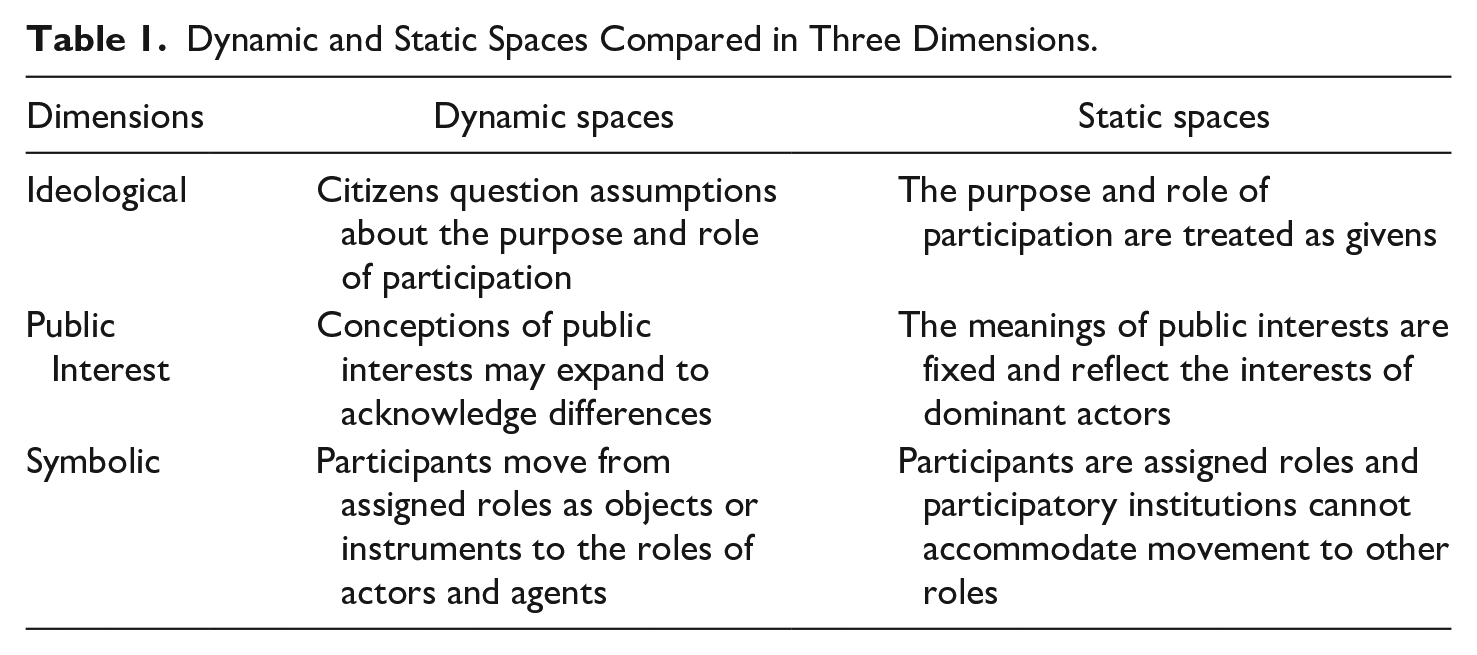
The subsequent sections will use this framework to analyze how participants in dynamic spaces contest these three types of boundaries, while in static spaces, they face only the options to accept or reject them. For each type of boundary, I will use case studies of participatory budgeting to illustrate this distinction. As I aim to show, the framework helps to bring to the fore forms of both contestation and domination along these boundaries, that is, they highlight ways in which, in one or more of these aspects, a space may only allow action within its limits or allow and enable actors to act in ways that affect such limits. Finally, the three types of boundaries discussed below, do not suggest mutually exclusive types of contestation. I discuss them separately only for the purpose of analytical clarity. However, challenging one type of boundary may often require people to contest others, too. For example, challenging ideological assumptions about what participatory budgeting is for may require people to contest status differences that are part of the symbolic boundaries. Contesting what counts as a public interest, as opposed to private or narrow group-based concerns, may similarly require actors to contest ideas about the purpose of allowing citizens to be part of decision making.
Ideology
That ideological commitments shape participatory institutions may seem obvious. While political parties of various orientation have initiated forms of citizen participation and deliberation, participatory budgeting was initially strongly associated with the left and framed as part of an agenda of social justice (see Baiocchi & Ganuza, 2014). Commenting on the global diffusion of participatory budgeting, Baiocchi and Ganuza (2014) argue that the ideological dimension is crucial for understanding its possibilities and constraints. In its original versions, it was part of a leftist project that aimed for deeper societal transformation. Because it was part of a broader strategy of institutional reform, decisions taken through participatory budgeting became strongly linked to priority-setting by the local government. Participants were empowered in the sense of becoming part of the structure of local administrations. By contrast, when the political right uses participatory budgeting for its purposes, it is “promoted as fostering ‘community cohesion,’ ‘innovation,’ ‘social entrepreneurship’ and ‘restoring trust’ in government” (p. 31). Commitment to citizen participation has, however, affinities with various ideological views, also beyond the left (Baiocchi & Ganuza, 2014; Goldfrank, 2007a; Goldfrank & Schrank, 2009), and more recent research has questioned whether leftist orientation is sufficient, or even necessary, to accomplish empowerment of citizens (see Goldfrank, 2012). Other research suggests that ideological assumptions among both left and right may enable and constrain participation in various ways (see Holdo, 2019). Wampler (2010) shows, moreover, that mayors’ varying political commitments and orientations affect whether participants feel entitled to question or object to how projects of participation are framed. In participatory budgeting in New York City, Celina Su (2018) shows, the public agencies involved relied on a model of “managed participation” that privileged technical over local knowledge and minimized the deliberative aspects of participation.
Although ideological commitments are widely acknowledged as a factor that shapes the spaces of interaction in participatory budgeting, few studies have analyzed, or even recognized, the roles played by participating citizens in challenging ideological boundaries. Scholars have, as will be discussed below, paid more attention to contestation of public interest and symbolic boundaries. Baiocchi and Ganuza (2014) claim, however, that with regard to the political orientations of the actors initiating participation and how these affect interactions with, and between, participants, “there are myriad ways in which participants themselves tend to outrun the limits imposed on them” (p. 45). They quote a participant in Chicago’s participatory budget, who says that she, and her association, sees participatory budgeting as an opportunity for members to “learn more about the city budget and then we can press the alderman about other things he controls, and we can move on to tackle the city budget” (p. 45). That ideologically motivated political decisions to initiate participatory budgeting cannot completely determine the uses of the space they open up for citizens is demonstrated in a number of other case studies. For example, Rodgers’s (2007) analysis of participatory budgeting in Buenos Aires focuses on the relations between political elites from the ruling Peronist Frente Grande coalition, participants and the bureaucrats in charge of the process. The political elites in the city treated participatory budgeting as an additional means of mobilizing their own loyal supporters and solidifying their power. This mode of organizing fitted the Peronist ideology of a popular movement party that has traditionally been organized in clientelist networks (see Auyero, 2001). However, while political elites sought to politicize the participatory budget meetings, both participants and bureaucrats defended their independence. In the end, while many of the participants were sympathetic to the ruling party, the participatory budget generated “unintentional democratization,” according to Rodgers. Political leaders could not control the process of participation and the interactions it generated between participating citizens and employees at the municipality, who were more deeply committed to undistorted citizen participation. As one participant told Rodgers, participatory budgeting made it possible to interact directly with civil servants and hold them accountable (Rodgers, 2007, p. 195).
Empirical studies such as Rodgers’s suggest the ideological boundaries that constrain the possibilities of participation may come at least as often from left as from the right. This is to a significant part due to how participation fits the idea of a popular movement party that translates grassroots demands into public policy. The populist imaginary is that party leaders embody the collective views and interests of the people, which makes independent agency on the part of civil society irrelevant (see Laclau, 2005). In Porto Alegre, participatory budgeting functioned as a way to use the Workers Party’s mode of grassroots mobilization to make citizens part of actual decision making. The party structure had a pyramidal shape, Abers (1998, p. 516) explains—small groups would meet at the level of neighborhoods, schools, and workplaces to make decisions and elect delegates zonal, municipal, and regional party conferences. Similarly, participatory budgeting meant that local popular councils would take over part of the work of government decision making. Goldfrank and Schneider’s (2006) analysis highlights more clearly the strategic advantages of this approach, suggesting that it was really a form of “competitive institution building.” Like many other institutions it was intended, they argue, “to privilege the interests of certain social groups in order to advance partisan goals, including electoral success” (p. 2). Although participatory budgeting’s achievements in many places have exceeded such specific aims, its structure made it vulnerable to ideological domination (see Goldfrank & Schrank, 2009). In spaces that are static in the ideological dimension, participants find themselves unable to raise issues and make proposals that do not fit the political purpose for which participatory budgeting was initiated. This was the experience of some participants in one of the districts of Buenos Aires, according to Rodgers (2007), who quotes one participant who said, There was so much deceitfulness and so many disappointments due to all the politicking, all the projects we wanted to set up and have included in the budget became secondary to certain people’s political agendas. It became so ugly, projects were being promoted by people simply in order to gain political support, and so of course people began to withdraw from the process (p. 196)
Similar observations have been made in other cases of participatory budgeting (see Holdo, 2016b; Wampler, 2010). In ideologically static spaces, it may also, as will be further explored in the next section, become more difficult to question what kinds of public interests participatory budgeting should serve.
The Public Interest
The second dimension of political contestation concerns the idea of “public interests.” Citizen deliberation, as conventionally understood, is an exchange where people speak in public terms rather than private ones. This means that participants in deliberation, including in participatory budgeting, are expected to disregard their own personal interests and focus on shared, public interests (see Baiocchi, 2005). Critics of deliberation suggest, however, that this idea often merely masks the objective reality that different participants, and participants and facilitators, usually have significantly different interests. For example, poor citizens often have interests that are not captured in elites’ references to public concerns and public interests. Deliberation may often make it difficult for the less resourceful to object when the reasoning about public interests is shaped by the interests of more resourceful groups. As Jane Mansbridge (1990) puts it, deliberation is often thought to transform people’s individual concerns to a shared concern—it transforms “I” into “we”—but as it does this may subtly impose the view of dominant actors. Critics have claimed that in the real world, such subtle domination is usually the point of initiating deliberation and participation. Why else would powerful actors invite the powerless into spaces of participation? (Przeworski, 1998).
This risk of domination arises partly because people are told that as participants (“councilors”) they act in the interest of the city, their districts and their neighborhood, not other, narrower interests. Several studies have suggested that participatory budgeting creates division among participants by encouraging them to defend the interests of their respective communities (Abers, 2000; Baiocchi, 2005; Holdo, 2016a). This sense of competition may empower citizens to defend their interests and contest attempts of discarding them as outside the realm of public concerns. However, as Montambeault and Goirand (2016) show, in Recife, Brazil, this reinforced inequalities between groups of citizens, as it favored groups that were better mobilized. This aspect is likely to relevant in many cases where studies have not explicitly examined it. Grillos’s (2017) research in Solo, Indonesia indicates that this kind of bias toward the better mobilized begins at the proposal stage, where participants from poorer neighborhoods are less likely submit their own proposals. Along similar lines, Saguin (2018) found in his research on cases in the Philippines that when powerful actors dominated, the results for poorer participants are often disappointing. Even in the cases where participatory budgeting generates material benefits, the poor did not feel included, and, importantly, participation did not increase their trust for the government either.
However, in dynamic spaces, participants have often been able to use a discourse of public interests to their own benefit while at the same time challenging the boundaries of what can be acknowledged as public interests. For example, Baiocchi (2005) observed that at participatory budgeting meetings in Porto Alegre, participants would respect the norm of speaking public-mindedly, but they would also use their meetings to address neighborhood concerns that were not strictly relevant to budgetary discussions and even organize actions to be carried out outside of participatory budgeting. Wampler (2010, p. 120) notes, moreover, that participants criticized administrators that seemed unable to understand their perspectives. This failure of understanding was often related to the different living conditions of facilitators and participants that translate into different conceptions of public interests. Participating citizens, Wampler comments, do not shy away from open confrontation with government officials . . . [but] carry themselves as emboldened, rights-bearing citizens rather than as weak, subservient individuals asking for the government’s support. [They] use the institutional space afforded them under PB’s rules to express their frustration and anger at how the government functions and manages PB. Citizens and delegates use their allotted time to explain why they believe that government officials have been negligent or incompetent (p. 120).
Part of the tension between facilitators and participants, Wampler suggests, was their different lived experiences of needs, which also concerned the responsibilities of the government to protect and provide basic standards of living for all citizens. Similarly, in Rosario, participatory budgeting has been used by facilitators to inform citizens about their rights, and participating citizens have used the resources available to initiate campaigns to raise consciousness about the rights of citizens, sometimes with a particular focus on indigenous peoples’ rights (Holdo, 2016a). In this way, public interests and public concerns become not only articulated but also appropriated for other purposes, within the space of participation. In other words, public interests become an object of renegotiation and contestation. As noted by several researchers (Baiocchi, 2005; Wampler, 2010; Holdo 2016a, Holdo 2016a), participants in Porto Alegre and Rosario have been watchful to see that participatory budgeting works to their benefit and the benefits of their communities. Many participants are conscious of the fact that the support and esteem they enjoy in their communities depend on their capacity to promote their collective interests, not the political interests of the government (Holdo 2016b, 2019).
The public interest dimension is also discussed in Hernández-Medina’s (2010) study of participatory budgeting in São Paolo. After introducing a special mechanism for increasing diversity among participants, the redistributive effects of participatory budgeting increased, according to Hernández-Medina. This happened, she argues, despite the fact that the process was not initiated with the intention to address redistributive issues. With the introduction of the principle giving special priority to nine “socially vulnerable segments” (including ethnic and sexual minorities, disadvantaged age groups, women, homeless people and people with disabilities), the projects decided through participatory budgeting shifted as representatives of the “segments” began mobilizing within the budget meetings. While part of this change was due to the way that the “segments” mechanism was consciously designed to increase the voice of underrepresented groups, another part was an effect of how the participants used this new advantage to push the boundaries further. While the city administration anticipated that participants would defend the interests of their respective “segments,” participants’ actions frequently went beyond such expectations. By representing marginalized groups, participants helped reinforce the sense of empowerment. Hernández-Medina (2010) quotes a homeless participant who recalls threatening staff from the housing department: “We are only asking for the law to be implemented. That’s all we’re asking; we’re not asking for anything out of this world. And if you don’t want to negotiate, then we will leave . . .” (p. 526).
The study of participatory budgeting in Rosario, Argentina, found that members of indigenous groups felt that it was a continuous struggle to make other participants and administrators see that their disadvantaged positions meant that their interests were often not included in what others believed would be best for the city or for their districts (Holdo, 2016b). Those participants nevertheless found it fruitful to raise these concerns and challenge structural discrimination through participatory budgeting. In more static spaces, such actions appear less meaningful. For example, McNulty (2015) found that in Peruvian participatory budgets, women were underrepresented because of structural obstacles to participation, including domestic obligations and organizational deficiencies. Lack of political will in combination with these structural barriers prevented women, she argues, from having an equal say as to which projects would best serve their communities. Wampler (2010) suggests, in more general terms, that “PB rewards those who can mobilize, and there are few mechanisms in place that recognize that certain groups face even greater challenges as they attempt to organize” (p. 66). Moreover, while the central argument for participatory budgeting has been that it deepens democracy by making citizens part of processes where the public concerns are defined and problems are addressed, this only happens, Wampler argues, if participants are allowed to actively contest claims made by government representatives (2010, p. 281). In many cases, Wampler’s study suggests, this has actually not been the case. On the contrary, participants are often expected to accept predefined public interests, as well as administrators’ assessments of their projects’ feasibility and way of organizing and leading meetings. When this happens the way that deliberation in participatory budgeting turns “I” to “we,” as Mansbridge (1990) puts it, “can easily mask subtle forms of control” (p. 127).
Symbolic Battles
The symbolic dimension of contestation in participatory institutions concerns the roles that citizens are allowed to play in politics and society. Citizens are dominated symbolically when they cannot affect the limits of the roles assigned to them, that is, the expectations and norms that allow them to act in accordance with their views and interests (see Bourdieu, 1989). Conversely, they contest symbolic boundaries when they question such limitations and contradict them in action (see also Lamont et al., 2017; Silva, 2016). Cornwall (2003) suggests that participants in a political space may be assigned the roles of objects or instruments, whose roles are static and meant only to serve the initiators’ predefined political objectives. However, they may also be given, or may take, the roles of actors that have own ideas and objectives and who may also make use of their own resources to gain leverage and political support, or agents that reshape the boundaries of political spaces to explore their potential to provide new mechanisms of accountability, the realization of rights, and the building of political capabilities. This symbolic dimension becomes crucial in participatory budgeting when citizens demand recognition for their diverse interests, identities and resources.
While the contestation of symbolic boundaries has not been a major focus in case studies of participatory budgeting, a few studies indicate that it is a central aspect of participation for many citizens. Holdo’s (2016b) study of Rosario’s participatory budget shows, participants constructed a new social identity around the title of councilor and used that identity as a source of esteem and public recognition. This gave them a form of “deliberative capital” (Holdo 2016b) that allowed them to balance the power of more resourceful administrators and political leaders. Having been enlisted and allowed to participate mainly to produce political legitimacy for the government, participants contested the boundaries of these roles by claiming a larger significance. Often their sense of esteem was based in part on their view that they were helping to deepen democracy by serving as crucial links in the governments’ interactions with ordinary citizens, especially in marginalized residential areas. In Rosario, participants were able to use this “capital” to hold facilitators accountable, expand the budget, increase transparency, and promote minority rights (ibid). In these ways, symbolic contestation enabled them to expand the space of participation.
Similar forms of symbolic contestation take place in other cases of participatory budgeting as participants question or contradict their roles assigned to them. For example, Baiocchi (2005) reports that participatory budgeting meetings in Porto Alegre were frequently taken over by participants who wished to address issues that went beyond specific budget concerns. These “takeovers” included organizing marches to advocate for such concerns as safety in schools. As participants explored their own ways of taking advantage of how budgeting meetings brought together people with diverse ties throughout their district, the participatory budgeting forum assumed “a central place in coordinating collective action and [gained] symbolic importance as the place where ‘the whole community’ is present” (Baiocchi, 2005, p. 100). This, too, exemplifies how participants in dynamic participatory spaces may contest the roles assigned to them to expand the boundaries of action. They became more than objects or instruments that serve specific purposes for the local government and claim roles as actors and agents that promoted marginalized interest in a significant political space.
As with the other dimensions of political contestation, not all spaces are dynamic in the sense that they allow participants to question and challenge symbolic boundaries and these boundaries do not affect participants equally. Wampler finds that in two Brazilian municipalities, Blumenau and Rio Claro, participants did not feel that they had the right to question the government’s practices and treatment of participatory budgeting. While participatory budgeting served to increase participation nominally, it “did not develop into a political space that allowed citizens to make meaningful decisions or exercise basic political rights” (Wampler, 2010, p. 261). In other words, citizens were locked into the roles of objects and instruments, in Cornwall’s terms. They were unable to expand the space for participation by challenging its symbolic boundaries and be recognized as actors and agents. Moreover, Stephanie McNulty’s research in Peru (2015, 2018) demonstrates that gender roles, in particular, are crucial aspects of participation. Gender equality was not promoted, she finds, because gendered patterns of participation were built into the process, which did not promote women’s participation or women’s organization. Specifically, there were economic barriers to participation, including getting to meetings and social expectations that women should take responsibility for domestic duties. This made it particularly hard to participate for women in areas where poverty and patriarchy were more noticeable. In other cases, transforming gender roles has been a priority, however. Hajdarowicz (2018) shows that women were empowered as participation affected power relations in both public and private as expectations of the roles they may play (domestically and publicly) change.
Conclusion
This article has developed an analytical framework for understanding contestation in participatory budgeting in spatial terms. This framework highlights subtle but significant acts that challenge boundaries in at least three dimensions: ideological, public interest, and symbolic. Ideological contestation consists in acts of challenging conceptions of what participatory budgeting is for, that is, what kind of vision of a better society it is part of. In static spaces, it has proved difficult to challenge, on the one hand, narrow views about improving governance and increasing efficiency, and, on the other hand, ideas about how participatory budgeting may serve partisan political interests. However, citizens may also “subvert spaces of invitation,” to use Rodgers’ (2007) phrase, if the ideological boundaries are sufficiently dynamic. This may be the case, for example, if the need for legitimacy is strong enough to make it worthwhile for a local government to be flexible with regard to the purposes served by participatory budgeting. Similarly, contestation of conceptions of public interests becomes possible in dynamic spaces, allowing citizens to expand notion of what should be a relevant public concern, and contestation of symbolic boundaries take as their targets the expected roles and status differences imposed on people in spaces of participation.
By conceptualizing three specific dimensions of contestation, this article has sought to contribute to the development of a relational understanding of participation, in which interactions within participatory spaces are connected to various contextual factors. Spaces of participation are shaped by political interests, traditions, and economic considerations. These shapes spaces of participation by providing them with resources, authority to make or influence decisions, and public recognition. In many cases, they may be empowered to begin with, that is, even without participants’ contestation. In other words, whether they are static or dynamic does not, on its own, explain outcomes in terms of effective participation. However, often participatory spaces develop into empowering forms of engagement because citizens negotiate their boundaries. A relational view recognizes the mutual dependence between concrete practices of participation and the contextual factors that provide such practices with a space.
The dimensions of contestation specified here may in practice overlap and feed into one another. Moving symbolic boundaries enables citizens to question ideological assumptions and narrow understandings of public interests. Questioning ideological assumptions about what participation should mean and what it should be used for may similarly open up new possibilities to promote diverse interests and claim more active roles and recognition in participatory spaces. And advancing previously marginalized interests may lead to new symbolic advantages and contribute to the destabilization of ideological rigor. Thus, while analytically, there are advantages to keeping them separate, crucial empirical questions concern their relationships. How does one kind of contestation depend on other kinds? Conversely, may different types of boundaries reinforce each other? These are questions that will need to be further explored in empirical research.
The argument of this article raises several additional questions for further research. While the analysis of this article highlights that political contestation may take various forms and be enabled and constrained in different political spaces, more research is need to analyze the conditions favorable to these different forms of contestation. Further research is also needed to specify the mechanisms that produce different outcomes. For example. how do different political and economic structures affect whether spaces for participation become dynamic or static? Moreover, the three dimensions explored in this article do not exhaust the possibilities for contestation in participatory budgeting or other forums. Rather, they are three dimensions that appear to be significant based on existing case studies. Further research may explore other dimensions and learn from studies from other contexts. For example, case studies of participation in environmental decision making suggest that knowledge and expertise can become a crucial dimension of contestation (Sprain & Reinig, 2018). The framework developed in this article may thus serve as a starting point for further studies that may contribute to our understanding of the types of contestation that participation may enable. This would allow us to recognize that participatory institutions may not only serve values distinct from public protests but also explore their limits.
Footnotes
Acknowledgements
I thank the participants in the ECPR joint sessions workshop on democratic innovations for comments on an earlier draft of this article. A special thanks to my discussant Adrian Bua and to the workshop organizer Andrea Felicetti. I also thank Joshua Dubrow, Matias López and two anonymous reviewers for very helpful suggestions.
Declaration of Conflicting Interests
The author(s) declared no potential conflicts of interest with respect to the research, authorship, and/or publication of this article.
Funding
The author(s) received no financial support for the research, authorship, and/or publication of this article.