



Abstract
Preventing the development of criminal potential in young people is an important component of broader crime reduction strategies. A key feature of developmental crime prevention is a comprehensive effort to improve the life chances of at-risk children and families, and there is evidence that doing so improves long-term life-course outcomes like physical health, mental health, education, and employment. We assess available research evidence from 12 high-quality studies of developmental crime prevention initiatives and find that extensive use of multimodal interventions helps to foster cumulative protection over the life course, that there are significant improvements in other outcomes over the life course, that there are promising signs of intergenerational transmission of the intervention effects, and that there is strong support for these sorts of interventions from the perspective of benefit-cost analysis. We also discuss implications for public policy and research.
Keywords
Developmental crime prevention is “interventions [that are] designed to prevent the development of criminal potential in individuals, especially those targeting risk and protective factors discovered in studies of human development” (Tonry and Farrington 1995, 2). Closely aligned with risk-focused prevention, developmental crime prevention is an important component of broader crime reduction strategies: One of several crime prevention strategies that operate outside of the formal justice system, it represents an alternative to punishment and crime control measures (Welsh and Farrington 2014).
Central to a developmental focus is the view that early life-course experiences influence later behavior and that criminal behavior, specifically, is influenced by “behavioral and attitudinal patterns that have been learned during an individual’s development” (Tremblay and Craig 1995, 151). Considerable evidence shows the continuity of criminal behavior over the life course: Childhood antisocial behavior is linked with juvenile delinquency, juvenile delinquency with criminal offending in early adulthood, and criminal offending in early adulthood with offending in later adult years (Farrington 2013).
A key feature of developmental crime prevention is a commitment to prevention in the first instance; that is, intervening before a delinquent act has been committed and before a child has come in conflict with the law. It is also the case that there is often a special focus on the early years of the life course, with developmental theory and science postulating that the early years are most influential in shaping later experiences (Duncan and Magnuson 2004).
Another key feature of developmental crime prevention is its larger focus on improving the life chances of at-risk children and families, extending well beyond the issues of delinquency or criminal offending. Thus, there is a special interest in other important life-course outcomes, including family relationships, health, mental health, education, and employment. In this way, developmental prevention aims to foster more productive, healthy, and socially responsible citizens. This objective is perhaps best captured through two well-known early developmental crime prevention interventions. For the Perry Preschool Project (reviewed below), the principal hypothesis was that “good preschool programs can help children in poverty make a better start in their transition from home to community and thereby set more of them on paths to becoming economically self-sufficient, socially responsible adults” (Schweinhart et al. 1993, 3). The Cambridge-Somerville Youth Study, founded in 1935 and representing the first delinquency prevention trial, espoused larger ambitions—as depicted through a fictitious study participant:
To see that Joe did not steal that bike was, of course, one of our aims, but we could not stop there for there very likely would be other bikes to be stolen. We realized early in the Study that fundamentally we were interested in Joe, as Joe. We wanted him to become a good citizen—not to be, in a negative sense, a mere “nondelinquent.” We became interested in Joe’s family, his friends, his success in meeting the daily problems of life. Our objectives, stated in terms of “delinquency prevention,” were recast into the broader concepts of “character development,” or building “constructive personalities.” (Powers 1950, 23; emphasis in original)
Here, we argue that this comprehensive focus sets the stage for early developmental crime prevention interventions that can bring meaningful and lasting prosocial change at both the individual and population levels. The chief aim of this article is to examine the research evidence on early developmental crime prevention interventions in terms of social impact over the life course. We begin by discussing key dimensions of developmental crime prevention that connect to social impact.
Understanding Social Impact over the Life Course
Upstream and downstream approaches
Early developmental interventions are sometimes designed to influence the macro- or meso-level social and environmental circumstances of young people and their families in ways that yield positive effects and outcomes (see Gehlert et al. 2008). Examples of these kinds of “upstream” interventions include universal Head Start and a variety of other programs that seek to help families emerge from poverty.
Other “downstream” interventions, by contrast, target specific problematic outcomes (see Brownson et al. 2010). These interventions focus on individual risk factors, personality characteristics, or problem behaviors that children sometimes evince, and the theory of action is that the identification of risk factors can inform the design of interventions that address or ameliorate the problems. Downstream prevention, for example, might focus on programs designed to improve children’s self-control.
Cumulative protection
Prevention interventions implemented in the early stages of the life course can result in “cumulative protection” for individuals (Yoshikawa 1994). In this model, early prevention is posited to have accumulative benefits through improved cognitive functioning and family relationships later in the life course. To the extent that programs or policies influence multiple domains (e.g., individual, family, community), the potential for these cumulative impacts is heightened. Research has shown that multimodal interventions (i.e., more than one intervention modality targeted at different risk factors and often in different domains) are more effective than unimodal interventions (Farrington and Welsh 2007; Tremblay and Craig 1995).
This notion of cumulative protection over the life course applies to examination of the social impact of developmental crime prevention, which seeks to understand how antisocial behavior unfolds at different stages of life and how events at one stage influence the development of later stages. The social impact of early developmental crime prevention over the life course can mean either averting early (or later) onset of antisocial behavior (i.e., prevention in the first instance) or stemming the process of cumulative continuity of antisocial behavior. Cumulative continuity is a concept that suggests that early antisocial behavior leads to later antisocial behavior through its effects on social factors, such as parental relationships and educational outcomes. In other words, delinquency and offending at one stage can set off a series of consequences, such as exclusion from social relationships and social institutions, that elevate the likelihood of later criminal behavior (Sampson and Laub 1997).
Cascading benefits
Social impact extends beyond the individual level. When offending is prevented in the first instance, the desirable effects may be experienced in the domains often associated with risk or protective factors. For example, children who are enrolled in a prevention program may not only exhibit less internalizing and externalizing behaviors, but also improve their relations with their parents, peers, and teachers—with benefits accruing to these groups as well. These children are also likely to do better in school, thus improving their prospects for a productive future. This clearly benefits the greater community, which will also have experienced the positive effects of lower crime from the program at the outset. These can be referred to as “cascading” effects (see Patterson et al. 2010).
Intergenerational effects
Beneficial effects of interventions may be realized not just within individuals, but across generations. To the extent that programs or policies reduce risk factors for offending, they should also reduce risk for offspring. In one view, parents with a healthier developmental trajectory, attributable in part to the intervention, will be better adjusted, enjoy better employment prospects, and have the skills to be more effective parents. Research has indicated that intergenerational transmission of trauma and mental health problems, for example, can be prevented via interventions focused on parents through improved parenting and relationship skills (Isobel et al. 2019). Another view foregrounds epigenetics, the idea that healthy development can be passed down through generations “inside” the body. Epigenetics is the process by which the environment gets “under the skin” and changes biological structure and functioning, such as gene expression, which can then be passed down generationally (Shields 2017, 224). As an example, Tremblay (2015, 555) reviewed studies indicating that “environmental risk factors related to the mother may start to have their impact on the child’s developing brain and eventual self-control problems during fetal life, and, soon after, through their impact on gene expression.”
Our Study
Early developmental crime prevention can influence how lives unfold in numerous ways. Implicit in this life-course focus is individual-level change occurring on the scale of the wider community or some other population level. In this article, we examine the research evidence on early developmental crime prevention interventions for attaining social impact over the life course. Important to our analysis—especially for thinking about implications of our findings for public policy—is the need to differentiate between efficacy (or research and demonstration) and effectiveness or broad dissemination (or routine practice) studies. We next turn to a discussion of the methods that informed and guided our review.
Methods
Several criteria were important for studies to be included in our review. Studies were restricted to developmental prevention interventions implemented in the early stages of the life course, including prenatal/birth, infancy, and childhood. To distinguish “childhood” from the transitional stage of “childhood-to-adolescence,” we used age 10 years as the cutoff for childhood. We are mindful that some may view this age as too old for “early” in the life course, but it is consistent with past writings on the subject (see Tremblay and Craig 1995; Welsh and Farrington 2009; Welsh and Tremblay 2021). Because of our focus on developmental crime prevention, studies needed to include a measure, either official (e.g., police records) or unofficial (e.g., self-reports), of delinquency or later criminal offending. At a minimum, it was important that studies reported a desirable (and statistically significant) impact on delinquency or later criminal offending. This criterion has everything to do with our interest in investigating meaningful social impacts over the life course. Wherever possible, we also report on improvements in other important life-course outcomes, such as education, employment, family relations, health, and substance abuse, as well as the results of benefit-cost analyses of the interventions.
Another key criterion has to do with the length of the follow-up period. We used the postintervention follow-up period (defined as the time between the completion of the intervention and the most recent assessment). It was important that studies carried out a longer duration assessment, one that extended beyond the initial life-course stage—for example, from childhood to early adulthood. Unlike other reviews of long-term follow-ups of crime prevention interventions (e.g., Farrington 2021; Farrington and Welsh 2013), we did not exclude studies if the follow-up period was shorter than 10 years. Lastly, studies needed to employ methodologically rigorous research designs in their evaluation of intervention effects. This included randomized controlled trials and high-quality quasi-experimental designs (i.e., at a minimum, measures of offending before and after the intervention in treatment and comparable control conditions).
We carried out several search strategies to identify studies meeting these criteria. We began by consulting prior reviews conducted by the authors on developmental crime prevention and crime prevention interventions more broadly (e.g., Farrington 2021; Farrington and Welsh 2003, 2006, 2007, 2013; Koegl et al. 2023; Piquero et al. 2016; Welsh and Farrington 2009; Welsh et al. 2022, 2024, ch. 19). Using the online platform Google Scholar, we carried out forward citation searches to identify more recent follow-ups of eligible studies. We also searched Blueprints for Healthy Youth Development (at www.blueprintsprograms.org), a leading online registry of evidence-based youth violence prevention programs. (It is important to note that we did not search all the other evidence-based crime prevention registries, both because there is some overlap among the registries and because our focus was on longer-term follow-ups.) We also consulted major reference works that included a focus on early developmental crime prevention (Farrington et al. 2019; Feld and Bishop 2012; Welsh and Farrington 2014; Welsh et al. 2024).
In the next two sections, we examine the research evidence on early developmental crime prevention interventions in bringing about social impact over the life course. For the purposes of our review, we distinguish among three types of trials or evaluation studies: efficacy, effectiveness, and broad dissemination. Rooted in public health and prevention science, the three different types of studies represent a progression of steps or stages in the process of scaling up evidence-based interventions (Fagan et al. 2019; Welsh et al. 2010). As the first stage, an efficacy (or research and demonstration) study is one that demonstrates an intervention’s desirable effects under optimal or laboratory-like conditions. For the next stage, an effectiveness study is one that can replicate the intervention’s desirable effects under different conditions (e.g., setting, sample, location). Achieving broad dissemination, the final stage, involves implementation of the intervention at multiple secondary sites and the ability to reach a large portion of the eligible population. Effectiveness and broad dissemination studies are also known as routine practice. Key to these distinctions is the real problem that, in moving from efficacy to broad dissemination, intervention effects will attenuate (Dodge 2001; Welsh et al. 2010).
Evidence from Efficacy Studies
We identified a total of five early developmental crime prevention interventions that can be classified as efficacy studies. As illustrated in Table 1, four of the studies were conducted in the U.S., one of which started in the early 1960s; the fifth took place in Canada during the 1980s. The interventions started as early as the prenatal stage and birth and took place in a range of settings, including home, day care, preschool, and elementary school. Each of the studies employed multimodal interventions targeted at multiple early risk factors for delinquency and later offending and often in different domains (e.g., individual, family). Primary intervention modalities can be grouped into one of three types: preschool intellectual enrichment, parent education plus enriched child care, or child social skills training.
Efficacy Studies of Early Developmental Crime Prevention
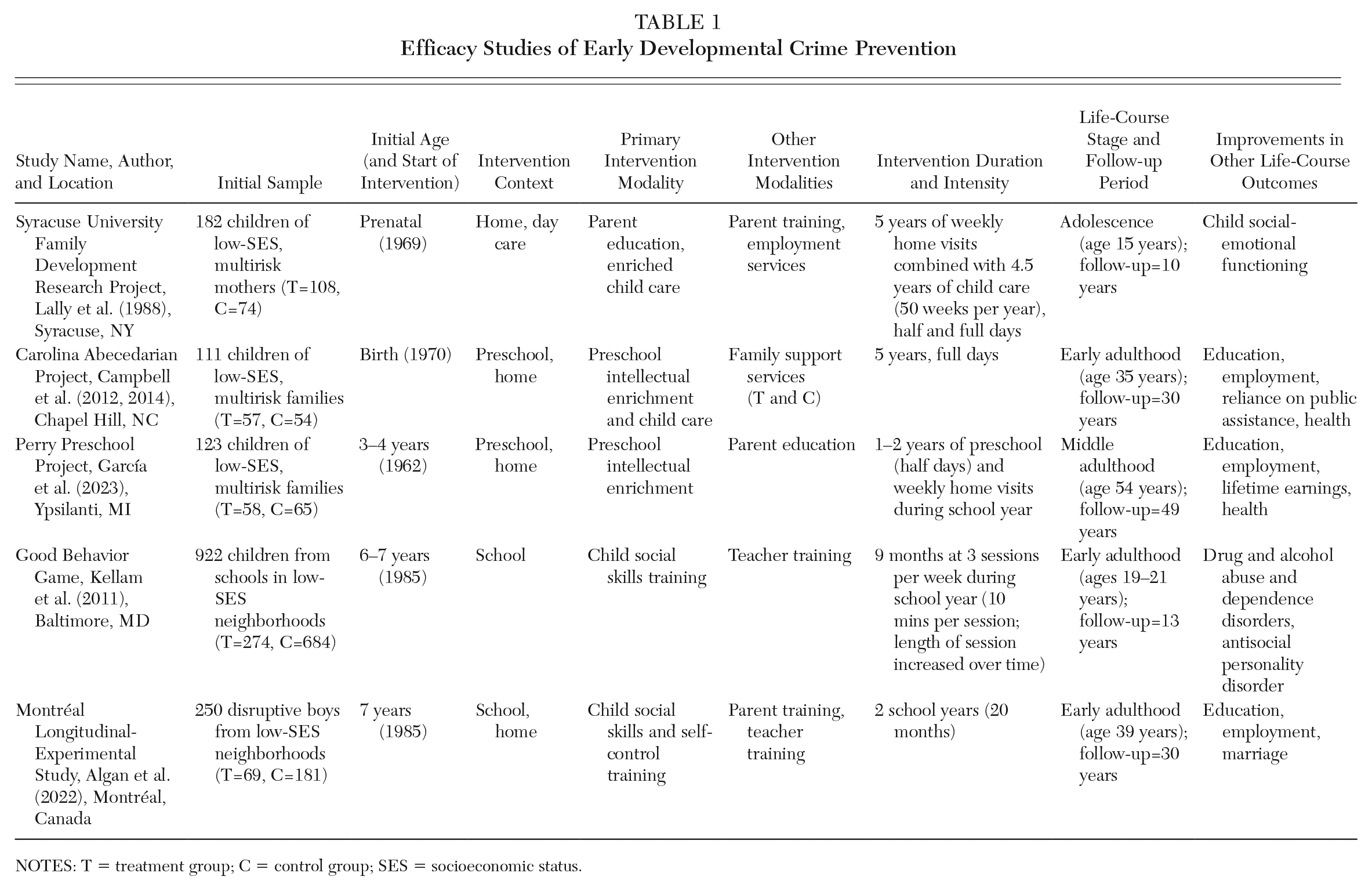
NOTES: T = treatment group; C = control group; SES = socioeconomic status.
There was a fair degree of variability in the duration of the interventions, with four studies lasting between two and five years and the other lasting less than one year. On the matter of the intensity of the primary (and sometimes also the secondary) interventions (e.g., the number of days or sessions per week), it seems fair to say that all five studies were delivered in an intensive manner. The postintervention follow-up period ranged from a low of 10 years to a high of 49 years, with four of the studies assessing intervention effects between early adulthood and middle age. In addition to reporting desirable effects on delinquency, criminal offending, or both, each of the studies reported desirable effects across a wide range of other important life-course outcomes, including academic achievement, social-emotional functioning, education, employment, substance abuse, and health.
Syracuse University Family Development Research Project
This project aimed to bolster family and child functioning through a multimodal intervention involving parent education, enriched child care, parent training, and employment services (Lally et al. 1988). The project began prenatally and provided expecting mothers—mostly impoverished and single women—with a range of educational and health services. After the child’s birth, trained paraprofessionals visited the homes weekly to assist the mothers (and other family members) with issues of child-rearing, family relations, and employment. Children were provided with 4.5 years of enriched child care (50 weeks a year), commencing with five half days a week at ages 6 to 15 months and, thereafter, with five full days a week until age 5 years.
Researchers assessed intervention effects using a matched control group design, which was established when the children were age three years. Ten years after the completion of the intervention, 119 of the initial sample of children (65 percent) were followed up to age 15 years. Significantly fewer treatment group members compared to the controls were referred to the juvenile court for delinquency offenses (2 percent versus 17 percent). Female youths in the treatment group, compared to their control counterparts, had better school attendance and school performance; no differences were found among the male youths. A benefit-cost analysis found that the costs of running the intervention exceeded benefits—in the form of savings to the criminal justice system and crime victims—by a factor of three to one (Aos et al. 2001). This was largely because of the high cost of the intervention ($45,000 per child in 1998 dollars).
Carolina Abecedarian Project
This project aimed to improve school performance by encouraging the adaptation of cognitive, language, and behavioral skills through games and activities designed to facilitate child-teacher interactions (Campbell et al. 2012). Enrollment included 111 children from multirisk families that met poverty guidelines. Participants were randomly assigned to treatment and control conditions. Children in the treatment group received five years of full-day preschool child care, and both groups received family support services.
At age 30, 101 of the participants (91 percent) were interviewed, and it was found that fewer of the treatment group members, compared to the controls (but not significantly so), reported being convicted of a criminal offense (27 percent versus 28 percent). It was also found that significantly fewer of the treatment group had used public assistance in the previous seven years (4 percent versus 20 percent), significantly more had graduated from college or university (23 percent versus 6 percent), and significantly more were consistently employed (i.e., worked full time) in the previous 24 months (75 percent versus 53 percent) (Campbell et al. 2012). A benefit-cost analysis conducted for the previous follow-up at age 21 years found that for every dollar spent on the program, $2.49 was saved to society (Barnett and Masse 2007). A more recent follow-up at age 35 years, which included 72 of the participants (65 percent), focused on health outcomes; one key result was a significantly lower prevalence of risk factors for cardiovascular and metabolic diseases for treated compared to control participants (Campbell et al. 2014).
Perry Preschool Project
Carried out in the early 1960s in Ypsilanti, Michigan, investigators allocated (approximately at random) 123 children (ages 3–4 years) of low socioeconomic status (SES) families to treatment and control conditions, with treatment children attending a daily enriched preschool program taught by professional teachers (García et al. 2023). Referred to as “plan-do-review,” it aimed to provide intellectual stimulation, increase thinking and reasoning abilities, and improve later school achievement. Teachers also conducted weekly home visits with the aim of engaging parents in their children’s development.
The project had long-term benefits extending up to age 54. The latest follow-up analyzed the project’s impact on criminal activity beyond adolescence (i.e., ages 20 to 50 years) or, as Heckman and Karapakula (2019, 43) call it, “life-course-persistent crime.” Compared to the control group, men in the treatment group were significantly less likely to have been convicted of a serious crime (7 percent versus 30 percent). By age 50, 23 percent of the control group men had two or more convictions for violent misdemeanors compared to only 3 percent of the treatment group men.
Improvements were also found for many other important life-course outcomes. For example, between the ages of 26 and 40, treatment group participants (men and women) spent a greater amount of time employed (56 percent versus 42 percent) and reported higher annual incomes. Heckman and Karapakula (2019) suggest that this is due to treatment group participants spending significantly less time incarcerated. As part of the age 54 follow-up, participants received a number of health tests, the results of which indicated that treatment group men (compared to their control counterparts) had significantly lower levels of total cholesterol and arterial inflammation. Compared to their control counterparts, women in the treatment group exhibited lower concentrations of hair cortisol (indicating lower levels of long-term stress), were less likely to have diabetes or a substance use disorder, and were more likely to exercise regularly.
These and other improvements over the life course translated into substantial financial benefits. A benefit-cost analysis at age 40 found that Perry yielded more than $17 of benefit per dollar of cost (Schweinhart et al. 2005). A reanalysis by Heckman et al. (2010) found a slightly lower but still favorable return of $7 to $12 of benefit per dollar of cost. For the latest follow-up, García et al. (2021) expanded the benefit-cost analysis to include intra- and intergenerational effects, with a specific focus on siblings’ and children’s education, income, health, and criminal activity. It was estimated that $9 was returned to society for each $1 spent on the project, with some of the benefits realized by the treatment group participants’ brothers, sisters, and children.
Good Behavior Game
The Good Behavior Game was designed to reduce aggressive or disruptive behavior among first-grade children through the adoption of a game built into the school curriculum that rewarded students for prosocial classroom behavior (Kellam et al. 2011). Teachers start the game with short, regularly scheduled periods and gradually vary the length and time of the sessions. This unpredictability is designed to condition children to express prosocial behavior more frequently without prompting or reward. The research team randomly assigned 922 first-grade children from low-SES neighborhoods in Baltimore, Maryland, to treatment and control conditions.
Thirteen years after the intervention ended, 75 percent of the initial sample were located for a young adulthood follow-up (ages 19–21). It was found that males in the treatment group reaped the greatest benefits. For instance, compared to their control counterparts, they were significantly less likely to suffer from drug abuse and dependence disorders (19 percent versus 38 percent), engage in violent or criminal behavior (34 percent versus 50 percent), and have suicidal thoughts (11 percent versus 24 percent) (Kellam et al. 2011).
Montréal Longitudinal-Experimental Study
This study was set up for the express purpose of preventing delinquency through an intensive, multimodal intervention targeted on young disruptive (i.e., aggressive/hyperactive) boys from low-SES neighborhoods in Montréal, Canada (Tremblay et al. 1995). Investigators randomly allocated a total of 250 boys to treatment and control conditions. Between ages seven and nine years, and over the course of two school years, the treatment group received training designed to foster social skills and self-control. Coaching, peer modeling, role playing, and reinforcement contingencies were used in small group sessions on such topics as “how to help,” “what to do when you are angry,” and “how to react to teasing.” Parents were trained in parent management techniques, which included how to provide positive reinforcement for desirable behavior and how to use nonpunitive and consistent discipline practices. The interventions were carried out by three full-time university-trained professionals (psychologist, social worker, and psycho-educator).
By the time participants reached age 39, the intervention had demonstrated significant desirable effects across a wide range of important life-course outcomes, including criminal offending, education, and employment. For criminal offending (assessed at age 28), treatment group participants, compared to the controls, had significantly lower rates of self-reported property violence but not personal violence. These results were part of a comprehensive benefit-cost analysis, which found that for each $1 spent on the intervention, $11 was saved to society—in the form of savings to the criminal justice system and crime victims, increased tax revenue (from higher employment and earnings), and less reliance on social services (Algan et al. 2022).
Evidence from Effectiveness and Broad Dissemination Studies
We identified a total of seven early developmental crime prevention interventions that can be classified as effectiveness or broad dissemination studies. As shown in Table 2, each of the studies was carried out in the U.S. Most of the studies were implemented in the 1980s and 1990s, with the earliest studies beginning in the mid-1960s (Head Start) and late 1970s (Nurse-Family Partnership). The interventions were delivered as early as the prenatal stage and birth, with most of the interventions delivered between ages three and nine years. The interventions took place in a range of settings, including home, preschool, elementary school, community, and child development centers. All but one of the studies used multimodal interventions. Primary intervention modalities included home visitation services, preschool intellectual enrichment, child care, day care, social skills training, parent education, parent training, and teacher training.
Effectiveness and Broad Dissemination Studies of Early Developmental Crime Prevention
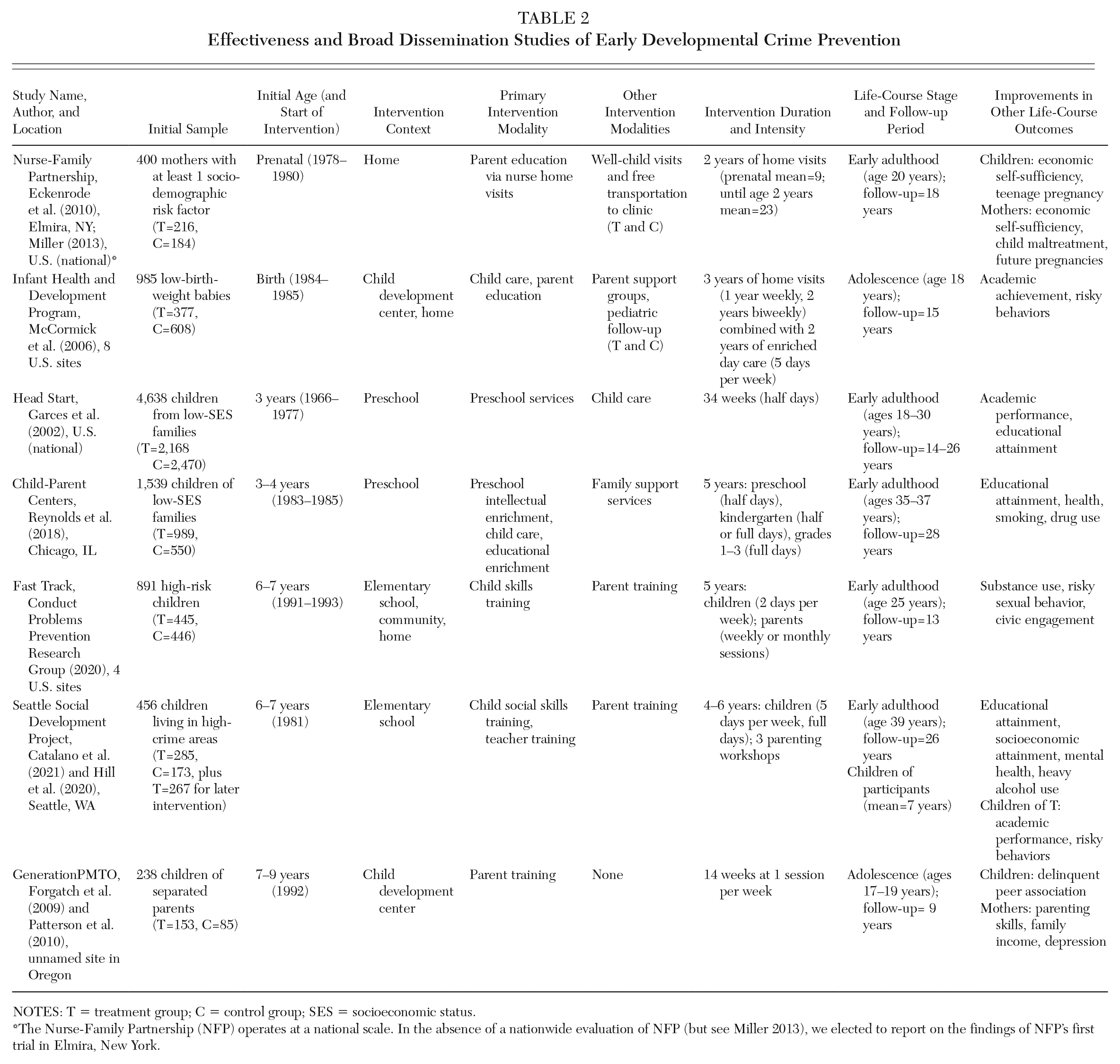
NOTES: T = treatment group; C = control group; SES = socioeconomic status.
The Nurse-Family Partnership (NFP) operates at a national scale. In the absence of a nationwide evaluation of NFP (but see Miller 2013), we elected to report on the findings of NFP’s first trial in Elmira, New York.
Intervention duration was relatively long, with five of the studies lasting between two and six years. Most of the interventions were also delivered with some degree of intensity. The postintervention follow-up period ranged from a low of 9 years to a high of 28 years, with five of the studies assessing intervention effects during early adulthood and the other two studies during late adolescence. In addition to reporting desirable effects on delinquency, criminal offending, or both, all of the studies reported improvements in at least one other life-course outcome.
Nurse-Family Partnership
In the late 1970s, the first trial of the Nurse-Family Partnership (NFP) began in Elmira, New York (Eckenrode et al. 2010). The program enrolled 400 women prior to their 30th week of pregnancy. Women were recruited if they had no previous live births and had at least one risk factor for health and developmental problems in infancy (under the age of 19, unmarried, or low SES). Investigators randomly assigned the women to a group that received home visits from nurses during pregnancy, a group that received visits both during pregnancy and the first two years of life (the treatment group), or a control group that received no visits. Each visit lasted about one hour, and the mothers were visited on average every two weeks. The nurses gave advice about prenatal and postnatal care of the child, infant development, and the importance of proper nutrition and avoiding smoking and drinking during pregnancy.
The first results of the trial showed that prenatal plus postnatal home visits led to a significant decrease in recorded child physical abuse and neglect during the first two years of life, especially by poor, unmarried, teenage mothers (Olds et al. 1986). In the latest follow-up when the children were age 19, compared to their control counterparts, daughters of the full sample of mothers had incurred significantly fewer arrests and convictions, and daughters of the higher-risk mothers had significantly fewer children of their own and less Medicaid use; few effects were observed for the sons (Eckenrode et al. 2010). Large-scale replication or effectiveness trials of NFP (in Memphis, Tennessee, and Denver, Colorado) have also shown desirable effects on a wide range of outcomes for both nurse-visited mothers and their children (see, e.g., Olds et al. 2014). NFP currently operates at a national scale, with agencies in 41 states, and serves almost 55,000 families annually.
Drawing on sites from across the country, Miller (2013) carried out a benefit-cost analysis of NFP. Analyses showed a favorable return of $2.90 for each dollar spent on the program, with monetary benefits derived from a wide range of improvements over the life course, including lower rates of youth criminal arrests and substance use, reduced use of governmental assistance programs like Medicaid and food stamps, and better health outcomes.
Infant Health and Development Program
The Infant Health and Development Program is a multisite randomized controlled trial of a prevention intervention designed to improve the life chances of low-birth-weight preterm infants (McCormick et al. 2006). The infants were stratified before random allocation into two categories of low birth weight: lighter (up to 2,000 grams) and heavier (2,001–2,499 grams). The intervention lasted three years and had three components: (a) parent education through home visits (delivered weekly during the first year and every other week during the second and third years of life), (b) enriched day care beginning at 12 months, and (c) parent support groups coinciding with the day care.
The latest follow-up, conducted when the children were 18 years old, included 636 participants of the initial sample (65 percent). The authors found that the program produced desirable but nonsignificant effects on juvenile arrests for both the lighter-infant group (16 percent versus 20 percent) and the heavier-infant group (21 percent versus 26 percent). For the heavier-infant group, the treatment group, compared to the controls, demonstrated significantly higher math achievement scores and fewer risky behaviors (McCormick et al. 2006).
Head Start
Started in the mid-1960s and reaching about 800,000 children living in poverty annually, Head Start has long been considered the nation’s most important early education program (Office of Head Start 2023). In addition to providing an enriched educational environment for children (ages three to five years) to develop learning and cognitive skills, Head Start aims to improve self-regulation, gross and fine motor skills, and self-confidence, and offers access to health care services. Some Head Start sites also provide programs for parents.
Head Start has been the subject of several evaluations and benefit-cost analyses. A large-scale study of the program’s long-term effects, by Garces et al. (2002), found that children who attended Head Start were significantly less likely to report having been arrested or referred to court for a crime by the time they reached adolescence and early adulthood (ages 18–30 years) compared to a control group, which included their siblings who did not attend Head Start. Head Start participants were also found to have significantly improved academic performance and educational attainment. Improvements have also been observed in the children of Head Start participants (Barr and Gibbs 2022; Garces et al. 2002).
A benefit-cost analysis of Head Start found that the program’s short- and medium-term benefits could offset between 40 percent and 60 percent of its costs, and the addition of a small fraction of long-term benefits would make the program a worthwhile public investment (Currie 2001). A more recent benefit-cost analysis compared the efficiency of funding Head Start versus funding traditional K–12 education (Johnson and Jackson 2019). The study’s key finding held that, “for a district that spent $4,500 per-pupil (about 10 percent above the average K–12 spending level), the marginal dollar spent on Head Start led to between 1.5 and 2.5 times the improvement in adult outcomes as that spent on K–12 education” (Johnson and Jackson 2019, 346). The authors concluded that transferring funds from K–12 education toward Head Start would result in better average outcomes for youth.
Child-Parent Center program
The Child-Parent Center (CPC) program provides disadvantaged children (ages three to four years) with high-quality, active-learning preschool supplemented by family support, along with an educational enrichment component during elementary school (up to age nine) (Reynolds et al. 2018). Begun in 1967, the CPC is the second-oldest federal preschool program in the U.S. (after Head Start) and the oldest “extended early intervention” program. CPC operates in 24 centers in high-poverty neighborhoods across Chicago, Illinois.
A nonrandomized controlled design was used to evaluate the program, with a sample of more than 1,500 children. By age 26, the treatment group, compared to their control counterparts, had significantly lower rates of felony arrest (13 percent versus 18 percent) and higher rates of school completion (87 percent versus 81 percent) (Reynolds et al. 2011, 2018). A benefit-cost analysis of CPC, which included some outcomes measured up to age 26 (crime was measured at age 18), found that for every dollar spent on the program, the average return in benefits to society was $5.21 (Reynolds et al. 2011). The largest share of the monetary benefits was from reduced interaction with the criminal justice system (57 percent). A more recent benefit-cost analysis, carried out when participants were 37 years old, focused on health outcomes. Based on lower rates of diabetes and smoking among treatment group participants compared to their control counterparts, it was estimated that for every dollar spent on the program, between $1.35 and $3.66 was returned to society (Varshney et al. 2022).
Fast Track
This is a multimodal, long-duration intervention set up to prevent severe and chronic conduct problems in children at high risk for antisocial behavior, beginning in the first grade (ages six to seven years) (Conduct Problems Prevention Research Group 2020). The primary intervention modality involved child social skills training. Delivered in a school setting, teachers used the Promoting Alternative THinking Strategies (PATHS) curriculum, which emphasized building social-emotional competence through teaching prosocial skills (e.g., self-control, emotional awareness, understanding). A secondary intervention—parent training—involved parent groups and home visits focused on improving child-parent interactions, family-school interactions, and disciplinary actions.
In the early 1990s, 891 high-risk children in four sites across the country were randomly allocated to receive the Fast Track program or to a control group that received usual services. The latest follow-up was carried out when participants were 25 years old and involved 92 percent of the original sample. Among the key findings, the treatment group, compared to the control group, had significantly lower rates of violent crime (severity weighted mean: 0.94 versus 1.38) and drug-related crimes (event mean: 0.5 versus 0.58). In addition, treatment group participants, compared to their control counterparts, exhibited significantly lower rates of externalizing and internalizing behavior problems, substance use, and risky sexual behavior and had significantly higher levels of civic engagement (Conduct Problems Prevention Research Group 2020).
Seattle Social Development Project
Implemented largely in a school setting, the Seattle Social Development Project combined teacher training, parent training, and child social skills training to prevent the early onset of delinquency (Catalano et al. 2021). Investigators randomly assigned approximately 460 first-grade children (age six years) living in high-crime areas of Seattle, Washington, to treatment and control conditions in the original study; a later intervention involving about 270 children was added, which extended the duration of the intervention from four to six years. Parents and teachers of children in treatment group classes received training in methods of child management and instruction, which were designed to increase children’s attachment to their parents and their bonding to the school. The children were also trained in interpersonal cognitive problem-solving. Their parents were trained to notice and reinforce socially desirable behaviors in a program called “Catch Them Being Good.”
In a follow-up when study participants were 18 years old, Hawkins et al. (1999) found that the full intervention group (i.e., those who received the intervention from grades 1 to 6) self-reported less violence, less alcohol abuse, and fewer sexual partners than the late treatment group (grades 5–6 only) or the controls. An associated benefit-cost analysis found that for every dollar spent on the program, $3.14 was saved to government and crime victims (Aos et al. 2004). In the latest follow-up when participants were age 39, which included 88 percent of the initial sample, Catalano et al. (2021) found that the full intervention group (compared to the control groups) reported significantly better mental health, physical health (e.g., lower blood pressure), and socioeconomic attainment (e.g., higher income, home ownership, reduced dependence on public assistance). Earlier desirable effects on criminal offending were no longer evident.
With many of the study participants now parents themselves, researchers could examine whether the long-term desirable effects of the intervention carried over to their children (with a mean age of seven years). Hill et al. (2020) found that children in the treatment group, compared to the controls, showed significant improvements across a range of outcomes, including higher academic skills and performance and lower behavioral problems.
GenerationPMTO
Formerly known as Parent Management Training–Oregon Model, GenerationPMTO refers to a group of parent-training interventions that aim to prevent antisocial behavior in children and adolescents (Forgatch et al. 2009). Therapists coach parents in the use of effective parenting strategies, namely, skill encouragement, setting limits or consistent discipline, monitoring, problem-solving, and positive involvement. GenerationPMTO is designed to be delivered in group or individual family formats and different settings (e.g., homes, community centers) as well as over varied durations, all depending on families’ needs.
GenerationPMTO was first tested in a randomized controlled trial of mothers who had recently separated from their spouses (known as the Oregon Divorce Study II), which included assessing effects on a range of outcomes for their children. At ages 17 to 19 years, treatment group youth, compared to their control counterparts, had significantly lower arrest rates (mean: 0.16 versus 0.3) (Forgatch et al. 2009). Treatment group mothers, compared to their control counterparts, reported significantly lower rates of depression and improved standards of living and were significantly less likely to have ever been arrested (Patterson et al. 2010).
Discussion and Conclusions
We set out to examine the research evidence on early developmental crime prevention interventions that might carry a social impact over the life course. We identified a total of 12 high-quality studies of early developmental prevention interventions that demonstrated significant and long-term (i.e., over multiple life-course stages) desirable effects on delinquency, criminal offending, or both. Of the 12 studies, we classified five as efficacy studies and seven as effectiveness or broad dissemination studies.
Several key findings emerge from our review. First, with one exception, all the studies used multimodal interventions that allow for the targeting of different risk factors and often in different domains (e.g., individual, family, school, community). In large measure, this approach helps to foster cumulative protection over the life course. Second, all the studies reported significant improvements in other important outcomes (e.g., education, employment, health, mental health, substance use) and over different stages (i.e., adolescence, early adulthood, or middle adulthood). This result is indicative of cascading effects. A third key finding relates to the intergenerational transmission of effects of early developmental prevention interventions. While only a handful of the studies investigated intergenerational effects, those that did reported that children of participants who received the intervention (often referred to as the third generation) also had improved outcomes during early stages of their life course.
Another key finding has to do with the financial return on public spending on early interventions. Of the eight studies that carried out benefit-cost analyses, all but one found that the monetary benefits from desirable intervention effects exceeded the monetary costs of running the program, with benefit-to-cost ratios ranging from a low of 2:1 to a high of 11:1. It is noteworthy that many of these interventions have high costs per participant, with some of this being a function of the (important) professional qualifications of the personnel delivering the interventions (e.g., teachers, nurses, psychologists).
Limitations
Our review has some limitations. The first has to do with the small number of studies that met our inclusion criteria. On the one hand, there is no established minimum number of studies for narrative reviews. On the other, having a few more studies might have allowed for a more detailed examination of intergenerational transmission of effects, for example. Relatedly, we included two studies (Carolina Abecedarian Project and the Infant Health and Development Program) that did not find significant effects on delinquency or criminal offending at the latest follow-up. We decided to include them because they represent highly important studies in the early prevention literature, they reported lower (albeit nonsignificant) rates of criminal offending for treatment- versus control-group participants, and they reported significant effects for other life-course outcomes.
There is also the matter of how we frame “other” life-course outcomes. For many of the studies some of these “other” outcomes are the primary foci of the intervention. Delinquency or criminal offending could just as easily be considered “other” outcomes for some of the studies were it not for our specific focus on crime prevention.
Implications for public policy and research
In terms of translating research into public policy, there is wide agreement that greater weight should be placed on effectiveness and broad dissemination (or routine practice) studies than on efficacy (or research and demonstration) studies (Fagan et al. 2019). This view holds implications for policy discussions about the social impact of early developmental crime prevention interventions—that is, policymakers will want to pay closer attention to routine practice studies. In Table 2, two of the studies—Head Start and NFP—currently operate at a national scale in the U.S. NFP started as an efficacy trial followed by two large-scale replication or effectiveness trials. The other five studies in Table 2 can be classified as effectiveness studies, each with large samples and characterized by multisite trials, multiple program sites within a city, or other real-world conditions.
It is important to note that the efficacy studies reviewed here are no slouches; they are highly important in their own right. They allow for a deeper understanding of the social impact of early developmental crime prevention and, in some respects, can be considered the starting point for a next generation of studies. It is noteworthy that two of the efficacy studies in Table 1, Perry Preschool and Carolina Abecedarian, are at the forefront of a national debate in the U.S. about the long-term benefits of early education programs—namely, high-quality preschool programs for children living in poverty—and calls for increased public spending in this area (see, e.g., Burchinal et al. 2024; García and Heckman 2024).
To return to the routine practice studies and the evidence base that they currently provide for bringing about social impact, any expansion of early developmental crime prevention policies and programs will need to include concerted action to mitigate the expected attenuation of effects in the scaling-up of evidence-based interventions. This issue has implications for moving from the intervention stages of efficacy to effectiveness and effectiveness to broad dissemination. Among the key challenges are loss of treatment fidelity, heterogeneity in target populations, and heterogeneity of service providers. Addressing these challenges and facilitating the scaling-up of evidence-based interventions to achieve population impacts or, more broadly, social impact is at the core of implementation science (see Fixsen et al. 2017)—and needs to be taken seriously. Not lost on this discussion is the importance these matters hold for the universal application of early prevention interventions, what Dodge (2022) argues should be the ultimate goal.
Prioritizing upstream approaches also warrants greater attention in policy discussions about the social impact of early developmental crime prevention interventions. NFP and the Chicago CPC program are two examples of upstream approaches that have resulted in substantial and lasting benefits over participants’ life course (i.e., through early adulthood) and social impacts within the wider community and population. Depending on the needs of the population being served, multimodal interventions may allow for a dual focus on upstream and downstream approaches. Relatedly, this approach might also present a research opportunity to investigate the independent or interactive effects of the different intervention components as well as to model the different pathways to social impact.
Developmental crime prevention is a strategy that aims to prevent delinquency and criminal offending in the first instance, by attending to early risk factors and promoting healthy development over the life course. As shown in the current review, various intervention modalities are effective in preventing delinquency and later criminal offending and, when implemented rigorously, generate significant social impact. Future research should continue to explore the ways in which early developmental crime prevention contributes to a better society and further advances knowledge on the intervention modalities that can lead to greater social impact.
Footnotes
NOTE/*: We are grateful to the anonymous reviewers for helpful comments on an earlier version of this article. We are heartbroken to note that David Farrington passed away on November 5, 2024, after completing work on this article. He is sorely missed.
Brandon C. Welsh is Dean’s Professor of Criminology, codirector of the Crime Prevention Lab, and director of the Cambridge-Somerville Youth Study at Northeastern University. From 2022 to 2024, he was Visiting Professor of Global Health and Social Medicine at Harvard Medical School. His research focuses on the prevention of delinquency, crime, and interpersonal violence and evidence-based social policy.
Heather L. Paterson is a doctoral student in the School of Criminology and Criminal Justice at Northeastern University. Her research interests include the impact of adverse childhood experiences on life-course behavior, particularly in relation to future criminal justice system involvement, and the development of effective social interventions for at-risk youth.
Michael Rocque is a professor of sociology at Bates College. His research interests are criminological theory, racial disparities in the criminal justice system, and desistance from crime.
David P. Farrington* was Emeritus Professor of Psychological Criminology in the Institute of Criminology at the University of Cambridge and codirector of the Cambridge Study in Delinquent Development. In 2013, he was awarded the Stockholm Prize in Criminology.