




Abstract
In the late 2000s, after the implementation of European policies to prevent and criminalize irregular migration, a new form of human smuggling—ransom smuggling—appeared in North Africa. This article is an analysis of ransom smuggling of Somali migrants, based on anthropological fieldwork in Germany and Kenya. Ransom smuggling is dangerous and complex, involving both human smugglers and hostage takers, but I argue that Somali migrants—especially younger ones—make use of this form of smuggling despite its risks because it is cheaper and easier to organize than other options. I describe the major elements of Somali ransom smuggling, which involves transit through the Sahara and Libya. I focus on the various actors involved, and the responsibilities and burdens that accrue to the migrants who transit a system that accounts for their lives as commodities for trade.
It’s sort of an agency. They would kidnap you and call your parents. And your parents would either pay money for your life or they won’t. It depends on if you are important for them.
This article analyzes a relatively new form of human smuggling that developed in Northern Africa at the end of the 2000s, following the implementation of European policies to prevent and criminalize irregular migration. In this form of human smuggling, hostage taking and extortion play a critical role. While some authors refer to this form of kidnapping as trafficking for ransom, I propose the term “ransom smuggling” to make the combination of the two elements, smuggling and holding for ransom, explicit. Both smugglers and hostage takers—actors of mobility and actors of immobility, respectively—are part of the system.
Ransom smuggling in the context of Somali 2 migration via North Africa means that migrants are first smuggled from the Horn of Africa or Kenya along clandestine routes by locally embedded actors and then taken hostage by local kidnappers in the Sahara and/or Libya. By threatening to kill the migrants and using psychological and physical violence, including torture and rape, the kidnappers extort money from their captives’ relatives. Only after ransom is paid are migrants released and able to continue their journey, again with the help of smugglers who are often, but not always, different from those involved in the kidnapping. In contrast to other forms of smuggling, the “service” on the ransom-smuggling route is not, or not fully, paid upfront but collected later, in most cases through kidnapping.
In this article, I argue that, despite the risks involved, Somali migrants make use of this form of smuggling because it is cheaper and easier to organize than other options. The routes along which this form of smuggling is prevalent are used especially by young people who often leave without the knowledge of their parents on travel-first-pay-later schemes (Ali 2016) but also by others with fewer resources. Choosing these route enables them to be mobile, in both a spatial and a social sense. Somali migrants refer to migrating by ransom smuggling as tahriib (which means smuggling in general, but in the Somali case refers mostly to dangerous irregular migration journeys), a term implying the dangers of the route as well as its criminalization.
Kuschminder and Triandafyllidou (2020) argue that this form of smuggling poses a conceptual challenge, as it blurs the distinction between smuggling of migrants and human trafficking (for a similar legal argument, see Goor 2018). While smuggling is based on a mutual agreement on price and service and hence presupposes “a legality of an agreed contract” (Kuschminder and Triandafyllidou 2020, 208), ransom smuggling does not entail such an agreement. Due to this blurred distinction, Somali migrants often found it difficult to differentiate between the various actors they encountered. Against this background, this article explores the distinction Somali migrants made between mukhalas and magafe as two discrete smuggler figures. 3 Whereas the term mukhalas (from Arabic, “trustworthy, sincere”) refers to brokers in general who can facilitate migration by organizing legal documents, transport, or food (but also organize, for instance, property deals), the term magafe (literally, “the one who does not miss”) emerged specifically in relation to hostage-taking actors in the Sahara Desert and further north in Libya. I argue that this distinction helps migrants to make sense of ambiguous and risky situations and to navigate the dangers of irregular migration.
The main body of data for this article was collected in 2017 and 2018 during anthropological fieldwork with Somali migrants in Germany. 4 Of the more than 80 interviewees, almost all had relied upon some form of facilitated mobility. Especially for those who had to cross the Sahara and the Mediterranean Sea, however, mobility facilitation could quickly transform into violence, torture, and forced immobility along the way. In addition, the author collected data in Kenya with Somali migrants who had attempted to go on tahriib and with families of migrants who had undertaken this journey to Europe. In this article, I explore how migrants try to navigate the dangers they encounter en route by making sense of the complex situations.
To do so, I first describe the context of the research. Second, I outline the development of ransom smuggling in North Africa from the mid-2000s onward in the context of European policies of migration prevention and criminalization. I then concentrate on those Somali migrants who came to Germany after 2010, most of whom experienced ransom smuggling. I show that there are marked differences between those who migrated via Libya, which entailed the danger of getting caught in the ransom-smuggling system, and those who migrated to Germany by other routes. I argue that, because migrating via Libya is often cheaper and easier to organize than using other routes, it is an option used especially by younger people and the less affluent. Next, I outline the different steps taken by Somalis who had migrated via Libya. I then explore one of the means they used to differentiate between the various actors they encountered—smugglers as well as militant Muslim groups and state actors (e.g., Libyan prison guards)—to make sense of the complex and dangerous situation ransom smuggling entails, that is, the emic distinction between mukhalas, brokers, and magafe, a term referring to kidnapper-trafficker networks in Northern Africa. In the last part of the article, I explore how mukhalas and magafe are described emically in narrations about migration and how this distinction between the two helps migrants to navigate some of the dangers of irregular migration, such as finding the “right” smuggler or how to interact with mukhalas and magafe.
Data and Methods
The material for this article was gathered mainly in Germany in the framework of a social anthropological project concerning the living conditions of Somali migrants in different cities. The data were, for the most part, collected by a group of master’s and undergraduate students of the University of Leipzig as well as two Somali-speaking German researchers, under my and the co–principal investigator’s (PI) supervision. Altogether, 84 interviews were conducted (in Somali, English, and German), most of which were recorded and transcribed. Except for three group discussions, all interviews were narrative or semistructured interviews with individual persons and ranged in length from 30 minutes to several hours. Contact to interview partners was established through members of the Somali community in the different localities, mainly through associations but also Somali shops or football clubs. In addition, researchers carried out participant observations (for instance, in the Somali shops) and took field notes whenever possible. Research, which took place for about six weeks in 2017, centered on common research questions formulated within the group and covered life before migration to Europe, the migration experiences, and life in Germany, which, by 2012, had become one of the medium-sized destination countries for Somalis. 5 As the people interviewed had migrated in different years and through different localities, it has not always been possible to discern whether any discrepancies in their narrations are the result of local variation, changes in the structures of ransom smuggling over time, or other factors. In some cases, migrants themselves were not entirely sure what kind of actors they had been dealing with; hence, this incomplete knowledge is also to be found in the data gathered. Furthermore, ex post interviews present a challenge in determining whether categories, such as mukhalas and magafe, became significant only after the migration experience or were already important beforehand.
In order to contextualize these retrospective interviews about migration experiences and to compensate for the limitations mentioned above, I contrasted the material from Germany to data I had collected in Kenya. This material included discussions with Somali migrants who had attempted to go on tahriib and with families of migrants who had undertaken this journey to Europe. I have had, over many years, recurrent contact with some Somali families, and these contacts form part of my long-standing anthropological research experiences with Somali migrants in Kenya since 2010. This combination of research experience in a proximate country of refuge (on proximity, see Scharrer and Suerbaum 2022) as well as in a destination country in Europe made it easier to reconstruct migrant smuggling experiences and to interpret the interview data in the wider context of Somali migration. Moreover, the research in Kenya showed that the emic differentiation of actors in the smuggling process, discussed as mukhalas and magafe in this article, also plays a role among people who have not migrated to Europe.
Ransom Smuggling
In North Africa, the practice of ransom smuggling, a form of smuggling in which hostage taking plays an inherent role, was described first in the Sinai region (Egypt) in 2009 (van Reisen and Rijken 2015, 113). Its appearance in the Sinai was linked directly to European policies aimed at restricting and criminalizing irregular migration. Since the early 2000s, the EU has established policies—such as the 2003 European Neighbourhood Policy (targeting mainly Eastern Europe) and the 2005 EU Strategy for Africa—that aim at the securitization and management of the borders adjacent to the EU and effectively render its neighboring states into buffer zones for preventing irregular migration (Bialasiewicz 2012, 846–47). One element of this policy was the creation of Frontex, the EU’s agency for external borders, in 2005. Frontex became active in Libya in 2007, only three years after sanctions against Libya had been lifted. In addition, in 2007 and 2008, Italy and Libya signed several bilateral agreements concerning migration control, which provided for joint patrols on the Libyan coast as well as the provision of surveillance equipment for Libya’s land and sea borders. Italy’s anti-immigration policies under Berlusconi furthermore illegalized irregular immigration and authorized direct deportations of migrants under the pretext of preventing terrorism, organized crime, and smuggling, without the assessment of their rights to asylum (Bialasiewicz 2012, 852–58). While migration from Libya to Italy declined as a result of these policies, 6 the falling numbers were due not to less migration overall but to a shift of movement from Libya to the Sinai–Israel route.
At first, mainly Eritrean migrants who wanted to enter Israel via this route became the targets of ransom smuggling, that is, a smuggling process involving periods of being kept as hostage and violence by the kidnappers 7 to extort money from the families of the migrants (Lorger and Gotlieb 2023). The inclusion of hostage taking into smuggling practices was not an entirely new phenomenon; it had already been reported from Yemen in 2006, concerning migrants from the Horn of Africa on their way to cross the fortified border to Saudi Arabia (Human Rights Watch [HRW] 2014). These practices probably built on older instances of hostage taking in the region, such as the ransoming of hostages by Somali pirates from 2005 onward (World Bank 2013). The Sinai region remained a crucial place of ransom smuggling until 2012, when Israel finalized its border fence to Egypt (Jacobsen, Robinson, and Lijnders 2013, 7; van Reisen and Rijken 2015, 115). The practice then appeared in Libya, which had by then disintegrated into several autonomous regions since the fall of Muammar Gaddafi in 2011 (Kuschminder and Triandafyllidou 2020; Lorger and Gotlieb 2023).
Interestingly, ransom smuggling emerged as a phenomenon almost simultaneously along various migration corridors in South America, Southeast Asia, and North Africa in the second half of the 2000s (Lewa 2008; van Reisen and Rijken 2015; Vogt 2013); in all cases, this emergence was directly or indirectly linked to the increasing restriction (and hence criminalization) of migration. In Mexico, ransom smuggling appeared in about 2006, when kidnappings and extortions intensified in the context of the state’s war on drugs and the decline of the country’s economy (Vogt 2013, 773). It has been argued that policies of border enforcement and migration prevention often do not lead to less migration, but rather to changes in smuggling practices (Galemba, Vogel, and Missbach 2019). Massey (2020), for instance, has shown that the militarization of the Mexico–U.S. border from the mid-1990s onward led to a steep increase in the cost and risk of migration. With more surveillance in border towns, smugglers became essential actors for guiding migrants through less populated but more dangerous areas, with many people dying when trying to reach the U.S. Vogt (2013) reports similar processes taking place in Mexico farther away from the border area. When specific migrant routes became more heavily controlled due to mobility being declared an issue of security, this elevated the significance of previously less travelled, but more dangerous routes, often overlapping with those used by organized criminal networks transporting drugs or weapons (Vogt 2013, 774). In Southeast Asia, a similar practice of ransom smuggling has been reported, dating back to 2007 (Lewa 2008, 41), when Rohingya were being held in captivity in Thailand on their way to Malaysia (Cohen, Cohen, and Li 2017).
As has been shown, ransom smuggling appeared in North Africa in an environment of securitization and externalization policies aimed at restricting the flow of migration towards Europe. Yet it is also connected to the emergence of new information technologies (van Reisen and Rijken 2015) that made possible a form of capitalism in which the human body itself has become the commodity beyond its value for labor (Vogt 2013). In this “new phase in commodification” of the living body (Vogt 2013, 765), the wide availability of mobile phones plays a key role: for those ensnared in the enterprise of ransom smuggling—both smugglers, migrants, and their families—it is the mobile phone that enables both communication and, crucially, payment of ransom (see van Reisen et al. 2017; on mobile phone communication, Campana 2018).
Somali Migration and the Routes of Tahriib
As Somalia disintegrated—starting at the end of the 1970s, and intensifying with the Somali army attack on the northern regions in 1988 and the fall of then-President Siad Barre in 1991—people started fleeing to the neighboring countries Kenya, Ethiopia, and Yemen. As of February 2024, there were still about 300,000 Somali refugees registered in Kenya, about 315,000 in Ethiopia, and about 45,000 in Yemen (UNHCR 2024); in addition, about 2.9 million people were displaced within Somalia (Bakonyi and Chonka 2023, 3). From the late 1980s onward, Somalis also moved to Europe (mainly the UK and the Scandinavian countries) to apply for asylum or to North America through resettlement—a move influenced by socioeconomic class and gender but also chance (on class and forced migration, see Hunkler et al. 2022; Scharrer and Suerbaum 2022). Other Somali forced migrants moved as workers and businesspeople to countries in closer vicinity, such as on the Arab peninsula (de Regt 2010). In addition, there is return migration as Somalis make their way back to East Africa from places farther afield (Scharrer 2020). During the entire period, however, most Somali forced migrants stayed in East Africa. While Somaliland and Puntland in the north have become relatively stable—as an unrecognized sovereign state and a federal member state of Somalia, respectively—the situations in the central and southern regions have been less so, ranging from periods of open and widespread war to periods of relatively calm nonstate order. The recurrent violence (including bomb attacks), an often-shifting political situation, a debilitated economy, and repeated droughts have resulted in ongoing insecurity that prevents people from moving back to Somalia on a larger scale.
In the 79 interviews considered for this article, four participants reported that they had arrived in Germany before 1990, and 10 told of coming to Germany between 1990 and 2009, seven of them in the 1990s. At that time, Germany was one of the smaller-destination countries. While between 1988 and 1992 about 10,000 Somalis had come to Germany, this number of Somali inhabitants dropped to half until 2009 and slowly started to grow in 2010. From 2012 onward, the numbers increased more rapidly until, at the end of 2022, about 55,500 Somalis were registered as living in Germany (Destatis 2024). All other Somali migrants interviewed (65) had arrived between 2010 and 2017. 8
The four interviewees who arrived before 1990 traveled to Germany by airplane and entered the country legally, with either a work, student, or visitor visa. Therefore, they did not need to use the service of mobility facilitators. This situation changed in the 1990s. In narrations about this time, mobility facilitators are mentioned frequently, but their service was mostly used only at one point of the journey. Their tasks consisted mainly of forging documents and partly organizing the travel route, so that migrants reached their intended destination relatively quickly with few stops. Of the 10 interviewees who arrived in the 1990s and 2000s, seven were able to take flights to a European destination; two took flights to Turkey and Russia, respectively; and only one traveled via Libya. Costs were relatively high; one interviewee in Kenya—a hotel owner in Mombasa—mentioned that all services combined could cost up to USD 30,000 for going to the UK in the 2000s. A Kenyan passport alone could cost between USD 2,000 and USD 5,000 and would only enable relatively high mobility within Africa (reported by a Chinese farm owner who established himself on a farm close to Lusaka with the help of a fake Kenyan passport in 2010). Thus, in the interviews about migration in the 1990s and 2000s, distinct networks of smugglers did not play a major role, nor did open violence—or the threat of violence—by facilitators.
For Somalis who came to Germany from 2010 onward, smuggler networks became almost indispensable (with the exception of family reunification). With European policies increasingly restricting irregular migration routes to Europe (Bialasiewicz 2012), new forms of smuggling, which became known as tahriib, manifested in the Somali context. This Arabic word (originally used for smuggling in general) now refers to illegal travel and people smuggling, especially by young people via Ethiopia or Kenya, Sudan, and Libya and then across the Mediterranean to Europe (see Ali 2016, 7–12). Of the 64 interviewees who had arrived in Germany since 2010, 39 (61 percent) used this route. 9 For the route via Libya, migrants often relied on an initial contact to smugglers to whom they transferred organizational matters almost completely—a decision that, at first glance, made traveling easier. One explanation for why they chose this arrangement is their age. Table 1 shows that migrants using this route were on average younger than those choosing routes beyond Libya. 10 Frequently, they did not have to pay smugglers up front or paid only a small sum, with the understanding that more payment was expected later (often only guessing the exact amount) and that it would almost certainly have to be paid as ransom, as the quote at the beginning of this article shows. This move-first-pay-later scheme is closely interlinked with the system of ransom smuggling. Ali (2016) wrote that kidnappers detain the majority of Somalis on tahriib at least once during their journey and do not release them until ransom is paid, a period that can last from a few days to several months (Ali 2016, 8). This was true also for our interviewees, of whom a majority of those 39 migrating through the Sahara and Libya were held for ransom by kidnappers; only five reported not having been detained at all. 11 This contrasts with what Slack (2016) described for migrants to and deportees from the U.S. in Mexico, of whom “only” 7 percent reported having been kidnapped (Slack 2016, 3). Most of the interviewees describing detainment by kidnappers said that they had been given over or “sold” from smugglers to kidnappers; only a few mentioned being caught on the way. Thus, although kidnapper and smuggler networks operate separately, there exists a symbiotic relationship. Smugglers facilitate movement and migration, and kidnappers capitalize on this movement, immobilizing migrants to secure debt for movement paid as ransom.
Statistical Breakdown of Interviewees Having Arrived in Germany from beyond Europe, 2010–2017
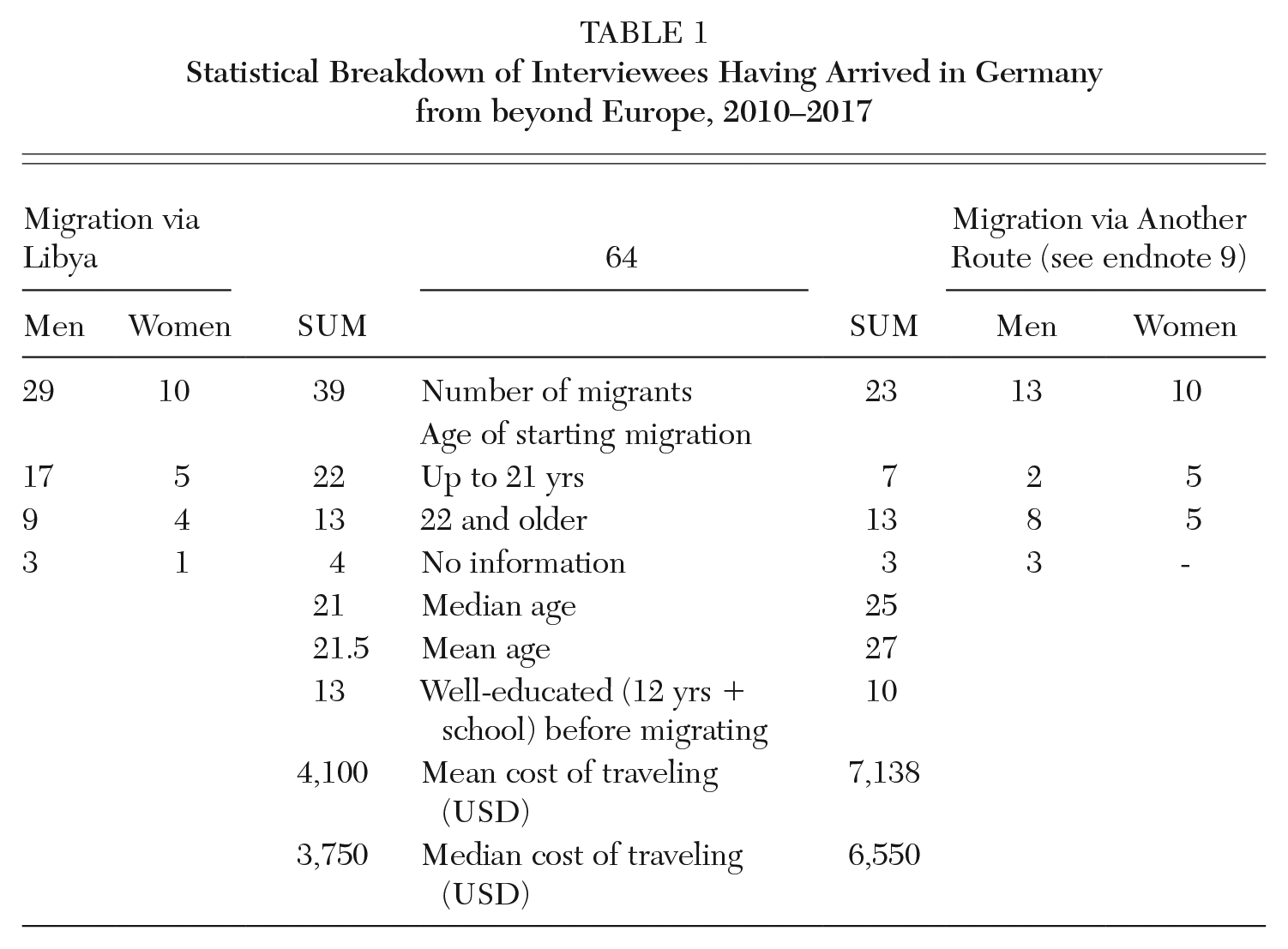
For the migrants interviewed, the journey via Libya to Europe lasted between a few months to several years (for five, less than six months; for 15, six to 12 months; for six, one to two years; for seven, more than two years; for six, no information). And they had to pay between USD 1,200 and USD 9,000, with a mean cost of USD 4,100 for the entire journey to Europe. This was cheaper than on other routes 12 and also cheaper than in the time before 2011, after which many Somali migrants to Germany used routes via Libya. The difference in costs can be attributed to two interrelated factors: the professionalization of smuggling networks prompted by policies of migration containment (Raineri 2018) and the breakup of the Libyan state. In combination, these factors enabled the establishment of a relatively stable ransom-smuggling system via Libya, whose economy relies on a high number of ransom payments.
Many young Somalis still mention being overcome with buufis, the intense urge to migrate abroad, emically described as a kind of mental illness (Horst 2006). This urge is fostered by social media reports of Somali youth in the Global North, smuggling networks advertising their services, and peers planning to go on tahriib, a journey in addition seen as rite de passage and adventure by some (Simonsen 2023). The interviews in Germany also showed that, although a comparatively high percentage of young Somalis (one in three) migrating via Libya were well-educated (at least 12 years of schooling before migration), they did not have enough resources to study in their home country. 13 Socioeconomic structures had been ruined by the civil war, and the resulting lack of opportunities at home further fueled their dreams for a better life. Hassan, whom I had met several years ago in Kenya, faced a similar situation. He had grown up in a refugee camp but was a very good student and had managed to work his way up to university. He had even received a stipend from Somalia to study in Nairobi, but this stipend covered only university fees and not living expenses. In Nairobi, he had lived with fellow students, as he could not afford to rent his own apartment, but he felt like an unwanted guest. So, when some Somali friends told him they were going on tahriib, he joined them in the hopes that, like his younger brother (who had arrived in Europe in 2014), he would be able to build a new life. Later, after he had been caught in Sudan, detained by police for six months, deported to Somalia, and returned to Kenya, Hassan explained to me that he had “not wanted to live like a cockroach anymore.” 14
Even though tahriib is often perceived by migrants as an individual decision of young people who leave without informing anybody, their families become involved in that moment when they are expected to pay ransom (see Ali 2016, 8). 15 Young Somalis use the move-first-pay-later scheme of tahriib to fulfill their dream of “going somewhere” in life, what Ghassan Hage has called “existential mobility” (Hage 2009, 97). And they hope that their families will pay their ransom, even though they would not have allowed them to leave if asked beforehand (Bakewell and Sturridge 2021). This situation leads to conflicts within families. The uncle of Hassan told me angrily, “I don’t care if he gets killed on the way. That is his business. But it is me who has to pay the money to get him out.” 16 Yet, with tahriib, the costs may be not only financial: migrants often experience traumatizing violence, with some spending a long time in confinement either as hostages of kidnappers or as prisoners of the security apparatus.
Most interviewees (31 of 39) had migrated to Libya through Ethiopia and Sudan. In Ethiopia, smuggling networks maintained a strong presence even though the Ethiopian state had expanded its antismuggling policies, often linking them (at least in discourse) to antiterrorism policing directed against al-Shabaab from Somalia. In Sudan, the next stage, the routes of tahriib were mapped to avoid detection by following pathways far from cities and conurbations. Similar to Ethiopia, the Sudanese prosecute tahriib as illegal mobility, and in both countries, migrants can be jailed for longer periods of time before being deported to their country of origin, as the example of Hassan above has shown.
When traveling further within Sudan, migrants eventually entered the Sahara, the next step on their journey. For many, this stage of their journey was connected to their first experiences of exploitation and discrimination on the route. While the European discourse mainly focuses on crossing the Mediterranean, interviewees described crossing the Sahara as very difficult as well. Extreme weather conditions make the journey dangerous (e.g., with extreme heat during the day and minus degrees during night), and sandstorms can bury people in the desert. More important, the actual system of ransom smuggling starts in the Sahara. There, the smugglers, on whom migrants have been totally dependent so far, hand them over to hostage takers, who immobilize them and threaten violence and death until ransom is paid by their relatives. Interviewees who had been held in the Sahara reported enduring harsh conditions: they received very little food and drink, with some migrants dying as a result. Some witnessed people falling off the open trucks used as transport, or dying in other accidents. “Sahara is the worst,” one participant said, adding that “I have never seen something as bad as in Sudan [Sahara]. I think the ocean is better. It is either death or life, but the Sahara . . . [is] difficult.” 17
After making it through the Sahara, 25 of the 39 interviewees reported being confined by hostage takers in Libya. Their time in Libya, an important destination for labor migration as well as a transit to Europe, took center stage in the narrative interviews with migrants who had moved to Europe via Libya after the fall of Gaddafi in 2011. This can be explained by the long time they spent in the country and their often-traumatizing experiences of captivity, violence, and cruel treatment due to discrimination. As one interviewee explained: For example, the children in the streets [will] chase you, and if you try to defend yourself, the children cry and [their] parents come out with guns and you cannot do anything. You see sometimes a big guy, they [make] a rope for his head and there is a tree and they will bind the head on the tree like an animal, and the children [then] play with that person. Even the relatives, they don’t say, “Let the man go.”
18
The coastal town of Ajdabiya was mentioned in several interviews; there, houses and even whole compounds were used as unofficial prisons by hostage takers. These places of captivity contained small rooms with several locks. Migrants were not allowed to talk among themselves or make any other noise, because their captors feared that new prisoners might become alarmed when arriving and try to run away. 19
Achtnich (2022) writes that “being transferred along this chain of actors . . . made migrants feel commodified and dehumanized” (103). I argue that the many references that interviewees made of “being treated like animals” were less reflective of their experience at the transfer from one actor to the next, which many had expected, but rather of the inhumane treatment they received—of having to undress, of being kept in confinement, of being beaten, and of being starved: Like cattle, we were lined up: the men were lined up, the women were lined up. Everyone’s three-digit name [given name, father’s name, and grandfather’s name] was put on a list. He wrote down the family’s phone number. After he wrote it down, you have to call there. He charges credit on it. [. . .] If the person calls and uses up the money, then that’s seven days without food and the person is beaten. [. . .] We went in to [see] people who were like a stick, with eyes and legs. We thought the people had been in here for five years; they were not. The one who had stayed there the longest had been in there for eight months.
20
In addition, there was no possibility for hygiene, no water for cleaning, only a bucket in the room for excrement—all conditions rife for the spread of vermin and disease. 21
Those who managed to buy themselves free or to escape often relied for survival on Somali networks in Libya that had existed since before 2011. Some interviewees told of being caught again, either by hostage takers or by the police; being confined once again; and, especially when caught by hostage takers, experiencing renewed violence. According to Warsan, migrants could not rely on the Libyan government or the police, who were often themselves involved in the smuggling system and/or eager to extort money from migrants. 22 Often, it was difficult for Somali migrants to distinguish between the different actors present in the Sahara and in Libya and to understand the nature of their involvement in the ransom-smuggling system.
The only way out of Libya seemed to be by crossing the Mediterranean, as people had already risked so much, and substantial amounts of money had already been paid by their families to hostage takers (an amount mostly higher than what was needed for the boat to cross the Mediterranean). 23 These onward journeys were, according to our interviewees, organized by smugglers as well as by kidnapping networks. Although migrants pay for the crossings, they still face harsh treatment and violence; for example, reluctant or fearful migrants may be forcibly pushed into the small rubber boats. 24 These boats are often steered by one of the passengers, whether or not they know how; in some cases, no life preservers or vests are allowed, as their vibrant colors can attract the attention of the coast guard. Jamiila described the moment when the rubber dinghies were made ready for the crossing: overwhelmed by fear, she backed out three times. “For the boat we had to line up in rows [behind each other]. This sound. . . . Every time it was my row, I went to the back row. I was scared of the sound of the sea. I could not swim.” 25 In such situations of fear and exhaustion, panic often breaks out. One strategy for protecting oneself in the case of an emergency was to board the boat only with conationals to minimize the danger of being thrown into the water should anything go wrong. 26 Others talked about an apathetic, deadened mood of just hoping to survive. 27
Of Mukhalas and Magafe
In order to make sense of the various actors they met along the way and to navigate the dangers of tahriib, many Somali interviewees made a distinction between two different kinds of actors in the smuggling process: mukhalas (from Arabic, literally, “faithful, sincere”) and magafe (Somali, literally, “the one who does not miss,” that is, “the one you cannot escape”; see, for instance, Achtnich 2022, 102). 28 Mukhalas refers to every kind of broker: in the context of migration, mukhalas establish contact with others who have the knowledge and means to bring someone from one place to the next; they are perceived as actors enabling mobility. Bassermann (2016) describes mukhalas as intermediaries, middlemen, and smugglers all in one. This term is used for different migration contexts, for instance, for the route from Somalia to South Africa (Ripero Muñiz 2019). The term magafe, in contrast, was used in the interviews specifically for local actors in Libya and the Sahara. It was initially used by Somalis for a specific Libyan warlord central in kidnapping migrants (Hassan 2015) and only later in a more general sense. The term magafe is hence discursively connected to immobilization, detainment, violence, and the extortion of money.
The distinction between the two terms does not only concern migration routes and smuggling practices but also carries different notions of normativity. While mukhalas are mostly described as nonviolent actors operating in a legal and moral gray zone, magafe are specifically linked to the dangerous routes of tahriib and to violent and criminal practices considered morally wrong by our interviewees. 29
This differentiation between the two smuggling figures of mukhalas and magafe can be interpreted as one way of making sense of the ambiguous and complex situations encountered by migrants on the route. However, during the journey, this difference often gets blurred as smuggling practices are interlinked, and mukhalas are involved as well in the ransom-smuggling system, mainly in the beginning. 30 Migrants are transferred from one smuggler to the next, with migrants often establishing only the very first contact. This kind of “all-inclusive package” results in a high degree of dependency on the smugglers people went with and blurs the distinction of who is a mukhalas, who is a magafe, and who is neither. 31 Further ambiguity is produced by the uncertainty concerning the payment needed and the treatment resulting from not being able to raise that money. A Somali writer, for instance, reported that his journey was paid for by another man who also organized his travel through Libya without being detained by hostage takers. Others had paid smugglers beforehand but were still captured by kidnappers. This shows that the emic categories mukhalas and magafe do not always map neatly on the actors in the uncertain situations of irregular migration. Nonetheless, they are important categories of sensemaking.
Campana (2018) has demonstrated that the smuggling networks from the Horn of Africa through Libya and farther to Italy exhibit a similar difference of actors and their roles. He showed that these networks are loose and decentralized, with only a few rather central and autonomous figures who often compete with each other. In contrast to the perception of migrants, these networks do not represent an organized chain from start to end but organize specific stages of the journey, with most actors in the smuggling networks being locally embedded. Campana (2018) also argued that, similar to what Somali migrants reported, not all actors linked up to the same communication channels, which “suggests that there is a clear separation between actors involved in the provision of smuggling services, in kidnapping for ransom and in the ‘management’ of detention centres” (491). According to his data, most smuggling actors along the way could be classified as brokers and smugglers, or what Somalis referred to as mukhalas (95 percent), while only about 4 percent were actual kidnappers involved in violent extortion and 1 percent other militia (Campana 2018, 488).
Other criteria used by migrants to distinguish between mukhalas and magafe concerned the rather rational, businesslike treatment of smuggling (money for service) and the relative mercy of mukhalas in contrast to the sheer violence of magafe. In the interviews, the use of violence was indeed the main issue that differentiated magafe from mukhalas. The term mukhalas was used for the smugglers up to the desert in the border region of Sudan and Libya, after which the term magafe was used more frequently. Even though both are part of the ransom-smuggling system, only the figure of the magafe was linked to kidnappings and violent extortion, while mukhalas could operate outside ransom-smuggling systems. In the Sahara region, the transition from mukhalas to magafe seems to be gradual. Yet, even if the boundaries could not always be drawn clearly by those affected, some make very explicit usage of the terms. Jamiila, for instance, described one of the smugglers in the desert as compassionate and humane. The man, who acted as a supplier of a magafe, “cried when he handed us to the lorry [of the magafe]. He was a gentle and kind man.” She said that he knew what they would be facing at their destination. Therefore, he took his leave with the words, “May Allah protect you,” with tears in his eyes. In contrast, she described the magafe in Libya as a “man who had lost his mercy. . . . He beat the people who were already skin and bones and then he says, ‘I want him to send money before he dies. Call your mother.’” 32 Drawing this clear distinction between different kinds of smugglers helped Jamiila to cope with the violence she experienced and witnessed. One could argue that it also allowed her to justify the decisions she made during the journey to herself and to others; that is, using these categories transfers responsibility for her decisions onto the actors involved, rendering her an “innocent victim” of violence encountered in the process of migration. Distinguishing between mukhalas and magafe is therefore a way to navigate the dangers of the journey by trying to make sense of the complex situation and by justifying decisions made.
Navigating the Dangers of Ransom Smuggling
The orientation gained by categorizing different kinds of smugglers is also crucial for actual decision-making processes in the complex and risky situations that often arise in the context of irregular migration. While most interviewees described a high level of dependency on the smugglers and enforced (im)mobility during the migration process, some also narrated moments in which they actively influenced difficult situations. In the following, I present two ways in which migrants were able to act which are (at least partly) based on the distinction between mukhalas and magafe: choosing the right smuggler and route, and negotiating with kidnappers.
In our sample, most Somali migrants could not influence who they were referred to or handed over to by their previous smuggler, but they mentioned that it was important to choose the right smuggler at the very start of the journey. Khadija, who had fled Somalia mainly to escape conflict with her family and to avoid getting married against her will, doubted that they would be willing to pay ransom for her: “I knew I didn’t save any face with my family; my mother hated me. She always did, in a way, because I was different from her other kids. And my dad was a loser: he beat my mum up, beat us up, and mistreated us, and . . . so I said no one is looking out for me but myself. I had no one at that time, and I decided I would save up instead of just going in blindly.” 33 Therefore, she decided not to use the mode of move-first-pay-later on the route through Libya, which carries the danger of ransom smuggling, and instead worked informally for several months in a clothes shop in Kenya and a teahouse in Sudan to save money. She then used the USD 400 she had put aside to travel to Egypt. After another year of saving money and after being told by the UNHCR that a possible resettlement process would take up to eight years, she went to Europe. Even though she also had to deal with many dangers on her journey—she was, for instance, caught by the Egyptian police the first time she tried going to Europe and spent two months in jail—she did not have to deal with the brutality and arbitrariness of ransom smuggling. As her quotation at the beginning of this text shows, Khadija was very aware of the different modes of smuggling and made a conscious decision against using the Libyan route to avoid ransom smuggling and the magafe figure. Other, especially younger migrants, use the ransom-smuggling system for their own purposes, despite the dangers involved. Bakewell and Sturridge (2021) argue that young people consciously proceed into the hands of the hostage takers to use the figure of the magafe and the threat of torture to blackmail their families into paying them for the smuggling route to Europe.
Beyond choosing the right smuggler and route, some migrants were able to negotiate with the kidnappers. Once the route to Libya was taken and migrants were detained by kidnappers, they became dependent on their captors’ goodwill. In a few cases, however, the interviewees managed to negotiate with their captors. Migrants who could speak Arabic were able to relate to the local Libyans in charge. Jamiila, for instance, reported her debate with the kidnappers in order to pay a last tribute to a deceased migrant: “The man said, ‘Bodies are thrown into the desert!’ We answered that we will wash the body ourselves. . . . But he said, ‘Are you the ones making the decisions here? There will be no body washed here, nor will there be prayers for it.’” 34 After that refusal, some inmates, including Jamiila, pressured him through a Somali smuggler connected by phone. When they threatened to interfere with the payment, posing a threat of less income for all actors in the ransom-smuggling system, the Libyan kidnapper relented and gave them some water to wash the deceased and allowed the captives to perform the funeral prayer. Only then, after the kidnapped migrants had been able to pay their last respects, was the body disposed of in the desert. This interaction was possible only because Jamiila was able to make sense of the basic principles of the ransom-smuggling system and the different actors involved in it.
Although, as in Jamiila’s case, Somali migrants might even openly confront and threaten the kidnappers, in other cases people tried to argue on the level of morality and religion: When I was in Libya, I got sick. In Libya, the smugglers [i.e., kidnappers] are not doing you any favor. There’s no cure, no tablets. So, one of the Somali ladies who went along with us on the journey helped me. She used to care for me, bring me a cooked egg. She went to the Libyan smuggler, the chief of the camp. She was good at speaking Arabic. So, she told him that I [would] die if I didn’t get any tablets or vitamins. She said, “If you do not help, you are not a Muslim. Help the other Somali Muslim; he is going to die. When we die, we go to hereafter, Akhirah, and there will be a judgment. If he dies, you are responsible for his death.” And he went to the city and brought me a lot of tablets.
35
These examples demonstrate that, in these life-threatening situations, there is some room for maneuver by migrants in the system of ransom smuggling—even if these moments might be romanticized in later narrations.
Conclusion
This article has shown how the practice of ransom smuggling, a combination of smuggling and hostage taking, has developed since the mid-2000s in a context of global policies of criminalizing and preventing irregular migration. Furthermore, in the case of Libya, ransom smuggling emerged after the start of the civil war in 2011 and the subsequent breakup of the Libyan state, which rendered this migration route highly dangerous. At the same time, a new figure of smuggling emerged in the wake of the criminalization of migration—the magafe, the actor linked to hostage taking in the Sahara and Libya. Somali interviewees who chose to migrate via Libya considered the almost inevitable risk of being taken hostage, a practice furthermore linked to violence, torture, and death threats in order to extort money from family members. Bakewell and Sturridge (2021) have argued that, despite the risks, migration along dangerous routes can also offer possibilities to those contemplating the journey and that people are often well aware of the perils they might encounter. Based on the interview material presented in this article, I would agree with these two authors that, even though the dangers of ransom smuggling have been known since at least 2014, this knowledge has not decreased people’s willingness to use the Libyan route. Somali migrants, however, often had only a general idea of the dangers and were not always aware of what experiencing ransom smuggling actually entailed in practice. Young people especially often overestimated their strength and underestimated the dangers they would face during the journey. However, the fact that the knowledge of the dangers does not decrease the willingness to use routes along which ransom smuggling takes place suggests that information campaigns about these routes will not have a major deterrent effect.
Despite the dangers involved, the majority of the interviewees who had arrived in Germany between 2011 and 2017 had used the route via Libya, as it was cheaper, easier to organize, and better-known than other routes. Migrants using this route were on average younger than those on other routes, and their on-average lower education hints at a lower socioeconomic class background compared to those using non-Libyan routes. This article has further argued that, for migrants, one way to understand the complex set of actors they encounter during ransom smuggling and to make sense of situations characterized by ambiguity and uncertainty is to differentiate between two smuggler figures: mukhalas, indispensable brokers who organize irregular migration on all routes; and magafe, violent and criminal hostage-takers in the Sahara and Libya. Both sets of actors are linked to the ransom-smuggling system, which constitutes one important way to cross borders that cannot be crossed legally on the route to Europe via Libya. Hence, the often-one-sided portrayal of smugglers as either criminals or heroes in the literature (Achilli 2018) does not reflect the ambivalence we encounter when taking a closer look at these actors.
The relationship between smugglers and Somalis during the journey is marked by unequal power relations. The smugglers know the “safe,” hidden routes for illegal migration better than the migrants do; they are more knowledgeable about the places, the people, and the local lingua franca; and they have access to means of transport and travel documents, as well as essential goods such as food, water, and medicine. Yet, despite their dependency, Somali migrants find ways to navigate the dangers of the journey—by choosing the right smuggler and route or by negotiating with violent actors. Further policies of preventing and criminalizing migration will not stop potential migrants but will only make their journey riskier and more traumatic.
Footnotes
Correction (November 2024):
Article updated online to correct a value in Endnote 6 and add the author’s affiliation.
Note:
I would like to acknowledge the work carried out by Samia Aden, Inga Albrecht, Malika Autorkhanova, Vittoria Fiore, Monika König, Julia Kühl, Najah Abdalla Osman, and Stephan Steuer, on whose fieldwork the empirical part of this article largely draws.
Notes
Tabea Scharrer is a social anthropologist working on (forced) migration, inequality, and religion, with a regional focus on Kenya. In addition to journal articles, she has published books on Islamic missionary movements in Kenya and Tanzania (2013), African middle classes (2018), Somali urban presence in East Africa (2019), and a handbook on forced migration research (2023). She is on the editorial board of Comparative Migration Studies.