



Abstract
This article considers the public communication challenges that health officials in rural America faced during the COVID-19 pandemic. I analyze the role that public health officials played in communicating news and information about the pandemic in 29 rural counties in Illinois. These officials were challenged by a diminished reporting capacity among local media outlets, and by a political radicalization of local Republicans, who no longer regarded local media as trusted nodes in local storytelling networks. I find that while public health officials can help fill a community’s critical information needs about risk and emergency, the public’s take-up of this information depends on sociocultural and political forces that shape the broader communication context.
The underlying premise of critical information needs is that people need information both about immediate concerns that are relevant to daily life and about higher-order information that can help them meaningfully participate in civic life (Friedland et al. 2012). This might include anything from the latest happenings at the local high school to information about political candidates running for local, state, and national office.
The conceit of critical information needs, though, is that there is an information gap that can be filled, if only we adjust the supply of this information—potentially with the help of media policy interventions. For example, if people lack a local newspaper and are not able to learn about local political issues, the simplified version of a media policy intervention might be to find a way to philanthropically support the production of more local journalism. On its surface, this solution sounds promising, but this is not a panacea: fixing the supply of local, professionally provided news is a framing of critical information needs that overlooks the complexity of citizen demand for information and the social and political contexts in which people settle on sources of information to trust.
With a rising tide of right-wing nationalism and ever-increasing distrust in news and institutions more generally (Ziblatt and Levitsky 2019), it seems naïve to presume that even if citizens’ critical information needs are met with improved supply, they will then rationally evaluate and integrate this information into their lives in ways that have socially beneficial outcomes. The COVID-19 pandemic highlighted how Americans were viewing changing public health recommendations—and even the mortality threat of the virus—through a prism of social and political influences. For many rural Americans, Republican misinformation was the information about the pandemic that met their critical information needs.
Unfortunately, we know that rural Americans had worse health outcomes than did their urban counterparts during the COVID-19 pandemic. While worse access to health care overall is in part to blame, the Centers for Disease Control and Prevention (CDC) points out that “sociocultural identities and political ideologies” also likely play into these disparities (Saelee et al. 2022). Scholarship suggests that misinformation and right-wing Republican beliefs about the pandemic are in part to blame for some of these negative health outcomes (Fridman, Gershon, and Gneezy 2021; Travis et al. 2021). For example, rural counties had lower vaccination rates than their urban counterparts did (58.7 percent and 74 percent, respectively), took fewer COVID-19 precautions, and were more likely to experience fatalities from COVID-19 (Callaghan et al. 2021). But a more textured understanding of the on-the-ground experiences of rural dwellers has received less attention. Without a better understanding of the cultural and communication context through which COVID-19 unfolded in rural America, it is hard to provide actionable solutions to the distrust in health and science and the contributions of platforms to the growing radicalization among those who identify as Republicans.
The orienting question is, How did people who were living in deep red rural locales learn and make decisions about the COVID-19 pandemic though their own local community storytelling networks, given a diminished local news ecosystem and a highly radicalized Republican national rhetoric? I specifically examine one aspect of political communication about COVID-19 in rural America—that is, how local public health officers communicated with residents about the pandemic. Given the preponderance of negative health outcomes in these communities, I frame my inquiry around identifying the challenges that public health officials faced when communicating with residents about COVID-19.
Digital misinformation is networked and placeless, but uptake of COVID-19 misinformation has been locally contingent (Usher et al. 2023). Sandra Ball-Rokeach and her Metamorphosis research team at the University of Southern California (USC) developed Communication Infrastructure Theory (CIT) as a way to understand geographically specific communication ecologies. CIT posits that communication is facilitated through and by community organizations/civil services, geographically specific local media, and residents themselves. CIT uses the metaphor of a “storytelling network” as a way to think about how people in locally situated geographic communities navigate their information environments; this network is a broader framing of the news and information available to citizens beyond just professional journalism. A storytelling network includes a community’s professional news, but it also accounts for information from local civic organizations, religious institutions, schools, public officials, and community residents themselves. The idea of a storytelling network is a departure from the concept of top-down information flow, which starts with authoritative mass media and trickles down: instead, the network is composed of trusted community storytellers who are well positioned to help residents negotiate new and existing challenges.
Ideally, a storytelling network would allow for mutually reinforcing communication messages to move among residents, community organizations, and local media: in the case of COVID-19, a healthy storytelling network would help residents find out critical information about how to mitigate the pandemic’s threat to health and well-being, even if they do not follow traditional local media. Going to church, shopping at the grocery store, and participating on a local softball team would all be ways for residents to connect to “in the know” nodes able to provide reliable and trustworthy local news and information.
However, these storytelling networks did not serve to connect residents to accurate local news and information about the pandemic. Rather, local social ties, diminished professional local news ecologies, and national misinformation infused local storytelling networks with misinformation. To show how storytelling networks became distorted in rural communities, I draw on the experiences of local public health officials, who serve as nodes within their geographic communities for communicating and implementing public health goals.
Using case studies of 29 rural farmland and postindustrial counties in Illinois (approximately a third of the state’s 102 counties), this article focuses on the communication action context of rural America. The state of Illinois provides an apt setting for this research; home to 12.8 million people, it has been called the “most average state in the U.S.” because of its demographics, politics, economic landscape, urban/rural divides, and educational levels (Kiersz 2014; Nowlan, Gove, and Winkel 2010). My research finds that the perfect storm of frayed rural economies, disintegrating local news media, rising distrust in social institutions, and platform-enabled misinformation undermines the ability of the storytelling network to provide science-based health information to residents. I also identify four challenges facing public health communication in this context: (1) the inability of public health officials to rely on local news media to distribute messages due to diminished or inadequate local news ecology, (2) rising distrust in journalism, (3) the rise of national misinformation in local contexts, and (4) the political polarization of local health departments. More broadly, I propose thinking about critical information needs not just from the perspective of supply but also from the perspective of public demand—an approach that better accounts for the complicated information disorder facing the public.
Critical Information Needs in a Time of Information Disorder
The World Health Organization has even called COVID-19 an “infodemic,” and the information disorder associated with health information has received significant scholarly attention (e.g., Cinelli et al. 2020; Hernandez et al. 2021). Platforms compete in the attention economy through algorithms that prioritize keeping our attention above all else—with little regard for the content that keeps us coming back. The problem is not a lack of supply of information, as, arguably, we live in an environment of too much content—information overload. In the case of the COVID-19 pandemic, this information overload contributes to news avoidance, news fatigue, and difficulty with analyzing information, all of which contribute to uptake of misinformation (Tandoc and Kim 2022).
However, a robust communication infrastructure depends on the strength of network ties that link the three nodes (Wilkin et al. 2007). This storytelling network is situated within a communication action context, which encompasses not only the communication ecology of a place—or the localized mediated or interpersonal networks of communication—but also the context in which the communication happens. The communication action context includes the community’s spatial geography (the physical layout of a place and its features, like sidewalks and benches), its material affordances (from demography to local economy), and latent and explicit cultural values and norms (Broad et al. 2013). Stronger ties and a stronger sense of community belonging have been shown to facilitate civic efficacy (Y. C. Kim and Ball-Rokeach 2006). This CIT framework has been used in health interventions in marginalized and underserved communities with low trust in medicine, whereby community receptivity to preventative health uptakes is improved by the bridging and bonding role played by trusted members of the storytelling network (Wilkin 2013). Notably, Ball-Rokeach’s team at USC was also a coanchor of the Federal Communications Commission’s Critical Information Needs literature review (see Friedland, this volume). Their insights from CIT helped inform the categories of critical information needs that were identified in the review and also solidified the importance of contextualizing any analysis of communication within a community-specific, geographically bounded context. Thus, an understanding of CIT is both helpful and relevant to issues raised in this volume, particularly as we consider the challenges faced by public health outreach in rural America at a time of information disorder that outstrips the news and information ecology of the 2011 and 2012 reports.
The supply of local news and information, especially in rural America, has rarely been adequate to fulfill the most vaunted aspirations of professional journalism, such as watchdog-style investigative coverage of powerful people and institutions (Usher 2021). The market failure of newspapers has hit a broad swath of news organizations, from local weeklies to mom-and-pop county newspapers to regional dailies that are not quite national but not so local that they only cover a city (aka Goldilocks newspapers), such as The Philadelphia Inquirer, the Chicago Tribune, and The Boston Globe. However, rural newspapers have been hit particularly hard by these cutbacks (Abernathy 2020). The decaying rural economy—whether agrarian or postindustrial—is further disinvested by professional news organizations given the loss of local advertisers and the slim likelihood of converting low-income rural dwellers into subscribers. While these outlets were likely never equipped to respond to a fast-moving, evolving crisis such as the COVID-19 pandemic, they were an instantiation of the pastoral public sphere (Mathews 2022).
However, challenges to traditional local news outlets mean that civic information is increasingly provided by community civil service organizations, who self-censor the content they post to avoid prompting discord, especially about politicized topics (Battocchio et al., this volume; Thorson et al. 2020). While broadband gaps still plague rural America, recent survey data suggest that rural residents are more likely to turn to social media—especially Facebook—for civic information than to professional journalism (Nah et al. 2021). Our earlier research found that the more discoverable an Illinois county’s local public health department was on Google search or Facebook, the better the vaccine uptake there; further, counties whose local public health department Facebook pages had clear moderation policies also had better vaccine uptake (Usher et al. 2023).
Limited supplies of this locally specific information may lead to all sorts of democratically adverse results, including political polarization (Darr, Hitt, and Dunaway 2018); declines in civic engagement (Hayes and Lawless 2021); and variable uptake of COVID-19 mitigation efforts, such as masking and vaccination (E. Kim, Shepherd, and Clinton 2020). Even in so-called “news deserts,” places that lack regular access to professionally produced, geographically specific news and information (Abernathy 2020), people are able to fill critical information needs, just not necessarily with the kind of news and information journalists and other public stakeholders might hope (Usher 2023). And even when there is a supply of accurate, locally relevant information—whether from professional journalism or community-based civil service organizations—there is no guarantee that people will seek out this information (see Battocchio et al., this volume; Edgerly and Xu, this volume). Moreover, even if such information is available and accessible, people may simply not trust it; only 29 percent of Republicans say they trust local news, compared to 62 percent of Democrats (Liedke and Gottfried 2022). That said, a strong local storytelling network can make a difference in communicating pandemic-related information. For instance, during the COVID-19 pandemic, local journalists in Philadelphia working with two community projects in minority neighborhoods were able to leverage their collaboration to circulate information within and between storytelling networks (Wenzel and Crittenden 2021). As such, a closer examination of rural American storytelling networks might help to better contextualize the challenges faced by public health providers trying to reach local residents, as such networks are critical to the effective provision of science-based public health information to residents.
The Statewide Crisis: The Collapse of Community Infrastructure
While more than 9.8 million people live in the Chicago metropolitan area (Chicago and its five surrounding counties), 83 of Illinois’ counties are defined as “rural,” according to the U.S. Department of Agriculture’s Rural-Urban Continuum Code, where “rural” is defined as a county that is not part of a metropolitan statistical area (MSA) or a county that is part of an MSA but with fewer than 60,000 people (Illinois Primary Health Care Association 2020). While Illinois is losing people as a whole, the rate of population decline is highest in rural areas, with all but three rural Illinois counties losing population since 2010 (Bessler 2023; Perez Pintado 2021). These losses create further setbacks, as population size is tied to federal and state funding. Compared to their urban counterparts, rural residents receive less funding for education, are older, have lower wages, and have less access to health care, among other demographic differences. Rural population centers were once home to a robust manufacturing sector; as one analyst put it, “From Elgin to Effingham, Peoria to Pontiac, Galena to Granite City, Illinois was once a manufacturing titan” (Berg, n.d.). Rural and suburban/urban counties are also growing more politically polarized, with rural areas increasingly more Republican in vote share and urban areas increasing in Democratic vote share (Center for Illinois Politics 2020). Civic organizations such as the Lions, Kiwanis, and Rotary clubs, which have long boosted communities through fundraising and civic engagement, are struggling to find new members, especially in rural locales (Vorva 2020). These civic organizations are other fraying nodes within the rural community storytelling network.
Rural America has seen banks either close or merge with bigger banks with limited local ties; underperforming grocery stores, squeezed by population loss, are either bought up by big chains or simply closed, particularly when national chains like Walmart are present. Local commerce, already pressured by box stores, are further challenged by online shopping—a process accelerated by the pandemic. Even rural schools, challenged in efforts to get federal funding due to small populations, are consolidating to reduce costs even as residents complain that this undermines civic cohesion. Overcoming such deficits is problematic, in part due to preexisting low trust in state government; as companies relocate elsewhere or decline to make further investments, they point to the state’s reputation for corruption and mismanagement, although these perceptions are not borne out by the actual administrative corruption counts (Cordis and Milyo 2016). In the case of rural Illinois, the communication action context itself is weakened. Practically speaking, if communication infrastructure theory posits that residents, community organizations, and locally situated news facilitates a storytelling network that at its best can enhance collective action and political efficacy, then a weaker storytelling network will be detrimental to civic life. In short, there are fewer people and fewer secular community institutions with local ties to serve as the bedrock for nodes in community storytelling networks (and to support community newspapers through advertising revenue). What remains are the government and public administration: local sheriff, the courts, and public services, like the public health department.
Local News Ecologies and Facebook
As with much of the rural U.S., Illinois’s rural communities are generally poorly served by local newspapers. As discussed in Usher (2022), as of 2002, Illinois was home to approximately 546 newspapers, including metro dailies and community weeklies; it is now down to about 106, according to estimates from the Illinois Press Association and Abernathy (2020). Outside of Chicago and its five surrounding counties, commonly called Chicagoland, only 12 percent of the state has access to daily, geographically specific newspaper journalism; 89 percent of these newspapers are weekly. The COVID-19 pandemic has accelerated challenges to rural newspapers in Illinois; on March 31, 2020, Illinois’s 22nd Century Media, the publisher of 14 suburban and exurban publications, closed, blaming “the economic impact of the coronavirus on all small businesses, from which we earn a large majority of our advertising” (Usher 2022).
Counties do have local radio broadcasts and, unlike large cities, are able to take advantage of the locally owned spectrum on uncrowded airwaves. However, rural local radio tends to feature religious broadcasting with minimal local news coverage, other than daily announcements (Friedland et al. 2022). In southeast Illinois, residents can access Indiana, Kentucky, and Illinois local television news stations; local news is more a genre than a descriptor for television news in these areas. Given this legacy information environment, Illinois rural dwellers most likely turn primarily to social and digital media for access to news and information—and more likely than not, Facebook.
Of these non-Chicagoland newspapers, 22 percent do not have a website, and about 40 percent have a Facebook page. This means that more than one-fifth of rural newspapers are not readily available online, but they are almost twice as likely to have a Facebook presence. Not only is Facebook one of the most commonly used social media sites, but two-thirds of rural U.S. residents also say they have used Facebook compared to 18 percent who say they have ever used Twitter, according to a 2021 Pew survey (Auxier and Anderson 2021). Whether local news content surfaces in individual feeds amid Facebook’s algorithmic logics is unclear, although we know at scale that Facebook surfaces highly engaged content and local news receives low engagement (Weber, Andringa, and Napoli 2019).
Research suggests that Facebook is more commonly used by U.S. local health departments than other social media platforms (Bhattacharya, Srinivasan, and Polgreen 2017; Travis et al. 2021). For context in this article and in response to an earlier analysis of the data (Usher 2022), Illinois public health officials reported that they depended almost entirely on Facebook for the majority of their outreach to local community members. Our earlier research also found that the growth in followers of public health department pages was negatively correlated with vaccine uptake (Usher et al. 2023). One implication of this finding may be that the more people look for health information on Facebook, the more likely they are to encounter content that undermines science-based COVID-19 mitigation. More generally, in the context of COVID-19, Facebook is seen as a key source of both information and misinformation that can influence vaccination uptake (e.g., Bradshaw et al. 2021), thus creating challenges for public health communicators, as discussed below.
Method
To establish an understanding of the on-the-ground challenges in COVID-19 mitigation strategies, the researcher conducted 18 interviews with 21 public health department officials in Illinois between June and September 2021 (three were joint interviews with two officials from the same department). Illinois has 97 public health departments for its 102 counties, which are funded through a mix of grant money and state and federal funding. The 18 participating health departments emerged from a purposive snowball sample developed through health department officials passing on the researcher’s name and contact information to Illinois Public Health Department–wide email lists. The counties are divided into seven different public health regions (inclusive of Chicagoland); public health officials are anonymized but identified by their region and the order they were interviewed. These interviews took place in a relative “lull” in the pandemic, largely prior to the Delta variant hitting Illinois’s rural areas. Five out of the 21 interviewees identified as male, with the rest identifying as female. These semistructured interviews (see the online appendix) were conducted over Zoom and transcribed both by the researcher and the Zoom transcription option; each lasted between 45 minutes and an hour and a half. As a whole, interview responses yielded approximately 90 pages of singled-spaced text—a significant corpus from which to draw insights.
After each interview, the transcripts were analyzed using axial coding, an analytical strategy for grounded theory described by Strauss and Corbin (1998). Beginning with a line-by-line analysis, the transcripts were analyzed first for common codes, then larger categories. Following the development of basic codes after the first four interviews, the interview protocol was adapted as the interviewing sample expanded, and in response to this initial coding, until it reached saturation and no new themes emerged among participants. Then, in dialogue with extant research about the politicization of the pandemic, I employed axial coding, integrating structure with process. Four major challenges emerged: the local news media’s ability to communicate with residents, distrust in journalism, the localization of national misinformation, and the politicization of the public health department.
Challenge #1: Public health departments can no longer depend on local news media
Communication infrastructure theory posits that the nodes in a storytelling network include residents, community organizations, and geographically specific news media. However, public health officials in rural Illinois cite two reasons that they can no longer depend on local news media to get their messages out: first, because local news media are either too geographically distant or too slow (or both) to reach most people; and second, and more concerningly, because public health officials find local news media too controversial or unreliable to use in their communication. Weekly newspapers, beleaguered by declining advertising bases and diminished circulation, are seen by public health officials as too slow to reach residents. As the Edwardsville Region 4 official put it, “We don’t have a local daily paper. . . . The downside to working with [weekly] local newspapers is that once we provide them with the numbers and the statistics, it’s usually a few days if not a whole week before that article goes out in the paper.” In many low-density counties, weekly newspapers are mailed rather than delivered. The resulting outdated content is problematic for both news publishers and public health officials—for news publishers, because the printed figures likely do not align with the latest online numbers, their paper’s facticity and accuracy are undermined. Other public health officials contrasted the contemporary news environment with one that was more robust in the past. “Twenty years ago, I’d [have] a good relationship with radio, TV, and the newspaper, and right now, I can’t count on them to get a message out in a timely manner,” said the Champaign Region 5 public health official. They also pointed to the limited efficacy of digital advertising on local newspapers to get word out about COVID-19. “No one subscribes to the newspaper as a physical newspaper,” the Champaign Region 5 public health official explained, adding that posting to the public health department’s own Facebook page was likely to have “better penetration than a banner ad somewhere on a newspaper website someone may not see.”
The lack of locally specific television broadcast news further compromised the ability of public health officials in their COVID-19 mitigation outreach. As the Champaign Region 4 public health official explained,
A lot of people watch Terre Haute news. We get more Terre Haute than Central and West Champaign news. . . . [The news from Indiana] would raise a lot of questions—we would tell them Indiana has different rules . . . but [that] we had to go by guidelines here.
The Marion Region 2 public health official, who oversees a geographic region the size of the state of Delaware, expanded on these challenges and pointed out how local television was not actually local to the county: “We have media from three different states to get our message to the same county region.” In other cases, public health officials noted that their communities were often featured in local broadcast television news only if an important statewide official happened to be visiting. However, limited journalism about local counties was only one factor diminishing the communication infrastructure of rural Illinois counties.
Challenge #2: Diminished trust in journalism within local storytelling networks
The skepticism with which public health officials viewed journalism reflected a larger communication action context of declining trust in news. Health officials themselves worried about the credibility of the news itself and were concerned that simply posting journalism on their Facebook pages might be controversial. In interviews, more than half of the public health department officials noted preferring to rely on information from larger public health organizations (such as the Illinois Department for Public Health, Johns Hopkins University, or the CDC) rather than from news organizations. The Champaign Region 6 official said,
I did not share a lot of news articles, I mostly just shared factual information, so no, we did not really share any news articles because I feel like if people want to seek these articles, then you can go to that source . . . but I felt like we as a health department really just wanted to give evidence-based, factual research.
The Edwardsville Region 1 public health official put it more succinctly: “I just prefer to rely on more factual sources of information.” For many, a news story from even a reputable local news organization was simply not an authoritative source of public health information.
Public health officials also self-censored when it came to posting content from news organizations because they worried about negative community feedback. “We tried to avoid news sources altogether, just because of the polarization we were dealing with,” said the Champaign Region 4 public health official. “Looking at the demographics and makeup of [the] counties, news sources aren’t always trusted in this region.” Another public health official, in Peoria Region 2, shared this sentiment: “We try to stay away from news stories just because it can be controversial. . . . I feel like that’s been our policy. Once you share something, whether it’s whatever news source—TV, [newspaper] media—you kind of have a slippery slope. People think media spins things, [so] we’ve been [going] with credible sources.”
This sentiment that people do not believe the news media to be credible and the related idea that the credible sources are not the news media suggest that news stories—whether local or national—are simply too controversial for public health departments to even post during a public health crisis. This self-censoring of potentially controversial content has been found among other local storytellers from community-based groups elsewhere (Battocchio et al., this volume). Ostensibly, citing local news sources is not a politically controversial option—except insofar that the sources are simply part of institutional news media and, as such, deeply distrusted by Republicans. When many news organizations saw themselves as critical nodes in the communication infrastructure during the pandemic, this notion that simply posting a news story on a Facebook page might be too controversial and invite critique or dissensus is normatively alarming. As a whole, public health officials face two related challenges due to a diminished local news ecosystem: limitations on the supply and efficacy of local journalism and their own and community concerns about journalism’s credibility. The larger communication action context of limited local news media, distrust in local news, and heightened right-wing political radicalism in rural locales created challenges for public health officials trying to serve as nodes in the storytelling network.
Challenge #3: National misinformation at the local level
A third challenge facing rural public health officials was how national misinformation undermined local public health officials’ on-the-ground efforts in their local communities. As with elsewhere in the U.S., Illinois had its own set of COVID-19 regulatory precautions. When the vaccine was released for the public, the actual distribution occurred at the local level through county public health departments working in conjunction with other medical and health providers (including chain pharmacies such as Walgreens and Walmart). Public health officials found themselves confronting misinformation on their own Facebook pages as residents contested posts about COVID-19 precautions. Simple posts with case numbers would result in community members posting comments with misinformation, such as rumors about the vaccine (see Figure 1). In other cases, posts would result in personal attacks on members of the public health department (see Figure 2). However, understanding that the state’s Freedom of Information Act required them to record their Facebook pages (defined as a form of electronic correspondence), public health officials did not feel empowered to moderate these comments unless there was indecent language (cursing, etc.) (for further discussion of how officials moderated their pages, see Usher [2022] and Usher et al. [2023]).
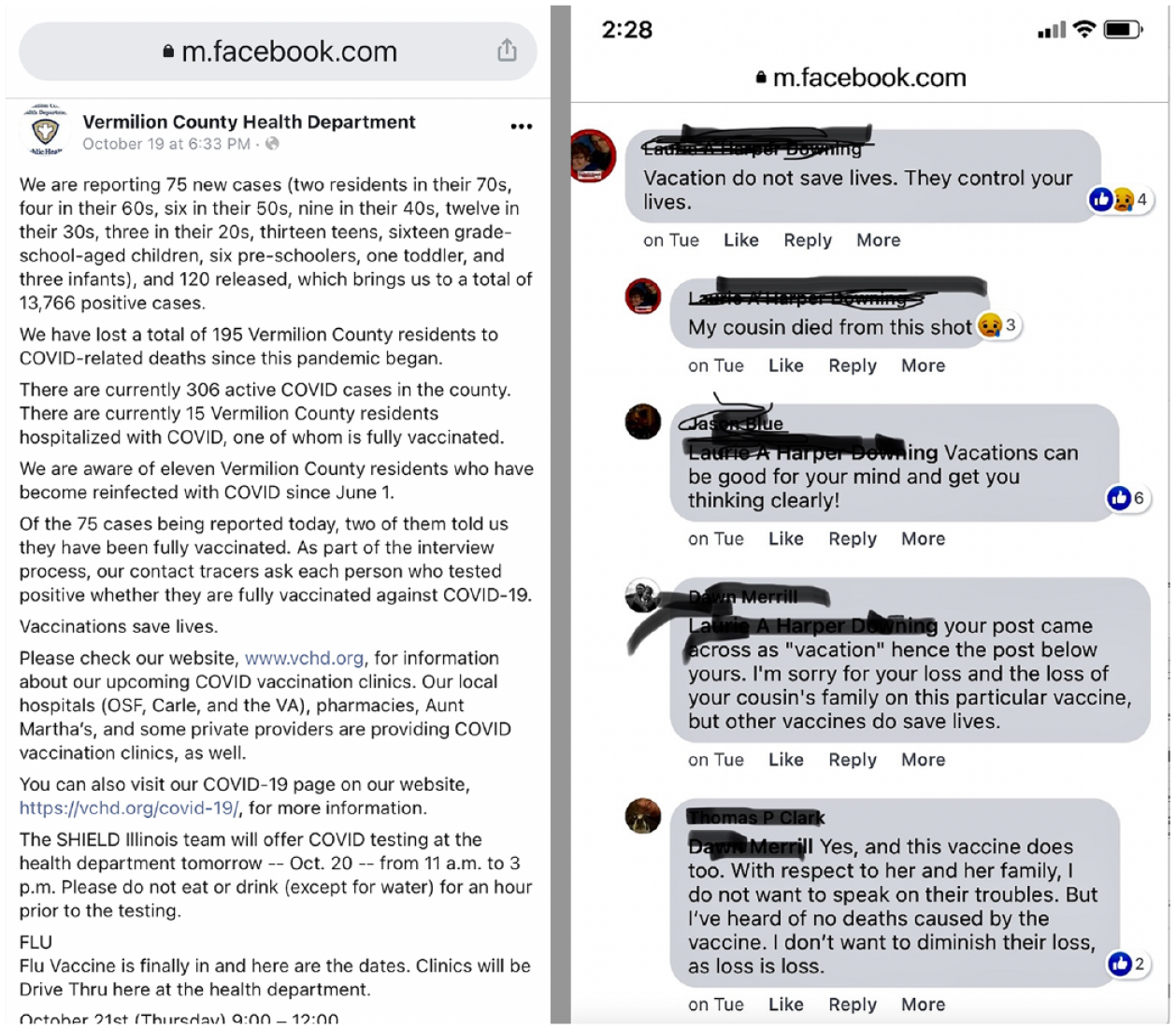
Misinformation in Comments Responding to a Public Health Department’s Facebook Post
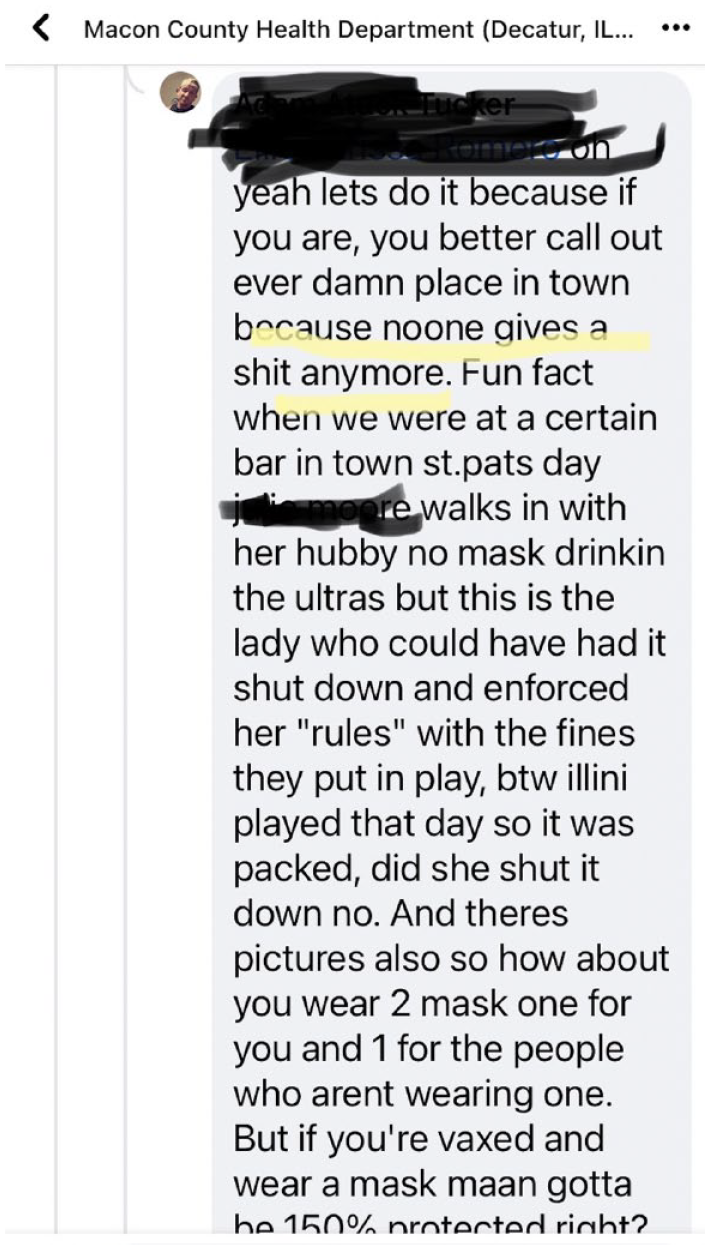
Personal Attacks in Comments Responding to a Public Health Department’s Facebook Post
The West Chicago Region 1 public health official gave an example:
On Fridays we do something like “two truths and a lie,” and we always had them comment, and a lot of times, it was like, you know, “we’re putting [in] microchips and we’re all sheep.” We still have those people that say we are an experiment to get rid of people to control the population.
These conspiracy theories, rooted in national right-wing hyperpartisan discourse (Hardy et al. 2021), are being discussed by local residents within a local context on the very same Facebook page intended to serve as a way to share geographically specific critical information about health and safety. As the West Chicago Region 1 official continued:
This is not my personal opinion, but you have to understand [our county] is very, very for Trump, so when the vaccine came out it was, you know . . . this was fake coverage . . . like there was an agenda. . . . We can’t convince someone it’s real. . . . Obviously [it’s] real, it’s happening. . . . People are dying and we would put the statistics up, but . . . people just thought it was a scam job or [would] say they really died from cancer, not COVID.
The shift in presidential administrations during the pandemic had not changed the underlying Trumpian sentiment that the official had observed as getting in the way of their public health outreach:
Obviously now he’s not president, but everything he said was wrong [mentioning the comment about bleach to kill the virus]. . . . People were believing it and everything he said, and it was like it was by the Bible and people don’t want to get the vaccine.
Another public health official explicitly linked national misinformation to the local conversation. Champaign Region 3 respondent said,
I would actually say misinformation and the effort to just bombard people that were easily impacted by these absolutely bizarre accusations and stories, . . . I would say that it was a combination of Facebook and Fox News and other websites [that are similar].
In this case, misinformation was embedded as part of the communication action context—even though it did not initially originate locally, it was taken up, shared, and distributed within a localized geographic context—ironically, on local public health department Facebook pages.
Right-wing conspiracy theory was often coupled with personal attacks. As the Champaign Region 2 public health official explained,
There were the people that thought you were incompetent or you were lying on purpose, or that this was all you know a conspiracy or a scam or all that. . . . You have all the people bashing all health care personnel, including ours, . . . and [saying that] we were all scamming everyone and doing this for our benefit . . . [saying stuff like] “these good people of [X] county are actually agents of Q,” or something like that.
Were the public health department officials really in the thick of the QAnon conspiracy, they would have understood that being called an agent of Q was a compliment, not a critique. Nonetheless, the official’s mischaracterization of conspiracy may speak to the confusion public health officials had about the politicization of public health departments more generally. The ramifications of this misinformation trickling down to local communities means that the local public health department’s Facebook page—seen by public health officials as the quickest and easiest way to reach people—ends up being a landing page for conspiracy theory and personal attacks. And, so, the efficacy of this outreach is undermined, and public health communication efforts on Facebook platforms become unintentional attention brokers for the misinformation spewed by local residents.
Challenge #4: The politicization of public health departments
Across the U.S., otherwise previously unnotable civic institutions—school boards, libraries, polling stations—have become deeply politicized. Mirroring a national trend, rural public health departments became a flashpoint as residents embraced right-wing talking points and applied them to their own lives (Hu 2021). National discord about COVID-19 mitigation inspired local partisans to actively resist their own local public health departments. The national-level radicalization on the right had a trickle-down effect on local public health departments, even though public health officials had been previously trusted local storytellers.
A public health official working in Marion Region 1, where local Republican politicians had mounted legal challenges to Illinois Governor J.B. Pritzker’s COVID-19 policies, decried the change:
We have always been a partner and highly respected and had th[is] warm fuzzy community . . . and huge followership, and this was difficult. . . . The political division [was a] huge frustration for me. I don’t know why they’ve taken a health issue and turned [it] into political issue. [It’s] very frustrating and hard to get people’s attention about the health side of it. People who are respected and trusted voices in health care are mixed up in politics, so people don’t know what’s true and what’s not anymore.
Almost all the public health officials interviewed said that they were working in communities they had grown up in and returned to after pursuing higher education. The turn against once-trusted communicators and community-based organizations is particularly concerning given scholarship that posits that community insiders can help introduce health interventions and overcome out-group/in-group distrust. As the Edwardsville Region 4 respondent explained,
I often laugh when looking at [County] because I’m either related to them or know their family, and that’s not just me, that’s true for anyone native from here, it’s just the way it is, and the pandemic has wreaked havoc on families and social circles. . . .
This official then shared a story about how the husband of one of her closest childhood friends called the sheriff “four different times because our vaccine clinics and our testing sites were causing traffic,” in order to undermine the public health department.
Others shared tales of personal threats to their safety and well-being from neighbors. As the Peoria Region 1 respondent put it,
I was a born and raised as a fifth-generation [resident of town], and there are some businesses I will never enter again. . . . At first, it kind of manifested that I was a soldier of Pritzker lying to people . . . because we do live in a small area . . . and [since] I have been in the job forever, they could Google my name and have my address. . . .
She described her family members as being so concerned that her brother regularly reminded her that he could be over to help protect her “within two minutes.”
In the context of communication infrastructure theory, trusted local storytellers are highly consequential nodes for local storytelling networks. These rural local public health officials are not community outsiders; rather, they are community insiders with long-standing social ties to other community members. The trust they have built up over time should validate them as translators of vital health information from local news outlets, government institutions, exogenous health interventions, and beyond into actionable insights for community members. However, based on the accounts of public health officials, these strong ties and previously high social trust do not seem to have made much of a difference in mitigating local resistance to COVID-19 prevention.
Discussion
Generally, scholarship on information gaps, public health interventions, and the role of local news in communities focuses on the undersupply or lack of demand for the professionally vetted and verified content that would enable people to make better decisions about the mundane details of daily life and participate in more robust engagement in civic and political affairs. However, this work rarely considers the ways in which misinformation and the radicalization of political identity might complicate a local communication ecology. This article relies on interview data from 18 interviews with local public health officials in rural communities. As a whole, this sample represents public health officials whose responsibilities include 29 counties in Illinois, or one-third of all Illinois counties. After exploring more generally the challenges facing rural Illinois, including the state’s news industry, the article identifies the challenges that public health communicators faced as nodes in the community storytelling network in sharing COVID-19 information. These include (1) a diminished local news ecology, (2) diminished trust in news more generally, (3) the trickle down of national misinformation into local contexts, and (4) the political polarization of local public health departments.
Drawing solely on the interviews with public health officials, this article is limited in scope as it does not extend further into the direct experiences of other community members. Another potential limitation is that the interview data reflect the perceptions of public health officials about public opinion and behaviors of their communities, rather than presenting replicable empirical data about the community itself. That said, the insights from these officials help us understand how critical information needs are, or are not, being met on the ground. Local public health officials are understood as critical nodes within community storytelling networks; being endogenous to their communities, they can serve as brokers for translating broader local, state, or federal public health interventions at the community level. While they saw local newspapers as insufficient for providing local health information, these public health officials believed themselves able to fill their community’s critical information needs. As they set about alerting their fellow residents about risk, emergency, and health, they turned to Facebook, which they viewed—even with all its flaws—as a dependable, effective, and easily updated way to reach people living in the counties served by their departments. Public health departments are not local news outlets; but when framed as part of the communication infrastructure in their counties, these officials are, without being journalists, key information brokers for residents.
However, their public communication outreach was met with active resistance. Community residents were caught in what Young and Bleakley (2020, 3509) call “ideological health spirals” or distorted feedback loops between interpersonal communication and one’s media selection and “political, media, and sociological context.” From the perspective of public health officials, residents in the majority Republican rural counties they served were filling their information needs about COVID-19, but with problematic input: misinformation taken from right-wing news outlets and political figures. This article provides a descriptive accounting of a communication ecology where local community-based actors have been delegitimized. Although local newspapers or broadcast television had insufficient capacity to communicate about COVID-19 to rural residents, public health officials stepped in with direct-to-resident communication, principally through Facebook. While the problems using Facebook for civic communication are addressed in this volume and elsewhere (see Usher 2022), it can still provide a supply of high-quality, locally relevant information. However, the uptake of such high-quality information has been resisted by residents, who have taken up national misinformation and applied what they have gleaned from this larger discourse of COVID-19 misinformation to the local storytelling network. Using the public health department’s own Facebook page, residents have been empowered to contest science-based public health regulations and recommendations. Future research might employ the concept of ideological health spirals to analyze community discourse on Facebook pages and perhaps provide new insights into how the interpersonal ties that predate COVID-19 can be reactivated to reposition public health officials as trusted local storytellers.
This case of rural health misinformation in Illinois and the politicization of local public health departments during the COVID-19 pandemic provides us with some sobering insights. First, local public health departments are not perceived as being more trustworthy simply because they are locally situated—a reality check that might help policymakers who fetishize localism for its own sake to work on repairing trust in larger social and political institutions. Second, simply shoring up existing local newspapers and local news media more generally may not result in news coverage that can fulfill critical information needs. A more solvent weekly newspaper is still a weekly newspaper and, given the vagaries of local news media attention online—especially the algorithmic surfacing of local news on platforms (Jaidka et al., this volume)—may simply not be the best way to reach people with reliable information that fulfills critical information needs. Although locally situated public health officials may seem to be one part of the solution, the politicization of local public institutions has undermined their authority. Thus, policymakers and public stakeholders writ large need to accept that the heightened political polarization in the U.S. must be accounted for whenever attempting any significant regulatory intervention. That is to say, absent meaningful research-backed interventions, the hope that locally situated communicators will mitigate the effect of partisan discord may well be no more than hope.
Supplemental Material
sj-docx-1-ann-10.1177_00027162231215655 – Supplemental material for Delegitimizing Rural Public Health Departments: How Decaying Local News Ecologies, Misinformation, and Radicalization Undermine Community Storytelling Networks
Supplemental material, sj-docx-1-ann-10.1177_00027162231215655 for Delegitimizing Rural Public Health Departments: How Decaying Local News Ecologies, Misinformation, and Radicalization Undermine Community Storytelling Networks by Nikki Usher in The ANNALS of the American Academy of Political and Social Science
Footnotes
Notes
Nikki Usher is an associate professor at the University of San Diego. They are the author of three books, Making News at The New York Times (Michigan, 2014), Interactive Journalism: Hackers, Data, and Code (Illinois, 2016), and News for the Rich, White, and Blue: How Place and Power Distort American Journalism (Columbia, 2021).
References
Supplementary Material
Please find the following supplemental material available below.
For Open Access articles published under a Creative Commons License, all supplemental material carries the same license as the article it is associated with.
For non-Open Access articles published, all supplemental material carries a non-exclusive license, and permission requests for re-use of supplemental material or any part of supplemental material shall be sent directly to the copyright owner as specified in the copyright notice associated with the article.
