



Abstract
Since 2017, in response to catastrophic declines in the commercial model that has traditionally undergirded U.S. journalism, lawmakers in 10 states have introduced legislation specifically designed to provide support to local news media. This analysis identifies four mechanisms in the legislation: tax incentives, establishment of a task force or commission, appropriation of general funding, and mandated advertising expenditures. Through late 2022, five of 24 bills introduced have been enacted in four states, a rate about the same as for state legislation enactment overall. I discuss several challenges attendant to the enactment of legislation aimed at supporting local news: (1) partisan divides, (2) budgetary restrictions, (3) narrow definitions of local news media, and (4) exacerbation of the deterioration of the economic conditions faced by news media by legislation that guts public notice laws. I also discuss the mandating of advertising expenditures enacted in New York and Chicago.
Over the past decade, local news media ecosystems have faced catastrophic economic losses as the business model that supported local news, particularly newspapers, collapsed (Abernathy 2022). Since 2004, approximately 2,500 newspapers across the U.S. have ceased publication (Abernathy 2022), creating gaps in communities’ ability to access civic information. Elsewhere in this volume, Napoli describes the contours and boundaries of media policy and highlights the critical need for policy that addresses the failures of journalism’s commercial model. “As local journalism continues to decline, reorienting the funding model for local news sources may be the most pressing and consequential media policy issue of the moment” (Napoli, this volume). To that end, three bills in the 117th U.S. Congress proposed remedies for local news: (1) creating tax credits to encourage individuals to subscribe to local news, to offset wages paid to local reporters, and to incentivize advertising with local media; (2) creating a safe harbor for publishers to negotiate payment from companies such as Google and Meta for local news content that appears on their platforms; and (3) creating a commission to study the state of local news in the U.S. and make recommendations for legislative support (Center for Innovation and Sustainability in Local Media 2022). Congress failed to pass any of these bills, and with the demise of federal legislation, the path toward government support for local news likely runs through state and municipal governments.
This article provides an overview of state legislation and local government policy designed to support local news organizations. Since 2017, lawmakers in 10 states have introduced legislation to provide support to local news organizations. These bills propose four mechanisms aimed at supporting local news: creating tax incentives, providing general funding, establishing a task force or commission, and allocating a proportion of a government’s advertising budget to local news media. This article discusses bills in each of the 10 states where they were introduced and follows with a discussion of proposed mechanisms of support and partisan support for legislation. Executive orders by the mayors of New York and Chicago allocating a proportion of each city’s advertising expenditures to local media are also discussed. I conclude with a discussion of the challenges and shortcomings of local news legislation.
Existing Subsidies for Local News Media
Before examining this legislation, we should acknowledge existing subsidies extended to local news media. Fearful that direct intervention by government might be a threat to editorial independence, some view government support for local news skeptically (Cowan and Westphal 2010; Waldman 2020). However, news outlets, particularly newspapers, have long received support from state and federal governments in the form of postal subsidies, revenue from publishing legal and public notices, and a wide range of tax breaks (Cowan and Westphal 2010). However, the same shifts in the industry that have brought about the closure of more than 2,500 newspapers and increased consolidation of local news ownership (Abernathy 2022) have brought about declines in the value of those subsidies and tax breaks (Cowan and Westphal 2010). For example, public notices have been one of the primary subsidies received by newspapers, but over the past decade, states have moved to amend existing laws to allow for the publication of public notices on government websites or by digital news organizations (Public Notice Resource Center 2018). Although public notices provide a source of funds for local news organizations, these bills are not considered here because their primary purpose is not to provide funding to news organizations.
Legislation to Support Local News and Civic Information
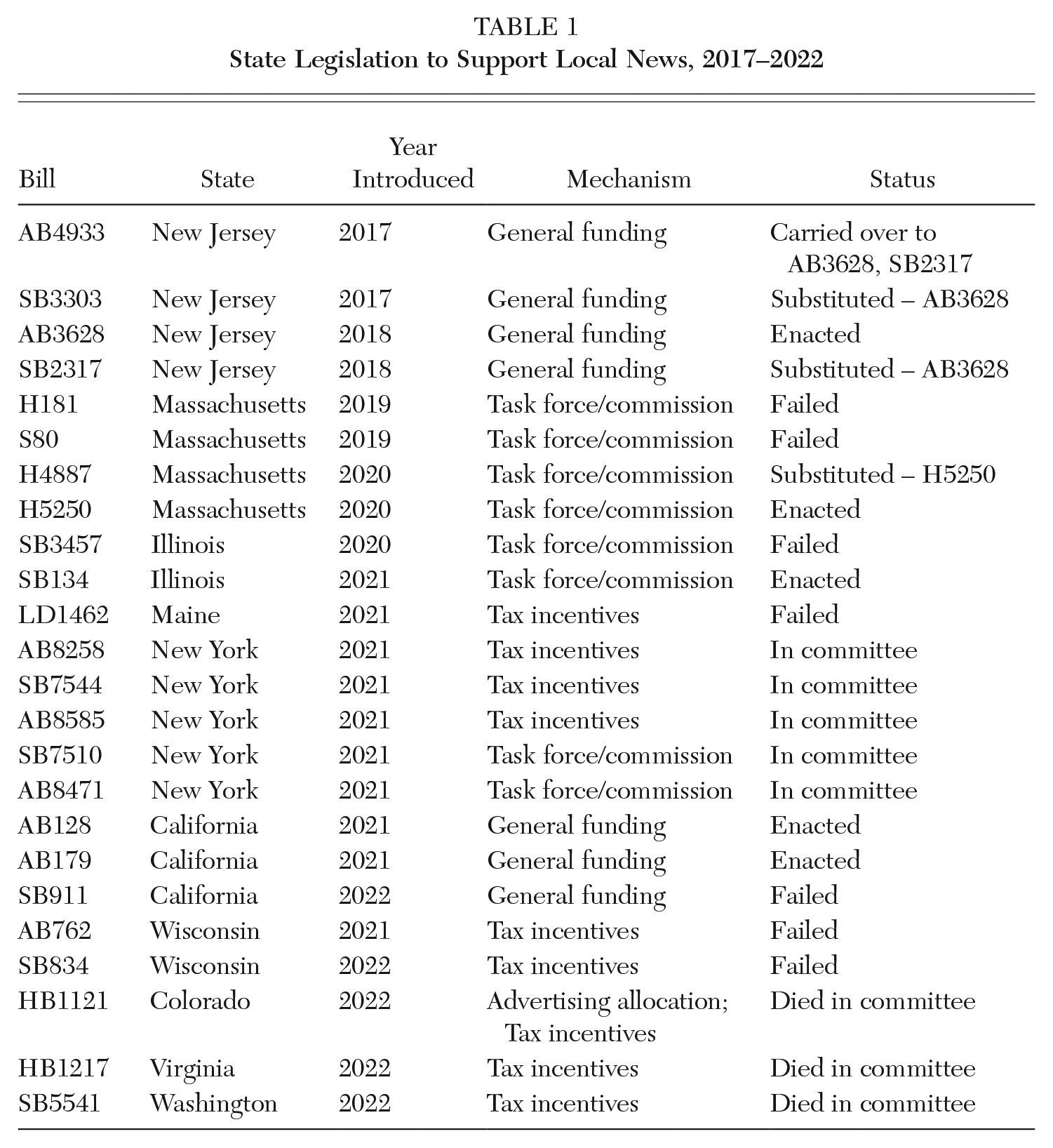
Since 2017, legislators in 10 states have introduced 24 bills that propose support for local news. Five bills have been introduced in the state house in New York, followed by four in New Jersey and Massachusetts and three in California. Two bills have been introduced in Illinois and Wisconsin and one bill in Colorado, Maine, Virginia, and Washington. Nine bills have failed to pass, and six were still active as of November 2022. Five have been enacted. Table 1 summarizes all 24 bills, their states, year of introduction, proposed mechanism of support, and status.
State Legislation to Support Local News, 2017–2022
Legislation in individual states 1
New Jersey
The New Jersey state legislature was the first in the U.S. to introduce and pass legislation directing support to local news. In 2017, the New Jersey Public Broadcasting Authority (NJPBA) received more than $330 million by auctioning the broadcast spectrum of two public radio stations to the Federal Communications Commission (FCC) (Stonbely, Weber, and Satullo 2020). This windfall presented an opportunity for the state legislature to reinvest in news and civic information in the state. Following the spectrum auction, bills AB4933 and SB3303 to establish the New Jersey Civic Information Consortium were introduced in the state legislature. The bills proposed allocating $100 million—$20 million per year for five years—to establish the Civic Information Consortium, a collaborative of state universities tasked with advancing research and innovation in media and technology to benefit the civic life and information needs of state residents. A 15-member board would set the consortium’s priorities and make grants to projects and organizations that (1) improve civic information; (2) give residents access to government data and information through technology; (3) provide media-oriented training to students, professionals, and community members; (4) improve civic engagement and dialogue; (5) better meet the information needs of low-income and racial and ethnic communities; and (6) invest in research and practice to improve the relationship between outlets and their communities.
After it became apparent that the state would use funds from the auction to cover budget shortfalls, sponsors and supporters of the consortium chose to modify their proposal and introduced AB3628 and SB2317 in 2018 (Stonbely, Weber, and Satullo 2020). These bills were largely similar to the 2017 proposals. The structure, function, and goals of the consortium remained the same, but these bills proposed substantially less funding for it. Bills AB3628 and SB2317 proposed $20 million in start-up funds in its first year, followed by appropriations of $1 million in each of the following four years. Ultimately, AB3628 replaced SB2317 and passed both chambers of the New Jersey legislature, and Governor Phil Murphy signed the New Jersey Civic Information Consortium Act into law in August 2018.
After the act was signed into law, the initial $20 million in start-up funds were reduced to $2 million in the 2019 to 2020 budget passed by the state legislature, and the consortium received its first $1 million in January 2020 (Stonbely, Weber, and Satullo 2020). The consortium has since received an additional $2 million in appropriations from the state’s general fund (New Jersey Civic Information Consortium 2022).
Massachusetts
Legislators in Massachusetts have taken the step of establishing a task force to study local news in the state and make policy recommendations to improve it. Introduced in 2019, bills H181 and S80 in the Massachusetts legislature proposed a 17-member task force to study a variety of topics related to local journalism, including coverage of underserved communities, ratios of residents to outlets, strategies for improving access to local news, social media’s effects on local news, and public policy solutions for local news. The bills also included career paths and professional development for aspiring journalists as a topic of study—the only bill of those analyzed here that directly addressed journalism careers. Neither bill was passed by the legislature.
Following the failure of H181 and S80, supporters of the bills saw the opportunity to include the task force proposal as part of bill H4887, a large economic development package introduced originally as HB4529 in 2020. The initial four versions of the bill—HB4529, HB4854, HB4874, and HB4879—did not include the proposal to form a task force to study local news. The provision was added to the fifth version of the bill, HB4887, and remained in the final version, HB5250. HB4887 and HB5250 proposed a special legislative commission largely identical to the task force proposed in bills H181 and S80, although the commission proposed in HB4887 and HB5250 was larger, with 23 members. The bill required the commission to file a report with legislative recommendations by August 1, 2021, but this deadline was extended by a year due to the late passage of the bill in the legislative session, a shortened timeline for members to be appointed, and challenges posed by the COVID-19 pandemic (Gardner 2021). Bill H5250 was enacted by the Massachusetts legislature and signed into law by then-governor Charlie Baker in January 2021. As of February 2023, there have been no appointments to the commission (Kennedy 2023), and the commission is not listed on the state legislature website (The 193rd General Court of the Commonwealth of Massachusetts 2023).
Illinois
Like Massachusetts, Illinois has pursued support for local news by proposing a task force or commission to study local news issues in the state and make policy recommendations. Bills SB3457 and SB134 in Illinois proposed a 17-member task force to examine a range of topics concerning local journalism, including coverage of underserved communities, ratios of residents to outlets, strategies for improving access to local news, social media’s effects on local news, and public policy solutions for local news. SB3457, introduced in 2020, failed to pass; but SB134, the Local Journalism Task Force Act, was introduced the following year. SB134 was enacted by the legislature and signed into law by Illinois governor J.B. Pritzker in August 2021. As of March 2023, there were four vacancies on the 23-person task force, and the task force had yet to issue its report (State of Illinois Office of Executive Appointments 2023).
Maine
Although tax breaks are one of the primary mechanisms proposed to provide financial relief to news media, bill LD1462 in the Maine legislature stands out as one of two bills introduced over the past five years to propose a tax exemption for media organizations. In 2013, Maine repealed newspapers’ exemption from the state’s sales and use tax. LD1462 proposed reinstating the exemption for newspapers that met certain criteria. Eligible publications must cover state and local government and community affairs, have a print edition, charge for copies, and publish more frequently than every two weeks. The Maine House of Representatives passed LD1462 and moved it to the senate for enactment in June 2021. Ultimately, the senate did not vote on the bill, and LD1462 died at the end of the 130th legislature in May 2022.
New York
With five bills introduced in 2021, New York has seen the most legislative activity on local news of any state. Three of these bills—AB8258, SB7544, and AB8585—have proposed tax incentives as a mechanism to support local news. All three proposed a tax credit to offset wages paid to journalists. This credit would be equal to 50 percent of journalists’ wages in the first year and 30 percent in subsequent years, capped at $12,500 per quarter, or $50,000 per year, per individual wage paid. The bills were still in committee as of November 1, 2022.
These same three bills also proposed a tax credit of 80 percent of subscription expenditures to qualifying news organizations in the first year and 50 percent in subsequent years, capped at $250 each year. Qualifying news organizations must distribute content within the boundaries of a county, metropolitan, or micropolitan statistical area or within the state itself. Additionally, qualifying news organizations are limited to print and digital outlets and must publish at least quarterly, maintain media liability insurance, publish the owner’s name, and employ fewer than 1,500 people. These bills also include a provision allowing individuals to claim the credit for donations to nonprofit news organizations whose primary activity is producing a print or digital publication. To qualify for the credit, the donation must be treated as a payment rather than a charitable contribution; that is, the individual claiming the credit cannot use the contribution to receive a deduction or other credit.
Bills AB8258 and AB8585 also proposed a credit for small businesses that advertise in local news media. The credit would be equal to 80 percent of advertising expenses spent in local news media in the first year and 50 percent in subsequent years. AB8585 in the New York legislature capped the credit at $5,000 in the first year and $2,500 in the second year and limited the number of employees for a business to be eligible to under 1,000. This bill based its definitions of qualifying media on distribution within the boundaries of a county, metropolitan, or micropolitan statistical area or within the boundaries of the state.
Bills in both chambers of the New York legislature, S7510 and AB8471, proposed establishing the New York Commission on Local News and Civic Information. Modeled after New Jersey’s civic information consortium bill, the New York Local News Act would establish a commission to make grants to advance local news and civic information in the state. However, the bills do not appropriate funds to the commission or otherwise designate state money to the commission, so the mechanism of support for these bills was designated as establishing a task force or commission. Both bills were still in committee as of November 1, 2022.
Wisconsin
Bills AB762 and SB834 in the Wisconsin legislature proposed offering a tax credit to small businesses that buy advertising in local media. Both bills proposed a credit equal to 50 percent of local media advertising expenditures with a cap of $5,000 per year. The bills limited eligible businesses to those with fewer than 100 employees and less than $10 million in revenue. To be eligible, advertising must be placed in a newspaper devoting at least 25 percent of its content to news, a radio or TV station licensed to serve a local community in the state, or a digital site designed to inform the public of news and events within a local community. Neither bill was passed.
California
The California state legislature incorporated funding for local news into the state’s budget for two consecutive years. First, the State Budget Act of 2021, SB128, allocated $10 million for grants to ethnic media outlets as part of an effort to improve outreach to marginalized communities in the state, particularly Asian American and Pacific Islander communities. The State Budget Act of 2022, SB179, allocated $25 million to the journalism school at the University of California, Berkeley, for the purpose of giving fellowships to local reporters in California newsrooms, the largest government allocation to local news in the U.S.
The incorporation of journalism funding into the state’s 2022 budget followed the failure of the legislature to pass bill SB911, which proposed a $50 million fund for public interest media in California. The bill proposed establishing the California Board to Fund Public Interest Media. Modeled after the California Public Broadcasting Corporation, the proposed board would have 11 members and would award grants to individuals and organizations for the cost of reporting local public affairs. Amendments to the bill required 25 percent of grants to be given to ethnic media outlets based in the state and for any content fully funded by the board to be made freely available online.
Colorado
Bill HB1121 introduced in the Colorado legislature proposed requiring state agencies to spend half of advertising expenditures on qualifying local media in the state, a tactic first used in New York City. The bill limited qualifying local media to print and digital publications serving a region or community in Colorado, providing content from primary sources, and employing at least one journalist who lives in the state. The bill also proposed a tax credit to individuals for subscriptions to local newspapers equal to 50 percent of the cost of the subscription and capped at $250. Bill HB1121 died in committee in May 2022.
Virginia
Bill HB1217 in the Virginia legislature proposed a credit equal to the lesser of 10 percent of journalists’ wages paid or $5,000 per journalist for the first year claimed and the lesser of 5 percent of wages paid or $2,500 per journalist in subsequent years. This credit was capped at $5 million per year. The bill also proposed offering small businesses a tax credit for advertising in local media. Typically, bills offering this type of incentive offer a credit of 80 percent of advertising expenses in the first year and 50 percent in subsequent years. HB1217 in the Virginia House of Delegates capped this credit at $4,000 in the first year and $2,000 in subsequent years, with an aggregate cap of $10 million, and required businesses to have fewer than 50 employees to qualify. The bill died in committee.
Washington
Bill SB5541 in the Washington state legislature proposed increasing an existing tax break so that newspaper publishers’ business and occupation tax burden would be eliminated. Newspapers in the state already pay a reduced rate, but that rate is set to expire in July 2024. Bill SB5541 proposed amending Washington’s tax code to exempt newspapers from the business and occupation tax entirely, provided they published a print version of the paper. The bill died in committee.
Mechanisms of Support for Local News
The bills described above provide support for local news in four basic ways: (1) tax incentives, (2) general funding, (3) a task force or commission, and (4) mandated allocation of state government advertising dollars.
Tax incentives were the most commonly proposed mechanism to support local news. Nine bills in six states— Colorado, Maine, New York, Virginia, Washington, and Wisconsin—have proposed some type of tax incentive to alleviate financial burdens for news organizations, to encourage businesses to support news outlets through advertising purchases, and to reward individuals for subscribing or otherwise providing financial support to news organizations. Most bills using this mechanism included tax incentives for multiple beneficiaries. But so far, no state legislature has passed a bill extending tax incentives to support local news.
Eight bills in three states—Massachusetts, Illinois, and New York—proposed establishing a task force or commission to study the status of local news in the state and make policy recommendations. Legislatures in Massachusetts and Illinois have passed such legislation, although neither task force has convened or issued a report. Task force legislation in New York was not passed by the state legislature. Although these bills do not propose a direct or tangible benefit to newsrooms, task force and commission bills are included here because the idea behind them is to study the problem in order to then propose tangible support. Additionally, early reporting and commentary within the field about these bills has framed them as a solution to declines in local journalism (see, for example, Burns 2022; Healy 2019).
Seven bills in New Jersey and California proposed the appropriation of general funding to support local news and direct funds to a consortium or other institution rather than allocating funds directly from the state to newsrooms. In August 2018, New Jersey became the first state in the U.S. to appropriate funds to local news. In 2021, the California legislature provided $10 million for ethnic news media as part of state outreach efforts through the state’s budget; and in 2022, the state budget included $25 million for a grant program operated through the University of California, Berkeley, journalism school.
Only one bill, HB1121 in the Colorado legislature, proposed directing state agencies to allocate a portion of advertising expenditures to local media. The bill died in committee. Figure 1 summarizes the mechanisms of support proposed in legislation to support local news.
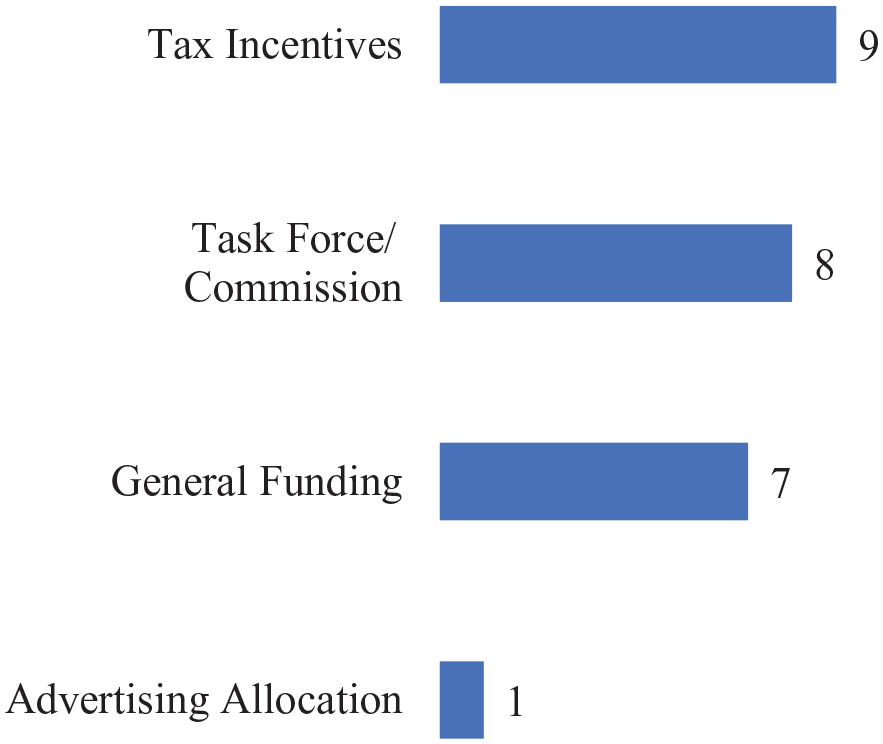
Mechanisms of Support in Legislation to Support Local News 2
Partisan Sponsorship and Voting for Legislation to Support Local News
Although federal legislation to support local news had bipartisan support (Center for Innovation and Sustainability in Local Media 2022), data on sponsorship and roll call votes indicates that support at the state level is generally partisan. The LegiScan (n.d.) database provides a partisan index for each bill based on the number of sponsors from one party relative to the number of sponsors from the other party. Partisan bills—those with many sponsors from one party and no more than one from the other—are labeled according to the party affiliation of the majority of the bill’s sponsors. Sixteen of the 23 bills that have been introduced to support local news in the past five years were partisan Democratic bills. 3 Six were moderate partisan bills, with many sponsors from one party but one or two from the other party as well. Three of those six were moderate partisan Republican bills. Additionally, only eight of the 23 bills introduced to support local news in the past five years had at least one Republican sponsor, compared to 21 bills with at least one Democratic sponsor.
The voting records of these bills also bear out the partisan divide on legislative support for local news. Six of the 23 bills introduced had a roll call vote—AB128 and AB179 in California, SB134 in Illinois, LD1462 in Maine, AB3628 in New Jersey, and HB5250 in Massachusetts. Putting aside California and Massachusetts, where support for local news was part of a larger bill, only three bills have had roll call votes towards final passage, with a total of five such votes. In all five instances, Democratic members unanimously passed legislation to support local news. In contrast, majorities of Republicans in both chambers of the Illinois legislature supported establishing the state’s local journalism task force, while Republicans in the New Jersey legislature were split: a majority of New Jersey Republican state senators voted to establish the state’s Civic Information Consortium, while the majority of Republican assembly members voted against it. Although the Maine state house voted to move LD1462 forward to the state senate for final passage, a majority of Republican members voted against the bill.
Local Policy Support for Local News
The mayors of New York and Chicago both signed executive orders directing half of each city’s advertising budget to go to local and ethnic media. In May 2019, former New York City Mayor Bill de Blasio signed Executive Order 47 mandating all city agencies to allocate at least half of all annual advertising expenditures to digital and print community and ethnic media outlets. The order was part of the city’s effort to improve access to city services and to strengthen its ties to community and ethnic media (City of New York Office of the Mayor 2019).
New York City
In June 2021, the New York City Council passed Local Law 83, codifying de Blasio’s executive order and establishing the city’s Office of Ethnic and Community Media (OECM). Local Law 83 also expanded qualifying media to include broadcast radio and television stations. OECM maintains a directory of qualifying media outlets to assist agencies with advertising placement. The directory is updated each July at the start of the city’s fiscal year. Outlets apply in October to be included in the next year’s directory (City of New York Mayor’s Office of Ethnic and Community Media 2021). There are currently 360 outlets in the directory (NYC Open Data 2022).
In the first year following Executive Order 47, city agencies spent nearly $10 million on advertising in community and local media—84 percent of advertising expenditures and far above 18 percent of expenditures in the previous year (Advertising Boost Initiative 2020). In the next year, after the city council passed Local Law 83, city agencies spent more than $15 million on advertising in community and ethnic media—82 percent of advertising expenditures (Center for Community Media 2022).
Chicago
In October 2022, citing the success of de Blasio’s executive order, Chicago Mayor Lori Lightfoot signed an executive order mandating all agencies in that city to allocate half of their advertising spending to ethnic and community media in the city. The order specifies that qualifying outlets must serve a discrete neighborhood or geographic area inside the city, serve a population not traditionally served by English-language media, or serve a population based on culture or specifically tailored subject matter. Like the New York City executive order and subsequent law, the mayor’s office will maintain a directory of qualifying outlets for city agencies. The order goes into effect in fiscal year 2023 (City of Chicago, Office of the Mayor 2022).
Discussion
The legislation discussed in this article describes four general types of legislation for state and local governments to support—creating tax incentives, providing general funding, establishing task forces and commissions, and allocating a proportion of advertising expenditures to local media. Since 2017, 24 bills to support local news have been introduced, five of which have been enacted—about the same as the average rate of bill enactment in statehouses in recent years (Fiscal Note 2021, 2022).
So far, little is known about the efficacy of the state legislation that has been enacted, particularly its impact on the sustainability of local news organizations or on communities. The New Jersey Civic Information Consortium has issued two annual reports detailing its grant-making activities. In fiscal year 2021, the consortium was allocated $500,000 in the state budget and awarded $490,000 in grants to 14 organizations. Individual grants in this inaugural round were valued at approximately $35,000 each (New Jersey Civic Information Consortium 2021).
In California, the $10 million in funds for ethnic media outreach have been administered through the California State Library and split into two rounds of funding in 2022 and 2023 (California Grants Portal 2023). So far, the state library has awarded $5 million in grants to 50 outlets (California State Library 2022). Because grants closed before July 1, 2022, were not required to give details about individual grants awarded (California Grants Portal 2023), there is not exact data about the size of grants received by each organization, but we can estimate that grantees received about $100,000 each. Applications for the next round of grants have closed, and grantees were announced May 1, 2023 (California Grants Portal 2023).
The University of California, Berkeley, Graduate School of Journalism has created a fellowship program from the $25 million appropriated to support local news in the state’s 2022 budget (University of California Berkeley Graduate School of Journalism 2023). The fellowship program will match up to 40 fellows to full-time reporting positions in newsrooms statewide for a period of two years (University of California Berkeley Graduate School of Journalism 2023), similar to the model used by the national nonprofit Report for America (2023). The first fellows will be announced in September 2023 (University of California Berkeley Graduate School of Journalism 2023).
Task forces and commissions appear unlikely to yield significant progress. Massachusetts’s special legislative commission on local news has yet to even be formed, and Illinois’s Local Journalism Task Force is incomplete. Still, despite the inaction of the special legislative commission in Massachusetts, a state representative introduced a bill in February 2023 to give state residents a $250 tax credit for subscribing to local news outlets (Garber 2023).
Similarly, it is clear New York City’s efforts to use the city’s advertising expenditures to support local media have increased the amount of money going to community and ethnic media in the city, but we do not have much data about the impact of those funds on news organizations’ long-term sustainability and operations or on communities. City agencies far exceeded the minimum requirements of de Blasio’s Executive Order 47 and Local Law 83 after it; they spent more than three-quarters of their advertising dollars on community and local media (Advertising Boost Initiative 2020; Center for Community Media 2022). Chicago Mayor Lori Lightfoot’s executive order was not implemented until the start of the city’s 2023 fiscal year on January 1st (City of Chicago, Office of the Mayor 2022). An analysis by the Chicago Independent Media Alliance (2021) found that less than 20 percent of approximately $3.5 million in advertising expenditures by city agencies from 2015 to 2020 went to community and ethnic media.
Sponsorship and voting data show a partisan divide on legislation to support local news, with only one bill receiving votes from the majority of legislators from both the Republican and Democratic parties. However, only three bills introduced with the specific goal of supporting local news received roll call votes, and only 22 bills were introduced overall, so it is difficult to draw a conclusion about what legislation is most likely to receive bipartisan support. Additionally, the political climate across the 10 states where legislation to support local news was introduced varies considerably. All but two bills to support local news were introduced and sponsored by members of the majority party in the legislature. However, three of the 22 bills introduced to support local news were sponsored by Republicans in the Wisconsin and New York legislatures. These three bills suggest Republicans are open to using tax incentives, particularly for small businesses, as a mechanism for providing support to local news.
Conclusion
Legislation to support local news media faces several major challenges. First, partisanship emerges as an obvious challenge. The majority of bills introduced to support local news have been sponsored by Democrats, and voting data indicates that Democratic legislators are more likely to support such bills than are their Republican counterparts. However, Republicans might be supportive of tax incentives, particularly for news organizations and small businesses. In addition, the impact of tax incentives for individuals would certainly be blunted by the fact that several states have no income tax at all (Lankford 2023), and in states that do have an income tax, there would be no benefit for lower-income families that do not pay income tax (Scire 2021).
Second, budgets are a considerable obstacle. Through the 2021 and 2022 state budget acts, California has allocated a total of $35 million to local news organizations, by far the most of any state. New Jersey follows with a total of $3 million. Had New Jersey appropriated the initial $20 million in start-up funds to the Civic Information Consortium as designated in the civic information bill, appropriations to the consortium at the end of the five-year period would have totaled $24 million. The cuts in the initial appropriation from $20 million to ultimately $2 million, of which the consortium received $1 million (Stonbely, Weber, and Satullo 2020), clearly limited the impact of this approach to supporting local news.
As noted above, the typical grant awarded by the consortium is less than $50,000 (New Jersey Civic Information Consortium 2021, 2022)—below the mean wage of a journalist in New Jersey (Bureau of Labor Statistics 2022). While the consortium does not exclusively support news organizations or reporters working in newsrooms, these figures highlight how smaller grants can likely limit the impact on newsrooms. Further, these are seed grants and are not intended to provide long-term support to grantees (New Jersey Civic Information Consortium 2023). Similarly, all grants coming from California’s investments in local media are project grants. Critics of project grants emphasize that such grants limit the ability of recipients to establish sustainability (Marcial 2020). In short, despite the millions going towards these initiatives, their design might not result in the long-term sustainability of their respective news ecosystems.
An additional challenge to the impact of such legislation may be the limits placed on which organizations qualify for tax incentives or other funding. With the exception of the New Jersey Civic Information Consortium Act and New York’s SB7510 and AB8471, eligibility for support is limited to legacy media, usually newspapers. Only a few extend eligibility to digital or broadcast media, and only the New Jersey Civic Information Consortium Act extends support to anything other than media organizations. Bills that extend eligibility to digital media typically refer to “websites,” so some types of digital media may remain ineligible.
Some critics of current policies for local news contend that limiting policy support to legacy media gives them a lifeline, effectively protecting the profits of a declining industry rather than meeting the information needs of communities (Green, Holliday, and Rispoli 2023). Such critiques are reinforced by the failure of most of these bills to recognize community information needs or incorporate critical information needs in any meaningful way. Further, prioritizing legacy media ignores the historical harms done by such outlets to communities of color, as described by Torres and Watson (this volume), and disadvantages outlets led by and serving Black, Indigenous, and people of color communities. Moreover, if such measures are limited to legacy media, specifically newspapers, communities without such outlets will still be left behind.
Perhaps the greatest challenge to the success of these bills, not only in terms of passage but in terms of impact, is the increasingly challenging conditions these proposals are up against. Not only is the local news ecosystem continuing to decline (Abernathy 2022), but legislative proposals that would reduce or eliminate existing subsidies, such as public notices, threaten to further exacerbate these conditions (Public Notice Resource Center 2018).
Although more data are needed to know which policies are most likely to grow a more sustainable and equitable future for local news, for now, it appears that task forces and commissions are a potential roadblock to progress and not significantly better than doing nothing. And despite the limitations of their structures, the funding established by New Jersey and California seem to have the potential for the most impact; perhaps these states may serve as test cases that lead to long-term, sustained support for local news and civic information. With legislative remedies most likely coming from the states, multiple approaches are apt to emerge and provide clarity about which work best.
This article was first written in fall 2022, as most state legislatures were ending their sessions. A search of LegiScan indicates that between January 2023 and March 2023, legislators in nine states introduced 11 bills to provide support to local news, nearly half as many bills as were introduced in total between 2017 and 2022. Of the nine states where legislation was introduced in the first quarter of 2023, four had not previously considered such legislation. Although it would not be accurate to say critical information needs are yet a part of the political agenda again, support for local news is a growing area of legislative policy concern. Accordingly, advocates may find reason for optimism and take the opportunity to heed Friedland’s (this volume) call for a renewed critical information needs agenda that centers information as a public good.
Footnotes
Notes
Jessica Mahone is the research director for the Center for Innovation and Sustainability in Local Media at the Hussman School of Journalism and Media at the University of North Carolina at Chapel Hill.