



Abstract
The police have the unique capacity to preempt and deter violence and to reduce the use of firearms in violent encounters. But overly aggressive policing tactics have contributed to a fraught relationship with low-income minority communities in which gun violence is heavily concentrated. Increased resources should be devoted to policing gun violence, but efforts of this sort must be targeted and disciplined. Effective policing requires a focus on the places and people that are at greatest risk; and there is a strong case for police agencies to increase the resources devoted to investigations of all criminal shootings, not just homicides. Successful policing of gun violence requires a productive working relationship with victims and their neighbors, which can be facilitated through observing community policing principles and respect for residents’ interests.
Introduction
Between 2019 and 2020, the U.S. national homicide rate increased 29 percent, the largest proportional increase on record. Almost all of this increase was due to the surge in gun violence: the proportion of homicide victims killed by gunshot has grown to 79 percent (Kegler et al. 2022). In some cities, the homicide rate has returned to levels not seen since the crack cocaine–era peak of the early 1990s. Given the social costs of gun violence in heavily impacted jurisdictions, it is reasonable to conclude that it is the most pressing crime problem (Cook and Ludwig 2022), and reversing the recent surge in criminal shootings should be of the highest priority to law enforcement.
The cost of gun violence can be measured by the toll of death and injury—five victims are wounded, sometimes grievously, for every one killed (Barber, Cook and Parker 2022)—but also by the consequences for the overall quality of life in hard-hit communities. The psychological trauma of gun violence extends well beyond immediate victims to those who witness or have reason to worry about this threat (Sharkey 2018). A broad research literature documents how trauma disrupts normal child development. From the community perspective, gun violence is a drag on economic development and property values; out-migration is closely linked to the homicide rate (Cook and Ludwig 2000). Since gun violence is so highly concentrated in low-income minority communities, redressing these consequences is an imperative of any social justice agenda. Fully 55 percent of homicide victims are African American, the result of a victimization rate nearly ten times as high as non-Hispanic Whites (Centers for Disease Control and Prevention [CDC] 2022).
What is to be done to prevent gun violence? We argue here that the answer must give a prominent role to the police. The police have a unique capacity to prevent violence and deter the use of guns in violence. In many jurisdictions, that capacity is underutilized or diluted by conflicting demands on police resources. The evidence, reviewed here, suggests that much can be done to improve policing effectiveness, through better targeting and management of resources.
Of course, police agencies are imperfect instruments. Low-income minority communities typically have a difficult relationship with the police, with residents perceiving both abuse and neglect—both overpolicing and underpolicing (Braga, Brunson, and Drakulich 2019; Brunson and Wade 2019; Chalfin et al. 2020). The extreme version of abuse is cases in which the police shoot suspects in circumstances in which the shooting is unjustified and even criminal. While only about one-quarter of law-enforcement-involved shootings involve African American victims, 1 it is those cases that have produced mass demonstrations and outrage—reflecting the endemic distrust of the police. On the other hand, residents of these communities also have reason to believe that the police are neglecting their concerns. In this view, the police could gain control of the gun violence problem if they chose to do so. The high rates of violence thus contribute to the belief that the police simply do not care. The way forward for effective policing requires navigating this complex terrain.
Our focus here is on making the police more effective in preventing gun violence, not because we believe that the police are the only answer, but because their role in prevention is essential and has been misunderstood or doubted by many commentators (Cook and Ludwig 2019a, 2019b). A common assertion is that the police are not in the prevention business because they become involved after the crime has already taken place. That view can be readily challenged, both because it wrongly suggests that all police resources are focused on responding to specific crimes, and because it implicitly denies the importance for future crime rates of holding current criminals accountable, thereby preventing them from shooting others and strengthening the deterrent effect of the law. The police are a civilized alternative to vigilante justice, but only to the extent that they are successful in delivering justice to serious criminals.
Nonpolicing approaches to reducing gun violence begin with regulation of the manufacture, retailing, possession, and use of firearms (although even the regulatory approach requires enforcement if it is to be successful). Other nations have been remarkably successful in curtailing the use of guns in crime through stringent regulation (Cook and Goss 2020, 140–42; see also GunPolicy.org). But in the U.S., the scope for regulation is severely limited by politics and by the current Supreme Court’s interpretation of the Second Amendment. The trend is toward laissez faire. Just as one example, 50 years ago most states banned public carry of a concealed weapon, or limited it to those with demonstrated need. Now every state allows carrying, and an increasing number of states have done away with a requirement to obtain a permit (Cook and Goss 2020). The 2022 Supreme Court ruling in New York State Rifle & Pistol Association, Inc. v. Bruen (597 U.S. ___, 2022) has the effect of establishing a constitutional right to carry concealed weapons, further restricting what the states and localities can legislate. The result of this trend has been an increase in gun carrying and gun crime, together with a reduction in the effectiveness of the police in solving crimes (Donohue et al. 2022). In the absence of strong regulation on guns, we rely even more on police enforcement.
The long-term project for reducing violence includes strengthening the social safety net for families and doing what is necessary to keep youths in school and provide them with marketable skills. This intergenerational investment is warranted for a variety of reasons, including social justice, and there is evidence that it would reduce crime and violence. But we must also acknowledge that one of the “root causes” of violence is violence itself; generations growing up with violence will tend to reproduce what they have seen and learned, even while recognizing that a low-violence environment is healthier. There is a strong analogy here with a principle from emergency medicine: “First, stop the bleeding” (Abt 2019).
So, what is needed for the police to be more effective in preventing gun violence? Police patrol activities can be better targeted to preempt gun carrying, discourage illicit gun transactions, and redress specific neighborhood problems that spawn violence. Law enforcement agencies can strengthen their capacity to collect gang intelligence to identify the most dangerous groups and craft interventions, including a program to promote “focused deterrence.” Detectives tasked with investigating nonfatal shootings can be given the same investigative resources as homicide detectives. These and other reforms are all designed to focus limited resources available to the police on their most productive uses in preventing serious violence.
The overall strategy here bears repeating. Police departments have limited resources and a wide array of responsibilities. If those resources are diffused—every neighborhood is patrolled regularly, all calls for service are given equal weight, and so forth—the result will be failure to address the most serious problems adequately. Gun violence in particular is highly concentrated in certain neighborhoods, and even among particular individuals. What is needed is to match the resources to the contours of the most pressing problems. Bill Bratton, a police leader acclaimed for his success in reducing crime in New York City and Los Angeles, California, has adopted the term “precision policing” (Bratton and Anderson 2018). This strategy was not just due to the need to focus resources; in part, Bratton came to that strategy from his experience with “imprecise” policing, namely, an overly broad program of “stop, question, and frisk” that did more harm to community relations than it accomplished in keeping guns off the street (Braga and Cook 2023). We discuss New York City’s experience below.
There is a useful analogy here with medical practice. The oath that doctors take includes the well-known principle, “First, do no harm.” It recognizes that medical interventions that are intended to improve the patient’s health have side effects (some unintended, some expected) and often inflict pain, disability, and the risk of death. Thus, medical best practice does “inflict harm” (the Hippocratic admonition is not to be taken literally), but the doctor’s commitment is to limit the use of harmful or potentially harmful prescriptions, surgeries, and other treatments to cases in which the benefit to the patient exceeds the foreseeable harm. The same principle applies to policing, although there the focus expands from the individual victim or suspect, to the community. Police actions to preempt and deter gun violence must be evaluated by the contribution to public safety in comparison with foreseeable harm to the individuals who are directly impacted by arrest or other encounters with the police. And because in the case of police work, unlike clinical medicine, the costs of police interventions are often borne by individuals for the sake of protecting the group, limits on action must be observed that respect individual autonomy. In that sense, principled policing is more like public health (such as vaccine mandates or quarantine rules) than clinical medicine.
The Nature of Gun Violence in America
Recent homicide increases have made long-established victimization patterns even more pronounced. The surge was concentrated in economically disadvantaged minority communities (Schleimer et al. 2021). Almost all of the increase was committed with firearms. Studies in Oakland, California, and Baltimore, Maryland, documented that the gun-murder increase in 2020 was generated by and against gangs, drug-selling crews, and other criminally active groups of offenders (Barao and Braga 2021; Crime and Justice Policy Lab 2021). Spatial analyses suggest that recent increases in shootings are concentrated at small “hot-spot” locations, for example 151 blocks in six disadvantaged neighborhoods in Washington, D.C. (Davies and Hermann 2021). Persistently violent places, such as specific housing developments in the Bronx and Brooklyn, New York (Herrmann 2020), are experiencing even higher levels of shootings than in previous years. And as in other years, only a fraction of the shooters in 2020 were held accountable by arrest, let alone conviction. Indeed, the rate at which homicide investigations are successful, usually meaning arrest and prosecution (the “clearance rate”) nationwide continued a long downward slide, dropping near 50 percent in 2020 (Braga 2021), and the clearance rate for nonfatal shootings was far lower still (Cook et al. 2019).
National data support the conclusion of intense and increasing concentration. In particular, gun violence is relatively high among youthful male victims who are Black or Hispanic. The degree of concentration is extraordinary and became more so in 2020. As shown in Table 1, Black males aged 15 to 39 constitute just 2.4 percent of the U.S. population, but they accounted for fully 41 percent of gun homicide victims in 2019 and a still higher percentage in 2020. Expanding the tabulation to include Hispanic males in the same age group (still just 6.2 percent of the total U.S. population), we find a majority (51 percent) of all victims in 2019, increasing to 53 percent in 2020.
The Concentration of Gun Violence among Black and Hispanic Male Youths
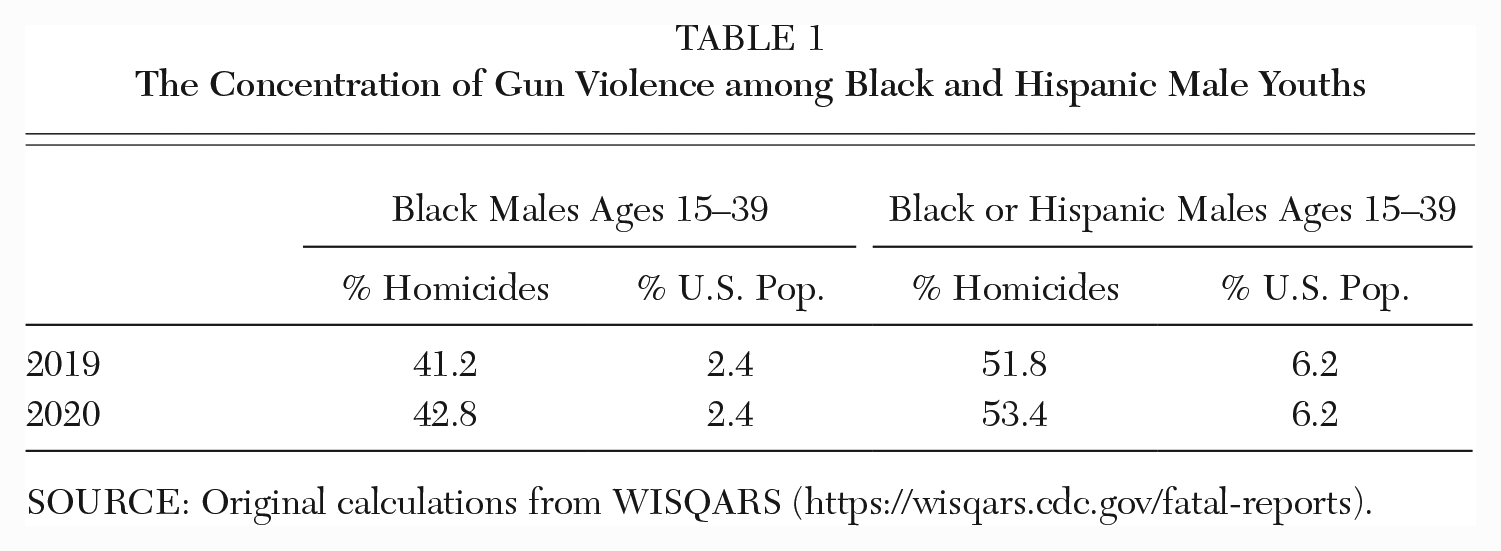
SOURCE: Original calculations from WISQARS (https://wisqars.cdc.gov/fatal-reports).
Documenting these and other well-established patterns in gun violence provides guidance in developing effective policing strategies. Gun violence is highly concentrated not only with respect to victim demographics, but also with respect to place and social network and prior criminal record. Effective policing requires a corresponding concentration of resources and effort.
Concentration of gun violence in small networks of high-risk offenders
Gun violence is usually concentrated among groups of serious offenders, and conflicts between street gangs have long been noted to fuel much of the serious street violence in major cities (Braga 2004; Howell and Griffiths 2018; Miller 1975). In some cities, such as Baltimore, the violent street scene is characterized by various criminal groups ranging from small informal networks of drug sellers and street-robbery crews to more formal gangs to larger drug-trafficking organizations (Braga, Kennedy, and Tita 2002). A study of more than twenty cities found that gangs, drug crews, and other criminally active groups, on average, represented less than 1 percent of a city’s population but were connected to more than half of a city’s shootings and homicides (Lurie 2019). In Boston, Massachusetts, social-network analysis revealed that 85 percent of total shootings in one neighborhood were concentrated amongst a co-offending network of 763 individuals connected to ten gangs who represented less than 3 percent of the resident population of that neighborhood (Papachristos, Braga, and Hureau 2012). Furthermore, each “handshake” an individual was closer to a gunshot victim in the network increased their personal risk of gunshot injury by 25 percent.
High-risk co-offending networks are central to gun violence problems regardless of whether group-on-group violence is prominent in particular cities. In Newark, New Jersey, an analysis of homicide data for 2009 to 2012 found that while only 16 percent were the result of disputes between gangs, gang members were involved as victims, offenders, or both in 60 percent of homicides (Papachristos, Braga, et al. 2015). In fact, nearly one-third of all shootings in Newark occurred in a co-offending network that was 81 percent male, nearly 100 percent Black and Hispanic, and contained less than 4 percent of the city’s total population. Being a gang member in this risky social network increased an individual’s risk of being shot by 344 percent, and being a non–gang member who is socially connected to a gang member increased an individual’s risk of being shot by 94 percent (Papachristos, Braga, et al. 2015). Rates of nonfatal and fatal shootings within such co-offending networks are considerably higher than city-level rates or even the highest-crime neighborhoods. In Chicago, Illinois, for example, 70 percent of all fatal and nonfatal gunshot injuries occurred in identifiable networks composed of individuals arrested in previous years that was 89 percent male, 99 percent Black, and comprised less than 6 percent of the city’s total population; the rate of gun homicide in the network was more than nine times higher than the city average (Papachristos, Wildeman, and Roberto 2015).
“Cafeteria-style offending,” where individuals take advantage of a range of criminal opportunities that arise from specific situations and through social connections, is a central aspect of gangs and criminally active group dynamics (see, e.g., Klein 1995). For instance, a study of 2016 to 2017 Oakland homicides found that 72 percent of these homicides had gang and other criminally active group members involved as offenders, victims, or both (California Partnership for Safe Communities 2018). This study further revealed that 76 percent of victims and suspects were previously known to the criminal justice system. These “criminal justice known” individuals had, on average, twelve prior arrests for a variety of armed and unarmed violent, drug, property, and disorder offenses. More than two-thirds were previously convicted felons, more than a third were on active probation supervision at the time of the homicide event, and more than two-thirds had spent time incarcerated before the homicide occurred.
Finally, a study of adults arrested for homicide in Chicago during the 1990s estimated that while 72 percent had at least one recent arrest, “only” 43 percent had actually been convicted of a felony, and were hence proscribed from possessing a gun by federal law (Cook, Ludwig, and Braga 2005).
Concentration of gun violence in small public places
The police have always known, and systematic analysis has confirmed, that serious violence is concentrated in particular areas. Typically, those neighborhoods are home to gangs and open-air drug markets, and low-income Black households are predominant (e.g., see Cohen and Tita 1999; Rosenfeld, Bray, and Egley 1999). Within these larger neighborhood contexts, however, gun violence further concentrates at specific addresses, buildings, and blocks. For example, gun violence hot spots covered only 5 percent of Boston’s roughly forty-eight square miles but experienced nearly 53 percent of the city’s fatal and nonfatal shootings in 2006 (Braga, Hureau, and Winship 2008). These shooting hot spots were predominately located in the disadvantaged minority neighborhoods of Roxbury, Dorchester, and Mattapan. Similar concentrations of shootings in small hot spot locations have been observed in Philadelphia, Pennsylvania (Ratcliffe and Rengert 2008); Houston, Texas (Wells, Wu, and Ye 2012); and Newark, New Jersey (Xu and Griffiths 2017).
Research further suggests that city-level gun violence trends may best be understood by analyses of trends at specific small places, such as street segments and intersections, rather than analyses of trends at larger areal units such as neighborhoods or arbitrarily defined policing districts. Braga, Papachristos, and Hureau (2010) found that almost 90 percent of Boston street segments and intersections never experienced a single shooting incident during the 29-year period between 1980 and 2008. Boston gun violence trends were largely generated by repeated incidents at less than 5 percent of its street segments and intersections that accounted for 74 percent of total shootings between 1980 and 2008. The most violent sixty street segments and intersections accounted for roughly one thousand shootings during the study time period. The late-1980s and early-1990s gun violence epidemic and sudden downturn in the mid-1990s were almost completely driven by trends at about 3 percent of the city’s micro places that exhibited volatile concentrations of serious gun violence over time.
The Boston study further revealed that persistent gun violence hot spots were characterized by public housing buildings, gang turfs, and street drug markets (Braga, Papachristos, and Hureau 2010). Other studies of gun violence hot spots have linked shootings to high-risk settings in small places that facilitate violent encounters between shooters and their victims. These situational characteristics have included home addresses of known gang members; locations of drug arrests; and selected business establishment locations, such as bars, bus stops, liquor stores, strip clubs, fast food restaurants, pawn shops, and check-cashing stores (Caplan, Kennedy, and Miller 2011; Xu and Griffiths 2017).
Low shooting clearance rates
Low fatal and nonfatal shooting “clearances” represent a persistent and deadly problem that contributes to gun violence in cities. The clearance rate is a metric for police crime-solving performance, defined by the Federal Bureau of Investigation’s Uniform Crime Reports as the proportion of crimes that result in arrest—at least one person arrested, charged with the commission of the offense, and turned over to the court for prosecution—or cleared by exception, where the police have identified and located the perpetrator but cannot proceed for some reason. There is a prominent gap in clearances of fatal shootings relative to nonfatal shootings. For instance, the Chicago Police Department annual clearance rates for gun homicides ranged from 26 to 46 percent between 2010 and 2016, and it ranged from 5 to 11 percent for nonfatal shootings in that same period (Kapustin et al. 2017). The Durham, North Carolina, Police Department made arrests in half of their city’s gun homicides but only made an arrest in 10 percent of the nonfatal shootings in 2015 (Cook, Ho, and Shilling 2017). In 2020, the New York City Police Department (NYPD) cleared 47 percent of the city’s 290 gun murders and 32 percent of the city’s 1,251 nonfatal shooting incidents (Braga 2021). These unsolved shootings feed cycles of urban gun violence. Dangerous people remain free to shoot others. Gunshot-wound survivors and the families and friends of gun murder victims may seek justice by taking the law into their own hands, and retaliatory shootings generate further shootings. Unsolved shootings also undermine trust in the police as residents of mostly minority neighborhoods suspect the police do not care about Black and Brown shooting victims. Conversely, an increase in the arrest and conviction rate for shooters would arguably improve police-community relations and reduce the volume of retaliatory shootings.
Shootings differ widely in their intrinsic “solvability.” Domestic violence often leads to an obvious suspect and a quick arrest. On the other hand, a drive-by shooting motivated by gang turf disputes may have no willing witnesses or much physical evidence. Thus, the mix of cases in a particular time and place affects the arrest rate (see, e.g., Braga, Turchan, and Barao 2019; Cook et al. 2019; Wellford and Cronin 1999). A consistent finding is that gun homicides have a lower clearance rate than nongun homicides, a difference that has much to do with case mix.
One serious impediment to solving violent crimes is lack of cooperation from the victim (if the victim survives) and other witnesses. As we have seen, shootings concentrate in disadvantaged neighborhoods, where residents are more likely to have cynical views of the police, prosecutors, and courts (Kirk and Papachristos 2011; Sampson and Bartusch 1998). Community members who view the criminal justice system as illegitimate and unresponsive are less likely to share information on a shooting incident and testify in court against charged shooters. Sharing information with the police could also put residents and their families at risk of violent reprisals by gangs, drug sellers, and others responsible for shootings. It is very difficult to convince young men who are involved in gangs and drug selling crews to cooperate with the police. For instance, a study of fifty young Black men from the Bronx and Brooklyn, many of whom were gang members and had been involved in gun violence, found that 92 percent preferred violent retaliation over cooperating with the police after witnessing or surviving shooting incidents (Brunson and Wade 2019). A survey of prison inmates from Chicago who survived a gunshot injury found that half had information on the identity of their shooter but refused to cooperate with the police (White, Cook, and Pollack 2021). The respondents justified their lack of cooperation by describing their mistrust of the police, “street codes” against snitching, and desire to retaliate against the shooter.
Prevention Strategies
Policing is not a substitute for larger societal efforts to reduce violence in the long run by investing in disadvantaged communities, improving schools, supporting families, facilitating inclusion in the labor market, and other attempts to address the “root causes” of violence. Effective policing is a complement to these longer-term efforts to reduce violence. Safe public spaces free from the trauma of repeated gunfire and gunshot injuries are a necessary condition for positive neighborhood change. While the police are not in a position to impact socioeconomic conditions directly, police departments are well positioned to reduce violence in the near term by focusing on the situational opportunities for offending (police officers can in some cases connect people in need to social services), and by harnessing the preventive effects of punishment. It is also important to note that the police are but one component of the criminal justice system, and their efforts to control crime are often reliant on the effective operations of other parts of the criminal justice system. For instance, if perpetrators are to be held accountable, it is not enough that police make good arrests, but also essential that the courts and corrections system do their jobs well. Only then will repeat offenders be removed from the street (Moore et al. 1984) and dangerous people be forced to consider the possible legal consequences of carrying guns and using them in criminal activity. While beyond the scope of this article, the policing programs described here may be of limited effectiveness if prosecutors decline cases, judges refuse to impose adequate penalties, and community corrections officials do not supervise convicted offenders on the street.
The effectiveness of prevention-oriented policing programs relies on two key prevention mechanisms: deterrence and opportunity reduction (National Academies of Sciences, Engineering, and Medicine 2018). Deterrence theory suggests that violence can be prevented when the costs of committing a violent act are perceived by the offender to outweigh the benefits (Zimring and Hawkins 1973). Deterrent effects are determined by offender perceptions of apprehension risk and influenced by the swiftness and certainty of punishment (Cook 1980; Nagin 2013). Strategies that result in large and visible shifts in perceived apprehension risk are likely to reduce crime. That conclusion receives strong (albeit indirect) support by the extensive evidence that an increase in the size of a police force or police deployment in a particular area reduces crime (Chalfin and McCrary 2017; Chalfin et al. 2020).
Deterrence does not necessarily require an increase in the volume of arrests and punishments. An increase in the (perceived) likelihood of arrest and punishment will, if the deterrent effect is large enough, actually reduce the number of people arrested (Durlauf and Nagin 2011). Police can also limit the opportunities for violence by changing the underlying situations and dynamics that give rise to recurring problems (Clarke 1997; Cook and MacDonald 2011; Goldstein 1990). These efforts include problem-solving actions that manipulate the environment to make places and situations less conducive to violence, such as target hardening convenience stores to reduce robberies, cleaning up vacant lots and securing vacant buildings to disrupt violent drug markets, and halting the overserving of alcohol at bars to reduce assaults.
A traditional distinction in criminology is between “proactive” and “reactive” policing. Both are important in preventing future crime, and gun violence in particular. “Reactive policing” refers to the important task of responding to calls for service and investigating crimes. In contrast, the National Academies’ Committee on Proactive Policing (National Academies of Sciences, Engineering, and Medicine 2018, 1) defined the elements of police proactivity as including “an emphasis on prevention, mobilizing resources based on police initiative, and targeting the broader underlying forces as work that may be driving crime and disorder.” This definition includes a range of community-oriented, problem-solving, and enforcement programs, many of which focus on crime places and active offenders, as examples of proactive policing. The committee concluded that the available program evaluation evidence supports proactive policing efforts that focus on high-risk people and high-risk places, as well as seeking to address specific crime-fostering problems (National Academies of Sciences, Engineering, and Medicine 2018). Community-based strategies, such as community-policing programs and procedural justice, also showed evidence of improving relations between the police and the public.
Community policing is an organizational strategy that allows residents and the police who serve in their neighborhoods to set public safety priorities and determine the activities needed to achieve them; the three central components of community policing are citizen involvement, problem solving, and decentralization (Skogan 2019). The available program evaluation evidence suggests community policing, as a stand-alone program, does not reduce crime (National Academies of Sciences, Engineering, and Medicine 2018). However, community policing does seem to improve police-community relations and enhance police legitimacy (Gill et al. 2014). Procedural justice policing seeks to improve police-citizen encounters by encouraging officers to treat citizens with respect and dignity, show unbiased decision-making and trustworthy motives, and allow citizens the opportunity to explain their actions before making further decisions (Tyler 2006). Procedurally just encounters improve citizen perceptions of the police and seem to generate positive effects on police legitimacy (Mazerolle et al. 2013; Sahin et al. 2017).
Proactive policing programs, such as focused deterrence to manage groups of risky people and hot-spots policing to control risky places, can reduce shootings and improve police-community relations if properly infused with community policing and procedural justice principles. Reactive policing, and in particular enhancing police investigations of shootings, may also be used to good effect in controlling gun violence and improving police legitimacy. These approaches are discussed further below. It is important to note that additional police reforms should accompany the implementation of these programs. For instance, police departments need to ensure that the officers staffing proactive policing programs are trained to diminish implicit biases that might influence their decision-making in encounters with people of color (Eberhardt 2019), held accountable for unlawful enforcement actions (Friedman 2017), and skilled at interactional tactics that can prevent avoidable police shootings of citizens in tense situations (Sherman 2020). Limited space precludes discussion of these other important topics here.
Policing risky groups
Police can reduce gun violence by focusing their enforcement efforts on the gangs and other criminally active groups that generate a disproportionate number of shootings. For instance, beginning in 2012, the NYPD shifted away from making large numbers of street “stops and frisks” for guns towards a “precision-policing” strategy that used highly coordinated and targeted raids on violent gangs in public housing communities (Bratton and Anderson 2018). Targeted gang members were arrested on felony and criminal conspiracy charges and, as appropriate, prosecuted in federal court. A quasi-experimental evaluation of the NYPD gang “takedown” operations found that gun violence in and around public housing decreased by about one-third in the first year after an operation. The precision-policing strategy explained nearly a quarter of the reduction in gun violence in New York City public housing communities between 2012 and 2020 (Chalfin, LaForest, and Kaplan 2021).
Focused deterrence represents another approach to change the violent gun behaviors of gangs and other criminally active group members through the strategic application of law enforcement, social service, and community-based action (Braga and Kennedy 2021; Kennedy 2011). When properly implemented, these strategies avoid unintended harms associated with indiscriminate and unfocused enforcement efforts while improving police legitimacy in the eyes of the communities they serve. Relative to gang takedowns in precision policing, focused deterrence is more economical in its use of sanctions against offending groups as swiftness and certainty is emphasized over severity. These programs are also distinguished by the offer of services and other forms of help to violent offenders. They involve community members (including family), street outreach workers, and churches in an attempt to undermine proviolence norms and stimulate informal social control over violent behaviors.
Pioneered in Boston during the 1990s, focused deterrence strategies are often framed as problem-oriented exercises in which specific recurring gun violence problems are analyzed, and responses are tailored to local conditions and operational capacities (Braga and Kennedy 2021). These strategies have tended to follow this basic framework:
Pulling together an interagency working group of criminal justice, social service, and community-based agencies.
Conducting research to identify key offenders and groups of offenders, such as street gangs and drug crews, and characterizing the context of their criminal behaviors.
Framing a special enforcement operation directed at those offenders and their co-offenders, and designing all legal tools (or levers) to sanction groups of offenders in ways that reduce the chances they will continue to commit serious violence.
Matching enforcement operations with parallel social services and moral voices of affected communities to those same offenders and groups.
Communicating directly and repeatedly with offenders and their co-offending groups to let them know that they are under particular scrutiny. The threat of legal consequences is made very specific: what criminal acts will receive special attention, what has happened in fact to particular offenders and groups who have ignored the warning, and what they can do to avoid enforcement action (Kennedy 2019).
Focused deterrence programs attempt to promote legitimacy by ensuring that crime control efforts consider the safety and well-being of group members and others at high risk of violence. It does not entail an indiscriminate increase in sanction severity but, rather, is narrowly focused on those individuals and groups believed to be responsible for a disproportionate share of gun violence in communities. Applied sanctions can range from modifications of community supervision conditions for those on probation to more serious federal charges. When implemented as designed, focused deterrence responds to triggering events, such as a gun homicide committed by a specific gang, and the rationale supporting subsequent enforcement actions are transparent to community members and offenders alike.
Effective focused deterrence interventions involve community stakeholders in the development and implementation of the program. For instance, activist Black clergy forming the Ten Point Coalition were closely involved in Boston’s well-known Operation Ceasefire strategy. Its members supported the strategy by mobilizing communities and exerting informal social controls through their social networks (Braga, Hureau, and Winship 2008). Contacts between offenders and the authorities include community members and are conducted in a procedurally just way that offers credible threats of sanctions and help and assistance to offenders who are willing to desist from violent offending (Kennedy 2011). Most focused deterrence programs that have been deemed effective note strong community partnerships as key programmatic elements. Among the prominent examples are the Cincinnati Initiative to Reduce Violence (Engel, Skubak-Tillyer, and Corsaro 2013), Oakland Ceasefire (Braga, Zimmerman et al. 2019), and New Haven’s Project Longevity (Sierra-Arevalo, Charette, and Papachristos 2017).
Gang outreach workers, including violence interrupters, play important supporting roles in focused deterrence strategies as part of a network of capacity to reduce gun violence (Braga and Kennedy 2021). They have relationships with gang youth that can be leveraged to enhance deterrence (e.g., “law enforcement knows who you are and will do whatever they can to stop the shooting”) and norm-changing messages (e.g., “the community is tired of losing its young men to violence and the criminal justice system; you can change your life by taking advantage of the services being offered”). Street outreach workers are also knowledgeable about the life challenges faced by particular gang- and group-involved youth that can be used to connect them with appropriate support such as job training, education, drug and alcohol counseling, and other services. On the other hand, it should be noted that programs that are limited to violence interrupters and gang outreach workers, without the focused-deterrence element, can often be ineffective or worse (Hureau et al. 2022; Klein 1995).
An ongoing systematic review suggests a positive impact of focused deterrence programs on serious violence. The most recent iteration of the systematic review identified twenty-four controlled evaluations of focused deterrence programs (Braga, Weisburd, and Turchan 2018). The review noted that the methodological rigor of existing program evaluations improved over time, but the overall evidence base needed to be strengthened. Nineteen of the twenty-four focused deterrence evaluations (79 percent) included in the review reported at least one significant crime-control effect (Braga, Weisburd, and Turchan 2018). A meta-analysis of the program impacts found overall moderate reductions in targeted crime problems (typically including gun violence). Descriptive evidence suggests these strategies promote improved police-community relations (Brunson 2015; Kennedy 2011; Meares 2009). The National Academies’ Committee on Proactive Policing (National Academies of Sciences, Engineering, and Medicine 2018, 310) review of focused deterrence strategies concluded that the existing evaluations “show consistent crime control impacts in reducing gang violence, street crime driven by disorderly drug markets, and repeat individual offending.”
Policing risky places
A series of randomized experiments and quasi-experimental program evaluations show that police can prevent crime when deployed to crime hot-spot areas (Braga, Turchan, et al. 2019). The well-known Kansas City gun experiment found that Terry stops 2 focused in gun violence hot spots led to a 65 percent increase in gun seizures and a 49 percent reduction in shootings without displacing gun violence into surrounding areas (Sherman and Rogan 1995). Since then, hot-spots policing studies also found that gun searches, especially when focused on suspicious persons in hot spots, generated significant reductions in gun violence in Indianapolis (McGarrell et al. 2001), Pittsburgh (Cohen and Ludwig 2002), and St. Louis (Rosenfeld, Deckard, and Blackburn 2014). The Indianapolis study noted that not a single citizen complaint was tied to the directed gun patrols (McGarrell et al. 2001).
A separate study examined community reaction to the Kansas City intervention and, through surveys of randomly selected residents in the treatment and control areas, found that the community strongly supported the intensive patrols and perceived an improvement in the quality of life in the treatment neighborhood (Shaw 1995). The research did not, however, attempt to measure the views of persons stopped by police patrolling in the hot-spot areas. Shaw (1995) presented data revealing that two-thirds of all persons arrested for illegally carrying concealed weapons in the hot spots did not live in those areas. Shaw (1995) suggested that most offenders in gun hot-spot areas may be outsiders who come only for trouble and, as such, the street population who are stopped and checked by the police may have very different views from the residents of that area.
The New York City experience with “stop, question, and frisk” during the 2000s presents a cautionary tale on how unfocused and indiscriminate street stops can generate harm and negative police-community relations. Empirical research on the relationship between increased stop reports and subsequent crime reductions in New York City is mixed, with more rigorous studies suggesting small crime reductions associated with increased stops of citizens (see, e.g., National Academies of Sciences, Engineering, and Medicine 2018). MacDonald, Fagan, and Geller (2016) evaluated the effects of the NYPD’s Operation Impact initiative that deployed extra police officers to high-crime areas designated as impact zones and encouraged them to make investigatory stops. Relative to high-crime comparison areas, they found that Operation Impact significantly reduced crime in the targeted areas. Impact zones were also associated with significant increases in investigative stops and arrests, some better targeted than others. The evaluation found that the crime control gains were driven by lawful stops supported by clear probable cause indicators on the submitted reports. Unfortunately, most investigative stops were based on weak indicators of suspicious behavior and did not play an important role in the observed crime reductions.
The NYPD’s increased use of stops as a proactive policing strategy was strongly criticized for violating Fourth Amendment protections against illegal searches and seizures and increasing racial disparities in who was stopped (Fagan 2010; Gelman, Fagan, and Kiss 2007), with some arguing that Black and Hispanic residents were explicitly targeted in violation of the Equal Protection Clause of the Fourteenth Amendment (Jones-Brown, Gill, and Trone 2010). Studies have also suggested that repeated NYPD stops of young minority men were associated with increased mental health trauma and anxiety symptoms (Geller et al. 2014) as well as reduced school performance (Legewie and Fagan 2019). In 2013, a federal judge ruled that the NYPD was liable for a pattern and practice of unconstitutional stops of citizens that violated the Fourth and Fourteenth Amendments.
Proactive stops of suspicious persons help police departments get guns off the street. However, a strategy that encourages patrol officers to engage in proactive stops risks undermining police legitimacy in the communities and violating individual rights. In striking the appropriate balance, police stops (let alone frisks for weapons) need to be lawful, conducted in a procedurally just manner, and highly focused on people and places for which there is good reason to expect illegal gun possession. A complementary approach is to use community problem-solving approaches to change the underlying conditions and dynamics at gun violence hot spots.
The Boston Police Department implemented the Safe Street Teams (SST) program to apply problem-oriented policing techniques to control violent hot spots in the city in 2007. Teams, each comprised of one sergeant and six patrol officers, were assigned to implement the program in thirteen violent crime hot spots. The SST officers identified recurring violent crime problems in their assigned hot-spot area, analyzed the underlying conditions that caused these problems to persist, and developed appropriate responses to change environmental conditions and situational dynamics such as cleaning vacant lots, improving street lighting, and diverting disorderly youth towards recreational outlets. SST officers were required to engage community members and local merchants in defining and responding to identified problems in the hot-spot areas. A quasi-experimental evaluation found that the SST problem-oriented policing program reduced robbery incidents by 19 percent and aggravated assault incidents by 15 percent relative to untreated violent hot spots (Braga, Hureau, and Papachristos 2011). Equally important, the number of fatal and nonfatal shootings in the SST violent crime hot spots declined by almost 12 percent without any evidence of displacement.
A well-known randomized experiment with cleaning up vacant lots in Philadelphia provides especially strong evidence of the preventive impacts of changing the underlying conditions and dynamics of places that generate gun violence hot spots (Branas et al. 2018; Moyer et al. 2019). Relative to the vacant lots in the comparison group, the “greening” of vacant lots into park-like settings reduced shootings by almost 7 percent, while mowing and trash cleanup interventions reduced shootings by a similar amount. The evaluators speculated that vacant lot remediation encouraged residents to use these public spaces for recreation and socializations while discouraging illegal activities such as drug dealing and disorderly behavior. In turn, the increased guardianship of public spaces reduced opportunities for altercations that resulted in shootings. The basic lesson for police is that changing places can be an effective approach to reducing gun violence.
Strengthening shooting investigations
Police departments nationwide have a weak track record in solving gun homicides and nonfatal shooting cases. A particular challenge for investigators in many cases is that victims and other witnesses refuse to cooperate. Be that as it may, there is more that could be done in gathering and processing forensic evidence, and in working to “convert” recalcitrant witnesses. What is required, quite simply, are more investigative resources and a commitment to solving crimes even when the immediate victim is not cooperative. The goal is not so much to serve the victim as to prevent subsequent shootings.
The claim that more investigative resources will solve more crimes seems like common sense and is supported by a sort of natural experiment. When the circumstances and characteristics of the actors in gun violence are studied, it becomes clear that the mix of fatal shootings is very similar to the mix of nonfatal shootings; whether the victim lives or dies is largely a matter of chance (Braga and Cook 2018). But police departments have traditionally given much higher priority to solving homicides than to solving nonfatal shootings. In particular, in larger cities, the homicide detectives have a much lighter caseload than those tasked with investigating nonfatal shootings. An analysis of five years of shooting cases in Boston found that higher clearance rates for gun homicides (43 percent) relative to nonfatal shootings (19 percent) were primarily a result of more sustained and intense investigative effort in homicide (Cook et al. 2019). More evidence of every sort was collected if the victim died. Most of the homicide arrests occurred weeks or even months following the shooting, but in nonfatal shooting cases, there was little action following the first week. The natural conclusion is that clearance rates could be improved through additional investigation resources.
The Boston Police Department homicide clearance project was the first field test to explore the effect of specific investigation practices (Braga and Dusseault 2018). The intervention started with an expansion of the homicide unit in 2012. Homicide unit investigative personnel expanded by slightly more than one-third (36 percent, from twenty-eight to thirty-eight). A second victim-witness resource officer was added, and the unit strengthened the connections to victim-assistance organizations in an effort to improve relationships between detectives and homicide victims’ families and witnesses. A crime analyst was assigned to enhance the ability of the unit to search computerized databases in real time and pursue analyses to generate investigative leads. The unit also implemented a comprehensive set of standardized protocols to guide work activities across the different stages of homicide investigation. The unit then convened monthly peer review sessions for open homicide investigations to ensure that all possible avenues for identifying responsible offenders were being pursued. Finally, homicide investigators, district detectives, crime scene response officers, and forensic staff received enhanced training on cutting-edge investigative techniques.
An evaluation revealed that these reforms improved homicide clearance rates in Boston relative to homicide clearance rates in the rest of Massachusetts and in the U.S. (Braga and Dusseault 2018). The homicide unit cleared about 47 percent of Boston homicide cases during the 2007 to 2011 preintervention period and some 66 percent of homicide cases during the 2012 through 2014 intervention period. During this same time period, homicide clearance rates in the U.S. did not vary much, ranging from 61 to 67 percent during the years 2007 to 2014, while Massachusetts homicide clearance rates dropped. An analysis that controlled for case characteristics found that the Boston homicide intervention was associated with a 23 percent increase in homicide clearance for cases investigated (Braga, Turchan, and Barao 2019). The analysis further suggested that the homicide unit reforms improved the odds that homicide offenders were held accountable in very difficult-to-solve cases. For instance, the average clearance rate for a homicide case involving a 24-year-old Black male killed outdoors with a firearm in a gang-related dispute was only 27 percent during the preintervention period, but this rate increased to 43 percent after the enhanced investigation strategy was implemented.
Given the large resource gap that currently exists between investigations of fatal and nonfatal shootings, it may well be that the most cost-effective reforms for improving shooting investigations could come from additional resources to nonfatal shootings. The Denver Police Department is a notable pioneer in this respect, creating a special unit to investigate nonfatal shootings with the same level of effort as homicides. In the first seven months of 2020, the unit solved 65 percent of the city’s nonfatal shootings, a dramatic improvement over the department’s previous 39 percent nonfatal shooting clearance rate (Schmelzer 2020). Rigorous tests of this promising approach are needed. Future evaluations need to determine whether improved shooting clearance rates translate into reduced gun violence and improved police-community relations.
Conclusion
The multifaceted nature of urban gun violence requires the development of a multifaceted response. Cities should have a portfolio of primary, secondary, and tertiary prevention programs that draw on salient public health, social welfare, and criminal justice evaluation evidence to guide a comprehensive effort to address gun violence problems (National Academies of Sciences, Engineering, and Medicine 2013). Policing is an imperfect institution, but the police are essential to the prevention of gun violence. We have argued that this goal should be of the highest priority and have attempted to provide guidance in how to achieve greater effectiveness. The key is to recognize that police resources are limited and that resources should be concentrated where and with whom gun violence is concentrated.
Police activities often entail unpleasant or coercive encounters with the public. When police disperse a crowd at an open-air drug market, frisk someone they have reason to believe is illegally carrying a gun, or interrogate a suspect, they are pursuing an important goal—gun violence prevention—but at a cost to the individuals who are confronted. Just as in the case of some public health interventions (such as mandatory vaccination or quarantine), some of the policing techniques in the service of public safety burden individual autonomy and are in a sense harmful. It is an important ethical principle that police activities should minimize the negative impact and, more specifically, should only engage in such activities to the extent that they are well justified by public safety concerns and in accord with individual rights.
Curtailing the harms of policing is a core message of Black Lives Matter and underlie calls to “defund the police” that have been made in the wake of high-profile tragic events such as the police killings of Tyre Nichols, George Floyd, Philando Castile, Breonna Taylor, and others. But effective policing is vital to public safety, and existing research suggests that homicides are likely to increase when demoralized police departments cease engaging in proactive crime-control activities (Devi and Fryer 2020). While few cities have actually moved to defund the police, many have experienced “depolicing.” Withdrawal from proactive activities limits police effectiveness in controlling high-risk people in places where violence is heavily concentrated. If the relatively small population of high-risk people and high-risk places are not appropriately managed by the police and their partners, rapid and steep increases in fatal and nonfatal shootings can result as cycles of retaliatory violence spin out of control (Blumstein 1995; Braga 2003; Cook and Laub 2002). This cycle of violence also has the potential to spread out to other sections of cities (Zeoli et al. 2014).
The police need to do their job while minimizing harm. Police should limit the use of investigative stops for guns to high-risk people in small hot-spot locations and ensure that such encounters are conducted in a lawful and procedurally just manner. Even in states that have deregulated gun carrying, felons, minors, and others prohibited from gun possession are barred from carrying in public places. A reduction in routine gun carrying by gang members and other dangerous people can reduce the rate of opportunistic shootings. More ambitiously, patrol officers are in a prime position to notice crime patterns in particular hot spots and how they relate to underlying criminal opportunities. Violent crime may be linked to vacant lots, abandoned buildings, taverns that spawn fights, traffic patterns that facilitate street corner drug dealing, or the routes that teens take to get to and from school. Officers are in a position to work with community members to diagnose problems and propose new tactics for the department, or even interventions by other city agencies and organizations. A community problem-solving orientation can serve to improve relationships between the police and the people they serve.
The notion that violent gangs, drug crews, and other high-rate offenders could be deterred from gun misuse by the threat of arrest meets with widespread skepticism. However, the evidence tends to support the claim that focused deterrence interventions can induce gangs to reduce their involvement with guns. The credible threat of arrest for specific behaviors is a key ingredient. However, as focused deterrence has continued to develop, other aspects of the intervention have received heightened prominence. Participating agencies promote changing the proviolence norms held by gang members and paying attention to legitimacy and procedural justice. Community members, and those targeted by the intervention, seem to appreciate these aspects of the strategy. In their eyes, there is an inherent fairness in offering targeted offenders a choice and providing resources to support their transition away from violent behavior rather than simply arresting and prosecuting them.
All too often, violent gun offenders are not held accountable for their crimes, and justice is denied to victims and their loved ones. Since most shootings involve Black or Brown victims, the failure to solve shooting cases is of particular concern to minority communities. The absence of justice in these cases signals to minority citizens that the police do not care about serious violence in their communities. It follows that increasing arrest and conviction rates for shootings could simultaneously reduce gun violence and improve police-community relations.
The police are obviously not the only answer, but they are essential. We submit that it is entirely feasible to improve police effectiveness in gun violence prevention, while curbing the associated harms of aggressive policing. A clear demonstration that gun violence prevention is a priority will also improve police relationships with low-income minority communities and redress the long-standing neglect of their public safety concerns.
Footnotes
Notes
Anthony A. Braga is the Jerry Lee Professor of Criminology and director of the Crime and Justice Policy Lab at the University of Pennsylvania.
Philip J. Cook is the ITT/Sanford Professor Emeritus of Public Policy and professor emeritus of economics at Duke University.
Stephen Douglas is a research associate in the Crime and Justice Policy Lab at the University of Pennsylvania and a doctoral candidate in the School of Criminology and Criminal Justice at Northeastern University.