




Abstract
We provide an overview of child support policy in high-income countries, highlighting differences in institutional arrangements, the amount of child support due, and the amount of child support received. We show that the United States expects high levels of child support from nonresident parents when compared to other countries, that noncompliance is a problem across countries, and that most European countries deal with nonpayment of child support by providing guarantees of public support for children and resident parents. The guarantee schemes vary in terms of eligibility and generosity. Throughout, we find that child support policy approaches differ across countries. A key policy implication from this review is that the United States may be expecting too much child support from nonresident parents and that it could consider guaranteeing a modest amount of public support to single-parent households.
Keywords
The proportion of all families with children headed by a single mother has been increasing in many countries (e.g., Nieuwenhuis and Maldonado 2018). Single mothers are among the most vulnerable groups in many societies, and they face a triple bind of inadequate resources, employment challenges, and policies that do not adequately support the well-being of single mothers and their children (Nieuwenhuis and Maldonado 2018). One policy that may improve the economic well-being of single mothers and their children is child support (child maintenance): a financial transfer between separated parents 1 in which one parent is obligated to transfer resources (money and/or in-kind resources) to the other parent to share the costs of raising their children.
All high-income countries have child support policies, and a legal duty to provide for children is enshrined within the United Nations Convention on the Rights of the Child (UNCRC). Article 27 contains not only a legal expectation for parents to fulfil financial responsibilities to their children but also for countries to ensure that children receive financial support from their separated parents. Yet countries can do this in very different ways.
While the UNCRC implies that the goal of child support policy is ensuring parental responsibility, countries can have other goals (e.g., addressing poverty, recovering public expenditures in other social programs) that may lead to differences in policy approaches. Having multiple goals, which can sometimes be conflicting, may also lead to variation in policy. For example, countries may want both to limit public expenditures on single mothers and to encourage a father’s relationship with his nonresident children. If the former is prioritized, child support orders may be high and public policy focused on enforcing obligations; while if the latter is prioritized, child support orders may be an amount that parents negotiate, which may be low, and public policy may focus on providing mediation, conflict resolution, and relationship building. 2 Other factors associated with policy choices include the level of economic development, gender roles in work and caring, and the overall social policy structure (e.g., Chung and Kim 2019; Cuesta and Meyer 2012; Hakovirta, Meyer, and Skinner 2021). Cultural values such as individualistic or collectivistic beliefs on family responsibility may also be relevant for understanding discrepancies in child support policy (Kang et al. 2022). Although there is a variety of research that describes child support policy within a country, less research examines such policies across multiple countries.
We analyze child support policy across a variety of high-income countries, exploring areas of similarity (particularly the central policy challenges that are common across countries) and the ways in which countries’ approaches can be different. The countries we include differ somewhat between sections of this article, depending on available data, but they are mostly in Europe and also include Australia, Canada, Chile, New Zealand, the United States, and Uruguay. For countries that have different policies in different jurisdictions, we select one unit per country (Wisconsin for the United States, Ontario for Canada, and Catalonia for Spain). When possible, based on the expertise of the national informants, we generalize from the unit to the country. Because child support policy affects repartnered parents as well as single parents, we sometimes refer to the broader group of “custodial-parent” families. Although societal change toward more gender neutrality in parenting roles has occurred, the vast majority of single-parent households are still headed by women. For this reason, our focus in this article is primarily on single-mother families and the nonresident fathers of their children.
Institutional Arrangements
Countries organize their child support policy in different ways. In the countries we review, child support policies do not differ in term of support for parents who have been married and parents who have not been married; but for nonmarital births, legal paternity must be demonstrated. Once paternity is set, a father may be assigned an obligation to provide support. In early comparative studies of child support systems (Corden 1999; Skinner, Bradshaw, and Davidson 2007), countries have been grouped according to the parties involved in the determination of child support. Three main types emerged: court-based systems, agency-based systems, and hybrid systems (in which the courts and another agency/institution could get involved in calculating obligations). In Austria, Belgium, Canada (Ontario), Chile, Estonia, France, Germany, Spain (Catalonia), and Uruguay, the courts have main responsibility for the determination of formal child support obligations. Australia, Denmark, Norway, New Zealand, and the UK rely primarily on a governmental agency. In Finland, Iceland, Netherlands, Sweden, and United States (Wisconsin), both courts and agencies are involved.
The institutional arrangements also differ in terms of their strength. Because some degree of judicial discretion is usually allowed, court arrangements can consider individual factors in a deliberative process. However, the discretion can also mean that similar cases are treated differently by different courts, and some see courts as adversarial rather than cooperative. Conversely, agencies typically operate with formula and may determine amounts quickly. However, deviations to take into consideration individual circumstances may be less likely.
In addition, in many countries, parents can negotiate their own agreements; although in some countries, these have to be ratified by another body to be binding; and in some countries (like the United States), those who receive public benefits are required to use institutional supports rather than come to private agreements. In some countries, parents can request assistance from a government or nongovernmental agency to assist with their private negotiations. These agreements may result in more realistic orders that are more likely to be paid, but agreements made without assistance may not be ideal if there is a power differential between the parties involved.
The institutional arrangements have implications beyond the order amount. Countries with agencies (whether the agency has primary responsibility or not) may then use the agency to collect and distribute support, to monitor whether payments are made, and to bring enforcement actions if they are not. In contrast, countries with court-based systems often do not collect and distribute support, but instead parents make their own arrangements for transferring money. In these cases, responsibility for monitoring payments and bringing nonpayment to the attention of the authorities resides with the custodial parent.
Child Support Obligations
In general, factors that determine the level of child support that nonresident parents owe to the custodial parent include the resources of the noncustodial parent and/or the custodial parent, the children’s needs and age, the nonresident parent’s obligations to other children, and the proportion of time child spent with each parent (Skinner, Bradshaw, and Davidson 2007). There are no universal calculation methods for child support, and determination can range from full discretion to rigid formulas. Many countries have adopted a model in which parents should provide the level of financial support that they would have, had the parents lived together (e.g., Cancian and Meyer 2018). In most of these countries, the incomes of both parents are considered. In a few countries, Iceland, Netherlands, the UK, New Zealand, Canada, and a minority of states in the United States (but including Wisconsin in some cases), only the noncustodial parents’ incomes are explicitly considered.
Research on the level of child support due (ordered) across a broad range of countries is scant. Comparative research on child support receipt has relied on studies that harmonize national household surveys, but these data cannot be used to examine amounts due because most surveys do not include this information. Instead, data were gathered through a vignette method. In this method, country experts are identified and given the characteristics of hypothetical (model) families. They are then asked to report on whether there would be a child support order and its level, given the policies in place (e.g., Corden 1999; Hakovirta, Meyer, and Skinner 2021; Skinner, Bradshaw, and Davidson 2007). The vignette method is described in the online supplement, and more details are provided in Hakovirta and Haapanen (2020). Figure 1 shows the amounts of child support that would be owed in two hypothetical typical-income family scenarios, as reported by country informants in thirteen countries using the vignette method.
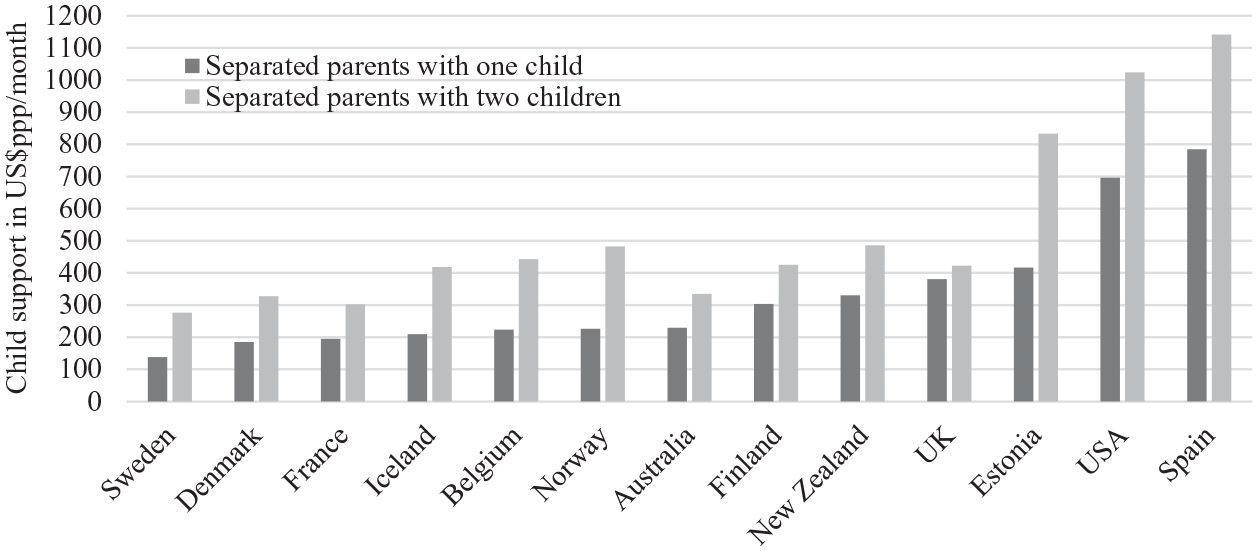
Amount of Child Support Due in Median-Income Family, 2017
In the one-child scenario, the father is expected to pay child support in all countries, but the amounts are dramatically different. Orders are clearly lowest in Sweden, followed by Denmark and France (less than $200 Purchasing Power Parities [PPP] per month). 3 The expectations are highest in Estonia, the United States, and Spain (above $400 PPP per month). In the two-child scenario, Spain expects the highest amount of support. The ranking of countries in the level of expectations is similar for the one- and two-child scenarios.
Comparing the two scenarios provides insight into the logic of child support systems. In Sweden, Iceland, Belgium, and Estonia, amounts per child for the two-child scenario are approximately twice that of the one-child scenario, perhaps in response to a children’s rights perspective in which the second child should be treated equally to the first. In eight countries, the amount for two children is less than twice the amount for one child, which may be the result of presumed economies of scale for the custodial-parent household. In Norway, the two-child amount is more than twice the one-child amount because 7- and 10-year-old children require more than 3-year-olds.
The amount of time children spend with each parent is an important factor affecting the amount owed. In some countries, a growing number of separated parents jointly share the care of their child(ren) either equally or at least 30 percent of care by each parent (e.g., Steinbach, Augustijn, and Corkadi 2020). Shared-care arrangements have created operating challenges for child support policies (Claessens and Mortelmans 2018). In the set of thirteen countries, the most common policy response to shared care is a partial reduction in child support amounts. However, in two of these countries, Estonia and Iceland, no reductions in child support were made when there was shared care in the scenarios provided. In Denmark, France, Sweden, and the UK, no child support is required in the two-child scenario in a shared-care arrangement. (Hakovirta, Meyer, and Skinner 2021).
Another substantial challenge for setting child support orders occurs when parents have had children with more than one partner. These situations are challenging because it is difficult to set orders that treat children equally, are affordable, are operationally feasible, and do not disadvantage older children (Claessens and Mortelmans 2018; Meyer, Skinner, and Davidson 2011). Another difficult issue is the appropriate order amount when the noncustodial parent has low income, especially if the custodial parent also has low income. Possible approaches include allowing a noncustodial parent to keep a certain amount of income for their own living before child support is assessed or using a different formula for low-income cases (Hodges and Vogel 2020). As we will see below, another option is having a public guarantee of a minimum amount of support for those whose ex-partners have difficulty paying.
Child Support Receipts
Previous research shows substantial variation in the proportion of families receiving child support across countries. The European Union Statistics on Income and Living Conditions (EU-SILC) from 2017-2018 shows in the Czech Republic, Denmark, Austria, Hungary, Cyprus, and Poland, over 50 per cent of single mothers received child support. Approximately one in every two single mothers in Finland, Portugal, Estonia, Latvia, Sweden, Belgium, Italy, the Netherlands, Spain, and Greece received child support. Receipt is less likely (under 30 percent) in the UK, France, Ireland, and Luxembourg (Hakovirta and Mesiäislehto 2022). In the United States, the comparable figure is around one-third (Hakovirta, Meyer, and Skinner 2019). Luxembourg Income Study (LIS) data show that about one-half of single-parent families received child support in Chile (in 2017) and Uruguay (in 2016). 4
Prior studies have also reported the total annual amount of child support received among those who receive any support from noncustodial parents. The EU-SILC from 2017–2018 shows mean annual amounts ranging from $735 in Hungary to $7,122 in Austria; the mean annual amounts were over $6,000 in five countries (Austria, Denmark, Italy, Luxembourg, and Netherlands). The second group of countries include Belgium, Cyprus, Finland, France, Greece, Ireland, Portugal, Spain, Sweden, and the UK, where the amount of annual of child support was between $2,000 and $5,000. The lowest amounts were in Czech Republic, Estonia, Hungary, Latvia, Lithuania, and Poland (around or less than $2,000) (Hakovirta and Mesiäislehto 2022). Chile and Uruguay show average annual amounts for single parents receiving support of between $4,000 and $5,000, 5 equivalent to the middle range of the European countries. In the United States, the average annual child support received by those mothers who receive something varies across data sources, but it generally ranges from about $5,000 to $7,000 (Grall 2020; Hakovirta, Meyer, and Skinner 2019). 6 The high amount in the United States is not surprising since the United States prioritizes obtaining support from noncustodial parents over governmental assistance (Hakovirta, Meyer, and Skinner 2021).
Some comparative research has examined the effects of receiving child support on poverty by comparing child poverty rates before and after the receipt of child support for those who receive any support. Results show that when child support is received, it substantially reduces poverty in most countries, but there is some variation in the magnitude of the effects. For example, Hakovirta and Jokela (2019) showed that in 2013 in Finland, Germany, Spain, and the UK, child support reduced child poverty by 30 percent or more; and in the United States the reduction was 21 percent. Another study showed that in Uruguay, around one-third of children in single-parent families whose income before child support was below the poverty threshold were brought out of poverty once child support was considered (Cuesta, Hakovirta, and Jokela 2018). However, studies of the antipoverty effectiveness of child support often miss an important challenge of this transfer: even as it increases the resources available to recipient families, it lowers the economic status of families paying it. Some research shows that when fathers pay support, their poverty rates do increase, although their poverty rates are still below those of single mothers (Cuesta and Meyer 2018; Hakovirta, Meyer, and Skinner 2019). Thus, for some separated parents with low incomes, child support merely reshuffles poverty by transferring resources from low-income noncustodial parents to low-income, custodial parents. Finally, some new research (see Nepomnyaschy and colleagues, this volume) emphasizes the importance of noncustodial parental involvement with children and the importance of their voluntary contributions of money and time to their children’s well-being.
Recently, research has highlighted how important it is to understand how child support schemes interact with social benefits and welfare systems. In Finland, Germany, New Zealand and the United States, for example, the amount of child support received counts as income when calculating some benefits, so the amount of benefits declines as more child support is paid. In other cases (in most U.S. states), child support is paid to the government when a family receives some types of benefits, and not all of this money is passed through to families. In these ways, the potential of child support to alleviate poverty is not fully realized, especially if the families are also in receipt of last resort benefits (Hakovirta et al. 2020; Skinner et al. 2017). More broadly, a challenge of implementing policy is ensuring that cross-program interactions do not limit the effectiveness of individual programs.
Nonreceipt of Child Support and Publicly Funded Guarantees
Countries have somewhat different mechanisms to enforce compliance with child support obligations. In most countries, the amount owed can be withheld from the noncustodial parent’s paycheck and forwarded to the custodial parent (Skinner, Bradshaw, and Davidson 2007). In some countries (like the United States), withholding typically begins from the beginning of the child support order in an attempt to prevent nonpayment. In other countries, withholding can be required, but only after nonpayment occurs. This enforcement tool highlights a key challenge: as earnings in the formal economy become less regular and more precarious, wage withholding may lose some of its effectiveness. Other common enforcement tools that are available include liens, holding people in contempt of court, and prohibition of international travel (either retaining passports or providing identification of noncompliers to airport authorities). Some countries also use driver’s license suspension and incarceration as enforcement mechanisms. There is little research on how often various enforcement actions are taken or their effectiveness (though see Meyer, Cancian, and Waring [2020] for the United States). In contrast to an approach that focuses on threats and punishments, a country could take an approach that provides a variety of services (including employment services) to noncustodial parents that would enable them to meet their obligations. In the United States, these types of programs show some success but have a mixed record (e.g., Cancian, Meyer, and Wood 2022).
Some countries have approached nonpayment by providing a public guarantee of a minimum amount of child support. This flows from a principle in which every child has a right to be adequately provided for and child support is the right of the child. Guaranteed child support schemes mean the child can receive child support from the government if the noncustodial parent does not pay the full amount (Corden 1999). Most European countries now have a guaranteed child support scheme (Nieuwenhuis 2020). Outside of Europe, these schemes are uncommon, although Quebec has a limited program (Skinner, Bradshaw, and Davidson 2007).
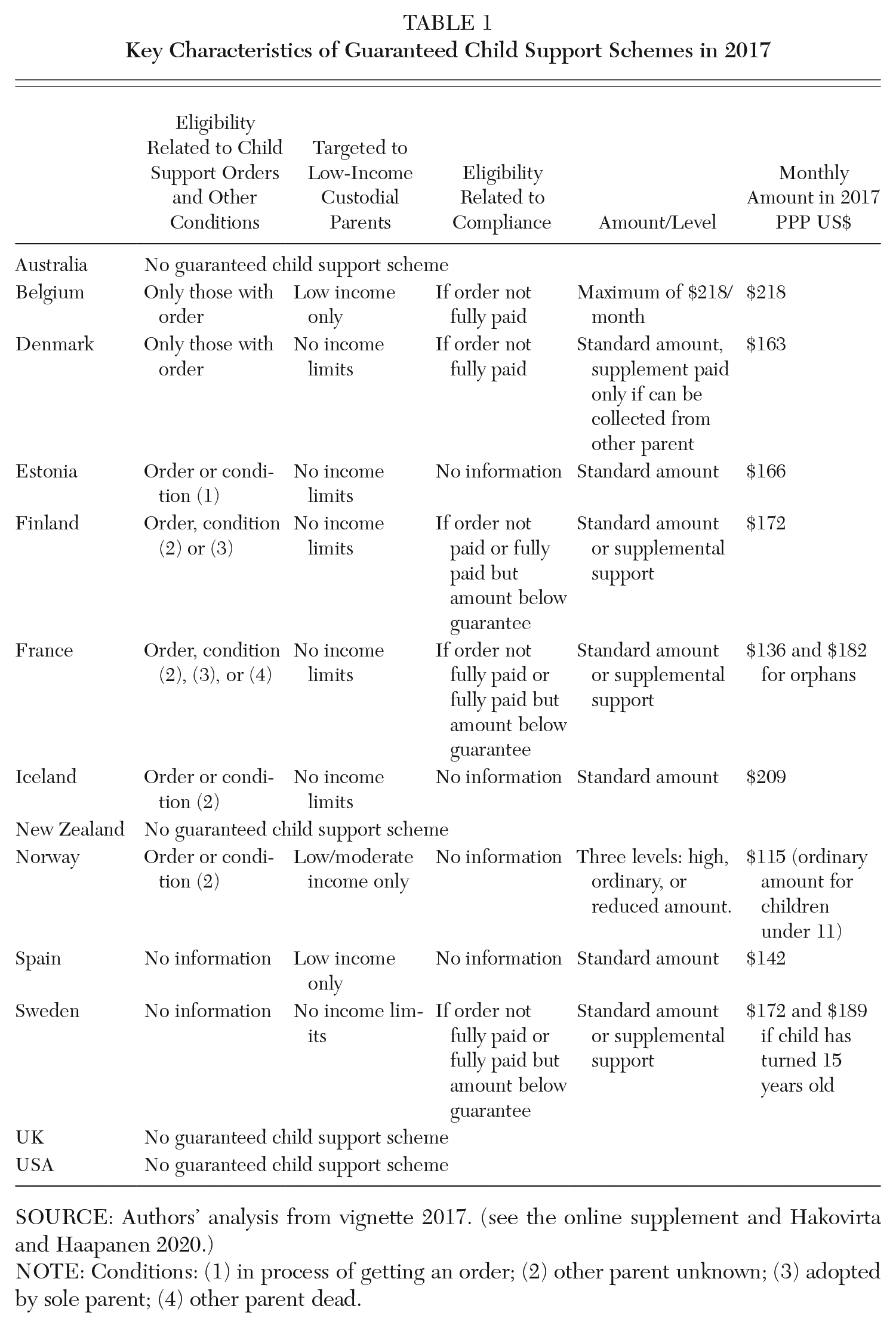
Our analysis of the characteristics of guaranteed support programs considers the thirteen countries for which we have vignette data collected in 2017. Table 1 shows that nine of these countries (i.e., Belgium, Denmark, Estonia, Finland, France, Iceland, Norway, Spain, and Sweden) have this program.
Key Characteristics of Guaranteed Child Support Schemes in 2017
SOURCE: Authors’ analysis from vignette 2017. (see the online supplement and Hakovirta and Haapanen 2020.)
NOTE: Conditions: (1) in process of getting an order; (2) other parent unknown; (3) adopted by sole parent; (4) other parent dead.
There are several similarities in the programs across countries. In all of them, the program guarantees a minimum level of child support for some children who would not otherwise receive it. There are some eligibility differences (see online appendix for more detail). In most countries, guaranteed child support is available only if there is a formal or ratified child support agreement. In three countries, the benefit is income tested; but in other countries, guaranteed support is seen as the right of the child, so it is not limited to low-income families. Countries may also have other restrictions on eligibility. For example, in France, guaranteed support is available only for those who have not repartnered. In most countries, the program is available until the child reaches adulthood; but in others, it is only available for shorter periods.
One key difference across countries is whether the program is available only when noncompliance occurs or whether (as in Finland, France, and Sweden) it is also available if the noncustodial parent is not able to pay child support at all or to “top up” private support to correspond the level of guaranteed child support if the amount of support ordered is below its level. In that case, guaranteed child support complements the child support received from the other parent, thus guaranteeing a minimum level of support for all eligible children.
The basis and amount of guaranteed child support varies. In Norway, the amount depends on several individual circumstances, including the income, number and age of children, and whether the eligible parent is single or partnered, generally following the formula approved for determining the amount due from a noncustodial parent. In the other countries, the amount follows a more standard schedule. When there is only one amount, the amount is highest in Iceland, followed by Sweden, Finland, Denmark, and lowest in France. However, if more than the guarantee can be collected from the noncustodial parent, the amount over the guarantee is forwarded to the child in Denmark, Finland, Norway, and Sweden.
To provide more information on the generosity of the guarantee, in Figure 2 we compare the amount of the order for the typical (i.e., median-income) couple with one child (previously shown in Figure 1) to the amount of the guarantee. In most countries, the public guarantee is less than the amount ordered for the typical couple; in Spain and Estonia, the public guarantee is less than half the amount due from the other parent. In Norway, Finland, and France, the public guarantee is between half and 70 percent of the order for a typical couple. In Denmark, Iceland, and Belgium, the public guarantee is about the same level as the order for the typical couple (over 85 percent). Finally, in Sweden, the public guarantee is actually higher than the amount that would be ordered for a typical-income one-child family.
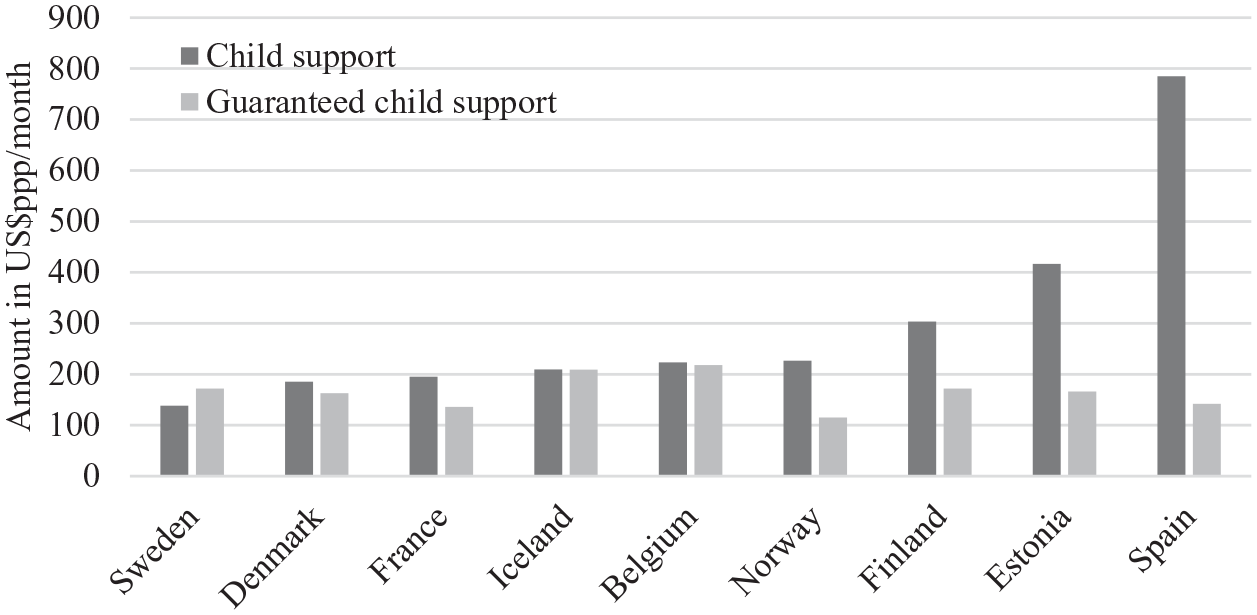
Child Support Due for One Child in Median Income Family Compared to the Level of Public Guaranteed Child Support, 2017
What might countries (like the United States) that do not have guaranteed child support learn from these examples? Our analysis suggests two: the importance of clear goals and the benefits of broader programs. If the goal of the child support policy is only to address nonpayment or irregular payment, then a public guarantee of child support could be tied to the amount of the order. Requiring orders would differentiate the program from more general welfare, which could be a political advantage and would also incentivize single mothers to pursue orders. A guarantee tied to the level of the order follows from the perspective of child support being the right of the child. Having a known and stable amount of support would result in a more stable budgeting for the child’s family, which could result in different choices about housing quality or other investments in children (e.g., Curtis and Warren 2016). Moreover, it would shift the social contract so that the custodial parent and children were not harmed by nonpayment. The government’s job is to ensure collection, and the custodial parent’s job is to use a given amount of regular child support in a way that best supports the child.
However, while this type of guarantee has many advantages, it does not provide much help to custodial parents who are owed low amounts. The lowest-income custodial parents often have ex-partners who themselves have very low incomes. The child support program (appropriately, in our view) asks less of these noncustodial parents than it does of noncustodial parents with more means, so guaranteeing the amount asked by the child support program does little to help those who may need it the most. For these families to be substantially helped, the public guarantee needs to be higher than the amount of their child support orders. This type of benefit is in place in Finland, France, and Sweden. This approach has the additional advantage that fathers are not liable for the amount of the top-up, only the amount that the child support program has determined would be appropriate for their circumstances. This can address a problem of some child support systems in which noncustodial parents with lower incomes have high orders, in part to try to provide something for the lowest-income children.
These high orders may, however, be counterproductive, leading to problems of compliance and the program trying to collect uncollectible amounts (see Hodges, Meyer, and Cancian 2020). In a program with a public guarantee that includes a top-up, the problem of too-high orders for low-income parents can be more easily addressed. If the guarantee does not have a top-up, then the other government benefits for single parents may need to be adjusted to address these needs. Most countries do not target this benefit only to those with low incomes. A clear advantage is that this makes administration simpler and allows the program to function as poverty prevention, rather than only poverty alleviation. As Aerts and colleagues show in this volume, countries that focus too much on income-testing are typically less generous, which also limits the program’s antipoverty effectiveness. Moreover, in the United States, not targeting would mean that state child support agencies could operate the program; these agencies do not currently have mechanisms to conduct an ongoing income test. If an income test is thought to be necessary to increase political feasibility, the Norway scheme, which is more focused on limiting higher-income families from receiving it than it is ensuring that only low-income families can be eligible, has advantages. Moreover, the United States has experience with this type of income test; several tax benefits phase out at levels well above median income, and a guaranteed benefit could do the same.
Similarly, the other restrictions on eligibility in some countries add substantial complexity and limit effectiveness. For example, limiting the program to those unpartnered requires a scheme of declaring (and monitoring) partnerships that does not currently exist in the United States. Finally, the amounts guaranteed in other countries are generally in the $100 to $200/month range. This level is consistent with the amount proposed for the United States by Cancian and Meyer (2018) and the U.S National Academies (2019).
Conclusions, Central Challenges, and Implications
Child support is a critical source of income for the increasing proportion of children living with a single mother, particularly for those at risk of experiencing poverty and material hardship. Yet in a wide range of countries, a significant proportion of single mothers do not receive economic support from their children’s father. A low proportion of single mothers receiving child support is a core issue across the countries in our analysis. The increasing precariousness of job markets worldwide is likely to exacerbate low receipts of child support, and it poses several challenging policy issues; the new labor market simultaneously makes child support more important for a child’s economic security and more difficult for the other parent to pay support. Determining an appropriate amount of support for parents with low or unstable earnings is difficult.
Cases involving low-income parents are not the only situations in which it is difficult to determine an appropriate order. Countries also face difficulties when parents have had children with multiple partners or when children spend substantial amounts of time with both parents. Approaches to orders when noncustodial parents have had children with more than one partner can vary between treating the children equally or prioritizing the order of obligations (i.e., determining what is available for the second family only after the obligation to the first family has been met). Approaches to amounts owed when children spend approximately equal time vary from eliminating child support orders, lowering them, or keeping them in place unchanged. Each of these approaches has disadvantages.
These variations in family circumstances can mean that there are relatively few “typical” cases. Child support policy designed for “simple” cases (parents with adequate resources, stable employment, and no other partners) may not work well for contemporary families. Moreover, the heterogeneity of the situations of single parents is further emphasized by differences by immigration status (Shutes, this volume ) and race and ethnicity (Baker, this volume). Countries can respond by having standardized approaches within each of major types of cases (low income, multiple partners, shared care) to try to ensure consistency. Alternately, countries can rely on schemes that have more individualized approaches, whether that be judicial discretion or allowing individuals to make their own arrangements (perhaps with help). Again, each approach brings potential new difficulties.
All of the countries we looked at appear to face challenges related to nonpayment. Approaches include focusing on enforcement, threats, and potentially punishments and/or trying to provide services that enable parents to pay (and trying to ensure that obligations are not set so high that they cannot be paid). Another approach is to publicly guarantee some level of support, ensuring that children’s economic well-being is not affected by the lack of payment. In part, these policy choices are informed by whether the primary problem is perceived to be that parents are not able to pay or are able but not willing to pay. An enforcement-focused approach for parents struggling to make payments can be counterproductive, and a services-oriented approach for parents who could make payments but are unwilling risks ineffective (and potentially expensive) policies. More broadly, some countries seem to be mostly focused on encouraging involvement of both parents, while others are more focused on ensuring economic transfers occur.
What does this review mean for U.S. policy? One conclusion is that many of the policy dilemmas faced in the United States are common across other countries. This suggests the potential importance of cross-national research and policy transfer. A key policy implication from this review is that the United States should consider guaranteed support, given limited incomes of custodial-parent families, difficulties in determining adequate support amounts, and an uncertain future in terms of the ability of most noncustodial parents to earn adequate incomes for themselves and their children. We have argued that a guaranteed support program in the United States of modest generosity, targeted at those who have orders, and providing additional resources to those whose orders are low, would likely have beneficial effects.
This review shows that, in comparison to other countries, the United States expects noncustodial parents to provide high amounts of child support. This results in relatively high amounts of support for the custodial parents and children who receive it, but the proportion of single mothers who actually receive support is not high. Nonpayment is a problem in the United States and may be related to the country’s focus on expecting high amounts and then trying to enforce them, rather than ensuring that amounts are not “too high” and then trying to provide assistance to those who are unable to pay. 7 Finally, the United States is primarily focused on enforcing financial transfers rather than encouraging involvement. In our view, this is an unhelpful dichotomy, and we would argue that the United States could do more to encourage involvement, especially among unmarried parents, as well enforcing the obligations that are in place. This could lead to a system in which all children and parents can thrive.
Supplemental Material
sj-docx-1-ann-10.1177_00027162221119959 – Supplemental material for Child Support Policy across High-Income Countries: Similar Problems, Different Approaches
Supplemental material, sj-docx-1-ann-10.1177_00027162221119959 for Child Support Policy across High-Income Countries: Similar Problems, Different Approaches by Janet C. Gornick, Laurie C. Maldonado, Amanda Sheely, Mia Hakovirta, Laura Cuesta, Mari Haapanen and Daniel R. Meyer in The ANNALS of the American Academy of Political and Social Science
Supplemental Material
sj-docx-2-ann-10.1177_00027162221119959 – Supplemental material for Child Support Policy across High-Income Countries: Similar Problems, Different Approaches
Supplemental material, sj-docx-2-ann-10.1177_00027162221119959 for Child Support Policy across High-Income Countries: Similar Problems, Different Approaches by Janet C. Gornick, Laurie C. Maldonado, Amanda Sheely, Mia Hakovirta, Laura Cuesta, Mari Haapanen and Daniel R. Meyer in The ANNALS of the American Academy of Political and Social Science
Footnotes
Notes
Mia Hakovirta is a senior research fellow at the Invest Flagship, Department of Social Research, University of Turku, Finland.
Laura Cuesta is an Assistant Professor of social work at Rutgers, The State University of New Jersey.
Mari Haapanen is a doctoral student at the Invest doctoral program, Department of Social Research, University of Turku.
Daniel R. Meyer is a Professor of social work at the University of Wisconsin–Madison.
References
Supplementary Material
Please find the following supplemental material available below.
For Open Access articles published under a Creative Commons License, all supplemental material carries the same license as the article it is associated with.
For non-Open Access articles published, all supplemental material carries a non-exclusive license, and permission requests for re-use of supplemental material or any part of supplemental material shall be sent directly to the copyright owner as specified in the copyright notice associated with the article.
