



Abstract
Capital punishment in the United States is racialized: those convicted of the murder of Whites are much more likely to receive the death penalty than those convicted for the murder of Blacks. Capital punishment is more commonly practiced in places where lynching of Blacks occurred more frequently and in states in which slavery was legal as of 1860. Accordingly, scholars have debated whether capital punishment reflects a legacy of lynching or a legacy of slavery. Our analysis shows that lynching on its own is a significant predictor of contemporary executions, but that once slavery is accounted for, slavery predicts executions, while lynching does not. We argue that slavery’s state-level institutional legacy is central to contemporary capital punishment.
Capital punishment has continued in the United States long after many other Western nations have abolished the practice. To explain the persistence of American capital punishment and its racial biases, scholars have pointed to the legacies of slavery and lynching. Historical regimes of racial control and violence may have shaped local institutions and culture in ways that continue to influence the exercise of state violence. Still, scholars have rarely considered both legacies in the same study, which is problematic given that the practices of lynching and slavery are highly spatially correlated. What we can conclude from prior quantitative studies is that contemporary executions occur more often in the same places where both lynching and slavery were prevalent (Jacobs, Carmichael, and Kent 2005; Vandiver, Giacopassi, and Lofquist 2007), but it remains unclear which legacy is key to understanding contemporary capital punishment.
Scholars pointing to the effects of the legacy of lynching on capital punishment note similarities between historical lynchings and contemporary executions, historical linkages between the two practices, and geographical associations between the two phenomena. Both victims of lynching and people executed by the state were disproportianately Black and male (Seguin and Rigby 2019; Tolnay and Beck 1995); contemporaries often thought of lynching and capital punishment as “substitutes” for one another and sometimes retained capital punishment laws out of concern over a resurgence of lynching (Steiker and Steiker 2020, 305); and lynching was most common in the parts of the country where capital punishment is most common today. Lynching is mostly thought to have a legacy on capital punishment due to an enduring effect on White racist attitudes (e.g., Messner, Baumer, and Rosenfeld 2006). Still, there are also potential institutional legacies of lynching in places where authorities executed prisoners to placate lynch mobs.
Despite affinities and historical connections to lynching, slavery may have a more significant legacy effect on contemporary capital punishment. The legacy of slavery may be transmitted mainly through institutional practices and organizations since the antebellum South used executions to suppress rebellions of enslaved people (see, e.g., Blackman and McLaughlin 2003) and hence had more fully developed the legal and institutional infrastructure for executions. Slavery may also contribute to the contemporary use of executions through attitudinal mechanisms since slavery has durably shaped White racist attitudes in general and toward punishment in particular (Acharya, Blackwell, and Sen 2018). Studies have shown that executions are more common in states with legal slavery as of 1860 (e.g., Vandiver, Giacopassi, and Lofquist 2007).
To disentangle these relationships, we conduct county-level analyses of the relative impact of slavery and lynching on contemporary capital punishment in the contiguous forty-eight states. We find a county-level association between the past lynching of Blacks and executions of Blacks from 1977 to 2017. 1 However, this association becomes insignificant when we account for the extent of slavery in 1860 at the county level. The association with county-level slavery, in turn, becomes insignificant when we account for slavery at the state level. Models of the executions of Whites display the same pattern: lynchings of Whites are associated with the execution of Whites until we account for slavery. We conclude that the practice of capital punishment in the United States is likely primarily impacted by the legacy of slavery, mainly occurring through slavery’s perversion of state-level institutions and culture.
Executions, Race, and the Legacies of Lynching and Slavery
Racial inequalities in contemporary capital punishment are consistent with what we know about racial norms originating in slavery and Jim Crow and patterns in lynching victimization. Those convicted of homicides of Whites as opposed to Blacks, for example, are much more likely to face execution. Those convicted of killing a White woman are 13.8 times more likely to be executed than offenders convicted of killing a Black man (Baumgartner et al. 2015, 803), echoing lynching apologists’ claims that lynching was in defense of “White womanhood” (see, e.g., Wells 1895). Capital punishment is also much more common in areas where the history of racial violence was deepest: where slavery and lynching were most heavily practiced. Therefore, scholars have pointed to the legacies of either lynching or slavery as causes of the continuing use of capital punishment.
Legacies occur when an institution’s or event’s effects persist long after the institution has ceased to exist or the event has occurred. Legacies result from path dependence, wherein institutions or events place societies or institutions on particular paths that reproduce themselves after the initial cause is absent (Arthur 1989; Pierson 2004). For both lynching and slavery, we theorize that the legacies of these historical forms of racialized social control may have been reproduced through two broad types of mechanisms: attitudinal and institutional.
Attitudinal mechanisms operate through the ongoing influence of slavery or lynching on White racist attitudes. Slavery and lynching were not only reflections of White racist attitudes but were central to the construction of these attitudes (Acharya, Blackwell, and Sen 2018; Smångs 2016). Whites may have then passed down these racist attitudes through generations. These attitudes influence the extent of public support for local officials with favorable views of capital punishment, whether local prosecutors pursue the death penalty in capital cases, local organizational support for capital sentencing (Kovarsky 2016), and whether White residents support racialized use of executions (Bobo and Johnson 2004; Soss, Langbein, and Metelko 2003).
Institutional mechanisms suggest that either slavery or lynching led to the development of institutions that reproduce their legacy. These institutional practices include constitutional and statutory constraints on capital sentencing, siting of facilities for incarceration and execution of capital offenders, differential funding of local districts attorney offices, variation in the structure and allocation of resources for capital defense, and local prosecutorial and judicial discretion in pursuit of capital sentencing (Baumgartner, Box-Steffensmeier, and Campbell 2018; Kovarsky 2016).
Legacies of lynching
Collective and ethnic violence generally appears likely to have legacy effects, mainly through attitudinal mechanisms, as attitudes toward outgroups, forged through violence, are passed down through generations. Scholars have shown, for example, that pogroms against Jews during the Black Death “reliably predict violence against Jews in the 1920s, votes for the Nazi Party, deportations after 1933, attacks on synagogues, and letters to Der Stürmer” (Voigtländer and Voth 2012, 1). In another analysis, descendants of Crimean Tatars violently deported by the USSR in 1944 were, 70 years later in 2014, significantly more likely to identify with their ethnic group, be politically active, hold hostile attitudes toward Russians, and support Crimean Tatar political leadership (Lupu and Peisakhin 2017).
Like these cases, lynching was an endemic form of racist violence and one that many Americans experienced either directly or indirectly. White mob violence against Blacks became a key means through which southern Whites sought to reestablish political supremacy following the end of Reconstruction (Du Bois 1999; Foner 1990). From 1883 to 1941, lynch mobs murdered more than 3,265 Black Americans across forty-three different states in the United States (Seguin and Rigby 2019, 2). Because lynch mobs could number well into the thousands, particularly at “spectacle” or “public torture” lynchings, a large number of Americans witnessed lynchings directly (e.g., Garland 2005). A greater number still experienced lynchings through the public display of victims’ bodies, souvenirs taken from victims’ bodies, lynching postcards and photographs, newspaper reporting, and other oral accounts (Wood 2009).
Scholars have found many enduring effects of lynchings. Demographic patterns due to Black out-migration in response to lynching persist to the present day (Tolnay and Beck 1990). White on Black homicides evolving out of interpersonal disputes are more prevalent in counties with a history of lynching (Gabriel and Tolnay 2017; Messner, Baller, and Zevenbergen 2005). Corporal punishment in schools is more common in counties where more lynchings occurred (Ward et al. 2019). Authorities are less likely to police and prosecute hate crimes in places with large contemporary Black populations and a history of lynching (King, Messner, and Baller 2009). Prison admission rates are higher in states where more lynchings occurred (Jacobs, Malone, and Iles 2012). As an institutional form of racialized corporal punishment, executions are similar to many of these phenomena. Perhaps most directly, a history of lynching is associated with increased use of the death penalty 2 (Jacobs, Carmichael, and Kent 2005), and contemporary Whites are more supportive of capital punishment when they reside in areas with a history of lynching (Messner, Baumer, and Rosenfeld 2006).
One mechanism through which a history of lynching may continue to have an impact is attitudes. Lynching was an education in White supremacy and helped to cement White racist attitudes. When Whites lynched Blacks, it often had an immediate effect on race relations. Blacks would often avoid Whites following a lynching and closely adhere to Jim Crow forms of “racial etiquette” when avoidance was difficult (Tolnay, Deane, and Beck 1996). Spectacle, or “public torture,” lynchings shored up White racial solidarity and were associated with increased Democratic party vote share, which was then the party of White supremacy (Smångs 2016). Because of the “instructive value” of lynching, Whites often brought their children to witness lynchings or see the bodies of lynching victims that mobs often left for display for days after their murder (Ritterhouse 2006).
Lynching also led to the development of institutional infrastructure for capital punishment. After lynchings became a liability for local reputations, White southern sheriffs, politicians, and newspapers often attempted to placate lynch mobs through the promise of legal executions, and courts sometimes enacted swift executions under the pressure of mobs (Wood 2009, 19–45). Attempts to abolish capital punishment in Tennessee and elsewhere were stymied by its perceived importance in suppressing lynching 3 (Steiker and Steiker 2020, 305; Vandiver 2005). When executions rose in the 1920s and 1930s, just as lynching was declining, executions were often framed as “legal lynchings” (Wright 1996, 223).
Following this research, then, we hypothesize that
Hypothesis 1 (H1): There will be more executions of Blacks in counties where more Blacks were lynched.
The execution of Whites may shed light on the mechanisms through which these legacies operate. Lynching of Whites occurred less frequently but over a wider geographic swath of the United States, including in significant numbers in the West (see, e.g., Seguin and Rigby 2019). If lynching increased attitudinal support for lethal punishment generally, we would hypothesize that
H2: There will be more executions of Whites in places where more Whites were lynched.
Legacies of slavery
As an institution, slavery had a far-reaching influence on the economic, political, and social systems in areas that took part in slavery. Scholars have shown across many contexts that the organization of economic and political systems can have enduring legacies. People whose ancestors traditionally employed plow agriculture, for example, tend to be hostile toward female labor market participation (Alesina, Giuliano, and Nunn 2013). Political institutions favoring interethnic cooperation and trust developed in Medieval-era port cities due to increased international trade have persisted and considerably reduced ethnic conflict in South Asia (Jha 2013). The legacy of good public administration has made residents of places that were part of the Habsburg empire more trusting of public services than residents of neighboring regions (Becker et al. 2016).
If economic systems and racial/ethnic violence tend to leave lasting legacy effects, it is not surprising that slavery, as an instance of both, has been shown to have legacy effects in many places. For example, Africans whose ancestors were more heavily raided during the slave trade are less trusting today (Nunn and Wantchekon 2011). Both Brazil and the United States, areas with a greater extent of slavery historically, have lower social capital today (Uttermark 2019). Globally, slavery and related colonialist practices have inhibited contemporary economic development in the areas where they were practiced by producing and replicating extractive political/economic institutions (Acemoglu, Johnson, and Robinson 2001).
Slavery has left deeper marks on the culture and politics of the United States than in other Western countries (Patterson 2019, 907). Slavery has shaped the design and functioning of the United States’ formal political institutions, limiting the development of a powerful central government, which, in turn, allowed the development of local regimes of capital punishment (Garland 2010, 155). Social control of enslaved people was also a key motivation for the development of resources and practices that facilitated executions in the slave states. Nearly half of the mass executions in the United States before 1860, for example, were of enslaved Blacks accused of plotting or participating in revolts against slavery (Blackman and McLaughlin 2003). Moreover, the slave states formally enshrined the racially unequal use of executions into law: many crimes in slave states carried the death penalty if committed by enslaved people, but not for Whites (Blackman and McLaughlin 2003).
Slavery has also continued to influence White racial and political attitudes in the areas in which it was practiced. Acharya, Blackwell, and Sen (2018) show that living in places with a history of slavery leads Whites to support more conservative political parties and express more “racial resentment.” These attitudes, in turn, could translate to support for the death penalty among elected officials and local support for racialized capital punishment. Finally, research has shown a strong empirical association between the historical practice of slavery and contemporary executions, with 90.6 percent of all executions from 1977 to 2005 occurring in former slave states (Vandiver, Giacopassi, and Lofquist 2007, 30). Hence, we hypothesize that
H3: Executions of Blacks will be more common in counties with a greater share of enslaved people in 1860.
Although the extent of slavery varied considerably throughout the slave states, slavery was not strictly a local practice but also had state-level implications. Former slave owners and their descendants, for instance, were overrepresented in state legislatures 50 years after emancipation (Bellani, Hager, and Maurer 2020). Efforts to reestablish slavery by other means through “Black codes,” such as vagrancy laws or convict leasing, took place at the state level. Moreover, before emancipation, support for slavery was uniformly high across counties with differing levels of slavery prevalence (Acharya, Blackwell, and Sen 2018, 151). Hence, we hypothesize that
H4: Executions of Blacks will be more common in states that had legal slavery in 1860.
Disentangling the legacies of lynching and slavery
Although lynching had been widely practiced throughout the West, often targeting White victims, the kind of anti-Black lynching that emerged after Reconstruction as an expression of the racial caste system was itself a legacy of slavery. Counties in the South with greater reliance on cotton agriculture—an indicator of some of the worst slavery conditions—saw more lynchings of Blacks (Tolnay and Beck 1995). The practice of lynching often involved skills and infrastructure, such as the use of bloodhounds, developed by slave patrols (see, e.g., Smångs 2016, 60–61). Many of the tortures involved in lynching were also developed during slavery. In Missouri, for example, lynchings were accompanied by tortures like whipping, whereas such tortures occurred much less frequently in nearby Kansas (Campney 2019, 116–31). Furthermore, the legal impunity of White lynch mobs was maintained through White supremacist norms solidified during slavery. Thus, lynching may be a mechanism that reproduced the legacy of slavery over time.
Lynching, however, was not the only legacy of slavery and not the only mechanism through which White supremacist attitudes and institutions persisted after abolition. Moreover, these other mechanisms were not necessarily coextensive with areas with high lynching rates, meaning that lynching does not proxy for these other mechanisms. In places where the Democratic party was stronger, for example, lynch mobs were more likely to be thwarted by local sheriffs, suggesting that local elites viewed White electoral political power as a substitute for lynching (Hagen, Makovi, and Bearman 2013). Convict leasing is another example, where Alabama, for instance, had many fewer lynchings than neighboring Mississippi or Louisiana but also had a more extensive and profitable convict leasing system (McCarthy 1985). 4 These examples hardly exhaust the ways White supremacy pervaded the former slave states. Thus, slavery may have been the root cause of both lynchings and other forms of violence that perpetuated racist attitudes and institutions. Hence, we hypothesize
H5: After controlling for the extent of slavery in 1860, any observed association between historical lynching and contemporary legal executions of Blacks will disappear.
Many of the institutional legacies through which slavery may have perverted local institutions are formally colorblind. Local resources devoted to capital sentencing and executions shape potential outcomes for capital-eligible offenders regardless of race. Hence, if the legacy of slavery operated through its effect on formal institutions, we would hypothesize that
H6: Executions of Whites will be more common in states that had legal slavery in 1860.
Data
Our data comprise county-year level observations of demographic variables, as well as counts of executions and lynchings. Our data on executions cover 1977 to 2017, while our historical data on slavery come from 1860, and our data on lynching span 1883 to 1941. Many county boundaries have shifted between 1860 and 2017, and many new counties have been created. To generate consistent boundaries, we used areal interpolation, a spatial averaging approach to apply data from historical counties to the contemporary counties that contain some proportion of the land area from historical units (Downey 2006), allowing us to use counties as they existed in 2017 as our unit of analysis.
We gathered data on slavery from the 1860 population census. Our data on lynching come from Beck’s update of the original Tolnay-Beck lynching inventory for the deep South (Beck 2015; Tolnay and Beck 1995) and Seguin and Rigby’s inventory of the remaining thirty-eight contiguous U.S. states (Seguin and Rigby 2019). Data on executions come from the Death Penalty Information Center. This dataset includes the prisoner’s race and the county of sentencing for every U.S. prisoner executed from 1977 to 2017. Data on contemporary demographics come from the 1970, 1980, 1990, 2000, and 2010 population censuses and the 2013–2017 American Community Survey five-year estimates. We also include data on homicide incidents and offender and victim characteristics from the Supplementary Homicide Reports (Kaplan 2018).
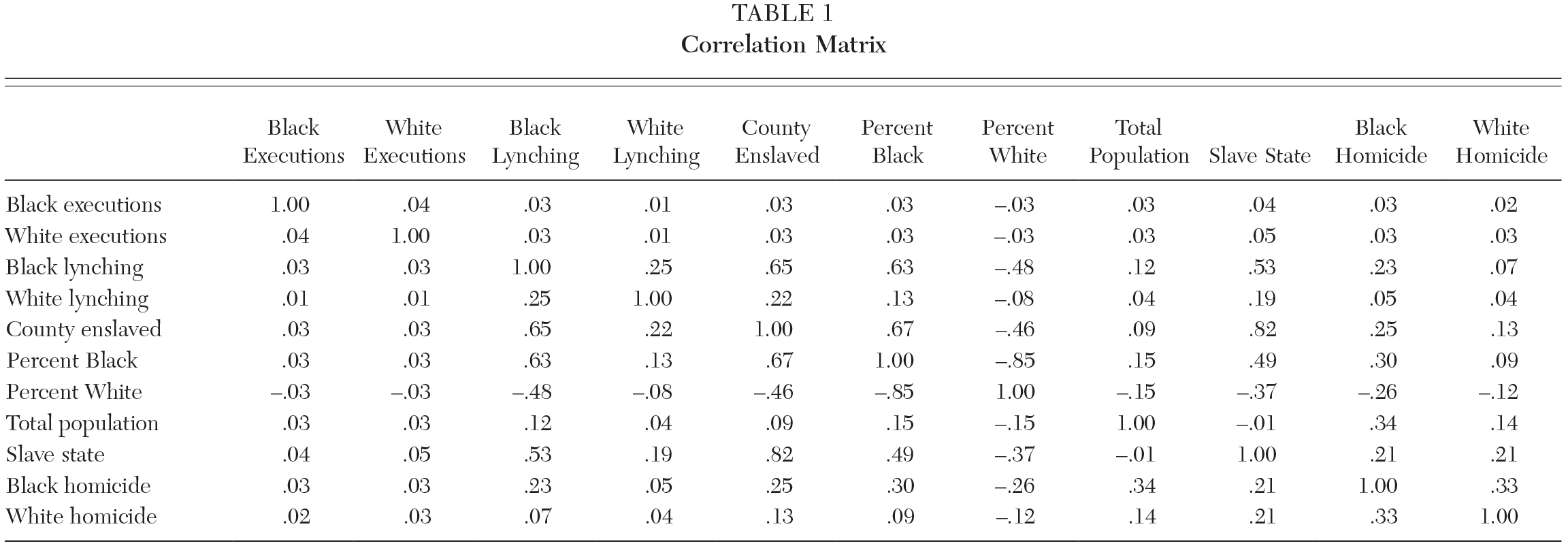
Our dependent variables are the (logged) rates of Black and White executions at the county level. The number of facilities where legal executions take place is highly limited, so for our analyses, we record the county where an executed prisoner was sentenced. Our key independent variables are county-year level counts of Black or White lynching victims between 1883 and 1941 and the proportion of the county population that was enslaved in 1860. We also include controls for the rate of Black or White homicide offending (assuming that the impact of local crime rates on sentencing practices is lagged, we measure this as a 10-year trailing average), the size of the local Black or White population, the size of the total population, and an indicator for whether the state permitted slavery in 1860. To account for the heavy right skew of variables in our model, we took the natural log of all variables except for the slave state indicator. Table 1 displays a correlation matrix of the variables in our analysis. Note that correlations of most variables with Black and White executions are low because, year to year, there are very few executions in most counties, and so there is considerable idiosyncratic variation.
Correlation Matrix
Analysis and Results
Figure 1 overlays the locations of historical Black lynchings and contemporary legal executions of Black prisoners on a choropleth of the county-level distribution of the enslaved population in 1860. Figure 2 illustrates the count of Black and White lynchings and executions across slave states and free states.
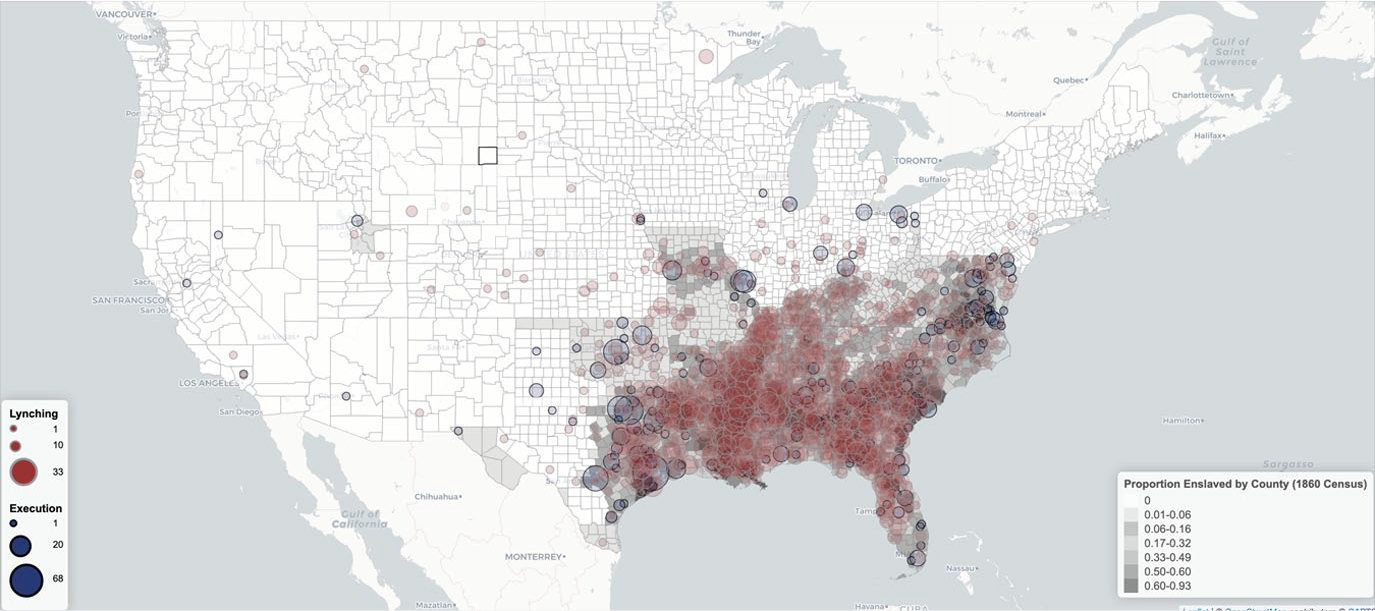
Map of Black Lynching (1883–1941), and Black Executions (1976–2017), over Slavery in 1860
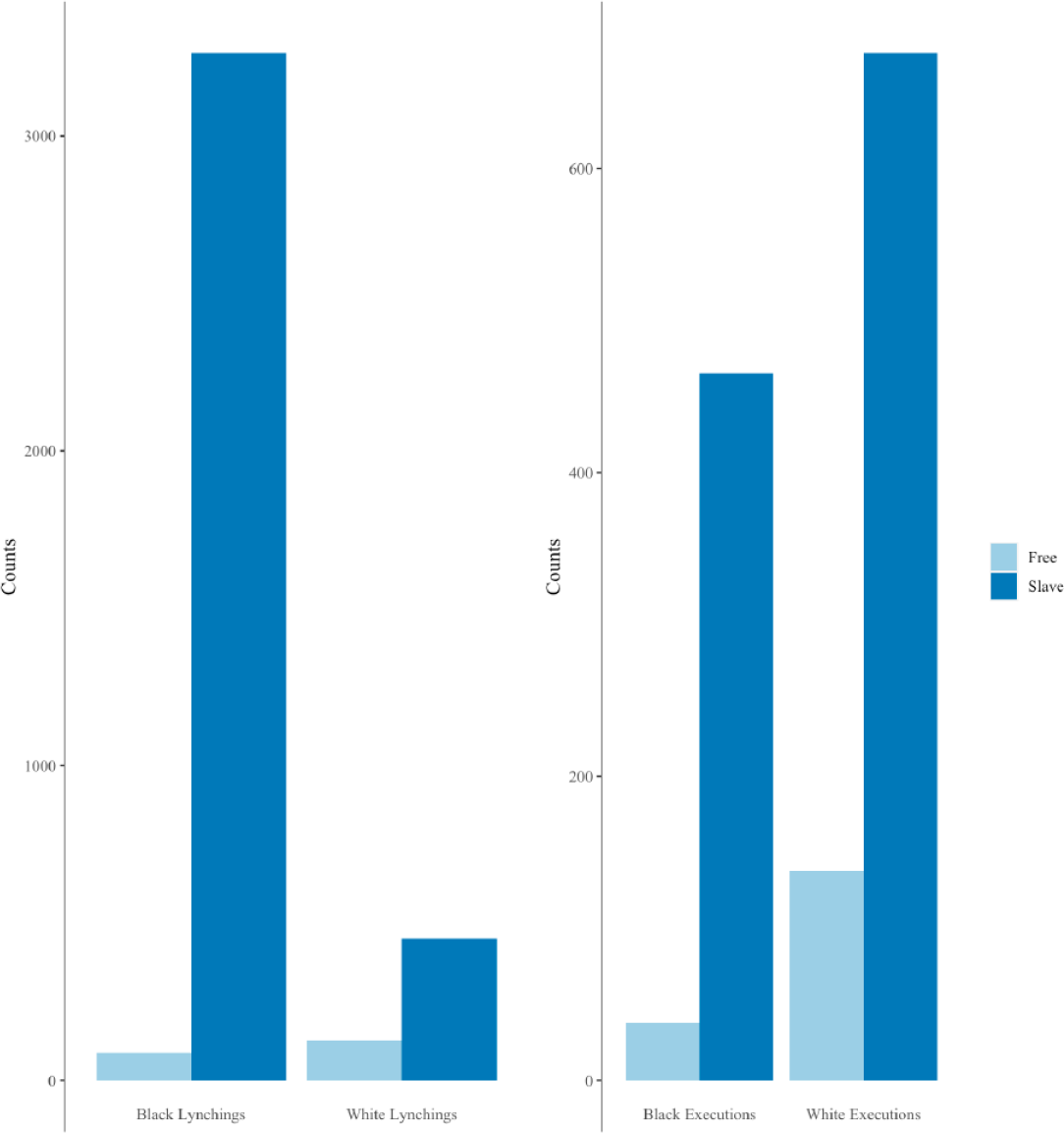
Lynchings and Executions of Blacks and Whites in Slave States and Free States
Table 2 displays results from a series of pooled time-series ordinary least squares (OLS) regressions with standard errors clustered by county. We standardized coefficient estimates so that a standard deviation change in an independent variable is associated with a standard deviation change in the logged execution rate in a given year. Models 1 through 3 show contemporary Black executions, and models 4 through 6 estimate legacy effects on contemporary White executions. In model 1, the number of Black lynching victims in the county is predictive of contemporary executions of Blacks, lending support for H1. In addition, our control measure of the trailing 10-year average of Black homicide offenders in a given county is significant, 5 which is unsurprising given that the vast majority of death penalty sentences are handed down for homicide convictions.
Time-Series Models of Lynching on Contemporary Execution
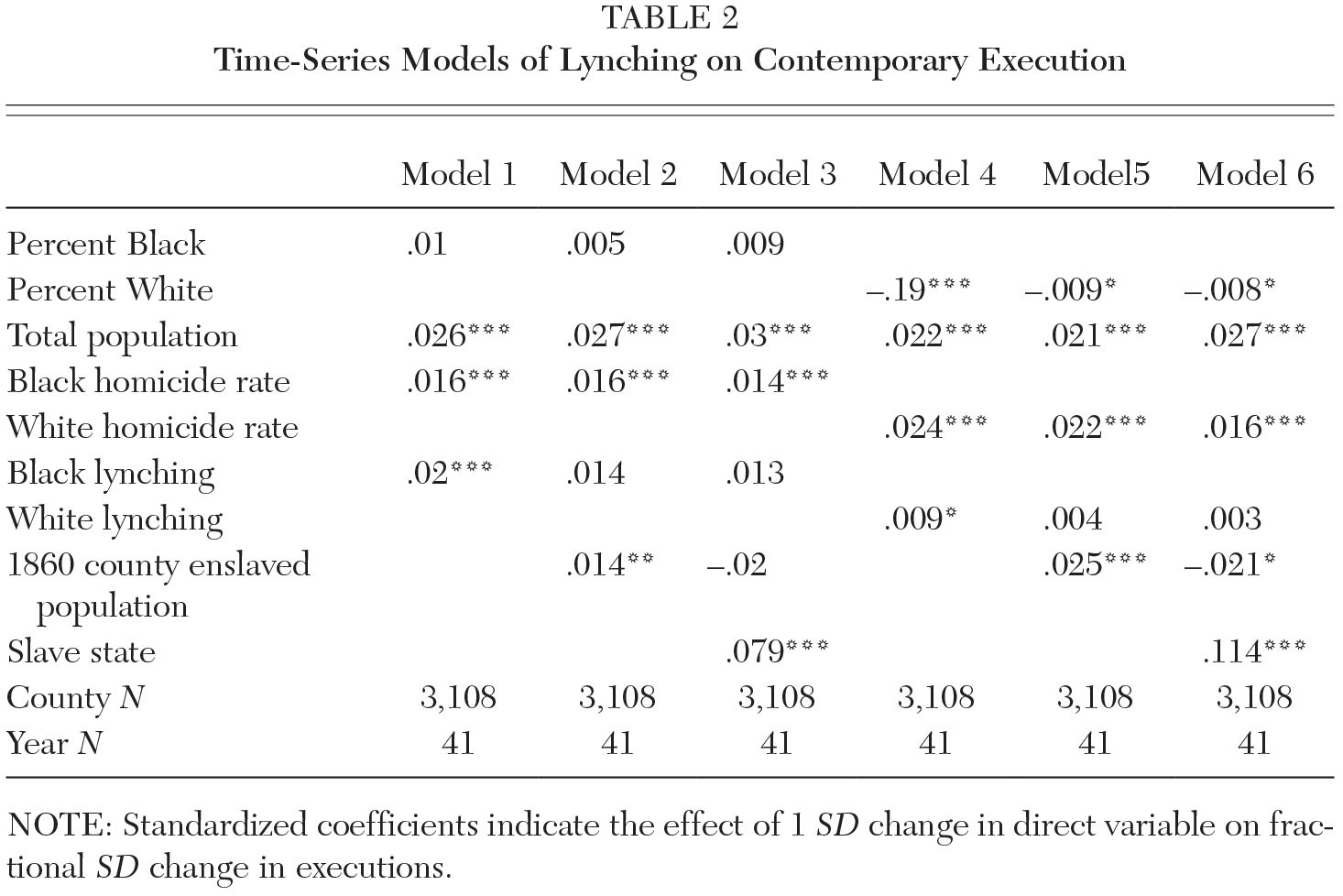
NOTE: Standardized coefficients indicate the effect of 1 SD change in direct variable on fractional SD change in executions.
Model 2 introduces our measure of the extent of county-level slavery in 1860, which is a significant predictor of the executions of Blacks, lending support to H3. Model 3 introduces a dummy variable for whether a county is in a state that had legal slavery in 1860. When including measures of slavery at both the county and state levels, this measure of state-level slavery is a significant predictor, lending support to H4. When we account for the extent of slavery in 1860, initially at the county and later at the state level, the association between historical lynching and contemporary executions of Black prisoners is no longer significant, lending support to H5.
Models 4 through 6 are identical to models 1 through 3, except they estimate effects for the executions of Whites. Model 4 shows that the number of historical White lynchings at the county level is predictive of contemporary executions of Whites, lending support for H2. Model 5 introduces a measure of the extent of slavery at the county level. When accounting for county-level slavery, the effect of slavery on contemporary White executions is positive and significant, while the effect of historical lynching is no longer significant. Model 6 includes measures of slavery at both the state and county levels. In this model, historical lynching is not a significant predictor of contemporary White executions, but slavery at both the state and county levels is significant. Although state-level slavery is positively associated with contemporary executions, the coefficient for county-level slavery has switched signs and is negatively associated with White executions; the size of this effect, however, is swamped by that of the state-level effect, lending support to H6. In models 4 through 6, the White homicide offender rate is positively and significantly associated with contemporary executions, but the size of the local White population is negatively associated with White executions. Again, although historical lynching predicts contemporary executions, once county and state slavery are accounted for, the effect for lynching becomes insignificant. These results are substantively similar to the results of our analyses of Black executions. We interpret these findings as evidence that although institutions shaped by slavery were designed to maintain White economic and social status, these institutions also harm many poor or otherwise marginal Whites (see, e.g., Bell 2005; Du Bois 1999).
Discussion and Conclusion
Capital punishment today is shaped in many ways by a legacy of racial violence and control in the United States. Scholars have posited that both lynching and slavery are historical practices with legacy effects on capital punishment. In this article, we ask which of these historical institutions of White supremacy continue to exert the strongest influence on the racialized practice of contemporary capital punishment. Our results show that lynching on its own is a significant predictor of contemporary executions but that once slavery is accounted for, slavery predicts executions, while lynching does not. The legal status of slavery at the state level appears to be the best historical predictor of contemporary executions at the county level, suggesting that the perversions of slavery on state-level political institutions or culture may be the key historical legacy. We caution here that considering the strong relationship between slavery and lynching, our analysis depends on a relatively limited amount of variation.
Lynching may be one mechanism through which the legacy of slavery on capital punishment was reproduced. Lynching appears to have been used as a form of racialized social control in substitution for more formal methods, so the practice of lynching may have been, net of the effect of slavery, negatively correlated with other mechanisms like convict leasing. Hence, it may be that if we had included measures of these other mechanisms of reproduction in our regression models, lynching would predict contemporary executions of Blacks. However, even if this were true, since lynching was a legacy of slavery, slavery would still be the distal cause.
It makes sense that the effects of slavery would overshadow those of lynching. Lynching was part of a system of White supremacist terror and domination following Reconstruction, but it was only one part. Slavery was a longer-running and total institution. Slavery was formally written into law, while lynching, by definition, was not. Slavery nearly completely structured the economics, politics, and racialized social interaction in the regions in which it was practiced, while lynching was one mechanism among many that White supremacists used to restore White supremacy at the end of Reconstruction. Slavery has been lionized in collective memory through things like plantation tours and whitewashed in history textbooks; while even during the lynching era, local elites often sought to suppress publicity for lynchings (Wood 2009). Our findings also indicate that even as the historical and contemporary costs of White supremacy in the United States have been borne disproportionately by ethno-racial minorities, institutions and practices shaped by historical racism also persist in producing harms for Whites (see, e.g., Bell 2005).
Ultimately, legacies imply that past events and structures can continue to exert effects long into the future, meaning that what looks like a legacy effect may instead be a proxy for the persistence of a cause further back into the past. In the case of lynching and slavery, we risk mistaking one slice of a long history of racial violence and oppression as the root of contemporary racial oppression. 6 Regardless of the exact mechanisms at play here, that local variation in histories of racist violence impacts the practice of contemporary capital punishment violates the principle of fundamental fairness that underlies due process and equal protection under the law.
Footnotes
Notes
David Rigby is a PhD candidate at the University of North Carolina, Chapel Hill. His research looks at migration and political change with projects on polarization, changes in immigration policy-making, and vulnerability to collective and state violence. His dissertation looks at the post–civil rights era transformation of immigration politics in the United States.
Charles Seguin is an assistant professor of sociology at Pennsylvania State University. His research seeks to understand the dynamics of cultural and political change and stability broadly, with a particular focus on the roles of violence and group boundaries.