




Abstract
This article constructs an index that translates the substance of policy documents into numeric values across three dimensions of regulation—a qualitative assessment of policy substance, its potential impact, and enforcement of regulation—which aims to capture the strength of social objectives in the economy. It draws on theories of economic regulation and literature on the welfare state to develop a general understanding of social objectives. The use of the index is illustrated through public procurement regulation in two European countries (France and Germany) and shows an overall increase in the strength of social objectives. It also highlights systematic differences in country priorities in the regulation of their economy. The index demonstrates that social regulation can be measured and compared in a meaningful way within and across countries.
Freer markets come with more rules (Vogel 1998), but the rules do not relate exclusively to competition and price efficiency. Free market rules can promote other objectives, such as welfare norms and social ends. Such rules ensure that services offered in hospitals meet standards of maximum working hours or that mortgage credits offer old age security. The literature on the regulatory welfare state (RWS) provides analytical leverage in studying these developments (Windholz and Hodge 2013; Levi-Faur 2014; Benish and Levi-Faur, this volume). Yet scholars interested in the RWS have mostly focused on social policies, and there are few analyses that study how regulation addresses social objectives in other policy fields, such as the provision of utilities or financial products (Haber 2018; Eckert 2018; Schwartz 2009; Hartlapp and Rauh 2013). This is unfortunate, because regulation has the potential to create more solidarity and equality among different groups of market participants, create social cohesion in societies, and promote justice in access or consumption of goods and services that link directly to economic policy. One example is that of public procurement: regulation can create more solidarity by requiring that the footballs used in public schools and produced in the Global South have been sewed by adults rather than children. It can create social cohesion by requiring the bidder to ensure payment of collective wages in its production chain and promote justice by setting aside a certain percentage of jobs in public construction sites to groups of citizens discriminated against in the labor market. Furthermore, existing studies focus on single instruments or country cases, and are limited in the time period that they cover.
This article develops an index of regulation for social purposes that works toward systematizing our knowledge of the RWS, and potentially yielding comparative insights. I go on to illustrate use of the index for public procurement, a topic that lends itself to the study of regulation for social purposes beyond the field of social policy. Public procurement regulation aims to support and promote competition and flexibility in public contracting. It targets private enterprises, intermediaries, and supply chains, and regulates production as well as products. Public procurement regulation applies to anything from purchasing food for public schools to large-scale infrastructure construction. In terms of scale, public procurement is an economically significant policy area, with about 14 percent of GDP spent on public contracts across the European Union (EU) (European Commission 2016) and an estimated $1.5 trillion annually in the United States (Conway 2012, 143).
Public procurement is an interesting subject for study in social regulation not just because of the volume of government spending that is channeled into the economy. Two other reasons are material to my arguments in this article. First, in a narrow sense, public procurement regulation has the potential to render a market more social for equal levels of spending. When purchasing workwear for $ 1,000, a public enterprise can go to a sweatshop or buy fair trade labels. Thus, for equal spending levels, a state can decide whether to spend money on the basis of a pure cost-benefit analysis, or whether to also include social goals (McCrudden 2004; Wiesbrock 2015). Critics argue that social criteria in public procurement distort the market, create unnecessary complexity, and increase prices (e.g., Sánchez-Graells 2015; for an overview see Conway 2012, 146). Therefore, some public procurement regimes prohibit their use. Where contracts are awarded to bidders offering lower prices, enterprises are unlikely to respect collective agreements or will discriminate against less advantaged groups in the labor market. Similarly, without social criteria, products offered at a lower price are likely to be purchased without regard, for example, for unfair working conditions. Social goals in public procurement therefore steer the behavior of market participants away from simple price efficiency. They do so directly, via contracts, and indirectly, when a large number of competing bidders change their behavior to conform to award criteria that include social goals. At least some of these bidders are then likely to align their future behavior with these social objectives, too. Thus, social objectives in market regulation are interesting because they affect outcomes of markets.
My second interest in this article is public procurement as a case of regulation that increases welfare beyond the state. If social goals and norms are not limited to the welfare state, this opens up questions on the similarities and differences of the process and driving factors supporting these goals and norms in the welfare state and other areas of the state, as well as—regarding outcomes—their substitutive or supplementary nature. This analysis can thus provide insights for the study of boundaries of the regulatory welfare state and has the potential to travel to other cases, for example, para-state agencies or service delivery (Reiter, this volume; Klenk, this volume).
To aid in my study of the points above, I propose a measure for regulation for social purposes that can be applied to a broad range of regulatory topics. To construct this measure, I draw on different understandings of social objectives in theories of regulation and the welfare state literature. Theories of economic regulation summarize social objectives under a general public interest in functioning markets, but they do not differentiate social from other market-enabling objectives. The welfare state literature, on the other hand, is specifically interested in public (and increasingly private) policies that provide individuals with social rights or protect them against social risks. This article borrows from this literature with the aim of discussing what social objectives are and how they can be identified in the economy.
Against this background, and building on advances in macro-qualitative policy analysis (Steinebach and Knill 2017; Deakin, Lele, and Siems 2007; Caughey and Warshaw 2016; Kholodilin et al. 2019), I develop an index that translates the substance of policy documents into numeric values across three dimensions of regulation: a qualitative assessment of policy substance, its potential impact, and enforcement of regulation. Extending the policy-cycle in this manner allows us to move beyond the focus on formal regulatory output prevalent in existing studies (Guidi, Guardiancich, and Levi-Faur 2020, 8), and to work toward practical relevance for a society.
The main aim of the article is exploratory. Yet measuring and comparing regulation for social purposes promises to provide insights that could be helpful for advancing broader debates on the RWS (Benish and Levi-Faur, this volume). First, existing scholarship differs in response to the question whether the regulatory state grows instead of (Majone 1997), within, or alongside the welfare state (Trein, this volume). This differentiation is important for understanding the potential of regulation to condition (growing) markets, as well as possible tradeoffs with welfare state policies. For example, Schwartz (2009) has shown how mortgage credit regulation operates as a substitute for broad public pension instruments in the United States. Second, and closely related, is the question whether we should conceive of the RWS as an independent concept or whether regulation is simply another tool in the box of the welfare state. While answering this question is beyond the scope of this article, the index can help to identify regulatory regimes or time periods that are particularly promising for a more in-depth analysis of the nexus of welfare state institutions (Rothstein, Paul, and Demeritt 2020, 24) or state traditions (Guidi, Guardiancich, and Levi-Faur 2020, 15) and regulatory output.
The remainder of the article is in four parts. The first part provides a conceptualization of the two core concepts of the argument: regulation and social objective. Next, the article turns to the question of how to distill large quantities of information on policies into only a few numbers, and to this aim suggests a three-dimensional index. The third part illustrates the application of the index to public procurement as an important area of economic regulation in Germany and France. The final part then discusses the potential of the index to capture and analyze regulation across countries and over time, and explores the meaning of the findings in terms of the RWS.
Conceptualizing Social Objectives in Regulation of the Economy
Neither in economic nor in political science scholarship is there a fixed definition of the term regulation. For the purpose of this article, I define regulation in such a way that it covers legislative acts as well as rules negotiated by actors outside the legislative process, such as administrations, agencies, or private actors. This goes against the delineation of legislative politics and regulation commonly put forward in the literature. Legislation, by definition, originates in the legislator. Regulation, meanwhile, involves a potentially greater range of rule-makers. It is frequently associated with the rise of network agencies, bureaucratic actors, and other arm’s length bodies, such as public corporations (Jordana, Fernández-i-Marín, and Bianculli 2018). To this can be added private actors who self-regulate (cf. Eberlein et al. 2013). However, for a comparative analysis of social objectives in regulation, a focus on either one of the rule-makers risks the introduction of bias. Depending on the set-up of their political system, countries are likely to differ in the relative weight given to administrative and legislative rule making. What is more, countries also differ in the influence they grant to market and civil actors in regulation (Levi-Faur 2011, 8). A good example are corporatist countries in which social partners independently negotiate collective agreements, while in other countries statutory working time and wage standards exist. Excluding either one of the rule-makers might thus distort our assessment across countries. What is more, regulation goes beyond what is “in the books” to include potential impact and enforcement. I therefore side with the classical definition that Selznick (1985, 363) gives that “regulation refers to sustained and focused control exercised by a public agency over activities that are valued by a community.” Thus, regulation does not stop with rule making because rules still have to be monitored, assessed, sanctioned, or enforced by other means. Ultimately, and with reference to the definition of regulation I just provided, we therefore broaden public enforcement to also include cooperation with market or civil actors. With this understanding of regulation in mind, we now turn to a clarification of social objectives.
Social objectives in regulation theory
My focus on regulation of the economy makes economic theories of regulation a natural point of departure for understanding regulation’s objectives and their drivers. Yet theories of regulation give little guidance on social objectives. To define social objectives, these theories will need to be combined with insights from welfare state research. Somewhat simplifying economic theories of regulation, they may be divided into public interest theories and private interest theories (Ogus 1994). Public interest theories assume that regulators hold sufficient information and enforcement powers to pursue public interests in case of market failures. They may regulate for social objectives where a market price does not reflect the true costs for a society. Typical examples are objectives related to health, safety, consumer protection, and the environment. Yet in these theories, it is not possible to differentiate social objectives from other market enabling conditions. What is considered good for society is anything that allows individual utilities to be aggregated in a market (Windholz and Hodge 2013, 22). Beyond this, the general public interest remains underspecified (Prosser 2007, 243). Private interest theories, in turn, assume that regulators lack information and enforcement powers vis à vis private interests (Stigler 1971). Here, private demands explain regulation, and social objectives will be pursued only where they coincide with private interests. These two strands of traditional regulation theory differ in their assumptions and consequently in their explanations for regulation. But for both, market efficiency is key. Meanwhile, social regulation theorists work against this focus on market efficiency and explicitly include social objectives as noneconomic factors in their regulation theory.
For Prosser (2006), such social objectives include (individual) rights and the maintenance of social solidarity. Ogus (1994, 46) defines distributional justice, paternalism, and community value as wider social objectives. 1 Regulation can seek these objectives directly, where it is “primarily designed to pursue redistribution goals” (Ogus 1994, 48), or indirectly, where the objective is different but its distributional consequences are considered. And yet, social regulation theory mainly understands social objectives in negative terms, as the exclusion of market efficiency. We therefore turn to the welfare state literature for a positive conceptualization of social objectives.
Social objectives seen from the welfare state
Welfare state theories make two suggestions on how to define social objectives: individual rights and collective protection. For social objectives as individual rights, Thomas H. Marshall’s (1950) work provides a classic starting point. For him, social objectives range from “a modicum of welfare and security to the right to share to the full in the social heritage and to live the life of a civilized being according to the standards prevailing in society” ( 81). In contrast, collective protection is built around the objectives of distributional justice, social solidarity, and equity when addressing social risks. Historically, the range of identified social risks grew with the development of welfare states: sickness was covered first under Bismarck (Germany, 1881), followed by work injuries and pension.
Today, all welfare states pursue these goals to some degree, but the relative importance of specific objectives has been linked to particular configurations of ideas, interests, and institutions. According to Esping-Andersen (1990), liberal welfare states pursue individual rights via market solutions. Here, egalitarian protection is limited to residual public welfare. In contrast, universal social protection as a social objective is more fully developed in social democratic welfare states. For Esping-Andersen (1990), such variation in the social objectives must be attributed to mobilization of the working class and cross-class alignments. These result in particular institutions that shape developments along historical paths of liberal, social democratic, and conservative worlds of welfare state capitalism.
While this is not the place to discuss the merits of Esping-Andersen’s argument or to highlight alternative explanations, it illustrates a phenomenon that is important for our argument. That is, in contrast to economic theories of regulation, many welfare state scholars focus on broader output patterns or entire regimes, rather than single instruments. Further, while theories of economic regulation center industry interests or “the state” as causes for regulation, the welfare state literature typically offers more complex explanations that link ideas, interests, and institutions across historical trajectories.
Scholarship on the RWS has taken inspiration from the welfare state literature to describe and explain differences between regulatory regimes. These regulatory regimes, including their social objectives, are shaped by a range of different factors: the polity (political institutions and administrative and legal system), and the economy (sector and coordination) (Guidi, Guardiancich, and Levi-Faur 2020, 9), as well as “welfare provision and wider norms and traditions of state action” (Rothstein, Paul, and Demeritt 2020, 21). Following this line of reasoning, we expect that regulation, which increases welfare beyond the state, should be driven by similar factors as the welfare state. We can further expect such regulation to include strong social objectives, particularly in countries and during time periods where welfare provisions are well-developed, and where polity and economy show characteristics of social democratic welfare states. While such a causal link seems theoretically plausible, the actual link between social objectives and regulatory regimes remains open to empirical investigation. And while a descriptive index will not be able to answer this question, the patterns emerging from the index could render such a link more plausible. Further, comparison could help to identify regulatory regimes or time periods that are particularly promising for in-depth analysis.
Index Building
Regulatory indices are typically built on broad topic categories such as housing (Kholodilin et al. 2019), data protection (Mizrahi-Borohovich and Levi-Faur 2020), or financial services (Hartlapp and Rauh 2013). Within each topic, a number of goals and strategies can be identified to address an existing policy problem. In the words of Mizrahi-Borohovich and Levi-Faur (2020, 113), these strategies create sub-regimes. For example, in housing we can differentiate sub-regimes for rent control, tenant protection, and the rationing of rental housing (Kholodilin et al. 2019). Following our research interest, we have selected those sub-regimes for analysis that follow a social objective, as conceptualized here. 2 We propose that the strength of social objectives is affected by three analytically distinct dimensions of regulation: substance, potential impact, and enforcement.
Substance refers to the content and meaning of the standards and provisions that form a policy. In terms of their substance, sub-regimes may cover social objectives more or less broadly. In a first step, a list of the possible standards catering to a social objective is drawn up for each sub-regime. This is achieved by a thorough reading of the existing regulation, on the basis of which we inductively generate a list of possible standards. Our sources include legislation; national, European, or international soft law instruments, such as guidelines; as well as reports; webpages; and newspaper articles. Next, the standards identified in a concrete case are compared to this list of possible standards by dividing the number of concrete standards found by the number of possible standards. We are aware that we cannot assume the same standards to be applicable across all countries. However, the list of possible standards may serve as a benchmark against which to measure the efforts for social regulation in different countries and time periods (for a similar approach see Kholodilin et al. 2019; Mizrahi-Borohovich and Levi-Faur 2020, 114). For each sub-regime, the measure will amount to a value between 1 and 0. Where a country regulates a large number of the possible standards on the list, it will score closer to 1.
The potential impact of a sub-regime is captured by considering its relevance for a society. We acknowledge that any measure of actual impact would require systematic evaluation studies. However, this stands in tension with our aim to develop an index that allows us to compare broadly over time and across countries. The index, therefore, focuses on potential impact. Standards differ in their potential societal relevance, which is operationalized as the scope of beneficiaries. Regulatory sub-regimes differ in such scope, for example where they apply to specific groups, such as pensioners, or sectors, such as agriculture. Scope is affected by level of regulation, with subnational levels scoring lower, and exemptions, such as thresholds. For most standards we can assume that societal benefits grow in relation to their scope. As we want to avoid the impression that we can measure potential impact in all its detail, we operate with three broad categories. A multiplier of 1 applies where the entire population is (potentially) affected; a multiplier of 0.6 is applied where a large subgroup of society is covered, such as a specific age group or entire sectors; and a multiplier of 0.3 is applied where the objective applies to a small group only. 3
Finally, sub-regimes differ along the dimension of enforcement. Existing accounts frequently use court cases as an indicator of such variation. According to the above conceptualization, it would be misleading to limit enforcement to courts. Typically, judicial enforcement is open to legislative instruments only, and excludes (soft) regulation (Hartlapp and Hofmann 2020). Consequently, we suggest a twofold measure that has the potential to contribute to a better understanding of enforcement, mainly by making hindrances in the legal provision and systematic noncompliance visible. First, we ask: is a sub-regime legally binding? Rules that are nonbinding are less likely to be followed. However, under specific circumstances, financial or other compliance incentives integrated into the rule can act as a functional equivalent to formally binding rules. Second, we ask: are enforcement measures reasonable or deficient? Enforcement covers a broad range of measures that are enacted by administrations, such as labor inspectorates, or jointly, by public and private actors (Hartlapp 2014). Reasonable enforcement is objective-specific (specific monitoring and sanctioning measures such as setting up supervisory bodies; empowering an agency with more money, staff, and competences; or providing proactive information), as well as systemic (sanctioning capacity as visible in the severity of punishment and judicial authority) (Hartlapp 2014). As in the case of potential impact, we want to avoid the impression that we can measure enforcement in all its detail and operate again with three broad categories. Sub-regimes characterized as nonbinding are multiplied by 0.3. Binding rules with deficient enforcement are counted with a multiplier of 0.6.
To calculate the strength of social objectives within a sub-regime, the scores for substance, potential impact, and enforcement are multiplied. Meanwhile, to answer many of the questions raised in the introduction to this article, we should look at a specific sub-regime. Frequently, they allow us to differentiate who (in terms of socioeconomic group) benefits from a social objective. Finally, for a measure of the overall strength of social objectives, the scores of different sub-regimes are aggregated. A higher score tells us that, rather than exclusively catering to price efficiency, regulation conditions the market to focus either on wider societal goals of distributional justice, on (individual) rights, or on the maintenance of social solidarity and equity.
Although ours is certainly not the first attempt to measure regulation for social purposes, the index we propose is unique in two ways. First, unlike indices that are developed for a specific policy problem (housing, see Kholodilin et al. 2019; consumer credit, see Mizrahi-Borohovich and Levi-Faur 2020), our index is grounded in general reasoning on social objectives. It can therefore travel widely to be applied to a broad range of regulatory topics beyond the area of social policy. Second, the index goes beyond regulatory output, allowing us to anticipate actual outcomes by including potential impact and enforcement as dimensions of regulation. While the index does not aim to measure or even explain outcomes in terms of more or less social markets, as these are affected by many other economic and social variables, it is constructed in such a way that it provides insights into a longer stretch of the policy cycle than already existing indices.
There are also limitations to the index. Most importantly, the index has to square the circle of offering a sufficiently valid measure of social objectives while remaining extensive enough to cover functionally equivalent standards and formulations across topics, countries, and time. This means it risks sacrificing one for the other. In a way, this risk is the flip side of what is also the index’s greatest strength, namely that it is general rather than policy-specific. Another limitation concerns the relative impact of the different dimensions. Far-reaching substantial changes could be easily levelled out by potential impact and enforcement. This means that regulatory changes are likely to be underestimated where they are not accompanied by changes in scope and enforcement measures. This can potentially diminish the value of the index for dynamic causal analysis that looks, for example, for the effect of government change on social objectives in regulation.
Putting the Index to Work: Public Procurement
This section applies the index to the cases of France and Germany, which have been chosen pragmatically on the basis of availability of data. In both countries, a roughly similar share of public expenditure goes to public procurement, 4 and EU public procurement regulation suggests a common regulatory frame, one that does not include social goals. Differences in social goals are thus expected to stem from specific national ideas, interests, and institutions. In the two cases the index reveals interesting differences, both between sub-regimes and over time. This suggests a potential for the index to bring out meaningful patterns for a wider range of cases. In the final part of this section, we explore a link to causal analysis by discussing scope and dynamics of the scores in light of German and French conceptualizations of the welfare state.
Public procurement
At the national level, social criteria in public procurement have a long history, dating back to the nineteenth century in the United States, when President Van Buren issued an executive order on a “Ten Hour Work Day” in public works (31 March 1849). With privatization of public production and outsourcing of formerly public services, procurement has gained importance over the last decades. To identify the strength of social objectives in public procurement regulation we proceed in three steps: first, we identify sub-regimes seeking social objectives on the basis of secondary literature; second, we identify the universe of possible standards in these sub-regimes on the basis of primary sources; and third, we calculate and compare the standards in France and Germany.
First step: for public procurement the literature focuses on three sub-regimes that seek social objectives. They are discussed largely independently from one another, and different labels are used by different authors. Writing from a comparative politics perspective, scholars interested in public procurement emphasize (national) “production conditions.” Geographically these studies focus on continental Europe (e.g., Sack and Sarter 2018). A second strand in the public procurement literature is interested in “products” that are sustainable in their provision of services and/or the (transnational) supply chain (e.g. Martin-Ortega and Methven O’Brien 2019; Hassel and Helmerich 2016). Finally, “insertion” is highlighted as a sub-regime mostly by U.S. scholars, typically focusing on race as a group characteristic (Noon 2009; Conway 2012).
Second step: we then gather possible standards in the three sub-regimes through an analysis of primary documents. Each standard may manifest in nuanced ways. Appendix Table A1 online provides a list of the standards that have been identified as possible standards seeking social objectives and describes a range of measures that allow for the identification of a standard in different countries with specific regulatory traditions and institutions.
1) The production sub-regime regulates the conditions under which goods and services are produced for the state. Three standards contribute to the production regime: 1.1) working conditions, such as maximum work and rest hours, or health and safety standards; 1.2) wage regulation, such as minimum wages, living wages, reference to statutory wages, and/or collective agreements; and 1.3) gender equality measures, such as antidiscrimination rules in recruitment and during employment.
2) The insertion sub-regime aims to correct injustices in employment, such as discrimination in hiring, promotion, or compensation against certain groups, and to create solidarity (Conway 2012, 146, 154). Standards provide five socially and economically disadvantaged groups with access to the labor market: 2.1) apprentices, 2.2) the disabled, 2.3) the unemployed, 2.4) veterans and war widows/widowers, and 2.5) minority businesses. Percentage goals, set-asides, and mandatory purchasing for one or all of these groups serve as instruments through which the standard can be put into practice.
3) The product sub-regime regulates goods and services for a more just and solidary society. Three possible standards can be identified: 3.1) barrier-free infrastructure; 3.2) sustainable public services and products; and 3.3) the application of ILO core labor standards when supplying, producing, assembling, or handling products in other countries and down the supply chain.
In public procurement the potential impact of a standard depends on its scope. Sometimes, waivers and de minimis rules are applied to public contracts. Production standards are frequently regulated at the level of industries that are particularly relevant for public procurement, such as public works. The scope of insertion standards is influenced by the size of the benefitting groups in a given country. For product standards the potential impact is likely to be high where infrastructures and services are provided for the entire society.
In many countries binding law is complemented by nonbinding standards and soft law, such as administrative manuals and guidelines. A lack of information about the legal hierarchy of different (soft and hard) rules can hamper enforcement. Uncertainty might prevail, for example, regarding which groups are subsumed under a specific call or contract. Where great amounts of public money are spent, award criteria may serve as incentives to follow even nonbinding rules. Enforcement measures are carried out by labor inspectorates and customs authorities, while in some countries social partners are involved, too.
Third step: the strength of social objectives is measured by comparing the social standards in a concrete case against possible standards, while taking into account their potential impact as well as enforcement. This third step is illustrated through the cases of Germany and France. For Germany, assessment is based on the legislation of the sixteen federal states who (apart from Saxony) all exhibit social criteria in public procurement as well as soft law measures adopted by other actors (e.g. Deutscher Städtetag et al. 2010). 5 In France, hard and soft instruments by different actors (legislator, administration, local entities) are considered (e.g., Alliance Villes Emploi 2011). Figure 1 depicts the index for the three sub-regimes: production, insertion, and product for the period of 2000 to 2018. A detailed description of sub-regimes, their standards, potential impact, and enforcement is provided in online Appendix A2, and transformed into social regulation scores that are visualized in Figure 1.
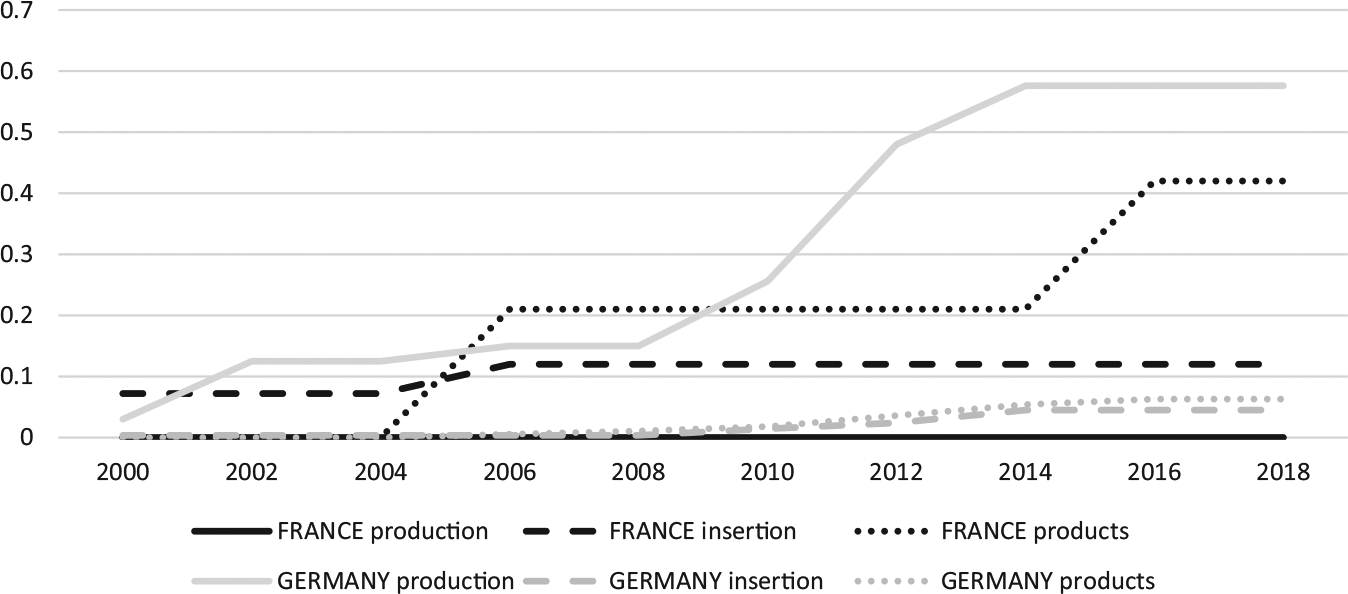
Social Objectives in Different Sub-Regimes of Public Procurement (2000–2018)
The index clearly shows that, during the period under investigation, both countries have increased their social objectives in public procurement regulation over time. In Germany, the index highlights a pronounced focus on production standards (solid line). Here, regulation of remuneration is the most important standard. Many federal states require firms to remunerate in accordance with collective agreements, for example, when employing workers on public construction sites. More recently, minimum wages have replaced collective agreements as the primary reference point in a number of federal states. This is related to legal uncertainty due to discrepancies in EU and national legislation and related case law of the European Court of Justice (Rüffert C-346/06 and PostRegio C-115/14) (Hartlapp and Hofmann 2020). Increased scores since 2010 can be attributed to newly introduced standards on gender equality. The two sub-regimes of insertion (dashed line) and social production (dotted line) have both become part of public procurement more recently and thus remain weaker. The insertion sub-regime is focused on apprentices, and standards can be identified early on; however, their scope is limited to four federal states. Integration of disabled people into the labor market is a measure pursued by only two federal states. Production standards are also limited in their potential scope, but the number of federal states in which purchased products should obey ILO core labor standards has grown to eleven over the last decade. In both sub-regimes, lower scores on the index can be attributed to the enforcement dimension, as standards here remain nonbinding.
For France, the index highlights that public procurement turned “social” later than in Germany and remains more contained overall. Here, groups disadvantaged in the labor market (dashed line) and products (dotted line) are the most important areas of regulation that render public procurement social. The insertion regime comprises standards that aim at the integration of unemployed and disabled people into the labor market. For the unemployed, measures typically take the form of administrative decrees and swing in accordance with the economic situation. Yet they are formulated and enforced rather ambiguously. The disabled are a second group of people that gain enhanced access to the labor market via public procurement regulations. This standard is responsible for the rise in the score in 2006. At this point, enforcement turned much more stringent via set-asides for sheltered work centers and incentives to award contracts to firms employing a majority of disabled people. Scores also rose in 2006 for the product sub-regime, because public infrastructure is now required to be barrier-free on a conditionally binding basis (“chaque fois que possible”). The product sub-regime was further strengthened in 2014 by the introduction of new standards on sustainability of public goods and services. Strikingly, production standards that target working conditions of those employed in public works or in the provision of public goods play no role at all.
Comparing developments between countries, the index clearly shows a greater strength of social objectives in Germany than in France. More importantly, it brings out differences in sub-regimes. For Germany, the index highlights a strong focus on individual social rights to strengthen the weaker party in an employment relationship. In France, the regulation of the economy seems to be geared toward social solidarity and equity over individual social rights. This difference brings out specific national patterns in how markets regulate for social objectives. Another clear merit of the index is that it captures variation across the three dimensions of regulation and makes this variation comparable across countries. In Germany, changes in the number of federal states applying a standard account for much of the dynamism via the potential impact dimension. Lower scores in France are by and large due to many nonbinding standards and thus are influenced more strongly by the enforcement dimension. Such explanations for country-specific dynamics would have remained obscured in a more classical assessment of law that considers substance of standards independent of their scope or enforcement. In sum, applying the index to public procurement regulation shows how the index can capture variation across sub-regimes and across the three dimensions of regulation, as well as how it makes this variation comparable between countries.
Summary and Outlook
Where freer markets come with more rules, questions arise around whether and how such rules can render markets more social. Therefore, this article has asked how to best assess regulation for social purposes in the economy. Scholarship on economic regulation has considered social objectives at a general level. By drawing on conceptualizations of social objectives in the welfare state literature, this article identified two broad sets of social goals: individual rights that aim to strengthen the weaker party in a market relationship, and objectives of distributional justice, social solidarity, and equity that fill the notion of a public interest with specific meaning. I then used these objectives to identify and measure the strength of social objectives through a three-dimensional index. The index covers a larger proportion of the policy-cycle than regulatory output only and goes beyond a formal view to include potential impact and enforcement.
The illustration of the use of the index for public procurement regulation in France and Germany shows an overall increase in the strength of social objectives which, in turn, point toward a growing potential for public procurement to achieve wider societal benefits. The index has also brought to the fore that in the regulation of the economy, France and Germany prioritize different social objectives. While regulation in Germany is particularly strong with relation to individual social rights that support employers who find themselves as the weaker party in a market relationship, French regulation is oriented toward collective goals of social solidarity and equality in markets. Other differences between the two countries exist: for many of the standards, potential impact in Germany is limited by unequal application across federal states. In France, enforcement is hindered by nonbinding standards. These regulatory output patterns are specific to the cases at hand. Yet they demonstrate that differences in social regulation can be measured and compared in a meaningful way within and across countries. We, therefore, suggest applying the index to a wider range of topics in future research, for example, financial services, housing, tax, or energy policy. This would bring out systematic differences in how countries regulate the economy for social goals by measuring the strength and type of social objectives they seek. In turn, by including the three dimensions, we can identify trade-offs among standards, potential impact for different groups of people in a market, and enforcement across the policy cycle.
While this article is exploratory in nature, the findings contribute to wider debates on the RWS. Comparing regulatory scores in France and Germany provides us with preliminary insights into the link between social regulation of the economy and welfare state development. Patterns in the sub-regimes suggest that this relationship is country specific. In Germany, it is best described as complementary. In all three sub-regimes, procurement regulation reflects existing welfare state standards. This is most evident with respect to wage clauses, whereby public procurement ensures that collective agreements are followed under public contracts. Similarly, gender equality regulation in production and insertion regulation for apprentices refer to welfare state regulation. Meanwhile in France, the relationship seems to be compensatory. A guaranteed legal minimum wage (SMIC - salaire minimum interprofessionnel de croissance since 1946) renders wage clauses in procurement superfluous. Similarly, women are not explicitly featured among groups covered in the insertion sub-regime, as the Code du Travail specifies far-reaching equal treatment standards that apply to public contracts. Certainly, this argument needs more empirical support and theoretical development.
And yet the stylized comparison suggests that RWS and the regulation of social objectives in the economy are not fully independent from one another. Consequently, future analyses interested in causal explanations of RWS beyond social policy should not confine themselves to theories of economic regulation. Rather, they would benefit from drawing more explicitly on the complex explanations offered in the welfare state literature. Here, the index could help to identify sub-regimes and periods that lend themselves to the study of causal relationships through in-depth analysis.
Footnotes
Acknowledgements
I wish to thank all participants for the discussion, Konstantin Schönfelder and Léonore Stangherlin for valuable research assistance, and the two anonymous reviewers as well as the editors of this special issue for their excellent comments.
An earlier version of this article was presented at the workshop “Regulation & Welfare” at Jerusalem University, May 2019.
Notes
Miriam Hartlapp is a professor of comparative politics (Germany and France) at the Freie Universität Berlin. She teaches and researches European integration and comparative politics, in particular questions of power, contestation, and conflict in the EU Multilevel System; the intersection of economic and social integration; as well as implementation and compliance.