



Abstract
This study examines to what extent extrinsic and intrinsic work values are associated with nonelectoral political participation, such as signing a petition and taking part in a public demonstration. We examine whether individualism and economic factors at the country level moderate the relation between work values and political participation. Using data from two rounds of the European Social Survey covering thirty-one countries (N = 55,927), results show that people who are extrinsically motivated are less politically active, while people who are intrinsically motivated are more politically active. Comparatively low national wealth weakens these relations. Findings also reveal that people who highly value extrinsic job rewards are even less politically active in individualist countries, whereas people who highly value intrinsic job aspects are more politically engaged in those countries. Overall, this study adds to understanding who is politically active and under which conditions.
Contemporary societies face major challenges, such as aging populations, mass migration, climate change, and severe economic crises. Governments and politicians are expected to deal with such problems, thereby acquiring legitimation for their role in democratic political systems (Dahl 1971). Citizens may express dissatisfaction with how governments deal with major social problems through conventional or electoral political participation. Radical ideologies and parties have, for instance, gained support in many countries (Rooduijn et al. 2017; Visser et al. 2014). Citizens may also consider unconventional or nonelectoral ways to take political action. One can think of joining the Occupy movement, signing a petition against the bio-industry, or taking part in mass demonstrations against global warming. These kinds of political protest are often viewed as a reaction to the (perceived) inaction or inadequate response of governments (Barnes and Kaase 1979). Connecting citizens to the state by political participation and civic involvement, however, is considered crucial for a vibrant and well-functioning democracy (Putnam 1993). As Van Deth (2014, 350) puts it, “participation is the elixir of life for democracy.”
In this contribution, we examine citizens’ nonelectoral political participation and its relation to work values. Specifically, we are interested in the associations between extrinsic work values (e.g., valuing job security or a high income) and intrinsic work values (e.g., valuing a job that enables the use of own initiative) and political participation. Prior studies on the influence of work values predominantly focused on consequences for work-related outcomes, such as job aspirations (Gallie, Felstead, and Green 2012), job mobility (Gesthuizen and Dagevos 2008), and job satisfaction (Kalleberg 1977). At the same time, previous studies on political participation have not considered work values as a predictor (e.g., Brady, Verba, and Schlozman 1995; Dalton 2008; Linssen et al. 2014; Norris, Walgrave, and Van Aelst 2005; Van Aelst and Walgrave 2001; Verba, Nie, and Kim 1977). We argue that people’s work values reflect socialization processes and outcomes related to working under specific conditions (see also the contribution by Gallie, this volume). Looking at features of a person’s job or work place to explain involvement in nonelectoral political action may thus add to our understanding of the complex interplay between motives and resources that are decisive for who becomes politically engaged. Moreover, the work domain seems especially important as jobs and work contracts are increasingly precarious as a result of globalization and labor market flexibilization, which are guided by political processes (Kalleberg 2009). This could be conducive to people taking political action. Empirical evidence suggests that workplaces act as “pools” rather than “schools” of democracy (Ayala 2000; Van der Meer and Van Ingen 2009), yet work values have not been closely scrutinized.
The relation between work values and political participation has also not been examined comparatively. To deal with the variety in economic and political constellations in which work values could be relevant for people’s political participation, we propose a cross-national approach. More specifically, we expect that cultural (i.e., individualism) and structural country characteristics (i.e., wealth, unemployment, and income inequality) may strengthen or weaken the relation between work values and political participation. Hence, we formulate the following research questions: (1) to what extent are people’s extrinsic and intrinsic work values associated with nonelectoral political participation, and (2) to what extent are these relations moderated by a country’s level of individualism and by macroeconomic conditions? We employ data from two rounds of the European Social Survey (ESS), gathered in 2004 and 2010. The ESS is a high-quality survey that is particularly suitable for the purpose of our study, because it includes valid measurements of both work values and nonelectoral political participation. By this, we mean that the sample size is large and covers a broad and diverse population within countries, and the survey questions have been tested in a way that ensures they actually measure what they intend to measure. To answer our research questions, we conduct multilevel regression analysis on a sample of more than 55,000 individuals across thirty-one countries.
Theoretical Framework and Hypotheses
Much research has been done on unconventional political participation (Inglehart 1997; Norris 2002; Opp 2009; Theocharis and Van Deth 2017). We will not discuss all possible theoretical explanations for individual differences in nonelectoral participation but focus on the unique contribution of people’s work values and rigorously control for confounding explanations in our analysis. Furthermore, we theoretically elaborate on factors at the country level that possibly moderate the relation between work values and political participation.
Work values and political participation
People’s sociopolitical ideologies and values seem more important than self-interest in determining whether they are politically active (Inglehart 1997). Researchers generally acknowledge that such values are the result of socialization processes (Grusec and Hastings 2014). People’s work values are established along the life course, and several socializing agents play a role in this process (Gallie 2007; Kalleberg and Marsden 2013). First, growing up with higher-educated and well-to-do parents likely nurtures values of autonomy and self-expression (primary socialization). Second, a person’s own schooling (secondary socialization) supports the development of more liberal work attitudes (Hyman and Wright 1979). Most importantly for this study, we expect work place characteristics to affect the way people feel about their work. The work domain can thus also be seen as a socializing agent through which people internalize work values (e.g., Gallie, this volume). Thus, one could say, this tertiary socialization process contributes to the formation of political opinions, which in turn may affect political participation. This seems especially relevant because the work domain is important in politics—wage systems, company regulations, and labor market laws are directly affected by political decision-making.
In general, involvement in associations is theoretically thought of as training for democracy (Van der Meer and Van Ingen 2009). Being active in nonpolitical organizations would have a positive effect on political participation as people obtain the civic skills, mindset, and social network needed to participate politically. These capabilities and competencies can be directly acquired in the workplace and transferred to the political domain (Brady, Verba, and Schlozman 1995; Schur 2003). This spillover hypothesis assumes that work offers opportunities to learn how to participate in politics and to develop an ideological position that is required for political participation (Sobel 1993). However, Ayala (2000) demonstrated that civic skills learned in voluntary, nonpolitical associations are more decisive for a person’s level of political participation than skills learned in involuntary or at least less voluntary settings such as that of the workplace. What is more, studies thereafter have shown that the commonly found relation between active involvement in voluntary associations and political participation is likely due to a selection effect instead of a socialization effect, implying that individual resources and personality traits stimulate both civic and political engagement (Van der Meer and Van Ingen 2009; Van Ingen and Van der Meer 2016).
Although the supposed participation-enhancing effect of the workplace has been examined, we know of no studies that have looked specifically at work values. Two distinct but related dimensions are often distinguished regarding attitudes toward work. Extrinsic work values are largely driven by monetary incentives, such as a high income, bonuses, or fringe benefits. Jobs are thus mostly valued for their material rewards (Gallie 2007). Intrinsic work values stress the importance of job autonomy and personal development (Ester, Braun, and Vinken 2006). It then seems most important for people to make use of their talents and capabilities (Gallie 2007). It is important to acknowledge that nonelectoral political participation, such as taking part in demonstrations or working in a political party or action group, is occasionally considered as individualized collective action or responsibility-taking (Stolle and Micheletti 2013). We expect that people who put more emphasis on intrinsic work values and who highly value a job that enables them to take initiative would be more prone to take political action as a way to contribute to the common good. People who subscribe more to extrinsic work values and appreciate monetary benefits would be considered more self-centered and therefore less prone to collective action. People with high extrinsic work values may also refrain from taking political action because they are afraid of losing their job when they do so or because they might fear their employer’s reaction if it becomes known that they are politically engaged. The fear of losing material job rewards thus hampers political participation, particularly among extrinsically motivated people. This leads to the following individual-level hypotheses: (H1) The higher people value extrinsic job rewards, the less they participate in nonelectoral political activities; and (H2) The higher people value intrinsic job rewards, the more they participate in nonelectoral political activities. To test these hypotheses, we rigorously control for individual characteristics and resources, human values, political interest, and social origin with the aim of ruling out selection effects.
The role of individualism and macroeconomic conditions
Next to individual-level expectations, we argue that both cultural and structural country characteristics may influence the association between work values and political participation. Research on unconventional political participation has scarcely examined such cross-level interaction effects and did not do so for work values (Dalton, Van Sickle, and Weldon 2010; Rapp and Ackermann 2016; Welzel and Deutsch 2012). We first derive hypotheses about the moderating role of individualism.
Based on the seminal work of Inglehart (1997), we expect that people are affected by the cultural makeup of a country. Hofstede, Hofstede, and Minkov (2010) differentiate national cultures according to their collectivist and individualist nature. In collectivist countries, individuals are stimulated to regard personal goals as subordinate to collective ones. By contrast, people are less bound to collective norms in individualist countries, where they mostly take care of themselves and more often pursue their own interests. With respect to nonelectoral political participation, we expect that valuing extrinsic work rewards has stronger consequences for taking political action in more individualist countries. In such environments, less attention is paid to the creation of collective goods. As a consequence, people who mainly value extrinsic job rewards will be supported in their self-centered attitude and will refrain even more from politically participating for a greater good. People who hold intrinsic work attitudes, with generally more attention given to collective goods, might also be affected by individualism in society. In those societies, where the breeding ground for collective action is weak and opposition toward it might be stronger, it could be more difficult to organize collective action. People who highly value intrinsic job aspects are thus also expected to be less prone to take part in political activities due to the attenuating influence of individualism. We hypothesize: (H3) The more individualized a country, (a) the stronger the negative relation between extrinsic work values and participation in nonelectoral political activities and (b) the weaker the positive relation between intrinsic work values and participation in nonelectoral political activities.
We also expect structural macroeconomic conditions to affect the relation between work values and political action. Earlier studies showed that macroeconomic conditions affect support for extrinsic and intrinsic work values (Gallie 2007; Gesthuizen and Verbakel 2011). Research has also shown that people are less politically active in countries with greater income inequality (Dubrow, Slomczynski, and Tomescu-Dubrow 2008). However, comparative research that examines how the association between work values and political participation is affected by macroeconomic conditions is lacking.
Our expectation is that adverse macroeconomic circumstances stimulate people with high extrinsic work values to take part in nonelectoral political activities. Under these conditions, especially extrinsic aspects of work and acquiring a good income are threatened. For extrinsically motived citizens, poor economic circumstances might be a motive to engage in political activism to advance their point of view and to act upon labor market insecurity, which might hit them personally. As we expect to find a negative relation between extrinsic work values and political participation, this relation will likely be less negative (weaker) in countries with worse macroeconomic conditions. For people with high intrinsic work values, we predict the opposite. We expect them to be less politically active in countries that perform worse economically. In situations of economic hardship, expressing intrinsic work values will likely be less important, and simply having sufficient financial means may prevail. Even people who highly value intrinsic job rewards might be worried about losing their job and making ends meet. Therefore, they are more often forced to refrain from action to protect collective goods. This leads to our final hypotheses: (H4) The poorer the economic performance of a country, (a) the weaker the negative relation between extrinsic work values and participation in nonelectoral political activities, and (b) the weaker the positive relation between intrinsic work values and participation in nonelectoral political activities. Figure 1 graphically summarizes our theoretical and analytical framework. Dashed arrows reflect nonhypothesized effects.
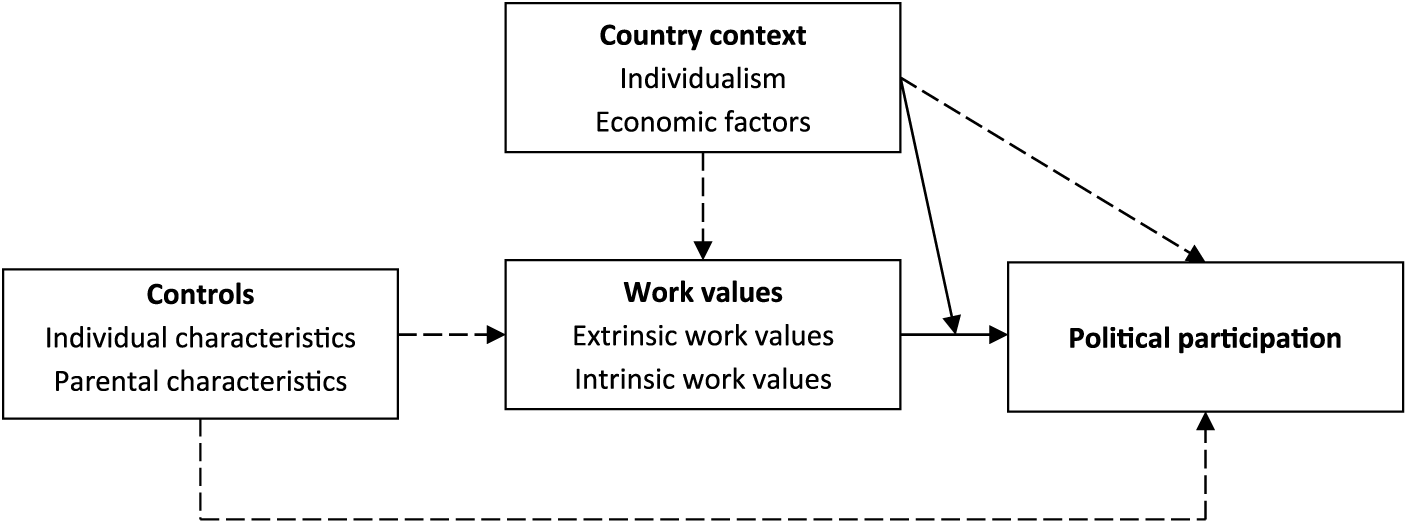
Theoretical and Analytical Framework
Methods
Data
We use data from rounds two and five of the ESS, collected in 2004 and 2010. The target population consisted of persons aged 15 and older who live in private households. Respondents are selected for face-to-face interviews based on strict random probability sampling. Response rates for round two range from 44 percent in France to 79 percent in Estonia. For round five, response rates vary between 30 percent in Germany and 77 percent in Bulgaria. 1
We pooled the data from both rounds. The initial sample was made up of 99,995 respondents. We selected adults age 18 to 64, as 65 was the state pension age in most European countries at the time. This means that we excluded retirees. The main reason for doing so is that retired people are likely a selective group with regard to work values. We also removed first-generation migrants because they are a selective group as well, especially regarding political participation. These selections reduced the sample to 61,680 respondents. 2 Finally, we removed respondents with missing values. The analytical sample comprises 55,927 individuals across thirty-one countries. 3
Nonelectoral political participation
Individual nonelectoral political participation refers to people who participate voluntarily with the objective of influencing political decisions (Van Deth 2014). Unlike for politicians, the political activities citizens undertake are not part of their job. The question was asked as follows: “There are different ways of trying to improve things in [country] or help prevent things from going wrong. During the last 12 months, have you done any of the following?” Respondents had to answer whether they (1) contacted a politician, government, or local government official; (2) worked in a political party or action group; (3) worn or displayed a campaign badge/sticker; (4) signed a petition; and (5) took part in a lawful public demonstration. 4 A confirmatory factor analysis (enforcing a single-factor structure) of the total sample of countries confirmed that these items measure one underlying construct. The factor accounts for nearly 38 percent of the total variance. Confirmatory factor analyses for each country separately also support unidimensionality with explained variances ranging from 30 percent in Finland to 47 percent in Turkey. The dependent variable is constructed by the sum score of the five dichotomous items, which is a common operationalization in the literature (e.g., Ayala 2000; Van Ingen and Van der Meer 2016). On average, respondents score 0.572 on the political participation scale, which ranges from participating in none of the activities to participating in all five. There are substantial cross-national differences. Average political participation is lowest in Hungary (0.207) and Portugal (0.220) and highest in Iceland (1.464) and Norway (1.100).
Work values
Work values are measured by the following question: “How important do you think each of the following would be if you were choosing a job?” Respondents could answer on a scale ranging from 0 (not important at all) to 4 (very important). The items “a secure job” and “a high income” were averaged to measure extrinsic work values. The Pearson correlation between both items is .465 (p < .001). Intrinsic work values are measured by a single item: “a job that enables you to use your own initiative.” The correlation between extrinsic and intrinsic work values across all countries is .244 (p < .001), which is in line with previous cross-national studies that reported a positive association (e.g., Gesthuizen and Verbakel 2011). The relation is strongest in Turkey (.589, p < .001) and weakest in Norway (.029, p = .183).
Country-level variables
We added five variables at the country level. First, we included a measure of individualism, which is one of six dimensions to compare the cultures of countries in Hofstede’s 6D model (Hofstede, Hofstede, and Minkov 2010). According to this model, individualism is the degree of interdependence among members of a society. In highly individualist countries, people predominantly look after themselves and their direct family. In contrast, in highly collectivist countries, people also take care of others. Second, we added three variables to capture macroeconomic conditions: gross domestic product (GDP) per capita, unemployment rates, and Gini coefficients. Figures on GDP were derived from the World Bank to measure the level of national wealth. We logged this variable to minimize the impact of countries with high GDP. Unemployment rates are taken from the online database of the United Nations Economic Commission for Europe (UNECE). Gini coefficients are obtained from the Standardized World Income Inequality Database (SWIID), ensuring comparability across time and space (Solt 2016). Finally, we included a control variable indicating whether a country has been known to be an authoritarian regime since 1945. 5 The highest correlation at the country level (between authoritarian regime and GDP) is –.762 (p < .001), which does not directly indicate multicollinearity.
Control variables
Based on previous research (e.g., Opp 2009; Theocharis and Van Deth 2017), we controlled for a battery of relevant variables to deal with alternative explanations of work values and political participation and to take into account compositional differences between countries. We control for an individual’s openness to change (a higher-order group of basic human values) and universalism, as developed by Schwartz (1992). We also control for the extent to which people are politically interested. Educational attainment of respondents and their parents refers to the highest level of education completed based on the International Standard Classification of Education (ISCED). For parental educational level, we also included a dummy variable for missing values. Occupational status of respondents and their parents is measured by the International Socio-Economic Index of occupational status (ISEI), which ranges from 16 to 90 (Ganzeboom, De Graaf, and Treiman 1992). We also added dummy variables for respondents who are unemployed, students, and inactive; and a dummy variable for missing values on parental occupational status. Finally, we included age, gender, marital status, and number of children living in the household. Table 1 provides descriptive statistics of all variables.
Descriptive Statistics (N1 = 55,927; N2 = 31)
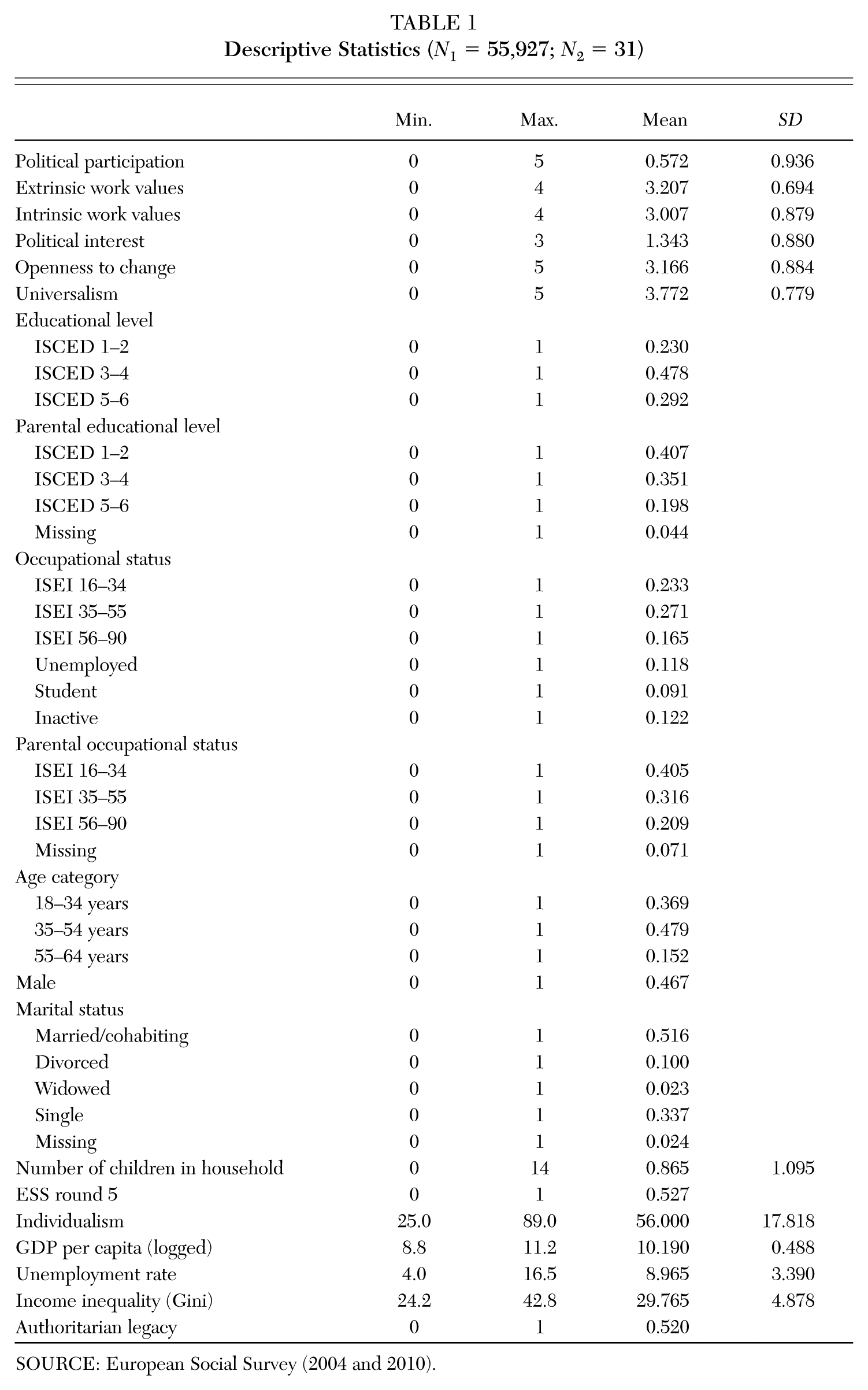
SOURCE: European Social Survey (2004 and 2010).
Analysis
We applied multilevel linear regression analysis to take into account that individuals are nested within countries. 6 We first estimated a random intercept model without covariates to calculate the intraclass correlation (M0). In the next model (M1), we added all variables in Table 1 to test H1 and H2. We also controlled for ESS round in this model and onward. In the following model (not shown), we allowed the effects of the work values to vary across countries. The random slope variance components are significant, meaning that the effects of extrinsic and intrinsic work values vary cross-nationally and that country characteristics should be able to explain this variation. To this end, we ran four models (M2–M5) that test H3 and H4. Interval variables are centered on their mean value in all models.
Results
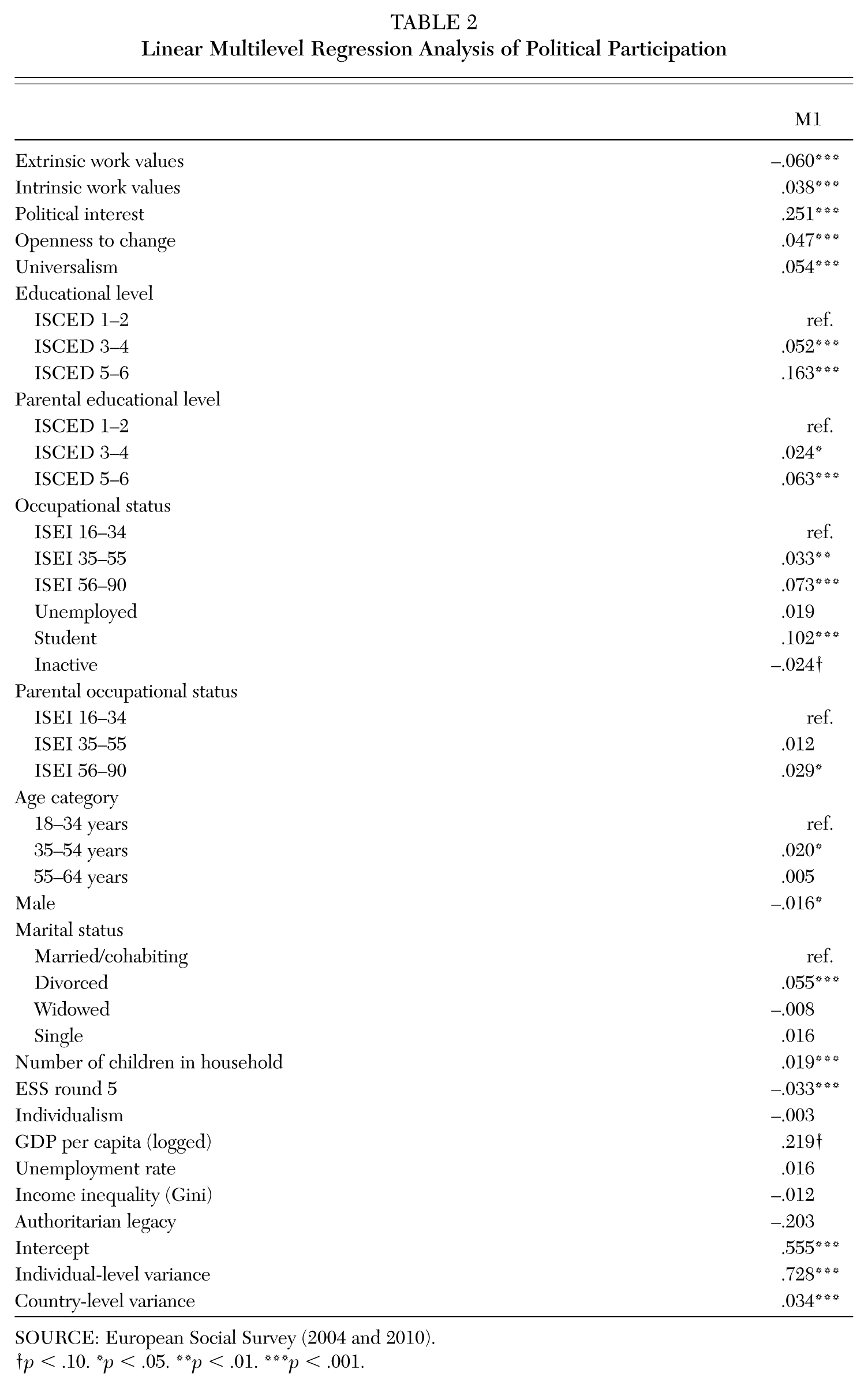
The results of the multivariate analysis are shown in Tables 2 (M1) and 3 (M2–M5) and present unstandardized coefficients. Based on the null model, the intraclass correlation is (.087/[.087 + 0.809=]) .097. This means that almost one-tenth of the total variance in political participation is situated at the country level. The country-level variance is also highly significant (p < .001), confirming that multilevel analysis is appropriate.
Linear Multilevel Regression Analysis of Political Participation
SOURCE: European Social Survey (2004 and 2010).
p < .10. *p < .05. **p < .01. ***p < .001.
Model 1 shows that extrinsic and intrinsic work values are both significantly associated with political participation, controlled for individual and country characteristics. The higher people value extrinsic job aspects, the less they participate politically. The results show the opposite for intrinsic work values. The higher people value intrinsic job aspects, the more they participate politically. We find these relations over and above the influence of a wide range of potential confounders, strengthening our confidence that we are able to avoid selection effects. If extrinsic work values increases with its range, political participation decreases by .240 (4 × –.060); and if intrinsic work values increases with its range, political participation increases by .152 (4 × .038). These findings support H1 and H2.
We briefly pay attention to the effects of the control variables. As can be seen in Table 2, people who are more interested in politics, more open to change, and more universalist in nature are more politically active. The same holds true for higher-educated people and those who have higher occupational status as they are politically more active than their counterparts. Similar effects are found for parental educational level and occupational status. We also observe that students, people aged 35 to 54 years, and divorced people exhibit more political behavior. Men take less political action than do women. At the country level, GDP per capita is positively and marginally significantly related to political participation. All in all, the variables in Model 1 account for 10 percent of the individual-level and 61 percent of the country-level variance.
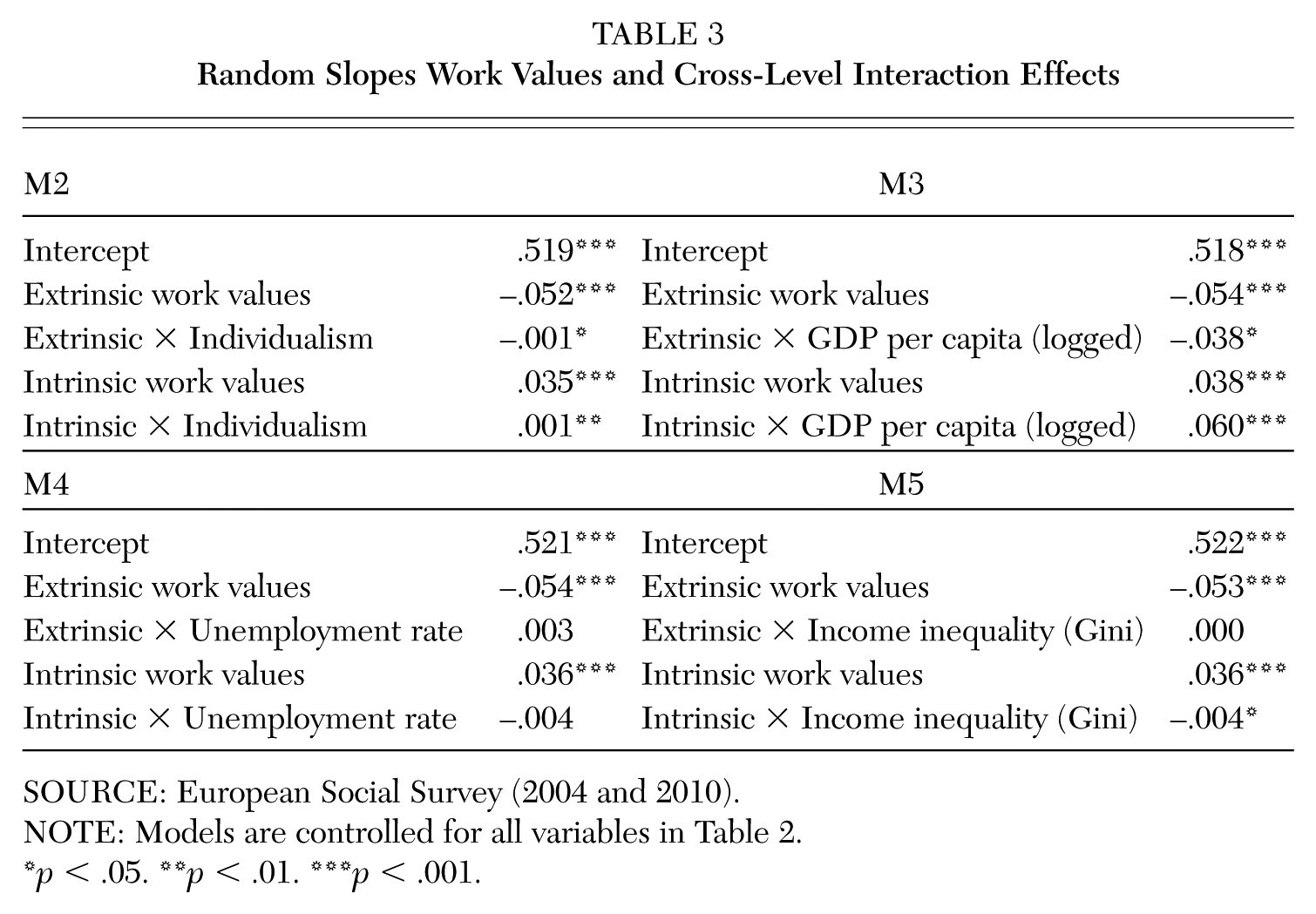
Table 3 contains the results with regard to the cross-level interactions. The main effects of extrinsic and intrinsic work values apply to countries with average levels of individualism (M2), wealth (M3), unemployment (M4), and income inequality (M5). Starting with individualism, we find support for H3a: the more individualized a country, the stronger the negative association between extrinsic work values and political participation (–.052 – .001). The positive relation between intrinsic work values and political participation also becomes stronger if individualism increases (.035 + .001), which rejects H3b.
Random Slopes Work Values and Cross-Level Interaction Effects
SOURCE: European Social Survey (2004 and 2010).
NOTE: Models are controlled for all variables in Table 2.
p < .05. **p < .01. ***p < .001.
Moving on to the macroeconomic variables, the results with regard to GDP per capita are clear and in accordance with H4a and H4b. The lower a country’s GDP per capita, the weaker the negative effect of extrinsic work values (–.054 + .038) and the weaker the positive effect of intrinsic work values on political participation (.038 – .060). Unemployment does not moderate the effects of extrinsic and intrinsic work values, which refutes H4a and H4b for this macroeconomic indicator. Last, and in support of H4b, the higher the level of income inequality, the weaker the relation between intrinsic work values and political participation (.036 – .004).
We present predicted scores on political participation across the range of extrinsic and intrinsic work values as well as the range of individualism and the macroeconomic factors in Figure 2. The figure sheds light on the strength of the cross-level interaction effects. First, note that the direct effect of GDP on political participation is visible in Figure 2 as the two lines are farthest apart, regardless of looking at the minimum or maximum scores on work values. GDP also seems to play the strongest moderating role, particularly in affecting the effect of intrinsic work values given that the lines are strongly diverging. Finally, unemployment and income inequality seem to be of the least importance, especially with regard to extrinsic work values because the lines run virtually parallel or slightly diverge.
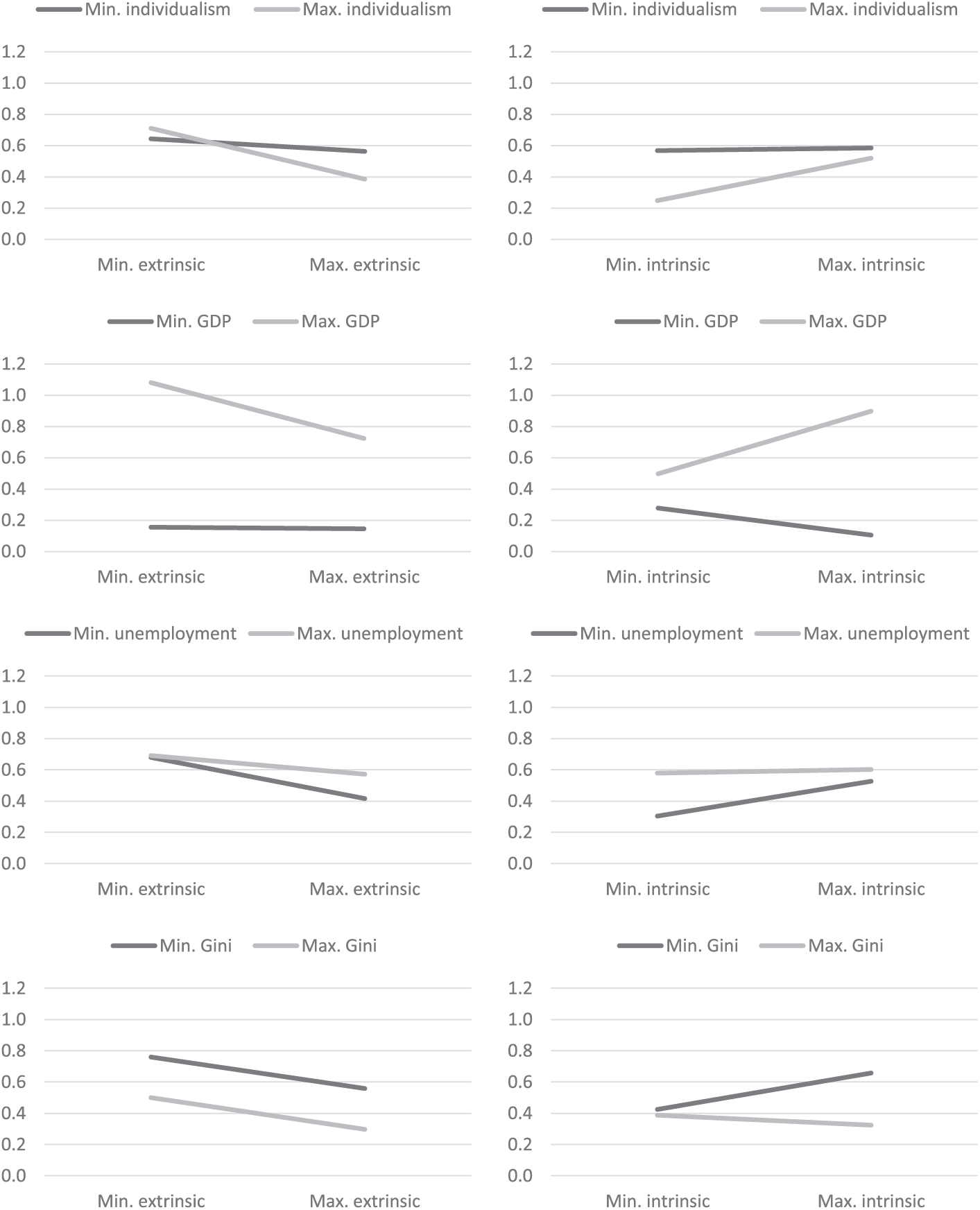
Predicted Scores on Political Participation (Y-Axis) for Minimum and Maximum Scores on Work Values (X-Axis) and Minimum and Maximum Scores on Country Characteristics
Conclusion and Discussion
Citizens exert influence over government policies by taking political action. This study assessed the relation between people’s extrinsic and intrinsic work values and their nonelectoral political participation—activities such as signing petitions, contacting a (local) government official, or taking part in a public demonstration. We took a cross-national approach and assessed whether the effects of both types of work values are moderated by cultural and structural country characteristics, using data from two rounds (2004 and 2010) of the methodologically rigorous ESS.
Starting with the first research question, the results clearly showed that people who highly value extrinsic job rewards are less prone to take part in political activities, whereas people who hold more intrinsic job attitudes are more politically active. We argued that these associations likely reflect socialization processes in the workplace that either hamper or promote one’s inclination to contribute to the common good. On one hand, individuals with extrinsic work values have been subject to socializing forces that emphasize self-interest, attach less importance to collective goals, and do not foster the development of skills useful for taking political action. On the other hand, individuals who find intrinsic aspects of work important have been socialized at work in “intrinsic” environments. Personal development, autonomy, and the common good are generally held to be important in those environments, which may subsequently translate into increasing political action. People who are intrinsically motivated may also be more motivated to use their acquired civic skills to politically participate (e.g., Schur 2003).
Our findings are inconsistent with previous studies that show that the workplace does not seem to matter as much (Ayala 2000) and that voluntary associations do not socialize people to be politically active, but bring politically active people together (Van der Meer and Van Ingen 2009; Van Ingen and Van der Meer 2016). Although these studies did not examine work values and although our cross-sectional research design cannot completely rule out selection effects, we took into account a wide range of factors that are related to both work values and political participation. By doing this, we found robust associations between work values and political activity.
Both nonelectoral political participation rates and their relation to work values differ considerably across countries, rendering our cross-national approach plausible. Building on works by Inglehart (1997) and Hofstede, Hofstede, and Minkov (2010), we expected individualist national cultures—as opposed to collectivist ones—to weaken the effect of extrinsic and intrinsic work values. Indeed, individuals primarily concerned with extrinsic work values are even less likely to take political action in individualist countries, suggesting that such a cultural makeup supports a self-centered work attitude.
Contrary to our expectations, individuals who value intrinsic job factors show more political involvement in individualist countries than in collectivist countries. This finding perhaps implies that in individualist countries the necessity to take political action is felt stronger because the breeding ground to solve collective problems is less well developed. This might stimulate individuals who recognize the greater good to achieve change through unconventional political participation.
In accordance with our expectations, findings revealed that in countries with lower GDP per capita, people who have extrinsic work values take more political action, whereas people who hold intrinsic work attitudes are politically less active. GDP was also the only economic factor that directly affected political participation rates. For extrinsically motivated people, the role of lower national wealth can be understood in terms of self-interest: (the fear of) being hit by an economic downturn might motivate them to act. For intrinsically motivated people, (the fear of) economic decline might result in a lower prioritization of taking collective action. This could be the case because poor economic performance of a country might mean that taking political action is directed at personal, material goals, coinciding less with their values and more with the values of extrinsically motivated individuals. The empirical evidence with regard to the moderating role of unemployment and income inequality was less univocal.
For our cross-national comparison, the ESS rounds of 2004 and 2010 provided high-quality and tailored data: sufficient countries, valid measures—the items pertaining to extrinsic and intrinsic work values, and their intercorrelations, nicely fit into previous work on these dimensions (Gesthuizen and Verbakel 2011; Kalleberg 1977)—and ample opportunity to control for confounding factors. This enabled us to advance current knowledge as we demonstrated the relation between work values and nonelectoral political participation, as well as the moderating role of cultural and structural characteristics of European countries. Future comparative research could benefit from multiple-item measurements of extrinsic and, in particular, intrinsic work values; and from extending the scope to other work dimensions, such as values related to workload and preferred supervision style. It would also be interesting to examine whether the politic climate of countries affects the association between work values and political participation. Finally, taking a longitudinal perspective would provide the opportunity to more adequately deal with possible selection effects and reciprocal causal relations and may get a grip on what precisely is driving the effect of work values on political participation (Van Ingen and Van der Meer 2016). For example, under which conditions do work values change from extrinsic to intrinsic and vice versa, and to what extent does that influence (un)conventional political participation?
To conclude, this study underlines the importance of collective action, as do many other studies (e.g., Putnam 2000). An intrinsic (work) motivation favors autonomy, own initiative, and personal development over material rewards; and socially flourishing (work) places over “bowling alone.” Unconventional political participation exemplifies the willingness to take action to contribute to the collective good and to invest time and effort in achieving collective gains. Our findings showed that a person’s intrinsic work motivation is strongly associated with taking collective action. What is more, people with a stronger self-centered work motivation contribute more to the collective good when cultural values and norms regard personal goals as subordinate to collective ones. Intrinsically motivated individuals also seem to feel a stronger need to take political action in individualist countries. As ever more empirical evidence underscores that cohesive and inclusive societies are better protected from collective ills (Fukuyama 1995; Putnam 2000), governments face the challenge to nourish and stimulate collective awareness and the collective good.
Footnotes
Notes
Mark Visser is an assistant professor in the Department of Sociology at Radboud University in the Netherlands. His major research interests include older workers, political sociology, social inequality, and the welfare state. He has published widely on these topics in both national and international scientific journals.
Maurice Gesthuizen is an assistant professor in the Department of Sociology at Radboud University in the Netherlands. His major research interests include educational inequality, economic vulnerability, social capital, and their interrelations. He has published widely on these subjects in international scientific journals.
Gerbert Kraaykamp is a professor of empirical sociology in the Department of Sociology at Radboud University in the Netherlands. His major research interests include educational inequality, partner effects, and health inequality. He has published widely on these subjects in international scientific journals.