




Abstract
This article investigates how France has been represented in Malian media and how major geopolitical events have driven these shifts. Using a corpus of 822 Maliweb articles published between 2017 and 2024, the study integrates topic modelling, sentiment analysis, and qualitative discourse interpretation to capture both thematic patterns and temporal dynamics. The results reveal that France's image deteriorated sharply following the collapse of pro-French authorities in 2020. Concurrently, anti-French narratives progressively seized discursive initiative, adapting their strategies to changing political and media environments, and ultimately dominated the construction of France's public image. These findings offer a more grounded understanding of how African newsrooms construct former colonial powers while highlighting African journalists’ emphasis on African agency and interests. Moreover, the study illuminates the interactive relationship between local media, grassroots activities, and state policy trajectories, demonstrating how media can both reflect and shape broader societal and political developments.
Introduction
The African continent, endowed with abundant strategic resources, favourable demographic structure, and substantial market potential has increasingly become a focal point in global geopolitics (Zabelin, 2023). As external powers such as China, the United States, and Russia deepen their economic and military engagement in Africa, the continent's geopolitical order is undergoing significant transformation, challenging the regional influence of France, a former colonial power.
In recent years, several African countries have actively adjusted their cooperation frameworks with France. At the monetary level, the Communauté Financière Africaine (CFA) franc system has been increasingly questioned. On the one hand, multiple West African Economic and Monetary Union (UEMOA) and Economic and Monetary Community of Central Africa (CEMAC) countries no longer strictly transfer 50 per cent of their foreign exchange reserves to the French Treasury, opting instead to strengthen the autonomy of their national central banks; on the other hand, the UEMOA has launched currency reforms, including the introduction of the “ECO,” aiming to reduce its linkage with French fiscal accounts and enhance monetary sovereignty (Banque de France, 2025). At the economic level, countries such as Senegal and Côte d’Ivoire have sought to deepen partnerships with emerging economies like China and Turkey. In traditional French-dominated sectors such as infrastructure and energy, French firms face increasing competition from Chinese and Turkish companies. Consequently, France's market share in sub-Saharan Africa has declined from approximately 7 per cent in 2005 to 3.2 per cent in 2023 (de Vergès, 2024), signalling a structural weakening of French economic influence in the region. At the military level, countries including Mali, Burkina Faso, and Niger have expelled French troops following political upheavals – a trend that has extended even to historically pro-French nations such as Côte d’Ivoire and Senegal. At the cultural level, although France has sought to maintain its cultural cooperation with Africa, its “attractiveness and participation” have weakened in the context of political tensions and anti-French sentiment (Limam, 2025).
These developments have led to a significant decline in France's multifaceted influence in sub-Saharan Africa, particularly in West Africa. Scholars have attributed this shift to international competition and the diminishing global influence of France. Yet, this reduction in France's influence is not merely a consequence of geopolitical and structural changes; shifts in local African media discourse – particularly the framing of national sovereignty and anti-neocolonial sentiments by African youth – have played a significant role in shaping anti-French sentiment and redefining France's regional image. For instance, Pigeaud and Sylla (2024) note that digitalisation has disrupted the monopoly of Western powers over African public discourse, enabling a new generation of African youth to express anti-French sentiment on social media platforms and generate calls for a “Second Independence.” Within local discursive frameworks, France is often depicted as an obstacle to Africa's development, particularly among younger generations who have no direct experience of colonial rule (Guiffard, 2023). Research on this trend moves beyond Eurocentric perspectives to understand Franco-African relations from African viewpoints. Yet, these studies tend to focus on macro-level politics or public narratives and rarely offer empirical validation based on systematic corpora.
Against this backdrop, this study focuses on Mali, where anti-French sentiment has been particularly pronounced and the bilateral relationship has experienced significant shifts. Drawing on news articles published on the online platform Maliweb between 2017 and 2024; the study addresses the following research questions:
To address these questions, the study employs a corpus-assisted discourse approach, integrating topic modelling, sentiment analysis, and qualitative interpretation. This approach facilitates both a macro-level examination of dominant media frames and a micro-level analysis of key events shaping France's image. Furthermore, the analysis provides insights into the broader dynamics of African media discourse and offers a framework for understanding emerging policy orientations in African states.
Literature Review
Franco–African Relations and the Idea of a “Second Independence”
Given France's colonial legacy in Africa and its close post-independence ties with numerous African leaders, Franco–African relations have long remained a central topic in African studies. In recent years, successive political turnovers across the continent have precipitated a structural transformation of this relationship. Existing explanations largely attribute France's declining influence in Africa to shifting external conditions and shortcomings in French foreign policy.
On the one hand, the ascent of China and Russia, together with strategic recalibrations by the United States and other Western allies, has intensified competition among major powers and eroded France's traditional sphere of influence. On the other hand, France's Africa policy has remained rigid and insufficiently responsive to shifting developmental priorities. Economically, the CFA franc system has long constrained African monetary autonomy and impeded diversification (Taylor, 2019). France's emphasis on protecting its own interests further diminished its appeal relative to China's investment-driven “win–win cooperation” model. Militarily, although France institutionalised its presence in Africa early on under the banners of peacekeeping and counterterrorism, its recurrent prioritisation of geopolitical considerations – often oscillating between different actors – failed to deliver meaningful regional stability (Andjembe Etnogho et al., 2022). This strategic stagnation, compounded by the arrival of Russia's Wagner Group – whose explicit focus on combating jihadist groups is coupled with access to natural resources – ultimately contributed to the wave of coups in West Africa and to the withdrawal of French troops from the region (Beloff, 2024).
Yet many analyses remain entrenched in a France-centric, policy-driven analytical framework that treats France and other external powers as the primary agents of change while casting African states as reactive, dependent actors lacking autonomous strategic intent. In reality, the current geopolitical moment is not a “second scramble for Africa” among external powers, but rather a global contest between the Global West led by United States and Europe and the Global East led by China and Russia to secure support from the Global South and thereby establish their centrality in the evolving global order (Ikenberry, 2024). Within this context, African states, as part of the Global South, have gained new opportunities to capitalise on their positional flexibility. They are no longer passive objects of external competition but increasingly assertive actors seeking to actively influence global order while securing tangible political and economic benefits (Soulé, 2020).
At the policy level, African states “do not wish to be seen as swing states” (Carbone, 2023). Rather, they are acutely aware of global divisions and deliberately exploit them to pursue genuine self-determination and material gains (Lock, 2023; Soulé, 2020). Consequently, African governments strategically engage and disengage from different external partners in ways that maximise national interests. The recalibration of relations with France represents one of the most salient manifestations of this shift. Any accurate assessment of contemporary Franco–African relations must therefore foreground the evolving interests and agency of African states.
Global South Communication Theory and the Evolution of the African Public Sphere
Global South Communication theory emerged in the post–Cold War period as international communication studies gradually moved beyond US-centrism. Drawing on postcolonial critiques, the framework foregrounds the structural asymmetries that shape global information flows. Its core propositions may be summarised in three dimensions. First, it includes a structural critique. International communication has long been shaped by a “one-way flow” in which Western actors dominate agenda-setting, interpretive frames, and normative standards, producing a concentrated and standardised global narrative order. Understanding communication in the Global South thus requires attention to structural asymmetries.
Second, it highlights agency and meaning-making. The theory emphasises that Southern actors generate autonomous interpretations through domestic media systems – including state outlets, commercial media, community platforms, and digital spaces. Communication in the Global South is not a derivative of great-power competition but a practice grounded in independent cognitive and cultural logics.
Third, it emphasises multi-centric transformation. The rise of reverse information flows and digital platforms is shifting the global communication landscape from a Western-centred hierarchy toward a multi-centred configuration. Societies in the Global South increasingly re-contextualise international issues within local epistemologies, producing new interpretive traditions.
As an integral component of the Global South, Africa's media sphere has undergone significant transformation. In the late twentieth century, US-led media assistance initiatives, together with political liberalisation, pushed African media systems toward greater openness and pluralism. While this process weakened the tight state control characteristic of the early independence era, it simultaneously accelerated the Westernisation of local media. Institutional norms, news routines, and professional training were recalibrated according to Western standards; Western outlets remained the primary information suppliers; and Western values permeated local discourse, marginalising indigenous epistemologies.
Since the early twenty-first century, the proliferation of digital technologies has catalysed a new restructuring of the African media sphere. New information platforms have enabled the entry of diverse communicative actors who increasingly challenge the binary narratives long sustained by Western media. Meanwhile, a rising consciousness among African journalists and scholars has intensified calls for media autonomy. The emergence of Ubuntu journalism, for instance, seeks to ground journalistic practice in communitarian ethics and an explicitly African epistemological standpoint. Overall, the contemporary African media landscape is best understood as a transitional field in which “Western structural dependency” coexists with a rising wave of “local autonomisation.” The evolving dynamic has important implications for how external actors, such as France are framed, contested, and reinterpreted within local discourse.
Data and Methods
Corpus Construction
This study selected Maliweb.net as the corpus source based on both the structure of Mali's information environment and the platform's intrinsic qualities. The rapid spread of internet access has reshaped Mali's media landscape: by December 2020, Mali counted approximately 12.4 million internet users, corresponding to a national penetration rate of 61.6 per cent (Konaté, 2025). In this context, digital media – comprising digital editions of newspapers, social networks, and online news sites – offer immediacy and portability that complement or surpass traditional radio, television, and print outlets, and are particularly popular among educated, urban audiences.
Among Mali's online news platforms, Maliweb holds considerable reach and visibility. Headquartered in Bamako, it is routinely ranked among the country's leading news websites (FeedSpot, 2026) and reports a Domain Authority of 59 – substantially higher than many domestic competitors, including bamada.net. Analytics from SimilarWeb indicate that Maliweb attracts roughly 17,000 unique international visitors per month, with audiences in neighbouring African countries (e.g. Senegal and Morocco) as well as in France, the United States, and Spain.
Beyond its technical advantages and high visibility, Maliweb functions as a cross-media news aggregator that routinely republishes content from major Malian newspapers – such as L’Essor, L’Indépendant, Le Républicain, and Aurore – alongside editorials, wire reports, and selected international coverage. By consolidating material produced across heterogeneous newsrooms, the platform concentrates dispersed agendas into a single, widely accessed interface. In the Malian context, where outlets vary markedly in resources, infrastructural stability, political alignment, and publication frequency, such aggregation platforms play a critical integrative role. Accordingly, while Maliweb cannot be taken as a complete mirror of Malian journalism, its dual status as a high-traffic portal and a cross-media content hub provides an analytically tractable window into how diverse Malian outlets collectively articulate France-related issues. This structural function renders Maliweb a methodologically defensible proxy for tracing broader discursive tendencies and shifts in national public debate.
Using Maliweb's site search, I extracted articles containing the keyword “France” published between 1 January 2017 and 31 December 2024. This interval – beginning with the 27th France–Africa Summit and ending with France's large-scale withdrawal from the Sahel and Chad in 2024 – permits an examination of France's image from a Malian vantage point and of the long-tail effects of successive geopolitical events. The initial query returned 2,269 articles, forming the preliminary corpus.
The retrieved texts varied substantially in length, from short dispatches to long-form analyses, which rendered simple keyword-count heuristics insufficient to determine topical relevance. I therefore adopted a keyword-density criterion, operationalised as the frequency of “France” divided by total word count per document, and set a threshold of 1 per cent to exclude items in which the keyword appeared only incidentally. After this step the corpus comprised 1,707 articles.
To reduce topical noise (notably a large share of sports and social-life reports unrelated to France's national image), I performed domain classification using a large language model. Considering pre-training scale, instruction-following performance, and long-text support, I selected the open-source Qwen2.5-7B-Instruct model (Qwen Team, 2024) and prompted it to assign each document to domain categories (politics, economy, culture, military, social events, etc.). I retained articles coded as political, economic, cultural, or military; following this filtering the corpus comprised 1,607 texts.
Because the project's analytic focus is on France's representation rather than media ecology per se, I applied sentiment labelling to concentrate on attitudinal shifts. Using the same large language model (LLM), I instructed the model to label each article's stance toward France as “positive,” “negative,” or “neutral.” To validate automated labels, a subset of articles was independently coded by French-language students; inter-coder checking indicated a high concordance between human judgments and model outputs. For the present analysis I retained only items classified as exhibiting strongly positive or strongly negative sentiment, yielding a final corpus of 822 articles.
After constructing the final dataset, I proceeded to analyse the discursive patterns within the corpus. In the next section, I apply BERTopic (Grootendorst, 2022), a transformer-based topic modelling approach, to uncover dominant themes and their evolution over time.
Copus Analysis
To identify dominant themes in Malian media discourse on France, this study employs BERTopic, which leverages contextual embeddings to capture semantic regularities more effectively than traditional approaches such as Latent Dirichlet Allocation. Given the heterogeneous nature of the corpus – which ranges from short news updates to long-form analytical commentary – I adopt sentence-transformers/all-mpnet-base-v2 (sentence-transformers 2025) to generate dense semantic representations for each article. These embeddings mitigate sparsity issues and provide a more robust foundation for subsequent dimensionality reduction and clustering in BERTopic.
Topic extraction proceeded iteratively. Parameters such as minimum topic size and clustering sensitivity were calibrated to maximise thematic coherence while preventing excessive fragmentation. Positive-sentiment texts were relatively limited and showed sufficient thematic coherence, whereas negative-sentiment texts were subjected to hierarchical clustering to refine topic boundaries and merge semantically adjacent clusters (see Figure 1 for an example of this process). Scatter-plot visualisations of document embeddings further assisted in diagnosing topic overlap and redundancy, informing subsequent adjustments and consolidations (see also Figure 2).
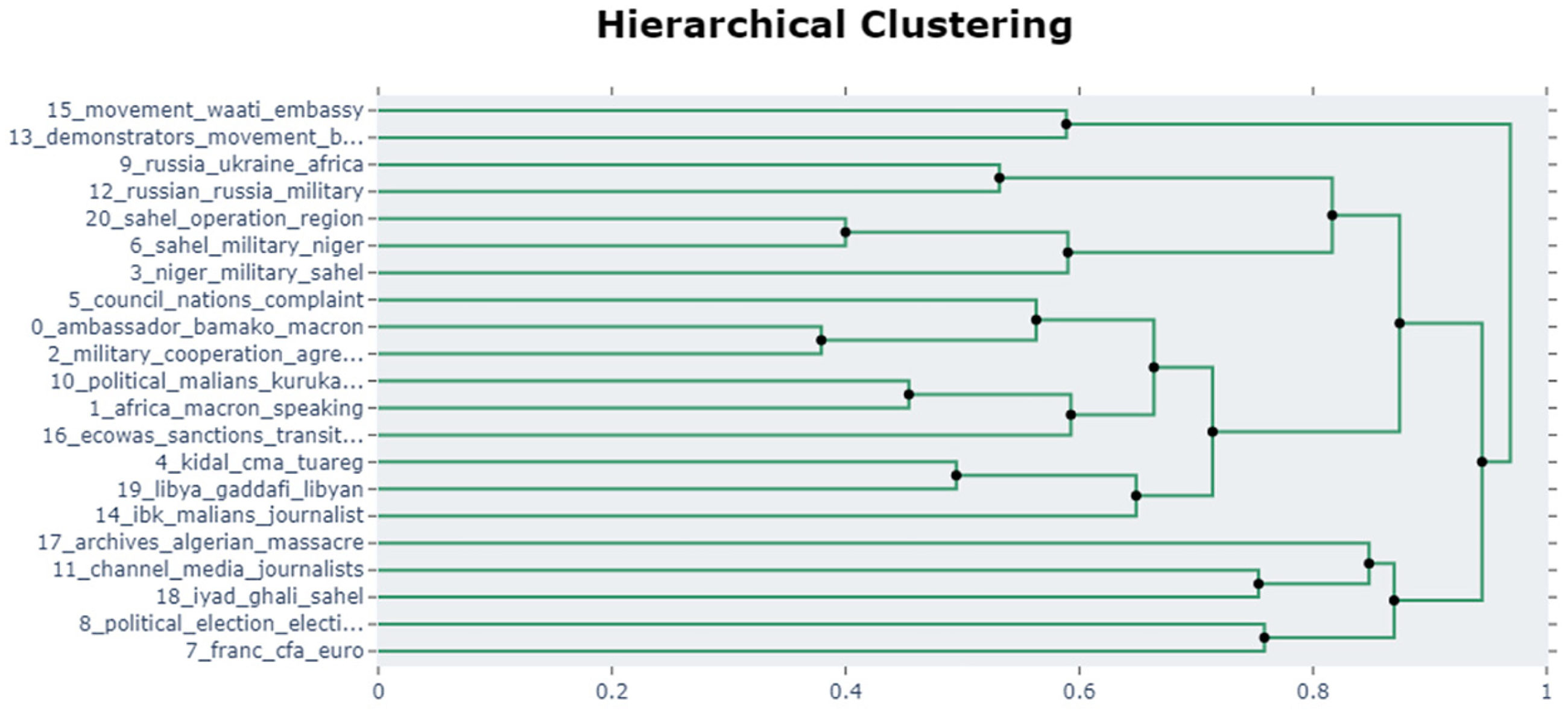
Example of Topic Clustering (Author-Generated).
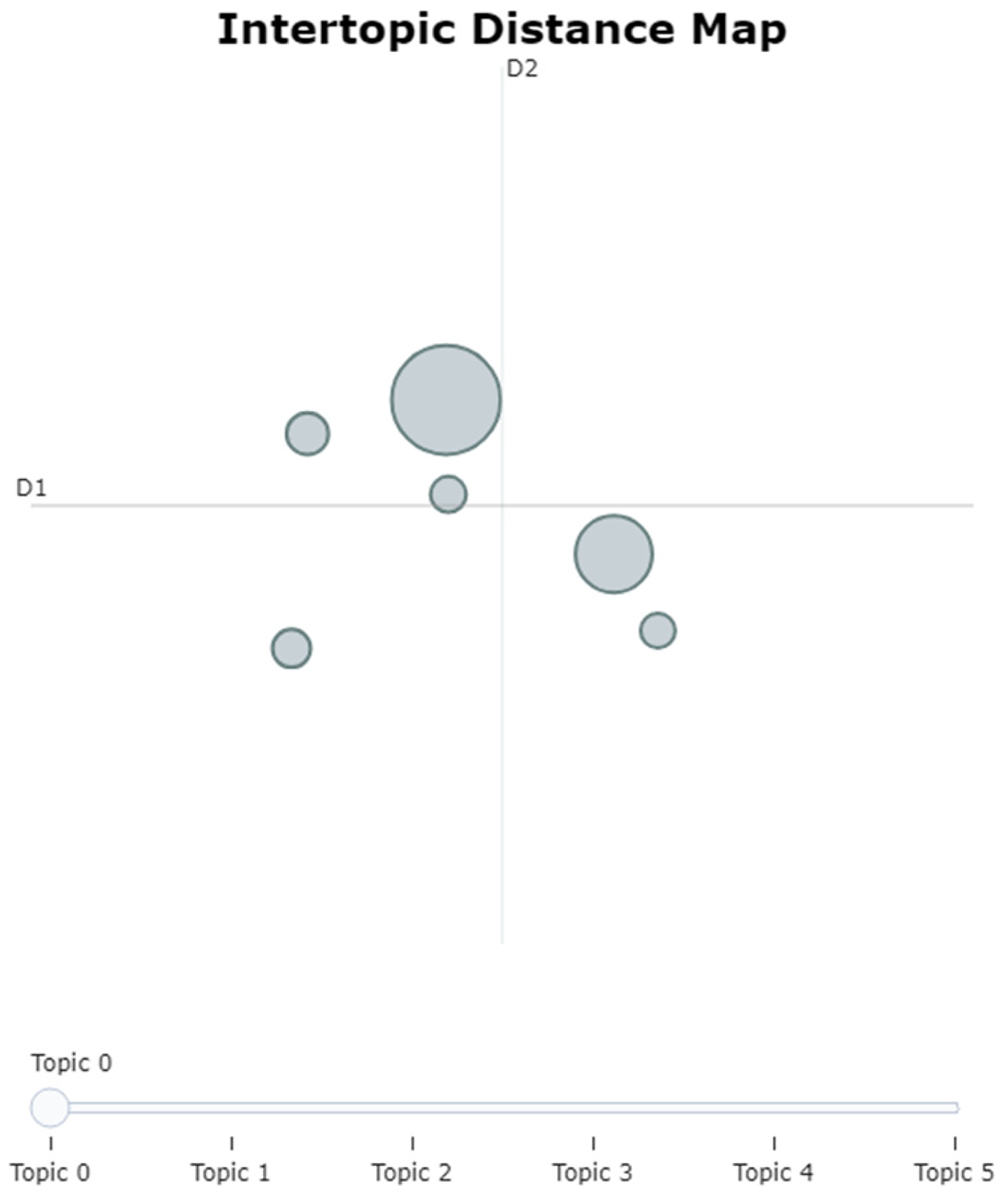
Example of Intertopic Distance Map (Author-Generated).
Beyond its function as a static clustering tool, BERTopic was used to trace the temporal evolution of themes. By segmenting the corpus into annual intervals from 2017 to 2024, the model captures how discursive emphases shift in relation to major geopolitical developments, including France's military operations, diplomatic ruptures, and eventual withdrawal from the Sahel. This diachronic modelling reveals how fluctuations in media attention and sentiment align with real-world events.
Building on these outputs, the ensuing empirical analysis reconstructs how France's representation evolved within Malian media across the eight-year period. Rather than treating extracted topics as isolated thematic clusters, the analysis integrates them into a longitudinal narrative that identifies critical junctures where discursive shifts coincide with major political or security events. Through this linkage of thematic dynamics and geopolitical triggers, the study illuminates the reciprocal constitution of real-world developments and media representations, offering a grounded account of how France's status is constructed, contested, and transformed within the Malian public sphere.
Results
After constructing the text corpus, an initial analysis of news articles related to France on the Maliweb platform reveals the evolving media representation of France in Malian discourse.
First, Maliweb has maintained a consistent level of attention to France-related topics over time, regardless of whether Franco-Malian relations were improving or deteriorating. The number of neutral reports has remained relatively stable, ranging between 60 and 100 articles per year. Negative coverage, however, has consistently dominated and shown a clear upward trend. Except for 2020, the number of negative articles surpassed that of both positive and neutral articles. In terms of annual proportions, negative reports accounted for 35.4 per cent in 2017, surged to 64.2 per cent in 2022, and remained high at 49.5 per cent in 2024, indicating a significant shift toward a predominantly negative portrayal of France. Positive coverage, by contrast, declined sharply: from 103 reports in 2017 to only 5 in 2022 and 14 in 2024, a decrease of 86.4 per cent. The proportion of positive articles plummeted from 33.4 per cent in 2017 to 1.9 per cent in 2022, reflecting the near disappearance of France's favourable image. Overall, France's media representation has shifted from a contested and neutral stance to a distinctly negative one, with 2017 and 2022 serving as key turning points (see Figure 3).
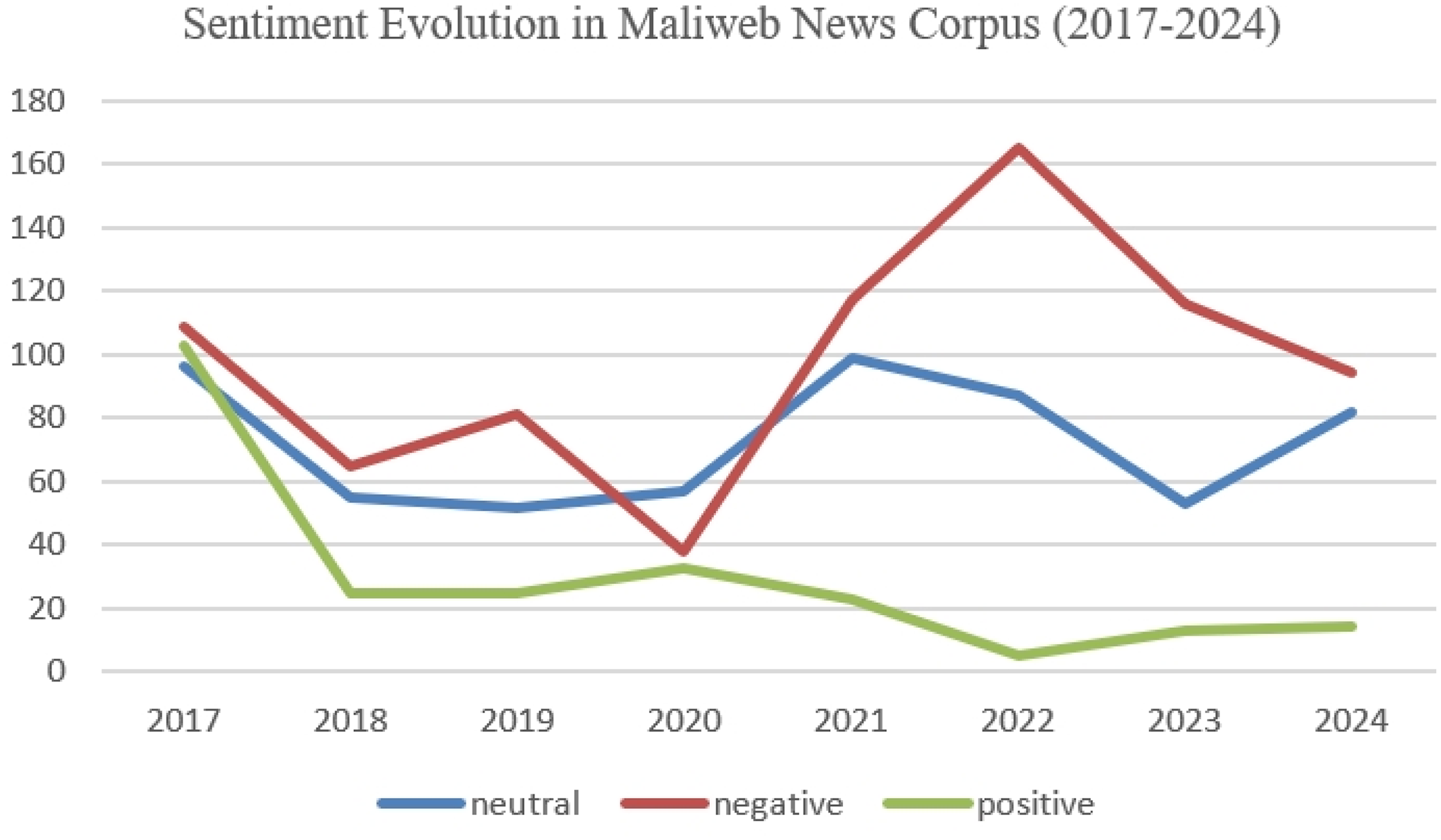
Sentiment Evolution in Maliweb News Corpus (2017–2024).
Through BERTopic modelling, positive sentiment articles were categorised into three thematic clusters: Franco-African diplomatic relations (149 articles), French aid projects in Mali (46 articles), and Franco-African economic and investment cooperation (11 articles). These themes are summarised in Figure 4, which displays the top keywords associated with each topic. For instance, Topic 0 is characterised by terms such as summit, Africa, Sahel, and Macron, reflecting a focus on high-level diplomatic engagement.

Topic Modelling Results (Positive Texts).
The dynamic evolution of these topics over time is illustrated in Figure 5, showing that positive coverage peaked in 2017, coinciding with the 27th France-Africa Summit, but steadily declined thereafter, with fewer than 20 articles per year in recent years. Reports on French aid projects ceased entirely after Mali's 2021 coup, and coverage of economic cooperation remained limited.
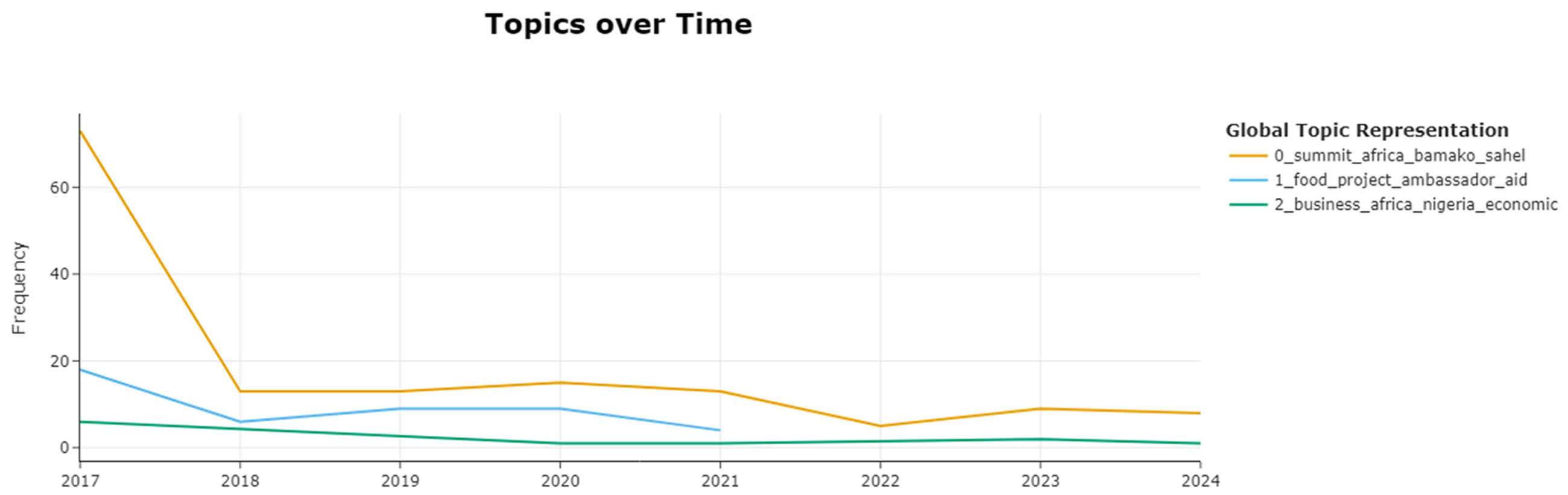
Temporal Evolution of Topics (Positive Texts).
Conversely, the large volume of negative sentiment articles allowed for the identification of 18 subtopics, which were consolidated into six core themes: Criticism of France's Africa policy (277 articles), France's counterterrorism operations in the Sahel (138), Criticism of the CFA monetary system (41), Franco-Russian military competition (34), Anti-French movements in Mali (30), and Historical memory and colonial legacy (28). These themes are summarised in Figure 6, with the top keywords associated with each topic.
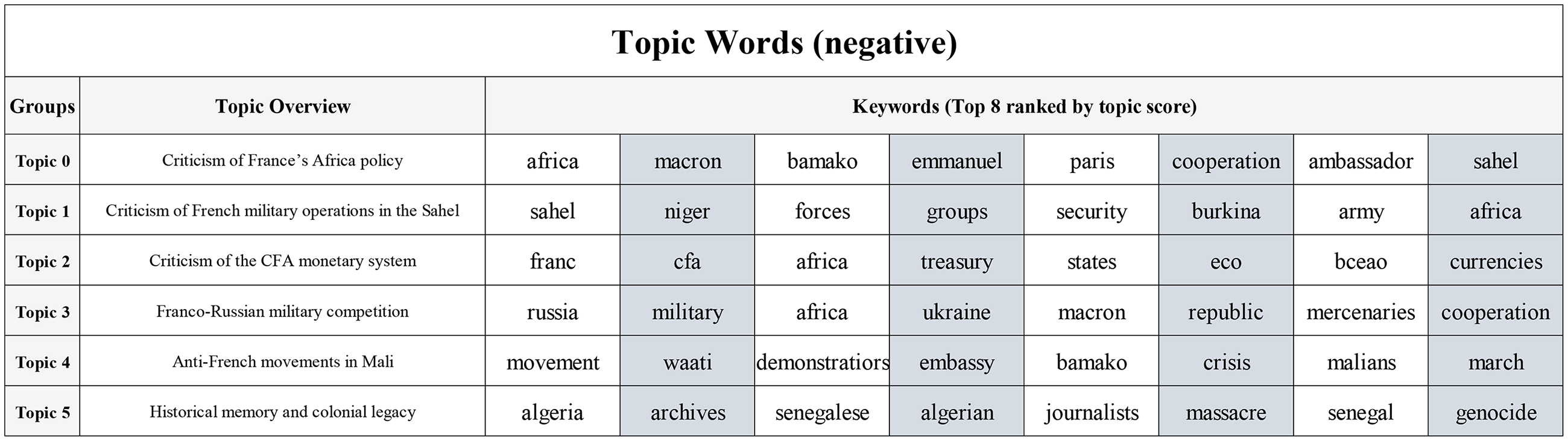
Topic Modelling Results (Negative Texts).
Criticism of France's Africa policy remained highly discussed, peaking in 2022 with nearly 100 reports analysing France's strategic approach toward Africa. Discussions on regional counterterrorism persisted over the years, surging notably after the withdrawal of French troops at the request of multiple African governments. Discourse on Franco-Russian military competition increased in 2021, emphasising the influence of Mali's policy reorientation on Franco-Russian relations. Historical memory and colonial legacy gained traction since 2021, maintaining a steady volume of nearly ten articles per year (see Figure 7 for the full trend over time).
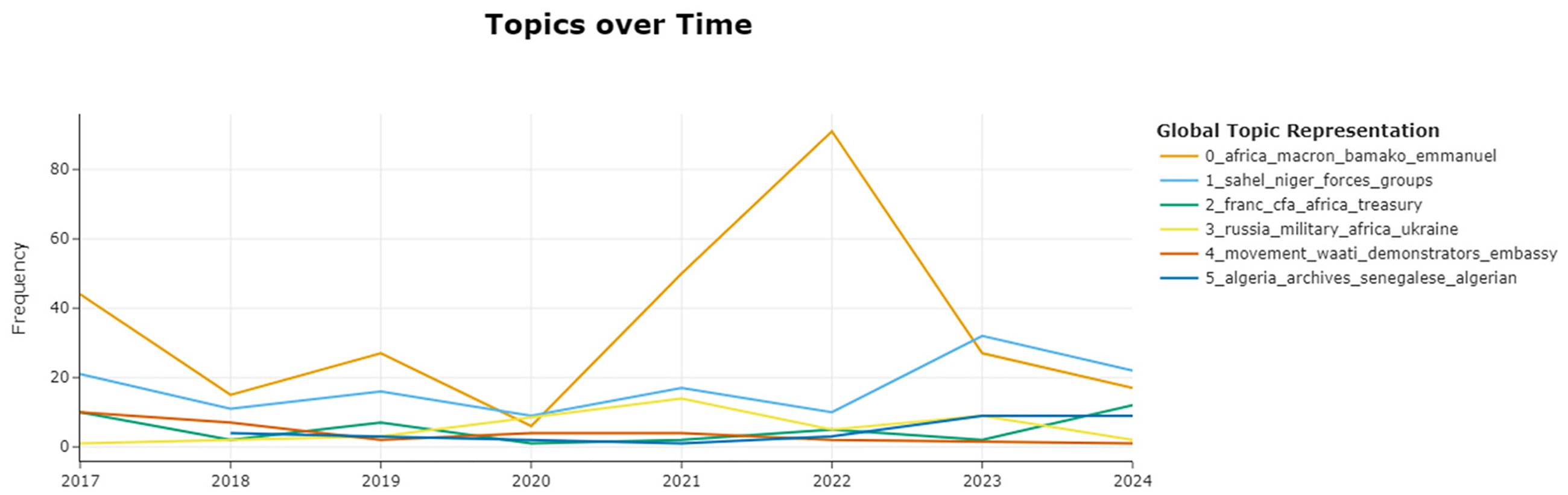
Temporal Evolution of Topics (Negative Texts).
It is also worth noting the relative distribution of themes (see Figure 8), which reveals that criticism of France's Africa policy accounted for 51 per cent of all negative-sentiment articles, making it the dominant narrative. This was followed by criticism of French military operations in the Sahel (25 per cent), underscoring the centrality of security and sovereignty concerns in public discourse.
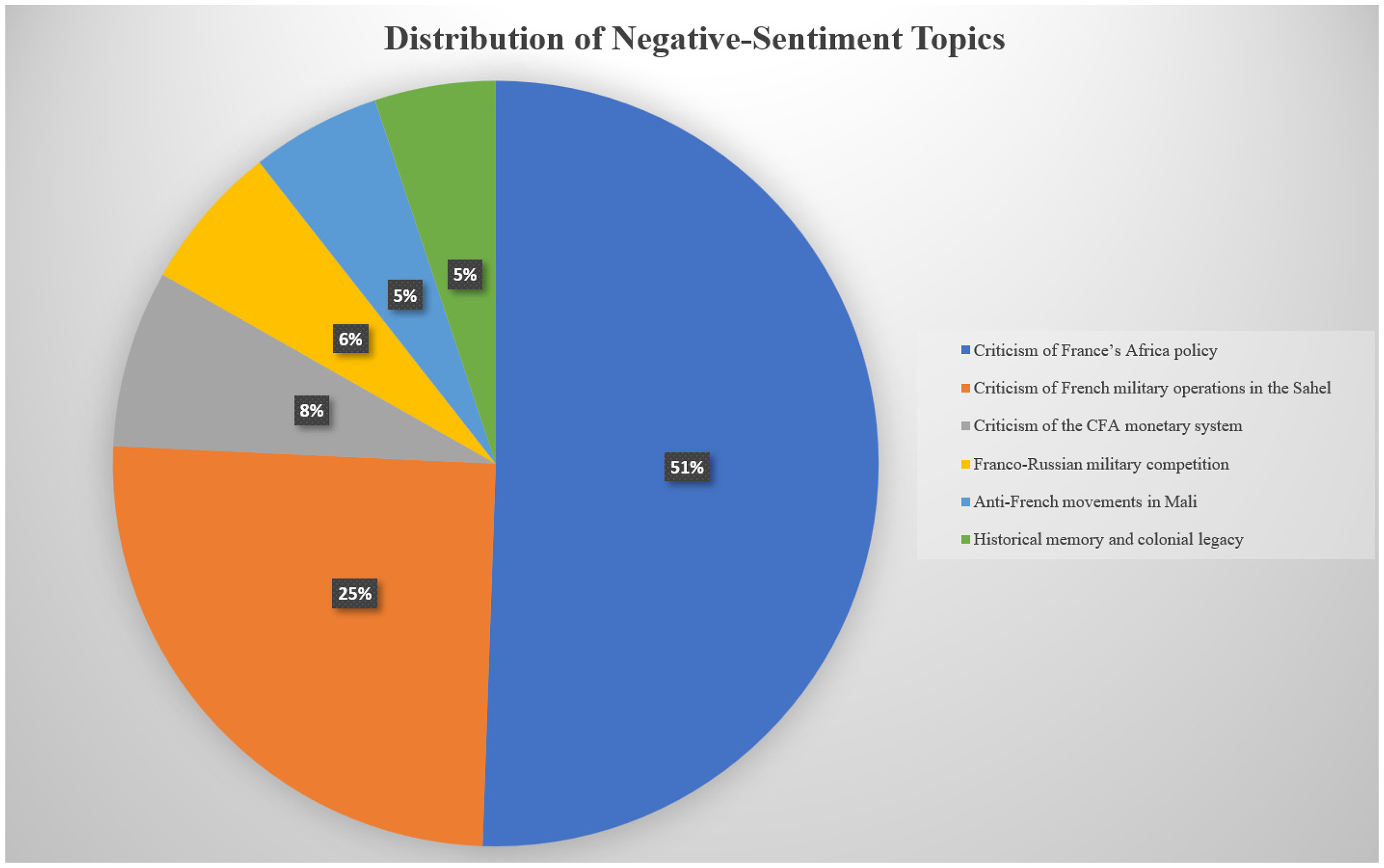
Distribution of Topics (Negative Texts).
The corpus exhibits several notable characteristics. First, France-related reporting on Maliweb shows clear temporal clustering, with peaks and declines closely aligned with major domestic and regional developments. Periods of heightened positive or negative coverage occur in concentrated bursts rather than gradually, indicating an event-sensitive pattern of agenda formation. This temporal variability provides an empirical basis for the subsequent Findings section, which will examine how specific political, security, and diplomatic events intersect with shifts in France's media image over time.
Second, negative coverage displays both a strong regional orientation and considerable thematic diversity. Across most negative clusters, the top-ranked keywords consistently include “Africa” or references to other African states, suggesting that representations of France extend beyond bilateral Franco-Malian relations. Maliweb situates France within a broader continental context, reflecting enduring Pan-African frames and the increasing salience of African agency in interpreting France's role. Negative reporting spans multiple domains, such as policy critique, monetary governance, military competition, and so on, indicating that Mali's media agenda integrates both national priorities and transnational concerns.
By contrast, positive coverage remains narrowly concentrated in three domains: diplomatic engagement, development aid, and economic cooperation. This asymmetry illustrates that negative representations involve multidimensional and cross-sectoral issue linkages, whereas positive portrayals rely on a limited set of narrative sources. Overall, these patterns demonstrate that Maliweb's agenda setting reflects a combination of domestic interests, regional perspectives, and historical legacies, collectively contributing to the multifaceted reconstruction of France's image in Malian media.
Findings
France's portrayal in Malian media evolved across three distinct phases, each shaped by shifting domestic and international contexts.
2017–2019: Competing Narratives, Fluid Image
Between 2017 and 2019, Maliweb exhibited several competing narratives. Pro-French and anti-French coverage advanced contrasting arguments, generating discursive tension between official media and civil society outlets.
In terms of content, pro-French reporting emphasised cooperation, development initiatives, and bilateral partnerships. Anti-French coverage, by contrast, highlighted neo-colonial logics, drawing attention to inequitable benefit distribution and Mali's structural dependence on France. Regarding sources, pro-French narratives relied predominantly on international outlets (e.g. La Réduction, L'Officiel), state media (L’Essor), official government statements, and international news agencies (AFP, Reuters). Anti-French coverage, however, emerged mainly from reader submissions, private correspondence, and local tabloids (Le Heron). This divergence fostered competing narratives – official versus popular – each resonating with distinct audiences.
The France-Africa Summit: Partnership or Neo-Colonialism?
The 27th France-Africa Summit (Bamako, January 2017) dominated public discourse. Pro-government media invoked the slogan “Partnership, Peace and Emergence,” portraying the summit as a declaration of national recovery, emphasising domestic unity and achievements facilitated by French support since 2013. Coverage included extensive quotations from President Hollande, reinforcing Franco-Malian friendship and France's role as a responsible partner. Un peuple qui a su surmonter ses divergences pour ne rechercher que le succès d’un évènement qui consacre le retour de notre cher pays sur la scène internationale
1
(Diamoye, 2017a). La réussite du sommet de Bamako malgré la peinture noire, […] ouvre les portes et les fenêtres de notre pays sur l’extérieur, notamment les investisseurs étrangers
2
(Diakité, 2017a). Il (Hollande) a fini par rassurer son homologue malien que son pays accompagnera le Mali jusqu’au bout : La France restera toujours au côté du Mali, jusqu’à l’aboutissement du processus de paix…
3
(Keita, 2017). En raison de l’arrêt des activités au Centre international de conférence de Bamako (CICB) pour la tenue du sommet Afrique-France […] il n’y a aucune garantie de paiement de leurs salaires pendant cette période
4
(Konaté, 2017). Le Sommet Afrique-France ou Françafrique est une sorte de Triangle infernal pour nos peuples, un réseau opaque parallèle de décisions stratégiques dont les acteurs sont d’une part les dirigeants politiques français … et les gestionnaires d’entreprises … et d’autre part les dirigeants politiques africains
5
(Koumba, 2017). C’est une autre Françafrique qu’il faut mettre en route. Une Françafrique qui respecte les africains dans leur globalité. Une Françafrique qui considère que toute vie est une vie et que toute vie est égale à une vie
6
(Studio Tamani, 2017).
IBK: Democratic President or French Proxy?
President IBK became a focal point of contestation in Malian media. Pro-government outlets emphasised his administration's legitimacy and economic-diplomatic achievements, presenting Western-style democracy as compatible with Mali and framing French policy as successful. As Mohamed Naman Keita (2017) put it, “IBK est l’élu du peuple malien, l’économie repart, et la réconciliation avec les accords d’Alger est en cours. Voilà ce qui a été fait en 4 ans,” thereby portraying the president's tenure as one of tangible progress and national unity.
Critical coverage challenged this narrative. Scholar Tiécoro Diakité argued that Western political systems in Africa risked fostering authoritarianism disguised as democracy, advocating instead for governance rooted in constitutional supremacy and military oversight – laying the ideological groundwork for subsequent military rule. Critics depicted IBK as subordinate to Paris, highlighting agreements such as the 2014 defence pact as exemplars of Franco-African elite collusion detrimental to Mali's autonomy. Quand tous les pouvoirs du régime politique sont aux mains d’une personne, on ne peut plus qualifier ce régime de démocratique…Dans un tel contexte, il est inutile de voter. La France puissance néocolonialiste se proclame démocratique
7
(Diakité, 2017b). À la faveur de cette guerre qu’on a imposée à notre peuple, le président de la République du Mali, sans consulter son peuple, a permis la signature du fameux accord de défense, en 2014. […] légitimer la présence de l’armée française sur le sol du Mali
8
(Keïta, 2019).
Economic Relations
The France-Africa Economic Forum sparked debate over whether bilateral cooperation reflected mutual benefit or primarily served French interests. Pro-French narratives emphasised shared economic goals and the potential for partnerships to foster employment and development. Critical accounts, invoking de Gaulle's dictum that “France has no friends, only interests,” highlighted the near-absence of indigenous African companies at the forum dominated by French subsidiaries. Benefits, critics argued, accrued to the heirs of colonial governance, while an unequal structure concealed France's strategy of resource exploitation. A ne citer que l’Agence française de Développement au Mali (AFD), Les coopérations culturelles, économiques et plusieurs autres partenariats entre la France et le Mali […] “La France intervient par intérêt, mais un intérêt commun au Mali et à la France”
9
(Cissé, 2019). Une représentation, aussi forte qu’elle soit du MEDEF lors de ce Sommet, n’est pas pour aider les Africains, mais c’est pour consolider et voir comment promouvoir davantage les intérêts français en Afrique. Le MEDEF ne vient pas pour développer l’Afrique, le MEDEF ne vient pas en Afrique pour défendre les intérêts des Africains. Non, le MEDEF vient parce que la France a besoin d’autres ressources pour se développer et qui ne peut se faire sans l’accompagnement du MEDEF
10
(Nimaga, 2017). La France et le Mali entretiennent des relations privilégiées et anciennes. Sur les 25 dernières années, l’aide publique au développement mobilisée par la France s’est élevée à plus de 1 130 milliards de FCFA (1,7 milliard d’euros)
11
(Le Confident, 2017). A elle seule, la France ne pourra, endosser la responsabilité de l’appauvrissement de l’Afrique, en dehors de ses propres dirigeants
12
(Haïdara, 2019).
Counter-Terrorism Operations
National security emerged as a sensitive dimension of Franco-African relations, raising questions over whether France's involvement reflected genuine commitment to African stability or pursuit of regional influence.
Pro-French narratives lauded French contributions to counter-terrorism since 2013, emphasising its role in safeguarding Mali's territorial integrity. Official media highlighted rewards for terrorist capture, underscoring Paris's commitment and operational effectiveness. La France la mène de manière claire, avec des femmes et des hommes courageux qui risquent leur vie contre ses troupes et feront tout pour les neutraliser, avec des forces G5 qui sont dans la même clarté opérationnelle et […] la même détermination de la part de toutes les puissances de la région
13
(Samaké, 2017).
France's stance toward Russian military cooperation further framed counter-terrorism as a geopolitical enterprise. Russia's involvement was seen as compromising French interests, explaining repeated obstruction of collaboration. Prolonged operations and Franco-Russian tensions led Malians to question France's intentions and seek alternative partnerships. Après avoir contribué à créer des foyers de conflits dans nombre de pays africains et permis la décadence des armées régulières au profit des rebellions […] la métropole est bien parvenue à s’arroger le rôle incontournable de « gendarme de l’Afrique »
14
(Traoré, 2017). Les derniers événements à Ménaka prouvent à suffisance la volonté manifeste de la Barkhane et la Minusma à participer activement au processus d’occupation et de partition du Mali
15
(Makadji, 2017). Certains partenaires de longue date du Mali, qui luttent aux côtés de nos militaires, risquent de faire leurs bagages, notamment la France et la Minusma. […] il sera difficile, voire impossible, une cohabitation franco-russe au Mali
16
(Doumbia, 2019).
The Northern Mali Question
Northern Mali represented the most sensitive and contested topic of Franco-Malian relations. Pro-French narratives avoided direct engagement with the region's political complexities, preferring phrases such as “reclaiming the north” or “preserving integrity.” In contrast, anti-French narratives offered multifaceted critiques, framing French operations as both historical atonement and a response to persistent separatist ambitions.
Critical coverage focused on two questions: the origins of separatist organisations and France's stance toward Kidal and the Azawad administration. France emerged as a principal destabilising actor. Northern instability was traced to French and NATO intervention in Libya; post-Gaddafi, France's failure to implement effective resettlement measures allowed armed militants to migrate southward, proliferating weapons and precipitating insecurity. As Boubacar Yalkoué (2017) starkly put it, “De la Libye avec l’assassinat de Kadhafi à la terreur que vivent les populations du nord, du Mali tout entier, le nom de la France résonne comme un refrain,” encapsulating the widespread perception of France as a continuous source of regional turmoil.
Following Operation Serval's 2013 recapture of northern territory, French forces’ ambiguous stance on sovereignty drew criticism. France reportedly restricted Malian troops from controlling Kidal and prohibited Air Force reconnaissance, demonstrating disregard for territorial authority. France also maintained ambiguity regarding the Azawad population, referring to Tuareg as “nomadic peoples of our colonies” to legitimise their presence, potentially bolstering separatist proxies controlling strategic resources such as underground oil fields. Au Mali, la réalité actuelle est très criarde, le nord du pays échappe totalement à la souveraineté nationale par l’absence de son armée et de son administration. Alors que l’armée française y règne en maître absolu
17
(Traoré, 2017). À ses dires, la France réussit dans sa politique à travers la guerre psychologique qu’elle mène en jouant avec la mauvaise volonté des autorités et avec la complicité de certains journalistes. S’agissant de la question de la Coordination des mouvements de l’Azawad (CMA), il dira qu’à la longue le terme Azawad finira par être considéré par nos enfants qui naitront comme étant un autre pays
18
(Païtao, 2019).
From 2017 to 2019, debates surrounding France intensified. While earlier controversies centred on generalised anti-colonial sentiment and unequal bilateral relations, which could be mitigated through official statements or cooperative initiatives, anti-French reporting became increasingly specific, highlighting CFA franc disputes, northern Mali conflicts, Franco-Russian competition, historical memory, and French corporate practices. This specificity escalated reputational costs and accelerated France's structural image deterioration, rendering recovery increasingly difficult.
2020–2022: Anti-French Dominance and Systematic Reframing
The period from 2020 to 2022 marked a pivotal transformation in France's image in Mali, driven by domestic political upheaval and international developments. Two successive military coups fundamentally altered Mali's policy orientation toward France. Following the August 2020 coup that forced President IBK's resignation, the transitional government under Bah N’Daw adopted a neutral, pragmatic stance. As France intensified pressure on the interim administration throughout 2021, military and political elites grew increasingly dissatisfied. The May 2021 coup establishing military junta rule completed Mali's qualitative shift toward a fully anti-French policy. The collapse of pro-French officialdom enabled grassroots anti-French sentiment to dominate France's image construction.
International events reinforced this trajectory. The U.S. withdrawal from Afghanistan in 2021 undermined Western credibility in regional security, while the 2022 Russia-Ukraine escalation intensified Franco-Russian confrontation, providing reference points that shaped Malian perceptions of France.
Mali's media landscape underwent significant transformation. Unlike the previous phase's narrative clashes over discrete events, this period saw pro-French narratives decline sharply and anti-French narratives ascend. Coverage shifted from reporting on France's actions to defining France's essence – negative identity characterisation driving public image collapse.
Pro-French articles on Maliweb dropped from 138 to 48, rarely carrying official Malian endorsement. Content, sourced predominantly from international organisations and French outlets, focused on military cooperation, monetary reform, humanitarian aid, and youth policies, presented through objective description lacking critical engagement or societal resonance. This reporting failed to generate narrative momentum counterbalancing negative sentiment. Anti-French narratives, maintaining comparable coverage, gained systemic support from official channels, constructing France's portrait through four interrelated dimensions.
The Performative Great Power
Anti-French narratives depicted France as obsessed with grandstanding, setting multiple agendas and implementing superficial policies to signal concern for African populations while lacking genuine commitment. Policies were treated as bargaining chips whenever French interests faced threats.
The October 2021 Montpellier Summit exemplified this pattern. Promoted as a direct presidential dialogue with African youth rather than government officials, it purportedly demonstrated France's generational focus. However, editorials highlighted that youth participants’ limited understanding of Franco-African security produced discussions that were simplistic and emotional, lacking substantive content. Macron's financial commitments, roughly €40 million, were dwarfed by Russia-Africa pledges exceeding $20 billion in 2019 and China-Africa investments of €60 billion in 2018. Against this backdrop of multiple nations prioritising Africa, France's comparatively modest aid contrasted sharply with high-profile propaganda.
France's celebrated monetary reforms drew particular criticism. Late 2019 announcements promised replacement of the CFA franc by the ECO currency in 2020, French withdrawal from West African Monetary Union management, and elimination of reserve requirements to the French Treasury. These measures ostensibly signalled respect for monetary autonomy and a break from colonial legacy. African elites, however, argued that the reforms perpetuated existing policy by maintaining unlimited external convertibility, enabling France to profit through adjustments to trade terms. The reforms were widely perceived as obstructing the West African common currency project.
France's aid policies reinforced this performative image. Amid escalating tensions with West African nations and Russia, France adjusted its strategy by suspending official aid to Mali, including humanitarian channels, following strained relations, and freezing assistance to the Central African Republic after labelling it a Russian accomplice. African media noted that these actions contradicted earlier cooperative rhetoric, entangled humanitarian organisations with foreign policy, disregarded African peoples’ interests, and underscored France's hypocrisy. The contrast between diplomatic rhetoric and interest-driven policy during tense periods fostered widespread scepticism regarding France's sincerity. Aid appeared motivated by ulterior purposes, with posturing prioritised over performance, creating a transferable negative label that deepened African distrust. Des applaudissements ponctuant les interventions au cours de ce Sommet laissaient apparaître un théâtre de boulevard, à la limite un opéra-comique si les chants et danses étaient au rendez-vous
19
(Kane, 2021). Sur ces quatre piliers, la réforme annoncée par Macron et Ouattara ne touche qu’un seul élément, à savoir la centralisation des réserves de change, le moins essentiel des quatre principes pour la France. Dans tous les cas, c’est un principe dont la suppression était déjà programmée et amorcée. […] Ce point de la réforme n’est donc pas un changement fondamental et inédit
20
(Bossoué, 2020).
The Hypocritical Security Partner
France long justified its African presence through security cooperation, yet Malian trust declined sharply between 2020 and 2022. Media portrayed France's engagement as profoundly duplicitous, ostensibly promoting African stability while covertly collaborating with neighbouring states and terrorist organisations to perpetuate instability and safeguard broader continental interests.
France's ambivalent stance drew central criticism. While maintaining bilateral military activity, French forces adopted ambiguous counter-terrorism approaches. They were reluctant to launch decisive offensives, claiming military solutions were insufficient, yet dismissed dialogue as unviable whenever Mali pursued negotiations with jihadist groups. This duplicity deepened Malian suspicion. When Mali sought to terminate French cooperation and engage Russia's Wagner Group, France pressured authorities to avoid Russian collaboration. After Mali declared French operations lacked legal basis, France returned through the Takuba force. Its insistence on remaining Mali's indefinite security partner while refusing to eradicate terrorist groups raised fundamental questions about its intentions.
Official characterisations of northern Mali further tarnished France's security image. Evidence suggested France established a Kidal enclave, training militants and supplying weaponry. Reassessment of trilateral cooperation with France and Algeria revealed both states actively provided terrorist sanctuary, exploiting instability for strategic gain. Unlike the previous phase's analytical debates, this period witnessed explicit denunciations of France's duplicity, a pivotal factor prompting Mali and West African nations to demand French withdrawal. Si le Mali juge que l’arrivée du groupe russe Wagner va lui permettre de renforcer la puissance et l’efficacité de ses forces contre les groupes terroristes, alors pourquoi s’en priverComment comprendre alors cet acharnement contre notre pays, […] Sommes-nous pas un État souverain qui mérite d’être compris et accompagné par la communauté internationale
21
(L’Aube, 2021). Dans un entretien qu’il nous a accordé le 17 octobre, le Premier ministre Choguel Kokalla Maïga a porté des mots accusateurs envers la France, qu’il tient pour responsable de l’instabilité dans son pays
22
(Diallo, 2021).
The Destabilising External Actor
France's interactions with Mali's transitional government provoked widespread unease. Scholars accused France of engaging in “political, media, and diplomatic terrorism,” a charge widely disseminated, gradually shaping France as a destabilising external actor.
Politically, Malian authorities reported that France refused to engage with the transitional government. Instead, it allegedly colluded with other factions seeking regime change to install pro-French proxies. On the media front, reports indicated that France frequently portrayed Malians as ungrateful, waging international media campaigns that exploited its global discourse advantage to discredit Mali's patriotic efforts and counter-terrorism initiatives. Diplomatically, France consistently opposed Mali's inclusion in international financial institution agendas and collaborated with ECOWAS to impose sanctions. Malian media interpreted these actions as deliberate attempts to destabilise the government and install a puppet regime. These manoeuvres, occurring while anti-French policies enjoyed broad support, further tarnished France's image as an external instigator of instability. This sentiment was crystallised by Prime Minister Choguel Kokalla Maïga (2022), who declared: “Et donc pour nous, il n’y a aucun doute: les décisions prises contre notre pays, ont été inspirées par un agenda extérieur aux intérêts du peuple malien, aux intérêts de l’Afrique.”
The Unwelcome Outsider
The “unwelcome outsider” image directly reflected Malian public sentiment. Media extensively covered anti-French, pro-Russian grassroots activities and highlighted youth criticisms at the France-Africa Summit. This amplification transformed scattered discontent into broad consensus, causing France's image to plummet across Mali and West Africa.
Public sentiment aligned closely with the transitional government's stance, with demonstrations advancing alongside policy shifts. Extensive coverage accelerated the collapse of France's reputation among citizens. As external discourse waned and local voices gained prominence, media outlets, which were supported by academics and political elites, assumed control over France's image construction. By late 2022, France had lost both its official foothold and public opinion standing, with negative narratives firmly dominant.
2023–2024:Consolidation and Symbolic Transcendence
France's African influence diminished further amid evolving regional and international dynamics. Following the 2021 and 2022 coups in Mali and Burkina Faso, Niger experienced a military takeover in 2023. By 2024, these nations had formed the Alliance of Sahel States. Compounding France's setbacks, longtime allies Chad and Senegal terminated defence agreements and demanded troop withdrawals, signalling not only lost Sahel footholds but also the failure of France's comprehensive West African security strategy.
Instability extended to France itself. Domestically, Macron's administration lost its parliamentary majority, complicating policy implementation and triggering frequent prime ministerial changes. Internationally, spillover from the Russia-Ukraine conflict intensified, with Europe facing energy crises, inflation, and mounting social tensions. African media absorbed and integrated these developments, amplifying France's negative image beyond Mali and projecting it as a symbolic issue transcending temporal and spatial boundaries.
As anti-French policies took root, media construction entered a phase of consolidation. Reporting volumes remained stable, but strategic shifts emerged. Pro-French narratives, recognising the dominance of negative portrayals, attempted conscious reconstruction. Following the 2024 Moscow attacks, France unusually emphasised willingness to strengthen counter-terrorism cooperation with Russia, adopting a “focus on issues, not actors” approach in response to prior criticism regarding sincerity. Pro-French coverage highlighted policy adjustments and respect for African autonomy, seeking to distance France from neo-colonial accusations through more restrained postures. Nevertheless, these narratives relied heavily on external sources. In environments dominated by anti-French sentiment, their dissemination and visibility remained limited, struggling to counter established negative frameworks.
Anti-French narratives, building upon local events, incorporated broader West African, pan-African, and global case studies to situate France within wider political arenas. These narratives extended beyond post-2012 interactions, engaging with colonial history and future trends. Through analytical frameworks that transcended time and space, they offered holistic and symbolic African perspectives on France's image.
The Neo-Colonial Power Rejected by West Africa
By examining France's interactions with West African neighbours, anti-French narratives highlighted France's persistent interference in contrast to regional autonomy trends, framing Mali's stance as representative of broader West African consensus.
Burkina Faso's suspension of RFI and France 24 received particular attention. Narratives alleged that France exploited media resources to disseminate misinformation, incite divisions, and destabilise regional governance. Some reports even claimed that France 24 colluded with North African terrorist organisations, functioning as a propaganda platform.
Niger and Chad exemplified shared regional experiences. Multiple nations redeployed security cooperation while France, seeking to preserve existing interests, allegedly resorted to ECOWAS sanctions, bombed a Chad arms depot, attempted regime change, and pursued installation of pro-French proxies.
These narratives built upon Mali's earlier anti-French discourse. By progressively externalising French intervention as a regional phenomenon, they amplified readers’ sense of shared grievance with neighbouring African nations. Simultaneously, they forged symbolic links between France and neo-colonial ambition, portraying France as a power collectively rejected by West Africa.
The Former Colonial Hegemon Burdened by Historical Debt
By invoking colonial memories and linking them to contemporary grievances, anti-French narratives cast France as a hegemonic relic perpetuating old orders. This framing transformed anti-French sentiment from a historical reckoning into sustained political demand.
Artefact plunder and repatriation struggles emerged as the most tangible and mobilisable issues. As African societies increasingly emphasised cultural identity, artefacts became pivotal symbols connecting colonial violence to national sentiment. They visualised France's historical expropriation while providing material evidence for narratives portraying France as a “robber.” This process elevated anti-French sentiment from policy critique to matters of cultural and national identity. C’est ainsi que se sont retrouvés dans les musées français des restes humains et objets culturels en provenance d’Afrique. Aucun des terroirs conquis n’a été épargné dans cette œuvre d’expropriation à grande échelle ayant vidé des sociétés entières de leur essence
23
(Anadolu Ajansi, 2023).
The Declining Power Versus Newly Independent Actors
Anti-French narratives extended beyond African regional frameworks, incorporating cross-regional comparisons and global power shifts. France was portrayed as a declining power, whereas African nations were cast as newly autonomous actors reclaiming sovereignty. This reframing redefined Franco-African relations through historical reversal.
Narratives traced Africa's independence journey and fluctuations in historical state power, emphasising fundamental shifts in the global power landscape. Africa's resources and markets were now deemed essential to France, rather than the reverse. This narrative undermined France's moral and political authority, providing historical logic and legitimacy for autonomous development and anti-French policies – key discursive resources for sustained mobilisation.
Concurrently, anti-French narratives highlighted the spillover of France's domestic political instability, noting impacts on euro exchange rates and broader European economic stability. Combined with diplomatic frictions across multiple countries, these narratives depicted France not as a strong member of the Western core but as a weak link in the old global governance order. Such framing further legitimised domestic anti-French sentiment. N’oublions pas non plus que le Mali regorge de cet or que les BRICS, et notamment la Russie, recherchent en se débarrassant de leurs dollars, ou encore que la RCA, apparemment pays parmi les plus pauvres, s’avère, en fait, un scandale géologique. […] La France est apparue, fort justement, comme le maillon faible du prétendu « Occident » dans ce conflit ukrainien. Il n’est que le lieu brûlant de cette opposition mondiale entre une organisation du passé et des pays d’avenir
24
(Reseau International, 2023).
The Unreliable Partner Beyond Redemption
France frequently emphasised its “New Africa Policy,” aiming to signal renewed engagement. However, anti-French narratives widely argued that these efforts lacked genuine structural transformation. Citing French parliamentarians and American media observers, they contended that France persisted along unilateralist trajectories with no fundamental policy logic or understanding shift. Consequently, France appeared as an outdated partner, offering empty promises and proving untrustworthy, further diminishing prospects for rebuilding cooperation. Ou alors, “Il fait un discours [en octobre 2021] qui fait croire aux jeunes qu’il va se débarrasser des dictateurs africains. Et puis il ne le fait pas. Cela affaiblit la position de la France. Et cela témoigne d’une extrême arrogance envers les chefs d’État africains”
25
(Mondafrique, 2024).
Coverage increasingly framed perspectives through comparisons with neighbouring Sahelian and West African countries rather than focusing solely on Mali's domestic issues, such as the northern conflict or military cooperation. By presenting anti-French concerns as shared experiences across the region, media reports broadened the reach of negative sentiment, fostered regional solidarity, and applied wider pressure on France.
At the same time, discourse moved beyond merely defining “what France is” to exploring “how African nations ought to act.” Reporting emphasised African agency and strategic decision-making, linking commentary to practical processes of regional autonomy. This shift elevated narratives from passive critiques of France to active social advocacy, serving local policy objectives and signalling that anti-French discourse had matured into a tool for regional political mobilisation and identity construction.
Conclusion and Discussion
This study investigates France's evolving image in Malian media through a period-based analysis of news coverage on the representative platform Maliweb, observing both the transformation of France's public image and the evolution of anti-French narratives. During 2017–2019, France's image remained relatively neutral amid competing narratives. As pro-French official discourse in Mali weakened, however, anti-French narratives gradually gained dominance, leading to a progressive deterioration of France's image. This decline extended beyond Mali, beginning to influence perceptions in other African countries.
The evolution of anti-French narratives followed a distinct trajectory through three identifiable stages. Initially, from 2017 to 2019, narratives concentrated on specific issues, emphasising “what France has done” to contest official pro-French positions. Between 2020 and 2022, narratives increasingly dominated media discourse, characterising France's identity and assigning evaluative labels that defined “what France is.” By 2023–2024, anti-French discourse transcended temporal and spatial limitations, incorporating comprehensive and localised analyses that situated Mali's experiences within broader regional and international contexts. This stage also stimulated discussions on “how Africa should respond,” reflecting a maturation of narrative strategies from issue-specific critique toward broader political and symbolic mobilisation.
These findings offer several theoretical contributions. First, they highlight the complexity of media-state relations in African contexts. Rather than passively reflecting official positions, media outlets can actively shape discursive space, particularly when popular narratives align with societal sentiment and gain official endorsement. Once such narratives acquire institutional support, they can rapidly expand influence, reconstructing interpretations of domestic and international affairs and challenging assumptions of linear state control over media in transitional political environments.
Second, the study illuminates the dynamics of counter-narrative evolution and discursive agency. The three-stage progression demonstrates how indigenous anti-French narratives seized the discursive initiative following the retreat of pro-French forces. By synthesising local perspectives for broader dissemination, Malian media provide a paradigmatic case for understanding Southern discourse evolution and propagation. The shift from issue-specific critique to identity-based characterisation to regionalised mobilisation illustrates how marginalised voices can reshape dominant narratives when structural conditions allow.
Finally, the study underscores the interplay between media framing and decolonisation sentiment. Anti-French sentiment emerges not sporadically but through sustained framing of issues such as CFA franc policies, northern Mali sovereignty, and historical artefact repatriation. Media thus function as active agents that transform diffuse grievances into coherent political mobilisation, amplifying decolonisation demands and influencing public discourse.
This research has limitations that point to avenues for future inquiry. Focusing solely on Maliweb restricts representation of the broader African media landscape, potentially overlooking regional dynamics. Expanding analysis across multiple Francophone platforms could strengthen claims regarding continental patterns. In addition, examining news coverage without considering audience reception – including social media and user interactions – provides an incomplete view of media influence. Future studies incorporating reception analysis could reveal how audiences interpret, contest, or amplify anti-French narratives.
Building on these insights, subsequent research may systematically examine African media's role in shaping France's image through issue selection, narrative frameworks, metaphorical constructions, and emotional expression strategies. Comparative analysis across media types, sources, and genres could further illuminate which discursive strategies prove most effective under varying political conditions. Ultimately, the study demonstrates that France's image collapse in Mali stemmed not from isolated policy failures but from a sustained process of narrative reconstruction. As anti-French discourse achieved regional resonance and symbolic transcendence, France transformed from a contested partner into a collective adversary, offering broader insights into post-colonial reckoning, media agency in political transitions, and the contested construction of international images in African contexts.
Footnotes
Data Availability Statement
The data supporting this study consist of publicly available news articles and media reports from Malian outlets (e.g. Maliweb). Full source information for each analysed text excerpt is provided in the Supplemental Materials. All original sources are accessible online via the URLs listed therein.
Declaration of Conflicting Interests
The author declared no potential conflicts of interest with respect to the research, authorship, and/or publication of this article.
Funding
The author received no financial support for the research, authorship, and/or publication of this article.
