



Abstract
The article explores regulation practices governing access to the central market of Kinshasa. It argues that, contrary to conventional ideas, urban trading places do not escape state regulation, nor are they outside the realm of legitimacy. These places and the economic activities that take place in them are highly regulated. Yet, their regulations do not always conform to official standards. The dominant binary divide of formal/informal obscures different processes and scales of effective regulation. Hence, to better understand how these places and activities are regulated, it is necessary to go beyond the binary divide. Drawing on practical norms’ literature, the article shows the multiplicity of overlapping norms, their corresponding logics, and how different actors navigate regulation. Regulations can have diverse effects on people. Some deviations from official laws have reassuring effects, leading to forms of organisation that serve traders’ needs or provide them with space for resistance against exclusion. However, certain other deviations serve to extract more resources from vendors and can lead to the (re)production of social inequalities.
Introduction
“Do the police harass you here too?” I asked a vendor on a sunny afternoon in late November 2022, as we chatted quietly behind his stall, set up against the eastern fence of the construction site of the central market of Kinshasa. He was one of the vendors authorised to temporarily occupy the main arteries around the construction site after the market was demolished in early 2021. In different corners of this temporary market, in front of some kiosks and along the main road, street vendors display their wares on a large piece of cloth on the ground. Several police officers stop by, around midday, to demand a bribe from them. They threaten to chase away vendors or to impound the goods of those who cannot pay. It turns out that the police do not harass vendors occupying designated areas around the site. These vendors pay various fees and a daily tax to the market management to secure their place. Conversely, traders occupying unauthorised spaces on the main road are frequently harassed by the police, unless they pay a bribe. This daily act of corruption is recurrent and takes place in plain sight. In this sense, it is more akin to an unofficial tax paid daily by vendors to the police in exchange for the right to occupy the street – albeit temporarily. Far from being random, this conduct of street-level bureaucrats, like many other deviant practices before or after the market demolition falls within a different normative framework.
This article aims to unravel the different regulations governing access to the central market of Kinshasa. I argue that, contrary to conventional ideas, urban trading places, and the small-scale economic activities that take place there, are not unregulated. Nor should they be perceived as being placed by the state outside the realm of legitimacy. These places are highly regulated because they are major arenas of competing interests (Lindell and Appelblad, 2009). Yet, their regulations do not always follow official laws. However, this is not unique to these small-scale economic activities. Discrepancies between official laws and actual enforced practices can be observed, to varying degrees, at different levels of public administration (de Herdt and Olivier de Sardan, 2015). It is therefore important to move beyond the binary categorisation of these trading places as formal/informal or legal/illegal to better understand the different ways in which they are regulated. This is particularly important for highlighting the different levels of transgression of official laws and their rationale. It also shows how actors navigate regulations differently depending on “the configuration of power relationships” between them (Titeca and De Herdt, 2010: 579). Here, Olivier de Sardan's (2001, 2008, 2021) exploratory concept of “practical norms” is of great theoretical use in analysing the relationship between different forms or scales of regulation.
Access to the market is thus regulated by a combination of official policies and several “non-policy mechanisms” (Ribot, 1998: 344). Actual regulatory practices of public servants are influenced not only by official decrees but also by social conventions and several other arrangements. Various deviations and transgressions of the law ensue. Sometimes they occur in response to some organisational needs that are not satisfactorily addressed by official decrees. In other cases, economic or political interests lead officials to circumvent the law to better meet various needs (Malukisa and Titeca, 2018). However, the logics behind these ‘non-observant behaviours’ are often multiple and intertwined (Olivier de Sardan, 2021), leading to mixed effects in governance. Even if they serve the interests of powerful actors, certain deviations contribute to what I call “making the market work,” that is, creating an ecosystem that brings together sometimes divergent interests in the provision of public service. Moreover, in these various calculated infringements, vendors do not always occupy a passive position. Some transgressions offer them the space needed to resist exclusion, or at least negotiate the occupation (Cross, 1998) or management of trading places (Jacob and Leu, 2014). Yet, several other transgressions also reinforce the marginalisation of certain groups and lead to the (re)production of social hierarchies.
The article makes two important contributions to the literature. First, it makes a strong case for going beyond the formal/informal binary divide 1 in analysing urban trade activities. Researchers have increasingly found it difficult to classify some economic activities as formal or informal in a context where the two sectors remain closely intertwined (Roitman, 1990). Yet, the literature mostly fails to provide a sound alternative conceptual approach in its place. By exploring the material infrastructure of regulation, this article sheds light on the diversity and plasticity of regulation – rendering the binary approach obsolete. Second, the article offers more insight into the daily work of public authority (Lund, 2006) in the regulation of trading places. This is nothing new, as research has already shown the coexistence of different normative registers in the regulation of trade activities (Titeca and de Herdt, 2010). However, this article adds to the literature by specifically looking at the dialectic between different norms governing access to urban markets and their effects on different groups. In this respect, it offers a fresh perspective, especially as the literature generally presents urban markets as sites of informality (Young, 2021a).
In the next section, I restate the argument for thinking beyond the concept of informality. I, then, discuss the conceptual framework of practical norms in relation to the existing literature on the regulation of urban trading places. This is followed by a presentation of the research environment and methods. After that, I describe official procedures governing access to the central market of Kinshasa prior to its demolition and sketch out the articulation of practical norms and their underlying logics. Finally, I map the regulation mechanisms of street-level bureaucrats after the demolition of the market and highlight the ways in which different individuals or groups navigate regulations.
Thinking beyond the Concept of Informality
Coined by Keith Hart (1973) to draw attention to non-wage income activities of urban dwellers in Accra, the concept of the informal economy has gradually moved away from its original meaning, which was to establish a Weberian qualitative distinction between different degrees of social organisation (Hart, 1985: 56). For some, it came to refer to a wide range of economic activities, or a whole sector of the economy perceived to escape state regulation (Chen, 2012). However, while the degree of informalisation in a country such as the Democratic Republic of Congo (DRC) remains an indisputable fact (De Herdt and Marivoet, 2018; De Herdt and Marysse, 1996; Trefon, 2004), the binary classification of economic activities as formal or informal is rightly questionable (De Villers, 1992; Rubbers, 2007). Much of contemporary social science literature recognises both the stickiness and the redundancy of this terminology and the persistent normativity attached to it. Yet, it hardly abandons it (McFarlane, 2019).
In the past, various attempts to move beyond the concept of the informal economy have prompted the use of inverted commas or the adoption of analogous lexicons – which only displace the problem without solving it. For instance, Janet MacGaffey (1983, 1987, 1991) proposed using the term “second economy” to refer to a range of unrecorded and unmeasured economic activities with varying degrees of illegality. She argues that this “second economy” is practised by the ruling class, the business class, and the poor. It can be seen as a means, for the former, to consolidate their position and as a means, for the latter, to accumulate capital or escape the predation of powerful elites and proletarianisation (MacGaffey, 1987: 22). Although such a view has the merit of showing the development of unofficial economic practices across social class, it also raises some concerns. Gauthier de Villers (1992: 16), for instance, contends that such economic activities should not be understood to occur outside the law, but rather as practices that ignore the distinction between legality and illegality. This, he continues, is because actors exploit opportunities without necessarily taking account of the legal framework defined by the texts of the law.
The issue of urban informality is also addressed in recent literature on the regulation of urban commercial spaces in sub-Saharan Africa. The political economy analysis highlights the way in which different parcels of regulatory power are secured, consolidated, and negotiated by different actors, leading to processes of stratification, accumulation, and dispossession (Banks et al., 2020: 223–224). However, while authors rightly emphasise the contested and negotiated nature of regulation, which involves a variety of actors and aims (Lindell, 2010), much of this literature does not completely depart from the dominant binary understanding of urban economies either. Informality is still perceived as what Roy (2009: 8) calls a “state of exception” – a regime deliberately created by the state to place economic activities outside the law (see for example the study by Young, 2021a: 199).
Instead, this article argues in favour of thinking beyond this binary approach by exploring the gaps created in the regulatory process, which leave room for negotiation at different levels of public administration. Using the concept of practical norms in this sense avoids the ambiguity and pitfalls of the normativity attached to the concept of informality, as unregulated by the state or somehow inferior to what is presented as formal. The practical norms framework provides a detailed description of the different forms of effective regulation that are often indiscriminately lumped under the term informal (Olivier de Sardan, 2021: 161). However, going beyond this binary divide or deciding not to use it to account for a variety of regulations does not mean that the difference between explicit and implicit norms no longer exists. On the contrary, it is precisely because this difference exists that one can recognise the gaps and dialectic between different norms – thus making the binary analysis unsustainable (Olivier de Sardan, 2021: 121). Hence, a more dynamic or dialectical analysis that considers the diversity and plasticity of regulations is necessary.
Practical Norms and the Regulation of Urban Trading Places
The literature on the regulation of commercial spaces generally highlights the central role of political and economic forces in the regulation process, leading to processes of negotiation and contestation (Banks et al., 2020; Goodfellow and Titeca, 2012; Lindell and Appelblad, 2009; Morange, 2015; Young, 2021b). Faced with the constraints imposed on them by the regulatory powers, vendors adopt diverse strategies of resistance (Baudouin et al., 2010; Hansen, 2010). These may entail more overt forms of resistance, such as individual or collective – and sometimes violent – protests. They may also take various forms of hidden “everyday resistance” (Scott, 1989). An example of such covert resistance can be the discreet or negotiated reoccupation of public space after an eviction. Hence, the relationship between economic actors and the state in the regulatory process is not always antagonistic, as it can vary from confrontation to negotiation and alliance (Lindell, 2010: 3). These alliances can take forms of clientelism, informal arrangements, or corruption.
The literature on the regulation of commercial spaces in Kinshasa also suggests a multi-level conflict of interest between different powerful political factions over the control of revenue streams (Malukisa and Titeca, 2018). This scramble for rents (see Bierschenk and Muñoz, 2021 for an overview on rentier capitalism in Africa) leads to a negotiated and contested market management. In the DRC, the processes of mobilising, consolidating, and distributing resources are even more visible in a context where governance remains open to negotiation and contestation (Englebert and Tull, 2013; Titeca and De Herdt, 2011; De Herdt and Titeca, 2019). Negotiated statehood goes hand in hand with bureaucratic fragmentation, as illustrated in public service delivery (Moshonas et al., 2022). Public administration is affected at various levels. Clientelism in the recruitment of civil servants ensures the loyalty of civil servants to their “patrons” but it also has detrimental effects on public service delivery. Similarly, the overpopulation of public posts without a substantial budget leads to poor performance and forms of competition to generate revenue that then follows complex distribution chains to higher administrative echelons (Moshonas et al., 2022).
This article builds on the above discussion to account for the various ways in which actors negotiate regulation practices. Moreover, the article further expands on the literature by taking a closer look at the relationships between different forms and scales of regulation of the market space. This entails shifting the focus from powerful political actors and economic actors to a different scale of public administration. Here, the concept of “practical norms” provides a very useful conceptual toolbox to analyse the interweaving of norms and logics in the regulation (Olivier de Sardan, 2021). It also highlights the agency of street-level bureaucrats and vendors’ organisations in regulating access to urban trading places. These micro-level regulations and the relationship between different scales of regulation are not sufficiently addressed in the literature on urban markets in sub-Saharan Africa. Olivier de Sardan's (2021: 355) argument in favour of the plurality of social logics underpinning practical norms is also useful for understanding the context of the emergence of practical norms beyond the prevailing binary classification of “neo-patrimonial logics” versus “rational legal logics.” Alongside the logic of interests, various other social logics (such as the gift-giving logic, the logic of shame, mercy, etc.) intertwine as they also play an important role in the development of practical norms.
The article draws on the idea of the coexistence of horizontal and vertical normative pluralism (Olivier de Sardan, 2015: 40–44). This implies recognising not only the existence of a multitude of explicit normative frameworks that regulate social behaviour (Von Benda-Beckmann, 1981) but also the existence of several norms of a more implicit nature – called practical norms. To be sure, the recognition of the coexistence of several “contradictory orders” regulating the behaviour of social agents is nothing new in the social sciences. Max Weber (2016), for instance, already made an important distinction between regulation according to a certain order (legal or conventional) and de facto regulation – which is more implicit in nature and follows usage or interests (see de Herdt, 2015: 103; Olivier de Sardan, 2021: 144–146). However, the richness of the practical norms concept lies in the possibility of developing a more complex analysis of regulation by exploring the overlap of different types and scales of norms. This literature suggests that there is overlap not only between different explicit norms (e.g. official and social norms), but also between explicit and implicit norms, and within implicit norms.
Olivier de Sardan (2021: 136–139) thus proposes an empirical typology of practical norms – based on the relationship between practical norms and official norms. As a typology, these forms of practical norms can be contested, specified, or contextualised based on specific fieldworks (Olivier de Sardan, 2021: 136). In line with this, the research conducted at the central market of Kinshasa demonstrates the existence of adaptive practical norms intertwined with official norms. Adaptive practical norms regulate a zone of “tolerated improvisation” (Olivier de Sardan, 2021: 136) linked to the leeway exercised by administrative agents in adapting and assessing different official norms (Bourdieu, 1990a). However, these various adaptations of official norms are also interwoven with other practical norms that may be more or less tolerated by administration workers and their hierarchies. On the other hand, some practical norms are more transgressive as they clearly depart from both the spirit and the letter of the explicit norms – with some of them being equally intertwined with these explicit norms (official and social norms) or other practical norms.
The most significant criticism of the concept of practical norms denounces its descriptive character and concomitantly its lack of explanatory power (Kelsall, 2009: 5). However, far from being an obstacle to empirical and conceptual analysis, this exploratory character of the concept is an invitation to a wide range of solid empirical research and in-depth analysis (Titeca and de Herdt, 2010: 580). Further empirical and conceptual developments will, thus, have the merits of shedding light on “the diversity and plasticity of the types of implicit regulation that are encapsulated in the conducts of actors when these are not simply applications of official protocols” (Olivier de Sardan, 2021: 162. My own translation).
Methods
Kinshasa's central market, also known as Zando ya Monene (Great Market) or simply Zando (Market), presents an excellent context to study the interweaving of norms, and regulation processes. As one of the four public markets under the jurisdiction of the provincial government of Kinshasa, the central market is the largest market in the city in terms of the number of vendors and visitors. It is estimated that over 30,000 2 vendors and several hundred thousand visitors flock daily to this market. For this reason, it occupies a central position in the city's urban fabric and its economy (Beeckmans and Bigon, 2016; Pype, Forthcoming). In 2005, the city of Kinshasa signed a build-operate-transfer agreement with a private company, Safricom Sprl, to conduct renovations and manage the central market. However, this agreement was prematurely terminated after the election of a new governor of Kinshasa, Gentiny Ngobila, in 2019. The new governor quickly alleged that Safricom's management was not transparent and that it was embezzling money with the complicity of key political actors from the previous government.
Following various conflicts and failed negotiation attempts, the central market was officially closed for demolition and reconstruction due to its unsanitary state in January 2021. In the meantime, the urban government provided space for the temporary relocation of the vendors. As these provisional markets were somewhat peripheral to the central business district and did not provide an ideal sales area for vendors, most traders refused to relocate. Following negotiations and political pressures, the governor agreed to the creation of a marché de crise (crisis market) near the central market's construction site. This entailed allowing a reduced number of vendors to operate temporarily in the streets bordering the construction site. However, due to significant delays in the reconstruction, more and more vendors began to populate the side streets near the construction site. Other vendors lined up in the small alleys and main roads near the central market. Initially, these traders were managed by the unions’ leaders, who levied a daily contribution to clean up the temporary market. However, a more or less official crisis market structure, with an ad hoc administrative office headed by a chargé de mission (project manager), was later set up to replace the unions. As is the case in most urban markets, a relative of a senior civil servant was appointed to this position – in this case, the governor’s maternal uncle. In Figure 1, the authorised locations of the crisis market are represented by blue lines, while the unauthorised streets occupied by vendors are represented by red lines. The green lines represent street vendors under the jurisdiction of a different municipal authority or a satellite market. In Figure 2, the Crisis Market is around the construction site, with umbrellas spread out on the top of stalls.
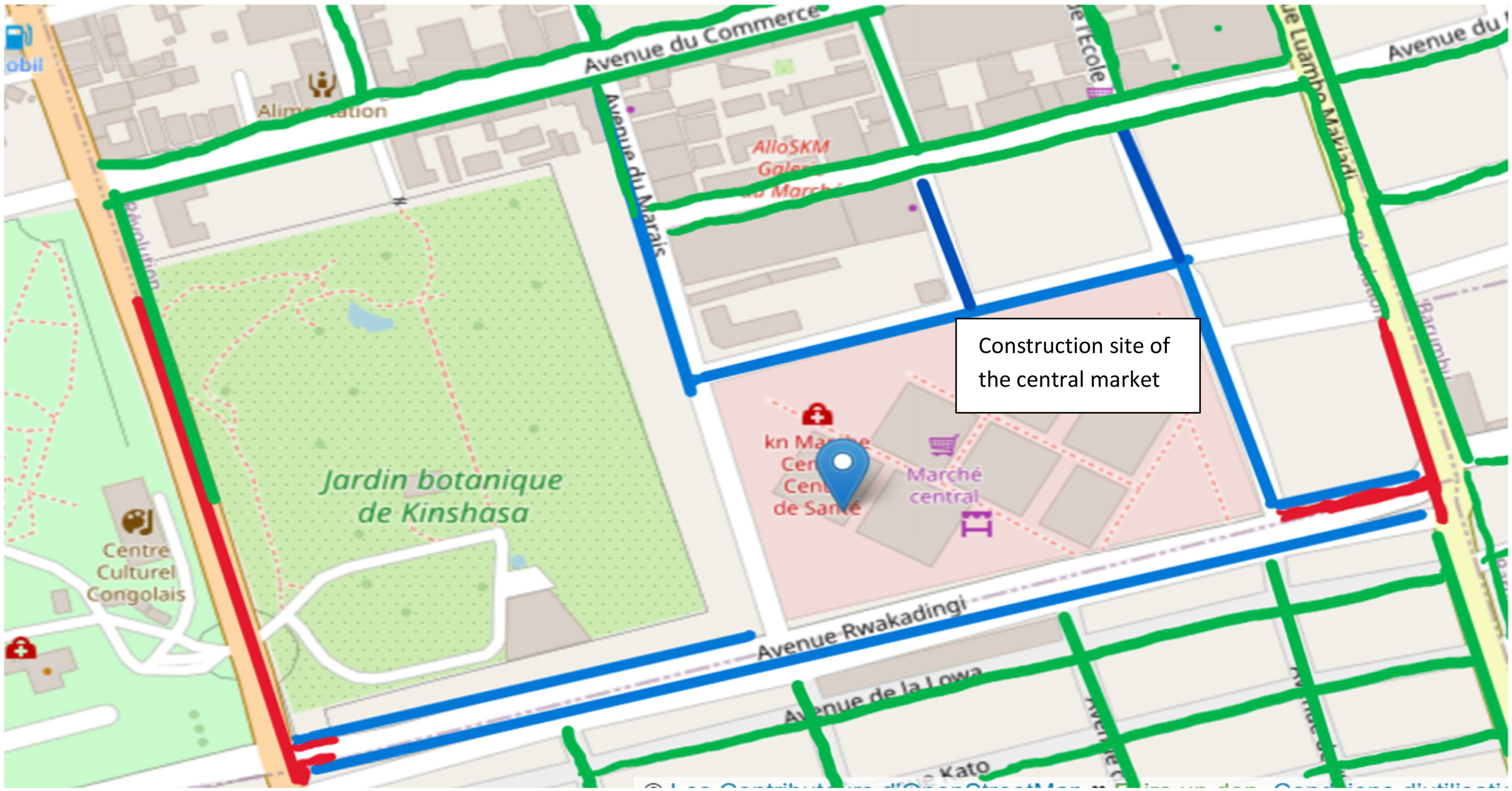
Map of the Central Market of Kinshasa's Area. Source: OpenStreetMap, with text and line addition by the author.
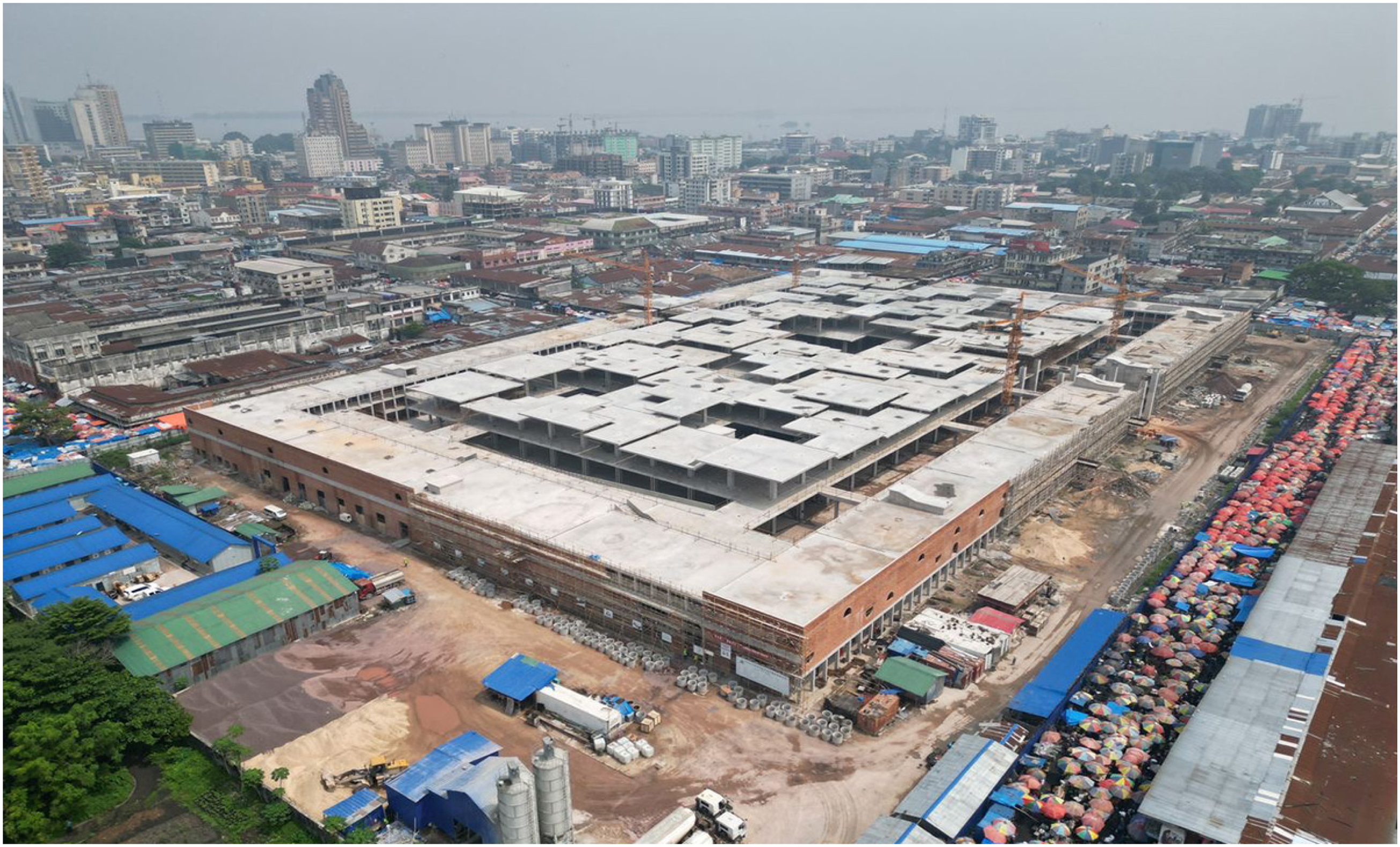
Picture of the Construction Site of the Central Market of Kinshasa in 2024. Source: Site photograph by Société Zhengwei Technique Congo. “Reconstruction of the large Central Market of Kinshasa.” Reproduced with permission from the commissioner, THINK TANK Architecture – Marine de la Guerrande and Adrien Pineau.
The article is based on semi-structured interviews and participant observation conducted over a period of twelve months between 2019 and 2023 in the central market of Kinshasa. Initial interviews were conducted in 2019, before the demolition of the central market. Another round of interviews was conducted after the market demolition in 2021 and 2022. Follow-up interviews were conducted in 2023. In total, I conducted around 60 semi-structured interviews with vendors operating on the market site and in the surrounding streets. The data gathered were supplemented by nine interviews with union leaders, three with market management officials, three with pavilion chiefs, and two with different commanders of the police post at the central market. Considerable time was devoted to participant observation, which consisted of spending time with the vendors at their stalls or in the street to observe the various regulatory mechanisms. To better articulate the development of practical norms as deviations from, or transgressions of, official norms, I compared official decrees on the organisation and occupation of market space with the accounts of the various actors interviewed. The relationship of trust, built over the years with certain key informants such as vendors, market administrative workers, and trade union leaders, was essential in gaining access to sensitive information relating to practices that do not comply with official norms. Anonymising informants helps protect their identities for ethical purposes. In the next section, I identify and map the relationships between the different norms governing access to the commercial space of the central market.
Official Procedures and Practical Norms Regulating Access to the Market Space
Official Procedures Governing Market Management
Prior to the demolition of the central market, its organisation, management, and access to its space were governed by official decrees 3 issued by the urban government. However, as an official from the central market administration confided: “Because market life is dynamic and not static, these different laws are very often readapted and complemented by the promulgation of new decrees and several arrangements.” 4 Official laws are thus usually subject to negotiations, manipulations, and circumventions, giving rise to different and at times contrasting effective procedures (Olivier de Sardan, 2008). The most recent decree on urban markets, 5 broadly restates the provisions set out in previous decrees on the organisation and regulation of the marketplace. According to these decrees, the purpose of the urban market as an infrastructure is to provide a sales area for traders and to generate financial resources for the city. As a state property, the market can only be occupied on a temporary basis, with proper authorisation, and in return for payment to the state. Any other forms of appropriation of market space – including the streets around the market – whether free of charge or in return for payment, are therefore formally prohibited.
The market is organised around three structures: the managing committee, the technical units, and the evaluation committee. The managing committee is appointed by the governor and is made up of an administrator, a deputy administrator in charge of finance, and a deputy administrator in charge of technical, maintenance and environmental issues. The administrator, assisted by his two deputies, supervises and coordinates the activities within the market, ensuring compliance with laws and norms. The technical units are extensions of the various public services within the market and are under the supervision of the market administrator. They include, among others, the departments of finance, hygiene, and security. The evaluation committee is composed of the managing committee, the technical units, and the vendor unions. Market staff are made up of civil servants and sub-contractors. Civil servants receive a service bonus from the market in addition to their monthly civil service salary. The salary and benefits of sub-contracted staff are set by the provincial finance minister.
To rent a shop in the central market, a vendor pays a rental guarantee and a monthly rent – the price of which is set by an urban government decree. Officially, shops cannot be sublet, and the lease cannot be passed on informally to others. During Safricom's management period, the revenues from monthly rent for shops were managed by Safricom to recoup its investment. In turn, Safricom supposedly paid the exceeding amount back to the provincial authorities. However, in addition to the amount officially paid by Safricom to the urban government, the company's director was allegedly requested to pay bribes and commissions to various public officials. 6 The market management thus came to depend mostly on the amount of stall taxes. Stall occupancy is guaranteed by an amount paid daily by the market vendor, who does not pay a rental guarantee or monthly rent. As with shops, traders occupying stalls may not pass on their access rights to other vendors. When a trader does not occupy their stall for a certain period, they are supposed to lose their place. The amount of stall rental is set by a decree of the urban government, which also produces a grid for the distribution of stall revenues. The most recent ministerial decree 7 set the stall rental fee at 400 Congolese Franc (FC). The distribution key is as follows: 5 per cent for the urban treasury, 65 per cent for the operation and sanitation of urban markets, 20 per cent for the markets’ management board in the city hall, 5 per cent for the commune where the market is located, and 5 per cent for the vendors’ unions.
Practical Norms: Meeting Organisational Needs
The above legal provisions governing market management are not always systematically enforced by the authorities. As a result, several practical norms emerge in the management and regulation of market space. Some official norms are difficult to apply either because of financial imperatives or political contingencies. Sometimes, certain official provisions do not fully cover the practical matters for their application, thus opening the way to what Olivier de Sardan (2015: 55) calls “adaptive practical norms.” These are practices that do not necessarily conflict with the law, and which, in some ways, can be understood as an operationalisation of official procedures. In practice, however, such operationalisation often opens the door to further transgressions of the law, with which it then becomes closely intertwined (Olivier de Sardan, 2021: 125–131). This is possible through the “playing field,” or the room for manoeuvre that actors use to navigate between different norms (De Herdt and Olivier de Sardan, 2015).
The distribution of market revenues is illustrative of further transgressions associated with the operationalisation of the official law. The distribution grid is not always respected for several reasons. First, in addition to the amount that the market administration officially pays to the urban treasury and the markets’ board, the administrators also pay large sums to various senior public officials and political actors in support of various clientelist networks 8 (see also Malukisa and Titeca, 2018). Second, many market agents are contractors, as they are often recruited on a clientelist basis to accommodate the acquaintances of public servants and members of political parties. They must therefore be paid from the market's budget. This means that the budget earmarked for running the market and for its sanitation is often not sufficient. 9 It follows that the market administration reduces the official amounts of certain quotas in the distribution grid to satisfy the different interests of the more powerful networks. As a result, the budget allocated to maintaining the market is considerably reduced. Moreover, vendors’ unions complain that they do not regularly receive the amount of the quota indicated in the official distribution grid. In some cases, however, the administration deliberately deviates further from the explicit norm by informally paying an undeclared commission to union delegates rather than officially paying the quota to the vendors’ unions. This strategy may enable the administration to control the union delegate in charge of the market while weakening the political influence of the national vendors’ union by depriving it of its source of funding.
To compensate for a budget deficit that was affecting market sanitation and increase their own quota, the vendors’ unions proposed to the administration another operationalisation of the law: an additional tax on stallholders. The market management signed therefore a memorandum of understanding with the Congo National Vendors’ Unions (Le Syndicat national des Vendeurs du Congo), in which they agreed to add a tax, known as a “sanitation tax,” of 100 FC per stall. Later, the sanitation tax would be increased to 200 FC per stall. Hence, before the demolition of the central market, any vendor occupying a stall at the market had to pay a total of 600 FC, that is, 400 FC for stall fees and 200 FC for sanitation tax. The additional sanitation tax collected should be distributed as follows: 80 per cent for sanitation and 20 per cent for the running of the unions and the chiefs of the pavilions. However, as with the previous distribution grid, the distribution of the sanitation tax was rarely enforced by the authorities, often leading to further deviations in the management of market revenues.
Furthermore, the official decrees did not provide for vendors to pay for identification forms. Still, for the market administrators, it was imperative to register vendors for census purposes. With a view to increasing market revenues, the market administration decided to introduce a fee of USD 5 per vendor for the identification form. Two other public institutions also competed for the amount to be collected for the identification form. These were the provincial Ministry of the Interior and the provincial Ministry of Finance. Both institutions claimed that they were entitled to the amount of the identification form. To resolve the conflict, the market administration decided to appoint a liaison committee to identify the vendors. The committee was made up of agents from the urban government, members of the market administration and the vendors’ unions. This led to further operationalisation of the law, through a new signed memorandum of understanding. The amount collected from the identification forms was therefore not officially paid to the urban government but shared between these various institutions and actors. The identification form will be used on several occasions over the years by the market administration as a strategy for increasing market revenue, suggesting further deviations underneath the operationalisation of the law.
The above mechanisms of control illustrate not only the multiplicity and plasticity of practical norms but also the interweaving of the social logics underpinning these norms (Olivier de Sardan, 2021: 351–374). Thus, the need to better adapt governance to organisational needs is sometimes so closely linked to economic or political interests that it becomes impossible to separate them. To a certain extent, these different operationalisations of the law contribute to “making the market work.” Here, practical norms bring together divergent interests in the provision of a public service. However, because these deviations are created out of the opportunism of officials who manipulate the law to meet their needs (De Villers, 1992: 16), they end up benefiting more these powerful actors, at the expense of vendors who must pay additional fees. Yet, the operationalisation of the law does not only serve the interests of state actors. Other forms of operationalisation help “make the market work” by responding effectively to organisational and vendors’ needs. An illustration of such practical norms is the outsourcing of the state function or the delegation of power to the chefs de pavillons (chiefs of the pavilions) to classify vendors in their respective pavilions. A pavilion is a cluster of specific products, such as second-hand clothing, jewellery, fresh food, etc. A chief of the pavilion is first and foremost a vendor who is designated by others or who imposes themself as the representative of other vendors in a particular cluster.
The structure of the chiefs of the pavilion was created by the market administration during the reign of former president Mobutu Sese Seko, at a time when trade unions were banned in the country. Yet, the structure was maintained even after the advent of the vendors’ unions at the end of Mobutu's reign in 1997. Today, the structure of the chiefs of the pavilions operates more or less unofficially in the central market. It is not sanctioned by any official decree, unlike the unions, which are recognised in the official decree as members of the market evaluation committee. Any new vendor wishing to occupy a space within the market must have the consent of the chief of the pavilion, who will allocate the free space. Even though it is relatively recent, the structure of pavilion chiefs has similarities with the structure of customary authorities – which coexists in the DR Congo with the official norm – in land rights (Van Acker, 2005). In this context, the structure of pavilion leaders can be thought of as a practical norm that is structured by social norms recognising forms of non-state authority and community-based regulation system.
Practical Norms: Tolerated Deviations
The structure of the chief of the pavilion also represents a good illustration of practical norms that are virtually tolerated as they reflect the “spirit of the law.” According to official decrees, access to a stall is only allowed on payment of a daily stall fee. Once set up, the vendor also needs to comply with the regulations governing small businesses in Kinshasa, which require annual payment of a licence fee corresponding to the category of products sold. In practice, however, the chiefs of the pavilions charge additional stall occupancy fees to the vendors. This is a one-time bargained flat-rate fee, varying from USD 20 to USD 50.
The amount is not officially recognised in any decree on market management and is not recorded in the administration's register. However, it is recognised by the market administration as part of the “unofficial” market occupation practices. The chief of the pavilion keeps the amount collected, but they pay a commission to market administrators, and sometimes even to the vendors’ unions. The commission paid protects the chief against probable repercussions from the market authorities. To explain these practices, one chief of the pavilion once quoted a Lingala adage saying that “the totem animal must be consumed by all those who know the law prohibiting its consumption.” Redistribution of bribes provides a form of protection against sanctions for transgression. By ensuring that everyone is somehow complicit in the crime, transgression appears normalised, or at least tolerated (Olivier de Sardan, 1999: 34–35).
Such a practical norm is therefore tacitly enforced and sanctioned by all the actors operating in the market. For the vendors, this practical norm gives them a degree of autonomy over their sales area. In common parlance within the market, this action is referred to as kosomba mesa (to buy a stall) from the chief of the pavilion. However, here, the verb “to buy” is used more loosely and does not mean definitively appropriating the right to the space. Rather, it means having a little more room for manoeuvre over occupying the space. Thus, contrary to the official provisions of the decree, in practice, vendors can pass on their right of occupation to other vendors or sublet their stall, 10 with the complicity of the chief of the pavilion, who often demands additional fees to validate the name change in their register.
Practical Norms: Transgressive Practices
Other practices regarding the occupation of sales spaces are more akin to a clear transgression of official norms and are often based on self-interest (Olivier de Sardan, 2021). These are practices that comply with neither the letter nor the spirit of official norms. Not only were the chiefs of the pavilions exempt from paying the daily tax in their own stall, but they could also claim a few stalls in their pavilion to develop their own trade. They often assigned these stalls to their relatives for free, or to other vendors who paid rental fees to the chief of the pavilion. When it came to tax collection, the administration only considered the official number of stalls reported to them by the pavilion chiefs.
It was, therefore, common for the chief of the pavilion to manipulate the official number of stalls in their pavilion, which partly explains the inconsistencies around the total number of vendors in the central market before its demolition. In the case of inspection of pavilion areas by the administration agents, the chief of the pavilion would cover up their transgressions, for example, by asking the vendors they have placed in unofficial areas not to be there during the inspection. Tax collectors may also manipulate official rules by negotiating with some vendors so that they pay a reduced amount for tax without being given a ticket that serves as proof of payment. As the administration only refers to the actual number of tickets sold, some tax collectors can therefore retain the amount received by certain vendors who have not received tickets.
Regulatory Practices of Street-Level Bureaucrats in the Marché de Crise
The discrepancy in the application of official norms is also observable in the period following the demolition of the central market. Moreover, the advent of the crisis market adds a new element to the regulation of sales space. In the absence of official decrees governing market organisation, regulation mechanisms have multiplied, as they have been accompanied by growing competition between various players wanting to perform as the state (Abrams, 1988; Aretxaga, 2003). It is as if the space for the agency of bureaucrats (Bourdieu, 1990a) is widened when official decrees or written laws no longer apply. Although the demolition officially led to the suspension of much of the market's organisational structures, two former institutions were maintained to regulate the crisis market. These are the national police and the ad hoc administration. The interim administration's mission was to ensure the organisation of vendors in the crisis market and to oversee the cleanliness of the trading area. The police ensured the safety of people and property. The state also put in place a Forces armées de la république démocratique du Congo (FARDC – the DRC armed forces) battalion to maintain security and, above all, to deal with any protests by relocated vendors.
The administration set a daily fee of 400 FC per vendor with the purpose of funding the cleaning of the sales site. However, as was the case before the demolition, much of the money collected ended up being used to pay various agents and was redistributed to public agents through unofficial channels. 11 The interim administration also benefited from the collaboration of certain chiefs of the pavilions who came to take back their positions. In the crisis market, the official procedures for occupying space were also altered. While the chiefs of the pavilions were still able to claim occupancy fees from new vendors, some old vendors – those who were evicted and returned to the crisis market after protests – refused to pay this fee. They considered the fees unjustified given the temporary state of the crisis market. Access to the new sales areas was, once again, controlled by a daily tax. Vendors who did not find suitable places in the spaces demarcated for the crisis market moved to other main roads nearby. For some vendors, moving to the main road can be a strategic move to attract a large customer base instead of staying confined in a less affluent corner of the market. Among them, those with a relatively stable income set up shop on the main road, placing a stall against a fence or on the sidewalk. They usually obtain permission from the authorities, which is subject to a fee and a daily tax payment. For other vendors, the lack of significant financial capital means that they cannot rent a stall in designated areas nor afford a stall on the road. Hence, they often end up selling on the ground of the main road.
However, instead of chasing them away, the police let these vendors remain, in exchange for a small bribe. Those who refuse to pay the bribe may be harassed by the same police and have their property confiscated for a short period. Furthermore, some collectors charge fees to street vendors despite there being no official tax imposed on street vendors by the crisis market administration. Tax collection in the streets surrounding the central market is often the subject of conflict between the market administration and the administrations of neighbouring communes or satellite markets (Ayimpam, 2014: 125–126). Street traders sometimes pay the price, as some are taxed simultaneously by both administrations. Admittedly, tax collection in the streets is not as straightforward as in authorised places. For example, it is common knowledge that if a vendor occupying an authorised stall within the crisis market refuses to pay the daily tax, their goods will be confiscated by the administration. In order to recover their goods, they will need to pay the tax in addition to a fine determined by the authorities.
For street vendors, however, an amicable negotiation, generally concluded with a small sum discreetly paid into the agent's hand, or the famous mbote ya likasu, 12 is quickly arranged. Sometimes, the bravest ones refuse to pay the amount demanded by the agent, knowing full well that this amount is not officially recognised by the administration. This often results in heated arguments, and sometimes ends with the police or the public agent letting the vendor operate on the street after the latter promises to pay next time. Sometimes they part ways after exchanging verbal abuse or intimidation. In very few cases, police officers might impound their goods for a short time as leverage to force them to pay a bribe. In this case, practical norms emerged out of self or collective interests of street-level bureaucrats (De Herdt and Olivier de Sardan, 2015) and proceed through calculated manipulation of the law (De Villers, 1992: 16). However, they are also structured by different social logics such as the logic of shame or pity (Olivier de Sardan, 2021). Thus, navigating through contradictory logics can lead some interface bureaucrats to behave in an unpredictable manner.
A certain familiarity, or the creation of social ties, between public agents and some vendors is an important feature of the collection of bribes and taxes that are unrecognised in official registers (Amani Lemeke et al., 2023). Even if they do not have official registers of street vendors, the police and other public agents operating in the area know them by name or by sight. Indeed, the nature of the daily transaction between these actors often leads to a certain familiarity (Hornberger, 2004). Vendors might plead with the police when they have no means of paying on a given day. They may call on the protection of certain police officers to whom they have paid bribes, or with whom they have formed ties, to prevent other police officers from harassing them. It may also be the case that the transaction between vendors and public agents is not straightforwardly financial, despite the monetarisation of everyday life which seems to prevail even in corruption practices (Olivier de Sardan, 1999: 39). Certain transactions between public agents and vendors may be carried out in kind, in the form of goods sold at a discount to the police or public agent, or goods donated free of charge – in a gift-giving logic. However, in the corruption context, the reciprocation is not in terms of the exchange of gifts, but an exchange of gifts for favours. Sometimes the gift is given in advance, as a preventive measure to reconcile good graces (Olivier de Sardan, 1999: 39). Sometimes these exchanges also take place in the context of a certain relationship established between the public official and the vendors.
The FARDC soldiers posted at the entrance of the construction site are supposed to disperse crowds of vendors on the main road when they prevent vehicles from passing through. Sometimes, vendors who have been left alone by the police in return for a bribe are instead chased away by the military to let the vehicles through. At times, these soldiers also demand bribes from the vendors. Meanwhile, along with other security guards who have been contracted to secure the construction site, the soldiers act as “guardians” of the construction site's improvised gates. Since several corners of the construction site have been barricaded, marketgoers and vendors often have difficulty moving from one end of the crisis market to the other. Hence, the security guards and the FARDC have opened small doors through the protective fences and allow pedestrians who do not want to make long detours to pass through for a fee of around 500 FC.
Officially, the police, administration workers, and FARDC soldiers are supposed to restore order and clear away people who occupy unauthorised streets. In this official narrative, the bribery and harassment to which these street-level bureaucrats are dedicated are on their own initiative, and the money collected is kept by these agents and not shared with their hierarchy. However, anyone who knows the public administration in the DRC, or in sub-Saharan Africa more broadly, understands that bribes often follow more complex channels of redistribution (Blundo and Olivier de Sardan, 2001; Moshonas et al., 2022), moving from police officers to the head of the police station, up to the higher reaches of the police or public administration. Failure to comply with such practical norms may result in an agent not being sent to a strategic revenue location. Hence, some police officers are said to be “parked” as their hierarchy has assigned them to administrative tasks that give fewer opportunities to take commissions, bribes, or tributes. This daily practice of corruption is well known to the hierarchy and stems in part from the idea that bribery is perceived by public officials as a supplement to a meagre and irregular civil service salary (Rubbers, 2007). It is therefore not surprising that, a few weeks after my interview with the police commander who criticised these acts of corruption, I recognised one of his guards on the street asking vendors for bribes.
These mechanisms of control and access thus reveal different manifestations of the state in everyday life. We are faced here with a multiplication of interfacing or street-level bureaucrats and administrations regulating access to space and the economy. This can be understood in terms of different agents from the same institution trying to apply the law individually or to manipulate it to their own ends. This is the case, for example, of several police officers who take turns to ask the same vendors for bribes. But it can also refer to different state administrations whose missions may be complementary or even competing, as in the case of police officers working in synchronisation or contradiction with FARDC soldiers or civil servants. One must agree with Aretxaga (2003), who astutely observes that there is good reason to believe that this is not representative of the deficit of the state, but that we are in the presence of an “excess of statehood practices: too many actors competing to perform as [the] state” (396).
Ultimately, this closer look at the articulation of practical norms allows for a dynamic view of actors’ positions in commerce. Certainly, some practical norms offer social agents the opportunity to negotiate their position within the market more favourably. Most vendors, for example, are happy to enjoy a degree of flexibility in the way that they occupy their stalls or to be able to temporarily relinquish their occupancy rights to other vendors when they are unable to continue their activities – even if this means paying a fee to the chief of the pavilion. However, transgressions of official norms, such as corruption practices by street-level bureaucrats, affect vendors differently depending on their social position within the market (Mesa, 2022: 329–330).
The regulation of salesplaces in the crisis market provides a good example here. After the demolition, some well-off vendors rented shops, kiosks, or stalls in corners of the crisis market that were more accessible to customers and where they were not bothered by the police. This was not the case for small traders with minimal capital who found themselves in less affluent corners or in unauthorised streets, where they were subject to persistent harassment. In this case, it may be useful to think of the physical space as a form of capital, a “spatial capital” that is produced and reproduced in association with other forms of capital (Bourdieu, 1990b; Mace, 2017). Vendors selling in stalls and those in small shops not only benefit from various protections against police harassment but also their strategic location attracts more customers who can spend up to a good fortune on quality goods. This may provide some with better opportunities for social mobility despite the crisis caused by the market demolition (Noret, 2019). Hence, a more complex analysis of practical norms also reveals how different hierarchies within the market can be (re)produced by the regulation.
Conclusion
This article aimed at analysing different regulations governing access to the central market of Kinshasa. Its contribution to the literature on the regulation of urban trading spaces is twofold. At the outset, the article argues that contrary to a widely held view, urban trading places do not escape state regulation, nor should they be viewed as intentionally placed outside the realm of legitimacy or legality. These spaces are highly regulated because they represent important sources of government revenue (Lindell and Appelblad, 2009) and rent seeking (Malukisa and Titeca, 2018). The same applies to economic activities, which are regulated by controlling access to marketplaces. Building on strong empirical evidence, the article makes therefore a strong case for going beyond the formal/informal binary divide in analysing the regulation of urban trading places and activities. The dominant formal/informal binary divide, I argue, obscures the researcher's abilities to capture the multiplicity and dialectic between scales of regulation and their rationale.
Surely, going beyond this binary divide does not mean that the difference between official laws and the implicit norms that regulate the behaviour of social agents no longer exists. Nor does it ignore what Hart (1985: 56) already noted as a “qualitative distinction between degrees of social organisation.” A distinction, for example, between an intensive capitalist production firm and street vending. However, what the article rejects is a binary approach which would consider certain economic activities as formal, that is, regulated by the State, and others as informal, that is, not regulated by the State or relegated to a regime of exception by the State. The argument is that an in-depth analysis of the relationships between forms and scales of regulation renders this dichotomy obsolete.
The second contribution of this article to the literature is that, drawing on the practical norms literature, it offers more in-depth insight into the inner working of public administration (Bierschenk and Olivier de Sardan, 2014) in regulating markets. This offers a new perspective, especially in a context where urban markets are usually presented in the literature as sites of informality. Trading places in Kinshasa's central market are highly regulated. Yet, often the official norm that is supposed to be at the heart of the state's enforcement of the law is, in reality, no more than a starting point for an order that is open to negotiation (Strauss, 1992). In particular, the article examines the dialectic between the different norms governing market access and their effects on various groups.
The multiplicity and plasticity of these norms go hand in hand with the multiplicity of social logics. In turn, these lead to divergent and at times mixed effects in governance. In Kinshasa, several powerful political networks often compete for market rents. In line with this, the appointment of market administrators generally follows a clientelist logic to generate rents. These powerful networks appoint and protect public servants, and in return, the rents generated “trickles up” to higher echelons of public administration. However, it would be reductionist to explain these emerging regulatory mechanisms solely by economic or neo-patrimonial logics (Olivier de Sardan, 2008, 2021). As the article shows, several deviations or transgressions of the official law contribute to what I call “making the market work” – providing a public service even though they serve the interests of powerful actors. Moreover, some practical norms provide market vendors with the opportunity to negotiate favourably their position within the market. Yet other deviations from official laws lead to accentuated differentiation and increased exclusion of the most vulnerable. Ultimately, this analysis requires us to reflect on the effects of different regulations in the (re)production of inequalities for different individuals or social groups, because people navigate regulatory powers differently, depending on their position in social space.
Footnotes
Acknowledgements
This article is based on the fieldwork conducted during my doctoral research. I would like to express my deepest gratitude to my key informants, whom I have chosen to present here anonymously for reasons of confidentiality. This research would not have been possible without their generous participation. An earlier version of this article was presented in the workshop on “regulating work,” organised at the University of Liège. A draft version of this article was also presented at the Harvard Law School's IGLP Global Scholars Academy organised in Stellenbosch and at the Congo Research Network PhD day in Brussels. I wish to thank all the participants of these workshops for their valuable input and constructive criticism. I would also like to particularly thank Benjamin Rubbers, Joël Noret, Sasha Newell, Sylvie Ayimpam, and the two anonymous reviewers and journal editors. They have all been incredibly generous with their time and constructive feedback. Yet the arguments presented here are my own and I alone am responsible for any flaw in this article. It is acknowledged that the map data in Figure 1 is copyrighted by OpenStreetMap contributors and available from  .
.
Declaration of Conflicting Interests
The author declared no potential conflicts of interest with respect to the research, authorship, and/or publication of this article.
Funding
The author disclosed receipt of the following financial support for the research, authorship, and/or publication of this article: This work was supported by the Fondation Philippe Wiener – Maurice Anspach, Chaire unesco défis partagés du développement, Académie de recherche et d'enseignement supérieur.