




Abstract
Zimbabwe's August 2023 elections were held against the backdrop of outcry over the outcomes of previous elections, which opposition political parties accusedthe ruling Zimbabwe African National Union-Patriotic Front party of rigging. Access to the public media is among the issues of contestation. Opposition political parties claim that they are not given equal space for campaigning purposes. Social networking sites such as X (formerly Twitter) and Facebook have recently provided spaces for political communication, where all parties have unfettered access to the electorate. Recently, TikTok has emerged as a popular social networking site, rivaling established applications in terms of its uptake, particularly among youths. Research on the social media application suggests that it is largely used for trivial purposes and does not contribute to critical dialogue. However, lately there is evidence that TikTok is being used for “serious” purposes, including activism. The study sought to find out how political actors in Zimbabwe used the TikTok platform for political communication in the run-up to the 2023 elections. The paper also examines the nature of digital persuasion on TikTok and how this enriches or trivialises political discourse. Findings show that TikTok was used to urge Zimbabwean youths to register to vote as well as to provide visual evidence of the good and the bad associated with particular political parties, as they competed for voters. It was used as a politainment tool, combining political messaging with the entertainment affordances of TikTok.
Introduction
On 23 August 2023, Zimbabweans voted in a general election to elect a president, members of the House of Assembly, and councilors. The Zimbabwe African National Union-Patriotic Front (ZANU-PF) and the Citizens Coalition for Change (CCC) 1 were the major contestants in the country's eighth general election since independence in 1980. The ZANU-PF garnered the majority vote amidst outcries of voter intimidation and vote suppression in opposition strongholds. The opposition has always challenged electoral outcomes, alleging that the ruling party manipulates them. One of the major points of contestation is the use of public, state-controlled media in political campaigning, which favours ZANU-PF. Beyond the opposition, regional and international observers of the 2023 elections, including the Southern African Development Community (SADC) to which Zimbabwe is a member, also raised concern over ZANU-PF use of state media. According to the SADC's Principles and Guidelines Governing Democratic Elections (Section 2.1.5), all political parties must have equal opportunities to access state media. In its report on the elections, SADC's Observer Mission to the elections said: “While the Mission noted some improvement compared to the 2018 electoral processes, we also noted that the content of the public broadcaster and the State-owned newspapers were in favour of one political party, contrary to the relevant provisions of the Constitution, the Electoral Act, and the Revised SADC Principles and Guidelines Governing Democratic Elections, which requires State-owned media to be impartial” (SADC, 2023: 7). Zimbabwe's publicly owned, state-controlled media include the Zimbabwe Broadcasting Corporation, which runs television and radio broadcasting services, as well as the Zimbabwe Newspapers stable (Zimpapers), which owns several daily and weekly newspapers in addition to national and community radio services, as well as a television station. Opposition parties complain that whenever these public media outlets report about them, they always use negative frames (Moore, 2011; Matingwina, 2019). However, as Matingwina shows, the bias is two-way, because privately owned media also cover the ruling party unfavourably. This is little consolation, however, given that the media industry is dominated by state-owned and controlled entities. Recently, the Zimbabwean government licensed new private, commercial broadcasters, although these too have alleged connections with the ruling party (Ureke, 2023). This means the media landscape is uneven, with ZANU-PF enjoying the lion's share of that space.
Apart from the media environment, Zimbabwe generally has a poor record of freedom of speech as political activists are harassed and sometimes imprisoned for their utterances, which was a recurrent issue in the 2023 election. For example, The Patriotic Act, enacted in 2023 prior to the elections, criminalises acts and utterances that are deemed to damage Zimbabwe's national interests. Also prior to the elections, several opposition activists such as Fadzayi Mahere, Job Sikhala and Godfrey Sithole were arrested on different spurious charges that highlighted the curtailment of freedom of speech in Zimbabwe. Mahere, who was the spokesperson of CCC was arrested and charged with communicating falsehoods on social media. Sikhala and Sithole, both senior CCC officials were arrested for inciting public violence. Sikhala had allegedly threatened to avenge the murder, by suspected ZANU-PF members, of CCC activist Moreblessing Ali. Sikhala went on to stay in prison for close to two years without trial.
Against the above background, social media have emerged as viable alternatives for political discourse in Zimbabwe, particularly for communication that antagonises business and political elites. Critics can use pseudonyms and stock images to conceal their identity when speaking against government and corporates. Included among these critics are numerous identified and anonymous cyber-gladiators, cyber-protesters, “artivists” and moles using social media to speak out against ZANU-PF excesses (Chibuwe and Ureke, 2016; Gukurume, 2017; Ureke, 2023). Thus, a substantial amount of political talk, which was traditionally confined to offline spaces and legacy media, concurrently happens online. At the same time, politicians are gradually coming to grips with digital technologies and improving their ability to reach constituents and supporters (Mutsvairo and Karam, 2018). This adoption of digital technology has given rise to what Cervi and Marín Lladó (2021: 2) call the “technopopulist party,” which “cannot be understood without comprehending their interaction with social media.” Technopopulism refers to contemporary political practices that are enmeshed with information and communication technologies (Venizelos, 2020).
In previous elections, Twitter (now X), Facebook, and WhatsApp were the most popular social media platforms for political actors across Zimbabwe's political divide (Chibuwe, 2020; Ncube, 2019; Mare, 2018). In 2017, TikTok came into being, before catapulting to fame at the height of the Covid-19 pandemic in 2020. At the time of the 2018 Zimbabwean elections, TikTok was little known, and many had not figured out how to use it due to its novelty. In the following years, the application grew wildly popular and was the most downloaded app in 2022, with 672 million downloads worldwide (Aslam, 2023). TikTok's spread has had wide ramifications on the way people interact online which makes it worthy of study. The application has ushered in its own vocabulary, such that a video created or shared on it is called a tiktok while producing such content is referred to as tiktoking. It has also become common to hear people speaking about having tiktoked something just like “googling” it. The development of this vocabulary, among other attributes, is an indication of the ubiquity and widespread appropriation of TikTok.
Apart from its well-documented and widespread use to curate ephemeral, entertainment-inclined content, there are indications that TikTok is being used for other “serious” and even nefarious communicative purposes. As was the case elsewhere, Zimbabweans used TikTok dance challenges to escape the boredom associated with Covid-19 lockdowns (Machirori, 2023). However, there have also been concerns about its use for disinformation in the Russia–Ukraine war (Oremus, 2022) and violent extremism propaganda elsewhere (O’Connor, 2021). More importantly for this paper, there is evidence that TikTok is being used in some parts of the world for political communication (Moir, 2023; Cervi et al., 2023; Del Rosso, 2021). Some observers are already touting it as the “most powerful political weapon of the twenty-first century” (Valenzuela, 2022). It seems TikTok's playful and simplistic disposition makes it a potent political communication tool (Zamora-Medina et al., 2023). It has already proven to be a popular campaign tool in Kenya, Canada, Nigeria, and the United States’ recent elections. Yet, the emergent use of TikTok for political communication is not complemented by equally growing academic scholarship on the subject, particularly on the African continent. Studies about the use of TikTok in Africa are especially necessary given that the continent has the world's second-largest youth population aged between 15 and 24 years, estimated at 19 per cent as of 2015 (UN, 2015). About 53 per cent of TikTok content creators are aged between 18 and 24 years (Aslam, 2023).
This paper examines how political actors used TikTok for political communication in the run-up to Zimbabwe's 2023 general elections. It seeks to address the question of how Zimbabwean political actors are adapting their communication strategies to TikTok's affordances. The Zimbabwean elections provide new evidence on patterns of TikTok use, which can add insights into general debates about social media and society but more specifically about the affordances of this application and how they align with political communication needs. As yet, there are no known in-depth studies on the use of TikTok for political discourse in Zimbabwe. Therefore, the paper makes preliminary arguments that contribute knowledge towards understanding the uses of social media in Africa. The paper shows that the protagonists in Zimbabwe's 2023 elections, ZANU-PF and CCC, used TikTok for campaign purposes by exploiting the playful nature of the application to appeal to the electorate. This evidence supports the argument that TikTok's playful affordances make it a potent tool for political communication by combining entertainment and politics in its rhetoric. Findings also show a personalisation of politics in which TikTok messaging by political parties revolves around attributes of the party leaders.
Political Communication in Zimbabwe: The Role of Song and Dance
Defined by McNair (2018: 4) as “purposeful communication about politics,” political communication includes political advertising, political public relations, or any communication intended by its senders to influence the political environment (Denton and Woodward, 1990). McNair (2018) outlines three broad categories of this form of communication, namely: communication by politicians and other political actors to achieve specific objectives; communication addressed to political actors by non-politicians (e.g., voters and activists); and communication about political actors contained in the media. While the first form is age-old and widespread, the emergence of social media has made the other two forms of political communication increasingly ubiquitous. Inasmuch as these definitions of political communication are widely acceptable, they best describe Global North contexts where political communication is often systematic, formal, and traceable. Political communication in many African contexts has unique characteristics that do not always fit easily into Western definitions. For example, dance, jest, and all-night vigils are common political interface media in the Zimbabwean context but may not easily fit the “purposeful communication about politics” definition by McNair.
Long-standing forms of political communication in Zimbabwe include formal means, such as rallies, media talk, music, political advertising, as well as alternative, performative modes such as song and dance. Singing and dancing, particularly, were essential strategies of political communication during the war for independence in the 1970s. Liberation war fighters would gather villagers in all-night vigils called pungwes during which they would spread the doctrine of the struggle. These pungwes would be punctuated by song and dance, which had the effect of galvanising the fighters and citizens around the cause of the struggle. Songs were used by the guerilla fighters to celebrate victories, cheer themselves up, and mourn victims of war (Guzura and Ndimande, 2015). Among Shona sub-cultures, a dance called kongonya emerged as a performance particularly used to facilitate political mobilisation, psychological anchoring, and morale-boosting within the traumatic environment of the war (Gonye, 2013). This culture continued beyond the war. As Gonye further observes, at the height of Zimbabwe's land reform programme in the early 2000s, song and dance were often used during violent land grabs by ZANU-PF vigilante groups to instill fear and trauma among white farmers. They were exploited to a similar effect at ZANU-PF bases where opposition supporters were tortured as part of the ruling party's violence machinery during the 2002, 2005, and 2008 elections (Gonye, 2013). As ZANU-PF faced mounting pressure from the then main political opposition Movement for Democratic Change (MDC) led by Morgan Tsvangirai, it deployed jingles on public radio and television, extolling the land reform program and urging the populace to persevere through economic hardships (Guzura and Ndimande, 2015) that the ruling party blamed on European and United States imposed sanctions. As will be shown later in the paper, these performative song and dance forms of communication reappear on TikTok, a platform that is particularly well-suited to their dissemination.
Social Media and Political Communication
Everywhere in the world, social media have become popular and indispensable tools of political expression. According to Settle (2018: 52), political expression is “when a person makes public some aspect of their political identity or political views.” This is a fundamental aspect of political communication, which includes expression of an ideological identity or candidate preference. Like in many parts of the world, political communication in Zimbabwe has also moved online, complementing its traditional offline forms. The use of social media platforms such as Facebook and X for political communication in Zimbabwe is well-documented (Mare, 2018; Chibuwe and Ureke, 2016). Citizens Coalition for Change has a verified official X handle (@CCCZimbabwe), while an unverified ZANU-PF account (@ZANU PF_Official) also exists on the platform. For context, CCC was established in 2022 after leadership wrangles in the MDC Alliance, between Chamisa and secretary general Douglas Mwonzora, who now leads the MDC party. Both Mnangagwa and Chamisa have verified X accounts. Traditionally, the parties’ social media communication use those handles although other proxies such as party officials and social media activists also come into the fray. Those who tweet in favour of ZANU-PF and Mnangagwa have been nicknamed Varakashi. Tshuma et al. (2022) established that Varakashi were using Twitter to sanitise and justify the coup that brought Mnangagwa into power in 2017 and in so doing trolled and bullied opposition supporters, hence, the name Varakashi, which means “destroyers.” Chamisa's X supporters have been dubbed Nerrorists (Mavengano and Moyo, 2023; Tshuma et al., 2022; Chibuwe, 2020). Nerrorists is derived from Chamisa's nickname “Nero” which is a shortened adaptation of his first name, Nelson. Thus, Nerrorists becomes “those who follow Nero (Nelson).” Given the diminished freedom of expression and shrunk democratic space, Zimbabweans find social media to be a relatively “safe” space where they can speak truth to power. The reason for this, as stated before, is that netizens can use anonymous accounts when commenting on otherwise sensitive subjects. A good example of this is the anonymous whistle-blower Baba Jukwa, who revealed state secrets on Facebook, but eluded several government attempts to uncover “his” identity (Chibuwe and Ureke, 2016).
Social media political communication is not always rational or logical. Sometimes it uses devices that border on incivility, including attack advertising and memefication of otherwise serious issues. Whether online or offline, humour is one of the major devices used for political and protest communication in Zimbabwe. As Kuhlman (2012) argues, humour and satire have been used to communicate dissent as part and parcel of the politics of resistance (Makwambeni and Adebayo, 2021; Mamvura et al., 2023). Moving beyond existing scholarly work, which has not focused on TikTok, I demonstrate in this article that, as with song and dance, humour and satire figure prominently in the use of TikTok in Zimbabwe.
Despite TikTok's burgeoning popularity, in a country where much of the population (close to 70 per cent) is rural-based, digital communication largely serves urban populations. Even in urban spaces, there are many who cannot afford the data costs of connecting and communicating digitally. According to Datareportal's 2022 Digital Access report, only 10.2 per cent of the total Zimbabwean population was active on social media although 89.7 per cent had cellular mobile connectivity (Kemp, 2022). Although there may be fewer users of TikTok compared to older platforms such as X and Facebook, studying TikTok is important for a nuanced understanding of digital communication. The uniqueness of TikTok's algorithm coupled with its ability to combine text and intimate, up-close performative audio-visual content make it a novel phenomenon worthy of analysis in varying cultural contexts.
TikTok in Digital Rhetoric and Persuasion
This study is informed by the theory of digital rhetoric or digital persuasion as well as the concepts of political entertainment (politainment) and playful activism (playtivism). Digital rhetoric theory describes how rhetorical strategies exploit digital platform affordances for persuasion. As promulgated by Aristotle, persuasion is based on three elements, namely ethos, pathos, and logos (Zamora-Medina et al., 2023; Zappen 2005). Ethos is about establishing the authority or credibility of a speaker, which makes the audience highly likely to trust that speaker; pathos is about appealing to the audience's emotions (stirring anger or sympathy), while logos is about appealing to the audience's reason and logic (Zamora-Medina et al., 2023). In recent times, digital media have transformed and extended these traditional notions of rhetoric and persuasion. Owing to the rise of social media, there is an intertwining of persuasion and entertainment, leading to concepts like “politainment,” which is prevalent on TikTok (Cervi et al., 2023; Zamora-Medina et al., 2023; Riegert and Collins, 2015).
When applying digital rhetoric theory to TikTok use, the ethos or character of the speaker can be represented by the account bio, as well as the speakers featured in the videos. The pathos is contained in the messaging and its aesthetics, including the use of entertainment formats. It might involve the use of syllogistic arguments whose major premise the audience already buys into (Demidröğen, 2010), for instance, that ZANU-PF misgovernance is the root of Zimbabwe's problems or that CCC is a Western-sponsored movement. The logos gives the “call to action” after one has been presented with all the “information,” for instance, urging users to register to vote or to elect a particular candidate.
Though started as an app for light-hearted issues, TikTok has taken a “serious turn” (Cervi and Divon, 2023) and is now being used to tackle political issues, leading some scholars to suggest that it has led to a “TikTokisation” of politics (Ball, 2021). It has proven to be a popular campaign tool, especially for politicians seeking to connect with younger voters (Moir, 2023) because around 80 per cent of the platform's users are youths aged between 16 and 34 (Iqbal, 2022). Studies show that politicians use TikTok mainly for its performance affordances (Bösch and Ricks, 2021; Cervi and Divon, 2023), which usher in “politainment” – political entertainment in which politics depends on spectacle and adopts entertainment strategies (Cervi et al., 2023; Zamora-Medina et al., 2023). As entertainment and politics become intertwined, political actors and topics get entangled with entertainment culture. In the process, politics and entertainment industries mutually exploit each other to result in politics that is entertaining and entertainment that is political. In that interface, cultural industries package political content in entertainment formats while politicians use their celebrity status and media access to promote issues (Riegert and Collins, 2015).
The playful nature of TikTok has been exploited by activists such as those in the BlackLivesMatter movement, the Palestinian resistance, and the LGBTIQ+ movement – resulting in what can be termed “playtivism” (Cervi and Divon, 2023). Both politainment and playtivism exploit audiences’ tendencies to “play” with the media (Stephenson, 1967; Caldwell, 2013). As advanced in Stephenson's play theory, when people consume media content, they “play” with it because they regard it as entertainment such that their personal pleasure becomes an end in itself. Thus, the “playful” affordances of TikTok, ranging from its trivial and ephemeral content to the very nature of scrolling through the content feed, coincide with audiences’ predisposition to “play” with media. From this perspective, any persuasion stemming from media texts is incidental and subjective because the main goal of consuming content is, foremost, to play.
Stephenson's ideas notwithstanding, on digital platforms, celebrities, influencers, and social media infrastructures are designed strategically such that those with messages can attract attention through equally playful packaging of content, leading to celebrity pop politics. Such emergent digital cultures contradict earlier concerns that public communication was in crisis owing to a range of factors, including commercialisation, tabloidization, and an increase in infotainment at the expense of “serious” journalism (Blumler and Gurevitch, 1995). The influencer logic that is predominant on digital media platforms revolves around those factors but still tackles “serious” issues. Particularly in the Global South, where many citizens are marginalised, digital media open up communication spaces and multiply interaction possibilities, even if in playful fashion. Admire Mare (2018) argues, using the Zimbabwean context, that a new type of “celebrity” politician is often seen and active in online spaces, more than they are available offline. This observation has become more apparent in visual applications like TikTok.
Influencers cum digital celebrities are key actors in any digital persuasion. Influencers are social media users who command a huge following online and attract a large amount of engagement (Kay, Mulcahy and Parkinson, 2020). They can be categorised into micro influencers (those with a low following) and macro influencers (high following) (Kay et al., 2020). de Sousa (2020) breaks down influencer categories into six tiers, namely nano, micro, mid-tier, macro, mega, and celebrity influencers. According to de Sousa, the numbers of followers/likes vary according to the platform (e.g., YouTube, Facebook etc.), but generally, mid-tier influencers range between 50,000 and 100,000 likes. Duncan (2019) has already noted that influencers are increasingly being used in electioneering, particularly in countries with huge youth populations. Close to 30 per cent of Zimbabwe's population is aged between 18 and 34 years (Kemp, 2022).
Methodology
This qualitative interpretive study is a content analysis of video, text, speech, and music drawn from purposively selected TikTok pages. Thus, the study employs a multimodal qualitative content analysis that identifies themes and patterns in audio-visual and linguistic data in the context of the Zimbabwean political environment. Context is important in the analysis of semiotic elements (Serafini and Reid, 2023) such as tiktoks. The study draws data from six different accounts named after CCC or ZANU-PF, which consistently churn political content associated with the parties. To identify these accounts initially, the researcher exploited the TikTok algorithm by constantly searching for “CCC” and “ZANU-PF,” such that the application itself suggested content on the “For You” page. TikTok would most likely recommend the same content for users who continuously searched for CCC and ZANU-PF, meaning that tiktoks by these political parties, or their proxies, would constantly appear on the users’ feeds. A TikTok search was subsequently conducted for users named CCC/Citizens Coalition for Change and ZANU-PF. These keywords were employed as the study is specifically interested in those two political parties, for reasons explained in the introduction. Between February 2022 and July 2023, all the accounts that appeared under the search were noted, recording those that had posted some content and then checking the number of times they had posted and the likes that had accrued to them. This was for the purpose of gauging user engagement and the accounts’ influencer statuses.
A scronalysis [author's term] of each of the accounts was then conducted to determine if their content was specifically about the named political party and, in the process, eliminate accounts that may have used CCC/ZANU-PF appellations when their content was in no way related to those political organisations. Scronalysis is a method that combines scrolling and analysis. Because TikTok content is organised vertically, one can scroll down through the feed and cursorily scan the previews without necessarily opening a video. In the process, it is possible to recognise apparent features that self-manifest such as logos, regalia, movement, and image composition and quickly judge whether to open the video or not. From this, the researcher was able to identify the users that associated closely with the two parties and eliminate those with aberrant content. Computational methods use similar methods to fast-scroll through accounts and scrap their data for later analysis.
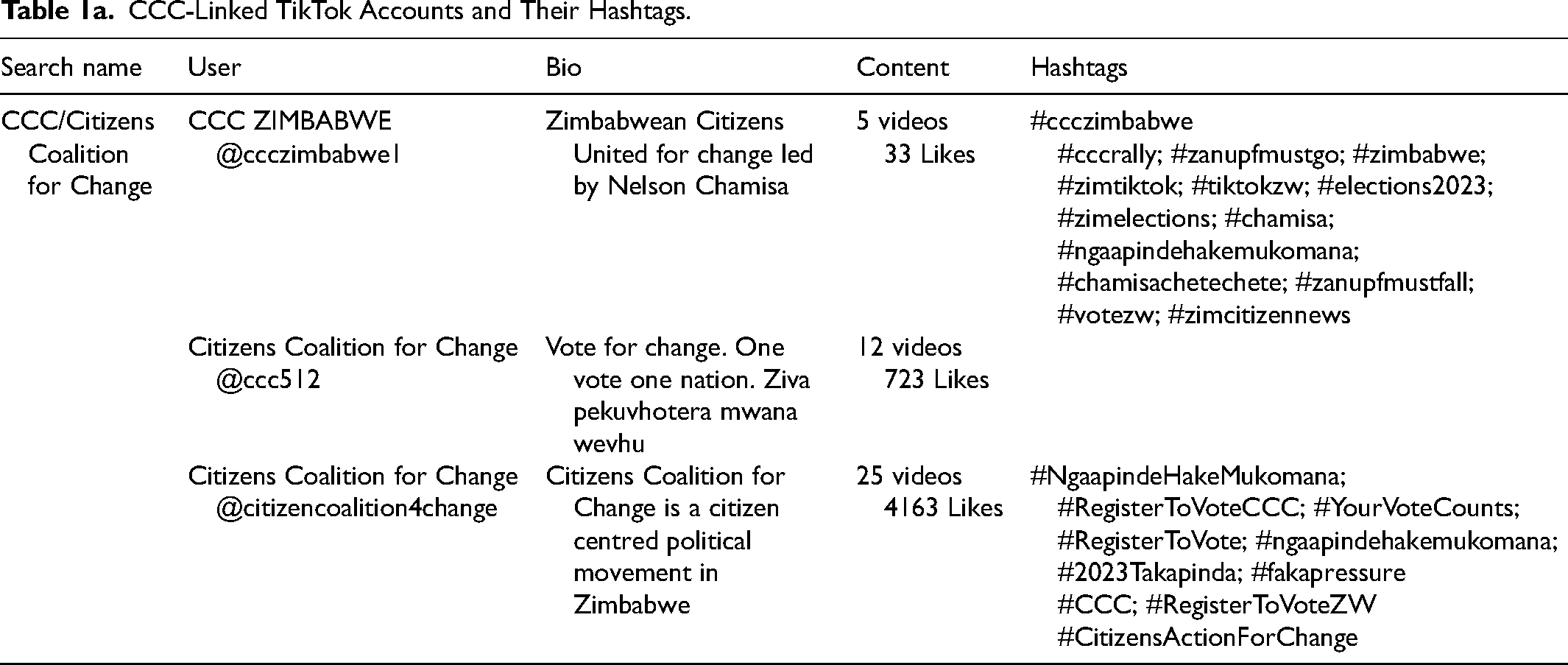
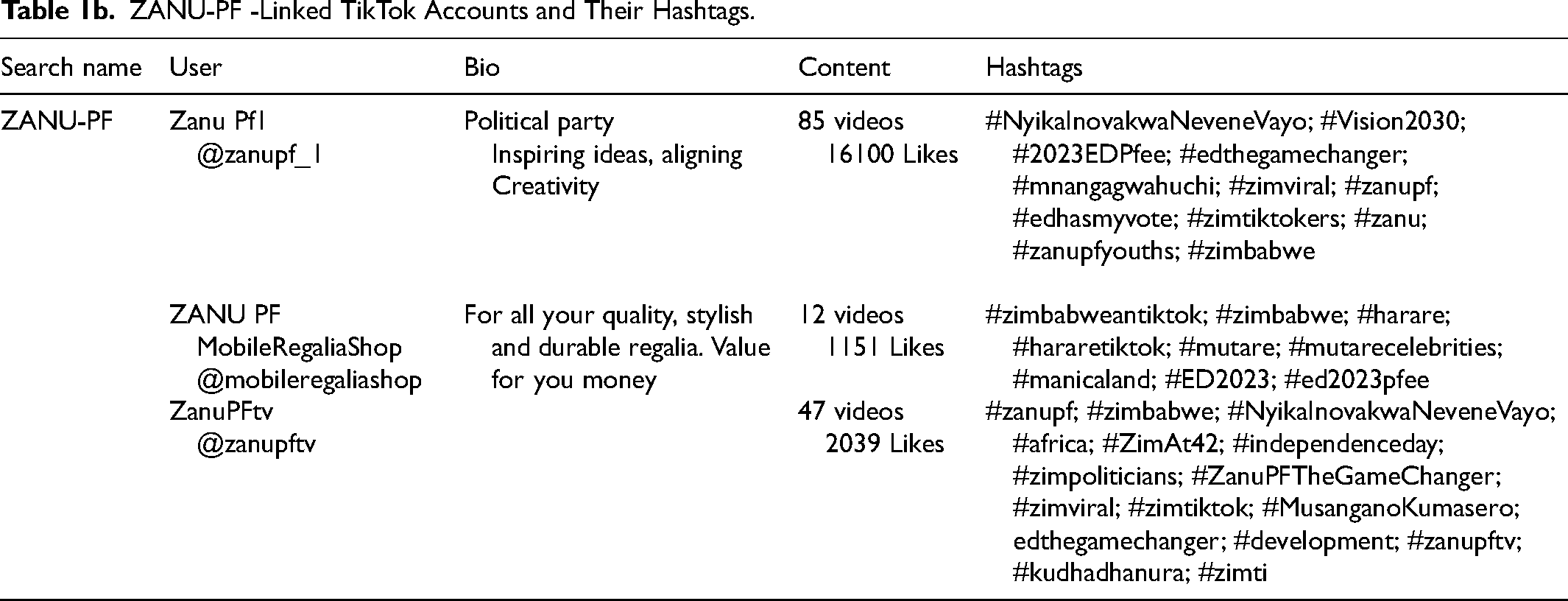
After scronalysis, the researcher then coded the tiktoks according to recurrent hashtags contained in the videos posted under the selected accounts (see Table 1a and 1b). Hashtags increase visibility and create communities around common topics of interest. They are like keywords that help users easily find content that they are interested in. As Bruns and Burgess (2015) argue, hashtags lead to the formation of ad hoc publics, which can be ephemeral or long-term. The videos were then closely examined, taking into consideration the issues they contained, visuals, text, speech, and soundtracks used. The hashtags/themes were grouped into topics, for example, #EDGameChanger and #NyikaInovakwaNeveneVayo imply a “Mnangagwa development-oriented leader” topic. The findings of the study, presented below, reflect the paper's predominant focus on TikTok accounts associated with the two political parties. There is scope yet, to examine how “ordinary” people also use the application for political discourse.
CCC-Linked TikTok Accounts and Their Hashtags.
ZANU-PF -Linked TikTok Accounts and Their Hashtags.
Zimbabwean Political Actors Warming up to TikTok
The presence of Zimbabwean political actors on TikTok is an indication that they are gradually warming up to the application and are recognising its potential for political persuasion. Going by McNair's (2018) classifications of political communication, the most prevalent type identified on the accounts is “communication by politicians and other political actors to achieve specific objectives.” In most of the cases, two objectives stood out: encouraging voter registration and soliciting votes. ZanuPf1 (@zanupf_1) and ZanuPFtv (@zanupftv) were identified as the accounts most likely associated with ZANU-PF, while CCC (@ccc512) and CCC (@citizenscoalition4change) were most likely associated with CCC (see Figures, 1 and 2). None of these accounts are verified, although, in their bios they claim to represent the political parties. Going by digital rhetoric theory outlined above, the bios, which contain basic user information, represent the ethos. Using the specific names of the parties was a way of identifying ZANU-PF and CCC as the parties behind the tiktoks. Furthermore, the images of Mnangagwa and Chamisa, respectively, appear on the @zanupf_1 and @ccc512 accounts in order to closely associate the parties with these protagonists. The @citizenscoalition4change account introduces itself by stating “Citizens Coalition for Change is a citizen centred political movement in Zimbabwe” (see Figure 1) while @zanupf_1 introduces itself as a “[p]olitical party inspiring ideas, aligning creativity” (see Figure 2).
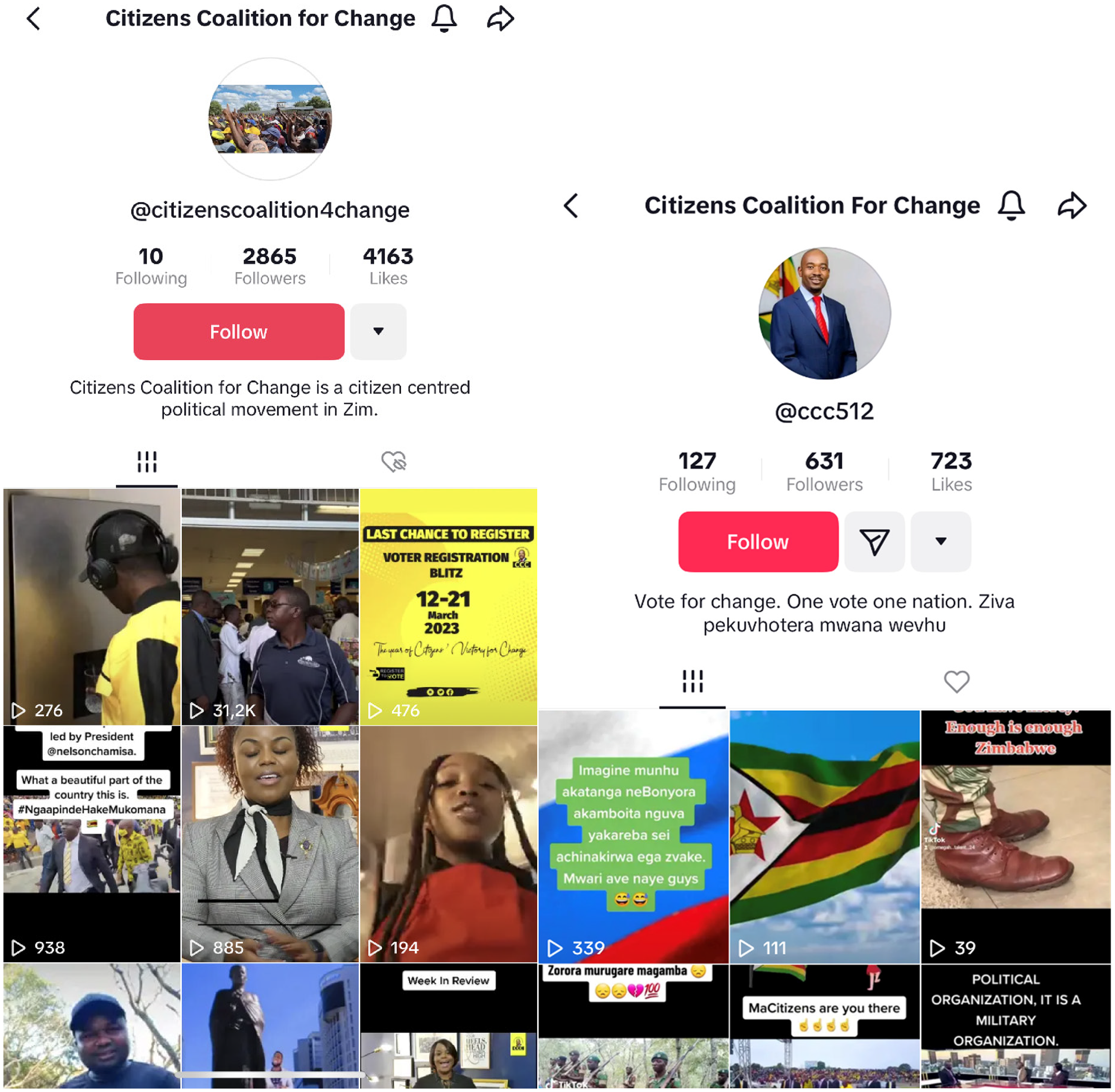
Main TikTok Accounts Linked to Citizens Coalition for Change (CCC).
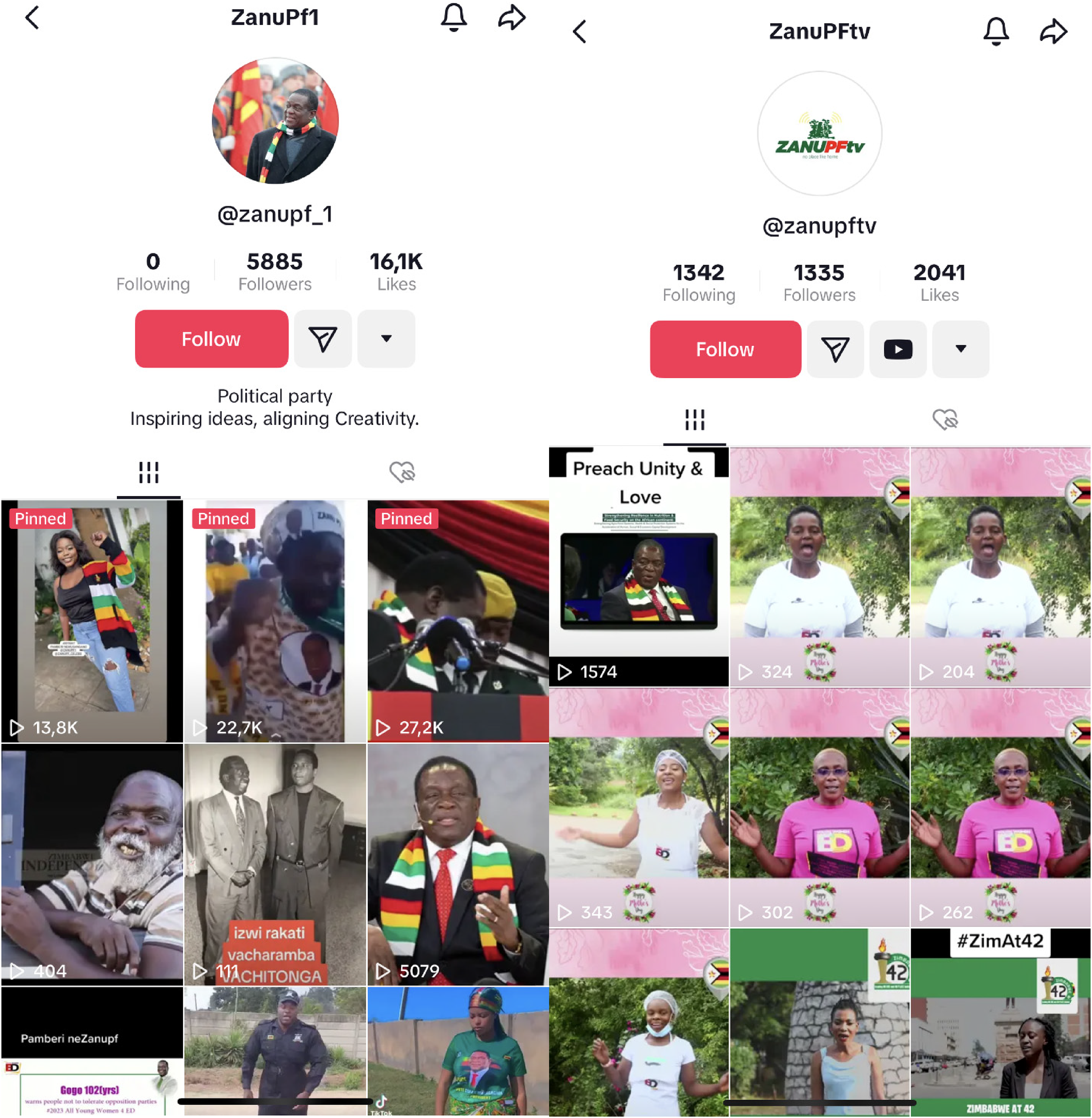
Main TikTok Accounts Linked to ZANU-PF.
The identities of the parties are discussed with caution due to the challenge of user identity online. It is possible that the identified accounts are not administered within, or by, the political parties but by sympathisers or officials from the parties posting on their own accord. Apart from these most likely accounts, there is also CCC ZIMBABWE (@ccczimbabwe1) and ZANU PF Mobile Regalia Shop (@mobileregaliashop) that also resonate with the parties’ ethos (see Figure 3). Then there is a host of other accounts that use the ZANU-PF and CCC appellations, although their ethos and pathos do not have apparent and consistent connections with the political parties.
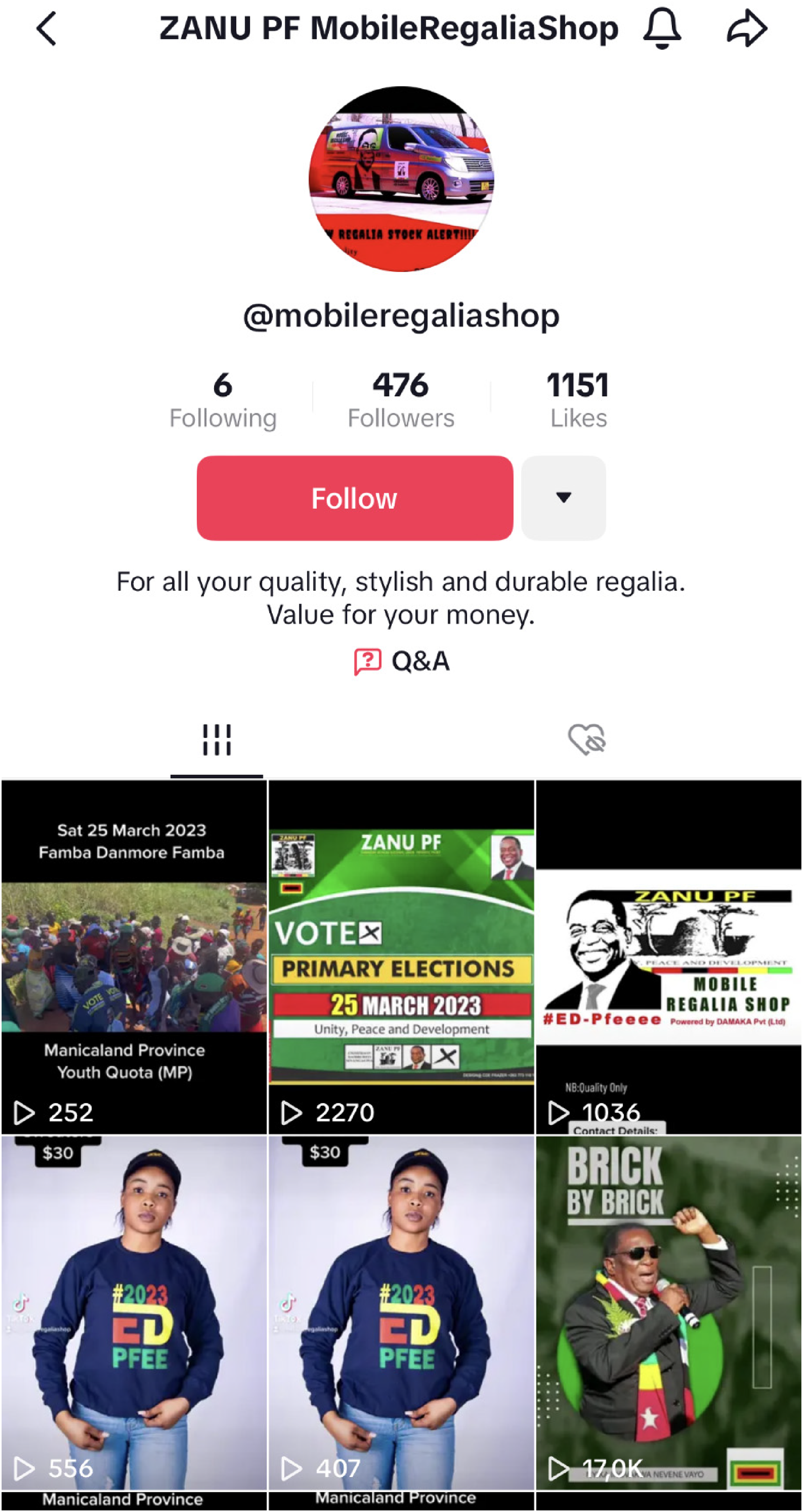
Zimbabwe African National Union-Patriotic Front (ZANU-PF) Regalia Shop Advertising Party Branded Regalia.
In the run-up to the elections, political actors were using TikTok to mobilise youths to register as voters, posting under hashtags such as #YourVoteCounts and #RegisterToVote. As the 2023 elections drew closer, messages became more direct in their appeal for votes and attack of competition. By the time of the elections, none of the accounts had reached influencer status going by de Sousa's (2020) classification. As shown in Table 1a and 1b, by 1 June 2023, the CCC-aligned accounts (@ccczimbabwe1, @ccc512, and @citizenscoalition4change) had a paltry 33, 723, and 4163 Likes, respectively, while the ZANU-PF linked accounts (@mobileregaliashop, @zanupftv, and @zanupf_1) had 1151, 2039, and 16,100 Likes, respectively. These low numbers could be because the political actors were relatively new on TikTok and their supporters had not yet warmed up to the idea of their parties being on this application. ZanuPFtv started posting content in November 2021 while ZanuPf1 became active in January 2022, and @mobileregaliashop became active in March 2023. Citizens Coalition for Change (@ccczimbabwe1) was only active in the month of March 2022, while @citizenscoalition4change became active starting around the same time. @ccc512 only became active as of April 2023.
The parties posted content sporadically, often doing so when there were notable events to publicise or to which to react. For example, March 2022 was an important period as the country held parliamentary by-elections to fill in seats that had become vacant for various reasons since the last election in 2018. There was a noticeable flurry of activity around the time. This sporadic use affects engagement as TikTok users are known to constantly want content, with statistics showing that nine out of 10 users open the application multiple times daily and the average user spends about 1.5 h per day on it (Aslam, 2023). While these initial indicators suggest low engagement on TikTok, it is possible that some of the videos are shared and only become viral on other social media applications such as Facebook and WhatsApp, which are the most used applications in Zimbabwe (Kemp, 2022).
While CCC and ZANU-PF did not have verified TikTok accounts, there were several proxies that created and shared content tagging the political parties or containing their names in hashtags. Cucs Man (@cucsman), a CCC social media activist and musician, performed various advocacy acts on TikTok, often donning branded party regalia and using jingles that plainly promoted Chamisa. In many other videos, Cucs Man explicitly attacked ZANU-PF. Chamisa (@nelsonchamisa) was also on TikTok which, among other things, he used for optics, often posting videos portraying jubilation and zeal of the bumper crowds that attended CCC rallies. Journalist and political activist, Hopewell Chin’ono (@daddyhope02), was also active on TikTok, where he posted messages that were critical of ZANU-PF, just as he did on his other social media accounts.
Government spokesperson Nick Mangwana (@nickmangwana) used TikTok to promote government programmes and mobilise support for the incumbent president Mnangagwa. Political commentator Rutendo Matinyarare's (@rutendomatinyarare) TikTok posts were also sympathetic to the ruling party, and sometimes amplified Mnangagwa's nyika inovakwa nevene vayo mantra (explained below) and the view that Zimbabwe's economic and political calamities are the detrimental effects of the EU/US sanctions on Zimbabwe. The sections below examine the messaging (pathos) employed by the two political parties.
Citizens Coalition for Change Pathos: “Only Chamisa can Save Zimbabwe from ZANU-PF”
One of the CCC-linked videos employing the hashtag #NgaapindeHakeMukomana features a group of youths in rural Bikita posing for a selfie with Chamisa while raising the index finger, the party's symbol. One of the youths can be heard shouting “one usingashaine” (the unassuming one). Another one shows Chamisa's grand entrance into Sakubva Stadium in Mutare, waving at cheering multitudes of supporters. The videos are meant to show his popularity and organic connection with supporters. The playful nature of the Bikita selfie video adds an entertaining dimension to otherwise serious electioneering.
The hashtags and content used by CCC-linked accounts show that the party was galvanising around the persona of its leader, Chamisa. Hashtags such as #NgaapindeHakeMukomana and #ChamisaCheteChete (Ngaapinde hake mukomana means “let the boy get into office,” while Chamisa chete means “Chamisa only”) demonstrate Chamisa's centrality to CCC's TikTok activity. The use of Chamisa-focused hashtags gives the impression that the CCC was focusing its campaign on the Presidency and used the youthful persona of its then 45-year-old leader, rather than his ideas, as the rallying point. It points to the “personalisation of politics” (Zamora-Medina et al., 2023) that comes with social media political communication. Citizens Coalition for Change's strategy suggests that not only is Chamisa the only solution to Zimbabwe's problems but it also communicates that he is the sole centre of power in his party. This message is reflective of developments within the party where, by June 2023, Chamisa was the only confirmed candidate that would represent the party. Results of nomination processes to select parliamentary and ward representatives had not been publicised by that time with elections less than two months away. Critics and disgruntled supporters accused Chamisa of being dictatorial and selfish, adding that he was running the party's affairs like a one-man show (Mandingo, 2022). They also pointed to the lack of transparent structures within the party as an indicator of these tendencies. Apart from Chamisa himself, there was no other known office bearer, with other officials simply being referred to as “Change Champions.” Chamisa contended that this ambiguity was a deliberate strategy to guard against infiltration of the party by ZANU-PF agents.
Apart from extolling Chamisa, the CCC-linked TikTok accounts have a consistent message – remove ZANU-PF from power. This message is reflected in hashtags such as #zanupfmustfall, #zanupfmustgo, and #fakapressure. This messaging represents both the pathos and logos of CCC's digital persuasion as it exploits public sentiment that for the economic plight of the country to improve: ZANU-PF must be removed from power. Citizens Coalition for Change members believe that one way of achieving this is by exerting pressure on the ruling party on all fronts. Faka pressure (exert pressure) is a cryptic war cry used at CCC rallies and on their social media platforms (Staff reporter, 2022; Ndoro, 2022) to troll ZANU-PF misdemeanors. The ZANU-PF complaints that this call might actually be an incitement for opposition supporters to be violent. The statement might also emanate from a classic song by Zimbabwean yesteryear band Bundu Boys whose lyrics say “uchinge wabayiwa, rega kuponja, faka pressure’ (if you are pricked, don’t be deflated, add pressure).” Thus, CCC appeals to the electorate's emotions invoking the country's economic troubles to motivate voting decisions. At the same time, considered together with #zanupfmustfall and #zanupfmustgo, the messaging seems to play on common reason, making it appear obvious that ZANU-PF is the cause of all of Zimbabwe's problems.
Many of the videos posted by the CCC-aligned accounts under #CitizensActionforChange and #RegistertoVoteZW use pathos to appeal to people to register to vote. One of the videos features archival footage of the late liberation war hero Josiah Tongogara proclaiming his yearning for change (apparently from colonial to black majority rule) although the message is spun to imply the desire for change from ZANU-PF rule. Previous ZANU-PF wins have been partly blamed on voter apathy. Many Zimbabwean youths were not registered to vote and were indifferent about elections given previous rigging allegations. Using motivational videos is part of a larger strategy by the opposition to mobilise more people to vote, thus complicating ZANU-PF's alleged vote manipulation methods.
Other tiktoks showcase the party's rallies or outreach activities in rural places such as Tsholotsho, Bulilima, Uzumba, and Bikita which are traditionally strongholds of ZANU-PF. This is part of a politics of the spectacle where the party uses the colourful gatherings and images of a carefree Chamisa freely mixing and mingling with citizens to suggest that the party is gaining appeal in ZANU-PF strongholds. In these instances, Chamisa is presented as a celebrity leader who is at one with the ordinary Zimbabwean, in contrast to the securocratic Mnangagwa. His bravado and playful poses evince aspects of politainment and the fetishisation of images in the optics of politics. TikTok affordances, like its visual cousins in film and advertising, promote central characters or protagonists. As both the CCC and ZANU-PF cases show, most content can be curated around political personalities. Their celebrity status as leaders is used to drive the party messages. Thus, in the comment sections, there is no confusion as to the identity of these leaders as they have become the faces of their parties.
Zimbabwe African National Union-Patriotic Front Pathos: “Building the Nation Brick by Brick”
The ZANU-PF's TikTok communication strategy seems to sell to the electorate “tangibles” that its leader and incumbent President Mnangagwa has achieved in his first term in office. It uses ethos by presenting content in news formats where people give testimonies of the good work that the President is doing, complemented by evidentiary footage of this “progress.” Hashtags that point to this endeavour include #NyikaInovakwaNeveneVayo, #EDTheGameChanger, and #Vision2030 (see Table 1b). Nyika inovakwa nevene vayo literally means “a nation is built by its owners/citizens.” Videos that employ this hashtag include one in which Mnangagwa is giving a speech preaching peace, unity, and love. In another, a Tonga language-speaking man thanks President Mnangagwa for drilling boreholes in Binga, one of Zimbabwe's most marginalised communities. In the video, the man stands in front of a drilling truck branded in ZANU-PF colours and emblazoned with “Vision 2030” letters. Another tiktok features vox pops of people thanking the President for drilling boreholes in St Mary's, Chitungwiza, and yet another contains testimonials by different people praising Mnangagwa for refurbishing roads. In yet another video using the same hashtag, hip hop artist Holy Ten appears wearing a Zimbabwe-flag coloured jacket in the company of a man wearing a jacket imprinted “ZANU-PF Huchi” (ZANU-PF is honey). Holy Ten thanks President Mnangagwa for several infrastructure development projects completed across the country as well as a new programme to mitigate drug abuse among youths. Using a celebrity in its messaging is yet another example of politainment where a pop celebrity is used to talk about political projects and appeal (through pathos) to the electorate to vote for a particular candidate.
The videos consistently show Mnangagwa to be the one in charge of the infrastructural developments taking place in the country. Just like CCC's persuasive tactics, ZANU-PF's communication revolves around the personality of Mnangagwa. None of the tiktoks present what other members of the party are doing in their official capacities. Nyika inovakwa nevene vayo, is a continuation of Mnangagwa's mantra that ZANU-PF under his leadership, is focused on developing the country or building it “brick by brick.” This pathos is in tandem with Mnangagwa's infrastructural development drive, which has among other things seen the refurbishment of roads, airports, and construction of dams and key buildings. This message is complemented by other videos using the same hashtag that provide the call to action (logos) for the electorate to vote for Mnangagwa, not Chamisa. For example, one such tiktok is a still image of Mnangagwa raising a clenched fist and the text “VOTE ZANU-PF” and another one that features an elderly lady urging people to vote ZANU-PF for the by-elections in 2022, punctuating her talk with “Pasi naChamisa” (down with Chamisa), a common ZANU-PF slogan.
The hashtag #development is self-evident and supports the nyika inovakwa nevene vayo messaging tallying with #EDTheGameChanger and #Vision2030. Labelling Mnangagwa as a game changer is consistent with his purported development drive, which is seen as a departure from the time of Robert Mugabe's rule. This is meant to position Mnangagwa and ZANU-PF as progressive and development oriented. These messages all dovetail into the logos of Mnangagwa's government's Vision 2030, an expression of the National Development Strategy 1, the goal of which is to see Zimbabwe become an “empowered and prosperous upper middle-income society by 2030” (Republic of Zimbabwe, 2020). To some extent, ZANU-PF tiktoks also valorise the strength and unity of the party outside of what Mnangagwa is doing. The hashtag #MusanganoWakasimbaKumasero, accompanied by a soundtrack of the same title claims, that ZANU-PF's strength lies in its grassroots structures (the cells). This gives the party an identity of its own separate from, but related to, Mnangagwa's and distinguishes the party's philosophy from CCC's “Chamisa only” mantra.
“Hashvertising”: Use of Hashtags for Viral Circulation
As discussed above, both parties use hashtags to group their messages and make them easily searchable. In some cases, they both use open hashtags of online communities such as #zimtiktok; #zimbabwe; #zimviral; and #tiktokzw. This means whenever someone searches for Zimbabwean content, or for ZimTikTok, this content is likely to appear on their feeds. Using these types of open hashtags increases the chances of content going viral beyond people who actually follow and support these parties. It makes it easy for users to find content as they “play” on TikTok. Advertising through hashtags, which I call hashvertising, is the equivalent of conventional advertising, in this case just like advertising during prime time. The online spaces represented by these hashtags are the prime spots of Zimbabwean TikTok. Top TikTok influencers such as Madam Boss (@madambosszim), Tee (@tiann22), Lonlisha (@lonlisha98), and Mat Tt (@@maitsdiaries1) among others also use the same hashtags when curating their content. Thus, people who follow these influencers are likely to be accidentally exposed to political content as they pursue influencer content (as they play). Once they do so, and show some interest, either by liking or watching the content for a prolonged time span, the TikTok algorithm will suggest more of such political content. Although comparable to conventional advertising, the difference is that there are no strict time limits to content that TikTokers can post, unlike TV and radio adverts, which usually take 30 seconds and must therefore deliver their messages with a tone of urgency and directness.
Although Blake Chandlee, TikTok's Vice President of Global Business Solutions, has been quoted saying “we will not allow paid ads that promote or oppose a candidate, current leader, political party or group, or issue at the federal, state, or local level – including election-related ads, advocacy ads, or issue ads”, Zimbabwean political actors are already using the application to promote candidates and political ideas. The ZANU-PF's @mobileregaliashop sells branded party regalia and features models wearing such regalia. This might not be the form of advertising that TikTok exclusively prohibits but clearly TikTok's focus on creative expression can easily be manipulated by political actors such that seemingly trivial performances may contain political satire and attack advertising, sometimes revolving around a disinformation logic.
Promoting Political Ideas Through Music and Dance
Music is an integral component of TikTok content. Usually, it is used in the form of soundtracks accompanying corresponding performances. It suits the playful nature of TikTok and becomes the background sound to the very act of playing in the app. If the music is popular, it can help the content go viral as users follow and share it or participate in challenges. The ZANU-PF aligned TikTok accounts create nostalgia by using music with military connotations that extoll the liberation struggle, as it has done in other forms of political communication in the past. Such music includes Simon Chimbetu's Ndarangarira Gamba (remembering the heroic soldier), Bob Marley's Zimbabwe, and liberation war anthems such as Sheyera Mabhuzu Mana (launch four missiles). Some of these songs/jingles, for example Sheyera Mabhuzu Mana and Chief Shumba Hwenje's Dhakota Rondeya (the military chopper is hovering) are composed in the jiti genre for which kongonya is a common corresponding dance. In one such video posted by ZanuPf1, party members carrying a banner and campaigning for their Zengeza East member of parliament candidate sing the song “Baba Mnangagwa muri chokoreti” (Mr Mnangagwa, you are chocolate). In the foreground, a man wearing military fatigues brandishes a miniature AK47 prancing in front of the banner in a manner reminiscent of a guerilla fighter. Again, this playful performance is a strategy that seamlessly combines politics with entertainment.
The song Dhakota Rondeya/Musangano wakasimba kumasero is used in many instances, for example, in a tiktok of ZANU-PF's Women's League members doing the kongonya dance (ZanuPf1, 3 February 2022). In other instances, liberation war songs like Tonosangana kuZimbabwe (we will meet in Zimbabwe) or remixes of Shona church choruses like Ndichakutungamirira (I will lead you) are used together with kongonya dance at public functions whose highlights are also captured on TikTok (ZANU PF MobileRegaliaShop 15 March 2023; ZANU PF MobileRegaliaShop 22 March 2023). Thus, the rhythm of the music together with the carefree kongonya dance invoke memories of the liberation war, violent land grabs, and historical persecution of opposition members, which might have the effect of traumatising CCC supporters or reinvigorating older ZANU-PF supporters nostalgic of the heroics of liberation war fighters. It also has traces of ethno-nationalism, where being Zimbabwean is expressed through these tropes associated with Shona (one of Zimbabwe's major ethnolinguistic groups) history and culture. Related to this, one video uses Charles Charamba's gospel track Kuchachemwa, which means “there shall be mourning.” This might mean mourning by CCC supporters following electoral defeat, but it might also be a chilling promise of violence against opposition supporters. This constant reminder of past trauma can be considered a form of permanent campaign where “parties and politicians apply campaign tactics to the everyday practice of governing” (Moir, 2023: 3). Apart from this use of soundtracks, ZANU-PF uses TikTok to capture snippets of performances by popular artistes at musical galas that it organised in the run-up to the elections to honour liberation war heroes, but which were also used as campaigning platforms. In addition, it employs in its content contemporary music, which obviously appeals to youths but is loaded with political sub-text, such as Goya Menor and Necktunez's Ameno (you want to chill with the big boys), Holy Ten's Ndakanzwa Izwi (I heard a voice), as well as Jah Prayzah's Chirege Chiyambuke (let him/her cross), Kutonga kwaro (the hero's reign), and Mudhara vachauya (the big man will come). The use of Game Changer by popular Sungura musician Leonard Zhakata implies that Mnangagwa is a game changer as evidenced by complementary visuals that show signs of infrastructural development. Ameno would suggest that ZANU-PF are the “big boys” of Zimbabwean politics. Ndakanzwa Izwi's chorus goes “Ndakanzwa izwi richiti ucharamba uchipisa” (I heard a voice saying you will remain hot), which might connote that ZANU-PF will remain important in Zimbabwean politics. Close to the elections, Holy Ten publicly pronounced his support for Mnangagwa. Jah Prayzah's Kutonga Kwaro is especially significant because it extols military rule and almost became an anthem in the wake of the removal of Robert Mugabe from power in a military coup that installed Mnangagwa as leader.
CCC-aligned TikTok accounts mostly use contemporary music, particularly employing the Zimbabwe dancehall (Zimdancehall) beat which is popular among urban youths. Such songs include Cucsman's Chamisa Ndomufarira (I like Chamisa) and Winky D's Dzimba Dzemabwe (houses of stones). In Dzimba Dzemambwe, the chorus sang by contemporary musician Shingai asks “Is this the land we cry for, we die for?” This is a pertinent question querying ZANU-PF's long-standing abuse of state power and corrupt tendencies. In recent times, Zimdancehall has been used as the soundtrack accompanying social commentary about subaltern struggles in Zimbabwe (Ureke and Washaya, 2016). As such, it is the music genre that resonates with CCC's youthful leadership and support base. Popular rally songs such as Chamisa dhonza (Chamisa, persevere) are also used on CCC-aligned TikTok accounts. Winky D, who is one of Zimbabwe's top contemporary musicians appears to align with CCC while the equally popular artist Jah Prayzah has many followers and admirers in ZANU-PF and is viewed as sympathetic to the ruling party (Matsilele, Msimanga and Tshuma, 2020). This polarised competition in the entertainment industry spills over to social media where fans take turns trolling each other in a political battle between ZANU-PF and CCC. Thus, music plays both an ideological and aesthetic function in Zimbabwean TikTok political communication.
Conclusion
Zimbabwe's main political parties seem aware of the potentials of TikTok for political communication as evidenced by their appearance on the application in recent times. However, there is no way of verifying yet that the user accounts that purport to be ZANU-PF and CCC are really administered by those political parties. While the parties are warming up to TikTok use, there is still very little in-app engagement with content for several cited reasons. Personalities seem to take centre stage in TikTok's political persuasion logic. There are some continuities between the nature of communication on TikTok and earlier forms of political communication in Zimbabwe, including the use of music and dance. TikTok's visual affordance lends it to emotional appeal, making it the ideal tool for pathos forms of digital political persuasion. In many cases, political actors exploit the playful nature of TikTok to communicate serious political issues.
Emerging patterns of TikTok use for political communication mirror those of X and Facebook use in previous elections. Cybergladiators have ideologically battled on these platforms for the hearts and minds of the electorate. However, in TikTok digital persuasion, political actors exploit the platform's playful nature together with users’ tendency to “play” online to deliver serious political messages. Such messages include appealing to youths to register as voters, as well as expressly campaigning for particular political candidates and parties. The accounts studied show a flow of political communication from political actors to ordinary TikTok users. Other political actors helped amplify the messages of the main political parties. Through acts of play, they appropriated and memefied political messages, thus attaching their own meanings to them in addition to reaching and influencing other non-politicians. TikTok videos are easily sharable across platforms. This easy shareability means even those people in remote parts of the country, where connectivity is poor, can receive TikTok videos via the popular WhatsApp messaging platform. Because TikTok relies heavily on visual modes of communication, literacy is not an important factor in deciphering messages. However, without empirical research, it is difficult to prove the reach or lack thereof of TikTok political communication. Complementary research might consider the reception aspects of TikTok-based political communication in Zimbabwe.
Footnotes
Declaration of Conflicting Interests
The author declared no potential conflicts of interest with respect to the research, authorship, and/or publication of this article.
Funding
The author received no financial support for the research, authorship, and/or publication of this article.