




Abstract
From the colonial days, the dibia (folk practitioner) in the Igbo-speaking southeast of Nigeria, as elsewhere, has been maligned by hegemonic Christianity and biomedicine. The consequent public reluctance to openly pursue indigenous healing remains a core part of the challenges to patronage the dibia has had to navigate. Drawing empirical materials from the Igbo town of Nsukka, this ethnographic account narrates how the dibia not only resists these hegemonic forces but even instrumentalizes their allures to advance folk healing. This I term forward or offensive agency, as against inclined or defensive agency along which lines decolonial and postcolonial discourses have ordinarily framed patterns of local reaction in much of today's South. In offensive agency, a smokescreen of change is projected by the locale, indicating, to an external eye, that change has happened while the core of the epistemic sphere in question remains shielded behind that façade of cosmetic change.
Introduction
I once had a neighbouring couple whose newborn, in 2017, almost died of a certain skin disease called ogwuma cha-cha, for which only herbal remedy had been effective around town. Because they were staunchly faithful Catholics 1 who evaluated folk healing and many other indigenous practices as “ungodly” and so would not want to be seen identifying with them, they rejected our suggestion that they seek an alternative treatment option for the baby, insisting they would keep with hospital treatment. When it was clear the baby was dying, they had to change course. When they eventually visited the dibia mgbọrọgwụ na mkpa-akwụkwọ 2 (or, herbalist), it was secretly. It was in one of her visits to see how they were faring that my wife noticed the baby's body was damp, covered in mashed roots and herbs. It was easy to recognise it as the medicament of the dibia we had recommended to them, because we had also used it to treat our first son, who had developed the condition a few weeks after his birth. We laughed over their “hypocrisy,” but I could already see how this event embodied the intersubjective struggle of identity besetting “postcolonial subjects” even in matters of life and death such as the health of themselves and their relatives. These sorts of intersubjective misgivings, which we may call clinical dissonance, are common among contemporary African publics (cf. Okello and Musisi, 2015). In southeastern Nigeria, the long history of Western contact – now spanning over 170 years – will help contextualise this reality.
To establish Christianity here, indigenous 3 religious practices needed to be denigrated by the European missionaries. Given that healing was entangled with religion in these parts, they came under the same denunciation that cast them both as fetish. This malignment was corroborated by the secular spheres (biomedical tradition, Western schooling, and other hegemonic communicative practices in general) of the colonial acculturation process which generally framed autochthonous systems as backward and irrational (Ezeh, 2016; Farmer, 2020; Good, 2012; Manton, 2013). Many members of this public are therefore reluctant to, at least openly, patronise the dibia. Several instances of such campaigns aimed at decentring “local” alternative care options have been reported elsewhere. We have seen Kleinman's (1980) ethnographic account of how practitioners of traditional Chinese medicine in China and Taiwan fought marginalisation by “Western medicine,” and Good's (1977) ethnographic report on a similar challenge among folk healers in Iran. Good (2012) has also recounted similar experiences in Java and Indonesia. El Kotni (2019) tells of a comparable case among Mexican midwives. The list goes on. In such instances, the biomedical tradition is postured as the truly “scientific” option, with its roots in the “civilised” West, forcing those practising “alternative” healing methods to mobilise their own agency to maintain relevance – this agency has been enacted in terms of syncretistic accommodation (Good, 2012; Kehr et al., 2019; Offiong, 1999) or resistance (Comaroff, 1985; El Kotni, 2019; Kleinman, 1980; Mbembe, 1992; Scott, 1985). How resistance may be mobilised towards epistemic autonomy in the face of homogenising external pressures to change is the perspective that this present ethnographic account raises.
Foundations of Clinical Dissonance
In the early twentieth century, Edmund Husserl wrote about intersubjectivity, a core theme in his phenomenology, to suggest how shared meanings and background assumptions arise as human groups undergo common experiences in each sociohistorical milieu (Ritzer and Jeffery, 2020). Several studies – for example, Frantz Fanon's Black Skin, White Masks (1967) – have accounted for ways in which colonial intersubjectivity manifests in health-seeking across Southern locales (cf. Akyeampong et al., 2015; Good, 1977; Kleinman, 1980; Last, 2014; Offiong, 1999; Okello and Musisi, 2015).
Obviously, sickness and health-seeking are not independent of social and political contexts. Arturo Escobar (2012) has drawn insights from Michel Foucault, Edward Said, V.Y. Mudimbe, Chandra Mohanty, and Homi Bhabha, among others, to argue that “development” in its modern, Eurocentric pretext has sought to marginalise other social, political, and epistemic systems (Asher and Wainwright, 2019; Ndlovu-Gatsheni, 2015). By tying healthcare to notions of “development,” coloniality has sought to decentre and marginalise non-Western healing systems (Brouwer, 1998).
The dibia here is a bearer of an exemplary autochthonous episteme (a term I use here to mean knowledge system); dibia practices have been historically framed as “fetish” by the Christian churches, and the biomedical tradition has routinely constructed them as idiosyncratic and unscientific (Manton, 2013; Prince, 2014), even though we have seen accounts (e.g., Umeh, 1997) articulating the systematicity of the dibia's epistemology and healing practice. The consequent public reluctance to pursue indigenous options of healing, given the general cognitive misgivings that coloniality has generated towards folk healing, is a major challenge to patronage that ndị dibia 4 in these parts are currently facing, and which they must continually navigate to survive. Faced with this prospect of dwindling clientele, many ndị dibia here have had to carefully reconstitute their public image, donning the trappings of biomedicine and of Christianity, their chief rivals. As will be shown presently, this appears to be a strategy to retain public attraction and sustain patronage and so achieve the survival of their practice in its authentic form.
At any rate, what seems to yet work in the dibia's favour is that, although members of this public are apparently given to not seeking folk healing, situations, now and again, force them to do so, even if sneakily, as in the case of our neighbours. The pattern in which this unfolds in this locale is what this ethnographic account narrates. After having answered positively the question of whether there are local systems that thrive despite coloniality (having identified folk healing as one such example), I went on to ask: 1) In what ways do the bearers/custodians/practitioners of this knowledge system navigate the structures of external hegemonic censorship? 2) What new insights can we gain in terms of the mechanisms that these knowledge bearers mobilise to protect and advance their knowledge system in this circumstance? The empirical materials marshalled in response to these questions basically tend towards an anthropology that flips the sense of loss and regret which has characterised much of humanistic social thought in and on the global South.
Conceptual Orientation – Resistance and Agency
The culture-centred approach, articulated by Dutta (2008) and upon which I draw conceptual insight, aims to highlight the interaction between culture, structure, and agency in terms of how sickness and healing are theorised from the “margins.” It basically asks: How do “marginal” communities frame meanings and discourses with which they resist the structures they deem hegemonic (Dutta and Basu, 2017)? Scholars have framed “structure” in different, related ways that cannot be historicised here, given limited space. I use that term in this essay to refer to forms of social organising and ideological formation by which power is exercised in all its guises (both frontally and indirectly), by which access to social, political, and economic resources is regulated, and by which meaning is determined (cf. Dutta, 2008; Ritzer and Jeffery, 2020). Agency, through which structures of dominance are resisted, generally captures the fact of social actors actively invoking their natural, moral, and legal competences to shape the structures of their social life. This resonates with Giddens (1976: 64) usage of agency as “the capacity to act and the ability to have acted otherwise.” Resistance – the day-to-day actions that challenge the dominant structures of globalisation (Haynes and Prakash, 1992) – has been one of the key ways in which agency is expressed among marginalised communities. We have encountered resistance in its various forms: Comaroff (1985) narrates how parody was mobilised to invert the colonising mentality of Christianity among the Tswana of southern Africa; Dutta and Basu (2017) describe how sex workers challenged the dominant communicative structures that tended to keep them at the margins and deny them access to legitimate healthcare services; Martin (1987) provides an interesting account of how women in the United States resisted general social constructions of the experience of menopause; a similar account is given of women in Japan (Lock, 1993). Indeed, Kleinman (1980) narrated the Chinese case of resistance to the received Western system of care. Chinese Traditional Medicine (CTM) would not give in to the dominance that Western biomedicine exerted over other forms of care in early twentieth-century Euro-America, because its practitioners had fully professionalised as well, having their own practitioners’ association, bureaucratic organisational structure, pharmaceutical sector, and licensing procedure. In 2006 folk practitioners in Nigeria, like the CTM practitioners, formed their own association and licensing procedure. These are some of the collective moves they made as they have sought to protect their practice. Unlike the Chinese, however, they have evolved neither a pharmaceutical sector nor a bureaucratic organisational structure. What interests me in this account, though, is the pattern in which folk practitioners are enacting their agency at the individual level in dealing with the structures of dominance that the translocal process has thrust upon them.
Research Setting and Methods 5
Having lived in Nsukka, a small town in Igbo-speaking southeastern Nigeria, for more than four decades, that their indigenous healing was thriving despite coloniality was not lost on me, although they were now carrying on in modified outward appearances. This observation motivated this account. Ethnographic attention to such spaces of contestation and resistance adds an interesting perspective to our understanding of how “marginal” local systems and actors critique and seek to decentre external hegemonic systems. As a former colony, Igboland is one of the Southern societies that entered the current translocal network of societies from a marginal position. It is, therefore, a fitting locus from which to contemplate the ways the locale critiques and reacts vis-à-vis the asymmetries of the translocal.
From the late nineteenth to early twentieth centuries, Nsukka had begun to play host to a few British-introduced institutions, in reaction to which people from far and near communities had begun to gravitate here (Odugu, 2016). By the 1910s, Catholic Church buildings, civic structures of the colonial government (courts, government houses, schools, and so on) had been established in the area (Afigbo, 1981; Catholic Diocese of Nsukka, 2009). Of much significance was the establishment of the University of Nigeria here in 1960. Today, structures such as two cathedrals (Anglican and Catholic), several Pentecostal or other Protestant churches, mosques, hotels, banks, several public and private schools, public and private hospitals, and three sizeable daily markets have further heightened the urban plurality of Nsukka.
This physical plurality of urban Nsukka, similar to other urban areas in Africa, is but the prevailing ideological plurality rendered tangible. Religion in traditional Igbo society was seamlessly entangled with other aspects of social life, such as healthcare, making Igbo persons ordinarily entangled with their religious life and thought, given that these were not necessarily distinguishable from other spheres of life (Ezeh, 2004). Currently, however, given significant Westernisation, it is not out of place to find in one family traditionalists, agnostics, realists, Catholics, Anglicans, Protestants, Pentecostals, or other inclinations or worldviews.
It is in this plural landscape that I grew up. In my childhood and teenage years, I participated in our indigenous practices (where my parents, who would later become Catholics, oriented themselves), and then in Catholic Church. Today I class myself as a non-practicing traditionalist 6 after having been a Catholic for more than three decades. My elder brother, who also used to be a Catholic, is now a traditionalist while my other three, female siblings remain Catholics, like several other people in this region. This pluralisation is still unfolding in different dimensions of social life. How the process is manifested in sickness and health-seeking interests me in this essay. And it is from my longstanding ethnographic position that I pen this account.
The empirical materials arise first from my ethnographic position as an observing participant, having spent many of the more than 40 years of my life here. In other words, observations and experiential learning that predate the conceptualisation of this work form a significant part of the information that I work with. However, at different moments between January 2018 and August 2021, I undertook focused participant observation – that is, the immediate and intentional aspect of this work in which I set out on an intentional pursuit of further relevant materials to build on the narrative. This involved visits to folk practitioners’ spaces where I would undertake informal interactions with the healers as well as community members who showed up as part of their clientele. I had 18 such sessions with four healers “masquerading” as Christian prophets (ndị amụma), five sessions with three undisguised ndị dibia, and 13 sessions with 10 ordinary locals whom I met in the healers’ spaces of healing. Working closely with folk practitioners enabled me to build rapport and to see the other “hidden sides” of their practice that visitors may not immediately notice. In addition to my field notes, in which I recorded relevant observations and comments, I made 29 audio recordings of healing sessions. Due to limited space, I can present only one YouTube video out of the 21 relevant materials collected from that platform, in addition to a few relevant comments from Facebook.
It is relevant to mention that there have been concerns in the social research community as to how much trustworthiness should be accorded to at-home ethnography (Obbo, 2006). Generally, the insider's positionality, as it affects the interpretation of empirical materials, is likely to play out uniquely in different conditions (Ntarangwi, 2006; Ugwu, 2017). However, the increasing coming to terms with the contingency of human social action wills the researcher to give attention to their own changing society (and not just offer some understanding of the other) as part of their contributions to creating a more balanced view of the world (cf. Nyamnjoh, 2012). It has even been argued that local scholars are better suited to analyse their own groups than outsiders are (Bernard, 2011).
I am an inhabitant of the global South, the section of the world where dialectical tensions continually arise between external and local/indigenous systems, and my anthropological training affords me an explicit awareness of the unique ways in which these tensions unfold at the “local” level. Yet, as human beings living among others, social researchers cannot be totally impartial and detached (Atkinson et al., 2009), especially those studying their own community. Since complete objectivity is, by definition, a myth, it is suggested (Bernard, 2011) that the at-home ethnographer worries more about producing credible data and strong analysis and less about whether being at home is good or bad for social research.
The Clinical Context – Navigating the Intersubjective Struggle
In Nsukka, as elsewhere around the world, it is common to find cases eventually handled by folk practitioners after several unfruitful hospital visits. On many occasions, as has been variously reported, relatives and caregivers tend to subscribe to both folk and biomedical treatments for their sick, apparently to cover their bases, depending on whatever the actual cause of the sickness might be. What one second-year medical student interviewed by Erinosho in Lagos, Western Nigeria, told him as early as 1975 is illustrative here: Most of the time, the cause of the illness […] is not directly known, and the patients, rightly, I would say, think it is due to witchcraft or “juju.” I would agree partially with such patients because there are certain conditions which cannot be explained scientifically, such as the fact that patients respond to native treatment when modern medicine has failed. I think certain illnesses […] may be influenced by witchcraft. If as a doctor I am confronted by patients who insist that their illness is caused by witchcraft, I would try and explain to the patients the nature of their illness and the medical cause and treatment […]. I concede that my reaction to such patients may not be realistic […]. It is difficult to break this trend and say these things don’t exist (Erinosho, 1977: 152).
The Dibia as Onye Amụma
Faced with the danger of dwindling clientele, owing to homogenising Christian and biomedical censorship, many ndị dibia adopt social personae and imagery aimed at circumventing this threat, in a manner that reveals a clear understanding of the dynamics. Christian-style vigils and prayer sessions are organised by some ndị dibia who have morphed into ndị amụma (prophets/faith healers/spiritualists), who make a show of “falling into the spirit” and perform ịhụ ụzọ or fortune-telling (mindfully framed as prophecy). Apparel depicting Christian priesthood, altars covered in white, red, or purple cloths and decorated with other paraphernalia pertaining to Western Christianity, as well as Christian-style prayers and fellowship sessions, now characterise the sacred spaces of many of the practitioners I visited (Figure 1).
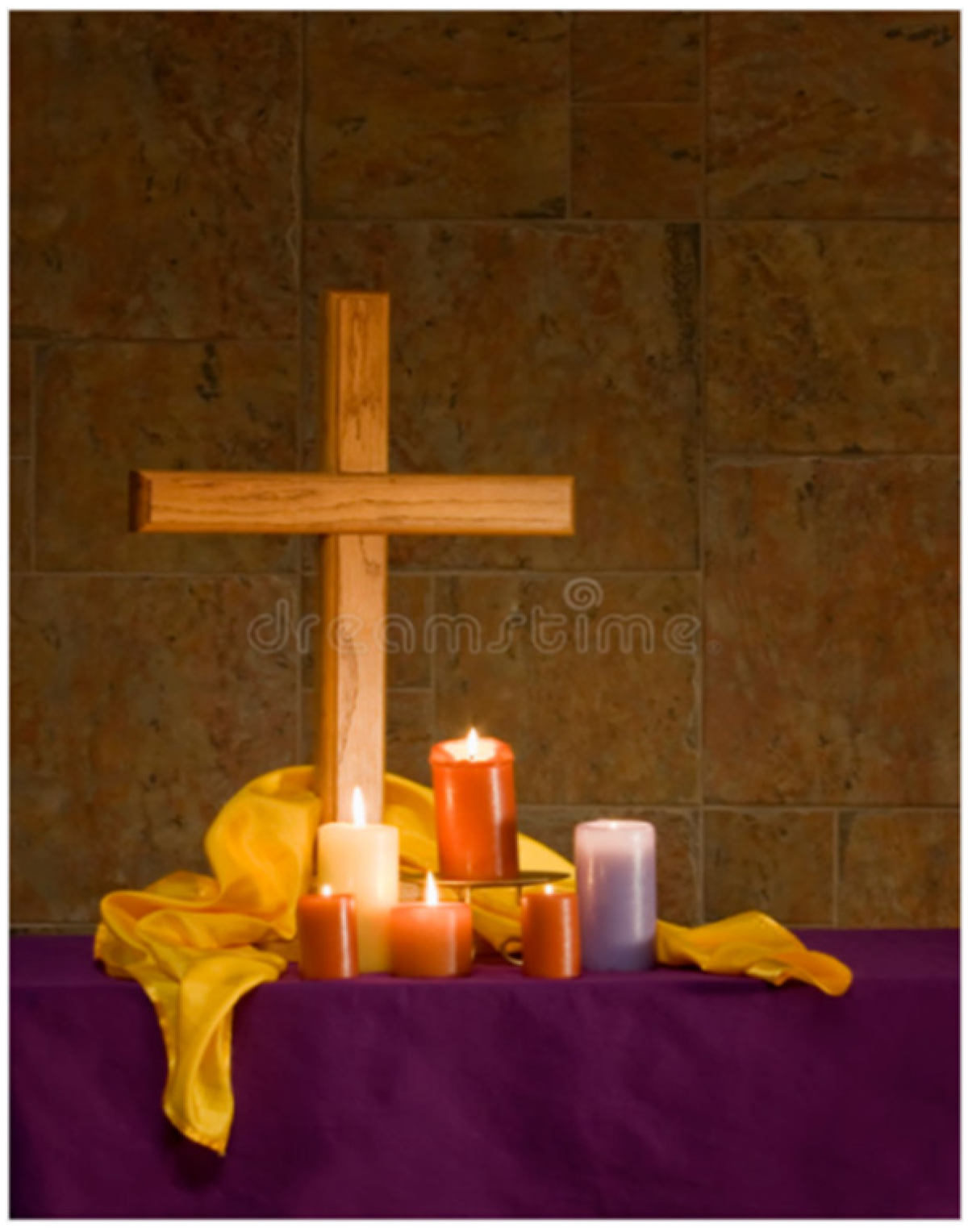
An Onye Amụma's Altar. Source: Ngozi Obi, 2021.
Such spaces, scattered across urban southern Nigeria and many of the rural outskirts, are called ụlọ ekpere (prayer house). Their owners brand them as “healing homes.” I have participated in many of these sessions and have also interacted with other participants – enough to observe that it is not even lost on most clients that what many of these healers do is a Christian smokescreen used to window-dress folk healing, which is where the real appeal lies for many: for things to be laid bare is what it seems they would not just have. Clients are given to the notion that even if the practitioners they consult draw on indigenous tools, the fact that they perform under the cloak of Christianity suggests their practices have been “sanctified” and so become permissible for a Christian. One vignette will help to illustrate this: One Saturday in May 2021, a colleague of mine whose partner was facing many challenges (sicknesses, car accidents, and robbery among them) asked me to take her to an onye amụma whom I had been visiting for my studies. When we got into his consultation room, we saw red candles, images related to Christianity (crucifix, Jesus Christ, Virgin Mary, and so on) in addition to assorted traditional figurines, which, combined, suggested he was ordinarily a folk healer who publicly presented as onye amụma. He allowed my colleague in with me only because of my longstanding relationship with him. (Newcomers would normally first join his other followers/clients in his compound, singing Christian songs and saying prayers in the name of Jesus. None who had not spent a long enough time for their genuine intentions to be established was allowed to see those “hidden” aspects of his practice.) Some moments after our arrival, my colleague, given her open alignment with Christianity, was becoming visibly disturbed. She began to relax only when the man intoned his incantation with “God of Israel; God of Abraham, Isaac and Jacob; God the Father, God the Son and God the Holy Spirit.” In one of my later visits, I remembered to ask him why he always began his divination sessions with the name of the God of Israel. He paused – as a man lost in thought. After that brief moment of heavy silence, he said, speaking to me as one who was already a friend and insider, “You know, […] we have to address people in the language they understand.” Nudged for clarification, he told me, The churches have been telling our people that what we are doing is evil. To dispel that impression, we have to invoke the name of the god they now see as the right one. I know you understand what I am saying. I also trust you won’t go out to say I said so (Akika Ogbodo, 2021, personal communication).
I also paid numerous visits to another onye amụma, whose first encounter with me was full of assessment questions, cautious silence, and concerned looks. His responses in my first conversations with him were full of Bible quotes. But as I repeated my visits over many months and managed to build rapport with him, he began to gradually let me into other sides of his spiritual healing which, in addition to herbs and roots that were not hidden, included ịgba eha/afa (divination) and ịgwọ ọgwụ (charm making). That it took more than being a first-time visitor to discover these implied he was intentional about keeping his real practice from public view – behind the veil of ibu amụma na-igwọ ọya (prophesy and healing). Upon entry into his compound, one was met with his followers (read: clients) singing Christian songs and chanting prayers. If you were not among those he allowed to get really close, nothing would suggest to you that he had other (indigenous) means of healing; these were kept among people he thought had got close enough to be trusted with this information. This includes persons to whom he has provided some form of healing: for, having benefitted from his service makes you a sort of in-group member of this aspect of his practice that might not be popular among the majority “Christian” population around here. Regarding this onye amụma, a client I met just outside his ụlọ ekpere said, This man of God is an instrument God is using to provide healing to us, his children. […] Sometimes he uses herbs and roots […] revealed to him by God, who made all of them. Through prayer and revelation, he is led in the direction of those things so he can use them to serve the children of God like us. The Bible even supports herbal healing. It's just that many of our people don’t want to understand it properly (Okeke Eme, 2020, personal interview).
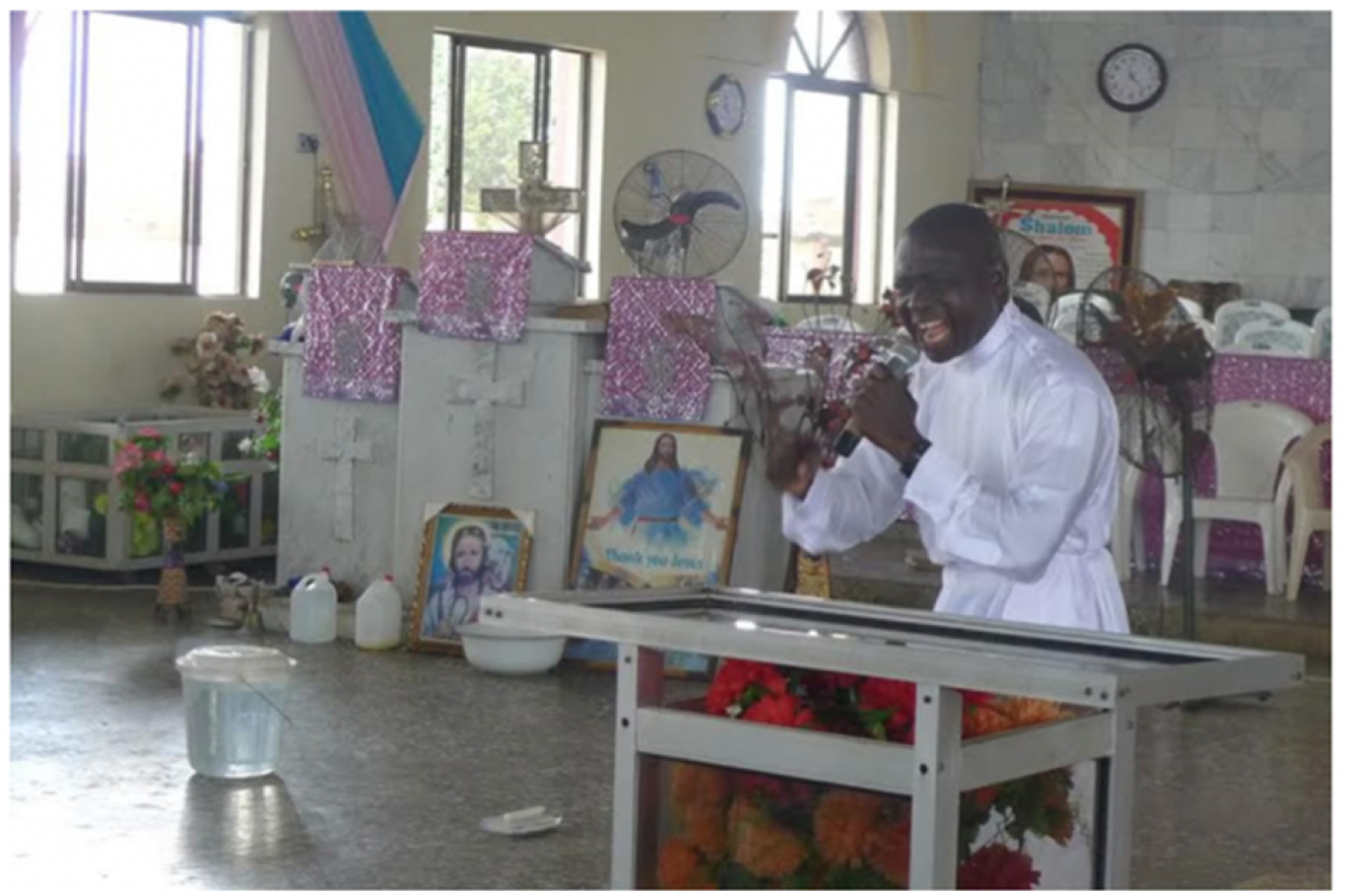
A Healer in a Prayer Session before Commencing Consultations with Clients. Source: Ngozi Obi, 2020.
Many ndị dibia attempting to retain clientele amid the challenges therefore carefully cloak their practice in whatever Christian denomination is prevalent around their locality, organising as ndị amụma of different hues – seers (read: diviners), prophets (read: fortune tellers), and faith/spiritual healers (read: exorcists). At some point, some cautiously introduce herbal healing – long known to them but which they then perform in accordance with their current faith-healer personae – as having been revealed by the Holy Spirit – as some of the vignettes above already depict. In one of the mental-healing homes in Nsukka where weekly Christian prayers and night vigils were organised, the “prophet” (as he self-identified) had an altar covered in white cloth and figurines of Jesus, the Virgin Mary, and a few other Christian personages, alongside candles in assorted colours, incense, and other items normally found in Christian sacred spaces. He always clutched his dog-eared Bible, from which he quoted abundantly, not only to exhort his many clients and visitors but also in his responses during many of our conversations. By way of introduction, he told me, I am a traditional doctor. And whatever a man answers, that is what he is. According to the book of Jeremiah, chapter 1, verse 5, before you entered your mother's womb, I knew what you were. And Daniel is a prophet, bringing spirituality into herbalism, for they are only but one thing
7
(Chijioke Ozioko, 2015, personal communication). I am a prophet of God. Any sickness caused by a negative entity requires deliverance. And this power of deliverance is given to man in the book of Matthew 18:18; that whatever you loosen on earth is loosened in heaven; whatever you bind on earth is bound in heaven. Authoritatively, in the book of Psalm 8, man becomes little less than gods because there is power in the word. And that system of healing is deliverance, casting away; “in the name of Jesus I nullify you evil power to vacate this body that you are occupying, that this body is that of the Holy Spirit.” As the book of 1 Corinthians, chapter 6 says, we start pulling in that individual's spirit in order that, on his own accord, he agrees that Jesus is that person that came and died for our sins. Jesus then comes to dwell in him, and he receives holy healing which is one of the gifts of the Holy Spirit. For as the book of Acts of the Apostles says in chapter 1, verse 8, I will send you power through the radiated authority of the Holy Spirit and his anointing of the Holy Spirit and his power. Then, in the book of 1 Corinthians chapter 12, verse 14, it says that healing power is one of the spiritual gifts of the Holy Spirit. So, it is not bought with money, for God's own grace is not bought with money. It is a gift making the person gifted to be a called one. In the book of Ephesians chapter 2, it is written, “it is by my grace and not by your might” (Chijioke Ozioko, 2015, personal communication). I know the big churches around town now want to find out what I am really doing that makes my healing more effective than theirs and brings me fame. I am not suspecting that you are here for that purpose. But, you know, anything is possible. One must be careful about trusting people these days (Chijioke Ozioko, 2015, personal communication).
The healer's apprehension from the outset about being seen through got me curious. My concern was later borne out in repeated visits. I was to find that he conducted afa/eha – though carefully presenting it as ịhụ ụzọ (prophesy or foretelling) – and other such performances of a dibia in these parts. Once, I was seated with him in the company of a family friend of his, and their conversation veered onto the topic of a dispute over a piece of land over which he was in what looked to me to be a fierce contest with another family. The healer claimed the family was threatening him with sorcery and boasted they would eventually realise whose ọgwụ (charm) was more potent. Among Igbo Christians, there is a metaphor of prayer as the Christian's ọgwụ. In this instance, however, the healer spoke in a manner that was clearly literal. This conversation happened after I had been able to build a level of rapport that normalised my presence in his space. Yet immediately after he made that boast, he stole a glance at me that suggested some quick awakening. What that short, sharp glance meant was not lost on me. I managed to keep a straight face, so as not to betray my impression of the import of that statement, for any mishandling of that quick moment could mark me as persona non grata going forward. Besides, my letting anyone into what I was beginning to learn about the hidden layers of his practice (a fear that he himself had expressed from the get-go before letting me in) would be a breach of confidentiality. This healer's persona is characteristic of how several ndị dibia in southern Nigeria have adjusted to survive in a postcolony where indigenous healing has been historically imprecated especially by the Christian churches and the biomedical establishment (cf. Ugwu, 2018). And this speaks more generally to the identity contest among groups being marginalised in current translocal power dynamics, setting them on a fateful struggle against powerful external forces that have come to strip them of a world they inhabit, a world within which they find meaning and relevance.
Unlike the ndị dibia who now perform as ndị amụma, there are a good number who maintain their undisguised dibia personae. And members of the public who have cause to visit any of this category of dibia usually do so stealthily, like our neighbouring couple mentioned in the opening vignette. It is such Nicodemite clients that the healers charge more. One healer told me that he doubled the charges for many of his Christian clients because “those are the people who condemn us during the day but come to us at night” (Emeka Uwakwe, 2018, personal communication). Christian priests are not exempt from such surreptitious visits. It is an open secret 8 that many Christian priests (especially the new generation of Pentecostal pastors) visit renowned ndị dibia ọgwụ (mystics/charm makers) to acquire magical powers to perform miraculous (or magical) feats. Such enchanting performances popularise them and enlarge their followings, which invariably increases their material fortunes. A huge following implies more income, for it is normal in these parts that the upkeep of the priest/pastor is the followers’ responsibility. The more, the merrier. It makes sense to then mention that much as folk healers adopt the allures of Christianity as a shield to sustain their practice here, Christian priests also draw upon indigenous systems to advance their own fortunes.
Averse to being taken for granted, in any case, the undisguised ndị dibia are deliberate in their pushback. For example, one dibia doubling as a shaman and herbalist told me, Some people come and tell me they have been to the psychiatric hospital. Some of the big [rich] people who bring their mentally ill relatives here come and tell me they have been to the psychiatric hospital. I charge them more because they make treatment more difficult for me (Francis Udenze, 2010, personal communication).
Ogbenye Bụ Ọya – Prophet Onye Eze Jesus, 9 Curer of the Poverty Disease
Among the Igbo and many groups elsewhere, as already hinted above, health-related practices are multifaceted, seamlessly bound up with religious and other social spheres (Last, 2014; Prince, 2014). Here, health extends beyond the boundaries of the body and is intimately tied to matters of prosperity and general self-preservation (Onwuejeogwu, 1992; Shelton, 1971; Ugwu, 2019). Bodily health is conceived as part of wider social relations. If one considers that persistent poverty is now regarded as a form of unwellness (ogbenye bụ ọya 10 ) among many Igbo young people, which they reckon has some supernatural connection, one will perhaps better understand the appropriateness of a performance targeted at restoring material well-being within the remit of the anthropology of health.
Ndị dibia here (several of whom have had to reconstitute their public images as ndị amụma) function in different circumstances as seers, healers, herbalists, rain makers, exorcists, and so on. The Nigerian social mediascape now and again turns the spotlight on an onye amụma called Onye Eze Jesus, whose performance and public presentation demonstrate a deliberate negotiation of the colonial clinical intersubjectivities prevalent among this public. His public performance is featured in this present account because of how it typifies folk practitioners’ innovative struggles in this setting where their practice has been extensively anathematised. One video circulated widely in 2020 shows Onye Eze Jesus taking his clients to a small river in his hometown, Nkpọ (in Anambra State, southeastern Nigeria), where they ritually bathe as he makes pronouncements supposed to exorcise them of the “spirit of poverty,” replacing it with the “spirit of money.” Onye Eze Jesus organises this scene that would ordinarily pass for an indigenous religious ritual but constructs and dramatises it as a Christian performance. He is shown on this occasion making the following comments as his clients (men and women lined up horizontally, naked) take the ritual bath: So long as you are neither a murderer nor a thief, my god will bless you. As they [Onye Eze Jesus’ clients] are being empowered, they would get back to give thanks. There's division of labour. It's God Almighty that owns money and owns water. There is only one power and there is only one God – Jehovah the king of kings and the Lord of Lords; any other god you know does not concern me. You [speaking to clients] will lack money no more. Money will run through your lives. It’ll run on Eke, on Orie, on Afo, on Nkwo [the four days of the Igbo week]. Money will come – left and right, front and back. As you give to ágbàlà’ [now stealing in the name of the water deity in his hometown of Nkpọ Unọ], ágbàlà’ will give to you. Bathe the bath of money [this message is repeated, as he ritually sprays Nigerian currency notes on them].
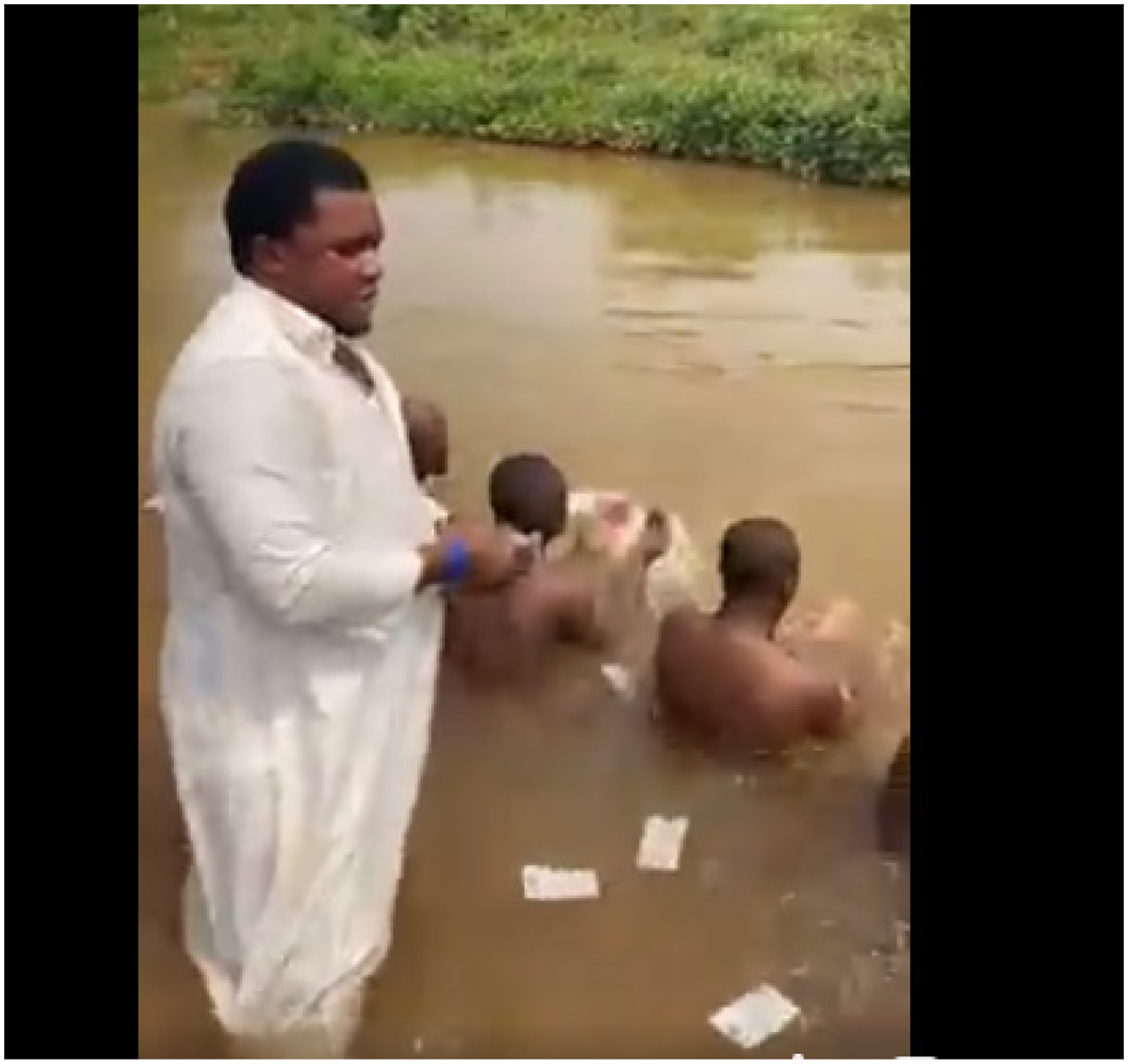
Prophet Onye Eze Jesus Organising a Money-Ritual Bath (ca. 2020). Source: Screenshot from YouTube.com (https://www.YouTube.com/watch?v = -0uWGbf-Zjg).
Making sacrifices to make money and you still call God? Our people wake up! (Efobi, 2021)
I don’t blame you, i only blame our lazy youth that patronize u. U can fool them but please stop using our lord Jesus christ name to cheat people (Ddj, 2021).
Exactly! Time shall come when they will cry (Oha, 2021).
These representative comments depict an environment in which powerful externally driven discourses have anathematised folk practice performed by practitioners such as Onye Eze Jesus. Onye Eze Jesus’ invocation of “God Almighty” and “Jesus Christ of Nazareth” is meant to deflate this run-of-the-mill demonisation of such rituals as his, while in the same breath endorsing it with the influential seal of Christianity. In a narrative that compellingly marshals an indubitable socio-economic rationale for his poverty-curing ritual, he declares, “We help people to make money. If they get money, they will help their government. We’re helping the government. If you raise a billionaire, he will raise his own community.” To further cloak his persona in a garb acceptable to the target public, he hails some Nigerian Christian priests, mentioning names that are obviously thoughtfully selected: Let me hail the persons in whom I’m well pleased […]. Apostle Johnson Suleiman, Prophet Jeremiah Omotayo […]. All my brothers in Christendom, I greet you. Reverend Father Ejike Mbaka […]. It shall be well with all of you in the name of Jesus Christ of Nazareth. Amen!

Prophet Onye Eze Jesus Pictured against a Backdrop of Angels. Source: Getty Images, 2021.
For further context, it looks proper to foreground the socio-economic pressures to which poverty-curing folk practitioners such as Onye Eze Jesus are reacting. The Igbo are known to be vibrant in commerce and have always readily embraced forms of social change that enhance trade, wealth-making, and individual prosperity (Brown, 2007). As this spirit of free enterprise met with the liberal capitalism of the Structural Adjustment Programme (SAP) period of the 1980s, the rising desire for individual wealth was constrained by the unfavourable, liberalist socio-economic transformations introduced by the SAP. In such moments of rapid social transformation, note Comaroff and Comaroff (1999), people tend to recourse to mystique, turning to supernatural ways of dealing with modernity's overpowering deformities. This echoes Gluckman's (1963) “Magic of Despair.” Drawing from Evans-Pritchard's (1937) premise that “new situations demand new magic,” Gluckman theorises that peoples in different societies tend to recourse to the supernatural when faced with disempowering social transformations. This gives context to Dan Jordan Smith's (2007) ethnographic report on southeastern Nigeria in the mid- to late 1990s, which tells of an increasing turn to “money ritual” in the region, accompanied by scary rumours of child kidnapping and thefts of body parts. The recourse to the supernatural as a means of securing one's well-being amid the precarious social conditions of the late 1980s to early 1990s in Nigeria also surfaced in Stephen Ellis (2008) narration of how some senior Igbo politicians sought to secure unquestioning loyalty from their protégés by leading them in oaths of allegiance before a congeries of shrines in Okija, a town in Anambra State. Salacious narratives of grisly ritual murders and cannibalism accompanied the rumours with which the Okija story travelled around the Nigerian mediascape and the passageways of local talk shops in southeastern Nigeria. Although his report was about Igbo political godfathers and their occult dealings with their protégés, Ellis could not avoid noting how the names of prominent Igbo millionaires got in the mix. Mentions of them came in terms of the public notion that the huge government contracts being handed to them (to which they would commit a percentage for some shoddy job and pocket the rest) could have been made possible only by oracular mystique. It was also widely held that they belonged in the same occult groups and shared ritual associations with politicians. We have seen a less extreme cargo cult movement in parts of Melanesia by which locals sought to redress colonially introduced material imbalances through some mimetic rituals apparently aiming to attract, through mysterious means, Western goods to their harbours (Cox, 2018; Lawrence, 1964). Comaroff and Comaroff (1999) use “occult economy” to connote this conjuring of wealth by a resort to mysterious techniques – techniques whose principles of operation are neither transparent nor explicable in ordinary terms. This, they showed, pervaded post-revolutionary South Africa as young people struggled to deal with the unrealised promises of material well-being that the anti-Apartheid struggles had held. Likewise, the huge following that prosperity-preaching Pentecostal churches command in the current context of southeastern Nigeria is largely driven by the widespread desire for material prosperity among young people, but in an economic environment that makes this hard to realise (Smith, 2021). Much like the Calvinist Protestant ethic, Nigerian Pentecostalism envisions wealth among the “children of God” as evidence of God's grace (Obadare, 2022) but does not necessarily attach to it the hard work and asceticism that were central to the Calvinist movement. Like the Catholic and Anglican churches have done from the colonial days, Pentecostalism has grown since the late 1970s, when it entered Nigeria, into a hugely influential force shaping social behaviour and expectations (Wariboko, 2014). It is the forcefulness of the resort to some supernatural help for wealth-making in this environment that explains the huge following that these churches attract (Kalu, 2008).
Highlighting the prosperity-preaching Pentecostal movement as embedded in the context of contemporary southeastern Nigeria matters for this essay because it constitutes a competitive force in the “occult economy” within which folk practitioners such as Prophet Onye Eze Jesus operate, and within which they must innovate to thrive. Given his awareness of the sense of anathema that would meet his money-making rites if presented in its purely traditional nakedness, however, he wraps it up in a Christian cloak, as shown above, which is more generally acceptable to the current popular imagination here. Onye Eze Jesus not self-identifying with any mainline Christian denomination is sensible in order to avoid a possible backlash – for example, in the form of being denounced by the leaders of that church group. He simply calls his own organisation “Prophet Onye Eze Jesus Ministries.” Of course, leaders of mainline churches forcefully preach to their congregations against patronising folk practitioners, and people like Onye Eze Jesus can easily be characterised as one (as some of the Facebook comments above show), no matter how much he tries to present as onye amụma.
The Challenge of Folk Healing as a Constant Fallback
In all, what seems to yet work in favour of folk healing here is this: Although most members of this public mainly identify as Catholic, Protestant, Pentecostal, or (now increasingly) Muslim, among others, many of them are still, at a deeper level, adherents of the indigenous system. Although they would not admit this in the open, when matters come to a head, a resort to indigenous means remains the fallback for the many. Indeed, there is a general notion here that it is within the indigenous system that more immediate results of one's supplications are guaranteed than in the received faiths that seem to postpone things to a future indefinite (cf. Offiong, 1999; Ottenberg, 2012; Ugwu, 2021). This time, the practitioner who looks to advertise their practice – but with the awareness that there is apparent public opprobrium (owing to pretentiously negative colonial subjectivities) against which his client must be guarded – projects this in the frame of Abrahamic faiths. He mindfully appeals to the complex emergent identities and sensibilities this public has come to embody.
Onye Eze Jesus, like other such practitioners in these parts, has choices before him, each with its possible outcomes: He may carry on with the rites in private, in the purely traditional mode (without advertising it), in which case he would not grow his clientele as he would wish to: because if information about his practice does not circulate widely, many will not come to know and patronise him. If he, however, wishes to advertise his practice, he, again, has two choices: either perform it in the purely indigenous mode and risk a shrinking clientele (many will stay away to avoid being labelled “pagan”), or cloak the ritual in Christianity, with which most people are willing to publicly identify. He and many of his ilk have taken the latter option – a sensible thing to do to survive the current ideological power imbalance that translocal hegemonic structures and communicative practices have thrust upon their local world.
Closing Thoughts: Offensive Agency – Towards Epistemic Autonomy
Faced with dwindling clientele due to translocal forces that denounce their epistemic positioning and undermine their material practice, many ndị dibia in southeastern Nigeria have had to morph into ndị amụma. This seemed to be their Hobson's choice in a world in which the levelling momentum of biomedicine and Christianity ever forces them to “delocalise” to maintain relevance.
Properly nuanced, the mode of this unfolding is not syncretism, which basically suggests a synthesis of healing systems. Rather, it is agency, whose enactment is cloaked in the appeals of the “dominant” forces it is up against. This viewpoint demonstrates how a local system seeks to maintain its autonomy not just by shielding itself behind the pretext of ephemeral change in the face of external pressures 11 but also by instrumentalising the allure of its powerful external rivals as a strategy to market and advance itself. We can term this offensive or forward agency.
In the discourses on coloniality and change, the agency of Southern epistemic landscapes has not been necessarily denied; rather, what is generally implied is what we may term defensive or accommodative agency. Syncretism, which is typical of accommodative agency, basically entails the adoption of aspects of the received system, which are then blended with the local in order to protect, enrich, or strengthen the latter. It is through such processes of borrowing and accretional synthesising of systems of practice that human societies have generally advanced themselves. That syncretism is a positive outcome is therefore not in doubt. The point, however, is that, in addition to syncretism, there are other patterns in which local agency could be enacted in the face of external pressures to change. Offensive agency is one more pattern that this account highlights.
Furthermore, public reconstitution of one's social persona as a survival strategy has been noted in what the Indian social anthropologist Mysore Narasimhachar Srinivas has called Sanskritisation – a process whereby members of a lower caste try to rise in the hierarchy by publicly rejecting their own identity and adopting the “higher” attributes of the caste above them. However, whereas Sanskritisation suggests the intention to slough off an “original” identity in favour of a “higher” one (inclined agency), offensive agency is aimed at protecting an “original” system while pretending to have dropped it in favour of a homogenising external order. In the particular account that makes my case, one may note parenthetically, offensive agency is enacted by an autochthonous system to survive an external force, whereas in Sanskritisation, both the “dominant” and its “subordinate” systems are local, produced within the same social history of the Hindu environment and culture.
There is another relatable story of early Christians led by St Paul validating Athenian gods as a strategy to enable Christianity to gain acceptance among the local population (Acts of the Apostles, 17). In a comparable
In sum, inclined/accommodative agency refers to the adoption of aspects of received knowledge and/or practice which are then blended with the local in some way so that the local survives or even gains strength (cf. Offiong, 1999). Syncretism and other forms of hybrid outcomes, such as glocalisation 12 (Robertson, 1995) and transfiguration 13 (Kehr et al., 2019), typify this. Inclined/accommodative agency may also unfold in the sloughing off of an undesirable element or identity and the adoption of a dominant one in order to gain acceptance into the dominant group – as noticed in Sanskritisation, for instance. In forward/offensive agency, on the other hand, the clear intention is not to achieve hybridity but to protect the epistemic autonomy of the local system by dissembling having adopted a homogenising external order while using its garb merely as a shield. A smokescreen of change is projected by the locale, indicating, to an external eye, that change has happened, while the core of the social sphere in question remains shielded behind that façade of change. This viewpoint does not necessarily deny other forms of agency or different modes of epistemic transformation that have been reported by other observers. This account seeks only to name and nuance offensive/forward agency as an additional perspective to the observations that have been made about agency of marginalised groups elsewhere.
Footnotes
Declaration of Conflicting Interests
The author(s) declared no potential conflicts of interest with respect to the research, authorship, and/or publication of this article.
Funding
The author(s) disclosed receipt of the following financial support for the research, authorship, and/or publication of this article: This work was supported by the Harvard Radcliffe Institute, (grant number HRI 2021-22).