




Abstract
This article describes how the mass media in Ghana use quantitative information to communicate the prevalence of child labour. During the period 2000–2020, stories about child labour frequently appeared in Ghana’s mass media. Within nearly 30 per cent of the stories, at least one numerical quantification is used. Quantifications appear to be constructed primarily to dazzle readers. The large numbers and the weight of the technical jargon used would appear to significantly reduce the potential to inform. We ask why successive governments have not used the mass media tools at their disposal to more effectively address the complex policy problem of child labour.
Introduction
To address complex public policy problems requires leadership, political commitment, and resources, but in democratic settings, an informed public can be equally important. In some cases, a section of the public provides the stimulus for action; in others, selected members of the public may play a role in developing or prioritising possible responses; while in still others, public attitudes and behaviours are seen as part of the problem. In the latter case, information dissemination through the mass media can be important in all phases of the policy process (DeJong, 2002; Soroka et al., 2012).
Child labour (or harmful children’s work) is an example of a complex public policy problem that cannot be successfully addressed without an informed and sensitised public. 1 Nowhere is the need to address child labour more pressing than in the West African states of Ghana and Côte d’Ivoire, where persistent claims of the widespread use of child labour pose a significant threat to the cocoa sector. Cocoa contributes 7 per cent and 10 per cent of GDP to the economies of Ghana and Côte d’Ivoire, respectively (World Bank, 2018, 2019). In Ghana, child labour is most commonly associated with cocoa, but it is also claimed to be endemic throughout agriculture (Ghana Statistical Service, 2014b; UCW, 2017), fishing (ILO-IPEC, 2013; Sackey and Johannesen, 2015; Singleton et al., 2016), and artisanal mining (Human Rights Watch, 2015; Okyere, 2017a). While there is still much debate about the nature, causes, extent, and effects of child labour in Ghana, the government remains under pressure from both markets (particularly with cocoa) and powerful development partners to address the problem. Successive governments have seemingly done all the right things, including: ratification of the UN Convention on the Rights of the Child (1991); passage of Children’s Act (Act 560) (1998); ratification of UN Convention 182 on the Worst Forms of Child Labour (1992); launching a National Programme for the Elimination of Worst Forms of Child Labour in Cocoa (2006); publication of National Plan of Action for the Elimination of the Worst Forms of Child Labour (2009–2015), with a second phase in 2017; and collaboration with key international agencies including the International Labour Organisation (ILO) and United Nations Children’s Fund (UNICEF). Nevertheless, in the all-important cocoa sector, the latest available data, although disputed by the governments of Ghana and Côte d’Ivoire, suggest little progress is being made in reducing child labour (Sadhu et al., 2020).
This article addresses the part played by the mass media in the effort to eliminate child labour in Ghana. Our approach is essentially descriptive and focuses specifically on the media’s use of quantitative information to communicate the prevalence of child labour and associated abuses, including child trafficking and child slavery. We concentrate on what is being quantified; the sources of the quantitative information; and how quantification is used in framing the problem of child labour and why it should be addressed. Ultimately, we are interested in what the use of quantitative information in the mass media says about efforts to address child labour. Our objective is to draw attention to an important area of research and provide some initial hypotheses on which future research could focus.
We analyse 175 stories about child labour, child trafficking, and/or child slavery that appeared on the website GhanaWeb.com between 1997 and March 2020 and that presented quantitative information on the prevalence of child labour. The argument we develop is that child labour is a complex social and economic phenomenon. Communication about child labour is made even more difficult by the obscure technical language and definitions that arise from overlapping conventions and legal and sectoral frameworks. A lack of effort on the part of government, politicians, experts, and the media itself to translate, explain, or cut through the resulting complexity means that quantitative information about child labour in the media is unlikely to increase public understanding. Given the role of the state-controlled Ghana News Agency (GNA) in supplying stories containing quantitative information about child labour to mass media outlets, including Ghanaweb.com, questions must be asked about the government’s commitment to actually addressing the problem. More broadly, we argue that the quantified messages around child labour that appear in the media represent a missed opportunity to leverage the mass media to better inform the public and foster support for efforts to address this important problem.
Others have studied the quantitative representation (or misrepresentation) of complex social issues like intimate partner violence (Carlyle et al., 2008) in the media; however, the focus is often on how media representations compare with existing data sets. In contrast, the contribution of our paper is to provide a first systematic exploration of how quantitative information about child labour is presented in the Ghanaian mass media. We develop and use a four-part model to deconstruct quantitative statements about child labour.
Before proceeding, it is important to be clear about what the article does not do. It does not attempt to evaluate the evidence concerning the prevalence of child labour in Ghana. Nor does it review the technical terminology that underpins the study and regulation of child labour, or evaluate whether or not the newspaper stories are using this terminology correctly. Finally, no attempt is made to establish a causal link between media coverage of child labour and public understanding or attitudes; but hopefully, the paper will draw attention to the importance of this as a research area.
The remainder of this article is organised in four sections as follows. The next section provides background material covering three areas: the interplay between policy, the media and social change; the psychology literature on the ways people with different levels of numeracy process numbers in text; and child labour in Ghana, which we argue has all the characteristics of a complex social problem, requiring accessible and comprehensible information and public discourses. The next section describes the methods used to analyse the 175 stories, and a presentation of the results. The last section explores three possible explanations for the failure to use the mass media effectively, either politicians want to avoid the complex problem of child labour and do so by keeping the public in the dark; they fear that smallholder cocoa production is reliant on child labour and informing the public could be a hindrance; or finally, they are focused primarily on short-term goals in order to secure reelection and are less concerned about the long run.
Background
Policy, People, and the Media
In democratic contexts, it is impossible to imagine how complex social, economic, and environmental issues, like racism, entrenched poverty, human trafficking, or climate change can be addressed without the engagement of the public. This engagement might be relatively passive, fostered, for example, through the dissemination of information about the issue and how it will be addressed. Here the policy is likely to be already set, and the point is to inform the public to facilitate implementation (Gesualdo et al., 2020; Walters et al., 2000). More active engagement might include participation in referenda or deliberative exercises, such as citizens juries, which aim to gauge public sentiment and identify and/or prioritise potential interventions (Bingham et al., 2005; Smith and Wales, 2000). In this case, the point is to bring the public into the policy formulation process, with the hope of increasing the chances of successful implementation. Depending on the context and issue, exercises like these may also require a significant investment of time and resources to inform and educate the participants.
Historically, the mass media, including newspapers, radio, and television, would have been central to all public information campaigns about important social issues. Walters et al. (2000) argued that the news media is used by policymakers to educate and persuade the public in relation to either “moderately-” or “ill-structured” issues – i.e. where there is limited information, few alternatives for action, and outcomes from decisions are mostly unknown. More broadly, the role of the mass media in setting the policy agenda has been widely discussed. Yanovitzky and Weber (2019) proposed that the news media provides five functions: awareness, accessibility, engagement, linkage, and mobilisation. Wolfe et al. (2013) noted that the media has pervasive effects on the public, which can drive agenda change, policy change, and policy outcomes. Recent examples of the media playing a critical role in generating public awareness around difficult issues include climate change (O’Neill et al., 2015; Smith and Joffe, 2009), racism, and other forms of discrimination (Amin-Khan, 2012; Lamour, 2019), sexual assault, and sexist cultures (Xiong et al., 2019).
Policy advocates’ use of the mass media during the early phases of the policy process is one thing, but as highlighted above, there may also be a need to inform the general public as part of implementation. Few studies have looked specifically at this (also see Soroka et al., 2012), however, some have drawn attention to how the mass media can stifle public discourse by creating a sense of moral panic (Altheide, 2009; Costelloe, 2006).
The growth of the internet and social media has fundamentally changed the quantity and type of information and opinion that are available, and how they are accessed. The public now more directly influences newsrooms in terms of content and style of reporting (e.g. Ferrucci, 2017). While traditional media controlled by governments, political parties, media barons, or profit-seeking corporations have long promoted particular views or ideologies, the new media landscape has increasingly blurred the lines between news, opinion, and entertainment, on the one hand, and public, commercial, and political interests on the other.
What’s in a Number?
Policy communication aimed to influence the general public must minimise complexity, ambiguity, and uncertainty (Roe, 1994). It does this through rhetorical devices, including the use of quantitative information, which can convey credibility, expertise, and certainty. Following the Oxford English Dictionary, we use the term quantification to mean “the action of quantifying something.” Quantification can either be non-numerical (many, high, low, several, few) or numerical, and in the latter case, can use round (2 million) or sharp (2.154 million) numbers. Numerical and non-numerical quantifications are often coupled, which allows the communicator to emphasise or de-emphasise a phenomenon, and add meanings to numbers in ways that can better persuade or manipulate an audience (Brase, 2002; Viswanathan and Childers, 1996). Attaching normative values (small or high) to a seemingly objective number allows a communicator to engage in “subtle interpretive work” (Potter et al., 1991: 256). Whether it is intended to inform, persuade, or deceive, quantification in the mass media can act to “suppress distinctiveness, absorb uncertainty and expunge ambiguity” (Espeland, 1997: 1117), and thus minimise an audience’s inclination or ability to critically appraise some claims or findings.
The literature on numerosity heuristics, focusing on what people infer about quantity from numbers, shows the importance of the type and scale of the numbers used. Round numbers suggest approximation, which implies uncertainty and low confidence, while sharp numbers suggest exact knowledge, and support higher levels of confidence and believability (Dehaene, 2011; Schindler and Yalch, 2006). While larger numbers are often less well understood and may lead an audience to misjudge a phenomenon, they are nevertheless employed by communicators because they signal the significance or importance of a phenomenon. Some refer to this communication strategy as the “bigger-is-better” heuristic (Bagchi and Davis, 2012, 2016; Pelham et al., 1994). Of course, with child labour, this becomes the “bigger-is-worse” heuristic.
Psychologists explain the tendency to be less critical of quantified claims with reference to two distinct ways that humans process information: central cognition and peripheral cognition (Yalch and Elmore-Yalch, 1984). Central cognition is used to directly examine the information being communicated, including its underlying logic and merit. In contrast, peripheral cognition only examines factors external to or surrounding the information itself, such as the credibility or expertise of the communicator or source. Depending on the numeracy levels of the audience and the type of quantification used, people respond differently to quantified messages. For instance, those with low numeracy levels are less able to be critical of numerical messages – they make limited or no use of central cognition, making them look to the credibility or expertise of the communicator. By employing peripheral rather than central cognition, low numeracy audiences are “in a way, outsourcing fact-checking to the communicator (Haugejorden, 2016: 13; Yalch and Elmore-Yalch, 1984). While individuals with high numeracy levels are more able to understand – and potentially critique – quantified messages (Hart, 2013), they are also susceptible to accepting them at face value (Yalch and Elmore-Yalch, 1984).
For a quantified message to work, the credibility of the communicator, the source of quantification, and the clarity around what is quantified are all critical. Experts are expected to use quantified messages, and failure to do so raises suspicion (Artz and Tybout, 1999; Yalch and Elmore-Yalch, 1984). In other words, quantified messages appeal to the peripheral cognition when the communicator highlights his or her expertise or the credibility of the source (Artz and Tybout, 1999; Kadous et al., 2005). Invoking authoritative sources such as international organisations serves a dual purpose of establishing the credibility of both the source and the message. According to Jerven (2016: 2), “the reason we trust numbers is not only due to technical accuracy, but as much to the social power, legitimacy, and credibility of the institution that provides the facts.”
The Landscape of Ghana’s Mass Media
Ghana’s mass media has been characterised by state-elite control since the colonial era. The first newspaper was published in 1822 and was state-owned. Prior to 1935, the press enjoyed significant freedoms, and several privately owned newspapers were established. However, the state-media relationship was blurred in 1935 when Governor Sir Arnold Hodson established a state-owned and controlled radio station, modelled on the BBC, to counter what he considered to be anti-colonial propaganda in nationalist newspapers (Hasty, 2005). The monopoly model was then embraced by Nkrumah’s post-independent government. It established the Ghana News Agency (GNA) on the eve of the country’s independence (March 5, 1957); acquired the national paper, Daily Graphic; banned private news media through the 1963 Newspaper Licensing Act; and consolidated radio and TV broadcasting under state-ownership and control (Gadzekpo, 1997; Hasty, 2005; Twumasi, 1981).
Following the overthrow of Nkrumah’s government in 1966, the mass media struggled to exorcise the legacy of state control and influence. Successive governments reshuffled or replaced the editorial staff of state-owned media outlets to ensure that editorial positions aligned with government ideologies (Anokwa, 1997; Hasty, 2005). The democratic awakening of the 1990s was accompanied by new protections for press freedom (Articles 162 and 163 of the 1992 Constitution), the repeal of the newspaper licensing law, and establishment of the National Media Commission with a mandate to protect state-owned media from manipulation and interference (Gadzekpo, 2008; Hasty, 2006). These developments led to a proliferation of private media outlets. Today, Ghana’s media landscape comprises a mix of state and privately owned outlets, including newspapers, FM radio (399 stations, many of which are local), and television (96 operating stations) (National Communications Agency, 2019). Some of these outlets also have an online presence. There are also news aggregator websites, of which GhanaWeb.com appears to be the most popular.
Ghana’s media landscape is increasingly dominated by wealthy commercial interests (IREX, 2012; Nyarko, 2015). There is also a trend of politicians setting up media houses for political and business interests (Hasty, 2005; Owusu, 2012; Shardow and Asare, 2016). In this context, advertisement and other forms for corporate and party political funding affect editorial independence. Public media outlets are restrained from acting as an independent watchdog over a ruling political party but are unleashed on rival political parties (Asah-Asante, 2007; Danso and Edu-Afful, 2012; Shardow and Asare, 2016).
Research suggests that radio is by far the most popular source of news, followed by TV, digital media, family and friends, and newspapers (African Media Barometer, 2013; Afrobarometer, 2020; Temin and Smith, 2002). However, it is important to note that this information underestimates the importance of newspapers, and the GNA, because radio and television news pick up stories from these sources. For example, radio and TV talk shows discuss newspaper headlines and stories (African Media Barometer, 2013). According to Hasty (2005: 2), “…newspapers constitute the very terms of local news discourse [in Ghana]: identifying the main characters, the important local events, and recurring themes – subsuming all in an ongoing narrative frame of national news.”
Much of the news that appears in Ghana’s mass media, including GhanaWeb.com, originates with the GNA (Sikanku, 2011, 2014). The GNA is an agency of the Ministry of Information and acts as a central news collection agent of the state. It describes itself as being “instrumental in carrying government messages, policies, plans and programmes to the people, including those in the remotest areas of the country” and says that its “operations also give a voice to the vast majority of citizens living in rural areas, thereby promoting good governance and reducing the urban bias of news reportage.” 2
In summary, Ghana has a diverse and vibrant media sector. Nevertheless, the landscape of state-centric public media and profit-centric private media, plus falling journalistic standards (Gokah et al., 2009; Skjerdal, 2018), has been linked to the gradual displacement of informative content by sensationalism (see African Media Barometer, 2013).
Child Labour in Ghana
In rural areas of Ghana, as throughout sub-Saharan Africa, childhood and work have been closely interwoven for centuries (Van Hear, 1982). Whether helping at home, on the farm or in the family business, children have been, and remain, integral to much rural economic activity. Even today, after significant progress in raising school enrolment, many rural children combine education and work. Children’s work contributes to the household economy, generates pocket money, helps defray the cost of school for themselves and their siblings, and increases the children’s sense of self-worth and social standing (Maconachie and Hilson, 2016; Thorsen, 2012).
On the other hand, “child labour,” which can broadly be understood as inappropriate, hazardous, or harmful work, represents a policy challenge of the utmost importance. In addition to putting the cocoa sector at risk (cocoa is Ghana’s most important agricultural export), child labour is associated with agriculture more generally, as well as mining and fishing. Indeed, most child labour in Ghana is thought to be concentrated in the agricultural sector, which in 1980 (the latest figures available) was estimated to encompass 1.85 million predominately small “farm holdings” (FAO, 2001). This means that most “child labourers” live at home, go to school, and work on their parents’ or relatives’ farms (see Sadhu et al., 2020).
The literature on child labour in Ghana is extensive (Admassie, 2002; Berlan, 2009; Hamenoo et al., 2018; Lambon-Quayefio and Owoo, 2018; Okyere, 2017a, 2017b; Singleton et al., 2016). Nevertheless, reliable data on the prevalence of various types of child labour, the hazards children encounter, and the harms they experience are scarce. The first and only national survey specifically focused on child labour estimated that 1.27 million children were in child labour, and this included a quarter of all rural children (Ghana Statistical Service, 2003). The 2012/13 Ghana Living Standards Survey (GLSS 6) estimated that 30 per cent of children in rural areas were in child labour, and 20 per cent of all rural children were involved in “hazardous child labour” (Ghana Statistical Service, 2014a; also see UCW, 2017). The most recent survey of cocoa-growing areas estimated that 1.27 million (or 64 per cent) of children were engaged in child labour in agriculture; and the study provided no evidence that the number of children working on cocoa farms who are in child labour is decreasing (Sadhu et al., 2020). It is commonly assumed that child labour is primarily a result of poverty.
As indicated in the introduction, the government of Ghana has put in place a multi-faceted legal and policy framework to address child labour. Two aspects of the child labour problem make it particularly difficult to address through policy. First, efforts to address child labour are framed by a complex, multi-layered body of international human rights instruments, nomenclature, definitions, national legislation, and regulations. 3 Together they set out the kinds and conditions of work that are and are not acceptable for children of specific ages. In Ghana, specific guidelines for the cocoa sector detail guidance related to acceptable tasks, loads, tools, hours of work, etc. (Amoo, 2008). As we will demonstrate, the resulting labyrinth of technical terms works against clarity of understanding and communication, resulting in child labour often being bundled together with trafficking, slavery, and other social ills, including child abuse and prostitution. Second, the education of parents and the public about child labour is challenging because these complex legal definitions run up against local norms and expectations around childhood, and associated social institutions including fostering and apprenticeship (Okyere, 2017b).
Methods
This study used the website GhanaWeb.com to provide a window on how media in Ghana cover the issue of child labour. GhanaWeb.com generates its own content and aggregates content from 45 Ghanaian print and online media partners 4 , including the government-owned Ghana News Agency (GNA). It claims to be “the most popular news website in Ghana and ranked the third most visited website in the country after Google and YouTube” 5 , with 3–4 million unique visitors per month and 90 million monthly pageviews. Sixty per cent of the website’s traffic comes from Ghana, and the remainder mainly from the USA and Europe. 6
GhanaWeb.com provides a searchable news archive covering the years 1995 to the present. During February and March 2020, we conducted a search of the news archive for all articles categorised as news, business or opinions, which contained any reference to “child labour,” “children’s work,” “slavery,” or “trafficking.” This search yielded 1350 individual stories. The full text and the associated metadata, including Ghanaweb.com’s attribution of the source of each story, were imported into Zotero, a free and open-source reference management software. 7 On closer inspection, it became clear that some texts made only the most fleeting reference to child labour. All 1350 stories were then inspected carefully to identify those that were primarily or substantially about child labour or related issues. This yielded a sub-set of 627 stories that were imported into Nvivo, read carefully, and coded. Coding included whether the story contained quantification of any aspect of child labour (including child slavery and child trafficking); the source of the story; the motivation (i.e. release of a new report, a seminar focusing on child labour, etc.); and the source of the quantitative information presented in the story. Each individual quantification was then coded in relation to four constituent elements: the quantifier (e.g. 8 million); the subject (e.g. children); the spatial scale (e.g. in Ghana); and the predicate (e.g. are involved in hazardous work). The main variants of each of these elements are shown in Table 1.
Main variants of four quantification elements.
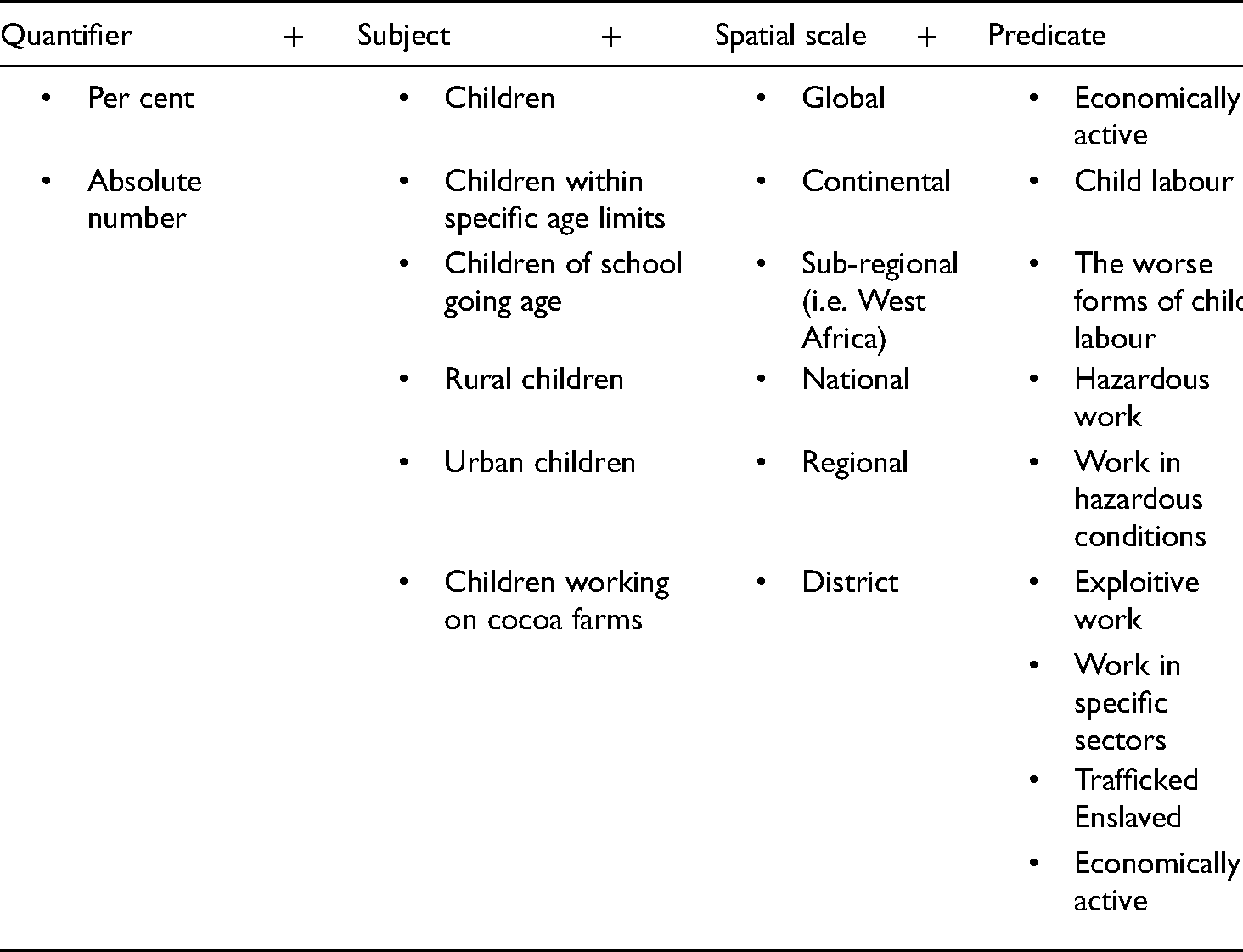
This article focuses on the 175 stories that contained one or more quantifications: many stories had more than one, and in total 409 individual quantifications were identified. For some parts of the description that follows, we treat the stories as cases, while for other parts, the individual quantifications are treated as cases.
We recognise that GhanaWeb.com does not provide complete coverage of the mass media in Ghana, and that, particularly in the early years, coverage was likely to be incomplete. Nevertheless, the relatively large number of sources that GhanaWeb.com draws from, and the fact that the search strategy yielded nearly 200 stories with quantifications, gives us some confidence that we are working with a reasonable sample.
Findings
Quantifications in Context
The sources of the 175 stories containing at least one quantification are shown in Figure 1. From 1997–2004 through 2010–2014, the GNA was by far the single most important source, supplying between 65 and 80 per cent of the stories. During the 2015–2020 period, this dropped to 25 per cent, with nearly 45 per cent ( = 30 stories) originating from 19 other sources. Twelve of these sources supplied only one story each, while at the other end of the spectrum, 3news.com, a website associated with TV3, a free-to-air channel owned by Media General Ghana Limited, supplied four stories. Given that many media outlets have limited in-house capacity to gather news, it would not be surprising if at least some of the stories from non-GNA sources were based on material originating from the GNA.
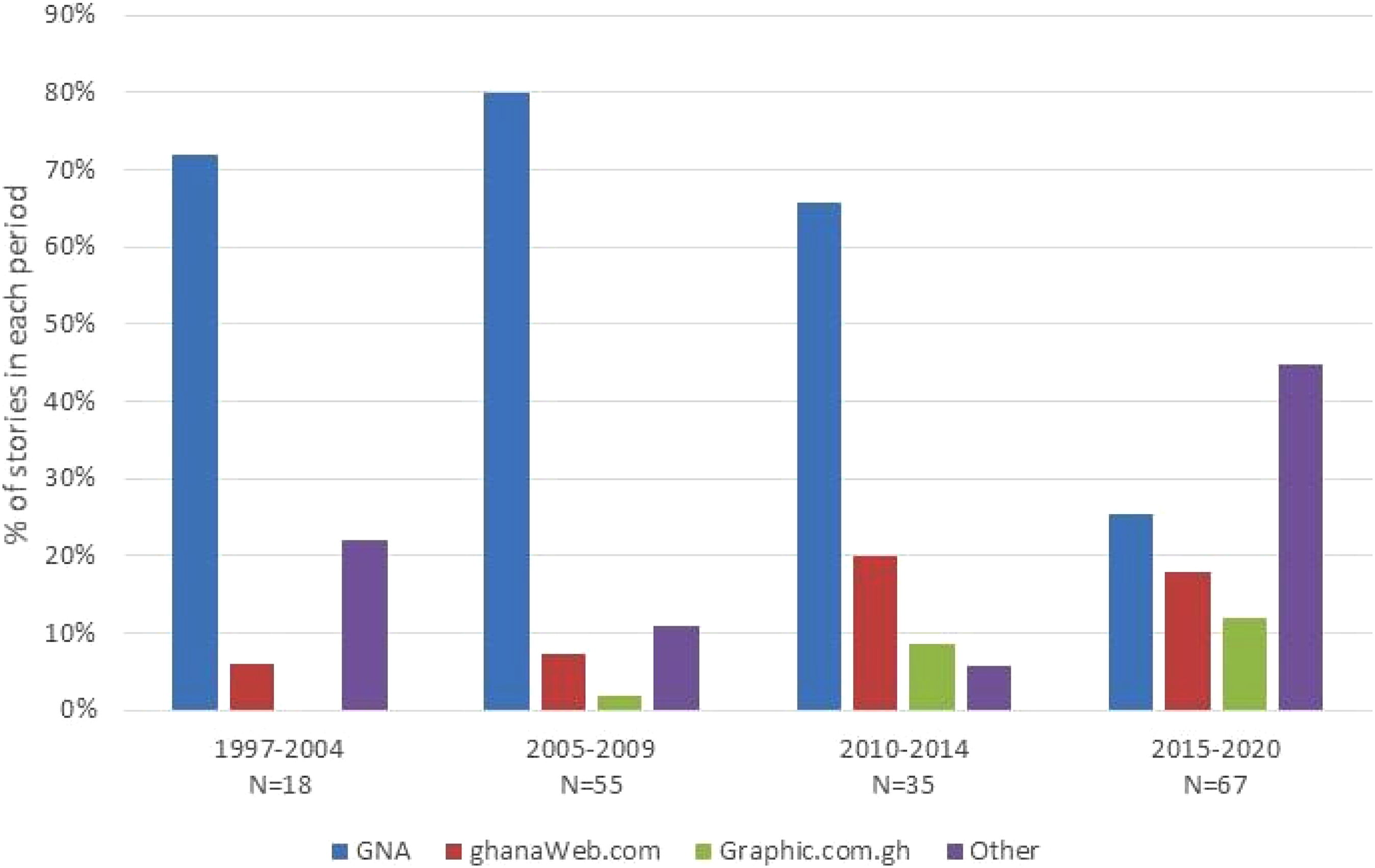
Source of 175 stories with quantifications, by period.
Overall, nearly half of the stories were motivated by either an international day to highlight child labour or slavery, or a workshop or seminar (Figure 2). However, during the 2015–2022 period, the motivations were more diverse, with a decline in those linked to workshops or seminars, and an increase in stories motivated by the CNN documentary Troubled Waters and by initiatives to “rescue” children said to be trafficked or enslaved. While some stories were motivated by events or actions of NGOs (Empowerment Aid, 2017; GNA, 2007b; IJM, 2016; viasat1.com.gh, 2015), only a few were linked to actions of companies or industry bodies (Nestlé, 2017).
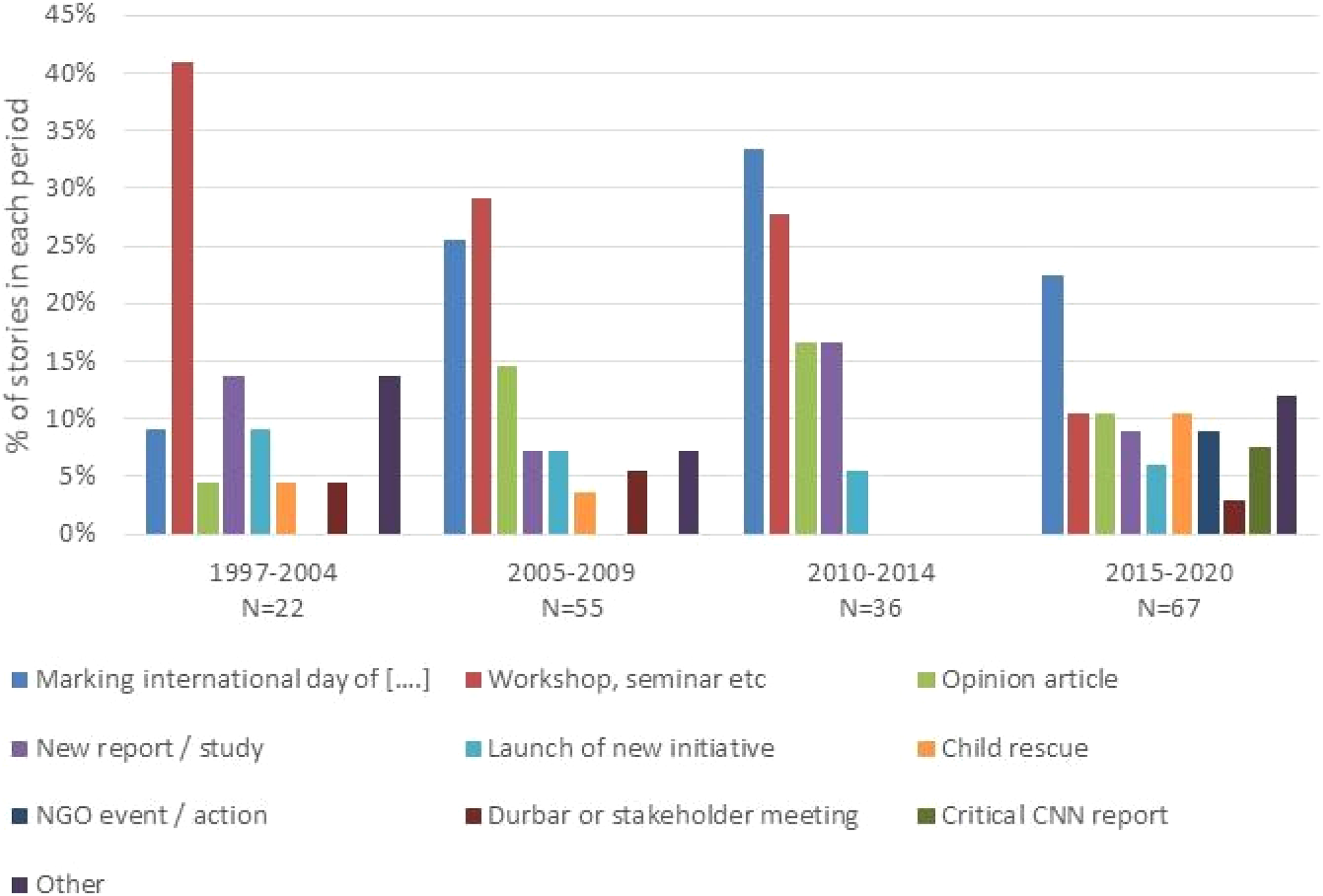
Motivation of stories with quantifications, by source and period.
Some quantifications cite a specific study or source, others cite non-specific sources (i.e. “ILO statistics,” “a survey,” or “government statistics”), while others do not cite any source. One source repeatedly cited is the Ghana Child Labour Survey (Ghana Statistical Service, 2003). This is the first and only national survey specifically focused on child labour, and it was still being cited as late as 2015 (Tv3network.com, 2015). Other sources include the sixth round of the Ghana Living Standards Survey (GLSS 6) (Ghana Statistical Service, 2014c), which included a special report on child labour (Ghana Statistical Service, 2014b), and a large survey of child labour in the cocoa sector (Tulane University, 2015).
Quantifications Deconstructed
Quantifications of the prevalence or importance of child labour in the 175 stories range from the relatively simple, such as “she said there were over 800,000 children in Ghana involved in hazardous labour” (ghanaWeb.com, 2002); through the less simple, “2.47 million children, about 40 per cent of Ghanaian children aged between five years and 17 years, were economically active, with about 1.27 million being active in activities classified as child labour” (GNA, 2005b); to the highly complex, containing several related or subordinate elements, e.g.: an estimated total of 1,273,294 (20 per cent) of children in Ghana are engaged in child labour. Out of the 2,474,545 (39 per cent) of children engaged labour, 6,361,111 are into economic activity with over 1,031,220 children under 13 years. In Ghana, the largest proportion (57 per cent) of working children are in agriculture, hunting and forestry; 20.7 per cent in sales; 9.5 per cent into production and 11 per cent in other general workers such as porters, truck pushers and drivermates. The records showed that 242,074 children engaged in Worst Forms of Child Labour work in dangerous and hazardous environment, exposing them to injuries, toxic substances, sexual abuse, violence and even death. (GNA, 2007d)
The most frequent subject (element 2) of the quantifications is simply “children,” which refers to anyone below the age of 18 years in the Ghana policy and legal context. However, many quantifications specify age limits (e.g. “children aged 5–17”; “children, boys and girls, between the ages of 5 and 14 years”; “children under 13 years”). Other qualifications are also used: “rural children,” “working children,” “children working on cocoa farms,” “children of school age,” and so on.
The spatial scale (element 3) covered by the quantifications ranges from the entire world to one of Ghana’s administrative districts. Since 2000 around half of the quantifications have been specified at the national scale (i.e. Ghana). During the 2015–2020 period, 13 per cent of quantifications refer to Lake Volta (previously, there were none), and this is linked to a similar increase in child slavery as the predicate of the quantifications (see below). Global, African, and regional scales are common in quantifications originating from ILO staff and often appear in stories that subsequently provide national scale quantifications. Reflecting specific survey work or studies, scales such as “in the cocoa sector” (GNA, 2011b: e.g.), “on cocoa farms” (e.g. Public Agenda, 2006) and “in Ghana and Côte d’Ivoire” (e.g. Okertchiri, 2017) also appear, particularly during the 2015–2020 period.
The fourth and last element of the quantifications is the predicate. Economic activity, work, domestic labour, child labour, hazardous child labour, the worst forms of child labour, unpaid family labour, trafficking, and slavery are the most common. Figure 3 shows the frequency of these terms by period. Since 2000, a decreasing share of quantifications have focused on economic activity while there has been more frequent reference to child labour, education, and slavery, with references to the latter increasing significantly in the 2015–2020 period. Much of the discussion of child slavery in Ghana relates to fishing on Lake Volta, stimulated in part by publications by ILO-IPEC and NGO International Justice Mission (ILO-IPEC, 2013; Singleton et al., 2016). In 2018, the Ghana government launched a strategy to counter child labour and trafficking in fishing communities (MOFAD, 2014), which was developed with the help of USAID. 8 But, perhaps the most important stimulus for the higher profile of slavery in the mass media since 2015 was a 23-min documentary film entitled Troubled Waters: Inside the child slavery trade broadcast by CNN in February 2019 (CNN, 2019). Three news stories from 2019 (3news.com, 2019; citinewsroom.com, 2019; www.ghanaweb.com, 2019), together accounted for eight of the 17 individual quantifications relating to slavery during the 2015–2020 period, and all make reference to the CNN film.
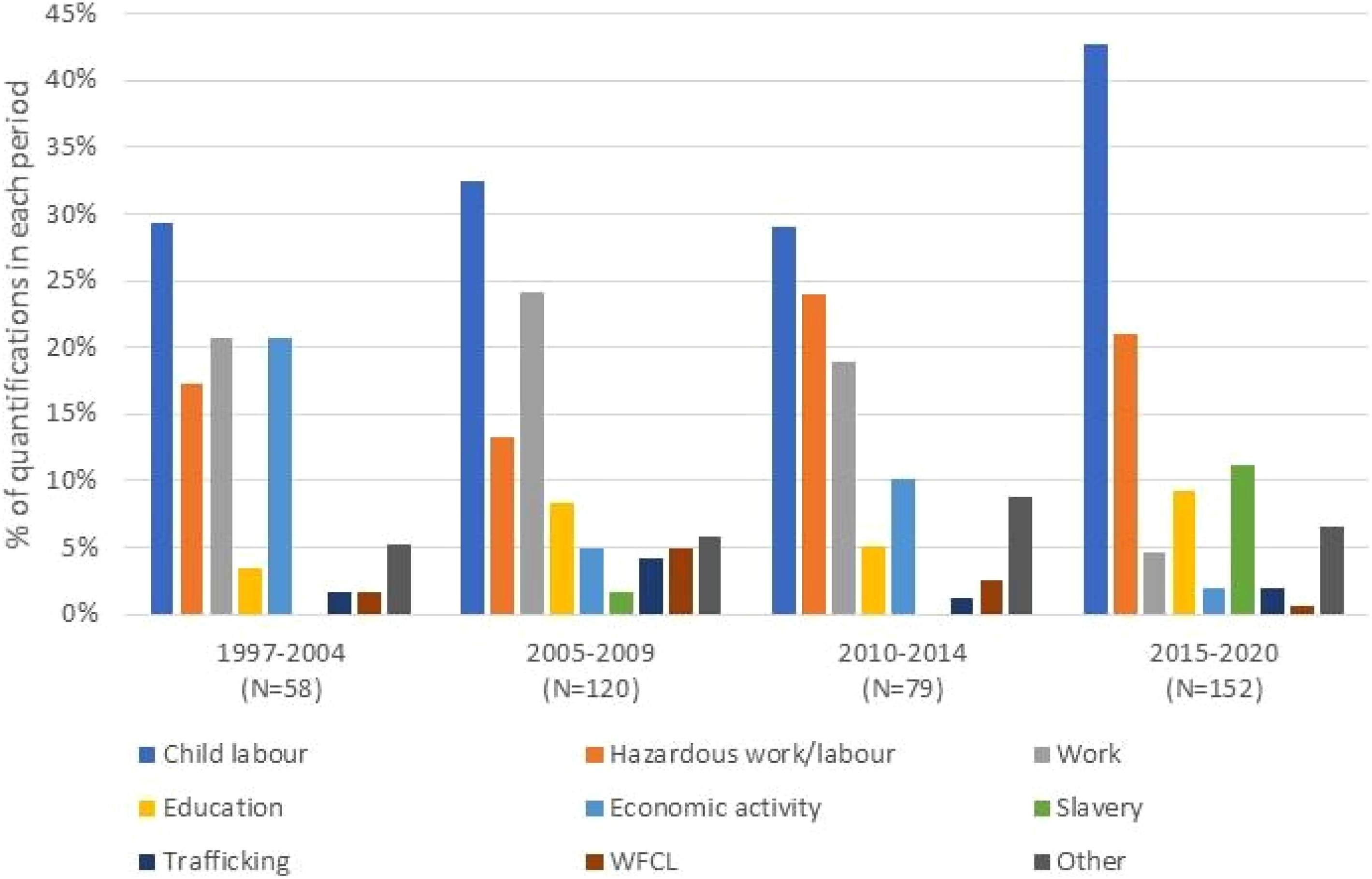
Share of quantification “predicates,” by period.
To those who are well versed in child labour conventions, laws, and regulations, terms like economic activity, work, domestic labour, light work, child labour, hazardous child labour, and the worst forms of child labour have very specific meanings, which can change depending on the age of the child. The hierarchical or nested nature of these terms is clearly reflected in some of the quantifications: The Ghana Living Standard Survey Round Six, conducted by the Ghana Statistical Service, indicates that 8,697,602 children aged five to 17 are engaged in economic activities. Out of that, 21.8 per cent constitute child labour with 14.2 per cent in hazardous work. (GNA, 2016)
Quantification in Use
It should be clear from the two preceding sections that while all quantifications are constructed from a similar set of elements, they are nevertheless laid out in various ways, and highlight different aspects of child labour. This section focuses on the apparent purpose or role of the quantification, and argues that broadly speaking, it serves to dazzle – “To overpower, confuse, or dim (the vision)” 9 – rather than inform.
Some quantifications appear to be constructed to both “wake up” the public to the magnitude of the problem of child labour (Okyere, 2017b; 2020), and stimulate action to ensure that it is eliminated. They are generally simple, and lack nuance or qualification. The intent seems to be to make the maximum impression on the reader, by foregrounding very large numbers or percentages (reflecting the “bigger-is-worse” heuristic):
“over 1.27 million children are in child labour in the country” (GNA, 2003) “in West Africa, between 200,000 to 800,000 people were trafficked each year” (GNA, 2008) “More than 20,000 children are forced into slavery on Lake Volta in Ghana, the International Labour Organization estimates” (Reuters, 2015) “The report, quoting an International Labour Organization report said there are 20,000 children working for slave masters on the Volta Lake” (Graphic.com.gh, 2019)
Some of these quantifications combine global and national numbers. As noted earlier, stories citing representatives of organisations like ILO often first refer to global and/or Africa-wide statistics before discussing the situation in Ghana. This strategy provides an opportunity to introduce some very large numbers, which, while having no particular relevance to Ghana, may nevertheless help create a heightened sense of urgency.
Very few quantifications stray far from the well-established numbers and percentages presented in the Ghana Child Labour Survey (Ghana Statistical Service, 2003) and “ILO statistics.” Two exceptions are worth noting. In 2005, a GNA sourced story quoted Professor James Annorbah-Sarpei, Executive Director of the Centre for Community Studies, Action and Development (CENCOSAD), as saying that “about five million working children in the country were engaged in dangerous child labour” (GNA, 2005c). Two years later, another GNA-sourced story quoted Mr Annan, Founder and Executive Director of the NGO Challenging Heights, as saying that “an estimated six million children were believed to be engaged in child labour in Ghana” (GNA, 2007b). What is peculiar is that numerous other stories, including some originating from the GNA, quote six million as the total number of children in Ghana. Both of these mistakes (or exaggerations?) are associated with the staff of NGOs. It is also interesting to note that the story that quotes James Annorbah-Sarpei of CENCOSAD introduces a new term – “dangerous child labour” – to the already complex discussion of hazardous child labour, harmful work, the worst forms of child labour.
Other quantifications appear to be constructed to overcome the reader’s resistance by presenting a stream of numerical data. These are generally compound if not complex quantifications, often containing nested or sub-ordinate aspects, and because of this, they tend to be particularly heavily laden with technical jargon:
“out of the 210,800 economically active children aged between 4 and 14 years, 186,300 were in child labour and 111,300 were in hazardous jobs” (ghanaWeb.com, 2002) “out a total children population of 6.3 million out of which over 1.2 million were engaged in some form of child labour or the other, adding that, over 200,000 of them were presently engaged in hazardous work” (GNA, 2005a) “2.47 million children, about 40 per cent of Ghanaian children aged between five years and 17 years, were economically active, with about 1.27 million being active in activities classified as child labour” (GNA, 2005b) “1,273,294 (20 per cent) of children in Ghana are engaged in child labour. Out of the 2,474,545 (39 per cent) of children engaged labour, 6,361,111 are into economic activity with over 1,031,220 children under 13 years. In Ghana, the largest proportion (57 per cent) of working children are in agriculture, hunting, and forestry; 20.7 per cent in sales; 9.5 per cent into production and 11 per cent in other general workers such as porters, truck pushers, and drivermates. The records showed that 242,074 children engaged in Worst Forms of Child Labour work in dangerous and hazardous environment, exposing them to injuries, toxic substances, sexual abuse, violence, and even death” (GNA, 2007d) “According to the 2017 global estimates of child labour, 154 million children are in child labour and almost half of them, that is, 73 million work in hazardous child labour. The statistics reveals that approximately every one out of five children is engaged in child labour” (ghananewsagency.org, 2019)
Considering both the quantity and use of numbers in these quantifications, and the weight of technical jargon, it is difficult to see how they can convey accessible and useful information about child labour to the general reader. We see little evidence that the use of quantified and jargon-laden communication in the media has declined over time, or that a greater effort is being made to explain or explore the terminology, or the social and economic phenomena behind the story. As a consequence, over the 20-year study period, the picture of the prevalence of child labour in Ghana, as painted by these stories, has barely evolved.
Discussion and Conclusions
We started by suggesting that with complex policy issues, particularly when the behaviour of the public is seen to be part of the problem, recruitment of the public into the implementation process is essential if progress is to be made. The framing of the problem by the mass media, and the provision of information, is an obvious part of this recruitment.
Our exploratory study demonstrates that stories about child labour and associated concerns frequently appeared in Ghana’s mass media during the period 1997–2020. It is also clear that the bulk of these stories was sourced from the government-controlled GNA, although this was less so during the 2015–2020 period. Nearly 30 per cent of the 627 stories we assessed used at least one numerical quantification to communicate the prevalence or importance of child labour. Although they add authority to the stories, it seems likely that the main effect of these quantifications is to dazzle readers. The numbers are large, but we argue that the weight of the technical jargon, and the lack of explanation, significantly reduce their information value.
Evidence from psychology would suggest that these quantifications, especially when coupled with out-dated government or international statistics, would appeal more to readers’ peripheral than their central cognition. In other words, whether intentionally or not, the quantifications may push readers to outsource their critical thinking to the politicians, technicians, and organisational spokespeople who figure centrally in these stories.
This leads us to hypothesise that the way child labour is quantified in the mass media may partly explain why there is little evidence of any reduction of child labour in Ghana. This is despite abundant political rhetoric, policy, programmes, international cooperation – and local media coverage.
It may be that what we have documented should be put down simply to poor journalistic and communications practice. The ways that quantifications are commonly constructed, and the lack of effort to cut through the technical jargon, should certainly raise concerns in this regard. However, the role of the GNA as the dominant source of stories containing quantifications about child labour begs a broader question. Successive governments in Ghana have been under mounting international pressure to address child labour, and they have all publicly committed to doing so. Why then have politicians and policy makers not insisted on the effective use of mass media tools at their disposable, specifically the GNA, to simplify, improve understanding, and democratise the public discourses around child labour? How can this apparent failure to use a potentially powerful lever to support government policy be explained? We identify three possible explanations.
The first is that politicians are afraid to act decisively because the problem of child labour is complex and ill-structured, and they want to avoid potentially costly unintended consequences. Thus, they do the minimum and see no real or immediate need to assure that the public is aware of the nuances around the issue of child labour. The second possible explanation is that politicians and policy makers believe (or fear) that smallholder cocoa production would not be commercially viable without the relatively inexpensive labour of children. Thus, raising awareness among the public is not urgent. The third possibility reflects the fact that politicians are known to think primarily about the short term, which essentially means the next election. The GNA, which puts a positive spin on the programmes and achievements of government, and the activities of ministers and other officials, is a part of this short-term election orientation. In contrast, there is probably little electoral advantage in informing the public about the nuances of child labour.
Poor journalistic technique in the presentation of quantitative data and the political factors motivating government and the GNA may be important parts of the story. But these cannot explain why the staff of international organisations like the ILO, who are prominent in the mass media stories we analysed, have not done more to cut through the labyrinth of terminology around child labour. It is ironic, if not tragic, that this terminology, which seeks to hierarchise and distinguish between the many shades of children’s work, seems to be the very thing that stands in the way of greater public understanding, and thus the possibility of change.
Footnotes
Declaration of Conflicting Interests
The author(s) declared no potential conflicts of interest with respect to the research, authorship, and/or publication of this article.
Funding
The author(s) disclosed receipt of the following financial support for the research, authorship, and/or publication of this article: This work was supported by the Department for International Development of the UK government (now part of the Foreigh, Commonwealth an Development Office). The views expressed are those of the authors.
