




Abstract
Local governance in many developing countries attracts several stakeholders who maintain a lot of significance in improving well-being, service delivery, accountability, and responsibility. The plural legal system where government structures exist side by side with customary structures in many countries south of the Sahara provides an opportunity to explore relationships, partnerships, and interactions among them. With ethnographic evidence from Kpandai District in Northern Ghana, this article explores customary structures not only as cultural and religious leaders with authority embedded in tradition but also as major stakeholders in local governance. The article argues that historical factors, coupled with limited government presence at the local levels, have positioned customary structures as an accessible channel to the people in the district. Customary structures have forged informal relationships and partnerships with government structures to bring the government closer to the people and to access basic services.
Introduction
11 September 2016, Nkanchina: We drove on a dusty road for about twenty minutes before arriving at a cluster of buildings under construction near Nkanchina. Construction work seems to be progressing steadily as old buildings are being painted and tattered roofs are being patched. The site, I was told, was leased by the chief to the government of Ghana and her partnering NGOs as a leprosarium; however, after many of the lepers were either discharged or relocated some years ago, it was handed over by the chief to the District Assembly for the construction of a nursing training college. The project is an example of the narratives that surround the relationship between customary structures and local government units in Kpandai District. While the chief provides the land for developmental purposes, the district assembly provides the funding and logistics for making sure the project happens.
This case from my fieldnotes provides a quick glimpse into the main thesis of this article: exploring partnerships, interactions, and relationships in plural legal systems. 1 The political processes at the local levels do not occur in a vacuum (Lutz and Linder, 2004: 2). In many countries south of the Sahara, decision-making attracts several actors into the political spaces (Gomes, 2004). Collaboration between major actors at the local levels is relevant not only for the successful implementation of policies and programmes but also for the promotion of sustainable development (Dawda and Dapilah, 2013: 238). These actors, whom Gomes (2004) referred to as “stakeholders,” become powerful agents in local governance because they exert a high level of influence and control on a wide array of local policies and decision-making. In building stronger local governance, therefore, it is only essential that efforts are put into identifying these stakeholders in their respective local areas. The integration of stakeholders at the local levels will help propel local governance, ensure policy effectiveness, harness local potential, and enable equitable distribution and redistribution of local resources (Yankson, 2000).
In Ghana, while local government structures exist, significant efforts have gone into identifying other stakeholders as agents in bringing government closer to the people (Ferrazzi, 2006; Mahama, 2009). In recent discourses, however, there have been growing concerns over stakeholder involvement in local governance. These stakeholders may not necessarily be democratic representatives of the people as “the right to choose one’s representatives is a fundamental and basic human right in contemporary democracy” (Chinsinga, 2006: 259). Thus, the fear stems from the fact that these unelected stakeholders might seek their interest rather than the interest of the populace.
One such stakeholder is customary structures. Customary structures have been referred to by many names. In Arhin’s (1985) Traditional Rule in Ghana: Past and Present, he referred to them as traditional structures. Other scholars like Chinsinga (2006), Hahn (2012), and Parke (2015) used inherited structures, local structures, and customary structures, respectively. One of the main theses of this research is to explore debates between tradition and modernity. The article argues that even though customary structures are based on traditions and long-standing precedents, they possess or are in the process of possessing characteristics that are somewhat similar to modern structures. In this respect, this article uses customary structures to refer to all those established structures that are based on customs, usages, and traditions. As shall be observed below, customary institutions have become a central point in Ghana’s local governance, tracing to periods before colonialism. In recent decades, the institution has won many hearts and has maintained its status as one of the main pivots around which the local government is organised.
Many smaller communities in Kpandai District are closely knit by family, kinship, clans, and ethnicity headed by an individual (or groups of individuals) whose position is based on customs and traditions. The close social interactions based on kinship, tracing its roots to periods before colonial rule, has placed customary structures as relevant stakeholders in their respective areas of jurisdiction. That is, customary leaders’ roles as custodians over land, representatives of culture, t dispute settlers, religious and spiritual leaders in the respective villages and towns in the district have cemented them as one of the forces of local governance. The case described at the beginning of the article emphasises this point. Because land is vested in customary structures in Kpandai, it is only essential that in planning developmental projects (like building a nursing training college), collaborative measures are put in place to include customary structures (owners of the land) and the government structures (responsible for making the project happen). A nursing training college is badly needed in this district to provide training and jobs for the many high school graduates since the district has no tertiary training centre. Such a facility, as argued by the District Health Director, “will help equip graduates with knowledge and skills while propelling the district towards efficient health service and delivery.” 2 Thus, the collaboration in effect will improve the well-being of the target group towards whom the programme was geared. In this situation, customary structures become so active that local projects cannot go on without their consent.
Between Tradition and Modernity
The intrinsic discourse surrounding customary structures and local governance hinges on tradition and modernity. The debates are often shaped by the crash of customs, precedents, and usages, on the one hand, and democratisation, globalisation, and technological advancement on the other (Stoeltje, 2003: 3). By drawing a line between tradition and modernity, scholars like Olowu and Erero (1996: 3) and Lutz and Linder (2004: 5) are making distinctions between what they referred to as “informal and formal social interactions.” Customary actions are based on precedents, traditions, and conventions that have been part of people’s lives for a long time (Lutz and Linder, 2004: 5). Their authority is based on precedents that are handed from generation to generation. Usually, heads of customary structures appeal to age-old traditions for commands to be obeyed. The commands are obeyed not necessarily because the person has the means of enforcing them but because of the person’s traditional status (Weber, 1947: 341).
On the other hand, customary practices are opposed to modern practices. Modern structures are distinguished from “traditional” structures through authority from the central government, usually tracing its roots to colonial governments. Modern structures are shaped by functions of production, distribution, reproduction, objectivity, and rationality (Lutz and Linder, 2004: 7). Unlike appealing to age-old customs and traditions, popular and periodic elections or sometimes bureaucratic procedures and tactics become the yardstick of leadership selection in modern structures (Edel and Josua, 2018; Lutz and Linder, 2004: 7). The source of legitimate power of formal structures is sometimes laid down in legal processes that define the existing relationship between those exercising power and those to which power is exercised.
The distinction between tradition and modernity may be obvious theoretically; in practice, however, the distinction remains blurred especially in Kpandai District. This article contributes to the tradition and modernity debates by arguing that all structures in Kpandai exert features that combine characteristics of both tradition and modernity. Customary institutions in this research are, therefore, defined as a mixture of tradition and innovation that are shaped by current globalisation trends. While customary structures maintain their status as the inherited representatives of the people, they are also adapting to changing circumstances, incorporating measures of accountability, responsibility, transparency, and other democratic values to respond to the current wave of democratisation and globalisation (Boafo-Arthur, 2003: 149). Customary structures have been altering their stands to incorporate democratic values in order to maintain their status not only as the cultural leaders of their respective areas of jurisdiction but also as strong partners in local governance.
The incorporation of democratic values by the customary structures is significant in the dynamics that surround the partnership, co-operation, and interaction debates. Customary structures are constantly being shaped by their interactions as part of the legal plural system in Ghana. This implies that governmental structures (in the form of local government structures established by Act of Parliament), existing on one side, and customary structures (based on precedents, customs, and conventions), existing on the other, are constantly interacting, fractionising, and developing relationships. It is important to note that while legal pluralism exists in Kpandai District, the kind of relationship and interactions that should exist between the two are not properly defined in Ghana (Mahama, 2009: 10). This article, however, explores the informal efforts that have been put in place to ensure full partnership, interaction, and corporation of both structures in the district. These interactions and partnerships, the article argues, are occurring in a space full of dynamism, support, and co-ordination. It has brought the government closer to the people, made the government accountable and responsible, regulated community life, and ensured efficient delivery of services to the poorest and vulnerable in the district.
Methods
The article is a product of five months of ethnographic fieldwork beginning in August 2016 in Kpandai District in Ghana. Ethnography is defined as both an approach to fieldwork and a writing technique based on detailed and systematic observation from the field (Campbell and Lassiter, 2015: 1). As a method of fieldwork, ethnography allows the researcher to participate in the lives of others by observing events, asking questions through interviews, recording events, and putting them in narratives (Campbell and Lassiter, 2015; Crang and Cook, 2007). As a writing method, the collected data are interpreted and analysed in a contextual text (Campbell and Lassiter, 2015: 1). Ethnography – when done well with in-depth professional, intellectual, and ethical abilities – emphasises the observation, recording, and interpretation of real-life events systematically and contextually.
The approach to data collection used in this research relies heavily on the triangulation between ethnographic methods of data collection (participant observation, archival review, interviews, focus group discussions, and case studies). This triangulation approach allows for a more valid research design. It also taps on the benefits from new details that may emerge from different perspectives that might have been overlooked by a single method (Denzin, 1970: 471).
History of Kpandai District with a Focus on Dynamism of Local Power Institutions
Kpandai District is a relatively small district created by a legislative instrument in 2007 and officially inaugurated in 2008. According to the 2010 Population and Housing Census, the District has a population of a little over 100,000 inhabitants who are mostly skilled agricultural and fishery workers Ghana Statistical Service (2014). The district is located in the south-eastern corner of the northern region of Ghana, sharing borders with East Gonja Municipal, Nanumba South, Krachi West, and Nkwanta North Districts. 3 The district is approximately 400 km northeast of the national capital, Accra. Kpandai town serves as the main administrative and commercial capital of the district. Other smaller towns, including Nkanchina, Balai, Katiejeli, Kabonwele, Kaabeesu, and Wasawasa, have some commercial activities, especially during their respective market days. The district is surrounded by many rivers and streams. For instance, the Daka River – which passes through Kumide Electoral Area – joins the Volta Lake at the eastern corridor of the district. The Oti River also passes through the district’s eastern boundary.
There are approximately nineteen ethnic groups in the district with the Kokomba ethnic group in the majority. 4 Other groups include Nawuri, Baasare, Gonja, Nchumuru, Chokosi, Kaabre, Fulani, and a host of other smaller groups. The Nawuri ethnic group is believed to be the first settlers of present-day Kpandai (Mbowura, 2012: 57). The Nawuri belong to the Guan-speaking people, who make up about 6 per cent of Ghana’s population (Ntewusu, 2016: 1). Several debates surround the origin and migration patterns of the Nawuri. For instance, Braimah and Goody (1967) argue that the Nawuri were placed in their current location by Ndewura Jakpa (the founder of the Gonja Kingdom) to serve the Gonja. Other scholars like Mbowura (2012) and Ntewusu (2016) trace the Nawuri as living with other Guan groups in the Larteh area, east of Ghana, before the fourteenth century. The availability of land, increased warfare, and rain-fed agriculture meant that migration was very common among smaller groups in periods before colonial rule (Herbst, 2014). This implies that the Nawuri moved around a lot before finally settling in Kpandai District.
The political organisation associated with the Nawuri is quite distinct from other cultural groups in the region. First, the Nawuri did not develop a centralised system until 1951; however, chieftaincy remained popular among them (see Stacey, 2014). 5 The Nawuri political structures are organised among customary structures tied to kinship, clans, and families each having its shrine(s) and headed by customary leaders, usually males (Achor, 2016: 75). These kinship ties became the highest social interaction at least until 1951. The leaders of these kinship groups before colonial rule regulated village lives by maintaining law and order, settling disputes, performing religious functions, and protecting the well-being of members of the kin (Mbowura, 2012). Customary leaders could enforce their respective decisions through reward and punishment (Arhin, 1985). The well-being of their community members became central to the daily performances of their duties.
During colonial rule, the political transitions – first from German rule and later from British rule – shaped Nawuri social and political organisation. For instance, Ntewusu (2016: 2) points out that the 1899 Treaty that was signed between the British and the Germans placed Kpandai District as a German colonial territory administered from Kete Krachi. The recognition of the Nawuri was evidenced on the German map (Karte von Togo) of 1906, on which Nawuri was written in bold letters and the Gonja customary institution Kanankulai was written in somewhat smaller letters (Stacey, 2014: 426–427). However, the significant role of the leaders of the Nawuri was limited by the Kanankulaiwura 6 during this period. The Kanankulaiwura’s position ensured that the Nawuri were brought under German colonial administration under the umbrella of a Gonja chief. Even though Nawuri customary leaders enjoyed a certain degree of autonomy, the Nawuri and several other smaller segmented groups were clustered under Gonja rule through the imposition of Kanankulaiwura as the head chief of the area (Awedoba, 2009: 169).
While heads of Nawuri political organisations exercised authority in family and kin lives, a significant amount of authority in the district at the time was vested in the Kanankulaiwura. The presence of the then Kanankulaiwura, Mahama Karatu, a trader and a proficient Arabic speaker, strengthened German rule in the area (Ntewusu, 2016: 4). The Kanankulaiwura maintained law and order, served as the link between the German Colonial Administration and Nawuri people (as well as other smaller ethnic groups), administered German policies including road constructions and large plantations, and mobilised the people for communal development (Ntewusu, 2016: 4). He exercised enormous control over the area, which led to illegitimacy claims by the Nawuri (see Awedoba, 2009). With the introduction of indirect rule 7 in 1932, the Kanankulaiwura still maintained significant status as the main customary authority over the area – maintaining law, collecting taxes, and regulating village life (Braimah and Goody, 1967). It is important to note that the emphasis on customary structures in local governance by the colonial governments became the foundation for establishing local government in Ghana after independence.
For example, beginning in 1951, colonial government established a new local government that included both elected officials and customary leaders (see Ayee, 1999). The inclusion of customary leaders led to the creation of the Alfai Local Council in Kpandai District as one of the twelve wards of the then district council. The local council chaired by a head chief with recognition from the central government included the Kanankulaiwura, two elders from his council, a Nawuri Fetish Priest, and seventeen other elected members (Stacey, 2014: 430). The local council became responsible for land appropriation for development, raising and collecting market tolls, regulating village life, sanitation, and mobilising people for communal work (Stacey, 2014: 429). Furthermore, from 1957 to 1979, a number of local government acts made provisions for customary leaders in local governance through one-third representation to the local assembly. The main reason behind their inclusion, Ayee (1994) argues, was to ensure local participation and involve them as stakeholders in the decision-making process at the local levels.
Legal Pluralism at Work in Ghana
In Ghana, the local government aims at expanding people’s participation, accountability, and responsibility of government officials while bringing the government closer to the people (see Ahwoi, 2010). The Local Government Act of 1993 provides the basis of local governance in Ghana (Ayee, 2006: 55–56). This legal provision establishes local governance in Ghana and allocates to them several functions that range from education, social welfare, public health, housing, town and planning, transportation, public sanitation, infrastructural development, and culture (see Republic of Ghana, 1993). It embodies the move of the government to improve local participation through a better understanding of social structures within the local settings. Ghana’s local government is characterised by the transfer of power and authority from the central government to the regional governments and then to the Metropolitan, Municipal, and District Assemblies (MMDAs), as illustrated in Figure 1. Local governance in Ghana also features prominently devolution of administration, planning, and policy implementation in which the local governments recognise the roles of other stakeholders (Akudugu, 2013: 1406–1407; Ayee, 2003: 49).
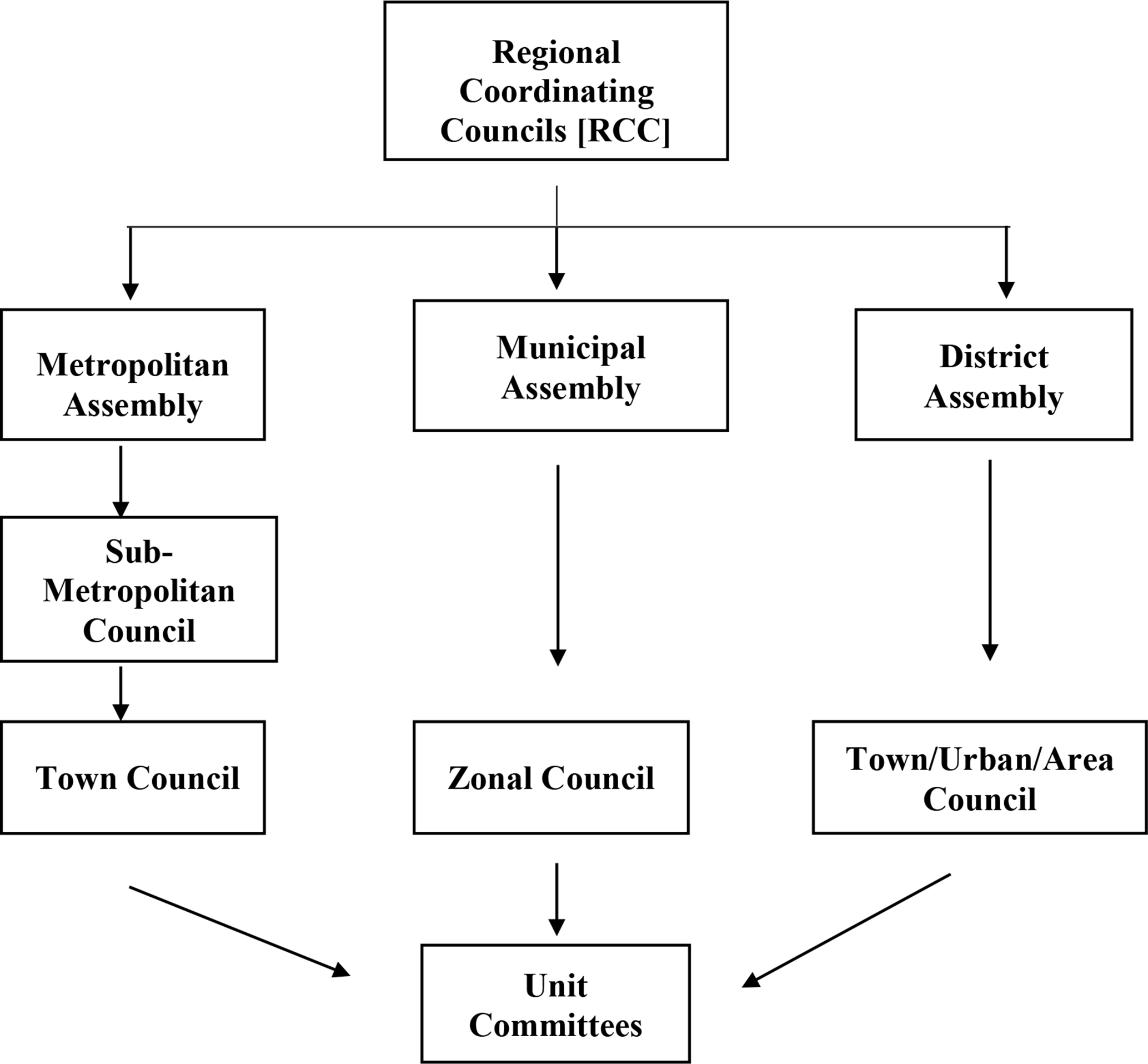
Structure of Local Government in Ghana.
At the top of the hierarchy of local governance in Ghana is the Regional Coordinating Council (RCC). Ghana is divided into sixteen regions, and in every region there exists a RCC playing monitoring, reviewing, and supervisory roles. The RCC has no power to make laws; however, membership includes top-level bureaucrats and customary leaders in the regions. After the RCC are the MMDAs, serving as the highest political authority in each local government. An area is referred to as Metropolitan, Municipal or District Assembly based on population distribution. For instance, areas with a population between 75,000 and 90,000 inhabitants are District Assemblies, between 90,000 and 250,000 are Municipal Assemblies, and above 250,000 are Metropolitan Assemblies (Ayee, 2003: 52). Currently, there exist six Metropolitan, 109 Municipal, and 145 District Assemblies, giving a total of 260 MMDAs. 8
The primary aim of the MMDAs is to provide local development through broad policy determination, formulation, execution, and initiation at the respective local levels (see Ayee, 1999). Its members include 70 per cent directly elected by the people through universal adult suffrage and 30 per cent appointed by the President in consultation with customary and other interest groups in the district (Crothers, 2003). While in previous constitutional provisions, customary structures were given seats with as much as one-third representation, it is very important to note here that customary structures are only made consultation bodies with the appointment of 30 per cent members to the MMDAs by the president. The substructures below the MMDAs do not hold any legislative power but maintain a lot of significance in Ghana’s local governance through cultural promotion, management of human settlements, and working hand in hand with other interest groups. The unit committees, for instance, are supposed to maintain close contacts with local communities (Botchie, 2000).
On the other hand, the Constitution of Ghana guarantees chieftaincy and all other institutions that are based on customary laws and usages (see Republic of Ghana, 1992). The National House of Chiefs is consequently established at the national level as a parallel institution to the central government (Crothers, 2003). Though with more limited powers than the central government, the National House of Chiefs is tasked with matters related to chieftaincy and customary institutions, sometimes playing advisory roles to the central government (Brempong, 2006: 35). Accordingly, at the regional levels, similar provisions are made for the establishment of Regional Houses of Chiefs. The Regional Houses, among others, advise any person or authority on matters relating to chieftaincy in the region and undertake studies that seek to resolve chieftaincy disputes in their respective areas of jurisdiction (Brempong, 2006: 35). The provisions also set out the legal framework that establishes the nature of the relationship that should exist between customary structures and the national and regional levels. That is, the customary institution’s role as advisory bodies and cultural representatives of the people is systematically guaranteed under the constitution of Ghana.
While Ghana’s constitution establishes the kind of relationship that exists between customary structures on the one hand and government structures on the other, it only does so at the national and regional levels. For example, the relationship between the National House of Chiefs and the Central Government is clearly defined by Article 271 of the constitution (see Republic of Ghana, 1992). Similarly, in Article 274, the relationships between the Regional Government and the Regional Houses of Chiefs (including the Northern Regional House of Chiefs where Kpandai District is located) are given legal backing. However, at the district level, limited constitutional provisions have been made to define the kind of relationship that should exist between both the Kpandai District Assembly and the Kpandai Traditional Council. The ill-defined relationship at the local levels in Ghana has been the subject of debate among scholars, policy analysts, and experts in local governance (see Ayee, 2006). The only linkage between both structures as stated in the legal provisions is when the president is empowered to consult customary leaders (and other interest groups in the district) in the selection of 30 per cent members of to the assemblies. What this means is that customary structures can only play active roles in local governance if they are included in the remaining 30 per cent of the membership to the MMDAs appointed by the president of Ghana (Brempong, 2006: 35). Even at the subdistrict levels, the legal provisions are not clear over the kind of relationship that should exist between customary and subdistrict structures.
Customary Structures in Local Governance in Kpandai
From the discussions above, customary structures have been very significant in local governance even in periods before colonial rule. It is, therefore, essential that efforts are made to explore their inclusion in Ghana’s local governance. The ill-defined relationship between customary and local government institutions at the local level was carefully captured in the National Decentralisation Action Plan by the Ministry of Local Government and Rural Development (2003: 16), when it stated:
A cursory assessment of the current situation confirmed that there is no structured and formalised arrangement that seeks to foster partnership and participation of traditional institutions in local governance. The relationship between the District Assemblies and traditional authorities is generally restricted.
Since this assertion by the Ministry, there have not been any changes to the legal framework, and scholars like Ahwoi (2010), Ayee (2006), and Dawda and Dapilah (2013) have highlighted the need for research into this. Even more interesting is the fact that chiefs are legally not allowed to participate in partisan politics (Boafo-Arthur, 2003: 144; Kwarkye, 2016: 28). The implication for their exclusion in partisan politics is that customary leaders could not contest elections to the assemblies or openly support a particular candidate.
In Kpandai District, customary structures are, however, “not left out in limbo.” Informal relations are developed between the Kpandai Customary Authority and the Kpandai District Assembly. By informal relationship, I mean that the kind of relationship between both structures is unofficial. There are no legal bindings as to how one should relate to the other, but there exist some conventional corporations (Seini, 2006). At the highest level of the Kpandai District Assembly, two seats are reserved for customary structures to actively participate in local governance. As of fieldwork in 2016, the two seats were occupied by two members of the customary council of Nkanchina and Kpandai townships. The role of these two customary representatives to the District Assembly, the Nkanchina chief summarises as follows:
We [myself and my colleague from Kpandai] are here to represent the interest of the chiefs in our respective communities especially concerning all customary interest in Kpandai. We serve as the liaison between the customary structures and the District Assembly. 9
During annual budgetary preparations for the district, these representatives of customary leaders are given a draft copy. They then invite other members of the customary authority to discuss the budget. They are allowed to give feedback concerning their decision on it. To emphasise more on the significance of customary structures in the district, an administrator working at the Kpandai District Assembly told me:
When we talk about the grassroots level of governance and participation, we cannot go on without the mention of customary structures perhaps because they have been part of the development at the local level for a very long time. The Constitution makes no provisions for their representation in the District Assembly, but because of the relevance we attach to them, we thought it wise to include them in the District Assembly. 10
Apart from reserving seats for customary leaders at the assembly level, the district assembly organises seminars and symposiums from time to time where they collate their views on the right path in ensuring the development of the district. They are also often consulted on the day-to-day dealings and activities in the district. The areas in which customary leaders are consulted, as ascertained by this research include, land allocation, land management and development, natural resource management, communal labour, human security, culture, infrastructural provisions, and revenue mobilisation. Even at the subdistrict levels (the levels of local government below the District Assembly), customary structures remain active agents with similar informal relationships with the town councils and the unit committees. At every unit committee sitting, for instance, customary structures in the respective communities are invited to participate in the deliberations and enjoy voting power on issues. This was highlighted by one female priestess during one such meeting:
[D]uring deliberations, we are always invited here to share our views on local matters relating to developmental issues, conflict resolution, and the like. My role is to represent fairly the interest of the chief of this community and make sure his voice is heard at the unit committee level. 11
Customary structures in the district have made themselves visible through the formation of these informal relationships and partnerships with the District Assembly. It is very important to point out that this unofficial relationship between customary structures and the Kpandai District Assembly is reciprocal. 12 Thus, while the District Assembly unofficially allows customary structures to participate in local governance through reserving seats or by consulting them on developmental issues on regular basis, customary structures on their part draw on the advice of the assembly during the allocation of lands, settling disputes, revenue mobilisation, and natural resource management. In the long run, it becomes a win–win situation for both structures.
This kind of co-operation at the local level in Kpandai District means customary structures could be included in any form of the development agenda whether there are legal provisions or not (Lutz and Linder, 2004: 35). In the development of this relationship, customary structures are informally involved in developmental projects, policies, and programmes that are organised by the respective local government. In planning, implementation, and monitoring, they become stakeholders within which the local government is organised. Customary structures, as active stakeholders, are also treated as independent actors who could participate in any form of the developmental project. They are, thus, free to come up with their policies and programmes without necessarily being tied to the District Assembly. However, should the need for consultation arise, they, through informal mechanisms, as illustrated above, are contacted and their opinions sorted. They are, in essence, made equal partners through informal recognition by the assembly.
The benefits of this kind of collaboration are to strengthen local actors in maximising their contribution to the development agenda. These benefits range from the use of indigenous institutions in local governance to customary structures acting as agents in their own rights for development and improved service delivery (Lutz and Linder, 2004: 35). Mahama (2009: 19–20) referred to this kind of partnership as the “ostrich partnership.” That is, this kind of relationship “avoids the challenge of the often controversial and delicate fusion of customary authorities into local administration” (Mahama, 2009: 19–20). Within the institutional framework, customary structures in Kpandai District can act as independent actors by participating in any form of development at their own accord and only consult local government units (or vice versa) if need be (Lutz and Linder, 2004: 36).
From the beginning of 1990, a new form of political discourse, what Kyed and Buur (2006: 1) called “re-traditionalization,” sought to give some relevance to the roles of customary structures in local governance and development. The conditions underpinning the state’s inability to successfully build the nation and establish effective institutions in rural areas have been the major explanation for the idea of re-traditionalisation (Kyed, 2007; Kyed and Buur, 2006; Skalník, 2004). As Kyed and Buur (2006: 2) point out, “The idea that Chiefs have filled the gap left by fragile states and/or continued to contest the monopoly of state authority in primarily rural areas […] has influenced much rethinking of the role of chiefs.” The inability of the state or formal government to provide basic structures for effective local governance provide the opportunity for members of the community to rely on alternative structures. Customary structures, therefore, become one of the available alternatives.
The shift from the national to the local levels of governance presents important dynamics in the discourses that surround local governance and stakeholder debates. In many developing countries, the state may not necessarily be strong, and its penetration to local areas may not be satisfying enough (Lutz and Linder, 2004: 2). The focus on the absence of the state, therefore, is an attempt to forge manageable relations with central governments that do not conform to the established images and state’s expectations.
The need for customary structures to be included in local governance is a result of their traditional roles, which trace their roots to periods before colonial rule. As discussed in the previous section, customary structures maintained significant roles in local governance before, during and after colonial rule. In Kpandai District, customary structures have been part and parcel of the lives of the people at the local level for a very long time. In many instances, therefore, people have accepted customary structures because the central government is unable to build well-structured and functioning institutions at the local levels that support the needs of the people. This has made customary structures a very strong pivot in local governance. As a result, the institution has adjusted more effectively to changing tides to become active stakeholders in local governance by introducing pragmatic efforts aimed at democratisation, technological advancement, and modernisation. The wave of Ghana’s democracy and the desire for customary structures to be a significant part of local governance have forced them to incorporate democratic stands in their daily activities.
Members of the communities in Kpandai have accepted customary structures as part of the local government agenda because state structures are limited or, in some remote areas in the district, non-existent. The absence of state structures, therefore, paves the way for the use of alternative structures – in this case, customary structures that already exist in Kpandai District. With regard to settlement of dispute, the following is a submission from an eighty-year-old man during focus group discussions at Nkanchina.
There are no courts in Kpandai District. The only preferred court in this area is in Salaga. Salaga is located approximately 80 km away and with the nature of our roads, the journey is very far for some of us. If I have a case to settle, I can’t travel that far. The best and favourable alternative for me is to rely on customary structures.
It is important to highlight that in the 1950s, the Native Tribunal “C” Court was established to complement the local government institution established at the time (Stacey, 2014: 430). However, following illegitimacy claims of the court by the Nawuri (the court was headed by the Kanankulaiwura, a Gonja chief), brewing ethnic tensions in the area, and apparent ideological difference by the government in later years, the court ceased operation (Mbowura, 2002; Stacey, 2016). As of January 2020, courts existed in towns closer to Kpandai including Bimbila (45 km) and Wulensi (21 km). By the time of submitting this article, plans were far advanced in the construction of a court in Kpandai. Despite the availability of courts near Kpandai, customary structures remain a favourite in settling disputes. For example, Maale, a food vendor, during a phone conversation points out that the court system “is too complicated to be understood and it is only meant for people that have some kind of formal education.” 13 Oti Abe, a yam farmer, prefers to be summoned by the Kankpe Shrine in Balai than the magistrate court in Bimbilla because, according to him, “going to court may be unaffordable.” 14 Indeed the role of priestly structures like the Kankpe shrine in local governance and regulating village lives needs to be emphasised here. The Kankpe shrine located in Balai, 4 km west of Kpandai, is held in high esteem as a result of its position as a significant actor in resolving disputes, land allocation, and land distribution among the Nawuri in Kpandai District (see Mbowura, 2002). Ndamile (2012) and Achor (2016) even point to the role of the shrine in peacemaking and peacebuilding efforts during the 1991 Nawuri–Gonja conflict.
In filling the gap of the central government, customary structures are adjusting to accountability and responsibility mechanisms, a hallmark that may not necessarily have been a feature of them before Ghana gained independence. The findings of this research reiterate the findings by Boafo-Arthur (2003) and Ogbokwe (1998). Indeed, many Ghanaians still depend on customary structures for the conduct of their day-to-day activities. Kpandai District is no exception, as in many rural areas of the district, people have maintained their customary forms of social and political interactions because of the relevance attached to it. Customary structures remain relevant in organising the lives of people in many local areas in Kpandai despite recent modernisation and democratisation of state structures. Customary structures are responsible for regulating lives in the villages by settling disputes, fighting for infrastructures, and controlling access to land. Their existence at the local level indicates that strengthening local governance will not be taking place in a vacuum but will involve an array of partnerships (Lutz and Linder, 2004: 2).
Until recently, the main policy tool for states’ inability has been mainly humanitarian relief and support (Leader and Colenso, 2005). However, a more broadened bottom-up approach to dealing with states’ absence in remote areas with the use of local resources has been taking shape in recent decades (Leader and Colenso, 2005). The use of alternative structures to fill the gap of state incapacity to organise and function properly was first seen as a cheap and politically backward form of colonialism in the 1960s and 1970s (Duffield, 2007). This is one of the core assumptions of dependence theory: that a weak government at the margins enables cheap reproduction of population with limited basic needs including healthcare, education, food, economic and personal securities (see Larrain, 1989). In many countries south of the Sahara, state structures exist side by side with customary structures vying for the same authority (Lund, 2006). These customary structures tend to fill gaps that the central government is unable to. Thus, the inability of states in many countries has led to the flourish of alternative institutions in the provision of basic services.
The increase in faith in the roles of customary structures could provide political stability and improve both governance and development (Sklar, 1994). With regard to history, customary structures are better positioned to support the provision of basic services to improve the standard of living of the people in Kpandai, especially because they are legitimised in the eyes of the people. What this means is that decision-making by customary institutions also has a high probability of success as the institution has been celebrated as an important driver in contributing to poverty reduction, improved welfare services, and local development in general (Kyed and Buur, 2006). The ability of customary structures to continue performing various functions in the modern democratic dispensation is dependent on the technical skills that are needed for these tasks (Lutz and Linder, 2004: 39). Customary structures may not necessarily have certain skills in, for instance, provision of electricity, maintaining a health centre, or building roads that require certain technicalities that may not be readily available. In this sense, it becomes necessary that their capacity is built to maximise their efforts in local development (Rukuni et al., 2015).
Conclusion
The article has assessed the nature of the relationship between customary structures and state structured institutions by tracing the roles of customary structures in local governance from periods before colonial rule in Kpandai District. It has also been pointed out by this research that, while at the national and regional levels in Ghana there exist legal provisions that establish the relationship between customary structures and formal government structures through establishing parallel structures at the national and regional levels, the same could not be said at the district levels. However, customary structures in Kpandai District have made themselves visible in local governance by establishing some form of informal relationship with the Kpandai local government institution. The informal incorporation of customary structures into local governance means they are free to mobilise resources and come out with their projects in improving well-being.
The increase in visibility is due to the inadequate presence of the state in Kpandai. As argued by this article, there are huge benefits of involving customary structures as actors in local governance. State-building at the local level in many developing countries might not be easy. This is mainly a result of inadequate resources, personnel, and technical support that is required in running an effective local government (as resources in many developing countries may be lacking). Relying on structures that have a strong footing in local governance and enhancing well-being could go a long way in limiting the demands that come with these resource limitations.
Against the background of increased democratisation and local participation in decentralised systems with respect to decision-making, customary structures and their relationships with state institutions have been dragged into the spotlight. This is also due to their roles as intermediaries between the citizens and the state. The opportunities available for democratic participation, good governance, and rule of law especially with the use of customary structures are without parallel. However, to maintain their status as stakeholders in local government, their continued adjustment and elasticity to the changing times will be essential in ensuring their existence.
Footnotes
Acknowledgements
I’m grateful for the feedback from Professor Dr Hans Peter Hahn.
Declaration of Conflicting Interests
The author declared no potential conflicts of interest with respect to the research, authorship, and/or publication of this article.
Funding
The author disclosed receipt of the following financial support for the research, authorship, and/or publication of this article: My heartfelt appreciation to the DANIDA Fellowship Center for their support in 2016 and the Andrea von Braun Foundation for their current support.
Notes
Author Biography
Email: