



Abstract
This paper places women at the centre of analysis, examining the potential and promise of the African Charter on Democracy, Elections and Governance (ACDEG) in the advancement of women’s political rights. This is a highly under-researched topic, necessitating a mapping of the current political landscape for women and an understanding of how ACDEG addresses these challenges as well as provides opportunities for advancing women’s political participation. This paper argues that ACDEG provides a good basis and framework to operate from for member states – some of whom already have suitable policies, and more importantly suitable practices, in place that emerge from a range of normative frameworks, including the Maputo Protocol. ACDEG complements these frameworks and makes a further case for women’s full and meaningful participation in public and private life by obligating states to take concrete steps to guarantee women’s political rights. Considering this, the paper identifies prospects for women’s rights activists and organisations to invoke ACDEG and monitor its implementation in the move towards the realisation of African women’s political rights.
Introduction
Despite the many provisions that the African Charter on Democracy, Elections and Governance (ACDEG) makes for women, there is a dearth of literature on the intersection of it and gender. The Charter’s potential to advance women’s political rights has largely been glossed over by scholars in the field, as well as by women’s rights practitioners and civil society organisations – whose main focus has centred around the Charter’s value addition to the democratic governance field more broadly (Alemu, 2007; Glen, 2012; Obi, 2014; Saungweme, 2007). Moreover, the literature that looks at women’s rights, and women’s political rights in particular, tends to focus on women’s rights-specific instruments such as the Convention on the Elimination of All Forms of Discrimination Against Women (CEDAW) and the Protocol to the African Charter on Human and People’s Rights on the Rights of Women in Africa (Maputo Protocol) (Ayeni, 2016; Raday, 2012). This paper thus seeks to begin a necessary conversation about the role of ACDEG in advancing women’s political rights and narrow the gap between those engaging on ACDEG and those engaging on women’s political rights in Africa. The definition of “political rights” that will be used in this paper entails the right to influence or engage with the political sphere and shape policy – including, but not limited to, engaging in the electoral process as a voter, an aspirant, a candidate, and/or as a holder of public office (UNIANWG 2015). We also include the right to monitor policy implementation and to monitor and observe elections as ways in which to hold duty-bearers accountable.
This paper utilises a feminist policy analysis framework, as elaborated by McPhail (2003). It details a set of guiding questions that ensure a gendered lens and feminist analysis is applied to the policy under review. The questions push us to examine context, the visibility of women within ACDEG, the Charter as a “women’s issue” despite it not being a traditional women’s rights instrument, the language used, as well as the role of women in accountability mechanisms. While the framework offers a plethora of questions, given the scope of this paper and its limitations, as well as the nature of ACDEG, we have selected the above-mentioned areas to focus our analysis on.
Methodologically, this paper scrutinises secondary as well as primary sources, including interviews with the lead drafter of ACDEG as well as staff of the African Union’s Democracy and Electoral Assistance Unit (DEAU) and of the African Governance Architecture (AGA) Secretariat as well as the normative frameworks under discussion. The state reporting process of ACDEG is in its infancy, with only one state party, Togo, having submitted its report and no member-state report having been reviewed thus far. As such, despite this reporting process being the mechanism which would most easily allow us to measure the impact of the Charter, some of the analysis remains only explorative.
This paper is structured into four sections. The second section provides an overview of the current political landscape for African women, interrogating why they continue to be marginalised amid a plethora of normative frameworks. The third section then examines the extent to which ACDEG makes provisions for women’s political rights. The fourth and final sections conclude with an exploration of available opportunities for advancing women’s political participation through the implementation of ACDEG.
Normative Frameworks and Realities for Women in Africa’s Political Landscape
Over the last two decades, Africa has made considerable progress in consolidating democratic governance. These gains could not have been realised without the concerted efforts of women’s rights groups, who have organised, mobilised, and strategised for the transformation of political systems (Tripp, 2001). Despite notable progress, the marginalisation of women and persistent inequalities are among the challenges that continue to limit the full realisation of democracy (Mindzie et al., 2014).
Available data shows that African women remain grossly under-represented in formal political structures and processes (Iwilade, 2011). According to the Inter Parliamentary Union (IPU), only 23.6 per cent of parliamentarians in Africa are women, with Rwanda, Namibia, and South Africa having the highest proportion of women in parliament at 61.3 per cent, 46.2 per cent, and 42.4 per cent, respectively (IPU, 2018). Women’s representation in executive or ministerial positions is even lower than in parliaments, where women held 19.7 per cent of ministerial posts in 2017 (IPU, 2017). This negatively affects women’s ability to influence national decision-making, including programme design and resource allocation.
Global normative frameworks such as the 1979 CEDAW paved the way for the development of legal frameworks that clearly articulate, elaborate, and advocate for the protection of women’s political rights by African states (Mukumu, 2015). Many argue that these global treaties do not effectively address issues particular to African women (Musa, 2007), and thus call for frameworks situated within the African context that expand the purview of women’s rights (Tadesse, 2015). In this regard, Africa has built up an extensive body of instruments and policies to push forward the women’s rights agenda at the continental, regional, and national levels. At the continental and regional ones, various policy decisions aimed at advancing women’s participation in decision-making structures have been adopted – including the Maputo Protocol, the Solemn Declaration on Gender Equality in Africa (SDGEA), the Southern African Development Community’s Protocol on Gender and Development, and the East African Community’s Gender Equality and Development Act.
The adoption of these policy pronouncements set the agenda for AU member states and other stakeholders to work towards promoting gender parity in democratic governance processes. However, regardless of the expanded normative commitments by African states, women’s political rights continue to be undermined by inadequate implementation, institutional barriers, discriminatory social norms, as well as by violence and intimidation (Bofu-Tawamba, 2015). These rights violations across Africa are indicative of the disconnect between policy and practice.
ACDEG and Women: Why Gendered Provisions?
ACDEG highlights gender equality as a key pillar for deepening democratic governance. It enjoins AU member states to create the necessary conditions for the full and active participation of women in democracy and governance processes (Articles 3.7, 8.2, and 29). This is significant, as it indicates a recognition and appreciation by member states of the necessity of a gender-conscious approach to democratic and participatory governance.
Even though the women-specific provisions of ACDEG were already covered under the other women’s rights instruments that preceded it, the Charter complements these – most important among them the Maputo Protocol – by reiterating the stated substantive political rights of women. Viljoen argues that “the Maputo Protocol should not be primarily viewed as correcting normative deficiencies in international human rights law dealing with human rights, but rather as a response to the lack of implementation of these norms” (2009: 17). The same can be said for ACDEG. Whereas women’s rights instruments have had provisions on political participation, here an instrument dealing with democratic governance is equally cognisant of and has provisions for gender. The stress on women in ACDEG, therefore, is a reaffirmation of AU member states’ commitment to women’s empowerment – particularly considering that ACDEG is not, in the traditional sense, a women’s rights instrument.
This corroborates with information gleaned from an interview with the lead drafter of ACDEG, where three main reasons for the gendered provisions in ACDEG emerged. First, the context in which ACDEG was drafted was much more conducive to the inclusion of gender principles and provisions. The progressive shift from the Organisation of African Unity (OAU) to the AU in 2001 was key here, representing a remarkable move away from the 1963 OAU Charter – which had no explicit commitments to human rights, let alone to gender provisions or considerations (Shaw, 2007) – towards the Constitutive Act – which now made an explicit commitment to gender equality. Second, during the drafting of ACDEG between 2004 and 2006 (Matlosa, 2017), SDGEA was adopted and the Maputo Protocol entered into force. The drafters were cognisant of these developments, and of the AU’s increased commitment to gender equality – which shaped their framing of ACDEG. Third, women’s rights activists and organisations were lobbying for progressive provisions around women’s rights, to which the drafters were receptive due in part to their own personal stance on the matter. 1
It is noteworthy that while ACDEG sought inspiration from other regions which had developed democracy charters – in particular the Organization of American States (Matlosa, 2017), which had adopted the Inter-American Democracy Charter in 2001 – it ultimately emerged with much more extensive provisions than counterparts elsewhere. This is particularly true in relation to its commitment to women’s rights (OAS, 2001). Such an outcome should be viewed in light of the developments taking place at the continental level, as discussed above.
To What Extent does ACDEG make Provisions for Women?
The objectives of ACDEG, as elaborated in its chapter 2, set the stage for a gender-conscious approach to democratic governance. ACDEG explicitly seeks to “promote gender balance and equality in governance and development processes” (Article 2.11). Notwithstanding the placement of gender as the 11th of 13 objectives, its explicit inclusion is indicative of how the Charter intends to cast gender as an overall framing for ACDEG. This is reiterated in the subsequent chapter, where gender equality in both public and private institutions is stated as a principle (Article 3.6). The fact that these provisions extend beyond public institutions is instructive, as the private sphere – despite being viewed as beyond the realm of regulation and states’ purview, particularly in relation to human rights (Oliver and Jorg, 2007) – is a site of struggle against multiple forms of oppression (Sunstein, 1989). Beyond guiding intentions and principles, the Charter places explicit obligations on state parties – recognising the necessity of gender parity to strengthen democratic governance in Africa and making clear provisions for women. These provisions will be highlighted according to their exact placement in the Charter.
Chapter 4 asserts the duty of states to ensure citizens enjoy their “fundamental freedoms and human rights” (ACDEG, Article 6). This is critical as a reiteration of an essential human rights principle, particularly when complemented by the notion of these rights as universal, interdependent, and indivisible – thereby rejecting the notion of a hierarchy of rights. This is particularly significant when discussing women’s rights, which are often seen as secondary to other rights (Parekh, 2008).
ACDEG proceeds to make a clarion call to state parties to “eliminate all forms of discrimination, especially those based on political opinion, gender” (Article 8.1) and to adopt “legislative and administrative measures to guarantee the rights of women […] and other marginalized and vulnerable groups” (Article 8.2). While ACDEG does not make mention of repealing or amending such laws, the provision to adopt legal and other measures to guarantee rights as well as eliminate discrimination can be utilised to push for reforms of discriminatory legislation. This is further supported by the obligation made to state parties in Article 10 to “protect the right to equality before the law and equal protection by the law as a fundamental precondition for a just and democratic society.” This is buttressed by the Maputo Protocol, which explicitly calls for the “reform of existing discriminatory laws and practices in order to promote and protect the rights of women” (Article 8, Protocol to African Charter on Human and Peoples’ Rights on Rights of Women in Africa, 2003). Over the years, there has been evidence of progress in partially or fully repealing or amending discriminatory laws in Algeria, Botswana, Ethiopia, Kenya, Lesotho, Morocco, and eSwatini among others (Equality Now, 2015).
ACDEG specifically emphasises the importance of gender equality in electoral observer missions (Article 21.2). While ACDEG is not prescriptive in detailing what exactly this should entail, this provision provides impetus to engender the entire process. These measures could include: gender-responsive training for observers; gender-specific questions featured throughout the AU election observer missions’ checklist; requiring gender-disaggregated data; gender analysis of laws, the electoral process, and any irregularities that may arise, as well as subsequently making gender-specific recommendations in final reports; and gender parity in the make-up of observer teams and having more female heads of missions. While many of these measures have been adopted over the years, their consistent application is still pending. 2
State parties are further called on to “recognize the crucial role of women in development and strengthening of democracy” (Article 29.1). In isolation, this could be seen as indicative of an instrumental rather than a rights-based approach. One could further question what recognition entails, and what good it would do in terms of advancing the rights of women. This is addressed, in part, by subsequent clauses. In Article 29.2, ACDEG stipulates that, beyond recognition, an enabling environment and “necessary conditions of full and active participation of women in decision-making processes and structures at all levels” must be created “as a fundamental element in the promotion and exercise of a democratic nature.” The Charter does not specify what these conditions are, and leaves much room for interpretation. However, the fact that the Charter allows for flexibility rather than rigidity becomes important considering the highly diverse contexts in which this clause would be put into practice (Hannum, 2016). Furthermore, if this clause is viewed alongside accepted normative standards on women’s rights, then these “necessary conditions” can be interpreted as encompassing “affirmative action, enabling national legislation and other measures” – as specified in Article 9 of the Maputo Protocol. There is thus a need for these two instruments to be read collectively.
With regard to the electoral process, state parties are urged to “take all possible measures to encourage the full and active participation of women […] and ensure gender parity in representation at all levels, including legislatures” (Article 29.3). In this regard, countries including Algeria and Rwanda have a practice of reserving a percentage of parliamentary seats for women, while others such as Guinea, Lesotho, and Mauritania have set quotas for women on candidate lists. 3 It is significant to note that ACDEG calls not for 30 per cent representation or even more ambiguous, increased representation, but for parity and – like the Maputo Protocol (Article 9, 1b) – specifies that gender parity must be attained at all levels.
Enhancing women’s political empowerment is dependent on a complex interplay of sociocultural, economic, and political factors. Indeed, ACDEG lays emphasis on the universality, interdependence, and indivisibility of human rights (Article 6) and makes provision for free and compulsory basic education and literacy for all – especially girls and women (Articles 43.1 and 43.2). State parties must ensure that measures to enhance women’s socio-economic status are part and parcel of efforts towards increased political participation. The introduction of day-care facilities in parliament, equal pay for work of equal value, and progressive policies that ensure women’s access, control, and ownership of resources are cases in point. Article 13 of the Maputo Protocol lends credence to this assertion in mandating states to “adopt and enforce legislative and other measures to guarantee women equal opportunities.” Complementary to this, Article 8 of ACDEG calls on state parties to “adopt legislative and administrative measures to guarantee the rights of women.” Both the Maputo Protocol and ACDEG rightly recognise the interconnected nature of rights – putting economic, social, and political rights side by side. Furthermore, by explicitly including a provision on literacy and education, there seems to be a recognition that failing to tackle these issues would by default marginalise women from electoral processes (Hassim, 2003).
Post-ACDEG Developments
Since 2007, when ACDEG was adopted, Africa has made significant strides towards opening up spaces for women. Several AU member states have put in place national laws and policies, as well as institutions such as ministries, commissions, and directorates that are responsible for advancing gender equality. These laws and policies include: constitutional reforms/amendments; the introduction of quota systems, gender equality, and women-friendly acts; and affirmative action measures. Illustrative of this are Burkina Faso’s (Ayeni, 2016) and Niger’s constitutional provisions reserving a certain number of parliamentary seats for women, and political parties in Namibia and South Africa that have adopted internal rules to ensure a certain percentage of women can vie for office (Bush, 2011; MEWC, 2016).
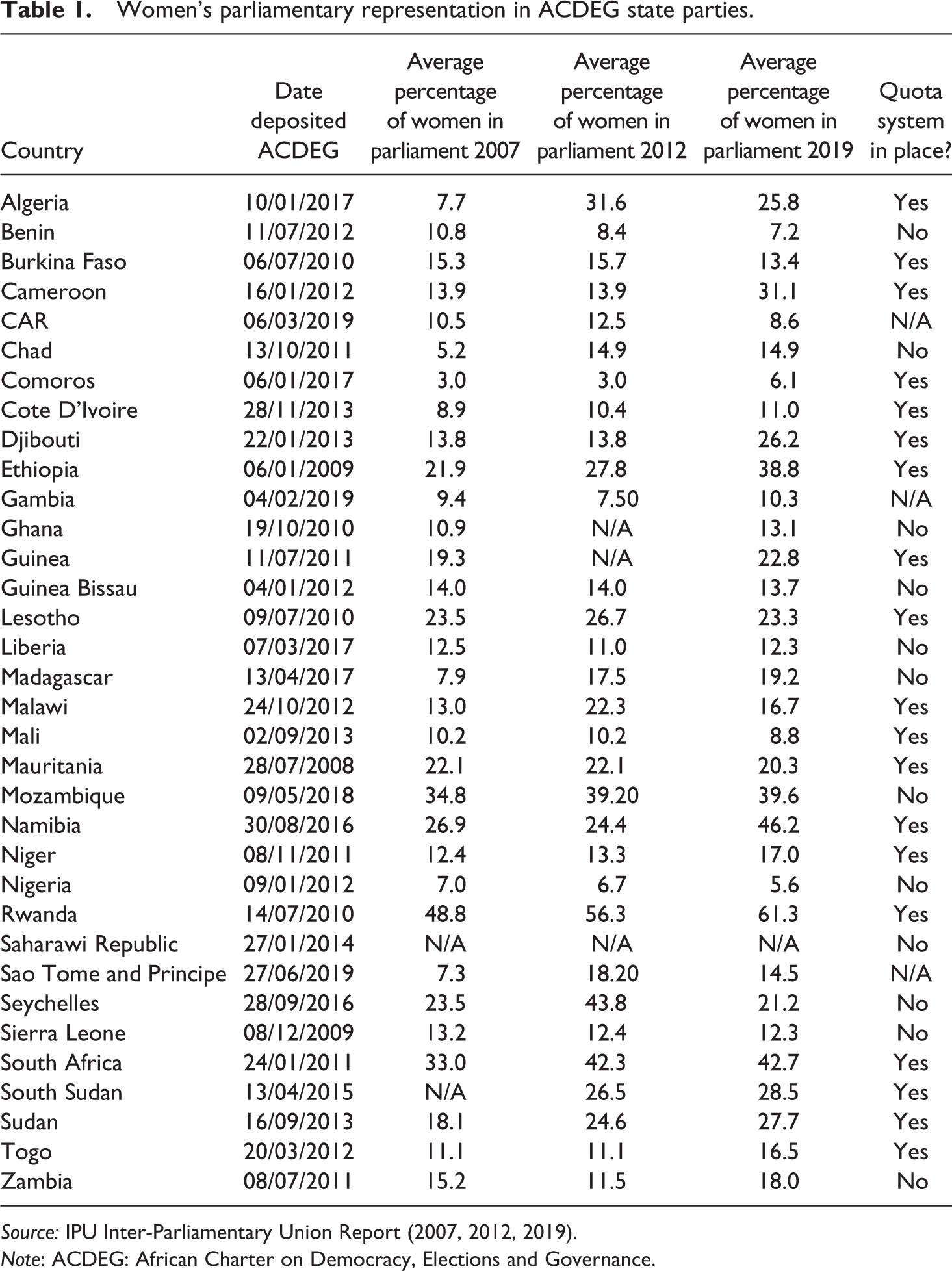
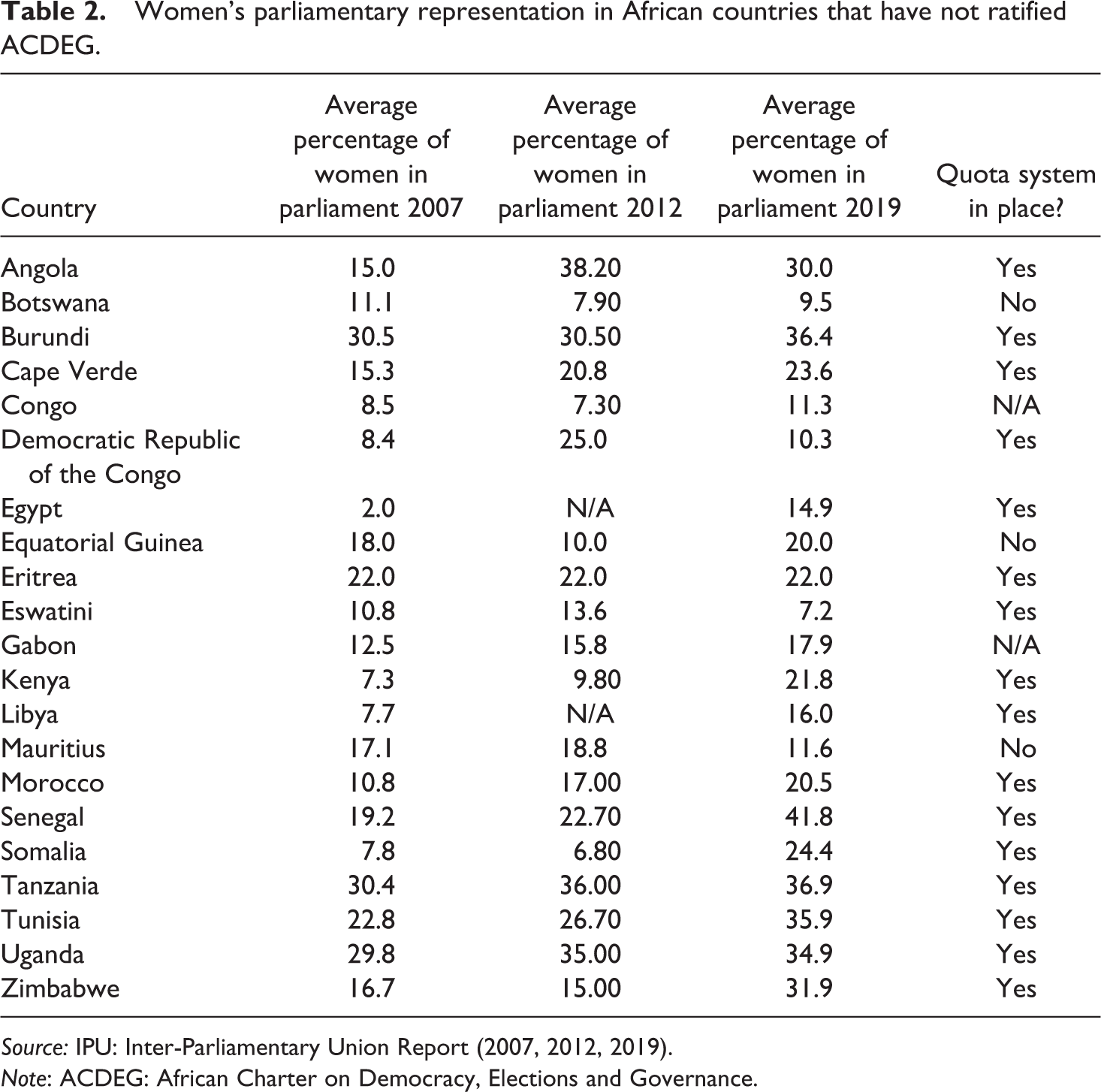
Facilitated by these policy initiatives, the continent has made substantial progress towards the increased participation of women in decision-making structures. The number of women taking up key positions as prime ministers, vice presidents, house speakers, chief justices, and cabinet ministers has gone up incrementally (Belay, 2017). Several women now head powerful ministerial portfolios, such as finance in Nigeria and defence in South Africa among others (Osei-Afful, 2014). Even more importantly perhaps, the number of women in parliament has increased significantly. Although this is but one of the markers of women in decision-making positions, it is one of the most common indicators thereof – and the easiest on which to find data. Tables 1 and 2 detail the percentage of women in parliament in 2007, when, as noted, ACDEG was adopted; 2012 when it came into force; and in 2019, marking twelve years since its adoption. The two tables distinguish between those who are party to ACDEG and those who are not.
Women’s parliamentary representation in ACDEG state parties.
Note: ACDEG: African Charter on Democracy, Elections and Governance.
Women’s parliamentary representation in African countries that have not ratified ACDEG.
Source: IPU: Inter-Parliamentary Union Report (2007, 2012, 2019).
Note: ACDEG: African Charter on Democracy, Elections and Governance.
While it is difficult to note any consistent trends from the tables with regards to women’s parliamentary representation among the fifty-five African member states, some aspects are nevertheless noteworthy. Only five of the twelve African countries that have surpassed the goal of over 30 per cent representation in parliament have ratified ACDEG. Furthermore, thirteen of the thirty-four countries that have ratified ACDEG have fewer than 15 per cent female participation in their parliaments. In addition, even though approximately two-thirds of the countries who have ratified ACDEG have seen a considerable increase in their share of women parliamentarians in the course of the twelve years since ACDEG’s adoption, the remaining thirteen have witnessed a decline or stagnation therein. Out of the twenty-one countries that have not ratified ACDEG, on the other hand, seventeen have seen an increase in the number of women parliamentarians, while three have shown a decrease. Moreover, while seven (33.3 per cent) have reached 30 per cent women’s representation, six (28.5 per cent) have less than 15 per cent of their parliamentary seats occupied by females.
Looking at these figures, it is difficult to assess ACDEG’s precise impact on the representation and participation of women in African political life. This is for many reasons, including the inability to relate the gains made so far solely to the Charter. Moreover, it would be highly desirable to consider indicators other than parliamentary seats – including the existence/absence of women-friendly legislation/measures implemented by state parties. This indicates the need for further interrogation of the matter in question, in order to better ascertain the relationship between the current political landscape for African women on the one hand and ACDEG and the instruments that preceded it – most importantly the Maputo Protocol – on the other.
Emerging Opportunities through the Implementation of ACDEG
Despite numerous provisions pertaining to the political rights of women throughout ACDEG, the lack of implementation of these commitments renders them moot. Article 44 thus calls on state parties to make true to their commitments by ensuring the harmonisation and conformity of national laws and regulations with the Charter, thereby promoting political will and popularising ACDEG (Article 44.1). It further calls on the African Union Commission to develop benchmarks to assess compliance, as well as promote “the creation of favourable conditions for democratic governance” (Article 44.2). These benchmarks are yet to be developed. Regional Economic Communities (RECs) are tasked, meanwhile, with the implementation and monitoring of the Charter, as well as enhancing buy-in to it – via the “massive participation of stakeholders, particularly civil society organizations, in the process” (Article 44.2).
The only consequences of non-compliance specifically outlined in ACDEG include suspension, sanctioning, and trial in court. However these measures are limited to perpetrators rather than state parties, and are confined to unconstitutional changes of government – as outlined in Article 25. This essentially means that there are no sanctions for non-compliance with the numerous issue areas that ACDEG covers, and for possible violations or inactions on the part of the state party (Saungweme, 2007).
Following the November 2016 APDH versus Cote D’Ivoire ruling of the African Court on Human and Peoples’ Rights, however, there is now a precedent for taking cases to the court on the basis of violations of the provisions of the Charter (ACHPR Judgment, 2016). In the case of Cote D’Ivoire, it was possible for a non-governmental entity (APDH) to take the state to court due to the state’s declaration of Article 34(6) – which enables individuals and NGOs direct access to the courts (Ayeni, 2016). While there are only eight member states who have signed on to this declaration, 4 this remains an entry point for women’s rights activists and organisations to find legal recourse – considering that an AU organ or other member state can also take a case to court.
Similarly, the ACDEG state reporting process also provides an opportune entry point to monitor and evaluate the level of compliance with the gender provisions of the Charter. The current AGA “Rules of Procedure,” to which the Guidelines for State Reporting are an annex, provide a good basis for this. They give the African Governance Platform as well as the Secretariat a specific mandate to ensure the robust engagement and participation of the citizenry – particularly women, youth, and civil society – in its various initiatives and programmes (Rules 4d, 7g, Rules of Procedure of African Governance Platform, 2016). This work has begun, evidenced by the development of youth and women engagement strategies and the subsequent programming that emerged from both. 5
In addition to the Rules of Procedure, the Guidelines for State Reporting provide further guidance and opportunities for women to engage throughout the process – from compiling the report, to its review, to even providing technical support following that review. For example, the Guidelines insist that state parties must put in place a multi-stakeholder national institutional framework, which will coordinate monitoring, reporting, and follow up on the implementation of recommendations that emerge from the process. While the Guidelines do not explicitly state the necessity of including women’s rights organisations, they do stress the inclusion of non-state actors – with a view to ensuring an inclusive, participatory, and diverse make-up to the group (Guidelines III/9, Guidelines for State Parties Reports under African Charter on Democracy, Elections and Governance. Annex 1 to Rules of Procedure, 2016). The Guidelines go further, asserting that the report must comprise information on the involvement and participation of women’s groups and minorities in compiling it (Guidelines VI/A/13(f)). This gives impetus to their involvement in the consultation process.
Moreover, the initial report – mandatory for state parties reporting for the first time – should provide baseline data on: the operating environment of non-state actors and regulatory frameworks in place; relevant instruments that have been ratified by the state party; and the status of reporting for that particular instrument. Noteworthy is the fact that the Maputo Protocol is included in the list of instruments to be reported on (Guidelines VI/A/13(c)). Furthermore, state parties are obliged to detail measures undertaken in line with the Charter – including providing disaggregated data and statistics on various areas including the political participation of women (Guidelines VI/B/14(e)). These measures facilitate the provision of gendered data from the state party, enabling an assessment of their compliance with ACDEG’s gender provisions. Indeed, the Togo State Report listed the women’s rights organisations that were part of its consultation process, had specific paragraphs pertaining to both women’s rights normative frameworks as well as policies in place, and identified the status of equity and gender equality in Togo. Furthermore, gender-disaggregated data was used throughout the report (Togo Report 2017).
Women, women’s rights organisations, and constituencies all have further opportunity to engage through interaction with the AGA Platform once the report has been submitted. Part of the process includes the convening of a pre-session for African non-state actors from the state party under review (Guidelines X/26). The fact that the guidelines specify that these African non-state actors must be members of the AU’s Economic, Social and Cultural Council (ECOSOCC) is indeed limiting; however, it still provides a window of opportunity for those women’s rights organisations that are members of ECOSOCC to participate in the process. For those who are not, other possibilities to engage nevertheless still exist – including via a dialogue with the state party under review that can include “representatives of any relevant stakeholders,” who may be invited to “make oral and/or submit written statements” (Guidelines X/27). The guidelines also make provisions for the AGA Platform to engage further with “relevant stakeholders” following the review of the state report and the dialogue for “continued collaboration and if need be for technical support” (Guidelines XI/34).
Many of the provisions that allow for the engagement of civil society and more specifically women’s rights organisations in the state reporting process are indeed at the discretion of both state parties and AGA Platform members. Nevertheless, the provisions that exist currently in both the Rules of Procedure and its annex provide a good grounding for the meaningful engagement of women and women’s rights groups vis-à-vis holding states accountable throughout the entire state reporting and review process. Considering that, as noted, only one state report has been received thus far, and no state report has yet been reviewed, this assertion can only be tested in future with empirical analysis – as it becomes available.
Conclusion
ACDEG, as detailed in this paper, provides numerous opportunities for the promotion and protection of women’s political rights – particularly when seen in conjunction with the plethora of other women’s rights instruments in existence. The provisions within the Charter reiterate the necessity of women’s participation, representation, and leadership in African governance and decision-making spaces. Coupled with its state reporting process, ACDEG creates a solid basis from which to push for the meaningful rather than tokenistic engagement of women and women’s rights groups vis-à-vis ensuring accountability regarding the numerous provisions that speak to women and girls. Conscious that it is too early at this point to assess ACDEG’s impact in advancing women’s political rights, particularly considering the nascent stage of state reporting and the short time frame since ACDEG came into force, further study in this under-researched area at a later point in time will be essential to shaping and informing both policy and practice.
AU member states must undertake practical steps to implement ACDEG and other AU shared values instruments that speak to women’s empowerment. These steps must be holistic, taking into account the interconnected and interrelated nature of rights across social, political, and economic divides. Furthermore, creating impactful change will require state actors to address the structural barriers to women’s political participation and harmonise these shared values with norms and practices at the national as well as local level. The steps should be reported on periodically, to facilitate monitoring and the sharing of comparable lessons. Furthermore, continental and regional institutions – namely, the AU and RECs – should play a central role in ensuring the effective implementation of ACDEG by providing technical support to member states; popularising the Charter among member states, gender machineries, and among civil society as well as women’s rights organisations; and rewarding reporting and compliance, to accelerate implementation and monitoring.
It is clear that the utility of the Charter for advocacy purposes has by no means been fully exploited yet. Women’s rights activists, practitioners, organisations, and gender machineries must capitalise on the numerous and substantive provisions of ACDEG outlined in this paper. Effective implementation of ACDEG’s provisions on women’s political rights requires all relevant stakeholders to work together at multiple levels, to pool necessary resources, and to promote the universal ratification, domestication, and implementation of the Charter. Only then can the potential and promise of ACDEG be fully realised.
Footnotes
Declaration of conflicting interests
The author(s) declared no potential conflicts of interest with respect to the research, authorship, and/or publication of this article.
Funding
The author(s) received no financial support for the research, authorship, and/or publication of this article.