




Abstract
This paper argues that development through large-scale land acquisitions (LSLAs) in Gambella, western Ethiopia, belies a state-remaking project under a dispossessive political economy. This argument is based on fieldwork in Gambella, Addis Ababa, and Minneapolis and is situated within the broader development agenda pursued by Ethiopia's ruling party. The political economy of LSLAs tells us that the deals are not occurring in a predominantly economic manner; rather, extra-economic state intervention clears the way for, facilitates, and ensures sustained accumulation. This political intervention is “unlocking” and making the lowland resources accessible and extractable by the state, while a concomitant villagisation project is guaranteeing continued accumulation by disempowering the local population by making the community legible, governable, and controllable. By combining these processes, the Ethiopian state is mastering, and building itself in, Gambella's lowlands.
Ethiopia's ruling coalition, the Ethiopian Peoples' Revolutionary Democratic Front (EPRDF), and the government it formed have been reiterating their commitment to building a developmental state since 2001, more aggressively since the hotly contested 2005 elections. The registered growth in this period led many to argue that the country has a good chance of joining middle-income countries in the coming decade (see, for example, Moller 2015). Economic growth is a crucial component of the EPRDF's claim for legitimacy, and the effort to build a developmental state is undergirded by the framing of poverty as an existential threat to the state and its “nations, nationalities, and peoples” (Fana 2015a). Such a securitised understanding of development made everything else secondary to economic development and is justifying increasing authoritarian tendencies (Fisher and Anderson 2015).
Despite this common basis, development is not pursued with a single policy approach throughout Ethiopia. As a recent World Bank report (Moller 2015) states, Ethiopia's growth is structurally driven by massive public infrastructure investment and explained by a modest shift in labour from agriculture to construction and services. These changes are not noticeable in the lowlands, though (see Markakis 2011), so the recorded growth could be labelled a “highland Ethiopia” phenomenon. This is despite the inclusion of differentiated development approaches in the country's rural development policy documents since the turn of the millennium: the intensification, commercialisation, and specialisation of smallholder agriculture in the highlands, the sedentarisation of the local population, and the encouragement of large-scale agricultural investments in the peripheral lowlands (Ministry of Information 2001).
Due to a range of factors holding back investments, the preferred approach to developing the lowlands has not significantly improved the lives of lowlanders (Markakis 2011; Ministry of Information 2001). These constraints were, however, to be surmounted by the opportunity presented by the global food price, fuel, and financial crises at the end of the first decade of the 2000s – that is, the global rush for land, which particularly targeted sub-Saharan Africa (Cotula et al. 2009; Deininger et al. 2011). In September and October 2010, the government of the Gambella Peoples' National Regional State (GPNRS) made mega-deals with the Indian giant Karuturi Global and the Saudi Star Agricultural Development, covering some 311,000 and 129,000 hectares of land, respectively, as reported at the time. 1
See the 16 September 2010 and 3 October 2010 issues of the biweekly, widely read Amharic newspaper, The Reporter.
Despite our limits on knowing the true figures due to both the opaque conditions under which deals are made and the unreliability of data, we can still say that Ethiopia is among the top land-leasing countries in Africa (Anseeuw et al. 2012; Cotula 2012; Friis and Reenberg 2010). The geography of land deals in Ethiopia attests that the western lowlands, particularly the GPNRS and the Benishangul-Gumuz Peoples' National Regional State, are especially targeted. These transfers to private investors are occurring as part of the developmentalist mission the EPRDF imposed on itself (Dessalegn 2011, 2014), with the stated aim of bridging the gap in socio-economic indicators between the “developing” and “developed” regions, thereby doing away with what Young (1999) calls a “two-tier” federal arrangement. 2
The predominantly highland regions – Amhara; Oromia; Southern Nations, Nationalities, and Peoples; and Tigray – make up the first tier of developed regions, and the predominantly lowland regional states – Afar; Benishangul-Gumuz; Gambella; and Somali – comprise the second tier.
This government-supported and government-facilitated targeting of low-lying peripheral areas for large-scale land acquisitions (LSLAs) represents a continuation of historical centre–periphery relations (Lavers 2012a; Makki 2012). Understandably, the federal project Ethiopia has embarked on, de facto since 1991 and de jure since 1995, has significantly altered centre–periphery relations, although much has remained the same in the economic sphere (Dereje 2013; Markakis 2011). The promise of self-determination and ethnic empowerment through the federal arrangement is countered by the increasing ascendance of the developmental state mission (Assefa 2014; Clapham forthcoming).
Although the international political economy of foreign land acquisitions has been duly studied (see Cotula 2012), the national political economy surrounding LSLAs is not well studied, including in Ethiopia (Baumgartner et al. 2015). Following Bayart (1993) and Chabal and Daloz (1999), the dominant view in the literature is that the national elite are serving as “comprador bourgeoisie” (Sassen 2013: 43), going counter to the state's interest to guarantee their continued hold on power using LSLAs as a new avenue to extend patrimonial links (Cotula 2012; Sassen 2013). Furthermore, investigation into the processes and outcomes of LSLAs is limited (Nolte and Vath 2015). This paper takes a more nuanced approach and examines manifestations of the political economy of LSLAs concealed within the Ethiopian government's developmentalist discourse and investigates the reconstitution of centre–periphery relations in Ethiopia.
Following Ferguson (1994), I argue that development through LSLAs in Ethiopia's western lowlands conceals political projects aiming to control the periphery and reconstitute centuries-old centre–periphery relations by undertaking a process of accumulation by dispossession (Harvey 2003). As a consequence, the state is becoming entrenched in peripheral areas, despite the dominant view in the literature that state power serves global agribusiness interests.
I examine this process by embedding LSLAs within the broader developmentalist mission, ambitions, and practices of the Ethiopian government, taking the example of the GPNRS, in western Ethiopia. Soft data-collection methods were used, particularly unstructured interviews and direct observation. Primary data was collected through unstructured interviews with officials and experts from the regional government, experts from the federal government, investors, and members of the Anuak diaspora (see Appendix). Due to the role they play in promoting LSLAs, my interviews particularly targeted government officials and experts from the Gambella Investment Agency, the Gambella Land Administration and Environmental Protection Authority (LAEPA), and the Ethiopian Agricultural Investment Land Administration Agency (EAILAA). Insights garnered from attending (as a non-participant observer) Gambella's Agricultural Investment Mass Mobilisation Forum (hereafter: Mass Mobilisation Forum) held on 25 June 2014 were also very useful. This event brought together officials from the EAILAA, top regional politicians (including its president), officials from all of Gambella's weredas (districts, the second-lowest administrative level), ten traditional and religious leaders, 31 investors (one Anuak, one Indian, the rest from other parts of Ethiopia), and one representative of the Commercial Bank of Ethiopia in an effort to solve serious challenges the commercial agricultural sector is facing. Observations made at the region's Investment Agency and LAEPA office compounds also informed this study.
The rest of this article is structured as follows: First, I historicise land alienations in the GPNRS by Ethiopia's successive regimes and summarise the debate on recent LSLAs in Ethiopia. Then, I provide some key details on LSLAs in Gambella. Next, I dwell on the process by which LSLAs occur in the GPNRS and elucidate the six major expressions of the political economy of LSLAs there, which I later link with the literature on the nature of accumulation. I finish by connecting the current mode of state-remaking with earlier attempts at that, and by arguing that violence, through the politics of dispossession, still underlies the current round of state-remaking in Gambella. 3
I would like to thank (in alphabetical order) Ulf Engel, Mercy Fekadu, Dereje Feyissa, Solomon Hassen, Dessalegn Rahmato, Tassew Tafesse, Yonas Tariku, and Dawit Yohannes for reading and commenting on earlier versions of this article. I thank the two anonymous reviewers of the first submission for their critical and constructive comments. The fieldwork was financed by the Deutsche Gesellschaft für Internationale Zusammenarbeit (GIZ) and the French Centre for Ethiopian Studies.
The “Highland State” in Its Lowland Peripheries: Land Alienations in the past Century
Ethiopia's socio-economic and political complexity is founded on its large highland landmass, to which the domestic ox-plough agriculture production system is suited (McCann 1995). The lowlands, infested with tropical human and livestock diseases and known for erratic rains, are ill adapted to settled smallholder agriculture, and as such are zones of shifting cultivation and agropastoralism. As a result, meaningful and sustained state extraction, thus state presence, was possible only in the highlands. All imperial royal seats and political and military strongholds are found in the highlands, and significant threats to the imperial state came via the lowlands. Thus, in a way, the lowlands were not to be secured by the imperial government; rather, they served to secure the highlands by serving as an “impenetrable” desert. Moreover, the northern highland is the sacred land of Orthodox Christianity, the state religion until the 1974 revolution, while the surrounding peripheral highlands and lowlands were inhabited by Muslims, animists, and followers of traditional religions. If the northern highlands are populated by “Red people” speaking Semitic languages, the western lowlands are inhabited by “Black people” speaking Nilotic and Koman languages (Dereje 2011a). This divide is still visible, even after the post-1991 federal restructuring. The predominantly lowland regions are relatively “underdeveloped” and fare much worse in terms of socio-economic indicators and political bargaining power (Markakis 2011; Young 1999).
The expansion of the Ethiopian state towards the frontier lowland buffer zones did not translate into effective territorial control and successful extraction, as was the experience with the southern highland periphery (Markakis 2011). Instead, the opted-for extractive and administrative approach towards the western lowlands, particularly Gambella, has consisted of offering concessions to agribusinesses for exclusive commercial agriculture rights over specific industrial crops (Bahru 1976, 1988); outsourcing administration and security (Meckelburg 2014); and randomly plundering lowland resources, be they in the form of slaves or ivory (Dereje 2011a). Under the Derg (the socialist military government in power from 1974 to 1991), the western lowlands were, de facto, spaces for launching proxy wars with the Sudan and establishing refugee camps and, in terms of domestic processes, for resettling the famine-stricken from the highlands and establishing state farms. This meant that the population was not particularly targeted to benefit from development projects of the time. In effect, both the imperial and Derg governments relegated the lowlands primarily for use in commercial, mechanised agriculture.
There are major differences between the land-governance systems of the two regimes. The imperial government considered all land in the peripheries as property of the emperor and the royal family, to be distributed among military as well as civilian leaders. The local community was not pre-informed about, nor compensated for, the leased land, nor was there any mechanism to challenge alienations. The agropastoral lowlander was simply considered as having no home, thus evicted without any recompense (see Bahru 2008; Buli 2006). Pursuant to the “Land to the Tiller” cries of the Ethiopian Student Movement (see Bahru 2014), the Derg nationalised rural and urban land in 1975 and redistributed land with a maximum holding of 10 hectares per family, thus truly revolutionising the country's political economy and implementing one of the very few land reforms on the African continent. This, however, was of little effect in the lowlands, as private commercial farms simply changed hands into state farms at the time, and new commercial farms, including in the western lowlands, were established in the 1980s (Abebe 1990). In addition to the state farms, land was alienated to establish individual as well as communal farms for resettled people. This time around, again, the lowlanders' views were not duly considered before their land was alienated from them.
The current policy thinking and practice shares major strands with this historical predisposition towards the lowlands. Although figures differ, numerous sources confirm that millions of hectares of land have been leased since the 1990s: 3.5 million hectares between 1990 and 2008, according to Dessalegn (2011), 4 predominantly from the lowlands. Had the plans to lease some 3.3 million hectares of land been realised by the Growth and Transformation Plan (GTP) 5 (Ministry of Finance and Economic Development 2010), Ethiopia would have leased land equivalent to 38 per cent of the total national smallholder landholdings (Dessalegn 2011).
For figures from roughly 2005 to 2010, see Abbink 2011 and Deininger et al. 2011.
GTP: the five-year economic development plan for the period from FY 2010/11 to FY 2014/15. The Ethiopian fiscal year (FY) runs from 8 July through 7 July of the following year.
The intention in promoting LSLAs is to marry foreign or domestic capital with appropriate levels of land, labour, and technology to fill the yield gap and augment the productive capacity of the economy (Deininger et al. 2011). In the highlands, capital- and labour-intensive commercial farms are encouraged, while mechanised farms with lower labour requirements but much larger land requirements are promoted in the lowlands. This has meant that the political base of the ruling coalition, the highland smallholder, is safe from massive displacement, but the politically and economically peripheral lowlander is not (Lavers 2012b).
The more contentious issue is the government's rationale for promoting LSLAs at the scale and pace witnessed. As Dessalegn (2011) and Lavers (2012a) argue, among the government's primary aims in aggressively facilitating LSLAs is to amass foreign currency to promote industrialisation in the future. Lavers' (2012a) attempt to explain why Ethiopia's ruling coalition is eagerly leasing out land also considers the government's intention to readjust national food self-sufficiency notions to trade-based notions. He reasons that as the government's previous Agricultural Development Led Industrialisation policy did not meet the aspired-to goals of increasing smallholder productivity, the shift towards focusing on trade, although very risky, has been deemed necessary by the ruling politicians. Abbink (2011) situates the mode of governance that prioritises number of deals entered into as a primary criterion of success (above other potential criteria such as long-term planning and social, environmental, and other concerns) in the context of the threat of gem gema (criticism) as the primary explanation for the surge in investments. He also mentions that LSLAs might serve as one form of sustaining the ruling party through patrimonialism. If the land deals are attempts at “‘exogenous modernisation' of Ethiopia's agriculture” (Abbink 2011: 519), the desire and ambition to modernise social and economic life represent another explanation.
Makki and Geisler (2011) provide two additional explanations. The first is in the context of the 1974 social revolution and the 1975 radical land reform, which created a de facto state monopoly of land ownership. Using this power, contemporary state authorities have continued to alienate land from producers. The second explanation they provide is the incumbent's commitment to the classical notion of modernisation, manifested in the intention to use surpluses from the agricultural sector to finance industrialisation.
Brief Profile of LSLAs in Gambella
From FY 2003/04 to June 2014, 420 land deals were made, adding up to 545,178.3 hectares in Gambella. LSLAs have occurred in eight weredas of the region. 6 Anuak Zone has the largest number of investors and total land area leased, followed by Nuer Zone and then Majang Zone. If the comparison is made on a wereda-by-wereda basis, the largest number of investors are located in Gambella Zuria Wereda (147), followed by Itang Special Wereda (93) and then Abobo Wereda (84). When it comes to total land leased, however, Itang overtakes first place (115,070 hectares) from Gambella Zuria (77,505.6 hectares), and Abobo takes third place with 69,590 hectares (see Table 1). 7
Profile of Commercial Agriculture Investments in the GPNRS
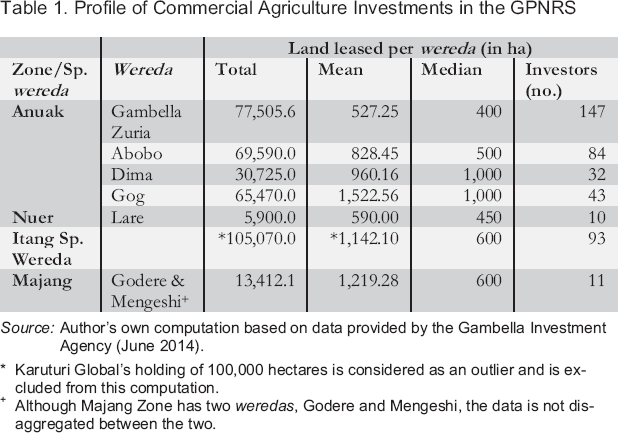
Source: Author's own computation based on data provided by the Gambella Investment Agency (June 2014).
Karuturi Global's holding of 100,000 hectares is considered as an outlier and is excluded from this computation.
Although Majang Zone has two weredas, Godere and Mengeshi, the data is not disaggregated between the two.
The region has three nationality zones (Anuak, Majang, and Nuer) and one special wereda (Itang). Below the zones there are 12 weredas: five each in Anuak (Abobo, Dima, Gambella Zuria, Gog, and Jor) and Nuer (Akobo, Jikawo, Lare, Makoy, and Wanthua), and two in Majang (Godere and Mengeshi). The weredas where there are no land deals are Akobo, Jikawo, Jor, Makoy, and Wanthua. Thus, in Nuer Zone LSLAs occurred only in Lare Wereda.
Detailed data received from the Gambella Investment Agency. Although this data is incomplete and not fully reliable, it is fit to indicate the trend and compare LSLAs between weredas/zones and across years.
If the unit of comparison is changed to average landholding per investor, Gog takes the lead, with an average holding of 1,522.56 hectares. Itang comes in second with an average of 1,237.31 hectares, followed by Godere and Mengeshi (1,219.28 hectares). Investors in Gambella Zuria leased the smallest average land area, 527.25 hectares, which is attributable to the wereda's proximity to the regional capital: the better infrastructure provisions there keep most of the small domestic investors in this wereda rather than farther away, where their expenses would certainly increase.
The majority of the aforementioned 420 land deals took place between September 2008 and August 2010 (247 deals), attesting to the trigger effect of the global land rush. Despite plans to lease millions of hectares of land in the GTP period, the number of land deals steeply declined afterwards. In FY 2010/11 there were only 88 land deals in the GPNRS. The number fell to fewer than ten in the following years.
Of the 420 firms which leased land in the region, only 12 are foreign. Generally speaking, the land leased to foreign firms is on average much larger in area than that leased to domestic ones. Next to Karuturi Global (100,000 hectares), the biggest commercial agriculture land plot leased is to BHO BIO (27,000 hectares) – both plots are in Itang Special Wereda. Rucci has leased 25,000 hectares in Gog Wereda, and the next largest land leases are located in Abobo Wereda: 10,000 hectares each to Saudi Star Agricultural Development and Bazen Agricultural Industry. The former is owned by an Ethiopian-born Saudi billionaire with numerous agricultural and industrial interests throughout the country. The latter is the largest landholding of a domestic investor in the region.
That foreign firms invest in more land than domestic ones is not a foregone conclusion. Neither is the Bazen exception the only one. One foreign investor has three different, very small plots, the largest being only 100 hectares. One thing is certain, though: foreign investors pass through a stringent evaluation before leasing land. Foreign investors are required to have the financial capacity to engage in the sector, in addition to prior experience and agricultural skill. When it comes to domestic investors, however, it is not certain if there is any concrete minimum standard one must meet to get land. Financial capacity, skill, and prior experience in the sector are not the primary factors weighed in the approval of requests for agricultural investment land. Even if the government wanted to follow a stringent procedure, it does not have the capacity to implement it, whether with respect to professional manpower, budget, or logistics. The manoeuvres individuals make to meet the requirements are “open secrets.” The profile of some domestic investors makes one wonder if any applicant has been denied on purely technical grounds (Interviews: Inv1; Inv2, Gam5). 8
As Gam5 stated, some domestic investors did not have the required capital, technology, or skill at the time they leased land. The example of a not-so-successful heavy-machine operator for a mega-farm who became a “millionaire” investor overnight is a case in point.
Political Economy of LSLAs in Gambella
Of the 420 deals mentioned, 335 were entered into in the three Ethiopian fiscal years following the 2008 global financial crisis: 140 in FY 2008/09, 107 in FY 2009/10, and 88 in FY 2010/11. The opaque and murky conditions under which the deals were made raises questions about the process and political economy under which LSLAs occur, and this topic is not well covered in the literature (Baumgartner et al. 2015; Nolte and Vath 2015). After a careful investigation into the political economy of the land-leasing process in the GPNRS, six major processes, in three broad phases, could be identified: In the first phase, preparation, a significant portion of Gambella was labelled “unused,” readying it for transfer to investors, and land administration power was, despite constitutional restrictions, centralised. During implementation, the second phase, most of the actual leases occurred within three years and most of the transfers were made to individuals with links to the ruling coalition. In the third phase, sustenance, state interventions ensured continued accumulation by way of creating a state agency authorised to regulate the cotton supply to textile factories, inter alia by buying stakes in private cotton farms and making the local population legible and controllable. Below, these political interventions and processes are elaborated.
The preparation phase begins with the “cleansing” and readying of Gambella for the accumulation drive by declaring most of the region “unused” or “marginally used.” At least 42 per cent of Gambella's territory is classified as such and made available for transfer without any recompense to the local population (Oakland Institute 2011). The federal government has taken these decisions based on the recommendations of its political and technocratic elite from the highlands. Underpinned by cultural biases, mobile forms of livelihoods are deemed irrational and wasteful, and in need of rationalisation (for a critique of such arguments, see Galaty 2011).
Although the government argues this categorisation is a technical rendering, evidence indicates otherwise. In the identification of “unused” lands, as Lavers (2012b: 804) reports, it was the most capable regions, in technical terms, which identified the least amount of land as fitting this description, while the weakest regions (Benishangul-Gumuz and Gambella) identified much more land this way. The identification of “vacant” areas (transferred to the Land Bank) was done through the use of satellite images, entering into verification only after the investor complained that local people were claiming to own/use (part of) the same land (Interviews: Inv1; Inv2; Fed1; Gam3). A detailed land-use study that was carried out by an international NGO and covered the whole of Majang in addition to some Anuak and Nuer areas could have provided crucial input into a technical rendering of land-use classifications. However, this study was ignored by the regional government (Interview: Inv1). A further indicator of the lack of technicality is that forest areas in Majang Zone determined to be priority forest areas to be protected with the participation of the local people were transferred for conversion into a tea plantation (Seyoum 2015). Currently, a detailed land-use study is being undertaken. Decisions based on this study could be closer to a purely technical exercise (Interview: Gam3). The process an investor has to go through to get land is also illustrative of the lack of technicality: first, a potential investor goes to the region's Investment Agency to get licensed; then, s/he identifies the specific land plot s/he wants to develop; finally, the responsible wereda administration gives the land to the investor and the investor enters into a lease contract. Following this, a letter is addressed to the region's Investment Agency requesting that the investor be given a land certificate; the agency sends proof and the investor gets the land certificate from the LAEPA (Interviews: Inv1; Inv2; Observation: Mass Mobilisation Forum).
Moreover, actions beyond rendering the lowlands “unused,” entrusting and delegating powers to the federal government, and including such areas in the Federal Land Bank hugely depend on the extent of political marginalisation of the particular ethnic group inhabiting the land. Entrusting the “unused” land to the federal government and leasing such lands to investors has taken place mainly in the Gambella and Benishangul-Gumuz regional states. If the process had been predominantly technical, Afar and Somali regions would have faced a similar fate. It could be argued that the Afar and Somali regions had less land conducive to commercial agriculture before irrigation infrastructure was put into place. Though, this is not the most important hindrance to the lesser extent of land deals there. It was the government's desire to avoid political complications 9 that led to the postponing of actual alienations. Thus, actual dispossessions are also expressions of powerlessness. That the GPNRS and Benishangul-Gumuz are the most targeted, and the first areas to be targeted, is an expression of their being the most marginalised in the current federal setup. It is a question of power relations, not a technical rendering.
These include clan landholdings (in the Afar community, land is held and administered communally, by clans) and strategic transport routes in Afar, in addition to problems posed by the Ogaden National Liberation Front in the Somali region.
The delegation of land administration powers to the federal government, allegedly willingly, by regional governments is the second major expression of the political economy of LSLAs. As per Article 50(3) of the Constitution (FDRE 1995), all land and natural resources are owned by the state and the peoples of Ethiopia. Sub-article 5 stipulates that pastoralists have the right to free grazing and cultivation of land as well as to not be displaced. The next sub-article, though, in effect nullifies that by stating that the government can transfer land to private investors “without prejudice to the right of Ethiopia's nations, nationalities, and peoples to the ownership of land.” Most importantly, Article 52(2, d) of the Constitution gives regional states the power to “administer land and other natural resources in accordance with federal laws.”
However, what transpired – according to the government in the interest of promoting LSLAs (Interviews: Fed1; Fed2) – is that the federal government symmetrically centralised land-administration power over “agricultural investment land” from all regional states with asymmetrical consequences. According to Article 2(2) of Regulation No. 283/2013, which established the EAILAA, as long as putting a particular parcel of land into agriculture is “deemed feasible,” there is no minimum land area below which the federal government could not be delegated to administer it. Furthermore, there is no distinction between foreign and domestic investors in the regulation. EAILAA's precursor, the Agricultural Investment Support Directorate within the Ministry of Agriculture (MoA), solely catered for the requests of all foreign investors and domestic investors leasing at least 5,000 hectares. Even before the enactment of this regulation, Gambella's regional government delegated all its agricultural investment land-administration powers to the MoA. The region successfully reclaimed its land-administration powers after two years in mid-2014, arguably after clearing its house of “rent-seeking” and corrupt officials and strengthening its land administration capacity (Interviews: Gam5; Gam6).
Such changes in which level of government administers rural land are occurring against constitutional provisions which confer those rights to the states and provide only for an upward power delegation (Ojot 2013; see also FDRE 1995). Going against these provisions, the federal government centralised land-administration powers under the guise of delegating powers from regional governments. As Ojot argues, in a strictly federal system both levels of government derive their powers from the Constitution, and amending the Constitution is required before the powers of either level can be changed. To centralise agricultural land-administration powers, however, upward delegation of power and function took place through executive power.
The third characteristic of the political economy of LSLAs is the fast-paced nature of the LSLAs. In the early 2000s, the total number of land deals made in Gambella numbered less than five per year. It jumped to eight in FY 2006/07 and to 28 in FY 2007/08, before leaping to 140 in FY 2008/09. Thereafter, a decline can be witnessed: 107 in FY 2009/10 and 88 in FY 2010/11, then free-falling to pre-2007/08 averages. The three peak years match the timing of the global rush for land and the government's intention of leasing millions of hectares of land in a short time period (Ministry of Finance and Economic Development 2010). Although the plan did not materialise due to a host of reasons, in the GPNRS alone two million hectares of land was supposed to be leased between FY 2010/11 and FY 2014/15 (Interviews: Gam1; Gam2; Gam5; Observation: Mass Mobilisation Forum). Therefore, both in terms of planned and actual land transfers, the nature of LSLAs in Gambella is fast-paced.
The fourth issue worth considering as part of the political economy in the GPNRS is the ethnic composition of domestic investors there. A striking, but not so surprising, fact is that investors from Gambella's native ethnic groups number only a few (in July 2015 there were only six – five in Gambella Zuria Wereda and the sixth in Lare Wereda; Interview: Gam5). As Dereje (2013) stressed, the imperfect ethno-cultural and political gains the federal arrangement delivered at the periphery are yet to be matched by socio-economic achievements. Thus, it is not surprising that only a few native individuals have the required interest, capital, and entrepreneurial skill. However, eligible applicants among natives of the region were not so few. A number of individuals applied and were rejected (Interviews: Inv1; Dias1). Even those that succeeded had to go through a stiffer bureaucratic check-up. Many members of the Anuak diaspora in North America decry that their agricultural investment applications were denied by the government. Their intention was more to take control of their ancestral lands before a “land grabber” would than to earnestly engage in commercial agriculture (Interviews: Dias1; Dias2). Recognising the political nature of their requests, the government declined the applications (Interview: Gam4).
Conversely, the predominance of Tigrigna-speaking investors is striking. An expert from the region's LAEPA estimated the proportion of such investors as being more than 90 per cent. Visits to the regional office compounds frequented by investors to get land and support letters – the region's Investment Agency and LAEPA – also indicate that Tigre investors predominate the sector. The predominance of Tigre investors was also evident at the Mass Mobilisation Forum organised by the EAILAA in June 2014. Concrete proof is available in the form of the list of investors. An attempt to get a rough idea of the number of investors by counting names usually associated with Tigrigna speakers (a proxy indicator, not necessarily an exact match) in each wereda suggests that Tigrigna-speaking investors predominate. The highest proportion is seen in Lare Wereda, where all the investors have Tigrigna-appearing names. This imbalance is also perceived by the local community and the Anuak diaspora. 10
In Abol Wereda, for example, the Komo feel surrounded by agricultural investments owned by Tigre investors (Personal communication, Res.1). Obang Metho, a well-known Anuak diaspora activist based in the US, also argues that land is being taken away from Gambella's native population to be given to the Tigre.
How can this be explained? It seems as though most domestic investors are going to Gambella (and Benishangul-Gumuz) regional states as land is becoming scarce in the northwestern lowlands (Kuwara, Mettema, and Humera), which were spaces of commercial agriculture in past decades (Interview: Fed1). If this were the case, though, the Amhara would have been expected to flock to Gambella as well, effectively contesting the overrepresentation of Tigrigna speakers in the GPNRS. Another possible explanation is imperfection in market information. The region promoted the vast land it prepared to lease only at the start of the rush, thus first-comer investors promote the profitability of engaging in agricultural investment in the region (Interview: Inv2). Therefore, if the majority of the first-comers were Tigre, the ethnicisation of social and business relations ensured their continued dominance. A more fundamental explanation is the translation of the political dominance of the Tigrayan People's Liberation Front (TPLF), the strongest member of the ruling coalition, into economic dominance. 11
Dereje (2011b) reported a similar extension of the TPLF's political dominance into the salt economy. Another potential explanation to the Tigrayan dominance in the salt economy could be their historical dominance of the salt trade in Ethiopia (Personal communication, Mulugeta Gebrehiwot). In the case of agricultural investment in Gambella, however, there is no such counterweight.
The fifth manifestation of the political economy of LSLAs is the readiness of the government, through the Ethiopian Industrial Inputs Development Enterprise (EIIDE), to re-enter cotton commercial farming by buying stake in private farms. This is happening after the privatisation of state farms by the government over the past two decades, save for sugarcane plantations. Article 5(5) of the Council of Ministers Regulation establishing the EIIDE (No. 328/2014) stipulates that one of the purposes of the EIIDE is “to work jointly with enterprises which are engaged in producing and supplying industrial inputs and raw materials.” When it comes to textile factories, the aim is to increase cotton production and productivity in the lowlands, Gambella included, by buying stake in private cotton farms (Interview: Fed3). 12 The retracting hands of the state are now being re-entrenched in commercial cotton farming.
As much as 51 per cent, according to Addisfortune 2015.
The sixth expression of the political economy of LSLAs is the pursuing of a simultaneous villagisation programme. This programme is criticised as a scheme to evict people and make way for LSLAs (Human Rights Watch 2012), while the government contends that there is no link between the two and that it is only a coincidence that the timing of their implementation overlapped. In addition to the stated objective of reducing costs of service delivery by aggregating the local population in nucleated villages, the villagisation programme aids the LSLAs by disabling the agency of members of the local community by making them legible, governable, and controllable by the state (see Scott 1998). Villagisation has the potential to replace old ways of life with settled ox-plough farming and simultaneously put every household under closer scrutiny of the kebeles (the lowest administrative level), structures established below the kebeles (development teams and one-to-five teams 13 ), and the police. This increases the state's ability to surveil and control and reduces the local community's ability to negatively react to the LSLAs (for more on this, see Fana 2015b).
One-to-five teams are established with a capable leader, a “model” individual, at the centre, who follows up on practices, and advises and mentors his/her teammates. In practice, such structures end up serving as another control instrument.
Commoditising Gambella's Resources: Extra-Economic Dispossession in the GPNRS
The commoditisation of Gambella's land resources is as ubiquitous as it is obvious, and is occurring in the name of development. The onset of the region's insertion into the whirl of capitalism more than a century ago (see Bahru 1976: 386–387) is in its completion phase, after an overextended interval. What was a conveniently ignored space – only associated with proxy wars, refugee flows, political crises, and disaster (flooding) – is now back on the map of new geographies of capitalist accumulation. Capitalist agriculturalists are after Gambella, seeking to pull and annex its coveted resources into the accumulation process.
The aggressive leasing of Gambella's land is far from a purely, or even primarily, economic process. In its creeping descent to its lowland peripheries, the Ethiopian state is effectively stripping off the crucial resources relied upon by pre-capitalist and non–surplus producing forms of production practised in the lowlands – that is, shifting cultivation and agropastoralism. Capitalist farmers stand to reap the spoils. This process falls under the broader banner of primitive accumulation, what Harvey (2003) re-packaged as accumulation by dispossession (Borras and Franco 2012; Mehta, Veldwisch and Franco 2012; Moyo 2011; Moyo, Yeros, and Jha 2012; Wolford et al. 2013).
For Harvey (2003), accumulation by dispossession is a primarily economic activity through which common resources are made available at very low prices for the accumulation process. For other political geographers, however (see Glassman 2006, 2009; Levien 2011), the distinguishing factor uniting various forms of accumulation by dispossession is its extra-economic nature. For Levien, it is “an extra-economic process of coercive expropriation typically exercised by states to help capitalists overcome barriers to accumulation” (2011: 454) or the “deployment of extra-economic means in the process of accumulation” (2011: 456). For Glassman, accumulation by dispossession is “accumulation by extra-economic means” (2006: 617) or extra-economic surplus extraction (2009: 94, 95).
As the discussion in the previous part shows, the Ethiopian state's political agency is deployed to “unlock” Gambella's land resources and make them available for the accumulation drive – in the process, enforcing dispossessions coercively. The categorisation of most of the GPNRS as “unused” is not a technical decision, but a political one. Similarly, the deposition of such “unused” lands into the Federal Land Bank and the centralisation of administrative power over such lands is another political intervention to favour capital. The pace at which LSLAs are occurring reflects the securitisation of development and the intention to spur rapid economic growth throughout the country. This cheetah-like pace is a political intervention through “ambitious” planning at the highest levels and a consequence of the political project of framing poverty as an existential threat to the state and its people and, as such, as something to be eliminated swiftly. In the composition of investors, we see the extension of political power into the LSLAs, the favouring of some and the raising of the bar on others. The decisions to implement a comprehensive villagisation programme and to establish the EIIDE are political interventions to guarantee continued accumulation. Villagisation disempowers the local population from doing anything about the LSLAs by making it legible, governable, and controllable. These six political interventions could be labelled as politics of dispossession, following Levien (2011: 457).
Such extra-economic interventions tilt the balance in favour of the capitalist. LSLAs are occurring in Gambella by way of a “decidedly political process through which the [Ethiopian] state's coercive power is deployed to make a key condition of production […] available for capital” by removing barriers to accumulation (Levien 2011: 457, emphasis in original). These interventions in our times come in more benign and muted forms (Büscher 2009; Negi and Auerbach 2009a). The framing of the dispossessions within the broader frame of development and the promise and delivery of social services as part of the villagisation programme plays down the violence involved in LSLAs (Fana 2015b).
Conclusion: Development and State-Remaking in Ethiopia's Peripheral Lowlands
Land transfers in the GPNRS are expressions of the coming of the Ethiopian developmental state to its lowlands. The political economy of LSLAs depicts the aggressive role the Ethiopian state plays in facilitating LSLAs and enabling accumulation from the lowlands. The Ethiopian government is getting closer to what the imperial and Derg regimes only dreamt of: mastering the lowland territory and controlling the “last frontiers,” as Markakis (2011) calls the lowlands. This is propelled by the need for stronger state intervention to facilitate LSLAs and augment accumulation. The state is defining which land is to be leased, centralising land administration powers, deciding who accumulates, and intervening to ensure continued accumulation.
Whether Gambella's lowlanders benefit from LSLAs and villagisation is vehemently contested, but the state's presence and strength in Gambella's lowlands is increasing. LSLAs indicate a continuation of the long history of centre–periphery relations (Lavers 2012a; Makki 2012), albeit qualitatively different. The state is now there to stay, not to plunder resources/punish the population and go back up to the highlands. Dispossession sets the ground for the sweeping away of the social relations of local life, abetted by the villagisation programme. LSLAs and the associated villagisation programme stand to alter the interaction between humans and nature in the lowlands. Social relations born of subsisting on shifting cultivation, agropastoralism, flood-retreat agriculture, fishing, bushmeat, and non-timber forest products (including hunger foods) are being transformed to match the needs of capital and the state. The roaming of natives to new fertile lands (Anuak, Komo), seasonal migration with livestock (Nuer), and dependence on forest products (Majang) are being severely restricted. The end goal is to reduce the native community to living off of a fixed plot of land or to depending on state alms.
Development through LSLAs undergirds and conceals the current round of state-remaking in Gambella, and it is occurring through dispossessive, violent processes. Past state-(re)making attempts were also violent: imperial violence had a civilising mission and revolutionary violence was propelled by high-modernist dreams (Dereje 2015). “Developmental violence,” unleashed in the form of politics of dispossession, is engrained in the current round of state-remaking. LSLAs constitute an extraction project and villagisation is a population control project. These projects are conducted through the developmentalist discursive frame, by extending state institutions and images to the lowlands. The LSLAs are not occurring because the state is weak, nor are officials acting against state interests and only serving global agribusiness interests; rather, LSLAs are economically justifying, contributing to, and simultaneously concealing the project of effectively controlling Ethiopia's “last frontiers.”
Footnotes
Interviews
To guarantee the anonymity of interviewees, per their request, only the (rough) position and organisation are listed, but not their names.