



Abstract
This article expands our understanding of the objectives of mutinies through an analysis of trends in tactics. It explores actions within mutinies through a review of 66 cases of mutiny from 1960 to 2012 in West and Central Africa. Despite wide variations in context among these mutinies, there are remarkable similarities in the tactics used by mutineers in the region and across time. These commonalities challenge the popular image of African mutinies as chaotic or devoid of strategy. The article demonstrates that the most common tactics used by mutineers in West and Central Africa all serve to open a dialogue with leadership and provide a platform for soldiers to vocalize their expectations in an environment that intentionally stifles the voices of the junior members. It suggests mutiny be viewed as an act of communication rather than merely a form of insubordination.
The media tends to portray mutinies as chaotic events that threaten public order and safety. 1 A sample of descriptors of African mutineers within international media include “ruthless”, “uncontrolled individuals”, “diehards”, “criminals” and “dangerous”, while the mutinies themselves have been characterized as “total anarchy”. 2 Military organizations have an equally negative reaction to mutinies, often handing out harsh penalties to those involved, including capital punishment. Elihu Rose (1982: 562-563) describes the way militaries generally view mutinies:
For example, see West Africa, 7 October 1991, 1675.
West Africa, 4 November 1961, 1 February 1964, 9 July 1966.
If governments abhor the word “mutiny”, the military does even more so, for the military's ability to act effectively is founded upon the principle of discipline, and mutiny is the antithesis of discipline. To the military, mutiny is utterly unthinkable. It is more than a breach of regulations; it is a negation of the military essence.
Rose's description is similar to other writings on mutinies, which regularly use emotive expressions such as “dishonour”, “disloyalty” and “moral weakness” to describe the actions of mutineers (James 1987: 4). While some of these adjectives commonly used to describe mutineers may apply to some individuals, the often-dramatic depiction obstructs the rationale and strategy of a mutiny.
Despite the strong reaction mutinies evoke, it is a topic that has been given little scholarly attention, particularly in sub-Saharan Africa. The few studies of mutinies on the continent are limited to individual case studies, such as the mutinies following independence in the Democratic Republic of the Congo (DRC), Tanzania, Kenya and Uganda. 3 This research breaks from the tendency to address mutinies as singular, exceptional events and instead looks at patterns across states and time.
Examples include Parsons 2003; Luanda 1998; and Mazrui and Rothchild 1967.
The article addresses an issue that is absent in most discussions of mutinies: tactics. It asks a basic but important question: How do soldiers in West and Central Africa generally conduct a mutiny? However, the article serves as more than a playbook for mutinies. It aims to provide a more detailed understanding of the objectives of mutinies by analysing common tactics.
The research question is approached through a review of 66 cases of mutiny from 1960 to 2012 in West and Central Africa. Despite wide variations in context among these mutinies, there are remarkable similarities in the tactics used by mutineers in the region and across time. These commonalities challenge the popular image of African mutinies as impulsive or devoid of strategy. For example, they counter work by Geoffrey Parker and Guy Pedroncini, who each conclude that in the (Western) mutinies they studied, there were “few premeditated or purposeful acts of indiscipline. Instead, most mutineers acted out of despair, fatigue or momentary anger” (Parker 2001: viii). The analysis of mutinies in this article demonstrates that the most common tactics used by mutineers in West and Central Africa all serve to open a dialogue with leadership. Among the many potential ways for military members to express their discontent, mutineers regularly choose tactics that bring their complaints into the public realm. Their actions are showy and difficult for politicians or military hierarchy to ignore. This analysis suggests mutiny be viewed as an act of communication rather than merely a form of insubordination.
Identifying Mutinies
Data for this article is drawn from a wider study on mutinies in Africa (Dwyer 2014). The research defines mutiny as “an act of collective insubordination, in which troops revolt against lawfully constituted authority” (Rose 1982: 561) for primary goals other than political power. Using a range of sources, including a systematic review of Africa South of the Sahara, Africa Confidential, Africa Research Bulletin and West Africa, I identified incidents of mutiny in West and Central Africa from 1960 to 2012. Additional information about the mutinies came from academic writing, memoirs and other news outlets, as well as declassified and leaked intelligence reports. In reviewing these sources, I was looking for events which included a group of soldiers who 1) remain within the state's military structure and 2) use mass insubordination to express stated grievances and goals beyond the desire for political power to higher political and military authorities. This is an intentionally conservative definition of mutinies that excludes other types of military indiscipline such as desertion. By limiting the scope of indiscipline, the analysis focuses specifically on acts in which soldiers attempt to work within the system rather than simply leave the organization. The definition also separates mutinies from coups. In practice, various forms of military indiscipline can often overlap or escalate, and some acts that have started as mutinies have ended in coups. However, within the 66 cases examined, there were only eight for which this pattern occurred. This counters the way mutinies have often been seen – namely, as the entry point of a coup (First 1970: 205; Luckham 1998: 23-24). Instead, the research looks at mutinies as a phenomenon with their own unique dynamics.
The study also involved qualitative field research in Sierra Leone, Burkina Faso and the Gambia (2011–2012) during which former mutineers, military leadership, politicians, civil society leaders and journalists were interviewed in regards to incidents of mutiny. This allowed me to gain unique insight into the perspectives of the individuals who conducted or experienced the mutinies first-hand. Through this combination of primary and secondary research, I identified 66 cases of mutiny. A list of these mutinies can be found in Table 1. A file of available data on each of these incidents was created, and the qualitative-data-analysis computer software NVivo was used to help organize the data and identify patterns across time. 4
The following countries are included in the dataset: Benin, Burkina Faso, Cameroon, Cape Verde, Central African Republic (CAR), Chad, Democratic Republic of the Congo (DRC), Equatorial Guinea, Gabon, Gambia, Ghana, Guinea, Guinea-Bissau, Liberia, Mali, Niger, Nigeria, Congo-Brazzaville, São Tomé and Príncipe, Senegal, Sierra Leone and Togo. Due to the lack of detail in reporting on most mutinies, it was not possible to accurately count each unit within large-scale mutinies. Instead, mass mutinies (such as those in the CAR in 1996/1997 and Burkina Faso in 2011) were logged as separate incidents only when there was a clear pause (usually for negotiations) and later continuation of the mutiny.
Incidents of Mutiny in West and Central Africa, 1960–2012
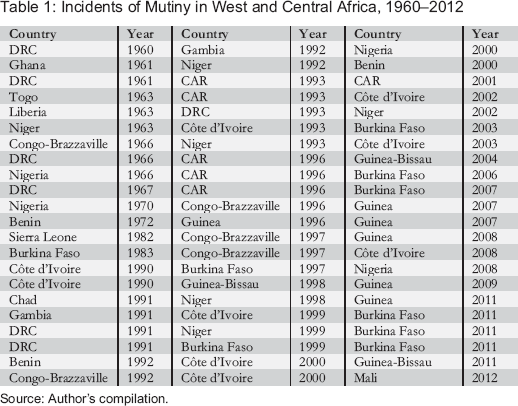
Source: Author's compilation.
The later sections will detail patterns of tactics used by mutineers as identified through the review of these revolts. It is important to note that in the vast majority of mutinies examined, the participants were rank-and-file soldiers. Occasionally, non-commissioned officers (NCOs) were involved – and, more rarely, junior officers – but the bulk of participants were at the lowest rank of the military hierarchy. This is consistent with studies of mutinies in a non-African context (Lammers 1969: 558). The low status of these individuals within their professional environment likely shapes the tactics they choose as well as the objectives of the mutiny, as will be further detailed.
Revised View of Mutinies
Mutineers typically make material demands, and in the context of West and Central Africa these usually include a combination of calls for increased pay and improved living conditions. However, often the analysis of mutinies is limited to these material demands. This can be seen in the way that mutinies in Africa are commonly referred to as simply “pay revolts” or “pay mutinies”. 5 These terms are usually not followed with much explanation, as the cause and solution are both implied. As Christopher Ankersen (2006: 123) explains, “many regard the lower ranks as unsophisticated” and “it may be easier, therefore, for their grievances to be viewed as basic and immediate”.
There is a growing consensus among mutiny scholars that we must look beyond “the mundane material grievances that have become cliché” in order to discover the less tangible motivations (Hathaway 2001: xv). One of these less tangible motives is a sense of injustice, which underlies most material grievances expressed through a mutiny. Mutinying soldiers usually draw on values concerning what they believe is unfair treatment and/or irresponsible behaviour by superiors within a military context. Their accusations against superiors often overlap with material demands. For example, soldiers demanding pay often specifically accuse their officers of having a hand in the delay and request their dismissal. Similarly, discrepancies in pay or opportunities between units are often attributed to wider issues of corruption and favouritism. While improvements to pay and living conditions often feature centrally in a list of mutineer demands, an important part of the revolt is the ability to reveal and discuss aspects of their conditions that they object to. The analysis in this research builds on works by scholars such as Craig Mantle (2004: 10), who in observing Canadian mutinies commented that the acts “served as a means of communication that informed leaders that, for whatever reason, all was not well within their respective commands”.
Examples include First 1970: 436; Cornwell 2000: 81-93; Peters and Richards 1998: 184.
The desire to use a mutiny to explain to leadership-specific faults in the system is exemplified in the excerpt below from an interview with a former mutineer in Sierra Leone. This soldier accused his officers of “seizing government funds” that were meant to go towards pay and equipment for junior soldiers:
Soldier: We just wanted to arrest those we [suspect] and hand them over. We wanted to expose them [senior officers].
Author: Expose them for what?
Soldier: For embezzlement of government money. They are just eating this money. We wanted to expose them, to expose them so others do not do the same. If you expose them, you bring them to justice, they punish them for that. (Interview with enlisted soldier, Sierra Leone, 2012)
This soldier's explanation of the mutiny he was involved in is similar to rhetoric used by other mutineers in the region. For example, mutineers in 1993 in the DRC stated that their revolt aimed to “draw attention to the disgraceful situation” concerning soldiers’ pay (Africa Research Bulletin, February 1993, 10907). Salary was the key material complaint in both of the above examples, but the ability of soldiers to communicate and reveal the problems was another important objective of the action. By explaining where they find fault in the system, mutineers regularly attempt to effect longer-lasting changes than a simple pay-off. The soldier quoted above believed that “exposing” the senior officers would deter other superiors from committing similar alleged crimes in the future. The desire to draw attention to their cause and open a dialogue about their conditions is not only apparent in soldiers’ rhetoric, but also demonstrated in the tactics used by mutineers, as described below.
The Power of a Threat
In understanding how soldiers carry out a mutiny, it is important to note that while the threat of violence is an integral part of a mutiny, the use of violence is not. Of the 66 mutinies examined in this article, slightly less than half involved direct acts of violence. This data contradicts writings by other scholars researching militaries, such as Jimmy Kandeh (2004: 42), who argues that “mutinies are by definition violent acts of defiance”. However, the finding from the cases reviewed in West and Central Africa is consistent with other studies of mutinies in a non-African setting, which have also shown that mutinies tend to be nonviolent (Rose 1982: 568; Hathaway 2001: xvi; Hamby 2002: 576).
An important aspect of mutineers’ strategy is the ability to create and control instability. Unlike those in an industrial or agricultural occupation, soldiers do not have tangible goods to demonstrate or measure their worth. Instead, the value of the military rests in its ability to manage violence (Huntington 1957: 13). Within this context, it is perhaps not surprising that the threat of violence is a key tool for mutineers. Mutineers utilize their position in the military to threaten to create a situation of instability or escalate the instability they have already created. Their main bargaining chip is their ability to also control the situation and cause circumstances to return to the desired state of stability. Yet, this is often an overly ambitious claim, especially when the group lacks cohesion. Anger, aggression and indiscipline can overshadow strategy, and individuals often act on their own accord. Involving large numbers of participants is often both the strength and the downfall of mutinies. A large group quickly gathers the desired attention and can place pressure on the government, but it is also difficult to control during a mutiny, when the standard hierarchy is often inverted.
This article does not intend to downplay the violence that mutinies can cause. Even though the (slight) majority of mutinies in the region are not violent, there are several cases in which mutinies have led to high numbers of casualties. For example, in the mutinies in the Central African Republic (CAR) in 1996 estimates of fatalities range from 200 to 500 (Mehler 2009: 10). The Côte d'Ivoire mutinies in 2002 led to 270 deaths (West Africa, September 2002, 25), and mutinies in Guinea in 1996 resulted in 50 deaths with a further 300 wounded (Africa Research Bulletin, February 1998, 13014). Significantly, many, if not most, of these casualties were civilians. Therefore, although mutinies are usually seen as internal military matters, in West and Central Africa they have had severe consequences on civilian populations. It is important to develop a better understanding of mutinies, not just from a standpoint of political stability, but also from a humanitarian perspective.
While acknowledging the potential for violence in mutinies, this article aims to look beyond violent acts in order to demonstrate the wider strategy of mutinies. Mutineers generally want their conditions to improve; they do not want to be removed from the military. At times, mutineers recognize that violence will harm their cause and so they intentionally demonstrate that they are unarmed. However, even in cases when soldiers indicate that they are unarmed, their position in an organization that has often been responsible for much insecurity in the region implies a threat of violence or instability. As a result, governments usually act with more expediency towards a mutiny than they would if members of the civil service or a trade organization were presenting similar grievances (as is often the case when mutinies coincide with civilian demonstrations).
Attention-Seeking Tactics
An image that likely comes to mind of a mutiny in Africa is one of soldiers gathered in streets firing weapons into the air. This is a fairly accurate starting point for a mutiny. Discharging firearms and holding mass gatherings in a strategic location (military headquarters, state house, parliament building, and so on) are among the most common tactics used by mutineers. The firing of weapons is closely linked to another common tactic: breaking into the armory. In most parts of West and Central Africa, junior soldiers do not readily have access to firearms and therefore the first step for many mutineers is to seize weapons and ammunition from the armory. Brandishing or firing weapons can serve as both a symbol of power and a threat to those not involved in the mutiny.
While the image of mutineers as gun-wielding soldiers creating a chaotic atmosphere for their own benefit is partially true, it is also an incomplete picture. Mutineers are often strategic and creative in their tactics, gaining inspiration from their own military training as well as from successful actions used by other armed groups and civilian organizations.
One common tactic used by mutineers is hostage-taking. Of the 66 mutinies examined in this dataset, at least 15 incidents involved the taking of hostages. This tactic is not specific to a particular time period. It was used in Congo-Brazzaville in 1966 when mutineers captured the head of the army and gendarmerie (West Africa, 2 July 1966, 757). This tactic was also used in the CAR mutinies in 1996 when mutineers took hostage the Army Chief of Staff, Energy Minister and National Assembly Speaker (West Africa, 27 May 1996, 812). Nigerien soldiers appear to be the most keen on using hostages as a mutiny strategy and have done so during revolts in 1992, 1993, 1998, 1999 and 2002. Their abductees include the head of the parliament, ministers, military commanders and local authorities.
Hostage-taking is also a common strategy among non-state armed groups in Africa, having been used by, for example, criminals in the Niger Delta, Al-Qaida in the Islamic Maghreb and Somali pirates. However, it is not a strategy that would commonly be used in a military context. In hostage-taking by both armed groups and mutineers, the value of taking hostages lies in the ability of that act to pressure an exchange. For example, armed groups usually attempt to exchange hostages for the release of prisoners or for money, while mutineers exchange hostages for meetings with senior leadership or promises that their demands will be met. One important aspect that makes hostage-taking by mutineers different from other armed groups is that they often abduct individuals from their own organization, whereas armed groups regularly go for external targets. Furthermore, mutineers typically do not attempt to hide their identity or location (as terrorists and pirates do). Last, mutineers usually do not overtly threaten the lives of their hostages. In the cases of hostages taken by mutineers examined here, there were no incidents in which the hostages were killed. Mutineers want to make changes to the military system or desire material gains; they do not want to be excluded and removed from the system. Therefore, they must use caution when dealing with hostages, as an injured or dead hostage would not help their cause.
Mutineers also often take over strategic locations as a way to assert their power and threaten authority. The tactical value of the locations utilized by mutineers ranges from relatively minimal to extremely high. For example, mutineers in Nigeria in 2008 blocked traffic for several hours on a major road in order to draw attention to claims that they had not been paid their allowances (Sowole 2009). While the mutiny did bring attention to their complaints and likely inconvenienced many local people, it did not threaten the stability of the nation. Other mutineers have captured more valuable targets. Mutineers from the Air Force of the Côte d'Ivoire took over the control tower and terminals at the Abidjan Airport in 1990 (West Africa, 28 May 1990, 877-878). Similar incidents of mutineers holding airports have occurred in the DRC (1966, 1991) and Niger (1992). 6 Mutineers in Congo-Brazzaville in 1997 held both the rail station and the power station, disrupting rail service and leaving local towns without electricity for several days (Africa Research Bulletin, February 1997, 12578).
West Africa, 30 July 1966, 869; West Africa, 7 October 1991, 1674-1675; Africa Research Bulletin, February 1992, 10471.
Controlling public or strategically important locations is similar to hostage-taking in that it brings the grievances of the mutineers into a more public forum. Unlike hostage-taking, controlling locations affects not just key political or military personnel, but the general civilian population as well. Targeting transit infrastructure, especially airports, also has international implications when air traffic is diverted. The longer mutineers hold strategically important locations, the more fragile a government appears, which could affect international trade and investments. Furthermore, when actions taken by mutineers affect civilians, there is the threat that civilians will react, further destabilizing the situation. Civilians may criticize the way the government handles the situation, or, perhaps even worse for a government, they may even side with the mutineers. Both scenarios have occurred during separate mutinies in Burkina Faso, the former in 2011 and the latter in 1983.
In addition to its strategic value, the choice of targeting transportation infrastructure can also be seen as mutineers working within a domain they are familiar with. While militaries worldwide often have a primarily external focus, in West and Central Africa the military regularly take on an internal function, similar to policing. The protection of key infrastructure is often part of their responsibility. It is particularly common for the military to be active in transportation infrastructure, as evidenced by military-manned road checkpoints or military personnel acting as airport security.
Gathering publicly, firing weapons into the air, taking hostages and holding key infrastructure all serve the purpose of drawing attention to the cause of the mutineers. These tactics are not meant to be discreet; mutineers want people to know their mission. This is an important difference between coups and mutinies. Coups are generally intended to be exclusive (Kandeh 2004: 43), and “the conspiratorial strike is the secret to its success” (First 1970: 19). Mutineers typically want to include many participants and want both military and civilians to know about their cause. As I will describe later, soldiers often specifically threaten a mutiny before one is carried out. Whereas coups are meant to be a definitive action, mutinies are a step in a process of negotiations.
Media-Savvy Mutineers
The above-mentioned mutineer tactics have been used fairly consistently from the 1960s to the present. A relatively new tactic that has emerged since the 1990s is the incorporation of media into mutinies. Radio has been the most preferred media outlet for African mutineers, which mirrors radio's popularity across the continent. This trend of soldiers utilizing the radio coincides with and has been enabled by increased media freedoms in the region from the 1990s onward. During the 1990s, more media freedoms allowed reporters (though not without risk) to “reveal what [was] going on behind the well-draped windows of public institutions” (Hyden and Leslie 2002: 12). There was increased public scrutiny of political figures and government procedures, with growing attention towards corruption (Hyden and Okigbo 2002: 48). Many of the same themes were paralleled within militaries, which saw an unprecedented surge of mutinies in the 1990s (there were at least 28 in the region in that decade). Soldiers also publicly scrutinized their leaders and military procedures, often emphasizing corrupt practices.
During the 1990s, it was common for mutineers to take control of the radio waves during their revolts. Several examples of this include mutinies in Côte d'Ivoire in 1990, Niger in 1992 and the CAR in 1996. However, in recent years mutineers have often not needed to physically take over a station to be heard. Media outlets vying for unique access often approach soldiers for interviews, as was the case during mutinies in Burkina Faso in 2011 (Interview with Editorial Chief for Ouaga FM, 2012).
The desire for mutineers to grab the attention of government officials, and often a wider audience, makes the media a natural tool. Radio announcements allow soldiers to articulate their demands. For example, in 1996 mutineers in the CAR made the following announcement:
First, we demand the payment of overdue salaries for 1992, 1993 and 1994. Second, the unfreezing of salaries. Third, the restoration and improvement of the Central African Armed Forces […]. Fourth, we demand that no legal proceedings should take place after the mutiny since we will stop today. (West Africa, 5 May 1996, 667)
As earlier noted, mutineers also seek to open a dialogue about the conditions under which they are working and often use radio announcements to provide detailed justifications for their actions. Radio statements by mutineers regularly provide an alternative narrative, one in which they are the victims of an unjust system rather than aggressors. For example, mutineers in the CAR stated the following in 1996:
Our living conditions are mediocre; we are treated badly and we are exposed to disease. This is why we have left the barracks. We made these demands from our barracks, but call to no avail. We have been forced to take to the streets. We have no intention of destabilizing the regime. (West Africa, 5 May 1996, 667)
The announcement serves to personalize the mutineers. They aim to portray themselves not as soldiers who are committing a military crime but rather as individuals who cannot provide for themselves or their families under their current salary. Additionally, they express that they used mutiny as a last resort and thus suggest that the blame is on their leadership for not responding to earlier complaints.
Mutineers commonly present their case pragmatically, with a heavy emphasis on numbers and facts. For example, in interviews with former mutineers in West Africa they often went to great lengths to explain their salary in precise numbers (including how often they were paid) as well as listing other various costs such as rice, a pound of meat, transportation to visit family, uniforms and boots. 7 This is apparent in media announcements by mutineers as well. For example, soldiers in the CAR announced, “We pay for our uniforms, which cost 25,000 francs [CFA]; a pair of boots costs 25,000 francs, and we get 29,041 francs and we have families and children” (West Africa, 5 May 1996, 667). The same group later explained on the radio, “We have continued to receive the salary of a second-class private, 29,041 francs, for 15 to 16 years” (West Africa, 5 May 1996, 667). Similarly, soldiers in Guinea in 2008 explained their pay grievances in relation to the cost of rice in order to show that a bag of rice costs roughly half of their monthly pay (Agence France-Presse 2008). In these cases, there seemed to be a strong desire to demonstrate in detail how their salaries could not cover the basic costs of living, and in doing so soldiers were making the point that their actions were driven by necessity. They provide a case for longer-term changes rather than a one-time pay-off. By providing the exact details of their salaries and expenses, soldiers also distinguished themselves from the officers whom they often accuse of economic irresponsibility. However, portraying themselves as sensible negotiators is likely to some degree a strategy in itself, and there are plenty of examples of behaviour within mutinies, such as looting, which cannot be justified by claims of necessity.
Author interviews with military sources in Sierra Leone, Burkina Faso and the Gambia in 2011 and 2012.
While the above examples used media during a mutiny, there is a recent trend of soldiers approaching the media with their complaints as a warning to the government of a pending mutiny. One such example involves Nigerian soldiers in 2012 during a deployment to Darfur as part of the United Nations/African Union mission. The soldiers told Radio France International Hausa Service that they would mutiny if they were not paid their owed allowances and airlifted back to Nigeria. In a related petition that they sent to the government, the soldiers stated:
Nobody seems to listen to us or the plight of our families back home. Even though it is against the ethics of the military to go to the press, we are pushed to the wall because nobody listens to our cries apart from the media. (Mukhtar and Bashir 2012)
In this case, the soldiers stress their desire to open a dialogue with their superiors and their willingness to take extreme measures to get attention for their concerns. Much like the examples from the CAR above, these soldiers also acknowledge that their actions go against a military code of conduct but express that it was a measure of last resort. These examples further the notion that mutinies are often planned events rather than impulsive reactions.
Similarly, soldiers in Sierra Leone used the media to express their complaints on a weekend radio show in October of 2013. A Sierra Leonean soldier deployed as part of the African Union Mission in Somalia (AMISOM) accused the government of “fraudulently” reducing the peacekeepers’ pay and claimed that soldiers have to bribe officers to go on the mission. 8 Among other complaints, he alleged that Sierra Leonean soldiers are living “precariously” on deployment, without adequate supplies and food (Cham 2013). While the Minister of Defence responded that the claims were “unfounded” and “unprofessional” and questioned whether the caller was even a soldier, he still provided a detailed response to each of the claims (Awoko 2013). It is too early to tell if the peacekeepers will be satisfied with his response, but the soldiers’ strategy of approaching the media with their concerns succeeded in opening a dialogue between themselves and senior hierarchy. Senior leadership clearly felt compelled to respond to the allegations, and it is possible that the response may have diffused tensions that otherwise could have led to a revolt.
This was a common complaint I heard while interviewing Sierra Leonean soldiers in 2011 and 2012.
The rapid increase in internet use and particularly social media potentially allows the messages of mutineers to reach much farther than radio announcements. Whereas the Nigerian and Sierra Leonean soldiers’ grievances were announced first on the radio, the stories were also posted online and picked up by bloggers and reposted via Twitter, thus reaching an incalculable number of people throughout the world. In another example from Nigeria, in 2013 a letter from an anonymous group calling itself the Group for the Salvation of the Nigerian Army and the Motherland (GROSNAMM) was widely circulated on blogs, internet message boards and Facebook, followed by hundreds of reader comments. The report detailed the career paths of dozens of senior officers and accused the Nigerian military of nepotism and ethnic favouritism within recruitment and promotions (among other things). It cautioned of growing tensions in the military and warned of a pending mutiny. 9 Similar to the other cases, the authors of this report turned to new forms of media to disseminate their perceptions of alleged crimes and threatened to mutiny to hammer in their point.
iReports-NG.com is one of the many sites that posted the report.
Considering mutinies often involve junior rank-and-file soldiers, many of whom will likely be of a more technologically advanced generation than their older peers, it is reasonable to assume that technology and media will be used even more pervasively in future mutinies. Today, soldiers see media as more interactive and as a way to circumvent their chain of command. It also allows soldiers to connect with the international community and the civilian population. Some military hierarchies appear aware of the new challenges posed by the spread of information via social media and have sought to limit its use. For example, in 2013 the Nigerian military leadership warned soldiers against posting sensitive information on social media and asked those who are technologically savvy to help monitor the social media activity of military personnel (Premium Times 2013).
The growing trend of soldiers utilizing the media poses new challenges to military leadership because it contradicts the standard chain of command and allows complaints to circulate quickly. Expanding the dialogue beyond soldiers and their superiors into the civilian realm can also create challenges for political leadership. For example, there was criticism within the media, civil society and political opposition when President Tandja of Niger declared a state of emergency following the mutinies in 2002. The state of emergency restricted civil liberties, particularly press freedoms, and journalists who reported on the story were arrested (Africa Research Bulletin, July 2002, 14972-14975; IRIN 2002). The Constitutional Court ruled against Tandja and declared that he did not have the authority to make the decree (Africa Research Bulletin, September 2002, 14999). Civilians stayed engaged with the mutineers’ cause and staged a sit-in in front of the Congress Palace in Niamey, where a conference for the African Commission of Human and People's Rights was being held to protest that over 200 mutineers had been held in jail for nearly a year without trial (Africa Research Bulletin, May 2003, 15317). The mutiny concerned pay and living conditions, as well as complaints about particular officers; however, it took on larger proportions when civilian organizations used the government response to question the powers of the president and the state of civil liberties.
Mixed Results
The goals of the tactics described above are to gain attention and open a dialogue with leadership in an environment in which the hierarchy does not easily allow individuals to express their opinions. Channelling concerns up the chain of command, which would be the required procedure within a military hierarchy, is rife with complications. For one thing, the chain of command is often the problem, particularly when soldiers accuse their direct superiors of having a hand in their overdue or low salaries. Another complication arises when the demands of mutineers are larger than can be addressed by their immediate superiors, which is frequently the case. For example, a junior officer or NCO is generally not able to raise soldiers’ salaries or bring allegedly corrupt officers to justice.
Most often it appears mutineers prefer to deal with political leadership rather than military leadership. This is a trend that represents their general distrust of the military hierarchy. This preference can be seen in the way they often physically approach the state house or demand meetings with the president. Their desire to negotiate with political leadership is also represented in their preference for abducting civilian political hostages rather than military officers. In some ways, this may be counterintuitive. One could assume that rank-and-file soldiers would take hostage those that they blame for their problems, who tend to be military officers. However, junior soldiers abducting their senior officers and expecting the military hierarchy to respond confines the act to an internal military matter and, generally speaking, the mutineers do not trust the military hierarchy. By involving political representatives, mutineers work around their chain of command and bring their complaints into the political realm. Additionally, they draw wider attention to the perceived wrongdoings of their seniors.
The goal of many mutineers to engage with political leaders can also be seen as part of the history of militaries in the region. Here, militaries have long been intertwined with politics, as evidenced by the high number of coups and subsequently high number of military and former military heads of state. Armed forces have long been involved in dialogue with politicians, and mutinies can be seen as an extension of this. Furthermore, mutinies in West and Central Africa are generally successful in allowing soldiers the opportunity to directly engage with senior leaders. In most of the cases examined in this research, governments did not initially respond by attacking the mutineers; instead, they negotiated with the soldiers. In several cases, the mutineers were able to meet directly with the head of state, no small feat for junior soldiers.
However, having a conversation is only one aspect of the goal, and soldiers also want senior leadership to actively address the issues raised in the discussion. While mutineers make their campaigns public, the negotiations with senior leadership tend to be conducted in private, and it is difficult for researchers to determine what soldiers receive in the negotiations. It appears that West and Central African mutineers are often successful in accruing at least some immediate gains (usually pay and occasionally the dismissal of officers that the mutineers objected to). Yet, there is less evidence to suggest that mutinies often result in longterm changes, such as major changes to the promotion system or significant action against the corruption that mutineers often allege. One indication of the lack of long-term changes resulting from mutinies is the high number of recurrences. Burkina Faso, the CAR, Guinea and Niger have all experienced numerous mutinies in a relative short amount of time. Furthermore, the mutineers’ complaints are generally similar to those of previous mutinies, indicating that problems have not been adequately addressed from the perspective of the junior soldiers.
Conclusion
The analysis of the tactics used in the cases of mutiny in this research challenges the way in which mutinies are often referred to as spontaneous acts. While there are certainly incidents within mutinies that are unplanned, mutinies in West and Central Africa are usually not reckless reactions. Taking control of an airport, breaking into an armory, capturing hostages and strategic locations and making media announcements all require a degree of planning and coordination. The acts were often premeditated, with soldiers regularly warning leadership ahead of time of the possibility of a mutiny. Furthermore, their objectives demonstrate a desire for more than basic and immediate demands.
Through their public actions, they intentionally spread their message beyond the military realm. In doing so, they aim to open a dialogue with individuals outside their chain of command about the conditions under which they are working along with their grievances. This allows the soldiers to express their sense of injustice and at times to expose those that they hold responsible.
Understanding common goals in tactics also helps anticipate future actions of mutineers. As many of the tactics have been consistently used since the 1960s, it is likely they will continue to be favoured by mutineers. The research has proposed that media, and new forms of media in particular, will be used increasingly in future mutinies. While military commanders and political leaders will likely be dismayed that soldiers are publicly airing their grievances to the media, the examples above have demonstrated that the tactic can help open a dialogue before soldiers resort to more severe actions.
This article provides a broad look at mutinies and suggests a view of the actions that goes beyond acts of insubordination. It fills a gap in mutiny literature by analysing mutineers’ tactics and how they have changed over time. It should be noted that the available empirical data on mutinies is far from complete. This is due to difficulties in obtaining information such as the number of military personnel involved, fatalities amongst the mutineers and concessions given to mutineers, which are all usually matters of confidential military record. Yet, there is also work to be done with existing data. For example, future research could examine circumstances under which mutinies turn violent or study various government responses to mutinies. As mutinies have remained “one of the constants in the history of military organizations” (Callahan 2001: 119), research on the topic will likely remain valuable for our understanding of armed forces in the foreseeable future.