



Abstract
After a successful transition to democratic rule in 1999, Nigeria launched a high-profile campaign aimed at securing the repatriation of looted public funds being held in foreign banks. This campaign was championed by President Olusegun Obasanjo, a long-standing critic of corrupt military regimes and co-founder of the global anti-corruption NGO Transparency International, throughout his eight-year tenure. By the time Obasanjo left office in May 2007, he had secured the recovery of approximately 2 billion USD in assets and triggered some vital international initiatives against money laundering. However, his efforts were hampered by a combination of local and external obstacles. Externally, the campaign was marked by the absence of sufficient international political will. While at the domestic level, it was undermined by a lack of transparency, the excessive fixation with the Abacha loot, inadequate legal and accounting skills, the uncooperative attitude of accused persons and limited domestic political will. This paper illustrates how these issues have combined to frustrate moves to recover Nigeria's stolen billions sitting in the West.
In 1999, Nigeria began implementing a comprehensive anti-corruption programme championed by President Olusegun Obasanjo (1999–2007). 1 This effort followed Nigeria's classification as the world's most corrupt nation 2 and evidence of massive looting of public resources by Nigerian leaders, especially during the presidency of General Sani Abacha (1993–1998). Obasanjo's efforts included reform of the public services, the setting-up of new anti-corruption agencies, and, more importantly, a campaign directed at identifying and recovering corruptly acquired assets held abroad. This campaign began in June 1998 with the military regime of Abdusalami Abubakar (June 1998–May 1999) but intensified with the election of Obasanjo.
President Obasanjo was succeeded by President Umaru Yar'Adua, who died in office in 2010 and was replaced by President Goodluck Jonathan. All the three leaders were from the same Peoples Democratic Party (PDP).
With estimated 170 billion USD in foreign private assets, Nigeria ranks as the country most damaged by capital flight in Africa. According to the United Nations, the total value of African assets held abroad stood at only 400 billion USD in 2002 (United Nations 2002; The Punch (Lagos), 24 July 2004).
The Nigerian initiative brought some improvements – notably increased global awareness of the issue and several important international initiatives aimed at depriving corrupt officials the use of the international financial system to hide their ill-gotten wealth. 3 Yet, such improvements did not translate into significant concrete success for Nigeria. First, the theft and international laundering of public funds did not stop. Second, much of Nigeria's estimated 170 billion USD in stolen public wealth was not repatriated. When Obasanjo left office on 29 May 2007, the government's efforts had only recouped 2 billion USD, including the 825 million USD previously retrieved by General Abubakar.
These included steps taken by some foreign countries to try corrupt Nigerian officials associated with the Abacha regime for using their financial institutions to launder funds. An example is Dan Etete, former oil minister under Abacha who was convicted for money laundering offences in France in 2007 (Rice 2012).
The recovery was hampered by a lack of transparency, an excessive fixation with the Abacha loot, inadequate legal and accounting skills, the uncooperative attitude of accused persons, and, more importantly, limited external support. This article examines these challenges, showing how they have combined to frustrate Nigeria's quest to recoup its assets.
Historical Context of Nigeria's Loot Recovery Drive
Understanding Nigeria's efforts to recover its assets requires putting the issue in its proper context. First, the perception of public office as a legitimate and primary source of wealth accumulation and redistribution, or neo-patrimonialism (Enweremadu forthcoming), is an age-long practice in Nigeria. Beginning from the 1950s – when Nigerian elites began to replace British colonial officials – corruption, especially the misappropriation of public funds, was widely practised (Falola 1998). These tendencies were compounded by the massive inflow of oil rents and unaccountable military dictatorships, which further institutionalised these practices (Apter 2005; Smith 2007).
Despite the historical embeddedness of corruption, Nigerians have always engaged themselves in what Larry Diamond (1991) called “a perennial struggle against corruption”, reinforced by worsening socio-economic conditions, relentless public criticism, and a desire by successive regimes to procure legitimacy. Anti-corruption rhetoric became more pronounced in the 1970s and 1980s when an unexpected oil boom was accompanied by increased diversion of public funds into foreign accounts. So severe was the problem at the time that architects of successive constitutions found reason to include clauses prohibiting the ownership of foreign accounts by all public officials (Federal Republic of Nigeria 1979, 1989). In the absence of genuine political will and a robust civil society, however, these pieces of legislation were rarely implemented by a largely predatory political class who continued to regard public office – and, by extension, corruption – as an important source of rent (Joseph 1987; Graf 1988). 4
Indeed, despite a succession of anti-corruption initiatives, the question of recovering assets stashed overseas was never addressed. In 1984, a move by the Mohammadu Buhari military regime requesting the aid of the British government in recovering funds embezzled and stashed in British banks by the political-tycoon class of the Second Republic (1979–1983), the very first of its kind, was quietly abandoned once Prime Minister Margaret Thatcher announced her intention to publish a list of Nigerians owning bank accounts in the United Kingdom (Graf 1988: 177).
By 1998, however, a combination of domestic and external developments made the issue of Nigerian corruption and stolen assets held abroad more or less unavoidable. Internally, the issue was made imperative by the sordid revelations that followed the sudden passing of General Sani Abacha. 5 Upon Abacha's death, his successor in office, General Abubakar, commissioned a probe into allegations of corruption levelled against Abacha. These investigations confirmed that Abacha and a handful of collaborators had diverted billions of US dollars in public funds into several local and overseas accounts and properties.
General Sani Abacha officially died from a cardiac arrest.
For many Nigerians and foreign observers alike, the scale of Abacha's ill-gotten wealth justified its being made a focal point in any quest to retrieve stolen assets. This reductionist view could, however, be questioned by a more critical reading of Nigeria's political history. While the Abacha affair was partly made possible because of the scale and impunity that characterised the looting of public resources under his regime, account must also be taken of the “legitimising effects” such efforts offered a new and insecure regime.
Externally, the “Abacha affair” was influenced by changing global attitudes towards corruption. For some time, corrupt leaders in the developing world saw Western banks as “safe havens” to hide their loot (TI 2004; Vlasic and Cooper 2011: 19). Unlike their own local institutions, which were susceptible to being probed once their governments were overthrown, Western institutions were famous for bank secrecy and protection of their home governments. This was particularly true for African leaders fleeing the double menace of frequent coups and depreciation of national currencies (Sindzingre 1997). While African leaders transferred their countries' wealth overseas, their crimes were regarded by many in the international community as internal problems for sovereign states.
Over time, however, an increased awareness of the negative effects of corruption on poverty and global security turned the fight against corruption into a global challenge. While some countries have managed to develop despite high levels of corruption, many studies have shown that the worst effects of corruption are felt where the proceeds are held or invested outside of the economy from which they are obtained (Sindzingre 1997). This can easily be seen in the case of Africa, where stolen assets equivalent to more than half of external debt are held in foreign bank accounts (Commission for Africa 2005). These realities, combined with threats of international terrorism, forced the issue of assets transfer and recovery on to the international political agenda.
Asset recovery initiatives have been spurred on by the relative success of some states in recovering their stolen assets from the mid-1980s – a good example being the struggles of the Philippine government against the Marcos regime, accused of looting over 10 billion USD. After a protracted legal and diplomatic battle, the Philippines secured the repatriation of 567 million USD from Switzerland in 1997 and 624 million USD in 2004 6 (Asia Week, 11 August 2000; Manila Times, 2 August 2002; World Bank 2007: 21). Following this initiative, many others followed suit. 7 Unfortunately, these subsequent attempts were undercut by a number of domestic and external challenges, which are reflected in the Nigerian case (Reuters, Geneva, 22 May 2007; Vlasic and Cooper 2011; Stephenson et al. 2011).
The funds had been frozen since March 1986 by the Swiss authorities.
Haiti is a good example. Legal and practical hurdles have, so far, prevented the return of millions of dollars looted by Jean-Claude “Baby Doc” Duvalier, former president of Haiti who fled into exile in France in 1986. Authorities in that country have failed to gather “adequate legal proof” that the Duvalier fortune was ill-gotten (Vlasic and Cooper 2011). Similar issues have also grounded proceedings to a halt in the case of 8 million CHF (6.49 million USD) belonging to the late Zairian strongman, Mobutu Sese Seko, held since 1997. Authorities in Zaire – now the Democratic Republic of the Congo – have not yet produced “evidence” that the funds were illicit; see www2.webster.edu/~corbetre/haiti-archive-new/msg30802.html (23 August 2012).
Recovering a Dictator's Loot: The Internal Challenge
Investigations into the Abacha affair started almost immediately after the death of the dictator on 8 June 1998. 8 A special investigation panel (SIP) was inaugurated by General Abubakar (Newsweek International, 13 March 2000; World Bank 2007: 19) to trace and recover money that had been advanced for contracts which had not been executed, advanced for contracts whose prices were over-inflated, and withdrawn for whatever purposes but was misapplied. Even though the statement setting up the SIP made no reference to probable sanctions for offenders, the task still required substantial investigative competence and domestic political will given that Abacha hardly operated alone in these activities. Many of his former ministers retained important positions under the new regime.
According to media reports, the investigations were provoked by the interception of the late dictator's widow, Mariam Abacha, at the Kano Airport allegedly in possession of 38 suitcases stocked with hard currencies and on her way to Saudi Arabia (Newsweek International, 13 March 2000).
With respect to investigative competence, facts about Abacha's criminal network were not hard to find. Perhaps this was due to the fact that Abacha's death was unexpected, leaving little or no time to cover his tracks. Just weeks after the commencement of investigations, details began to filter out. On 6 September 1998, General Abubakar announced that investigators had uncovered 130 bank accounts in 50 foreign and local banks, where billions stolen from the public treasury – notably the Central Bank of Nigeria (CBN) – were kept. Abacha's national security advisor also told investigators that he had helped the dictator collect a total sum of 456 million USD and 232 million GBP from the CBN between June 1996 and October 1997 (TI 2004: 17).
Abubakar consequently requested the cooperation of the countries where the funds were kept (The News, Lagos, 31 May 1999; World Bank 2007: 19). He also took steps to recover some assets held locally. By the time he left office in May 1999, Abubakar had overseen the retrieval of 825 million USD from the Abacha family, 9 while 1.3 billion USD had been frozen in Switzerland, Luxembourg and Liechtenstein (Daniel 2003: 102). The criminal origin of the assets was also confirmed: kickbacks paid by multinationals, especially oil companies; contracts for supplies or construction works awarded at inflated costs to firms linked to the dictator; and direct withdrawals from the CBN for purchases, jobs and services that were never performed (Ugolor 2002; World Bank 2007: 18). Abacha and members of his “kitchen cabinet” stole at least 2 billion USD from the CBN alone (Newsweek International, 13 March 2000).
The amount came from assets (buildings, lands, shares and stocks, vehicles, companies, etc.) and bank accounts held within Nigeria.
Despite public acclaim and media hype, the Abubakar administration did not invest much energy or capital in the asset recovery exercise. Apart from seizing assets held within Nigeria, publishing a list of foreign bank accounts used to stash stolen funds, and writing to some heads of government urging them to support efforts to recoup assets kept within their countries, the regime made little additional effort to recover Abacha's estimated 5–6 billion USD overseas assets. It also failed to raise the issue of assets looted under previous regimes – some more corrupt than Abacha. Nevertheless, it must be noted that Abubakar's administration was preoccupied with other pressing domestic challenges, such as the speedy return to democracy and the end of Nigeria's international isolation – all in the limited timeframe of one year (June 1998–May 1999). However, a visible desire to not “rock the boat too much” was a more decisive factor. This explains the decision not to prosecute anyone connected to the Abacha issue 10 and the tendency to focus on Abacha and his assets held within Nigeria. These shortcomings helped undermine Abubakar's efforts 11 as well as future efforts to prevent the illicit transfer of public assets.
Throughout his tenure in office, the Abubakar regime resisted public pressure to put anyone on trial – not even members of the Abacha family or those who aided Abacha in looting public assets. This, according to the then attorney general and minister of justice, Abdullahi Ibrahim, was because “there was no evidence of sufficient strength” to try anyone (The Guardian, Lagos, 10 May 1999).
During the Obasanjo administration, many state officials were routinely accused of massive diversion of public funds overseas. According to the Economic and Financial Crimes Commission (EFCC), a body set up to fight corruption and financial crime in Nigeria, some of these officials, especially state governors, bought properties in choice locations in the West and ran account containing billions of US dollars in open violation of domestic legislations. Two state governors were arrested in the UK in 2004/2005 for corruption and money laundering related offences (Global Witness 2010). A third Nigerian governor was arrested in Dubai in 2011 on an arrest warrant issued by British authorities and subsequently convicted in 2012 for similar offences (Tran 2012). According to Ibrahim Lomordi, current chairman of EFCC, up to half of Nigeria's budget is lost to money laundering every year. Between August and October 2012 alone, a total of 9 million USD was intercepted at the nation's airports by the EFCC in conjunction with the Nigerian Custom Service. One single individual was arrested while attempting to take 7 million USD in briefcase out of one of Nigeria's international airports (Olokor 2012: 14).
Abubakar's posture was in line with the usual practice in Nigeria of using the war against corruption to settle political scores (Abubakar had been pencilled in for retirement by Abacha over the former's lukewarm attitude towards the campaign to extend Abacha's rule) and procure political legitimacy, while at the same time avoiding any political backlash that may result from an aggressive anti-corruption crusade. 12 Even if the regime had sufficient time and fewer domestic tasks before it, finding the political will necessary for a more profound search would have almost certainly made such efforts impossible.
Why a high profile anti-corruption crusade will always generate popular acclaim in Nigeria, it does provoke anger and frustration amongst Nigeria's political class with vested interest in the status quo. Thus, the two leaders who had pursued what could be regarded as an aggressive campaign against corruption in Nigeria did not last in power. General Murtala Mohammed was brutally assassinated after only six months in power, while the General Mohammadu Buhari regime, which regarded itself as an offshoot of the Mohammed regime, managed 18 months.
The Return to Civil Rule: From Domestic Constraint to External Challenge
The arrival of Obasanjo was accompanied by the dramatic change in Nigeria's asset recovery drive from a more locally based initiative to an international campaign targeting several Western financial centres holding Abacha's stolen funds. On arrival in office, Obasanjo wrote to these countries (including the leaders of the G7) to request their support in retrieving Nigerian assets held abroad, thus raising hopes that the asset recovery drive would be pursued with greater vigour. These messages were followed with series of high-level diplomatic visits to the countries concerned.
In March 2000, the Obasanjo government announced that its requests were receiving positive consideration abroad. 13 Within one year, the amount frozen in foreign accounts rose from 1.3 billion USD to 1.93 billion USD. In subsequent years, however, limited success was recorded in the actual repatriation of funds. Out of a total of 5 billion USD allegedly transferred by Abacha (3 billion USD of which had been identified in May 2005), Obasanjo only managed to recover about 1.2 billion USD after eight years in power (ThisDay, Lagos, 13 March 2005; Nigerian Compass, Lagos, 14 November 2012). Worse still, this amount came from the Abacha family alone because little effort was made to investigate others, including the dictator's aides. Two issues accounted for this:
In 2000, Vice-President Atiku Abubakar openly declared that “legislations dealing with secret accounts have now been eased, liberalized. Countries that can demonstrate that their resources were stolen and stashed away can now bring them back. It gives us hope that we will be able to return some of our stolen wealth. […] We are encouraged with the responses we have so far” (Newsweek International, 13 March 2000).
limited domestic political will and
the fact that most of the assets were held overseas.
As some writers have emphasised, the presence of sufficient domestic political will is one of the most important preconditions for a successful war against corruption (Greenberg et al. 2009: xiii; Vlasic and Cooper: 2011). Yet, the position of Obasanjo on the Abacha issue did not raise questions of political will. To the contrary, Obasanjo's arrival raised a lot of optimism; this stemmed from two factors.
First, the president was widely regarded as an advocate of good governance prior to his election. It is well known that his insistence on transparent leadership contributed to his imprisonment by General Abacha. Second, his much desired goal of getting Western creditors to forgive Nigeria's external debts, and indeed the legitimacy of his government, hinged on an aggressive battle against corruption. Many Nigerians, therefore, expected these two factors to underpin a robust fight against corruption.
However, Obasanjo, just like his military predecessors, appeared to use his anti-corruption war as a tool to procure legitimacy, settle political scores and weaken his political rivals. Like Abubakar, Obasanjo had personal grudges against Abacha, who had had him arrested, tortured and imprisoned on false charges. As a consequence, he showed little willingness to go after assets stolen by those outside the Abacha family, despite frequent pronouncements to the contrary. Aside from his problems with Abacha, there was also an obvious concern for regime survival. Many prominent members of his government held important positions under Abacha or other previous corrupt regimes. He also needed to show “gratitude” to the many heavily tainted former leaders who facilitated his election as president.
Obasanjo's refusal to extend the search to other corrupt leaders showed his limited political will, as did his refusal (despite public pressure) to periodically publish detailed information on the loot recovery exercise – for example, the amounts recovered, those from whom they were recovered, sources or countries from where they were recovered, public officials or other intermediaries responsible for the recovery, fees and commissions paid, and punitive measures taken against those indicted. More importantly, questions about how recouped funds were used were never addressed (Esanbor-Ojo 2011; Mohammed 2012; Jimu 2009: 9; Ugolor et al. 2006), just as calls for the president to demonstrate leadership by publishing his own assets and those of his subordinates were ignored until the end of his tenure. All these failings affected the efficacy of the policy.
But domestic political will is just one side of the coin, the other side being international cooperation. The Obasanjo government could have recorded more tangible success but for the limited cooperation it received from abroad. Unlike domestic efforts, recovering looted funds from abroad is much more complex; it requires not only a well-functioning domestic criminal justice system, considerable financial resources and patience, but also substantial international commitment to negotiate the banking regulations and secrecy laws of foreign banks. A brief review of the responses of the governments of Switzerland, the United Kingdom and others to Obasanjo's attempts to recover funds from their territories will demonstrate how these challenges further hampered Nigeria's efforts.
Switzerland
Switzerland was the principal recipient of funds stolen under the Abacha regime. Between 2004 and 2005, a total of 750 million USD frozen in 42 accounts was successfully returned to Nigeria from Switzerland (Vanguard, Lagos, 17 March 2005; World Bank 2007:19).
Following the Abacha scandal, Switzerland came under significant diplomatic pressure from Nigeria both to freeze and repatriate stolen Nigerian assets and to reform its laws and banking practices to check the future flow of dirty money from Nigeria. In fact, Switzerland had already begun to take some steps in that direction. One such measure was the directive on politically exposed persons (PEP) issued to Swiss banks, which prohibited the acceptance of funds presumed to come from corruption. Under the PEP directive, banks were obliged to report all suspicious transactions, especially those involving PEPs (individuals holding political positions or those close to them). Although this directive was issued in January 1998, it only became law after the Abacha scandal erupted (Swiss Federal Banking Commission 2000: 13; Vanguard, Lagos, 5 December 2012). The adoption of these regulations brought noticeable improvements to Swiss banking practices. The number of reports on suspicious transactions made to the Money Laundering Reporting Office rose from 303 in 1999 to 652 in 2002, representing a 56 per cent increase; there was also a reported 50 per cent increase in 2003 (Swiss Federal Banking Commission 2003: 66).
In the post-Obasanjo era, the continued reform of Swiss banking and financial regulations and the repatriation of more Abacha money have ceased to be an urgent foreign policy priority for the Nigerian authorities. Obasanjo's successors were not direct victims of Abacha's tyranny and appear to have been discouraged by the limited success in asset retrieval. Nonetheless, additional anti–money laundering legislation and regulations in Switzerland have continued to come into force as a result of mounting global concerns about tax evasion and terrorist financing 14 (FINMA 2011: 9; Folasade Koyi 2012). The most relevant include the Anti-Money Laundering Ordinance of 8 December 2010 (FINMA 2011: 5), the Swiss Federal Act on the Restitution of Assets of PEPs Obtained by Unlawful Means (RIAA) of 1 February 2011, and Article 22a of the Federal Personnel Act of 1 January 2011 – which protects people who report crimes or offences (FINMA 2011:1)
Some of these new regulations have also been applied to the benefits of other countries. For instance, in 2011, Switzerland along with other states, froze the assets of certain persons associated with the governments of Tunisia, Egypt and Libya (FINMA 2011: 5)
Apart from adopting tougher laws, the Swiss also convicted one of Abacha's sons in 2009 for “participation in a criminal organisation” and ordered him to forfeit 350 million USD worth of assets, following his arrest and extradition by Germany (AllAfrica, 21 November 2009; see also BBC News, 20 September 2011). More recently, Swiss judicial authorities have not only upheld Mr Abba Abacha's conviction following his appeal, but have also begun additional proceedings against him in Geneva for allegedly sponsoring a criminal organisation (Daniel and Ndujihe 2012).
These gestures, however, cannot hide the means by which the Swiss have tried to frustrate Nigeria's demand for the repatriation of all stolen funds kept in Swiss banks, especially those linked to Abacha. To begin with, the Swiss did not return the 750 million USD voluntarily or promptly. From the outset, the Swiss authorities showed strong hesitation to any release of Nigerian funds. Switzerland's increased cooperation came as a result of the international embarrassment caused by the publicity given to the Abacha affair as well as intense diplomatic pressure and the threat of legal action by Nigeria. 15 Nevertheless, the Swiss based their release of Abacha's funds on the condition that Nigeria (i) first begin prosecution of the accused at home, (ii) confirm the criminal origin of the funds and (iii) sign an undertaking guaranteeing “transparent use” of any repatriated funds (World Bank and Federal Ministry of Finance, Nigeria, 2006) – the latter was to be supervised by the World Bank. Even after the Nigerian authorities agreed to these humiliating terms and took steps to implement them, the Swiss still remained reluctant to Nigeria's request. It was only after protracted diplomatic exchanges between both governments (spanning about five years) that the sum of 750 million USD was released (Vanguard, Lagos, 10 March 2005; World Bank 2007: 19).
Nuhu Rubadu, former chairman of one of Nigeria's anti-graft bodies (EFCC) made this threat in 2005 (ThisDay, Lagos, 4 June 2005).
Of greater concern is that no further funds have been repatriated since the release of 750 million USD in 2004/05, even though more funds are said to be held up in Switzerland. Recently, President Obasanjo revealed that at least 1 billion USD of the Abacha loot remains in Swiss banks and stated that these funds should be recovered by Nigeria's current leader, President Goodluck Jonathan. (Nigerian Compass, Lagos, 14 November 2012). Frustrated by Switzerland's stance, Nigeria decided to sign a memorandum of understanding (MoU) with Switzerland in 2010 on a “broader partnership” beyond irregular migration. In return, Switzerland pledged to ensure that its financial centres will no longer be used as safe havens by corrupt Nigerians. It also offered Nigeria continued cooperation for any ongoing cases (Okwe 2012). Shortly afterwards, however, the Swiss ambassador to Nigeria categorically denied the existence of any Nigerian funds in Switzerland, including the 1 billion USD mentioned by Obasanjo (Daniel and Ndujihe 2012)
This grudging response by the Swiss is a vivid illustration of how reluctant Western countries can be to give up assets stolen from developing countries. Even so, the Swiss may be commended when compared to the United Kingdom, which has refused to help Nigeria recover any significant amount from its territory despite confirming the presence of hundreds of millions of pounds of Abacha money in its banks.
United Kingdom and the Small Financial Havens
Apart from Switzerland and perhaps Jersey (which repatriated 149 million USD in November 2003 [TI 2004: 19] and 22.5 million GBP in June 2011 and promised to repatriate an additional sum of the 400 million USD [Alli 2011]), countries such as the United Kingdom, Luxembourg and Liechtenstein (which were also perceived as financial safe havens by Nigerians) have not shown much enthusiasm towards meeting Nigeria's request for the return of stolen assets.
Nigeria's efforts have been further complicated by moves on the part of the accused to exploit existing legal loopholes both at home and abroad. For instance, confronted by mounting legal expenses, a slow legal system and the uncooperative attitudes of accused persons, the Nigerian government reached an accord with the Abacha family in April 2002 for them to release to the Nigerian authorities approximately 1 billion USD (out of 1.1 billion USD) of frozen funds in Switzerland, the United Kingdom, Luxembourg, Liechtenstein and Jersey. In exchange, all legal processes instituted by the Nigerian government against the Abacha family were to be dropped, and the latter would also be entitled to keep 100 million USD (The Guardian, Lagos, 19 August 2004; TI 2004: 19). This accord was unilaterally repudiated by Abacha's eldest son, who – once released from detention – claimed that no such agreement had ever existed. Hoping for a more pliant presidential successor to Obasanjo and fully aware that he had time on his side, he chose to continue his battle through the courts. An important additional obstacle was the lack of international cooperation. In some cases, governments of European countries holding Nigerian assets refused to return the funds found in their jurisdictions or to put pressure on the banks involved. Liechtenstein and Luxembourg, which froze over 600 million USD traced to Abacha and his cronies in their territories (BBC News, 3 March 2006), were the worst offenders. To date, both countries have repeatedly refused to repatriate any funds despite passing new laws that restrict bank secrecy in response to international pressure.
If the behaviour of these countries is difficult to comprehend, the case of United Kingdom – the preferred destination for stolen assets from Nigeria after Switzerland – is even more perplexing (BBC News, 8 March 2001). In the wake of the Abacha scandal, the Financial Services Authority (FSA) – regulator of British banks – conducted an enquiry which confirmed that 23 British banks had received over 900 million GBP linked to Abacha between 1996 and 2000. 16 Yet, none of these 23 banks were publicly identified, let alone penalised (Global Witness 2010: 5). Despite the repeated requests by Nigeria and the cultural and historical links between these two states, the British government has done very little to date to ensure the repatriation of these funds. The presence of a host of anti–money laundering laws, including the Proceeds of Crime Act of 2002 (POCA) and a series of legal instruments on judicial cooperation, 17 are of little help (Daniel 2003). To deflate the intense international pressure, the British (like the Swiss) demanded that the Nigerian authorities first initiate prosecutions at home and then provide “credible” proof linking the accused to the assets. But unlike the Swiss, when such steps were taken, the British claimed they were insufficient (The Guardian, London, 26 January 2001).
The FSA instituted the enquiry following a request from the Nigerian government in 2001.
These include a bilateral treaty on mutual legal assistance involving Nigeria and the UK, the Harare Scheme of 1987, intended to fight against criminality and covering all member states of the Commonwealth, and a Council of Europe convention adopted in 1990 to encourage mutual assistance in fighting crime.
In December 2003, after considerable pressure, the United Kingdom returned a sum of 3 million GBP to Nigeria. This action was made possible by the conviction in a Swiss court of Uri David, who was one of the financiers of Tony Blair's Labour Party, for laundering millions of US dollars for the late Abacha (ThisDay, Lagos, 28 December 2003; TI 2004: 19). This was followed by an announcement by British Foreign Office minister Chris Mullin during a visit to Nigeria that the British authorities had “discovered in British banks about £30 million smuggled out of the country by Abacha […] the money is frozen pending court proceedings and once the proceedings are resolved the money will be returned” (ThisDay, Lagos, 3 February 2005). However, this declaration was not matched by any action.
The actions of the British government have not only denied Nigeria vital resources for development, they have also indirectly fuelled impunity amongst Nigerian politicians, who have continued to loot and transfer public funds to the United Kingdom and other countries (Global Witness 2010). That said, the British have introduced several measures to assist the fight against these crimes.
First, as in Switzerland, stronger anti–money laundering legislation has been adopted in compliance with international standards. A good example of this are the Money Laundering Regulations No. 2157 of 2007, which cover – amongst other measures – the criminalisation of money laundering, customer due diligence (especially in the cases of PEPs), the reporting of suspicious transactions, the freezing and confiscation of assets and international cooperation (Government of the United Kingdom 2007; IMF 2011).
Second, the United Kingdom has taken steps to enforce anti-corruption laws. On 17 April 2012, James Ibori, a former governor of Nigeria's oil-rich Delta State, was jailed for 13 years for using British banks to launder funds stolen from his state whilst serving as governor. 18 During his trial, Mr Ibori admitted laundering at least 50 million GBP through British banks. Some of the funds were kept as bank deposits, while others were used to acquire expensive properties in London. Prior to his conviction, several of Ibori's family members and associates had already been jailed for similar offences.
Previous attempts made by the British seeking to investigate and try other corrupt Nigerian governors had failed because the governors who were arrested on British soil (Diepreye Alamieyeseigha of Bayelsa State and Joshua Dariye of Plateau State) managed to flee to Nigeria while they were supposed to be under house arrest in London (Global Witness 2010).
Mr Ibori is not the only senior Nigerian politician to have been apprehended by the British authorities. In 2004, two state governors were arrested, investigated and convicted for corruption and money laundering activities involving a total of 12 million GBP in the United Kingdom. The investigation and trial of these officials revealed that they had managed to use British banks (including some of those listed in Table 3) to launder millions of pounds. As in the case of Ibori, all their assets were confiscated and repatriated by the British following a series of successful asset recovery suits won by the Nigerian federal government (Global Witness 2010: 5).
Estimation of Funds Frozen as of July 2000 (USD)
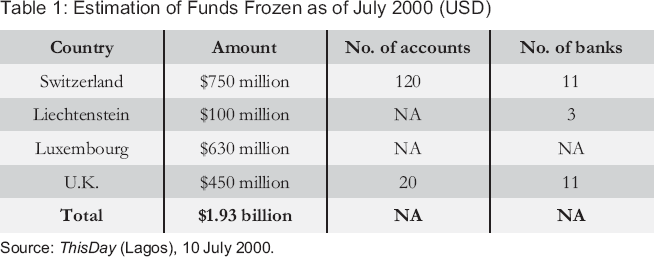
Source: ThisDay (Lagos), 10 July 2000.
List of Swiss Banks Holding Abacha Funds
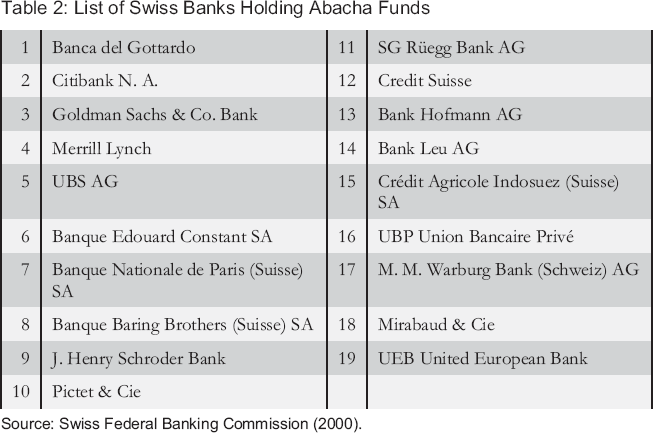
Source: Swiss Federal Banking Commission (2000).
List of British Banks Holding Abacha Funds
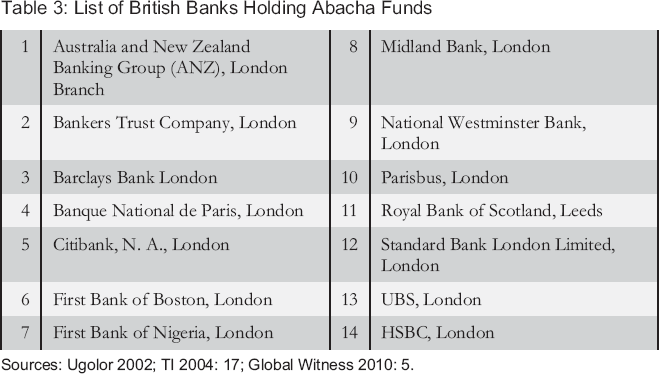
Sources: Ugolor 2002; TI 2004: 17; Global Witness 2010: 5.
These decisions seemed to confirm the United Kingdom's willingness to assist Nigeria in its fight against money laundering. Indeed, as Andrew Mitchell, secretary of state for international development, claimed:
James Ibori's sentence sends a strong and important message to those who seek to use Britain as a refuge for their crimes. […] We are committed to rooting out corruption wherever it is undermining development, and will help bring its perpetrators like Ibori to justice and return stolen funds to help the world's poorest. (Tran 2012)
Such claims can be questioned, however, on two grounds. First, the British authorities have not acceded to calls by anti-corruption NGOs (e.g. Global Witness) to conduct further investigations into (i) how Mr Ibori managed to move his loot through British bank accounts and (ii) the roles of British banks in that process. Second, and perhaps more importantly, the reason for the inability or unwillingness of the British to take steps to trace and repatriate funds or prosecute any individual linked to Abacha have not been satisfactorily explained. This further underlines the limited commitment of the British government and the scale of external challenges involved in the recovery of Africa's wealth in Western banks.
Conclusion
Two lessons can be drawn from Nigeria's recent endeavours to retrieve national resources diverted abroad by its corrupt leaders. First, such efforts are usually rooted in a given domestic and international historical and political context. Nigeria's asset recovery initiatives were heavily influenced by Nigeria's endless intra-elite conflict, where anti-corruption projects are employed to settle scores and procure legitimacy. The Nigerian initiative also occurred at a time when the international community was changing its stance on corruption and pressing for new laws to curb tax evasion and terrorist financing (Daniel 2004; Turner 2004).
Second, international asset recovery is a complex and highly demanding exercise. Although some important improvements were registered by Nigeria (e.g. increased global awareness and key countries' adoption of new anti– money laundering regulations), such international reforms have not translated into any significant success for Nigeria. Nigeria's efforts were constrained by several factors: inefficient judicial systems; insufficient domestic political will; and limited international cooperation, especially from countries holding Nigerian assets. While important improvements have been observed in the international legal framework for deterring the illicit transfer of assets, compliance with international standards is still patchy; this confirms Greenberg et al.'s assertion that “today the distance between international commitment and visible, effective action and impact remains wide” (2009: xiv). Although Nigeria's efforts to recover the Abacha loot were not a total failure, over a decade later, the bulk of these stolen funds have not been repatriated.