



Abstract
The coup d'état that occurred in Bamako in March 2012 brought a previously unknown army captain named Amadou Sanogo to power. This paper analyses Malian media reports to explore how Sanogo and his associates sought to legitimize their takeover with reference to local conceptions of heroism, power and destiny, and how Sanogo's public image resonated with time-honoured narratives about heroic figures in Malian culture. This case demonstrates that understanding religious worldviews is essential for understanding the workings of political power.
When a coup d'état toppled Mali's President Amadou Toumani Touré two months before the end of his second and final term of office, the man who led the putsch became the object of intense scrutiny by Malians and outside observers alike. This young army officer achieved overnight celebrity status in Bamako in the early morning of 22 March, when in his initial appearance on Mali's ORTM state television, wearing camouflage fatigues and a cap pulled low over his forehead, he hoarsely read a terse appeal for calm. A caption identified him as Captain Amadou Haya Sanogo, “President of the Comité National pour le Redressement de la Démocratie et la Restauration de l'Etat” (National Committee for Recovering Democracy and Restoring the State, or CNRDRE). This was the man now holding the reins of power in Mali.
Amadou Haya Sanogo was just 39 years old, but had already spent most of his life in the army. After attending a military-run primary school in Kati, a town 14 kilometres northwest of Bamako, he started his career in the enlisted ranks. Between 1998 and 2010 he attended at least five Pentagon-sponsored training courses in the United States, and gained promotions to lieutenant and then captain. He worked more recently as an English instructor for the army, a capacity in which he became well known to, and liked by, rank-and-file troops. When on 21 March 2012 a mutiny flared up at the Kati garrison, with young soldiers revolting in equal measure against their civilian leaders and the military high command, Captain Sanogo was the highest-ranking officer associated with the mutineers, who designated him to lead the 50–odd members of the new junta, the CNRDRE (Groga-Bada 2012a, SAPA 2012). “Les jeunes [the youths] associated with me, they accepted me, and they trusted me,” he told an interviewer on Africable Television the next day, referring to his fellow mutineers.
Many have speculated about the coup leader's motives. One military officer close to the deposed president interpreted the coup as a bid by Sanogo to settle professional scores with a power hierarchy that had stymied his advancement (Le Parisien 2012). Some in Mali saw him as a patriot, others as a menace. In his first televised interview on 22 March, Sanogo's own justifications for the coup were myriad and extremely varied. He spoke briefly about the Malian state's failing campaign against northern separatist rebels, which had caused troops to lose confidence in their leadership. But he devoted more time to listing other problems confronting the nation: a dysfunctional public education system, irregularities in civil service recruitment, high costs of living, and joblessness. He spoke of the mutineers’ demands for better housing, benefits and professional training (“That is our first mission,” he declared to enthusiastic applause from the troops standing behind him), and of their desire for reform – “not of the army, of the state”. He vowed that officials in President Touré's administration who had broken the law or abused their authority would be prosecuted (Africable 2012a).
While universally condemned abroad, the forced removal of President Touré proved generally popular in Bamako, where an opinion poll conducted in late April by an independent Malian statistician found that 64 per cent of residents approved of the Touré regime's early demise, and 65 per cent had a favourable opinion of Captain Sanogo, making him one of the most respected figures in national politics at that time (Guindo 2012). Mali's political transition had gone badly awry under Touré, amid rampant corruption and the breakdown of the rule of law (see Whitehouse 2012); it was not surprising, then, that many Malians were relieved to see Touré gone, even if many were also wary of the junta and particularly of the man who had driven Touré from office.
Although the CNRDRE officially surrendered power to a civilian caretaker government only three weeks after the coup, it continued to exert influence over Mali's political process, and Captain Sanogo remained a highly visible public figure. Nearly six months after the coup, the French magazine Jeune Afrique described him as ruling in a “triumvirate”, albeit uneasily, alongside President Dioncounda Traoré and Prime Minister Cheikh Modibo Diarra (Groga-Bada 2012b). While the true extent of his power remains murky, it is clear that after mounting his coup, Sanogo had no intention of quietly retiring from the political scene. Comparing Mali's democratic edifice under Touré's presidency to a sagging wall, the captain promised to watch over the country's process of political reform. “We did not knock down this wall to turn our backs on it,” he declared to the nation shortly after signing the agreement to transfer power to a civilian government (ORTM 2012a). Radical political leaders, discontented with the composition of the new civilian government, even tried to appoint Sanogo as the country's interim president in late May (Diallo 2012).
Despite his lack of national political experience, Sanogo proved to be a master communicator who knew how to frame his actions so as to maximize public support, especially in and around Bamako. By addressing questions of corruption, misrule, and general lawlessness, he spoke to ordinary Malians’ quite valid concerns about the state's failures to serve their needs; he also spoke to widespread disappointment with Touré and his allegedly anti-democratic behaviour. Again and again in the weeks and months following the coup, Sanogo represented his actions not as a blow against Mali's young democratic system, but as the only way to save democracy in the country from the depredations of a venal elite determined to entrench itself in power. 1 Whether in French, Mali's official language, or in his native Bamanan, Mali's most widely spoken national language, the captain was a gifted speaker; his narrative of acting to rescue Malian democracy from irresponsible politicians was compelling for a large number of Malians both at home and abroad, even as some remained sceptical of his true intentions.
See, e.g., Sanogo's 6 May interview broadcast on Africable Television (2012b).
Sanogo appealed to a large cross-section of the Malian public in part because after taking power he skilfully exploited local imaginaries pertaining to politics and leadership. His popular legitimacy derived not from formal legal texts but from widely shared discourses pertaining to the role of leaders in Malian society. Once in power, amid pervasive disenchantment with the political process under President Touré, Sanogo crafted his own public persona in stark contrast to those of the politicians who had run the country for the previous two decades. Specifically, at times the captain was cast in the role of a mythic hero, someone who comes to the aid of his people in times of desperation. It is certainly true that the CNRDRE junta justified its actions in universal terms of safeguarding democracy and fighting corruption, and this was an important source of its support. But a significant aspect of its appeal was more culturally specific, revolving around the person of Captain Sanogo and how he was represented to, and received by, a Malian audience. In this paper, based on my insights from my presence in Bamako at the time of the coup and on media reports from Mali, I analyse how discourses grounded in local conceptions of heroism, power and destiny helped Sanogo find a popular mandate after driving an elected president from office. I argue that political power in Mali is inextricably intertwined with religion, which we can understand as “a belief in the existence of an invisible world, distinct but not separate from the visible one, that is home to spiritual beings with effective powers over the material world” (Ellis and ter Haar 2004: 14). Spiritual power in this region figures centrally in constructions of personal, political and military power.
Mythic Heroes and Mystical Forces
In Mali, politics and daily life are always inscribed within the context of the region's oral histories. These legends carry especially great cultural significance for peoples of Mande origin (understood here to be members of the Bamanan and Maninka groups, who constitute a large portion of the populations of central, western and southern Mali, and whose languages are dominant in those areas). The figure of the hero – or, ngana, in the Bamanan language – is central to these narratives. The heroic role is well known in this region through legends of Sunjata Keita, the thirteenth-century founder of the Empire of Mali, of warriors like Sunjata's general Tura Magan Tarawélé, and of rulers like Da Monzon Jara, who led the Bamanan Empire in the late eighteenth and early nineteenth centuries. These heroes’ renown endures in contemporary Mali not only through oral histories and epic praise songs performed by jeli (members of the region's caste of griots), but also increasingly through popular music, television shows and films produced in the region. 2 For Mande peoples, this body of legends constitutes a charter underlying local authorities’ political legitimacy. As Johnson (1999) points out, it is probably no coincidence that Mali's first president, Modibo Keita, was a descendant of Emperor Sunjata, or that the man who ousted him from power, Moussa Traoré, was himself descended from Sunjata's general, Tura Magan, who challenged Sunjata's authority. Both Modibo Keita and Moussa Traoré built popular mandates partly on the foundations laid by their legendary ancestors (see also Sidibé 2012).
See translations of the Sunjata epic by Niane (1960) or Conrad (2004), or analyses in Austen (1999). Capitalizing on the success of films like Dani Kouyaté's Keïta! L'Héritage du griot (1995), which retold the Sunjata legend, in 2010 Malian state television began airing a series entitled Les rois du Ségou (“The Kings of Segou”), directed by Boubacar Sidibé.
The hero in these legends is a destabilizing force in society, someone who strikes against and sometimes overturns the prevailing regime. He – for the Mande hero is always male – can be described as an “agent of disequilibrium” (Bird and Kendall 1980: 13), someone who “resists the pull of the established social order” and brings about momentous changes, “even if these changes are potentially destructive” (Bird and Kendall 1980: 15). The hero is a complex figure because his heroism is dependent on his violating society's usual codes of conduct. He must defy social norms – in particular, he must defy existing power hierarchies – in order to acquire a name for himself. His heroic deeds, moreover, always unleash potentially dangerous forces that may be beyond his control.
Yet the hero is highly respected because his actions, destabilizing as they may be, succeed in freeing his people from inertia and complacency; his actions can also restore an equilibrium that had been lost. In times of crisis, when societal conventions prevent others from acting, the hero's unique role compels him to act. Because of his connections to certain types of people, such as sorcerers or blacksmiths, he is endowed with special means, known in Bamanan as daliluw, which others lack. McNaughton (1988: 42–43) describes daliluw as “concise, goal-oriented clusters of information and instruction, recipes for the successful completion of an endless array of activities” that are at once “the power behind human acts, the right to perform them, and their cause”. More succinctly, daliluw can be understood as the “means or powers required to perform an act” (Bird and Kendall 1980: 16). An individual can inherit these means as a kind of birthright, but can also acquire and strengthen them by obtaining secret medicines, amulets (often called “fetishes”) and training from specialists with advanced knowledge of the spiritual world. The possession of daliluw gives the hero the ability to break free of his society's inertia, then to master the powerful force unleashed by his actions and establish a new order.
This invisible force, known in Bamanan as nyama, lies at the heart of Mande understandings of events, agency and power, both in the human and the invisible world. Nyama is, according to McNaughton (1988: 15), “the necessary power source behind every movement, every task. It is a prerequisite to all action and it is emitted as a by-product of every act” (see also McNaughton 2008: 94). Nyama is released into the world in large amounts whenever a creature dies, or when a person breaks social taboos; the taking of human life therefore releases particularly great quantities of nyama, from both the death itself and the performance of a proscribed action. While nyama is required for all action, it is also dangerous since it can overpower the individual who unleashes it unless that individual has sufficient means (daliluw) to keep it under control (see discussion in Johnson 1992). Perhaps for this reason, nyama is also a term for misfortune.
People seeking to undertake momentous acts, then, can attempt beforehand to increase their store of daliluw to master the hazardous forces their acts will set loose. They may do so by obtaining power objects from specialists, such as sorcerers, blacksmiths or hunters (dozo), all of whom are believed in Mande communities to possess special knowledge and abilities to harness and channel nyama. The power objects are typically sebenw, leather amulets containing writing, although other forms include metal and wooden objects. Nyama is the “active ingredient” in all such objects (McNaughton 1988: 16), which are believed to protect their bearers against aggression. Amassing power objects is therefore one common way for individuals in Mande communities both to prepare for risky undertakings – such as hunting or combat – and to insulate themselves from the unseen consequences those undertakings might generate. Another way is to associate with specialists from whom one may receive secret knowledge. Legends recount that as a boy, the future emperor Sunjata joined a secret society of hunters and cultivated the company of blacksmiths and griots; from his integration into these networks, Sunjata built up his stockpile of daliluw, and was thus empowered to overcome his own weaknesses, stand up to his foes and weather the dangerous forces his heroic deeds unleashed.
A final concept vital to our understanding of the Mande hero is dakan, or destiny. Dakan blends individual agency and fate: A person cannot achieve something unless their destiny allows for it, but neither are they ensured of fulfilling their destiny.
Destiny is seen as preordained but not as inevitable predestination, writes Johnson (1999: 16).
It is left up to individuals to discover their destinies and to progress toward their fulfilment carefully and at just the right speed. In this balance, if they go too fast, they will not have stockpiled enough occult power to control the forces associated with power.
An individual can fail to achieve his or her destiny, just as an individual can be overpowered by the energy (nyama) his or her actions produce in the pursuit of destiny. Only by working assiduously to prepare oneself, particularly by acquiring secret knowledge and means (daliluw), can one be sure to realize one's destiny. Such goal-oriented, agentive preparation is known in Bamanan as lanyini – literally: “that which is sought”. As a proverb puts it, “lanyini precedes achievement” (lanyini ka koro latigε ye; see Bailleul 2005: 155). In sum, the hero's greatness is not a foregone conclusion, but it is foreseeable under the right conditions. A hero can achieve his birthright only if he has devoted considerable time and effort to building up a supply of understanding, contacts and protection to ensure that his dangerous undertaking is successful and does not destroy him in the attempt.
Captain Sanogo as Mythic Hero
Mali's coup d'état of 21/22 March was not especially violent, but it did entail confrontations between army units loyal to President Touré and those that sought his ouster, resulting in probably fewer than ten deaths among the combatants on both sides as well as an unknown but most likely smaller number of civilians killed by stray bullets. In the days immediately following the coup, the situation in Bamako remained volatile, as it was unclear how much support the junta had in various branches of the Malian armed forces. Rumours circulated on 23 March, both online and via Bamako radio stations, that members of Mali's parachute regiment were orchestrating a “counter-coup”, and that junta leader Captain Sanogo had been shot dead (Ahmed and Faul 2012, Nossiter 2012).
During this early, uncertain stage, Sanogo appeared regularly on Malian state television. By the evening of 22 March, he had replaced the green camouflage fatigues and cap he had worn when reading his first televised statement with standard-issue, tan-and-brown camouflage fatigues and the green beret worn by soldiers in all regular units of the Malian army. A white t-shirt was visible beneath his uniform, and a US Marine Corps “eagle, globe and anchor” pin now featured prominently above the right breast pocket of his fatigues, a sign of his US-sponsored military training. Sanogo would not have been issued this pin – which was in fact a hat badge – by the Marines, irrespective of any training he had completed with them; in other words, it was not an ordinary, required part of his uniform. Rather, it appears that he wore it as a distinctive symbol, a way of personalizing his individual appearance in the wake of the coup and accentuating his individual achievements and renown (known in Bamanan as fadenya). He wore it on each of his uniforms for several weeks thereafter, and subsequently for special occasions such as greeting Mali's interim president at the airport when the latter returned from two months abroad on 27 July.
As the days wore on after the coup, Sanogo's wardrobe began to showcase additional affectations. On 23 March, he wore the same uniform, beret, insignia and white t-shirt, but something new was visible between his t-shirt and fatigues: a mudcloth vest that appeared to be a dozofini, which literally means “hunter's cloth”. Those initiated as hunters in West Africa are believed to possess special powers, such as the ability to become invisible or to transform themselves into animals; their dozofini smocks contain amulets that can supposedly render them impervious to bullets or blades (see Hellweg 2011). Sanogo first appeared wearing dozofini immediately after the circulation of rumours that he had been killed. In addition to the dozofini undergarment, on 24 March Sanogo could be seen in television appearances wearing a leather amulet on his left wrist.
Around this same time, the captain also began carrying a wooden baton, approximately one metre in length, which was always visible on or near his person whether in public or on televised broadcasts. Although the baton could easily be viewed as the same type that officers in militaries around the world carry as a symbol of command, many Malian viewers interpreted this stick to be powerfully charged. In May, a Bamako journalist wrote that the captain “went around with a baton of strange wood, which reportedly protects him from any attack against his person” (Diop 2012). One of Mali's top editorialists wrote, “Before God and before men, I ask [Sanogo] what is in this baton that he is never without”; he ironically insisted, moreover, that the captain “not use it against the astrophysicist and the mathematician” – by which he meant Mali's new transitional prime minister, Cheikh Modibo Diarra, a former NASA scientist, and its new transitional president, Dioncounda Traoré, a former professor of mathematics (Thiam 2012).
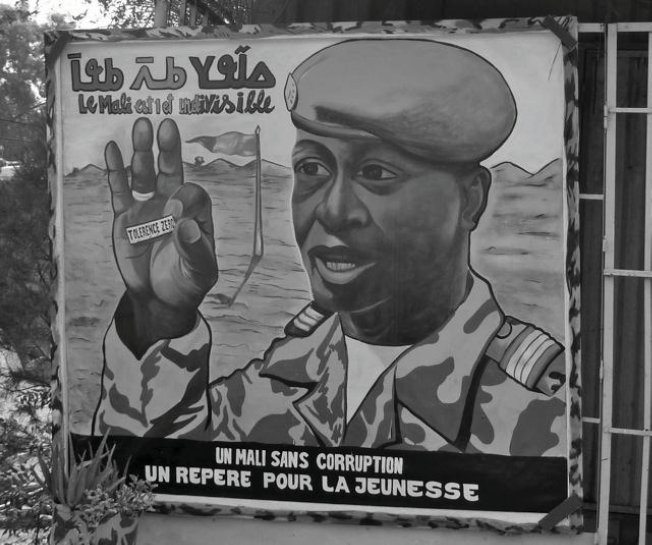
A mural in Bamako depicting Amadou Haya Sanogo. The text reads “Mali is one and indivisible” and “A Mali without corruption / A reference for the youth” (photograph by the author, May 2012)
A ritual specialist I interviewed in Bamako – known locally in French as a marabout, and in Bamanan as a karamogo 3 – claimed he knew about this storied baton's supernatural properties. As long as Sanogo held it, he told me, no harm could come to him. The specialist stated that the baton came from southeastern Mali, and was fabricated by members of the Senufo ethnic group, who had endowed it with its special powers. Mande people in and around Bamako often portray the Senufo, who speak a non-Mande set of dialects related to the Gur languages, as particularly skilled in the manipulation of invisible forces, and as having advanced knowledge of these forces that is inaccessible to those outside their group.
The term karamogo, a compound of the words qara'a (Arabic, “recite”) and mogo (Bamanan, “person”), also means “teacher”, and designates a wide variety of instructors in religious and non-religious contexts (see Bailleul 2007: 209).
Captain Sanogo, who is of Senufo descent on his father's side but never lived in the Senufo zone of southeastern Mali, had an interest, once he assumed power, in finding a tool both to symbolize and to shore up his authority. As the statements above by Malian journalists demonstrate, the mysterious baton became that tool, and he carried it everywhere. When he visited army barracks and government offices, when he stood on stage to salute Mali's new transitional civilian leaders, when he received visitors in his office before the television cameras, the baton was a permanent element of his public image – much as similar sticks became indelibly associated with certain African heads of state, such as Mobutu Sese Seko in Zaire or Yaya Jammeh in The Gambia.
Sanogo's post-coup public affectations are “power objects”, designed both to embody and to represent his ability to control invisible forces. In brief, they are intended to persuade his audience in southern Mali that he has a large stockpile of daliluw, the means necessary to master such forces. The baton shows that he has consulted ritual specialists, specifically Senufo specialists privy to exclusive knowledge outside the expertise of Mande ritual specialists in and around Bamako; the powers he received from the former, signified by his baton, would therefore be difficult for the latter to counteract. Like many members of the Malian armed forces in particular and Mande society in general, Sanogo was a regular client of marabouts, and journalists reported seeing such specialists at the junta's Kati headquarters in the aftermath of the coup (e.g. Cavendish 2012).
Sanogo's dozofini garment was therefore more than a mere nod toward “cultural authenticity” or an assertion that he was protected against his enemies. It was also a signal that, like a true Mande hero, he was prepared for the challenges and disorder he would face after carrying out his momentous actions. More specifically, the garment evoked a definite association between the junta leader and hunters, an association explicitly encouraged by junta leaders on more than one occasion. On 13 April 2012, for instance, a rally in support of the junta was organized by leaders of various dozo associations and broadcast on state television. A junta representative at the rally read a statement in Bamanan appealing to hunters to join forces with the Malian army to defend the country's sovereignty; he articulated the great respect Captain Amadou Haya Sanogo had for hunters, and expressly described the junta leader as the son of a dozo (see Coulibaly 2012, ORTM 2012b). Although Sanogo's father's status as a hunter is unconfirmed, the claim of such a linkage implied that Sanogo himself had acquired daliluw from his relationship with hunters – just as the young Sunjata had done. The leather amulet he sometimes wore on his wrist was another symbol of such an association and the means it conferred to control the invisible forces of nyama. Significantly, once the post-coup tumult subsided after several days, Sanogo no longer wore the dozofini or the amulet in public. Having made the successful transition from challenger to authority figure, the hero adopts new symbols of power. 4
Johnson (1999: 21) notes that Sunjata, having defeated his adversaries and assumed uncontested control over Mande country, took off his hunter's mudcloth garments and began wearing the dulokiba, or “embroidered robes of the town”.
Even the Marine Corps pin Sanogo wore on his uniform should be considered a type of power object. This pin, a symbol of his training in the United States, sets him apart from other soldiers. As a rare object in the Malian context and as a signifier of secret knowledge, it conveys not only that the wearer has undergone special preparation, but also – not unlike the Senufo baton – that he has access to distinctive outside sources of power, the precise nature and origins of which may be unfamiliar to his audience. As such, it distinguishes him from other army officers, 5 and reinforces the aura of mystery and strength that surrounds him in Mali. Moreover, in a society where the English language is rarely spoken or understood, Sanogo's fluency in English is yet another form of specialized knowledge that distinguishes him from his peers. I have heard Bamako residents refer to the coup leader as learned (in Bamanan, a kalannen don), despite the fact that he never attended lycée or secondary school, normally considered a minimal criterion of membership in Mali's French-speaking intellectual community. The time he spent in the United States, and the knowledge he acquired there, including the ability to speak English, confer upon him the status of a worldly, educated man who is prepared to face the challenges of his destiny and to master the dangerous forces unleashed by a coup d'état. Recall that it was through his role as an English instructor, a role for which he acquired the “means” in the US, that he became associated with the soldiers who later led the mutiny and the coup that brought him to power.
Personal communication with Kassim Koné, 21 September 2012.
Sanogo himself was very much aware of the destabilizing effects of his actions on Malian society. During the putsch, and again during violent outbreaks between rival factions of the Malian army in late April and early May, soldiers and civilians were killed. The ouster of the Touré regime touched off a wave of looting, particularly directed against government offices (which were systematically pillaged by troops) and against the homes of individuals associated with Touré's government. Internationally, the coup generated condemnation and resulted in the suspension of millions of dollars of foreign aid to Mali. During appearances on state television on 22 and 23 March, Sanogo asked his compatriots’ forgiveness for the negative consequences and dangerous forces unleashed by the deeds he and his men had carried out. He remained steadfast, however, in stating that the coup had been necessary despite its sometimes unfortunate consequences, insisting that Malians should take pride in the action he had led. “It's now that Mali can lift up its head a little, it's now that Mali has regained its pride a little,” he told an interviewer in May (Africable 2012b).
There is some indication that Sanogo saw the coup as part of his destiny, and that he believed he had taken power by divine right. “We can say that this action was God's doing,” he said in Bamanan to Malian journalists on 9 April. “Because if He does not will it, it is not done. And He alone saw to it that those of us sitting here today were the ones who did it. Otherwise, someone else would have carried it out” (ORTM 2012a). 6 Malians sympathetic to the coup were wont to describe it in similarly divine terms. A pro-putsch youth association leader in Bamako, for example, alleged that President Touré had been preparing sinister plans to undermine Malian nation: “It's clear that a plot against the Malian people was underway, but the Good Lord thwarted it,” he said, adding that the mutineers “did not set out in the beginning to launch a prepared coup d'état, but because God exists, there was this coup d'état and not another” (Inter de Bamako 2012). He described the junta's action as a “coup of destiny”.
Months later, Sanogo compared himself to another leader with a strong belief in his own destiny: “I have only been for Mali what [Charles] de Gaulle was for France” in 1940, he wrote in an opinion piece published in Le Monde (October 26, 2012).
One final link between Sanogo and the idea of invisible powers stems from the given names with which the coup leader is identified. Since his first television appearance, his name has been rendered as “Captain Amadou Haya Sanogo” in Malian broadcast and print media. His middle name, Haya, is a word meaning “magical Quranic verse” in Bamanan; it is derived from the Arabic word āyah, meaning “verse” (Bailleul 2007: 168). Verses of the holy Quran have long been regarded to hold special power in West Africa, and verses written on paper are frequently used to make amulets and other types of power objects. In Bamanan, haya can therefore also designate a type of amulet. Moreover, the captain's familiar nickname, Bolly, used by his kin and peers, resembles the Bamanan word boli, yet another category of power object charged with daliluw (see McNaughton 1988: 59–60). Names like these appeal to and further strengthen the mental associations that speakers of Mande languages tend to make between the junta leader and invisible forces, thereby making the unspoken argument that Sanogo possesses both the birthright and the means to wield power effectively.
Conclusions: Heroism and Legitimacy
In July 2012, the Malian intellectual and writer Fodé Moussa Sidibé published a commentary in a Bamako newspaper in which he discusses the role of the hero in Mande culture.
From Kaya Maghan Cissé of the Empire of Wagadou to the last kings of Segou, of Macina, of Kénédougou, of Bélédougou, of Wassoulou, etc., this land was built on the cardinal values of nganaya, of heroism,
he writes (Sidibé 2012). This role continues into the present day, he argues:
From 1960 to the present, the people of the Republic of Mali have adhered to numerous causes, ideologies and policies, but they have […] supported and adulated their heroes.
While the significance of heroism may have been slightly diminished under the less charismatic rule of President Alpha Oumar Konaré (1992–2002), who
worked to inhibit if not proscribe the natural propensity of Malian people to identify their president as a “national hero”,
it has never abated, Sidibé claims. In fact, he suggests that the very turning away from the heroic narrative in national politics during Mali's transition to democracy in the 1990s contributed to the country's recent slide into chaos. Sidibé writes:
This new state of mind, translated into the speeches and deeds of the “anti-hero president”, would soon have unexpected effects with respect to domestic politics and governance: the loss of bearings at several levels, the slipping away of the authority of the state, the rule of impunity, etc.
By this interpretation, the Malian nation needed a fresh infusion of heroism, and one arrived on 21 March 2012:
Captain Amadou Haya Sanogo is the new hero, a ngana, decree the sovereign people who strive to carry him as high as possible. Just as they did not await the approval, condemnation and other recriminations from anyplace to consecrate the innumerable heroes of their history, the Malian people, ignoring the diehards of the defunct regime, willingly attribute to Captain Amadou Haya Sanogo the supreme title of ngana minè ngana, “the hero who vanquishes other heroes”, with all its distinctions and prerogatives (Sidibé 2012).
If Sidibé's lofty language betrays a lack of critical distance, and if his account of Sanogo's lionization by “the Malian people” obscures key differences of opinion toward the coup leader within Malian society, his assertion that Sanogo's image resonated with a local “hero complex” is nonetheless justifiable in light of the evidence I have presented here. Such a resonance could explain in part how Sanogo developed a fervent support base cutting a wide swath through Malian society in a relatively short period of time. In some cases, the connections between the young captain's persona and that of the Mande hero were simply fortuitous, while in others such connections were actively represented and manipulated by Sanogo and his associates, and broadcast in ways both subtle and obvious through state media, as well as through private media run by groups sympathetic to the junta.
In Mali, even after two decades of democratic institution-building, a leader's political legitimacy may depend as much, or even more, on appeals to such heroic narratives than on written political institutions. For those who supported Sanogo and his junta, and who continue to support them, the fact that Amadou Toumani Touré was Mali's duly elected, constitutionally and internationally recognized head of state counted for naught; in their eyes, Touré's rule had been rendered illegitimate by his failings as a leader, and by his own disrespect for the law. They could grant legitimacy to Captain Sanogo, on the other hand, not only because he spoke the rhetoric of restoring true democracy and stamping out corruption, but also because he conformed to the norms of nganaya, the heroism of the man destined for greatness, armed with sufficient preparation and strength to control the unruly forces and events which his ascent to power sets in motion. “For this people of Mali, to identify and identify with a hero, a ngana or ngana minè ngana, is no less than a matter of psychological survival,” writes Sidibé (2012). “Never mind democratic norms, international condemnation of the coup d'état, [or] religious respect for a constitution which they disregard from start to finish.” 7
Sidibé also identifies Cheikh Modibo Diarra, Mali's civilian interim prime minister, as a ngana alongside the junta leader.
My contention is neither that Mali's coup d'état of March 2012 followed some inevitable cultural script, nor that the institutions of modern democratic governance cannot flourish in Mali for “cultural reasons”. Instead, I contend that in a context of severe state crisis and popular disenchantment with a formally democratic political process that many saw as fundamentally exclusive and un-democratic, political actors may build their public appeal more effectively on culturally specific concepts like nganaya than on formal legal mandates or generic populism. Where the abuse of power has delegitimised ostensibly democratic leaders and the institutions that consecrate them, many people look for alternative sources of legitimacy, and aspiring leaders will exploit that willingness.
In Mali, as in many societies of sub-Saharan Africa, political power is “perceived as originating in the invisible world” (ter Haar and Ellis 2009: 406). Articulations between Malian politics and religious beliefs, always present behind the scenes, have been very much in evidence since the country's coup d'état. It was, for example, the extremely public intercession of Mohamed Ould Cheicknè – the head of an influential West African Sufi brotherhood – that helped persuade Captain Sanogo to relent at a crucial juncture and allow Mali's civilian interim president to remain in office. The leaders of Mali's largest religious organizations have assumed duties formerly performed by the state, organizing humanitarian aid convoys to assist residents of the country's violence- and famine-stricken northern regions and negotiating directly with Islamist rebel groups occupying those regions. Such a highly visible overlap between religion and politics reflects another, less visible overlap between political and religious interpretations of power.
In my analysis, I have tried not to draw hard boundaries between naturalistic and supernatural explanations of events. Such distinctions may not be especially meaningful for Malians themselves. Where an item of modern military insignia and a mudcloth vest both function as power objects, where one acquires secret knowledge and daliluw from hunters’ societies and from US Department of Defense facilities alike, and where the dangerous forces unleashed by a coup d'état may come in the form of stray bullets and the invisible force of nyama, it seems to me that it is not helpful to differentiate between rationalist and “occult” justifications of power. Diplomats competed with diviners for the coup leaders’ attentions in Kati, the military blended seamlessly with the mystic, and the spiritual with the psychological. Recent events in Mali suggest that scholars seeking to understand politics and political legitimacy can ill afford to ignore the religious underpinnings of power.