



Abstract

Academic studies of South Africa's international relations have been well served over the past three decades by a number of acclaimed scholars. Readers of this journal will be familiar with the works of James Barber, Jack Spence, John Barratt and Peter Vale, amongst others. With this most recent book, Vale, Nelson Mandela Chair of Politics Emeritus at Rhodes University, Grahamstown, and presently professor of Humanities at the University of Johannesburg, has produced what is clearly a labour of intellectual love. Conceived of several years ago as a joint project with the late John Barratt, Keeping a Sharp Eye moves beyond the institutional settings of international relations to explore the perspectives – the “sharp eye” of the title – of South Africa's leading cartoonists.
Vale deliberately wrote the book in accessible language and aimed it at an audience broader than the limited number of readers prepared to persevere in a field of study “increasingly polluted by technical language” (xiii). Covering the period between 1910 and 2010, Keeping a Sharp Eye is organised chronologically. Starting with “what came before” the Act of Union in 1910, successive chapters trace stages referred to as “beginnings” (1910–1939), “what lies beyond” (1940–1959), “free from what?” (1960–1969), “now you're on your own” (1970–1979), “isolation – the full monty!” (1980– 1989), “starting over again” (1990–1999), and, finally, “not at all easy, is it?” (2000–2010). Each chapter contains a sharply etched discussion of the historical background against which individual cartoons are placed and examined. A brief concluding section, itself illuminated by a particularly apposite cartoon, makes the point that although Apartheid may have ended, “the idea lives through the word, which has come to symbolise all forms of discrimination and the wealth gap everywhere” (126). Five pages are devoted to brief biographies of the cartoonists themselves.
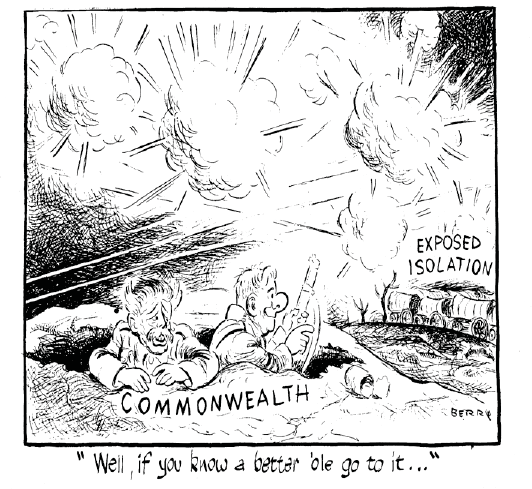
Amongst many glittering gems, any number of brilliant cartoons caught this reviewer's eye. Space, however, permits the reproduction of only a handful of them. The first cartoon, taking its inspiration from Bruce Bairns-father's well-known First World War “better ‘ole”, explains Vale, depicts British Prime Minister Harold Macmillan saying to white South Africa's Hendrik Verwoerd that if he knows of a “better ‘ole” than Commonwealth membership, he should go to it.
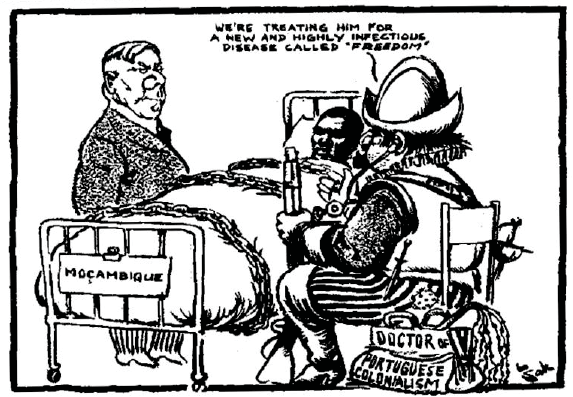
The second one, drawn in December 1961 by Port Elizabeth-born Len Sak, and showing Verwoerd looking on as a chain-wrapped black Mozambican is “treated” by an anachronistic “doctor of Portuguese colonialism”, presciently anticipated the implications for Pretoria of the region's liberation struggles.
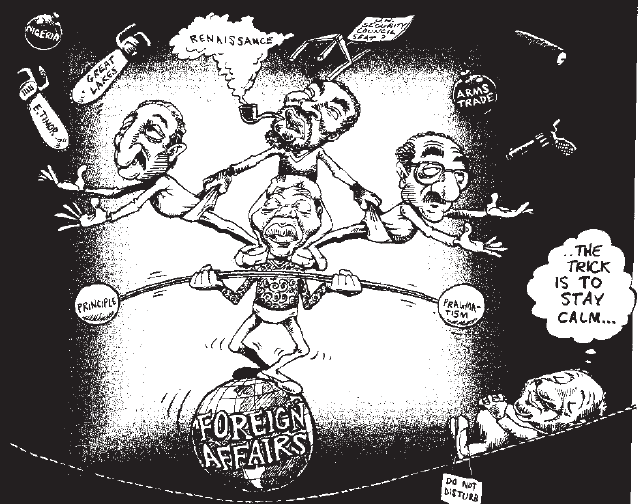
The remaining two cartoons are both drawn by Jonathan Shapiro, better known as “Zapiro” of the Johannesburg Mail & Guardian weekly newspaper. The first of these captures the precarious balancing act characteristic of the ANC's post-1994 foreign policy. As Vale explains, the cast of acrobats – then deputy foreign minister, Aziz Pahad, then deputy president, Thabo Mbeki, and then minister of water affairs, the late Kader Asmal – “are standing on Nelson Mandela's shoulders, while Mandela balances the age-old foreign policy dilemma: principle against pragmatism”. Also in the cartoon is the late Alfred Nzo, “a surprising pick for the post [of South Africa's first post-Apartheid foreign minister]”. Vale elaborates that “[Nzo's] age, his habit of dozing off and the “z” in his name often led Zapiro […] to draw him as a somnolent character” (90).
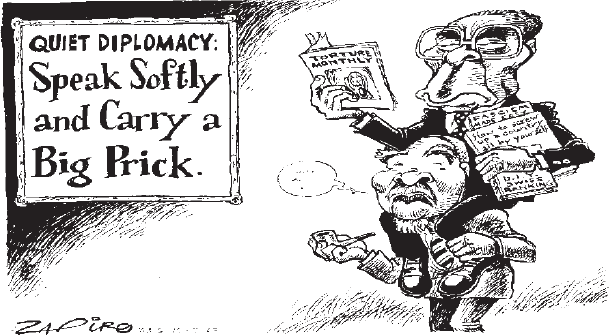
The second and last Zapiro cartoon reproduced here unforgettably depicts the absurdity of then President Thabo Mbeki's policy of so-called “quiet diplomacy” towards Zimbabwe's President Robert Mugabe. Drawing on Theodore Roosevelt's injunction to speak softly and carry a big stick, the cartoon depicts Mbeki speaking inaudibly and carrying a big prick, Mugabe, on his shoulders.
This erudite, witty book makes a significant contribution to the history of, and ways of thinking about, South African cartoons. In doing so, it readily takes its place alongside – and indeed in some respects surpasses – similar recent studies such as Mark Bryant's Wars of Empire in Cartoons (2006), and World War I in Cartoons (2008). But arguably more important is the contribution Vale's book makes to academic and popular understanding of South African international relations. The careful and informed selection of the cartoons assembled here; the appreciative criticism of the accompanying commentary; and the range and depth of the essays shaping successive chapters combine to make this book much more than the sum of its excellent parts. That Keeping a Sharp Eye can be read for pleasure as much as for enlightenment is a measure of its author's achievement.