



Abstract
This article analyses the extent to which the concepts underlying land policies in West Africa that prevail amongst the development organisations most active in this field correspond to the results of the intense debate on the same subject over the last three decades, which has involved almost all branches of the social sciences: ethnology, legal anthropology, sociology, history and rural economics. It is found that the outcomes of these academic analyses are in sharp contrast to the approaches propagated and translated into practice by development agencies, which often start from oversimplified and inadmissibly generalised assumptions, so that one must ask whether the diverging logics of these two disciplines are responsible for this marked difference.
In developmentalist discourse, local land-tenure regulations are most often described as being unclear, “insecure” and as posing an obstacle to the investments urgently needed in order to increase agricultural production. They are considered a major cause of rural poverty and social conflict. To quote one of the main actors in the field of land policy at present:
“Insecure access to land is a determinant of poverty and a major barrier to income growth in Benin (…). Investment climate studies list land access among the top constraints to business development in Benin.” (MCC 2006, schedule 1 to annex 1, p. 1)
The title of the World Bank Policy Research Report is no less explicit: “Land Policies for Growth and Poverty Reduction” (Deininger 2003).
The purpose of this paper is to discuss this perception by retracing the results of extensive field research on the topic of land tenure and land policy and by juxtaposing the results with current development policies. Its purpose is not to inquire into the complex field of the codification of customary local practices of land regulation, even if this question is implicit in the following analysis. Such an attempt to deal with problems of codification would demand a broader empirical foundation than the case presented here, and it would require a longer historical perspective in order to take all of its ramifications and results into account. With respect to the social functions of land titling, the remarks made by Pierre-Yves Le Meur are helpful. Referring to Michel Foucault, he characterises the current activities to formalise access to land “as a way of structuring the reality and the understanding of land rights” (Le Meur 2006: 78, my emphasis; both elements mentioned are of equal importance), with the objective to make them legible and prepare them for public intervention. Replacing local practices 1 by formal procedures always involves tendencies of strengthening the state. Yet contrary to Le Meur's statement, the process of codification we will describe in the following cannot be addressed as “an applied ethnography of rights” (Le Meur 2006: 91), but must be regarded as an attempt to establish a less complex reading of social realities in order to shape them in a way which permits rapid progress in project activities.
Although I know that this will dissatisfy some readers, I will not enter in sterile discussions on terminology, and I will use the notions “local”, “customary” or – rarely – “traditional” without discrimination. These local regulations differ from formally codified state law, even if there is a vivid interaction between both of them. I will also refrain from confessing again and again that I do consider African land-tenure structures dynamic – which is the case; cf. the German title of my book on the subject (Stamm 1996).
Beyond the above-mentioned objective of this article, I will try to explore differences in the approaches and the modes of reasoning characterising development policy and social research as two distinct ways of engaging Africa by examining the context of their confrontation with local land-tenure regulations. In the course of the analysis, I hope to consider the kind of cooperation – not to say synergies – that might be possible between the two of them, an issue that lies at the heart of the anthropology of development.
Some time ago, the empirical analysis of the impact of projects was an important field of development sociology (cf. Bierschenk and Elwert 1993). This path was almost abandoned in the following years, with the consequence that an exact knowledge of the transformation of “realities and understandings”, to take up Le Meur's terms, touched by development projects was widely lost. This might also explain the sometimes uninformed nature of criticism about development policies. The critics in question prefer to discourse on general macroeconomic trends rather than come down to concrete projects and their effects. Filling this gap is a further purpose of this article.
The paper is based on field research 2 and on the author's involvement as an adviser on land policies in West Africa since the early 1990s, especially in Côte d'Ivoire, Benin and Burkina Faso. 3 It is organised as follows. The first chapter presents an overview of important research results from studies conducted in recent years and justifies, given the amplitude of scholarly work, the thematic selection I have made. The following chapter describes the main concepts and objectives which underlie two of the most comprehensive land projects operated in West Africa in past years and discusses the instrument that was fundamental for these two projects, viz. the rural land plan (PFR). The final chapter concludes by discussing the logics of development operations in the field of land policies (and possibly beyond).
For details on methodological questions, see Stamm 1998: 23–26. The vivid recent discussion on large-scale land acquisitions and foreign investment in land is not considered in this article. The subject deserves an in-depth inquiry based on sufficient quantitative and qualitative data, which, at the moment, is still not available (see Cotula et al. 2009 regarding a first approach). Repeated calls for land titling in order to secure nationals against foreign investors seem to be rash. Neither do satisfactory methods of land titling exist, as this paper shows, nor is it evident that titles will present an effective guarantee against powerful economic interests.
This paper draws on lectures given at the Africa colloquium of Frankfurt University, directed by Prof H-P. Hahn (January 2008), and at the 15th Conference of the International Soil Conservation Organisation (ISCO) in Budapest (May 2008). It presents the author's personal views.
Some Research Results
In this section, I shall briefly review a few findings selected from the most comprehensive and innovative research on the topic, which culminated in the 1980s and 1990s. The intention is not to review the whole of this debate or parts of it, but to highlight those arguments which are of relevance to the discussion on development policies. Thus, the focus of this article results from the central topics of the international debate on development policies, which are poverty reduction and food security (e.g. the World Summit on Food Security, Nov. 2009), whereby the basic way of achieving food security is by increasing investment, productivity and production. This may explain why many highly relevant aspects of the subject, such as questions of political anthropology, namely the effects of power structures on land questions, internal fractures in customary land-tenure systems, and cleavages within rural societies, are almost absent in the following pages even though their importance is beyond doubt. The simple reason is that they are not central to development operations, the logics of which are contrasted with academic work here.
Two important centres of research were the Land Tenure Center, Wisconsin, with an emphasis on agro-economic questions, and APREFA (Association pour la promotion des recherches et études foncières en Afrique), Paris, which focussed more specifically on research in legal anthropology.
On Adverse Economic Effects
As stated in the introduction, what underlies developmentalist reasoning is the hypothesis that local tenure systems have negative effects on investment and productivity. The empirical evidence of this is quite poor, however. Up to the present day, even the most comprehensive analysis of data collected from all over Africa (viz. Bruce and Migot-Adholla 1994) has not been able to corroborate it, nor was a nationwide inquiry in Burkina Faso able to do so (Ouedraogo et al. 1996). Some of the key points taken from the former study are highlighted here:
“From these varied findings, it is not possible to make any general assertions regarding the effect of land rights on land improvements.” (Bruce and Migot-Adholla 1994: 255) “We found no significant relationship between land rights and yields in any of our four study regions.” (255) “Researchers did not find a significant relationship between the possession of title and use of formal credit.” (254) “If we return to our findings (…), they cast doubt on the wisdom and cost-effectiveness of large-scale, systematic programs of compulsory titling for smallholders in rainfed agriculture.” (261)
Whenever land-reform programmes have been carried out, “the impact … on actual patterns of access and control has been, at most, tangential” (Berry 1993: 134). In the following years, these results were confirmed by further research (de Zeeuw 1997, Brasselle et al. 2002, Stamm et al. 2003). To this day they can be considered to represent the state of knowledge for most parts of West Africa (Bromley 2009; Place 2009) 4 . However, in recent years, research on land tenure in West Africa – or extensive field study at least – seems to have been interrupted. This also concerns studies examining the capacity of local practices of land management to adapt to changing conditions in the ecological and social environment. The persistence of their dynamism, often considered a central characteristic, is now occasionally questioned. It is argued that in the face of increasing pressure on natural resources, these local practices are threatened by collapse. Once again, the reasoning appears to be intuitive, but the empirical evidence is lacking. The findings of a field study in which the author and his colleagues participated at the beginning of this decade indicated no signs of such a collapse (Stamm et al. 2003). Yet the argument that local customs cannot withstand all the alleged changes continues to be widespread and commonly shared.
They are, however, constantly questioned by Klaus Deininger (most recently in Deininger and Feder 2009). Even this author, who uses data from all over the world, but rarely from West Africa, characterises evidence as not being uniform, a fact stressed by Place with direct reference to some cases advanced by Deininger (Place 2009: 1329–1330). Deininger frequently adds a historic dimension to his argument (“From the earliest days of recorded human history …”, Deininger 2009). I have treated a very active land market in medieval Tyrol, which functioned well in the absence of a land-titling system (Stamm 2009). The actors' concern was not to record land rights, but land transactions, if at all. Those who had the possibility of and an interest in documenting their property were the lords. Recording land rights was seen as an attempt to stabilise their position and strengthen their rule, but not to secure the peasants' position.
On the Nature of Rights
The following template of a land-tenure matrix shows a methodological approach that attempts to describe and analyse complex bundles of land rights at the local level. The notion of bundles of rights over a given resource, held by several right-holders that may be individual persons or groups, was fundamental to the reflections of the Paris school of legal anthropology. The presentation of the manifold and often overlapping claims in a matrix form was a major advance in their analysis – and it stands in stark contrast to the assumption that local land rights are inherently unclear (see LeRoy 1995, Barrière and Barrière 2002, Soro and Colin 2004, Lavigne Delville 2006).
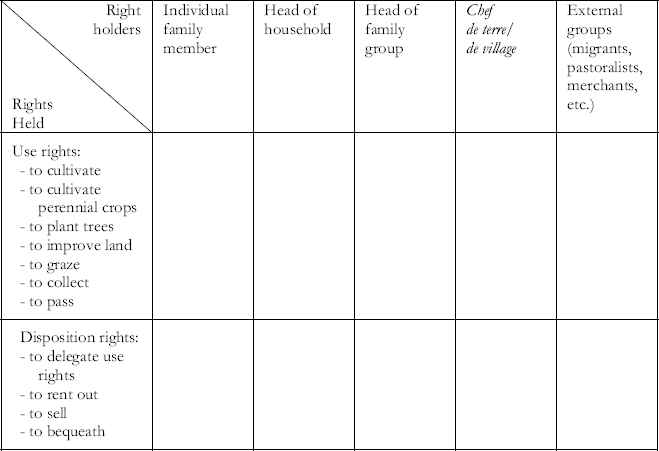
Matrix of Land Rights
The above matrix, however, still constitutes an oversimplification of the complex, manifold empirical realities “on the ground” at the local level. Therefore, further distinctions are necessary, such as a function of the form of access to land such as inheritance, gift, loan or purchase. In such cases, the matrix may be enlarged to suit the needs of analysis and the complexity of the data – its fundamental value lies in the fact that it provides an instrument with which to explore bundles of land rights and their respective holders.
At the same time, the seemingly simple terms used – ‘family’, ‘household’ and ‘family group’ – conceal major problems of definition, 5 which are closely linked to the hypothesis that local, or so-called traditional, land rights tend to become increasingly individualised. While this assumption seems to be reasonable at first glance, it lacks any empirical foundation so far. Studies of the different levels of decision-making concerning land matters in a given social entity and on the evolution of this system of discretional power are urgently needed. 6
The subject of family change in Africa was addressed in a recent issue of Africa Spectrum (cf. Alber and Martin 2007), but unfortunately without making any reference to land-tenure questions.
Initial steps in this direction of research are briefly summarised in Quan 2007.
On Security and Insecurity
The notion of security or insecurity, although a crucial problem in the debate on land issues, is only rarely developed and given an empirical meaning (see Sawadogo and Stamm 2000, Lavigne et al. 2002, for example). It can be analysed from a subjective and an objective point of view, and it effectively bears these two components. Land use may be embedded in informal arrangements, and yet people consider them to be reliable. Or the rules may be strictly formalised, but not regarded by peasants as trustworthy. The degree of formalisation is not a criterion of existing or felt security. One indicator that can be tested empirically is the rate at which land rights are lost; however, the author knows of no comprehensive study to this end. Bearing this qualification in mind, three types of situation shall be pointed out which are characterised by the high frequency and intensity of conflicts. The first situation characterises regions subject to significant pressure from immigration and where we find competing land claims of migrants and autochthonous inhabitants. Even superficial consideration of this type of situation leads one to conclude that land titling will not help to settle such conflicts: since land registration in a strict sense is an exclusive procedure, it will not promote a negotiated solution, but favour either the one or the other side, thus deepening and perpetuating the conflicts.
Secondly, it is argued that commercial land transactions such as land sales increase in number and importance (Chauveau and Colin 2007). Without any cartography of the different modes of access to land, the quantitative weight and the geographical diffusion of the phenomenon cannot be empirically assessed. The argument is now that because a legal document proving the authority of actors to dispose of the land, i.e. to sell it, is lacking, their disposition rights are not evident. Prevailing understandings of individual property are still far from the conception of the Code Civil, Art. 544, which defines it as “le fait d'user et de disposer des choses de la manière la plus absolue.” It might even be the case that content of the transaction remains unclear. Was the land itself sold for an unlimited period? Is the sale also binding upon forthcoming generations, etc? As an alternative approach to registration, authors such as Paul Mathieu (Mathieu et al. 2003) suggested that transactions should be formalised at a lower level using and recognising so-called petits papiers. Finally, external interventions, such as resettlement or development operations, are identified as major factors of land-tenure insecurity. They disturb existing land regulations and try to introduce new ones, but they are not able to succeed in enforcing them. They simply create parallel legal structures and lead to situations of legal pluralism that can further compound tenure insecurity. Land-reform projects are a specific form of these interventions, be they on a national level or be they conducted by introducing seemingly small changes in local communities, which non-governmental organisations often make, and which bear the risk of destabilising local procedures that are still functional, even if they are far from being perfect.
It should finally be stressed that vast regions exist in West African savannahs where no pronounced insecurity is felt or expressed by the people living there (Sawadogo and Stamm 2000, Stamm et al. 2003). Daniel Bromley's conclusion should be borne in mind in all these places, which in my view are widespread cases:
“The offer of formal titles to the poor presents them with the need to decide whether to exchange their current embeddedness in one community for an uncertain embeddedness in another community. In the absence of reasonable assurance that the new community (the government) can offer more effective protection than the current one, the switch is not obviously superior.” (Bromley 2009)
Currently Prevailing Land Policies: The Case of Benin
Concepts and Objectives
Our analysis of current land policies depends largely on the state of implementation of the respective projects, which form the empirical background of this study. Consequently, two major national experiences are reflected in its different regional and thematic layers. This organisation deserves some preliminary remarks.
Beginning in the early nineties, an important land operation was conducted in Côte d'Ivoire. It developed and tested the PFR approach. 7 Basically conceptualised by the French Cooperation, its implementation was mainly funded by the World Bank. It constitutes the most comprehensive experience in land policies over the last few decades since it covered both conceptual development and large-scale application in a nationwide test. The case of Côte d'Ivoire is therefore the frame of reference for the following argument. The concepts developed in Côte d'Ivoire were considered to be replicable in other West African countries, one of which was Benin, though on an even larger scale than in Côte d'Ivoire. Benin's land project is still going on. For our analysis, this means that it is not possible to assess its impact yet. But what is possible is to consider the changes undergone by the conceptual framework when applied within a strong development operation. This may explain why we shift between Côte d'Ivoire and Benin from time to time. Rich operational experiences are only available in the first country, so every time implementation is treated, we will have to come back to Côte d'Ivoire.
PFR = Plans Fonciers Ruraux, rural land plans; see below.
It should be noted, however, that land registration by rural land plans is not only of relevance in these two countries. The PFR approach is considered to be viable on a regional scale (cf. Burkina Faso 2007, for instance). Actually, when land registration is intended, no other set of instruments is available.
In the following sections, the conceptual foundations and operational modes of agency-led interventions in land policies shall be examined mainly with reference to the American Millennium Challenge Corporation (MCC). This example has been chosen because of the great importance of this organisation's interventions in land policy in Africa (Stamm 2008). Besides this, it resolutely puts what is predominantly regarded as right and necessary in the development community into practice. Its concepts are close to the World Bank's (Stamm 2004), which financed land registration in Côte d'Ivoire using the same tools, albeit in a more sophisticated manner.
One of the first recipients of an MCC grant in Africa including a land-tenure component was the government of Madagascar, a country that was considered an outstanding example of a nation pursuing a successful market-based development policy to eradicate poverty. However, not only current events (as of January 2009) may cast some doubt on the wisdom of this judgement (cf. the well-informed report by Stefanie Hanke 2007).
At present, the MCC is active in Benin, with the objective of registering land in some 300 villages spread across the entire country in order to issue more than 80,000 rural land certificates. An agreement (“compact”) to this end was concluded with the government of Benin in 2006. It covers a financial volume of more than 300 million US dollars, thirty-six million dollars of which are budgeted for land-titling operations (“the Land Project”), both in rural and urban areas. Other interventions by the MCC in Africa are mainly focussed on such sectors as infrastructure, road construction and harbour or airport rehabilitation. It seems that these are better suited to the MCC's type of large-scale but short-term projects and are better than land-tenure activities in any case, which require a patient approach and yield uncertain results.
The implementation of the MCC land activities was not prepared and is not accompanied by a notable research programme, as it was in Côte d'Ivoire. This may present subsequent problems with regard to evaluation since no baseline was defined that would permit an assessment of changes which might be induced by the project.
Benin is one of the best-researched countries in West Africa. Some tenure-related results of these endeavours, beginning with Gauthier Biaou's pioneering thesis (Biaou 1991), shall be summarised here even though the MCC itself did not take them into account. Important findings on agricultural systems resulted from the activities of a Special Research Project involving the national universities of Benin and Niger and the University of Hohenheim, Germany, among other institutions (Bierschenk et al. 1997). This project gave special attention to the particular case of South Benin, a region characterised by significant population pressures, with compounding influxes of migrants and the predominance of highly commercialised, export-orientated agriculture (palm oil). These combined factors bear the potential of increased tenure insecurity, as underlined by Neef (1997). But even in this specific context, the conclusion drawn from the data was not that the situation required state intervention, but rather that local institutions should be strengthened. This turned out to be the leitmotiv of the work of the research group, which focussed on land-tenure questions (cf. the articles by Biaou, Edja, Neef and Stamm in Bierschenk et al. 1997). In the following years, this position was taken up by development agencies. Instruments for implementing it were tested during a pilot project using Plans Fonciers Ruraux in selected locations. The question of land rights shifted to the sphere of development policy and turned away from the research agenda, at least as far as fundamental field research was concerned. Interest focussed on land policies rather than on tenure structures, their evolution and impact (with the notable exception of the IRD programme Régulations fonciéres, politiques publiques, logiques des acteurs).
The number of pilot projects testing the PFR was limited to some thirty villages. During the whole pilot period, the same difficulties arose as already observed in Côte d'Ivoire: the problem of determining the correct understanding and adequate recording of local tenure practices and their classification according to pre-formulated categories, such as (traditional) owner, land user, etc. I shall return to these issues and discuss them in more detail when I examine the methodological side of the PFR approach. It is no surprise that the provisional experiences of the pilot phase in Benin coincide with those gathered in Côte d'Ivoire, which are richer by far.
“… on s'aperçoit que tout un ensemble de micro-procédures, décrites dans ce texte, exercent un effet abrasif sur les aspérités du réel. Diagnostic et enquêtes sont pour partie préformés par la dichotomie pro-priétaire (coutumier)/exploitant et une représentation des logiques foncières fondée sur la superposition droit/parcelle/détenteur.” (Edja and Le Meur 2004: 26)
When we analyse the objectives of the MCC Land Project in Benin, we note that they were summarised as follows:
“The Land Project will encourage investment in urban and rural land. A new policy framework will enable a progressive transition between customary and administrative land management to markets and a title registration system. With lower transactions costs and fewer disputes, the climate for investment, productivity and finance will be improved. The Land Project will strengthen women's land rights under the law and, more importantly, work to ensure the new family code is practiced widely. In Cotonou, Porto-Novo and Parakou, the three main cities in Benin, up to 30,000 properties currently under administrative certificates will have titles. In twenty-four selected rural communes, as many as 83,000 families in 300 villages will receive a certificate, which can be subsequently turned into a land title. Other rural land users, without full ownership rights, will also have recorded agreements. Accurate land rights information will benefit potential local and international investors, including Benin's diaspora. For example, reliable and cost-effective inquiries of local records will be possible before entering leases or purchasing land. Finally, there will be better capacity for local planning and tax administration which will benefit local municipalities and civil society.” (MCC 2006, Schedule 1–9 to Annex 1)
On the operational level, a set of measures was stipulated, which provides further evidence on the finality of the programme. Those measures relevant in the context of land registration are outlined in the following:
“(ii) Expansion of formal land rights in rural areas. Consistent with existing standards and guidelines, expand the creation of rural land plans, land tenure certificates and local land management capacity:
For each rural commune meeting the site selection criteria and chosen by MCA-Benin for participation, (A) conduct of information campaigns, (B) assessment of the socio-economic and land tenure conditions of villages in the area and (C) prepare village profiles including documentation of any location-specific land tenure terms and norms;
Based on the conclusions reached in paragraph (1) above and the application of the more general site selection criteria to the villages within each commune, final selection of villages for implementing the PFR process;
For selected villages, production of land use and tenure maps (the PFR) using a participatory method and submission of the plan for public review and comment; and
Based on the PFR, issuance of rural land use certificates and facilitation of formal, written records of subordinate land rights such as tenancies using improved approaches (e.g., standard lease template).
(iii) Facilitation of voluntary, “on-demand” conversion of rural land certificates into land titles.
Conversion of rural land certificates to land titles through an efficient, affordable process. Priority will be given to villages that already have a PFR in place.” (MCC 2006, Schedule 1–5 to Annex 1)
This approach highlights the deficiencies in customary land-tenure practices and makes them responsible for the dysfunctionalities of the agrarian systems. The deficiencies are deemed to be omnipresent and spread throughout the country, regardless of the sharp social, agro-economical and natural differences that characterise a variegated country like Benin, which extends from the Gulf of Guinea to Sahelian regions in the North. However, such reasoning generates a need for policy intervention on a nationwide scale. Based on these assumptions, a space for intervention is defined by selecting the project villages and conducting the obligatory campagnes d'information et de sensibilisation, well-known from almost all development operations over the past decades. 8 The planning documents underline, as quoted above, the guiding principles of voluntariness and participation. This statement of intent contrasts to a certain degree with the tonality of the relevant land law, which reads:
Cf. Rossi 2006. The most comprehensive and refined analysis of extension practices is still the book written by v. d. Lühe (1996).
“Il est institué pour chaque village un plan foncier rural. Les autorités administratives locales sont chargées de promouvoir l'adhésion des populations à cette institution.” (Loi 2007-03 portant régime foncier rural en République du Bénin, Art. 105; my emphasis)
Even if no administrative pressure were intended, it is well known that there are other reasons for peasants to adhere to a land project than the conviction that its output will bring them direct benefits:
“Nous avons déjà souligné l'expression de réticences initiales largement partagées (…). Une fois celles-ci levées, le ralliement des villages limitrophes à la démarche doit essentiellement être compris comme une stratégie de gestion du risque.” (Edja and Le Meur 2004: 23)
The risks addressed by Edja and Le Meur are that the reluctant villages would be considered backwards, not dynamic and, therefore, not merit the benefits of further development activities.
Reservations regarding this aspect are also fuelled by the PFR's operations in Côte d'Ivoire in the 1990s. Following a participatory pilot phase, the PFR approach was subsequently generalised and resulted in a land law that stipulated:
“Les terres qui n'ont pas de maître appartiennent à l'Etat (…) sont considérées comme sans maître: les terres du domaine coutumier sur lesquelles les droits coutumiers exercés de façon paisible et continue n'ont pas été constatés (by the PFR method, V. St.) dix ans après la publication de la présente loi.” (Loi 98-750 relative au Domaine foncier rural, Art. 6; see Stamm 2000 with the text of the law).
The programme description in Benin explicitly sets out the process by which further “full” titling beyond the issuing of PFR certificates will be carried out (see above). Land titles derived from formal registration provide definitive proof of property, whereas the PFR certificates give strong, but not decisive evidence of the rights attested. 9 This intention to go beyond the results originally intended by the PFR is confirmed by the Land Law (Loi 2007–03, Art. 120–123). The same observation was made in Côte d'Ivoire, where the transformation of the PFR certificate into a land title became compulsory following a three-year delay (Loi 98–750, Art. 4). Given this logic of full titling, there is a strong feeling among the participants of the project that the PFR approach is merely an intermediate step in a fully comprehensive registration process (discussions with the author, Oct. 2007, confirmed by recent trends in Benin's land regulation; cf. Rochegude and Plançon 2009: 49).
For a complete discussion of the legal questions related to the PFR, see Etude Juridique 1996.
An explicit evaluation system would be needed in order to assess the degree of achievement of the programme's ambitious objectives. Ideally, it would focus on the following key parameters: investment/acre, production/acre, land conflicts/x plots. However, to establish such a system, a baseline study must have been carried out at the beginning of the operation. Among other things, this involves the selection of comparable reference fields, which will not be subject to project activities. During implementation, the essential parameters must be analysed and influences other than those of the land operations must be noted and corrected for. The planning documents do not provide such a detailed assessment procedure – the basic hypotheses and the conclusions inductively derived from them are regarded as being self-evident.
Instruments
What is crucial both to the understanding and implementation of the land project is the PFR approach repeatedly referred to in this paper. It was conceived at the end of the 1980s (Gastaldi 1987) and first implemented by a French development cooperation in Côte d'Ivoire. It is comprised of two elements as stated in the following excerpt from the law 2007-03, Art. 106:
“d'un document graphique, le plan parcellaire qui est l'ensemble des plans de parcelles d'un territoire villageois;
d'un document littéral, le registre des ayants droit qui précise pour chaque unité foncière cartographiée les modes, les caractéristiques des droits détenus et les titulaires de ces droits.”
Whereas the first component – the map (plan) – only presents minor technical problems, the exercise of documenting the land rights is riddled with complex issues inherent in the codification of customary rights. Although not explicitly stated in the law, the fundamental intention of the PFR is – and this is what constitutes its innovative nature – to record all existing rights over a given parcel of land such as they are claimed by the different right holders and not contested by other persons involved who might have rivalling or complementary claims. The result of this inquiry, which requires careful preparation and the active participation of all those who have a claim to the plot to be recorded, is registered in the proceedings and confirmed by the signatures of all participants. The basic elements of this procedure are influenced by the anthropological concepts referred to above, which understand local land-tenure systems as being comprised of a bundle of different rights often held by different people or groups. In this way, the register of land rights results from an inquiry into every parcel of land – the plot is mapped, its boundaries are stated, the right holders and their respective rights are identified, the different claims are discussed in the field in the presence of the inquiry team and all the farmers concerned, the results are recorded in the proceedings, signed by all the stakeholders and then publicly posted for a defined period in order to provide sufficient opportunity for neglected or opposing interests to voice their objections or dissent. The explicit intention of the procedure is not to create or fix “customary property rights”, which would reveal a misunderstanding of local tenure practices, but to produce a sort of “snapshot” of all rights without differentiating as to their origin, nature or supposed importance. Obviously, this approach requires a detailed and careful inventory (enquête foncière), which also has to inquire into the plot's history, since many claims are based on transactions that took place years, decades or sometimes even generations ago (see CIRAD 1996: 201 and the template of the fiche d'enquête foncière in the author's files). Taken seriously, it requires a team of researchers with an in-depth understanding of local land-tenure regulations. Its preconditions are diligence and patience on the part of the inquiry team, which must listen to the arguments brought forth by the peasants and distil their statements into a generally accepted synthesis, the procès-verbal signed by all of them.
Obviously, such an agreement cannot always be reached since the interpretations given to land rights and the interests influencing them may be divergent and conflictual or even antagonistic. The PFR approach tends to underestimate such situations. It claims that they represent a small minority of all cases and it threatens individuals or villages reluctant or unable to sign such agreements with not awarding them a village land plan, which leads to opportunistic behaviour on the part of village people.
The experiences of daily practical work in Côte d'Ivoire showed, however, that the requirements of a large-scale development project, now mainly funded by the World Bank, were at odds with the kind of careful approach required by this kind of procedure (for the following, cf. CIRAD 1996, Stamm 2000, Chauveau 2003 and Lavigne Delville 2006). In the course of such large-scale projects, the approach was subject to far-reaching simplifications. In consequence,
“the difficulties in identifying rights and the stakes underpinning identification operations are under-estimated. This leads to methodological biases that provoke distortions, which are sometimes very serious compared to the method's ambitions.” (Lavigne Delville 2006: 10)
Right holders were merely categorised in two groups: land managers (gestionnaires de terre) and land users (exploitants). Only the former were entitled to receive a land certificate testifying as to their rights interpreted as “customary property”. Thus, the original concept was seriously distorted – instead of codifying all rights, only those which could be assimilated to some vague idea of property were selected to be recognised by a certificate, which in turn was given the meaning of a minor form of a land title, i.e. a fully formalised title of property rights.
These observations were made with reference to the PFR operations in Côte d'Ivoire, which later ceased due to the political turmoil that broke out in that country. These results correspond in large part to what happened in Benin. With regard to the pilot project in the latter country, Le Meur found the same bias towards oversimplification of land rights as already observed in Côte d'Ivoire:
“The PFR is unable to take account of land tenure complexities and tends to produce a set of simplified artefacts through the action of its homogenizing procedures.” (2006: 77)
As in Côte d'Ivoire, the manifold existing land rights were “boiled down into a binary classification that distinguishes only the ‘customary owner’ – ‘power decision holder’ – and the ‘other users’ (exploitants).” (Le Meur 2006: 81)
It is not evident that the lessons from Côte d'Ivoire and the pilot project in Benin were well-learned at the time the nationwide operation in Benin was being prepared: the planning document (compact) only refers to “existing standards and guidelines” based on previous work, but there are no standards or guidelines available for Benin that could be applied in the course of an operation of these dimensions for the simple reason that such an undertaking had never been conducted before. No specific attention was given to problems of scaling up operations from a small-scale pilot phase to a large-scale national one. So the most obvious point of reference is regarded as being the case of Côte d'Ivoire, where the project dimensions were commensurate. Benin's quantitative aims are equally ambitious, the time frame in which the enormous number of 300 PFR needs to be created is extremely limited and no differences in approach are foreseen to allow for the specificities characterising the country's various regions – the operation's foremost priority lies in establishing land titles. But unlike Côte d'Ivoire, in Benin the complex exercise of studying the basic principles and terms of local tenure practices, their dynamics and the stakes involved is reduced to a strict minimum and entrusted to consultants. In Benin, too, Chauveau's observation is valid:
“Les équipes de terrain sont généralement soumises à une forte pression de ‘rendement’ en termes d'hectares levés, qui est un indicateur de performance trop souvent privilégié au détriment de la qualité des informations recueillies dans les enquêtes foncières.” (Chauveau 2003: 16)
Thus, the evolution of the tools follows the same trends as the evolution of the programme's conceptual foundation do: the complexity of local land-tenure practices is reduced to a dichotomy of property rights and secondary rights; only the former deserve codification, and only they foster social and economic development.
Conclusion on Development Logics
How can the obvious divergences in the presentation of facts and in interpretations between the academic and developmentalist discourses on land rights be explained? Initial responses to this question may be drawn from the analysis of one of development agencies' key concepts with respect to land tenure: sécurisation foncière, the securing of land rights. Almost absent in previous discussions, the term became explicit on the publication of the volume La sécurisation foncière en Afrique (LeRoy et al. 1996) and since then it has dominated the reflections of authors and institutions involved in applied development research (recherche-développement) such as GRET in France and IIED in Great Britain (see Lavigne Delville et al. 2003). Fitting well with developmentalist reasoning, this French expression is now found in almost all project documents pertaining to rural development. The question of land-tenure security (or insecurity) is therefore no longer an empirical issue. Irrespective of the specificities of a given local context, the discussion is focussed on the imperative to secure land rights.
Strictly speaking, sécurisation, derived from the verbal form sécuriser, to secure, is more an appeal for action or a campaign motto than an analytical category. It takes for granted what in fact must first be demonstrated by empirical research, namely a state of insecurity, and it calls for measures to remedy this failing. Once reference is made to the need for securing, the necessity of intervention is apparently self-evident. Projects are drafted and operational plans are set out without posing critical questions regarding whether or not these are even justified.
Underlying the categories employed, fundamental principles of the logics of projects or programmes 10 can be identified. Hence, programme strategies are characterised by the following constitutive elements:
To use the current term since that of projects is outdated in some way.
they are centred on identified deficiencies;
they are focussed on activities that respond to the defined problems; and
they concentrate on operations able to produce specific results, which must be visible and significant, i.e. quantitatively measurable and significant, and which are planned while keeping in mind the measurable indicators used for their assessment.
All of these factors, and particularly the last one, are conducive to tendencies towards the simplification of basic concepts: visible and significant results can be produced and assessed more easily when activities are conceived in such a way that they lead to results which can be expressed in physical units such as acres treated and certificates distributed, not to say funds disbursed. Analysing local situations carefully, drafting solutions that are in conformity with this local context, admitting that one option might even be – after weighting up the pros and cons – not to undertake any external intervention at all, but rather to rely on the adaptability and dynamics of local tenure systems, all this runs counter to expectations (and requirements) to obtain large-scale quantifiable results. It is not a problem that results from a missing link as suggested by Lavigne Delville (2007), but from differences between concepts that aim at very different objectives. In contrast with research logics, the world of development policy is characterised by an “instrumental means-ends rationality” (Mosse and Lewis 2006: 3). While I do not intend to suggest a fundamental incompatibility of methods here that precludes the possibility of cooperation, I would at least like to point out that different interests are at stake with respect to academic versus developmentalist discourses. 11 It is not the objective of scientific work to provide efficient means for given ends; in principle, it is open-ended. And at the same time, it is not the aim of development programmes to dissect the intricacies of local socio-economic systems, but rather provide efficient (and therefore measureable) solutions to clearly defined problems.
Both developmentalist and academic knowledge belong to what Mamadou Diawara (2003) calls “universal knowledge”, as opposed to local knowledge. This opposition seems to me to be questionable – since many local institutions belong to the sphere of the “development community”, they are sometimes launched and often financed by the agencies. “Local experts” offer their services as development brokers and translators.
Programme logics begin to prevail within development agencies when they pass from non-committal “policy research reports” (Deininger 2003) or “land policy guidelines” (EU 2004) to comprehensive field operations. It would indeed be difficult to base the latter on a statement such as the following found in the EU guidelines, which stipulates:
“… land tenure systems in rural areas have been considered backward, insecure and a constraint on productivity growth. The aim was therefore to replace them by a formal, state-led system based on private ownership. But, in fact, informal and customary tenure systems have usually proved to be very dynamic. In most cases, there is no major inefficiency in customary land management systems which could justify their replacement.” (EU 2004, section 5.2.2)
The above-mentioned tendencies of programme logics provide an explanation of the transformation undergone by academic discourses used in the context of development operations. This transformation results in a predominantly negative assessment of customary land rights and in the formulation of a land policy that measures progress in terms of the titles distributed or at least by advances on the way to a land-registration system. Thus, Thomas Bassett's prescient analysis dating from the early 1990s still holds true:
“… loin d'être un exercice objectif et purement technique, ce plan cartographique est guidé par les modèles de développement de ses promoteurs. (…) Le Plan constitue donc la première étape dans l'établissement d'un cadastre jugé comme une condition essentielle du changement agraire.” (Bassett 1995: 395–6)
To conclude, after having outlined the innumerable deficiencies in the logics of the programme approach and in the absence of visible benefits of its application, the burning question that poses itself is why large-scale land registration is still considered a policy option, even a priority, by several African states. One can only begin to answer the question after having looked at both partners in the envisaged operation: the international development organisations and their counterparts, the African national governmental bodies and governments. It should be noted that those development agencies which are most in favour of land titling, such as the World Bank or now the MCC, strongly advocate “liberal”, market-based solutions to problems of development. From the point of view of these agencies, the market-based strategy is at an additional advantage insofar as it conforms to economic orthodoxy, held to be universally valid and intuitively comprehensible even for those decision-makers within international organisations who have no deeper insight into African particularities. 12 Other agencies, with a less outspoken trust in the rule of the market, are more likely to call for refined methods of intervention that take the respective cultural and economic contexts into consideration. An example of the latter approach is provided by the recent “White Paper of the French Development Cooperation” (2008).
Obviously, this question is part of a larger debate on the universal applicability and validity of (neoclassical) economic theorems.
A number of different interests can be identified with regard to the African side, namely the national administrations and the governments sanctioning land-tenure operations in their countries. First of all, there is a general tendency to adhere to the current discourse prevailing in the donor community. African governmental bodies quite correctly assume that public contradiction to such discourse might not be remunerated by large-scale development projects, loans or subsidies. The argument seems to be trivial, but it remains valid, and from time to time it is even admitted by African statesmen, as witnessed by the author. Such an attitude, which can be called opportunism or realism, is sometimes corroborated by the specific experiences of some of these leaders, who entered into politics after years of successful entrepreneurship and who, like the president of Madagascar, have no personal reasons to doubt the merits of market solutions.
There are also issues of domestic politics at stake, though, such as in Côte d'Ivoire, where the land law served as an instrument to redefine the positions of migrants vis-à-vis autochthonous inhabitants. In Benin, however, such considerations of politique politicienne, i.e. politics inspired by personal, party or other group interests, do not seem to play a major role. Here, the deeply rooted conviction prevails that development means modernisation and that it can be advanced by the law. To question the theories of modernisation is almost always a concern of (African and Western) intellectuals, not of national administrations.
Burkina Faso, where the MCC is preparing land-tenure operations, is going to be an interesting case with regard to the possibility of recipient countries translating their own priorities into a project design. This country stands out because of its well-elaborated national land policy (Burkina Faso 2007) as well as its experiences with different approaches to land management and the participation of qualified national experts in this field. The discussions on the orientation of the programme to be implemented will provide further evidence of the interests at stake.