



Abstract
Employment continuity facilitates access to career opportunities, professional growth, and financial security, making involuntary disruptions—such as employer failures—potentially consequential for individuals’ career trajectories. Although prior research has explored how organizational leaders’ careers fare following employer failure, the implications for non-executive employees remain unclear in theoretical terms. Integrating theories of evaluation, evaluative stigma, and careers, we develop a theoretical framework to clarify how employer failure relates to subsequent career outcomes for employees. Using confidential, anonymized data from the United States Census complemented by detailed, identifiable data from the Automatic Speech Recognition industry, we find that employer failure is negatively related to organizational leaders’ wage growth, consistent with internal attribution and evaluative stigma. Conversely, non-executive employees experience wage (and industry retention) outcomes comparable to those of their unaffected peers, suggesting that affiliation with a failed employer does not stigmatize this set of employees. However, non-executive employees are not always unscathed: Career penalties emerge when failure involves a scandal, when industry labor-market conditions become more competitive, and when employees belong to some marginalized demographic groups (gender, race, immigration). By clarifying the conditions of evaluative stigma, we extend organizational research on careers and evaluations, highlighting the conditions under which affiliations with failed firms relate to subsequent career outcomes.
Employment provides individuals with financial stability, professional development, and personal security, making job continuity a central concern for most employees. Although certain occupations, such as project-based or freelance roles, involve frequent career transitions (e.g., Barley et al., 2017), most individuals strongly prefer stable, long-term employment within formal organizations (Kalleberg, 2009; Kalleberg et al., 2000). This preference for stability and fit can lead employees to remain in their current roles (Meyer & Herscovitch, 2001; Mitchell & Dacin, 1996; Mitchell et al., 2001; Mobley, 1977; Sørensen, 2000) even when better alternatives are available outside their employer (Jäger et al., 2021; Mincer, 1986). Consequently, individuals may undervalue external labor-market opportunities and underestimate their earning potential. For example, a Pew Research survey showed that while 80 percent of employees were not planning to look for a job in the next six months, those who did so usually realized wage gains (Kochhar et al., 2022).
An acute yet understudied threat to job continuity and stability is employer failure: when organizations cease operations, forcing employees to look for new jobs. These failures can prompt individuals to reassess their professional trajectories, but the involuntary nature of these disruptions introduces significant uncertainty about both immediate earnings and longer-term career prospects. Despite the substantial disruption that employer failure poses—and the extensive literature on related employment shocks, such as layoffs and other forms of precarious work (Kalleberg, 2009)—theoretical and empirical research on how failure shapes employee careers has been limited.
Organizational research has provided suggestive evidence regarding organizational leaders: Those at or near the top of the firm hierarchy often experience adverse career outcomes after their employer’s failure (Rider & Negro, 2015; Semadeni, Jr., et al., 2008; Sutton & Callahan, 1987). 1 Because leaders play an influential, central role in shaping organizational outcomes (Boeker, 1992; Park et al., 2021; Park & Westphal, 2013; Salancik & Meindl, 1984), hiring firms are likely to make internal attributions (Heider, 1958; Ross & Fletcher, 1985), interpreting a firm’s failure as reflecting its leaders’ competence. This attribution results in an evaluative stigma for leaders from failed firms (Semadeni et al., 2008; Sutton & Callahan, 1987).
When we consider whether evaluative stigma extends downward to non-executive employees, a theoretical tension emerges. On the one hand, affiliation with a failed firm could stigmatize all employees by signaling lower average quality, skills, or potential to prospective employers, a perspective that has been suggested but not theorized or tested (see Figure 1 in Wiesenfeld et al., 2008). On the other hand, employers may treat affiliation with a failed firm as situational and therefore not informative about the quality of non-executive employees. In this scenario, displaced workers should experience outcomes comparable to those of peers from ongoing firms (i.e., firms that have not failed). Moreover, because failure forces individuals into job searches that they might not otherwise have undertaken, they may realize career outcomes similar to those of peers who move voluntarily between ongoing firms. We address this tension by developing a framework that integrates insights from research on evaluations, stigma, attribution, and careers and by asking, what are the career consequences of employer failure for non-executive employees?
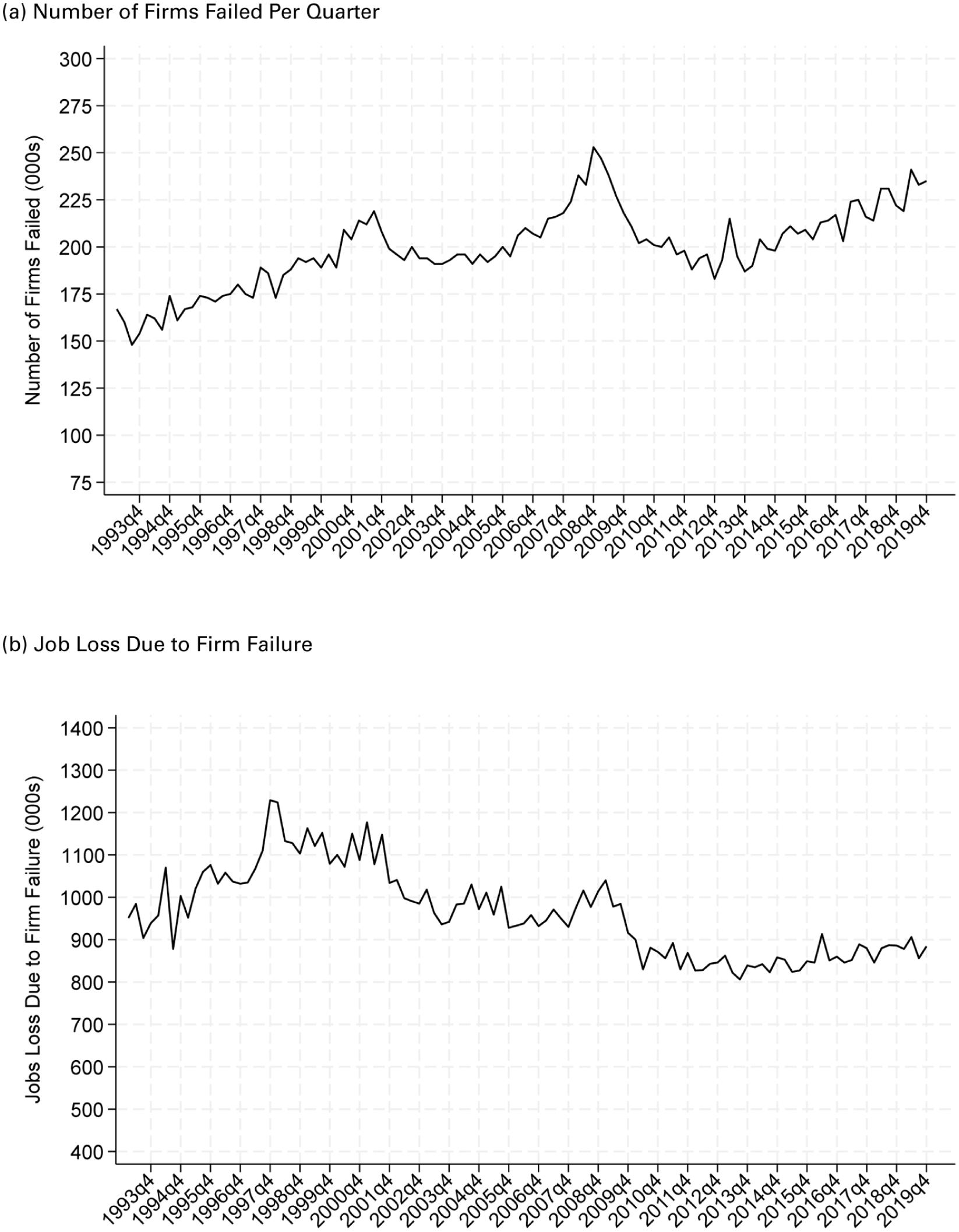
Firm Failure and Job Loss in U.S: 1993 to 2019*
Our framework centers on the conditions under which evaluative stigma (Goffman, 1963) is likely to arise after employer failure. Hiring under uncertainty often leads firms to rely heavily on observable—even if imperfect—signals to infer candidates’ quality, potential, and fit (e.g., Chatman, 1991; Correll et al., 2007; Corritore et al., 2018; Rivera, 2012). One particularly salient signal is candidates’ prior employer affiliation: Candidates from stable, reputable firms are typically perceived as higher quality (Bidwell et al., 2014; Phillips, 2001). Reversing this logic suggests that affiliation with unstable or failed firms may convey a negative signal. Although employers are unlikely to explicitly blame non-executive employees for their firm’s failure, evaluative stigma may still extend downward through “courtesy stigma” (Goffman, 1963, p. 30; Jensen, 2006; Wiesenfeld et al., 2008). Even absent direct responsibility or blame, evaluators might infer that failed firms employ workers of lower average quality, leading to internal attributions that resemble those directed at leaders. In this way, a non-executive employee’s affiliation with a failed firm can become discrediting, negatively shaping subsequent career outcomes.
If evaluative stigma does not extend to non-executive employees through direct stigma or courtesy stigma, then employer failure produces a theoretically important divergence: Outcomes differ systematically by hierarchical position. Whereas leaders are likely subject to internal attributions and, thus, evaluative stigma, non-executive employees may be insulated because they have little influence over strategic decisions or firm-level outcomes. For these employees, affiliation with a failed firm may be treated as situational—consistent with external attribution (Repenning & Sterman, 2002; Ross, 1977; Ryan & Connell, 1989; Schilit & Locke, 1982; Shaver, 2012)—or as simply uninformative for assessing quality. Moreover, most firm failures are relatively routine. Although high-profile collapses such as Enron, WorldCom, and Lehman Brothers dominate public perceptions, such dramatic cases are rare. Between 1993 and 2019, roughly 800,000 firms failed annually in the United States, displacing about 3.85 million employees each year, 3.82 million of whom worked at firms with fewer than 1,000 employees (Figure 1). These common, lower-profile failures are unlikely to provoke strong evaluative stigma for non-leaders. This perspective underscores a central contribution of our framework: Employer failure does not stigmatize employees uniformly; rather, attribution processes generate differentiated evaluative stigma between organizational leaders and other employees.
After establishing the general theoretical relationship between employer failure and employee careers, we consider additional sources of heterogeneity that may affect non-executive employees’ career outcomes after employer failure. First, we examine how characteristics of the failure itself, in particular routine failures versus those involving scandal, might influence the likelihood of evaluative stigma across the organizational hierarchy. Second, we theorize that broad labor-market conditions, including industry growth or contraction and the local concentration of competitors, shape the career opportunities available after employer failure. Finally, we explore how individual-level characteristics relevant to hiring decisions, including human capital and demographic factors, moderate career outcomes after employer failure.
A primary reason for the limited theoretical and empirical understanding of employer failure and employee careers is the difficulty of acquiring comprehensive data on employee career trajectories after firm failure. Prior organizational research has largely concentrated on organizational leaders, often examining a small number of high-profile failures (or even just one), and has usually focused on subsequent career outcomes within the same industry. Although this work has generated valuable insights into outcomes, such as title changes and employer prestige, it has overlooked the potential career impact of employer failure on non-executive employees and has not considered a fundamental career outcome: wages.
To address these challenges and test our more generalizable theory, we collected two complementary employee–employer matched datasets: one from the U.S. Census (Census) and another from the Automatic Speech Recognition (ASR) industry. We obtained access to 25 years of employee–employer matched data from the Census and the Internal Revenue Service, allowing us to track employment histories and earnings for nearly every taxpayer in the U.S. and providing definitive information about whether an employment change was precipitated by employer failure. However, Census data are de-identified and lack detailed information about employee roles (e.g., titles) or specific firm characteristics that may be of interest. To address this limitation, we supplemented our analysis with data from the ASR industry, an innovation-driven sector characterized by frequent employer failure (Botelho & Chang, 2022; Hall & Woodward, 2010; Puri & Zarutskie, 2012). The ASR data do not include wages but provide detailed employee information, including job titles and specific firm contexts. Additionally, the ASR data contain two instances of employer failure associated with major scandals, enabling a direct test of our arguments related to the role of attribution and evaluative stigma. To estimate the demand-side effects of employer failure and subsequent career outcomes, we used coarsened exact matching (CEM) (Blackwell et al., 2009; Iacus et al., 2012), comparing ex-employees from failed firms to similar employees who left firms that continued operating (ongoing firms).
Using the Census data, we find a negative relationship between employer failure and subsequent wage growth. However, this is limited to organizational leaders: Leaders from failed firms experience lower wage growth relative to similar leaders leaving ongoing firms, a result consistent with prior research and suggestive of evaluative stigma via internal attribution. By contrast, and consistent with a lack of internal attribution for non-leaders, we find no evidence of a wage growth penalty for non-executive employees from failed firms: Their subsequent careers are similar to those of peers from ongoing firms, they are not forced out of the labor market, and they do not endure prolonged unemployment.
Results from the ASR dataset confirm this finding by using a complementary career outcome: whether the employee remains in the ASR industry. However, the ASR results also suggest a boundary condition related to evaluative stigma: Employees associated with scandal-related failures experience uniformly negative career outcomes, suggesting that scandals provoke outcomes consistent with internal attribution and evaluative stigma throughout levels of the organizational hierarchy. Finally, we discuss the role of labor-market (e.g., shrinking industries, competition density) and employee characteristics (e.g., human capital, race/ethnicity, gender, immigration status), finding that certain employees suffer greater consequences than others do from having worked at a failed firm.
Employment Disruption and the Challenge of Evaluating Job Candidates
Our theoretical focus is on one specific form of involuntary career disruption: employer failure, namely the cessation of an organization’s operations. Despite the frequency of employer failures and the substantial number of employees affected annually (Figure 1), our theoretical understanding of how affiliation with a failed employer affects employees’ subsequent careers has been underdeveloped (see Botelho and Chang, 2022, for a discussion). Predicting firm failure ex ante is inherently challenging, even for informed stakeholders (Haveman & Cohen, 1994; Phillips, 2001; Puri & Zarutskie, 2012), and unlike a firm’s investors or suppliers, employees generally cannot diversify their risks across multiple organizations. Thus, developing a theoretical understanding of the conditions under which employer failure shapes employees’ subsequent career outcomes is important.
Layoffs represent a seemingly related yet distinct form of involuntary employment disruption, in which employers selectively terminate a subset of employees. Research on layoffs, and especially mass layoffs, offers preliminary insight into involuntary career disruptions. Employees displaced by layoffs typically face wage penalties, compared to unaffected employees (e.g., Couch & Placzek, 2010; Jacobson et al., 1993; Lachowska et al., 2020). The primary explanation is that hiring firms interpret layoffs as negative indicators of employee quality, given that layoffs generally involve selective terminations in which lower-performing employees are most likely to be dismissed (Gibbons & Katz, 1991; Jacobson et al., 1993). Indeed, laid-off employees are shown to have lower wages even before displacement (Jacobson et al., 1993), reinforcing prospective employers’ negative perceptions in subsequent labor-market outcomes.
One might extrapolate that affiliation with a failed employer similarly disadvantages affected employees. Prospective employers face uncertainty when assessing job candidates, lacking complete information about candidate quality and productivity. It is thus common for hiring firms to rely heavily on observable affiliations, proxies, and/or signals to reduce uncertainty and inform hiring evaluations (Spence, 1973). Research has shown that employers frequently depend on various affiliations and observable signals—even those with tenuous connections to underlying quality—to assess competence, capability, and organizational fit (Chatman, 1991; Correll et al., 2007), including one’s prior employer (Bidwell et al., 2014; Botelho & Chang, 2022; Phillips, 2001). However, employer failure substantively differs from layoffs in ways that complicate generalization. Layoffs typically send a much clearer signal about individual employee performance; among a large set of employees, the firm decided to lay off only a given subset. Employer failures simultaneously affect all employees, which may introduce ambiguity regarding a given employee’s competence, skills, and quality.
This theoretical ambiguity sets the stage for our framework, in which we consider the intersection of employer failure, evaluations, and employee careers. Next, we draw from research on organizational leaders affected by employer failure and integrate insights from attribution theory and evaluative stigma to theorize the conditions under which employees may (or may not) face evaluative stigma in their subsequent career after employer failure. We then extend our theoretical framework by briefly considering additional sources of heterogeneity—including whether the employer failure included a scandal, broader labor-market conditions, and individual-level characteristics—all of which may moderate the presence of evaluative stigma associated with affiliation with a failed employer.
Employer Failure, Evaluative Stigma, and Subsequent Career Outcomes
Organizational Leaders and Attribution
Evaluative stigma occurs when an individual possesses an attribute, has an affiliation, or engages in behaviors that external audiences perceive as discrediting (Goffman, 1963). For organizational leaders, those at or near the top of a firm’s hierarchy, one particularly salient characteristic shaping external audiences’ evaluations is the firm’s performance (Salancik & Meindl, 1984). Leaders typically reap significant benefits during periods of strong organizational performance but suffer considerable negative consequences when performance deteriorates. During periods of poor firm performance, organizational leaders bear the brunt of external criticism, often losing power, experiencing job termination, and facing difficulties securing comparable employment elsewhere (Gilson, 1989; Hambrick & Mason, 1984; Hermalin & Weisbach, 1998; Park et al., 2021; Park & Westphal, 2013). Leaders are aware of the evaluative stigma related to firm outcomes and may proactively engage in impression management or even identify scapegoats within the organization to deflect blame and protect their professional reputations (Boeker, 1992).
Evaluative stigma emerges in contexts of poor firm performance because external evaluators must engage in sensemaking to understand negative organizational outcomes and to attribute blame (Wiesenfeld et al., 2008). Organizational leaders, who are inherently responsible for their firms’ strategic direction, become natural focal points for such attributions. Although negative evaluations stemming from employer failure may occur from various external audiences, including investors, media, and suppliers, prospective employers are particularly important evaluators. Employer failure forces leaders (and all other employees) into the labor market, making prospective employers’ assessments especially consequential for their subsequent career outcomes.
Organizational research provides limited insights into the connection between employer failure and subsequent career outcomes, primarily through single-industry methodologies documenting negative career effects for leaders (Rider & Negro, 2015; Semadeni et al., 2008; Sutton & Callahan, 1987). For example, leaders from failed banks faced a greater likelihood of demotion in their subsequent employment, compared to similarly positioned leaders who exited the same banks prior to failure (Semadeni et al., 2008). Sutton and Callahan’s (1987, p. 412) analysis of four computer firm bankruptcies linked similar career consequences to evaluative stigma, emphasizing that firm failure “spoils” the reputation of organizational leaders.
Central to these theoretical expectations of evaluative stigma is the assumption of internal attribution: Prospective employers hold organizational leaders directly responsible for the failure of the firms they lead. Attribution theory provides a useful theoretical structure to this reasoning, distinguishing between internal and external attributions (Heider, 1958; Ross & Fletcher, 1985). Internal attributions occur when evaluators perceive an affiliation with an event or outcome as informing an individual’s characteristics; external attributions, by contrast, reflect outcomes perceived as driven by situational or environmental factors beyond the individual’s control and are thus uninformative about an individual’s characteristics (Fiske & Taylor, 1991; Ross, 1977). 2 Given organizational leaders’ clear responsibility for strategic direction and decision making (Boeker, 1992; Park et al., 2021; Park & Westphal, 2013; Salancik & Meindl, 1984), prospective employers should naturally default to internal attribution when evaluating leaders of failed firms, resulting in evaluative stigma. Consistent with this point, evidence suggests that leaders who explicitly deny responsibility for their firm’s failure are perceived even more negatively by evaluators, reinforcing the dominance of internal attribution in evaluating organizational leaders (Sutton & Callahan, 1987).
Non-Executive Employees and Internal Attribution
Organizational leaders constitute only a small subset of a firm’s workforce. Although existing organizational research has documented negative career outcomes for leaders affiliated with failed firms, it remains theoretically unclear whether and under what conditions these negative consequences extend downward to lower-level (i.e., non-executive) employees.
Internal attribution and blame vs. courtesy stigma
At first glance, applying internal attribution to a non-executive employee seems logically questionable. Organizational leaders clearly bear direct responsibility for strategic decision making, whereas lower-level employees do not have such direct control over firm outcomes. For example, when a bank fails, its leadership is blamed for poor strategic decisions (Semadeni et al., 2008), but it would seem unreasonable to blame the bank tellers, human resources personnel, or the IT department for the failure. Nevertheless, internal attribution does not necessarily require explicit blame. Ross (1977, p. 176) noted that observers (evaluators) can use an affiliation between an actor and an event to make inferences about the “dispositions of the actor (e.g., abilities, traits, or motives).” Thus, prospective employers may interpret affiliation with a failed employer as a noisy but credible signal of an employee’s quality, skills, or competence, generating evaluative stigma through a process of courtesy stigma (Goffman, 1963). Although Wiesenfeld et al. (2008, p. 233, their Figure 1) theorized about organizational leaders, they acknowledged the possibility that stigma arising from employer failure may extend categorically, affecting “a group or perhaps everyone associated with the firm.” Even without direct blame, affiliation with a failed firm may be sufficiently discrediting to stigmatize non-executive employees, producing negative career outcomes that mirror those resulting from the internal attribution faced by leaders.
Supporting this possibility is the fact that hiring firms face significant uncertainty when assessing job candidates, prompting them to rely heavily on observable signals and proxies—even if noisy—to infer candidate quality (Spence, 1973). Organizational research identifies prior employer affiliations as one influential signal used by prospective employers (Bidwell et al., 2014; Phillips, 2001). Firms regard employees as strategic assets (Fombrun & Shanley, 1990; Molloy & Barney, 2015), and reputable, high-performing firms typically attract and retain employees who have strong human and social capital (Gatewood et al., 1993; Rivera, 2012). Although existing literature primarily emphasizes the positive career implications of affiliation with successful firms, the inverse logic may also operate: An affiliation with a poorly performing (failed) firm could be interpreted negatively for the non-executive employee.
Even absent plausible culpability of non-leaders, one might infer that firms that eventually fail tend to employ workers of lower average quality, relative to the firms’ more successful counterparts. Weaker firms could struggle to attract top talent, and the employees they hire may receive inferior training, develop overly specialized or obsolete skills, or lack human capital relevant to contemporary labor-market demands (Groysberg et al., 2008). It is also possible that these employees are in roles they are not suited to hold. Phillips (2001) discussed this point directly, theorizing that new and smaller firms, which are at greatest risk of failure, can use title promotions as a mechanism to retain employees. He found that firms with characteristics consistent with a higher risk of failure are more likely to promote their employees rapidly. If a subset of these firms fails, failed firms will have a greater proportion of over-promoted employees than non-failed firms will have. This suggests that employees from failed firms may occupy positions above their capabilities, which could hinder their ability to secure comparable employment after failure.
Independent of whether these perceptions accurately reflect employees’ quality, affiliation with a failed firm can also affect the job-search process more broadly, such as by reducing displaced employees’ ability to leverage professional networks. Prospective employers may hesitate to hire or refer individuals from stigmatized firms through referral networks, which are essential in the labor market (Fernandez & Fernandez-Mateo, 2006; Granovetter, 1973; Smith et al., 2012). If employer failure indeed generates evaluative stigma beyond organizational leaders due to courtesy stigma and related uncertainty about an employee’s competence, skills, or quality, we would expect non-executive employees affiliated with a failed firm to systematically experience worse career outcomes than those of otherwise comparable employees from ongoing firms.
Lack of evaluative stigma and employer failure as a potential career opportunity
An alternative possibility is that evaluative stigma may not broadly affect employees through courtesy stigma; prospective employers may, instead, make external attributions when assessing non-executive employees affiliated with failed firms. Non-executive employees primarily execute tasks determined by their higher-level managers. From an attribution theory perspective, prospective employers evaluating these lower-level employees may perceive their job loss as resulting from external circumstances beyond their control rather than reflecting negatively on their individual quality or competence, even tangentially through courtesy stigma. In our example of a bank’s failure, employers evaluating bank tellers, human resources personnel, or IT staff might reasonably interpret affiliation with the failed bank as incidental and therefore uninformative regarding individual employee skills, quality, or potential. In such cases, the affiliation with a failed employer does not serve as a credible negative signal, shielding the non-executive employee from evaluative stigma and associated adverse career outcomes.
It is also possible that prospective employers make no attribution, which would yield expectations similar to external attribution, but this is difficult to empirically detect without direct evidence of evaluators’ beliefs. Although distinguishing empirically between external attribution and non-attribution is challenging, two considerations make the absence of internal attribution more consistent with external attribution. In labor markets, prior employer affiliations and experience are salient, routinely used signals that predict subsequent career outcomes (Bidwell et al., 2014; Botelho & Chang, 2022; Phillips, 2001). Thus, when evaluators do not make internal attributions, namely, stigmatized inferences about non-executive employees from failed firms, the more plausible interpretation is that they treat the affiliation as situational, in line with external attribution.
Supporting a lack of internal attribution for non-executive employees is research demonstrating that evaluative audiences systematically vary their attributions based on an individual’s position within a given hierarchy. Audiences consistently hold higher-status individuals to higher standards of accountability due to their presumed influence over organizational outcomes (Graffin et al., 2013; Rhee & Haunschild, 2006). Graffin et al. (2013) showed that higher-status members of the British Parliament faced harsher scrutiny for ethical violations than did lower-status members who committed similar infractions. Extending this logic to employer failure, we may expect prospective employers to direct internal attributions—and thus evaluative stigma—primarily toward those near the top of the hierarchy (i.e., organizational leaders), while not making the same attributions to non-executive employees.
If a non-executive employee avoids significant evaluative stigma, employer failure may paradoxically create opportunities for career improvement, similar to those of peers who search out new career opportunities from ongoing firms. Employees typically exhibit substantial inertia, remaining with current employers due to person–organization fit (Bermiss & McDonald, 2018; Chatman, 1991) and organizational commitment (Meyer & Herscovitch, 2001; Mitchell et al., 2001; Mobley, 1977). Thus, employees rarely assess their external labor-market value (Jäger et al., 2021; Kochhar et al., 2022; Mincer, 1986), instead developing strong attachments and deriving significant meaning from their current roles (Wrzesniewski & Dutton, 2001). Even when employees occasionally explore external opportunities, actual turnover remains uncommon (Griffeth et al., 2000). Over time, employees become effectively locked in, reluctant or unable to seek external opportunities that may better align with their true market value and capabilities (Bidwell, 2011; Sørensen, 2000). Employer failure disrupts this inertia, forcing employees to engage with the external labor market. Under conditions in which prospective employers primarily attribute failure externally, displaced employees may uncover career opportunities comparable or even superior to their previous positions. In this scenario, employer failure could serve as a career reset, allowing affected employees to move their careers closer to their true market value (Jäger et al., 2021).
Employer Failure Type, Industry, and Employee Heterogeneity
In addition to the primary theoretical contribution of our framework—highlighting that the likelihood of evaluative stigma relates to an employee’s position in the organizational hierarchy, resulting in broadly negative outcomes for all employees or, for non-leaders, outcomes comparable to those of unaffected employees—we also consider additional sources of heterogeneity that may shape non-executive employees’ outcomes following employer failure. Specifically, we consider how characteristics of the employer failure itself (e.g., scandals versus routine failures), broader industry conditions (e.g., shrinking industries, competitor proximity), and individual-level factors (e.g., human capital, demographics) might further moderate employees’ subsequent career trajectories.
Employer Failure Type: Routine Failure vs. Scandal
We have thus far assumed that firm failures primarily arise from general strategic mismanagement or poor performance, situations typically attributed to organizational leaders (Park et al., 2021; Park & Westphal, 2013; Salancik & Meindl, 1984). We have argued that prospective employers generally make internal attributions for organizational leaders but that it is less clear whether evaluative stigma will occur for lower-level employees. However, even if non-executive employees do not receive internal attribution, certain employer failures may include deeply discrediting events, such as scandals or fraud, that may create a blanket evaluative stigma for non-executive employees.
Unlike routine failures, scandal-related failures involve moral and ethical breaches, eliciting stronger responses from evaluators and attracting media attention that heightens public awareness and scrutiny (Jensen, 2006; Wiesenfeld et al., 2008). These conditions make it difficult for prospective employers to differentiate accountability based on organizational hierarchy, potentially extending internal attributions and evaluative stigma to non-executive employees. Real-world examples underscore this possibility. Non-executive employees from firms involved in high-profile scandals such as at Enron (Yardley, 2002) and Theranos (Fiegerman & O’Brien, 2019) have faced considerable hiring skepticism and difficulty securing subsequent employment, despite lacking direct involvement in misconduct.
Broader organizational research reinforces this perspective, highlighting that scandals uniquely erode evaluators’ distinctions between levels of accountability, thereby widening suspicion (Aven, 2015; Jensen, 2006). Additionally, research indicates that employees sometimes internalize or conform to the ethical norms within their organizations, raising prospective employers’ concerns that even lower-level employees from scandal-ridden firms might have indirectly internalized certain compromised norms or behaviors (Dimmock et al., 2018; Pierce & Snyder, 2008).
Therefore, if internal attribution is a main driver of career outcomes for organizational leaders versus non-executive employees, employer failures with an associated scandal should diminish or eliminate any protective buffer, triggering evaluative stigma for all employees. We should thus expect employees from scandal-related failures to experience worse career outcomes than employees displaced by routine firm failures experience.
Post-Failure Outcomes and Demand for Skills
Broader industry and local labor-market conditions may also moderate the relationship between employer failure and non-executive employees’ career outcomes. Our theoretical framework suggests that lack of internal attribution may insulate non-executive employees from the evaluative stigma associated with employer failure, potentially enabling career outcomes comparable to those of unaffected peers. If so, post-failure outcomes for affected employees should be contingent on the availability of suitable employment opportunities.
Employees’ career outcomes depend on the demand for their skills in the labor market. Consider a scenario in which a firm’s employees have skills that are highly specialized, whether firm-specific (Becker, 1964) or task-specific (Byun & Raffiee, 2023; Gibbons & Waldman, 2004), and thus not widely valued by other employers. When fewer firms value or seek these skills, displaced employees will encounter limited job opportunities. If we extend this logic, employees from failed firms operating in shrinking (or stagnant) industries may face particularly challenging career outcomes. In such competitive labor markets, prospective employers are more discerning and attentive to potential negative signals, increasing the likelihood that affiliation with a failed firm is viewed unfavorably. Thus, industry contraction likely magnifies the likelihood of adverse career implications after employer failure.
As well, the geographic location of ongoing firms in the same industry as the failed firm may significantly shape the career consequences of employer failure. Employees, much like entrepreneurs (Dahl & Sorenson, 2012), generally prefer to find employment near their current locations due to the personal and financial costs of relocating. A higher local concentration of competitor firms creates conditions in which employees from a failed firm may have greater access to alternative employment opportunities. Indeed, industry wages tend to be higher in geographically concentrated industry clusters (Wheaton & Lewis, 2002), and firms in similar industries often strategically co-locate to tap into shared pools of specialized human capital (Krugman, 1991; Saxenian, 1996; Sorenson & Audia, 2000). Related, geographic proximity should also allow employees to leverage their networks when looking for a new job. When a firm fails, nearby competitors might proactively recruit affected employees, viewing failure as an opportunity to acquire valuable talent without the legal risks of violating non-compete clauses (Marx et al., 2009). As a result, non-executive employees displaced by employer failure in densely concentrated labor markets may actually experience improved career outcomes.
Individual Characteristics: Specialized Human Capital and Demographics
Beyond one’s position in the organizational hierarchy, other employee characteristics likely moderate the relationship between employer failure and subsequent career outcomes for non-executive employees. Organizational researchers’ primary focus on firm leaders limits our understanding of individual-level heterogeneity. That said, even among senior partners at a failed law firm, educational status was found to moderate the adverse career outcomes of failure (Rider & Negro, 2015). Building on this logic, we consider two sets of employee characteristics, specialized human capital and demographic factors, that have been shown to shape employers’ evaluations of job candidates. These characteristics may influence whether prospective employers make assessments consistent with internal attribution after employer failure, thereby affecting the subsequent career outcomes of non-executive employees.
Specialized human capital refers to skills, knowledge, or expertise uniquely tailored to specific roles or industries, often highly valued but in short supply (Becker, 1964). Skills have been linked to firm performance and competitiveness, especially in innovation-driven industries (Jara-Figueroa et al., 2018; Shrader & Siegel, 2007). Reflecting the strategic value of specialized human capital, firms actively engage in talent recruitment from successful rivals (Combes & Duranton, 2006; Isaac, 2015). Proximity to talent pools even incentivizes firm co-location despite competition risks (Rotemberg & Saloner, 1990). Thus, employees possessing specialized human capital may experience relatively favorable career outcomes after firm failure, compared to those without these skills.
Demographic characteristics, including gender, race, and immigration status, are similarly important due to their established relationship with evaluative biases in hiring. Status characteristics theory highlights that evaluators consistently raise greater competency doubts about minority group members relative to majority counterparts, which adversely affects evaluative outcomes (Abraham et al., 2024; Berger, 1977; Correll et al., 2007; Correll & Ridgeway, 2003; Moss-Racusin et al., 2012). Gender differences are found even when evaluators have access to objective performance information (Foschi, 1996), and racial differences in customer ratings occur due to a shift from a five-star rating scale to a thumbs up/down rating scale (Botelho et al., 2025).
If prospective employers make internal attributions for organizational leaders but not for non-executive employees, this differentiation may be less likely for individuals who frequently face bias in the hiring process, disproportionately disadvantaging individuals from underrepresented backgrounds. In other words, even if non-executive employees are typically shielded from internal attribution, common stereotypes about competence tied to demographic characteristics may lead minority employees from failed firms to face evaluative stigma and worse subsequent career outcomes than those of similar employees from ongoing firms.
Empirical Approach
To understand the relationship between employer failure and subsequent employee career outcomes, we need detailed, longitudinal data across various firms that compare outcomes of employees from failed firms against those from ongoing firms. The ideal approach entails randomly triggering firm failures and tracking employees’ career outcomes compared to those of unaffected peers. Since such a field experiment is neither practical nor ethical, we approximated this ideal by using complementary longitudinal datasets that match employers with their employees.
When comparing career outcomes, we considered two possible counterfactual groups: employees who exited ongoing firms and employees who remained with ongoing firms. Because our theoretical interest centers on how prospective employers evaluate employees from failed firms, our primary analyses compare employees from failed firms to observationally similar employees who exited ongoing firms. We discuss the robustness of our results using employees who remained with ongoing firms later in our analyses.
U.S. Census
The Census maintains two comprehensive databases on employers and employees in the U.S.: the Longitudinal Business Database (LBD) and the Longitudinal Employer Household Dynamics (LEHD) database. The LBD contains founding and dissolution dates for all U.S.-based employers from 1976 to 2014, while the LEHD includes quarterly wages from IRS tax records for employees at those employers. Employer-level data are aggregated by state-level identifiers and tracked across states, with unique identifiers for individual employees.
The LBD and LEHD represent a unique resource for studying the U.S. labor force given the completeness of their coverage, especially compared to databases that rely on self-reported or imputed data (e.g., LinkedIn, surveys). Researchers must apply for Special Sworn Status to access these data within secure Census facilities and must adhere to strict confidentiality requirements. All analyses must be reviewed and checked by Census officers via a standardized submission process, which frequently includes feedback and revision requests. For example, researchers are restricted from disclosing certain subsample analyses that may identify a subset of observations deemed to be too small. Thus, all disclosed information for a project is compared to previously disclosed information to check for potential subsample issues. Moreover, not all data collected by Census are available for all research projects. For this project, we examined LEHD data for 25 states and the District of Columbia (D.C.). 3
Because our analysis examines employees’ career outcomes, we prioritized collecting full career histories. Individuals may move across states from which we do not have data (e.g., from Washington to Massachusetts), or they may work during a time for which we have data on one state (e.g., Colorado in 1999) but not another (e.g., Arkansas in 1999). Following other research using Census data, we opted for employee-level completeness by including only individuals we could follow for their entire career history. That is, we removed from our sample any individual who held a job outside the state-years for which we have LEHD data. 4 Moreover, because our outcome variable (discussed below) is the difference in wages between a worker’s current and former employers, we required that the worker had spent at least three quarters at each employer, to have a reasonable basis upon which to compare wages. Finally, we excluded North American Industry Classification System (NAICS) two-digit codes 91 and 61 (governmental and religious organizations, respectively) in order to focus strictly on commercial firms.
U.S. Census Measures
Dependent variable
Wages represent an equalizing metric for comparing career outcomes across firms and industries since individuals are interested in keeping or increasing their wages over time. Therefore, we examine changes in employee wages to assess the relationship between employer failure and subsequent career outcomes. Our dependent variable, Wage differential, measures the wage difference between an employee’s job at time t0 and their (previous) job at time t−1. Wages are reported quarterly at the employee–employer level; thus, we calculated annualized salary as four times the reported wages in the penultimate quarter at their previous job (t−1) and four times the reported wages in the second quarter of their subsequent or current job (t0). This method ensures that a complete quarter’s wages are consistently captured. For example, regardless of whether an employee exits in the first or last week of a quarter, the wage from that full quarter is reported. To maintain consistent comparisons, all wages are inflation-adjusted to constant 1982 dollars.
A positive (negative) Wage differential indicates that the individual earned higher (lower) wages at their current job relative to their previous job. To mitigate the influence of extreme outliers, we winsorized the wage values at the 99th percentile. 5 Finally, we measured wage differences as the difference in logged wages between the two jobs. For example, an employee whose earnings increase from $39,000 (10.57 logged) to $40,000 (10.60 logged) would have a wage differential of approximately +$1,000 (or +0.03 in log terms).
Independent variables
Our primary explanatory variable indicates whether an employee was employed by a firm at the time of its failure. We relied on the LEHD dataset to determine firm failure timing. Specifically, the quarterly granularity of the LEHD allowed us to pinpoint the exact quarter of failure by identifying the final quarter during which an employer paid wages to employees and whether a given employee was at the firm in the quarter that it failed. 6 Failure takes the value of 1 if an employee was affiliated with the firm during its final quarter and 0 if the employee worked at an ongoing firm during the same period.
The Census data do not contain information regarding an employee’s position, function, title, or seniority level. Therefore, we used the wage distribution within each firm to approximate where an employee likely sits on the organizational hierarchy. To approximate the likelihood that an employee is an organizational leader, we used their relative wages within each firm. High earner takes the value of 1 for employees whose earnings place them in the top 5 percent of their employer’s wage distribution and 0 otherwise. We selected this threshold to maximize the inclusion of organizational leaders, preferring to potentially incorporate some non-leaders rather than risk excluding leaders. It is important to note certain ambiguities inherent in this measure. For example, some CEOs have famously opted for low wages and, instead, receive lucrative stock options (not captured by these Census data) (Beckerman, 2016). Additionally, some highly compensated employees might be individual contributors rather than organizational leaders. Despite these limitations, we expect that the top 5 percent of wage earners will include most organizational leaders. We will also discuss the robustness of our results to other cutoffs.
Control variables
We included several employee- and firm-level control variables drawn from the LEHD, to account for characteristics that may influence wage outcomes. At the employee level, we controlled for available demographic information. Female takes the value of 1 if the Census indicated the sex of the employee as female and 0 if male. We calculated an employee’s Age by using an employee’s birth year. Immigrant takes the value of 1 if the employee was born outside of the U.S. and 0 if they were born in the U.S. To account for race and ethnicity, we constructed the variable Minority, which takes the value of 1 for all employees who report a race/ethnicity other than non-Hispanic White. 7
At the firm level, because a firm’s size may influence wage outcomes, we controlled for Firm size, measured as the logged number of employees at the firm during the focal year. To account for industry and geographic variation, we included fixed effects for the firm’s six-digit NAICS industry and the state in which the employee works. State-level unemployment could influence wages, so we controlled for Unemployment: the state-level unemployment rate during the year and in the state in which the worker seeks employment, which may differ from the state in which the worker was previously employed, and thus does not necessarily drop out of the model given state fixed effects.
Lastly, we controlled for the elapsed time between when an employee left the previous employer and joined the subsequent employer. Move lag (ln) is the natural log of the count of quarters between the two jobs. This variable captures any differences in job-search dynamics related to prior employer status.
U.S. Census Matching
As noted, our lack of an experimental design limits causal inference and makes it challenging to fully account for all differences between employees at failed firms and those at ongoing firms. To strengthen our empirical comparisons, we used a matching estimation. Our goal is to ensure a more balanced comparison between employees from failed firms and similar employees from ongoing firms. Although we do not claim that matching provides a causal estimation, it allows us to provide more generalizable and robust evidence of the relationship between employer failure and employee careers within our context. Again, our data consist of employee job transitions, primarily from ongoing firms, with a smaller number from firms that failed. Each transition includes both employee- and firm-level characteristics.
We used CEM, a non-parametric technique designed to achieve sample balance by grouping observations based on a specific treatment (Blackwell et al., 2009; Iacus et al., 2012). The extensive size of our Census data allows for one-to-one matching, pairing each employee from a failed firm with a similar employee from an ongoing firm. Although one-to-one matching risks creating small analytical samples, in our large dataset we avoided this tradeoff between reducing bias and maintaining statistical power. After matching, our analytical sample consists of approximately 2,200,000 observations. 8
At the employee level, we matched exactly on gender and coarsely on age, using five distributional bins. At the employer level, we matched exactly on location (state), industry (four-digit NAICS), and the firm’s founding year. We also matched on firm size (i.e., number of employees), using five distributional bins. 9
U.S. Census Estimation
We used ordinary least squares regression to estimate the relationship between Wage differential and Failure. Our unit of analysis is a job transition event: an employee moving from one employer to another employer. For employees from failed firms, this event represents a transition from their failed firm to a subsequent employer; for all other employees, it represents a transition from one ongoing firm to another. We specify our main regression model as follows:

where W is the wage difference for employee i between their employer at time t0 and their prior employer at time t−1. F is an indicator variable taking the value 1 if employee i worked at a firm that experienced Failure at time t and 0 otherwise (i.e., at an ongoing firm). We are also interested in the interaction between F and whether the employee is an organizational leader (High earner). U and B are vectors of time-variant and invariant control variables at the employee (U) and firm (B) level (see the subsection Control Variables). δ includes industry fixed effects, ρ includes state fixed effects, τ includes year fixed effects, and ε is the error term. We clustered standard errors at the firm level.
Automatic Speech Recognition Industry
While the Census data provide generalizable estimates, this comes at the expense of detail regarding specific firms and employees. To address this limitation, we assembled a complementary employer–employee dataset focused on a single innovation-driven industry: Automatic Speech Recognition (ASR), a form of artificial intelligence that translates spoken language into text by analyzing large datasets of recorded human speech. Although the technology only recently reached human-level accuracy (Bishop, 2017), ASR firms have claimed near-perfect performance since the early 1980s (Creitz, 1982). In the intervening years, unable to attain such vaunted performance expectations, many ASR firms failed.
We compiled detailed data on ASR firms’ entry and exit events between 1952 and 2013 by manually reviewing more than 15,000 pages from two industry newsletters, ASRNews and Speech Recognition Update. We obtained employee-level data from several sources, including trade journals, proceedings from several annual ASR conferences, patent records, CapitalIQ, and internet sources such as Bloomberg BusinessWeek, the ASR historical repository elsnet, and ZoomInfo (Kacperczyk & Marx, 2016). Our sample focuses on employees who made at least one career move within the ASR industry between 1980 and 2010. The resulting dataset contains 6,296 observations of employees from 374 unique ASR firms, of which 88 failed during our study period.
Our analytic approach to the ASR data is similar in many respects to our description of the Census data. Below, we highlight only the aspects in which the ASR data differ from the previously described Census data.
ASR Measures
Dependent variable
Comprehensive wage data is difficult to collect outside of Census or comparable registry sources. Therefore, for the ASR employee sample, we focused on a different yet important outcome variable: whether an employee remains employed in the ASR industry. Moving from one industry to another can have formidable implications for employees. Individuals develop substantial and valuable industry-specific human and social capital over their careers (Byun & Raffiee, 2023; Gibbons & Waldman, 2004; Phillips, 2002), especially in innovation-driven industries (Jara-Figueroa et al., 2018; Lazear, 2004). The inability to secure a subsequent job in the ASR industry may diminish these accumulated investments. Staying in industry takes the value of 1 if an employee’s subsequent job is within the ASR industry and 0 otherwise. 10
Independent variables
The primary independent variable, Failure, mirrors our Census measure with one difference: Due to data constraints, we can determine whether an employee worked at the firm only during the year of its failure rather than in the specific quarter.
A notable strength of the ASR data relative to the Census is the availability of detailed position titles, allowing us to directly identify organizational leaders. We classified employees as organizational leaders based on their job titles at the time of firm failure. This includes employees holding a C-level position (e.g., CEO, CTO, founder) or another executive position (e.g., executive vice president). Executive takes the value of 1 for employees in these organizational leadership positions and 0 otherwise.
Control variables
To account for specialized human capital, we used job titles: Engineer takes the value of 1 if the employee held an engineering or science-related role (e.g., software engineer, computational linguist) and 0 otherwise. We approximated employee Age as 21 years plus the number of years elapsed since the individual’s first appearance in our dataset, when an individual likely joined the workforce upon graduating from college. We inferred gender from given names, with the variable Female equal to 1 if the employee’s name is more commonly perceived as a woman’s name than a man’s name, using a name-gender classifier algorithm. Given that firms in innovation-driven industries sometimes co-locate for access to a labor supply (Saxenian, 1990), High ASR density takes the value of 1 if the geographic area has an above-median concentration of ASR firms and 0 if not.
ASR Matching and Estimation
We used a matching strategy similar to the one described for the Census analyses. Due to the smaller ASR dataset, however, we used one-to-many matching, assigning weights to balance variance. Within each stratum, observations receive weights based on the relative proportion of employees from failed ASR firms to employees from ongoing firms. At the employee level, we matched exactly on Engineer and Female, and we matched coarsely on Age, using four distributional bins. At the firm level, we matched exactly on location (state in the U.S.; country for international observations) and bucketed firm founding year by decade. Finally, we matched exactly on the observation year. The CEM procedure yielded a matched sample of 2,466 observations at 275 unique ASR firms, 87 of which failed.
Our estimation equation followed the specification detailed previously in the Census analysis.
Results
We first discuss the main empirical relationships of interest, starting with the Census data and then the ASR data. Subsequently, we explore additional analyses that unpack and clarify our primary findings.
U.S. Census Main Results
Table 1 provides descriptive statistics for the variables included in our Census analysis. Table 2 provides correlations. 11 The average employee in our matched sample is approximately 45 years old, 28 percent are female, 14 percent are immigrants, and 13 percent identify as a racial/ethnic minority.
Descriptive Statistics: Census Matched Sample*
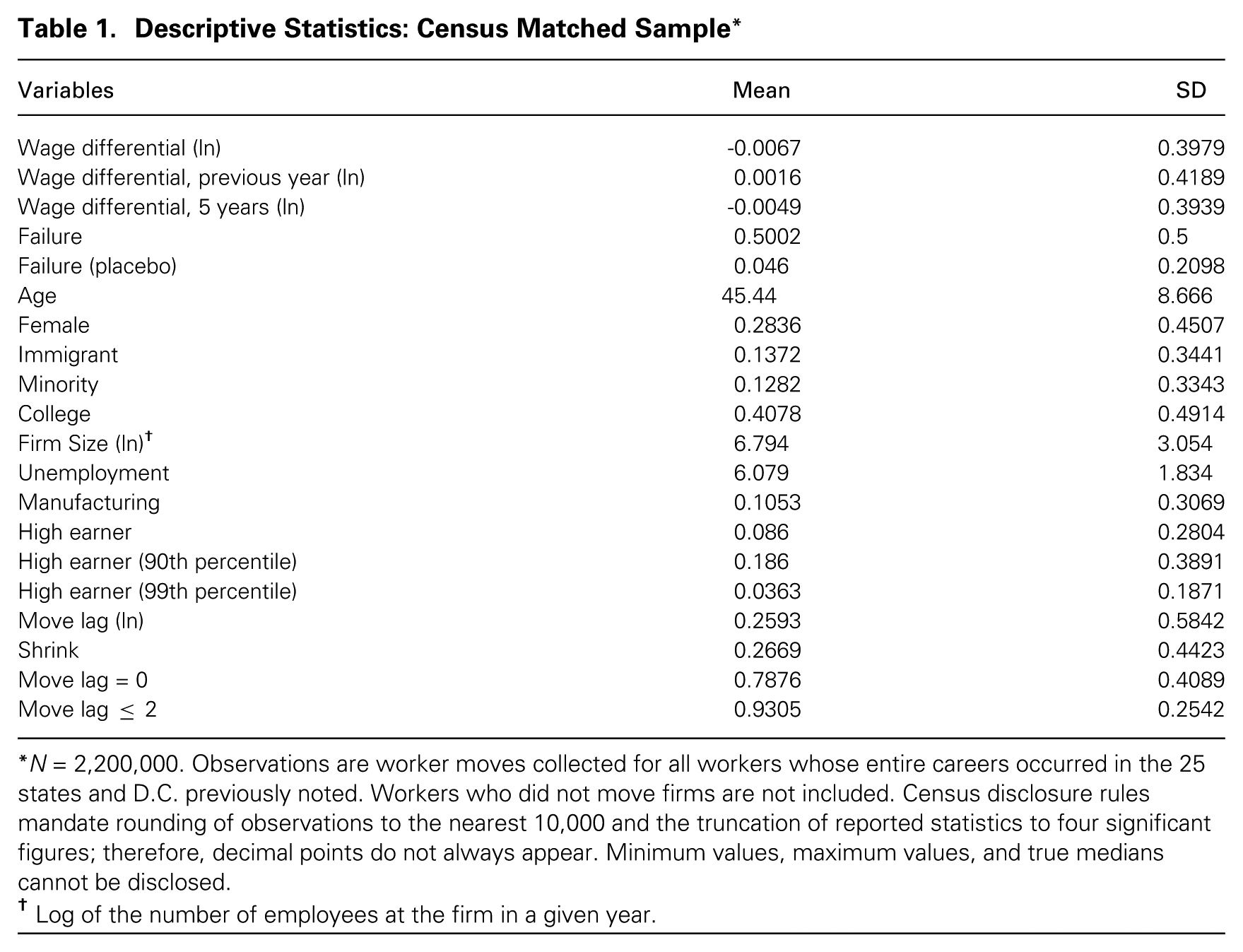
N = 2,200,000. Observations are worker moves collected for all workers whose entire careers occurred in the 25 states and D.C. previously noted. Workers who did not move firms are not included. Census disclosure rules mandate rounding of observations to the nearest 10,000 and the truncation of reported statistics to four significant figures; therefore, decimal points do not always appear. Minimum values, maximum values, and true medians cannot be disclosed.
Log of the number of employees at the firm in a given year.
Correlations: Census Matched Sample*
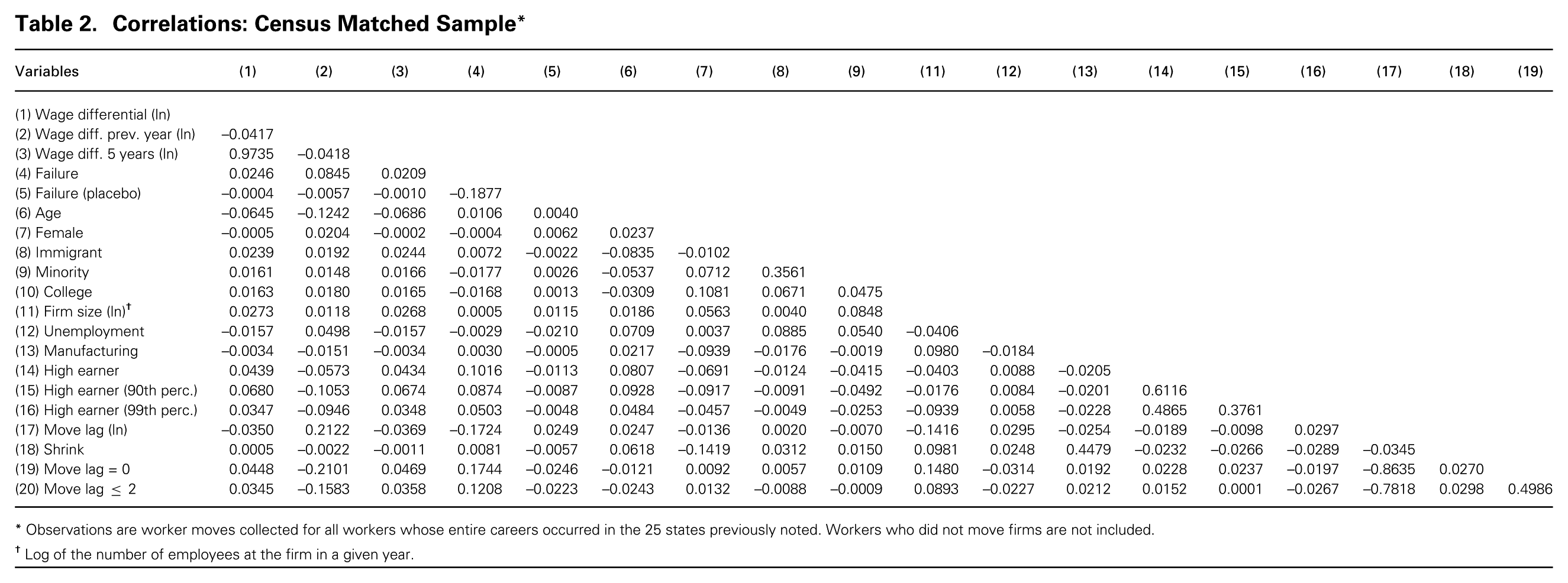
Observations are worker moves collected for all workers whose entire careers occurred in the 25 states previously noted. Workers who did not move firms are not included.
Log of the number of employees at the firm in a given year.
After an employee exits their employer (whether a failed or ongoing firm), their subsequent wages are similar to their wages at their former employer (Wage differential). These unconditional means should be interpreted cautiously as many factors are related to an individual’s wages, such as their firm’s industry, their experience, and state-level variation.
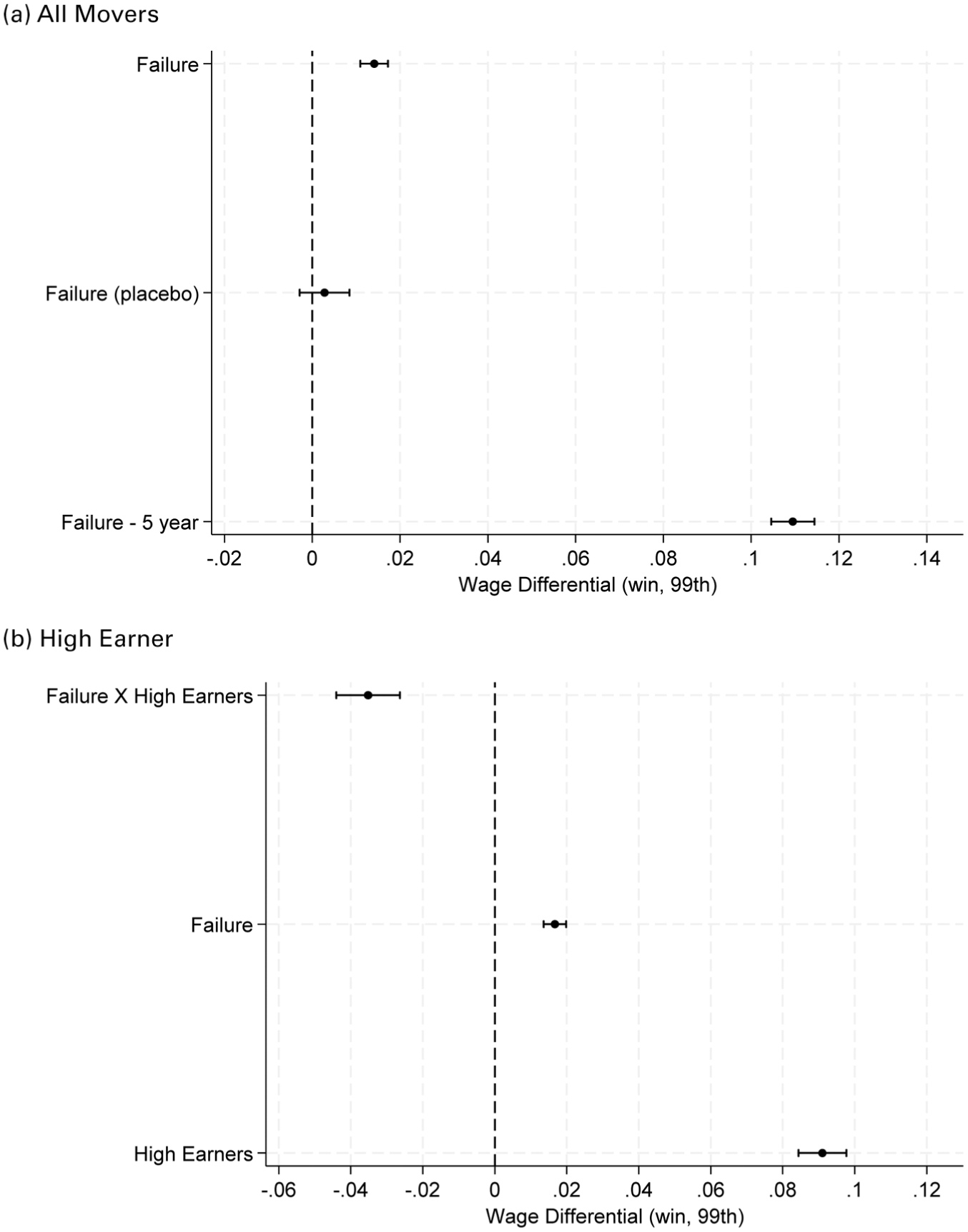
Table 3, Model 1 provides the results for the initial relationship between Wage differential and Failure, and Figure 2a provides the coefficient plot (Failure line). All analyses are conditional on a mobility event (i.e., an employee exiting a failed firm or an ongoing firm and securing a new job). Consistent with the idea that employees may not earn a market wage at their current employer (e.g., Jäger et al., 2021; Mincer, 1986), employees who exit ongoing firms earn a positive wage differential of about 11 percentage points. Thus, job mobility is associated with positive wage growth. The positive coefficient on Failure suggests that, on average, employees from failed firms experience about 1.4 percentage points higher wage growth, compared to employees who leave ongoing firms. Although statistically significant, this 1.4 percentage point difference is modest in practical terms. When we used the wages in our sample, which are inflation-adjusted 1982 dollars, it represents a difference of about $250 per year. Because the modal employee in our sample is not an organizational leader, these initial results do not support the existence of an evaluative stigma for non-executive employees affiliated with a failed employer.
Matched Census Sample OLS Regressions of Wage Differential on Firm Failure (vs. Employees from Ongoing Firms)*
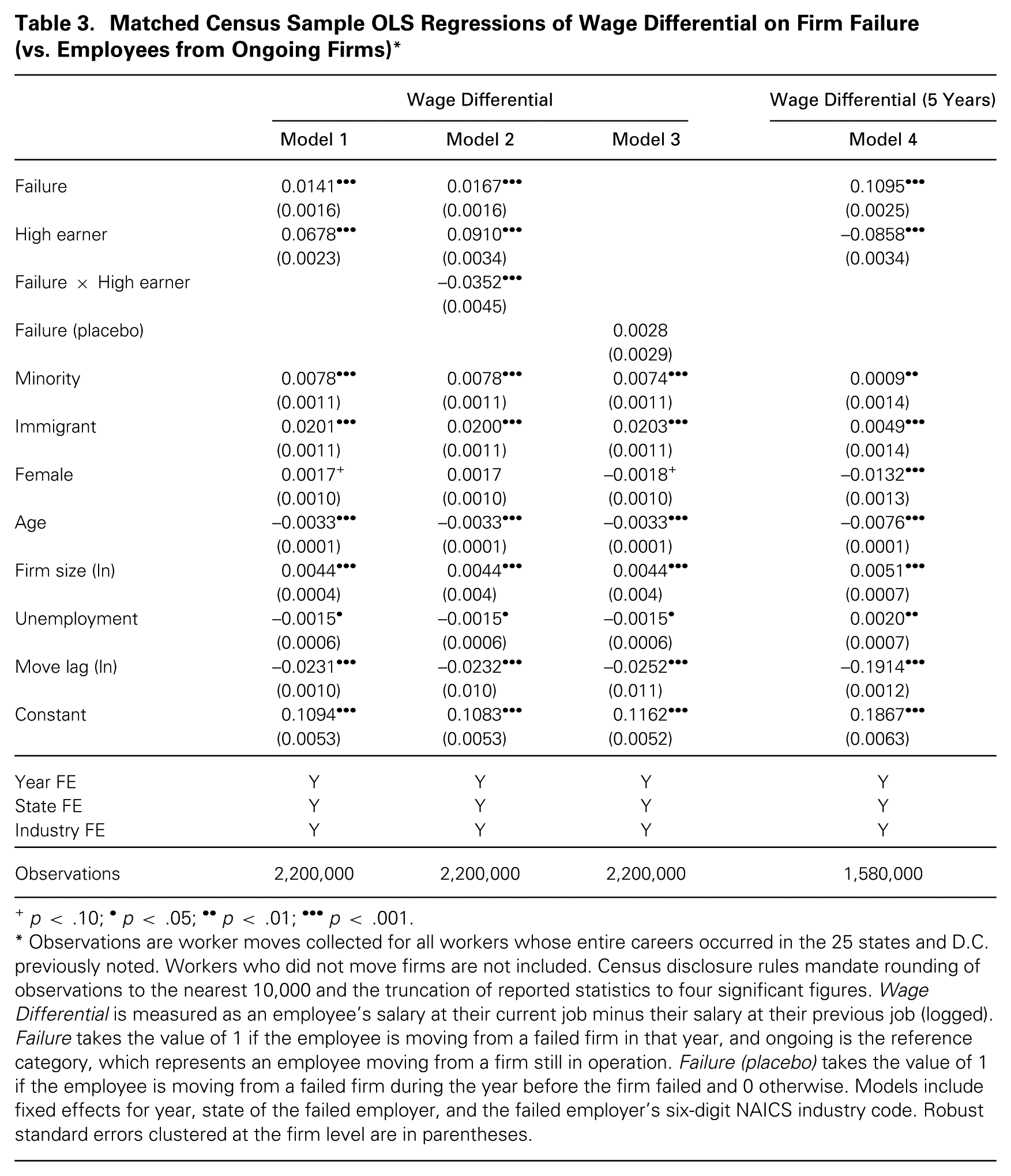
p < .10; • p < .05; •• p < .01; ••• p < .001.
Observations are worker moves collected for all workers whose entire careers occurred in the 25 states and D.C. previously noted. Workers who did not move firms are not included. Census disclosure rules mandate rounding of observations to the nearest 10,000 and the truncation of reported statistics to four significant figures. Wage Differential is measured as an employee’s salary at their current job minus their salary at their previous job (logged). Failure takes the value of 1 if the employee is moving from a failed firm in that year, and ongoing is the reference category, which represents an employee moving from a firm still in operation. Failure (placebo) takes the value of 1 if the employee is moving from a failed firm during the year before the firm failed and 0 otherwise. Models include fixed effects for year, state of the failed employer, and the failed employer’s six-digit NAICS industry code. Robust standard errors clustered at the firm level are in parentheses.
Comparison of Wage Differentials by Firm Failure in Census Matched Sample*
To test the possibility that employer failure does not affect subsequent career outcomes for any employee, irrespective of hierarchical position, Model 2 interacts High earners with Failure; Figure 2b provides a coefficient plot from this regression. For employees from ongoing firms (constant), there is a positive relationship between job mobility and wage growth. The positive coefficient on High earners indicates that organizational leaders from ongoing firms experience even more wage growth when they move to a new employer, relative to non-executive employees from ongoing firms.
With regard to the relationship of interest, the main effect of Failure suggests that non-executive employees from a failed firm experience slightly larger wage growth than do similar employees from ongoing firms (1.7 percentage points, or about $290). The situation differs for organizational leaders from failed firms: The interaction between Failure and High earner suggests that organizational leaders from failed firms experience approximately one-third lower wage growth (0.0352/0.1083 = 0.33) compared to organizational leaders exiting ongoing firms. While wage growth for organizational leaders is attenuated after firm failure, we do not find evidence that this penalty trickles down to non-executive employees. Instead, we find evidence that employees from failed firms are just as well off as similar employees who leave ongoing firms.
These findings are consistent with our theoretical expectations regarding attribution following employer failure. Prospective employers appear to make internal attributions—and thus an evaluative stigma applies—to employees at the top of the organizational hierarchy, whereas non-executive employees do not seem to experience similar evaluative stigma. This evidence does not support the notion that the latter employees face a courtesy stigma merely through their affiliation with a failed employer (cf. Wiesenfeld et al., 2008). Furthermore, while prior organizational research discusses the signaling advantages derived from working at a reputable firm (Bidwell et al., 2014), we do not find support for the inverse logic: that affiliation with a failed firm signals that non-executive employees are evaluated by subsequent employers as lower quality. In addition to disentangling competing theoretical predictions, our results replicate and extend prior organizational research on employer failure by using a representative, matched sample of over two million U.S. employees.
Overall, these results suggest that prospective employers are not using firm failure to make negative internal attributions, such as expectations of lower quality, potential, skills, or competence, about non-executive employees affiliated with failed firms. However, the same is not the case for organizational leaders.
Addressing alternative explanations: Failed firm differences and short-lived wage changes
Before we unpack this main result and focus on the ASR industry, two alternatives are worth considering. First, despite our matching approach, it is possible that failed firms might still systematically differ from ongoing firms, potentially driving observed wage differences. Second, the small wage growth observed for non-executive employees after employer failure might be short-lived.
If firms that fail differ sharply from those that do not, the positive wage differential may be a product of these differences rather than a lack of internal attribution for non-executive employees. We used the detailed timing available in the Census data to test this possibility. Our main employer failure measure, Failure, takes the value of 1 if an employee worked at the firm in the quarter in which the firm failed. We constructed a placebo measure, Failure (placebo), that takes the value of 1 if an employee left the firm during the four quarters (one year) before the firm failed. 12 If the results in Table 3, Models 1 and 2 were driven by underlying firm differences between failed and ongoing firms, we would expect Failure (placebo) to produce similar effects. However, in Table 3, Model 3 (coefficient plot in Figure 2a, Failure (placebo) line), the estimated coefficient on Failure (placebo) is no longer substantively or statistically significant. This analysis provides reassurance that our main findings are unlikely driven by unobserved firm-level differences and, instead, likely reflect employee affiliation with firm failure itself.
Next, it is possible that the observed wage growth for non-executive employees is temporary. Although even a short-term bump aligns with our attribution logic, it is informative to check whether this positive wage differential persists. To test this relationship, we collected a longer-term wage outcome: Wage differential (5-year), which compares employees’ logged wage five years after having left their employer (failed or ongoing) to their logged wages at their former employer. Table 3, Model 4 (Figure 2a provides the coefficient plot, Failure—5 year line) shows that the positive wage differential after firm failure (Model 1) persists.
Census Robustness
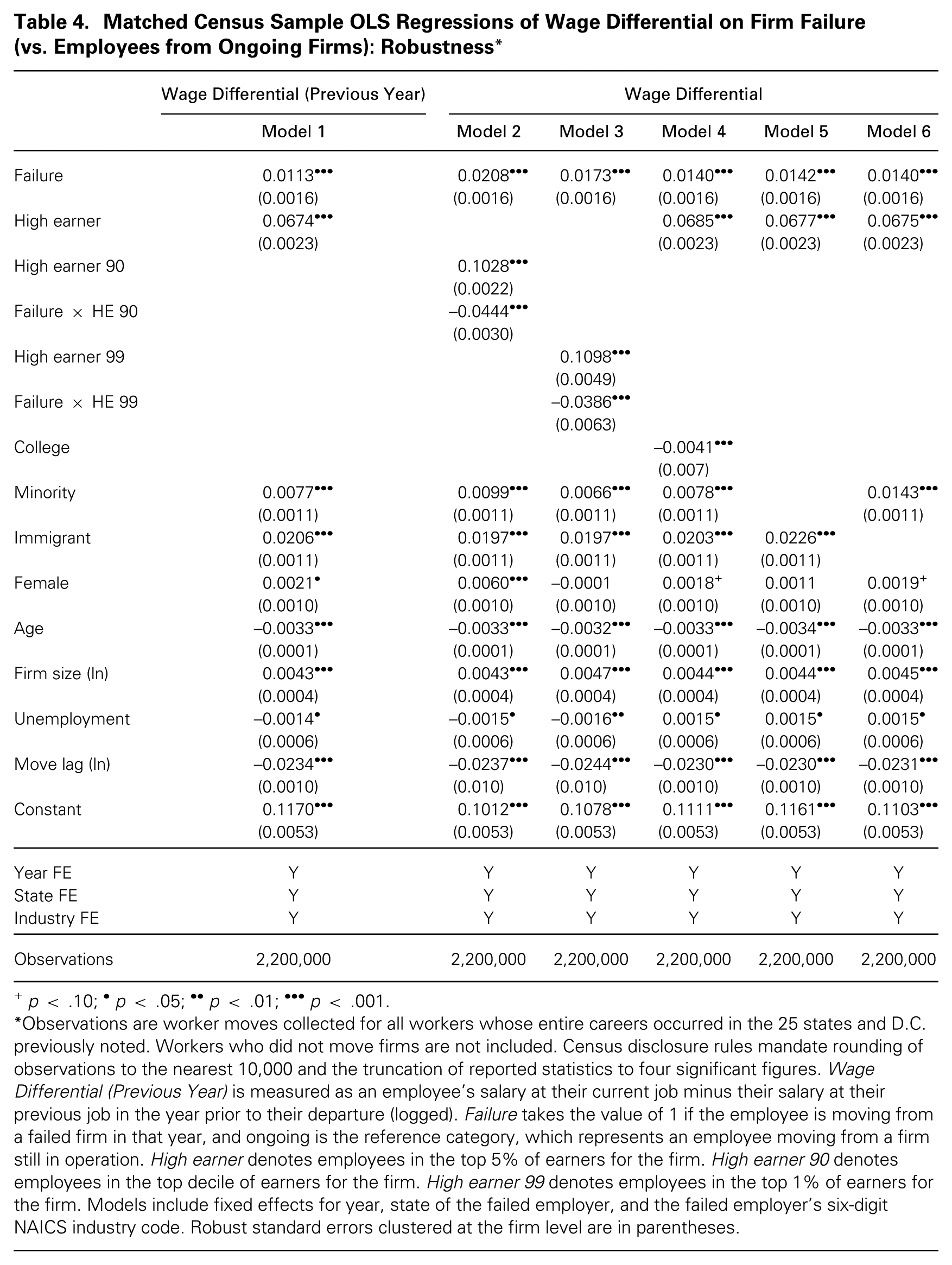
We conducted several robustness checks related to our main findings. First, we addressed the possibility that our results may reflect wage reductions implemented by firms prior to failure (i.e., a potential cost-saving technique). We explored this issue in two ways. Initially, we examined whether average firm-level wages systematically decline in the year of failure by comparing them to the preceding two years (all in inflation-adjusted 1982 dollars). Average wages at failed firms in the year before failure were approximately 1.8 percent lower than in the year of failure, while wages two years before failure were roughly 2.2 percent lower than in the year of failure. Therefore, wages increased year-over-year, and it does not appear that firms on the verge of failure implemented pre-failure wage reductions. 13 Although firm-level averages might obscure individual-level wage changes, this analysis suggests that systematic wage reductions prior to failure are unlikely.
To further address potential individual-level wage reductions, we re-estimated our main specification (Model 1 in Table 4), using wage data from the quarter occurring one full year before firm failure (instead of the quarter immediately before firm failure). This measure incorporates any wage decreases experienced by individuals in the year of failure. The results closely replicate our initial estimates (Table 3, Model 1), confirming robustness to timing adjustments.
Matched Census Sample OLS Regressions of Wage Differential on Firm Failure (vs. Employees from Ongoing Firms): Robustness*
p < .10; • p < .05; •• p < .01; ••• p < .001.
Observations are worker moves collected for all workers whose entire careers occurred in the 25 states and D.C. previously noted. Workers who did not move firms are not included. Census disclosure rules mandate rounding of observations to the nearest 10,000 and the truncation of reported statistics to four significant figures. Wage Differential (Previous Year) is measured as an employee’s salary at their current job minus their salary at their previous job in the year prior to their departure (logged). Failure takes the value of 1 if the employee is moving from a failed firm in that year, and ongoing is the reference category, which represents an employee moving from a firm still in operation. High earner denotes employees in the top 5% of earners for the firm. High earner 90 denotes employees in the top decile of earners for the firm. High earner 99 denotes employees in the top 1% of earners for the firm. Models include fixed effects for year, state of the failed employer, and the failed employer’s six-digit NAICS industry code. Robust standard errors clustered at the firm level are in parentheses.
A second potential concern involves overestimation due to sample selection bias, given that our analysis includes only employees who secure subsequent employment after leaving their prior firm. If a substantial proportion of displaced employees do not find new jobs (and thus have post-failure wages of zero), our results might overstate the true wage effects of employer failure. To address this possibility, we need to examine all employees of those failed firms and not just those from our CEM sample. Doing so reveals that 97.6 percent of employees of failed firms subsequently find employment at another firm (as captured by the LEHD). Of those, 90 percent find another job by the quarter after their former firm failed, and 95 percent find that next job within two quarters following failure. (As noted, our analyses controlled for the lag between employment spells.)
For the remaining 2.4 percent of employees not observed in the LEHD after employer failure, we linked those individuals to the Census Integrated Longitudinal Business Database (ILBD), which captures self-employment income not included in the LEHD. Approximately one-fifth of these individuals (less than 0.5 percent of the total displaced employees) appear in the ILBD within one year, suggesting that fewer than 2 percent of employees become truly unemployed (or retire) after employer failure. This indicates that our primary estimates are unlikely to be substantially biased by attrition.
Next, given that our definition of organizational leaders (High earners) is based on being in the top 5 percent wage cutoff, we tested the sensitivity of this cutoff. Models 2 and 3 in Table 4 replicate our main analyses. using alternative thresholds: top 10 percent (90th percentile, Model 2) and top 1 percent (99th percentile, Model 3). The consistency of results across these models indicates that our findings regarding internal attributions for organizational leaders are not driven by the specific cutoff choice.
In footnote 7, we acknowledged the limitations of the College variable given that it is largely imputed. It is omitted from all other models, but in Model 4 we included it, with consistent results. Finally, given the correlation between Minority and Immigrant (0.356), we re-estimated our main results without the Immigrant and Minority variables in Models 5 and 6, respectively. The estimated coefficient on Failure is similar across these results.
ASR Main Results
Our main outcome of interest in the ASR sample is whether the employee remained employed within the ASR industry (Staying in industry). The ASR data allow us to clearly identify direct competitors developing the same types of products and thus offer a more precise comparison than do the Census data, in which similarity among firms is limited to coarse NAICS groupings.
Table 5 presents unweighted descriptive statistics, and Table 6 provides correlations for our main variables. In our matched sample, about 22 percent of employees moved from ASR firms that failed during the observation period, and among employees who left their firms, roughly 30 percent subsequently moved to another ASR company. Executives constitute approximately 11 percent of the sample, and engineers 28 percent. Given that our data collection relied on industry newsletters, patent records, conference proceedings, and other publicly available sources, executives and engineers were more readily identified compared to other employees, such as back-office staff. Women compose approximately 10 percent of our sample, reflecting historical underrepresentation of women in innovation-driven industries, particularly in leadership and technical roles.
Descriptive Statistics: ASR Matched Sample*
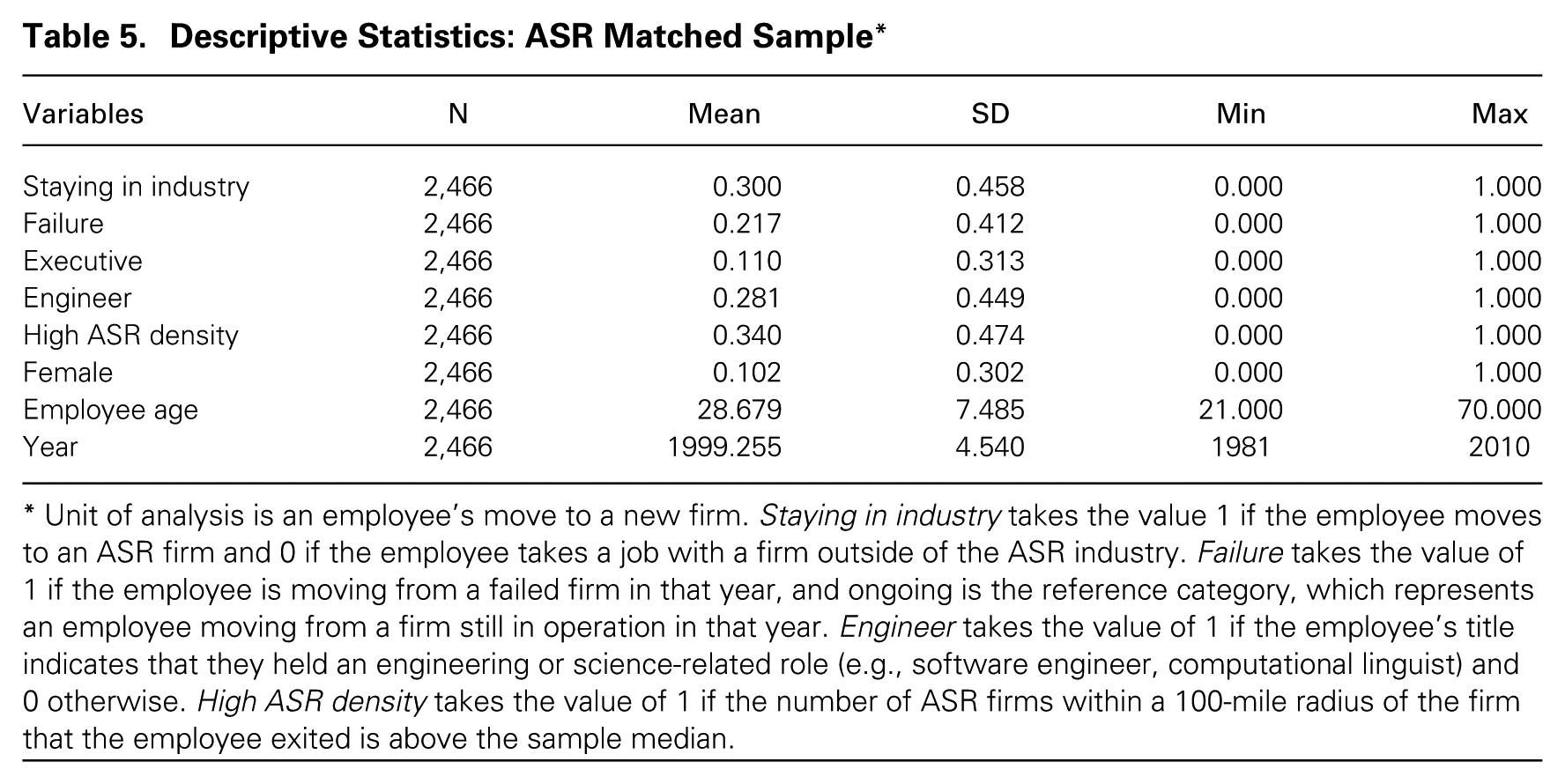
Unit of analysis is an employee’s move to a new firm. Staying in industry takes the value 1 if the employee moves to an ASR firm and 0 if the employee takes a job with a firm outside of the ASR industry. Failure takes the value of 1 if the employee is moving from a failed firm in that year, and ongoing is the reference category, which represents an employee moving from a firm still in operation in that year. Engineer takes the value of 1 if the employee’s title indicates that they held an engineering or science-related role (e.g., software engineer, computational linguist) and 0 otherwise. High ASR density takes the value of 1 if the number of ASR firms within a 100-mile radius of the firm that the employee exited is above the sample median.
Correlations: ASR Matched Sample*
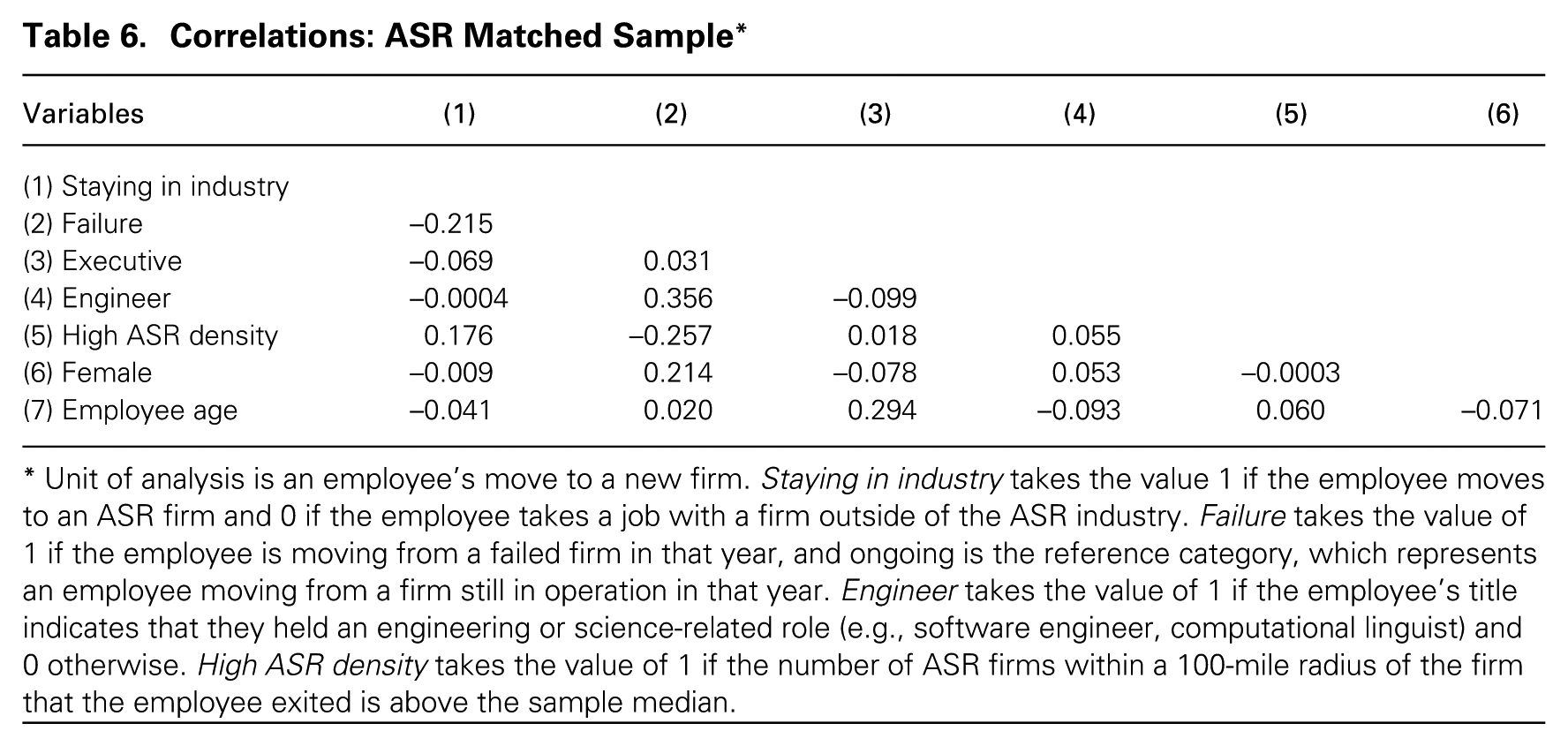
Unit of analysis is an employee’s move to a new firm. Staying in industry takes the value 1 if the employee moves to an ASR firm and 0 if the employee takes a job with a firm outside of the ASR industry. Failure takes the value of 1 if the employee is moving from a failed firm in that year, and ongoing is the reference category, which represents an employee moving from a firm still in operation in that year. Engineer takes the value of 1 if the employee’s title indicates that they held an engineering or science-related role (e.g., software engineer, computational linguist) and 0 otherwise. High ASR density takes the value of 1 if the number of ASR firms within a 100-mile radius of the firm that the employee exited is above the sample median.
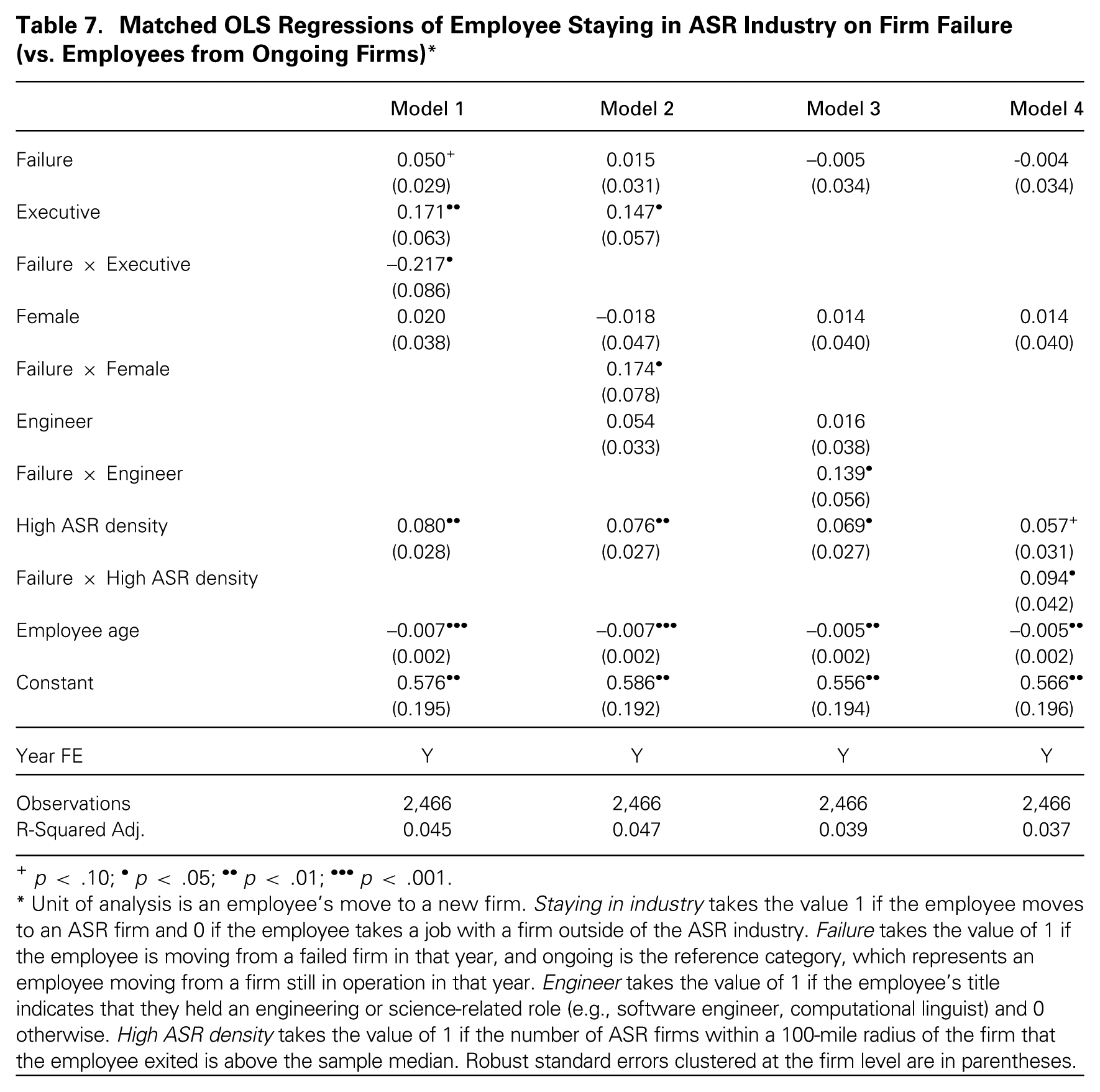
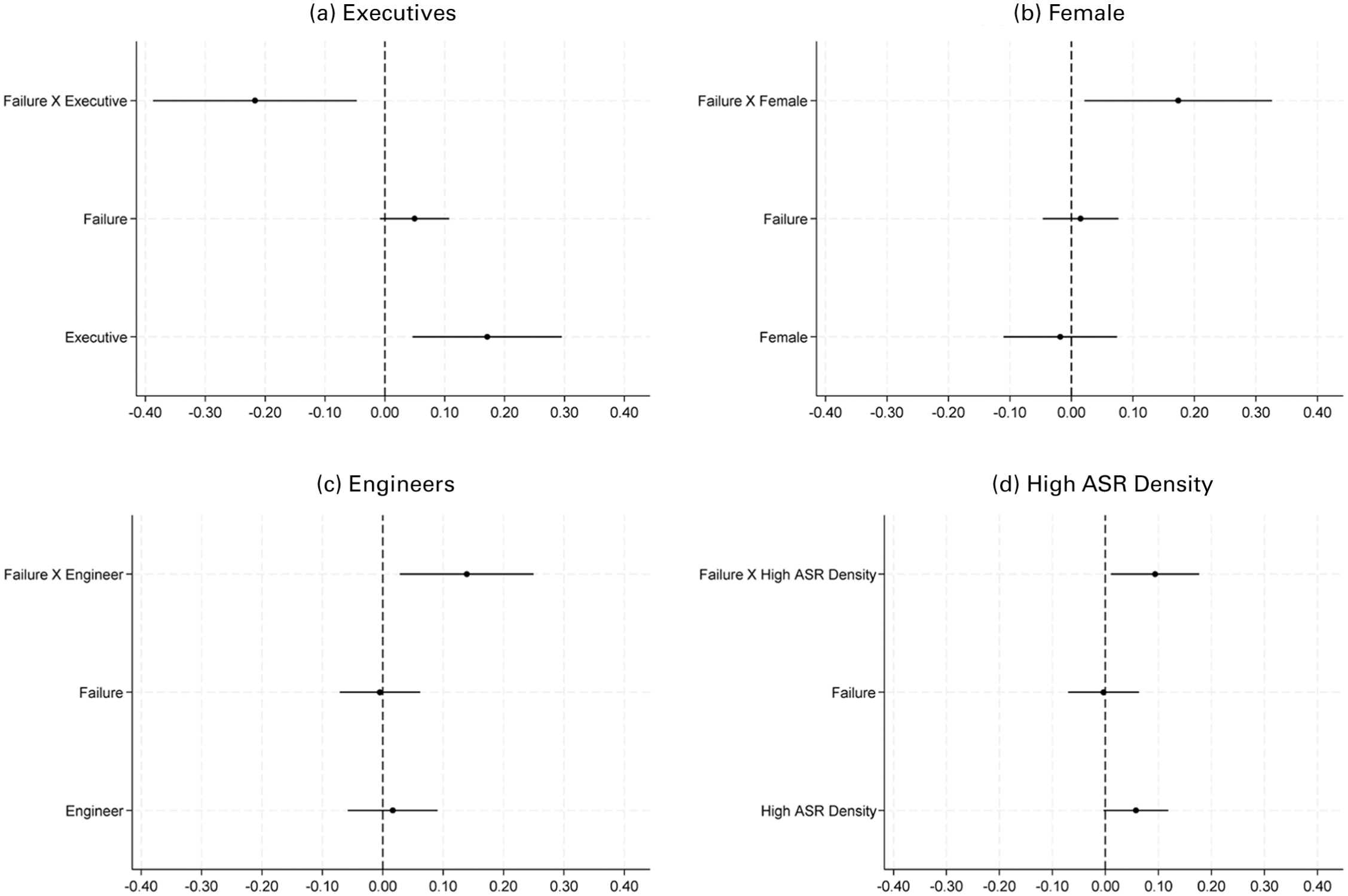
To test the relationship between employer failure and the likelihood of staying in the ASR industry (Staying in industry), we used our CEM sample in Table 7. All analyses condition on employees exiting either a failed or an ongoing firm. Model 1 includes an interaction between Failure and Executive (with the coefficient plot in Figure 3a), which tests differences between organizational leaders and the modal (non-executive) employee.
Matched OLS Regressions of Employee Staying in ASR Industry on Firm Failure (vs. Employees from Ongoing Firms)*
p < .10; • p < .05; •• p < .01; ••• p < .001.
Unit of analysis is an employee’s move to a new firm. Staying in industry takes the value 1 if the employee moves to an ASR firm and 0 if the employee takes a job with a firm outside of the ASR industry. Failure takes the value of 1 if the employee is moving from a failed firm in that year, and ongoing is the reference category, which represents an employee moving from a firm still in operation in that year. Engineer takes the value of 1 if the employee’s title indicates that they held an engineering or science-related role (e.g., software engineer, computational linguist) and 0 otherwise. High ASR density takes the value of 1 if the number of ASR firms within a 100-mile radius of the firm that the employee exited is above the sample median. Robust standard errors clustered at the firm level are in parentheses.
ASR Failure and Staying in the Industry*
The coefficient on Failure is positive and marginally significant (p = 0.09), suggesting that non-executive employees from a failed ASR firm are at least as likely, and maybe slightly more likely, to remain within the ASR industry, compared to similar employees from ongoing firms. This result implies that, for non-executive employees, association with a failed firm does not appear to produce evaluative stigma in terms of industry retention. If prospective employers were making negative internal attributions about non-executive employees affiliated with failed firms, we would expect these employees to be less likely to remain within the ASR industry.
The coefficient on Executive is positive, indicating that executives from ongoing firms are significantly more likely than non-executives to remain in the ASR industry after job transitions from ongoing firms—a finding that aligns with the general perspective that employees benefit from substantial industry-specific human capital (Becker, 1964). However, the negative and significant interaction between Failure and Executive reveals that executives from failed firms are less likely to remain in the industry, relative to executives from ongoing firms. These findings parallel those from our Census analyses. Prospective employers appear to make negative internal attributions, which produces evaluative stigma for executives. Non-executive employees do not seem to receive a similar internal attribution, suggesting that prospective employers evaluate non-executives from failed firms similarly to their counterparts from ongoing firms.
Unpacking the Lack of Evaluative Stigma After Firm Failure for Non-Executive Employees
Across both samples, we find consistent evidence that affiliation with a failed firm is negatively related to career outcomes but that this is limited to organizational leaders. Although our Census analysis approximated seniority through relative wages (top 5 percent, as well as sensitivity at the 1 percent and 10 percent level), the ASR dataset directly identified executives, helping confirm that leaders bear the brunt of evaluative stigma. Leveraging the unique strengths of each dataset, we now investigate distinct sources of heterogeneity, to inform further plausible mechanisms that may support this differential evaluative stigma: individual demographic characteristics, competitive conditions, and the type of employer failure.
Demographics
If a lack of internal attribution is a plausible mechanism explaining why non-executive employees avoid evaluative stigma in the subsequent labor market, then the likelihood that this occurs may be connected to other employee characteristics that are frequently linked to career outcomes: race/ethnicity, immigration status, and gender (Abraham et al., 2024; Berger, 1977; Correll & Ridgeway, 2003; Friedberg, 2000; Moss-Racusin et al., 2012).
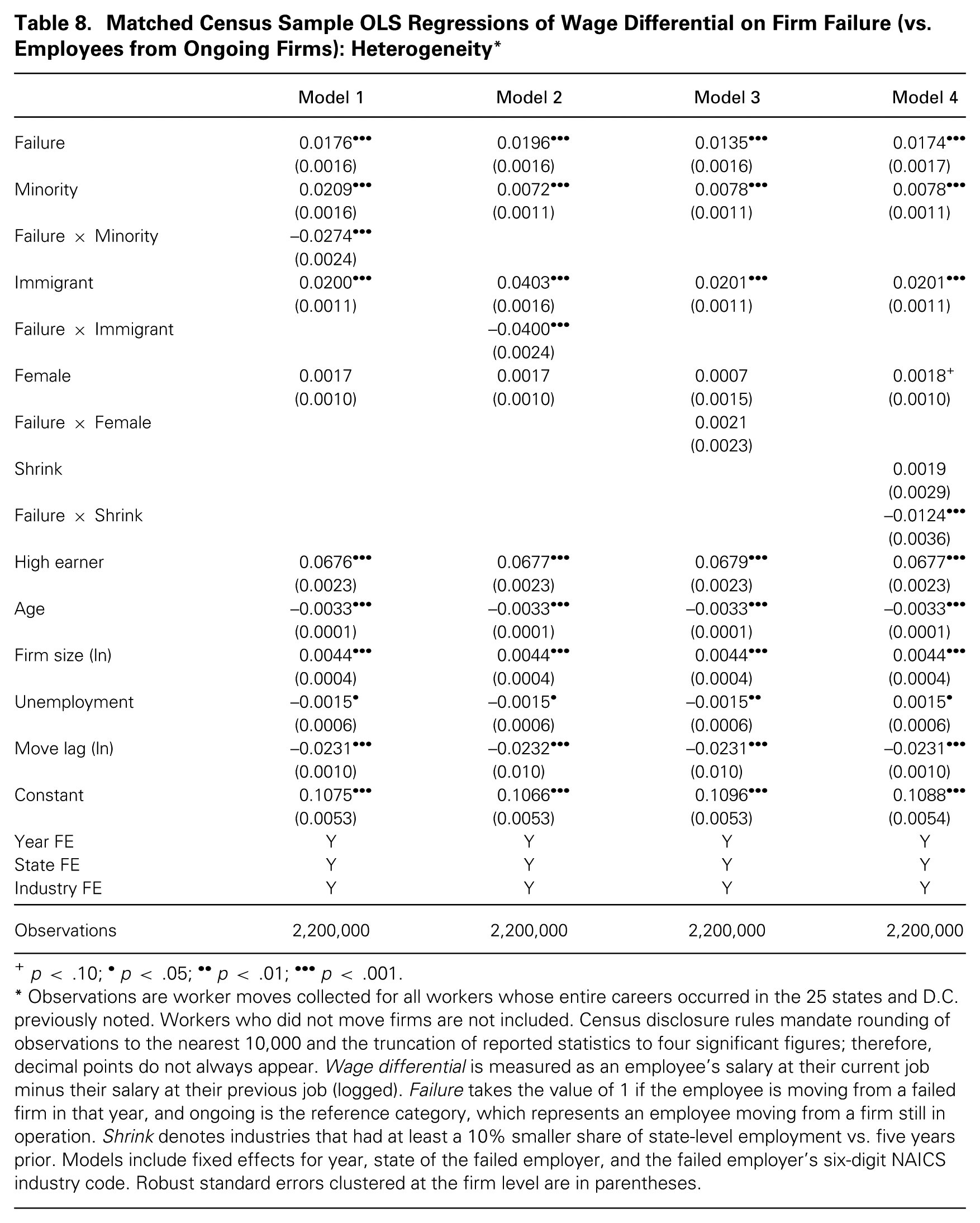
A benefit of the Census data is that gender, race/ethnicity, and immigration data are collected. In our main results (Table 3), we found that individuals from underrepresented groups experience larger wage growth than do individuals from majority groups. However, this does not mean that individuals from underrepresented groups earn higher absolute wages. Table 8 interacts Failure with Minority (Model 1), Immigrant (Model 2), and Female (Model 3), and Figures 4a, 4b, and 4c provide the coefficient plots, respectively.
Matched Census Sample OLS Regressions of Wage Differential on Firm Failure (vs. Employees from Ongoing Firms): Heterogeneity*
p < .10; • p < .05; •• p < .01; ••• p < .001.
Observations are worker moves collected for all workers whose entire careers occurred in the 25 states and D.C. previously noted. Workers who did not move firms are not included. Census disclosure rules mandate rounding of observations to the nearest 10,000 and the truncation of reported statistics to four significant figures; therefore, decimal points do not always appear. Wage differential is measured as an employee’s salary at their current job minus their salary at their previous job (logged). Failure takes the value of 1 if the employee is moving from a failed firm in that year, and ongoing is the reference category, which represents an employee moving from a firm still in operation. Shrink denotes industries that had at least a 10% smaller share of state-level employment vs. five years prior. Models include fixed effects for year, state of the failed employer, and the failed employer’s six-digit NAICS industry code. Robust standard errors clustered at the firm level are in parentheses.
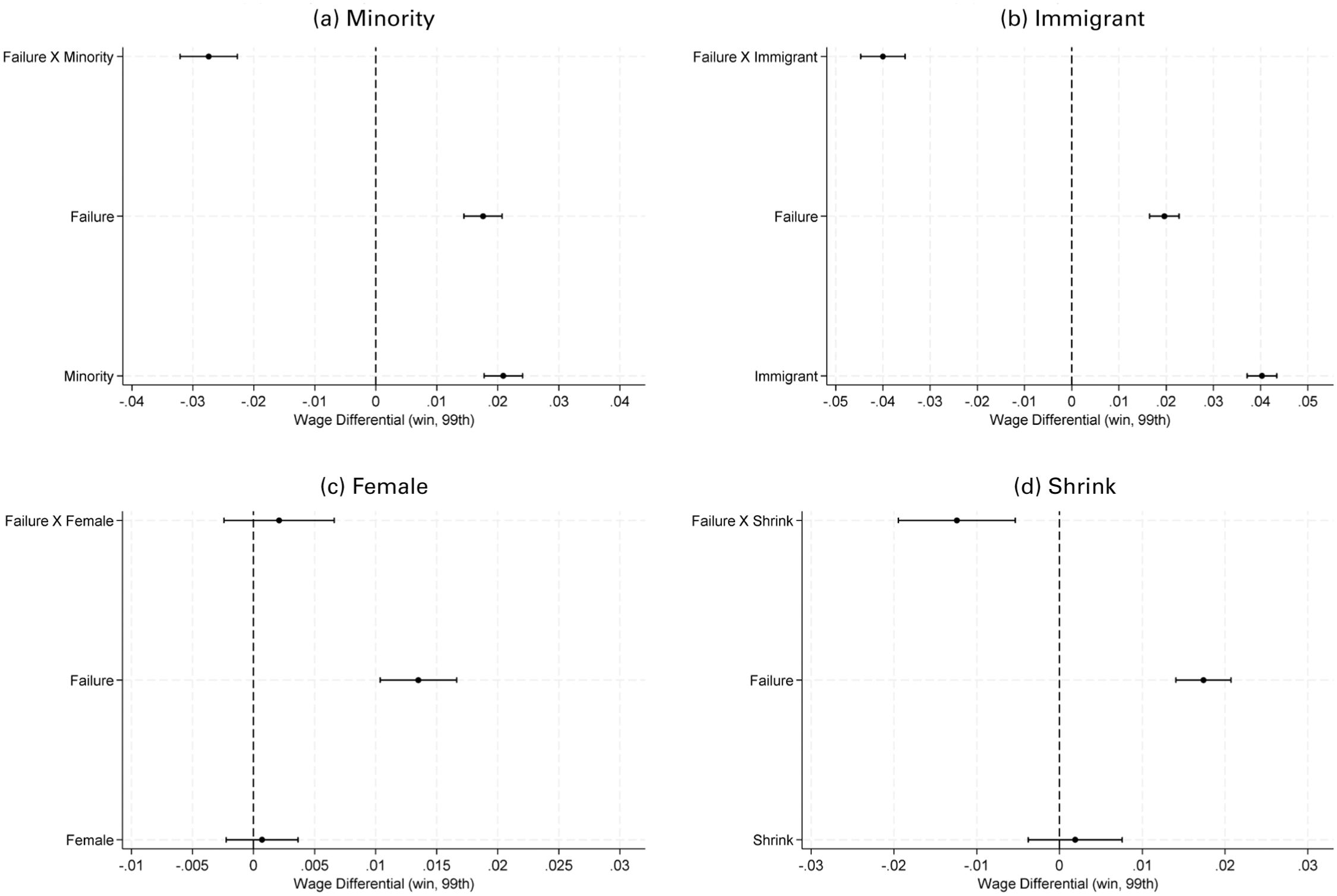
Interaction Effects for Census Wage Differentials*
We find that racial/ethnic minorities and immigrants from failed firms subsequently experience lower wage growth than do White or U.S.-born employees, respectively. For example, minority employees from failed firms experience less wage growth (about 1 percentage point) compared to minorities from ongoing firms, whereas White employees from failed firms experience more wage growth (about 2 percentage points) than do White employees from ongoing firms. As well, immigrant employees from failed firms experience less wage growth (2 percentage points) than do immigrants from ongoing firms. Related to status characteristics theory (Berger, 1977; Botelho et al., 2025; Correll & Ridgeway, 2003), which shows that gendered and racial stereotypes are more likely to emerge when uncertainty increases, this finding suggests that underrepresented employees may be more susceptible than White employees to evaluative stigma after employer failure. By contrast, we find no significant interaction between Failure and gender in the Census; this may be because we matched on gender, whereas we did not match on race/ethnicity or immigration, or because gender differences are often industry and role specific (Eagly & Karau, 2002).
In the ASR sample, we cannot measure immigration status or race/ethnicity, but we inferred gender from an employee’s given name, using GenderChecker.com, which we matched on for our analyses. From Table 7, Model 2 (with Figure 3b providing the coefficient plot), we find evidence that women from failed firms are more likely to stay in the ASR industry than are women from ongoing firms. Thus, across both samples, gender does not seem related to a higher likelihood of internal attributions for non-executive employees.
Human capital
We theorized that human capital, and in particular specialized human capital, is related to career outcomes. If prospective employers are unlikely to make internal attributions for non-executive employees from failed firms, employees with higher levels of human capital should be especially likely to avoid internal attributions.
A limitation of the Census data is the absence of a direct measure of specialized human capital. Although education is available, it is not only overly broad for assessing specialized skills but is also largely imputed. The ASR dataset offers a more precise measure, allowing us to identify employees with specialized human capital in an innovation-driven industry that is heavily dependent on engineering talent. Using detailed job titles, we coded employees who held engineering or related scientific roles. Table 7, Model 3 (Figure 3c provides the coefficient plot) interacts Failure and Engineer to test whether specialized human capital moderates the likelihood of staying in the ASR industry after firm failure. We previously found that non-executive employees from failed firms are generally unaffected by employer failure, and here we find that this is especially true for those with specialized human capital: Engineers from failed firms are significantly more likely than their counterparts from ongoing firms to remain in the ASR industry.
This result highlights another potential mechanism related to a lack of internal attribution, explaining why firm failure does not create an evaluative stigma for certain employees. Specifically, when employees leave an ongoing firm voluntarily, their availability to competitors is not widely known. By contrast, when a firm fails, competitors become immediately aware that valuable human capital is available. Consequently, engineers from failed firms, possessing highly sought-after skills, become particularly attractive targets for hiring. This targeted recruitment by competitors further reinforces the lack of internal attribution from prospective employers toward non-executive employees from failed firms.
Local employment conditions and opportunities
The local availability of skilled labor is one reason that firms accept the heightened competitive risks associated with co-locating near rivals (Krugman, 1991; Saxenian, 1996). Therefore, if prospective employers do not make internal attributions to non-executive employees following a competitor’s failure, we should expect proximity to competitors to increase displaced employees’ likelihood of more-favorable outcomes, namely remaining in the industry in which they have built specific human capital and social capital. We examined this possibility in both datasets, leveraging their complementary strengths: The Census provides broad industry coverage with limited geographic granularity (state level), while the ASR dataset offers detailed geographic resolution but within a single industry.
In Model 4 of Table 8, we examine whether industry-specific labor-market conditions moderate our Census findings. Specifically, we identified industries (defined at the one-digit NAICS level) whose share of overall state-level employment had declined 10 percent or more during the prior five years (Shrink). 14 The interaction of Shrink and Failure is negative (Figure 4d provides the coefficient plot), suggesting that the increase in post-failure wages may be ameliorated when jobs in that industry are less plentiful. This analysis suggests that differential evaluative stigma may be more likely when labor-market dynamics favor job candidates and that when labor-market dynamics tighten, favoring employers, employees from failed firms may be more likely to receive evaluative stigma.
The detail in the ASR data allows us to identify the exact geographic locations of employees and firms, using latitude and longitude coordinates, which are unavailable in the Census. Table 7, Model 4 examines how proximity to competitor firms (High ASR density) relates to staying within the ASR industry (with Figure 3d providing the coefficient plot). Consistent with agglomeration research, the marginally significant positive effect of High ASR density indicates that employees are generally more likely to remain in the ASR industry when employed within a geographic cluster. More notable, the significant interaction between Failure and High ASR density demonstrates that employees affiliated with failed firms located in such clusters are especially likely to remain in the industry. This result reinforces the general finding that prospective employers do not interpret affiliation with a failed firm as a negative signal regarding the quality of non-executive employees. Moreover, this evidence is also consistent with ongoing firms perceiving a competitor’s failure as an advantageous opportunity to hire available talent.
Forced into the labor market
Although the wage growth difference between the non-executive employee from a failed firm versus that from an ongoing firm is modest (1.7 percentage points), it is worth considering why employees from failed firms may experience a slight career benefit. (As we’ve demonstrated, even this slight benefit is heterogeneous based on certain employee characteristics and local labor-market conditions.)
A general explanation may be that employees usually experience a wage increase when they find a new job (Jäger et al., 2021; Mincer, 1986), and firm failure forces individuals into the labor market. Because prospective employers are unlikely to apply evaluative stigma to non-executive employees from a failed firm, firm failure forces this mobility event without concerns related to whether a job applicant is credibly looking for a job. In other words, employees from failed firms need another job, whereas employees from ongoing firms may be testing the market or trying to gain negotiation leverage over their current employer. Our theorizing and empirical approach thus far are similar to those of related organizational research: We are primarily interested in the demand-side evaluation of employees who came from failed firms. This demand-side focus is driven by the assumption that when individuals look for a new job, they are interested in at least maintaining their current wage.
To examine whether the forced mobility of failure is related to a wage increase, it is helpful to consider the counterfactual of employees staying at their firm, that is, employees from failed firms who may have likely stayed at that firm had it not failed. Of course, many outcomes are not possible with a “stayer” counterfactual, such as whether an employee leaves the industry. However, an advantage of Census data is that we can compare wage differentials between leavers and those who stay. Specifically, we matched employees from failed firms to employees who stayed at ongoing firms, using the same matching strategy described above, and we analyzed the relationship between Wage differential and Failure.
Although we cannot directly report the details from these results due to Census disclosure avoidance regulations, we are authorized to describe the results from an analysis that used the same specification as that in Table 3, Model 1 but with a matched counterfactual of those who stayed. Based on Census review of the analysis, we are authorized to make the following statement: “Among all workers whose entire careers occurred in the 25 states and D.C. available to us, we find that the estimated coefficient on Failure is both positive and statistically significant.”
The Limits of Avoiding an Evaluative Stigma: Failure Type
We theorized that evaluative stigma in the context of firm failure would be generated by evaluators, believing that an employee’s association with a failed firm is a credible proxy of their quality, skills, and competence (internal attribution) and not unrelated to these characteristics. We further theorized that if prospective employers apply evaluative stigma selectively across employees, then affiliations with certain failures are likely to stigmatize all associated employees. Specifically, researchers have discussed that evaluative stigma may be especially strong when the reasons for failure move beyond “honest incompetence” (Hendry, 2002, p. 98) and include more-nefarious events, such as scandal, which may call all associated employees’ trustworthiness and integrity into question (Wiesenfeld et al., 2008).
The anonymized nature of the Census data does not allow us to identify the causes of firm failure, particularly whether the failure involved a scandal. However, in the ASR data we were able to review the set of failures and identify two firms whose failures were associated with a widely publicized scandal: Kurzweil Applied Intelligence (1994; KAI) and Lernout & Hauspie (2000; LH). Online Appendix B (ASR Scandals) provides more background on these scandals. Like many other ASR firms, both KAI and LH had claimed a high level of accuracy for their speech recognition software yet struggled to deliver on those claims, resulting in disappointing sales. Unlike other ASR firms, LH and KAI fabricated sales to conceal their poor performance. In both cases, executives served jail time. Moreover, these failures were highly publicized.
Given that the nature of this failure was different from the routine failures in the rest of our sample, we removed from our main sample employees who worked at these two firms at the time of their failure. For these analyses, we matched (again using CEM) employees who worked at LH or KAI to employees from firms that failed for reasons not involving a scandal. (Employees of ongoing firms are not included in this analysis.) Our matching criteria are the same as those in the main sample, but we did not match on geography. Online Appendix Table BA3 provides the descriptive statistics for this sample.
Table 9 presents the results from this analysis, and Figure 5 provides the coefficient plots from these regressions (Figure 5a is from Model 2, and 5b is from Model 3). In Model 1, employees from scandal-affiliated failures are significantly more likely than their counterparts from routine failures to leave the ASR industry. Model 2 demonstrates that this adverse outcome is consistent regardless of employee seniority, meaning that both executives and non-executives experience evaluative stigma after scandal-driven firm failure. In Model 3, the main effect of Engineer again shows that employees with specialized human capital from failed firms are the most likely to stay in the ASR industry. However, the interaction between Engineer and Scandal suggests that this increased likelihood is absent when engineers come from a failed firm with an associated scandal.
Matched OLS Regressions of Employee Staying in ASR Industry on Scandal (vs. Employees from Firm Failure without Scandal)*
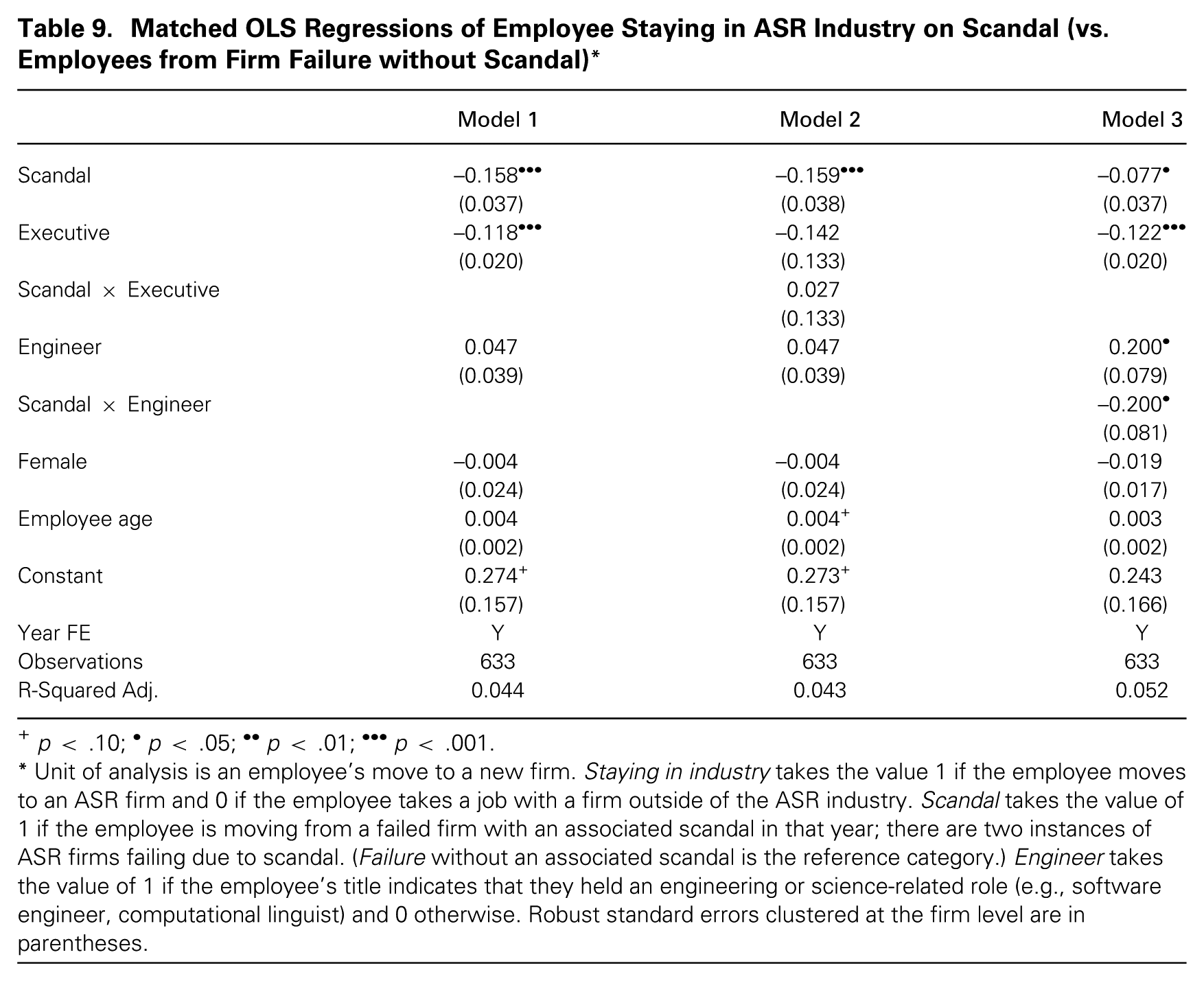
p < .10; • p < .05; •• p < .01; ••• p < .001.
Unit of analysis is an employee’s move to a new firm. Staying in industry takes the value 1 if the employee moves to an ASR firm and 0 if the employee takes a job with a firm outside of the ASR industry. Scandal takes the value of 1 if the employee is moving from a failed firm with an associated scandal in that year; there are two instances of ASR firms failing due to scandal. (Failure without an associated scandal is the reference category.) Engineer takes the value of 1 if the employee’s title indicates that they held an engineering or science-related role (e.g., software engineer, computational linguist) and 0 otherwise. Robust standard errors clustered at the firm level are in parentheses.
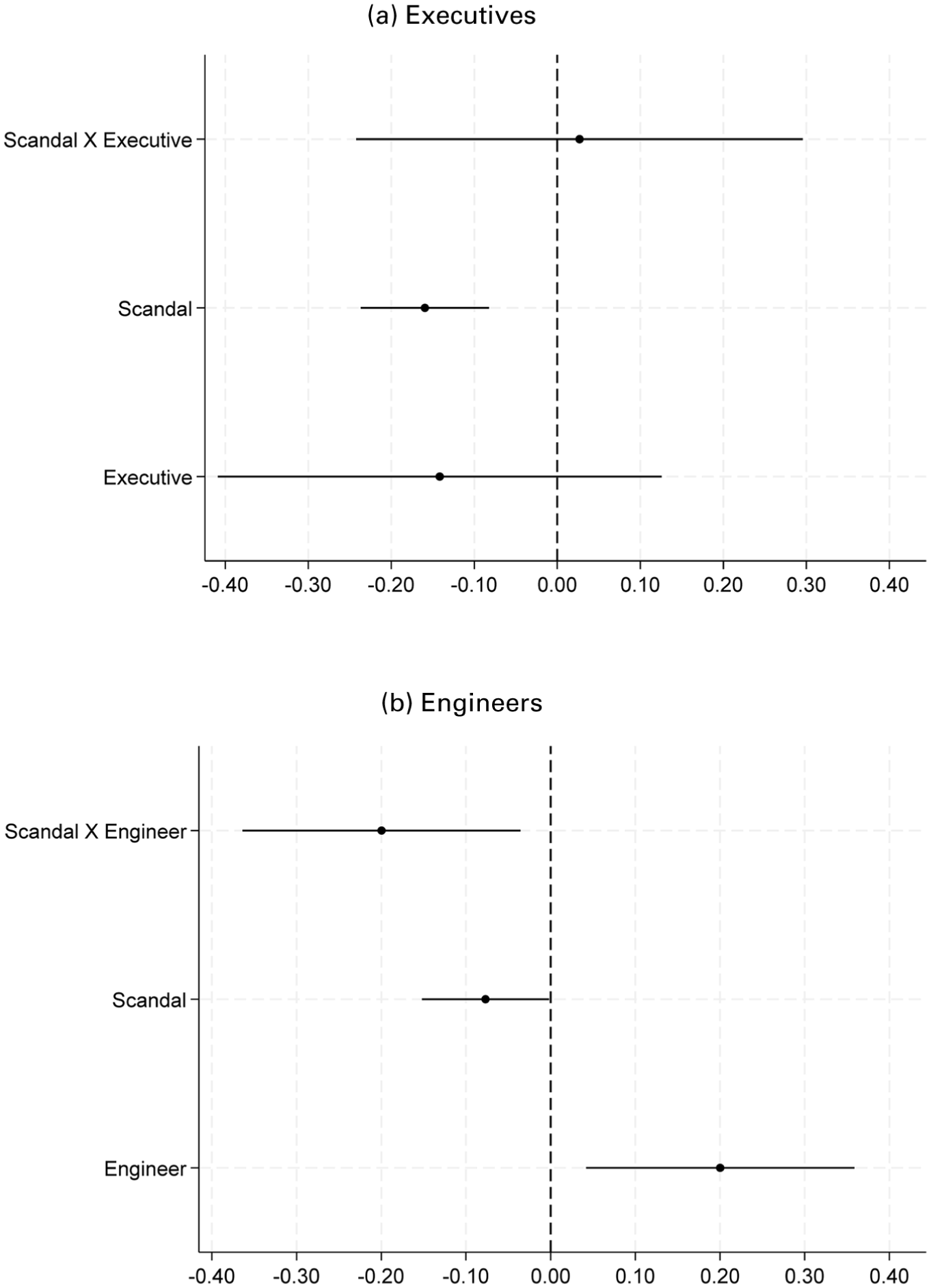
ASR Scandal and Staying in the Industry*
These analyses reinforce our theoretical expectation that scandals constitute a critical boundary condition: When failure signals compromised integrity or ethics, the evaluative stigma extends beyond organizational leaders, negatively impacting non-executive employees.
Discussion
We developed a theoretical framework specifying when evaluative stigma occurs after employer failure and whether expectations for organizational leaders differ from those for non-executive employees. The theoretical framework predicted that evaluative stigma may differ by hierarchical position: internal attribution and stigma for leaders and insulation for other employees. We extended our framework by considering heterogeneity in three domains: failure type (routine vs. scandal), which affects whether stigma generalizes across the hierarchy; labor-market conditions (industry contraction and geographic concentration), which shape post-failure opportunities; and individual characteristics, namely specialized human capital and demographics, which are commonly associated with evaluative bias.
Using complementary datasets from the U.S. Census and the ASR industry, we found empirical support that evaluative stigma is based on employees’ hierarchical position. Organizational leaders consistently experienced adverse career outcomes following employer failure, whereas non-executive employees did not. In the Census data, leaders from failed firms experienced substantially lower subsequent wage growth compared to matched peers from ongoing firms, whereas non-executive employees from failed firms had marginally higher wage growth (1.7 percentage points) compared to similar peers from ongoing firms. The ASR data reinforced this pattern: Executives from failed firms were significantly less likely to remain in the industry, while non-executive employees had outcomes comparable to their counterparts from ongoing firms.
Our results help to delineate the conditions under which evaluative stigma broadly applies. Specifically, the ASR data revealed that when firm failure involves highly suspect circumstances, such as scandals, evaluative stigma extends beyond leaders to negatively affect all employees. Employees from scandal-associated failures were uniformly less likely to remain in the ASR industry compared to peers from routine failures, providing strong evidence of evaluative stigma. Our analyses further highlight heterogeneity in how employer failure is related to subsequent career outcomes. Employees with specialized human capital experienced more-favorable outcomes after firm failure. The local availability of employment opportunities also proved important: In the ASR data, employees located in industry clusters were more likely to remain in the industry after failure, and the Census results demonstrated that wage benefits from firm failure diminished considerably when employment opportunities within an industry shrank significantly. Thus, displaced employees’ outcomes were more beneficial when employment alternatives were more abundant. Demographic factors also moderated the relationship between employer failure and career outcomes: Although we found no gender-based differences, racial minorities and immigrants in the Census sample experienced smaller wage gains after employer failure than did White, native-born peers.
Contributions
Our article expands organizational research on employer failure and employee careers. By considering all employees, not only those in the upper echelons of organizations, we were able to integrate insights across relevant research on careers, evaluations, stigma, and attribution to provide a more comprehensive theoretical framework for understanding whether and how affiliation with a failed firm relates to subsequent career outcomes. Prior research focused on leaders has made it difficult to disentangle whether observed career outcomes, and thus underlying mechanisms, stem from an employee’s hierarchical position, the nature of the failure event, or a combination of these factors. Furthermore, reliance on small-sample case studies may obscure the role of broader contextual factors, including economic downturns, industry trends, shifting competitive landscapes, or individual characteristics. By expanding our theoretical lens to include non-executive employees from numerous organizations, we establish a more robust framework to better understand the implications of employer failure for employee careers.
Our approach highlights conditional internal attribution as a key driver of evaluative stigma following employer failure. Prior research implicitly assumes that evaluators predominantly make internal attributions, viewing firm outcomes as directly reflecting organizational leaders’ competence and part of their responsibility (Boeker, 1992; Park et al., 2021; Park & Westphal, 2013; Salancik & Meindl, 1984). Although organizational leaders’ career outcomes are consistently linked to firm performance, whether these internal attributions extend downward to non-executive employees remained a theoretical puzzle.
Our perspective also contributes to broader organizational research on careers, particularly regarding the signaling value of employer affiliations. Prior research has highlighted that affiliation with reputable employers serves as a positive signal, thereby enhancing employees’ and prospective employers’ perceptions of candidate quality (Bidwell et al., 2014; Graffin et al., 2008; Phillips, 2002). Adding to prior research on potential negative aspects of having certain employer affiliations, our theoretical framework reveals conditions under which an affiliation with a failed firm may generate negative signals in the labor market: Prospective employers’ interpretations vary systematically, influencing career outcomes differently for organizational leaders compared to non-executive employees. Future research can explore potential heterogeneity in positive signaling contexts, examining whether benefits derived from affiliations with reputable or high-status firms similarly vary according to employee characteristics, such as department, demographics, or role.
We also contribute to research on employee mobility and external job searching. Prior studies have shown that individuals exhibit considerable inertia, preferring to stay with their current employers (Meyer & Herscovitch, 2001; Mitchell & Dacin, 1996; Mitchell et al., 2001; Mobley, 1977; Sørensen, 2000) and not frequently engaging in active job searches (Kochhar et al., 2022). As a result, many employees underestimate their external market value and potential wage gains (Jäger et al., 2021). By showing that non-executive employees displaced by employer failure experience wage growth comparable to—and even marginally exceeding—matched peers from ongoing firms, we provide connections across this broader literature. Our results suggest that employer failure involuntarily disrupts employee inertia, compelling affected workers to explore external employment opportunities and enabling them to realize wage gains similar to unaffected job seekers. Moreover, we find no evidence that employer failure leads to prolonged or permanent unemployment. Despite these potential benefits, we highlight that it is unlikely that employees would hope for such events, given the general preference for employee stability.
For research on evaluative stigma, we clarify the boundary conditions of internal attribution and, thus, stigma across the organizational hierarchy after employer failure. Although non-executive employees who experience a routine firm failure generally go on to attain career outcomes comparable to those of peers from ongoing firms, we find that this is not the case when their employer’s failure involves a scandal. These findings directly contribute to organizational research on stigma, evaluations, and scandal, which emphasizes how severe, negative events can erode evaluators’ distinctions about individual responsibility and extend stigma categorically across individuals (e.g., Dimmock et al., 2018; Jonsson et al., 2009; Paruchuri & Misangyi, 2015; Pierce & Snyder, 2008; Pontikes et al., 2010; Yenkey, 2018). Our findings highlight that affiliation alone may be insufficient to trigger courtesy stigma; rather, the nature and public perception of the failure event significantly influence whether categorical stigmatization occurs. This insight helps to further explain why some associations or actions become stigmatizing, while others do not (Adut, 2005; Aven, 2015).
Our consideration of employee-level and labor-market-level heterogeneity enriches our theoretical framework and provides further detail. Regarding the individual employee, we found in the Census data that racial minorities and immigrants experience less wage growth following employer failure, compared to U.S.-born, non-minority employees. Interestingly, we did not find evidence of gender-based disadvantages in either dataset. Extensive prior research has demonstrated that demographic factors often shape evaluative biases and career outcomes (Abraham et al., 2024; Berger, 1977; Botelho & Abraham, 2017; Correll & Ridgeway, 2003; Moss-Racusin et al., 2012), and our results extend this literature by suggesting that the likelihood of internal attribution after employer failure may differ based on employee demographics, disadvantaging certain groups.
Additionally, the ASR data allowed us to examine heterogeneity in specialized human capital. We found consistent evidence that employees with specialized skills are most likely to remain employed in their industry after firm failure, underscoring that a lack of internal attribution in the wake of employer failure may particularly benefit employees with highly sought-after skill sets (Gibbons & Waldman, 2004; Jara-Figueroa et al., 2018; Lazear, 2004; Phillips, 2002). Thus, employer failure can paradoxically create opportunities, especially for employees who are highly valued by competing firms.
Regarding labor-market factors, we considered industry dynamics and geographic proximity of competitor firms as conditions that may moderate career outcomes following employer failure. In the Census data, we demonstrated that wage growth for displaced employees is notably attenuated when employer failure occurs within a shrinking industry. This finding further supports our broader theoretical argument regarding internal attribution and evaluative stigma: Under tight labor-market conditions, prospective employers may be more likely to rely on an affiliation with a failed firm as a signal of employee quality, weakening the protective buffer that non-executive employees experience. Moreover, our detailed location data from the ASR industry show that displaced employees are more likely to remain within their industry when their employer fails in geographic areas with a high concentration of proximate ASR firms. This finding suggests that employer failure can present strategic hiring opportunities for nearby firms seeking to recruit valuable human capital (Saxenian, 1990). Taken together, these results highlight how labor-market dynamics shape the career implications of employer failure, offering insights for strategic human capital management.
Finally, we provide an empirical contribution to organizational research by replicating and generalizing findings previously established through narrowly focused case studies. In developing our broader theoretical framework, we first confirmed the negative relationship between employer failure and subsequent career outcomes for organizational leaders. Using millions of employees from thousands of firms across multiple industries and spanning a quarter century, we robustly replicated these prior case-study findings, strengthening their external validity. Additionally, our use of matched organizational leaders from ongoing firms as a comparison set helps to isolate the specific impact of employer failure. Although replication is widely recognized as critical to scientific inquiry, it remains relatively uncommon in organizational research. Further, by focusing on wages, we used a more generalizable and broadly comparable outcome than has typically been used in prior studies, allowing us to track individuals who change employers across industries, whereas other outcome variables such as titles or prestige may not be directly comparable.
Alternative Explanations, Limitations, and Future Directions
Although we provide consistent evidence for our main results, we consider alternative explanations. First, our results might reflect unobserved differences between firms that fail and those that continue operating. To address this possibility, we conducted a placebo analysis comparing employees who left firms in the year before failure with employees who remained until the firm failed. The absence of similar effects in this placebo group strengthens our confidence that observed outcomes are related to experiencing the firm’s failure rather than to pre-existing differences. Second, one might argue that employees of failed firms would have remained at their jobs had their firms not failed, implying a different counterfactual scenario. While our primary theoretical interest was to understand demand-side evaluations by prospective employers, we conducted additional analyses comparing employees from failed firms with matched employees who remained at ongoing firms. This complementary supply-side perspective yielded results consistent with our primary findings, reinforcing our main conclusions. Third, one might argue that the observed wage growth among employees from failed firms could be driven by these firms cutting wages immediately prior to their failure, artificially inflating the observed subsequent wage growth. We did not observe that this systematically occurred.
The results from our additional analyses provide greater confidence in the relationships we identified, but additional mechanisms not considered here could also play a role in our findings. One possibility is that employees from failed firms actively engage in impression management strategies to counteract or pre-empt potential evaluative stigma, thereby improving their subsequent career outcomes relative to those of other job seekers. Understanding employees’ responses to potential stigma following employer failure represents a significant opportunity for future research. Additionally, third parties, such as recruiters, former colleagues, or industry contacts, might intervene in ways that influence affected employees’ career outcomes. These interventions could be beneficial, such as by providing referrals and facilitating job opportunities, but they might also have unintended consequences, such as inadvertently publicizing an individual’s affiliation with a potentially stigmatized firm.
We triangulated our findings by using two complementary datasets, but our ability to draw causal inferences is limited for a few reasons. First, although the Census data provide detailed, quarter-by-quarter career histories, they do not specify the exact reasons that employees leave ongoing firms. For employees from failed firms, separations are clearly involuntary, but for the matched set of employees from ongoing firms, we cannot determine whether separations are voluntary or involuntary. However, our robustness analysis, matching employees from failed firms with similar employees who remained at ongoing firms, helps to alleviate this concern. Second, our data do not capture critical stages in the hiring process, such as job postings, interviews, or detailed recruitment interactions. Such data could enhance our understanding of how employers respond strategically to employees from failed firms, a dynamic suggested by our industry-shrinking analysis in the Census and local-competition analysis in the ASR industry. Furthermore, detailed recruitment data might also illuminate why certain demographic groups, notably racial minorities and immigrants, experience comparatively worse outcomes after employer failure.
We view our study as an initial step toward systematically investigating a key career phenomenon that has largely eluded organizational researchers, in part due to lack of detailed, generalizable data. This gap in data availability has constrained theoretical development regarding the broad impact of employer failure on employee careers. Our findings suggest several fruitful avenues for future research.
Our results indicate that, on average, the non-executive employee is not subject to internal attributions following employer failure. This pattern is consistent with hiring firms using external attribution when assessing these candidates, given the salience of employer signals in the labor market. That said, distinguishing external attribution from non-attribution would require direct evidence of evaluators’ beliefs, which we do not have. Future research should examine hiring managers’ and recruiters’ assessments along with their beliefs, to disentangle the two.
Another promising direction involves examining more precisely how the underlying causes of firm failure influence subsequent employee outcomes. Although firm failure is quite common, research lags regarding the role of such failure in careers (Botelho & Chang, 2022; Botelho et al., 2024). Identifying clear causes of firm failure is challenging: The anonymity of Census data precludes analysis based on named firms, and even within the ASR sample, in which firms were identified, exact reasons for failure remained elusive in most cases. Typically, publicly available accounts of firm failure lack detail given the absence of mandated reporting on the causes of failure. Future researchers who can collect contemporaneous data on why firms fail, such as through interviews or proprietary reports, would greatly advance our understanding. Additionally, our results highlight the importance of exploring how other employee-level and labor-market-level characteristics interact with employer failure. We provided initial evidence that certain individual characteristics and labor-market factors moderate observed outcomes. Future research could more thoroughly theorize and empirically investigate these factors, given our findings.
Practical Implications
Our study offers practical insights for employees, though caution is warranted against overgeneralizing from these findings. On the one hand, non-executive employees may find reassurance that joining firms with uncertain prospects need not necessarily harm their long-term career trajectories given that firm failure does not typically translate into negative evaluations for them via lower wage growth or likelihood of staying in the industry. However, this assurance does not extend equally to all employees. Individuals accepting leadership positions at high-risk or struggling firms should carefully evaluate the firm’s performance and outlook given the strong potential for evaluative stigma to negatively shape their subsequent career outcomes. Additionally, non-executive employees from certain backgrounds or who lack certain skills may experience worse career outcomes after employer failure, highlighting the need for increased vigilance. And because post-failure career benefits tend to accrue most in densely concentrated labor markets, employees considering roles in geographically isolated firms or declining industries should recognize the heightened risks associated with fewer local employment alternatives.
Overall, our results should alleviate concerns among non-executive employees about potential negative career implications of employer failure. Nevertheless, the presence of significant evaluative stigma following firm failures involving scandals underscores the necessity of careful due diligence. Prospective employees, particularly those joining new or lesser-known organizations, should evaluate not only business plans and industry risks but also the character and integrity of organizational leaders, to mitigate the risks of becoming affiliated with scandal-related failures.
Supplemental Material
sj-pdf-1-asq-10.1177_00018392251396949 – Supplemental material for Beyond Blame: Evaluative Stigma, Attribution, and Employee Careers after Employer Failure*
Supplemental material, sj-pdf-1-asq-10.1177_00018392251396949 for Beyond Blame: Evaluative Stigma, Attribution, and Employee Careers after Employer Failure* by Tristan L. Botelho and Matt Marx in Administrative Science Quarterly
Footnotes
Acknowledgements
We thank Justin Choi, Mehmet Hecan, Gabriel Rojas, Steve Rothman, and Bochao Sun for assistance in compiling lists of employees in the ASR industry. We would also like to thank seminar participants at the University of Maryland, University of Michigan, and Wharton People and Organizations Conference, as well as Mabel Abraham, Jim Baron, Julia DiBenigno, and Ben Polak for helpful feedback. Any views expressed are those of the authors and not those of the U.S. Census Bureau.
The Census Bureau’s Disclosure Review Board and Disclosure Avoidance Officers have reviewed this information product for unauthorized disclosure of confidential information and have approved the disclosure avoidance practices applied to this release. This research was performed at a Federal Statistical Research Data Center under FSRDC Project Number 1182. (CBDRB-FY21-P1182-R9045).
Funding
This research uses data from the Census Bureau’s Longitudinal Employer Household Dynamics Program, which was partially supported by the following National Science Foundation Grants: SES-9978093, SES-0339191 and ITR 0427889; National Institute on Aging Grant AG018854; and grants from the Alfred P. Sloan Foundation.
1
2
Conceptually, external attribution is distinct from a lack of internal attribution. Absent direct evidence of evaluators’ beliefs, however, the two are difficult to separate empirically and, in our setting, yield the same prediction: no evaluative stigma for non-executive employees. Because one’s prior employer is a salient labor market signal, we treat the absence of internal attribution as consistent with external attribution, while acknowledging that we cannot definitively rule out true non-attribution.
3
LEHD states in this project that were made available to us were Colorado, Illinois, Indiana, Louisiana, Maryland, Missouri, and Washington since 1990, California, Pennsylvania, and Oregon since 1991, Georgia since 1994, New Mexico, Rhode Island, and Texas since 1995, Hawaii and Maine since 1996, Delaware, Iowa, Nevada, South Carolina, and Tennessee since 1998, Utah since 1999, Oklahoma and Vermont since 2000, Washington, D.C. since 2002, and Arkansas since 2003.
4
This is possible to detect because the LEHD contains a file that notes whether every worker is employed somewhere in the U.S. during each year; therefore, if the worker is employed somewhere in the U.S. but not in any of the states we have access to, we concluded that the worker is not fully observable in our set of state–years and was therefore dropped from our analysis.
5
Census disclosure-avoidance policies do not permit us to reveal the 99th percentile wage.
6
7
The Census also provides coarse education categories for the highest level of education achieved: college graduate, some college, high school graduate, or some high school; however, this value is primarily imputed from the American Community Survey, which is based on a random sample. College takes the value of 1 if the employee has graduated from college and 0 if they have not. Because this value is heavily imputed, we did not use education in our primary models, but our results are robust to its inclusion.
8
As required by Census disclosure-avoidance policy, all statistics, including this count, were rounded to four significant digits.
9
Note that we did not match on every available employee and firm characteristic, such as Immigrant and Minority, and because education is mostly imputed it is not a desirable matching criterion. This is for theoretical and practical reasons: In theory, it is not advisable to match on too many variables as it may result in an unrepresentative sample (Blackwell et al., 2009; Iacus et al., 2012). In practice, the enormous size of the LEHD data for 26 states exhausted available memory capacity on Census computers when adding additional variables.
10
In Online Appendix A (US Census: Staying in Industry), we used a similar outcome variable using the Census data that captures whether an employee stays in the same six-digit NAICS industry when they switch employers. Table AA1 shows that our main ASR results are consistent in the Census, providing a connection between the two datasets. Furthermore,  demonstrates that staying in industry is associated with higher wage growth in the short term (Models 1, 3, 4) and in the long term (Model 2), providing a link between the wage differential outcome in the Census data and the staying-in-the-industry outcome in the ASR data.
11
Census disclosure-avoidance policies prevent us from revealing minimum or maximum values.
12
To be exact, if the firm failed in Q2 of 2005, this placebo defines Failed as employees who left the firm in Q1 2005, Q4 2004, Q3 2004, or Q2 2004.
13
Wages for the failure year were adjusted based on available quarterly data. Specifically, if a firm failed in the second quarter, we doubled the observed wage data to approximate a full year’s wages. Note, this may still underestimate wages if failure occurred early in a quarter. Average firm wages were calculated from all employees whose careers remain fully within the 26 states covered by our data, not only the CEM subset.
14
For observations from year–states in which we do not have data five years prior, this was replaced with the prior four, three, two, or one year. For the first year in which a state was observed, this variable was set to 0.
Authors’ Biographies
References
Supplementary Material
Please find the following supplemental material available below.
For Open Access articles published under a Creative Commons License, all supplemental material carries the same license as the article it is associated with.
For non-Open Access articles published, all supplemental material carries a non-exclusive license, and permission requests for re-use of supplemental material or any part of supplemental material shall be sent directly to the copyright owner as specified in the copyright notice associated with the article.
