



Abstract
Disability is typically perceived negatively, and employees with a disability are viewed as a burden that requires accommodation. We draw from creativity theory to challenge this view and propose that disability can make workplace imperfections salient, can function as a situational cue that increases coworkers’ cognitive flexibility, and thus can be a catalyst for creativity. We apply a multi-study, multi-method approach to test these predictions. First, results from time-lagged and objective data in a sample of 7,037 employees from 425 units of a large German car manufacturer show that units with people with disabilities generate more ideas, particularly when employees engage in perspective taking. Second, an experiment with 954 employees shows that having a colleague with a disability has a positive individual-level effect on idea generation. Third, we extend these findings with a full model test in a second experiment of 1,314 employees, which shows that having a colleague with a disability (compared to not having a colleague with a disability) leads to more idea generation and higher idea novelty. Increased cognitive flexibility mediates these effects. Together, our findings contribute to the disability, diversity, and creativity literatures by integrating disability and creativity theory and showing that disability has the potential to serve as a catalyst for creativity and, ultimately, innovation.
Keywords
We live in a world in which the so-called able-bodied person is the norm (Campbell, 2009; Jammaers et al., 2016) and workplaces are designed for this ideal worker (Doussard et al., 2024; van Laer et al., 2022). Yet, the World Health Organization (WHO) estimates the number of persons with disabilities, defined “not only by the underlying health condition or impairment of a person, but also by the fundamental effect of their environment,” to be 1.3 billion worldwide, or one in every six people (WHO, 2022, p. 3). The WHO also predicts that these numbers will continue to increase due to demographic (population increase and longer life expectancies) and epidemiological changes (rise in noncommunicable diseases). Already today, a 20-year-old U.S. worker has more than a 25 percent probability of acquiring a disabling condition before reaching retirement age (U.S. Social Security Administration, 2022). Thus, disability, which is typically conceptualized as a type of demographic diversity (Boehm & Dwertmann, 2015; Dirth & Branscombe, 2018; Nkomo et al., 2019), is clearly an important phenomenon for organizations and management research (Beatty et al., 2019; Dwertmann, 2016) but has not received attention commensurate with its importance.
Workplace design for the ideal able-bodied worker can create problems. People with disabilities are systematically underemployed, which has negative effects on individuals, organizations, and society. A United States Department of Labor report (Domzal et al., 2008, p. 13) showed that the main challenges that organizations cite related to hiring people with disabilities are the “nature of the work” (and its assumed incompatibility with disability-related impairments) and concurrent concerns related to accommodations (“not knowing how much accommodation will cost” and “actual cost of accommodating disability” ranked second and fourth out of 12 concerns). Accommodations for individual employees, defined as “modifications in the job, work environment, work process, or conditions of work that reduce physical and social barriers” (Colella & Bruyère, 2011, p. 478), are the legal organizational response when employing persons with disabilities. It is thus logical that accommodations have been a key topic in disability research (Baldridge & Swift, 2016; Colella, 2001; Schur et al., 2014). Existing research typically construes accommodations as a problematic and costly burden for organizations and as a tool to try to elevate the performance of a person with a disability to that of a person without a disability (Dwertmann & McAlpine, 2023). Accommodations are studied as a process of accommodating a single person with a disability (Schur et al., 2014) in which the individual, the supervisor, and potentially a human resources representative are involved (Baumgärtner et al., 2015; Florey & Harrison, 2000). Supervisors and colleagues, in particular, are almost exclusively considered as posing barriers because of their potential negative reactions to accommodation requests and to granted accommodations (Colella, 2001; Colella et al., 2004; Paetzold et al., 2008). It is thus no surprise that the only theoretical model on accommodations focuses on the willingness of persons with disabilities to even request an accommodation despite concerns about negative consequences (Baldridge & Veiga, 2001).
We argue that theory on disability and accommodations and, by extension, diversity and relational demography, needs an expanded focus. We draw from creativity theory, specifically the dual pathway to creativity model (De Dreu et al., 2008; Nijstad et al., 2010; Nijstad et al., 2021), to theorize an individual cognitive process that can cause employees to be more creative when they work alongside a colleague with a disability. The dual pathway to creativity model integrates prior creativity theory by proposing two qualitatively different individual cognitive pathways to achieving creative outcomes. The first pathway is via cognitive flexibility, which involves the “use of broad and inclusive cognitive categories, through flexible switching among categories, approaches, and sets, and through the use of remote (rather than close) associations” (Nijstad et al., 2010, p. 43). The second pathway is through cognitive persistence. We focus on the former because it is more strongly associated with novelty or originality, which “is considered the hallmark of creativity” (Nijstad et al., 2010, p. 35) and is rarer and more sought after compared to usefulness or feasibility (Amabile, 1996). 1 According to the model, situational and personal factors determine which of the two pathways people use, and we argue that having a colleague with a disability is a situational cue that will lead to cognitive flexibility because exposure to disability makes deeply entrenched ableist assumptions apparent and highlights alternative ways of functioning within the same environment (Campbell, 2009; Jammaers et al., 2016). Thus, having a colleague with a disability prompts new conceptual connections and approaches that may have previously been overlooked. More cognitive flexibility, in turn, will help coworkers generate a greater number of and more-novel ideas for redesigning or accommodating the work environment. This generation will likely have positive effects on the organization because many accommodations intended for people with disabilities have a broader positive impact on other employees. Think, for example, about the ability to blur the background in video calls, which was initially developed to ease lip-reading for people who are deaf or hard of hearing (Daehn & Croxson, 2021); ergonomic improvements such as standing desks, which not only help employees with back pain but also prevent future health problems for other workers; speech and voice recognition technology (e.g., Apple’s Siri, Microsoft’s Cortana); or curb cuts in sidewalks for people with mobility issues, which are also helpful for strollers, suitcases, roller blades, and so forth. These innovations have become so integrated into the mainstream that most people are unaware that they were originally designed and intended for persons with disabilities (Blackwell, 2017; Lazar et al., 2015). Developing these insights, we intend to contribute to the management literature on disability, diversity, and creativity and innovation in four central ways.
First, organizational research and theory of what disability means in an organizational context is dominated by the perception of functional limitations as a burden associated with the costly provision of accommodations (Baldridge & Swift, 2016; Colella, 2001). Whereas the goal of prior work has been to convince organizations that accommodations are less expensive than expected (Nevala et al., 2015; Schur et al., 2014), we argue that rather than solely being problematic and leading to a solution for an individual employee, functional limitations that may prompt an accommodation can be a useful tool for organizations because they highlight features of the work design that can be made more efficient or accommodating for everyone and lead to increased organizational productivity.
Second, much disability and accommodations literature has narrowly focused on the employee with a disability and the immediate supervisor when it comes to requesting, generating, and implementing accommodations. Supervisors and coworkers are mainly considered as posing barriers because of their potential negative reactions to accommodation requests and granted accommodations (Baldridge & Veiga, 2001; Colella et al., 2004; McLellan et al., 2001; Paetzold et al., 2008). We integrate the dual pathway to creativity model (De Dreu et al., 2008) into the disability literature to argue that coworkers, who often have a stake in the accommodation process (Schur et al., 2014), may take an active role and that disability acts as a situational cue that drives changes in coworker cognition, which allows for increased cognitive flexibility and the generation of creative ideas.
Third, when focused on diversity’s positive influence on creativity and innovation outcomes, diversity theory has mostly relied on information/decision-making processes and the idea that “diverse groups have a greater range of skills and resources from which to draw” (Milliken et al., 2003, p. 54; van Knippenberg & Schippers, 2007). In addition, the assumption is that broader information stemming from minority members must be elaborated to drive greater creativity and innovation (van Knippenberg et al., 2004). These two established assumptions of diversity theory are inconsistent with the effects that we theorize. We argue that disability (i.e., having a colleague with chronic back pain or arthritis)—which, importantly, would not typically be associated with extra skills or resources—drives creativity. Moreover, we theorize an individual cognitive process (i.e., increased cognitive flexibility) rather than a unit information-sharing or joint elaboration process. These ideas show that disability can function differently from other demographic diversity types with which it is typically associated (Dirth & Branscombe, 2018; Nkomo et al., 2019). They also run counter to relational demography work, which posits negative incongruence effects (Colella & Varma, 2001; Dwertmann & Boehm, 2016).
Finally, we not only draw on but also contribute to the dual pathway to creativity model and theory on cognitive flexibility (De Dreu et al., 2008). Based on the model, certain situational and dispositional cues influence the flexibility and persistence to creativity pathways more strongly and vice versa (Nijstad et al., 2010). In line with its origins in social and cognitive psychology, past research has focused on individual states (e.g., mood and motivation) as situational cues (Baas et al., 2011; De Dreu et al., 2011; Roskes et al., 2012). We extend the model into the workplace creativity literature and expand the scope to team contextual cues to address a dearth of theory and empirical evidence in organizational settings (Nijstad et al., 2021).
We make these contributions with a multi-study, multi-method approach. In field Study 1, we collect and analyze data from a large car manufacturer in Germany. Given this blue-collar context, job-relevant disabilities are mainly physical, with the most common being back pain, arthritis, knee and elbow pain, and so forth. While some of these impairments are invisible, they are evident in daily work when employees struggle with tasks, discuss them with coworkers, and get accommodations. We establish the link between disability and idea generation in field Study 1 at the unit level with 7,037 employees nested in 425 work units and show that perspective taking in units serves as a moderator (see Figure 1). We complement this field study with two experiments. In experimental Study 2, we replicate the disability–idea generation link (i.e., having a colleague with a disability) at the individual level in a sample of 954 German employees. Finally, in experimental Study 3, we provide a full model test in a sample of 1,314 German employees. We content-code ideas that participants provide and show that people who have a colleague with a disability show greater cognitive flexibility, i.e., generate broader sets of ideas. We also show that cognitive flexibility mediates the effects of having a colleague with a disability on idea generation and idea novelty. 2
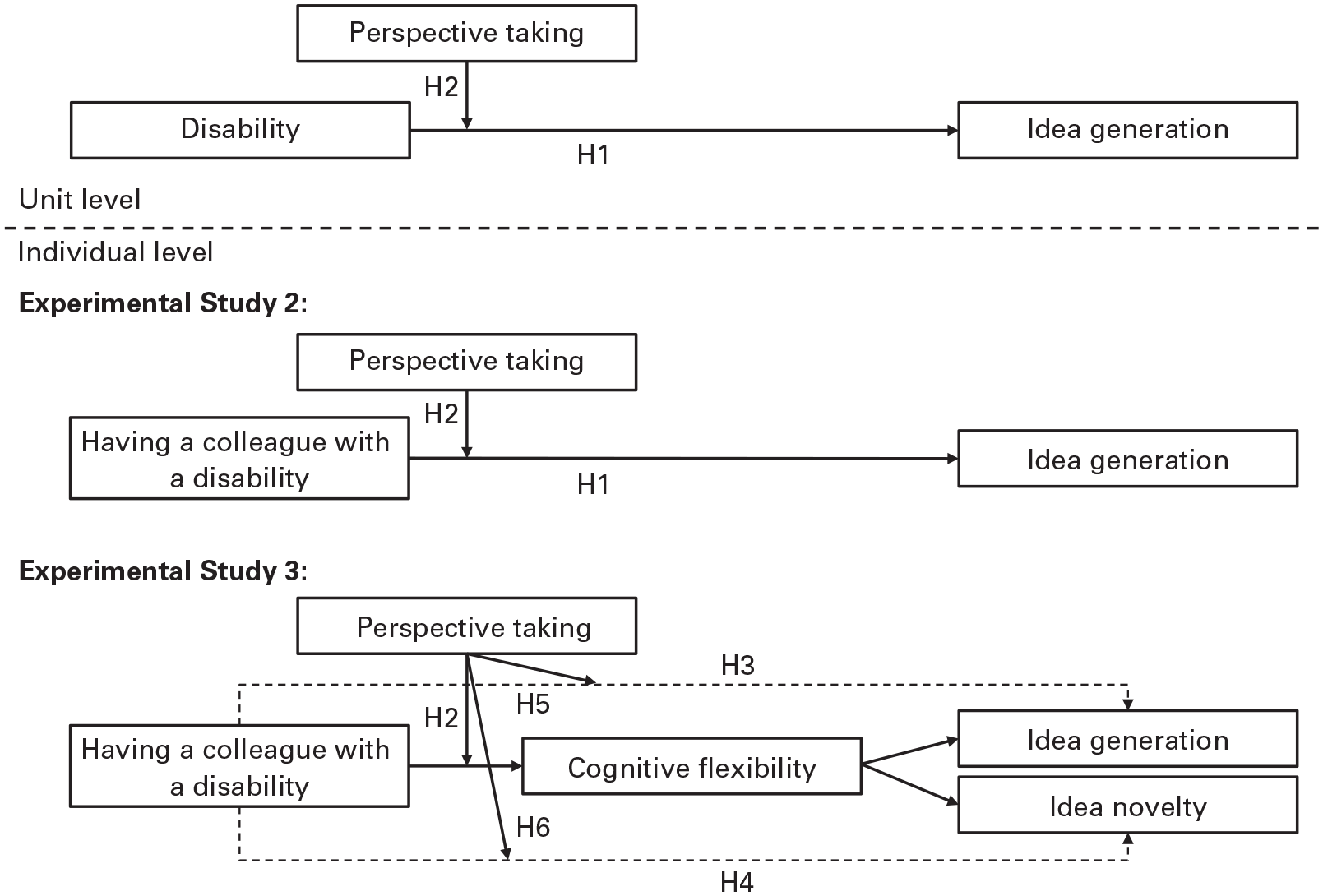
Theoretical Models of All Three Studies*
Theoretical Overview and Hypotheses
The Positive Link Between Disability and Idea Generation
People with disabilities typically encounter more challenges in everyday life than those without disabilities do, given the interplay of their functional impairment and an environment filled with physical, attitudinal, communication, and social barriers (WHO, 2022). These barriers are often not apparent to individuals without impairments, as environments are designed with able-bodied individuals in mind (Campbell, 2009). A raised curb to the sidewalk, for example, may not pose a problem if you do not use a wheelchair or face other mobility issues; therefore, it may not be evident as a design issue. In such ableist environments, a non-disabled body serves as the norm and reference point against which deviations are assessed (Campbell, 2009; Jammaers et al., 2016; van Laer et al., 2022).
The workplace is no different. Workplaces are routinely designed for people without any functional limitations, with work organized with able-bodied individuals as the baseline and default (Doussard et al., 2024). Recent work on the disabling nature of organizational spaces highlights the ableist norms that are built into the design of work, including assumptions about what is a tolerable amount of standing; which physical distances to cover within the workplace are reasonable; and which levels of lighting, sound, and visual information processing are acceptable (van Laer et al., 2022). These assumptions lead to the establishment of work environments that are, for example, too noisy, visually stimulating, or physically taxing for a range of individuals with sensory or mobility impairments. Yet, these environments may not rise to the level of awareness among individuals without impairments because the environments do not immediately pose significant challenges to them. While ableist norms are apparent in the design of work across knowledge work and manual work settings, they should be particularly salient in the latter, such as in manufacturing settings. Manual labor creates physical demands and bodily strain for all workers. Yet, workers with physical disabilities often encounter increased obstacles when faced with the need to lift heavy equipment, frequently bend down, or work overhead, resulting in a gap between the demands of their work tasks as currently designed and their ability to carry out those tasks. Perhaps more than in other environments, this situation may lead to the inability to do a job. This inability often requires accommodations that modify work tasks to better align with the abilities of persons with disabilities (Colella & Bruyère, 2011).
We argue that this mismatch between workplace demands and employees’ health conditions and disabilities can spur creative ideas for work redesign. Prior research in the disability literature has documented that people with disabilities generate “creative solutions in work settings by applying nonstandard patterns of thought” (Boehm & Dwertmann, 2015: 44) to effectively complete work tasks. This perspective, while important, treats the individual with a disability as the focal actor, the one who generates ideas and requests work modifications for their own benefit. It does not consider the interdependent nature of work by acknowledging that coworkers work alongside employees with a disability and can, themselves, put forth ideas for work modifications. We propose that coworkers’ observation of challenges and the nonstandard ways in which a colleague with a disability may work, particularly in the context of joint tasks, can make work design inefficiencies salient and, therefore, can enable novel insights into work processes that spur idea generation. Such idea generation is a necessary first step for selecting and implementing workplace innovations (Perry-Smith & Mannucci, 2017).
Drawing from the dual pathway to creativity model, we posit that the effect of working alongside a colleague with a disability on idea generation occurs through an increase in cognitive flexibility. Given that individuals typically default to ableist norms (Campbell, 2009) when approaching work design, working alongside a colleague with a disability can prompt them to consider new avenues that would not otherwise be apparent. Thus, we argue that disability can serve as a situational cue that makes inefficiencies in workplace design salient, expanding employees’ basic assumptions about what is (or is not) needed to perform a job. This awareness prompts them to become more cognitively flexible and, ultimately, creative, given a basic level of motivation. For example, instead of suggesting common ideas to address productivity issues, such as training (for skills) or different incentives (for motivation), employees who work alongside colleagues with a disability should be likelier to go beyond these ideas and consider the utility of ergonomic and health improvements. Thus, we argue that working alongside an employee with a disability is associated with greater idea generation related to workplace improvements.
Perspective Taking as a Moderator of the Link Between Disability and Idea Generation
Perspective taking is a cognitive process by which individuals adopt others’ viewpoints or imagine themselves in others’ shoes and try to understand their motivations, preferences, values, needs, and intentions (Parker et al., 2008). Research on perspective taking suggests that it both facilitates greater access to information from others and enables improved evaluation of such information (Amabile, 1996; Grant & Berry, 2011). It is thought to be especially beneficial for idea generation if it provides employees with new, non-redundant information (Hoever et al., 2012). For instance, if employees have similar skills, abilities, impairments, and knowledge bases related to the tasks at hand, perspective taking would be expected to yield much less novel information than in a context in which employees have a variety of skills, abilities, and knowledge.
Employees with disabilities are more likely than employees without disabilities to create their own modifications to work processes (e.g., due to physical or sensory limitations; Baldridge & Kulkarni, 2017). Moreover, given the heterogeneity in the way disability manifests across individuals (Dwertmann, 2016), there are countless ways that employees with disabilities may approach their work tasks and the potential workarounds they may develop to bridge the gap between their functional limitations and the job demands (Narayanan & Terris, 2020). Thus, when an individual without disabilities puts themselves in the shoes of a colleague with a disability, it should increase the chance that they notice and understand an entire set of workplace challenges that may otherwise be ignored. In addition, perspective taking is associated with increased interpersonal contact, which has been found to reduce negative cognitive stereotypes that organizational stakeholders hold about people with disabilities (Colella et al., 2004; Dwertmann et al., 2023). Interpersonal contact has also been found to facilitate information exchange toward tangible ideas for workplace improvements (Kulkarni et al., 2020). Thus, taking the perspective of a colleague with a disability can shine a light on suboptimal work processes and design issues and, in turn, reveal ideas for redesigning them, as well as increase efficiencies.
Apart from providing greater access to novel information from colleagues, perspective taking is critical for evaluating the potential utility of generated ideas. Individuals may generate various ideas, and taking others’ perspectives can serve as a litmus test to assess the value of these ideas (Prandelli et al., 2016). An employee generating ideas for improving work design who takes the perspective of a colleague with a disability should have greater exposure to information about the colleague’s challenges. This exposure may help the employee better identify the deficiency of some ideas, such as lack of attention to ergonomics issues, and prompt them to generate additional ideas to improve work for everyone. Thus, we argue that perspective taking will strengthen the positive association between having a colleague with a disability and idea generation.
Cognitive Flexibility as a Mediator of the Effect of Disability on Idea Generation and Idea Novelty
In Hypothesis 1, we argued that having a colleague with a disability functions as a situational cue that increases idea generation because the presence of a colleague with a disability makes ableist norms (Campbell, 2009; Jammaers et al., 2016) in work design salient. We did so based on the flexibility pathway of the dual pathway to creativity model (De Dreu et al., 2008). Synthesizing over a half century of creativity research based on the associative theory of creativity (Mednick, 1962), the flexibility pathway posits that certain individual and situational factors can prompt an increase in cognitive flexibility. Cognitive flexibility is a creativity process indicator that reflects individuals’ use of broad cognitive categories through switching among categories and approaches and through the connection of remote instead of close associations (Nijstad et al., 2010). This process, in turn, is associated with increased individual creative performance. This increase primarily assumes the form of greater idea generation (i.e., the production of a greater number of non-redundant ideas; Goncalo et al., 2015) and idea novelty (i.e., the production of more unconventional ideas; Amabile, 1983). But it also comes in the form of idea usefulness, i.e., the production of ideas that can potentially be implemented (Amabile, 1983). Since individuals store knowledge in the brain in an associative network, some concepts will necessarily be more closely linked to one another than others; thus, according to an associative creativity perspective, the greatest creative potential is in drawing associations with concepts that are more remote or uncommonly linked (Amabile, 1983; Mednick, 1962). This idea suggests that cognitive flexibility is at the core of the creative process.
Integrating the flexibility pathway into the disability literature suggests a new way of understanding the role of functional limitations and accommodations in the workplace. Given that individuals are subjected to ableist norms and that workplaces are routinely designed with able-bodied individuals as the default (Campbell, 2009; van Laer et al., 2022), we argue that in the absence of exposure to a colleague with a disability, employees likely resort to habitual or conventional thinking about how work should be designed when brainstorming workplace improvements. For example, they may suggest gloves that have better grip to lift tools off the ground. In contrast, employees who work alongside colleagues with a disability (e.g., chronic back pain) may be prompted to connect the dots between ideas from different domains to come up with new solutions. They may first realize that lifting tools should be avoided entirely and, instead, that tools should be kept at a convenient height. To do this, they may then think of using a magnet suspended from a mechanical arm to attach the tools (i.e., analogous to a magnetic strip for storing knives in a kitchen) that allows the employee to move the tools to them instead of moving the employee to the tools. Therefore, the presence of disability-related impairments, in line with the associative theory of creativity (Mednick, 1962), can give rise to new associations between previously remote and unconnected concepts to open new avenues of thinking that may not otherwise be apparent. In this way, this presence can result in greater idea generation.
Thus, the potential gap between the demands of work tasks and the abilities of employees with disabilities provides an opportunity for employees to reimagine work design to make it more effective, efficient, and accessible both for a focal individual with an impairment and for all employees. We formally state this as follows:
We argue that working alongside a colleague with a disability will contribute to the generation of not only a greater number of ideas but also more-novel, or original, ideas through an increase in cognitive flexibility. As stated in our theoretical rationale for Hypothesis 3, the flexibility pathway, centered around cognitive flexibility as an individual creative process indicator, is associated with multiple creative outcomes, most notably idea generation and idea novelty (De Dreu et al., 2008; Nijstad et al., 2010; Nijstad et al., 2021). In the organizational behavior literature, creativity is typically studied as an individual outcome (Zhou & Hoever, 2014) that is defined as the production of novel and useful ideas (Amabile, 1983). Thus, idea generation, a measure of idea quantity, does not capture the quality of the ideas produced. Following Amabile’s (1983) definition, creativity researchers have examined separate measures of novelty and usefulness to capture subjective assessments of these two facets of idea quality (e.g., Goncalo et al., 2015; Goncalo & Staw, 2006). Given that we argue that exposure to a colleague with a disability will foster more remote connections in the associative network and, thus, increase an individual’s cognitive flexibility, we expect that individuals will not only produce a greater number of non-redundant ideas but also higher-quality ideas captured in the form of higher idea novelty. In other words, exposure to disability will push individuals to consider a wider range of less-conventional and more-novel possibilities. Therefore, we propose the following hypothesis:
Perspective Taking as a Moderator of the Mediating Effect of Cognitive Flexibility
Integrating our preceding hypotheses, we formally propose that perspective taking moderates the mediation effects of having a colleague with a disability via cognitive flexibility on idea generation and idea novelty. We expect that when colleagues who work alongside an employee with a disability engage in more perspective taking, they will be especially likely to exhibit cognitive flexibility and generate more and more-novel ideas. Perspective taking should make it even more likely that exposure to a colleague with a disability will both elicit unique insight about what it is like to approach work differently (i.e., with a different set of functional abilities/limitations) and help employees better understand the range of possibilities for solutions that may be beneficial in redesigning work. Such access to and better insight about a colleague’s disability should therefore augment the effect of disability on cognitive flexibility and, in turn, on idea generation and idea novelty. Consequently, we propose the following hypotheses:
We have presented joint hypotheses in order to avoid repetition, even though we are aware of the differences in levels of analysis between our studies (i.e., unit for Study 1 and individual for Study 2, and exact operationalization of disability [Index of Quality Variation, or IQV; Marsden, 1990], a standardized version of the commonly used Blau index [Blau, 1977], as a unit-level measure in Study 1 and having a colleague with a disability in Studies 2 and 3). We conducted a full model test that included Hypotheses 3–6 in experimental Study 3.
Research Context
We conducted our research in a blue-collar manufacturing context in Germany because it is well suited to test our hypotheses. Employees in Study 1 work on assembly lines to build cars. They work together in units of typically 8–12 employees, and each unit covers one segment of the assembly line during their shift (i.e., morning, afternoon, night). Every employee has individual tasks (e.g., connect the cables and tighten the screws to install the navigation system), and sometimes tasks require multiple employees (e.g., take the windshield off a rack and attach it to the car). All tasks must be completed in a given time frame since the cars move to the next segment, where another unit takes over. Employees typically do this (relatively well-paid) job during their entire career and spend decades with the organization.
Given this physical labor context, job-relevant disabilities are predominantly physical and often occur after years of working for the organization. Our conversations with company doctors revealed that the most common ones are back pain, arthritis, knee and elbow pain, and so forth; even though some of these impairments are invisible, they are apparent in everyday work (e.g., through visible struggles with one’s task, informal discussions with coworkers, formal and regularly scheduled work design improvement meetings, the accommodation process). Given German labor law, it is very difficult to fire employees with disabilities. If employees are diagnosed with a disability, they will most likely remain with the organization until the end of their career, even if their productivity is lowered. Therefore, it is crucial for the organization to keep these employees as productive as possible. Ideally, they can continue working in their immediate manufacturing setting since few alternative blue-collar jobs exist outside of the timed manufacturing cycle (e.g., in packaging, cleaning, as on-site bus drivers). This goal is particularly important given aging populations, the increasing average age of employees, and the resulting increases in health problems within the organization’s workforce (a challenge common to most industrialized countries).
In our experimental Studies 2 and 3, we aimed to simulate the conditions from our field Study 1 with a video vignette and photographs (see more details in the study descriptions). At the individual level, we tested whether having a colleague with a disability leads to increased idea generation (number of ideas) and idea novelty for workplace improvements. In both studies, we manipulated perspective taking and examined whether more perspective taking moderates this effect and leads to even more generated ideas. In Study 3, we tested cognitive flexibility, a theoretical mechanism leading to more and more-novel ideas. In line with the most prevalent disabilities in our field context, we included chronic back pain and rheumatoid arthritis in the fingers and hands as the two disabilities in our experimental conditions.
Field Study 1: Methods
Members of our research team have been actively engaged with our partner organization for this study for over a decade. During this time, one Ph.D. student worked on site for over a year and intermittently for the subsequent two years. This student had an official company ID badge, participated regularly in employee meetings, and had access to organizational data. In addition, the lead and the second authors regularly visited the company to conduct interviews, plan data collections, present empirical findings, and participate in top management meetings. This extensive engagement created a high level of familiarity with the study context. We presented our results multiple times to company representatives from the manufacturing and human resources departments and to the labor union, and all stakeholders noted the face validity of our results.
To remain competitive in times of increased global competition and high labor and energy prices in Germany, the organization engages in continuous improvement, with an interest in higher quality and greater efficiency of work processes. Units are prompted to propose changes to the work environment that meet these goals by leveraging employee insights. To facilitate this goal, all units engage in regular workshops every other week. As part of these workshops, unit members jointly view and discuss videos recorded at each unit’s individual assembly line segment, highlighting where problems occur throughout the different production steps. All employees are invited to come up with concrete ideas for how production processes can be improved based on these workshops and individual observations and reflections. The quality of the resulting ideas is assessed through an official process. A panel of experts from different departments judges the novelty and usefulness of the generated ideas. Ideas can have direct monetary value if they save materials or increase production speed (e.g., using a chair attached to a mechanical arm that allows employees to more efficiently slide from one workstation to another) or relate to other work aspects (e.g., enhanced soundproofing of break rooms to enable increased relaxation during breaks). If deemed useful, employees’ ideas are implemented to optimize processes. The originators of the ideas are usually involved in the implementation process and receive a monetary reward for proposing ideas that are implemented. Workplace adjustments to accommodate disabilities are seen as part of this process.
Sample and Data Collection
We collected data for the field study at two separate time points from the headquarters and main production site of this large car manufacturer in Germany. Following national data protection laws, as well as the organization’s strict data protection contract, we gathered anonymized organizational records on all variables used in this study (i.e., disability, idea generation, all control variables), with the exception of perspective taking, in order to prevent common method bias a priori (Podsakoff et al., 2012). Further, because we did not rely on survey measures (except for perspective taking), we were able to minimize the shortcomings of self-report surveys, such as high levels of conceptual abstraction, social desirability, and lack of objective outcomes. For performance-related outcomes such as idea generation, access to objective data is particularly important, as the correlation between subjective and objective performance measures can be low.
We assessed perspective taking through a survey of 7,037 employees from 570 work units within 29 sections (e.g., assembling, painting, reworking) of the production site, yielding a response rate of 42.3 percent. Based on the information we gathered from official organizational records, the majority of the population were men (90.24 percent). In our sample, 90.82 percent were men. In the population (sample), 26.6 percent (26.6 percent) of the employees were between 18 and 30 years old, 22.2 percent (23.8 percent) were between 31 and 40, 27.6 percent (28.9 percent) were between 41 and 50, and 23.6 percent (20.7 percent) were between 51 and 65. The average age of the population was 40.13 years (SD = 11.57) and 39.72 years (SD = 11.20) in our sample. The average unit tenure of employees in the population was 17.87 years (SD = 10.75), compared to 17.62 years (SD = 10.45) in our sample. In the population, 4.37 percent had a disability (based on the official German disability identification card); in our sample, 4.02 percent had a disability. Overall, our sample was representative of the population.
In line with our research model, we aggregated all data to the unit level. All unit employees share workstations and have similar tasks and the same supervisor. They work in rotating shifts. We eliminated 27 units with fewer than three members, and we gathered idea generation information for 425 out of the 543 units. Units for which the organization did not have idea generation records are those in support functions that are not directly engaged in manufacturing (e.g., packaging, operating the production site’s supermarket, on-site bus drivers).
Measures
Disability
Information on disability was accessed through organizational records. The data captured whether a given employee has a disability according to the German legal definition of disability. Individuals with disabilities apply for a German disability identification card, which is issued by specialized government agencies based on detailed medical assessments. The card entitles the individual to benefits such as mobility aids, subsidized vocational training programs, qualified career advice, additional holidays, legal protection against layoffs, and reduced taxes (Kock, 2004). As Germany employs a quota system that requires 5 percent of jobs (in any organization with more than 20 employees) to be held by persons with disabilities, organizations must maintain records of the number of employees with a disability by counting disability identification cards. Consequently, the disability identification card is an objective way to assess the number of people with a disability in a German organization, particularly if organizational records can be used to obtain this information. The disability identification card has previously been used as the primary way to assess disability in German samples (e.g., Dwertmann & Boehm, 2016). With these data, we calculated the IQV (Marsden, 1990), a standardized version of the Blau index (Blau, 1977), to capture disability. It is calculated by dividing the Blau index by its theoretical maximum. Doing so allows for the comparison of diversity attributes that, for example, have different numbers of categories and, thus, different potential maximums. The formula to calculate the Blau index is
Perspective taking
Perspective taking is an individual, internal psychological process that can best be judged by employees themselves (Grant & Berry, 2011), and research has found self-reported perspective taking to be reliable and valid (Davis et al., 1996). Thus, we used three items from Davis and colleagues that were adapted by Grant and Berry (2011): “On the job, I frequently try to take other people’s perspectives,”“At work, I often imagine how other people are feeling,” and “At work, I regularly seek to understand others’ viewpoints.” All items were measured using a 7-point Likert scale ranging from 1 (strongly disagree) to 7 (strongly agree). Cronbach’s alpha for this scale was .86.
Idea generation
Idea generation is captured by the manufacturing organization through a standardized process. We gathered the mean idea generation data (i.e., number of new ideas for process improvement that were implemented by the organization) for each unit for an entire year following the initial data collection (i.e., our survey measuring perspective taking and organizational records). The fact that the ideas were implemented means that they are novel and useful (Amabile, 1983). We standardized idea generation data across units with similar work tasks. This allowed us to compare units across the production site.
Control variables
We controlled for unit size, average unit age, unit age diversity, and unit gender diversity since these variables can relate to idea generation (van Dijk et al., 2012). Information on unit size was taken from official organizational records and represents the number of employees in a given unit. Average unit age, age diversity, and gender diversity were also assessed from organizational records. Age diversity represents the standard deviation of employee age within units, and gender diversity is captured by calculating the IQV as an index. We did not control for tenure due to a high correlation with age (i.e., most manufacturing employees enter this organization as apprentices around ages 16–18).
Field Study 1: Analyses and Results
Data Analysis
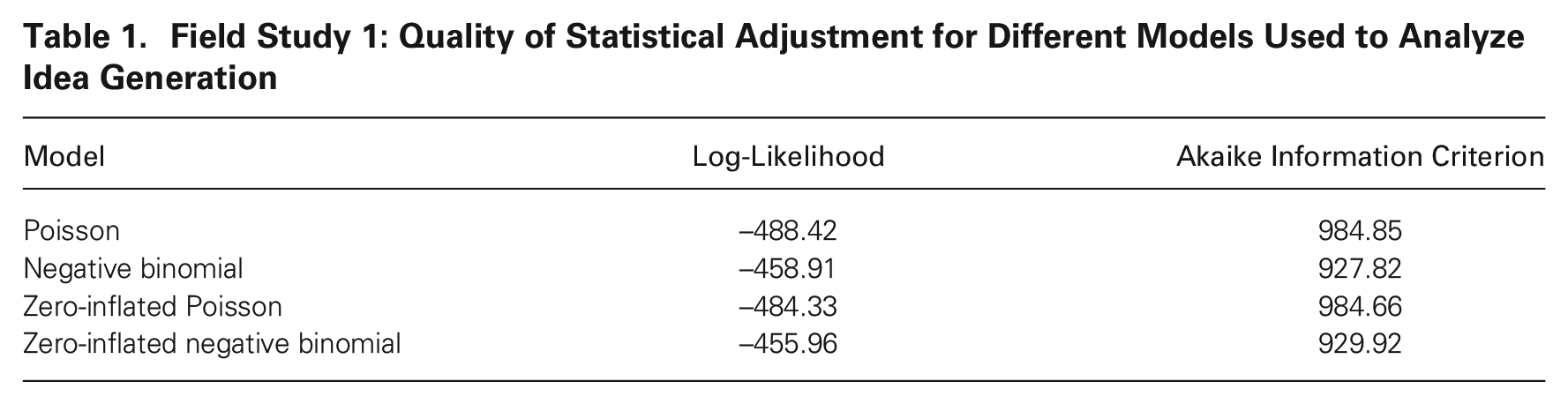
Our dependent variable, idea generation, is a count variable that is non-normally distributed. Therefore, we tested which statistical model was most appropriate for our analysis. Table 1 shows log-likelihood and Akaike information criterion (AIC) indices for four different models and indicates that a negative binomial or zero-inflated negative binomial model best fits the data. Since zeros in our data are meaningful (i.e., some units generated no ideas), we do not have zero-inflated data and chose the negative binomial model. We report one-tailed hypothesis testing given our directional hypotheses (Cho & Abe, 2013; Hinkle et al., 2003) throughout all studies.
Field Study 1: Quality of Statistical Adjustment for Different Models Used to Analyze Idea Generation
Descriptive Statistics
Means, standard deviations, and two-tailed correlations of all study variables for our sample of 425 units are presented in Table 2. Disability is not significantly correlated with idea generation (r = .07, p = .177), and perspective taking is positively correlated with idea generation (r = .12, p = .014).
Field Study 1: Means, Standard Deviations, and Correlations for Study Variables*
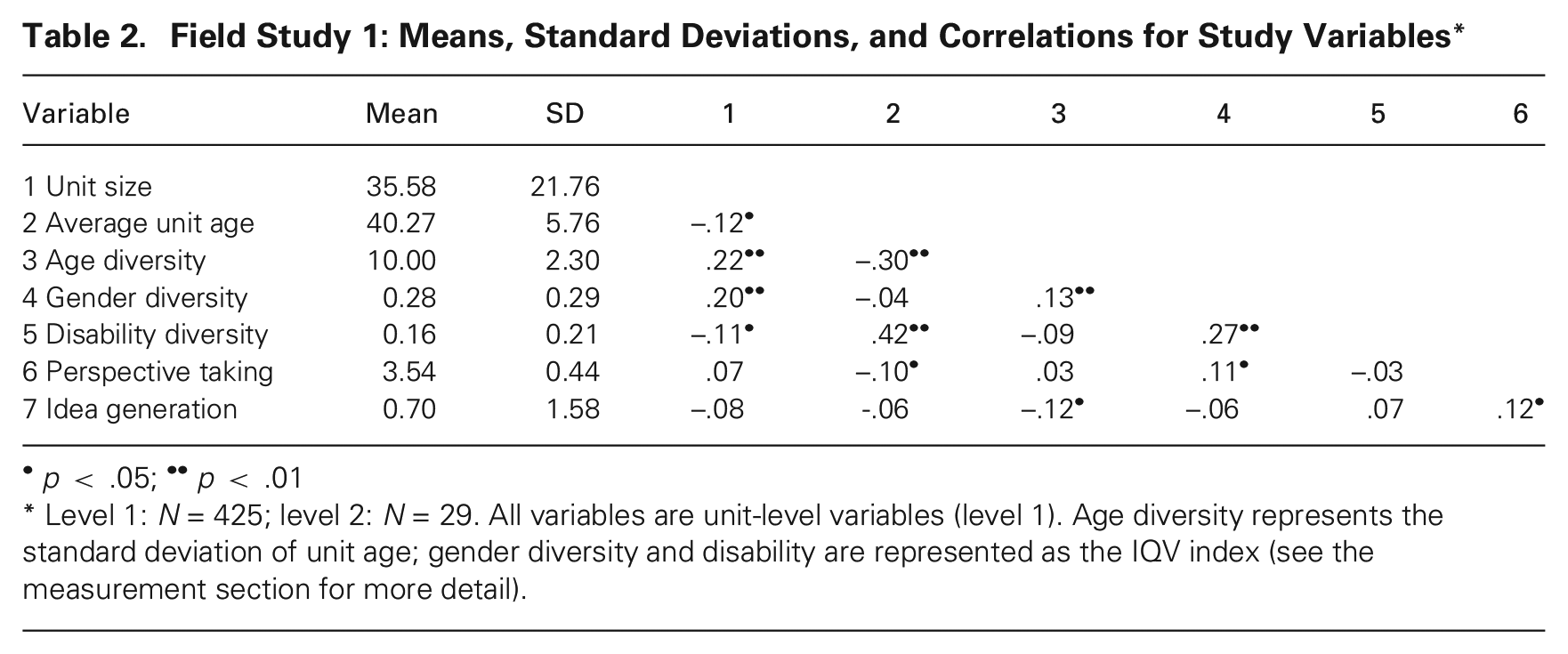
p < .05; ••p < .01
Level 1: N = 425; level 2: N = 29. All variables are unit-level variables (level 1). Age diversity represents the standard deviation of unit age; gender diversity and disability are represented as the IQV index (see the measurement section for more detail).
Hypothesis Testing
The units in our dataset are nested in larger sections (e.g., assembling, painting, reworking) of the car manufacturing site. We used hierarchical linear modeling to account for this structure and used group mean centering due to our interest in level 1 predictors, in our case, the unit level (Enders & Tofighi, 2007). To test for the appropriateness of this analysis, we first tested for systematic variation between sections. A null hierarchical model revealed significant variation in idea generation between sections χ2(Nunits = 425; Nsections = 28) = 55.46, p < .001). The variance partition coefficients indicated that approximately 24 percent of the variance in idea generation existed between the larger sections of the factory.
The main effect of disability on idea generation
In Hypothesis 1, we predicted that disability is positively linked with idea generation. The results of our analysis, depicted in Model 2 of Table 3, support this prediction. Units with higher disability generated more ideas (B = .70, p < .044). To ease interpretation, this means that a unit with high disability (1 SD above the mean) generates an additional 1.87 ideas, which roughly equates to a €14,500 value annually.
Field Study 1: Results of the Negative Binomial HLM Analyses for Idea Generation*
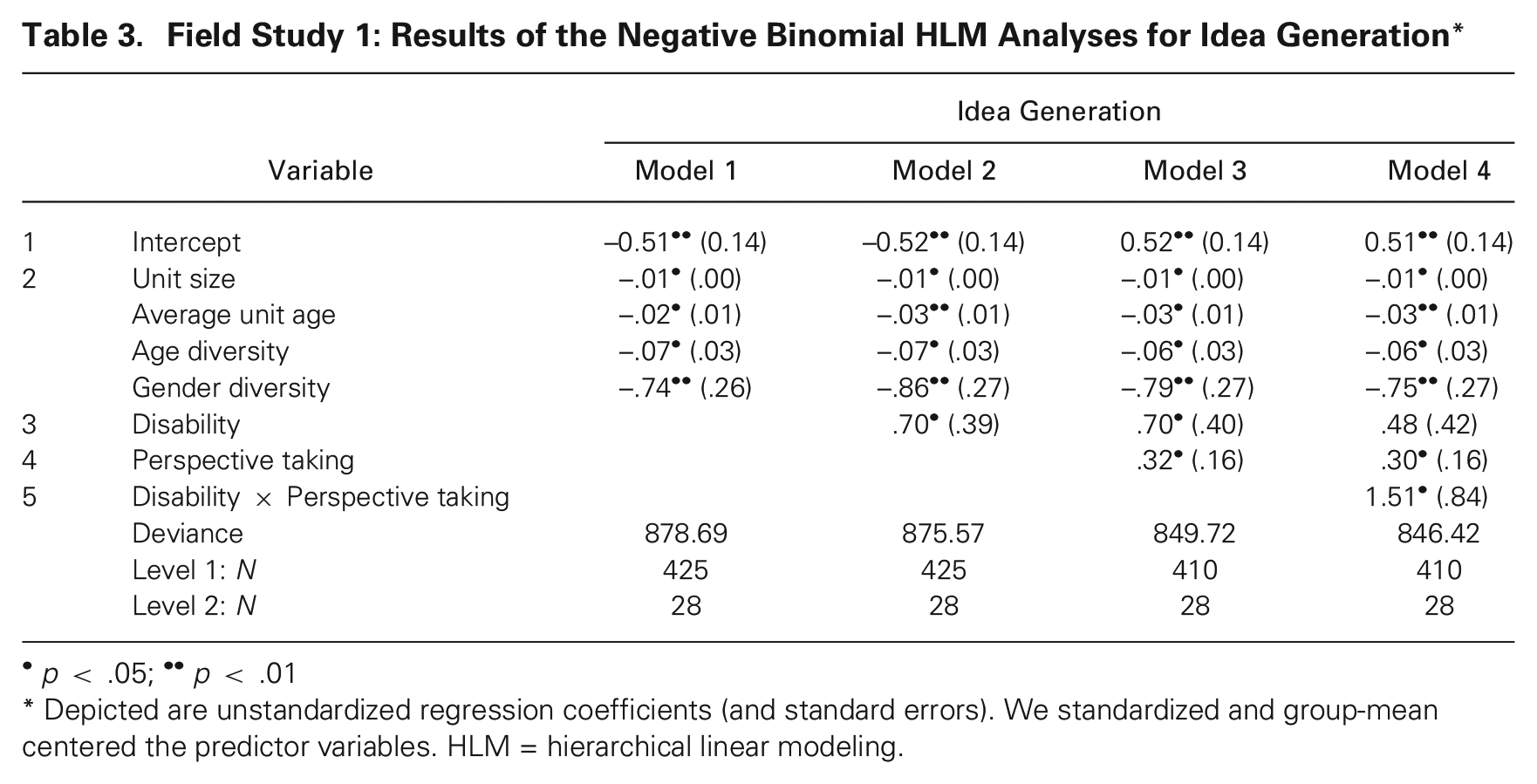
p < .05; ••p < .01
Depicted are unstandardized regression coefficients (and standard errors). We standardized and group-mean centered the predictor variables. HLM = hierarchical linear modeling.
The moderating effect of perspective taking on the link between disability and idea generation
In Hypothesis 2, we predicted that units that engage in more perspective taking are better able to leverage the diverse viewpoints of their members with and without disabilities for idea generation. The hierarchical linear modeling results (Model 4 of Table 3) support this hypothesis (B =1.84, p = .027).
To further inspect this moderation, we display the link between disability and idea generation for units in which members engage in less perspective taking (1 SD below the mean) and more perspective taking (1 SD above the mean). Figure 2 shows that disability is associated with more idea generation in units that engage in more perspective taking but not in low perspective-taking units. The results of simple slope tests (Aiken & West, 1991) support this conclusion. Disability is significantly associated with more idea generation in units that engage in more perspective taking (B =.93, p = .011) but not in units that engage in less perspective taking (B = -.09, p = .412). These results support Hypothesis 2.
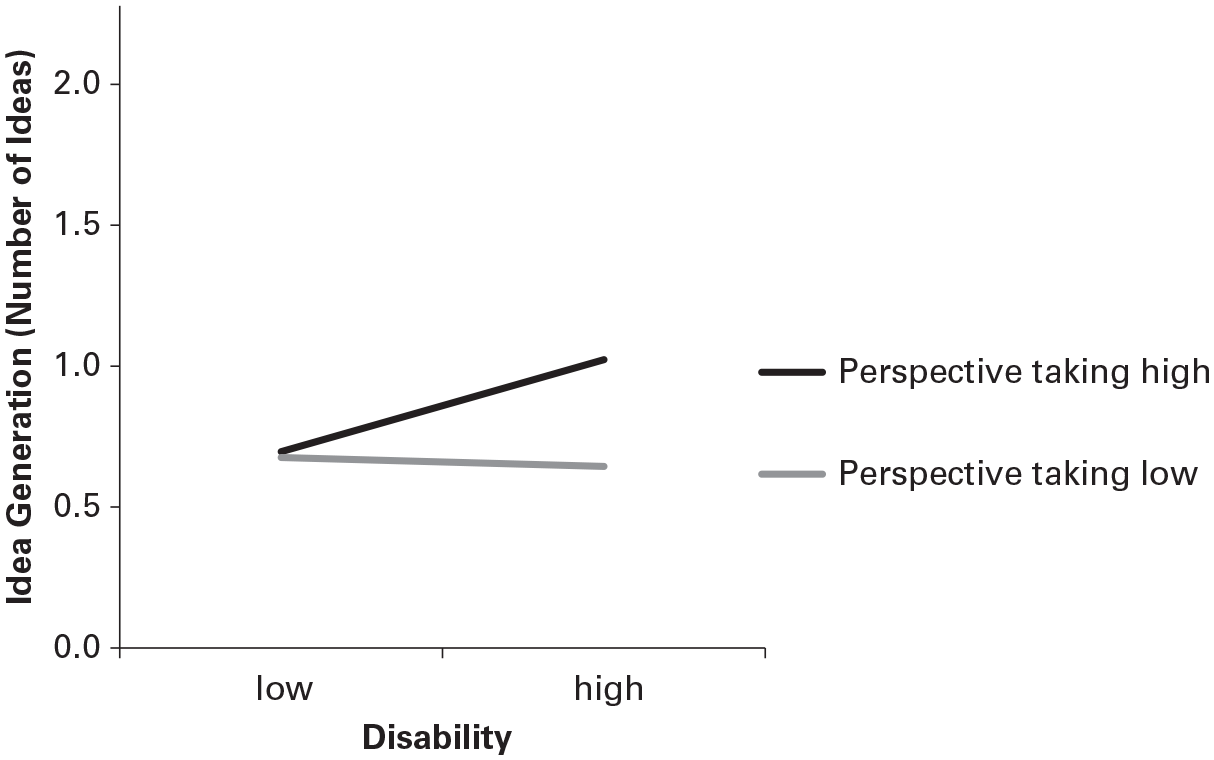
The Moderating Effect of Perspective Taking on the Link Between Disability and Idea Generation in Field Study 1
Robustness check
For a robustness check, we ran our model without control variables (Becker, 2005). The results changed only slightly in magnitude, and all effects remained significant.
Field Study 1: Discussion
The results of this field study support our theoretical model. Specifically, disability and average perspective taking are positively related to idea generation, and average perspective taking moderates the effect of disability on idea generation in the predicted direction. Disability in units is associated with more ideas when members engage in more perspective taking. While we use objective and time-lagged data, we cannot be sure about causality and external influences on our results. Because of this, we designed experimental Study 2 to further test our hypotheses.
Experimental Study 2: Methods
Design, Sample, and Data Collection
Participants
We conducted a preregistered experiment through a commercial data collection provider. 4 The sample includes full- or part-time employed participants between 18 and 65 years of age. It is representative of the German population of internet users in terms of age, gender, and state. We ran a 3 (disability) × 2 (perspective taking) experimental study and conducted an a priori power analysis using G*Power 3.1 (Faul et al., 2009) to determine our sample size. Results revealed that 967 participants would be sufficient to detect a small effect (f = .10) with 80 percent power and an alpha of .05. To account for the possibility of a sample reduction due to failed manipulation or attention checks, we recruited 1,723 participants. We excluded 164 participants because of unrealistic response time, 7 participants who did not watch the video that was embedded in the study, 59 because of a failed attention check (“If you pay attention and take this study seriously, please answer ‘I somewhat agree’”), and 69 participants for providing careless responses in our open text boxes when asked for ideas to improve processes shown in the video and the photographs. For example, these participants responded, “I will not give you my ideas, you have to pay for them,”“black,” or simply “XXXXXXXXXXX.” Thus, our sample was reduced to 1,424 participants. On average, participants were 43.56 years old (SD = 11.78) and 55 percent men (four participants indicated non-binary).
Design and procedure
Participants were randomly assigned to conditions. First, participants read an introductory vignette that matched the working conditions from Study 1 and asked them to imagine that they were employed by a car manufacturer. The vignette further described the way work is organized (i.e., teams of eight employees who work in a specific segment of the assembly line; each employee must carry out different types of assembly tasks over the course of one day, each within 50 seconds). Further, it specified that 50 seconds cannot be exceeded since this would necessitate stopping the assembly line. Thus, all team members must fulfill their individual assembly tasks within this time frame. The vignette also described that team members rotate between eight different tasks every two hours to avoid fatigue and boredom and provide relief over the workday, a procedure that the organization does not want to change. Three example tasks were specified: lifting the bumper from a shelf and attaching it to the front of the car, leaning into the car to tighten the screws that hold the steering wheel in place, and lifting the windshield from a shelf and attaching it to the car. After this description, participants saw three representative photographs and watched a 55-second-long video that showed the example tasks performed in an actual car manufacturing plant of our partner organization from Study 1. This experimental setup replicated the work tasks and conditions in our Study 1 organization.
After this, each of the six groups in our 3×2 design read a short vignette manipulating disability (1: chronic back pain; 2: rheumatoid arthritis in fingers and hands; 3: no disability). In the disability conditions, participants read, “You realize that one of your team members, Hans, faces difficulties completing the assigned tasks within 50 seconds” and either (1) “because he has chronic back pain. This makes it difficult for him to, for example, lift heavy items, bend down, and twist his back” or (2) “because he has rheumatoid arthritis in his fingers. This makes it difficult for him to, for example, hold heavy items, twist his wrists, and tighten screws.” The control condition simply stated, “You realize that one of your team members, Hans, faces difficulties completing the assigned tasks within 50 seconds.”
Next, participants were told that the organization is interested in improvements to the production process to make it more efficient and profitable. The organization “has given you the opportunity to propose ideas that are realistic, novel and useful to improve the team’s assembly tasks and workflows. Thus, if you suggest ideas that will help everyone handle these tasks more efficiently, you will receive a financial bonus.” Again, this mirrors Study 1 conditions.
Then, we manipulated perspective taking based on the materials used in prior literature (Hoever et al., 2012). Half of the participants in each of the two disability and one non-disability conditions ([1] chronic backpain, [2] rheumatoid arthritis in fingers and hands, [3] no disability) were simply asked to provide ideas for improving work processes and tasks. The other half were asked to do the following: Try taking the perspective of Hans, your team member who (1) has chronic back pain and has difficulty completing these tasks within 50 seconds / (2) has rheumatoid arthritis in his fingers and hands and has difficulty completing these tasks within 50 seconds / (3) has difficulty completing these tasks within 50 seconds. Taking Hans’ perspective means that you try to see things as if you were in Hans’ position. To do this, it is important that you understand what is important to Hans, how he approaches the tasks, and what may be challenging for him. Therefore, as you think about ideas to improve production processes and execution of assembly tasks, please try to take the perspective of Hans, your team member (1) who has chronic back pain / (2) who has rheumatoid arthritis in his fingers and hands / (3) who has difficulty completing these tasks.
These participants were then asked to provide ideas for improvements, our dependent variable. It is, of course, impossible to exactly match Study 1 conditions here (e.g., intact teams with long tenure, weekly team workshops). The top three participants with the most ideas received 20 euros each. Providing this monetary award mirrors the organizational context from our Study 1, in which the organization provides monetary awards to employees who generate ideas.
Measures
We included a manipulation check for disability, an attention check, the perspective taking measure, a manipulation check for perspective taking, and demographic questions in the study. Before measuring perspective taking, to prevent social desirability we instructed participants to “Please answer these questions based on what you did when coming up with ideas, not what you believe you should have done” (see also, Dwertmann et al., 2023; Parker & Collins, 2010).
Perspective taking
We used the same three items from Study 1 to measure perspective taking. Cronbach’s alpha for this scale was .91.
Idea generation
To measure the number of ideas, we provided open-ended text fields and asked participants to write each idea in a separate field. We used the number of non-redundant ideas provided by each participant (Goncalo et al., 2015).
Experimental Study 2: Analyses and Results
Manipulation Checks
For our disability manipulation check, we examined whether participants correctly described Hans (no health issues/chronic back pain/rheumatoid arthritis/uses a wheelchair/blind/none of these) and excluded from further analyses 302 participants who failed this check. For the perspective-taking manipulation check, participants were asked to select the option that best described their instructions (“I was asked to take the perspective of Hans/there were no specific instructions”). We excluded 168 participants who failed this check, yielding a final sample size of N = 954, which is close to what we aimed for based on our a priori power analysis. We also directly tested whether our perspective-taking manipulation was effective. Results of a t-test comparing both groups indicated that the manipulation was effective (M = 4.55, SD = 1.66 and M = 5.80, SD = 1.08 for the low, i.e., control, and high perspective-taking conditions, respectively; t(952) = −14.02, p < .001). We compared the descriptives of the participants who passed or failed the manipulation checks. These descriptives included age, sex, education level, employment status, whether participants worked in the manufacturing industry or a manufacturing job, whether they worked in a creative industry or a creative job, whether they have a long-term illness, whether they have a disability, whether they have regular contact with someone who has a disability, and whether they have a family member who has a disability. The only significant difference was that the group of participants who passed was more highly educated. Otherwise, there was no indication of a systematic bias, and we do not have reason to believe that the difference in education should affect our results.
Descriptive Statistics
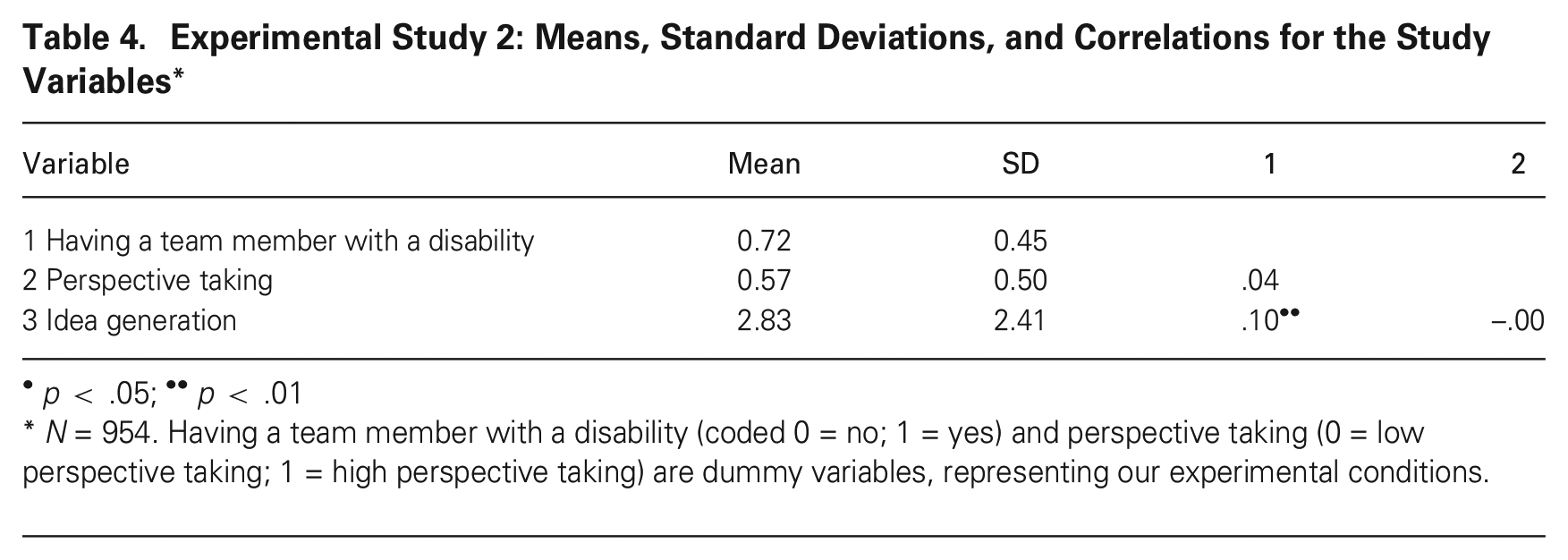
Means, standard deviations, and two-tailed correlations for all study variables for our sample are presented in Table 4. Having a team member with a disability is significantly correlated with idea generation (r = .10, p = .001). Perspective taking is not significantly correlated with idea generation (r = −.00, p = .985).
Experimental Study 2: Means, Standard Deviations, and Correlations for the Study Variables*
p < .05; ••p < .01
N = 954. Having a team member with a disability (coded 0 = no; 1 = yes) and perspective taking (0 = low perspective taking; 1 = high perspective taking) are dummy variables, representing our experimental conditions.
Data Analysis
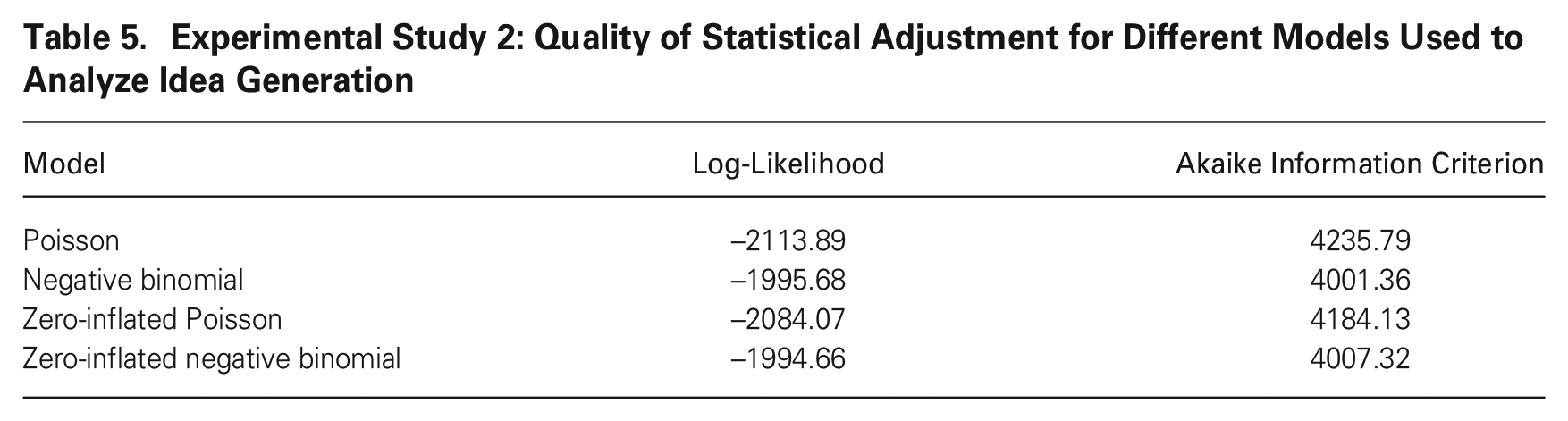
In our preregistration, we indicated that we would use analysis of variance (ANOVA) to analyze our data. Yet, after completing our data collection, we detected that our dependent variable idea generation was non-normally distributed (i.e., it is a count variable). Because of this, we tested which statistical model was most appropriate to analyze the data. Table 5 shows log-likelihood and AIC indices for four different models. Based on the results, a negative binomial or zero-inflated negative binomial model indicates the best fit. Since zeros for idea generation are meaningful (i.e., some participants generated zero ideas), we do not have zero-inflation present in the data and chose the negative binomial model for the analysis.
Experimental Study 2: Quality of Statistical Adjustment for Different Models Used to Analyze Idea Generation
Results
The main effect of disability on idea generation
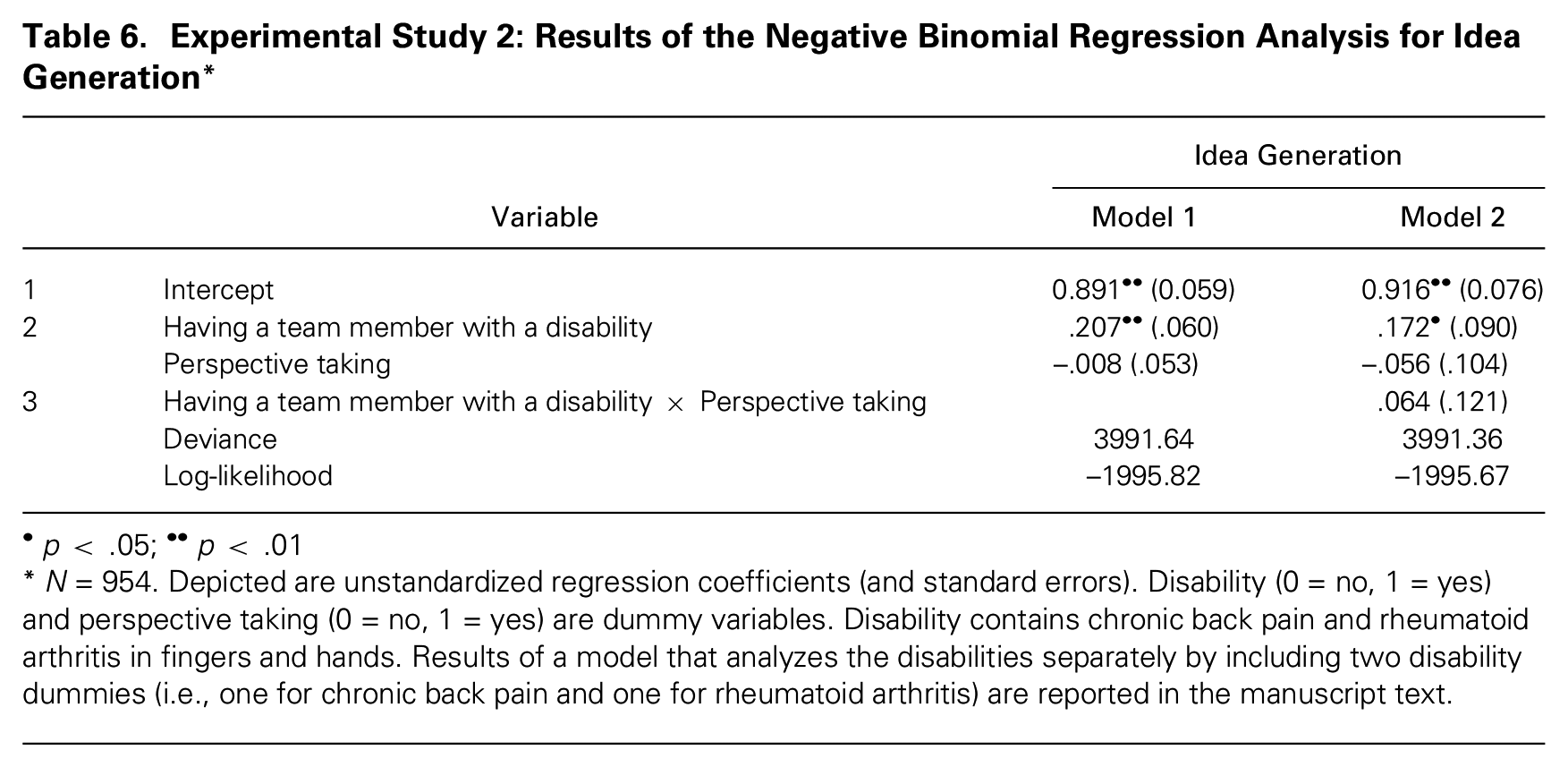
We first tested whether having a colleague with a disability leads to more idea generation. Our results indicate that, indeed, when pooled together, participants in both disability conditions generated significantly more ideas than did participants in the control condition (B = .207, p < .001). Participants generated ideas such as on-site physical training facilities and massage, as well as the use of exoskeletons and compression gloves, among others. When analyzed separately (full results available from the corresponding author upon request), participants in the chronic back pain (B = .245, p < .001) and the rheumatoid arthritis in fingers and hands (B = .167, p = .007) groups—compared to the control group—generated significantly more ideas. (Participants in the rheumatoid arthritis condition generated significantly fewer ideas than participants in the chronic back pain condition did when we used one-tailed testing, but we did not state a directional hypothesis regarding this comparison.) These findings support Hypothesis 1 (see Model 1 in Table 6).
Experimental Study 2: Results of the Negative Binomial Regression Analysis for Idea Generation*
p < .05; ••p < .01
N = 954. Depicted are unstandardized regression coefficients (and standard errors). Disability (0 = no, 1 = yes) and perspective taking (0 = no, 1 = yes) are dummy variables. Disability contains chronic back pain and rheumatoid arthritis in fingers and hands. Results of a model that analyzes the disabilities separately by including two disability dummies (i.e., one for chronic back pain and one for rheumatoid arthritis) are reported in the manuscript text.
The moderating effect of perspective taking on the link between disability and idea generation
Next, we tested the moderation effect of perspective taking on the link between having a team member with a disability and idea generation. As shown in Model 2 in Table 6, the interaction effect between having a team member with a disability and perspective taking, albeit in the anticipated direction, is not significant (B = .064, p = .298). This does not support Hypothesis 2.
Robustness Checks
We ran several robustness checks, which did not significantly change our results. First, while our random assignment of participants to conditions allows for equivalence of measured and unmeasured third variables, we included control variables that could be perceived as affecting our results. These variables include education level, whether participants work in a manufacturing job, whether they work in the manufacturing industry, whether they work in a creative job, whether they work in a creative industry, whether they have a chronic or long-term illness or health issue, whether they have a disability, how often they have contact with an individual with a disability, and whether they have friends or family with a disability. Second, we included education level as a control since this was the only significant predictor of idea generation. Finally, we ran the models with ANOVAs, as preregistered. One difference emerged compared to the negative binomial model: The effect of perspective taking on idea generation became significant.
Experimental Study 2: Discussion
In line with our first hypothesis, we found that having a colleague with a disability leads to more idea generation. The moderation effect of perspective taking on the link between having a colleague with a disability and idea generation was not significant. Although we can only speculate, we believe that limitations related to experimental realism may be at work here. As noted, employees in our Study 1 are prompted to propose changes to the work environment to increase productivity. To do so, units engage in regular workshops to discuss new ideas, jointly discuss videos recorded at each unit’s assembly line segment, and highlight where problems occur in the different assembly steps. Based on these activities, employees are invited to come up with ideas for how production processes can be improved. An experimental manipulation of perspective taking cannot replicate such a deliberate real-world process. In addition, it is much easier for an employee to take the perspective of a coworker with a disability whom the employee works with daily, compared to doing so via a written vignette. Thus, despite a successful manipulation that resulted in a significant difference in perspective taking between our experimental groups, the manipulation might not have been strong enough to detect the moderation effect that we observed in our field Study 1.
We alluded to cognitive flexibility as the mechanism in Hypothesis 1 and directly argued, based on the dual pathway to creativity model (De Dreu et al., 2008), that having a colleague with a disability would serve as a situational cue that increases cognitive flexibility and that this, in turn, increases idea generation and idea novelty (Hypotheses 3 and 4). However, we did not test this theoretical mechanism. To address this, we designed experimental Study 3. In this study, we content coded the ideas that participants generated to see whether participants in the disability conditions generated not only more ideas (Studies 1 and 2) but also ideas across more categories (i.e., ideas in different domains), which is a measure of cognitive flexibility (De Dreu et al., 2008; Nijstad et al., 2002), and more-novel ideas, compared to participants in the control condition. We also tested in a moderated mediation model whether perspective taking moderates the two mediation pathways (see Figure 1).
Experimental Study 3: Methods
Design, Sample, and Data Collection
Participants
We conducted another experiment through the same commercial data collection provider from Study 2. The sample includes full- or part-time employed participants between 18 and 65 years of age. It is representative of the German population of internet users in terms of age, gender, and state. We ran a 3 (disability) × 2 (perspective taking) experimental study, and we conducted an a priori power analysis using G*Power 3.1 (Faul et al., 2009) to determine our sample size. Since we have a count outcome variable, we based the calculation on a Poisson regression (Exp(β1) = 1.16, alpha = .05, 80 percent power, base rate Exp(β0) = 2, mean exposure = 1, R2 other X = 0, X distribution = binomial, and X parm π = 0.84). The results indicated that 987 participants would be needed. Since a relatively high number of participants failed our manipulation checks in Study 2, we conservatively recruited 1,974 participants. We excluded 19 participants because of unrealistic response time, 18 participants who did not watch the video that was embedded in the study, 126 because of a failed attention check, and 45 participants for providing careless responses in our open text boxes, when they were asked for ideas to improve processes shown in the video and the photographs. For example, these participants responded, “I will not give you my ideas.” Thus, our sample was reduced to 1,766 participants.
Design and procedure
Participants were randomly assigned to conditions. All background materials were the same as those in Study 2. After this, each of the six groups in our 3×2 design read a short vignette manipulating disability ([1] chronic back pain, [2] rheumatoid arthritis in fingers and hands, [3] no disability). In the disability conditions, participants read “You realize that one of your team members, Hans, faces difficulties completing the assigned tasks within 50 seconds” and either (1) “because he has chronic back pain” or (2) “because he has rheumatoid arthritis in his hands.” The control condition simply stated, “It is unclear why.” We shortened these vignettes relative to the language used in Study 2 to keep the amount of information provided constant across conditions (i.e., the Study 3 vignettes contain only a statement of what the disability is and not any additional information on how the disability interferes with certain tasks). Next, comparable to Study 1, and the same as in Study 2, participants were asked to provide ideas to improve the production process. Finally, we manipulated perspective taking in the same way as in Study 2, given the significant differences we observed in our measures of perspective taking between the low (i.e., control) and high perspective-taking conditions in that study.
Measures
We included a manipulation check for disability, an attention check, the perspective-taking measure, a manipulation check for perspective taking, and demographic questions in the survey. Before measuring perspective taking, we instructed participants to “Please answer these questions based on what you did when coming up with ideas, not what you believe you should have done,” to prevent social desirability (Dwertmann et al., 2023; Parker & Collins, 2010).
Perspective taking
We used the same three items from Studies 1 and 2 to measure perspective taking. Cronbach’s alpha for this scale was .90.
Cognitive flexibility
To assess how broadly participants think, we content coded the ideas they provided in the open-ended text fields. After reviewing all ideas, the lead author identified 14 different categories that emerged from the data. They were motivation, communication with employee, organizational health measures, ergonomics, automation, training (skills), breaks (more or different), rotation, team processes, time (additional), additional employees, different job in organization, layoff, and other. Discussing these categories with the second author led to one additional category: assistive tools. Table 7 provides an overview of all categories and illustrates three examples of ideas within each category. Next, we trained two research assistants who were unaware of the hypotheses and conditions of the study. They test-sorted 100 ideas into the categories, and we provided written feedback and conducted a second training. The two research assistants then independently categorized all responses. Following prior research (De Dreu et al., 2008; Nijstad et al., 2002), we used the number of categories in which the participants provided ideas as our measure of cognitive flexibility. Inter-rater agreement was good (Cohen’s K = .89; p < .001), and differences were resolved through discussion.
Experimental Study 3: Example of Answers in Different Idea Categories Indicating Cognitive Flexibility*
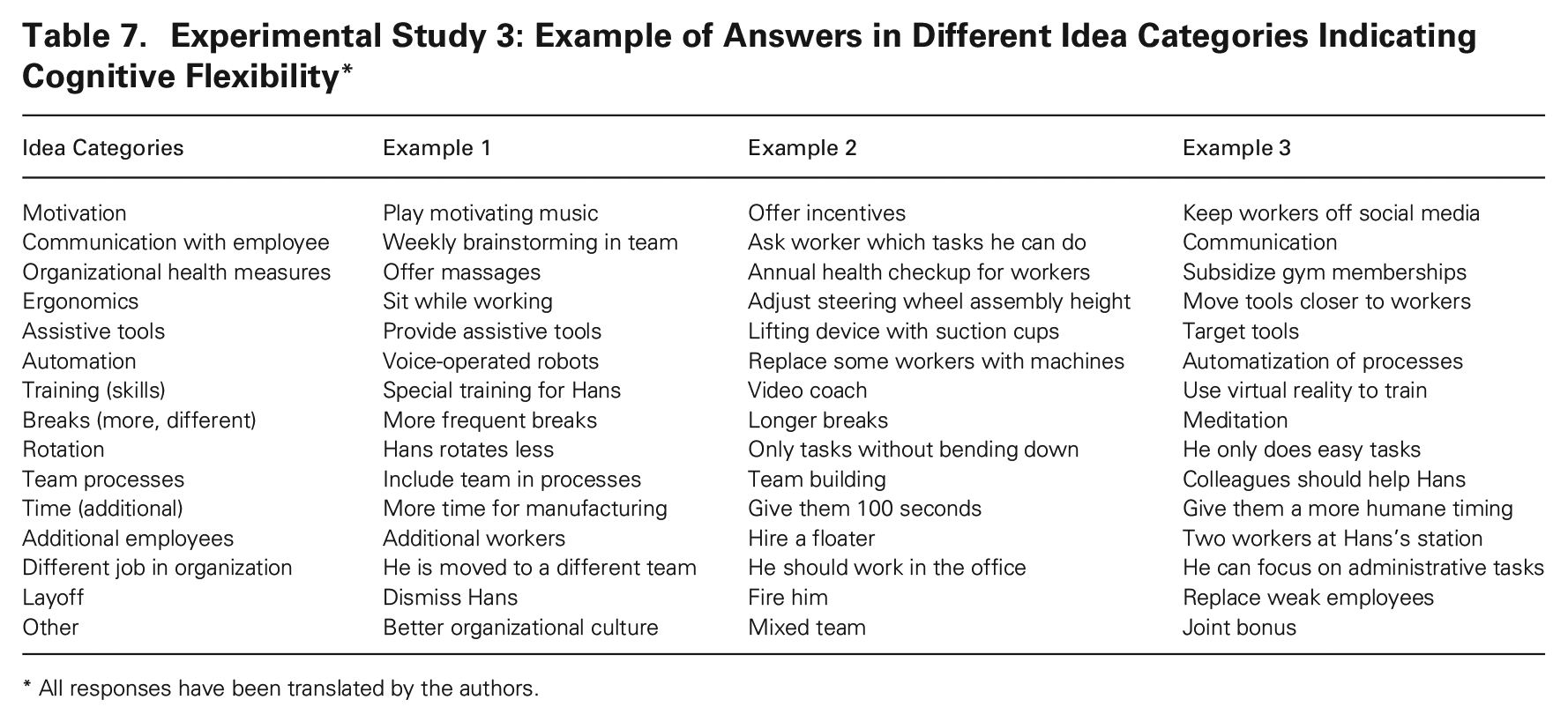
All responses have been translated by the authors.
Idea generation and novelty
We measured idea generation and idea novelty as our dependent variables, two common outcome measures of creative performance (e.g., Goncalo et al., 2015). Idea generation was measured the same as in Study 2. To assess novelty, we hired and trained two additional research assistants who were not aware of the hypotheses of this study. We first sent a diverse list of 105 ideas from the sample to one of our contacts within our partner organization from field Study 1. Our contact is the official disability officer of the organization who knows all actual accommodations being made and works closely with the manufacturing department. He rated the ideas in terms of novelty and usefulness, and we used these ratings in our training sessions for the research assistants. This procedure should strengthen the external validity of the ratings, as research has suggested that an idea is creative when relevant experts agree (Amabile, 1983; Nijstad et al., 2010). While we report detailed results only for idea generation and idea novelty, the results for usefulness are comparable and differ only in magnitude (most effects are stronger for usefulness than novelty). After the training, the two research assistants independently rated the novelty of each idea on a scale of 1 (not at all novel) to 5 (extremely novel), with participants who did not provide any idea receiving a score of 0. Since the two coders reached significant agreement on their ratings (ICC = .76, p < .001), we followed the procedure from Goncalo et al. (2015) and averaged their scores to form the novelty rating.
Experimental Study 3: Analyses and Results
Manipulation Checks
For our disability manipulation check, we used simpler wording due to a relatively high number of failed checks in Study 2. We examined whether participants correctly described Hans (no health issues/chronic back pain/rheumatoid arthritis/uses a wheelchair/blind) and excluded 276 participants who failed this check from further analyses. For the perspective-taking manipulation check, participants were asked to select the option that best described their instructions (I was asked to take the perspective of Hans/there were no specific instructions). We excluded 289 participants who failed this check, yielding a final sample size of N = 1,314. Since fewer participants failed our manipulation checks relative to Study 2, potentially due to the simpler wording, our power based on a post hoc analysis was 89 percent. Next, we tested the effectiveness of our manipulation. Results of a t-test comparing both groups showed effective manipulation (M = 4.75, SD = 1.51 and M = 5.86, SD = 1.03 for the low/control and high perspective-taking conditions, respectively; t(1314) = −15.18, p < .001). The descriptives (i.e., age, sex) of our sample did not significantly differ between participants who passed or failed manipulation checks, indicating no systematic bias. We also made sure that each participant provided non-redundant ideas before we proceeded to test our hypotheses.
Data Analysis
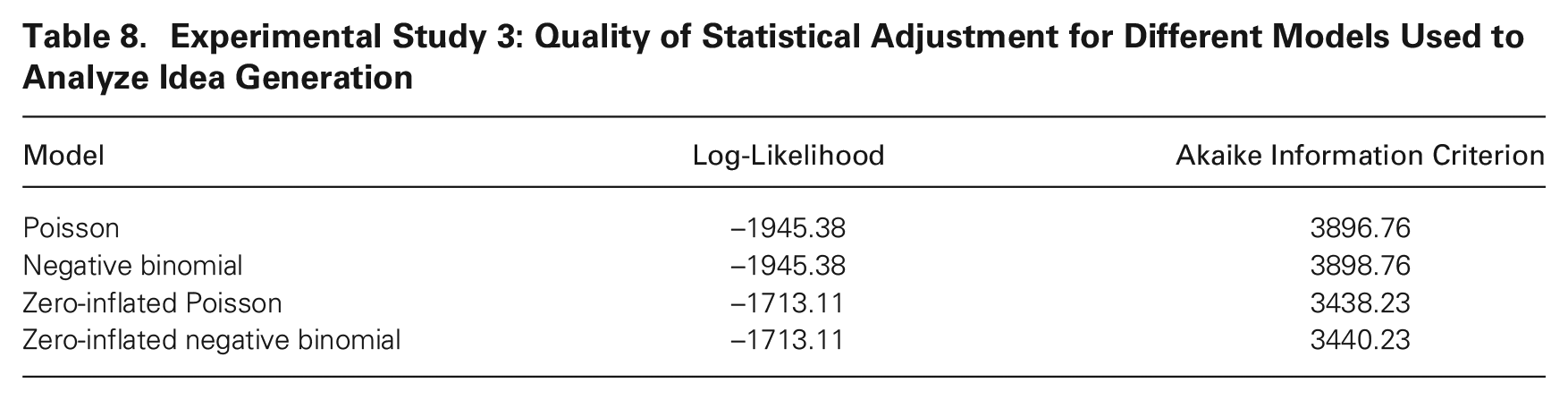
Since idea generation was non-normally distributed, we tested which statistical model was most appropriate to analyze the data. Table 8 shows log-likelihood and AIC indices for four different models each. Based on the results and given that we do not have zero-inflation present in the data (i.e., zeros are meaningful), we decided to use a Poisson model. For idea novelty, we used regular OLS regression.
Experimental Study 3: Quality of Statistical Adjustment for Different Models Used to Analyze Idea Generation
Results
The main effect of disability on cognitive flexibility
We first tested whether having a colleague with a disability leads to higher cognitive flexibility. Our results indicate that, indeed, when pooled together, participants in both disability conditions showed higher cognitive flexibility than did participants in the control condition (B = .145, p < .001). When analyzed separately (full results available from the corresponding author upon request), participants in the chronic back pain (B = .190, p < .001) and the rheumatoid arthritis in hands (B = .095, p = .031) groups showed higher cognitive flexibility, compared to the control group. Table 9 provides a descriptive overview; there was no significant difference between both disability conditions.
Descriptive Statistics of Experimental Study 3 for Idea Measures by Condition*
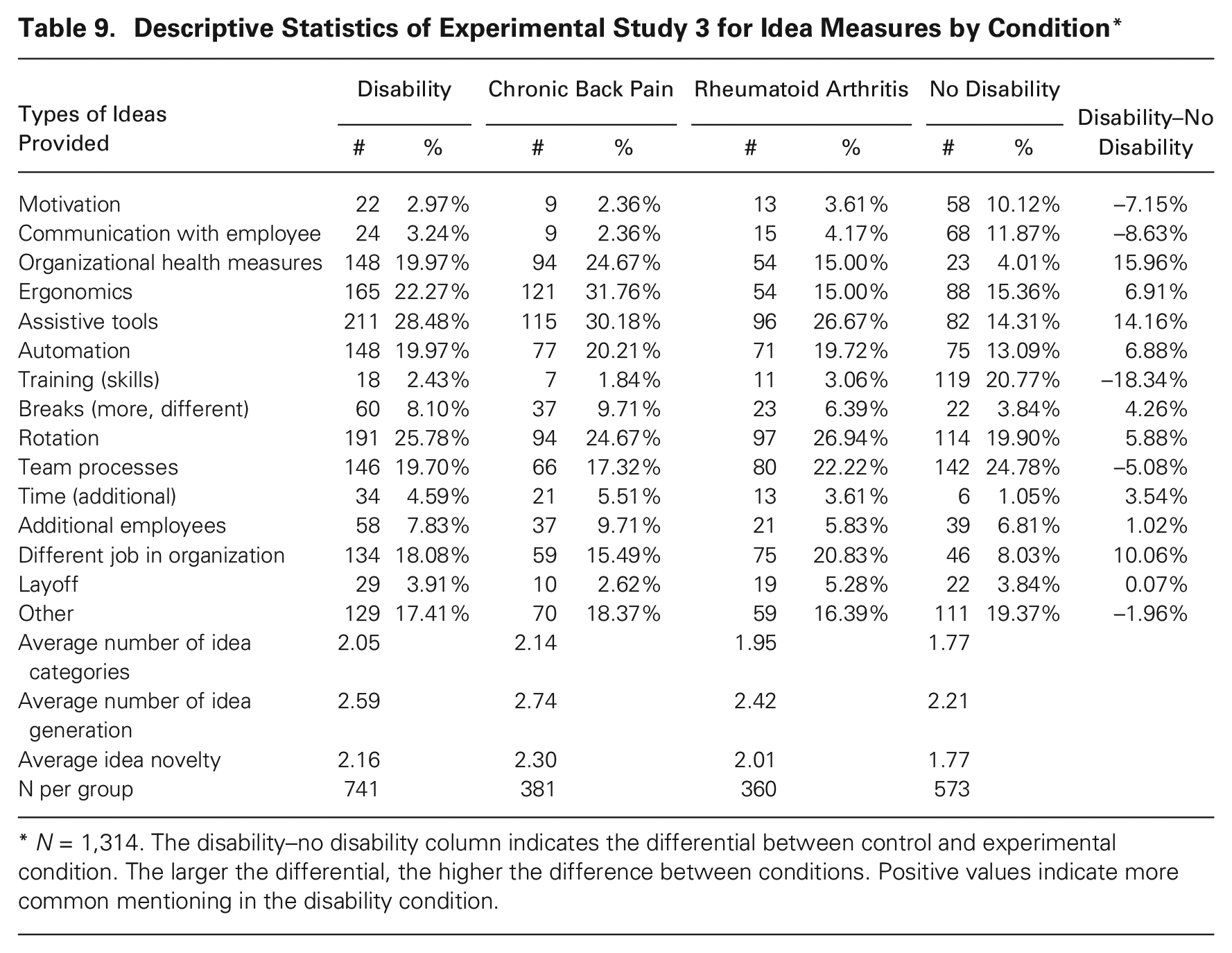
N = 1,314. The disability–no disability column indicates the differential between control and experimental condition. The larger the differential, the higher the difference between conditions. Positive values indicate more common mentioning in the disability condition.
The mediation effect of cognitive flexibility in the disability–idea generation/idea novelty relationship
Next, we tested whether cognitive flexibility mediates the effect of having a colleague with a disability on idea generation and idea novelty. Bootstrapping results with 2,000 replications indicate that the indirect effects on idea generation (B = .059, CI = [.031 .087]) and novelty (B = .104, CI = [.054 .154]) were significant. 5 These results support Hypotheses 3 and 4.
The moderated mediation effect of perspective taking on the link between disability and idea generation/idea novelty via cognitive flexibility
Finally, we tested first-stage moderated mediation effects of perspective taking on the link between having a team member with a disability and idea generation via cognitive flexibility, and the link between having a team member with a disability and idea novelty via cognitive flexibility. For idea generation, the index of moderated mediation (Hayes, 2015) was not significant (B = .007, CI = [–.051 .066]). For idea novelty, the index of moderated mediation was not significant, either (B = .007, CI = [–.047 .060]). Thus, Hypotheses 5 and 6 were not supported.
Robustness Checks
The same robustness checks as those used in Study 2 did not significantly change our results. First, while our random assignment of participants to conditions allows for equivalence of measured and unmeasured third variables, we included control variables that could be perceived as affecting our results. These variables included education level, whether participants work in a manufacturing job, whether they work in the manufacturing industry, whether they work in a creative job, whether they work in a creative industry, whether they have a chronic or long-term illness or health issue, whether they have a disability, how often they have contact with an individual with a disability, and whether they have friends or family with a disability. Second, we included as controls only education level, whether participants had a creative job, whether they work in a creative industry, and whether they have friends or family with a disability, since they were significant predictors of idea generation (for novelty, only the first two were significant). Third, we tested the moderation and moderated mediation effects of perspective taking with a trait (more analogous to Study 1) and state measure (i.e., with the same items from Study 1, using only the participants in conditions in which we did not manipulate perspective taking). The results were in line with our main findings and do not indicate a significant effect of perspective taking. Finally, we provided different amounts of information in our control and experimental conditions. In the control condition, we simply stated that it is unclear why Hans faces difficulties completing the assigned tasks within 50 seconds. In the experimental conditions, we provided chronic back pain or rheumatoid arthritis in his hands as reasons. To address concerns that this additional information could serve as a jumping off point for idea generation and, therefore, lead to more ideas, we conducted another preregistered experiment. 6 The results of this experiment show that participants in our original control condition and participants in four alternative non-disability control conditions (i.e., because [1] he lacks motivation, [2] he lacks skills, [3] his team communicates poorly, and [4] he gets nervous) generated similar amounts of ideas (B = –.065, p = .598, two-tailed). This indicates that our control condition is comparable to alternative control conditions that provide more information and that it is not driving the significant results from Studies 1 and 3. Detailed results can be found in Online Appendix A.
Experimental Study 3: Discussion
We found that, in line with our hypotheses, having a colleague with a disability leads to more cognitive flexibility and that such an increase in the breadth of thinking, in turn, relates to more idea generation and idea novelty. As in Study 2, the effect of perspective taking was not significant. Together, these findings speak to the robustness of our results.
Overall Discussion
Our article focuses on disability, an increasingly important but understudied topic for organizations and society (Beatty et al., 2019; Dwertmann, 2016). Across one large-scale field study and two experiments, we showed that disability is linked to two important creativity outcomes: idea generation and idea novelty. Contrary to prior literature, we focus on colleagues of persons with disabilities as the source of creativity and show that cognitive flexibility mediates the relationships between having a colleague with disabilities and creativity outcomes. While we also find that perspective taking moderates the link between disability and idea generation in our field study, the effect did not replicate in our experiments. These findings have several important implications for theory and research on disability, diversity, and creativity.
Theoretical Implications
First, integrating creativity theory into the disability literature enabled us to challenge the dominant perception of disability as a burden for organizations that requires costly accommodations (Baldridge & Swift, 2016; Colella, 2001). Whereas the goal of prior research has been to convince organizations that accommodations are less expensive than expected (Nevala et al., 2015; Schur et al., 2014), a view that is also explicitly reflected in legislation, where the granting of an accommodation is considered in light of its potential to pose “undue hardship” to the employer (U.S. Equal Employment Opportunity Commission, 2002), we have argued that this negative focus misses an important point. In reality, society at large and most workplaces are designed with ableist norms as the default, and such a focus on the ideal worker who is able-bodied and able-minded (cf. Dwertmann & McAlpine, 2023; Foster & Wass, 2013) leads to imperfect design. It does not account for the more than 16 percent of the population who have a disability (WHO, 2022), people whose impairments fall just below the threshold of disabling, and the many more who will acquire a disability. Given that these ableist norms are so baked in and nearly ubiquitous, they frequently go unnoticed unless they are brought to someone’s attention, such as when someone works alongside a person with a disability who faces challenges navigating a particular environment. Our results across studies and methods show a robust effect of disability on idea generation and idea novelty. Furthermore, we argued and showed in our field data that these generated ideas can be beneficial to employees without disabilities as well, leading to their implementation (i.e., innovation) and, likely, to additional positive effects, for example in terms of job attitudes, commitment, and morale (Colella & Bruyère, 2011). While we did not formally test a hypothesis on this due to limited space, we also coded our idea data from the experimental studies for usefulness, based on an initial expert assessment by the official disability officer of our partner organization from field Study 1. Rooted in the contextual nature of creativity, an idea is considered creative when relevant experts agree (Amabile, 1983; Nijstad et al., 2010). The results show that the experimental ideas that were generated are also useful and could benefit other employees, in line with field Study 1. Thus, disability can be a driver of creativity and innovation.
Second, most disability and accommodations literature has operated under a narrow understanding of accommodation as an issue that affects individual employees and their immediate supervisors (but see, for example, Johnson et al., 2023 and Schur et al., 2014 for exceptions). Coworkers have almost exclusively received attention because of their potential negative reactions to granted accommodations (Colella, 2001; Colella et al., 2004; Paetzold et al., 2008). While there is value in this perspective, we advance the idea that coworkers need to be integrated into accommodations theory in a much more nuanced way. Accommodations can affect coworkers in myriad ways: They may have to help colleagues with a disability (Colella, 2001), they can indirectly benefit from accommodations or suffer from a lack of them if they work in a team with an employee with a disability (Colella et al., 1998), and so forth. Therefore, coworkers can often be actively involved in the accommodation process (changes in coworker behavior can even be a form of accommodation). Most people are not born with a disability but, rather, develop a disability over the course of their life (WHO, 2022). This means that they have often worked with their colleagues before and have built relationships with them. As is often the case in our field study context, colleagues can be friends and have a vested interest in their mutual well-being. Thus, they may be motivated to help. Even if that is not the case, persons with a disability may face paternalism and patronizing behavior (Lyons et al., 2018), which can result in helping behavior even if it is unwelcomed (Baumgärtner et al., 2014). Lastly, joint rewards or interdependent work motivates colleagues to be engaged in the accommodation process (Colella, 2001; Colella et al., 1998). Thus, coworkers need to be viewed as potentially active participants in the accommodation process.
Furthermore, compared to many other literatures in the management domain, the disability—and particularly the accommodation—literature lacks theoretical richness. We address this problem by not only changing our understanding of the role of coworkers but also by integrating the dual pathway to creativity model (De Dreu et al., 2008) into the disability literature to explain how disability can lead to coworker creative performance (i.e., idea generation and idea novelty). We found support for the idea that the presence of a colleague with a disability who works on a task in a nonstandard way or struggles with a given task heightens the salience of potential inefficiencies in workplace design that were formerly unnoticeable to coworkers; it expands employees’ basic assumptions about how work can and should be organized. Disability serves as a situational cue for coworkers that drives changes in cognition and cues them to engage in broader, more inclusive—rather than habitual or conventional—thinking and to consider approaches that might otherwise be hidden to them. Such cognitive flexibility is core to the flexibility pathway, built on foundational creativity theory that shows the associative nature of individual cognition (Nijstad et al., 2021). In our experiments, despite being presented with a manufacturing context that involves manual labor and puts strain on the body, participants in our control (non-disability) condition rarely suggested workplace improvements related to ergonomic improvements, organizational health measures, breaks, assistive tools, etc. Instead, they habituated to motivational, training, and skill-related ideas. Participants in the disability conditions did not assume employees are, and remain, able-bodied when generating workplace efficiency ideas (e.g., associating speed and strength with effective work performance). While they provided motivation- and skill-related ideas in line with these assumptions, they also expanded their thinking to provide health- and ergonomic-related ideas as well (see Table 9), effectively suggesting working smarter, not harder.
Third, whereas diversity theory has relied on the idea that a greater skills range and more resources inherent in diverse units (which are implicitly assumed to stem from minority members who contribute their uniqueness; van Knippenberg & Schippers, 2007; Williams & O’Reilly, 1998) can lead to creativity and innovation if unique information is shared and elaborated on (van Knippenberg et al., 2004), we show in our experimental studies that disability leads to idea generation. The effects we theorize and find are inconsistent with these two established assumptions, because chronic back pain or arthritis is not associated with extra skills or resources, and because our individual-level experiments do not include information sharing or elaboration. The idea, supported by our findings, that a so-called weakness or inability to do something can lead to positive effects is rather unique to the disability—and, also, to the broader diversity—literature, and is not explained by theory in either area. These results also show that disability can function differently from other demographic diversity types with which it is typically grouped (Dirth & Branscombe, 2018; Nkomo et al., 2019; Shore et al., 2009). Contrary to sex, race, and so forth, disability by definition captures functional differences (Dwertmann, 2016). And whereas other types of diversity may still be associated with a lack of access to skills/resources, this lack stems from societal structures rather than individual impairments. Contrary to diversity theory (and relational demography research, which posits negative incongruence effects; Colella & Varma, 2001; Dwertmann & Boehm, 2016; Joshi et al., 2011), we find that having a colleague with a disability highlights ableist assumptions and makes employees realize that not everyone fits the ideal worker norm of having no impairments (Campbell, 2009; Jammaers et al., 2016; van Laer et al., 2022). This prompts cognitive flexibility, which spurs idea generation. Thus, at least to some extent, exposure to others with a disability seems to enable individuals to comprehend what it is like to work with functional impairments and what is needed to make work easier and more efficient.
Fourth, we contribute to the dual pathway to creativity model and theory on cognitive flexibility (De Dreu et al., 2008; Nijstad et al., 2021). Given the model’s roots in experimental social psychology literature and individual cognitive psychology, it is unsurprising that existing research on the model has focused on individual mood (e.g., positive activating mood states like happiness and negative activating mood states like anger; De Dreu et al., 2008; Nijstad et al., 2010) and motivational states (e.g., approach-related and avoidance-related motivation; Baas et al., 2011; De Dreu et al., 2011; Roskes et al., 2012) as situational cues that activate the flexibility or persistence to creativity pathway. We showed that the dual pathway to creativity model applies to real-world organizational processes at higher levels of analysis (i.e., unit), thereby extending it into the management literature on workplace creativity (Lu et al., 2019; Rouse, 2020; Zhou & Hoever, 2023). Having a colleague with a disability can serve as a situational cue that fosters cognitive flexibility and, ultimately, creativity. We hope that this highlights new avenues for using the dual pathway to creativity model to examine organizational creativity processes (Nijstad et al., 2021).
Boundary Conditions of Our Theorizing
Our findings raise important questions about the boundary conditions of our theorizing that can be leveraged for future work. Given prior work, for example, we believe that a certain level of motivation is important for the effects that we find to occur (Collins & Amabile, 1999). In our field study, participants could be expected to show a sufficient level of motivation to observe challenges based on functional differences and to translate those into ideas because they profited (a) directly from the financial recognition for implemented ideas and (b) indirectly by improved work processes for themselves. In experimental Studies 2 and 3, respondents also profited financially from being creative, since we offered a bonus to the participants who provided the highest number of quality ideas. In general, interdependent work may foster such motivation, since colleagues have a vested interest in their coworkers with disabilities being able to perform at their highest potential. We addressed this condition empirically by including a measure for prosocial motivation (Grant, 2008), the desire to benefit others, in Study 3. Including it as a control did not change our results, and in fact, we do not find significant differences in prosocial motivation between the disability and control conditions (i.e., it did not function as an alternative mediator).
Another boundary condition is likely the type of disability. Certain disabilities are more common, and individuals may more easily comprehend what it is like to have these disabilities (e.g., chronic back pain in our studies) and what the resulting challenges are. This could ease the generation of workplace improvement ideas, a notion for which we found exploratory support in Study 2, in which participants in the chronic back pain condition generated more ideas than participants in the arthritis in fingers and hands condition did. Having more common disabilities may also relate to the broader usefulness of ideas for other employees because more employees are likely to struggle with similar impairments, even if they have not (yet) risen to the level of a disability. We see the testing and further development of these ideas as an exciting direction for future inquiry into accommodation effects.
The type of job is likely another boundary condition. Although our studies were situated in a manufacturing and, thus, physical blue-collar context, there are many examples of the benefit of disability accommodations in a range of other contexts. For example, e-books were developed to allow blind people to access information (Lazar et al., 2015). The touchscreen and multi-finger gestures (e.g., two-finger scrolling) used on iPhones and iPads were developed to address carpal tunnel syndrome (McGrane, 2002). The ability to blur the background in video calls was developed to ease lip-reading for people who are deaf or hard of hearing (Daehn & Croxson, 2021). These examples relate more to white-collar office work and show the potential of our findings to generalize to other types of jobs and industries. For instance, future research on neurodiversity in the workplace (Ezerins et al., 2024) might find similar patterns of results for accommodations. For example, installing LED instead of florescent lighting and noise-canceling measures in office environments might not only help employees with autism spectrum disorder to better concentrate but should be beneficial for all employees.
A final potential boundary condition is a certain minimum level of domain-relevant skills and expertise. In fact, since creativity is inherently context dependent, experts can best assess whether an idea is novel and useful in a given context (Amabile, 1983; Nijstad et al., 2010). For example, one must know what already exists to judge the novelty of an idea. Therefore, a certain level of expertise might be necessary for creativity to emerge, since it enables understanding of task requirements, observing task execution problems, and developing task alterations. In field Study 1, this level of skills and expertise could clearly be expected. In Studies 2 and 3, laypeople from the general working population participated. The fact that they were still able to increase their cognitive flexibility and come up with more and more-novel ideas is exciting, as it points to the potential generalization of our findings to non-specialist samples. More research in this area seems warranted.
Limitations
Although our studies benefit from numerous strengths (e.g., a large-scale unit-level dataset that includes objective and time-lagged data for external validity, as well as two experiments that provide realistic materials, have high internal validity, and enable causal claims to be made), there are limitations that should be noted. We acknowledge possible limits to the generalizability of our findings. Although our field study sample is representative of the organization, all 7,037 study participants work for a single organization located in Germany. While there are a few similarities between the German context and other country contexts (e.g., 103 countries provide disability employment quotas; ILO, 2019), the treatment of disability depends on the cultural or country context (Schloemer-Jarvis et al., 2022). Thus, future research should seek to replicate our findings in other cultural contexts to bolster the theoretical and practical applications of our results. In addition, our partner organization is committed to continuous improvement processes through regular workshops and so forth. This strong commitment likely contributed to the idea-generation effects that we observed. Our experiments provided robustness tests, but future research should still investigate the disability–idea generation link in organizations that are less intentional in their work design.
Disability is not a monolithic construct; instead, it consists of multiple types of conditions with varying severity (Dwertmann, 2016). We were unable to capture this nuance in our field data as we had access only to the employees’ official disability status (a binary yes or no, not the type or severity of disability) stored in the HR systems. However, based on our conversations with management and company doctors of the partner organization over more than ten years, we do not believe this to be a major threat to our results. In fact, as anonymized and aggregated data on the underlying diagnoses showed, nearly all disabilities were of a physical nature. The exact diagnoses are not stored in the HR data but are known only to the company doctors (in specially protected medical files) and cannot be shared with other stakeholders. Therefore, we could not match the finer-grained disability data with other data in our study. This implies that considering our results, we can make solid predictions about the role of physical disabilities for creativity, but future research is needed to explore the potential of other types of disabilities for idea generation. Another aspect of disability to note is disability severity. Like disability type, this was held largely constant in our field study because employees’ impairments had to be severe enough to allow them to procure the official disability card, while also being moderate enough to allow for work in a production unit of a competitive, market-based organization in which most of their colleagues did not have a disability. In our experiments, we found that the two disability conditions—chronic back pain and rheumatoid arthritis, both common physical disabilities in our field sample—led to greater cognitive flexibility and idea generation. Thus, we assume that our findings generalize at least to other physical disabilities of moderate severity. Yet, additional research on the generalizability of our findings would be beneficial.
To test our mediation model in Study 3, we followed established norms and prior creativity research (e.g., Althuizen & Chen, 2022; De Dreu et al., 2008; Kühnel et al., 2022; Tang et al., 2024) by coding participant ideas to operationalize a creativity process indicator (cognitive flexibility) and two creative outcomes (number of ideas, idea novelty). We decided to do so because alternatives such as coding cognitive flexibility based on another task (e.g., via the Alternative Uses Task; Guilford, 1967) would have created challenges of their own, such as not measuring whether increased cognitive flexibility was used on our actual creativity task. Still, using our operationalization means that there is a lack of temporal precedence for the tested mediator to outcome linkage. Ideally, future research would provide such temporal precedence for this test.
Finally, whereas we were able to replicate most of our findings across different studies and methods, we did not find consistent support for the role of perspective taking. Although theoretical and empirical research (Amabile, 1996; Grant & Berry, 2011; Hoever et al., 2012), as well as the results from our field Study 1, support the idea that colleagues’ active adoption of others’ viewpoints assists the generation of new ideas in the context of disability, Studies 2 and 3 did not replicate this finding. Consequently, additional studies may be warranted to explore whether Study 1’s results were driven by the specific organizational context (e.g., regular joint workshops between employees with and without disabilities, which enabled colleagues to adopt each other’s perspective more effectively) or whether the experimental setting in Studies 2 and 3 failed to create the necessary level of immersion to allow employees to successfully take the perspective of the colleague with a disability. The difference in results could also be due to the fact that it is much easier to adopt the perspective and understand the challenges of a coworker with a disability with whom one works daily, compared to doing so through a written vignette.
Conclusion
Our conceptualization of disability—not just as an individual impairment that requires accommodation but as a catalyst for individual- and unit-level creativity—and the integration of the disability literature with the creativity literature offer new ways to examine disability and its effects in organizations. We hope that these results encourage scholars and practitioners to devote more interest to the topic of disability, increase the level of theoretical richness of disability research, and develop a more nuanced understanding of the potential effects of disability in the workplace.
Supplemental Material
sj-pdf-1-asq-10.1177_00018392251326110 – Supplemental material for Organizational Burden or Catalyst for Ideas? Disability as a Driver of Cognitive Flexibility and Creativity
Supplemental material, sj-pdf-1-asq-10.1177_00018392251326110 for Organizational Burden or Catalyst for Ideas? Disability as a Driver of Cognitive Flexibility and Creativity by David J. G. Dwertmann, Stephan A. Boehm, Kristie L. McAlpine and Mukta Kulkarni in Administrative Science Quarterly
Footnotes
Acknowledgements
We would like to acknowledge the helpful comments and suggestions by associate editor Aparna Joshi and three anonymous reviewers.
1
2
In our original submission, we included another preregistered experiment ( ), which also showed the effect of having a colleague with a disability on cognitive flexibility (and the mediation of cognitive flexibility in the disability–idea generation effect exploratively). We removed it during revisions due to limited space.
3
We thank an anonymous reviewer for the suggestion to examine the effect on idea novelty and usefulness. We tested our models including both outcomes and found comparable results. We state a formal hypothesis for only novelty, given space restrictions.
5
We also coded idea usefulness and ran all models with usefulness as the dependent variable. Results are robust.
Authors’ Biographies
References
Supplementary Material
Please find the following supplemental material available below.
For Open Access articles published under a Creative Commons License, all supplemental material carries the same license as the article it is associated with.
For non-Open Access articles published, all supplemental material carries a non-exclusive license, and permission requests for re-use of supplemental material or any part of supplemental material shall be sent directly to the copyright owner as specified in the copyright notice associated with the article.
