



Abstract
Despite the benefits associated with interorganizational collaborations, they often fail to meet partnering firms’ expectations. A common issue is competitive tension between partners. Yet, competitive tension is a well-known issue in collaboration, such that partners should be able to set expectations and manage it accordingly. Why, then, does competitive tension often derail collaborations? We suggest that whether partners perceive each other as competitors is a key but understudied aspect of how competition shapes collaboration. We hypothesize that misaligned perception—one firm perceiving the other as a competitor but not vice versa—leads to misplaced expectations about partner behavior and collaboration performance and subsequent failure to meet those expectations. We test our theory in the U.S. software industry and find that collaborations characterized by misaligned perception are less likely to be renewed, even after controlling for partner quality and market overlap (i.e., objective competitive tension). Our examination of the social structure surrounding collaborations illustrates how the perceptions of third parties can moderate the effect of misaligned perception. We examine mechanisms and find that misalignment is linked to litigation between partners and lower collaboration performance. We contribute to the literatures on interfirm collaboration and on perception in social networks.
Interorganizational collaborations can increase firms’ innovation and performance through knowledge exchange (Ahuja, 2000; Baum, Calabrese, and Silverman, 2000; Rosenkopf and Almeida, 2003; Schilling and Phelps, 2007; Kumar and Zaheer, 2019). Renewed collaboration with the same partner is associated with even greater benefits (Gulati, 1995; Elfenbein and Zenger, 2014; Zhelyazkov and Gulati, 2016). Yet, collaborations often fail to meet one or both partners’ expectations, leading to a decision not to renew their collaboration (Park and Ungson, 1997; Poppo and Zenger, 2002). This raises the question: What underlies the gap between firms’ expectations for a collaboration and the actual collaboration?
We focus on a prevalent feature of interorganizational collaborations: competitive tension. In collaborations characterized by competitive tension (compared to those without), partners share resources and knowledge less openly and keep each other at arm’s length (e.g., to avoid misappropriation) (Park and Russo, 1996; Khanna, Gulati, and Nohria, 1998; Uribe, Sytch, and Kim, 2020). Still, it is not clear why competitive tension leads collaborations to fall short of expectations and, consequently, fail to renew. Given that competitive tension in collaborations is common, well understood, and can be managed (Zollo, Reuer, and Singh, 2002; Elfenbein and Lerner, 2003; Hallen, Katila, and Rosenberger, 2014), one would assume that managers could set appropriate expectations and manage the collaboration accordingly. It is thus puzzling that competitive tension often derails collaborations (Khanna, Gulati, and Nohria, 1998; Vasudeva, Leiponen, and Jones, 2020). We address this puzzle by theorizing that it is not necessarily the presence but, rather, firms’perception of competitive tension that derails collaborations. Specifically, we theorize that partners need to be aligned regarding whether they perceive each other as competitors.
We distinguish three cases of perceptual alignment: (1) partners are aligned in perceiving each other as competitors (mutual perceived competition), (2) partners are aligned in not perceiving each other as competitors (no perceived competition), and (3) partners are misaligned—one perceives the other as a competitor but not vice versa (misaligned perceived competition). We suggest that each case comes with different expectations for how the partner will act (partner behavior) and for the outcome of the collaboration (collaboration performance). We theorize that expectations are more likely to be met when partners are aligned in whether they perceive each other as competitors (either mutual or no perceived competition), such that misaligned perception is negatively related to collaboration renewal.
The theorized mechanism is as follows. Collaborating firms that are perceptually aligned are both likely to have low expectations (mutual perceived competition) or high expectations (no perceived competition) for their partner’s behavior and the collaboration’s performance. In both aligned cases, expectations are likely to be met because partners act in accordance with them. By contrast, in the case of misaligned perceived competition, one firm (hereafter “ego”) does not perceive its partner (hereafter “alter”) as a competitor, while alter does perceive ego as a competitor. In this case, ego is—but did not expect to be—treated by alter as a competitor. Ego does not get the expected resource and knowledge sharing from alter, who is instead guarded and distant, and ego may even be injured by unexpected offensive actions (e.g., misappropriation) for which it is not prepared. As a result, the collaboration is likely to fall short of ego’s misplaced expectations, which, in turn, reduces its willingness to renew the collaboration.
The origin of the Sony PlayStation is a particularly consequential example of misaligned perception derailing a collaboration. In the early 1990s, Nintendo and Sony began an R&D collaboration to develop and jointly release a CD-based video game console. Because Sony had no intention of engaging in the console business without Nintendo, it did not see Nintendo as a competitor and thus collaborated with high levels of trust. But Nintendo perceived Sony as a possible competitor and did not trust it. This came to a head publicly when Nintendo announced that it had developed a separate CD-based console immediately after Sony had unveiled the console that it believed it was launching with Nintendo. The embarrassment angered Sony enough that it terminated the partnership and introduced the PlayStation under its own brand. If Nintendo and Sony had been aligned in their perceptions of each other, they might have spent the subsequent decades as fruitful collaborators rather than fierce competitors.
To test our theory about the effect of misaligned perception on collaboration renewal, we study U.S. software industry data covering the period 1995 to 2012 (Bresnahan and Greenstein, 1999; Graham and Somaya, 2004; Hallen, 2008). We leveraged press releases to capture firms’ collaborations (Zaheer and Usai, 2004; Schilling, 2009) and SEC filings to capture whether firms perceive a collaboration partner as a competitor (Porac, Wade, and Pollock, 1999; Thatchenkery and Katila, 2021). To test the theorized mechanisms of collaborations failing to meet expectations for partner behavior and collaboration performance, we gathered data on announced and actually released products as well as data on litigation between partners. We supplemented the quantitative data with qualitative evidence, including interviews with 26 industry informants, which helped us to define our measures and interpret our results.
When looking at the three cases of perceptual alignment, we find that collaboration renewal is least likely when there is misaligned perception. Examining mechanisms, we find that performance expectations differ across the three alignment cases, with misaligned collaborations being the least likely to meet performance expectations and the most likely to result in litigation. We also theorize and find that the effect of misaligned perception depends on the social structure in which the perceptually misaligned collaboration is embedded.
Our main contribution is to highlight perceptual alignment as a crucial antecedent to effective collaboration, thus contributing to research on interorganizational collaboration (e.g., Gulati, 1995; Ahuja, 2000; Owen-Smith and Powell, 2004; Aral and Van Alstyne, 2011). Our study helps to resolve a puzzle: Why does competitive tension derail so many collaborations given that it should be manageable (Hoetker and Mellewigt, 2009; Asgari et al., 2018)? We show that the problem is not competitive tension per se but partners’ misaligned perception of it. In doing so, we highlight the role of perception in the dynamics of collaboration (Rowley et al., 2005; Greve et al., 2010) and in how social structure co-shapes collaboration (Gulati and Gargiulo, 1999; Shipilov and Li, 2012; Tatarynowicz, Sytch, and Gulati, 2016). Our focus on perceptual alignment also informs the broader literature on network perception (Krackhardt, 1987; Smith et al., 2020).
Theoretical Background
Interorganizational Collaboration
Given the substantial and wide-ranging consequences of (repeated) collaboration, the decision to renew or not renew a collaboration is crucial. 1 Research on the behavioral theory of the firm provides a simple but powerful explanation: Organizations tend to change when they perform below aspirations (Greve, 1998, 2003; Audia and Greve, 2006; Gavetti et al., 2012; Gaba and Joseph, 2013; Keum and Eggers, 2018) and are therefore likely to not renew collaborations that have failed to meet their expectations (Azoulay, Repenning, and Zuckerman, 2010; Dahlander and McFarland, 2013; Clough and Piezunka, 2020). Importantly, for non-renewal to occur, collaborations need to fall short of only one partner’s expectations, as renewal requires agreement by both partners (Mindruta, Moeen, and Agarwal, 2016; Clement and Puranam, 2018; Argyres, Bercovitz, and Zanarone, 2020). While the link between unmet expectations and the decision to not renew is well established, it is less clear why collaborations so often fall short of expectations.
To explain why partners’ expectations are often not met, we focus on a factor shown to derail collaborations: competitive tension. Collaborations often feature competitive tension because “the same structural conditions that seed competition also present opportunities for collaboration” (Ingram and Yue, 2008: 276; Barnett and Carroll, 1987; Gimeno and Woo, 1996; Ingram and Roberts, 2000; Grohsjean, Piezunka, and Mickeler, 2025). The prevalence of competitive tension when firms collaborate is well documented (Das and Teng, 2000; Gimeno, 2004; Heidl, Steensma, and Phelps, 2014; Uribe, Sytch, and Kim, 2020; Vasudeva, Leiponen, and Jones, 2020).
Collaborations with and without competitive tension differ in terms of expected partner behavior and collaboration performance. Collaborations without competitive tension are often embedded, with partners openly sharing resources and knowledge (Granovetter, 1985; Uzzi, 1996; Doering, 2018). In contrast, collaborations with competitive tension are like arm’s-length relationships (Williamson, 1981; Hoffmann et al., 2018), with partners carefully guarding which resources and knowledge they share and maybe even needing to take action to protect themselves from their partner (Argyres and Mayer, 2007; Weber and Mayer, 2014). While contractual safeguards can mitigate misappropriation, they cannot govern every interaction within the collaboration. 2 Thus, the outcomes of collaborations with and without competitive tension tend to be very different. Accordingly, firms should have different expectations; specifically, they should have lower expectations for collaborations with competitive tension than for those without such tension. It is therefore puzzling that competitive tension so often derails collaborations, as firms should foresee it and adjust their expectations.
We theorize that partnering firms may differ in whether they perceive each other as competitors and that such misaligned perception may hinder collaboration. We suggest that misaligned perception leads to misplaced expectations about the collaboration, which in turn leads to mismanagement of the collaboration and eventual failure to meet expectations. The concept at the core of our theory—partners being misaligned in how they perceive each other—is anchored in the research on network perception.
Network Perceptions
The literature on network perception points out that relationships are not objectively given but are in part cognitive (Krackhardt, 1987; Brashears and Quintane, 2015). Smith and colleagues (2020: 160) considered networks to be “not only social structures but also structures that exist in the mind.” Research has examined how network participants perceive the network’s overall structure, with emphasis on how accurately they perceive ties across the network (Kilduff et al., 2008; Simpson, Markovsky, and Steketee, 2011; Brands, 2013). Building on this research, we focus on how two actors perceive their own relationship (Krackhardt, 1987), thus shifting the focus from accuracy to alignment, i.e., not whose perception is correct but whether the two parties agree.
Research specifically on perceptions of competitive relationships shows that competitive tension is not simply objective but also a question of perception (Porac et al., 1995; Cattani et al., 2018; Thatchenkery and Katila, 2021; Grohsjean, Piezunka, and Mickeler, 2025). 3 Studies on the antecedents of whom firms perceive as competitors (Porac et al., 1995; Clark and Montgomery, 1999) hint at several potential origins of perceptual misalignment. Discrepancies in firm characteristics can lead to asymmetries in perception (i.e., misalignment); for example, smaller or lower-status firms are more attentive to larger or higher-status firms than vice versa (Porac et al., 1995; Kilduff, Elfenbein, and Staw, 2010). Even similar firms often use different criteria to identify competitors; for example, some firms focus on technological similarity and some focus on customer overlap (Reger and Huff, 1993; Baum and Lant, 2003; Ng et al., 2009; Tsai, Su, and Chen, 2011; Dupin and Wezel, 2023). Combined with limits on managerial attention (Zajac and Bazerman, 1991; Ocasio, 1997), these differences in how firms perceive and prioritize competition can yield misalignment. Thus, while misalignment has not yet been the focus of research on network perception, prior research does point to reasons it may occur.
Our theory—that misaligned perception results in mismatched expectations and mismanagement of a collaboration and thus reduces the chances of collaboration renewal—bridges and complements two literatures. The literature on interorganizational collaboration underscores the importance of competitive tension but has yet to feature partners’ perceptions of each other. The literature on network perception has shown that perceptions of relationships matter but has yet to investigate whether partnering organizations are aligned in how they perceive each other and how that affects their partnership.
Hypotheses
We distinguish collaborations by whether partners perceive each other as competitors. We differentiate three cases: (1) firms are aligned in seeing each other as competitors (mutual perceived competition), (2) firms are aligned in not seeing each other as competitors (no perceived competition), and (3) firms are misaligned, as one perceives the other as a competitor but not vice versa (misaligned perceived competition). Figure 1 represents these cases.
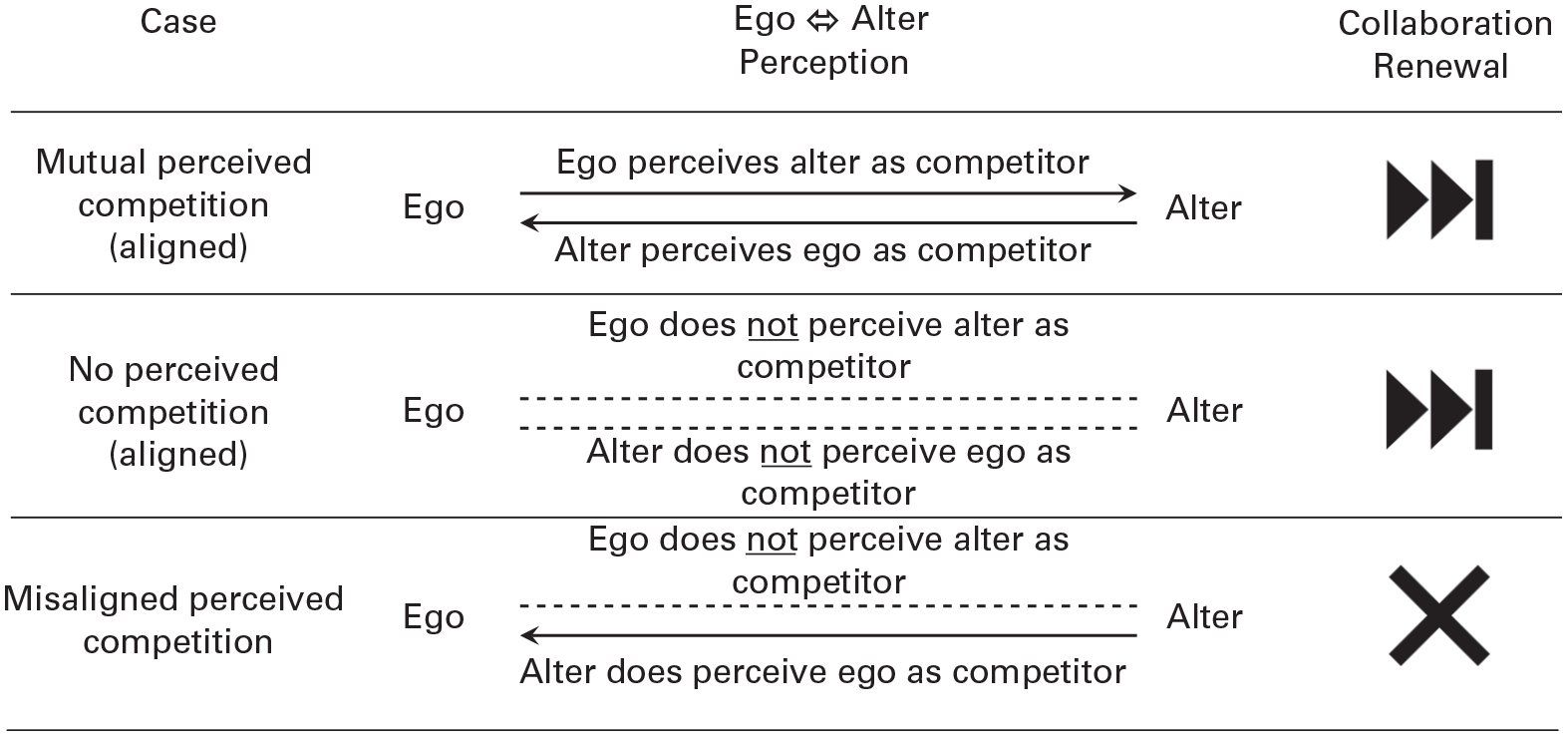
Three Cases of Perceptual Alignment in Collaborations
Our theoretical argument builds on research linking network perception (actors’ perceptions of their relationships) to expectations. Byron and Landis (2020) proposed that disagreement on the nature of a relationship results in expectancy violations. Actors develop expectations of how a partner will behave and of the potential outcomes of their relationship based on how they perceive that partner and the relationship. Perception is therefore likely to be consequential for collaboration yet has received surprisingly little attention. We suggest that perceptual alignment (or lack thereof) determines whether partner behavior and collaboration performance match (or violate) expectations, thus influencing collaboration renewal.
Consider the first case: collaborations in which partners are aligned in perceiving each other as competitors (mutual perceived competition). We suggest that expectations for such collaborations tend to be low and, crucial for our argument, are likely to be met. Typically, both firms expect an arm’s-length relationship and for their partner to behave accordingly, i.e., they do not expect their partner to openly share resources and knowledge and may even expect their partner to behave opportunistically (Asgari et al., 2018). Both firms are therefore likely to take precautionary actions to minimize appropriation risk. For example, they may use safeguards (Poppo and Zenger, 2002; Ryu, McCann, and Reuer, 2018; Hanisch et al., 2024) or limit what they share with partners (Katila, Rosenberger, and Eisenhardt, 2008; Kilduff et al., 2024). We also suggest that their expectations regarding collaboration performance are rather low given that it is an arm’s-length relationship. Since both partners are likely to behave and manage the collaboration in accordance with expectations, those (comparatively low) expectations are likely to be met, making renewal likely.
Now consider the second case, in which both partners are aligned in not perceiving each other as competitors (no perceived competition). These collaborations are likely to meet firms’ comparatively higher expectations for partner behavior and collaboration performance. In the absence of perceived competition, firms expect an embedded collaboration characterized by trust, openness, and resource sharing (Granovetter, 1985; Powell, 1990; Uzzi, 1996; Zaheer, McEvily, and Perrone, 1998; Doering, 2018). With respect to partner behavior, this case implies that firms expect their partner to share resources and knowledge openly and not to engage in opportunistic behavior. With respect to collaboration performance, firms are also likely to expect the benefits associated with embedded collaborations (Granovetter, 1985; Uzzi, 1997; Bermiss and Greenbaum, 2016; Doering, 2018). In the absence of any perceived competitive tension, partners are likely to act in accordance with these expectations. Thus, while expectations may be high, particularly when compared to the case of mutual perceived competition, those expectations are also likely to be met.
Finally, consider the third case, in which collaborating partners are misaligned in how they perceive each other: One (ego) does not perceive the other (alter) as a competitor, while alter does perceive ego as a competitor. This misaligned perception is likely to result in ego having overly high expectations for alter’s behavior and for their collaboration’s performance. Because ego does not perceive alter as a competitor, ego is likely to act in good faith and behave in accordance with an embedded relationship characterized by trust, openness, and resource sharing (Uzzi, 1996; Sorenson and Waguespack, 2006) and to expect alter to fully reciprocate. Alter, however, sees ego as a competitor and is likely to, instead, be guarded, distant, and even opportunistic. In a misaligned collaboration, alter’s behavior is likely to violate ego’s expectations.
The performance of a misaligned collaboration is also likely to fall short of ego’s expectations. Ego expects the benefits of embedded relationships but is, instead, met with a guarded partner that does not grant access to new knowledge and resources. Ego thus does not benefit as much from the collaboration as it expected (Harrison and March, 1984; Azoulay, Repenning, and Zuckerman, 2010). The collaboration may even be harmful to ego: It may (over)share information that it should have kept secret (Gulati, Lavie, and Singh, 2009), while alter may act with guile and take advantage of an unexpectedly open and one-sided embedded relationship by misappropriating shared resources (Khanna, Gulati, and Nohria, 1998). The outcome is thus not only less positive than expected but possibly negative. Ego is likely to be quite disappointed and unlikely to want to renew the collaboration. 4
The three types of perceptual alignment in collaborations differ in terms of partners’ expectations and the chances of these expectations being met, as illustrated in Figure 2. Mutual perceived competition comes with relatively low expectations that are likely to be met, so renewal is likely. No perceived competition comes with relatively high expectations that are also likely to be met, so renewal is likely. In misaligned perceived competition, ego is likely to have high expectations (similar to the case of no perceived competition) that are not likely to be met, and the actual outcome is likely to be even below the case of mutual perceived competition, so renewal is less likely. These observations lead to the following hypothesis:
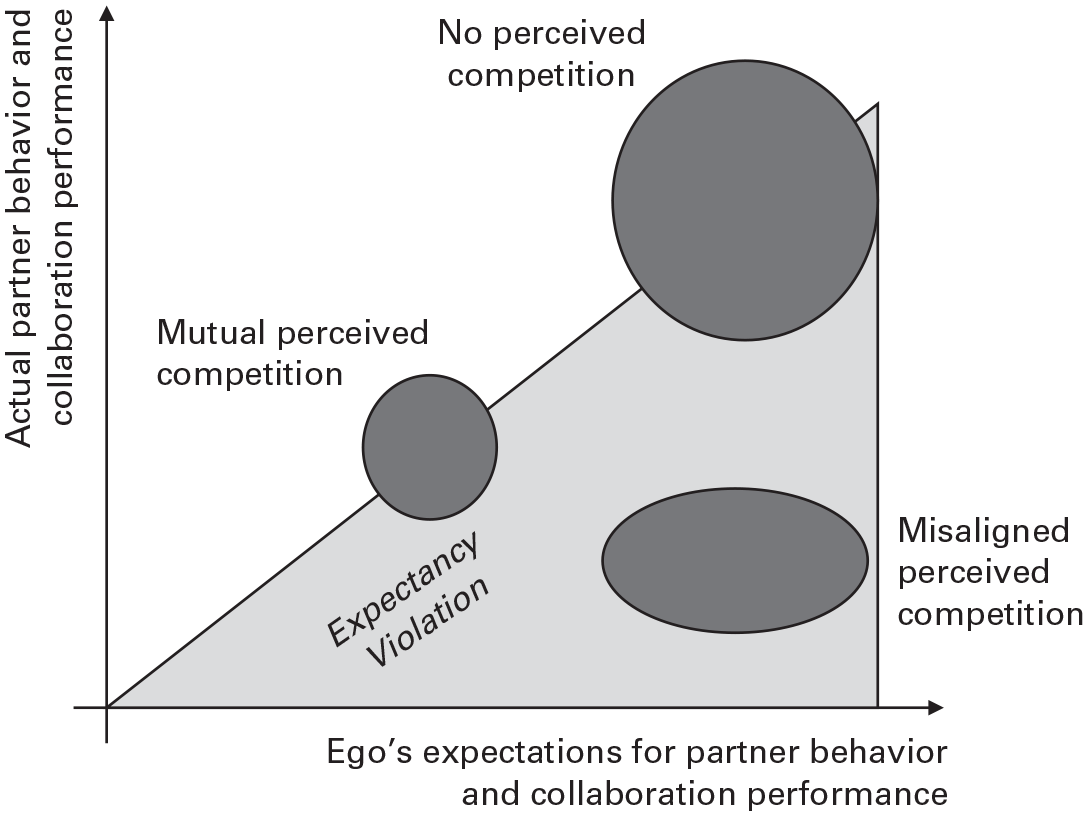
Hypothesized Expectations and Outcomes for Three Cases of Perceptual Alignment
Next, we suggest that the social structure in which a collaboration is embedded may attenuate the effect of misaligned perception on collaboration renewal. As theorized by Simmel (1950), the addition of a third party can ameliorate relational problems within a dyad; accordingly, research has shown how ties to third parties change a focal dyad’s dynamic (e.g., Shipilov and Li, 2012; Sytch and Tatarynowicz, 2014; Li and Piezunka, 2020). To study the impact of the surrounding social structure, we focus on misaligned dyads nested in multilateral collaborations: those with three or more partners (Greve et al., 2010; Gerges-Yammine and ter Wal, 2023). For conceptual clarity—and because the shift from two to three parties has a more significant impact on relational dynamics than does the shift from three to more parties (Simmel, 1950)—we focus on triads even though we expect our arguments would extend to larger collaborations.
In Hypothesis 2, we examine the case of a perceptually misaligned dyad that is part of a multilateral collaboration in which ego perceives the third party as a competitor (see Figure 3a). We suggest that the negative impact of misaligned perception on collaboration renewal for the focal dyad (ego and alter) will be attenuated in this scenario because the presence of a third party that ego views as a competitor changes ego’s expectations for the collaboration to be consistent with an arm’s-length relationship.
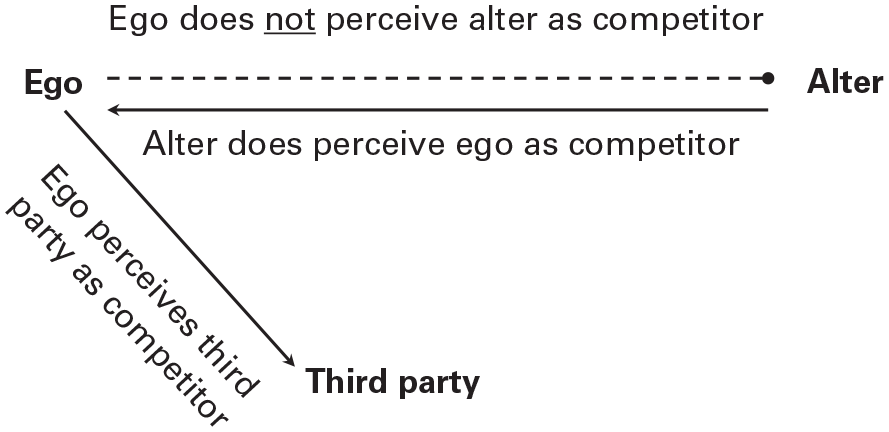
Triadic Collaboration with Misaligned Focal Dyad and Third Party Perceived Competitor (H2)
In a triadic collaboration with a third party that ego views as a competitor, ego will expect alter to behave as if the collaboration is arm’s-length rather than embedded. Ego will expect not only the third party to be guarded, distant, and to act opportunistically but also that alter will see the third party the same way and will itself consequently engage in guarded and distant behavior. The third party thus provides an excuse for alter’s behavior, making ego less likely to attribute this behavior to its own relationship with alter and rendering ego more likely to collaborate with that alter again. Ego is also likely to change its own behavior in managing the collaboration; specifically, ego is more likely to take precautionary measures (e.g., deploy safeguards). While these measures are supposed to protect ego against the third party it perceives as a competitor, they also protect ego from alter’s opportunistic behavior.
Ego is also likely to have lower collaboration performance expectations that reflect a more distant, arm’s-length collaboration, compared to the expectations ego would have if it were collaborating only with alter (which it does not perceive as a competitor). These lower expectations are likely to be met, making ego less likely to be disappointed in the collaboration. Thus, the presence of a third party that ego sees as a competitor changes ego’s expectations for the collaboration, mitigating the impact of misalignment in the focal dyad.
In Hypothesis 3, we propose a second way in which social structure can prompt corrections that mitigate misaligned perception. Social structure facilitates information flows that shape expectations for a partnership (Gulati and Gargiulo, 1999; Tatarynowicz, Sytch, and Gulati, 2016; Vanneste and Gulati, 2022). Information sharing within a triadic collaboration could reshape ego’s expectations of alter, thereby attenuating the negative impact of misalignment on renewal. We theorize that such information sharing is likely to occur when the third party has previously been in a misaligned collaboration with alter in which it did not see alter as a competitor (i.e., it held a perceptually equivalent position as that of ego to alter; see Figure 3b).
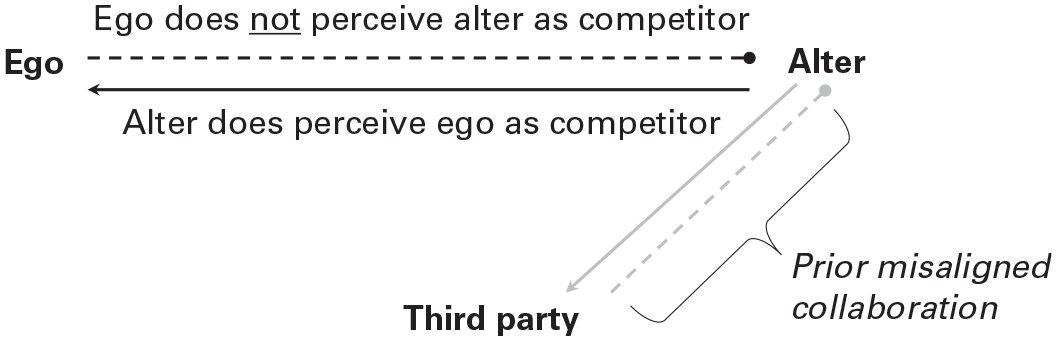
Triadic Collaboration with Misaligned Focal Dyad and Third Party Perceived Competitor (H2)
In this case, the third party is likely to both understand ego’s situation and be motivated to share information to help. Relative to a third party without such experience, the third party in this outlined constellation is likely to recognize ego’s misplaced expectations, as it had the same kind of misplaced expectations in the past and its direct involvement in the triadic collaboration provides it with a front-row view. Being a member of the collaboration also incentivizes the third party to share information with ego in order to increase the collaboration’s chances of success. Without a direct benefit to the third party, it would be less likely to share negative information about alter with ego, as the information is delicate, speculative, and of negative valence (Rosen and Tesser, 1970; Bond and Anderson, 1987). Thus, a third party with a prior misaligned collaboration with alter is likely to have useful information to share with ego and to be willing to share that information.
This constellation is also one in which ego is more likely to trust and act on the shared information about alter. Most crucially, the third party’s participation in the collaboration makes it a more trustworthy source of information than it otherwise might be. An outsider third party might be suspected of trying to undermine the collaboration or to replace ego as a partner for alter; in contrast, a third party that is part of the collaboration is directly invested in its success and thus is likely to be genuine. Trusting the third party’s information, in turn, makes ego more likely to attend to and act upon the shared information, changing its expectations for and interactions with alter in a way that mitigates the negative impact of misalignment in the focal dyad.
Method
Sample
We tested our hypotheses on a novel, hand-collected dataset of 121 public U.S. software firms covering the period between 1995 and 2011. 5 We focused on enterprise infrastructure software. These products form the backbone of enterprise computing and are used to manage and maintain complex information technology (IT) assets for corporations. Infrastructure software handles such critical functions as data backup, antivirus protection, and system performance. Prototypical firms in this industry include Symantec, Computer Associates, and Informix. Our data cover the entire population of public U.S. firms that developed software in the five infrastructure software markets defined by Gartner Research, a trusted software market research firm (Pontikes, 2012): developer tools, integration and middleware, database management, network and system management, and security.
The software industry has been a fertile area for research on both collaborative and competitive relationships (e.g., Young, Smith, and Grimm, 1996; Bresnahan and Greenstein, 1999; Hallen, 2008; Pontikes, 2012). Interorganizational collaboration in this setting is common (Lavie, 2007) and typically focuses on new product and technology development (R&D collaborations) or product bundling (marketing collaborations). Both types of collaboration tend to be brief and fixed in length, making the question of renewal particularly relevant. We also expect variation regarding perceptions of competition. As one CEO explained to us, “[In software,] there is never any hard data about competition, just assumptions.” Software firms therefore make sure to discuss their view of the competitive environment in investor disclosures, as we explain below. Finally, the nature of intellectual property (IP) protection in software makes the risks of misappropriation particularly potent. To protect core IP, software firms are more likely to rely on secrecy and selective disclosure than on formal patent protection (Graham and Somaya, 2004; Dushnitsky and Shaver, 2009). Expectations for how partners will behave—and thus the relative risk in disclosing IP—are therefore crucial.
Sample construction
We started by compiling a list of all public U.S. software firms. Following prior research (Lavie, 2007; Ndofor, Vanevenhoven, and Barker, 2013), we defined a software firm as one with either a primary or secondary classification under the SIC code “prepackaged software” 7372. 6 We classified a firm as an infrastructure software company if most of its product portfolio matched keywords from the Gartner IT Glossary. 7 We triangulated this information with The Software Catalog, an annual listing of software products (Thatchenkery and Katila, 2021), and with two industry experts to ensure a comprehensive sample. Cross-validation of these sources yielded a sample of 121 firms. Our sample exhibits regional concentration typical for the time period, with 31 percent of the firms headquartered in Silicon Valley, 11 percent in Southern California, and 9 percent in the Boston area.
Data Sources
Collaboration
Our key data sources for interorganizational collaborations are SDC Platinum and Factiva (cf Lavie, 2007; Schilling, 2009). 8 We restricted the sampling frame to collaborations between sample firms to ensure full data coverage, yielding 1,147 collaborations between 1995 and 2011. We further restricted the sample to collaborations of no more than three firms (so each dyad within the collaboration was likely to have meaningful interaction), yielding 919 collaborations. Our results are robust to including larger collaborations.
We examined press releases relating to each collaboration, to classify it as R&D (joint development of a new product or technology), marketing (joint sales or marketing of existing products), or other (encompassing a wide range of collaborative activities that are less common in our setting, such as corporate venture capital investment and hosting user conferences). We classified 541 collaborations as R&D, 296 as marketing, and 82 as other.
We focused our main analysis on R&D collaborations. These are particularly likely to involve intensive resource and knowledge sharing (e.g., Katz and Tushman, 1979; Anand and Khanna, 2000; Zaheer, Hernandez, and Banerjee, 2010; Reuer and Lahiri, 2014) and significantly more appropriation risk than other types of collaboration do (Diestre and Rajagopalan, 2012; Ryu, McCann, and Reuer, 2018; Palomeras and Wehrheim, 2021), making expectations for openly sharing (or not sharing) resources and knowledge more relevant. It can be harder to steer partner behavior via formal contracts in R&D collaboration than in other types because R&D collaborations require more personal interaction (e.g., between engineers) and exchange of tacit knowledge than other types do. The results for marketing collaborations and all collaborations are available in Online Appendix 4.1 and Table A7, Models 4–5. Because we examined collaboration renewal, our main sample consists of all dyads that had at least one R&D collaboration and so were at risk of renewal. The 541 R&D collaborations yielded a panel of 288 dyads and 1,220 dyad-years.
We dealt with potential right-censoring (i.e., firms not having enough time to renew their collaboration within our sample time frame) by dropping observations that had their first collaboration in 2010 or later. The results are robust to including those observations.
Perception of competitors
To gather data on who firms perceive as competitors, we used 10-K filings as a source for perceived competition (Li, Lundholm, and Minnis, 2013; Thatchenkery and Katila, 2021). All public U.S. firms must file a yearly 10-K report that updates shareholders on the company’s strategy and performance. We examined the mandatory “competition” section in Item 1, in which the firm describes the competitive conditions it faces and names competitors. A stream of research in accounting, finance, and strategy has shown that leveraging 10-Ks can accurately capture firm-specific measures of competition, particularly in comparison to traditional measures such as SIC industry definitions (Rauh and Sufi, 2012; Li, Lundholm, and Munnis, 2013; Hoberg and Phillips, 2016; Thatchenkery and Katila, 2021).
To validate the assumption that the competitors listed in the 10-K reflect the perceptions of individuals within the organization, we asked industry informants about the processes of generating such lists. Informants included high-level executives (including CEOs) and members of “competitive intelligence” units (typically housed in strategy or marketing) involved in preparing the report. It became evident that the 10-K reflects but also shapes employees’ perception: It reflects perception in that the views of the CEO and the top management are a crucial input, but it also shapes perception as top management’s views filter down through the organization to guide employees, including those directly involved in R&D collaborations.
Focusing on a single industry in our study reduced the chances that the firms in our sample had named competitors in the 10-K for strategic reasons. A common motivation for a firm to be strategic (i.e., inauthentic) in who it names as a competitor is that naming firms in industries with high valuations may allow a firm to be evaluated with the same multiple (e.g., a retailer listing an e-commerce firm) (Porac, Wade, and Pollock, 1999). By focusing on collaborations within one industry, we attenuated this concern. Prior research on software indicates a strong match between competitors named in the 10-K and those named in analyst calls (Thatchenkery and Katila, 2021).
Finally, we conducted two statistical validation exercises to increase confidence that the competitors listed in 10-Ks are a good measure of managerial perception. First, we tested whether our results are sensitive to potential strategic naming of competitors by dropping misaligned dyads that possibly result from strategic inclusion or omission based on discrepancies in executive compensation (Porac, Wade, and Pollock, 1999; Audia, Rousseau, and Brion, 2022); see Online Appendix 1.1. Second, we verified that our 10-K data exhibit patterns similar to those found in prior survey research on perceptions of competition in which managers should not have had any incentive to strategically distort their responses (Porac et al., 1995; Clark and Montgomery, 1999). We found that overall our results are not sensitive to strategic naming of competitors and that our data exhibit patterns consistent with prior surveys of managers; see Online Appendix 2.2.
Data for controls, mechanism tests, and robustness tests
To control for innovation and to conduct mechanism tests related to collaboration performance, we collected data on product releases via an extensive, manual content analysis of press releases (Katila, 2002; Li et al., 2013) conducted by the first author and verified by an independent team of trained coders. For an alternate control for innovation capabilities, we collected data on patents from the U.S. Patent and Trademark Office. Data on executive teams come from SEC filings. We collected data on litigation from Bloomberg Law for mechanism testing. For other controls, we collected data on firm characteristics, financial indicators, and executive compensation from Compustat and CapitalIQ.
Measures
Dependent variable
We coded Collaboration renewal as a binary indicator set to 1 for any announced collaboration between two sample firms in year t that had also collaborated in year t–1. 9 Measuring collaboration renewal yearly is appropriate because software R&D collaborations often focus on developing new products, and software development lifecycles are typically one to two years. We established robustness to larger time windows (i.e., two years, three years, or ever); see Online Appendix Table A7, Models 1–3.
Independent variables
We measured Misaligned perceived competition as a binary indicator set to 1 if only one firm in the dyad listed the other as a competitor in year t. We measured Mutual perceived competition (one type of perceptual alignment) as a binary indicator set to 1 if both firms in the dyad listed each other as competitors in year t. The case of No perceived competition (the other type of perceptual alignment) is the excluded category. 10
We tested an alternative measure in which perceptions of competition are frozen at the time of entering the most recent collaboration. Here, our misaligned and mutual perceived competition variables, used to predict renewal in year t+1, are based on perceptions at the start of an ongoing collaboration (if any) rather than on year t. The logic is that managers form expectations at the beginning of a collaborative relationship, and so perceptions at the time of initial tie formation would be most relevant to decisions made to renew the collaboration. The results are consistent with our main analysis and are described in more detail in robustness checks (in which we also examined how likely firms are to update their perceptions after collaboration).
For H2 we divided misaligned dyads into two categories. We measured Misaligned perceived competition with third party perceived competitor as a binary indicator set to 1 if (a) the dyad had misaligned perceived competition, (b) the dyad was part of a triadic collaboration, and (c) ego perceived the third party as a competitor. We measured Misaligned perceived competition without third party perceived competitor as a binary indicator set to 1 for misaligned dyads that did not meet these criteria.
For H3, we divided misaligned dyads into two categories. We measured Misaligned perceived competition with third party alter experience as a binary indicator set to 1 if (a) the dyad had misaligned perceived competition, (b) the dyad was part of a triadic collaboration, and (c) the third party was previously part of a misaligned collaboration with alter, in which alter perceived the third party as a competitor but the third party did not perceive alter as a competitor. We measured Misaligned perceived competition without third party alter experience as a binary indicator set to 1 for misaligned dyads that did not meet these criteria.
Note that for H2 and H3, misaligned dyads that were not part of a triadic collaboration are necessarily coded as “misaligned perceived competition without third party perceived competitor” (H2) or “misaligned perceived competition without third party alter experience” (H3). To ensure that our results for H2 and H3 are not simply picking up the effects of being in a triadic collaboration, we ran (and report) our analysis on both the full sample and the subsample of only dyads within triadic collaborations, with consistent results.
Dyad controls
To carve out the role of perception of competition above and beyond the market-based competition that has been the focus of prior work (Ingram and Yue, 2008; Hallen, Katila, and Rosenberger, 2014; Zhelyazkov, 2018), we included various controls for market-based competition. First, we controlled for Product market overlap, measured as the number of infrastructure software markets in which both firms developed products. We classified firms into markets based on definitions from Gartner Research. For an alternative, we tested a binary indicator for whether the firms in the dyad overlapped in at least one product market, with consistent results.
Second, we controlled for Perceived competition structural equivalence and Collaboration structural equivalence. Because firms that occupy similar network positions often receive similar flows of information (Burt, 1987; Galaskiewicz and Burt, 1991), firms that occupy similar positions in the perceived competition or collaboration networks may be more likely to partner with each other or to see each other as competitors (Gnyawali and Madhavan, 2001; Ingram and Yue, 2008). We followed prior research and measured structural equivalence, using Pearson’s correlation coefficient calculated on the rows and columns of the socio-matrix for each network (Guler, Guillén, and Macpherson, 2002; Milton and Westphal, 2005). We controlled for Perceived competition structural equivalence as Pearson’s correlation between the two firms in the perceived competition network and Collaboration structural equivalence as Pearson’s correlation between the two firms in the collaboration network. 11 For an alternative, we tested controls for shared perceived competitors (instead of perceived competition structural equivalence) and shared partners (instead of collaboration structural equivalence), with consistent results.
We also controlled for firms’ prior collaboration experience with each other. We controlled for Years of continuous collaboration as the number of consecutive years in which the firms had collaborated. Longer, ongoing collaborations may enable firms to build trust and routines that facilitate renewal. We also controlled for Number of prior collaborations, measured as the total number of (potentially nonconsecutive) prior R&D collaborations between the dyad. Firms may learn more about each other via repeated collaboration (Gulati, 1995; Uzzi, 1996; Baum et al., 2005; Hoang and Rothaermel, 2005). The results are robust to counting all previous collaborations (R&D, marketing, or other) instead of only R&D collaborations.
We controlled for differences between partners that could inhibit collaboration. We controlled for Difference in firm size—the absolute value of the difference in number of employees, logged to correct for skew. Discrepancies in size increase the likelihood of tie dissolution (Rowley et al., 2005; Greve et al., 2010) and may be particularly relevant for R&D collaborations (Cohen and Klepper, 1996). We alternatively operationalized difference in size as the logged difference in annual revenue, with consistent results. We also tested models that include separate controls for firm size for each firm, with consistent results; however, these separate controls are highly collinear with other variables and so are not included in the main analysis.
Firm controls
Characteristics of each collaborating firm can also influence the propensity to renew a collaboration. We input firm controls for each member of the dyad as separate variables (Shipilov, Li, and Greve, 2011; Sytch and Tatarynowicz, 2014).
Because collaborations are more likely to meet expectations when partners are more competent, we included proxies for partner quality. First, we controlled for Financial performance of each partner, measured as annual return on sales (Young, Smith, and Grimm, 1996). In addition to higher financial performance likely correlating with higher capabilities or competence, firms may specifically seek to collaborate with high-performing firms for aspirational reasons (Gulati and Gargiulo, 1999). 12 Second, we controlled for Innovation performance for each partner, measured as an annual count of new products. We included both new product lines and new versions (e.g., Version 2.0, 3.0), as both constitute major product releases for software firms (Huang et al., 2012). For an alternative, we tested and controlled for Firm patents and R&D intensity, with consistent results. In robustness checks, we controlled for Past renewal rate for each firm—that is, the proportion of prior collaborations (with any partner) that were renewed—as a control for a firm’s general quality as a collaboration partner, as well as Firm-year fixed effects as a control for unobserved time-varying heterogeneity in partner quality.
Executive turnover has been shown to render tie renewal less likely (Broschak, 2004; Broschak and Block, 2014; Rogan, 2014) and can change perception within the firm (Wezel, Cattani, and Pennings, 2006). We therefore controlled for Executive team turnover for each partner, measured as a yearly count of executives added to or removed from the executive team. The results are robust to a percentage measure of turnover.
We controlled for Collaboration network centrality of each partner, measured as an annual count of R&D collaboration ties for each firm in the dyad (Gulati, Sytch, and Tatarynowicz, 2012; Heidl, Steensma, and Phelps, 2014), to account for the time-varying propensity of each firm to form collaborations. More-central firms may also be seen as more-desirable collaboration partners (Gulati and Gargiulo, 1999; Heidl, Steensma, and Phelps, 2014), making it an important control for predicting collaboration renewal. Results are robust to counting all collaborations instead of only R&D collaborations. We also tested controls for competition network centrality (which cannot be included in the main analysis due to multicollinearity), with consistent results.
To control for differences in collaboration renewal rates across product markets (e.g., security software firms may be more likely than developer tool firms to renew collaborations), we included Product market effects for each partner. We created a binary variable for each of the five major infrastructure software markets defined by Gartner, set to 1 if the firm developed products in that market in year t.
To control for macroeconomic variation, and because firms’ tendency to collaborate varies over time (Schilling, 2015), we included Year effects. We also included Dyad fixed effects in our main analysis (see below).
Statistical Method
We ran fixed effects linear probability models to address potential incidental parameter bias from fixed effects nonlinear models (Greene, 2002; Rowley et al., 2004). We report standard errors clustered at the dyad and firm levels (Kleinbaum, Stuart, and Tushman, 2013; Correia, 2017; Li and Wibbens, 2023). We lagged all independent variables and controls by one year.
There may be unobservable variables that could bias our results by influencing the likelihood that partnering firms renew their collaborations. We addressed this in several ways. We included Dyad fixed effects to control for time-invariant heterogeneity between dyads, that is, the baseline propensity of each dyad to renew collaboration. Fixed effects and clustered standard errors also help to reduce the likelihood of false positives in panel regressions (Li and Wibbens, 2023). However, fixed effects models drop units lacking variation in the dependent variable. Therefore, for a robustness check, we report (a) random effects models with firm fixed effects, to control for each firm’s baseline propensity to renew a collaboration (with any partner); (b) random effects models with firm and firm-year fixed effects, to better control for unobservable time-varying differences between firms; and (c) random effects models without any dyad, firm, or firm-year fixed effects. Across models, we included variables to control for observable time-variant firm characteristics, as described above.
We used propensity score matching (PSM) to construct a weighted control group (aligned dyads) similar to the treatment group (misaligned dyads) along key attributes (de Figueiredo, Feldman, and Rawley, 2019), thus decreasing the likelihood that underlying differences in misaligned versus aligned dyads, rather than (mis)alignment itself, are driving our results. We matched along firm characteristics (product markets, size, R&D, years public), network positioning (collaboration structural equivalence, competition structural equivalence, collaboration network centrality, competition network centrality), and number of prior collaborations. 13 Our PSM matched sample consists of 210 dyads and 971 dyad-years. To see whether results are sensitive to poor-quality matches, we trimmed the top and bottom 5 percent of generated scores from the sample (de Figueiredo, Feldman, and Rawley, 2019), with consistent results. We also achieved consistent results via coarsened exact matching (see Online Appendix Table A1, Models 1–3) and using the unmatched sample.
Results
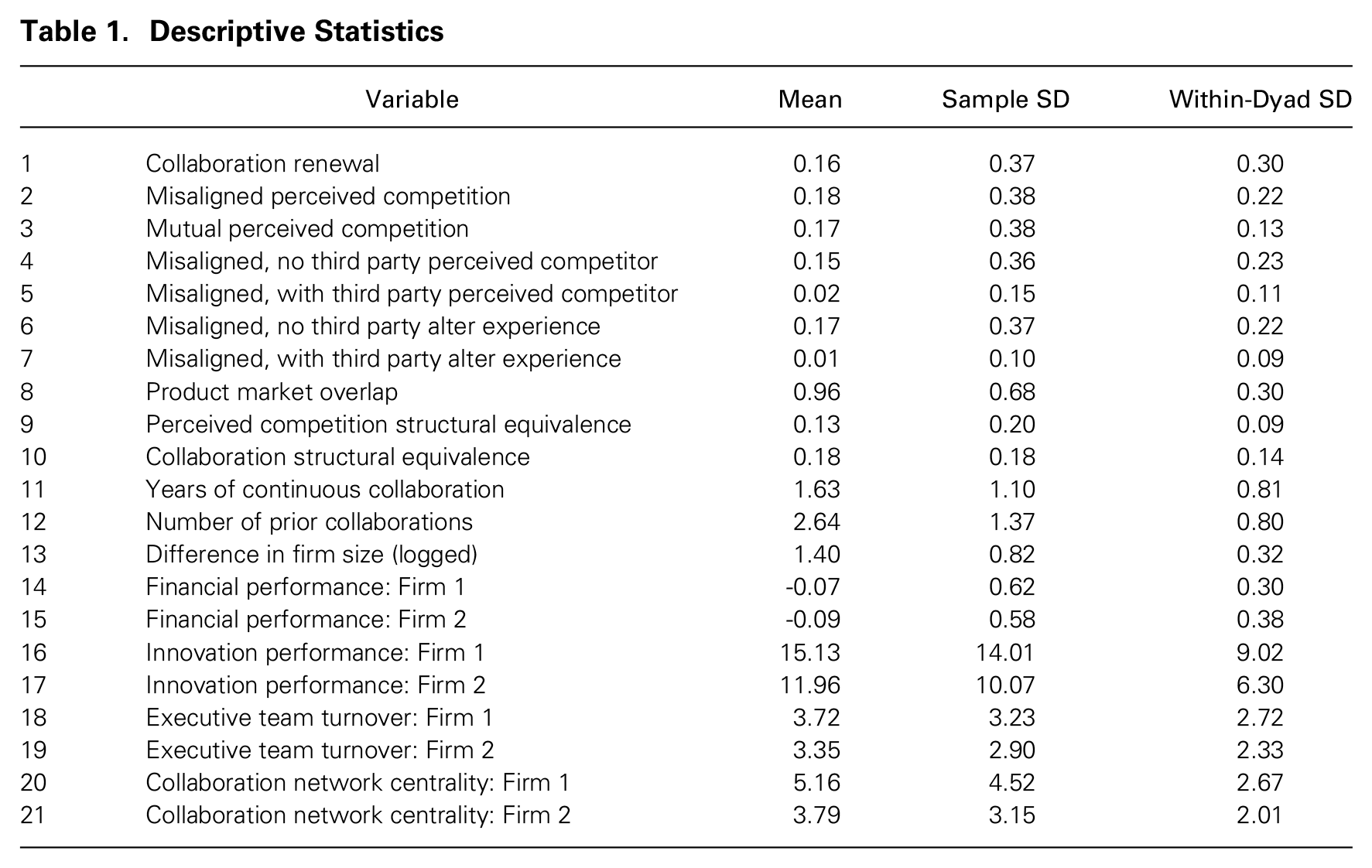
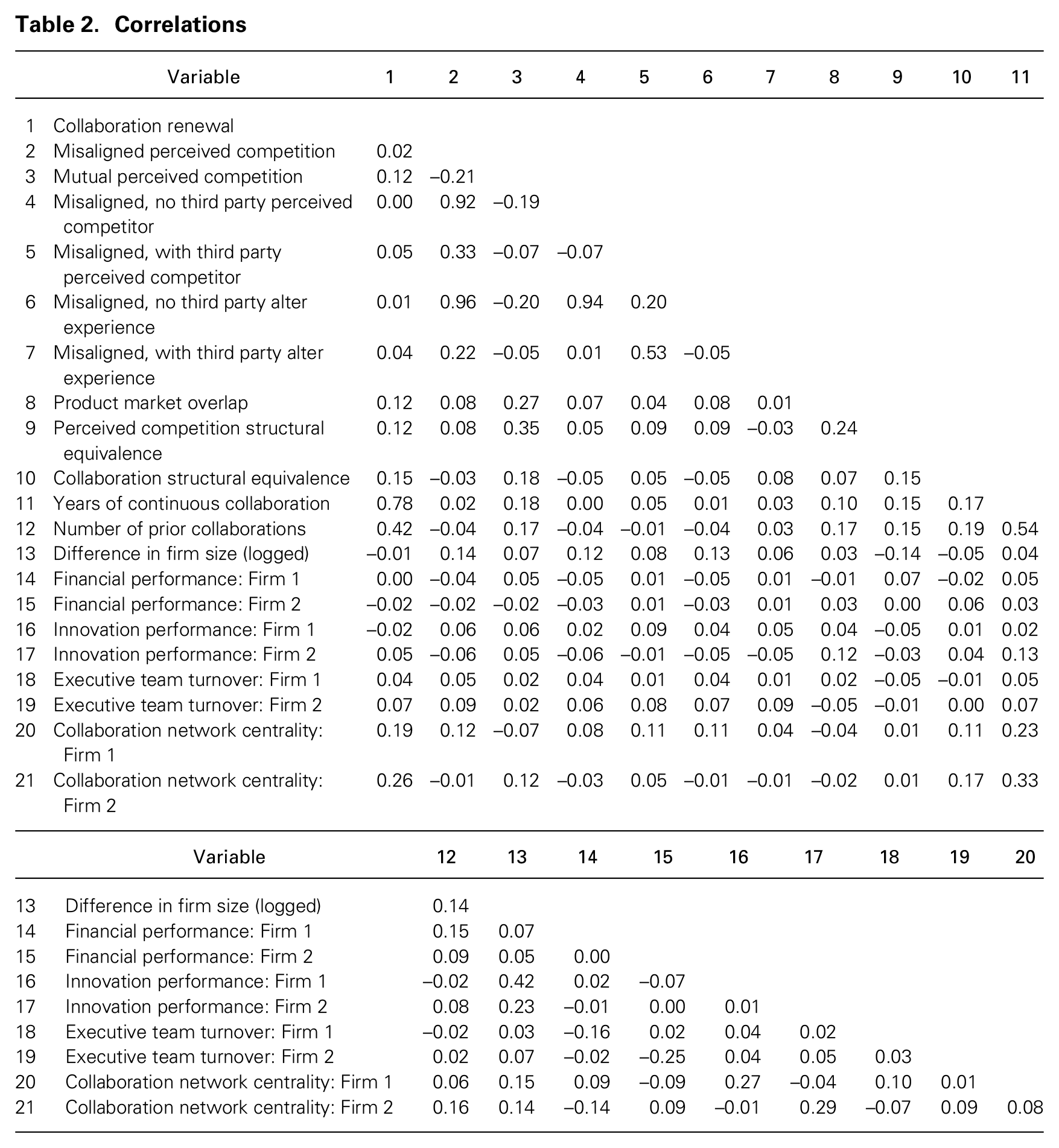
Tables 1 and 2 report descriptive statistics and correlations, respectively. The average rate of yearly collaboration renewal is 16 percent. Eighteen percent of dyad-year observations feature misaligned perceived competition, 17 percent feature mutual perceived competition, and the remaining 65 percent of dyads feature the base case of no perceived competition. Forty-eight percent of dyads change alignment at least once in the study time frame. 14 When splitting the misaligned competition variable based on embeddedness (H2 and H3), we find 3 percent of dyads with misaligned perceived competition in which ego perceives a third party in the collaboration as a competitor (H2) and 2 percent with misaligned perceived competition in which the third party was previously in the role of ego in a misaligned collaboration with alter. Variance inflation factors (VIFs) for independent variables, including the hypothesized variables, were less than the conventional cutoff value of 10, except difference in firm size (VIF of 10.52). The results are robust to dropping that variable.
Descriptive Statistics
Correlations
Regression Analysis
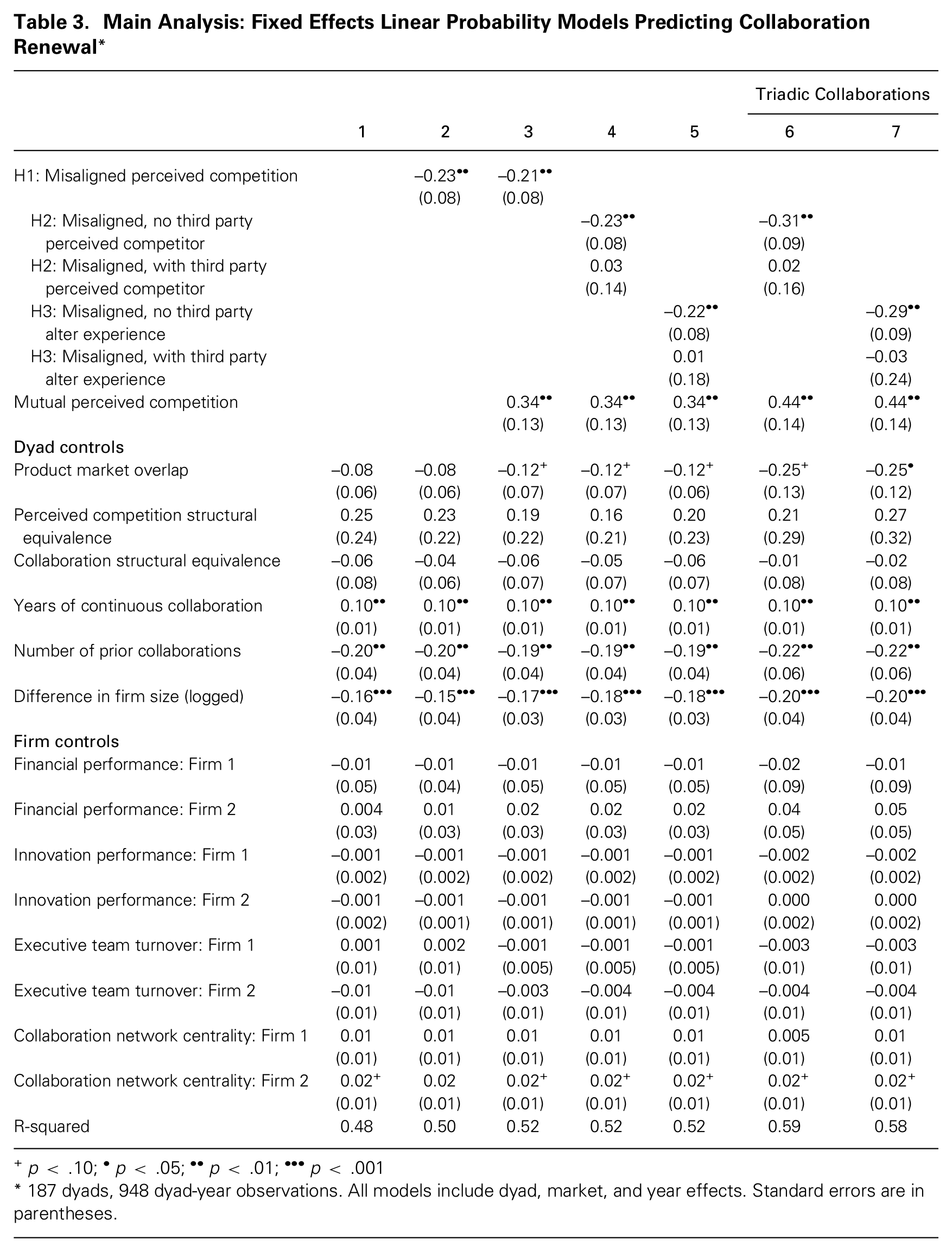
Tables 3 and 4 report fixed effects and random effects linear probability models, respectively. Model 1 reports results for control variables, though we advise caution in interpreting the coefficients (Hünermund and Louw, 2023). 15 We tested the hypothesized relationship between misaligned perceived competition and collaboration renewal (H1) in Model 2. Misaligned perceived competition has a negative and significant relationship with collaboration renewal, supporting H1. Note that when we include only a measure for misaligned perception, the comparison case is all aligned dyads (i.e., cases of mutual competition and no perceived competition). Model 3 allowed us to differentiate the two cases of alignment by adding a variable for mutual perceived competition, so that no perceived competition is now the baseline case. The negative effect of misaligned perception on renewal remains when compared against two counterfactuals (i.e., two forms of alignment).
Main Analysis: Fixed Effects Linear Probability Models Predicting Collaboration Renewal*
p < .10; •p < .05; ••p < .01; •••p < .001
187 dyads, 948 dyad-year observations. All models include dyad, market, and year effects. Standard errors are in parentheses.
While we did not theorize about the difference between mutual perceived competition and no perceived competition, it is notable that the coefficient on the former is positive and significant, suggesting that collaboration renewal is most likely when firms perceive each other as competitors. We return to this finding in the discussion.
H2 suggests that the negative effect of misaligned perceived competition on renewal is attenuated when there is a third party in the collaboration that is perceived as a competitor by ego (who does not perceive alter as a competitor). Model 4 adds misaligned perceived competition with a third party perceived competitor and misaligned perceived competition without a third party perceived competitor run on the full sample (including dyads that are not part of triadic collaborations), while Model 6 runs the same specification on only dyads in triadic collaborations. Only the coefficient on misaligned competition without a third party perceived competitor remains negative and significant, supporting H2.
H3 suggests that the negative effect of misaligned perceived competition on collaboration renewal is attenuated when there is a third party in the collaboration that has prior misaligned collaboration experience with alter, in which it did not perceive alter as a competitor. Model 5 adds variables for misaligned perceived competition with third party alter experience and misaligned perceived competition without third party alter experience when run on the full sample (including dyads that are not part of triadic collaborations). Model 7 runs the same specification on only dyads in triadic collaborations. Only the coefficient on misaligned competition without third party alter experience remains negative and significant, supporting H3.
To gauge the real-world significance of our results, we examined effect sizes and compared them to earlier findings (Shaver, 2008). Across fixed effects models, misaligned perception (or, when testing H2 and H3, misaligned perception without a mitigating third party) reduces the likelihood of renewal by 21–23 percentage points, relative to a sample 37-percentage-point standard deviation in the dependent variable and 30-percentage-point within-dyad standard deviation. Within dyads, misaligned perception thus reduces the likelihood of tie renewal by approximately 59 percent of the sample standard deviation and approximately 70 percent of the within-dyad standard deviation, an economically significant effect comparable to that of losing an executive (Rogan, 2014) or using a direct competitor as a supplier (Clough and Piezunka, 2020). Mutual perceived competition increases the likelihood of renewal by 34 percentage points within dyads, roughly equivalent to a one-standard-deviation (sample and within-dyad) increase in the dependent variable.
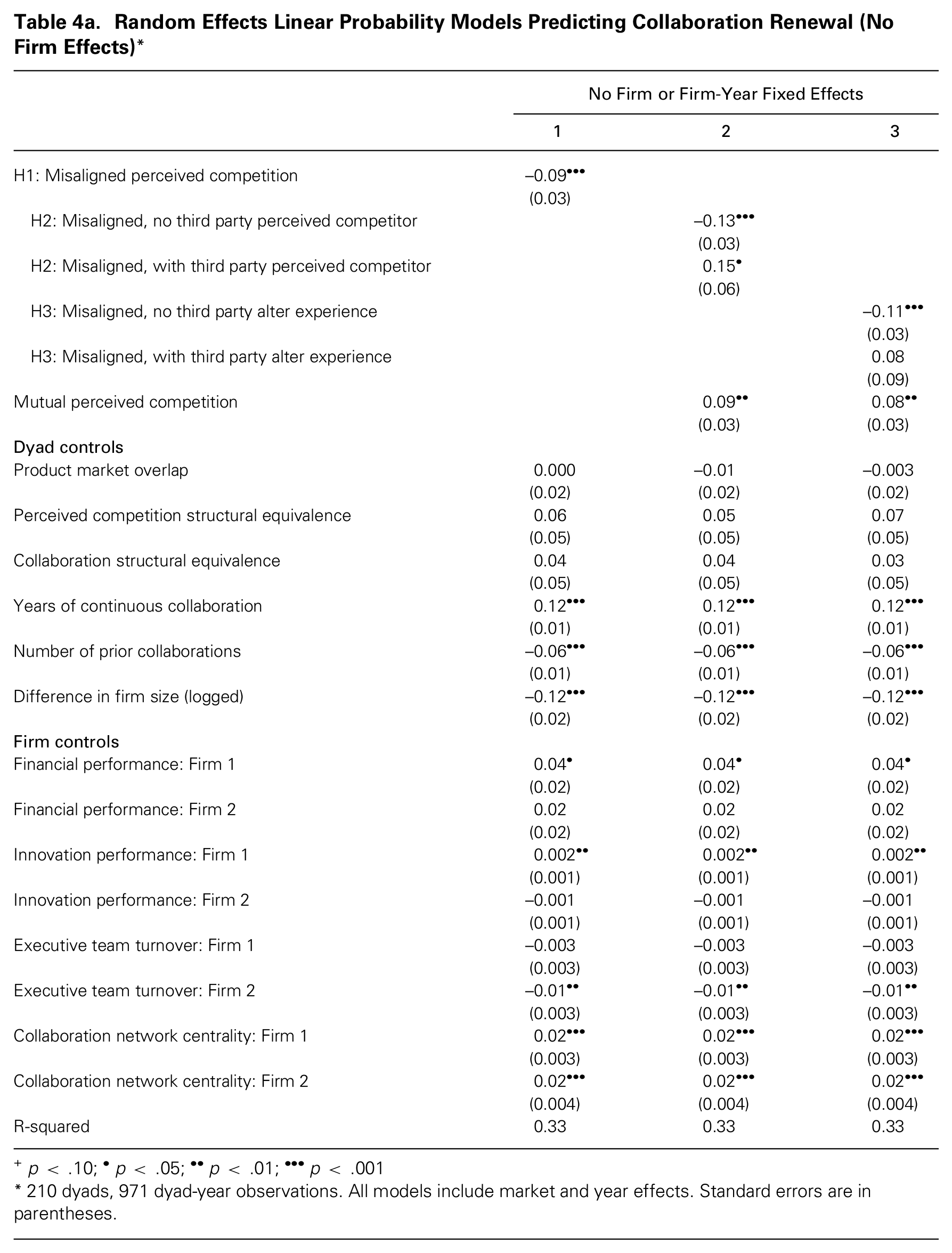
Effect sizes are reduced but still substantial in random effects models that allow for both within- and between-dyad variation (see Tables 4a and 4b). In the random effects models, misaligned perception reduces the likelihood of renewal by 9–10 percentage points, while mutual perceived competition increases it by 8–14 percentage points. While smaller in magnitude, these effect sizes are still meaningful and comparable to prior research (e.g., a one-standard-deviation drop in collaboration performance has been illustrated to increase the likelihood of tie dissolution by 10 percent; Clough and Piezunka, 2020). 16 We also link misaligned perception and collaboration renewal to litigation and product releases via mechanism tests described below, further indicating the practical impact of misaligned perception.
Random Effects Linear Probability Models Predicting Collaboration Renewal (No Firm Effects)*
p < .10; •p < .05; •• p < .01; •••p < .001
210 dyads, 971 dyad-year observations. All models include market and year effects. Standard errors are in parentheses.
Random Effects Linear Probability Models Predicting Collaboration Renewal (With Firm and Firm-Year Effects)*
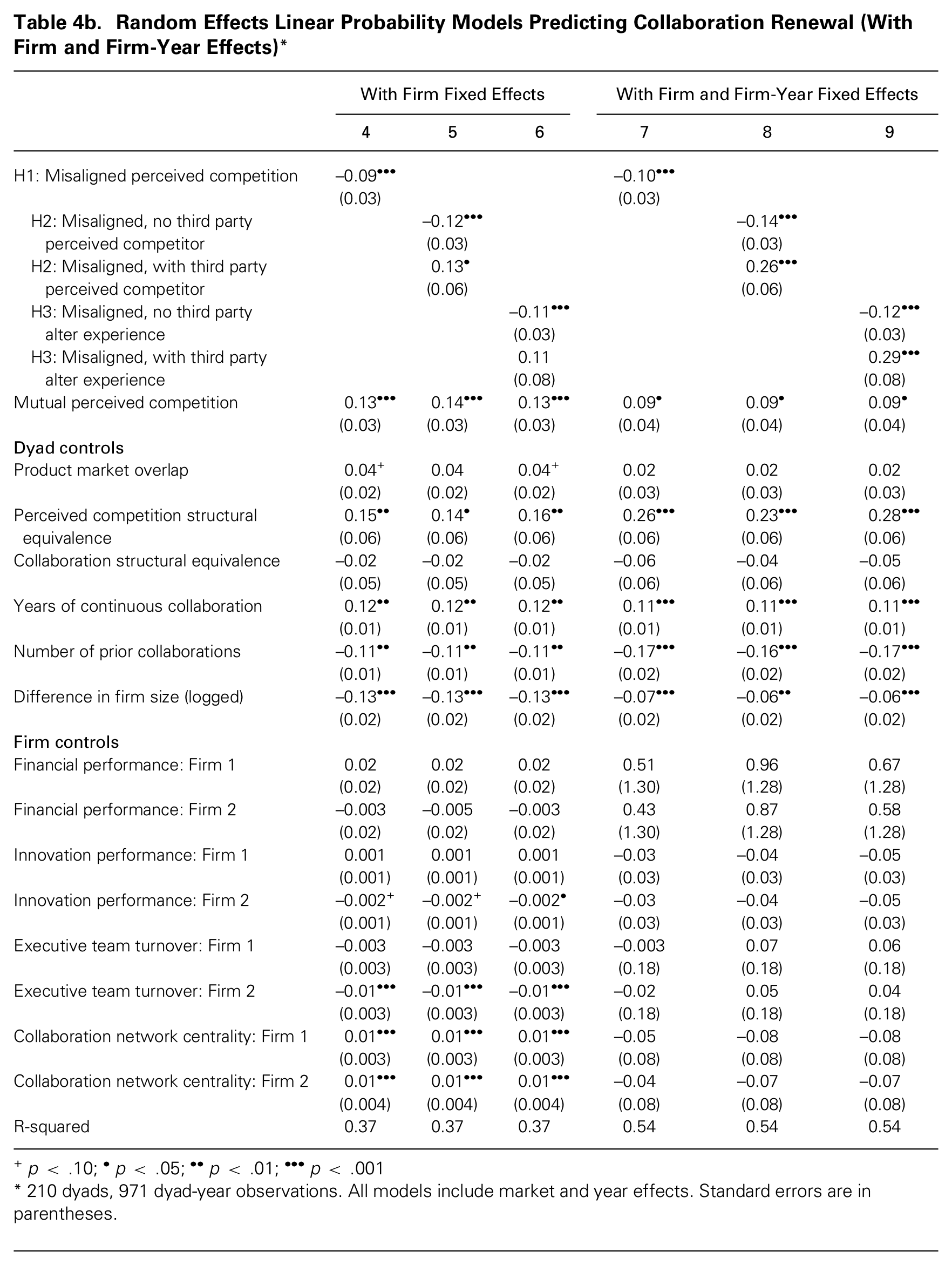
p < .10; •p < .05; ••p < .01; •••p < .001
210 dyads, 971 dyad-year observations. All models include market and year effects. Standard errors are in parentheses.
Mechanism Tests
To test the theorized mechanism that the negative relationship between misaligned perception and collaboration renewal is driven by failure to meet expectations in terms of collaboration performance and partner behavior, we ran a mediation analysis.
Failure to meet expectations: Collaboration performance
We tested whether collaborations meet expectations for performance (Li and Rowley, 2002; Clough and Piezunka, 2020). In software, R&D collaborations are often used to jointly develop products. We collected data on the number of Jointly announced products (expected collaboration performance) and Actually released products (actual collaboration performance) and compared them to quantify whether the collaboration met expectations (Ren et al., 2022).
We gathered data on jointly announced products via a manual inspection of press releases related to the collaboration announcement. We created a list of jointly announced products (if any) for each collaboration, noting the product’s name and version number. Out of 541 R&D collaborations in our data, 382 announced at least one future product (71 percent). We then compared the announced products to actual released products via product press releases gathered from LexisNexis and Factiva (Li et al., 2013; Thatchenkery and Katila, 2021). We measured Collaboration performance relative to expectations as the proportion of jointly announced products that were launched by the following year (given typical development cycles and the timing of product announcements versus launch in software). 17
Figure 4 depicts jointly announced and actually released products for the three alignment cases. Figure 4a shows that as theorized in H1, the expectation for collaboration performance (proxied here by number of jointly announced products) is substantially higher for no perceived competition than for mutual perceived competition. Figure 4b shows that when partners are perceptually aligned, that is, for no perceived competition and mutual perceived competition, expectations are likely to be met. For misaligned competition, expectations are just as high as they are for no perceived competition, but actual performance is substantially lower, as shown in the difference between Figures 4a and 4b (i.e., expectations are not met). This finding suggests that misaligned perception yields overly high expectations that are unlikely to be met, as theorized.
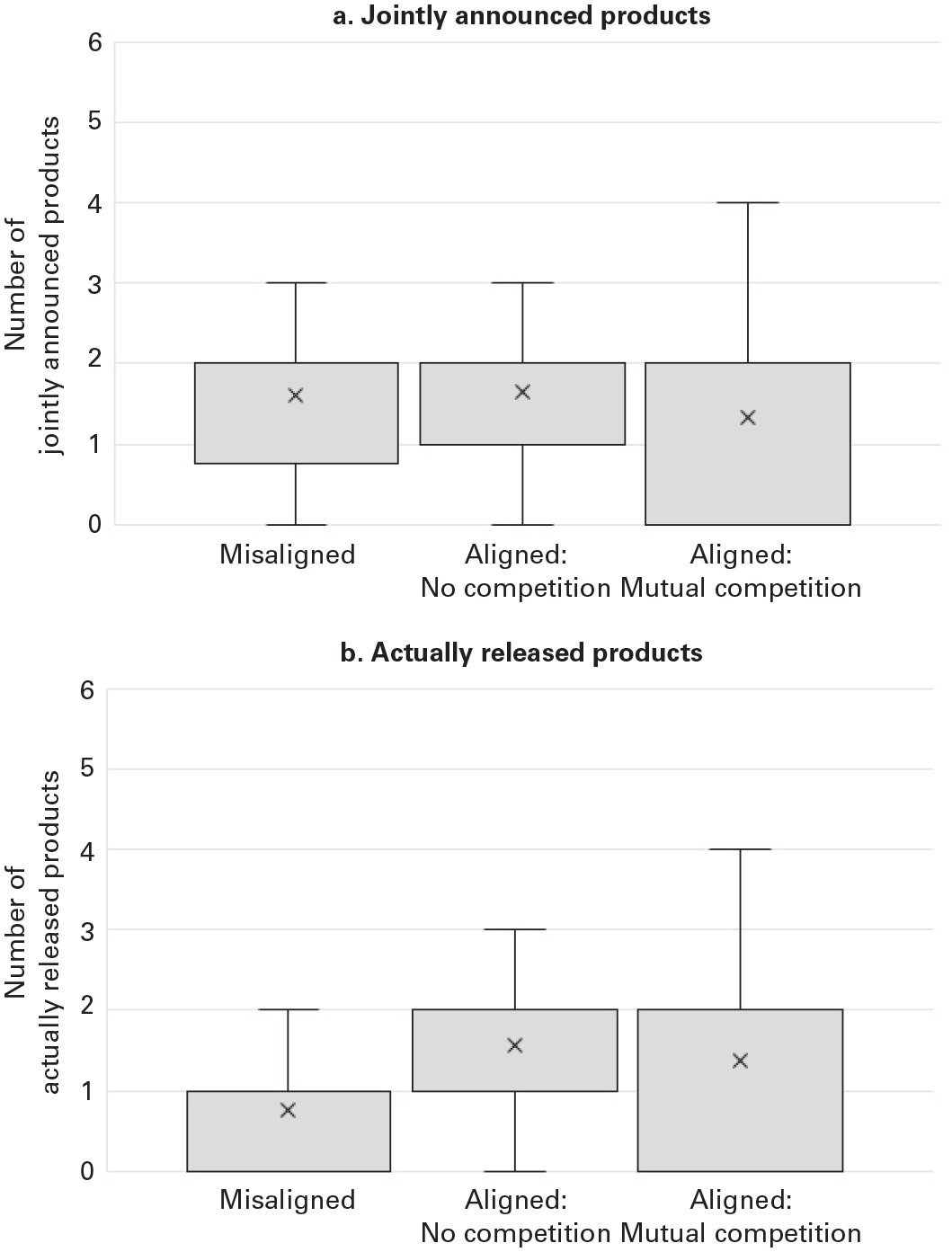
Jointly Announced Versus Actually Released Products Across Three Alignment Cases*
We ran mediation analysis to formally test the role of failing to meet performance expectations. We used the causal-steps procedure (Baron and Kenny, 1986; MacKinnon et al., 2002; Aguinis, Edwards, and Bradley, 2017), first regressing the potential mediator on the independent variable (misaligned perception), then regressing the dependent variable (collaboration renewal) on the potential mediator and the independent variable (misaligned perception). Some degree of mediation is indicated when, in the first step, the independent variable has a significant relationship with the mediator and, in the second step, the mediator variable has a significant relationship with the dependent variable, while the coefficient on the independent variable is less significant.
Since not every collaboration included an announced product, we ran the mediation analysis on the subset of collaborations that involved at least one jointly announced product (382 of 541). The results are reported in Table 5, Models 3 and 4. As hypothesized, misaligned perception reduces collaboration performance relative to expectations; specifically, it reduces by 50 percent the proportion of announced products that are actually released. 18 In the second step, collaboration performance relative to expectations has a positive impact on collaboration renewal, while the significance of misaligned perception is reduced but not eliminated, consistent with partial mediation. Using a product-of-coefficients approach (MacKinnon et al., 2002), 19 we found that collaboration performance relative to expectations mediates roughly 46 percent of the relationship between misaligned perception and collaboration renewal. This suggests that misaligned perception affects collaboration renewal above and beyond the impact of collaboration performance. 20 Subsetting the data to only triadic collaborations that involved announced products creates sample size challenges when we tested mechanisms for H2 and H3, particularly when we included dyad fixed effects; however, results are broadly consistent (using random effects models). 21 For robustness, and to confirm the statistical significance of the indirect effect, we also ran structural equation models (Iacobucci, Saldanha, and Deng, 2007). The results are highly consistent and indicate that the indirect effect is significant (p < .001); see Online Appendix 3.1 and Figure A2.
Mediation Analysis: Collaboration Performance*
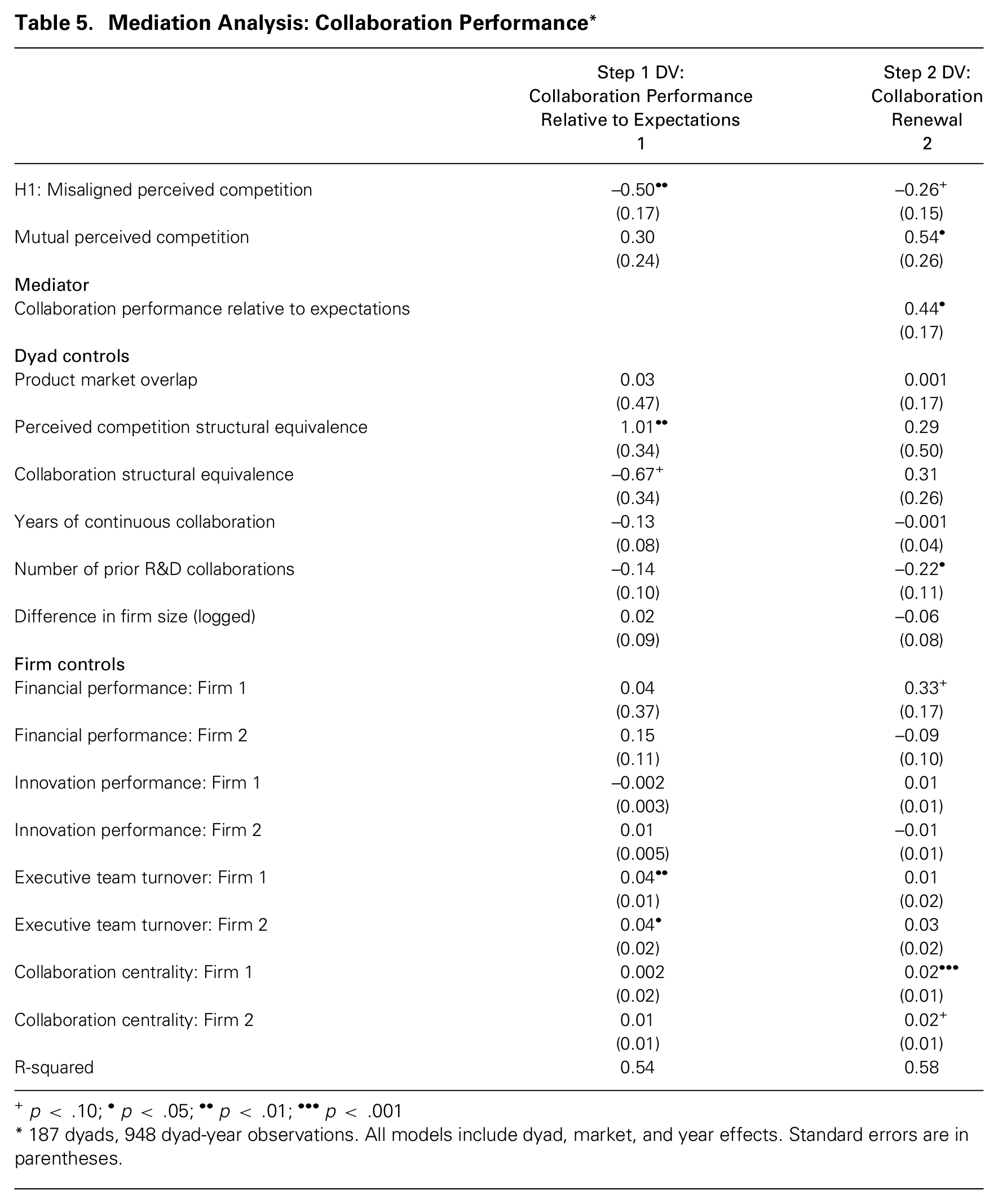
p < .10; •p < .05; ••p < .01; •••p < .001
187 dyads, 948 dyad-year observations. All models include dyad, market, and year effects. Standard errors are in parentheses.
Failure to meet expectations: Partner behavior
We proxied for a partner’s failure to meet behavior expectations via Litigation (Agarwal, Ganco, and Ziedonis, 2009; Malhotra and Lumineau, 2011; Tan, 2016; Ganco, Miller, and Toh, 2020; Sytch and Kim, 2020). Behavior far outside the boundaries of one partner’s expectations in a negative way—especially if related to resource misappropriation—may prompt a lawsuit. Note that lawsuits are infrequent in our setting, with 43 cases filed between firms that had collaborated during our study time period, 35 of which were filed between partner firms within two years of an announced collaboration. Descriptive analysis of the litigation data uncovers patterns consistent with our theory (e.g., more-frequent litigation of trade secrets among misaligned than among aligned partners), as described in more detail in Online Appendix 3.2.
We formally tested for mediation by using both the causal-steps procedure and structural equation models (see Online Appendix 3.2, Table A6, and Figure A3). The results indicate that consistent with our theory, misalignment increases the likelihood of litigation between collaboration partners. Litigation does not, however, mediate the relationship between misalignment and collaboration renewal. This may be due to litigation being an extreme measure of disappointment in partner behavior—one could imagine that most instances of disappointment do not merit the high expenses of corporate litigation—and thus infrequent in our data.
Robustness Checks
Statistical robustness
We validated the statistical robustness of our results in several ways, described in more detail in the appendix. We examined sensitivity to control variables via a specification-check analysis and by testing alternate controls; see Online Appendix 2.1, Figure A1, and Table A3 (Simonsohn, Simmons, and Nelson, 2020; King, Goldfarb, and Simcoe, 2021). We tested a logit regression model, with consistent results; see Online Appendix Table A4, Models 4–9. To examine whether selection bias might influence our results (Casciaro and Piskorski, 2005; Fleming, Mingo, and Chen, 2007), we used a two-stage Heckman (1979) model to control for the likelihood of collaborating in the first place, with consistent results; see Online Appendix 2.2 and Table A4, Models 1–3. Finally, we ran stochastic actor-oriented models to account for endogeneity in tie formation and continuation; see Online Appendix 2.4 and Table A5 (Snijders, van de Bunt, and Steglich, 2010; Withers, Howard, and Tihanyi, 2020).
Timing of competitive perception
Our main analysis uses competitive perception in year t–1 to predict repeated collaboration in year t. We ran a robustness check by freezing competitive perceptions for all hypothesized variables at the start of the most recent collaboration. This is an important test of our mechanism, since perceptions may change over the course of an ongoing collaboration, while expectations are likely set at the very beginning, before firms start actually working together. Freezing perception at the start of an ongoing collaboration corrects for this potential timing problem. The results are reported in Online Appendix Table A1, Models 4–6, and are consistent with our main analysis.
Objective competitive tension
In addition to controlling for product market overlap as a standard measure of objective competitive tension, we ran a robustness check in which we restricted the estimation sample to only dyads that overlap in at least one product market. This ensures a baseline level of competitive tension and reduces the likelihood that, for example, undisclosed planned market entry could be driving differences in perception. The results, reported in Online Appendix Table A1, Models 7–9, are consistent with those of our main analysis.
Qualitative Evidence and Post-Hoc Analyses
We ran several post-hoc analyses to gain a fuller picture of how (mis)alignment impacts collaboration renewal and other potential outcomes of interest.
Qualitative evidence
Our interviews with 26 informants—executives and other stakeholders in the enterprise software industry—support the notion that misaligned perceived competition can inhibit collaboration formation and renewal. One venture capitalist told of two portfolio firms he hoped would collaborate. They were developing similar core technology but applying it to different markets, so he foresaw no competition between them. One firm agreed and was happy to partner; the other insisted that the shared technology created competition, no matter how different their planned applications were, and consequently approached the potential collaboration in a guarded, almost hostile manner. The two potential partners could not come to a satisfactory agreement about how a collaboration should function, and they decided not to work together.
While misalignment is sometimes apparent at the tie-formation stage, collaborations with misaligned perceptions do often go ahead, as indicated by their existence in our quantitative data. A former CEO told us that situations in which only one partner perceived a competitive relationship were “very confusing” and that their firm typically “would walk away from”—that is, terminate—such partnerships. The description of misaligned collaborations as “confusing” suggests that the misalignment was not apparent ex ante and revealed itself via surprising or disappointing behavior only after the collaboration had begun.
Learning from misalignment
Our examination of mechanisms—expectations for partner behavior and for collaboration performance—has illustrated that the (mis)alignment of perception affects other outcomes beyond collaboration renewal, product releases, and litigation. We therefore examined another outcome: learning. In two separate analyses, we examined whether firms that experience perceptual misalignment (1) update their perception of their partner and (2) become less likely to enter other perceptually misaligned collaborations.
First, we examined whether firms that collaborate are more likely to become aligned. While prior research has not examined perception, it has found that collaboration can alter the intensity of competitive attacks between firms (Gnyawali, He, and Madhavan, 2006; Yu et al., 2022); further, repeated collaborations enable partners to learn about each other over time (Ring and Van de Ven, 1994). We created a measure for Change to perceptual alignment, equal to 1 if a dyad that was aligned in year t was misaligned in year t–1. We ran a fixed effects linear probability model regressing change to alignment on (1) a dummy variable indicating the dyad collaborated in year t–1 and (2) the dyad’s cumulative number of collaborations up to year t–1. The dummy variable for a single collaboration is not significant, but cumulative collaboration experience does have a positive and significant relationship with change to alignment (β = .13, p < .05, 95% CI [.03, .22]). With each additional R&D collaboration, a misaligned dyad is approximately 13 percent more likely to become aligned the next year.
Second, and in line with the qualitative evidence cited above, we examined whether firms with negative experiences of perceptually misaligned collaborations become more careful to avoid such collaborations in the future. Firms do learn about various aspects of collaboration (Mayer and Argyres, 2004; Howard et al., 2016) and may therefore become better at ensuring aligned perception when collaborating. We measured Entry into misaligned collaboration as a binary variable set to 1 if two firms formed a collaboration with misaligned perception and Prior misaligned non-renewal for each firm as a count of prior misaligned collaborations that were not renewed. Using fixed effects linear probability models, we found that misaligned nonrenewals for each firm have a negative (β1 = −0.01, β2 = −0.03) and significant (p < .05) relationship with entry into a new misaligned collaboration, indicating that firms become better at avoiding perceptually misaligned collaborations over time.
Relative network positioning and experience
We examined whether the negative impact of misalignment might be attenuated via mechanisms established in prior work, such as social defenses or collaboration experience. We found that the negative relationship between misalignment and renewal is attenuated when ego is more central in the collaboration network, has a more cohesive local collaboration network, and has more collaboration experience compared to alter; see Online Appendix 4.2 and Table A8.
Collaboration formation
Misaligned perception could also yield unexpectedly hostile behavior from partners in the collaboration formation stage. We ran analyses predicting collaboration formation and found that misaligned dyads are less likely to collaborate in the first place; see Online Appendix 4.1 and Table A7, Models 6–7.
Perception of the third party
In line with our theorized mechanisms, H2 focused only on ego’s perception of the third party in the collaboration. We tested different constellations (combinations) of perception across the triad and found that, as expected, only ego’s perception of the third party influences collaboration renewal; see Online Appendix 4.3 and Table A9.
Discussion
Building on the insight that competitive tension is (in part) perceptual, we examined how partners’ perceptual alignment relates to collaboration renewal. We found that renewal is less likely when firms are perceptually misaligned (H1) and that the perception of third parties can mitigate that relationship (H2 and H3). Using litigation and announced versus actual product releases to examine mechanisms, we found that perceptually misaligned partnerships tend not to meet expectations.
Interorganizational Collaboration
We contribute to research on the dynamics of interorganizational collaboration (e.g., Beckman, Haunschild, and Phillips, 2004; Ahuja, Soda, and Zaheer, 2012; Rider, 2012; Hubbard et al., 2018) and on their performance (e.g., Kale, Dyer, and Singh, 2002; Aggarwal, Siggelkow, and Singh, 2011; Baum, McEvily, and Rowley, 2012).
Our main contribution highlights the concept of perceptual alignment and its effect on interorganizational collaboration. Research on the antecedents of successful and renewed collaboration typically emphasizes firm-level factors such as quality and capability (Dyer and Hatch, 2006; Zhelyazkov and Tatarynowicz, 2021; Balachandran and Eklund, 2024) or dyad-level factors such as resource complementarity and strategic fit (Rowley et al., 2005; Greve et al., 2010) and the social structure surrounding the collaboration (Powell et al., 2005; Zhelyazkov and Gulati, 2016; Hernandez and Shaver, 2019). Our findings on perceptual alignment point to a thus-far neglected factor and strengthen the body of research on the role of expectations and perceptions in interorganizational relationships (Brands and Fernandez-Mateo, 2017; Clough and Piezunka, 2020; Weber and Coff, 2024).
Our study underscores the need for partners to have aligned expectations for their collaboration (Gibbons and Henderson, 2012; Weber and Mayer, 2014; Vasudeva, Leiponen, and Jones, 2020) and shows an important antecedent: aligned perceptions. The wide spectrum of partnership types (e.g., embedded vs. transactional) (Granovetter, 1985; Powell, 1990; Ingram and Roberts, 2000; Gnyawali, He, and Madhavan, 2006) creates the risk of partners being misaligned about what type to expect. Our study points to a key source of misalignment: Partners may differ in whether they perceive each other as competitors. By studying perceptions of competitive relationships rather than assuming that competitive tension derives symmetrically from market overlap, we answer the call by Lumineau and Oliveira (2018: 440) to examine how firms may be subject to “major blind spots” when assessing partners and to remove the assumption of “symmetry between parties or of the focal party’s perception.”
Our theory (and data) on the link between perceptions and expectations also contributes to research at the intersection of the behavioral theory of the firm and collaboration (Baum et al., 2005; Sorenson and Waguespack, 2006; Clough and Piezunka, 2020). Research has examined how firms form expectations regarding their own performance and how they respond if such expectations are not met (Gaba and Joseph, 2013; Audia and Greve, 2021; Keil, Posen, and Workiewicz, 2023). We complement this work by examining the origin of a firm’s expectations for collaboration, how these are anchored in perceptions of the partner, as well as when and why they are likely (not) to be met.
Our study raises the question of whether a firm might intentionally seek perceptual misalignment so that it can exploit a partner that is too open and trusting. This strategy may be fruitful if the short-term benefits of exploiting a perceptually misaligned collaboration exceed the costs of a nonrenewed collaboration. Beyond providing an agentic interpretation of the phenomenon we study (Tasselli and Kilduff, 2021; Lee and Gargiulo, 2022), this strategy raises a broader theoretical question: To what degree do firms exploit cognitive network structures? While a rich body of research has illustrated how actors navigate social structure (with agency) (Burt, 2005; Obstfeld, 2005; Kumar and Zaheer, 2022), there has been less research on cognitive social structures. It is possible that actors may exploit the misperception of others or may themselves be more exploitable due to misperception (Weber and Coff, 2024).
Competitive tension in collaborations
Competitive tension is frequent in collaborations (Khanna, Gulati, and Nohria, 1998; Baum, Calabrese, and Silverman, 2000; Hallen, Katila, and Rosenberger, 2014; Piezunka and Grohsjean, 2023). We inform this literature by linking it to the literature on perception, specifically perception of competitors (Porac et al., 1995; Tsai, Su, and Chen, 2011). Our study helps to resolve the puzzle of why competitive tension derails so many collaborations given that collaborations between competitors have been shown to be feasible (Hoetker and Mellewigt, 2009; Asgari et al., 2018). We show that the problem is not necessarily the presence of competitive tension—partners who perceive each other as competitors prove the most likely to renew their collaboration—but, rather, having misaligned perceptions of each other, with the resulting differences in expectations.
Our study highlights an interesting feature of competitive tension in collaboration, which is that collaborations with mutual perceived competition are more likely than those with no perceived competition to meet expectations and be renewed. A possible behavioral explanation for this finding is that if both partners perceive each other as competitors, they have comparatively low expectations for each other’s behavior and for the collaboration’s performance and are therefore less likely to be disappointed. In contrast, if they do not see each other as competitors, they may have high expectations, which are hard to meet and often the precursor to disappointment (Harrison and March, 1984). Our analysis of product releases supports this explanation, as collaborations with mutual perceived competition have the lowest number of announced products and are the most likely to announce no future products, indicating lower expectations relative to collaborations with no perceived competition.
Our study also suggests that firms do not act strategically regarding their collaboration, as they do not consider their prospective partners’ perspective and consequently fail to govern the collaboration appropriately. Despite the information on perceived competition being readily available, firms apparently fail to examine how their partners perceive them even though those perceptions have substantial implications for their collaboration. Indeed, interviews with industry informants indicated that reviews of the qualitative portions of the 10-K (sections other than the financial statements) were typically not part of their due diligence. This result is in line with research showing that firms often do not use a consistent process or function for alliance formation (Kale, Dyer, and Singh, 2002) and often fail to pay sufficient attention to competitor information (Kim, 2024). The lack of attention to partners’ perception is likely to result in fundamentally misguided management of the collaboration, such as lack of appropriate safeguards (Poppo and Zenger, 2002; Weber and Mayer, 2014). Thus, while we cannot measure due diligence or contractual safeguards directly, the results we observe indicate that firms may benefit from more thorough perceptual due diligence.
Social structure
We contribute to research on how the surrounding social structure, particularly in multilateral collaborations, affects a dyad’s evolution (e.g., Gargiulo, 1993; Vanneste and Gulati, 2022; Park, Nault, and Kuwabara, 2024; Durand, Piezunka, and Reinecke, 2025). Past research has focused on the role of balance theory, social sanctions, power, and the flow of information about partner quality (Gulati and Gargiulo, 1999; Gimeno, 2004; Rogan and Sorenson, 2014; Sytch and Tatarynowicz, 2014). Our study suggests a thus-far unexplored mechanism for how social structure may affect a dyad: The inclusion of a third party may result in adjusted expectations for and management of the collaboration that protects firms. We show (H2) that a misaligned dyad benefits from being embedded in a triadic collaboration in which ego sees the third party as a competitor, because the inclusion of that third party causes ego to lower its (possibly unrealistic) expectations of alter and increases the likelihood that it has its guard up. H3 indicates that ego may also learn from a third party that has had relevant experience with alter. In both cases, bad behavior is not necessarily deterred, as in previous studies (Polidoro, Ahuja, and Mitchell, 2011; Hallen, Katila, and Rosenberger, 2014; Pahnke et al., 2015); rather, the partner most at risk knows to look out for such behavior and to expect less from the collaboration overall.
Our study has interesting implications for trust in multilateral collaborations. An increase in the number of partners may increase the likelihood that at least one will consider another a competitor. Thus, the mechanism uncovered in H2, in which firms that perceive one competitor in a multilateral collaboration become more guarded about all the collaborators, suggests that an increase in the number of partners reduces the chance for an open and highly trusting multilateral collaboration. While the relationship between number of collaboration partners and trust among them has not been examined directly, there is some experimental evidence that cooperation is deeper in bilateral than in multilateral collaborations (Solinas et al., 2022) and that harmful “faultlines” can emerge in larger collaborations (Heidl, Steensma, and Phelps, 2014: 1351). This suggests that firms seeking greater openness in multilateral collaborations should be cautious about adding new members (Zhang and Guler, 2020) and attend to changes in how partners interact with each other over time (Davis and Eisenhardt, 2011; Davis, 2016).
Perception in Networks
We contribute to research on network perception by shifting emphasis from accuracy to alignment (Krackhardt, 1987; Porac et al., 1995; Casciaro, 1998; Brands, 2013). Research has found that individuals benefit when they accurately perceive the network around them (Krackhardt, 1990; Brands, 2013) and that firms benefit when they accurately identify industry competitors (Baum and Lant, 2003; Tsai, Su, and Chen, 2011). We complement this research by highlighting the importance of alignment: Interorganizational collaborations are more likely to be renewed when partners are aligned in whether they perceive each other as competitors, even when we control for objective competitive tension via market overlap.
We extend research on perceptions of competition by examining how perception shapes the renewal of interorganizational collaboration. We specifically raise the issue of perceptual misalignment and the fact that firms may not recognize their misalignment. Research on perceptions of competition has documented drivers of asymmetry (i.e., misalignment) (Porac et al., 1995; Kilduff, Elfenbein, and Staw, 2010; Kilduff, 2019) but has said little about its consequences. We show that misaligned perception shapes expectations in interorganizational relationships and, thus, their chances of renewal. Our study suggests that, in addition to accounting for objective asymmetries in competitive tension, such as differences in how important a shared market is to each firm (Chen, Su, and Tsai, 2007), future research on interorganizational relationships should consider differences in how firms perceive each other. We also extend an emerging line of research on the consequences of competitive perceptions for individual firms (Tsai, Su, and Chen, 2011; Thatchenkery and Katila, 2021), by demonstrating relational consequences for dyads.
Our examination of perception in networks reveals how the effect of perception can be moderated by the surrounding social structure. Research has examined how actors perceive the structure of the overall network (Kilduff et al., 2008; Simpson, Markovsky, and Steketee, 2011; Brands, 2013) but has said less about the implications of perception within local network structures, such as triads. We show the importance of the perception of third parties: both how the focal firm perceives third parties (H2) and how it can learn from the past perception of a third party (H3). A key insight here is that mistakes in perception (i.e., misalignment) can be corrected by specific constellations of third party perception, a finding in line with classic network theory on how triads can help stabilize dyads (Simmel, 1950).
More broadly, we contribute to research on perception’s role in strategy. Research at the intersection of managerial cognition and strategy suggests that managers’ perceptions and mental representations of their environment play a key role in strategic decision making, such as searching for new strategies (Gavetti and Levinthal, 2000; Gavetti and Rivkin, 2007; Csaszar and Levinthal, 2016) or responding to change (Nadkarni and Barr, 2008; Eggers and Kaplan, 2013; Helfat and Peteraf, 2015; Raffaelli, Glynn, and Tushman, 2019; Thatchenkery and Katila, 2023). We show how a firm’s perceptions of network ties can influence the ties’ stability and performance, thereby linking the literatures on managerial cognition and interorganizational networks.
Managerial implications
In line with calls for engaged organizational scholarship that considers practical implications for managers (Van de Ven, 2007), our study supports a few concrete suggestions. Managers should examine whether their firm and their partners are aligned in how they perceive each other; that is, they should conduct perceptual due diligence. Taking time to understand how a potential partner sees one’s own firm, including reviewing information readily available from 10-Ks, is likely to help establish longer and more fruitful collaborations, just as an alliance function (i.e., unit dedicated to managing collaborations) has been shown to yield collaboration performance benefits (Kale, Dyer, and Singh, 2002: 747). If managers find their firm and a potential collaborator to be misaligned, they may need to convince their own firm to change how it perceives the other or convince the other to change how it perceives them. When aligning toward no perceived competition is not possible, managers in misaligned collaborations can still benefit from aligning to mutual perceived competition, as our research indicates that doing so does not inhibit successful collaboration and, in fact, may help set more-achievable expectations.
Boundary conditions
Our theory suggests that how organizations perceive one another affects their expectations and behavior in a relationship. The influence of perception may, however, be limited in certain settings. For example, firms may manage collaborations in a consistent manner, independent of how they perceive a given partner. An example is collaborations that are coordinated via an impersonal standardized application interface (API) or blockchain (Lumineau, Wang, and Schilke, 2021). Misalignment may also be less consequential in settings, such as biotech, in which strict formal safeguards are standard protocol (Devarakonda and Reuer, 2018). Similarly, collaborations that require significant investment in partner-specific assets would likely involve detailed contracting (Dyer and Singh, 1998; Mayer and Argyres, 2004; Poppo, Zhou, and Zenger, 2008), making perceptual misalignment less consequential.
Another condition is that firms can have misaligned perceptions of each other in the first place. Misaligned perception is more likely in dynamic industries (e.g., with frequent entry and exit or with shifting market boundaries) or in moderately or highly fragmented industries. Stable, highly concentrated industries (e.g., defense) typically have only a few competitors in the market at all, making misalignment less likely.
Limitations
We treated competitive tension and being perceived as a competitor as interchangeable. Depending on the definition of these concepts one uses, there may be competitive tension between firms that do not perceive each other as outright competitors. Future research could investigate this difference by creating distinct measures of competition and competitive intensity. Related, we measured perceived competition as a binary variable, but competitive tension often exists on a spectrum. Future studies could capture additional nuance by measuring competitive tension as a continuous variable.
We used a firm-level measure of perception, which requires some anthropomorphization of the organization, as perception exists only in the minds of individuals within the organization. Furthermore, our firm-level measure of perception may mask differences between business units or between individual managers (Felin, Foss, and Ployhart, 2015). Future research could examine intraorganizational variance in perception and what that means for collaboration.
Our data allowed us to examine the overarching link and some of the suggested mechanisms; most notably, we proxied the failure to meet expectations in terms of partner behavior (litigation) and collaboration performance (announced versus actual product releases). One mechanism we suggest but cannot measure is that firms in misaligned collaboration mismanage the relationship. We cannot directly observe the behavior of firms in our dataset, as R&D collaborations are subject to considerable secrecy and software firms do not comment publicly on the inner workings of their collaborations. Ideally, we would gather data on deployed safeguards, but those data were not available in our setting. Studies of aligned perception in settings in which those data are more readily available, such as biotech (e.g., Hegde, 2014), may shed light on how partners manage collaboration in different alignment cases.
Finally, we used observational data without random assignment to each alignment condition, limiting our ability to directly support causal claims. Recent scholarship illustrates the need for better causal evidence in network research (Hasan and Koning, 2019, 2020; Maoret, Dufour, and Fonti, 2022; Hernandez, Lee, and Shaver, 2024). We acknowledge that misalignment could be correlated with another, less observable factor that affects the chance of renewal. For example, firms may differ in how seriously they take competition in the first place (Hsieh, Tsai, and Chen, 2015). Differences in competitive perception could also relate to other differences that interfere with collaboration; for example, firms may not align with each other’s perceptions if they are on different technological trajectories, which would also render renewed collaboration less likely. While this is of less concern in our study’s setting and time period, it could be a confounding factor in settings in which technological trajectories are more varied.
Future Research
We tested our theory on organization-level collaboration between firms in the same industry. We suggest that future research explore the implications of perceptual alignment in different situations. While we focused on horizontal collaborations between firms in the same industry, future research may explore perception in collaborations across a value chain (Chatterji, Cunningham, and Joseph, 2018), between complementors (Kapoor, 2014; Hannah and Eisenhardt, 2018; Zhu and Liu, 2018; Rietveld, Schilling, and Bellavitis, 2019; Adner and Lieberman, 2021), or between ventures and incumbents (Dushnitsky and Lenox, 2005). Future research may also examine the explanatory power of (mis)aligned perception in collaborations with other kinds of actors, such as innovation communities (O’Mahony and Bechky, 2008), NGOs and nonprofits (Cabral et al., 2019; Gatignon and Capron, 2023), social movements (Wang and Soule, 2012), and regulators (Gao and McDonald, 2022).
Future studies may also examine whether the developed theory holds for collaborations among individuals, thereby building on and complementing research at the intersection of cognition and social networks (Casciaro, 1998; Srivastava and Banaji, 2011; Carnabuci and Diószegi, 2015; Parkinson, Kleinbaum, and Wheatley, 2017; Kneeland and Kleinbaum, 2024). For example, do creatives on a project see each other as collaborators or competitors (Samila, Oettl, and Hasan, 2022)? Do athletes on the same team also compete (Grohsjean, Piezunka, and Mickeler, 2025)? Future research could also explore organization-level consequences of alignment in individual-level ties, for example, of the CEO or founder (Westphal, 1999; Vissa, 2011).
Another domain for future research is the role of artificial intelligence (AI) in collaboration and competition. Access to AI affects strategy (Gaessler and Piezunka, 2023; Krakowski, Luger, and Raisch, 2023). While our research has focused on human misalignment, research may also explore the role of algorithmic misalignment. AI is effective in classification tasks (Miric, Jia, and Huang, 2023), but AIs may differ in which firms they perceive as competitors. Future research may examine situations in which AI competitor analysis algorithms differ between firms and the implications for collaborations and governance.
Our focus has been on (mis)aligned perception in terms of competition. Research may explore this perception along other dimensions, such as whether collaborators share a temporal focus (short-term vs. long-term) or agree on how important their partnership is relative to others in a collaboration portfolio (Lashley and Pollack, 2020). When forming a partnership, one firm may assume the other is a core strategic partner, while the other may consider the collaboration a low priority (Katila et al., 2022).
Conclusion
Our research highlights a fundamental question in interorganizational collaboration: How do partners see each other? We show that perceptual alignment offers explanatory power above and beyond established concepts such as collaboration performance, prior experience, and market overlap. Most important, the question of how partners see each other informs these concepts, as it helps to explain organizations’ expectations, their ways of interacting, and perhaps even their governance structures. Our hope is therefore not simply that perception receives greater research attention but that it becomes an integral part of research on collaboration. We also hope this study informs how managers themselves form and manage their firms’ collaborations so that misalignment is less likely to derail otherwise promising collaborations.
Supplemental Material
sj-pdf-1-asq-10.1177_00018392241299787 – Supplemental material for Competition in Collaboration: The Problem of (Mis)Aligned Perception
Supplemental material, sj-pdf-1-asq-10.1177_00018392241299787 for Competition in Collaboration: The Problem of (Mis)Aligned Perception by Sruthi Thatchenkery and Henning Piezunka in Administrative Science Quarterly
Footnotes
Acknowledgements
We thank our Administrative Science Quarterly editorial team, Adam Kleinbaum and three anonymous reviewers, for invaluable feedback and guidance. We are grateful for thoughtful comments from seminar audiences at Cambridge University, the Center for Advanced Study in the Behavioral Sciences at Stanford University, Harvard Business School, Imperial College London, Massachusetts Institute of Technology, New York University, Stanford University, University of Kentucky, University of Michigan, University of Maryland, University of Utah, University of Southern California, and the Wharton School at the University of Pennsylvania; conference audiences at the Academy of Management, Competitive Dynamics Conference, Global Innovation Entrepreneurship and Innovation Research Conference, INQUIRE Conference, Strategic Management Society, and the Sumatra Ghoshal Strategy Conference; and internal audiences at INSEAD and Vanderbilt. We are grateful for comments from Shaz Ansari, Martin Gargiulo, Robert Gibbons, and Walter W. Powell and thank Yanfu Fang, Philipp Reineke, and Rae Staben for research assistance.
1
Collaboration with other firms has been associated with various benefits—including information gain, resource access, status increase, and diffusion of risk (e.g., Rosenkopf and Almeida, 2003; Schilling and Phelps, 2007; Ozcan and Eisenhardt, 2009; Zhelyazkov and Tatarynowicz, 2021)—and is therefore associated with increased firm survival, innovation, and financial performance (e.g., Lavie, Kang, and Rosenkopf, 2011; Vasudeva, Zaheer, and Hernandez, 2013; Kapoor and McGrath, 2014).
2
Collaborating firms can deploy safeguards to reduce the chances of misappropriation by their partners (e.g., Zollo, Reuer, and Singh, 2002; Hernandez, Sanders, and Tuschke, 2015; Devarakonda and Reuer, 2018).
3
Organization-level research on network perception requires anthropomorphization of the organization to some degree, as perception exists in the minds of individuals within the organization. The firm-level perception we theorize about reflects the perception of the CEO and top management team.
4
From alter’s perspective, ego’s unexpected openness and the resulting opportunity to exploit a (perceived) competitor is likely viewed positively; thus, alter may prefer to continue the collaboration. However, dissolution of a relationship requires only one party, so ego’s dissatisfaction will be enough to end it.
5
Disruptive technological change in an industry could create abrupt shifts in competition and collaboration. We therefore selected 1995–2011, the period in which distributed (or networked) computing was the dominant technological paradigm in infrastructure software. Prior to the mid-1990s, the emphasis was on centralized mainframes, and in the early 2010s, firms began shifting to cloud computing.
6
Between 1995 and 2011, there were 1,206 public U.S. software firms. To focus on enterprise software, we excluded the 390 that developed products only for consumers. We then compared each firm’s product portfolio with Gartner Research’s IT Glossary, a standard industry source that provides a comprehensive list of infrastructure software product categories (Pontikes, 2012).
7
We relied primarily on the 2012 version of the Gartner IT glossary, but we cross-referenced against infrastructure software categories in older Gartner reports and found them to be consistent.
8
SDC Platinum is a database commonly used in collaboration research (Kumar and Zaheer, 2019). Factiva compiles announcements and press coverage from over 8,000 sources (Ranganathan, Ghosh, and Rosenkopf, 2018).
9
We focused on collaboration renewal of the focal dyad, even when testing H2 and H3 on triadic collaborations. If ego, alter, and a third party collaborated as a triad, we considered the focal dyad between ego and alter to be renewed if there was any collaboration between them in the following year (with or without the third party).
11
We computed collaboration network controls for structural equivalence and centrality before dropping collaborations with more than three partners, to better capture general collaboration network positioning. The results are consistent when we include only collaborations with two or three partners.
12
We alternatively controlled for performance–aspiration gaps. Firms that fail to meet historical aspirations may be more likely to dissolve the focal collaboration and to seek out other partners (Baum et al., 2005; Clough and Piezunka, 2020). We measured the gap as the difference between the firm’s current performance and a weighted average of social and historical performance (Clough and Piezunka, 2020). Social performance was defined as the mean return on sales (ROS) across industry peers (i.e., other infrastructure software firms), and historical aspiration was defined as the mean ROS of the focal firm in the prior three years. The results are consistent across both measures.
13
Some variables were used in matching but not included in the main regression results due to collinearity.
15
When controlling for dyad fixed effects (i.e., baseline propensity for two firms to collaborate), we find that collaboration renewal is less likely with greater discrepancy in firm size and greater product market overlap, while it is more likely when firms are more central in the collaboration network and are part of a longer ongoing collaboration. When not controlling for dyad effects, we also see a positive influence of firm performance and a negative influence of executive team turnover. The surprise among our control variables is the negative influence of number of prior collaborations on renewal. Given that we controlled separately for the length of the current collaboration (which has a positive effect), this effect appears to be driven by sporadic (i.e., on-and-off) collaborations.
16
We also followed guidance from  to examine whether the large coefficients on our alignment variables might indicate a Type I error due to multicollinearity. Based on those guidelines, multicollinearity is unlikely to be driving our results: The two variables with large coefficients (misaligned and mutual perceived competition) exhibit correlation below the recommended threshold, the variables are correlated negatively and the coefficients are also of opposite signs, and the correlations between each variable and the dependent variable are in the same direction as their regression coefficients.
17
There were no instances in which collaborating firms released products that were not previously announced. This underscores the validity of the measure, as software firms do, indeed, announce the products they plan to release later.
18
Firms in our setting jointly announced an average of two products per collaboration, so releasing just one less product would be a 50 percent decrease.
19
The product-of-coefficients approach calculates the indirect effect of an independent variable via a mediator by multiplying the coefficient on the independent variable in the first step by the coefficient on the mediator in the second step. The direct effect is the coefficient on the independent variable in the second step. The total effect is the sum of the direct and indirect effects. Here, the indirect effect is −0.22 and the total effect (indirect + direct effect) is −0.48, indicating that failure to meet performance expectations accounts for 46 percent (= −.22/−.48) of the relationship between misaligned perception and renewal.
20
The results must be interpreted with caution because collaborations with versus without publicly announced product releases may differ in unobservable ways. For example, partners may be more likely to announce a future product release when they are more confident in the collaboration.
21
For H2, misaligned perception without a third party perceived competitor decreases the proportion of announced products that release (β = –.23, p < .05), while misaligned perception with a third party perceived competitor is not significantly related to the proportion of announced products that release (β = –.20, p = .28). For H3, misaligned perception without third party alter experience decreases product releases (β = –.21, p < .05), while misaligned perception with third party alter experience does not (β = –.27, p = .21).